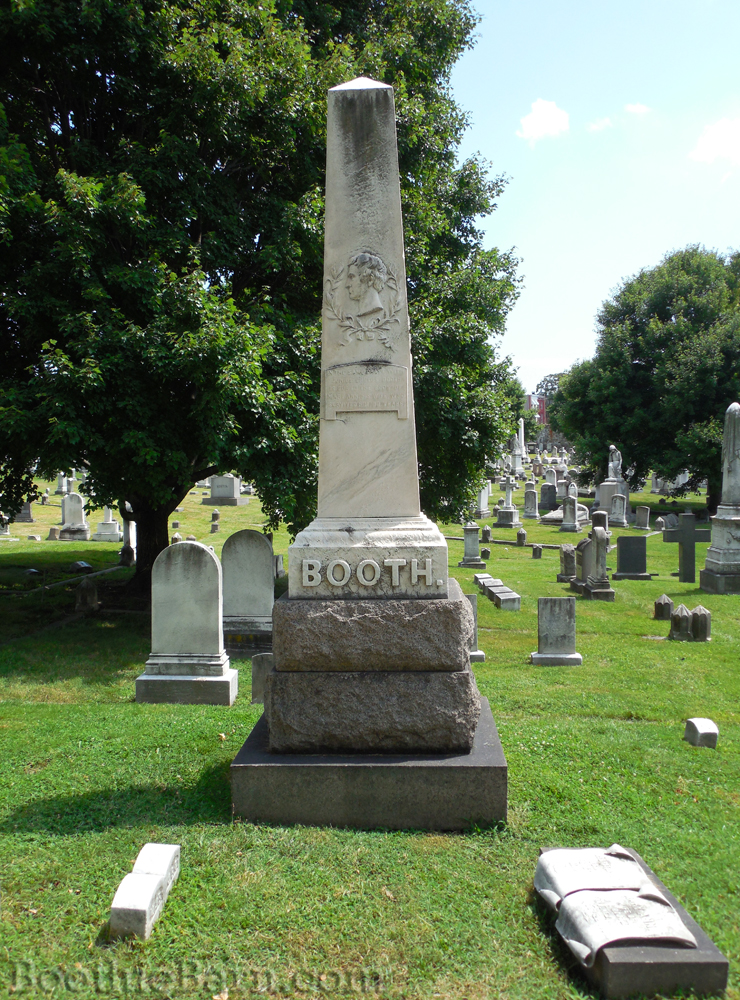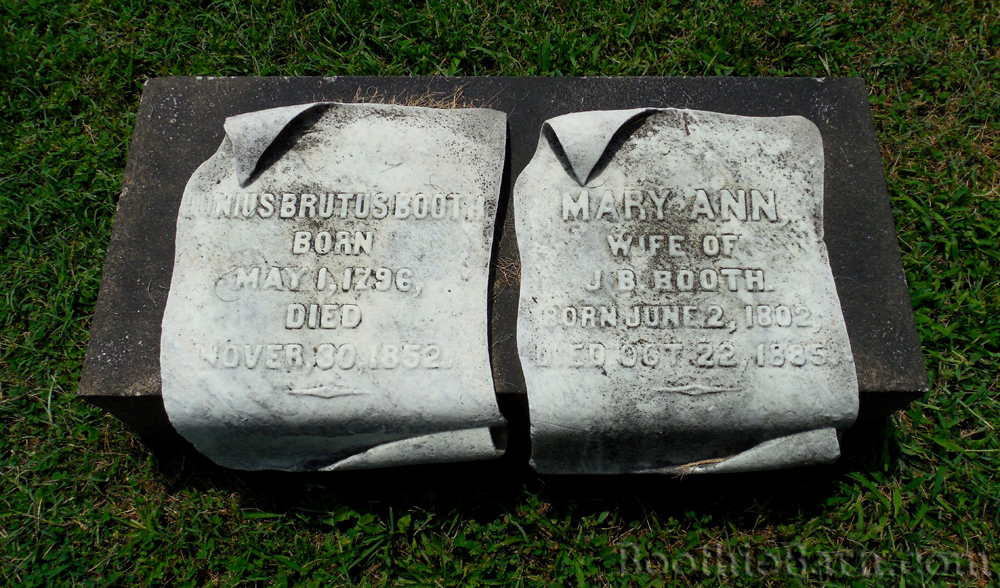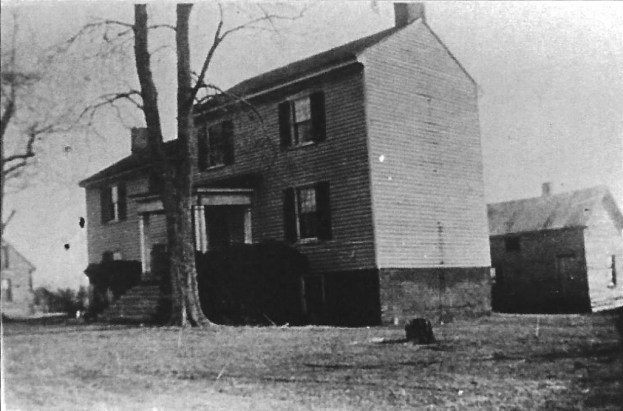
Posts Tagged With: John Wilkes Booth

A “Thomas Jones” Carol

With the holidays almost here, it’s time for another installment of Boothie Christmas caroling where we revise a classic Christmas Carol into a Lincoln assassination themed Boothie Carol. Today’s song is a revised version of, “Silver Bells”. I hope you all enjoy it in the humorous manner in which it is intended.

Thomas Jones Christmas Carol

“Thomas Jones”

As sung to, “Silver Bells”

Easter morning, without warning,
Sam Cox comes down my street.
In the air there’s a feeling of danger.
I start going, without knowing
Why his dad wants to meet,
But I get to Rich Hill and I hear:

Thomas Jones, (Thomas Jones)
I’ve hidden Booth in the thicket
Lend a hand (Lend a hand).
Help this man (Help this man).
Make sure he gets river bound.

When I find him, Herold’s with him,
So I say to them both,
“We must wait for the troopers to leave here.”
He wants papers. I say, “Later.”
Then I give him my oath
No amount could cause me to betray

John Wilkes Booth, (John Wilkes Booth)
It’s not quite time to go boating.
Hunker down (Hunker down).
Don’t be found (Don’t be found).
Soon it will be rowing day!

Previous years’ Boothie Carols can be read here:
“It’s the Most Wonderful Time of the Play” / It’s the Most Wonderful Time of the Year
“We Bruti” / We, Three Kings of Orient Are
“Wilkes Booth the Head Conspirator” / Rudolph the Red-Nosed Reindeer
“Lewis Powell is Coming For You” / Santa Claus is Coming to Town
“Little Doctor Mudd” / Little Drummer Boy
“Boothie Wonderland” / Winter Wonderland

Categories: History, Levity | Tags: , , , , , , , | 7 Comments

Grave Thursday: Dr. William Queen

Each week we are highlighting the final resting place of someone related to the Lincoln assassination story. It may be the grave of someone whose name looms large in assassination literature, like a conspirator, or the grave of one of the many minor characters who crossed paths with history. Welcome to Grave Thursday.


Dr. William Queen

dr-william-queen-grave-1

Burial Location: St. Mary’s Cemetery, Bryantown, Maryland

Connection to the Lincoln assassination:

Dr. William Queen was a physician in Charles County, Maryland who lived about six miles south of Bryantown. On November 11, 1864, John Wilkes Booth rode the stage down from Washington, D.C. to Bryantown where he spent the night. In his possession, Booth carried a letter of introduction to Dr. Queen. Booth had acquired this letter while he was in Montreal, Canada in the middle of October from a Confederate smuggler named Patrick Martin. Martin was from St. Mary’s County and still had contacts with the underground network of Confederate sympathizers and operatives back in Southern Maryland. Booth was anxious to connect with these individuals for his planned abduction plot against Abraham Lincoln. When Booth arrived in Bryantown the first time, he was able to send word to Dr. Queen that he wanted to meet with him. The next day Dr. Queen’s son, Joseph, picked Booth up at the Bryantown Tavern and brought him to his father’s home. John Wilkes Booth spent the night of November 12, at Dr. Queen’s home.

Dr. Queen’s son-in-law, John Thompson, would later testify at the trial of the conspirators that Booth’s letter of introduction to the doctor only mentioned that the actor was looking to purchase some land in the area and asked Dr. Queen to furnish him with assistance in this regard. This, however, is likely just a cover story that Booth and the Queen family committed to using. Booth’s true purpose was to scout the lands and roads of Charles County while simultaneously looking for individuals who would assist him in his abduction plot.

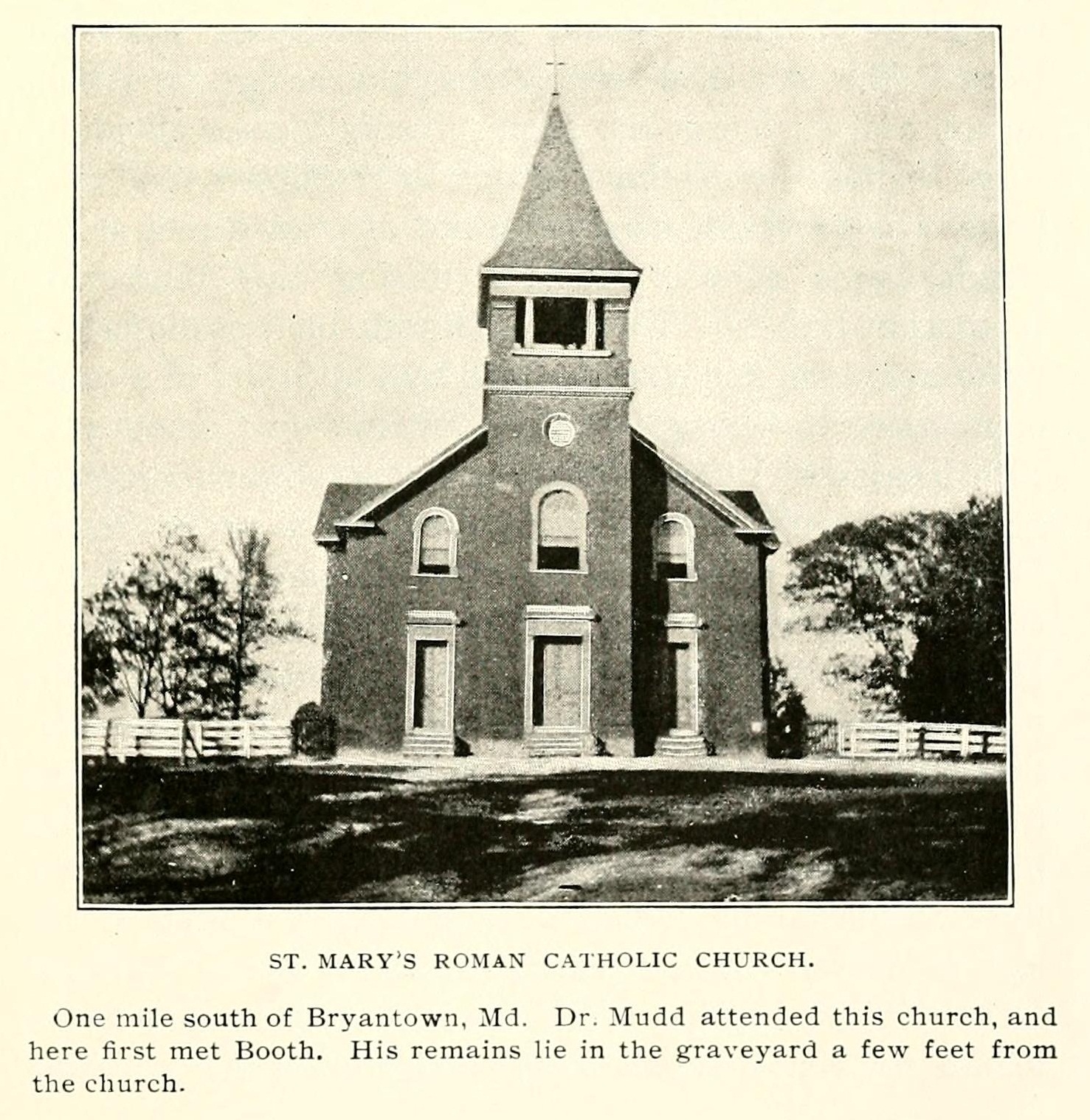
Dr. Queen was about 73 years old when Booth first arrived at his home. He was quite infirm and less than a year later he would become bedridden. So while Dr. Queen could not provide Booth with much in the way of physical assistance, his knowledge of the people and land was helpful. The next day, on November 13th, John Wilkes Booth joined Dr. Queen and his family in attending church at St. Mary’s Church in Bryantown. “Coincidentally” Dr. Samuel Mudd made the decision to attend St. Mary’s Church that Sunday rather than his home church of St. Peter’s. John Thompson introduced John Wilkes Booth to Dr. Mudd outside of the church before services commenced.

St. Mary's Church Oldroyd

John Wilkes Booth would return to Dr. Queen’s home after church was over and subsequently return back to Washington.

Booth was not absent from Charles County for very long, however. On December 17th, he returned to Bryantown and spent another night with Dr. Queen and his family. The next morning, a Sunday, Booth once again attended church at St. Mary’s before he met up with Dr. Mudd. For the next few days, Dr. Mudd, not Dr. Queen, would be Booth’s host. In this way, Dr. Mudd came to replace Dr. Queen as a more able bodied facilitator of Booth’s plot. Mudd introduced the actor to Thomas Harbin, a Confederate agent who signed on to help with the abduction plot. It was also during this trip that Dr. Mudd helped Booth to purchase a horse from the doctor’s next door neighbor, George Gardiner. Booth returned to Washington on December 22nd, and, the very next day, Dr. Mudd took a visit to Washington where he happened to introduce Booth to John Surratt, who would become another willing and helpful participant in Booth’s plot.

After the assassination of Lincoln and the subsequent investigation, Dr. Queen avoided arrest due to his declining health that had left him bedridden. His son-in-law, John Thompson, was taken up to Washington in his stead. Thompson would testify at the trial about Booth’s arrival in the county and his introduction to Dr. Mudd.

dr-queen-obit-1866

Dr. Queen’s health continued to deteriorate and, on March 1, 1866, he died at his home near Bryantown. He was buried next to his first wife and his son Joseph (the son who had transported Booth to the Queen home in November of 1864) who had died in November of 1865. The family plot is near the back of St. Mary’s Church cemetery, the same cemetery where Dr. Mudd would later be buried.

One of the artifacts in the collection of the Dr. Samuel A. Mudd House Museum is a newspaper clipping that was owned by one of Dr. Queen’s daughters, Molly Queen. The clipping contains a poem called “Then and Now” which was a piece of political propaganda related to the election of 1864. The poem laments the poor condition of the country due to the last four years of Lincoln’s presidency and encourages the reader to vote for the Democratic candidate, George McClellan. The poem ends with the line: “Three cheers for Mac and the good times coming; And a groan for Abraham!”

While this piece completely fits with the political point of view of the Queen family and so many others in Southern Maryland, what makes this artifact unique and worth saving is an ambiguous signature which is affixed in pencil to the side of the clipping:

queen-clipping-mudd-house

queen-clipping-booth-signature

John Wilkes Booth did visit the Queen family for the first time just a few days after the election of 1864 and so it is likely that Molly Queen had this clipping out and around during the actor’s visit. Even if this is not actually John Wilkes Booth’s signature, it still is a fascinating artifact connecting John Wilkes Booth and the family of Dr. William Queen.

GPS coordinates for Dr. William Queen’s grave: 38.539667, -76.836000

Categories: Grave Thursday, History | Tags: , , , | 16 Comments

Edwin Booth and the “Big Hole in the Ground”

edwin-booth-circa-1876-harvard In 1876, eleven years after his brother assassinated Abraham Lincoln, Edwin Booth was still making his living as a touring actor. After a brief period of respectful grief and contemplation in the months following his brother’s crime, Edwin’s success and fame as an actor had only increased through the years. However, while Edwin was widely respected and praised for his talents, his business dealings over the past decade had hurt him considerably. The lavish theater he financed, constructed, and named after himself in New York had bankrupted him and he had been forced to sell ownership of it to help cover his debts. As much as he disliked the stress of touring, it was the only way he was able to recoup his losses and provide for his family. He had hoped the Booth Theatre would be his home for years, but its failure required him to retake the role as a touring star.

One man who knew the pain of losing a theater all too well was John T. Ford – he having lost his theater in Washington due to Edwin’s brother’s crime. John T. Ford approached Edwin Booth with an idea for a tour of the heart of the former Confederate states. Edwin Booth had not played in these areas since before the Civil War and John T. Ford assured Edwin that there would be a fortune to be made in his return. Edwin agreed and starting in January of 1876, he began a tour of cities in Virginia, North Carolina, South Carolina, Georgia, Alabama, Tennessee and Kentucky. Joining him on this tour was his second wife, Mary McVicker. As Ford had predicted, Edwin was widely acclaimed during his performances in the South. “It was an ordinary sight to behold the ladies standing in double lines throwing flowers in his path as [Edwin] walked from his hotel to the theatre,” the company manager John Barron later recalled.

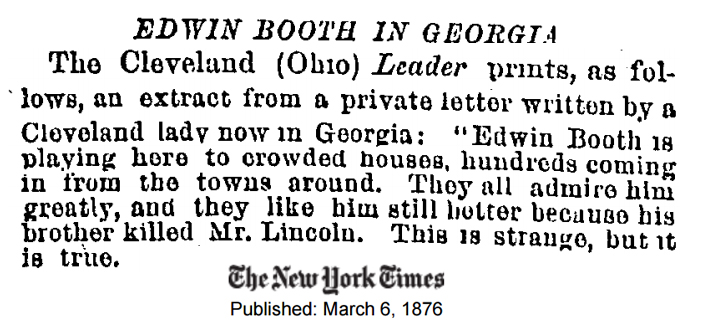
While the tour was a financially successful one and Edwin was pleased by the reception of his audiences, he was often displeased with the newspaper articles that accompanied his tour. The articles often contained “disgraceful anecdotes” about his father, Junius Brutus Booth, “all in the main false or exaggerated.” Worse yet, Edwin could not escape the shadow of his brother’s crime. He would write to a friend that during his tour he was, “daily reminded of the disgrace and misery that can never be forgotten by me or any member of my family.” Edwin was no doubt aware that there was a strong desire by many Southerners to see not just “Booth, the great Tragedian” but also “Booth, the brother of the assassin.”
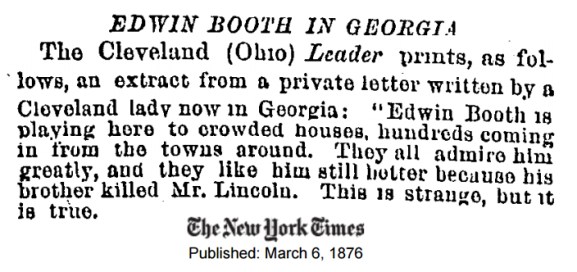
edwin-booth-in-georgia-1876-nytimes

The tour with Ford was a short one with Edwin completing his final performance in Bowling Green, Kentucky on March 3rd. The entire tour grossed almost $90,000. Edwin made his own arrangements to perform in Louisville, Kentucky starting on March 13th, leaving him with a few days of downtime. Edwin decided to take this opportunity to visit a local landmark, Mammoth Cave.

mammoth-cave-nps

Mammoth Cave is the longest known cave system in the world with over 405 miles worth of surveyed passageways. Edwin Booth was greatly impressed by his experience touring through just a small bit of the cave system and wrote about his experience to his daughter Edwina. Please be aware that in this letter Edwin writes the words of his black guide, William Garvin, in the form of “negro dialect” which is most widely known today due to the writings of Mark Twain. Edwin also demonstrates his racial views which, while not acceptable today, were common with white men of the period. Edwin Booth was likely unaware that his guide was a veteran of the Civil War and had done more to protect the country that they shared than the actor ever did.

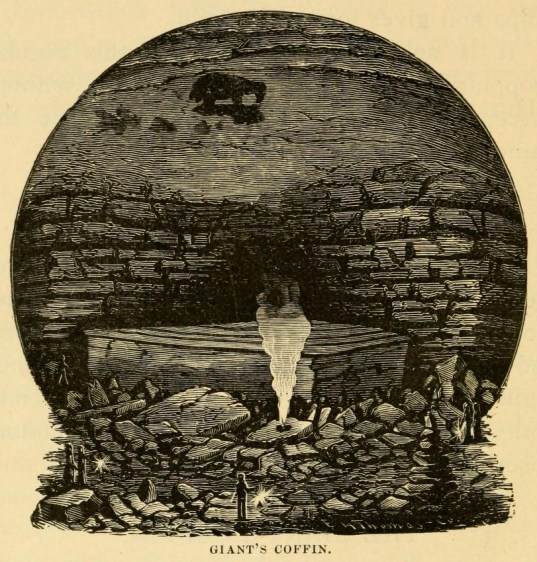
“I must tell you of our ride from Mammoth Cave, that ” big hole in the ground.” I shall try to relate the wonders I heard in the cavern, and describe our jog over the stones through the forest. Our guide was a bright young colored chap, who produced by his imitations of dogs, cows, etc., some fine effects of ventriloquism on our way through the cave. In pointing out to us a huge stone shaped like a coffin he would remark: “Dis is de giant’s coff-in”; then, taking us to the other dilapidated side of it : ” Dis is what he coughed out.” Then we reached what they call down there “The Altar,” where some foolish folk were married once upon a time. “De young lady swore she nebber would marry any man on the face ob the earth, so she came down yer and got married under de face ob de earth. ‘Spec’ she wanted materomony inter de groun’.” Then he would cry out, ” Hi ! John ! ” and we could hear the echo, as we thought, far away; then he would strike the ground with his staff, and we could hear a loud, reverberating sound, as tho’ all beneath were hollow, though when any of us tried it, no sound would come. He had finally to own up that he was both cause and effect.

William Garvin, Edwin Booth's guide through the Mammoth Cave

William Garvin, Edwin Booth’s guide through the Mammoth Cave

Frequently we found in different chambers in the cave crystallizations hanging from the rocky ceilings called “stalactites,” and others rising from the ground directly beneath them, reaching up and often joining the ones from above, and forming a solid pillar from floor to roof; these latter are called ” stalagmites.” William, our guide (very serious all the time), remarked that ” De upper ones was called stalac-tite ’cause dey stuck tight to de roof, and de odder ones stalag-mite — cause dey might reach the upper ones, and den again dey might n’t.” A facetious and comical darky, truly! One of these columns, or pillars, had a sort of knob on it shaped like a fat dumpling face, which is named here “Lot’s Wife.” William said, “And she has n’t done poutin’ about it yet.” So we went laughing at his weak jokes; for it was funny to us actors to see this fellow throwing his wit at us, and our appreciation of his acting made him very happy. I think I have already written about the pretty little bats that hang about the walls and roof of the cave in clusters, with heads down and mouths wide open, as if laughing in childish glee at the fun they are having in playing “upside down.”

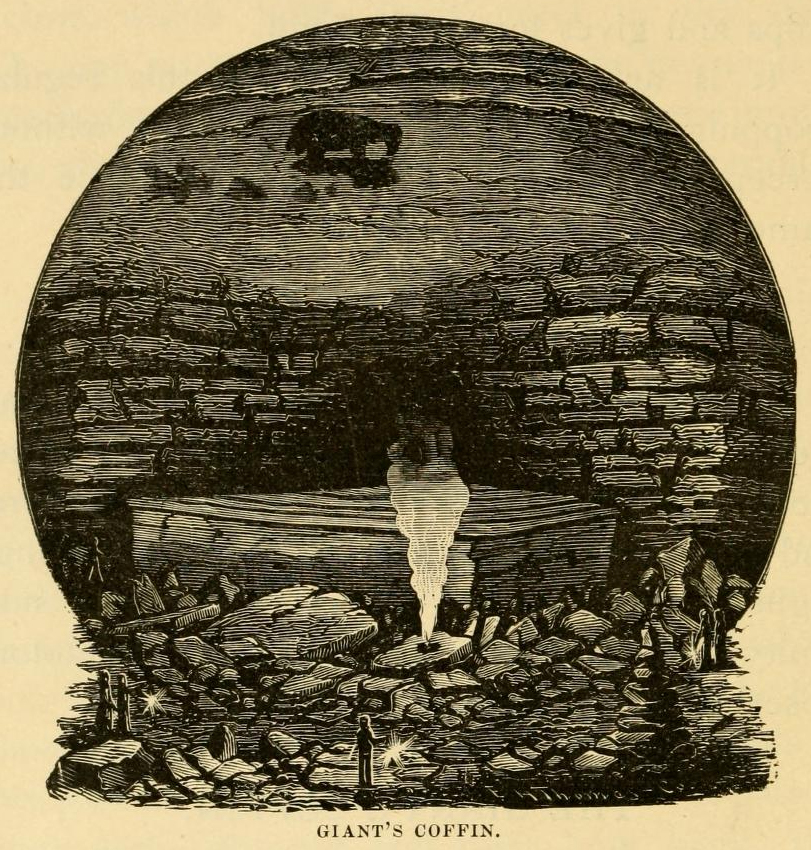
One of the geological formations pointed out by William Garvin was the “Giant’s Coffin”. This large slab of rock, about 40 feet long resembles a huge coffin when viewed from the right angle.
giants-coffin-engraving-mammoth-cave

giants-coffin-mammoth-cave

This and the other features of Mammoth Cave must have made a lasting impression on Edwin. Perhaps it was seeing these sights in person and then recounting them in his descriptions to Edwina that fueled Edwin’s desire to return. Over a year would pass, but as soon as it was convenient, Edwin made a return visit to Kentucky with both Edwina and Mary McVicker in tow.

In November of 1877, Edwin had a break of a little over a week after his engagement in Philadelphia ended and his new engagement in Cleveland was set to begin. Though it was certainly out of the way, Edwin rushed his family off to Cave City, Kentucky so that he could visit Mammoth Cave, once again. Whether Edwina was invited to join her father in exploring the cave on this trip is unknown, but I’d like to think that she was. It was, after all, a special day for the Booths. Edwin had scheduled his return visit to the cave to fall on November 13th, his 44th birthday.

Edwin revisited much of the same sites he saw in the year prior, possibly with William as his guide once again. This time, when the group of Edwin and his friends got to the “Giant’s Coffin”, Edwin enacted a plan he had thought up.

“While there Mr. Booth laid the first stone of what he hopes will become a monument to the memory of Shakespeare. The stone, weighing about two hundred pounds, was, with considerable exertion on the actor’s part, placed in position at the foot of the ‘Giant’s Coffin’ and the name of Shakespeare and the date painted on it in large white letters. Mr. Booth hopes that visitors to the cave, in the future, will each add a stone to the monument until it becomes one fitting the memory of the great author.”

Various searches have failed to come up with anything regarding a Shakespeare monument near the Giant’s Coffin, so I think it’s safe to say that Edwin’s dream never came to fruition. However, it would be an interesting piece of research to see if the cornerstone he laid and painted still exists somewhere near the coffin formation.

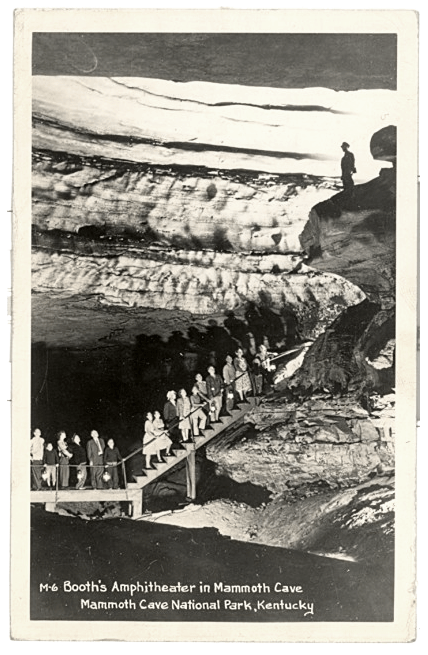
While Edwin Booth’s monument to Shakespeare may not stand today, he still managed to leave an indelible mark on Mammoth Cave just as the cave had left on him. According to local stories, during one of Edwin’s two trips to the cave he gave an impromptu recitation from Hamlet, his signature piece. He gave his recitation from high up on a ledge outcropping that was known as the Theater Gallery. To his few friends and the other souls who were lucky enough to be present, this was a truly unique performance by the greatest actor of the day in the most breathtaking of settings. Ever since that performance, the area in which he gave his recitation has been appropriately called “Booth’s Amphitheater” in honor of the great tragedian who enjoyed his visits to that “big hole in the ground” in Kentucky.
booths-amphitheater-postcard-1

edwin-booths-ampitheater-mammoth-cave

References:
American Tragedian: The Life of Edwin Booth by Daniel J. Watermeier
Edwin Booth: A Biography and Performance History by Arthur W. Bloom
Edwin Booth: Recollections by His Daughter, Edwina Booth Grossmann, and Letters to Her and to His Friends by Edwina Booth Grossman
“Edwin Booth’s Birthday” Cleveland Daily Plain Dealer, Saturday, November 17, 1877
Mammoth Cave National Park
Black Guides of Mammoth Cave
Pictorial Guide to the Mammoth Cave, Kentucky by Adam Binkerd

Categories: History | Tags: , , | 5 Comments

Grave Thursday: Junius Brutus Booth

Each week we are highlighting the final resting place of someone related to the Lincoln assassination story. It may be the grave of someone whose name looms large in assassination literature, like a conspirator, or the grave of one of the many minor characters who crossed paths with history. Welcome to Grave Thursday.


Junius Brutus Booth

junius-brutus-booth-sr

Burial Location: Green Mount Cemetery, Baltimore, Maryland

junius-brutus-booth-grave-2

junius-brutus-booth-grave-1

junius-brutus-booth-grave-3

Connection to the Lincoln assassination:

Junius Brutus Booth, the father of the Maryland Booths, needs no introduction to anyone who has done any reading about the Lincoln assassination. In addition to the many books that include brief stories about him in order to provide background on the upbringing of John Wilkes Booth, Junius Brutus Booth’s life has been thoroughly documented in Stephen Archer’s wonderful book, Junius Brutus Booth: Theatrical Prometheus. I will not insult that text by trying to summarize the life of such a brilliant tragedian in only a few paragraphs.

So while I will not go into a full history of Junius Brutus Booth, I do want to recount one aspect of Junius’ life that I feel is especially appropriate given the recent events here in America. I want to preface this by acknowledging that Junius was not a perfect man and had his fair share of personal demons, often brought upon by drink. However, despite all of the negative or troubling aspects of Junius’ life, he did have one personality trait that was considered eccentric that I wish more of us sought to emulate today. Junius Brutus Booth had a great an appreciation for the different religions and beliefs in the world and a desire to learn about them.

In Asia Booth Clarke’s 1865 book about her father entitled, Passages, Incidents, and Anecdotes in the life of Junius Brutus Booth (the elder), she writes the following about her father’s views on religion.

“All forms of religion and all temples of devotion were sacred to him, and in passing churches he never failed to bare his head reverently. He worshiped at many shrines; he admired the Koran, and in that volume many beautiful passages are underscored; days sacred to color, ore, and metals, were religiously observed by him. In the synagogues he was known as a Jew, because he conversed with rabbis and learned doctors, and joined their worship in the Hebraic tongue. He read the Talmud and strictly adhered to many of its laws.

Several fathers of the Roman Catholic Church recount pleasant hours spent with him in theological discourse, and aver that he was of their persuasion, by his knowledge of the mysteries of their faith.  Of the numerous houses of worship to which I have accompanied my father, the one he most loved to frequent was a floating church or “Sailor’s Bethel.” The congregation was of the humblest degree, and the ministry not at all edifying. I remember kneeling through a lengthy impromptu prayer, which contained no spirit of piety to my childish ears, and looking around wearily at my father, I beheld his face so earnestly inspired with devotion that I felt rebuked, and it became pleasant to attend to that which was so devoid of interest before.

His reverence for religion was universal and deep-rooted. It was daily shown in acts of philanthropy and humane deeds which were too misdirected. He was not a sectarian, but made many creeds his study, and although the dogmas of the church might have yielded him a more enduring peace, the tenderness of his heart, from which which emanated his loving-kindness and great charity, afforded strength to his declining years.”

Junius Brutus Booth’s appreciation and study of different religions is evident in his own writings as well. In 1825, he wrote to his father Richard about visiting a settlement of Shakers (an offspring of the Quakers) a few miles from Albany, New York. He wrote of this sect of Christians far more sympathetically than most of his day:

“They are the most singular people I ever beheld. They have more simplicity and apparent primitive Christianity than all other classes of Christians…There is nothing to disgust – much to admire in them, and their ceremonies whose description would excite ridicule, produce a very contrary effect in witnessing. They are the best of Christians for they don’t prosecute and are harmless. All they desire is to live and die unmolested – but they are often insulted by the foolish and thoughtless.”

Booth’s knowledge of different faiths extended beyond the Abrahamic religions. Booth was especially found of Hinduism and seemed to favor it writing in 1834 that:

“Although practical Christianity is a beautiful type of Man’s approach to perfection, he is not so near it as is the poor despised and unavenged Hindoo [sic]. So thoroughly am I convinced that these Asiatics are nearest the Truth, that were I acquainted with their language and living in Hindustan, I should most conscientiously and devotedly become a worshipper…of those Images, which every minute satisfy the Hindoo who and what he is himself and also of his relative position in the World…”

To Junius Brutus Booth, all faiths were valid and possessed an inherent value. Junius was fluent in so much of the world’s religions that he would analyze and find commonalities in their teachings. While others would use religion to separate and isolate, Junius found ways to combine them. In 1834, he began a letter to merchant with the heading:

“Year of the Christ
Feb. 3. 1834
of the Planet
5594

Praise be to Allah!”

In this way he included the year according to the Christian (1834) and Jewish (5594) calendars and also gave reverence to the Islamic name for God (Allah).

Junius also demonstrated his ability to merge the teachings of multiple religions together upon the death of his own father, Richard Booth. When Richard died, Junius cut a lock of hair from his father’s head and tied it with a green cord, green being the symbolic color of paradise to Muslims and the color most associated with the prophet Mohammed. Junius then had Richard’s funeral presided over by a minister of the Episcopal church, the Christian religion his wife most associated with and under which his children were raised. Finally, the gravestone Junius placed on his father’s grave was originally engraved in Hebrew and the text spoke not of one god or faith, but more of the Hindu belief of oneness with the universe:

“I take my departure from life as from an inn
Thee I follow to the internal kingdom of
The most renowned ruler –
– thence to the stars”

After Junius Brutus Booth’s own death in 1852, Asia would recall a visit from two of the Booths’ neighbors who considered themselves “pillars of the church”. They visited the grieving Mary Ann and her children and told them of their desire to “convert” the household to Christianity. Mary Ann replied succinctly that she was a Christian and that her household did not require converting. The neighbors were unhappy that the Booth children had experienced the “wickedness” of different faiths and provided Mary Ann various pamphlets on how to set her children back on the correct path to their one true salvation. They even gave Rosalie Booth a short pamphlet entitled “Her Feet Take Hold on Hell” in their attempt to aid her conversion to the true path. After the neighbors departed, Asia Booth seethed with anger over their sanctimonious nature and “narrow comprehension of devotion.”

“I could not reconcile the two ideas,” Asia later wrote, “but I felt it a sacrilege, their intrusion and brazen ignorance. I remembered [my father’s] respect of all creeds, his silent reverence for every man’s peculiar faith, his great regard even for a little picture of a Mosque given to him by a Moslem [sic], and here were these egotistical little people teaching us our prayers, trying to make us accept his death as a judgement for our wickedness, a call to righteousness. His life had been a living lesson, for his piety was so real and deep it did not show itself in Sunday clothes, a conspicuous missal, or studied countenance, but calm and unassuming it always took the lowest seat, that his Host coming might say, ‘ Friend, go up higher.'”

In the 1800’s, Junius’ appreciation for different religions may have been considered eccentric. Today, however, I see the desire to understand the belief systems of others as a crucial trait for us all. The world is far more connected in 2016 than it was in 1852. Being completely ignorant and dismissive of faiths is no longer an option. Whether our country wants to admit it or not, we live in a global community and, despite a recent success to the contrary, America will not go back to limiting the equality of others due to their beliefs. Like Junius Brutus Booth, we must respect the beliefs of others and acknowledge the shared humanity of all people.

GPS coordinates for Junius Brutus Booth’s grave: 39.307097, -76.606022

Categories: Grave Thursday, History | Tags: , , , | 2 Comments

Grave Thursday: Virginia Clarke

Each week we are highlighting the final resting place of someone related to the Lincoln assassination story. It may be the grave of someone whose name looms large in assassination literature, like a conspirator, or the grave of one of the many minor characters who crossed paths with history. Welcome to Grave Thursday.


Virginia Clarke

The home of Virginia Clarke outside of Bowling Green, Virginia.

The home of Virginia Clarke outside of Bowling Green, Virginia.

Burial Location: Greenlawn Cemetery, Bowling Green, Virginia

virginia-clarkes-grave

Connection to the Lincoln assassination:

One of the most forgotten and overlooked parts of the escape of the assassins of Abraham Lincoln involves the home of Mrs. Virginia Clarke. This is probably due to the fact that Mrs. Clarke’s home is technically not a part of John Wilkes Booth’s escape route. The lead assassin never got as far south as Mrs. Clarke’s home and, therefore, never saw the home pictured above. However, Booth’s accomplice and fellow fugitive, David Herold, not only saw this house but spent the night at Mrs. Clarke’s during the brief period of time where he separated from the assassin. On the afternoon of April 24, 1865, John Wilkes Booth and David Herold were waiting at the ferry crossing of Port Conway, Virginia, waiting to cross over to Port Royal on the other side of the Rappahannock River. As they waited, three Confederate soldiers rode up to the ferry landing. After some parlay, the fugitives announced their identities to the men. The soldiers, Willie Jett, Absalom Bainbridge and Mortimer Ruggles vowed to give Booth and Herold assistance on their escape. After crossing the ferry Jett attempted to find Booth refuge at the home of Sarah Jane Peyton, but she rebuffed him after seeing the condition Booth was in. The group of five then rode about two miles south of Port Royal where Jett dropped Booth off with the Garrett family. It was at this time that Herold separated from John Wilkes Booth for the first time since the pair had met up at Soper’s Hill outside of Washington on April 14th. While Booth enjoyed the hospitality of the unsuspecting Garrett family on the night of April 24th, Herold made his way with Absalom Bainbridge to Mrs. Clarke’s home.

David Herold briefly mentions this visit to Mrs. Clarke’s in his interrogation:

“One of the soldiers named Bennington [Bainbridge], was going to see a gentleman named Clark[e] whom I met some three or four years ago, & of whom I had heard people in Maryland speak. I do not know Clark’s christian name. Both Bennington & Clark had belonged to Mosby’s command. We went there and Bennington introduced me…We staid there all night.”

James Clarke, Herold and Bainbridge’s mutual acquaintance, was not at home when the pair arrived. Therefore Bainbridge had to introduce Herold to James’ mother, Virginia Clarke. Bainbridge introduced  Herold to Mrs. Clarke using the pseudonym of Mr. Boyd, the same name Jett had used to pass Booth off on the Garrett family.

Practically nothing is known about Herold’s stay with Mrs. Clarke and the next morning he was riding back with Bainbridge to Bowling Green to meet back up with Ruggles and Jett who had spent the night at the Star Hotel. Ruggles, Bainbridge, and Herold rode back up to the Garrett farm where Herold joined back up with Booth. The rest is history.

Mrs. Clarke’s home no longer stands. The area where it was once located has been transformed into a man-made lake.

Site of the Clarke house Caroline

When Virginia Clarke died in 1877, she was originally buried in a family cemetery belonging to her son-in-law’s family. However, when Fort A. P . Hill was created in Caroline County in the 1940’s, that family cemetery, along with many others, had to be removed. Greenlawn Cemetery in Bowling Green was created specifically to receive the transplanted graves of those originally interred on land now owned by Fort A. P. Hill.

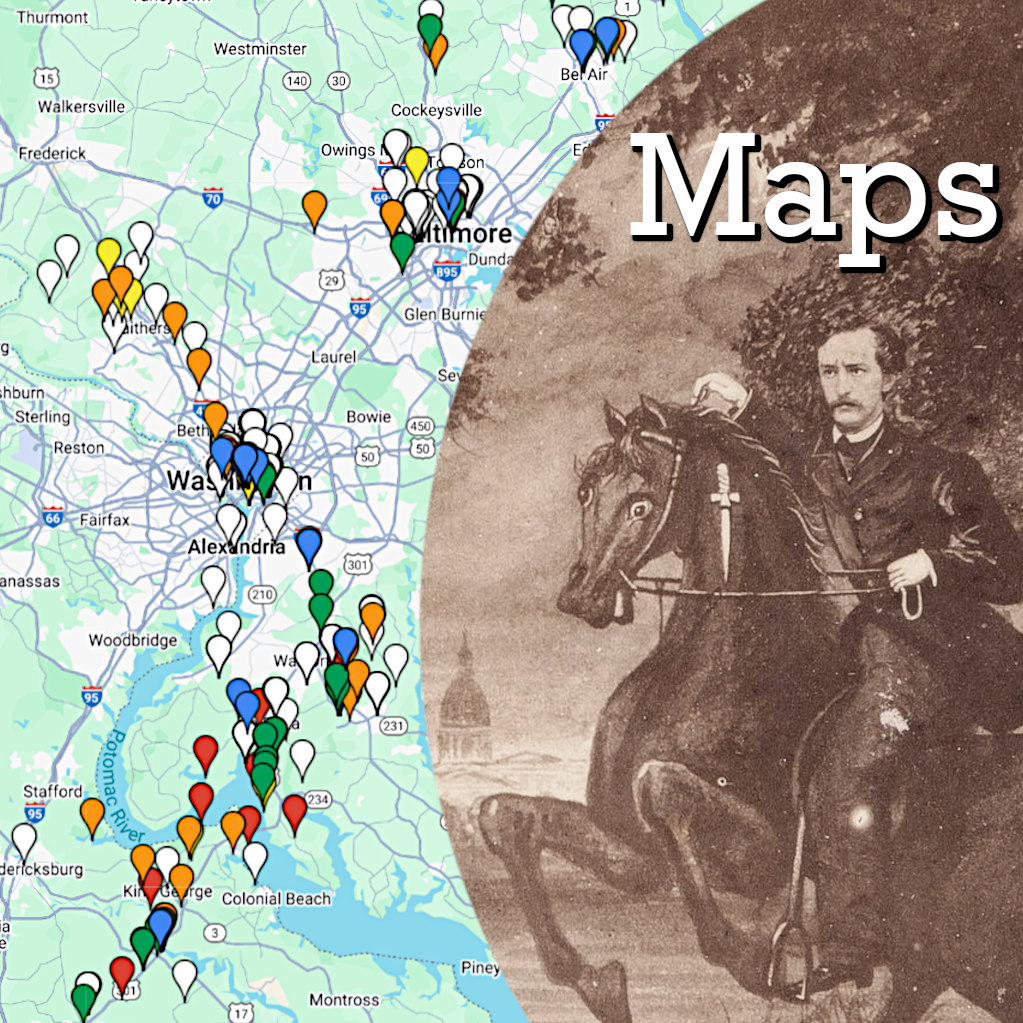
Check out the Maps page for more details. For more information about the actions of Willie Jett, Absalom Bainbridge and Mortimer Ruggles click this link.

GPS coordinates for Virginia Clarke’s grave: 38.070225, -77.338979

Categories: Grave Thursday, History | Tags: , , , , , , | 12 Comments

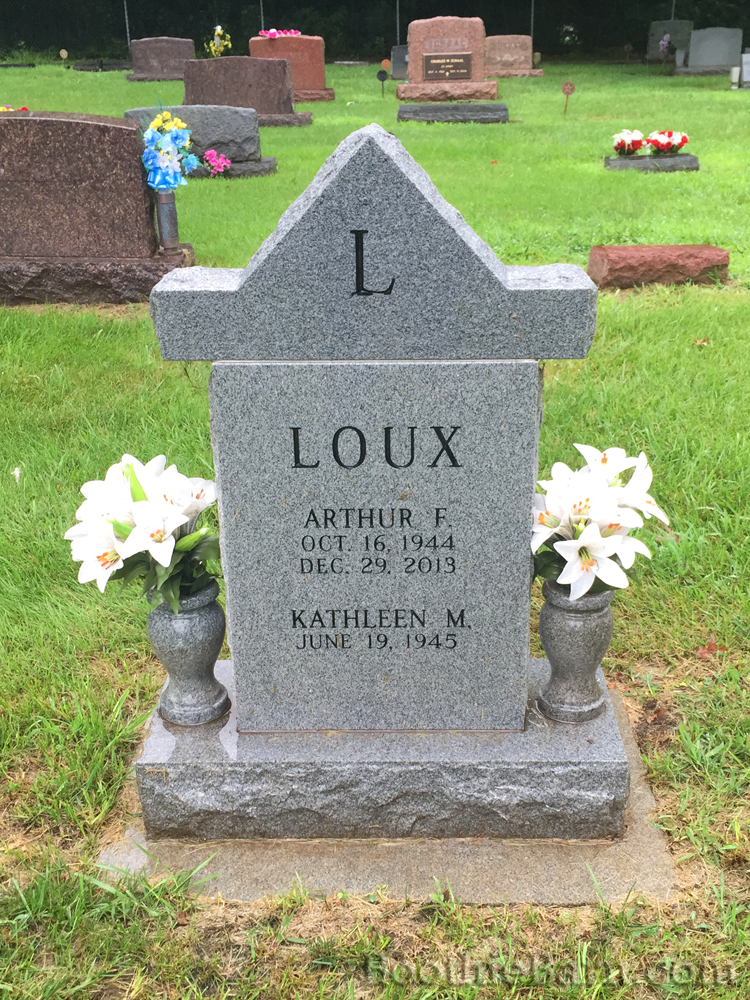
Grave Thursday: Art Loux

Each week we are highlighting the final resting place of someone related to the Lincoln assassination story. It may be the grave of someone whose name looms large in assassination literature, like a conspirator, or the grave of one of the many minor characters who crossed paths with history. Welcome to Grave Thursday.


Arthur F. Loux

Art Loux

Burial Location: Pleasant Valley Cemetery, Overland Park, Kansas

art-louxs-grave

Connection to the Lincoln assassination:

Art Loux may not have been around during the time of Lincoln’s assassination, but, based on his detailed work on the subject, you would find it difficult to believe that he wasn’t. As a John Wilkes Booth and Lincoln assassination researcher, Art spent over 40 years delving into the history and engaging with others in the field. His name appears in the acknowledgements of countless books and practically all of the authors in the field considered Art a friend and generous colleague.

Art’s magnum opus, the product of his entire lifetime of researching, was his book, John Wilkes Booth: Day by Day.

Art Loux's JWB DBD

This fabulous book documents the day to day movements of the world renowned actor, John Wilkes Booth, who turned into our nation’s first Presidential assassin. Art spent decades compiling Booth’s daily whereabouts and movements using newspapers, personal writings, and published accounts. In the days before the internet, Art sent letters to practically every library and historical society in America asking the recipients to check whatever newspapers and microfilm they had for mentions of the assassin. The magnitude of his research is staggering. Thanks to Art’s careful and meticulous eye, the life of John Wilkes Booth has been documented in a way never before thought possible.

Art Loux passed away on December 29, 2013, two days after signing a deal with McFarland & Company to have John Wilkes Booth: Day by Day published for the masses. In one of the greatest injustices of fate, Art never got to see his work become one of the most revered texts in Lincoln assassination literature.

I have written about my deep appreciation for Art Loux before and I have a page here on BoothieBarn in memory of Art. Please take a few minutes out of your day to read more about the career and life of this wonderful historian.

I decided to choose Art for today’s Grave Thursday selection for two reasons. The first is that this Sunday, October 16th, would have been Art’s 72nd birthday and so I felt a mention this week was appropriate. The second reason I chose to include Art in Grave Thursday is because I know he would have enjoyed it. In addition to being a big Lincoln assassination buff, Art was also a big cemetery buff. Art was always visiting cemeteries looking for, and photographing, graves. Art’s daughter Jennifer, who supervised the publication of her father’s manuscript after his death, has told me that she has many childhood memories trekking through graveyards with her father looking for such-and-such’s grave. To prove it, here’s a picture Art took in 1978 of his daughter standing next to Laura Keene’s grave in Green-Wood Cemetery in Brooklyn (Keene, by the way, is the subject of next week’s Grave Thursday):

keene-laura-green-wood-aug-78

Art later became a big contributor to the site FindaGrave.com, uploading over 800 pictures he had taken over the years of different people’s graves. I hope by including Art in Grave Thursday I am honoring not only a man I deeply respect and miss, but also the hobby that he enjoyed so much.

Every time I open Art’s book, I am grateful I had a chance to know such a generous man who gave knowledge so freely and without the expectation of anything in return. In 1977, Art penned the following note, in which he wrote admiringly of the generosity and helpfulness of those in the Lincoln assassination field:

Art's letter 1977

Like the people he writes of in his note, Art, too, was remarkable. He was always generous with his time and knowledge, and still stands as a role model for me on how amateur historians are supposed to act and share. Every new post I put up here on BoothieBarn is my attempt to share my discoveries and knowledge with as many people as I can, just as Art did.

So, if you ever find yourself in the Topeka/Kansas City area, stop by Pleasant Valley Cemetery and pay your respects to one of the great historians in the field of Lincoln assassination studies, Arthur F. Loux.

dave-at-art-louxs-grave-7-8-2015

GPS coordinates for Art Loux’s grave: 38.838552, -94.695460

Categories: Grave Thursday, History | Tags: , , , | 8 Comments

Grave Thursday: C. Dwight Hess

Each week we are highlighting the final resting place of someone related to the Lincoln assassination story. It may be the grave of someone whose name looms large in assassination literature, like a conspirator, or the grave of one of the many minor characters who crossed paths with history. Welcome to Grave Thursday.


C. Dwight Hess

C Dwight Hess

Burial Location: Westville Cemetery (Old Section), Westville, Indiana

c-dwight-hess-grave-6-25-2016

Connection to the Lincoln assassination:

C. Dwight Hess was the manager and co-owner of the National Theatre in Washington D.C. The theater, also known as Grover’s Theater after Hess’ co-owner, Leonard Grover, was the main theatrical competitor of Ford’s Theatre in Washington City. As the manager of the National Theatre, Hess was very familiar with the actor turned assassin John Wilkes Booth.

On April 13th, the day before Lincoln’s assassination, John Wilkes Booth paid a visit to the National Theatre where he found Hess running lines with the stage prompter George Wren. Booth barged into the office where Hess and Wren were speaking, sat himself down, and proceeded to converse with the two men. Hess and Wren broke from their rehearsal and entertained the young actor. During the conversation, Booth inquired with Hess whether he was going to participate in the Grand Illumination planned for that evening. Hess replied in the affirmative but that he was saving his best material in order to illuminate the next night, Friday, April 14th, the anniversary of the fall of Fort Sumter. After mentioning his plan to illuminate on Friday night, Booth then asked Hess, “Ain’t you going to invite the President out?” Hess replied that, yes, he was hoping to invite the Lincolns and even thanked Booth for reminding him to do so. After a bit more conversation, Booth departed and both Wren and Hess would comment that they thought it odd that Booth would mention the President given his known dissatisfaction with the Union government. Hess was not aware that Booth was laying the groundwork for a possible assassination right inside Hess’ own theater. C. Dwight Hess did send along an invitation to Mrs. Lincoln, inviting her and her husband to his planned illumination on Friday and for the theater’s performance of Aladdin! or the Wonderful Lamp. While Tad Lincoln would take up Hess’ offer, Mr. and Mrs. Lincoln would choose Ford’s Theatre for their entertainment on April 14th, and John Wilkes Booth’s plan would change venues because of it.

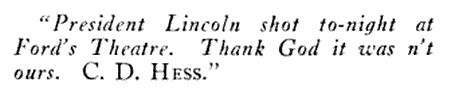
Hess would be present at his theater when the terrible news came in that the President Lincoln was assassinated over at Ford’s Theatre. His first thought after clearing the house was to send word to Leonard Grover who was not in D.C. at the time. Hess quickly dispatched a telegram to Grover which conveyed both his shock and relief:

hess-telegram-to-grover

Clarence Dwight Hess (who is also often recorded as Charles Dwight Hess) would later be a witness at the trial of the conspirators where he would testify about Booth’s visit to his theater on April 13th. After 1865, he continued in the theatrical business where he managed other theaters and even his own opera group which toured throughout Americas. In his later years, Hess retired to a small farm near Westville, Indiana. When he died on February 15, 1909, he was buried at the Westville Cemetery. Check out the Maps page for more details. For more information about Grover’s National Theatre and its connections to the Lincoln assassination story read the Grover’s Theatre and the Lincoln Assassination post.

GPS coordinates for C. Dwight Hess’ grave: 41.540153, -86.914445

Categories: Grave Thursday, History | Tags: , , , | 9 Comments

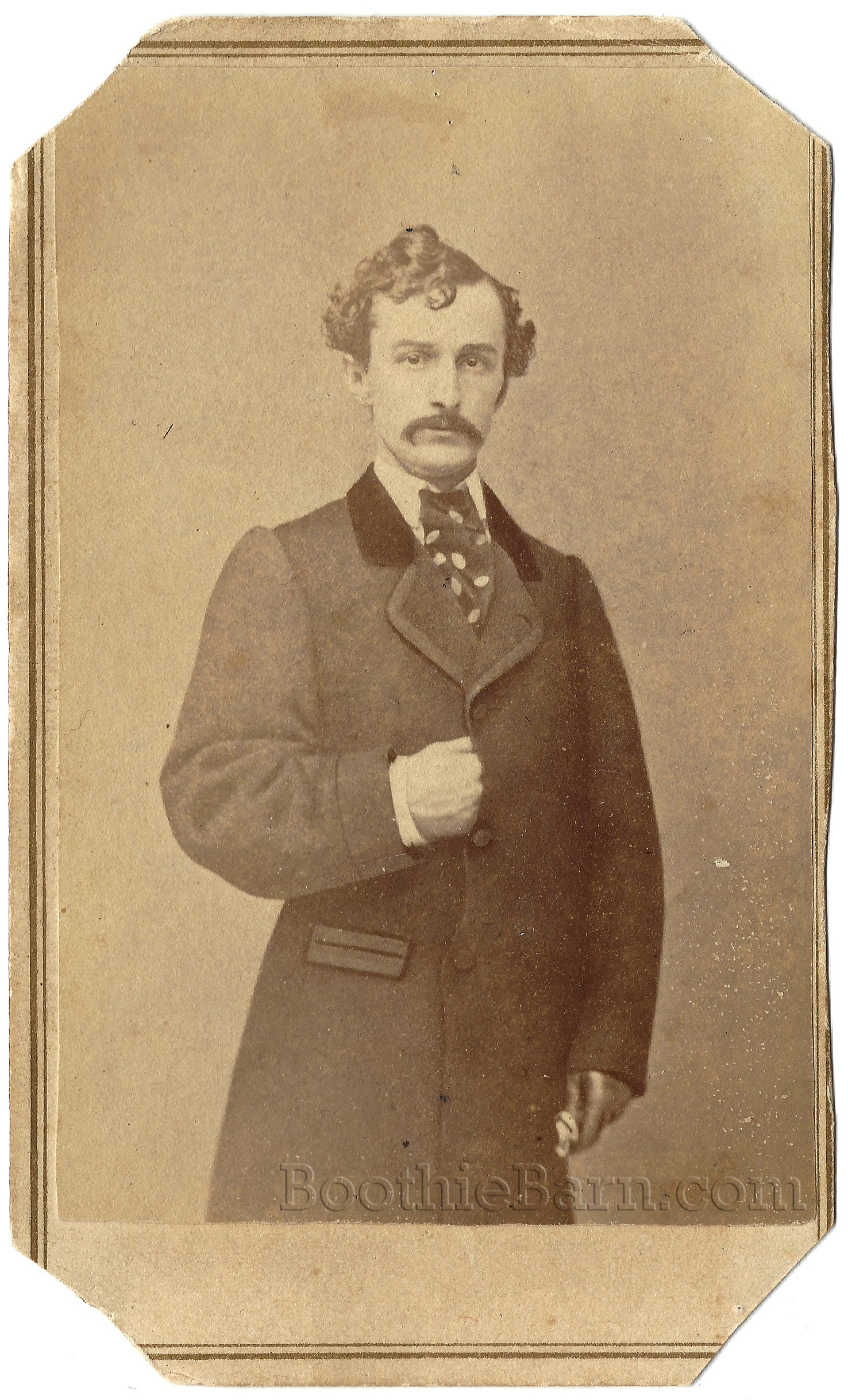
Photo of the Day: John Wilkes Booth

john-wilkes-booth-gutman-26-boothiebarn

Categories: History | Tags: | 32 Comments

Blog at WordPress.com.