Posts Tagged With: John Wilkes Booth

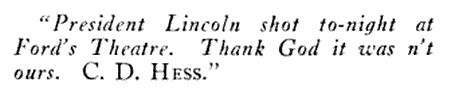
Photo of the Day: John Wilkes Booth

john-wilkes-booth-gutman-26-boothiebarn

Categories: History | Tags: | 32 Comments

Grave Thursday: Junius Brutus Booth, Jr.

Each week I am highlighting the final resting place of someone related to the Lincoln assassination story. It may be the grave of someone whose name looms large in assassination literature, like a conspirator, or the grave of one of the many minor characters who crossed paths with history. Welcome to Grave Thursday.


Junius Brutus Booth, Jr.

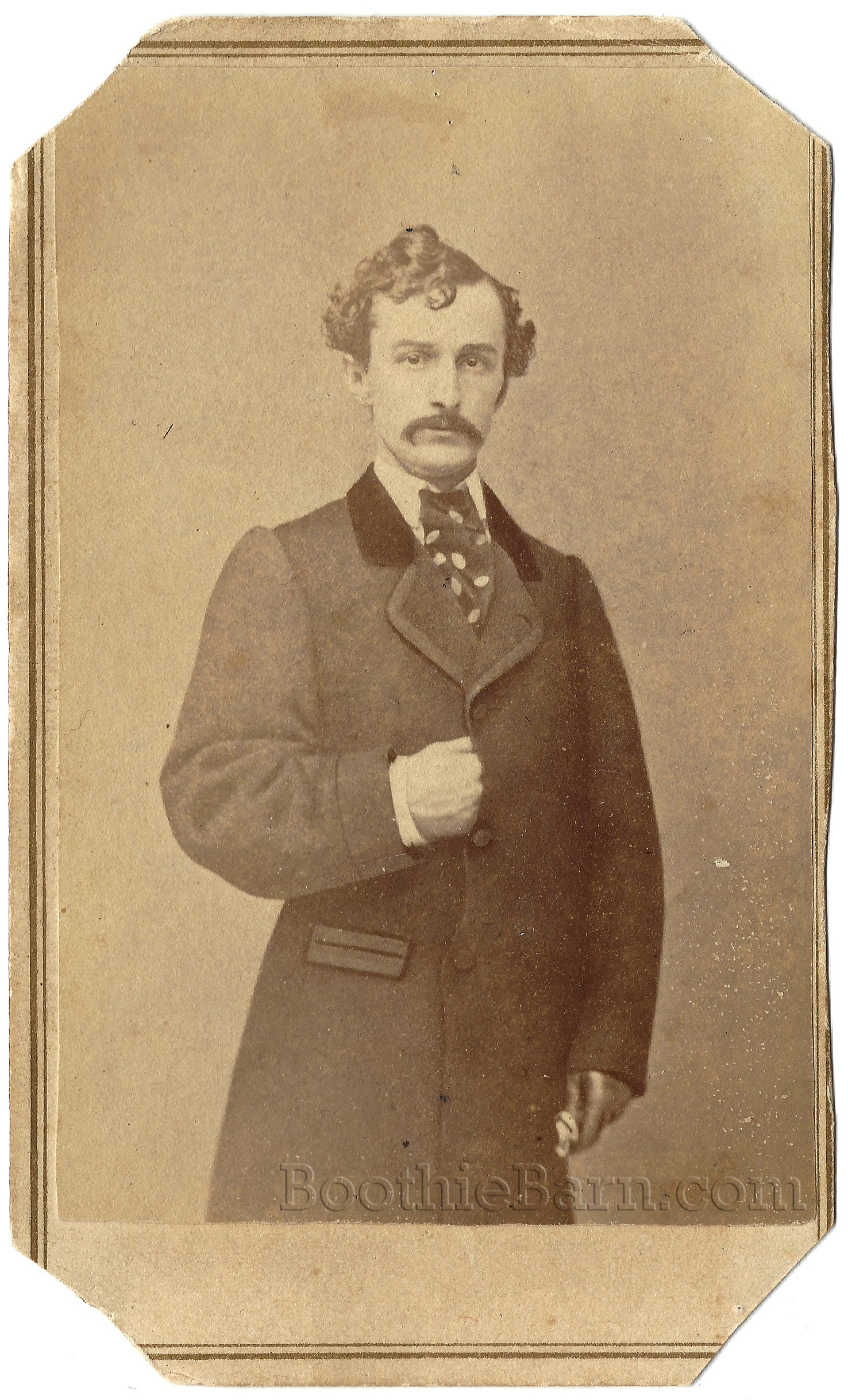
junius-brutus-booth-jr-cabinet-card-boothiebarn-watermark

Burial Location: Rosedale Cemetery, Manchester-by-the-Sea, Massachusetts

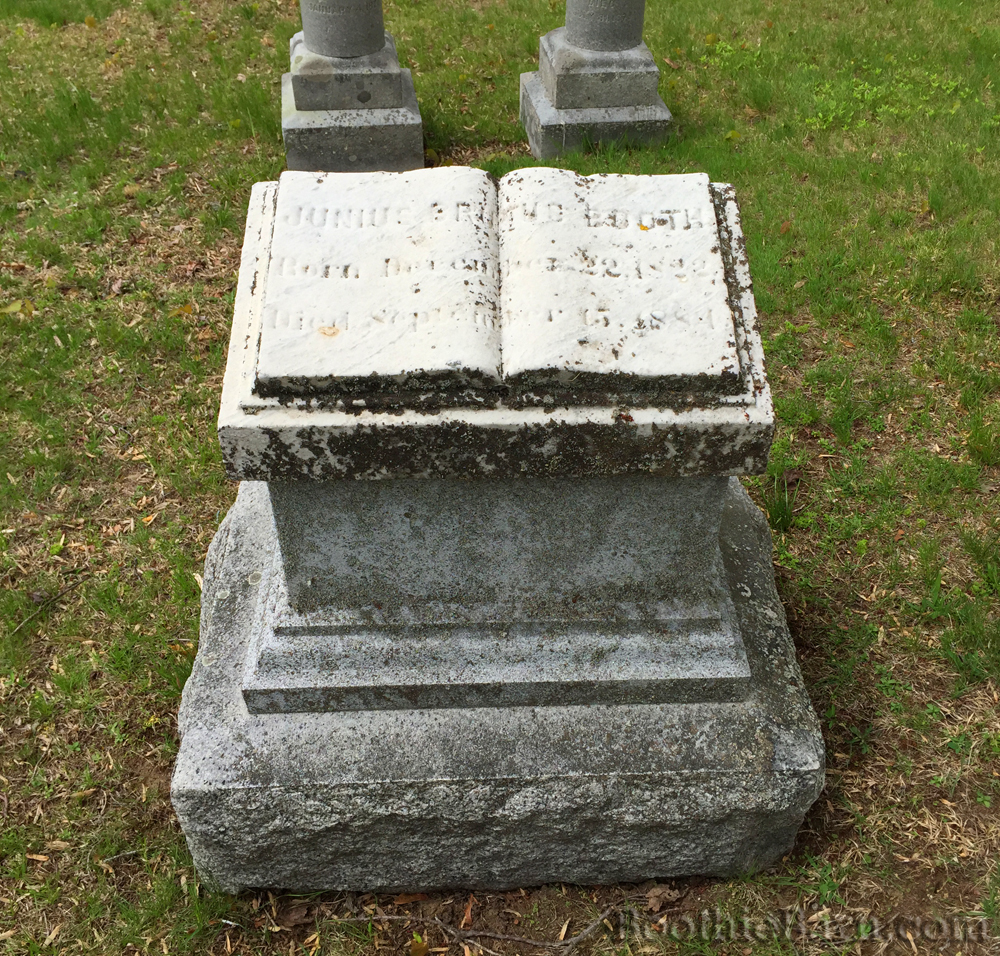
junius-brutus-booth-jr-grave-2-5-2015-boothiebarn

junius-brutus-booth-jr-grave-5-2015-boothiebarn

junius-brutus-booth-jr-grave-plot-5-2015-boothiebarn

Connection to the Lincoln assassination:

Junius Brutus Booth, Jr. was the eldest brother of John Wilkes Booth, the assassin of Lincoln. For much of his younger brother’s upbringing, June (sixteen years John Wilkes’ senior) was acting in California. By the time June returned from the west, John Wilkes was grown and beginning his own acting career. Nevertheless, out of all of the Booth brothers, June may have had the closest relationship to John Wilkes. The differences in their ages and June’s more substantial life experiences likely made June a surrogate father figure to his younger brother. John Wilkes also took great interest in the lives of June’s children, doting upon and nurturing the acting careers of his nieces. More than anyone else in the family, June was the most sympathetic to John Wilkes’ political views. While June did not address politics with the same passion as John Wilkes, he was, nevertheless, more Confederate in his sympathies than the other Booths during the Civil War. However, June knew that he was a father and breadwinner to his children first and so he kept most of his sympathies to himself to protect his income and family.

While John Wilkes was close to June, he did not confide in him about his plot against Lincoln. In spring of 1865, John Wilkes kept up the charade among his family that he had made a fortune in the oil business and that he need not act upon the stage any more. Shortly before Lincoln’s assassination, June had learned the truth of John Wilkes’ failure in his oil ventures and wrote to him to “let go yr oil bus.” and “attend to your profession”. June was unaware that, since his failure in the oil fields, John Wilkes had referred to his plot to kidnap Lincoln as the “oil business”. When detectives found June’s letter while searching John Wilkes’ rented room at the National, they believed the elder Booth might have known of his brother’s plot. After barely escaping mob justice in Cincinnati where he had been performing, June was arrested at his sister’s house in Philadelphia. He and his brother-in-law, John Sleeper Clarke, were kept at the Old Capitol Prison in D.C. until they were released in the month of June.

Post assassination, Junius Brutus Booth returned to his career as an actor and theater manager. He married his third wife, Agnes Perry, in 1867 and had four boys with her, two of whom would survive into adulthood and become actors themselves. In his later years, Junius moved to Manchester-by-the-Sea in Massachusetts. June and Agnes opened and ran a large hotel called the Masconomo House where they often arranged for outdoor theatrical performances, including some of the earliest “Shakespeare in the Park” performances that had ever occurred.

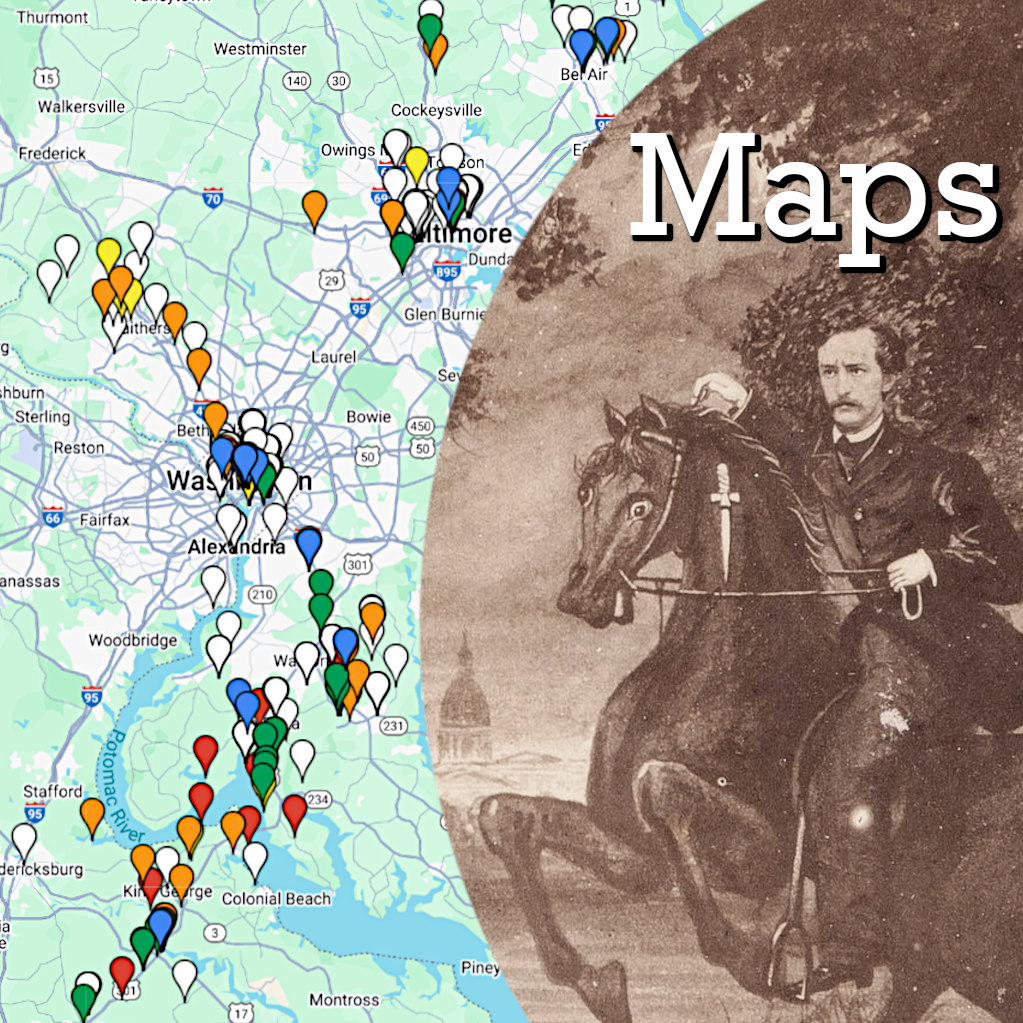
When Junius Brutus Booth, Jr. died in 1883 he was not interred in the Booth family plot at Green Mount Cemetery in Baltimore. Instead, June is buried in Manchester-by-the-Sea at Rosedale Cemetery. His two young sons by Agnes preceded him in death. Agnes and a third son, Sydney Barton, were later buried in the same plot. Check out the Maps page for more details. For more images of Junius Brutus Booth, Jr., his wives, and his children, visit the Junius Brutus Booth, Jr. Picture Gallery.

GPS coordinates for Junius Brutus Booth, Jr.’s grave: 42.582743, -70.768894

Categories: Grave Thursday, History | Tags: , , | 1 Comment

Dr. Mudd’s Suicide Attempt

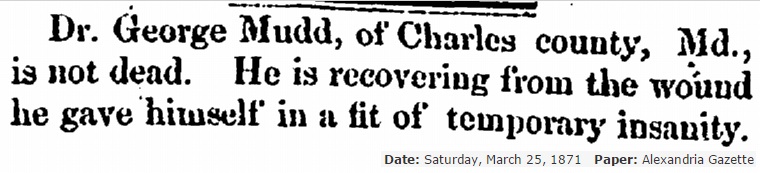
1871 must have been a rough year for a certain Charles County physician. In late March of that year a few of the regional newspapers carried stories about the apparently successful suicide of Dr. Mudd who played a small role in the story of Lincoln’s assassination.

suicide-attempt-of-dr-george-mudd

The Dr. Mudd reported to have committed suicide by cutting his own throat was not Dr. Samuel Mudd, but rather his second cousin, Dr. George Dyer Mudd.

George Mudd

This “other” Dr. Mudd was actually the elder of the doctors Mudd. George even sponsored his younger cousin, Samuel, when the latter was applying for his doctorate in medicine.

Unlike his younger cousin, Dr. George Mudd was a Union supporter during the Civil War and as such was well liked and known among the Union soldiers who occupied Charles County. It was likely due to this reason that Dr. Samuel Mudd chose to confide to Dr. George Mudd that two “strangers” had come to his house on the morning of April 15th, after the assassination of President Lincoln. Samuel told this to George on April 16th, when both men attended Easter Sunday services at St. Peter’s Church. Dr. Sam hinted to Dr. George that he was worried that these two men might have been connected with Lincoln’s death, but did not put too fine a point on this suspicion. George Mudd said he would tell the authorities, but did not actually report the news until the next day. The authorities eventually followed up on Dr. George Mudd’s lead, and pretty soon the whole family’s name was Mudd due to his younger cousin’s well established acquaintance with John Wilkes Booth.

Despite what the papers initially reported in March of 1871, however, Dr. George Mudd did not succeed in his attempt to kill himself. A correction was quickly published.

suicide-attempt-of-dr-george-mudd-2

Further information was published in the local newspaper, The Port Tobacco Times, on March 24th. The article started with a copy of one of the original notices citing Dr. Mudd’s death by suicide:

“The above, which we find in the Baltimore papers of Wednesday last, is incorrect, and we copy it merely to correct the misstatements of false rumors, growing out of a very unfortunate affair. From trustworthy sources we learn that on Sunday morning last, during a fit of temporary insanity, superinduced by mental prostration, Dr. Mudd did attempt to take his own life but was prevented by friends, but not until he had inflicted an ugly cut upon his throat. The wound is by no means fatal, and, at last accounts, the Doctor is pronounced out of danger.”

Dr. George Mudd recovered from his suicide attempt and it does not appear he ever tried to take his own life again. Instead, two years later, Dr. George Mudd enter politics and was elected as a state senator. When he was re-elected to the legislature in 1876, many newspapers confused him with his infamous cousin.

Categories: History | Tags: , , | 11 Comments

The Boston Corbett Supper Club

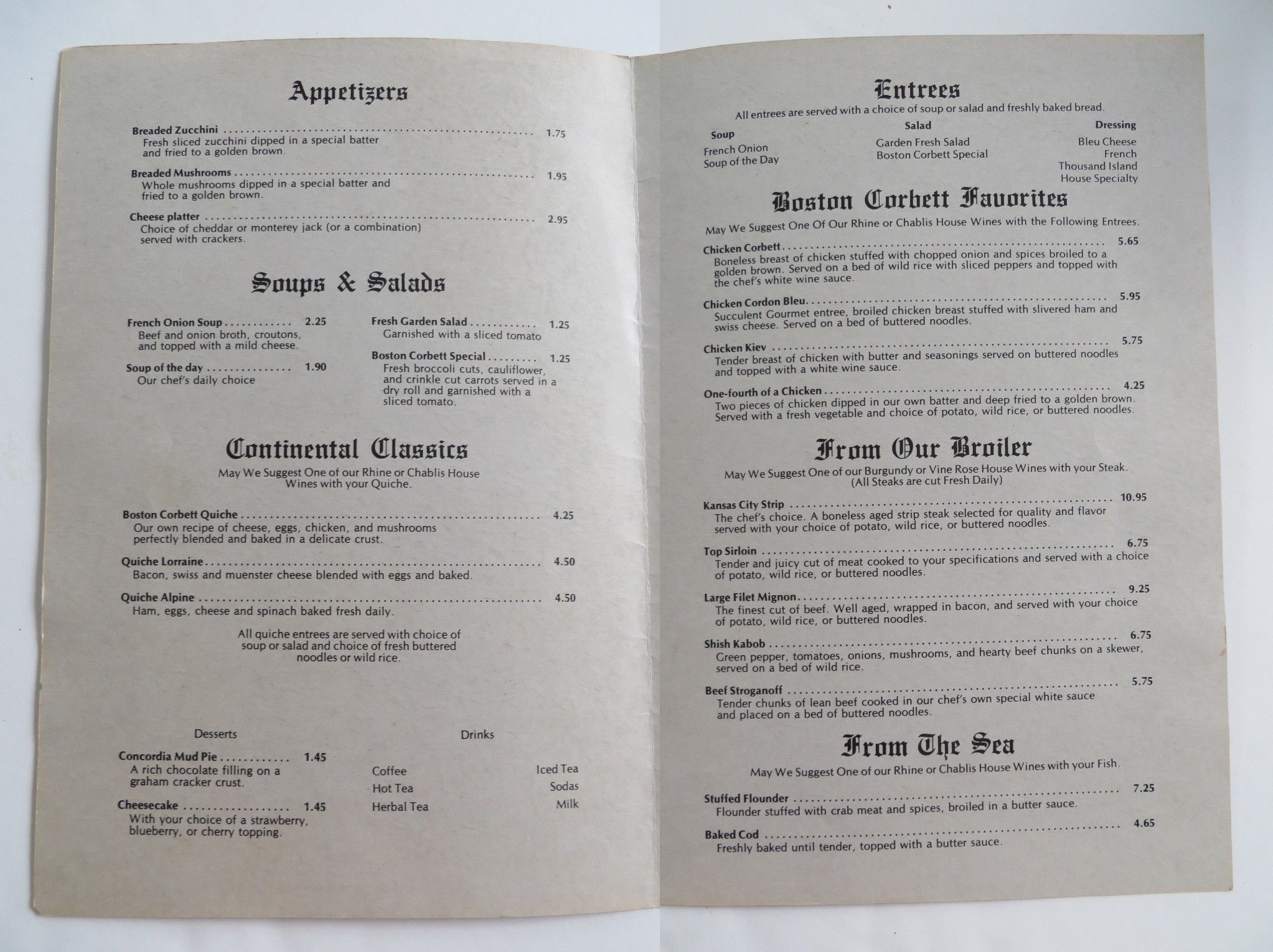
I stumbled across this oddity on eBay tonight. It is a menu from a restaurant called the Boston Corbett Supper Club.

Boston Corbett Supper Club Menu 1

Boston Corbett Supper Club Menu 2

The menu features a drawing of the avenger of Lincoln on the front and, on the inside, a few of the menu items are named after the famous sergeant from the 16th NY Cavalry. Corbett’s honorary dishes include a salad called the Boston Corbett Special containing a variety of cut vegetables, perhaps alluding to Corbett’s expertise with sharp blades. The Boston Corbett Quiche is “baked in a delicate crust” not unlike Corbett’s delicate mind. And under the heading of “Boston Corbett Favorites” is what must be the sergeant’s signature dish, Chicken Corbett, which is “broiled to a golden brown” not unlike John Wilkes Booth in the Garrett barn.

The rear of the menu contains a short biography of Boston Corbett’s life.

Boston Corbett Supper Club Menu 3Noticeably missing from this brief biography is any mention of Corbett’s paranoia induced nervous breakdown in 1887 in which he made threats and waved a gun at representatives in the Kansas state house. For this mania he was committed to an asylum before managing to escape into oblivion.

After a little searching, I found that the Boston Corbett Supper Club had been located in Concordia, Kansas. Starting in 1878, Boston Corbett resided just north of Concordia in a dugout structure built into a hill. I drove out to Corbett’s dugout home, visiting other sites along the way, last summer. You can see my images and videos from that trip here.

The Boston Corbett Supper Club was used as a venue for wedding rehearsal dinners and receptions in the Concordia area and even supported Concordia’s annual 4th of July fireworks display. Unfortunately, a supper club based around the brave avenger of Lincoln who was also a partially crazed eunuch couldn’t make ends meet and so “Providence directed” it to close in the early 1990’s.

Though we missed out on our chance to dine at the Boston Corbett Supper Club, its menu has me thinking about opening my own Lincoln assassination restaurant in the future. For possible dishes I’ve thought of: Our American Couscous, Sic Semper Tilapia, Seward Skewers, George’s Beer-Battered Yellow Croaker, Physician’s Pie a la Mudd, and John Wilkes Bologna Sandwich.

Let me know your ideas for menu items in the comments below.

Categories: History, Levity | Tags: , , | 10 Comments

Grave Thursday: General Levi Dodd

In an effort to get back to posting on a more regular schedule, I’ve decided to attempt a weekly post entitled, Grave Thursday. Each week I will highlight the final resting place of someone related to the Lincoln assassination story. It may be the grave of someone whose name looms large in assassination literature, like a conspirator, or the grave of one of the many minor characters who crossed paths with history. They won’t be lengthy posts, but they will be something to look forward to between my increasingly irregular research intensive pieces.


Bvt. Brig. Gen. Levi Axtell Dodd

Gen Levi Dodd

Burial Location: Green Mount Cemetery, Baltimore, Maryland

Levi Dodd's Grave Green Mount

Connection to the Lincoln assassination:

On May 2, 1865, Col. Levi Axtell Dodd of the 211th Pennsylvania Volunteers was assigned duty under the command of Maj. Gen. John Hartranft. At that time, General Hartranft had been assigned as the commander of the Old Arsenal Penitentiary in Washington, D.C. and was charged with the imprisonment and care of the Lincoln assassination conspirators as they underwent trial. Col. Dodd joined Hartranft’s staff and would serve under him. Dodd’s major duties were to supervise the prisoners. Reports show that he supervised George Atzerodt as the latter bathed. After the day’s trial proceedings were over, Dodd would also stay in the court room with some of the prisoners when their lawyers wished to counsel with them. Dodd also supervised visits between the conspirators and their guests, sitting in on a meeting between Mary Surratt and her friend Mr. Kirby. After the execution of four of the conspirators, Dodd, who was subsequently brevetted as a brigadier general due to the recommendation of General Hartranft, was given the task of escorting the four remaining conspirators to their distant prison of Fort Jefferson off of the coast of Florida. This task he completed, earning the appreciation of Dr. Mudd who stated that Gen. Dodd allowed the lily iron handcuffs to be removed from the conspirators during part of the voyage. Dr. Mudd’s appreciation of Gen. Dodd would not last, however. Upon returning back from Fort Jefferson, Dodd, along with two others who accompanied the conspirators, would state that on the journey to the island prison Dr. Mudd confessed that he had known the identity of John Wilkes Booth the moment the assassin showed up at his door. According to Dodd and the others, Dr. Mudd lied about not knowing Booth due to his own fear of punishment.

It is also interesting to note that Levi Dodd was born in Franklin, a small town in Venango County, Pennsylvania. In 1864, John Wilkes Booth traveled to Franklin and invested a great deal of his wealth in the oil fields nearby. Booth and some of his pals sunk quite a lot of money into a well in Franklin called the Wilhelmina, but the enterprise was a failure.

Gen. Dodd is buried in Green Mount Cemetery in Baltimore, the very same cemetery as John Wilkes Booth and many others connected to the assassination of Lincoln. Check out the Maps page for more details.

GPS coordinates for Gen. Levi Dodd’s grave: 39.306333, -76.604881

Categories: Grave Thursday, History | Tags: , , , , | 24 Comments

Mudd and a Broken Leg

In the “Weird Coincidence” file of Lincoln assassination trivia, we find this little gem.

In 1868, a horse fell on, and broke, the leg of James Mudd, the brother of Dr. Samuel Mudd:

James Mudd suffers a broken leg 1868

Since his brother was serving a life sentence at Fort Jefferson at the time for the assistance he gave to another man with a broken leg, James Mudd had to seek medical help from a different local doctor, Dr. William Boarman (misspelled as “Bowman” in the article).

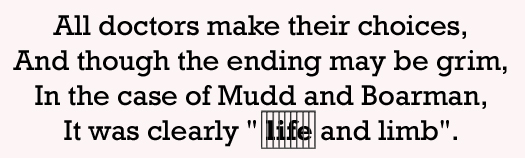
Setting James’ broken leg was the second piece of assistance that Dr. Boarman provided to the Mudd family. In 1865, he had testified on Dr. Mudd’s behalf at the trial of the conspirators. Dr. Boarman testified about meeting John Wilkes Booth at St. Mary’s Church in November of 1864 and that the actor told him he was in the area looking for land to purchase. We know now that Booth’s true purpose was to scout the escape route for his abduction plan and to recruit conspirators in Southern Maryland. Perhaps if Dr. Mudd had turned John Wilkes Booth down, the actor might have confided his plans to Dr. Boarman instead. All of this is to say that Dr. Boarman probably had no qualms about treating James Mudd while the latter’s brother was in prison. Considering the trouble Boarman might have been in had Dr. Mudd not welcomed John Wilkes Booth into his home, setting Mudd’s leg was a far favorable alternative. Or, to say it another way:

Mudd and Boarman

Categories: History, Levity | Tags: , , , | 1 Comment

“The Murderer: John Wilkes Booth and the Plot Against Lincoln” at the ALPLM

Almost a year ago, I was contacted by representatives from the Abraham Lincoln Presidential Library and Museum in Springfield, Illinois. Though I was right in the middle of setting up my classroom for a new school year (at a brand new school, and grade, actually), I dropped everything to take the call from employees of such an esteemed institution. As part of their volunteer educational programming, the ALPLM asked me if I would be willing to come to Springfield in the upcoming year and give a talk about the assassin of President Lincoln. I suppose it is not difficult to ascertain what my response was. After a few victory laps around my minefield of classroom, I settled in for the long wait until summer.

Dave Taylor at the ALPLM 6-29-2016

Less than a month ago, on June 29, I was humbled to present my speech, “The Murderer: John Wilkes Booth and the Plot Against Lincoln” for the wonderful folks at the ALPLM. The museum was kind enough to record my presentation and put it on YouTube, and so I have embedded the video below. It misses some of the fancy animations I included in my PowerPoint but is of far better quality than I could have ever done. The video below includes the lively question and answer session that followed the speech where we cover several other Lincoln assassination topics beyond John Wilkes Booth.

In addition to the speech, I spent my time in Springfield visiting the Lincoln sites and viewing several of the ALPLM’s assassination related letters and artifacts. Altogether, the speech and visit to the ALPLM are among the highlights of my “career” as a “historian.” I would like to thank Jeremy Carrell, Barbara McKean, Samuel Wheeler, Dr. James Cornelius, David Grimm, and Chuck Hand for setting everything up and for their hospitality in, and around, the ALPLM.

It was truly an honor to speak at the ALPLM and, if you have the time, I hope you enjoy the speech below.

Categories: History, News | Tags: , , , , | 20 Comments

Inside Thomas Jones’ Huckleberry

Thomas Austin Jones has gone down in history for the assistance he gave assassin John Wilkes Booth and his accomplice David Herold. Jones not only cared for the two fugitives as they hid out in a pine thicket in Charles County, but he also transported Booth and Herold from the thicket to the shores of the Potomac from which they got into a boat and attempted to row across to Virginia.

Thomas Jones 1

Thomas Jones, who was born in the Port Tobacco area in 1820, owned two houses in Charles County during the Civil War. It was from his larger home on the Potomac River called Ravenscliff that Jones began his career as a mail agent for the Confederacy, but by 1865, his financial situation and death of his wife had caused him to downsize his estate to the more modest Huckleberry farm. Jones was living at Huckleberry with his nine children when Samuel Cox, Jr. showed up on the morning of April 16th and beckoned Jones to return with him to his father’s farm of Rich Hill. At Rich Hill, Jones would learn about Cox’s nighttime visitors and be given the task of caring for the fugitives while looking for an opportunity to get them across the Potomac.

Huckleberry-Animation

Today, as part of the Maryland House and Garden Pilgrimage in Charles County, Thomas Jones’ home of Huckleberry was open to the general public for the first time in 56 years when it was featured in the 1960 Maryland House and Garden Pilgrimage. The house has been remodeled and updated since Thomas Jones’ days but still maintains much of its same 1865 character.

Huckleberry exterior

Huckleberry door

Huckleberry Parlor

Huckleberry stairs

Huckleberry meeting room

Huckleberry kitchen

Jones Mantle

These images, along with the watchable yet somewhat motion sickness inducing video that follows, were all taken today after the garden tour was completed. About 450 people showed up and toured through Huckleberry while I stood in the room with chairs giving visitors a brief overview of Thomas Jones and his life before, during, and after John Wilkes Booth.

The visitors truly seemed to enjoy learning more about this unique man and his role in the Lincoln assassination story. Probably the most interesting little known fact about Thomas Jones is that, in 1893 when he traveled to the World’s Fair in Chicago in order to try to tell his book about helping Booth, Jones actually borrowed and brought with him two artifacts from Dr. Mudd’s house. The Mudd family allowed Jones to borrow the bed that Booth slept in at the Mudd house along with the parlor sofa on which John Wilkes Booth laid on while Dr. Mudd had inspected his leg. Having these artifacts did not help Jones much, however. His book sold very poorly in the Land of Lincoln and he came back to Charles County with many copies of the book and a great deal of debt from the venture.

Though it is impossible to say the next time that Huckleberry will be open to public tours again, the Loyola on the Potomac Retreat House has done a wonderful job as stewards of the house and property since they acquired it in the 1950’s. So even if Huckleberry waits another 56 years before being on the garden tour again, I think, in the meantime, it will stay in very good hands.

Categories: History | Tags: , , , , , | 18 Comments

Blog at WordPress.com.