Posts Tagged With: John Wilkes Booth

Replica Booth Diaries for Sale Again!

Looking for that special gift for the Lincoln assassination aficionado in your life? How about a replica of the diary John Wilkes Booth used during his 12 day escape?

A few years ago, I assisted a prop maker named Pasquale Marsella to create near perfect replicas of John Wilkes Booth’s diary. Using photographs of the diary that were taken during the 1970s, Mr. Marsella was able to reproduce the interior of the diary with amazing detail. The interior of these replicas contained Booth’s own handwriting and duplicated the number of missing and torn pages exactly. Mr. Marsella created only a limited number of diaries and quickly sold out of them. I was fortunate enough to purchase one of the diaries, as did the Surratt House Museum, which keeps the replica on display in their visitor center.

Replica Booth diary on display at the Surratt House Museum

In the years since Mr. Marsella’s first run of diaries, demand for the replicas has been high. In 2015, I was contacted by producers at the Smithsonian Channel who were hoping to get their own replica diary for use in a documentary. I had to inform them that Mr. Marsella had no more left. Instead, I agreed to lend them my replica diary for use in their documentary, Lincoln’s Last Day:

Over the last few years I’ve had several other folks contact me hoping they could purchase diaries, and I sadly also had to inform them that Mr. Marsella had no more left and wasn’t making them anymore. However, Mr. Marsella has recently decided to do another run of his diaries which are available for purchase!

In this second run of diaries, Mr. Marsella has made some improvements from his earlier design. The new replicas utilize a higher quality leather which is softer and gives the diary an older look and feel than previous models. Further, Mr. Marsella is including a more accurate piece of brass on the outer part of the diary. During the last few years, Mr. Marsella has improved his technique for aging paper, giving these new diaries a more authentic “old” look to them. Lastly, the interior pockets marked “Postage” and ” Tickets” are no longer just sewn on displays, but fully functioning pockets like on the real diary.

One of Pasquale Marsella’s new, second run of John Wilkes Booth diaries

This second run of replica John Wilkes Booth diaries consists of only 30 diaries, several of which have already been sold. The limited amount is due to the time consuming process of detailing and tooling the leather, which Mr. Marsella does himself.

Mr. Marsella is selling his limited number of John Wilkes Booth diary replicas for $375 each plus $30 shipping. Payment is accepted through PayPal. Due to the nature of his work, Mr. Marsella will need 25 days from receipt of payment to complete each diary. If you are interested in purchasing a replica diary, please email Mr. Marsella directly at pasqualemarsella@yahoo.it and he will give you instructions on how to pay through PayPal.

If you have any questions about the diaries feel free to leave a comment below or email Mr. Marsella directly. As an owner of one of Mr. Marsella’s replica diaries, I can say that his workmanship is impeccable. I have used this diary as a prop during my own reenactments as John Wilkes Booth, I’ve brought it along with me to speeches, and I always carry it when I give the John Wilkes Booth escape route bus tour. You should see the interest in people’s faces when I pass around my handmade, Italian crafted (Mr. Marsella lives in Italy) replica John Wilkes Booth diary. Everyone on the bus enjoys leafing through the pages and seeing John Wilkes Booth’s handwriting duplicated exactly. They have no idea that the piece is so exactly duplicated that even the missing and torn pages in the replica match the real McCoy in the Ford’s Theatre museum. My diary has passed through many hands in the 4 years that I have had it and it’s holding up great.

Yours truly showing off his own replica Booth diary while presenting at the Abraham Lincoln Presidential Library in Springfield, Illinois

I truly enjoy giving Mr. Marsella some free advertising and assisting him in selling his diaries because he provides such a unique and well-crafted piece that you can’t get anywhere else. Get yours today before they’re gone once more.

Categories: History, News | Tags: , , , , , | 25 Comments

“You know best, Captain” The Executed Conspirators in Lincoln’s Assassination

On June 27, 2017, I was fortunate enough to return to the Abraham Lincoln Presidential Library and Museum in order to speak to their volunteers and members of the public. The topic of my talk revolved around the four conspirators who were executed for their involvement in John Wilkes Booth’s plot against Lincoln. The following is a video of that talk that the ALPLM was kind enough to put on YouTube:

In the process of researching and writing this speech I consulted many excellent books. Specifically, I’d like to point out the vital scholarship of Betty Ownsbey in her book on Lewis Powell and the research of Kate Clifford-Larson in her book about Mary Surratt. These texts are a wealth of information and proved invaluable in preparing for this speech. I would also like to thank Betty Ownsbey and Dr. Blaine Houmes for allowing me to use some of their images in this speech.

The day before the speech I gave a radio interview to WTAX, the local Springfield station, about the speech and my interest in the Lincoln assassination. It’s only about 5 minutes long and can be heard here: https://soundcloud.com/news-radio-wtax/6-26-17-dave-taylor-lincoln-assassination-expert-podcast

I’d like to thank the folks at the ALPLM for allowing me to come back and speak to their volunteers. I must admit that I definitely feel a strong sense of pride at being able to tell people that I’ve spoken at the Lincoln library. I had an amazing time touring the museum and being taken into the vault to see their treasures.

I hope you all enjoy the speech.

Dave

EDIT: For ease of access I’m also going to embed the video of my prior speech for the ALPLM in which I discussed John Wilkes Booth’s history:

Categories: History, News | Tags: , , , , , , , , , , | 16 Comments

In the Words of Asia Booth

Asia Booth Clarke was the chronicler of the Booth family. In the collection of the Maryland Historical Society in Baltimore are a series of letters Asia wrote to her life long pen pal Mary Jane “Jean” Anderson.

I decided to put together this animated .gif showing some of Asia’s words from her letters to Jean.

If you want to learn a little more about Jean Anderson, here is a short and unfortunately shaky video I recorded at her grave in Green Mount Cemetery:

Categories: History | Tags: , , , | 4 Comments

John Wilkes Booth’s Acting Debut

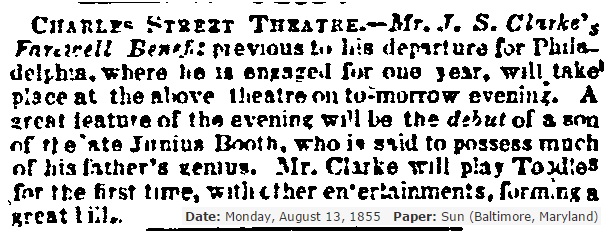
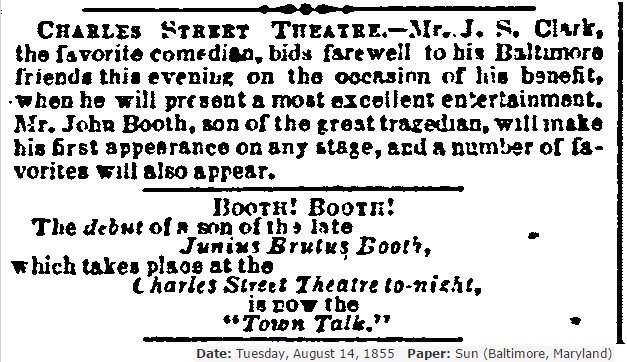
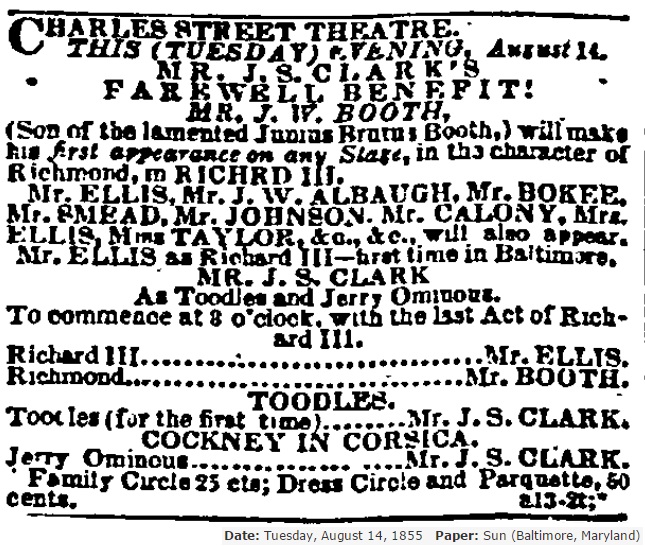
On August 14, 1855, John Wilkes Booth, the seventeen-year-old son of the late, great Junius Brutus Booth, made his professional debut upon the stage. For one performance only, John Wilkes Booth performed the role of Richmond in the third act of Shakespeare’s Richard III at Baltimore’s Charles Street Theatre.

As shown by the above newspaper advertisements, the performance was part of a benefit for Booth’s friend and fellow actor, John Sleeper Clarke. Clarke had known John Wilkes and Edwin Booth from their shared boyhood in Baltimore. The three boys and a few other friends used to perform together in self produced children’s shows for their neighbors, dubbing themselves The Tripple Alley Players. Using makeshift costumes and borrowed props the boys would stage shows in back rooms, stables, or cellars charging their friends a penny for a ticket. These performances definitely made an impact on the boys as four of The Tripple Alley Players would grow up to become professional actors. Clarke’s real name was John Sleeper and he had been nicknamed “Sleepy” by his peers. Seeing how such a name would make him a subject of ridicule on the stage, he wisely chose the stage name of John Sleeper Clarke for the rest of his life.

John Sleeper Clarke

It is interesting to note that this performance was not only the debut of John Wilkes Booth, but also the first time Clarke performed in the play of Toodles. This comedy would later become a staple for Clarke and the role he was best known for. As a benefit performance, Clarke was entitled to all of the box office returns for that night after expenses, so the young actor was eager to draw in as many patrons as possible. Clarke heavily advertised the debut of John Wilkes, the son of the great tragedian Booth, in order to pull in the largest audience he could. Sadly, there do not seem to be any reviews in the days that followed about John Wilkes’ performance. Booth himself, however, was very happy with his performance. He had not told his family of his intentions to act on the stage for Clarke and so they did not witness his debut. Instead he came riding back to Tudor Hall after the fact to inform them. The story of his return is recounted in Asia Booth’s memoir about her brother and follows below. Please note that the following text demonstrates racial language and views which are not acceptable today but were held by John Wilkes, Asia, and most of the Booth family.

“Wilkes went for a brief visit to Baltimore, and on the day of his return I was under the low trees outside our grounds pulling mandrakes, gathering may-apples and dew-berries. Six little darkies, seven dogs, and a couple of cats who always followed the dogs, were my company. Our baskets were partly filled, and the clatter of hoofs sounding clear, I looked out from the bushes to see Wilkes returning on Cola. He came up rapidly then dismounted, while the dogs yelped and the cats rubbed against his legs, and the piping querulous voices of the darkies called out in the uproar, ‘How do, Mars’ Johnnie.’

He had a greeting for all and threw a packet of candies from his saddle-case far beyond where we stood, saying, ‘After it, Nigs! Don’t let the dogs get it!’ The never-forgotten bag of candies was longingly looked for by the blacks, young and old, whenever ‘Mars’ Johnnie’ came from town or village.

Turning to me, he said, ‘Well, Mother Bunch, guess what I’ve done!’ Then answering my silence, he said, ‘I’ve made my first appearance on any stage, for this night only, and in big capitals.’

He had acted ‘Richmond’ at the St. Charles’ Theatre [sic], Baltimore. His face shone with enthusiasm, and by the exultant tone of his voice it was plain that he had passed the test night. He had made his venture in life and would soon follow on the road he had broken. Mother was not so pleased as we to hear of this adventure; she thought it premature, and that he had been influenced by others who wished to gain notoriety and money by the use of his name.”

Mary Ann Booth was right on the money when she expressed her belief that Wilkes had been used for the sake of his name in his first performance. Clarke asked his friend to perform, literally, for his own benefit. Even from early on, Clarke understood the power in the Booth name and sought to gain from it. Later he would go into business with Edwin Booth and then come into the family by marrying Asia. However, even if Clarke’s inclusion of John Wilkes as an actor stemmed from his own self-interest, he did help foster the young man’s growth. When the next theatrical season began, Clarke got John Wilkes a job as a stock actor in Philadelphia. From here Booth would start down the road of learning his craft. Thus, it is from this minor performance in Baltimore’s Charles Street Theatre, that John Wilkes Booth’s career as an actor began.

References:
John Wilkes Booth Day by Day by Arthur F. Loux
John Wilkes Booth: A Sister’s Memoir by Asia Booth Clarke edited by Terry Alford
Newspaper extracts from Genealogybank.com

Categories: History | Tags: , , , , | Leave a comment

Grave Thursday: The Montgomery Theatre

Each week we are highlighting the final resting place of someone related to the Lincoln assassination story. It may be the grave of someone whose name looms large in assassination literature, like a conspirator, or the grave of one of the many minor characters who crossed paths with history. Welcome to Grave Thursday.


The Montgomery Theatre

Burial Location: 39 S Perry St, Montgomery, Alabama

Connection the the Lincoln Assassination:

For this week’s Grave Thursday we are dealing with the death of a place, rather than a person. The place is the old Montgomery Theatre in Montgomery, Alabama which is currently in the final phases of demolition.

In the fall of 1859, Colonel Charles T. Pollard, president of the Montgomery and West Point Railroad, commissioned the construction of a new theater in Montgomery, Alabama. The brick contractor was B. F. Randolph who used his female slaves as the laborers for the theater’s masonry and plastering. By October of 1860, the large and stately Montgomery Theatre was completed. The first lessee and manager of the theater was Matthew Canning, who opened the theater with his troupe of actors on October 22, 1860.

Matthew W. Canning

22 year-old John Wilkes Booth was part of Matthew Canning’s troupe of actors.  Booth’s tour with Canning was his first as a star performer. Prior to this he had been learning his craft in Philadelphia and Richmond. Attempting to succeed on his own talents rather than his prestigious family name, he had been and was continuing to be billed “J. B. Wilkes” or “John Wilkes”.

When the Canning troupe presented the grand opening performance of the show, School for Scandal, at the Montgomery Theatre, John Wilkes Booth was not present. Ten days earlier, when the troupe had been in Columbus, Georgia, Booth had suffered an accidental gunshot wound to his thigh. Though stories differ, the most reliable account holds that Booth and Canning were attempting to clean a pistol when the weapon accidentally discharged. This gunshot wound ended Booth’s performances in Columbus and caused him to sit out most of his starring performances in Montgomery as well.

John Wilkes Booth finally made his debut at the Montgomery Theatre on Monday, October 29, 1860, when he performed as Pescara in The Apostate. He would perform for the rest of the week before closing his engagement to recuperate further. John Wilkes Booth was resting in Montgomery, Alabama when Abraham Lincoln was elected the 16th President of the United States on November 6, 1860.

On November 16, Booth returned to the stage of the Montgomery Theatre in a benefit performance for his fellow actor, Kate Bateman. Booth played Romeo to Bateman’s Juliet.

The troupe’s final day at the Montgomery Theatre was on December 1, 1860 in a benefit performance for Booth himself. Booth performed in a two act play called Rafaelle, the Reprobate, and then his fellow actor, Maggie Mitchell, performed in Katy O’Sheal. The evening was ended with Booth performing the titular character in the fifth act of Shakespeare’s Richard III. This performance marked the end of Booth’s engagement in Montgomery but it also marked a new beginning for the young actor. It was on the stage at the Montgomery Theatre that John Wilkes Booth reclaimed his true name and was billed as J. Wilkes Booth. From this day onward, the actor would always use his true name.

John Wilkes Booth would never return to Montgomery, but the beautiful theater he helped to christen would continue to operate for many years. Edwin Booth would perform on the same stage in 1876, 1882, and 1888 along with countless other luminaries of the stage.

After 47 years of operation, the Montgomery Theatre was closed on November 13, 1907 when a newer, grander theater was opened in the city. The old theater’s interior was remodeled into a department store but the outside retained its original construction. The Webber department store lasted until the 1990’s when it finally closed. After a few years the building was bought by a foundation which paid almost half a million dollars to replace the roof. In 2010, the foundation sold the building to a developer who planned to restore the structure and create retail and housing space within the interior. Unfortunately while work was being done to restore the building in June of 2014, the structure suffered a partial collapse.

Though the hope was that the restoration would continue, the owner of the building didn’t have the funds to continue after the collapse. The ownership of the building reverted to the city of Montgomery in December of 2014. The city valiantly made efforts to find a buyer willing and financially able to restore the structure, offering to sell structure for $1 to any developers who would restore it. In the end, however, the city could not find a buyer with the means to restore the building. The property was sold off and slated for demolition which began in late 2016. Here is how the building looked on March 30th of this year:

Though the Montgomery Theatre building could not be saved, deconstruction of the building has been slow to allow for the salvage of some of the structure’s cast iron, bricks, and masonry pieces. Some of the windows of the theater are also being saved and will be given to the local historical society.

Despite the loss of the Montgomery Theatre building, the history of the site will not be lost. There is a historic marker that will be returned once construction on the site is completed. In addition, the company that is redeveloping the property has vowed to, “include a plaza and information to recognize the building’s history.”

I want to close this post with the words of an old time Montgomery resident by the name of Frank P. O’Brien. O’Brien was present the night the Montgomery Theatre opened in 1860. When the theatre closed in 1907 he gave his reminiscences of the many plays and actors that had graced its stage. At the end of the article, O’Brien stated the following words, which are very fitting today:

“Wednesday night, November thirteenth, the curtain was ‘rung down’ in the old play-house to give way to one of more modern construction. The soft glow of unforgotten scenes alone is left to me, and many whose hearts have throbbed with hope for future years, as nightly we ascended the broad stairs from the street to listen to and witness scenes of comedy, music, and tragedy. Thus is marked the passing of the glory of the old Montgomery theatre…There is not one of us who has not gone up the wide stairs loving, and come down them loving the more. There is not one of us who has not left some weight of the soul there and never returned to claim it.

Vale! old house, the ghostly shadows of scenes long to be remembered will continue to hover within thy hallowed walls ’till the inevitable march of progress hastens thy destruction.”

GPS coordinates for the former site of Montgomery Theatre: 32.378385, -86.307671

Categories: Grave Thursday, History, News | Tags: , , , | 4 Comments

“An Evening with John Wilkes Booth”

On March 3, 2017, I presented at an event for the Friends of Rich Hill and the Society for the Restoration of Port Tobacco. The event venue was the restored Port Tobacco courthouse in Port Tobacco, Maryland. Though Port Tobacco is the former stomping grounds of conspirator George Atzerodt, the subject of this event was the lead assassin, John Wilkes Booth. While I have given speeches about Booth in the past, including my 2016 speech for the Abraham Lincoln Presidential Library and Museum volunteers, I had never previously attempted to portray John Wilkes Booth in the first person. The event in Port Tobacco, billed as “An Evening with John Wilkes Booth”, was my first attempt at being John Wilkes Booth, rather than just discussing John Wilkes Booth.

The following play is meant to provide an insight into the mind of John Wilkes Booth by utilizing much of his own words and writings. Some of the words said by Booth are uncomfortable to hear, but they are vital if we are to truly understand the world view of Lincoln’s assassin. The video of the performance is embedded below or you can watch it directly on YouTube by clicking here.

EDIT: I just realized that today is the five year anniversary of my very first posting here on BoothieBarn. When I started this site, it was an outlet for me to share some of the interesting things I had learned while researching the Lincoln assassination. I didn’t really know if it would be of interest to anyone other than myself. However, through this site I have made many wonderful friends and have been fortunate enough to speak about John Wilkes Booth and Lincoln’s assassination in several venues. And so after 5 years, 400+ posts and almost 600 followers later, I want to thank you all for your much appreciated support. As long as I keep finding interesting things about the Lincoln assassination to share, I expect posts will continue here on BoothieBarn for many more years to come.

Categories: History, News | Tags: , , , , , , , , | 10 Comments

Grave Thursday: Dr. Charles Urquhart

Each week we are highlighting the final resting place of someone related to the Lincoln assassination story. It may be the grave of someone whose name looms large in assassination literature, like a conspirator, or the grave of one of the many minor characters who crossed paths with history. Welcome to Grave Thursday.


Dr. Charles Urquhart, Jr.

dr-urquhart-grave-1

Burial Location: Urquhart Family Cemetery, Locust Grove, Virginia

dr-urquhart-cemetery-1

Connection to the Lincoln assassination:

At about 4:00 am on the morning of April 26, 1865, Dr. Charles Urquhart, Jr. was hastily awakened from his bed in Port Royal, Virginia. The doctor was just a little shy of 65 years old and had been the resident physician in Port Royal since he first moved to Caroline County from Germanna, Virginia in 1821. Over the last forty years, Dr. Urquhart had become a pillar of the Port Royal community, serving not only as town doctor but also as a deacon at St. Peter’s Church and master of the masonic lodge in town for about 10 years. In 1853, Dr. Urquhart had married Louisa Care, a long time neighbor of his who was about 30 years his junior. The pair’s only child, a daughter named Finella “Nellie” Urquhart, was born in 1861. The Urquhart family owned several pieces of property in Port Royal but made their home right on the shore of the Rappahannock River. Their home was located just a few yards away from the landing for the ferry that ran between Port Royal and Port Conway on the other side of the river.

dr-urquharts-home-circa-1930

Dr. Urquhart’s home in Port Royal, Virginia as it appeared circa 1930. Image Source: Surratt House Museum

The good doctor may have been accustomed to receiving late night/early morning visitors who were in need of medical attention, but nothing could prepare him for this unique house call. Upon answering the door, Dr. Urquhart was met by a Union soldier who hastening him to get dressed and come with him a few miles south of Port Royal to the farm of Richard H. Garrett. By following the soldier’s command, Dr. Urquhart rode into the pages of history.

When the doctor arrived at the Garrett farm, he saw a tobacco barn being completely consumed by fire, a man with his arms tied behind a tree, and a detachment of over 20 Union solders meandering about the grounds. On the front porch of the house, Dr. Urquhart was presented with his patient; a young man about 25 years of age who was suffering from an apparent bullet wound to the neck. His name was John Wilkes Booth and he was the wanted assassin of President Abraham Lincoln.  The soldiers and detectives that were present pounced on the doctor to give his prognosis of the patient. Detective Luther Byron Baker stated:

“We asked the surgeon to examine him, to see if he would live. The surgeon examined him for ten or fifteen minutes, & probed the wound, though I told him the ball had gone through the neck. At first he said he thought Booth might live, he then expressed a different opinion, saying he could not survive… While the surgeon was examining him, he seemed to be unconscious. He slowly rallied afterwards, then sunk away. His mouth and lips began to look purple, and his throat became swollen.”

There was nothing Dr. Urquhart could do for the assassin other than to monitor him and direct the soldiers and Garrett ladies who were tending to him. Booth, as stated, had already lost consciousness before the doctor had arrived. Urquhart was, therefore, not present when Booth issued his final words of “Useless, Useless” while looking at his own hands. According to Baker, John Wilkes Booth died, “not half an hour after the physician pronounced his case hopeless.”

death-of-the-assassin-booth-urquhart

It was at the death of John Wilkes Booth that the Garrett family procured a small remembrance of the man they had unknowingly cared for during the past two days – a small lock of the assassin’s hair. There are many stories about who exactly cut the lock from Booth’s head, with one of the stories giving the credit to Dr. Urquhart. Lucinda Holloway, Mrs. Garrett’s sister and live-in teacher of her children, later told the story of Booth’s death to a newspaperman. The reporter then wrote, “A little struggle just as [Booth] died threw a lock of his jet black hair over his marble white forehead, which Dr. Urquhart clipped off at the request of Miss H[olloway], she thinking it would be a sweet memento for some friend or relation of his.” It would take a few years but eventually, in 1878, Edwin Booth did receive from the Garrett family a lock of hair cut from his brother’s head at the time of his death. It was not, however, the complete lock of hair the family had procured. The balance of the treasured item remained in the Garrett family for many years more.

Despite his brush with a note worthy event, it does not appear that Dr. Urquhart ever recorded his thoughts on being present at the death of John Wilkes Booth. In truth, however, he didn’t have that much time to reflect on his involvement with history. In June of 1866, Dr. Urquhart and his family went to visit his sister-in-law in Culpepper, Virginia. While enjoying their hospitality Dr. Urquhart suffered a stroke that left him speechless. Knowing his condition was mortal, he was able to make his final wishes known through writing. He asked to be buried alongside his mother in the family burial ground in Germanna. Dr. Charles Urquhart, Jr. died on July 7, 1866.

After his death, Dr. Urquhart’s brother-in-law, Ezra Bauder, wrote a touching letter to another of their relatives about the doctor’s death and burial:

“It is with the most painful emotions that I feel called upon to announce the death of our dear friend & connection Dr. Chas. Urquhart. He is gone – calmly, tranquilly, oh! how quietly he has passed away! He is now sleeping his last sleep. He has fought his last battle with the rude world. There will be no other struggle. He now reposes by the side of his mother. His ashes will mingle with his kindred, whilst the sod which he trod in his infancy covers his remains. He is buried in a beautiful spot. The winds will not sigh through the big walnut, which shelters his father’s grave & his because a noble form is buried there. A life of quiet benevolence & Christian virtue has been illustrated in that now lifeless form, the tenement of that spirit which we know reposes on ‘the bosom of his Father & his God.'”

The doctor’s final wishes were granted and he was buried beside his mother and father in the old Urquhart burying ground in Germanna. Given his wealth and his family’s tenderness for him, it seems likely that Dr. Urquhart had a gravestone when he was buried in 1866. However, as time went by, the Urquhart family cemetery was slowly covered by overgrowth and the victim of vandalism. Around 1960, the land where the Urquhart Family Cemetery was located was acquired by the Germanna Foundation, which is an organization that “preserves the heritage of the earliest organized settlements of Germans in colonial Virginia”. At the time of the Germanna Foundation’s initial possession of the cemetery, there was only one gravestone left in the cemetery and it, too, had been felled and broken by vandals. The sole gravestone in the cemetery was that of Dr. Urquhart’s mother, Finella Urquhart. The stone, which is heavily eroded from time, is engraved with the following:

“Finella Urquhart – wife of Charles Urquhart – departed this life May 23rd, 1816 in the 30th year of her age – this tomb is dedicated to her remains as a memorial of her worth by an affectionate husband. Her virtues are recorded in the memory of her neighbors and filial tears consecrate her resting place”

In the 1980’s an effort was made by Carroll M. Garnett, a descendant of one of Mrs. Urquhart’s sisters, to put a marker on the grave of Dr. Urquhart. This task was accomplished on April 12, 1983 with a special ceremony. The quote for Dr. Urquhart’s memorial comes from the letter written by his brother-in-law after his death. At the 1983 ceremony a foot stone for Dr. Urquhart was also put in that read “The Physician who Attended John Wilkes Booth, Garrett’s Farm, Caroline County, VA, April 26, 1865”. In the years since the dedication ceremony, however, this foot stone has gone missing.

Mr. Garnett also attempted to get two historic highway markers put in to honor Dr. Urquhart. Though neither of the signs came to fruition, one marker was to be placed on the site of Dr. Urquhart’s home in Port Royal. The home (which burned down in 1935) was not far from St. Peter’s Church where Louisa Urquhart and her daughter Nellie are buried. The proposed text for that marker was:

“HOME OF BOOTH’S DOCTOR

During the early morning of April 26, 1865, Dr. Charles Urquhart, Jr., residing at this site, was roused by Union cavalrymen and ordered to the Garrett farm, located 4 miles SW, to give medical attention to John Wilkes Booth, President Lincoln’s assassin. Dr. Urquhart treated Booth for his gunshot wound and later pronounced him dead.”

The other proposed highway marker was to be near what is now the Brawdus Martin Germanna Visitor Center in Locust Grove, Virginia. It is from this visitor center that the Germanna Foundation continues to care for the Urquhart Family Cemetery. One can visit the cemetery by parking at the visitor center, which is adjacent to Germanna Community College. The Foundation has cut a path through the grass and woods that leads right to the Urquhart cemetery.

dr-urquhart-cemetery-trail

Dr. Charles Urquhart was probably pretty tired after being awakened so early on the morning of April 26, 1865. It is altogether fitting, therefore, that, “he is now sleeping his last sleep,” under the trees of his family burying ground in Germanna.

References:
Program: Honoring Dr. Charles Urquhart, Jr. at Germanna, Orange County, Va, Tuesday, April 12, 1983
Carroll M. Garnett’s application for historic highway markers, August 15, 1982

GPS coordinates for Dr. Chalres Urquhart’s grave: 38.376483, -77.784450

Categories: Grave Thursday, History | Tags: , , , , , | 4 Comments

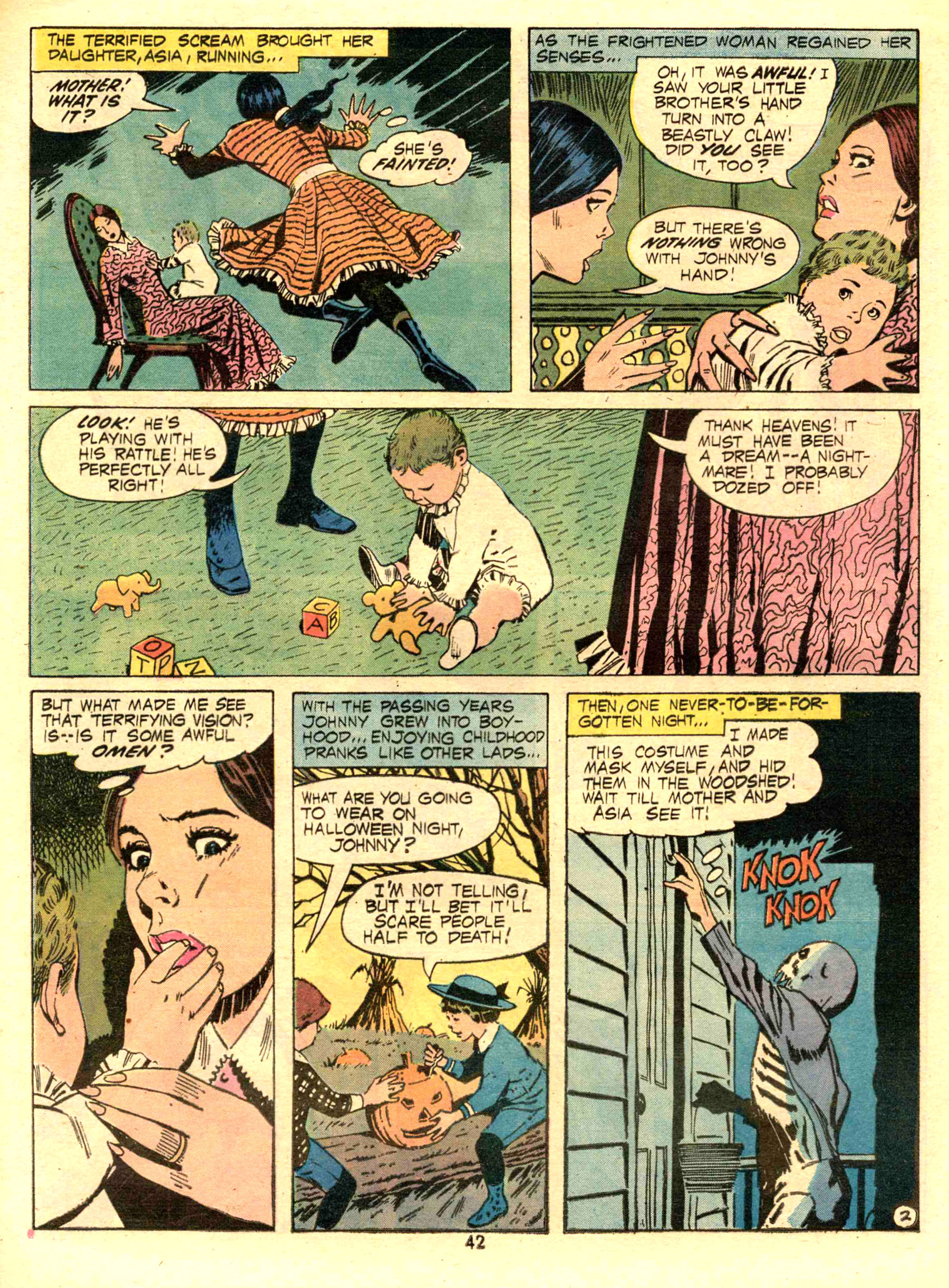
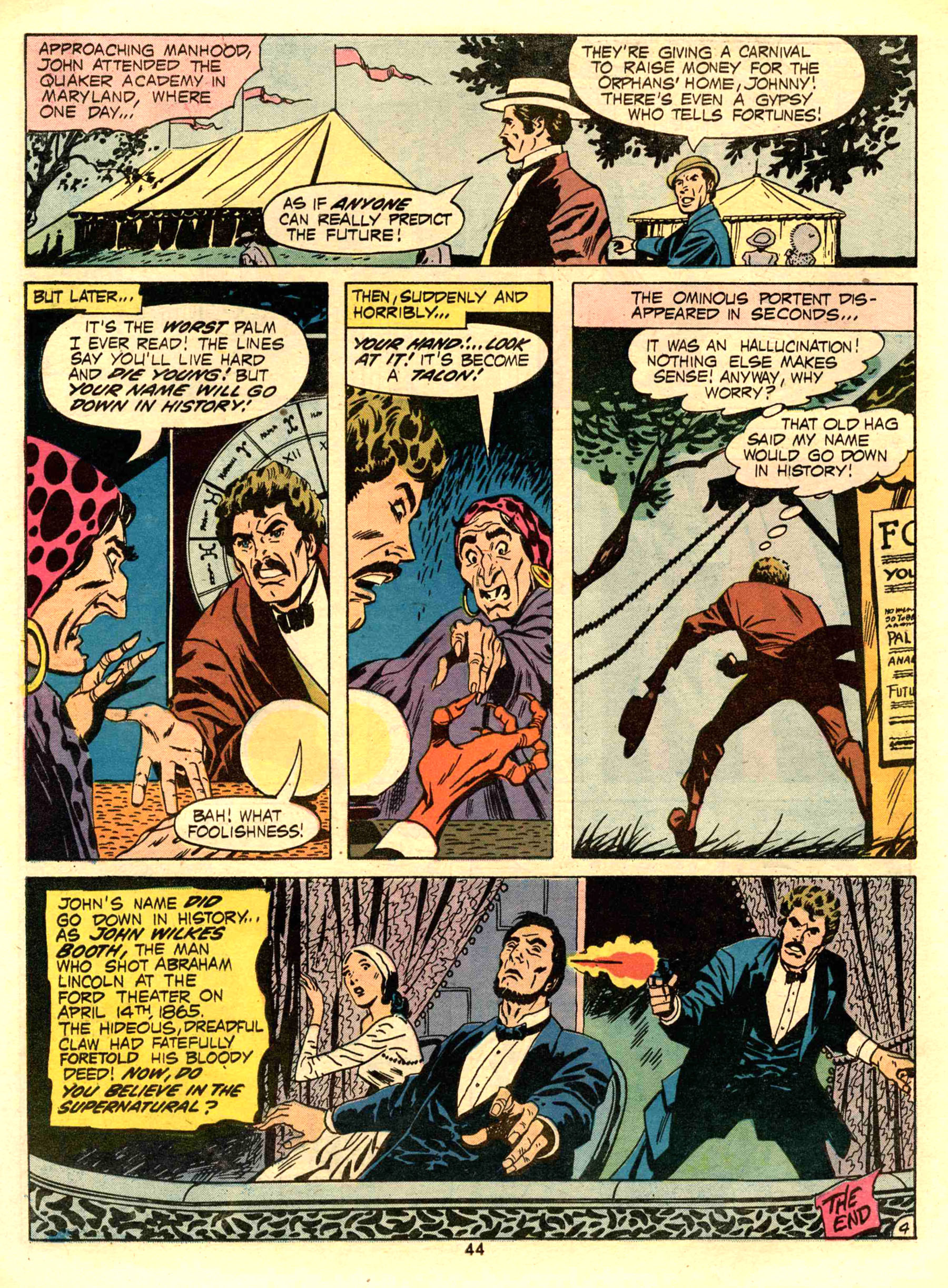
John Wilkes Booth’s Crimson Claw!

Our friend and fellow Lincoln assassination researcher, Scott Schroeder, was a recent guest on a podcast that discusses comic books of the horror genre. The subject of Scott’s appearance on Midnight The Podcasting Hour stems from his own interest in depictions of Abraham Lincoln and his assassination in comic books. On the podcast, Scott shared one of the many unique stories he had found that centers around Lincoln and his assassination. Specifically, Scott highlighted a story from a 1972 issue of the analogy Ghosts entitled The Crimson Claw!

the-crimson-claw-page-1 the-crimson-claw-page-2 the-crimson-claw-page-3 the-crimson-claw-page-4

In the podcast, Scott leads a fascinating discussion with the host regarding the almost unbelievable facts behind this work of artistic fiction. The entire podcast is 51 minutes long but Scott doesn’t really start in until the 5:30 mark and his segment ends at 39:30. You can listen to the podcast by clicking here to stream it, or by clicking here to download it.

Scott Schroeder will be speaking more on the topic of the Lincoln assassination in comic books at this year’s annual Surratt Society Conference on April 1, 2017. The conference is put on by the Surratt House Museum and takes place at the Colony South Hotel and Conference Center in Clinton, Maryland. Scott’s speech topic perfectly fits my description of the event as Boothie Comic-Con. The conference is a wonderful way to learn more about the Lincoln assassination and meet others who share an interest in the history. Please visit the Surratt House Museum website for information on how to register. I will be joining Scott as a presenter at this year’s conference, so I hope you’ll be able join us.

I want to thank Scott for his kind references to BoothieBarn and Roger Norton’s Lincoln Discussion Symposium during the podcast.

To tide you all over until Scott’s speech in April, here is a far inferior post I put up a few years ago about some of the other depictions of The Lincoln Assassination in Comic Books.

Categories: History, Levity | Tags: , , , , , | 3 Comments

Blog at WordPress.com.