
On May 21, 2025, Freeman’s | Hindman Auction House in Chicago, Illinois, offered 144 lots related to the life of Abraham Lincoln. “Lincoln’s Legacy: Historic Americana from the Life of Abraham Lincoln” was a landmark auction with many unique objects of Lincolniana. The pieces sold were part of the Lincoln Presidential Foundation collection. In 2007, the Foundation had purchased these items and many more from Lincoln collector Louise Taper, on behalf of the Abraham Lincoln Presidential Library and Museum in Springfield, Illinois. The original intent was for the Foundation to donate these items to the museum after it paid off the debt on the original purchase price. Unfortunately, a nasty and protracted fight occurred between leaders of the ALPLM and the Foundation, which ultimately led to the Foundation removing the Taper collection items from the ALPLM in 2022. To read the details of that whole, sad affair, check out this post. Still needing to raise funds to pay off the remaining debt of the original $23 million purchase price, the Foundation chose to sell some parts of the collection through Freeman’s | Hindman.
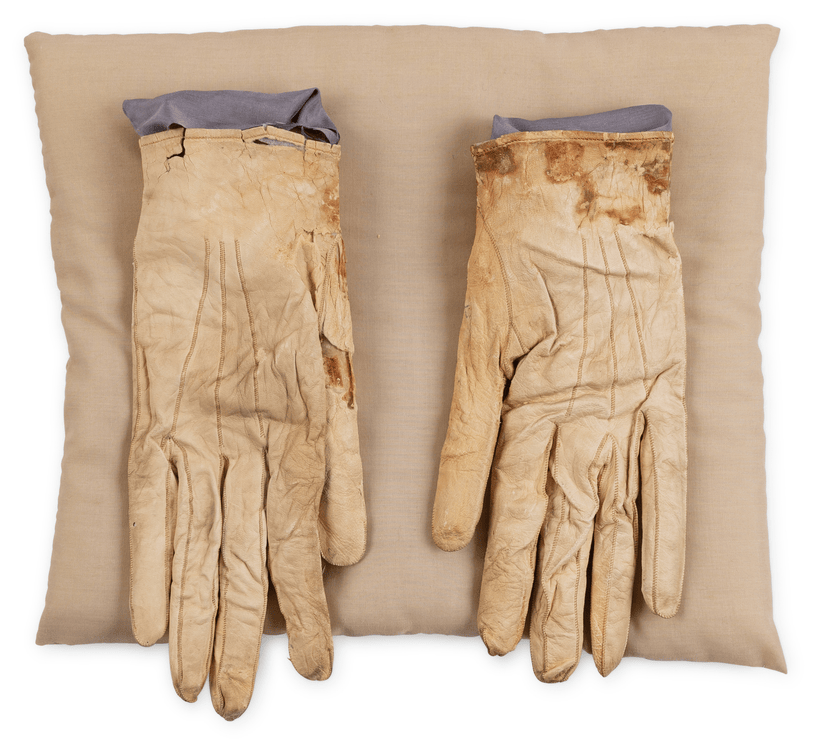
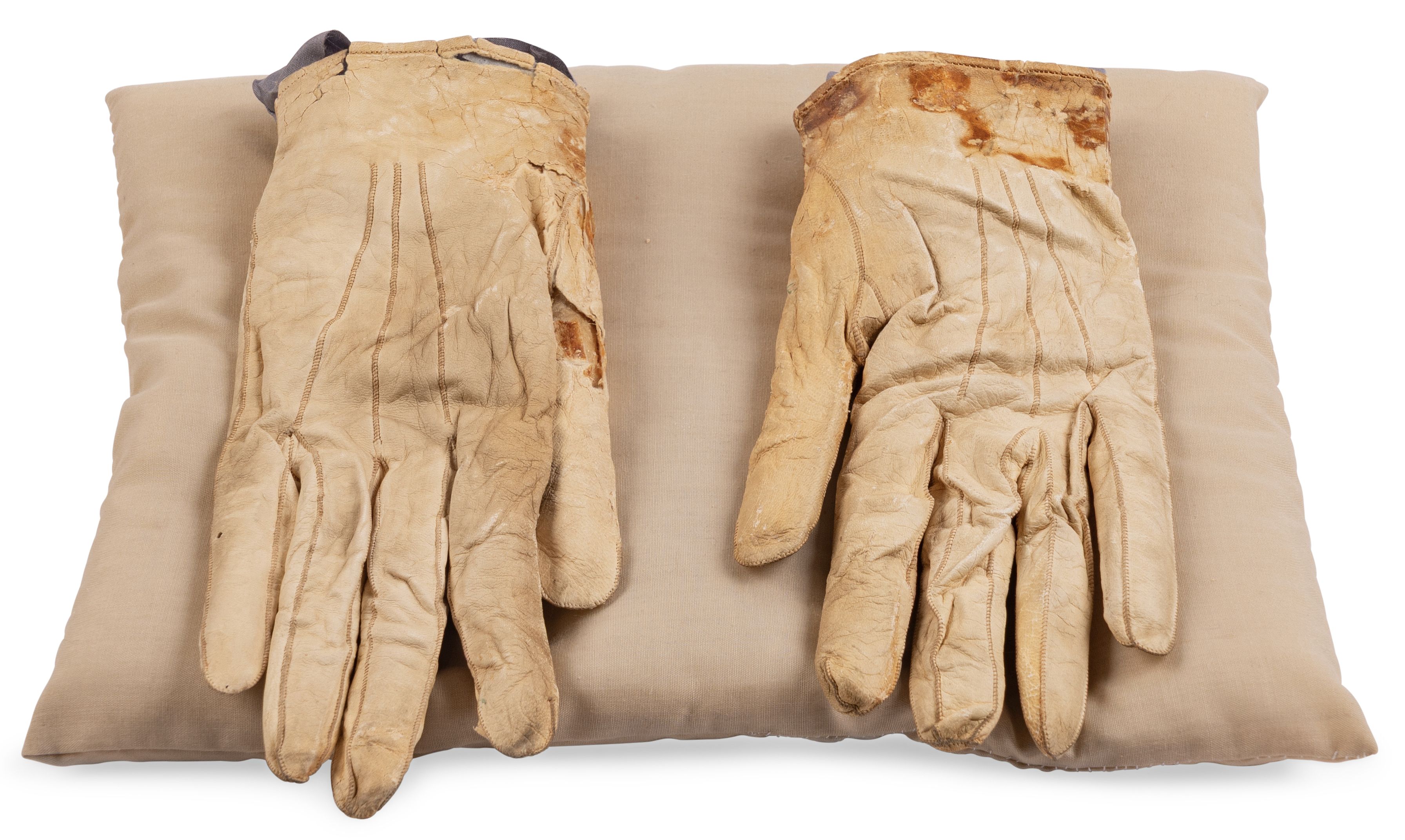
The 2025 auction was a massive success for the auction house, with the total sales amounting to almost $7.9 million. The centerpiece of the auction, and the lot that went for the highest amount of money, was a pair of gloves alleged to have been carried by Abraham Lincoln to Ford’s Theatre and stained with his blood following his assassination. These gloves sold for a staggering $1,512,500.
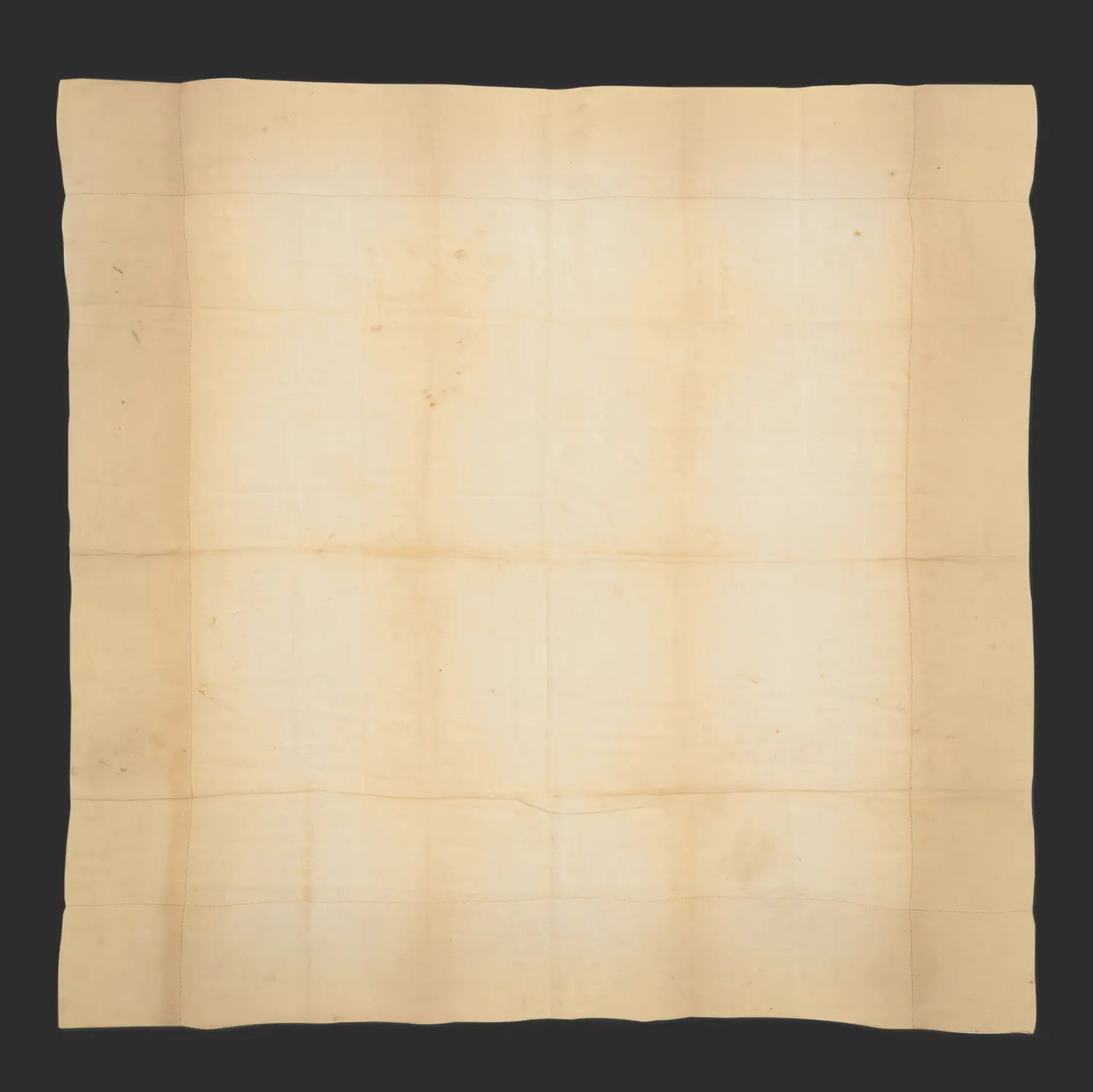
The same buyer of the gloves also purchased its sister piece – a handkerchief also said to have been carried by Lincoln to Ford’s Theatre. The handkerchief sold for $826,000.
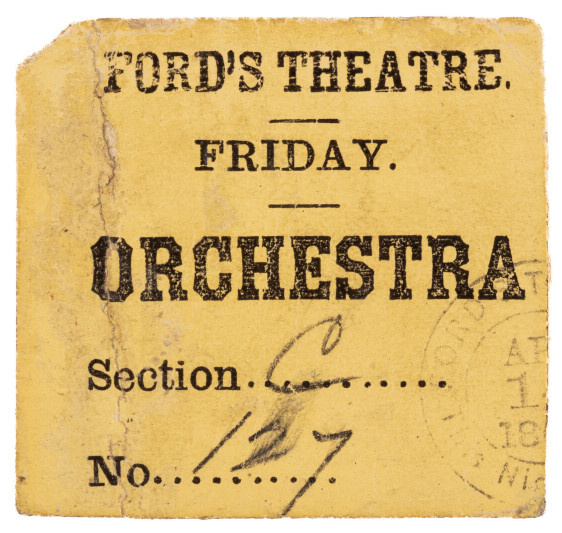
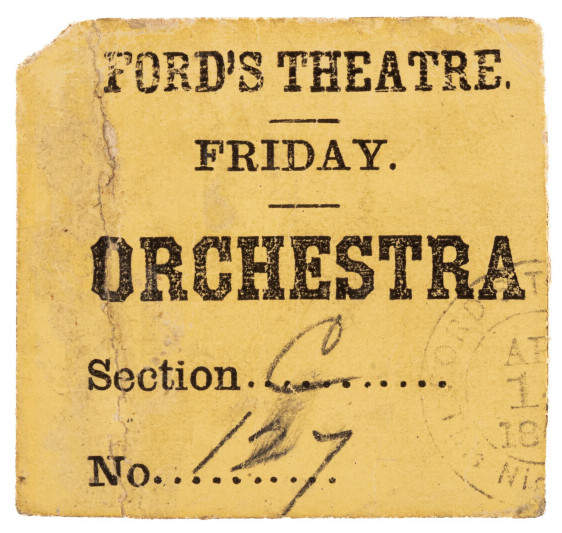
The same buyer also purchased a ticket stub for an orchestra seat at Ford’s Theatre on the night of the assassination for $381,500.
While other objects, such as a wanted poster for John Wilkes Booth and one of the earliest writings of Abraham Lincoln as a child, also sold for high amounts, in the aftermath of the sale, most of the press reports focused on the unique “blood-stained” gloves present at the moment Abraham Lincoln was shot.
However, beyond the high-profile headlines, these gloves are not as unique as they seem. They are one of at least four pairs of gloves that have been claimed to be the ones Lincoln carried on the night he was shot. More than that, however, a deep dive into the provenance of these million-dollar gloves leads one to seriously doubt whether they were ever at Ford’s Theatre to begin with. Let’s explore the many pairs of Abraham Lincoln’s Assassination Gloves.
Abraham Lincoln and his Gloves
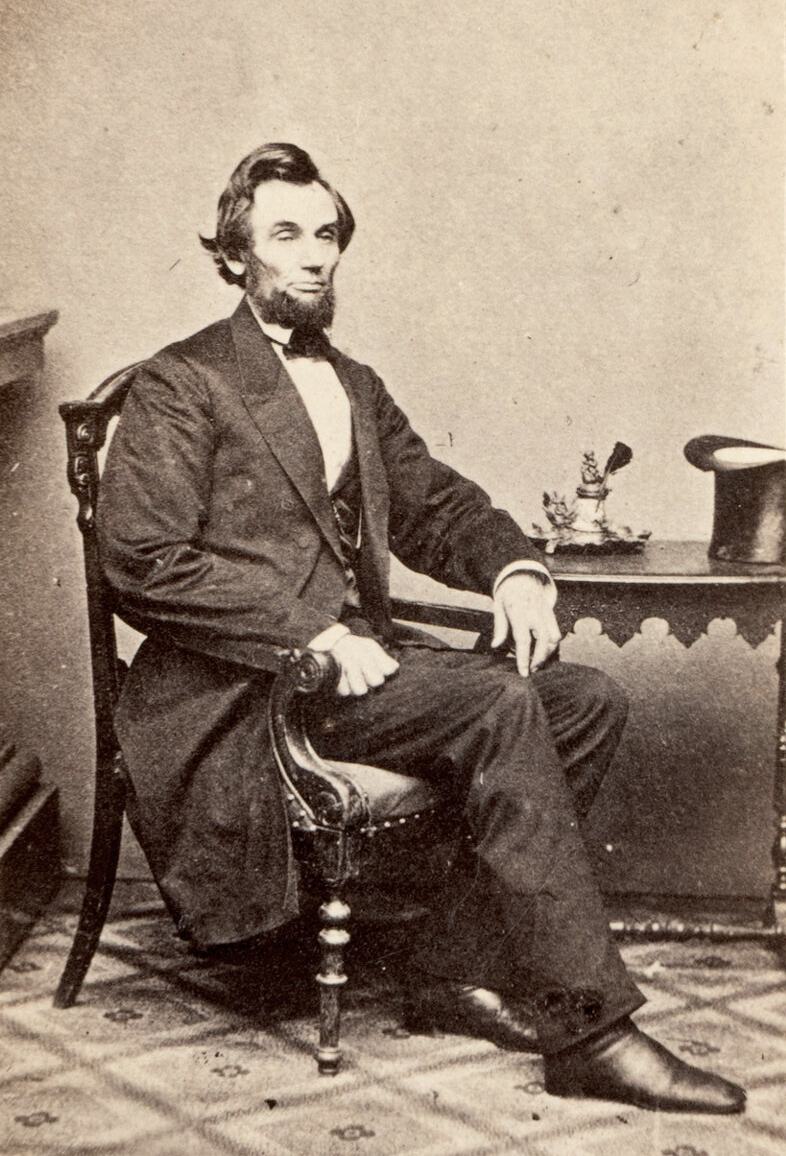
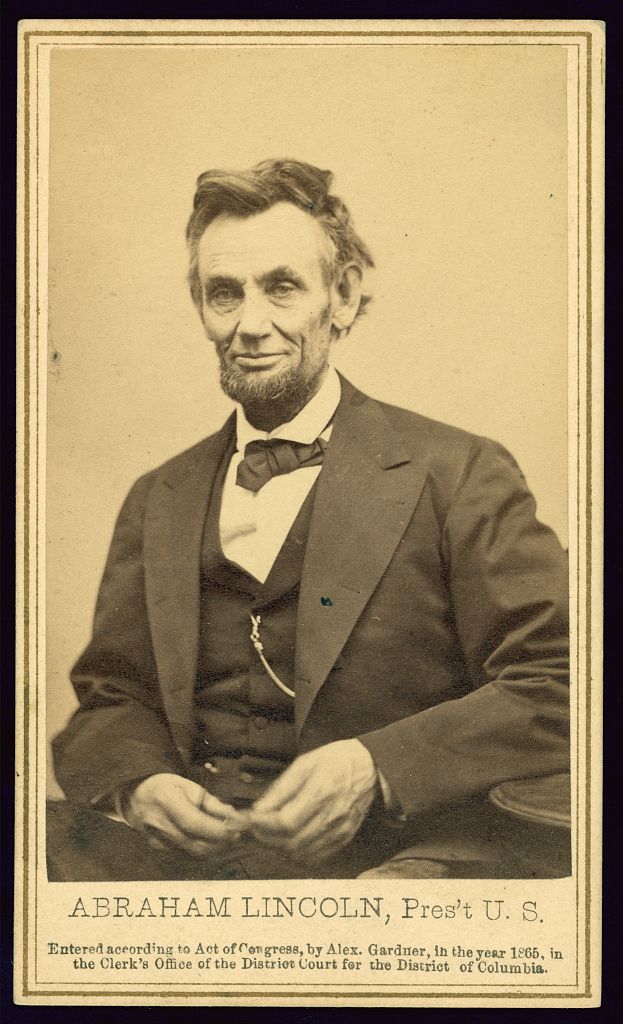
Abraham Lincoln came from humble beginnings. Though he eventually rose from a railsplitter to a respected lawyer and then 16th President of the United States, there were many aspects of his achieved status to which the frontier-born Lincoln never grew accustomed. He struggled with the pomp and circumstance of his office, greatly preferring the intimate telling of a joke to presiding over grand ceremonies. Yet, as President, there were many instances where Lincoln was forced, albeit reluctantly, to submit to the trappings of his high status. One aspect of society that gave Lincoln the most trouble was wearing ceremonial gloves. The President hated wearing them. Prior to his ascent to the Presidency, Lincoln rarely wore gloves for anything other than to keep his hands warm in the cold winter months. But fashion norms in the 1850s and 1860s emphasized the wearing of thin, more decorative than practical gloves, often made of white leather. These gloves were often called kid gloves, not because they were meant for children, but because the leather often came from young goats.
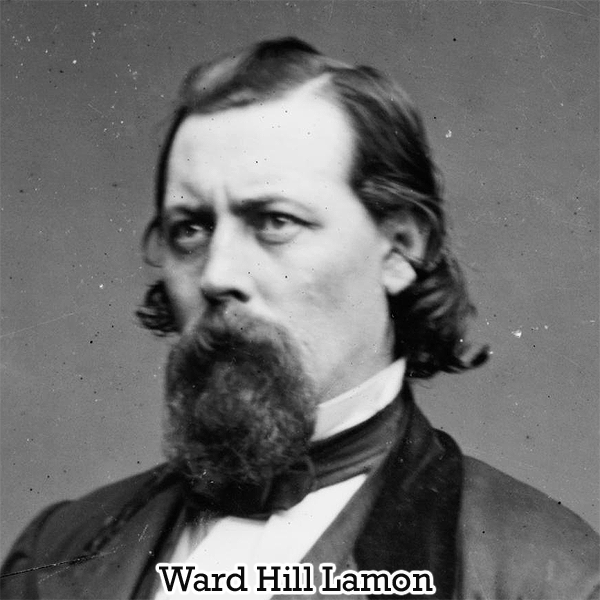
When it came to the tenets of fashion, Abraham Lincoln could hardly be bothered. Ward Hill Lamon was a friend of Lincoln’s from their shared days as attorneys in Illinois. When Lincoln was elected President, he tapped Lamon to be U.S. Marshal of D.C., a role that also made Lamon Lincoln’s unofficial bodyguard. In his later memoirs, Lamon twice wrote about Abraham Lincoln’s dislike of ceremonial gloves:
“…Mr. Lincoln still suffered much annoyance from the tyranny of fashion in the matter of gloves… [T]he necessity to wear gloves he regarded as an affliction, a violation of the statute against “cruelty to animals.” Many amusing stories could be told of Mr. Lincoln and his gloves. At about the time of his third reception he had on a tight-fitting pair of white kids, which he had with difficulty got on. He saw approaching in the distance an old Illinois friend named Simpson, whom he welcomed with a genuine Sangamon County shake, which resulted in bursting his white-kid glove with an audible sound. Then raising his brawny hand up before him, looking at it with an indescribable expression, he said, — while the whole procession was checked, witnessing this scene, — ‘Well, my old friend, this is a general bustification. You and I were never intended to wear these things. If they were stronger they might do well enough to keep out the cold, but they are a failure to shake hands with between old friends like us. Stand aside, Captain, and I’ll see you shortly.’”
In another story, Lamon once again recounts Mr. Lincoln’s resistance to wearing gloves, and his genuine joy at avoiding the practice with a friend:
“Shortly after the first inauguration, an old and respected friend accompanied by his wife visited Washington, and as a matter of course paid their respects to the President and his family, having been on intimate social terms with them for many years. It was proposed that at a certain time Mr. and Mrs. Lincoln should call at the hotel where they were stopping and take them out for a ride in the Presidential carriage, — a gorgeous and grandly caparisoned coach, the like of which the visitors had seldom seen before that time. As close as the intimacy was, the two men had never seen each other with gloves on in their lives, except as a protection from the cold. Both gentlemen, realizing the propriety of their use in the changed condition of things, discussed the matter with their respective wives, who decided that gloves were the proper things. Mr. Lincoln reluctantly yielded to this decree, and placed his in his pocket, to be used or not according to circumstances. On arriving at the hotel he found his friend, who doubtless had yielded to his wife’s persuasion, gloved in the most approved style. The friend, taking in the situation, was hardly seated in the carriage when he began to take off the clinging kids; and at the same time Mr. Lincoln began to draw his on, — seeing which they both burst into a hearty laugh, when Mr. Lincoln exclaimed, ‘Oh, why should the spirit of mortals be proud?’ Then he added, ‘I suppose it is polite to wear these things, but it is positively uncomfortable for me to do so. Let us put them in our pockets; that is the best place for them, and we shall be able to act more like folks in our bare hands.’ After this the ride was as enjoyable as any one they had ever taken in early days in a lumber wagon over the prairies of Illinois.”
We can see that while Lincoln understood the stylistic necessity of kid gloves, he happily shed them at the earliest opportunity. Yet, his refusal to wear kid gloves did not stop Mary Lincoln from supplying her husband with many pairs. Mrs. Lincoln was very knowledgeable about fashion and the expectations of high society, but she clearly fought a losing battle trying to dress up her husband.

It is interesting to note that most of the accounts relating to Abraham Lincoln and his wearing of kid gloves come from the beginning of his Presidency. It appears that in the early days of his administration, he was trying his best to fit into the fashion requirements of his office. However, as the Civil War went on, Lincoln could no longer be bothered by trivialities like fashion. As noted by author Reignette Chilton in her book Lincoln’s Frock Coat, while some criticized Lincoln’s often unkempt and slovenly appearance, others understood that “his mind was intent upon more important things.”
In the end, Lincoln’s mind and the bravery of the Union soldiers resulted in the surrender of Confederate General Robert E. Lee’s army to General Ulysses S. Grant on April 9, 1865. The surrender of the Confederacy’s largest army, combined with the recent conquering of the Confederate capital of Richmond, marked the beginning of the end of the Civil War. The Lincolns were in a celebratory mood when they picked up their guests, Clara Harris and Major Henry Rathbone, for an evening at Ford’s Theatre.
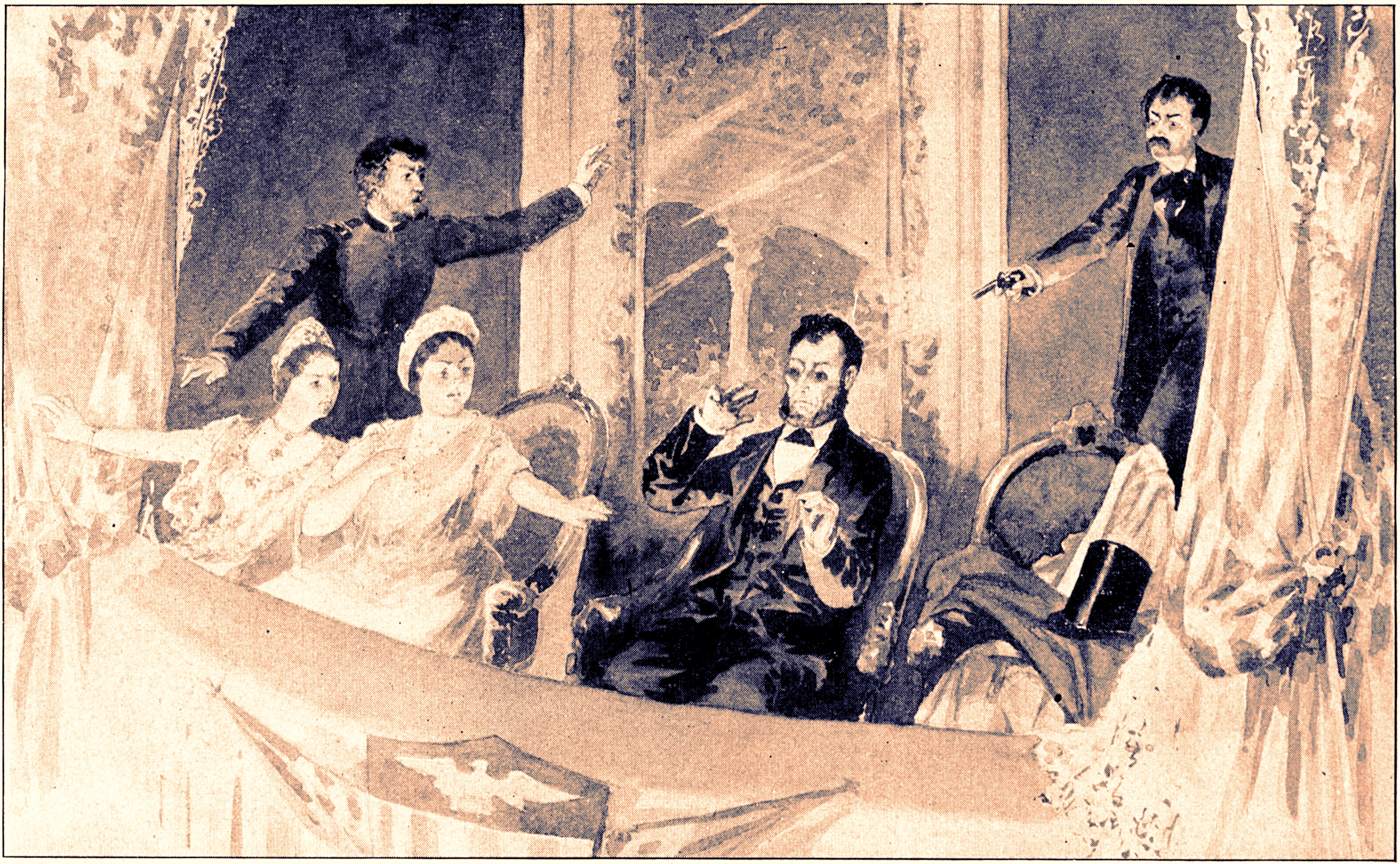
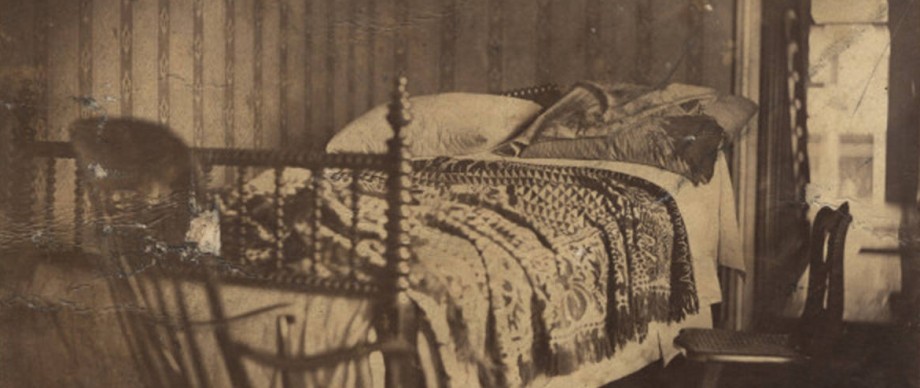
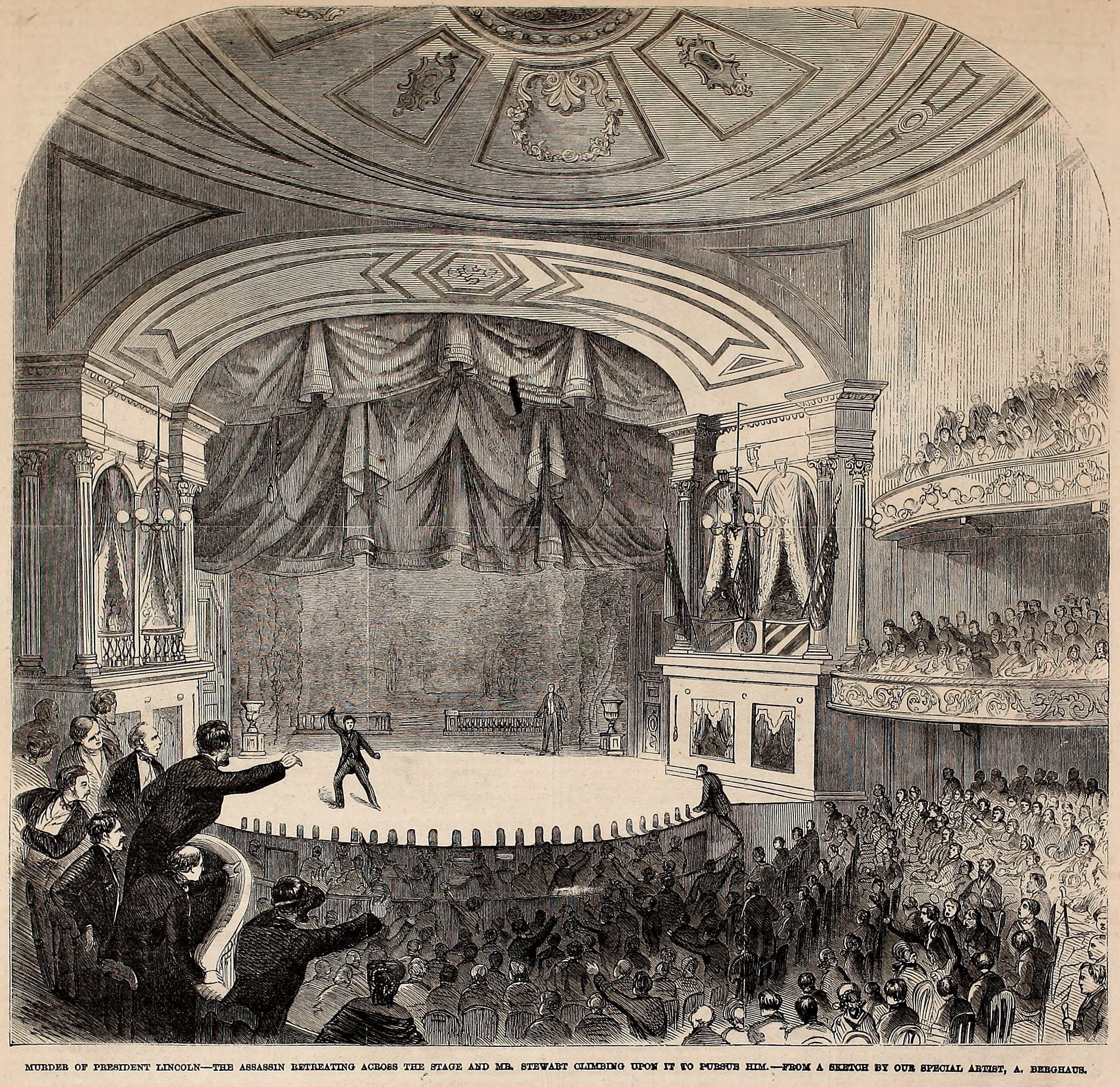
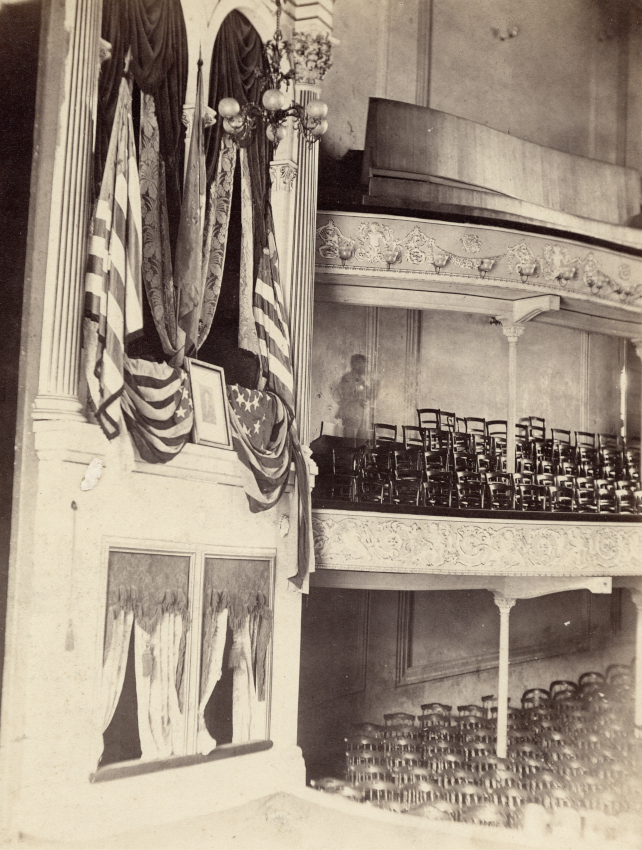
The revelry in Washington turned to tragedy when, in the middle of Act 3, Scene 2 of Our American Cousin, an assassin entered the Presidential box at Ford’s Theatre and shot Abraham Lincoln in the back of the head. Abraham Lincoln died nine hours later in the bedroom of a boardinghouse across the street from the theater. In time, at least four different pairs of gloves would come to be associated with Lincoln and the terrible act at Ford’s Theatre.
Found in the Box?
In 1905, the Lincoln National Life Insurance Company was founded in Fort Wayne, Indiana. Early in its history, the founders became interested in collecting objects related to its namesake to better associate the company with the 16th President and his legacy. This led to the creation of the Lincoln Financial Foundation collection. Over the years, the collection grew, leading the company to open its own Lincoln museum in Fort Wayne to display its artifacts. In 2008, a century after the company was founded, the now-named Lincoln National Company decided to shut down its museum holdings and donated its impressive collection to the people of Indiana. The collection was split between two groups, the Allen County Public Library in Fort Wayne and the Indiana State Museum in Indianapolis. The library became the home of the collection’s books, newspapers, documents, and photographs, while the museum houses the fine art, engravings, prints, and physical artifacts.
One item from the Lincoln Financial Foundation collection housed at the Indiana State Museum is this pair of gloves.
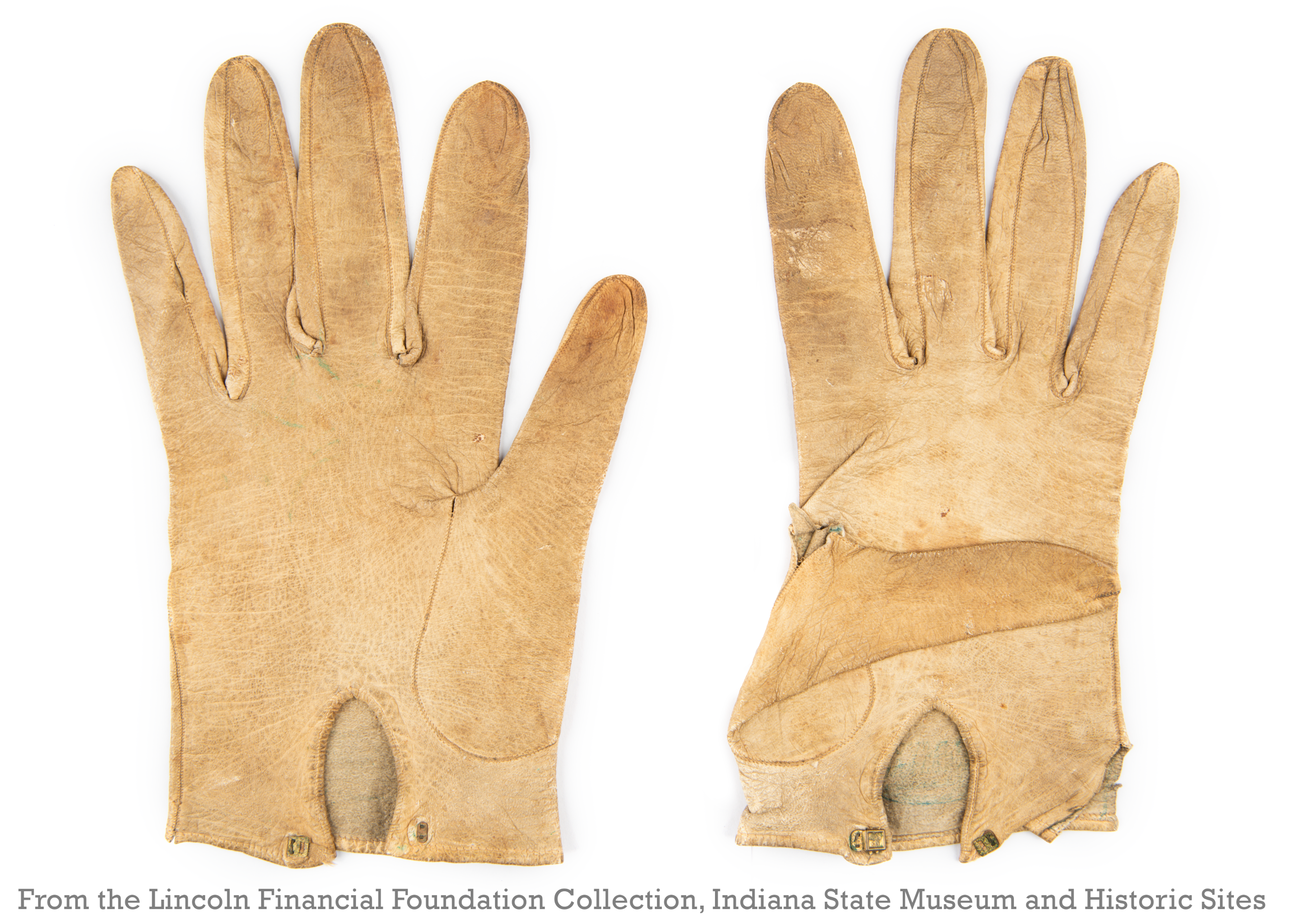
These gloves were received by the Lincoln Foundation collection on Jan. 2, 1948. The donor of the gloves was a family of antiquarian booksellers located in New Haven, Connecticut, by the name of Whitlock. Clifford Whitlock, Sr. had apprenticed in his great-uncle’s bookshop starting in the early 1900s, which was later given to him. Though the first Whitlock’s Book Store closed during the Great Depression, Clifford continued to operate as a book dealer and eventually reopened the store in the 1950s. His sons, Reverdy and Gilbert, followed in their father’s footsteps, and all three Whitlock men were working as book sellers in 1948 when the donation was made.

A note, held with the gloves at the Indiana State Museum, gives the following information:
“These gloves are alleged to have been found in the presidential box at Ford’s Theatre the night of Lincoln’s assassination. It is also said that there are blood stains on the gloves probably from Major Rathbone who was wounded when trying to detain Booth from escaping the box. The gloves were given to Whitlock’s of New Haven, Connecticut, by Mrs. Tillinghast.”
Unfortunately, the identity of “Mrs. Tillinghast,” the prior owner of the gloves who gave them to the Whitlocks, is unknown. The chain of custody on these gloves ends with her, with no way of knowing where or how Mrs. Tillinghast acquired the gloves or how she came to believe they were found in the box at Ford’s Theatre. The only additional information about the gloves is the object’s description: “Pair of cream-colored leather gloves features three decorative lines of thread on the back of each glove. A metal clasp on the inside of the wrist secures the glove,” and that they measure 8 in x 3.75 in (20.32 cm x 9.525 cm) in size.
As intriguing as the claim is that these gloves were found in the Presidential box, the story cannot be verified due to a lack of information about the donor, Mrs. Tillinghast. Even if we suppose the story is true and the gloves were recovered from the floor of the Presidential box at Ford’s Theatre, we could not be certain they belonged to Abraham Lincoln. Many individuals, including a slew of doctors, entered the box after the shooting to care for the President. Any one of them could have lost a pair of gloves during the chaos.
Assessment: The gloves in the Lincoln Financial Foundation collection at the Indiana State Museum have an interesting story, but without more information about Mrs. Tillinghast and her connection, there is nothing to prove they are connected to Abraham Lincoln’s assassination.
The Presidential Provenance
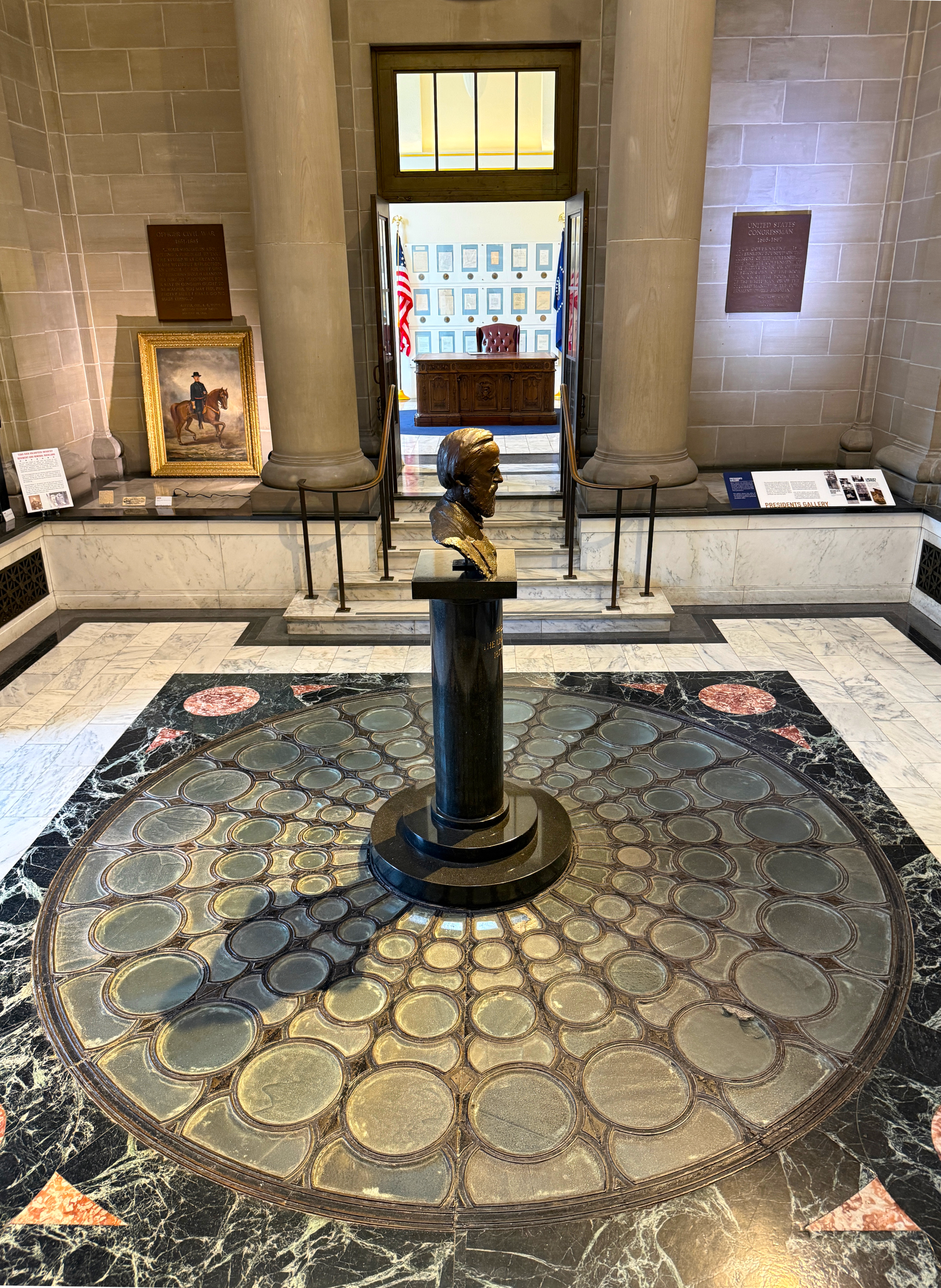
The Rutherford B. Hayes Presidential Center in Fremont, Ohio, is an impressive complex dedicated to the life and times of the 19th President of the United States. Hayes was a successful attorney who gave up his practice to join the Union Army during the Civil War, where he became an officer. Hayes ended the war as a brigadier general, having meritoriously performed at the Battle of Cedar Creek. During his service, Hayes won election to the House of Representatives in Ohio. He took his seat in December 1865, before being elected Governor of Ohio in 1867. After two terms as Governor, Hayes left office in 1872, but in 1875 he found himself once again nominated by the Republican Party for the governorship. His reelection increased national attention on the Ohio governor and Army veteran, and the Republican Party nominated Hayes for the Presidency as a compromise candidate in the election of 1876. The election was the most contentious in history, with neither major candidate earning enough electoral votes to win. In the end, a special electoral commission was created to determine the outcome of 20 disputed electoral votes from Florida, Louisiana, South Carolina, and Oregon. A strict party-line vote of 8 Republicans vs. 7 Democrats gave all the disputed electoral votes to Hayes. This was followed by the Bargain of 1877, in which Democrats ended a filibuster of the results and threats of political violence in exchange for the promise that Hayes’ administration would withdraw the remaining military troops and oversight entities from the former Confederate states. This effectively ended Reconstruction and was a betrayal of Black Republicans in the South who found their hard-earned rights quickly stripped away by Jim Crow laws.
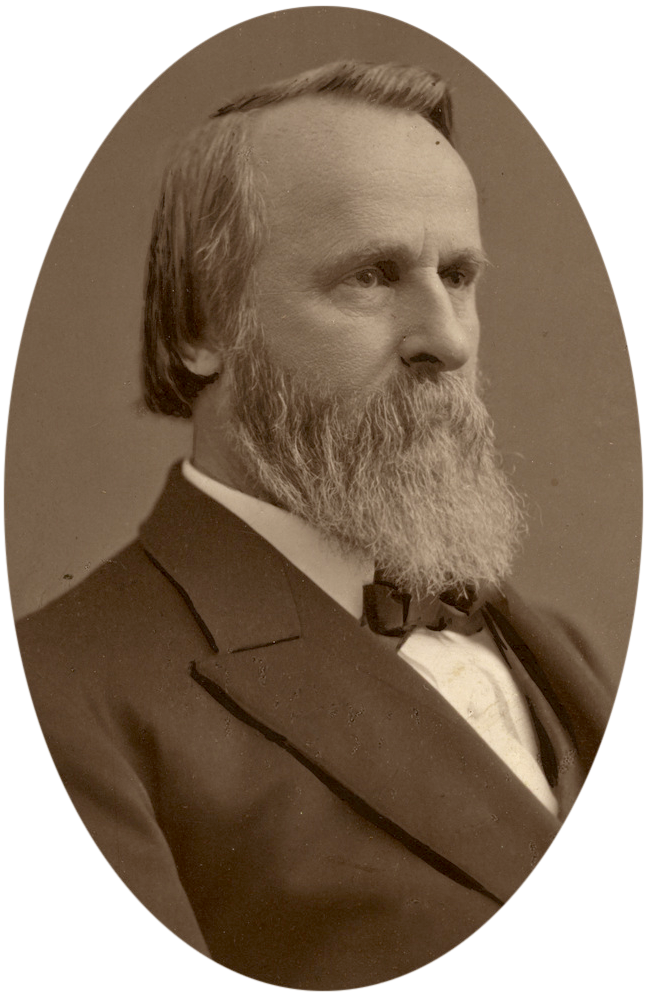
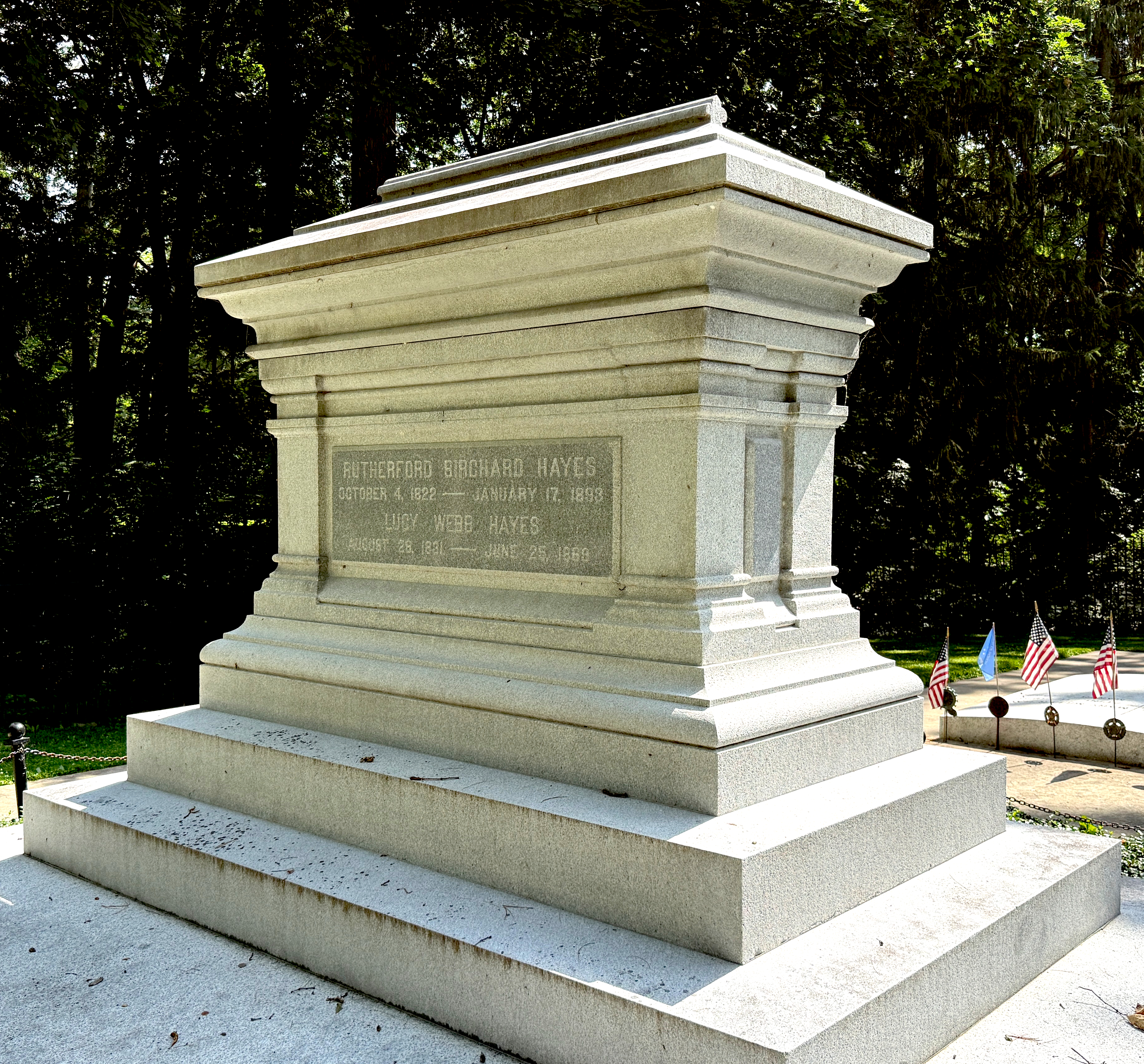
As President, Hayes, a Republican, was stymied by a Democratic-controlled Congress. Hayes supported civil service reforms after the corruption and cronyism of the Grant administration, and he also served during a time of economic growth. He also vetoed the Chinese Exclusion Act of 1879. But Hayes also called out the National Guard and U.S. Army against striking railroad workers in 1877. When compared to other presidencies, historians usually rank Rutherford B. Hayes in the slightly below-average tier. Hayes fulfilled his pledge not to seek reelection and left office after a single term in 1881, replaced by James Garfield. When Hayes left the White House, he, like his predecessors, took his official and personal papers with him. He retired to his home of Spiegel Grove in Fremont, where he died in 1893.
Perhaps more so than any of his predecessors, President Hayes was a collector. He carefully kept his papers and many items related to his time as President together. A student of history, Hayes also actively collected items related to American political history. Hayes’ impressive collection led his son, Col. Webb Hayes, to try to establish a presidential library where members of the public could learn about his father’s life and legacy. Col. Hayes deeded the Spiegel Grove estate to the state of Ohio and donated his family’s impressive collection to the Ohio Historical Society. In 1916, the country’s first presidential library, then known as the Hayes Memorial, was built and opened to the public.
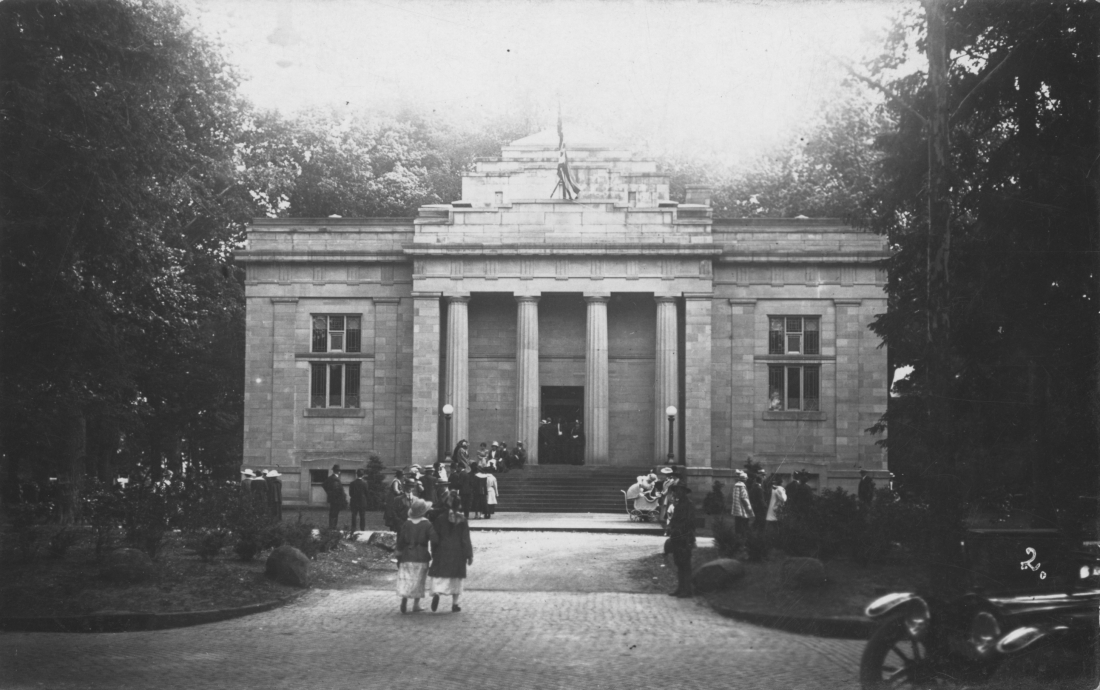
The Hayes Memorial in 1916
The Hayes Memorial building has expanded greatly over the years and now includes detailed exhibits about the life of President Hayes and his family, as well as library, office, and event spaces. But the original structure, built in 1916, still stands at the heart of the museum. One wing of the original building is now known as the Presidents Gallery and contains artifacts related to all the presidents. The room’s centerpiece is a replica of the Resolute Desk, the ornately carved desk Queen Victoria gifted to President Hayes in 1880. The Resolute Desk has been a fixture of the White House ever since, and each President since Jimmy Carter has used it for a time as their Oval Office desk.
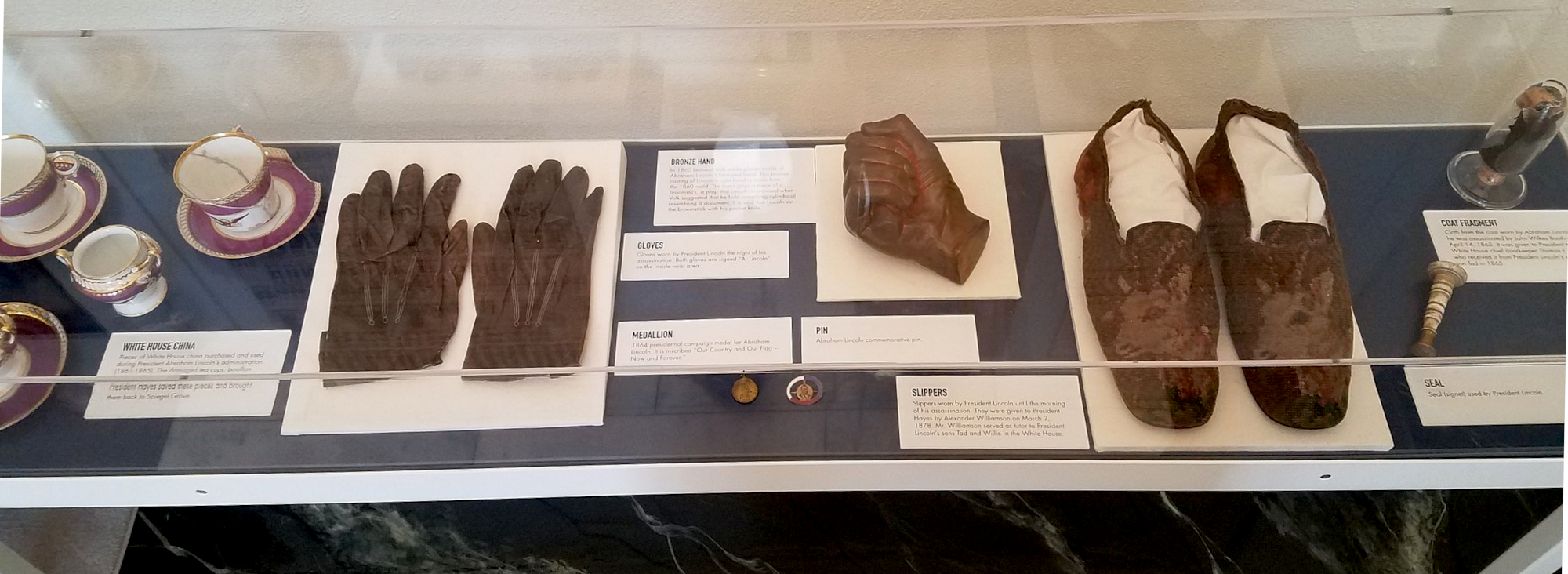
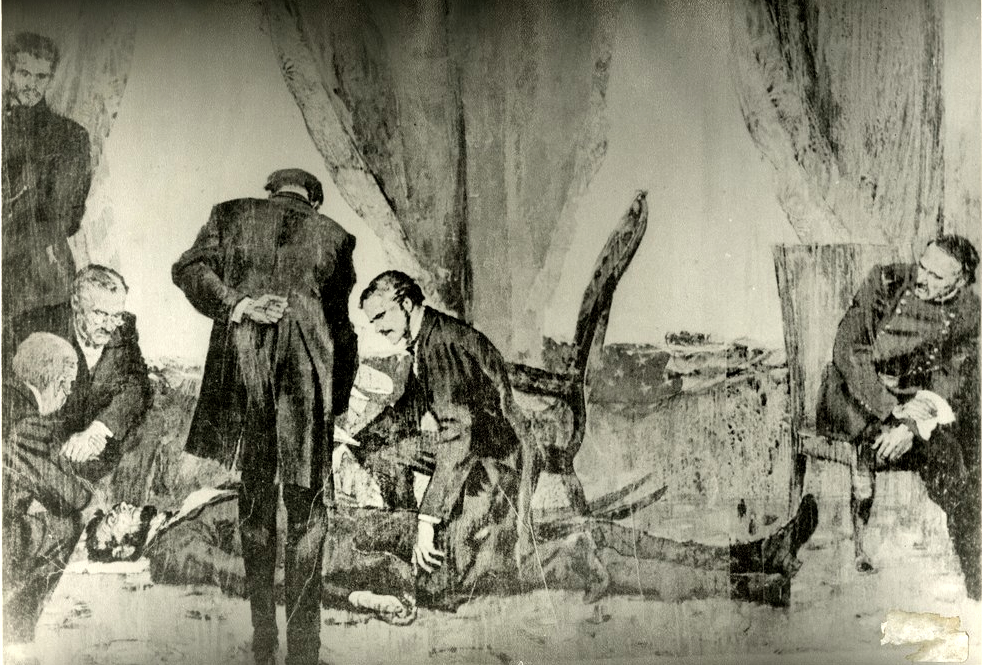
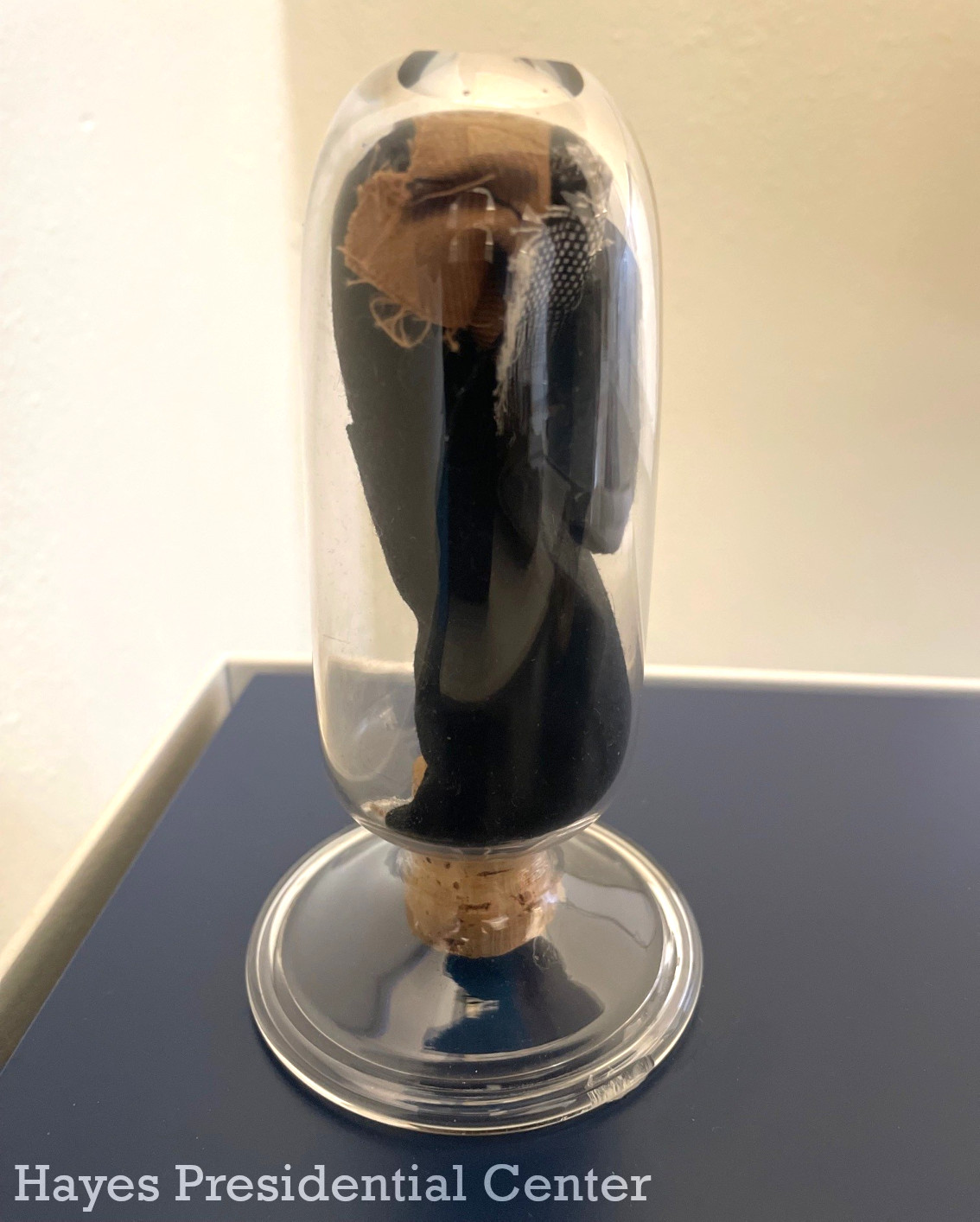
An exhibit on the side of this room has artifacts related to Abraham Lincoln. As the exhibit label notes, President Hayes greatly admired Lincoln and considered him one of the country’s greatest leaders. Hayes personally collected most of the Lincoln objects on display here during his lifetime. The display includes examples of broken Lincoln White House china salvaged by Hayes, an 1864 Lincoln re-election campaign medal, slippers worn by Lincoln at the White House, and even a piece of fabric from the frock coat Lincoln was wearing at Ford’s Theatre when he was assassinated:
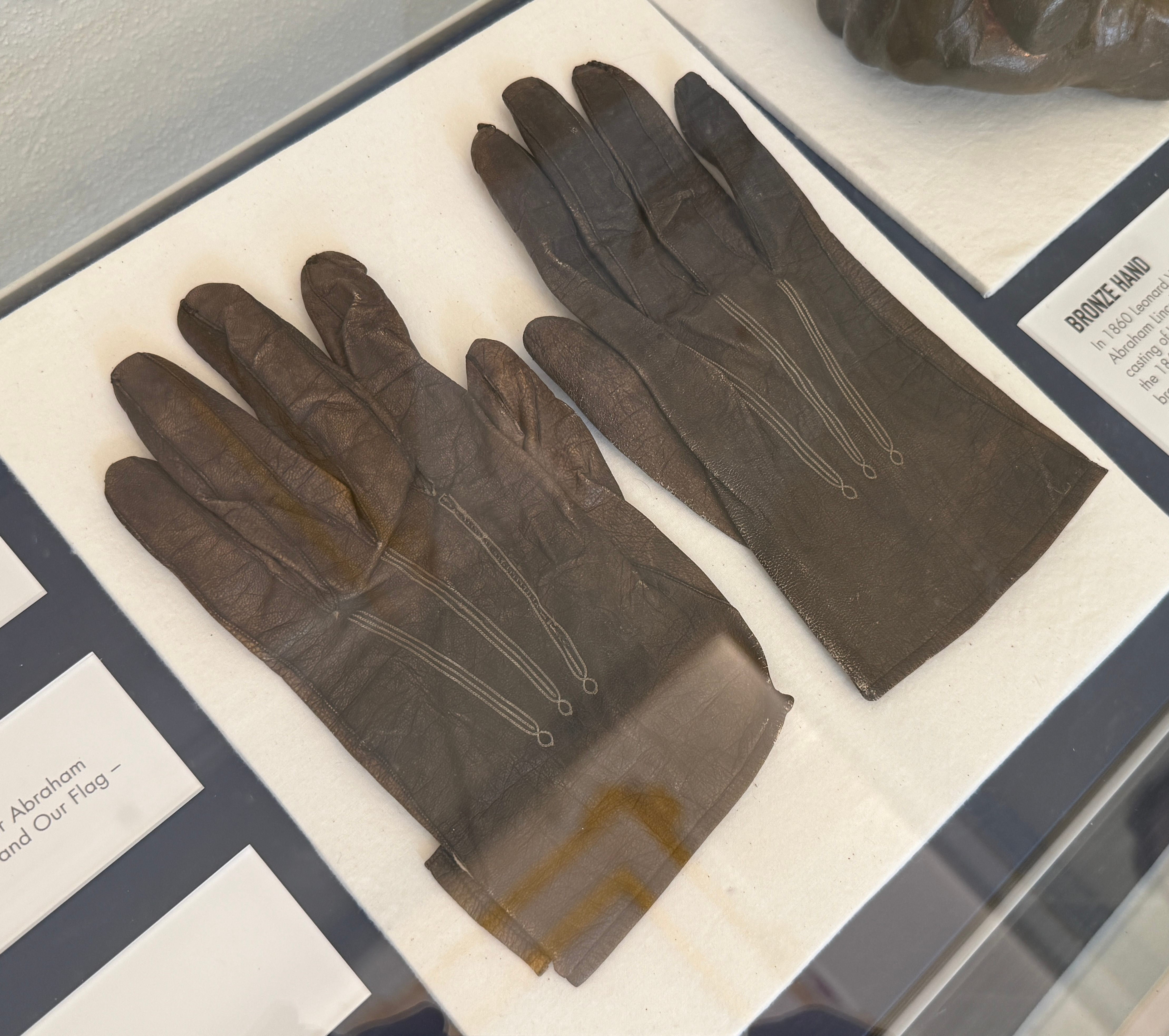
This exhibit also includes a pair of dark kidskin leather gloves. The exhibit tag next to them states: “Gloves worn by President Lincoln the night of his assassination. Both gloves are signed ‘A. Lincoln’ on the inside wrist area.”
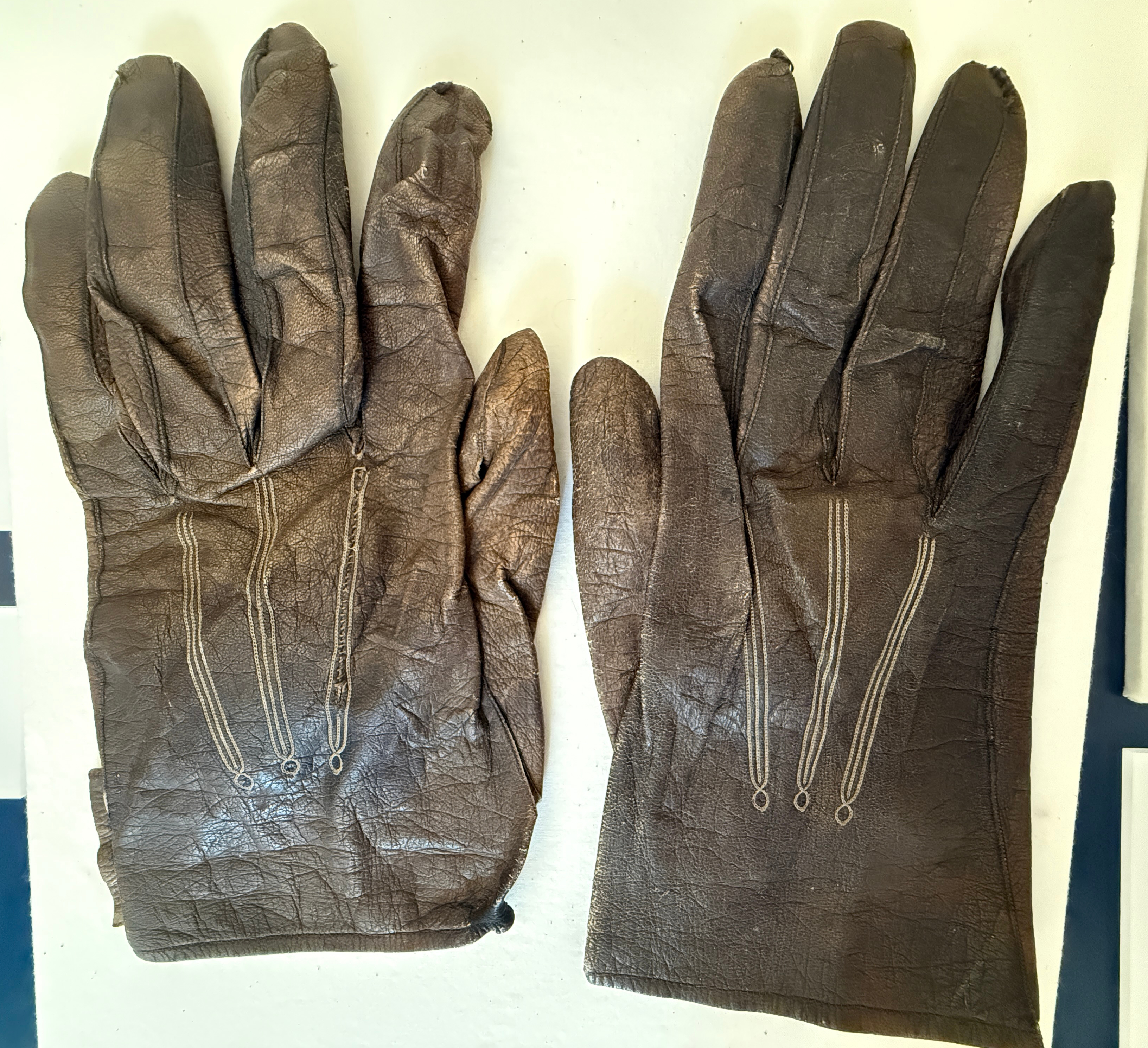
The gloves are 22.5 cm in length. An internal mark gives them a size of 9 2/4, but this fractional part may be incorrect. The inside of each glove near the wrist features the ink signature “A. Lincoln.”
A condition report for this artifact from 2025 noted that “the leather is dry and brittle; cracked and peeling in palm of left glove; seams torn at outside wrist and bottom of thumb of left glove, black thread stitching repair done to finger tips of both gloves; metal pieces used to latch wrist of each corroding.”
The provenance connecting the gloves to Lincoln’s assassination is, like the Indiana gloves, sadly limited. The museum knows President Hayes acquired the gloves personally, but when and from whom is unknown. The only original document that the museum has for the gloves is an envelope from the White House on which President Hayes has written the words, “Gloves of Mr. Lincoln worn the night of his assassination. With his autograph in each.”
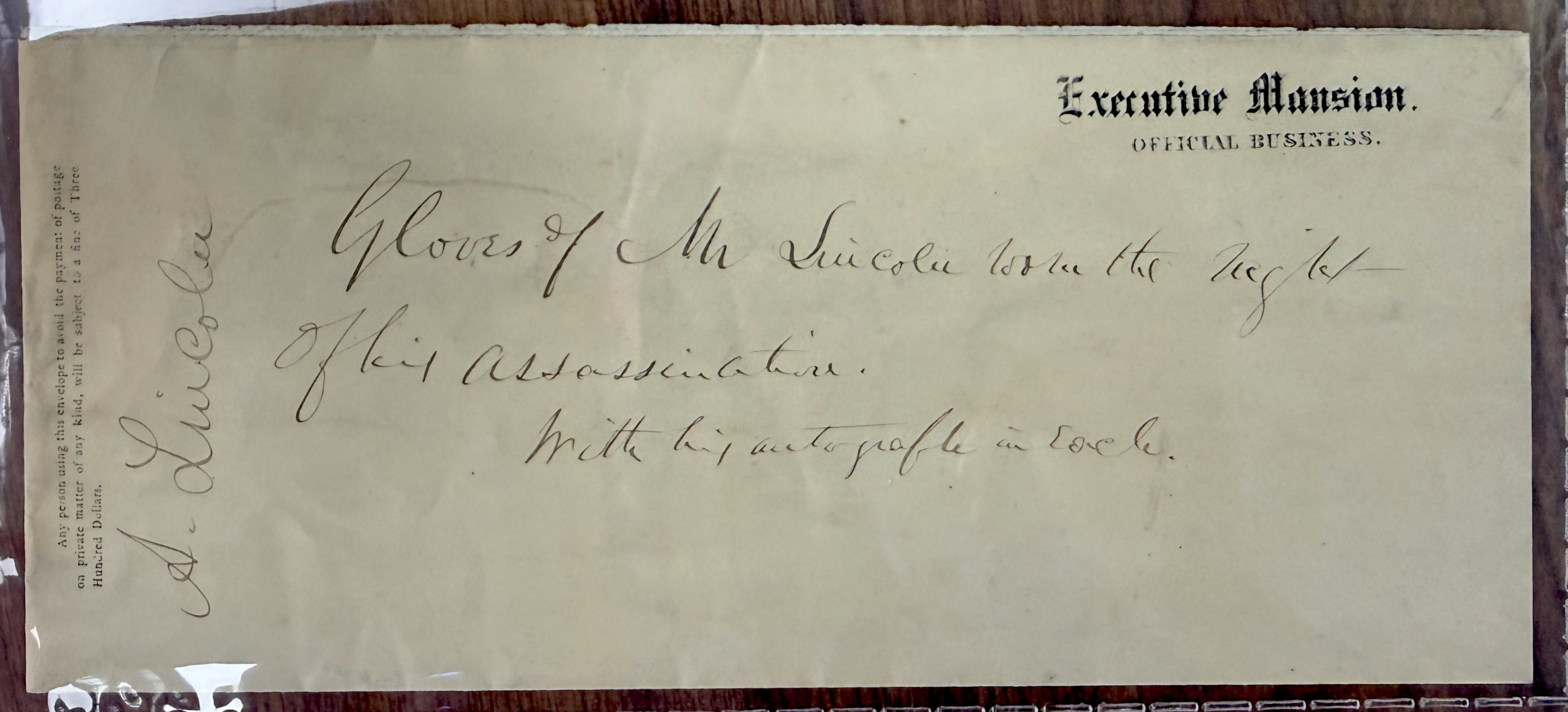
As stated, Hayes collected many things, and other items in the collection have much better records of how he acquired them. The fragment of Lincoln’s frock coat, for example, came with an affidavit signed by White House doorkeeper Thomas Pendel describing how he obtained Lincoln’s frock coat from Tad Lincoln and was presenting a piece of the coat to President Hayes. This is a very clear chain of ownership. These gloves have no such chain. All we have are Hayes’s handwritten notes that these were Lincoln’s gloves and that he wore them the night of his assassination.
The Hayes gloves differ from the other gloves in this article, as this pair is dark brown rather than a more formal white leather. During Abraham Lincoln’s trip to Washington, D.C. on the way to his first inauguration, he visited New York City and spent the evening of February 20, 1861, at the Brooklyn Academy of Music where he watched part of an opera performance. Another opera attendee that evening later recalled that Lincoln wore “a pair of huge black kid gloves,” rather than the fancy white kid gloves worn by most others. According to the witness, these dark, practical gloves “attracted the attention of the whole house, hanging as they did over the red velvet box-front.” So there is some precedent for Lincoln wearing dark colored gloves to a theater.
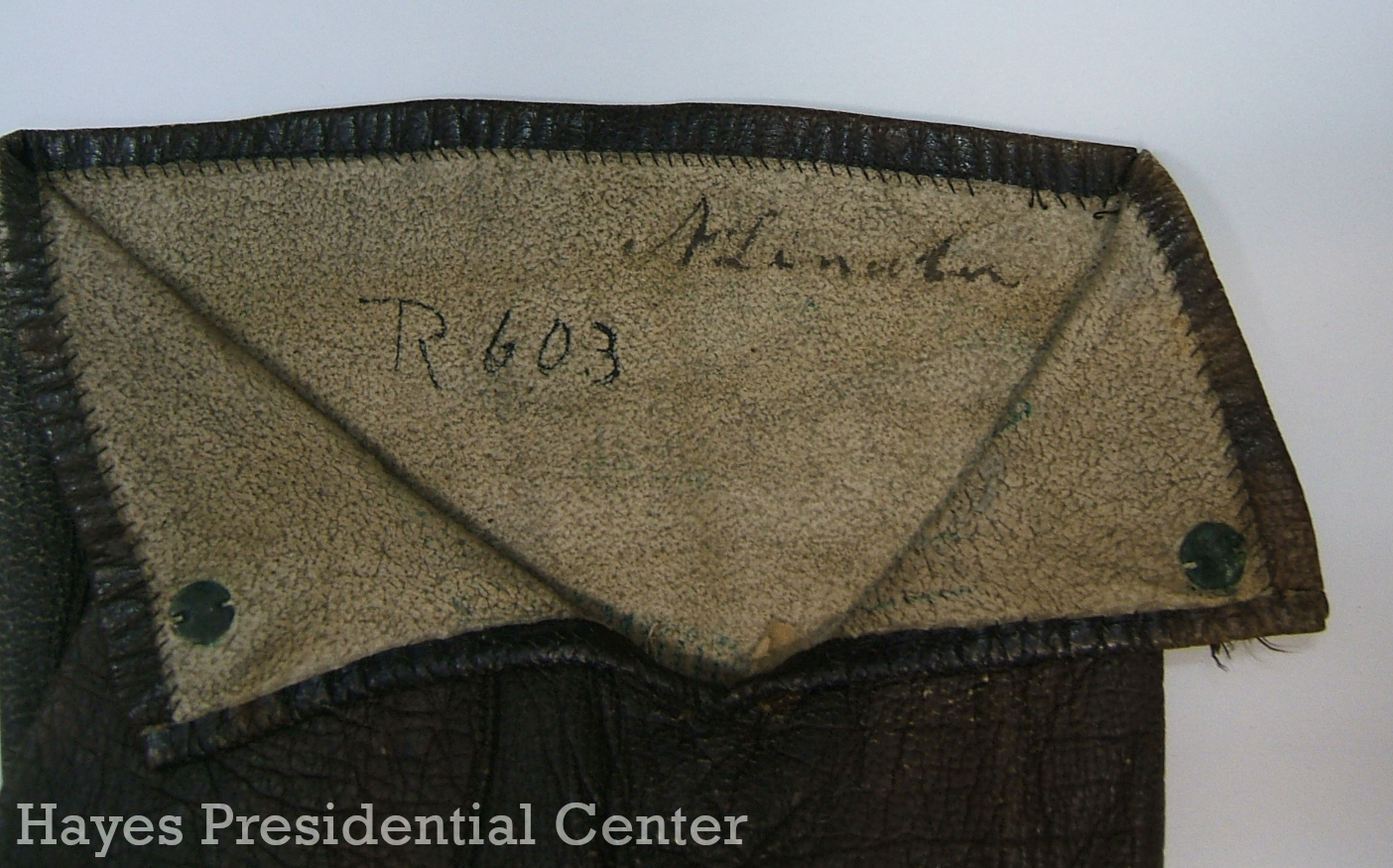
The Hayes gloves are more practical than fashionable, which definitely fits Mr. Lincoln’s style. The interior signature of “A. Lincoln” supports the idea that these gloves did, at the very least, belong to Abraham Lincoln.
But did Abraham Lincoln wear the Hayes gloves on April 14, 1865? At this time, there is no way to prove or disprove this claim. All we have is President Hayes’s handwritten note attributing them to Lincoln’s assassination. Given Hayes’s passion for collecting and his admiration for Lincoln, he likely believed they were genuine, but without knowing when and where he got the gloves, we can’t prove either way.
Assessment: President Hayes’s belief and credibility are our only source for the gloves’ authenticity. The Rutherford B. Hayes Museum is trusting its namesake’s word by exhibiting these gloves as the ones Lincoln wore the night he was assassinated. President Hayes may have acquired such a unique artifact, especially since he collected other items related to Lincoln’s death. But without more information, there is no way to prove the claim.
A Family Connection
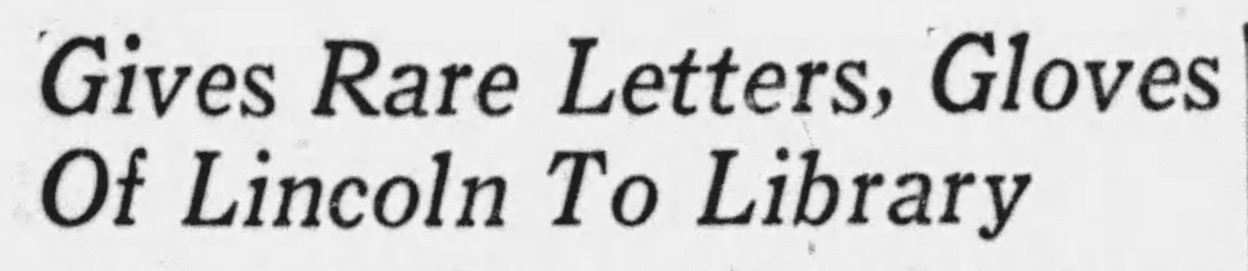
In 1956, the Illinois State Historical Library received a donation from Philip R. Baker, the great-grandson of Mary Lincoln’s sister, Elizabeth Edwards. Philip Baker donated 12 letters written by Mary Lincoln, seven letters written by Elizabeth Edwards, and 66 letters from Illinois Senator David J. Baker, who briefly held office in 1830.
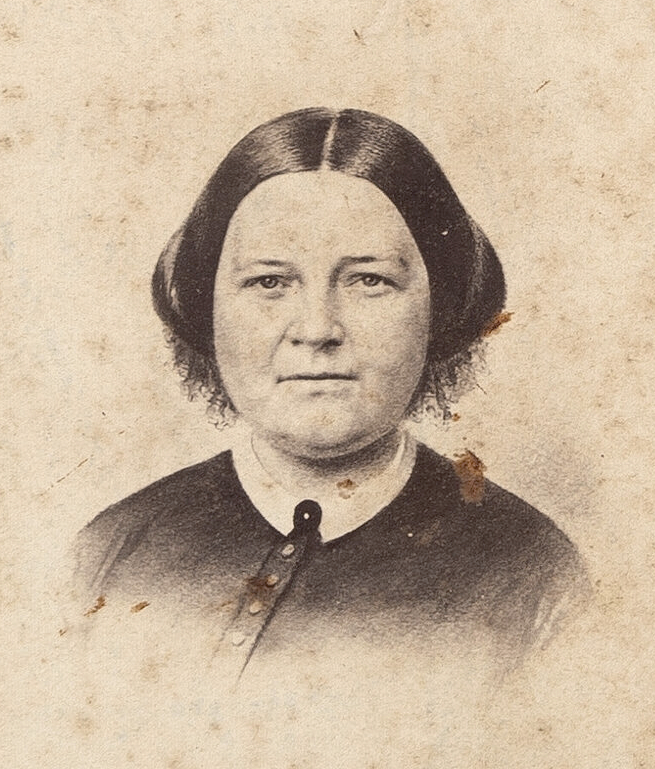
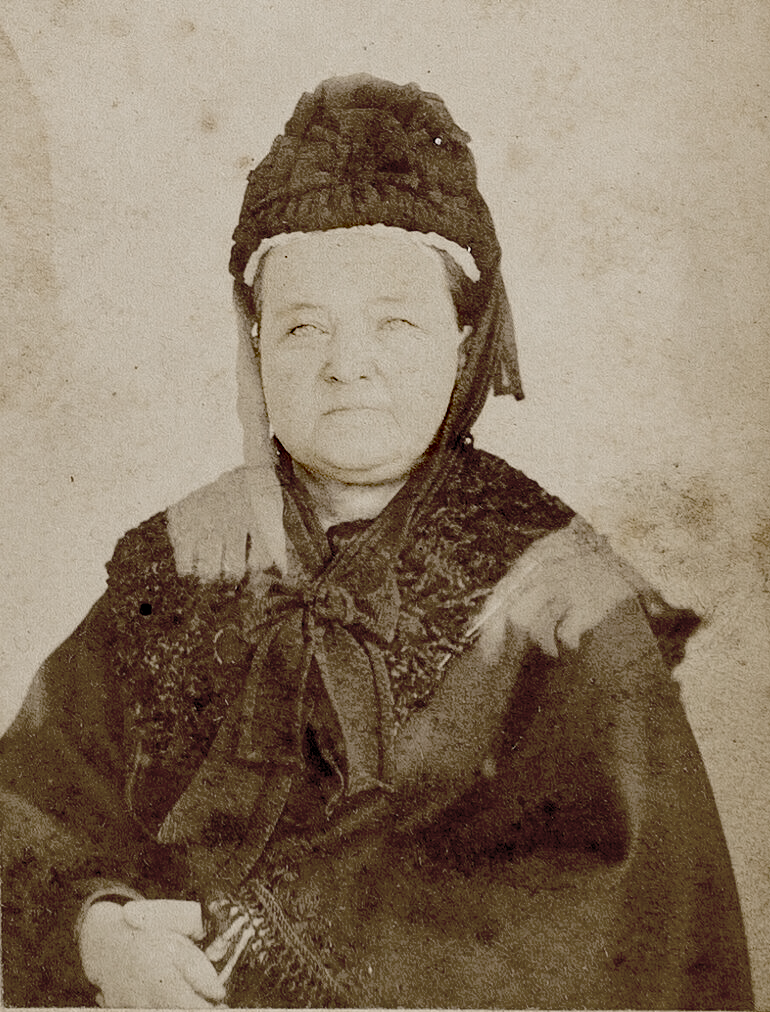
Mary Lincoln wrote the letters in this collection to Edward Lewis Baker, Jr., the donor’s father. After Mary was forcibly committed to an insane asylum by her only surviving son, Robert, in 1875, she expertly managed to secure her release three months later. After leaving the asylum, she went to live with her sister Elizabeth Edwards in Springfield. There she got to know Elizabeth’s grandson Edward Lewis Baker, Jr., who was called Lewis. He was about 17 years old at the time and reminded Mary of her son Tad, who had died four years earlier at the age of 18. She took a strong liking to her great-nephew, especially now that her relationship with her only surviving son had ended acrimoniously. According to Lois Romano’s newest biography, An Inconvenient Widow, “[Mary] treated him as a surrogate son, pouring into him the love and grandmotherly advice pent up inside her. Lewis agreed to accompany her to New York for her trans-Atlantic crossing, and they left Springfield in September 1876, stopping in Lexington.” From her birthplace, the pair made their way to New York, where Mary set sail alone for France in October 1876. The earliest letter from Mary Lincoln to Lewis Baker in the donated collection is dated Havre, France, Oct. 17, 1876. All but the last letter was written on monogrammed mourning stationery.
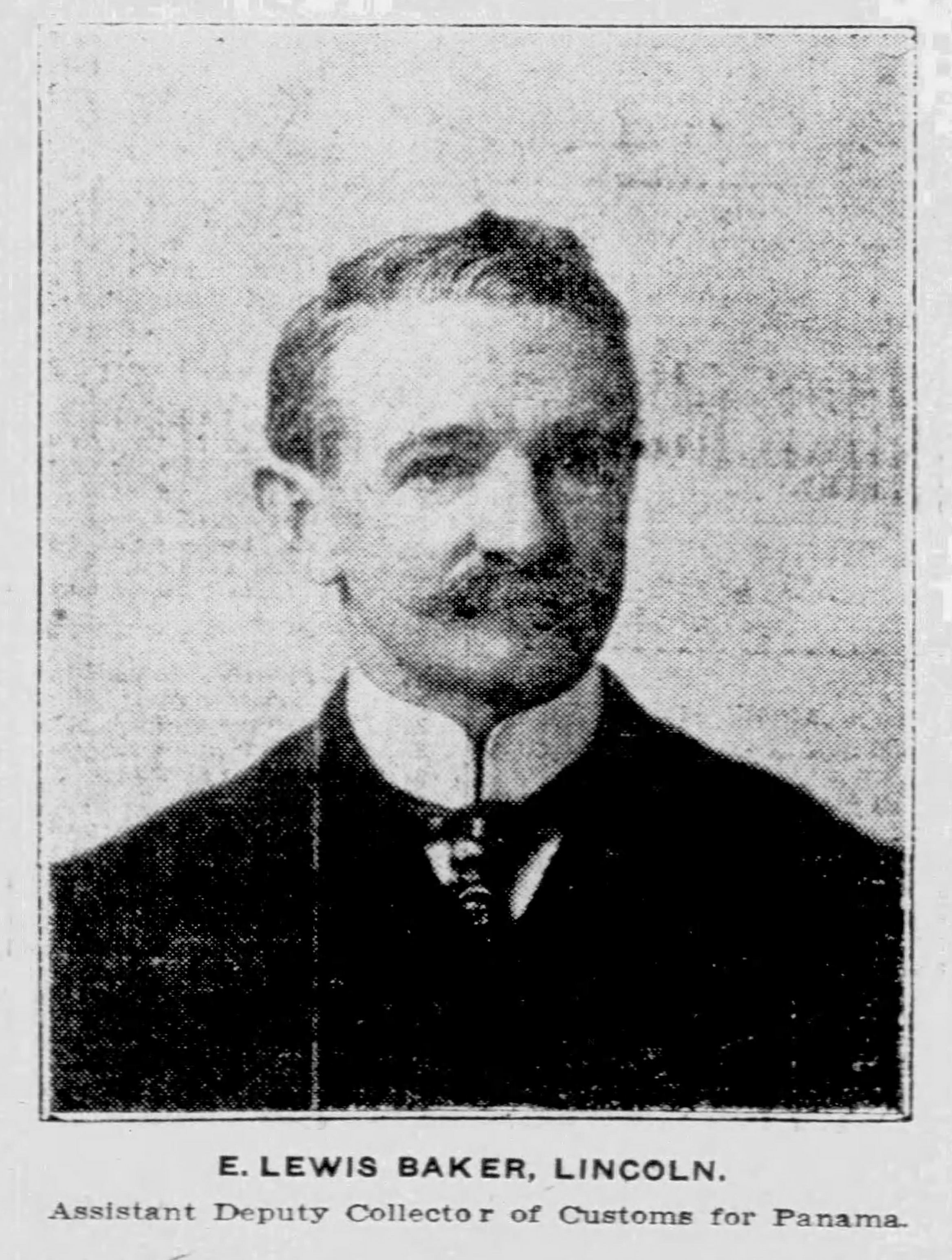
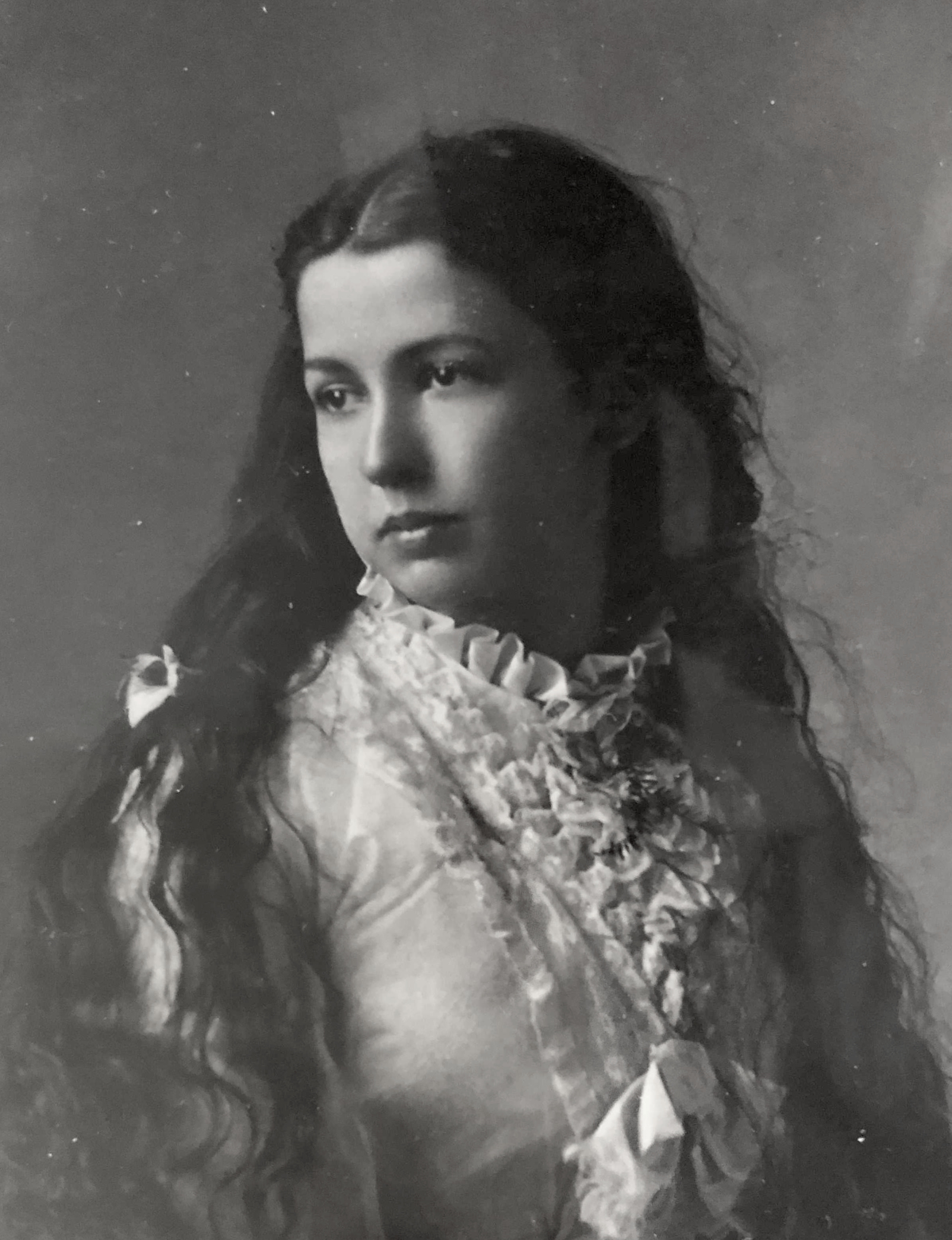
Edward Lewis Baker, Jr. circa 1905
Edward Lewis Baker, Jr. was the only person to greet Mary in New York when she arrived back home in America after her prolonged European stay in 1880. Mary then moved back in with her sister in Springfield, and Lewis remained a regular visitor. Though not named in the newspapers like his grandparents, the “Hon. and Mrs. N. W. Edwards,” Lewis was undoubtedly one of the “other relatives” who attended Mary Lincoln’s funeral on July 19, 1882.
Yet Philip Baker’s donation consisted of more than just letters. There were also some physical objects from his father’s papers, including a pair of white kidskin gloves claimed to have been found in Abraham Lincoln’s pocket after his murder.
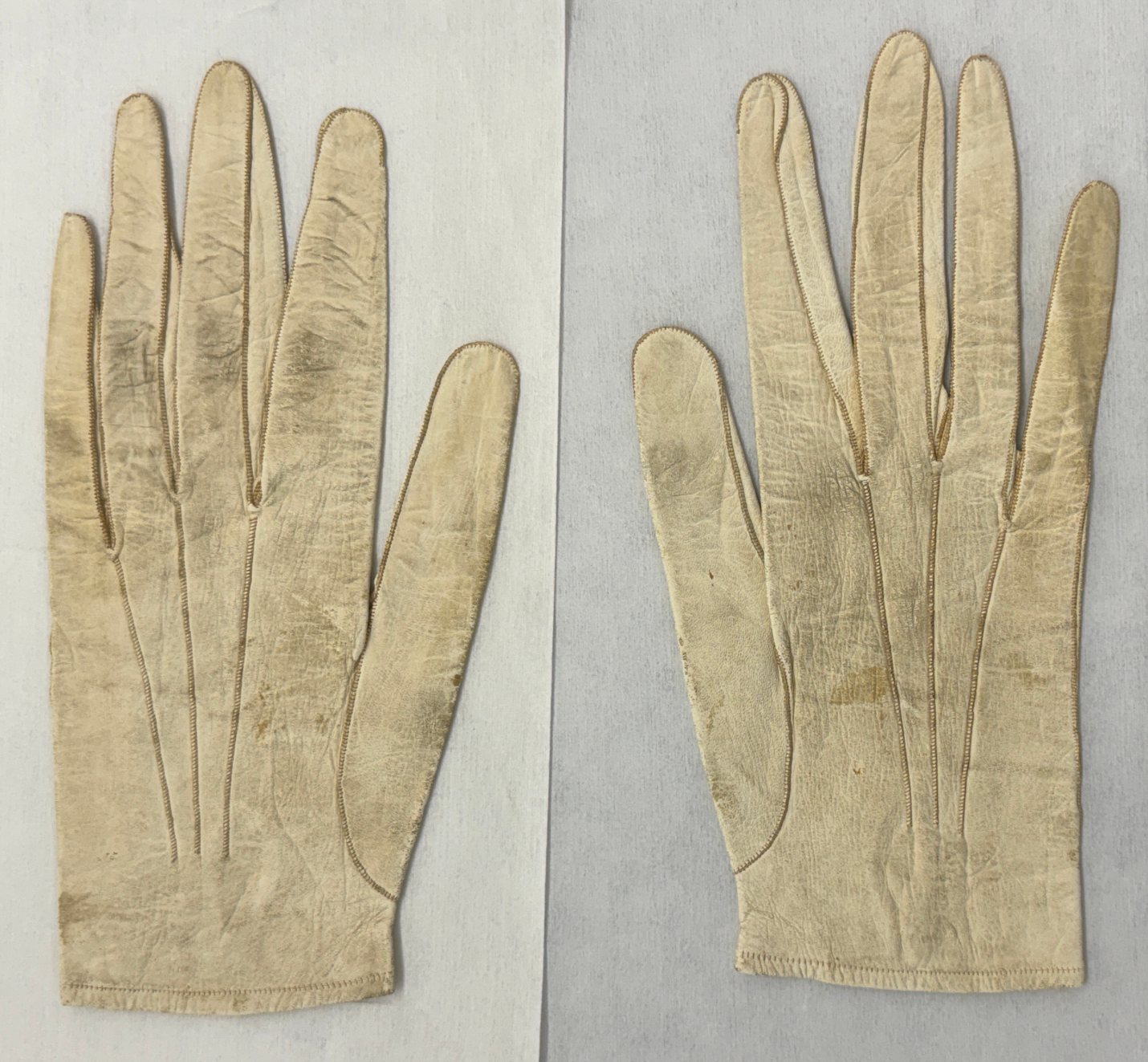
These gloves are 23.2 cm in length from the wrist to the longest finger, and the inside of the left glove near the wrist features the name “Ph Courvoisier” and the number “8 ¾” stamped in light blue ink.
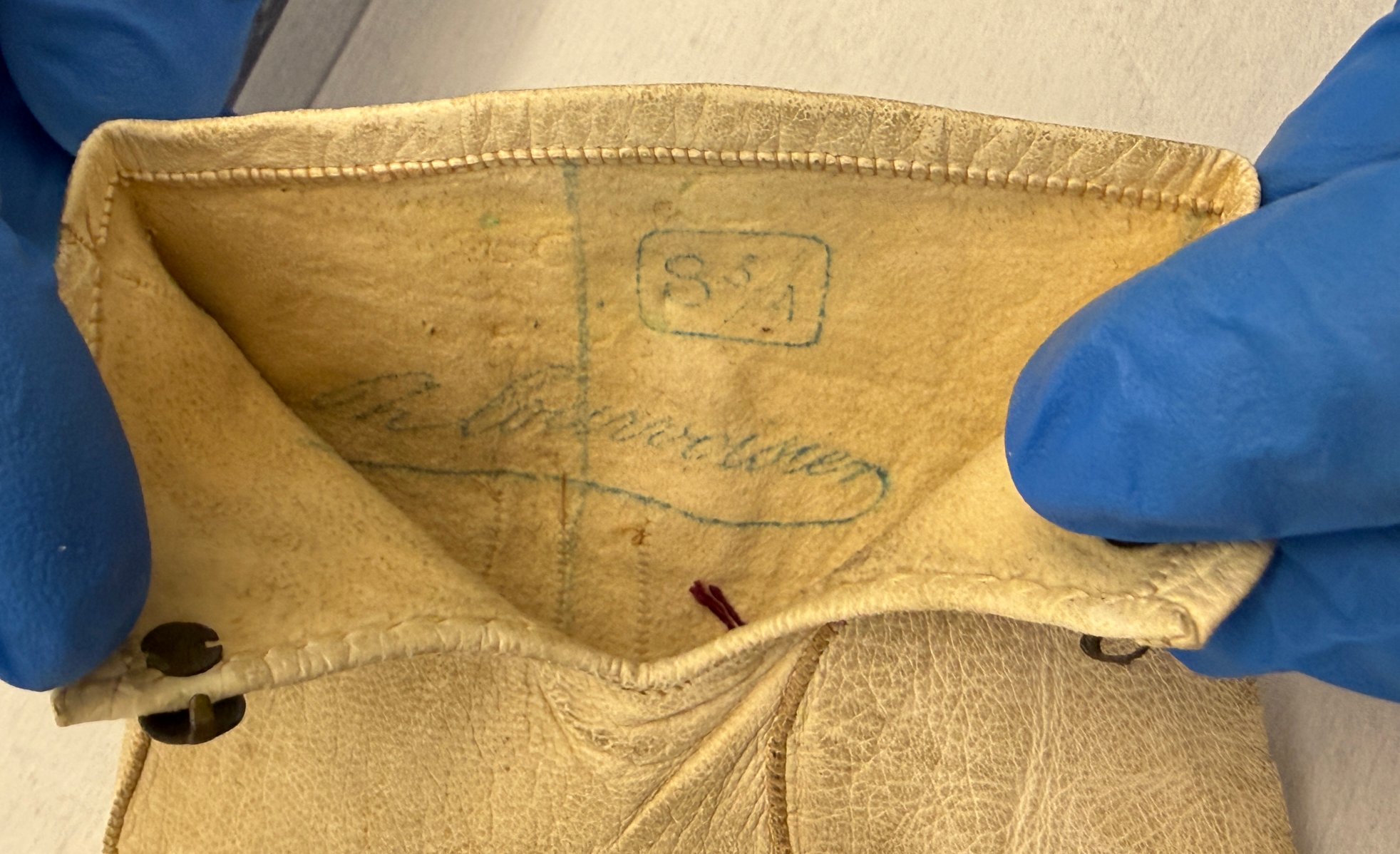
Additional blue vertical lines are stamped on both gloves, along with numbers ranging from 11-18, likely part of the manufacturing process.
While none of the letters from Mary Lincoln to Edward Lewis Baker, Jr. reference the gloves, their provenance consists of Baker’s handwriting on the back of his business card.
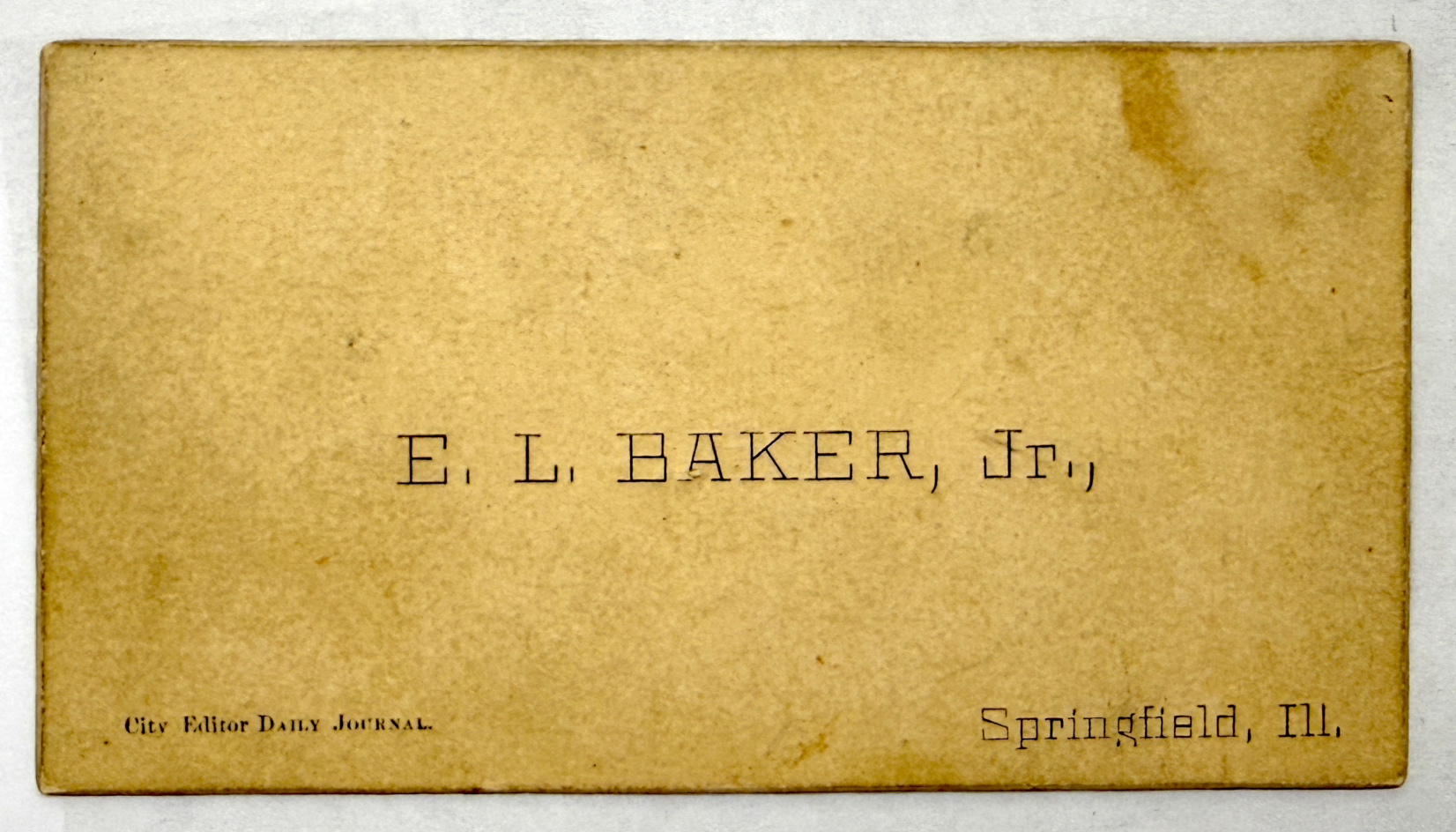
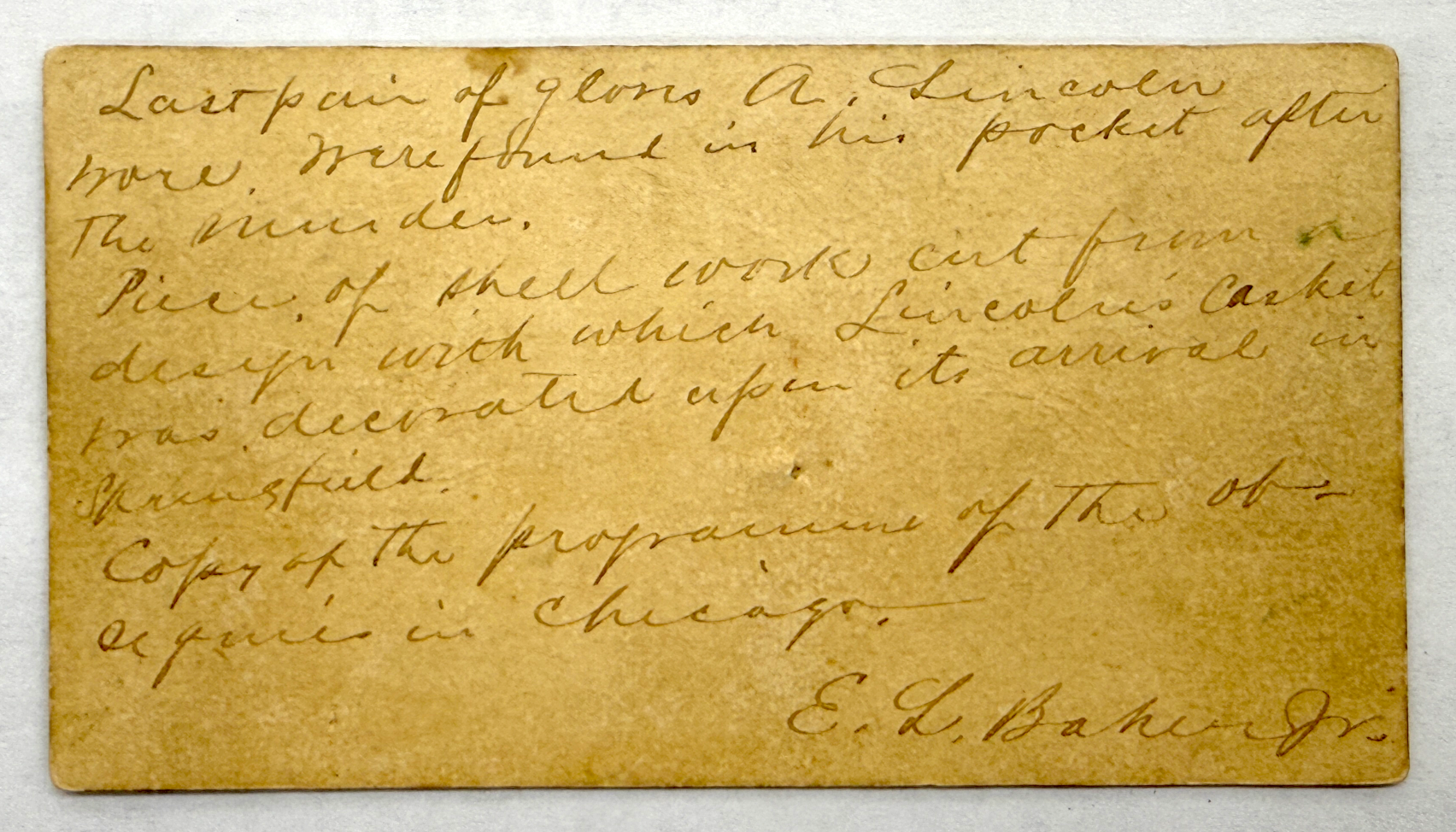
This handwritten note documents three assassination-related objects:
“Last pair of gloves A. Lincoln wore. Were found in his pocket after the murder.
Piece of shell work cut from a design with which Lincoln’s casket was decorated upon its arrival in Springfield.
Copy of the programme of the obsequies in Chicago.
E. L. Baker, Jr.”
The assumption is that Mary Lincoln gifted Lewis these gloves, perhaps as a token of appreciation for the young man who became a surrogate son. This seems like a very likely series of events. But where were these gloves present at the assassination? Like the prior examples, we don’t have the evidence to prove it.
A close reading of Lewis’s provenance for the gloves is actually a bit ambiguous. All he wrote is that they were the “Last pair of gloves A. Lincoln wore. Were found in his pocket after the murder.” We first assume Lewis means Lincoln wore these gloves to Ford’s Theatre, but the wording doesn’t say that. For all we know, Lincoln did not wear any gloves to Ford’s Theatre, and these were found in an undisclosed pocket from an earlier outing that involved gloves. While Lincoln likely brought gloves to Ford’s Theatre, no period evidence confirms this assumption. As this post highlights, there is a surplus of so-called assassination gloves in physical form, but a dearth of period evidence from eyewitnesses discussing any gloves, which complicates matters.
The Baker gloves and their assumed connection to Mary Lincoln also raise another issue. Mary Lincoln did not like physical reminders of her husband’s murder. As documented in Reignette Chilton’s books, she gave away the greatcoat and suit Abraham was wearing when he was shot just days following the assassination. In the weeks after the crime, Mary gave away many articles of clothing and objects relating to her husband. For example, here is a pair of Abraham’s riding gloves that Mary gave away on May 22, 1865, the same day she left the White House.
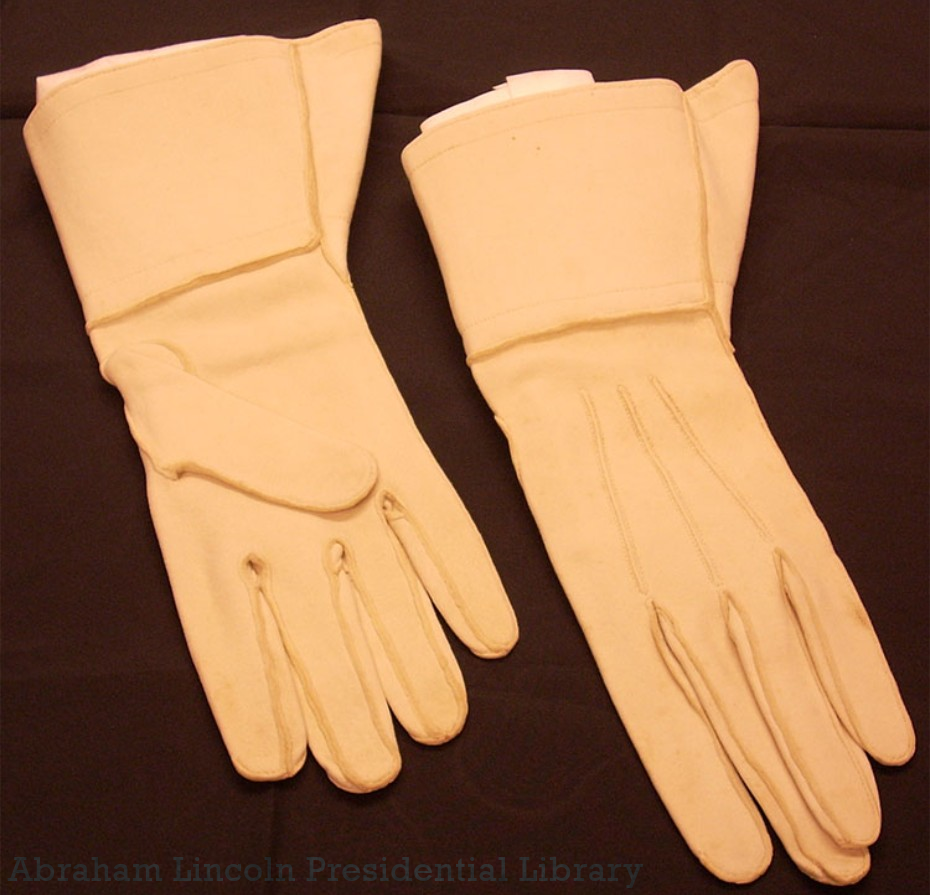
She presented these gloves, through her son Robert, to Gen. Christopher C. Augur, who commanded the defenses around Washington. Augur had been present at the Petersen House during the deathwatch and took part in the manhunt for Booth. Robert wrote to Augur, gifting him the riding gloves and expressing his mother’s thanks for his “kindness during the past few weeks.”
It is difficult to believe that Mary Lincoln would have retained the gloves her husband had with him when he was assassinated for any period of time, especially a decade later when she became close to Lewis Baker. In addition, at the time of Abraham’s death, Mary was estranged from her sister Elizabeth Edwards, making it unlikely that she gave “assassination gloves” to her at the time, which later could have passed to her grandson, Lewis. Yet the gloves’ inclusion in Lincoln family papers now held by the Abraham Lincoln Presidential Library and Museum in Springfield, Illinois, elevates them above the rest.
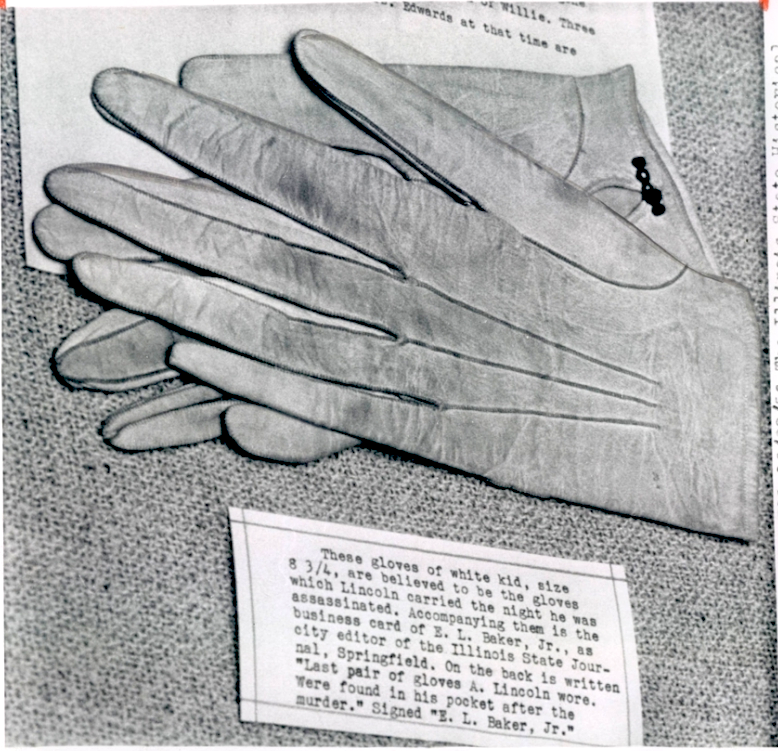
Assessment: The Baker gloves have better provenance than the previous examples as they are linked to a member of the Lincoln family with whom Mary Lincoln had a close relationship. However, the provenance doesn’t directly state that the gloves came from Mary Lincoln, and the likelihood that Mary would have kept any assassination gloves long enough to gift them to Baker is low. Still, the family connection makes it likely the Baker gloves once belonged to Abraham Lincoln, even if they weren’t with him at Ford’s Theatre.
A Millionaire’s Mistake?
Benjamin Richardson was rich. Of that there was no question. But he didn’t start that way. He was born in England in 1812 and emigrated to the United States as a ship’s cabin boy at 18. Richardson started in America as a servant for New York Representative (and later Governor, Senator, and Secretary of State) Hamilton Fish. Over time, the young man saved enough money to buy real estate in New York. In 1849, he headed west to California, along with others hoping to make it big in the gold rush. While prospecting for gold failed to bring a fortune, a well-placed land purchase in San Francisco was Richardson’s own gold mine when he later sold the land to a railroad company for a mint. Soon, Richardson became very wealthy. He diversified his land holdings to include quarries in Utah and Missouri. Soon, Richardson’s land assets provided for all he could want and more. Around 1861, Richardson left the United States and conducted a world tour that would last almost seven years. During this time, he visited Europe, Asia, and Africa, and was fond of collecting unique objects during his travels. Upon his return to America in early 1868, the eccentric millionaire announced his intention to open a free museum in California filled with his relics.
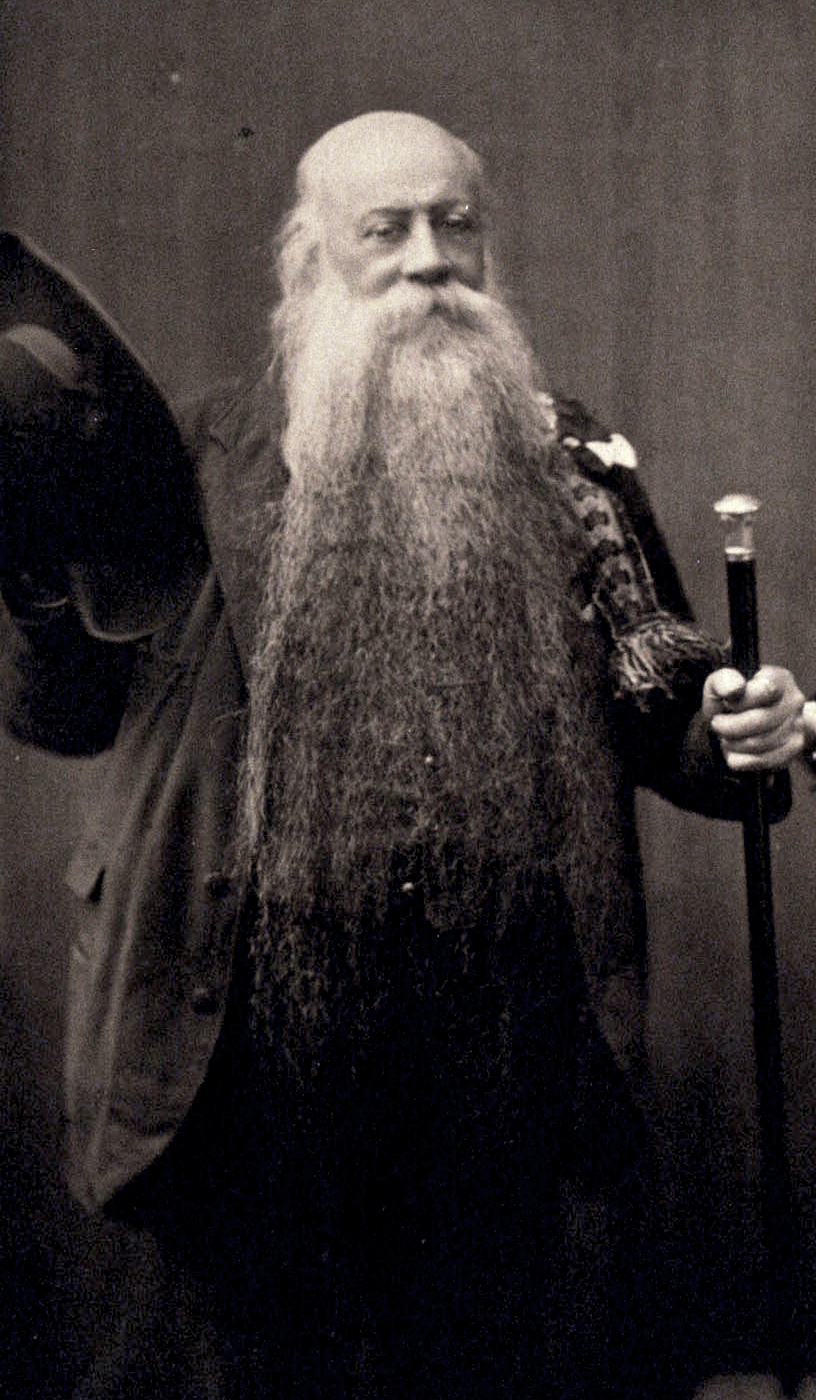
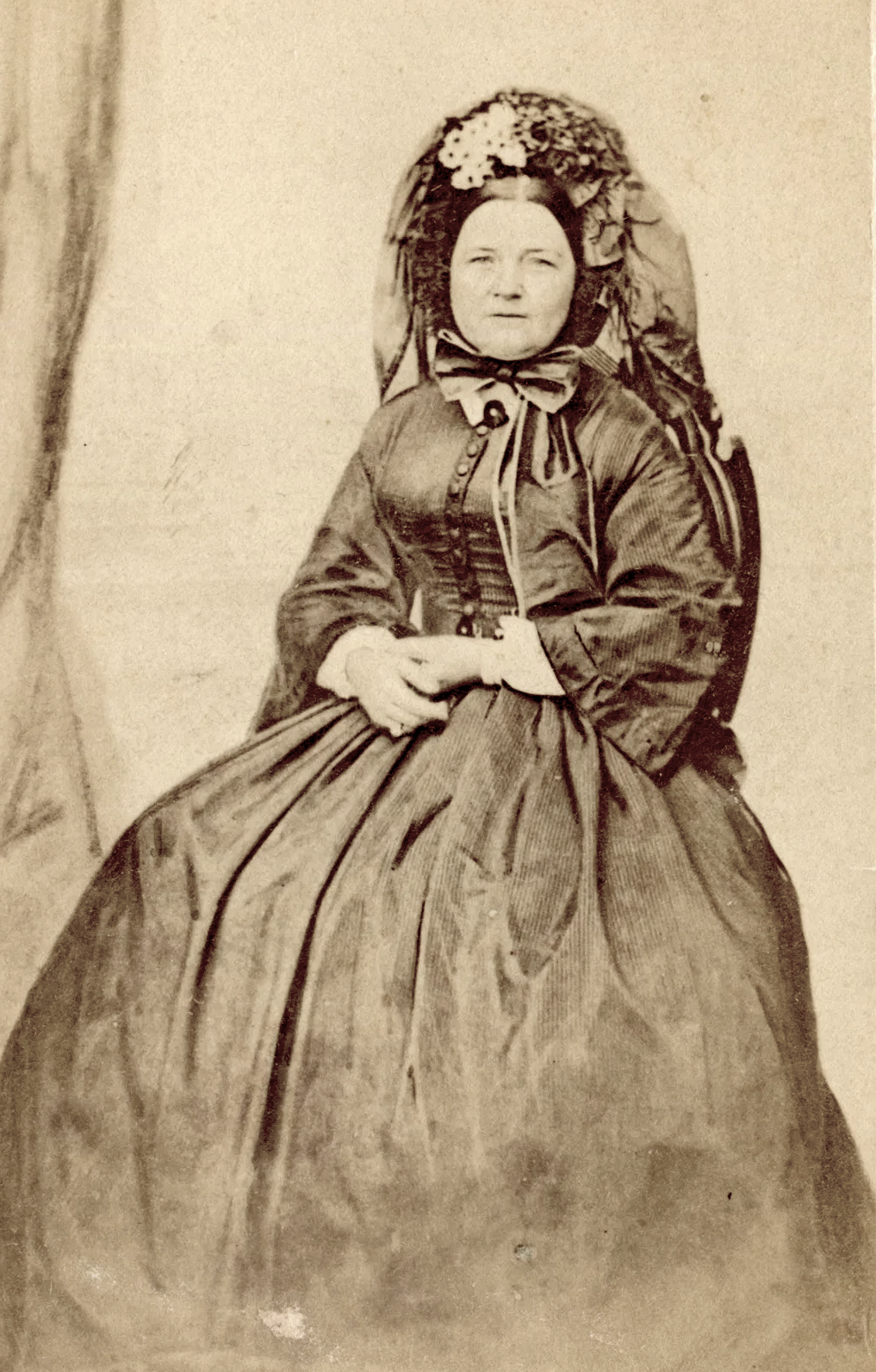
Benjamin Richardson in 1886
How Benjamin Richardson became acquainted with Mary Lincoln is uncertain. However, in 1868, he was exactly the type of person she was looking for. Ever since her husband’s death, Mary Lincoln had struggled financially. Some of her struggles were self-inflicted, as she used excessive shopping as a means to counter her grief. But there were also individuals in Mrs. Lincoln’s life who actively thwarted some of her attempts to acquire additional funds. Abraham Lincoln’s estate was not settled until November of 1867, and even after she gained access to her portion, Mary still worried about her financial future. During the interim years, Mrs. Lincoln would appeal to others to help secure donors and patrons who would support her and her needs. And Mary Lincoln was not above selling things to make sure she and her son Tad were taken care of. Enter the eccentric millionaire, Benjamin Richardson.
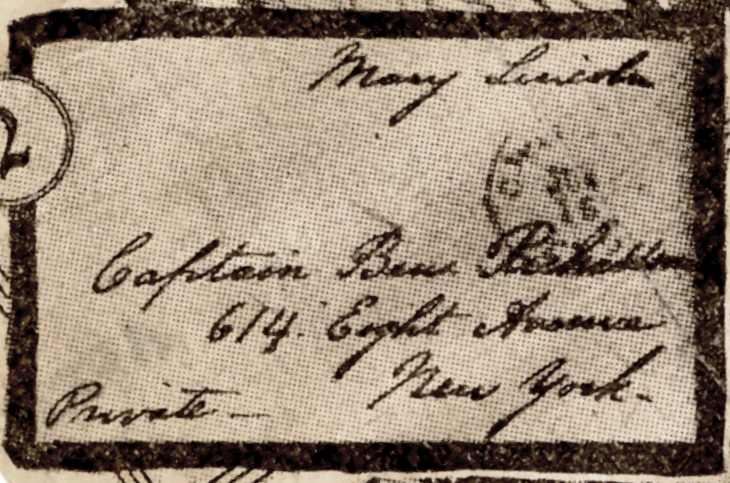
Two letters are known to have existed from Mrs. Lincoln to Richardson. Each is in response to letters from Richardson. The first is dated June 16, 1868, from Chicago, Illinois, while the second was sent by Mrs. Lincoln during her extended trip to Europe in 1870. Mrs. Lincoln sent her and Tad Lincoln’s best wishes to Richardson in both letters. In her 1868 letter to Richardson, she clearly tries to woo the real estate-savvy Richardson into buying some property she owned. As part of this gambit, Mrs. Lincoln documents the sending of certain items to Richardson, writing, in part:
“Capt. Benjamin Richardson:
My Dear Sir – Prof. and Mrs. Sawyer have just paid me a call, and handed me your letter, which I was very gratified to receive. I hasten to reply to it, fearing you may think I have been negligent regarding my promises. And yet I am sure you will be tantalized to know that some of the specialties promised have been in my room and only awaiting this being sent to Mr. Sawyer. Tomorrow my little Taddie will carry them down to the University [of Chicago] and it may be the rest I will bring on to you myself. After this explanation of the delay you will feel relieved…”
While Mrs. Lincoln never specifies in her letter what “specialties” she and Tad will present to Richardson, newspaper accounts from Richardson’s lifetime and beyond note that he was given a pair of gloves, a handkerchief, a cane, and possibly a hat, all of which belonged to Abraham Lincoln.
Richardson continued collecting unique objects for his planned museum. One impressive purchase he made in 1876 was a carriage owned by President George Washington. Richardson rode behind this famous carriage during a parade to mark the unveiling of the Statue of Liberty in 1886. However, despite his wealth and impressive collection, Richardson’s planned museum never came to fruition. He died an eccentric millionaire in 1889, and it took many years to settle his estate.
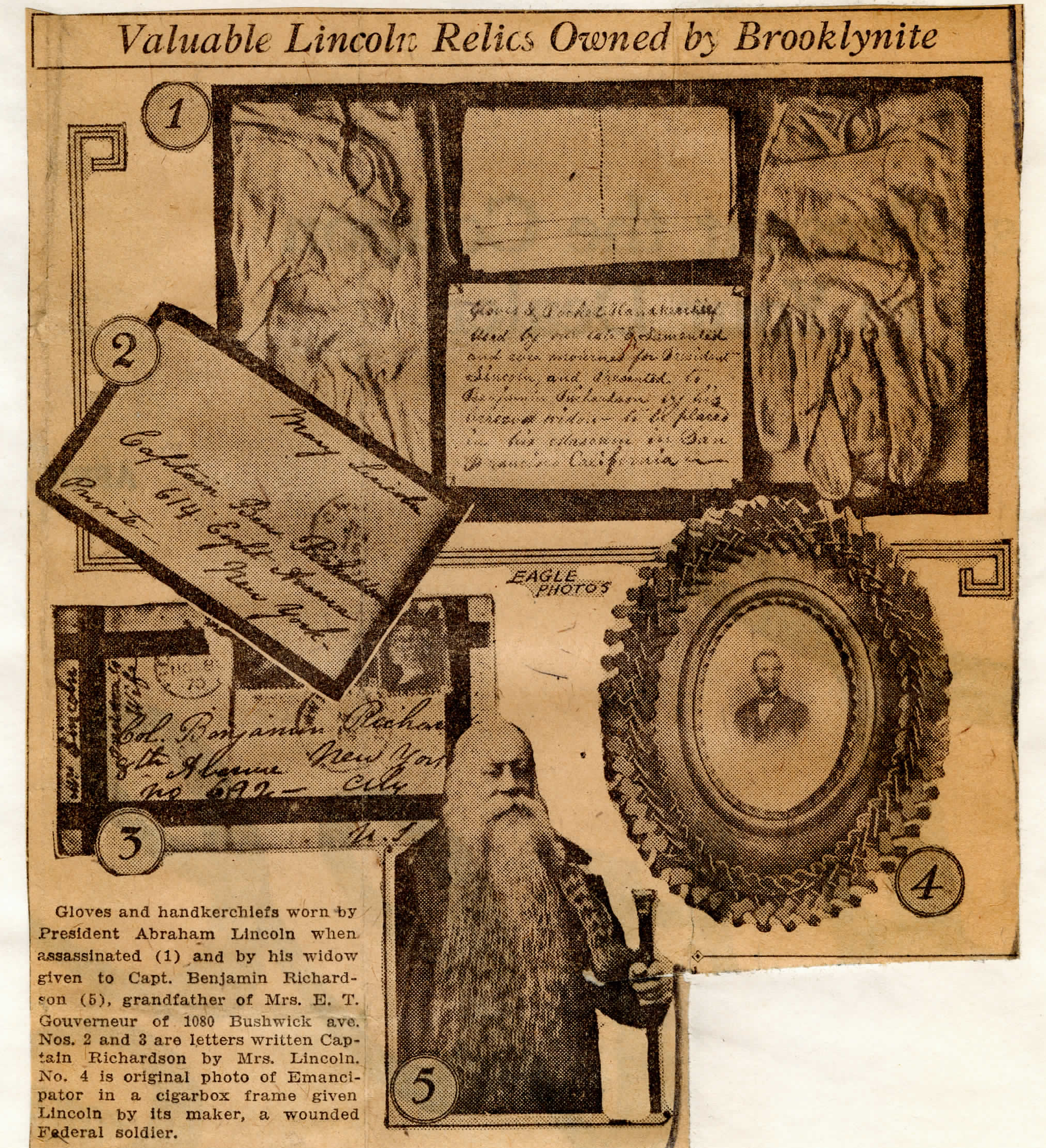
While the Washington carriage was sold and eventually made its way to Mount Vernon, Richardson’s heirs retained some of the Lincoln relics. In 1925, the Brooklyn Eagle published an article featuring the Lincoln artifacts, then owned by Richardson’s granddaughter, Ella Gouverneur. The article explained that the gloves and handkerchief were framed together and hung in Ella’s dining room. The newspaper included a collage of these items, an image of Richardson, the envelopes from Mrs. Lincoln, and a framed portrait of Lincoln also claimed to have come from the former First Lady.
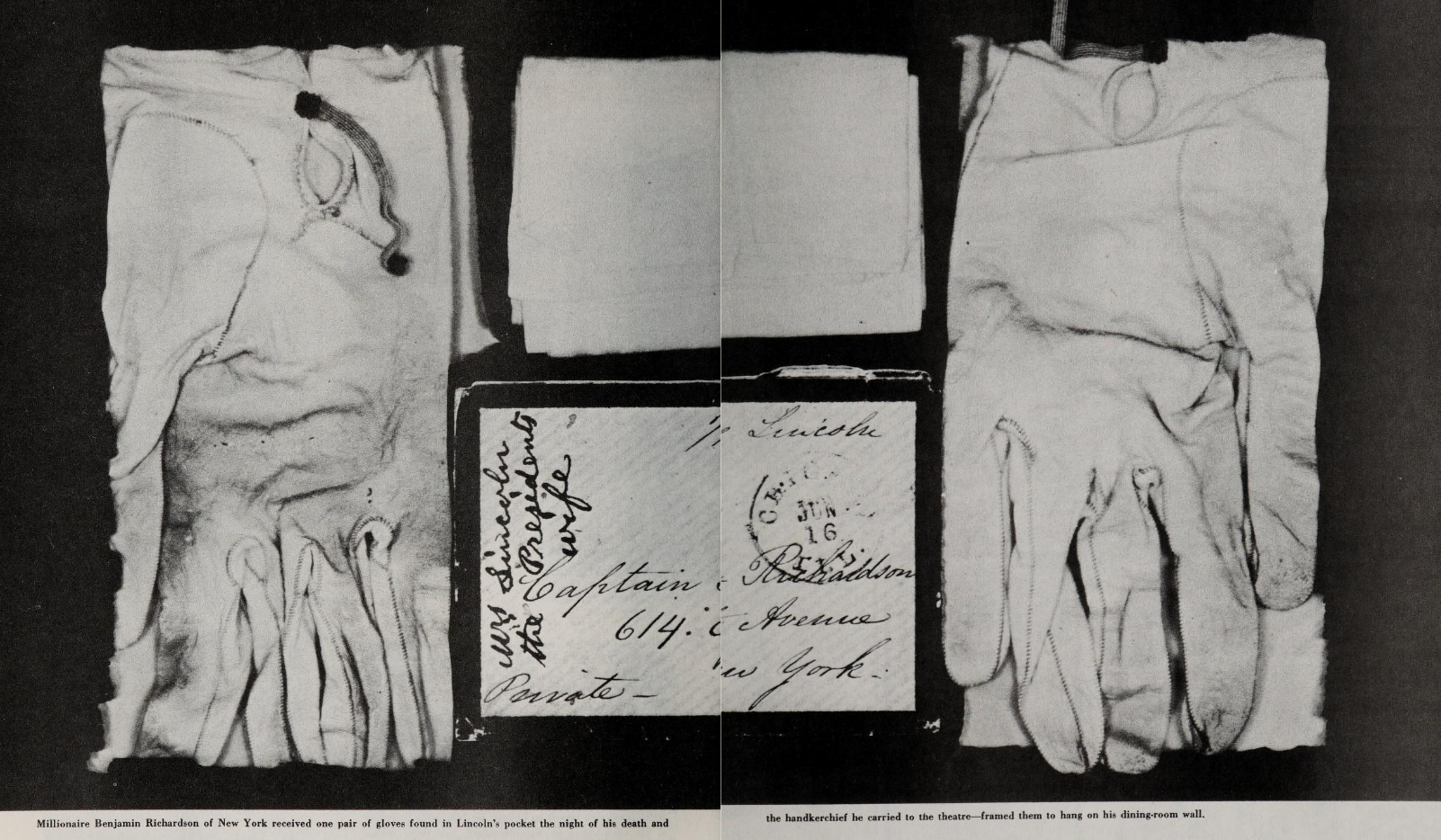
These relics later passed to Ella’s daughter (Richardson’s great-granddaughter), who allowed the gloves, handkerchief, and one of the Mary Lincoln envelopes to be photographed and published in Dorothy and Philip Kunhardt’s coffee-table-sized book on the assassination, Twenty Days, in 1965.
Around the 1990s, the gloves, handkerchief, and cane came into the possession of Lincoln collector Louise Taper, who sold them to the Lincoln Presidential Foundation.
These are the fourth and most famous pair of gloves: the “blood-stained’ gloves sold by Freeman’s | Hindman auction house in 2025.
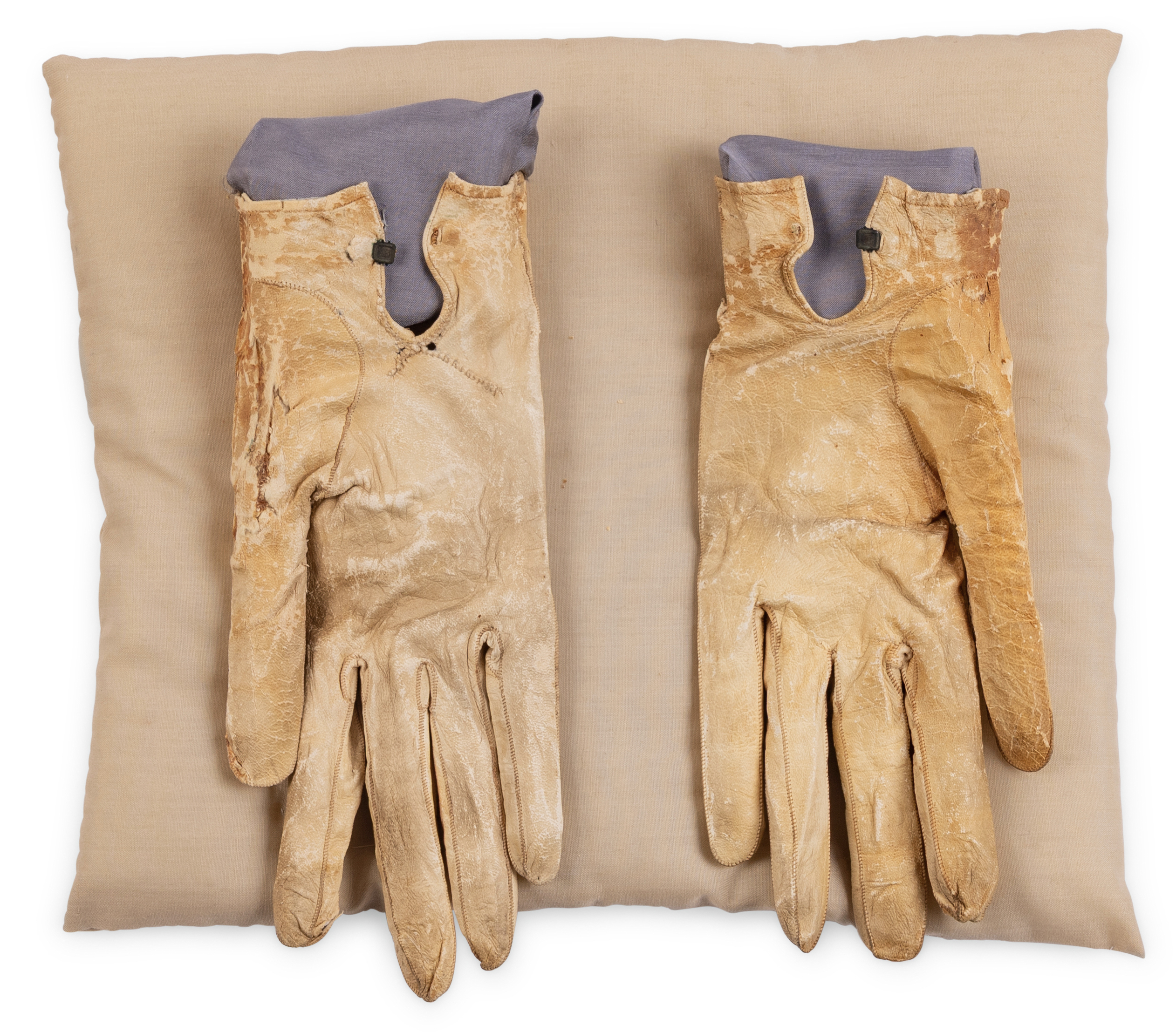
They are 22.8 cm in length with the number “9 ¼” stamped inside. The clasp of each is stamped with a small “T.” There is also dark colored staining near the wrist area and thumb of each glove. The auction listing for these gloves from 2025 gives the following brief description of their condition: “Some flaking and cracks; elastic bands detached, but present; archival repairs to lining of each glove; contemporary repaired split at base of palm on right glove; each glove soiled and unevenly darkened.”
As shown, the chain of custody for the gloves is quite strong. While Mary Lincoln does not provide an exact accounting of the “specialties” she provided Richardson, other period evidence strongly supports the idea that these gloves and handkerchief were among them. It is safe to say that these gloves and handkerchief came from Mrs. Lincoln.
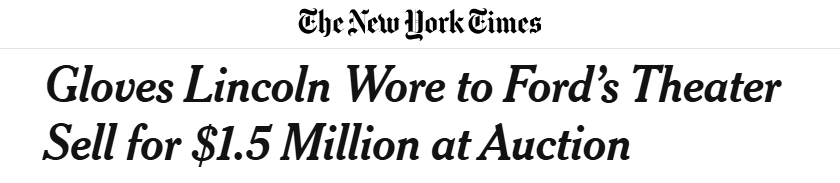
But let’s get to the $1.5 million question – what is the evidence that these are “assassination gloves?” As we follow the line of provenance back, it is clear that the recent auction house, the Lincoln Presidential Foundation, Louise Taper, and the Richardson heirs believed that these gloves were carried by Lincoln on the night he was assassinated. Ella Gouverneur stated this without reservation when the Brooklyn Eagle interviewed her in 1925. So, for at least 100 years, the owners have had no doubt that these gloves witnessed that tragic night.
But if we look back further, the idea that these gloves were associated with the assassination becomes less certain. Unfortunately, the main sources we have regarding the gloves during this early period are newspaper articles that mention them in connection to Benjamin Richardson. In a few of the obituaries that came out upon his death in 1889, there was a line noting that he was “a fast friend of Mrs. Abraham Lincoln and received from her the cane, hat, and gloves worn by her husband when he was shot.” However, another obit that made the rounds merely stated that he “owned a pair of gloves and a cane used by Abraham Lincoln,” with no mention of the gloves’ claimed connection to Ford’s Theatre. As we continue going back in time, we see this happen more and more. While a Boston Globe article from 1886 described Richardson as the “possessor of the cane and gloves carried by Abraham Lincoln when he was shot by John Wilkes Booth,” an earlier Chicago article from 1883 only mentioned that Richardson “hoards Lincoln’s gloves and cane,” with no further detail. We can’t expect different newspapers to mention every aspect of the gloves in their articles, especially since they are not usually the focus of the piece, but it is interesting how often the gloves are not attributed to the assassination as we travel back through the records.
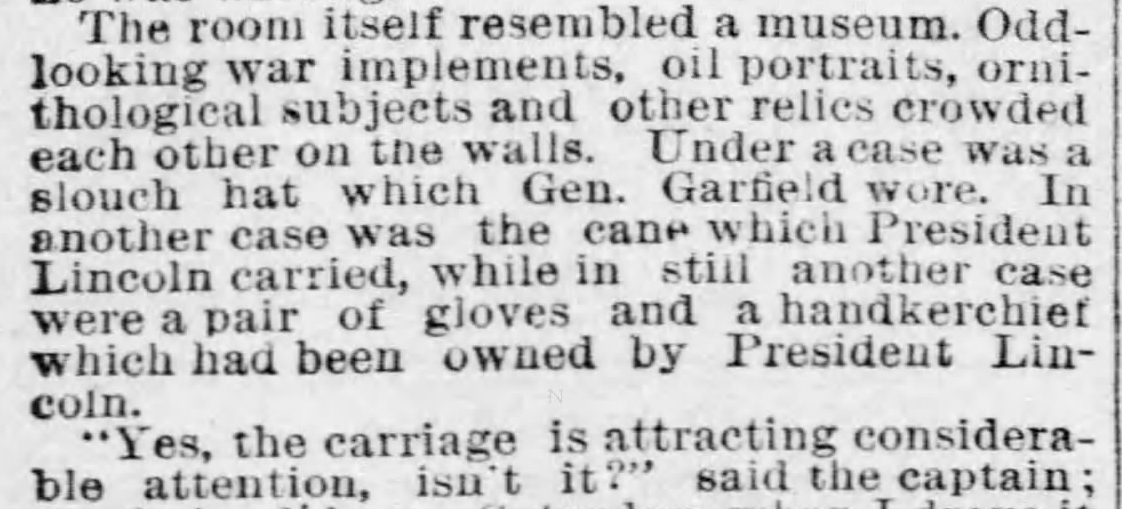
An 1883 article from the St. Louis Dispatch described a visit to Richardson’s home in Harlem, which he called the “Lincoln Cottage.” He showed the reporter his many treasures, including the George Washington carriage and a slouch hat worn by President Garfield. When it came to the gloves, the article merely stated that, “In another case was the cane which President Lincoln carried, while in still another case were a pair of gloves and a handkerchief which had been owned by President Lincoln.” Again, the article makes no connection between these artifacts and the world-changing event they were later said to have witnessed. As an article about Richardson’s unique collection, one would have expected more details.
The next earliest mention of Richardson and his gloves comes from 1880, in a biographical sketch of Richardson that appeared in a Missouri paper near where he owned a lucrative quarry property. There, Richardson is described as “the possessor of Lincoln’s gloves and cane,” with no additional significance given to them.
That brings us to the earliest record I’ve come across that mentions Richardson and his Lincoln gloves. It appeared as an article in the Trenton State Gazette in New Jersey, published on February 15, 1869. The article documented the second annual banquet of the Lincoln Association of Jersey City. Annual events honoring Abraham Lincoln were very common in the years following the 16th President’s death, and you can still find Lincoln dinners and banquets around the anniversary of Lincoln’s birth today. The Gazette article described the recent festivities that had occurred:
“About 150 persons sat down to dinner, many prominent men of Hudson county being present. The hall was richly decorated and oil paintings of Washington, Lincoln, Generals Scott and Grant were hung in the spaces between the windows. On the centre of the dais was the well known Rogers group, Lincoln, Stanton and Grant, holding a council of war…”
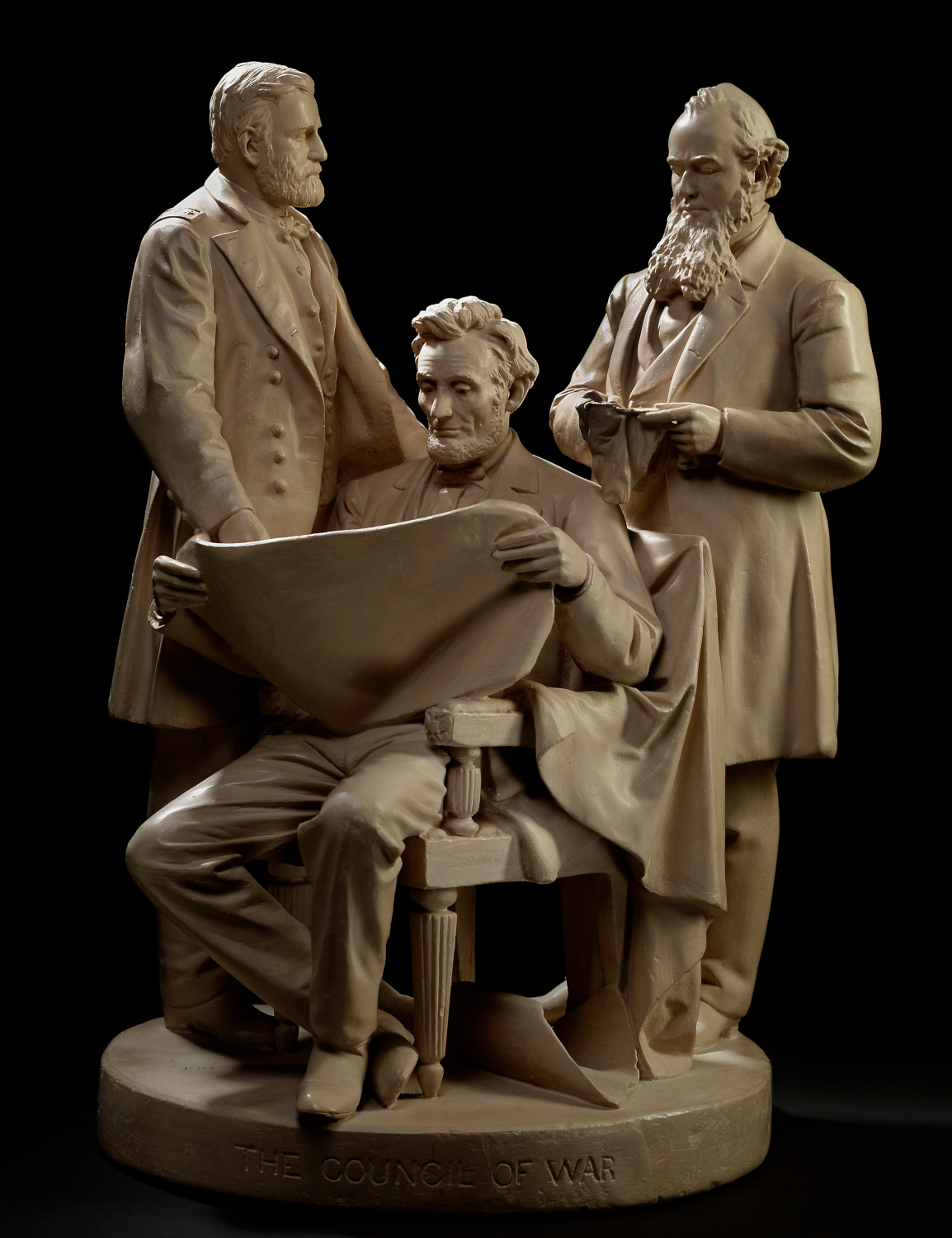
John Rogers’ sculpture, “The Council of War”
“…After partaking of an excellent supper the company turned their attention to the intellectual portion of the programme. The chair was occupied by Mr. David W. Weiss, President of the Lincoln Association. Letters of apology were read from the President and Vice President elect, Generals Sherman, Sickles, Logan and Sigel; Senators Wilson and Frelinghuysen; Congressmen Halsey and Hill; ex-Governors Ward, Chief Justice Chase, Judge Bedle, Hannibal Hamlin, William Cullen Bryant, and others. The following toasts were proposed: – ‘The Memory of Abraham Lincoln,’ responded to by B. W. Throckmorton; ‘The President of the United States;’ ‘The Congress,’ by E. B. Wakeman; ‘The Judiciary,’ by Isaac W. Van Winkle; ‘The State of New Jersey,’ ‘The Army and Navy,’ by Captain B. F. Frazer, Jr.; ‘The Proclamation of Emancipation’ by Rev. J. L. Danner; ‘The Press,’ by General Edward Jardine, and ‘Woman’ by Benjamin Van Riper. A pleasing feature of the entertainment was the singing by Mr. Charles Henry, whose rendering of ‘Kathleen Mavourneen’ was exquisite and brought down the house.
The delegation from Hoboken consisted of General Hatfield, Captains Hart, Lee and Frazes; Major Mount and Mr. Pritchard. The affair was passed off most successfully.”
As you can see, this article is very detailed. The reporter described the Lincoln banquet scene, the decorations, and the many people who took part in the proceedings. The article also contains one additional section that I have withheld until now:
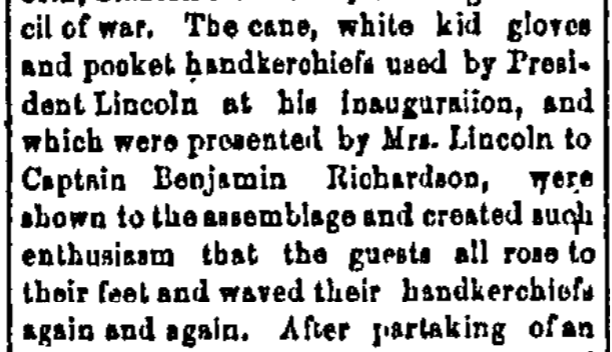
“The cane, white kid gloves and pocket handkerchief used by President Lincoln at his inauguration, and which were presented by Mrs. Lincoln to Captain Benjamin Richardson, were shown to the assemblage and created such enthusiasm that the guests all rose to their feet and waved their handkerchiefs again and again.”
You read that right. This article notes that the gloves, cane, and handkerchief given to Benjamin Richardson by Mary Lincoln came from Abraham Lincoln’s inauguration, not assassination. We have already established that the reporter who composed this article was very detail-oriented. It seems unlikely that they would mistake Lincoln assassination relics for Lincoln inauguration relics. Even if we were to suppose the reporter was in error and substituted inauguration for assassination, does it make logical sense that the crowd would have risen to their feet and waved their own handkerchiefs in response to relics of the President’s death? It’s clear that the crowd was pleased by the items Richardson displayed and acted out of celebration.
For historical research and provenance, the earliest accounts are usually best. Stories and memories change over time. Sometimes this is a case of people lying or altering their stories to make them more appealing. But alterations in stories are not always the product of deliberate deception. The human brain is not a perfect recall device. Memory is incredibly subjective and changes over time. Even setting aside the assumed memory loss that comes with aging, our minds constantly alter our memories. Studies have shown that, among many things, imagining an event having taken place can create a false memory of it actually occurring; the manner in which you are asked about an event can change the way you remember it; and the more often you recall an event, the more the memory of that event changes. This is how someone like Mrs. Matilda Todd, an eyewitness to Lincoln’s assassination in 1865, can be completely honest in telling newspapers in the 1930s that she remembered Booth’s broken leg spurting blood upon the stage and that a giant lasso whisked him off into the wings. After years of recalling the event she witnessed, her genuine memories became a fictional account.
Mary Lincoln wrote to Benjamin Richardson about preparing his items on June 16, 1868. This Lincoln banquet occurred on February 12, 1869. Therefore, this article was written just a few months after Richardson acquired his Lincoln relics. Nothing in Mary Lincoln’s known letters to Richardson describes the objects, and the earliest published account claims no connection to his assassination, but rather to his inauguration. The first account claiming these gloves were present at Lincoln’s assassination dates to 1886, nearly two decades after Richardson received the items and after Mrs. Lincoln had died. The evidence demonstrates that the story around these gloves changed over time to become associated with Lincoln’s death.
Even the note displayed with the gloves and handkerchief at Richardson’s and then Ella Gouverneur’s home lacks any mention of the gloves being connected to Lincoln’s death. If we zoom in on the photograph in the Brooklyn Eagle article in 1925, we can read the handwritten note that accompanied these relics. It says:
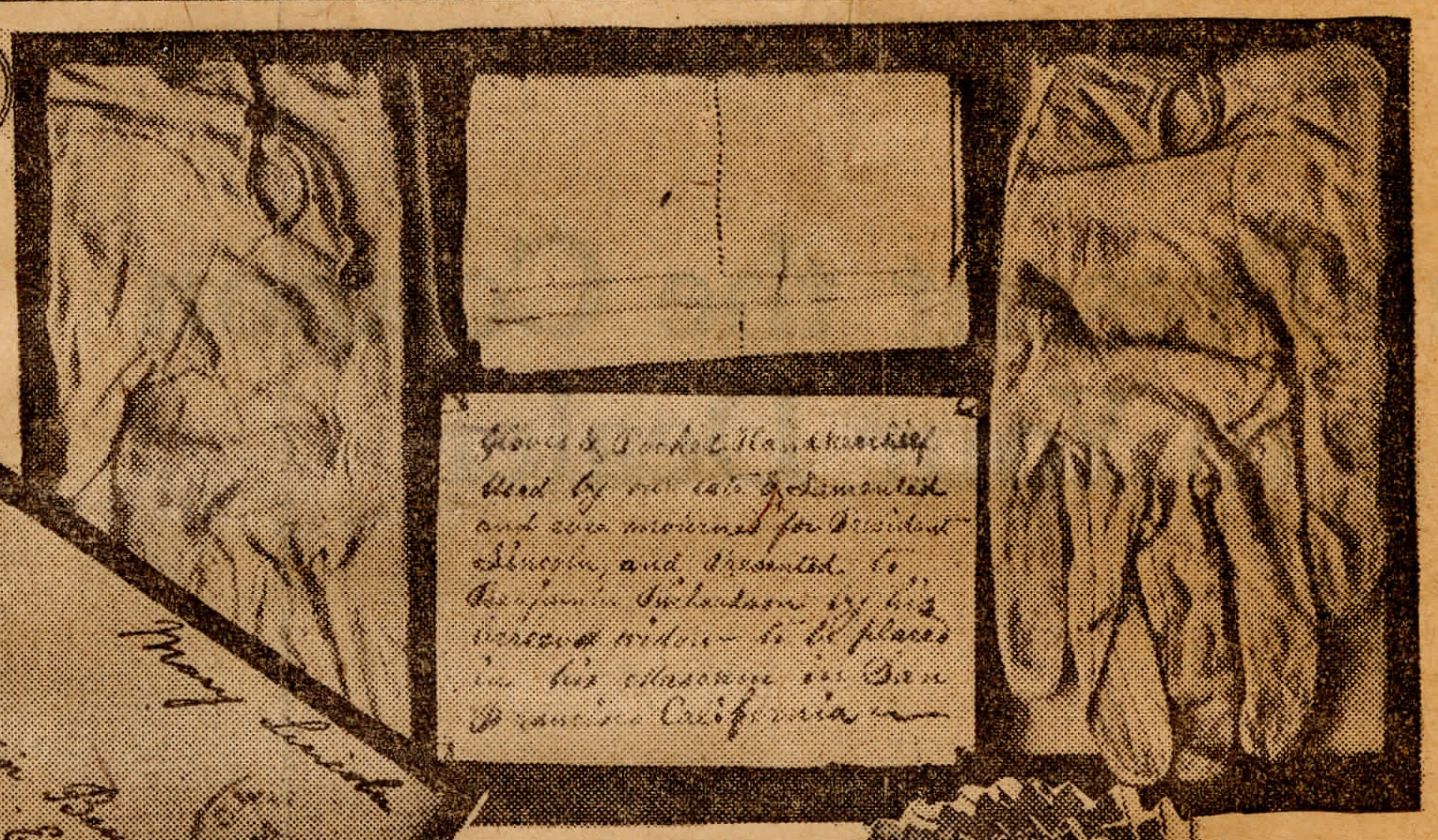
“Gloves & Pocket Handkerchief used by the late Lamented and ever mourned for President Lincoln and Presented to Benjamin Richardson by his bereaved widow – to be placed in his Museum in San Francisco California ~”
As a display piece, one would expect this note to state directly that these items were with Lincoln at Ford’s Theatre, but it gives no such detail. All the note says is that Lincoln once “used” these items, with no timeframe or specific place given, which fits some of the descriptions in the 1880s where the gloves are merely recounted as being owned by Lincoln, and nothing more.
“But, hang on,” you might be thinking. “If these aren’t Lincoln assassination gloves, how do you explain the blood stains?” That is the second piece of evidence used in support of these gloves. While many of the press accounts around the sale of the gloves commented on the dark blood stains featured on the gloves, only once in the auction listing does it suggest the staining on the gloves is blood. Here is that sentence:
“According to an article published in the Brooklyn Eagle on 22 March 1925, and featuring a photograph of the gloves and a handkerchief, both possibly stained with the president’s blood, were gifted to Richardson at the University of Chicago, and delivered by Lincoln’s son, Tad.”
The auction house writes this to suggest that the Brooklyn Eagle article described the staining on the gloves and attributed it to Lincoln’s blood, but the 1925 article mentions no staining at all. In fact, there is no mention of blood in any reference to the gloves until the modern era. Even the articles from Richardson’s and Ella Gouverneur’s lifetimes that attribute the gloves to the assassination do not say anything about the gloves being bloodstained. When the photograph of the gloves and handkerchief was published in Twenty Days in 1965, the caption says nothing about bloodstains, even while a photograph on the next page highlights fragments of bloodstained towels from the Petersen House. When an appraiser looked through the Louise Taper collection in advance of its sale to the Lincoln Presidential Foundation, he documented the gloves and handkerchief but did not include any mention of blood stains:
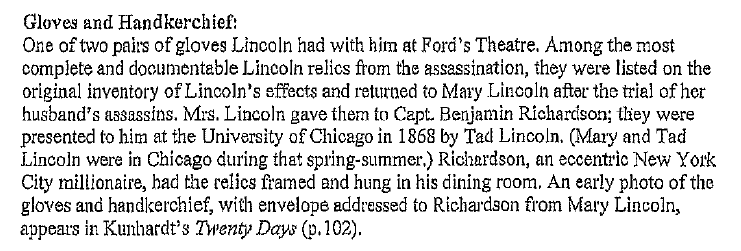
It appears that only during the transfer of the gloves from Taper to the Foundation around 2007 did the staining on the gloves become associated with blood.
To be honest, the claim that these gloves are stained with Lincoln’s blood is what led me to first question and investigate them. Abraham Lincoln suffered a small-caliber gunshot wound to the head, with the bullet remaining inside his brain. After shooting the President, Booth dropped his gun and pulled out a large Rio Grande Camp knife, which he used to attack Major Rathbone. Booth was holding this knife when he made his jump to the stage. Because of this, Dr. Charles Leale, the first doctor to reach the box, was under the impression the President had been stabbed. Dr. Leale removed Lincoln from the rocking chair he was slumped in and laid him on the floor of the box. As he wrote in a letter to a friend in May of 1865, “While doing this I put my hand on a part of his coat near the left shoulder saturated with blood.” Leale then borrowed a penknife from an audience member who had made his way into the box, William Kent, and with it, Dr. Leale cut open the President’s great coat, frock coat, and shirt, looking for a stab wound. “As soon as his shoulder was laid bare and no wound discovered I examined his head,” Dr. Leale recounted. In feeling the back of the President’s head, Leale located the bullet wound and, using his pinky finger, removed a bloodclot that had formed. This briefly relieved some pressure on Lincoln’s swelling brain and extended his life. After Lincoln was taken across the street to the Petersen House, the doctors would regularly probe the wound, leading to many towels and pillowcases becoming bloodstained.
How could a pair of gloves likely in couched in Lincoln’s pocket become stained with his blood as a result of his shooting? A few months after the sale of these gloves, an individual connected to the auction house contacted me seeking information about another item from the former Taper collection that has since been sold. In my email conversations with this individual, I expressed skepticism that these gloves were present at Lincoln’s assassination. I asked my contact whether the auction house had done any testing to verify that the staining on the gloves was actually blood. My contact replied that the auction house had not, but that they personally believed the staining was blood. This individual even sent me an in-house document explaining how the gloves could have become soiled with Lincoln’s blood. The document theorized that, upon arriving in the box, Lincoln removed his gloves and placed them both in his left coat pocket, slightly sticking out for easy retrieval. Then, after the shooting, but before Leale’s examination, “approximately 5-7 drops of blood impacted around the open ends, affecting the left glove more than the right and suggesting that the left glove had been placed over the right by Lincoln when he placed them inside of his left coat pocket.” While I credit the document for putting forth an explanation of how the staining on the gloves could have occurred if the stains were blood and if the gloves were at Ford’s Theatre, in my mind it’s a bit like putting the cart before the horse. The staining has not been proven to be blood, and the gloves have definitely not been proven to have been at Ford’s Theatre.
The lack of any mention in the historical record of these gloves being bloodstained is important. When these gloves were accepted as having been at Ford’s Theatre, such a revelation would have been widely reported. There is a fragment of a Ford’s Theatre playbill with a drop of blood on it located in the Kansas History Museum. This relic was so popular that its owner, Dr. Thomas Bancroft, photographed the blood-stained playbill fragment and sold cabinet card reproductions. Victorians were obsessed with relics, especially blood relics. The fact that these gloves appear to have circulated for over 100 years in the public consciousness without any mention of Lincoln’s blood on them is telling. Clearly, no one before the modern era believed these gloves were stained with blood.
But, for the sake of argument, let’s suppose that somehow this important detail about the gloves being stained with Lincoln’s blood was overlooked until around 2007. In this scenario then, it means that Mrs. Lincoln held on to a grisly reminder of her husband’s murder for three years before casually selling them to Benjamin Richardson. How likely is this? Mary Lincoln was traumatized by her husband’s death. Clara Harris recalled how, during the deathwatch for the President at the Petersen House, “Poor Mrs. Lincoln all through that dreadful night would look at me with horror & scream, ‘Oh! My husband’s blood, my dear husband’s blood,’” even though Clara’s dress was actually stained with the blood of her fiancé, Major Rathbone. Before leaving the White House for the last time, Mrs. Lincoln disposed of the remaining bloody remnants from that terrible night. Footman Charles Forbes recalled how he was given the complete suit of clothes Lincoln was wearing when he was shot by Mrs. Lincoln, including the shirt and frock coat that had been sliced open by Dr. Leale. He wrote in an affidavit that after receiving the clothes, “I asked her, ‘What shall I do with them?’ She said, ‘Do anything you like with them, don’t let me see them again.’” In her deep mourning and trauma, it is inconceivable that Mrs. Lincoln would have retained any article that contained her husband’s blood.
If not blood, to what, then, can we attribute the staining? I have a theory. The staining that exists appears on the back of the gloves, near the wrists. The Brooklyn Eagle article from 1925 noted that the gloves were framed and hung on a wall in Ella Gouverneur’s home, “like the museum exhibit it was intended to be.” The 1965 photograph Ella’s daughter provided to the Kundhardts shows the gloves still in the same frame and position, making it unlikely they were removed in the interim. I suggest the staining on the back of the gloves has less to do with blood stains and more to do with how the gloves were affixed to the back of this display for at least 40 years (and likely longer). A number of substances could have caused discoloration over time, not to mention the unknown manner in which the gloves were stored when they left the Richardson heirs. The noticeable cracking of the leather shows these gloves were not kept in slightly humid conditions modern conservationists would recommend. What appears as stains of blood could just as easily be residue and deterioration from decades of improper storage and display. Since the auction house did not complete any sort of testing to verify the presence of blood on the gloves, the claim that the gloves have blood stains can not be confirmed, and the historical record does not support this conclusion.
When I shared the 1869 article featuring Richardson and the gloves’ attendance at the Lincoln banquet with my auction house contact, they replied with the following: “Personally I’m more skeptical about Mary Lincoln identifying the gloves to Richardson as those worn by Lincoln during the second inaugural, just because what would have differentiated them from any other pair he owned for her to make that kind of a claim?” I politely pointed out to them that they had once again drawn a conclusion that wasn’t in evidence. The 1869 article stated that Lincoln wore these gloves to his inauguration, but did not specify which one. But more than anything, my contact had perfectly proven my overall point. Since we have no written evidence from Mrs. Lincoln about the history of the objects she presented to Benjamin Richardson, we can’t be certain that these gloves were associated with any “big event’ in Lincoln’s life. Most likely, these gloves were just one of many random pairs of fancy gloves Abraham Lincoln owned and eschewed having to wear.
Knowing Mrs. Lincoln’s shopping and hoarding habits, there was no doubt an excess of gloves owned by the president when he died. We know from efforts to settle his estate that Mrs. Lincoln owed a considerable sum of money to “Mr. Perry, a merchant of Washington for 300 pairs of kid gloves purchased by her between the first of January and the death of Mr. Lincoln.” Surely some of those 300 pairs of kidskin gloves were meant for her husband. In the years after his death, Mrs. Lincoln often presented small tokens from her collection to friends and admirers. Just a week after she wrote to Richardson in 1868 that his items, which included a cane, were ready, she presented another Lincoln cane to a family friend in Springfield, Jesse K. Dubois.
Mrs. Lincoln’s interaction with Richardson came on the heels of the “Old Clothes Scandal,” where she attempted to sell her non-mourning wardrobe in New York in an effort to raise funds. A likely scenario is that Richardson, a New Yorker, contacted Mrs. Lincoln after hearing about her efforts and asked whether she had anything related to her husband that might find a place in his future museum. After some haggling, Mrs. Lincoln agreed to sell some items to the wealthy Richardson and was merely awaiting payment, which she received when Prof. Sawyer provided her with the letter from Richardson she references in her 1868 letter. What, if anything, Mrs. Lincoln told Richardson as to the significance of the items beyond that they had belonged to her husband is unknown.

The inside of the “blood stained’ gloves
Eight months later, Richardson displayed the gloves and handkerchief as having been at Lincoln’s inauguration, much to the acclaim of the Lincoln banquet in New Jersey. Other articles in the years that followed made no real conclusion about the gloves until, starting in 1886, when they were first connected to Lincoln’s death.
In conclusion, this particular artifact shows the importance of digging into the provenance of a piece in order to assess the different claims made about it. The earliest and most reliable evidence does not associate these gloves with Abraham Lincoln’s assassination, and the so-called blood stains used as evidence to support the theory have not been verified to be blood. All we know for certain is that three years after her husband’s death, Mary Lincoln presented these gloves, a handkerchief, and a cane to Benjamin Richardson, a wealthy real estate tycoon. Over the decades, the story of these artifacts changed, first being claimed as coming from Lincoln’s inauguration and later from the assassination. We have no documentation from Mary Lincoln in either direction. In addition, we know that Mrs. Lincoln gave away many items that formerly belonged to her husband and that she had a surplus of gloves following his death.
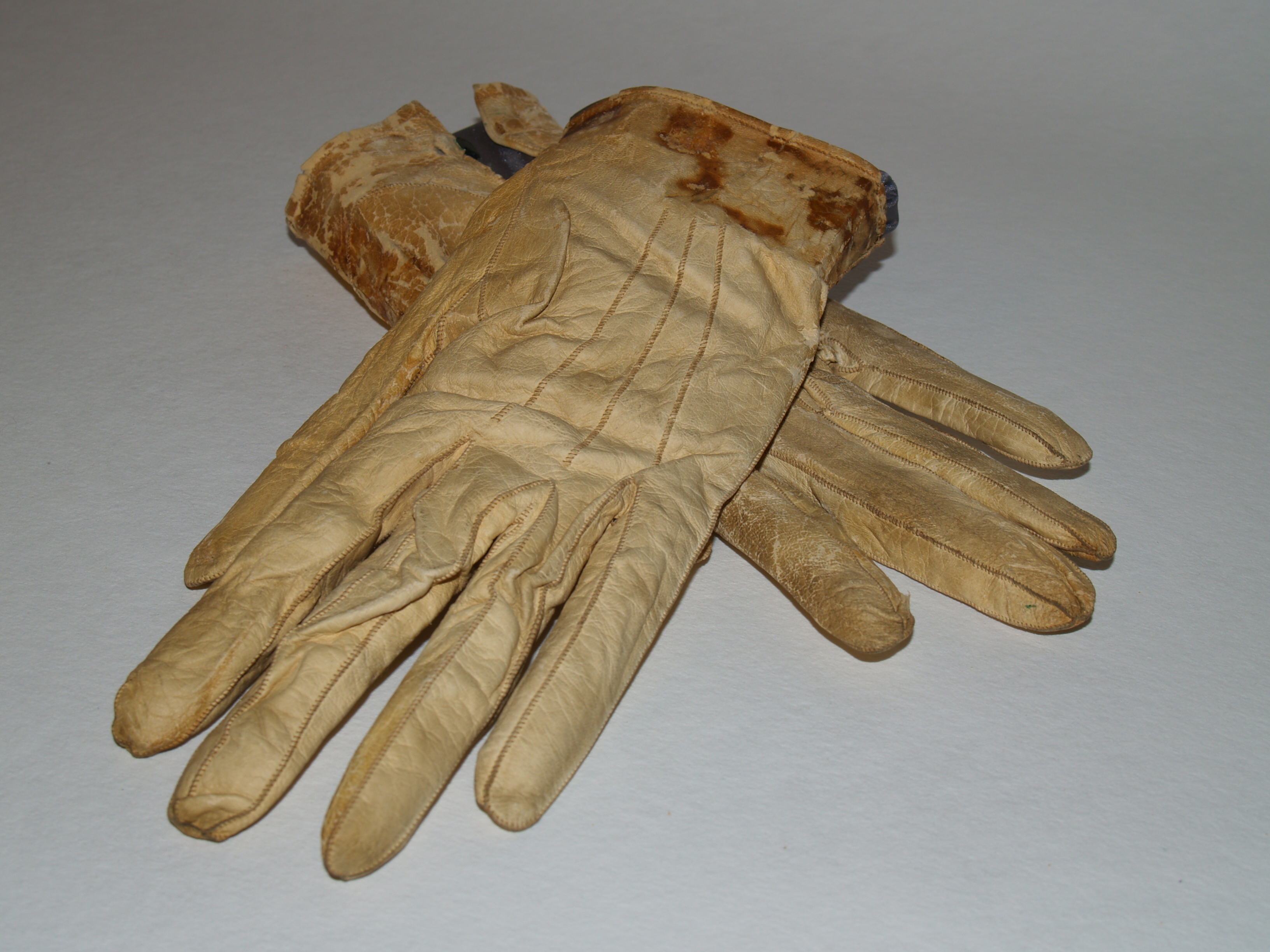
Assessment: While these gloves can safely be credited to Mary Lincoln, the evidence supports nothing more definitive about them. In my opinion, these gloves are likely one of many pairs Mr. Lincoln owned and unlikely to be associated with any important event in his life. A pair of gloves owned by Abraham Lincoln still has value, but the $1.5 million price tag these gloves sold for in 2025 was based on family lore and a much-hyped story that doesn’t hold up to scrutiny.
Many Gloves, No Perfect Fit
Noah Brooks was a California journalist who became a friend of Abraham Lincoln and the First Family. In an 1878 article for Scribner’s Monthly, Brooks discussed Lincoln’s fashion and gloves. Brooks wrote:
“[Mr. Lincoln] was always neatly, but not finically dressed. He disliked gloves, and once I saw him extract seven or eight pairs of gloves from an overcoat pocket, where they had accumulated after having been furnished him by Mrs. Lincoln.”
Much like Brooks’ interaction with the President, we have also borne witness to multiple pairs of gloves, each claiming a connection to Abraham Lincoln. While each pair of gloves discussed in this article has an intriguing story connecting it to the tragic night of April 14, 1865, a deep dive into the provenance has failed to prove the authenticity of any of them. This is very common for artifacts in museums and in private collections. It is incredibly rare to have perfect provenance and chain of custody for anything. For the vast majority of artifacts, authenticity is an act of belief and faith, rather than fact.
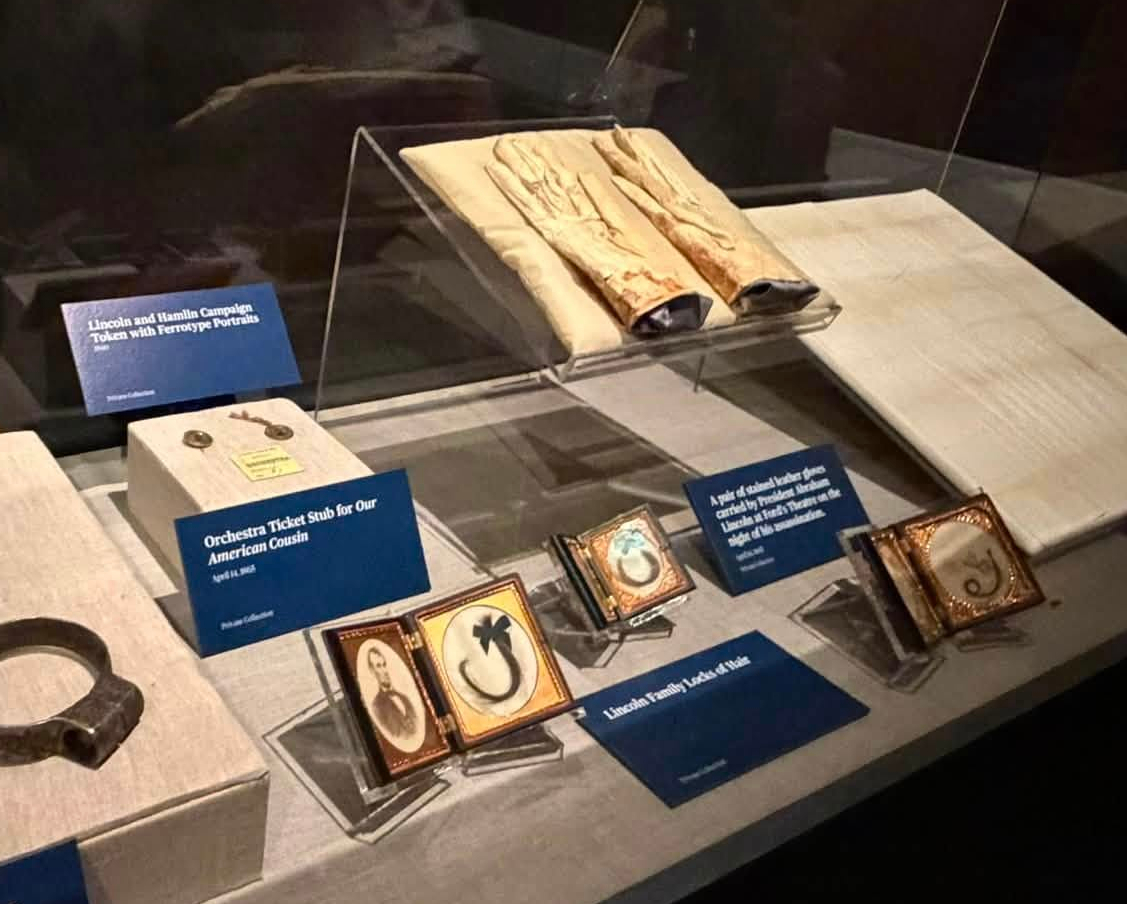
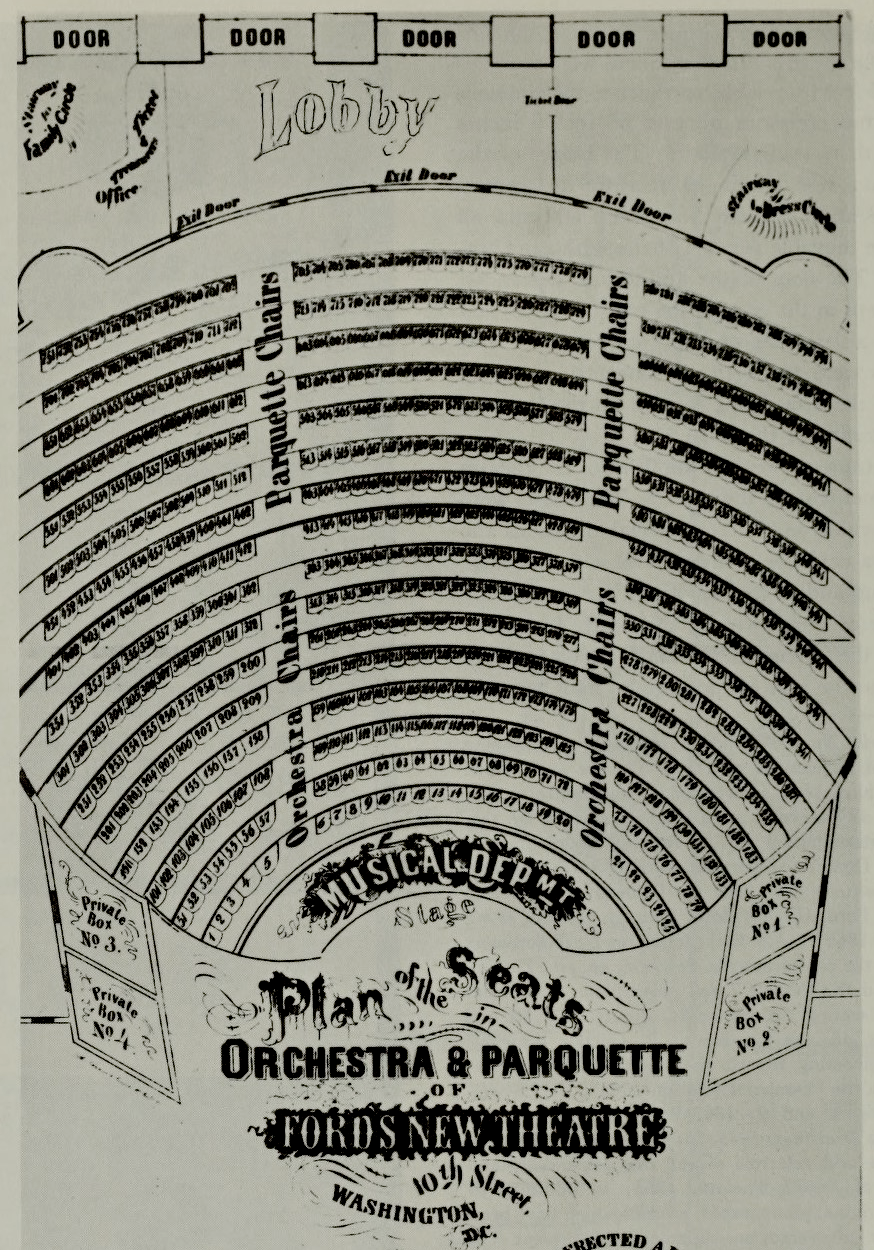
Misrepresentations and mistakes happen over time, even from individuals with the best of intentions. For example, from May to September of 2026, the gloves, handkerchief, and Ford’s Theatre ticket stub purchased at the Freeman’s | Hindman auction were loaned to the Ronald Reagan Presidential Library as part of an America 250 exhibit. On both the Reagan Library website and in videos highlighting the exhibit, the ticket stub was incorrectly claimed to have been in Abraham Lincoln’s pocket when he was killed. Since Lincoln was in the Presidential box, not seated in section C, seat 127 of the Orchestra level as documented on the stub, it makes no sense that he would have this random ticket in his pocket. This innocent mistake perfectly demonstrates how easily false claims can be created and spread. In our modern world, the spread of misinformation, both historical and otherwise, is exacerbated by Large Language Models and AI bots that regurgitate a user’s desired answer rather than an accurate one. Now more than ever, it is crucial to investigate claims and not take them at face value.
With the information we currently possess, none of the gloves highlighted in this piece can be definitively proven to have been with Abraham Lincoln when he was assassinated by John Wilkes Booth at Ford’s Theatre. In fact, we can’t even be sure Lincoln had gloves with him that night, especially given his established distaste for them. But as with many other historical artifacts with incomplete provenance, the slight possibility remains that one of these gloves actually did witness the night of April 14, 1865.
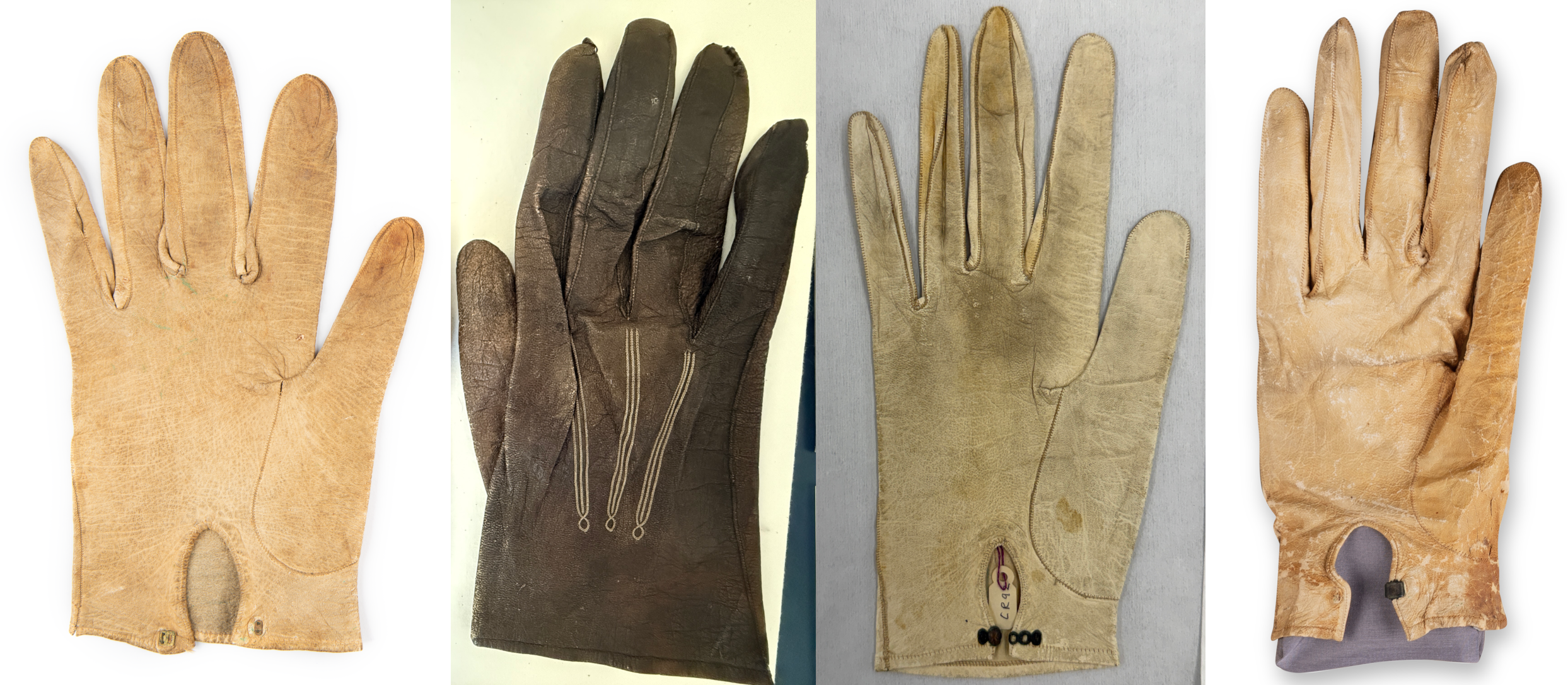
In the end, all of these gloves have interesting stories and unique histories, regardless of their genuineness. Through these gloves, we learn more about Abraham Lincoln, his family, his humanity, and his tragic death. What more value can you ask for out of historical artifacts than that?
Several individuals and institutions were crucial in researching this piece. My special thanks go to:
Anna Dvorachek, Registrar, Abraham Lincoln Presidential Library and Museum, Springfield, Illinois
Kevin Moore, Former Curator of Artifacts, Rutherford B. Hayes Presidential Library & Museums, Fremont, Ohio
Kevin Whaley, Registrar, Indiana State Museum and Historic Sites, Indianapolis, Indiana
The Lincoln Financial Foundation Collection
Reignette Chilton, author of Lincoln’s Great Coat and Lincoln’s Frock Coat
Freeman’s | Hindman Auctions




















Recent Comments