Monthly Archives: July 2014

Jett, Ruggles, and Bainbridge

A few days ago, commenter Kees van den Berg posed the following question:

“I wonder, what happened with Jett, Ruggles and Bainbridge? I suppose they were arrested and confined in the Old Capitol Prison in Washington. Is it true that they never were tried, but came free after a couple of weeks after taking the oath of allegiance to the US? Have you dates of confinement and release? Thank you beforehand.”

His question refers to Willie Storke Jett, Mortimer Bainbridge Ruggles, and Absalom Ruggles Bainbridge. Ruggles and Bainbridge were cousins which explains the last names as middle names coincidence.  These three men were Confederate soldiers who ran into John Wilkes Booth and David E. Herold during their escape.

About midday on April 24th, the fugitives were at Port Conway, VA on the banks of the Rappahannock River. They were waiting for the ferry to come so they could get to Port Royal on the other side. As they waited, Jett, Ruggles, and Bainbridge came riding up.  The three men were heading towards Richmond, ultimately to get their paroles. At first, Herold lied to the men and told them that he and his wounded brother were also Confederate veterans. Thinking the three soldiers were on their way south to meet up with others in order to continue the fight, Herold pulled Jett aside and asked him if they could join them. Surprised by Herold’s desperation, especially when he and his comrades had accepted the defeat of their cause, Jett asked Herold straight away who they really were. Herold replied back, “We are the assassinators of the President”.

After more conversation, Jett, Ruggles, and Bainbridge agreed to help the men. The five men and their three horses crossed the Rappahannock on the ferry guided by ferryman Jim Thornton. When they arrived at Port Royal, Jett searched out a place for Booth to stay. He came to the home of Sarah Jane Peyton, who agreed, sight unseen, to care for a wounded solider.
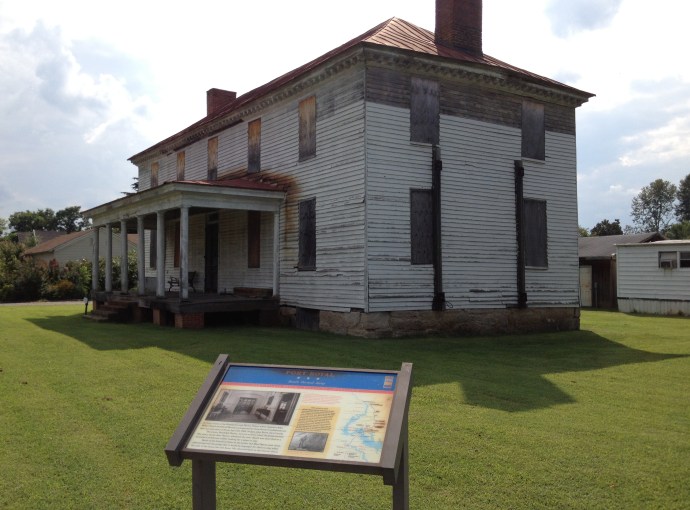
The home of Sarah Jane Peyton in Port Royal, VA

The home of Sarah Jane Peyton in Port Royal, VA

When Booth hobbled into her parlor, however, her hospitality changed. She no longer thought it proper for her to entertain a guest while her brother, the man of the house, was absent. She suggested to Jett that he might find better lodging for the wounded man a couple of miles down the road, at the farm of Richard Garrett. The three men rode to the Garrett place, with Booth and Herold sharing horses with Ruggles and Bainbridge, respectively. When they arrived at the Garrett farm, Bainbridge and Herold stayed by the outer gate as Jett, Booth and Ruggles approached the house. The Garretts agreed to care for Booth, whom Jett said was a wounded soldier named Boyd, until Jett’s return in a couple of days. Jett, Ruggles, Bainbridge, and Herold rode further south. They stopped at the Trappe, a house of entertainment, before separating for the evening. Jett and Ruggles went to the Star Hotel in Bowling Green. Jett was courting Izora Gouldman, the hotel-keeper’s daughter.  Bainbridge and Herold traveled to the home of Virginia Clarke. Coincidentally, both Bainbridge and Herold knew Virginia’s son James and were welcomed into her home for the night.

The next day, Bainbridge and Herold met back up with Ruggles, likely in Bowling Green. The three men rode back to the Garrett house where Booth had comfortably spent the night in an upstairs bedroom. Bainbridge and Ruggles dropped Herold off and then continued on to Port Royal. When they arrived, they found a troop of Union cavalry crossing the ferry from Port Conway to Port Royal. They turned around and put spurs to their horses. They rushed back to Booth and Herold at the Garrett farm long enough to tell them of the approaching troops, then they continued quickly south.

The rest is well-known. The Union troops learned from one of the residents of Port Conway that Willie Jett was among the men who crossed with John Wilkes Booth. What’s more, they learned of Jett’s affinity for Izora Gouldman. Unknowingly, the troops rode right past the Garret farm where Booth was hiding on their way to Bowling Green. They captured Jett at the Star Hotel and he agreed to take them to the Garrett farm. When the troops arrived, they kept Jett under guard near the gate of the farm while the rest surrounded the house and barn. Eventually Herold surrendered himself and the barn was lit on fire to smoke Booth out. Boston Corbett fired at Booth inside of the burning barn, paralyzing him. Booth was dragged from the barn, first placed under a tree and then on to the front porch of the house.  He died around dawn on April 26th.
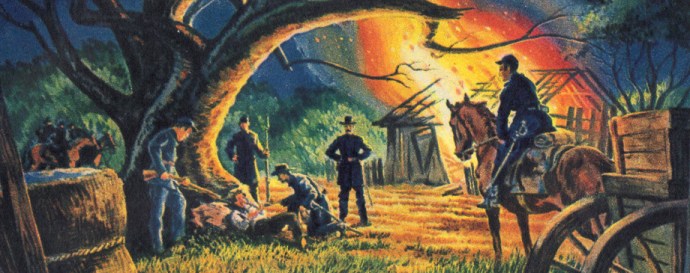
pulled-from-the-barn-header.jpg

During the lengthy crossing of the soldiers on their way back across the Rappahannock after killing Booth, Detective Luther Baker took possession of Booth’s body and the prisoner Jett. With two other soldiers, Baker departed Port Conway ahead of the rest of the troops. At some point during their travel to Belle Plain, where a steamboat would take them up to Washington, Baker let Willie Jett go. Jett had led the soldiers right to the assassin without a fight, and Baker did not believe there was any need to detain him further. When Baker got back to Washington, he was severely berated by Edwin Stanton for releasing Jett without authorization. An arrest order for Jett was quickly sent out:

An arrest order for Willie Jett dated April 28th.

An arrest order for Willie Jett dated April 28th.

Jett was re-arrested in Westmoreland County, VA on May 1st. He was transferred to Washington and imprisoned at the Old Capitol Prison with the other Lincoln assassination related suspects. On May 6th, he gave a lengthy statement to the authorities about his interaction with Booth, ending it with the assurance, “I have tried to evade nothing. From the beginning I have told everything.”  Jett was also called to testify at the trial of the conspirators, giving his testimony on May 17th.  Willie Jett was imprisoned for a month and was released on May 31st when he took an oath of allegiance at the Old Capitol Prison:
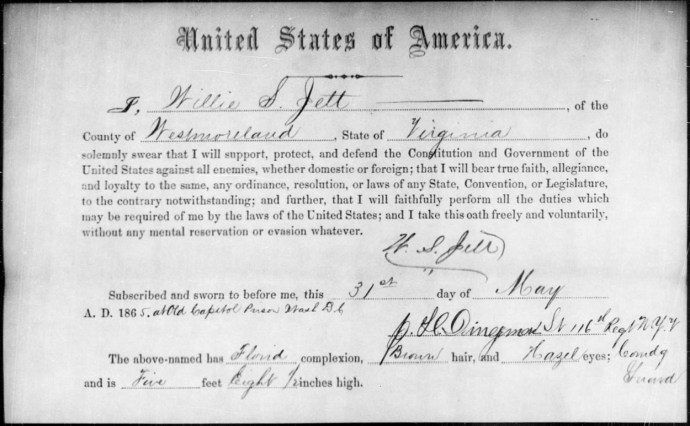
Willie Jett's Oath of Allegiance NARA

Though Jett had been a major player in the escape of John Wilkes Booth, he was not tried as a conspirator since he had never met Booth prior to April 24th and Jett had also assisted in Booth’s capture.  The government was only concerned with prosecuting those they believed had real knowledge of the conspiracy before it was carried out.  Jett did not fit this criteria.

In January of 1890, an account written by Lieutenant Ruggles was published in The Century Magazine. Not all of the details in Ruggles’ recollections almost 25 years after the fact are correct, but he does give this account of what happened to him and Bainbridge:

“Learning that Jett was a prisoner, and that we were to be arrested, tried, and hanged, as aiders and abetters, Bainbridge and myself stood not on the order of going, but went at once. Making our way into Essex County and crossing to Westmoreland, we went to our home up in King George County. Some ten days after, I was arrested at night by a squad of United States cavalry. Bainbridge was also captured. We were taken to Washington and placed in the Old Capitol Prison. We were not alone in our misery, however, for Dr. Stewart, at whose house Booth had stopped, William Lucas, the negro who had driven him to the ferry, and a number of others, were there, among them being Jett, who had escaped from Captain Doherty, and had been recaptured at his home in Westmoreland County.”

Lieutenant Ruggles was arrested in King George County either on May 2nd or May 3rd (both dates are given on two different records).  Private Bainbridge was arrested in King George County on May 4th or 5th (again two different dates on two different records).  They were both transported to the Old Capitol Prison and were incarcerated there starting on May 5th.  For some unknown reason (Ruggles thought it was by mistake), the two men were transferred out of the Old Capitol and sent all the way to Johnson’s Island, a prisoner of war camp for Confederate prisoners located near Sandusky, Ohio.  They left the Old Capitol Prison on May 11th and arrived at Johnson’s Island on the 13th.

Johnson's Island 1865 LOC

It didn’t take very long for those in charge at Johnson’s Island to determine that these two men were much more than your average prisoners of war.  It certainly looks like their transfer to Johnson’s Island was a mistake because, on May 15th, Ruggles and Bainbridge were being transferred back to D.C.  They arrived at the Old Capitol Prison on May 17th and this time they stayed there.

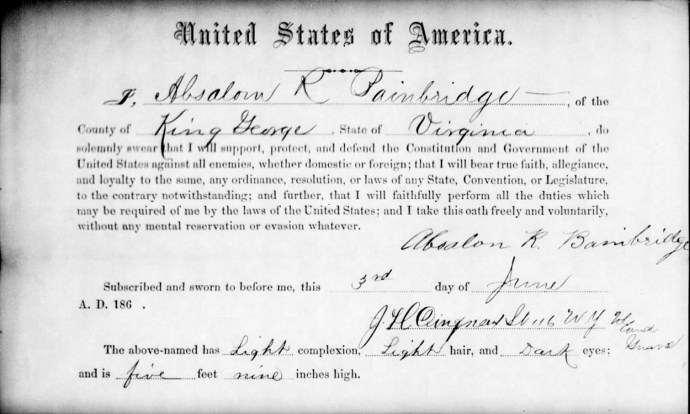
Neither Ruggles or Bainbridge were ever called to testify at the trial of the conspirators.  On June 3rd, both men were released from their confinement after taking the oath of allegiance:

Mortimer Ruggles Oath of Allegiance NARA

Absalom Bainbridge Oath of Allegiance NARA

Willie Jett never ended up marrying Izora Gouldman of the Star Hotel.  Instead he moved to Baltimore, married, went insane (possibly because of untreated syphilis), and died in an insane asylum in Virginia.  His body is buried in Fredericksburg.
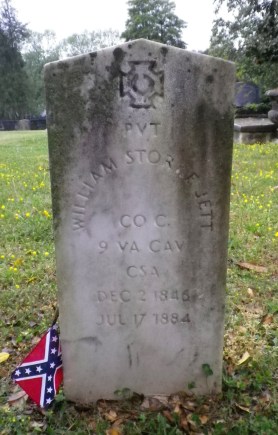
Willie Jett's grave

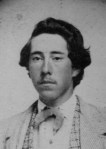
After the war, Mortimer Bainbridge Ruggles and Absalom Ruggles Bainbridge continued to imitate each other.  Both men married and had two children.  Both moved to New York.  Both found occupations that forced them to move around; Ruggles as a traveling salesman and Bainbridge as an interior decorator.  Finally, both men died not only in the same year, but in the same month.  These two Confederate veterans are buried in two different cemeteries in New York:

Mortimer Ruggles' grave

Grave of Absalom Ruggles Bainbridge


While Jett, Ruggles, and Bainbridge spent a bit more time imprisoned than some of the other suspects in Lincoln’s assassination, their incarceration could have been longer, especially since it was known that they had contact with Booth and assisted him during his escape.  Booth’s brother, Junius Brutus Booth, Jr., who knew nothing about the assassination, was imprisoned until June 22nd.  John Lloyd, the man who gave Booth and Herold a carbine, field glasses, and some whiskey at the Surratt Tavern, wasn’t released until June 30th.  One of the last people released from the Old Capitol Prison was Joao Celestino, the Portuguese ship captain whose ill-timed threats against William Seward made authorities believe he was a main conspirator.  Celestino was released from the Old Capitol Prison on July 8th and was ordered to leave the U.S. within 10 days, never to return.  And, of course, Dr. Mudd, Edman Spangler, Samuel Arnold, and Michael O’Laughlen were imprisoned at Fort Jefferson for three and a half years before the surviving three were pardoned in 1869.

The imprisonment endured by Jett, Ruggles, and Bainbridge could have certainly been worse had the government truly wanted to punish all those who assisted John Wilkes Booth.

References:
American Brutus by Michael W. Kauffman
Brutus’ Judas: Willie Jett by Eric J. Mink
“Pursuit and Death of John Wilkes Booth” by Prentiss Ingraham, Century Magazine, Jan, 1890
Jett, Ruggles and Bainbridge’s prison records and oath of allegiances were accessed via Fold3.com
FindaGrave.com (Bainbridge, Ruggles)
Rich Smyth
Categories: Uncategorized | Tags: , , , , , , , | 18 Comments

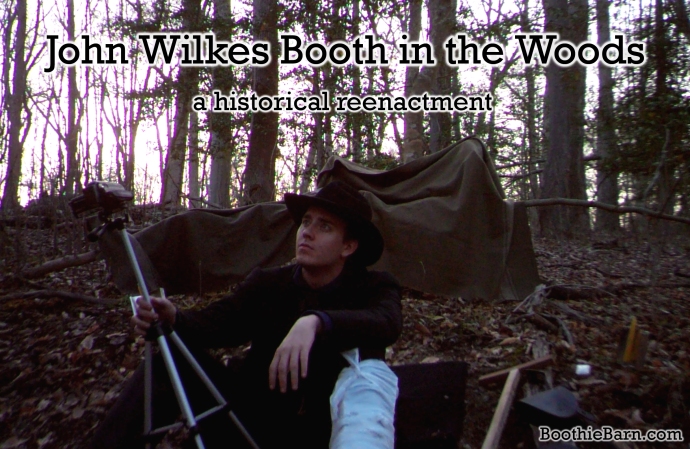
John Wilkes Booth in the Woods: Part 8

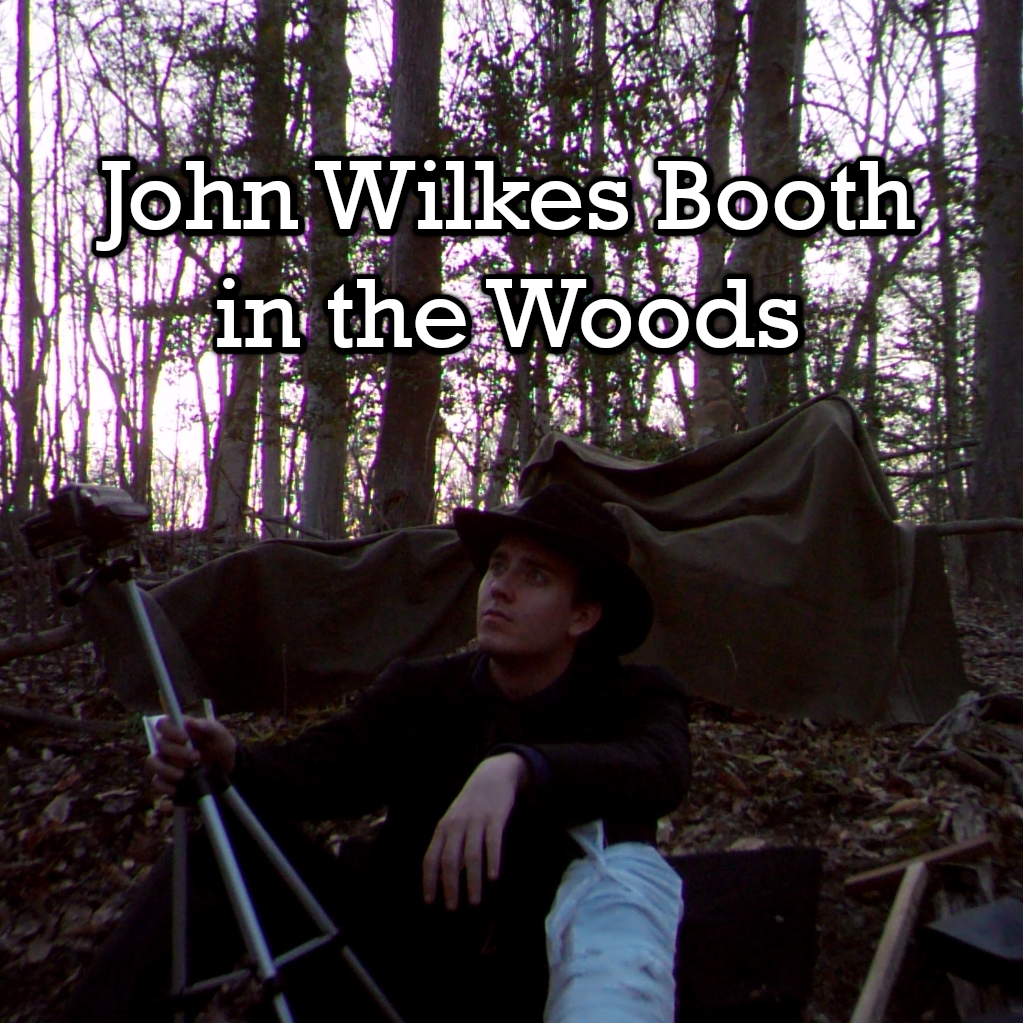
John Wilkes Booth in the Woods

Part 8 of my series “John Wilkes Booth in the Woods” is now complete and available for viewing.

In this part I discuss Booth’s comfort and the ways he could have passed the hours of waiting.

To watch the video, you can either click on the image above and scroll down, click HERE to watch the video on YouTube, or play the embedded video below.

Categories: Uncategorized | Tags: , , , , , , | Leave a comment

St. Clement’s Island and the Forgotten Tragedy on the Potomac

A half mile from Colton’s Point, Maryland, located in the Potomac River, lies St. Clement’s Island.

St Clements island

St. Clement’s Island is the site of the first landing of European settlers in Maryland.  The landing occurred on March 25, 1634, when the 150 or so colonists aboard the ships The Ark and The Dove made landfall here having departed England four months earlier.  St. Clement’s is, essentially, Maryland’s birthplace and the anniversary of the landing, March 25, is a state holiday known as Maryland Day.

In a few days, most of the colonists would move off of St. Clement’s Island, after having negotiated with the Yaocomico Native American tribe to create a permanent settlement on the mainland.  That settlement would become St. Mary’s City, the first capital of Maryland.

During the Revolutionary War and the War of 1812, the British captured St. Clement’s Island using it as a base for their operations.  It was known then as Blackistone Island.  The Blackistone family had inherited the island in 1669 and continued to own it until 1831. In 1848, the U.S. Congress appropriated $3,500 to build a lighthouse on the island, which was finally completed in 1851.

Blackistone lighthouse 1928 Coast Guard

The Blackistone Island Light in 1928

During the Civil War, the lighthouse became a target for the Confederacy. On the night of May 19, 1864, Confederate Captain John W. Goldsmith and his men landed on the island. It was Goldsmith’s intention to dynamite the lighthouse. The keeper of the lighthouse, Jerome McWilliams, begged the Captain not to destroy the building as his wife was pregnant and her life would be in danger if they had to go back to the mainland before the baby came. Goldsmith was a St. Mary’s county native who had crossed the Potomac to fight for the Confederacy and he knew McWilliams. In sympathy to McWilliams’ circumstances, instead of destroying the building Goldsmith destroyed the lighthouse’s lens and lamp, and took all of the oil. Union troops eventually were able to repair the light and stationed a unit of guardsmen on the island.

The aborted destruction of the lighthouse on St. Clement’s was not the only Civil War era event to happen near the island.  A largely forgotten naval incident also occurred there during the night of April 23 and 24, 1865.  This tragedy has a connection to the assassination of Abraham Lincoln and the search for his assassin.

The incident involves two steamer ships, the USS Massachusetts and the Black Diamond.  The Massachusetts was a steam ship built in Boston in 1860.  She was purchased by the U.S. Navy in May of 1861 and became the USS Massachusetts.  During the Civil War, the Massachusetts was involved in enforcing the blockade of Confederacy and later worked as a supply carrier between the Northern ports and the other blockading forces.

An engraving from Harper's Weekly showing the naval forces at Ship Island, Louisiana.  The Massachusetts is the ship on the far right.

An engraving from Harper’s Weekly showing the naval forces at Ship Island, Louisiana. The Massachusetts is the ship on the far right.

A close up view of the USS Massachusetts at Ship Island, Louisiana.

A close up view of the USS Massachusetts at Ship Island, Louisiana.

On April 23, 1865, the Massachusetts was assigned the task of ferrying Union troops from Alexandria to Norfolk, Virginia.  At 5 o’clock p.m., about 400 men boarded the Massachusetts at Alexandria, with one soldier recalling later that the boat was “unfit to carry more than half the number she had on board”.  The troops on board had lived through the darkest parts of the war.  There were men on the Massachusetts who had survived the deadliest day in American history at the battle of Antietam.  Many had been prisoners of war in the horrible prison camps of North Carolina and Georgia.  Too many had witnessed their comrades perish at Andersonville prison.  These men had been through the worst circumstances and had managed to survive.

As the Massachusetts steamed on one soldier remembered,  “We glided along down the river very nicely until a little after dark, when a strong wind began to blow and the river became very rough…”  They were nearing St. Clement’s Island.

The Black Diamond was an iron hull steam propeller canal boat built in 1842.  At the time of the Civil War, the Black Diamond was being chartered by the U.S. Quartermaster Department.  She regularly transported coal between Washington, D.C. and Alexandria, which was a Union occupied city.  Her crew consisted of men from the Alexandria fire department.

After the assassination of President Lincoln on April 14, 1865, the Black Diamond was assigned picket duty on the Potomac River.  Her job was to patrol the Potomac, keeping an eye out for the assassin, John Wilkes Booth, if he attempted to cross the river.  On the night of April 23, the world was unaware that Booth and his conspirator David Herold had already crossed the Potomac and were that night sleeping in the cabin of William Lucas in King George County, Virginia.  The Black Diamond lay at anchor about a mile south of St. Clement’s Island.

It was a clear night but there was no moon.  The Black Diamond was said to have had only had one light showing.  Somehow, it wasn’t seen in the darkness.  At around 10 o’clock p.m. on April 23, the Massachusetts and its 400 passengers collided with the Black Diamond and her twenty crew.

What follows is a newspaper account of the incident recalled by Corporal George Hollands in 1914.  Hollands was one of the soldiers aboard the Massachusetts who had spent time at Andersonville prison.  His account provides a vivid description of the tragedy:

“…About 10 o’clock at night, when we were all cuddled down for a night’s sleep, part on the upper deck and part below — myself and my bunkmates were stretched out on the lower deck — we heard an awful crash and felt a sudden jar. We all sprang to our feet, pulled on our coats and ran up on deck to see what the trouble was. All was confusion and excitement, as we discovered we had crashed into the side of another boat, striking her amidship.

I ran to the bow of our boat, as most of the others had done, and found her bow was settling fast. The Captain was shouting to us to go aft, so as to keep her bow out of the water as much as possible. In the meantime we were shouting to the boat we had run into — the Black Diamond — to come to our assistance. She circled around and came up alongside of us, and about 150 jumped from the Massachusetts to the deck of the Black Diamond. I was among the first to board her, and I ran immediately to the man at the wheel and asked him if the boat was all right. He said: “No; she is sinking.” I then made up my mind that we had “jumped out of the frying-pan into the fire.” I immediately turned to go toward the stern of the boat, and in going I stumbled onto a stepladder which had been torn from the hurricane deck. I grabbed up the ladder and was about to jump overboard with it — scores of the boys had already jumped overboard to avoid the suction of the boat as she went down — when all of a sudden the thought came to me that the river was not deep enough to engulf the masts and all, so I threw down the ladder, grabbed one of the guyropes and began climbing up toward the mast.

I soon landed my foot on the yard-arm and got my arms around the mast, and about that time the boat struck bottom, with her deck only about two feet under water. I found three or four of the crew among the rigging, so they evidently were of the same mind as I concerning the depth of the river.

We clung to our positions all night, and could hear the cries for help in all directions from the boys who had jumped overboard.

A drummer boy of the 16th Conn. had been washed overboard and had grasped hold of the keel of the boat, or something else, and was hanging on for dear life and calling for help. One of the crew up in the rigging got hold of a rope and time and time again threw it to where the boy was, telling him to grab for it. The boy couldn’t get hold of it. Every now and then a wave would wash over him and strangle him, and as he would emerge from it he would call for the rope. He finally became exhausted and cried out to us that he could hold out no longer. He told us his name, but I have forgotten it. [George W. Carter] He said he was a drummer of Co. D, 16th Conn., and asked us to inform his mother that he was drowned. He bade us goodby, and as the next wave washed over him he loosened his hold and sank beneath the waves.

We clung to our position until daylight, when we were discovered and picked up by a small United States gunboat or revenue cutter and transferred to our old boat, the Massachusetts, which, with one wheel out of commission and part of her bow carried away, had floated about in the vicinity during the night and picked up those she could of our comrades who had jumped overboard.

After we were safe onboard the Massachusetts made her way slowly down the river, and about 11 o’clock a.m. she sighted a large steamer lying at anchor. She steered for her and ran alongside, and we were immediately transferred to the larger boat…”

As recalled by Hollands, in the moments after the collision many aboard the Massachusetts thought that it was their ship that was going to sink.  The panicked soldiers, who had already experienced hardship and fear far beyond their years, jumped into the river with anything that would float.  Many, like Hollands, sought sanctuary on the Black Diamond.  However, the impact of the Massachusetts had struck the Black Diamond in the boiler and she quickly took on water.  It was said the Black Diamond sank in about three minutes.

In the immediate aftermath, the death toll was estimated to be about 50 people drowned.  While the newspapers of the day contained reports of the collision and the presumed number of dead, the killing of John Wilkes Booth on April 26 ensured that the focus on the crash was fleeting.  Only local Alexandria and Washington, D.C. newspapers continued to report on the accident a week after it occurred.  What they did report, however, showed the grim aftermath and growing number of dead that washed up on shore of St. Clement’s Island:

Sinking of the black diamond Evening Star 5 -1- 1865

Bodies Recovered Alexandria Gazette 5 - 6 - 1865

87 victims Alexandria Gazette 5-12-1865

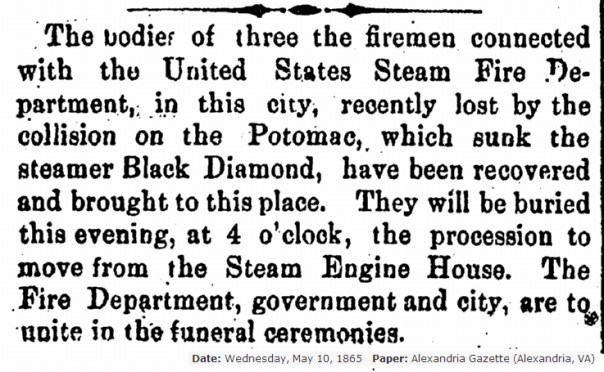
Out of the eighty-seven people who died when the Massachusetts crashed into the Black Diamond, only four of them were from the Black Diamond‘s twenty person crew.  They were Peter Carroll, Christopher Farley, Samuel Gosnell, and George Huntington.  The bodies of these four men received special treatment when they were returned to their native Alexandria:

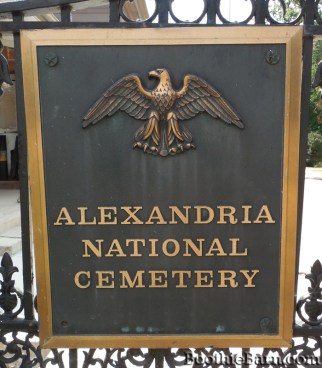
Black Diamond deaths Alexandria Gazette 5-10-1865These four men, though employed by the Quartermaster’s Department through its charter of the Black Diamond, were civilians and yet they received a high honor and were buried together in the Soldier’s Cemetery in Alexandria, now known as Alexandria National Cemetery.

Alexandria National Cemetery

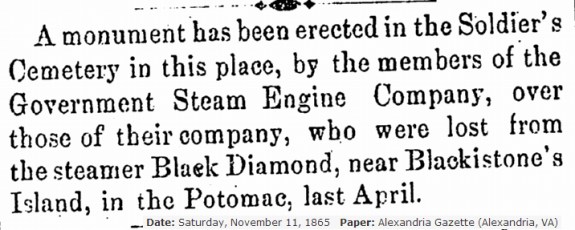
One source states that President Andrew Johnson gave authorization for these civilians to be buried in the Soldier’s Cemetery, although substantiating evidence has yet to be found by this author.  In November of 1865, some of the fallen men’s comrades erected a monument to their memory in the cemetery.

Monument to Black Diamond Alexandria Gazette 11-11-1865

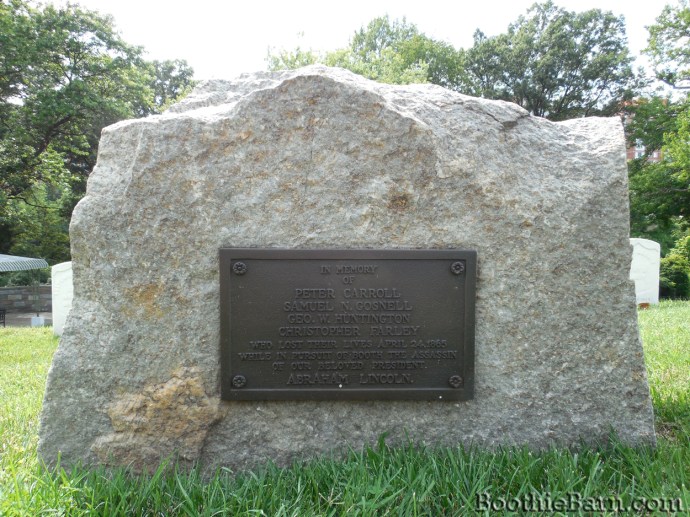
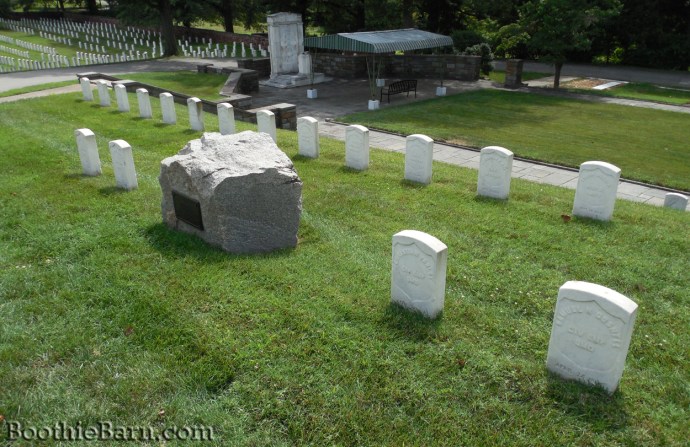
Over the years, this first monument to the lost crew of the Black Diamond deteriorated.  On July 7, 1922, a new granite monument with a bronze plaque was unveiled to honor the men:

Modern monument to Black Diamond victims

Black Diamond victims plaque

In the 1950’s the headstones for each of the four men were also quite deteriorated.  They were replaced around 1955 with the new ones being of the same design as those used for Union soldiers:

Black Diamond victims graves

The other victims of the Massachusetts – Black Diamond collision are buried all over the country but many of the bodies of those who drowned were never recovered.  For example, the body of George Carter, the regimental drummer who drowned after several attempts to throw him a rope, was never found.  He has a memorial cenotaph in West Suffield Cemetery in Suffield, Connecticut.  It states that he “died April 24, 1865, age 20 yrs.” and that he, “Drowned near the mouth of the Potomac River”.

Today, seasonal visitors can take a quick ferry ride to St. Clement’s Island from its museum at Colton’s Point.  The island is home to a recreated Blackistone Lighthouse (the original was destroyed by fire in 1956).  It also boasts a 40 foot tall commemorative cross which was dedicated on Maryland Day in 1934.

Many people come to the island to tour the lighthouse, go birdwatching, hike, or just relax on the beach.  Like most beaches, the sands of St. Clement’s Island are spotted with pieces of beach glass – fragments of broken glass containers that have been weathered by the wind and the waves.  During my visit yesterday, I filled my pocket with pieces of the smooth glass.  After taking the ferry back to the mainland, I drove straight to Alexandria, Virginia to see the graves of four men who lost their lives near the shore I had visited.  On each grave I placed a small piece of my St. Clement’s Island beach glass as a reunion of sorts between the men and the place where they lost their lives.

Beach glass on Black Diamond graves

If you visit St. Clement’s Island, you will not find any mention of the collision between the Massachusetts and the Black Diamond.  The story is not told on any of the historical markers on the island nor is it mentioned (or seemingly known) in its museum on the mainland.  It truly is a forgotten tragedy and its victims are more blood upon the hands of John Wilkes Booth.  Had he not assassinated President Lincoln, there would have been no need for the Black Diamond to perform picket duty off of St. Clement’s.  The men on the Massachusetts, who had already experienced the worst of war, would have steamed into Norfolk without incident.  The shot in Ford’s Theatre on April 14, 1865, killed far more than the President; it also created a ripple effect that caused eighty-seven men to lose their lives.

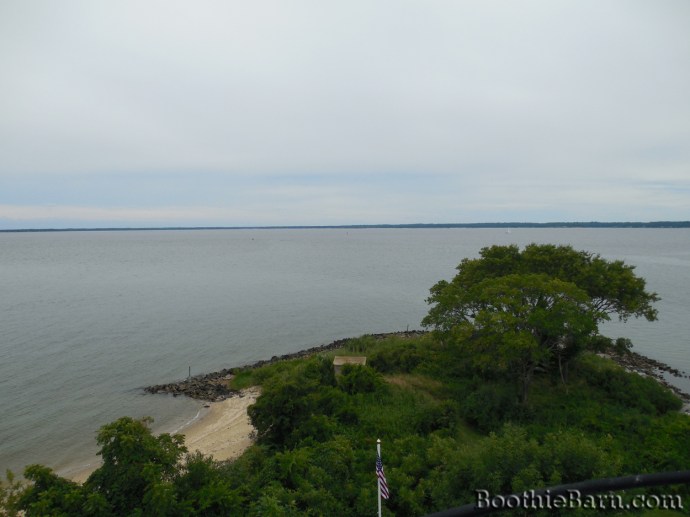
If you’re ever at St. Clement’s Island, take the spiral staircase up the recreated Blackistone Lighthouse.  At the top of the stairs ascend the ladder into the cupola.  Take your pictures and enjoy the view for a bit.  Then, turn your eyes to the water in the south.  It was there on the night of April 23 and early morning of April 24 that eighty seven men lost their lives, collateral damage of John Wilkes Booth.

South of St Clement's Island

References:
A History of St. Clement’s Island by Edwin W. Beitzell
Slipped into Oblivion: A Connecticut Tragedy on the Potomac by John Banks
George Hollands’ account “On the Massachusetts“, National Tribune, 5-14-1914
American Canals, No. 48 – February, 1984, Page 9
Alexandria National Cemetery
St. Clement’s Island Museum
Newspaper articles from GenealogyBank.com

Categories: Uncategorized | Tags: , , | 32 Comments

John Wilkes Booth in the Woods: Part 7

John Wilkes Booth in the Woods

Part 7 of my series “John Wilkes Booth in the Woods” is now complete and available for viewing. In this part, I practice walking with a crutch and experience my second night sleeping in the woods.

To watch the video, you can either click on the image above and scroll down, click HERE to watch the video on YouTube, or play the embedded video below.

Categories: Uncategorized | Tags: , , , , , | 3 Comments

John Wilkes Booth’s Movements at Ford’s Theatre

It is well known that John Wilkes Booth assassinated President Lincoln in his theater box, jumped to the stage, and escaped out of the back door of Ford’s Theatre.  These hurried moments at Ford’s instigated a massive manhunt that lasted twelve days and ended with the death of the assassin.

The moments that preceded John Wilkes Booth’s firing of his derringer are not as well known.  John Wilkes Booth was intimately familiar with the layout, and people, of Ford’s Theatre.  It was like a second home to him insomuch that he even had his mail delivered to Ford’s when he was in Washington.  This familiarity allowed Booth to move about Ford’s Theatre without arousing suspicion.  What follows is an account of Booth’s movements at Ford’s Theatre in the time before he shot the president.

Ground Floor of Ford's Theatre and Baptist Alley plan

John Wilkes Booth had a busy day on April 14th.  His preparations to assassinate the President took him to the Herndon House hotel to alert his conspirators, the Kirkwood House hotel to leave a suspicious note for Vice President Johnson, and near Willard’s hotel to give a note to John Mathews which would justify his later actions.  Booth also visited Mary Surratt’s boarding house on H street three times that day.  It was after his third visit, where Mrs. Surratt confirmed she had given John Lloyd the message that parties would be calling for the hidden weapons tonight, that John Wilkes Booth walked to Ford’s Theatre.  He first went into the Star Saloon owned by Peter Taltavul. It was located right next door to Ford’s Theatre.  He briefly drank there with some of the stagehands from Ford’s, including Edman Spangler, since the play for that night, “Our American Cousin“, was at an intermission.  He found himself drinking alone when the men we called to curtain.

From the Star Saloon, Booth made his way to Baptist Alley behind Ford’s Theatre and got his horse, a bay mare, out of her stable. Spangler built the stable for Booth and took care of it for him.  Booth walked his horse to the back door of Ford’s Theatre. At the back door, Booth called for Spangler, who he hoped would hold his horse until he would need it.   Booth was told by another stagehand that Spangler was needed for an upcoming scene change and so Booth waited with his horse.  After the change, Spangler came out and agreed to hold Booth’s horse.  Booth entered the back door of Ford’s.  The current scene of the play left Booth with no room to sneak across.

The back wall of Ford's Theatre from backstage.  When Booth tried to go across here, there was not enough room.

The back wall of Ford’s Theatre from backstage. When Booth tried to go across here, there was not enough room.

Instead, he lifted a trap door and descended a staircase that led under the stage.  This was a T shaped passageway that was used by stagehands to cross the stage underground and for the musicians to reach the orchestra pit.  Booth emerged by ascending another flight of stairs and opening a trap door on the opposite side.

From there, Booth exited a stage door and into a covered alleyway between Ford’s Theatre and the Star Saloon.  He exited the passageway right out onto Tenth St.  Various witnesses put Booth in the theater lobby and at the Star Saloon at different times which makes knowing his precise course impossible.  However, a likely scenario would have Booth entering the lobby of Ford’s Theatre after exiting the alleyway.  He walked past the ticket taker, John Buckingham, who instinctively held out his hand for a ticket until he realized it was Booth.  Buckingham said that Booth entered the theater and stood behind the seats watching the production (and the President’s box) for some time.

As this was going on, Spangler had grown tired of caring for Booth’s horse.  He called for Peanut John, a young man who acted as an errand boy for the theater, to come out and take his place.  With Peanut holding the reigns, Spangler returned to work.

John-Wilkes-Booth-at-Ford's

An animated clip showing, approximately, Booth’s movements at Ford’s Theatre on April 14, 1865.

Booth exited the theater and walked next door to the Star Saloon.  Here he had a glass of whiskey and some water to chase it down.  He also acquired a cigar and began puffing away.  Cigar in mouth, Booth returned to the lobby of Ford’s.   Booth entered the main floor of the theater again and watched the production some more.  Upon exiting, he conversed with Harry Ford who was in the ticket office counting receipts.  Booth placed his half smoked cigar down on the window’s ledge and joked with Ford that no man should disturb his cigar.

As stated before, Booth’s movements are not an exact science.  It is likely that Booth, anxiously passing the time while waiting to strike, repeatedly traveled between Ford’s Theatre and the Star Saloon, attempting to gain courage with every drink.  Eventually, however, Booth realized that it was time to strike.  From the lobby of Ford’s Theatre, Booth ascended the staircase which led him to the balcony level.

Booth crept across the back of the dress circle level.  As he approached closer to the president’s box he stopped and noticed a guard sitting in front of the entryway to the boxes.  He removed his hat, and took out something, probably a calling card, from his pocket.  He then approached the man and presented the card to him.  He was allowed to pass and entered the vestibule with led to the boxes.  Booth closed the door and, using a bar he had hidden there earlier, he wedged the door shut.  The door to Box 8, which was at the end of the passageway, was open.  With his single shot derringer in hand and a large Rio Grande Camp knife at the ready, Booth entered the President’s box through door 8, turned left, and shot Abraham Lincoln in the head at close range.

The Shot 14 National Police Gazette 4-22-1865

Booth cried out “Sic Semper Tyrannis” and dropped the gun.  He raised the knife in his hand as Major Rathbone, one of the President’s guests that night, rushed at him.  Booth tried to stab Rathbone in the chest but Rathbone parried the strike and took it in his left arm instead.  Booth then ran to the front of the box, put his hands on the railing, and leaped over.  He fell almost twelve feet to the stage below.  He landed awkwardly, either due to a last minute grab by Rathbone or his spur catching one of the decorative flags adorning the box.  In a moment he raised himself up and with quick speed made his way across the stage, perhaps pausing briefly at center stage to raise his knife and shout “The South shall be Free!”  Booth ran into the wings and towards the back door he originally entered through.  William Withers, the orchestra director, unknowingly got in his way and Booth pushed him away, cutting his vest in the process.  Booth reached the back door, rushed through it, and shut the door close behind him.

In the alley, Booth shouted at Peanut John to, “Give me the horse!”  Booth knocked Peanut away using the butt of his knife and a firm kick.  He swiftly mounted the horse and put spurs to her.  She dashed down Baptist Alley.  Booth turned her northward and exited out onto F Street.  He would soon escape D.C. via the Navy Yard bridge and America’s largest manhunt would begin.

References:
Backstage at the Lincoln Assassination by Thomas A. Bogar
Restoration of Ford’s Theatre by George Olszewski
American Brutus by Michael W. Kauffman
The Art Loux Archive

Categories: Uncategorized | Tags: , , , , , | 7 Comments

John Wilkes Booth in the Woods: Part 6

I just completed Part 6 of my series “John Wilkes Booth in the Woods“. In this part, I discuss the fate of John Wilkes Booth and David Herold’s horses while the pair hid in the pine thicket.

To watch the video, click on the image below and scroll down, or click HERE to watch the video on YouTube.

John Wilkes Booth in the Woods

Categories: Uncategorized | Tags: , , , , , , , | 2 Comments

The Execution on Warehouse 13

Almost two years ago, I noticed the Syfy show Alphas (now cancelled) used a doctored version of Davy Herold’s mugshot photo as a piece of set filler in an episode.  Tonight, I was surprised to notice another Lincoln assassination related photograph in yet another SyFy channel show.  This time the show was Warehouse 13, which actually ended its five season run in May of this year.  Warehouse 13 revolves around a group of Secret Service agents who search for historical artifacts that have become imbued with supernatural powers connected to their origin.  The effects of the artifacts can be both good and bad with most episodes revolving around the team identifying, searching for, and then taking possession of an artifact that is causing problems in the real world.  For example, one artifact in the series is a glass bottle from the Donner party which causes those who handle it to develop hypothermia and insatiable hunger.  The artifacts the agents retrieve are then kept in a huge “Indiana Jones” style warehouse under lock and key.  It’s a unique and interesting show.

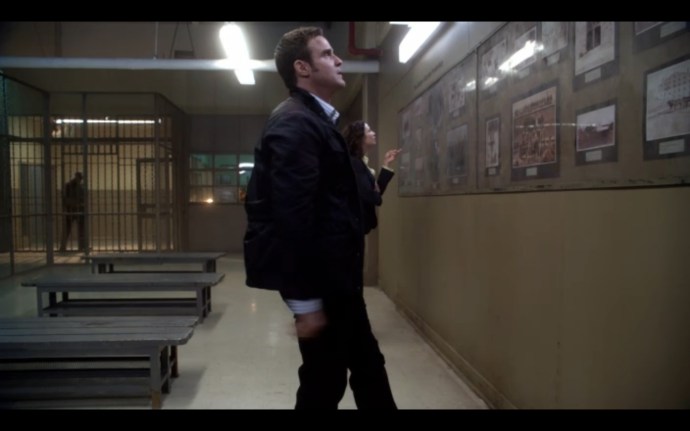
As stated, Warehouse 13 ended back in May.  Nevertheless, I decided to relive the show and start watching it from the beginning again.  Tonight, as I was bedding down for the night, I was watching an episode from the show’s first season entitled, “Regrets”.  In this episode the main characters, Pete and Myka, are investigating what is causing prisoners at a penitentiary to hallucinate visions of their victims and then commit suicide due to their fear and guilt.  At one point the agents are in a room of the prison which contains photographs of the history of the prison.  One of the photographs on the wall caught my eye:

Execution photo on Warehouse 13 1

Execution photo on Warehouse 13 2

Execution photo on Warehouse 13 3

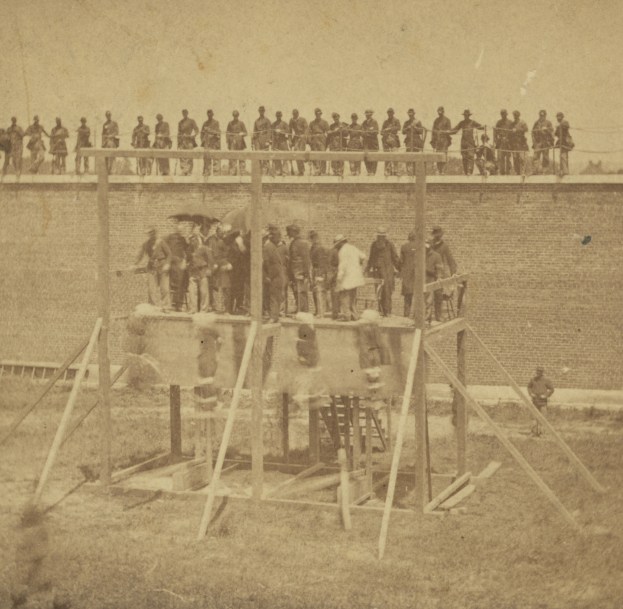
Clearly, that is not a photograph of the prison in Florida where they are supposed to be.  Instead, a history minded set designer used a photograph of the execution of the Lincoln conspirators to round off the prison related wall.

Execution 6 The Drop

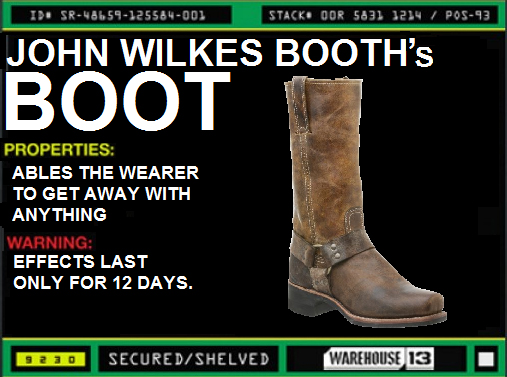
This is actually not the only Lincoln assassination related item connected to Warehouse 13.  As you would expect, fans of the show were always discussing historical artifacts that could be included in the show and the various “powers” they could have.  One fan thought that John Wilkes Booth’s boot would make an interesting artifact for the show and created his own “Inventory Display” for it:

John Wilkes Booth's Boot Warehouse 13 Fan

I give the fan credit for his creative thinking and mixing of fact and fiction, but I wish he would have used a picture of Booth’s actual boot, on display in the Ford’s Theatre museum:

John Wilkes Booth's Boot FOTH LOC

Like David Herold’s appearance on Alphas, I’m amazed to find another reference to the Lincoln assassination in such an unlikely place.  It’s good to know that the people at the SyFy channel seem to appreciate history, at least for set dressings.

References:
Warehouse 13, Season 1, Episode 9, “Regrets”
LOC
John Wilkes Booth’s Boot on the Warehouse 13 Wiki

Categories: Uncategorized | Tags: , , | Leave a comment

John Wilkes Booth in the Woods: Part 5

Part 5 of my series John Wilkes Booth in the Woods is edited and uploaded!  To watch it, click on the image below and scroll down, or, to watch the video right on YouTube, click HERE.

John Wilkes Booth in the Woods

I apologize for the delay between the previous installments and this one.  I was having computer issues which prevented me from editing and rendering videos.  Now, thanks to my brother, my computer is fixed and the rest of the videos should be completed and shared in a more timely manner.  Thank you for understanding.


Categories: Uncategorized | Tags: , , , , , , , | Leave a comment

Blog at WordPress.com.