
Thanks to my good friend Steve Miller for allowing me to republish the following short article and its included letter. The article contains a letter that was written by Emory Parady to his parents on April 28, 1865. Parady was a member of the 16th New York Cavalry and part of the detachment that traveled to Virginia in search of John Wilkes Booth. In his letter, Pvt. Parady recounted the capture and death of Lincoln’s assassin. It’s a fascinating first-person account of the assassin’s end, written just two days after the event. I appreciate Steve sharing this part of his collection with us.
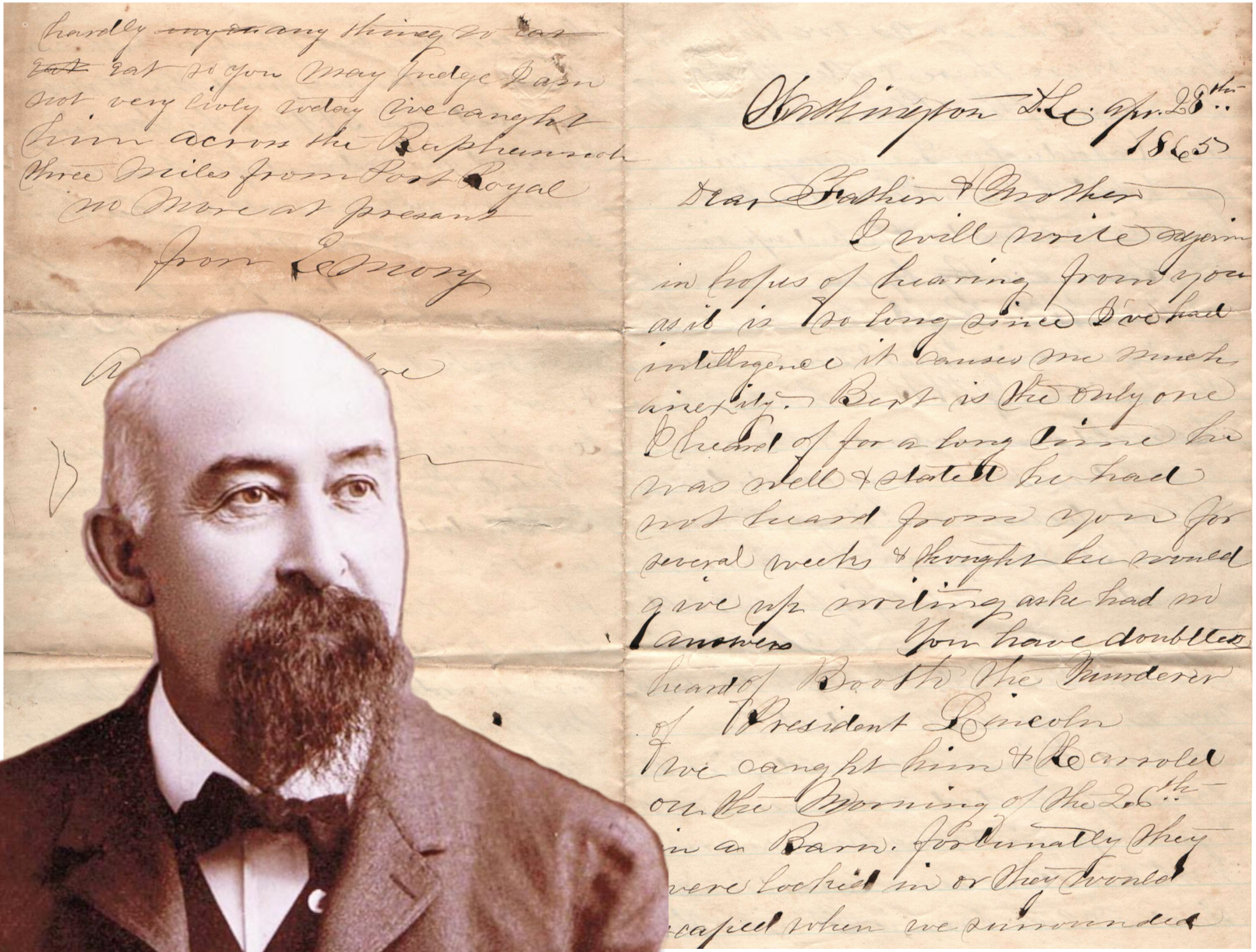
The month of April 1865 had been a busy one for Pvt. Emory Parady, a trooper in the Sixteenth New York Cavalry stationed in Vienna, VA, just outside Washington City. On the 9th of that month, he had celebrated his 21st birthday. The war was winding down, and it looked like he would soon be released from service. Any danger was likely passed.
Then, on the morning of the 15th, the regiment had gotten the terrible news that the president had been shot the night before. Parady and several hundred fellow members of the Sixteenth were deployed to capture John Wilkes Booth, the announced assassin. On the following day, the day before Easter, Parady and others were sent to Washington to help in the manhunt and to prepare for the state funeral on the 19th.
Parady was aware that his father, Edward Parady/Paradis, would be particularly upset by news of the assassination. The president was a great family favorite, and Emory had a four-year-old brother who had been christened Lincoln Parady. He might have been comforted by the fact that Emory had ridden as an escort to Lincoln’s body.
On the 24th, Pvt. Parady had volunteered as a member of a search party organized at the Lincoln Barracks. Lieut. Edward Doherty of the 16th, had received orders to proceed down the Potomac River accompanied by two War Department detectives. They had a fresh lead on Booth’s whereabouts.
The 29-man group landed in the Northern Neck of Virginia, and over the next several hours, they looked for Booth’s trail. Through a combination of hard-riding, determination, and good luck, they found Booth on the night of April 25-26th at the farm of Richard Garrett in Caroline County. He was trapped but would not surrender to the troopers. He was shot while resisting arrest and died a couple of hours afterward.
Back at the Lincoln Barracks on the 28th, located near the White House, Parady was able to write a letter to his parents detailing the death of the assassin. Perhaps that could give them some solace in the wake of the distressing events of the previous two weeks. This eyewitness account contains some important information concerning the identification of the man in the barn and the way he was killed. It presents clear and detailed contemporary evidence that confirms my opinion that the patrol ran down the correct man, not some Booth lookalike. Parady spelled out the circumstances of the shooting, gave us specifics on the time, place, action, and even the fact that the body had the ink-tattooed initials “J.W.B.” on the hand.
The text of this letter follows:
“Washington D.C. Apr. 28th, 1865
Dear Father & Mother
I will write again in hopes of hearing from you as it is so long since I’ve had intelligence it causes me much anxiety. Bert is the only one I heard of for a long time{.} he was well & stated he had not heard from you for several weeks & thought he would give up writing as he had no answers{.}
You have doubtless heard of Booth the Murderer of President Lincoln{.}
We caught him & Harrold on the morning of the 26th in a Barn. Fortunately they were locked in or they would {have} escaped when we surrounded the House as we thought they were there & after threatning the owner of the Places lif {sic} one of his sons (a soldier from Lees army) came up & told they were there or at least two suspicious characters & locked up in the Barn one by the name of John Wm. Boyd his reason for choosing that name was on account {of} the initials J.W.B. on his left hand{.} Harrold surrendered & Booth would not on any conditions{.} his only terms were if we moved back 50 paces from the Barn he would come out & fight us & told us if we shot him to shoot him through the Body through the heart says he {‘}Boys make a stretcher{.’}
We told him we would fire the Barn if he did not come out & give up his arms{.} he was armed with two Revolvers a Carabine seven shooter & two Bowie Knives the longest one was Bloody on both sides of the blade{.} we fired the {barn} as it was dark between 3 & 4 in the morning & he had the advantage of us as he could see us & we could not see him but as soon as the fire lit up he tried to stamp it out & found he could not so he
walkedran back to the midle of the floor & was in the act of raising the caribine when crack went a Pistol & I with with {sic}ColBakerChiefdetective rushed in & caried him out{.} he was shot through the Neck about 2 inches lower than Mr. Lincoln was{.} his last words were Mother! Mother My Mother{.} he could just whisper{.}well I will close as I feel very dull today &
if Iwhen I see you I will tell you more about it{.} we were on the chase three days & three nights without sleep & hardly any thing to eat so you may judge I am not very livly today{.} We caught him across the Raphannock three miles from Port Royal.no more at present
from Emoryaddress as before
Write soon”





While “Useless, useless” are the most famously recorded final words, it appears from Pvt. Emory Parady‘s letter home to his mother and father that Booth’s last words may have instead been “Mother! Mother My Mother{.}” Great article! Thanks for sharing.
Awesome work as always, Steven!
Hi Dave –
I was on the April 18 tour and meant to leave a review when I got home, but now I can’t find the comment form. Could you please send me a link?
Thanks for your well-planned and -executed tour. My wife and I had a great time. Getting to meet both you AND Michael Kauffman was an enjoyable experience.
Grant Veeder
Owing to the fact that Booth was only able to whisper at best, might it also be possible that he whispered, Lucy, Lucy? Even Booth’s sister Asia said they were lovers and would marry!
It took Booth a long time to die, and he drifted in and out of consciousness while he slowly failed. During periods of lucidity, he apparently muttered several different things. Among these, it appears, he said, “Useless, Useless,” and “Tell mother I die for my country.” Various witnesses heard some of what he said, and others who were there heard other statements. In one account, by John Millington, as I recall, Booth was just about to say something, and, before the trooper could hear it, Detective L. B. Baker shoved him out of the way!
When you factor in the reality that the witnesses told their story time and time again over a long period of years, it’s pretty nearly impossible to say with certainty what Booth’s last words were.