
On this 161st anniversary of the assassination of Abraham Lincoln at Ford’s Theatre, researcher and author Joe Barry shares with us a project he is working on to create a singular list of people who claimed to have attended that fateful performance. I’m grateful to Joe for sharing his research with us and for taking up the mantle of trying to document this event in such a way.
Who Attended Ford’s Theatre the Fateful Night of April 14, 1865?
by Joe Barry
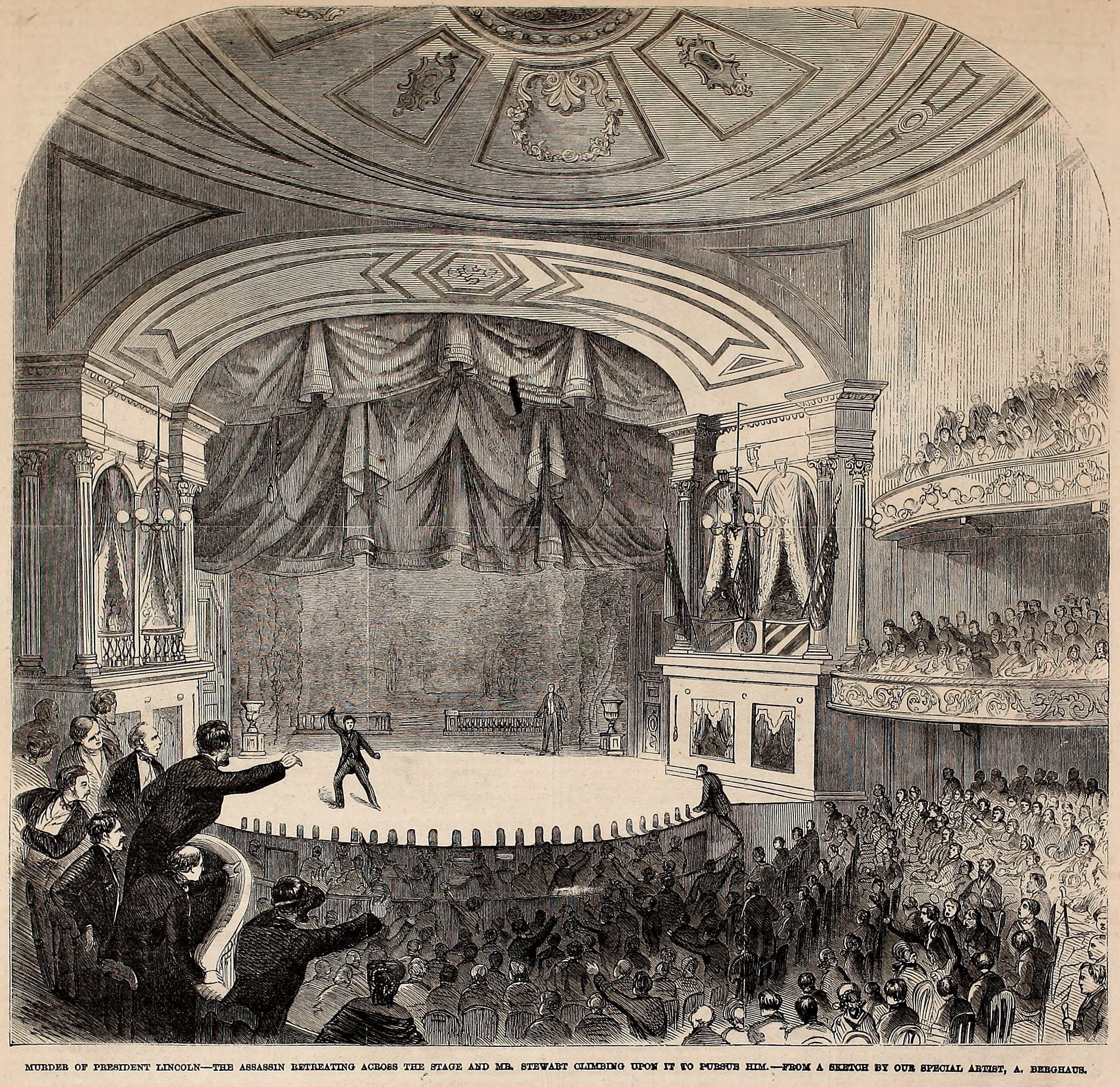
Albert Berghaus illustration of inside Ford’s Theatre from Frank Leslie’s Illustrated Newspaper, May 20, 1865
Good Friday, April 14, 1865 was one of the most consequential days in American history. The exact details of President Abraham Lincoln’s assassination have been contested by scores of eyewitnesses who offered contradictory testimony, and whose fading memories over the succeeding decades added further confusion. In light of this challenge, a comprehensive spreadsheet of the attendees at Ford’s Theatre provides an opportunity to clarify the record. Towards this goal, the first such list can be found here.
But first, how many people attended that evening? To determine a ceiling on the attendance, there are differing estimates of the maximum capacity of Ford’s Theatre. The National Park Service states that although owner John T. Ford claimed the theater could hold 2,500, the actual capacity was closer to 1,900. Given eyewitness testimony that audience members were able to change their seats, we know it was not at full capacity, and therefore the National Park Service estimates 1,700 attended that night. However, the National Park Service also conducted a deep historical study of Ford’s Theatre in 1963 to assist its restoration into the theater and museum we enjoy today. This study cited a capacity of 1,624 (602 in Orchestra level, 422 for the Dress Circle, and around 600 in the Family Circle). Therefore, a basic—if not completely satisfying—answer is there were well over 1,000 attendees at Ford’s Theatre on April 14, 1865.[1]
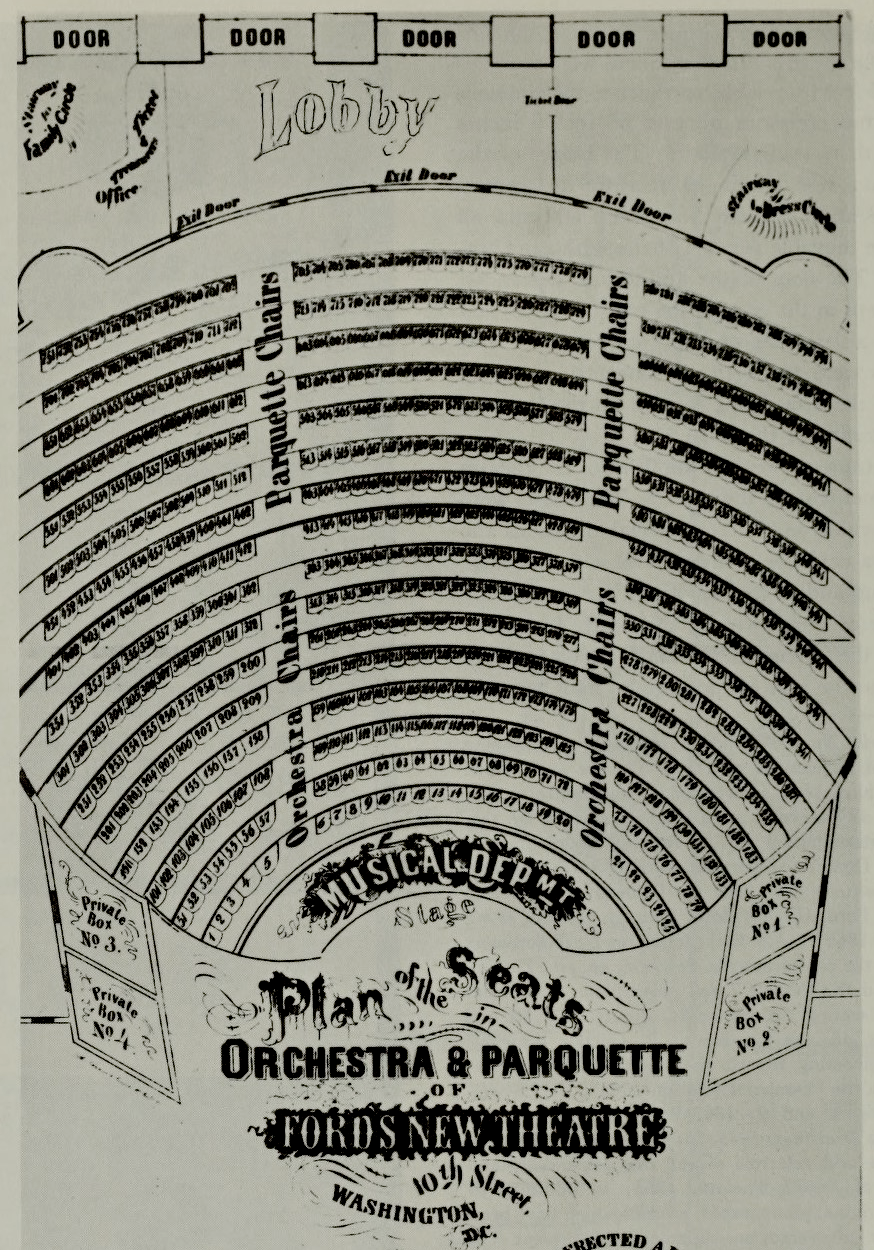
Ford’s Theatre Orchestra level diagram, National Park Service
Although the broad outlines of the assassination are well-known, particular details remain in debate:
- What did John Wilkes Booth say, and did he say it in the president’s box, mid-flight, on stage, or while fleeing?
- Did Booth injure himself upon landing on stage?
- How did the audience respond in terms of rushing the stage and how orderly or disorderly were they?
- What was the status of the employees backstage? Did Booth knock down and slash conductor William Withers, or merely brush past him? Did Edman “Ned” Spangler assist in Booth’s escape?
- Who was present with the dying president in the box? Did Laura Keene cradle Lincoln?
- Who helped Lincoln from the box to the Petersen House across the street?
For each of these questions, there is a general consensus formed by the majority view, as well as several outliers who challenge the consensus. This list allows us to place the eyewitness claims in one place, to evaluate sources, to find patterns based on their identity and location in the theater, and other details that may affect the veracity of their account.
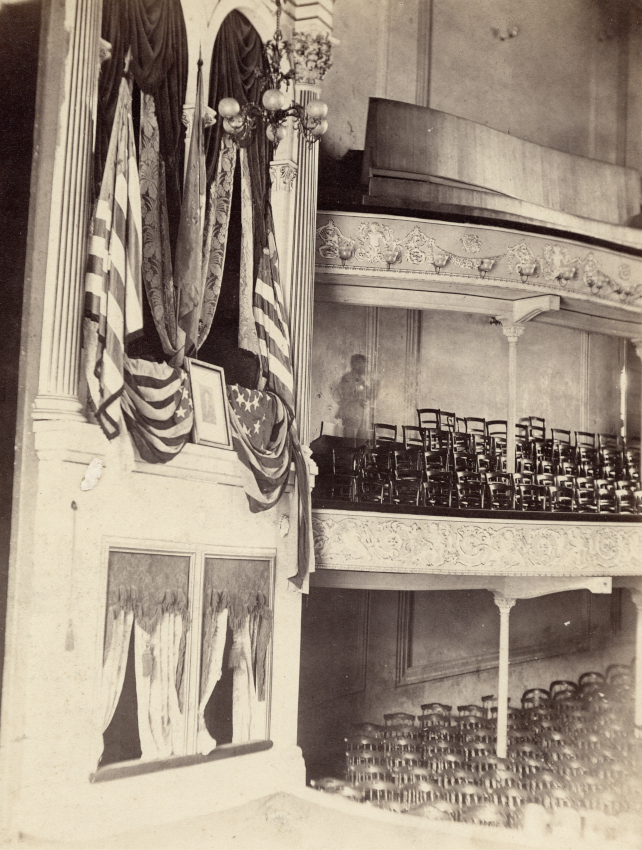
Orchestra, Dress Circle, and Family Circle bench seats, National Park Service
Of course, a full Ford’s Theatre attendee list will include a lot of dubious and contradictory testimony. Skepticism is natural, healthy, and nothing new. In fact, with so many obituaries of attendees appearing in newspapers of the 1920s and 1930s, one reporter in 1932 joked: “Another man died the other day who helped carry the assassinated Lincoln from Ford’s theater in 1865. Now its somebody’s turn to say they crossed the Delaware with Washington.”[2]
This list benefits from valuable sources such as Timothy Good’s We Saw Lincoln Shot: One Hundred Eyewitness Accounts, Thomas Bogar’s Backstage at the Lincoln Assassination: The Untold Story of the Actors and Stagehands at Ford’s Theatre, The Lincoln Financial Foundation’s folders of eyewitness testimony, online sources such as Newspapers.com and Ancestry.com, and physical archives nationwide.
Work still remains to complete the details of the accounts, and to verify the sources. There is no pride in authorship, and the best results will come from a combined effort to chronicle as many people as possible. It is helpful, though, to have a common document to unify the research so that everyone can benefit from the shared effort. The list will be continually updated.
Given the number of attendees at Ford’s Theatre on April 14, 1865, hundreds of more accounts remain to be found from both online and archival sources. To be sure, there is a finite number of details we can glean from the existing record, barring any new discoveries. Still, many people researching their ancestors’ genealogies will find this a valuable resource. The joy is in hunt; here is to further research and discoveries!
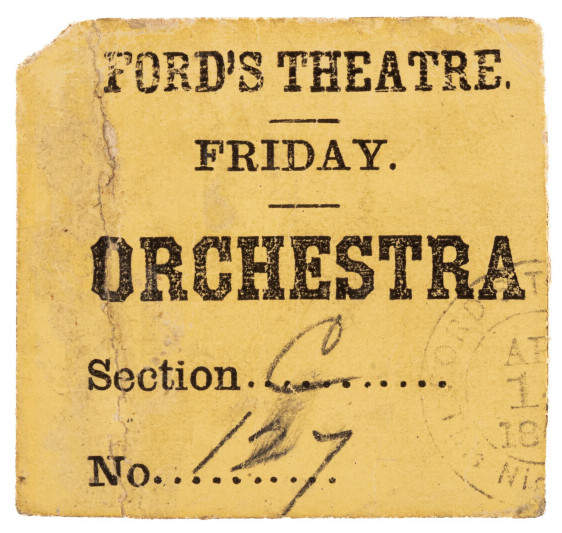
Orchestra ticket stub for April 14, 1865, Freeman’s Auctions
[1] George J. Olzewski, “Restoration of Ford’s Theatre, Washington, D.C.,” National Park Service (Washington, D.C., 1963), 37-39; “Frequently Asked Questions: The Assassination,” Ford’s Theatre, https://www.nps.gov/foth/learn/historyculture/faq-the-assassination.htm, accessed March 29, 2026.
[2] “Evansville Courier and Press (Evansville, Indiana), Jun. 25, 1932, p. 4.
As an example of the work Joe is doing, here is a video of the supposed last witness to the assassination of Lincoln, Mr. Samuel Seymour of Maryland. Please note that the video is in a vertical format for social media.
If you’d like to read the article from American Weekly referenced by host Garry Moore in the clip above, check out this post about Mr. Seymour.





Awesome research Joe!
Nice to see my hometown (Evansville,IN) mentioned in the footnotes.
Hi Joe, what a great idea! I was researching the Seward family some years ago and came across an eyewitness account of the assassination in a letter from Dr. Samuel A. Sabin to his wife, Ellen. Sabin was accompanied to Ford’s Theatre by Lieut. Jakeway Hoff. Both had been members of the Ninth New York Heavy Artillery which “was organized at Auburn,” NY. Sabin had been discharged for disability in January 1865 and, at the time of the assassination, Hoff was “formerly of the 9th.” Lieut. Col., William H. Seward, Jr., the youngest son of Secretary Seward, was also a member. In fact, the 9th was nicknamed “Seward’s Pets.”
Here’s the link to my post on Roger Norton’s assassination’s forum.
https://rogerjnorton.com/LincolnDiscussionSymposium/thread-1663-post-32641.html#pid32641
https://museum.dmna.ny.gov/unit-history/artillery/9th-heavy-artillery-regiment
Thanks for the great info, Linda! I’ve updated the file on my site. https://joebarryauthor.com/fords-theatre
I keep having difficulty opening the “continue reading” to see the whole article on these emails. What am I doing wrong?
Your help is much appreciated.
D. Turner
Debbie,
I’m not sure why the “continue reading” part is not working. My recommendation would be to click on the title of post in the email. That should open the full post on LincolnConspirators.com for you to read.
Dave
That worked Dave! Thanks for your quick response!!
Debbie