Posts Tagged With: Escape

New Gallery – Horsehead Tavern

Horsehead Tavern in Baden, MD, is an extremely minor place in the story of the Lincoln assassination.  After leaving John Lloyd at the Surratt Tavern in Clinton, we know that John Wilkes Booth and Davy Herold rode their way through the small neighborhood of T.B.  After this, the next stop the pair made was at Dr. Mudd’s house.  A modern-day highway marker on the side of Route 301/5, states the following:

Entering Charles County

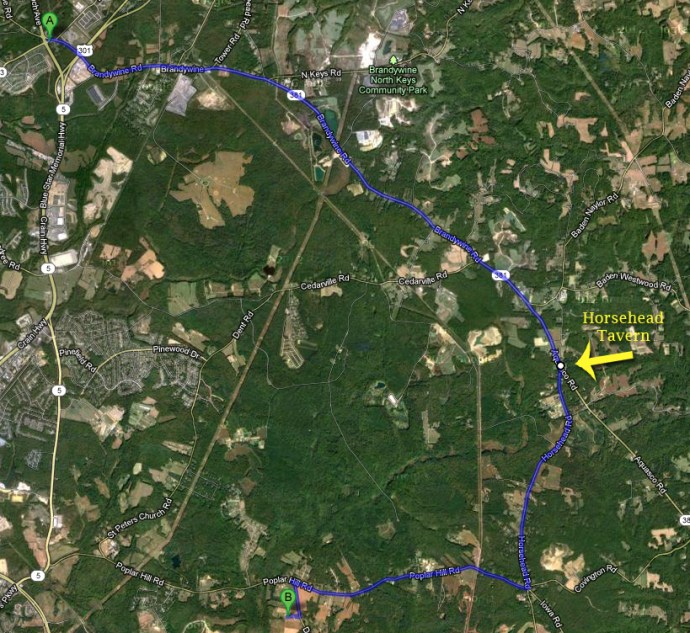
Those individuals who have taken the Surratt Society’s Booth Escape Route Tours will not recognize this sign, as the tour does not pass it. This is due to the fact that, despite the assertion by this sign, we are not exactly sure where Booth and Herold crossed over into Charles County. While the sign provides a possible route, many “old timers” in the field have long-held that the more probable route the assassins took between T.B. and Dr. Mudd’s is one that goes by the Horsehead Tavern.

Route from TB to Mudd's via Horsehead

Horsehead Tavern was similar to the Surratt Tavern. Both served as the local post offices with the communities around them bearing their names (Surrattsville/Horsehead). Both were on the stagecoach lines and often had visitors making their way north or south. The two served as taverns and rented rooms to those who needed a place to stay. And lastly, both had run ins with John Wilkes Booth.

The only known time of John Wilkes Booth going to the Surratt Tavern was his escape after shooting President Lincoln. Rumor has it though that John Wilkes Booth visited and slept at Horsehead Tavern in the fall of 1864 while scouting his future abduction/escape route. An image from 1903 marks the bedroom where Booth is said to have slept.

Old Horse Head 1903

If the story is true, then we know that John Wilkes Booth was at least familiar with the roads around Horsehead, making it a possible route for him to take on his way to Dr. Mudd’s.  In truth, Horsehead Tavern is little more than a possible waypoint on the escape route.  Nevertheless, it is still standing today and the newest Picture Gallery here on BoothieBarn.

Categories: Uncategorized | Tags: , | 2 Comments

The Grave of James W. Pumphrey

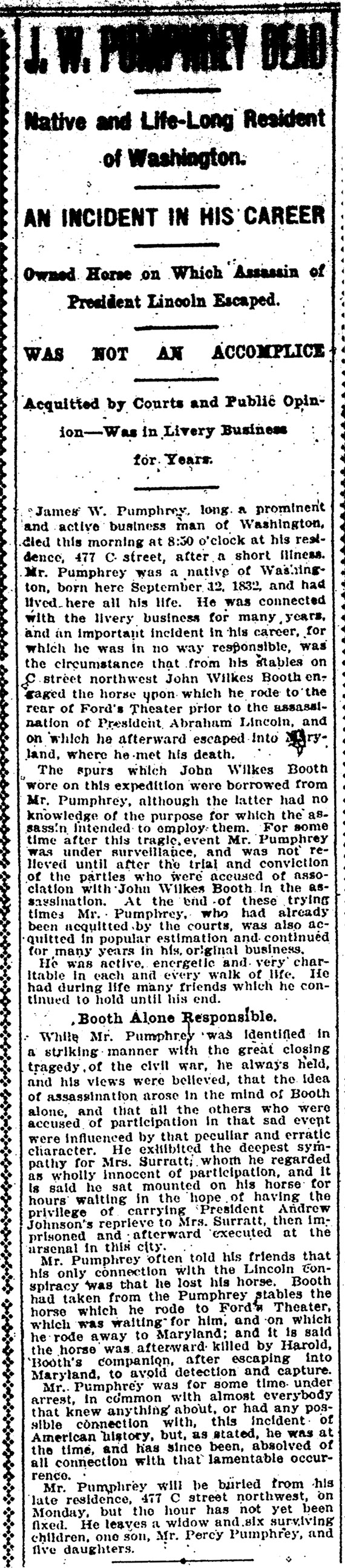
“James W. Pumphrey owned a livery stable on C Street in Washington, D.C., just behind the National Hotel where Booth stayed when he was in town. Booth became a patron of Pumphrey’s, renting horses from him on several occasions, including the night of the assassination.  Booth stopped by Pumphrey’s stable shortly after noon on April 14th, asking to reserve a particularly horse, and to have it ready at 4 o’clock that afternoon.  When Booth stopped by the livery the horse had already been rented to somone else and Booth had to settle for a bay mare.” – Steers, Assassination Encylopedia

Pumphrey's Obit

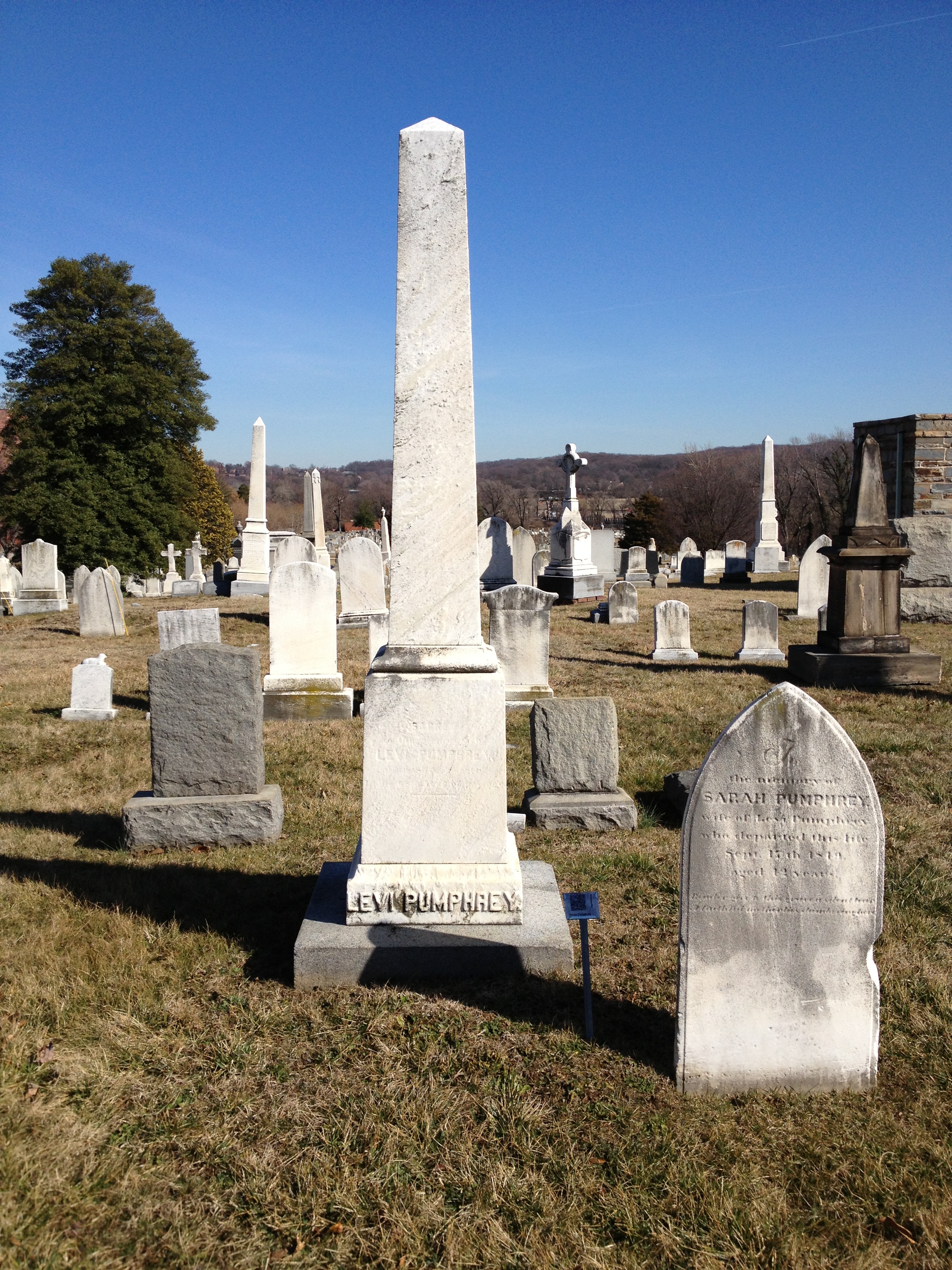
James W. Pumphrey is buried with his father Levi, in D.C.'s Congressional Cemetery.

James W. Pumphrey is buried with his father Levi, in D.C.’s Congressional Cemetery.

Congressional Cemetery has a wonderful news article about James Pumphrey trying to cheat the gas company in 1883 (bottom of page 5).

Categories: Uncategorized | Tags: , , | 1 Comment

New Gallery – Baptist Alley

After shooting President Lincoln in his box at Ford’s Theatre, John Wilkes Booth leapt onto the stage, brandished his knife red with Major Rathbone’s blood, and made his way swiftly backstage.  From there he exited the building from a small stage door.  Outside he found Peanut John, a young boy who sold peanuts at the theatre and did odd jobs like watch the stage door during performances, holding the reins of his horse.  Upon his arrival at the back theatre entrance that night, Booth had called for his friend Edman Spangler to hold the reins of his restless horse.  Spangler, busy with the job of shifting the scenery for the play outsourced the job to Peanuts.  Upon his explosion from the theatre, Booth shouted for his horse, struck Peanuts as he mounted, and galloped away down the alley.  He quickly turned left and exited out onto F street.

This alley was called Baptist Alley due to the theatre having previously been the home of the First Baptist Church of D.C.  The originally rented their building to John T. Ford before selling it to him outright.  The building caught fire and burned on December 30th, 1862 and Ford rebuilt.  The alley was a common place to John Wilkes Booth, who had Edman Spangler construct him a makeshift stables in the alley.  When his body was released to his family n the waning hours of Andrew Johnson’s presidency, Booth made a return trip to his former stables in Baptist Alley as his remains were placed there to hide them from the public.

Click on the Picture Galleries tab to see the new addition of pictures relating to Baptist Alley.

Categories: Uncategorized | Tags: , , | 1 Comment

Going the Extra Mile…and Then Some

One practically required aspect of studying the Lincoln assassination is to at one point retrace John Wilkes Booth’s route as he escaped south. Nowadays, this is generally done either by yourself in a car, or with a group in a bus and narrator.  The fact is tracing the escape route is really a necessity for all of those interested in the Lincoln assassination. The miraculous invention of the automobile allows us to complete an only slightly abridged version of Booth’s twelve day escape in a mere 12 hours.  However, retracing Booth’s footsteps is not a modern occurrence.  A mere 10 days after his death at the Garrett’s barn, the first official retracing of the route occurred when Lieut. Luther Baker traveled down Booth’s route looking for suspects and items. From that day on, countless people have retraced the escape route by a variety of means. So much of our knowledge, in fact, is based on the early accounts of individuals who retraced Booth’s escape route by foot. One such individual, from whom we get a lot of our knowledge about the escape route, was Osborn Oldroyd.  A noted Lincoln collector who lived in both Lincoln’s home in Springfield, IL and the Petersen House where Lincoln died, Oldroyd retraced Booth’s steps on foot through Maryland and Virginia. Oldroyd brought along a camera, photographing his many stops and, in 1901, published his book containing his travels and a history of the assassination called, The Assassination of Abraham Lincoln: Flight, Pursuit, Capture, and Punishment of the Conspirators.  Oldroyd’s book and walk is very useful and is still cited and read today.

Though such a pedestrian journey commencing at Ford’s Theatre and ending at the Garrett’s farm near Port Royal, VA, seems momentous, this trip was just a drop in the bucket for Mr. Oldroyd. As it turns out, Mr. Oldroyd was an enthusiastic walker as this article from 1913 shows:

Oldroyd takes a walk Evening Star Nov 5 1913

Oldroyd in Newark

For those of you who are interested, I’ve figured out a way to “one up” Osborn Oldroyd.  All you have to do is walk the distance between two of Osborn Oldroyd’s former homes, the Lincoln home in Springfield to the Petersen house in D.C.  According to Google, the walking distance is 756 miles and would only take 249 hours to complete.  Dig out those Nikes folks!

Categories: Uncategorized | Tags: , , | 1 Comment

Booth’s Boat

While I sit here in the midst of a hurricane, I can’t help but think of the currents that John Wilkes Booth and David Herold had to overcome in their attempts to cross the Potomac River.

I certainly wouldn’t want to be out on the water today with this little row boat.

References:
Engraving from Frank Leslie’s Illustrated Newspaper 5/20/1865
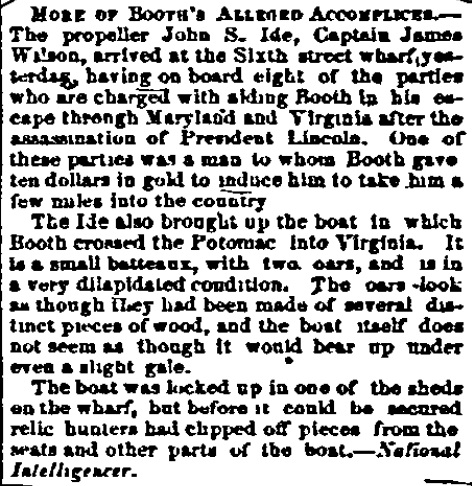
Article from the Philadelphia North American 5/5/1865

Categories: Uncategorized | Tags: , , , | 4 Comments

Mrs. Quesenberry’s Statement

On May 16th, 1865, Elizabeth Quesenberry gave the following statement to authorities:

“The day that the person I now supposed to be Herold came to my house was on Sunday, the 23rd of April, about one o’clock P.M. He asked my daughter to see the lady of the house, and on being informed that I was absent asked whether I could be sent for. She told him that if he could wait she thought I could. He then remarked to my daughter ‘I suppose you ladies pleasure of good deal on the river.’ my daughter answered ‘No, as we have no boat’. He said that he had crossed the river the night before and had left a very nice little boat by the river bank, which the young ladies could have if they wished. I returned very shortly, and he on seeing me asked if I could not furnish him with a conveyance to take him up the country. I told him no, and asked why he could not walk. She said that he could walk, but his brother was setting down by the river could not, for his horse had fallen and broken his leg; from the way in which he said this, I got the impression that they had both been riding the same horse. He said they were both escaped prisoners, and asked if I could not sell them a horse. I said no, that if I was inclined to assist them I could give them a horse, but that I was not inclined to assist them. He seemed surprised that I was not willing to assist him. I told him that he must go away. He went off very much put out. He went across the field in the direction where I supposed his brother was. I then called to him and asked him if he had anything to eat. He said no and I told him I would go to the house and send him something to eat. I went to the house and after my dinner was over I sent by Thomas Harbin, whom I supposed was a soldier, something to eat. Mr. Harbin, and a Mr. Baden, whom I also suppose was a soldier, came to my house. They had been there before; they had come to my house immediately after the fall of Richmond and they remained there until Mr. Baden was brought to Washington, and Mr. Harbin was there when I left. Harbin returned in about half an hour, and said that she had seen the party the food was for, going on horseback towards Dr. Stewart’s house, and that they told him they were going there. I understood that the horses were furnished by an old man named Bryan never saw the parties afterwards. I became alarmed and suspecting that something was wrong, determined for my own protection to signal to the gunboats, and did hoist a signal and remained there three hours, but they did not come to me. I did not report it to any officer of the government has I had no opportunity to do so and in the meantime I had heard that after they left Dr. Stewart’s they had crossed the Rappahannock at Port Royal and that the soldiers were in pursuit.
E. R. Quesenberry”

Mrs. Quesenberry’s home then:

20121016-224107.jpg

Mrs. Quesenberry’s home today:

20121016-224130.jpg

References:
American Brutus by Michael Kauffman
The Evidence by Edwards and Steers

Categories: Uncategorized | Tags: , , | 17 Comments

Crossing the Bridge

Reader Richard Petersen asked this excellent question on my last post about Silas Cobb:

Question. What was the protocol for Booth and Herold in crossing the bridge? Could they ride across or did they have to dismount and walk?

I believe this to be a very good question and worthy of discussion. The record of what transpired at the Navy Yard Bridge comes from the official statement and the conspiracy trial testimony of Sgt. Silas Cobb. In his statement to authorities specifically, Cobb gives wonderful details about the two riders who crossed his lines. For example, we learn that Booth was wearing a “soft black or dark brown felt hat” and that “his hands were very white, and he had no gloves on”. Cobb even provided details about Booth’s voice stating it was, “rather light, and high-keyed”. For Davy Herold, Cobb described him as wearing, “a light coat, light pants, and a snuff colored felt hat, of rather a light shade.” He even let us know that Davy was, “the heavier of the two”. When it comes to the actual method of crossing the bridge, Cobb does not give specific detail. This is probably due to the fact that crossing people over the bridge was so commonplace to Cobb, that he didn’t consider the way in which Booth and Herold did it to be any more notable than any other person. He does provide a few statements that we can piece together though, to paint a seemingly accurate picture of what the process was.

When both men approached the bridge, the sentry challenged them (assumedly by asking “Halt, who goes there?” or “Friend or Foe”). Booth and Herold both replied “a friend” and Cobb began his interrogation of them. In the trial testimony, Cobb is asked a question about his encounter with Herold:

Q. Did you have a good view of his face? Was there a light?

A. I did. I brought him up before the guard-house door, so that the light shone full in his face and on his horse.

So we know that Cobb moved Davy to be in view of a light. Unfortunately, this statement is inconclusive regarding whether or not Davy was still on horseback, or on foot next to his horse. However, a little while after this, Cobb is asked about Davy’s size:

Q. How would he compare in size with the last man on the row in the prisoner’s dock? [David E. Herold, who stood up for identification.]

A. He is very near the size, but I should think taller, although I could not tell it on the horse; and he had a lighter complexion than that man.

The darken part is very important. Cobb, the man who provided so many details about the men who he crossed over the bridge, was unsure about Davy’s height. It appears his explanation for this is because the Davy stayed on his horse and so Cobb was not able to accurately compare Herold on his horse with Herold on the prisoner dock. This testimony appears to favor Booth and Herold remaining on their horses.

Cobb gives us a bit more (though still not as much as we’d like) with regard to Booth’s crossing:

“He then turned and crossed the bridge; his horse was restive and he held him in and walked him accross the bridge; he was in my sight until after passing the other side of the draw. I do not know with what speed he rode after that.”

During my first few readings of this, I pictured Booth walking his horse as a man would walk a dog. In my eyes it appeared as if Booth (who apparently showed no physical pain supporting Michael Kauffman’s theory that he broke his leg later in a horse fall) kept his horse close to him and acted like a child crossing the street by walking his bicycle. Upon further reading and trying to put myself into the correct 19th century equestrian mindset though, I read this now as Booth riding his horse at a walking pace across the bridge. The last phrase, “I do not know with what speed he rode after that,” implies to me that Booth was already riding his horse and not walking it on foot. I want to believe the detail oriented Cobb would have stated something along the lines of “he remounted his horse” if Booth was actually walking alongside it beforehand.

There is no specific statement by Cobb saying that Booth and Herold ever dismounted their horses. In addition, the few details that Cobb does give regarding the process appears to imply that they remained in their mounts during their entire time they conversed with him. There is no smoking gun or definite answer to Richard’s question, but I believe the majority of the evidence points to Booth and Herold staying on their horses when they crossed the Navy Yard Bridge.

What do you think?

Booth making his escape on horseback.

References:
The Evidence by Williams and Steers
Poore’s version of the Conspiracy Trial (Vol 1)

Categories: Uncategorized | Tags: , , , | 16 Comments

The Ironic Death of Silas Cobb

On April 14th, 1865, Sgt. Silas Tower Cobb was in charge of the Army’s guard detail over the Navy Yard bridge leading out of D.C. 

The Navy Yard Bridge in 1862

During that night, he was approached by three individual riders all looking to be crossed over the bridge.  As a proper guard he interrogated the men asking them where they were going, why they waited until after 9:00 pm to depart, and what their names were.  The first man replied he was going to his home in Charles County, MD, “close to Beantown”.  He pleaded ignorant of the rule forbidding passage over the bridge after 9:00 and stated that, “It is a dark road, and I thought if I waited a spell I would have the moon”.  Sgt Cobb was hesitant to let him pass but the man who gave his name as Booth seemed proper enough and his answers had been satisfactory.  While Cobb’s standing orders had been that no person was allowed to cross the bridge between 9:00 pm and sunrise, the enforcement of these orders had been more lax as the war had dwindled down.  Sgt. Cobb unwittingly allowed the assassin of Lincoln to cross his line.  Not long after this, another man rode up giving his name as Smith.  He told Cobb he was heading home to White Plains.  Again, Silas Cobb informed the man that passage over the bridge after 9:00 o’clock was forbidden.  Smith replied, “I stopped to see a woman on Capitol Hill, and couldn’t get off before.”  Though this man did not appear as proper as the first man, he allowed him to cross the bridge as well.  Sgt. Cobb had unwittingly allowed David Herold, one of the Booth’s accomplices, to cross his line.  History repeated itself as a third horseman appeared.  This man asked Cobb if he had passed a man on a horse fitting the description of “Smith”.  Cobb replied in the affirmative.  The third man told Cobb he was a stableman, and that “Smith” had run off with one of his horses.  The stableman, John Fletcher, asked for permission to cross and give chase.  Cobb told him that while he would be allowed to cross out of the city, he would not be permitted to return until daybreak.  Fletcher decided the idea of spending all night stranded outside of the city looking for a lost horse was an unappealing one and returned to the city to report his loss to the police.

Though Cobb was later in deep dung for allowing two conspirators in Lincoln’s assassination escape over his bridge, he never suffered court martial for his actions.  He testified at the trial of the conspirators and was honorably discharged from the army in September of 1865.  He assumedly returned to his hometown of Holliston, Massachusetts.  Two years later, however he met his end at the age of 29 while traveling in Michigan:

Silas Cobb’s death as reported in the Lowell Daily Citizen on November 11, 1867

Silas Cobb’s death as reported in the Jackson Citizen on November 19th, 1867

It is one of those odd twists of fate that the man who permitted the river crossings of two Lincoln assassination conspirators would meet his end in his own unfortunate attempt.

References:
Silas Cobb’s FindaGrave page
The Evidence by Williams and Steers

Categories: Uncategorized | Tags: , , , | 14 Comments

Blog at WordPress.com.