Posts Tagged With: Escape

The Ironic Death of Silas Cobb

On April 14th, 1865, Sgt. Silas Tower Cobb was in charge of the Army’s guard detail over the Navy Yard bridge leading out of D.C. 

The Navy Yard Bridge in 1862

During that night, he was approached by three individual riders all looking to be crossed over the bridge.  As a proper guard he interrogated the men asking them where they were going, why they waited until after 9:00 pm to depart, and what their names were.  The first man replied he was going to his home in Charles County, MD, “close to Beantown”.  He pleaded ignorant of the rule forbidding passage over the bridge after 9:00 and stated that, “It is a dark road, and I thought if I waited a spell I would have the moon”.  Sgt Cobb was hesitant to let him pass but the man who gave his name as Booth seemed proper enough and his answers had been satisfactory.  While Cobb’s standing orders had been that no person was allowed to cross the bridge between 9:00 pm and sunrise, the enforcement of these orders had been more lax as the war had dwindled down.  Sgt. Cobb unwittingly allowed the assassin of Lincoln to cross his line.  Not long after this, another man rode up giving his name as Smith.  He told Cobb he was heading home to White Plains.  Again, Silas Cobb informed the man that passage over the bridge after 9:00 o’clock was forbidden.  Smith replied, “I stopped to see a woman on Capitol Hill, and couldn’t get off before.”  Though this man did not appear as proper as the first man, he allowed him to cross the bridge as well.  Sgt. Cobb had unwittingly allowed David Herold, one of the Booth’s accomplices, to cross his line.  History repeated itself as a third horseman appeared.  This man asked Cobb if he had passed a man on a horse fitting the description of “Smith”.  Cobb replied in the affirmative.  The third man told Cobb he was a stableman, and that “Smith” had run off with one of his horses.  The stableman, John Fletcher, asked for permission to cross and give chase.  Cobb told him that while he would be allowed to cross out of the city, he would not be permitted to return until daybreak.  Fletcher decided the idea of spending all night stranded outside of the city looking for a lost horse was an unappealing one and returned to the city to report his loss to the police.

Though Cobb was later in deep dung for allowing two conspirators in Lincoln’s assassination escape over his bridge, he never suffered court martial for his actions.  He testified at the trial of the conspirators and was honorably discharged from the army in September of 1865.  He assumedly returned to his hometown of Holliston, Massachusetts.  Two years later, however he met his end at the age of 29 while traveling in Michigan:

Silas Cobb’s death as reported in the Lowell Daily Citizen on November 11, 1867

Silas Cobb’s death as reported in the Jackson Citizen on November 19th, 1867

It is one of those odd twists of fate that the man who permitted the river crossings of two Lincoln assassination conspirators would meet his end in his own unfortunate attempt.

References:
Silas Cobb’s FindaGrave page
The Evidence by Williams and Steers

Categories: Uncategorized | Tags: , , , | 14 Comments

Newish News

Most of what follows is probably already known to those who regularly read this blog.  Nevertheless here’s some newish news on the Lincoln assassination front.

Booth reading the news

 1.  New Site

When it comes to learning about Abraham Lincoln’s life, there really is no better resource than the Abraham Lincoln Research Site run by Roger Norton.  The website at http://rogerjnorton.com is actually composed of three equally valuable sections: the life of Abraham Lincoln, the life of Mary Todd Lincoln, and Lincoln’s assassination.  The proprietor of the site is Roger Norton, a retired Illinois social studies teacher.  His website is the top choice for students, both young and old, to learn about Lincoln.  In 2006, his site received the prestigious honor of being completely archived by the Library of Congress.  Just as the LOC archives and preserves movies and TV shows deemed culturally significant, Mr. Norton’s site was archived for all time due to its educational significance.  It is a very high honor for an individual’s site to achieve and speaks to the quality of Mr. Norton’s work.

Recently, Mr. Norton has expanded his website to now include a public forum.  The Lincoln Discussion Symposium is open to all who wish to discuss the many aspects of Abraham Lincoln.  It is a collaborative community where amateurs and experts alike can post questions and comments regarding our 16th President.  Due to the large amount of traffic Mr. Norton receives from students in the school setting, forum members are expected to be courteous and respectful in their remarks.  While it is still growing, the forum already houses a wonderful community of experts from the Lincoln community eager to answer questions and take part in discussions.  I, myself, am a member there and endorse it fully.  While my main interest lies in Lincoln’s assassination, the forum has already taught me so much that I didn’t know about the living Lincoln.  Membership is growing every day, so I invite you all to visit the Lincoln Discussion Symposium and join the wonderful community of learners.

2.  New Links

On the right side of the blog you might have noticed a list of “Links to Learn More”.  Here I have placed links to some of the best websites out there for Lincoln assassination material.  Hovering over each link will give you a short description of the site.  To this list, I have recently added two new links.  The first is the above mentioned Lincoln Discussion Symposium.  The second is the Facebook page for the Spirits of Tudor Hall.  The Tudor Hall estate was the Booth family homestead in Maryland.  The theatrical patriarch of the Booth clan, Junius Brutus bought the land when he and Mary Ann Holmes emigrated from England.  The Booth family originally lived in a log cabin on the property before Junius commissioned the building of the beautiful Tudor Hall manor house in the fall of 1851.  Sadly, Junius never got to live in the main house as he died while on tour on November 30th 1852.  The Booth family lived on the Tudor Hall property on and off from 1822 to 1858.  Nowadays, Tudor Hall is used as an office for the Harford County Center for the Arts.  It is also home to the Junius B. Booth Society.   The house is open on select weekends for public tours about the Booth family and the history of Tudor Hall.  The Spirits of Tudor Hall Facebook page advertises the house’s tour dates and times, along with highlighting wonderful pictures and articles on the Booth family (including some from here, Woot!).  If I was a member of Facebook, I would Share it/Like it/Poke it/Friend it/Hug it/High Five it, whatever it is that you young people do there.  One thing they are advertising on Tudor Hall’s behalf is the sale of a genuine brick from a Tudor Hall chimney.  While the bricks can’t be completely authenticated to when the Booths lived there, it’s still a relic you can own dating back to Edwin Booth’s lifetime.  Add the Spirits of Tudor Hall Facebook page to your favorites today.

3.  New(ish) Books

I am happy to report that William Edwards’ book, The Lincoln Assassination – The Reward Files, is now available for purchase as an ebook through GoogleBooks.  Previously released as a book on CD-ROM, Mr.  Edwards has revamped his collection of primary source documents into a searchable ebook.  The Reward Files hold many details about the military’s search for Booth and contains firsthand accounts (like Samuel Arnold’s confession) not found in other sources.  This text along with The Evidence and the Court Transcripts, make up the trilogy of the government’s primary documents into the assassination of Abraham Lincoln.

Also, Ed Steers, the noted Lincoln author and co-author on The Evidence with William Edwards, has also just released an updated Kindle ebook version of his popular booklet, The Escape and Capture of John Wilkes Booth.  Mr. Steers originally posted the news of his revised book on the Lincoln Discussion Symposium.

Well, that’s all the newish news that’s fit to print.  Back to our regularly scheduled programming.

Categories: Uncategorized | Tags: , , , , | 10 Comments

George in Georgetown

On the morning of April 15th, George Atzerodt awoke in a daze.  He found himself at the Pennsylvania House hotel having spent the previous night wandering around trying to come to terms with his failed role in the assassination and the consequences that would soon follow.  He registered at the Pennsylvania and shared the room with a stranger he met on the street, Samuel Thomas.  Atzerodt awoke early and left the hotel, without paying his share.  He began his trek to Georgetown.

At around 8:00 am, George walked into the storefront of Matthews & Knowles, a dealer of, “fine teas and choice groceries for the family”.  He approached the clerk, John L. Caldwell, a man he was acquainted with from his time in Montgomery County.  In the need of funds, George asked Caldwell if he would purchase his watch from him.  Caldwell, having a watch already, declined George’s offer.  “’Well,’ said he, ‘I want to borrow $10.  I have not any money.  I am going to my uncle’s.  You let me have the $10 and I will leave my revolver with you, and I will send you the money or bring it to you next week.’”   Caldwell gave George the $10 and kept his gun (No. 499, Cooper Firearm Mfg. Co., Frankford, Phila.).

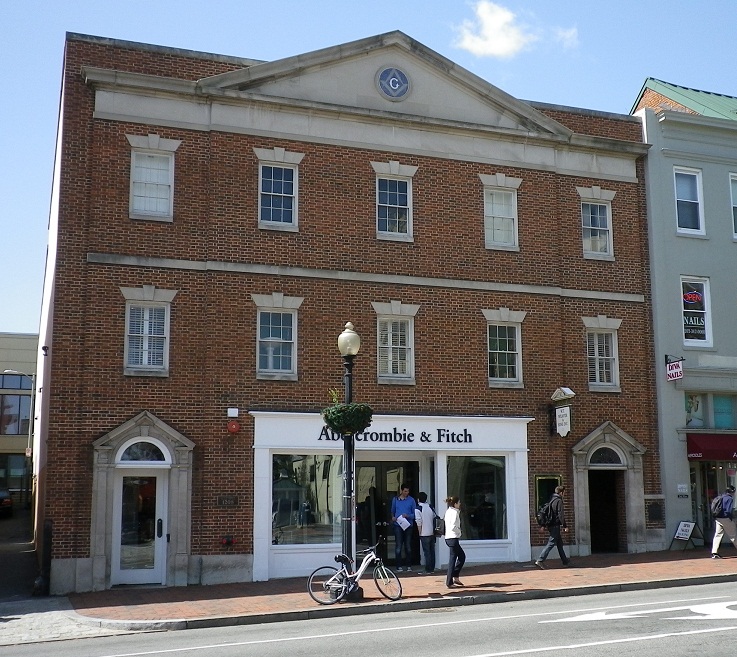
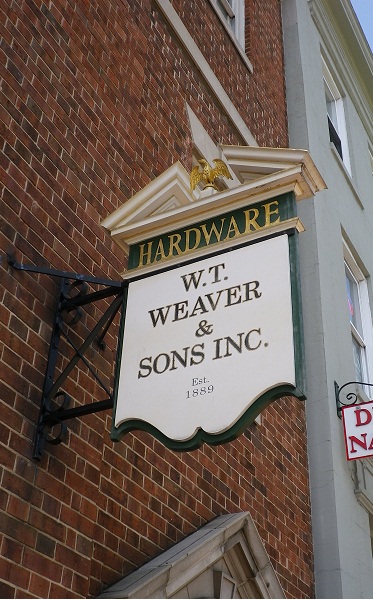
The location of the Matthew and Knowles store was located at 49 High Street in Georgetown.  Today the building still stands at 1202 Wisconsin Avenue with the W. T. Weaver and Sons Hardware store occupying the same spot:

Building that once housed the Matthew and Knowles shop where Atzerodt pawned his gun.

Current occupant of the Matthew and Knowles store.

After pawning his revolver, Atzerodt then walked a few blocks up High street (now Wisconsin avenue), and visited in the home of Lucinda Metz.  Lucinda Metz was a 44 year old widow with four children who had known George from his time in Montgomery County.  Known as Andrew Atwood to her, he visited with the widow and had breakfast with her before heading for the stage coach to take him to his cousin Hartman Richter’s.  Mrs. Metz’ house still stands today near the corner of Wisconsin and P streets:

Lucinda Metz' house.

References:
The Escape and Capture of George A. Atzerodt
Jim Garrett, my generous tour guide to these and many other Georgetown sites

Categories: Uncategorized | Tags: , | 6 Comments

Blog at WordPress.com.