Posts Tagged With: Escape

Assassination Maps Update

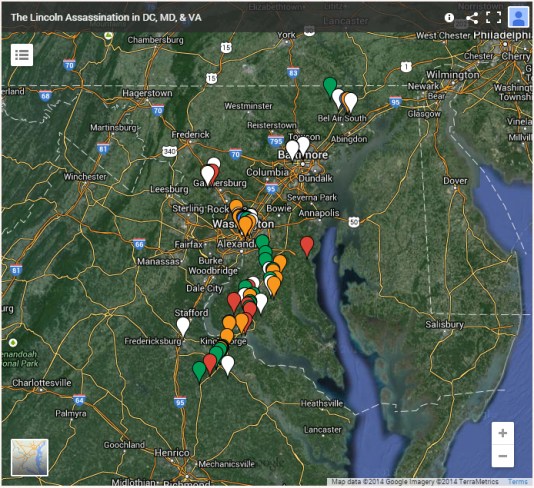
DC, MD, VA Assassination map thumb

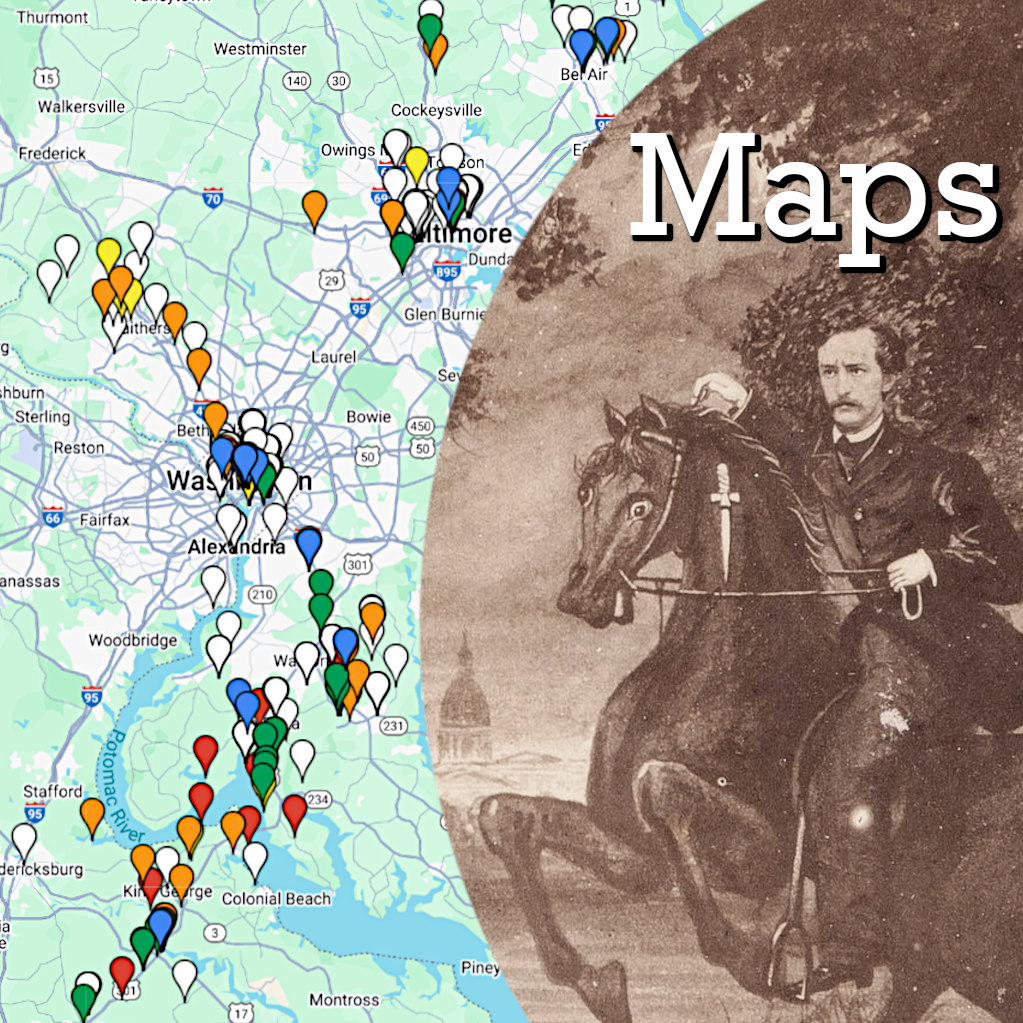
I just wanted to publish a quick post highlighting a big update to the Maps section of BoothieBarn.  First, I have added about 30 more sites to the D.C., Maryland, and Northern Virginia map, bringing the total up to over 120 sites on this map alone.  Maps for other regions of the U.S. are planned, but, since most of the action occurred in the Maryland area, I have been focusing on adding to and improving that map first.  To that end, I have gone through and added a new aspect to the map which should make it even easier to locate and visit these sites, especially “on the go”.

We know, from studying an event that occurred 150 years ago, that landscapes have changed.  In many instances, places that were once isolated farms and open land are now housing developments or busy highways.  Old roads are lost to new roads and bypasses.  Due to this, it is important to mark historic sites with something more long term than a street address, which could change (or disappear) in a few short years.  Recording latitude and longitude coordinates based on the Global Positioning System (GPS) is, therefore, the best way to mark sites on an ever changing landscape.  Regardless of what transformation occurs on the site itself, the GPS coordinates will always mark what was once there.

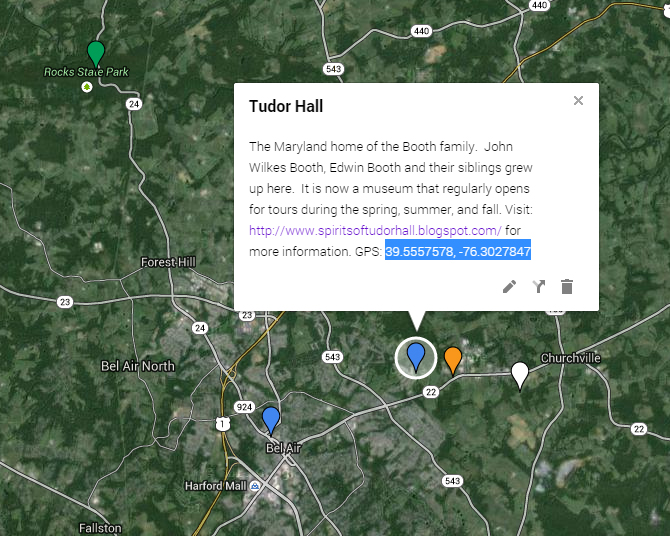
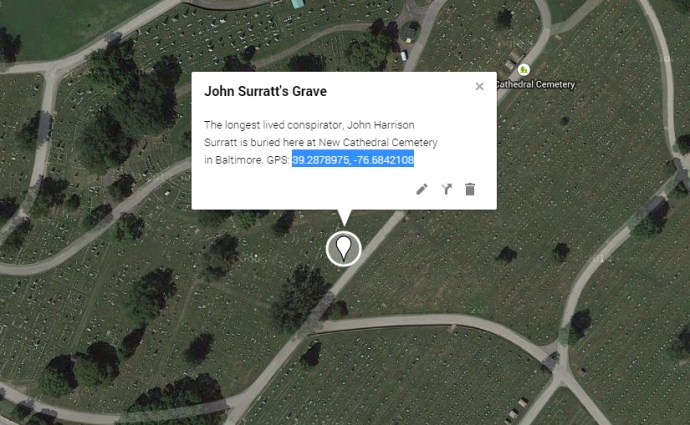
With this in mind, I have gone through and added the GPS coordinates for every site marked on my map.  This is not only for posterity’s sake, but also serves to improve the functionality of the map itself.  Practically every “smart” cell phone built today has the capability of providing driving directions.  Now, with the GPS coordinates included in the description for every Lincoln assassination site, all you have to do is click the place you want to visit on my map, copy the GPS coordinates, and direct your phone or GPS device to give you directions there.

Assassination maps GPS coordinates example

For places like cemeteries, the GPS coordinates are even more helpful, as they direct you almost exactly to the grave you are looking for.  No more wandering around a huge cemetery hopelessly looking for that one grave.  My coordinates will put you right at it.  As I visit more graves in more cemeteries (using a wonderful book by Jim Garrett and Rich Smyth as my guide), I’ll be updating the map with even more grave GPSes.

Grave coordinates example

Me Surratt Grave Jan 2015

So, if you’re planning a trip to the area or, better yet, planning to drive John Wilkes Booth’s escape route on your own, be sure to check out my D.C., Maryland, and Northern Virginia Lincoln assassination map for all the GPS coordinates you’ll need.

Click here to view the updated Maps section of BoothieBarn, now with GPS coordinates!

Categories: Uncategorized | Tags: , , , , | 5 Comments

Retracing the Steps of the 16th New York

When John Wilkes Booth looked out between the slats of Mr. Garrett’s tobacco barn in the early morning hours of April 26, 1865, the faces he saw staring back at him belonged to the troopers of the 16th New York Cavalry.  Through perseverance and a good bit of luck, the troop of twenty-six men commanded by Lieutenant Edward P. Doherty, detectives Luther Baker and Everton Conger, managed to locate and surround the assassin of President Lincoln.  On the last day of the 2014,  I retraced some of the steps the troopers took which concluded in them successfully locating the most wanted man in America.

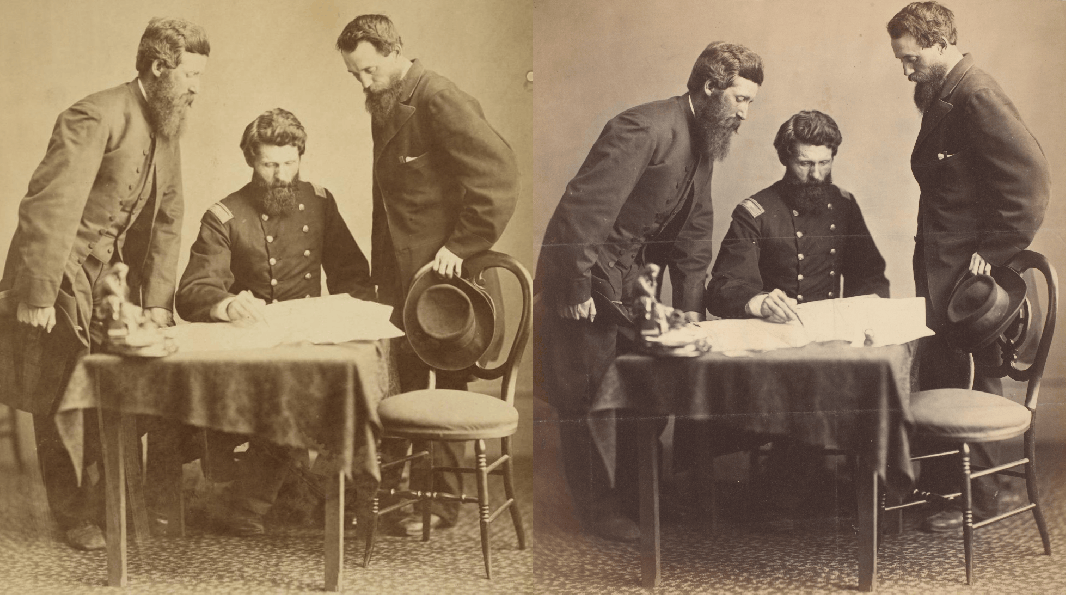
Luther Baker, Lafayette Baker, and Everton Conger posed as if planing the capture of John Wilkes Booth. Image animated by Chubachus (http://chubachus.blogspot.com/2014/12/time-lapse-photographs-of-colonel.html)

Following the crime of April 14th, numerous troop detachments were sent out to scour the countryside in search of the assassin.  However, with the assistance of others, Booth and Herold always managed to stay one or two steps ahead of the soldiers.  When the pair crossed over into Virginia, they had a huge lead over their pursuers.  While the manhunt succeeded in identifying and arresting some of the major players in the escape (John M. Lloyd, Dr. Samuel Mudd, even Thomas Jones), up until the moment he was killed, the widespread belief among those searching for him held that Booth was still hiding out in Maryland.  The reason the 16th New York had even made its way into Virginia to search for the assassin was due to a serendipitous case of mistaken identity.

On April 16th, two Confederate agents named Thomas Harbin and Joseph Baden, Jr. crossed the Potomac river from a point on the Maryland shore called Banks O’Dee.  Harbin had been introduced to John Wilkes Booth by Dr. Mudd and had apparently agreed to help the actor in his initial abduction plot against Lincoln.  The increased troop detail in Southern Maryland and his acquaintance with the assassin probably motivated Harbin to cross to safer shores in Virginia.  On the 19th of April, while detectives from James O’Beirne’s Washington D.C. provost marshal’s office were in Southern Maryland looking for information and acting as spies, a farmer in Banks O’Dee named Richard Claggett mentioned having seen two men cross the river on the 16th.  As days passed with no other signs of the fugitives, two of O’Beirne’s men followed up on this lead and traveled into the Northern Neck of Virginia where few troops had been deployed.  The detectives found a boat but nothing more.  On the morning of the 24th O’Beirne, himself in the field at Port Tobacco, had a telegraph sent to the War Department about the theory that the fugitives may have already crossed into Virginia.  Lafayette Baker, head of the National Detective Police, decided O’Beirne’s theory warranted further investigation and received permission from  Secretary of War Edwin Stanton to send a cavalry troop.  An order went out for a “reliable and discreet commissioned officer” to command the mission.  Lt. Edward Doherty of the 16th New York Cavalry answered the order.

Edward P. Doherty of the 16th New York Cavalry

Edward P. Doherty of the 16th New York Cavalry

A call then went out for twenty five privates from the 16th New York to join him, and Doherty took the first twenty-five who responded, regardless of their rank.  Lafayette Baker also sent two detectives with the 16th New York.  One was his cousin, Luther Byron Baker, and the other was a former Lieutenant Colonel Everton Conger.  Both had served with Lafayette Baker in the District of Columbia Cavalry.  Technically, Luther Baker and Everton Conger were civilians at the time which would have left Doherty as the de facto leader of the group.  However, once Booth was cornered and killed and the applications for reward money came in, battle lines were drawn with Conger and Baker both refuting Doherty’s ownership of the operation, making it difficult to ascertain who Lafayette Baker truly put in charge (if anyone).

Regardless, after receiving their orders to investigate the Northern Necks of Virginia, the detectives and the soldiers of the 16th NY made their way to the Sixth Street wharf in Washington D.C. and boarded the propeller-driven steamer, John S. Ide.  The Ide steamed them down the Potomac, depositing them at Belle Plain, Virginia which is right at the border of King George and Stafford counties.  It had taken Booth and Herold nine days to reach King George County. The troops made it there from D.C. in four hours.

Belle Plain map 1

Here are some pictures Belle Plain today showing the location where the John S. Ide docked and unloaded the soldiers:

Belle Plain 2

Belle Plain 1

Belle Plain Pano

The detachment unloaded here at around 10 pm on April 24th.  Knowing that Booth was suffering from a broken leg, they immediately set about looking for doctors in the area.  Luther Baker recalled the long night of April 24/25th thusly:

“The direction we took I could not tell positively.  We went under the bluffs, and waked up the inhabitants of a house, to ascertain if any physicians resided in that locality.  We learned the names of three of them, found them, and questioned them closely as to whether or not they had attended anyone with a fractured limb, or had heard of anyone with a fractured limb in the vicinity.  We also questioned a negro and a few white persons upon the subject.  All had heard of no such case.”

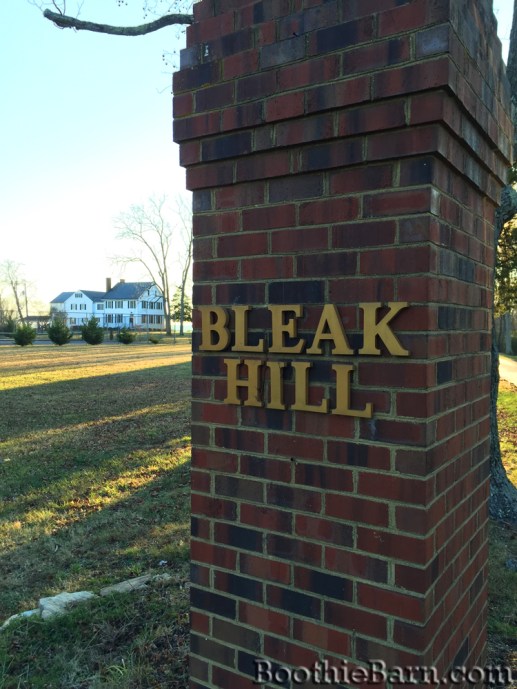
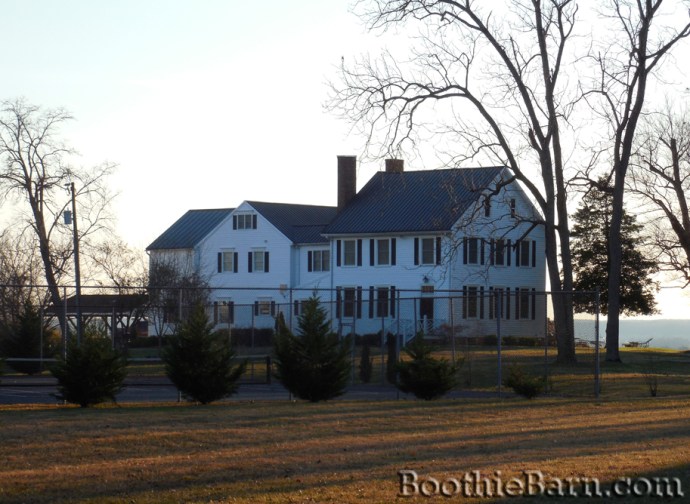
Around daybreak on the 25th, the 16th New York arrived at the home of Dr. Horace Ashton, the last doctor on their list.  Like the other doctors in the area, Dr. Ashton had neither seen or heard anything in regard to a man with a broken leg in the area.  The doctor was a fairly wealthy man with a large plantation which he called, Bleak Hill.

Bleak Hill map

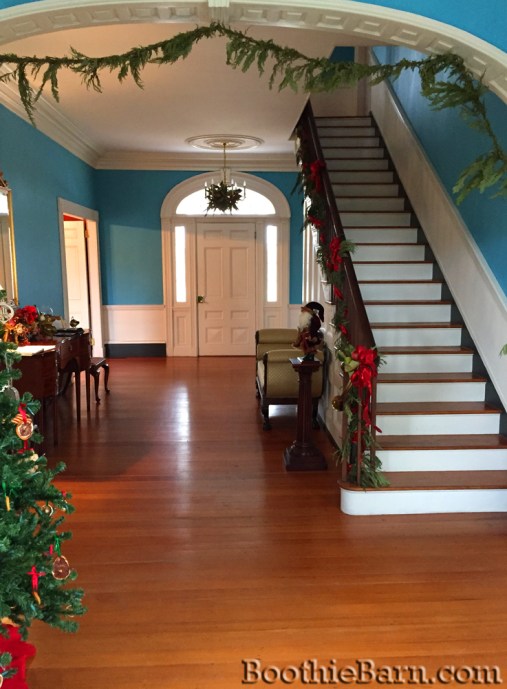
The doctor fed the troopers’ horses and provided the soldiers with a well deserved breakfast.  Bleak Hill still stands today though the large building on the property apparently dates to 1870.

Bleak Hill 1

Bleak Hill 2

When the troops departed Bleak Hill, they split into two groups, each tracing a different route down to Port Conway on the Rappahannock River.  Lt. Doherty and the majority of his men took the main road to Port Conway passing through Office Hall.  Unbeknownst to the men, they were now on the trail of Booth and Herold as the pair had also passed through Office Hall on their way between Cleydael and Port Conway 24 hours before.  Baker, Conger and four troopers took a less traveled route and eventually met up with the posse in Port Conway around lunch time.

The horses were again in need of feed and were lucky enough to find hospitality at the home of a wealthy planter named Carolinus Turner.  His large and beautiful home was called Belle Grove and had the distinction of being the site of President James Madison’s birth.  About half of the troopers were served lunch at Belle Grove with the rest being fed elsewhere.  After lunch, Col. Conger, exhausted and suffering the long term effects of previous battle wounds, fell asleep from exhaustion in the hall of Belle Grove.

Belle Grove map

Today, Belle Grove is operated as a beautiful bed and breakfast. As refreshing as Col. Conger’s rest in the hallway must have been, I can say from personal experience that is nothing compared to a night or two in their luxurious Madison Suite.

Belle Grove 1

Belle Grove Front

Belle Grove Hallway

Belle Grove Hallway with Conger

As Conger slept, Lt. Doherty and some of his men made their way the half mile down the road to Port Conway, where they interviewed the inhabitants. It was here, in tiny little Port Conway on the Rappahannock River that the 16th New York finally got their first real lead on Booth’s whereabouts. Local fisherman William Rollins, had seen Booth and Herold as they were waiting to cross the Rappahannock the day before. Even more helpful, Rollins’ wife not only recognized the Confederate soldiers who ended up crossing the ferry with the pair, but knew that one of them, Willie Jett, was courting Izora Gouldman who lived in nearby Bowling Green. With this information in hand, Doherty sent one of his men to wake up Conger and the whole posse began the task of crossing the Rappahannock river. It took a while as the small ferry could only carry a few horses at a time. When the entire group made it across the river, they set about galloping at full speed to Bowling Green. Unknowingly, they rode right past the Garrett farm where Booth and Herold were hiding out.

Bowling Green map

Once in Bowling Green (a place I did not visit on New Year’s but you can see other pictures relating to it in the Bowling Green Picture Gallery), the company found Jett sleeping in the Star Hotel. Surrounded by troopers, he “offered” to take the men to the Garrett place where he had dropped off Booth two days before. The troops, with Jett in tow, headed back to the Garrett Farm.

Garrett's farm map

The rest, as they say, is history. Booth and Herold had been exiled to the tobacco barn that night due to their strange behavior when the troops were originally galloping past on the way to Bowling Green. With the barn surrounded, Herold surrendered while an obstinate Booth asked for 50 paces so that he could come out shooting. Eventually Conger tired of the ongoing parley and set fire to the barn. Sergeant Boston Corbett aimed his pistol through the slats of the barn and shot Booth, striking him in the neck, and paralyzing him. He was pulled to the porch of the farmhouse and died there right after sunrise.

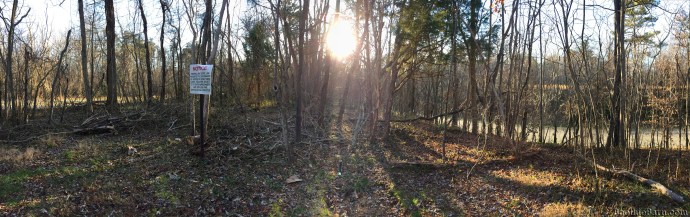
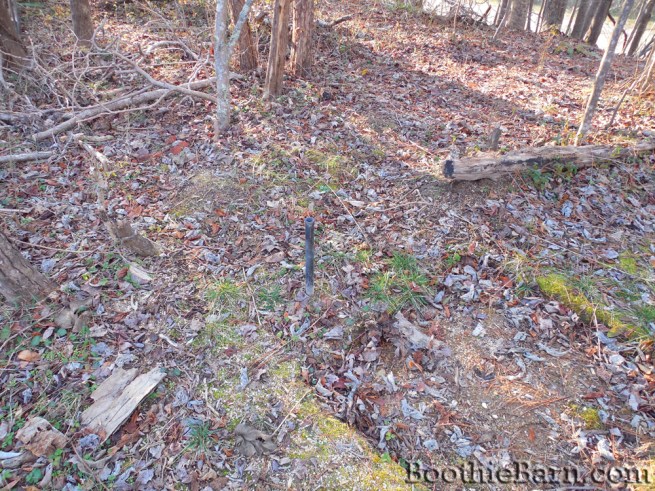
Today the site of the Garrett house is in the wooded median of Route 301, surrounded on all sides by Fort A. P. Hill. The only marker at the site, aside from a warning that digging for artifacts in illegal, is a metal pipe sticking out of the ground which marks the center line of the western most chimney of the Garrett house.

Garrett site 1-1-2015 Pano

Garrett Site 1-1-2015

A visit to the Garrett site on New Year’s day (a tradition of mine ever since I moved to Maryland) ended our retracing of the route of the 16th New York Cavalry. After getting a breakfast and food for their horses at Garrett’s, the troopers returned to Belle Plain. With Booth’s body in tow and Herold taken prisoner, the victorious men reboarded the John S. Ide and steamed back up to D.C. They were Lincoln’s Avengers and no doubt spent that steamship ride dreaming of the fame and reward money that awaited them.

References:
American Brutus by Michael W. Kauffman
The Lincoln Assassination: The Reward Files by William Edwards
Belle Grove Plantation

Categories: Uncategorized | Tags: , , , | 20 Comments

John Wilkes Booth in the Woods Finale

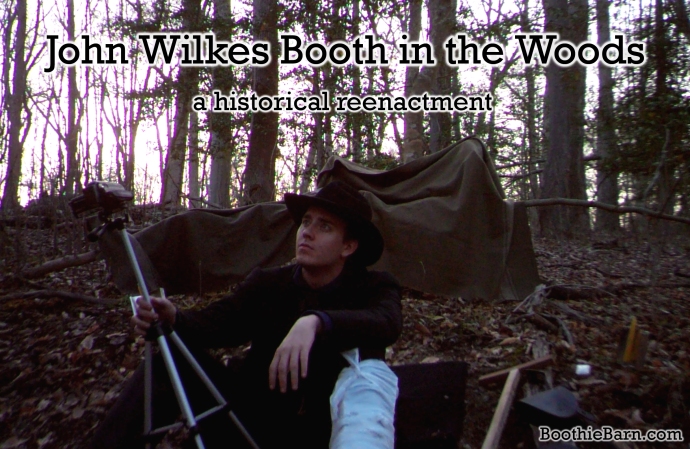
John Wilkes Booth in the Woods

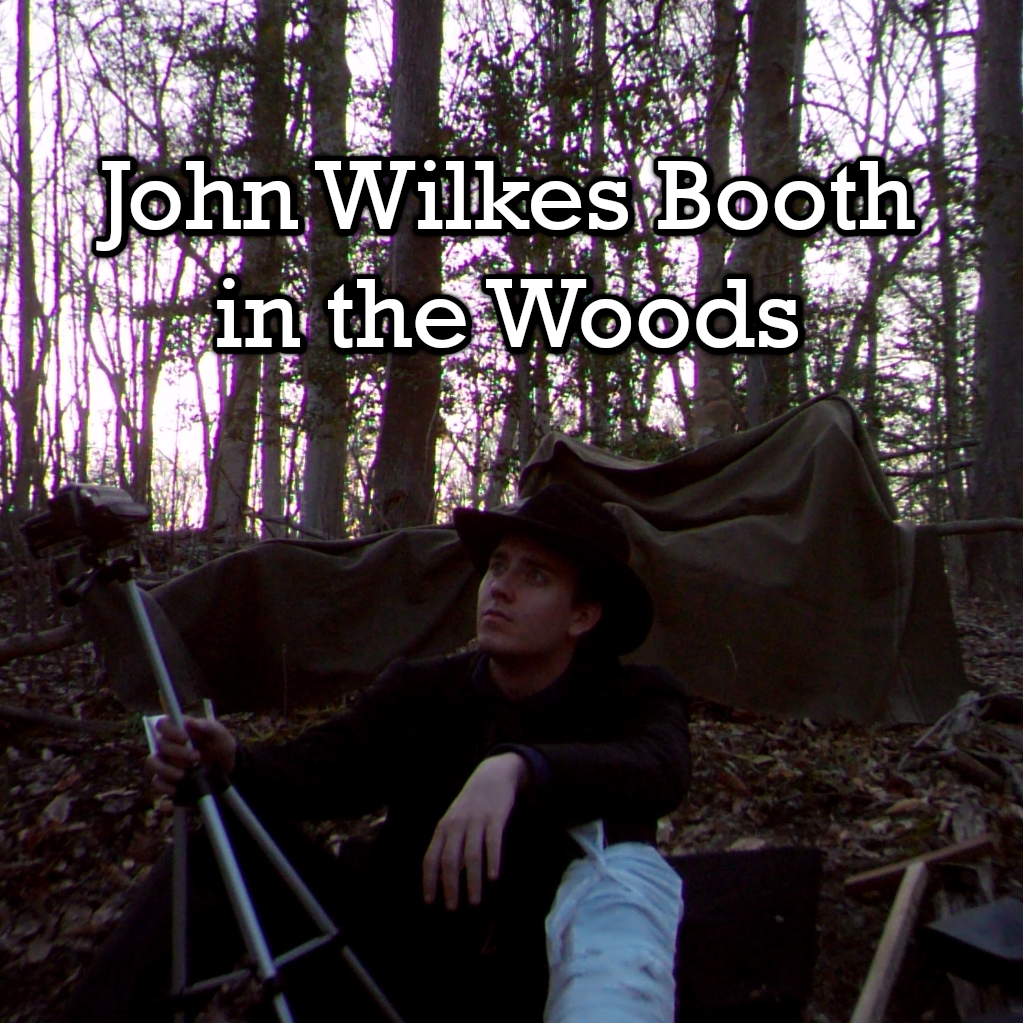
On April 12th of this year, I underwent a journey into history.  For 3 days and 2 nights, I completely immersed myself in the conditions John Wilkes Booth faced while hiding out in a pine thicket after he assassinated Abraham Lincoln.  The project took months of preparation and the assistance of countless individuals who alerted me to new research, informed me of the intricacies of 19th century attire, and provided much needed moral support for such an endeavor. I strove to ensure that this experience was as genuine as possible and committed to feeling the same discomfort Booth felt.

Even from the beginning I knew I wanted to document the experience in order to share it with others.  While the 19th century method of documentation would have been limited to the written word, modern technology allows us to go further.  Therefore, with camera gear as my only anachronism, I walked into the woods with the same meager supplies that were afforded to Booth hoping to shed some light on this forgotten part of his escape.

Today, I publish the final installment of the series, bringing the project to its completion.  I am extremely grateful to not only those listed in this final video but also the many others who helped my along the way and prayed for my safety.  I hope that you have enjoyed this series as I hope to produce more like it in the future.

To watch the final video, you can either click on the image above and scroll down, click HERE to watch the video on YouTube, or play the embedded video below.

Remember that all of the videos in the series can be found in one place by clicking the “John Wilkes Booth in the Woods” image at the top of this post.

Thank you all for coming on this journey with me.

~ Dave Taylor

Categories: Uncategorized | Tags: , , , , , | 8 Comments

Mapping the Assassination

I came out to Washington, D.C. for the very first time in 2009.  It was the summer between my junior and senior year of college and the trip was an early graduation gift from my parents.  My father and I had a great time exploring the many wonderful sites before returning back home to Illinois.

Two Illinois natives visiting an old friend.

Two Illinois natives visiting an old friend.

It was a whirlwind visit as we tried to do all the touristy things D.C. has to offer.  We visited the Lincoln Memorial, Ford’s Theatre, the Air and Space Museum, the American History Museum, the National Portrait Gallery, the Library of Congress, the Jefferson Memorial, the FDR Memorial and the Newseum.  We paid our respects at the World War II, Korean, and Vietnam Memorials, as well as visited Arlington National Cemetery and the Marine Corps War Memorial.  We also went up into the Washington Monument, and viewed both the House of Representatives and the Senate in session.  It was a blast.

Admittedly though, my favorite part of the trip was the one day in which my father and I rented a car from Union Station and drove the escape route of John Wilkes Booth.  I had been learning about the assassination for years and I couldn’t wait to visit some of the places I had read so much about.  My father always appreciated Lincoln, so much so that he volunteered not once, but four times to chaperone groups of rowdy eighth graders on their annual class trip to Springfield, IL.  Though Dad doesn’t have the same interest in Lincoln’s assassination as I do, he definitely appreciates the importance of it.

In planning for our day trip, I spent hours tracking down the various locations we wanted to go and printing off directions on how to get there.  It was a difficult process.  I often had to consult many different websites just to figure out where exactly a certain place was.  It took awhile, but in the end, I managed to work up an itinerary.

Our condensed tour was great, except for one hitch.  On our way to the Mudd house I had planned for us to stop and visit the grave of Edman Spangler.  Dad and I pulled up at St. Peter’s Cemetery and spent about an hour looking at every single grave in the place to no avail.  We were almost late for the last tour of the day at the Mudd house due to our searching.  When we told the people at the Mudd house of our difficulty they informed us of our mistake.  “Spangler,” they said, “is buried in the Old St. Peter’s Cemetery.” Dad and I had spent an hour trampling through the wrong cemetery.

This completely understandable mistake has always stuck with me.  It makes me laugh to think of the time Dad and I wasted reading every grave in the new St. Peter’s Cemetery (which, by the way, is down the road from the old cemetery).  It shows how helpful and important it can be to have a guide.

Since moving to Maryland I have been lucky to have the guidance of many knowledgeable individuals.  As time has gone on, I’ve slowly become a guide myself and I am able to point out places relating to the assassination of Lincoln around D.C., Maryland, and Virginia.  Some time ago I started a project of recording the locations of various assassination places using a mapping app called Rego.  At first it was just for my own reference as I pinpointed places I had visited or places that I wanted to visit.  This summer I drove a circuitous route to Illinois and back so I could visit a few of those places on my list.

In August, I decided to make my map widely available.  I converted my Rego map into a custom Google map complete with a color coded key.  Without fanfare or announcement, the new page on BoothieBarn appeared called Lincoln Assassination Maps.

Maps Header Menu Maps Pages Menu

About a month after I created the page, I received a wonderful email from a man who took his grandson along the escape route and used my map to help them plot their course.  I emailed him back expressing how ecstatic I was that someone had not only found the map but used it as I had hoped.  Since then I’ve been slowly adding more places to the map expanding far beyond the escape route.  Using aerial views and my own knowledge, I’ve tried to pinpoint places as specifically as I can, even putting markers directly on top of where graves are in a cemetery in some cases.  Currently, the only map on the Lincoln Assassination Maps page is one that covers D.C., Maryland, and the Northern Neck of Virginia.  Though it already contains about 100 sites, it, by no means, is complete.  Future maps will highlight places in other regions such as the Midwest, the South, the Northeast, and even an International map.

With a subject as vast as the assassination of Lincoln, a guide is much needed commodity.  I hope that these maps will serve as beneficial guides for those of you who want to explore the plethora of assassination related sites.

Click HERE to check out the BoothieBarn Lincoln Assassination Maps page!

DC, MD, VA Assassination map thumb

Categories: Uncategorized | Tags: , , , , | 12 Comments

John Wilkes Booth in the Woods: Part 10

John Wilkes Booth in the Woods

The tenth installment of my series “John Wilkes Booth in the Woods” is now complete and available for viewing.

In this part I get some unexpected news and start walking towards the Potomac River.

To watch the video, you can either click on the image above and scroll down, click HERE to watch the video on YouTube, or play the embedded video below.

There is one final installment of “John Wilkes Booth in the Woods” left to go. Stay tuned for the conclusion of this historical reenactment.

Categories: Uncategorized | Tags: , , , , , | 7 Comments

John Wilkes Booth in the Woods: Part 9

John Wilkes Booth in the Woods

Part 9 of my series “John Wilkes Booth in the Woods” is now complete and available for viewing.

In this part I try one of Booth’s favorite drinks and finally receive the newspapers I’ve been craving.

John Wilkes Booth in the Woods

To watch the video, you can either click on the images above and scroll down, click HERE to watch the video on YouTube, or play the embedded video below.

Categories: Uncategorized | Tags: , , , , , | 8 Comments

Jett, Ruggles, and Bainbridge

A few days ago, commenter Kees van den Berg posed the following question:

“I wonder, what happened with Jett, Ruggles and Bainbridge? I suppose they were arrested and confined in the Old Capitol Prison in Washington. Is it true that they never were tried, but came free after a couple of weeks after taking the oath of allegiance to the US? Have you dates of confinement and release? Thank you beforehand.”

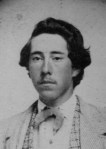
His question refers to Willie Storke Jett, Mortimer Bainbridge Ruggles, and Absalom Ruggles Bainbridge. Ruggles and Bainbridge were cousins which explains the last names as middle names coincidence.  These three men were Confederate soldiers who ran into John Wilkes Booth and David E. Herold during their escape.

About midday on April 24th, the fugitives were at Port Conway, VA on the banks of the Rappahannock River. They were waiting for the ferry to come so they could get to Port Royal on the other side. As they waited, Jett, Ruggles, and Bainbridge came riding up.  The three men were heading towards Richmond, ultimately to get their paroles. At first, Herold lied to the men and told them that he and his wounded brother were also Confederate veterans. Thinking the three soldiers were on their way south to meet up with others in order to continue the fight, Herold pulled Jett aside and asked him if they could join them. Surprised by Herold’s desperation, especially when he and his comrades had accepted the defeat of their cause, Jett asked Herold straight away who they really were. Herold replied back, “We are the assassinators of the President”.

After more conversation, Jett, Ruggles, and Bainbridge agreed to help the men. The five men and their three horses crossed the Rappahannock on the ferry guided by ferryman Jim Thornton. When they arrived at Port Royal, Jett searched out a place for Booth to stay. He came to the home of Sarah Jane Peyton, who agreed, sight unseen, to care for a wounded solider.
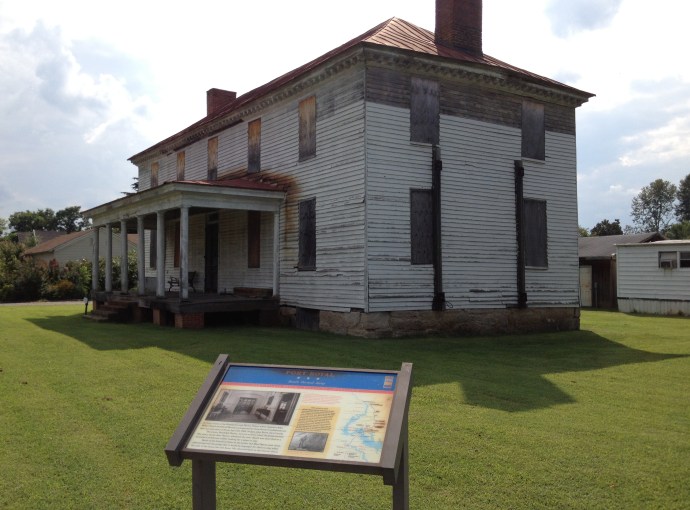
The home of Sarah Jane Peyton in Port Royal, VA

The home of Sarah Jane Peyton in Port Royal, VA

When Booth hobbled into her parlor, however, her hospitality changed. She no longer thought it proper for her to entertain a guest while her brother, the man of the house, was absent. She suggested to Jett that he might find better lodging for the wounded man a couple of miles down the road, at the farm of Richard Garrett. The three men rode to the Garrett place, with Booth and Herold sharing horses with Ruggles and Bainbridge, respectively. When they arrived at the Garrett farm, Bainbridge and Herold stayed by the outer gate as Jett, Booth and Ruggles approached the house. The Garretts agreed to care for Booth, whom Jett said was a wounded soldier named Boyd, until Jett’s return in a couple of days. Jett, Ruggles, Bainbridge, and Herold rode further south. They stopped at the Trappe, a house of entertainment, before separating for the evening. Jett and Ruggles went to the Star Hotel in Bowling Green. Jett was courting Izora Gouldman, the hotel-keeper’s daughter.  Bainbridge and Herold traveled to the home of Virginia Clarke. Coincidentally, both Bainbridge and Herold knew Virginia’s son James and were welcomed into her home for the night.

The next day, Bainbridge and Herold met back up with Ruggles, likely in Bowling Green. The three men rode back to the Garrett house where Booth had comfortably spent the night in an upstairs bedroom. Bainbridge and Ruggles dropped Herold off and then continued on to Port Royal. When they arrived, they found a troop of Union cavalry crossing the ferry from Port Conway to Port Royal. They turned around and put spurs to their horses. They rushed back to Booth and Herold at the Garrett farm long enough to tell them of the approaching troops, then they continued quickly south.

The rest is well-known. The Union troops learned from one of the residents of Port Conway that Willie Jett was among the men who crossed with John Wilkes Booth. What’s more, they learned of Jett’s affinity for Izora Gouldman. Unknowingly, the troops rode right past the Garret farm where Booth was hiding on their way to Bowling Green. They captured Jett at the Star Hotel and he agreed to take them to the Garrett farm. When the troops arrived, they kept Jett under guard near the gate of the farm while the rest surrounded the house and barn. Eventually Herold surrendered himself and the barn was lit on fire to smoke Booth out. Boston Corbett fired at Booth inside of the burning barn, paralyzing him. Booth was dragged from the barn, first placed under a tree and then on to the front porch of the house.  He died around dawn on April 26th.
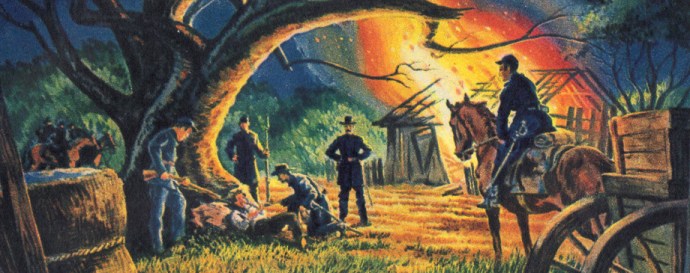
pulled-from-the-barn-header.jpg

During the lengthy crossing of the soldiers on their way back across the Rappahannock after killing Booth, Detective Luther Baker took possession of Booth’s body and the prisoner Jett. With two other soldiers, Baker departed Port Conway ahead of the rest of the troops. At some point during their travel to Belle Plain, where a steamboat would take them up to Washington, Baker let Willie Jett go. Jett had led the soldiers right to the assassin without a fight, and Baker did not believe there was any need to detain him further. When Baker got back to Washington, he was severely berated by Edwin Stanton for releasing Jett without authorization. An arrest order for Jett was quickly sent out:

An arrest order for Willie Jett dated April 28th.

An arrest order for Willie Jett dated April 28th.

Jett was re-arrested in Westmoreland County, VA on May 1st. He was transferred to Washington and imprisoned at the Old Capitol Prison with the other Lincoln assassination related suspects. On May 6th, he gave a lengthy statement to the authorities about his interaction with Booth, ending it with the assurance, “I have tried to evade nothing. From the beginning I have told everything.”  Jett was also called to testify at the trial of the conspirators, giving his testimony on May 17th.  Willie Jett was imprisoned for a month and was released on May 31st when he took an oath of allegiance at the Old Capitol Prison:
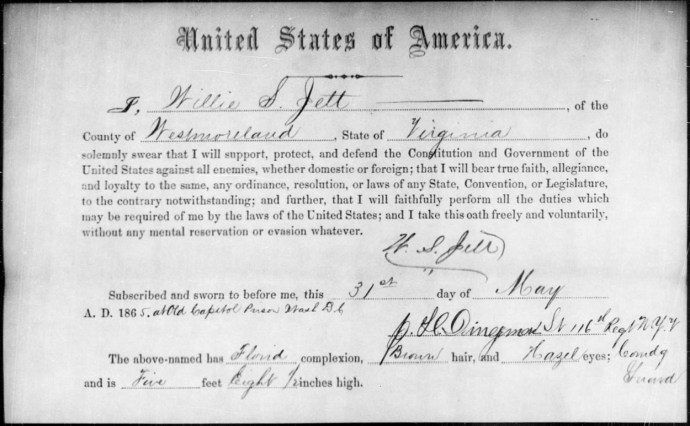
Willie Jett's Oath of Allegiance NARA

Though Jett had been a major player in the escape of John Wilkes Booth, he was not tried as a conspirator since he had never met Booth prior to April 24th and Jett had also assisted in Booth’s capture.  The government was only concerned with prosecuting those they believed had real knowledge of the conspiracy before it was carried out.  Jett did not fit this criteria.

In January of 1890, an account written by Lieutenant Ruggles was published in The Century Magazine. Not all of the details in Ruggles’ recollections almost 25 years after the fact are correct, but he does give this account of what happened to him and Bainbridge:

“Learning that Jett was a prisoner, and that we were to be arrested, tried, and hanged, as aiders and abetters, Bainbridge and myself stood not on the order of going, but went at once. Making our way into Essex County and crossing to Westmoreland, we went to our home up in King George County. Some ten days after, I was arrested at night by a squad of United States cavalry. Bainbridge was also captured. We were taken to Washington and placed in the Old Capitol Prison. We were not alone in our misery, however, for Dr. Stewart, at whose house Booth had stopped, William Lucas, the negro who had driven him to the ferry, and a number of others, were there, among them being Jett, who had escaped from Captain Doherty, and had been recaptured at his home in Westmoreland County.”

Lieutenant Ruggles was arrested in King George County either on May 2nd or May 3rd (both dates are given on two different records).  Private Bainbridge was arrested in King George County on May 4th or 5th (again two different dates on two different records).  They were both transported to the Old Capitol Prison and were incarcerated there starting on May 5th.  For some unknown reason (Ruggles thought it was by mistake), the two men were transferred out of the Old Capitol and sent all the way to Johnson’s Island, a prisoner of war camp for Confederate prisoners located near Sandusky, Ohio.  They left the Old Capitol Prison on May 11th and arrived at Johnson’s Island on the 13th.

Johnson's Island 1865 LOC

It didn’t take very long for those in charge at Johnson’s Island to determine that these two men were much more than your average prisoners of war.  It certainly looks like their transfer to Johnson’s Island was a mistake because, on May 15th, Ruggles and Bainbridge were being transferred back to D.C.  They arrived at the Old Capitol Prison on May 17th and this time they stayed there.

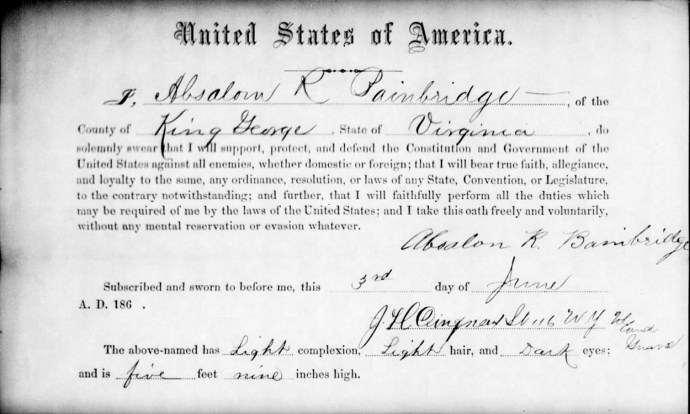
Neither Ruggles or Bainbridge were ever called to testify at the trial of the conspirators.  On June 3rd, both men were released from their confinement after taking the oath of allegiance:

Mortimer Ruggles Oath of Allegiance NARA

Absalom Bainbridge Oath of Allegiance NARA

Willie Jett never ended up marrying Izora Gouldman of the Star Hotel.  Instead he moved to Baltimore, married, went insane (possibly because of untreated syphilis), and died in an insane asylum in Virginia.  His body is buried in Fredericksburg.
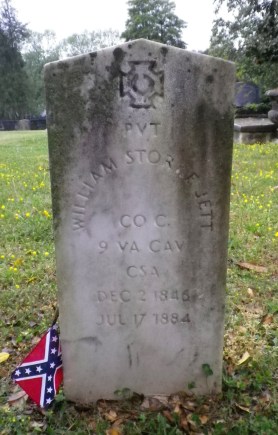
Willie Jett's grave

After the war, Mortimer Bainbridge Ruggles and Absalom Ruggles Bainbridge continued to imitate each other.  Both men married and had two children.  Both moved to New York.  Both found occupations that forced them to move around; Ruggles as a traveling salesman and Bainbridge as an interior decorator.  Finally, both men died not only in the same year, but in the same month.  These two Confederate veterans are buried in two different cemeteries in New York:

Mortimer Ruggles' grave

Grave of Absalom Ruggles Bainbridge


While Jett, Ruggles, and Bainbridge spent a bit more time imprisoned than some of the other suspects in Lincoln’s assassination, their incarceration could have been longer, especially since it was known that they had contact with Booth and assisted him during his escape.  Booth’s brother, Junius Brutus Booth, Jr., who knew nothing about the assassination, was imprisoned until June 22nd.  John Lloyd, the man who gave Booth and Herold a carbine, field glasses, and some whiskey at the Surratt Tavern, wasn’t released until June 30th.  One of the last people released from the Old Capitol Prison was Joao Celestino, the Portuguese ship captain whose ill-timed threats against William Seward made authorities believe he was a main conspirator.  Celestino was released from the Old Capitol Prison on July 8th and was ordered to leave the U.S. within 10 days, never to return.  And, of course, Dr. Mudd, Edman Spangler, Samuel Arnold, and Michael O’Laughlen were imprisoned at Fort Jefferson for three and a half years before the surviving three were pardoned in 1869.

The imprisonment endured by Jett, Ruggles, and Bainbridge could have certainly been worse had the government truly wanted to punish all those who assisted John Wilkes Booth.

References:
American Brutus by Michael W. Kauffman
Brutus’ Judas: Willie Jett by Eric J. Mink
“Pursuit and Death of John Wilkes Booth” by Prentiss Ingraham, Century Magazine, Jan, 1890
Jett, Ruggles and Bainbridge’s prison records and oath of allegiances were accessed via Fold3.com
FindaGrave.com (Bainbridge, Ruggles)
Rich Smyth

Categories: Uncategorized | Tags: , , , , , , , | 18 Comments

John Wilkes Booth in the Woods: Part 8

John Wilkes Booth in the Woods

Part 8 of my series “John Wilkes Booth in the Woods” is now complete and available for viewing.

In this part I discuss Booth’s comfort and the ways he could have passed the hours of waiting.

To watch the video, you can either click on the image above and scroll down, click HERE to watch the video on YouTube, or play the embedded video below.

Categories: Uncategorized | Tags: , , , , , , | Leave a comment

Blog at WordPress.com.