With the holidays almost here, it’s time for another installment of Boothie Christmas caroling where we revise a classic Christmas Carol into a Lincoln assassination themed Boothie Carol. Today’s song is a revised version of, “Silver Bells”. I hope you all enjoy it in the humorous manner in which it is intended.
“Thomas Jones”
As sung to, “Silver Bells”
Easter morning, without warning,
Sam Cox comes down my street.
In the air there’s a feeling of danger.
I start going, without knowing
Why his dad wants to meet,
But I get to Rich Hill and I hear:
Thomas Jones, (Thomas Jones)
Thomas Jones, (Thomas Jones)
I’ve hidden Booth in the thicket
Lend a hand (Lend a hand).
Help this man (Help this man).
Make sure he gets river bound.
When I find him, Herold’s with him,
So I say to them both,
“We must wait for the troopers to leave here.”
He wants papers. I say, “Later.”
Then I give him my oath
No amount could cause me to betray
John Wilkes Booth, (John Wilkes Booth)
John Wilkes Booth, (John Wilkes Booth)
It’s not quite time to go boating.
Hunker down (Hunker down).
Don’t be found (Don’t be found).
Soon it will be rowing day!
Each week we are highlighting the final resting place of someone related to the Lincoln assassination story. It may be the grave of someone whose name looms large in assassination literature, like a conspirator, or the grave of one of the many minor characters who crossed paths with history. Welcome to Grave Thursday.
Virginia Clarke
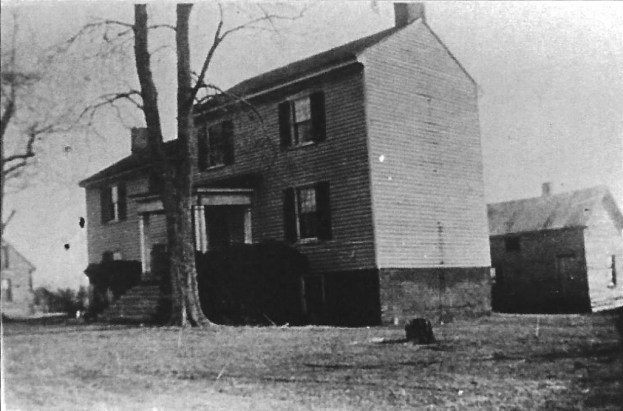
The home of Virginia Clarke outside of Bowling Green, Virginia.
Burial Location: Greenlawn Cemetery, Bowling Green, Virginia
Connection to the Lincoln assassination:
One of the most forgotten and overlooked parts of the escape of the assassins of Abraham Lincoln involves the home of Mrs. Virginia Clarke. This is probably due to the fact that Mrs. Clarke’s home is technically not a part of John Wilkes Booth’s escape route. The lead assassin never got as far south as Mrs. Clarke’s home and, therefore, never saw the home pictured above. However, Booth’s accomplice and fellow fugitive, David Herold, not only saw this house but spent the night at Mrs. Clarke’s during the brief period of time where he separated from the assassin. On the afternoon of April 24, 1865, John Wilkes Booth and David Herold were waiting at the ferry crossing of Port Conway, Virginia, waiting to cross over to Port Royal on the other side of the Rappahannock River. As they waited, three Confederate soldiers rode up to the ferry landing. After some parlay, the fugitives announced their identities to the men. The soldiers, Willie Jett, Absalom Bainbridge and Mortimer Ruggles vowed to give Booth and Herold assistance on their escape. After crossing the ferry Jett attempted to find Booth refuge at the home of Sarah Jane Peyton, but she rebuffed him after seeing the condition Booth was in. The group of five then rode about two miles south of Port Royal where Jett dropped Booth off with the Garrett family. It was at this time that Herold separated from John Wilkes Booth for the first time since the pair had met up at Soper’s Hill outside of Washington on April 14th. While Booth enjoyed the hospitality of the unsuspecting Garrett family on the night of April 24th, Herold made his way with Absalom Bainbridge to Mrs. Clarke’s home.
David Herold briefly mentions this visit to Mrs. Clarke’s in his interrogation:
“One of the soldiers named Bennington [Bainbridge], was going to see a gentleman named Clark[e] whom I met some three or four years ago, & of whom I had heard people in Maryland speak. I do not know Clark’s christian name. Both Bennington & Clark had belonged to Mosby’s command. We went there and Bennington introduced me…We staid there all night.”
James Clarke, Herold and Bainbridge’s mutual acquaintance, was not at home when the pair arrived. Therefore Bainbridge had to introduce Herold to James’ mother, Virginia Clarke. Bainbridge introduced Herold to Mrs. Clarke using the pseudonym of Mr. Boyd, the same name Jett had used to pass Booth off on the Garrett family.
Practically nothing is known about Herold’s stay with Mrs. Clarke and the next morning he was riding back with Bainbridge to Bowling Green to meet back up with Ruggles and Jett who had spent the night at the Star Hotel. Ruggles, Bainbridge, and Herold rode back up to the Garrett farm where Herold joined back up with Booth. The rest is history.
Mrs. Clarke’s home no longer stands. The area where it was once located has been transformed into a man-made lake.
When Virginia Clarke died in 1877, she was originally buried in a family cemetery belonging to her son-in-law’s family. However, when Fort A. P . Hill was created in Caroline County in the 1940’s, that family cemetery, along with many others, had to be removed. Greenlawn Cemetery in Bowling Green was created specifically to receive the transplanted graves of those originally interred on land now owned by Fort A. P. Hill.
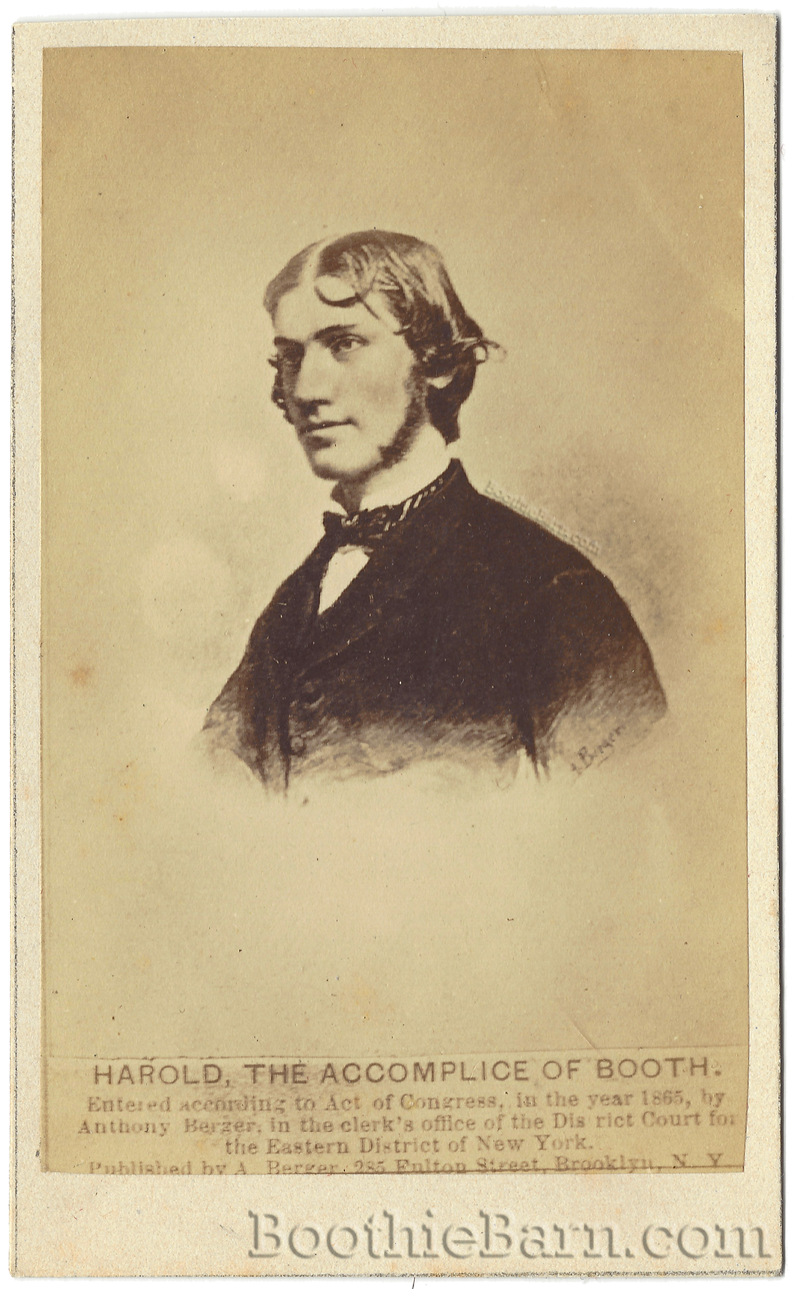
No? Well, that’s completely understandable because, despite the words on the bottom of this CDV, this image is definitely not of conspirator David Herold. However, like the false image of Mary Surratt that has been previously discussed on this site, in the wake of Lincoln’s assassination this image was copied and distributed to the general public as the likeness of David Herold. The nation clamored for images of John Wilkes Booth and his gang of conspirators and, when images were unavailable or difficult to acquire, some photographers were forced to improvise.
One of those improvising photographers was a man by the name of Anthony Berger. Berger had learned his trade from the famous Civil War photographer Mathew Brady and had even run Brady’s studio in Washington, D.C. Under Brady’s tutelage, Berger became a experienced photographer and respected artist in his own right. Berger photographed President Lincoln at least 14 times and many of the classic images of Lincoln that we revere today were taken not by Brady, but by Berger. All of the images of Lincoln that we use on our money today were the products of Berger’s work:
Photograph of Abraham Lincoln taken by Anthony Berger on February 9, 1864. This image was the basis for the Lincoln penny.
Photograph of Abraham Lincoln taken by Anthony Berger on February 9, 1864. This image appears on the current $5 bill.
By 1865, Berger had moved to his own photography studio in New York. This is why the above image of “fake Herold” was copyrighted in Brooklyn and not in Washington, D.C. The true identity of the man pictured in Berger’s photograph is unknown as is Berger’s reasons for attempting to pass off such an image. The most obvious reason would be financial gain with Berger knowingly passing off a fake image of Herold during a time of huge demand and in a place where no one would know the difference. Or perhaps Berger truly believed that it was an image of David Herold and, being so far away from anyone who could correct him, it was mistakenly published as such. Eventually, Berger’s false image found its way into the illustrated newspapers that were published in New York. This fake David Herold image appeared as an engraving in Harper’s Weekly on June 10, 1865:
In addition to being flipped horizontally, someone took the liberty of adding a mustache to the man, a detail that does not appear on the original image. Perhaps this was done in order to fit the newspaper reports of the day which gave descriptions of the conspirators appearances. We know that Herold, like most of the conspirators, grew out his facial hair during the trial as the conspirators were rarely shaven during their imprisonment. Military commission member Lew Wallace sketched the conspirators while they were in the courtroom and his drawing of Herold also demonstrates an increase in facial hair:
By the time the execution came about we know that Herold had returned to his nearly clean shaven look:
Despite Berger’s success at getting his image published in the illustrated newspapers, it appears that the image never really became the big seller he was hoping for. Perhaps the wide publication of it in Harper’s Weekly made him, and others, aware that the image was incorrect. Just a couple of weeks later Harper’s Weekly published engravings of the conspirators based on the mug shot photographs by Alexander Gardner. Comparing Berger’s and Gardner’s photographs of Herold made it clear that Berger’s image was false.
So many errors were made in the aftermath of Lincoln’s assassination. Names were misspelled, printed biographies contained inaccurate details (like Herold having attended Charlotte Hall Military Academy), and false images were published. Some of these myths and mistakes still pop up in the present. This fake image of David Herold, like the one of Mary Surratt, is a nice visual reminder that we have to carefully sift through the reports of the past and always question the validity and reliability of the evidence. Like Abraham Lincoln once said, “Not everything you read on the internet is true”.
On April 24, 1865, John Wilkes Booth, the fugitive assassin of President Abraham Lincoln, was dropped off at the Garrett farm just outside of Port Royal, Virginia. Over the prior ten days, Booth and his accomplice David Herold had successfully eluded the massive manhunt searching for them in Maryland and had made their way into Virginia. By portraying himself as a wounded Confederate soldier named James Boyd, John Wilkes Booth was welcomed in by the Garrett family and given the hospitality of their home and farm. David Herold, on the other hand, decided for the first time to depart from Booth’s company. Whether this was his own choice or whether Booth sent him away on purpose, perhaps to scout the route ahead, is unknown. Regardless, Herold did not stay at the Garrett farm on April 24th and, instead, continued on towards Bowling Green with the three Confederate soldiers that he and Booth had met in Port Conway. When the sun went down on April 24th, Herold and one of the soldiers, Absalom Bainbridge, would spend the night outside of Bowling Green, Virginia at the home of a Mrs. Virginia Clarke. Before that would occur, however, David Herold and the three Confederate soldiers would all make a pit stop on the road between Port Royal and Bowling Green at a tavern known as “The Trap.”
The Trap was built around 1752 and initially operated as a private home. Its location of being about half way between Port Royal and Bowling Green earned it the nickname of the “Halfway House.” In 1777, a wealthy man by the name of Peyton Stern (whose land holdings in Caroline County at that time stretched over 2,000 acres and included what would become the Garrett family farm) started operating the building as a tavern. In the 1830’s the tavern was acquired by a man named George Washington Carter, whose family owned an adjacent land tract of 452 acres. George Washington Carter died in 1853 leaving his widow, Martha, to care for their large family of children. Similar to the Surratt Tavern in Prince George’s County, Maryland, Mrs. Carter would continue to operate the tavern as a means of income and offer lodging for visitors passing by on the road. The Trap also operated as the local post office in the same way the Surratt Tavern did.
In 1865, Mrs. Carter was running The Trap with the help of her four daughters. The daughters were twins Martha and Mary (27), Sarah (23), and Agnes (20). On April 5, The Trap briefly received a fairly distinguished guest by the name of Thomas Conolly.
Thomas Conolly
Conolly was an Irish member of British parliament who had crossed the Atlantic to visit the Confederacy. He was well connected, wealthy, and was able to meet many of the Confederacy’s elite. Conolly was lavishly wined and dined during his trip, likely in the hopes that impressing him would motivate him to convince his countrymen to support the Confederacy. Conolly had departed Richmond just before the Union troops seized it and was making his way north. He mentions his stop at The Trap in his diary which has been published as An Irishman in Dixie: Thomas Conolly’s Diary of the Fall of the Confederacy.
“Stopped again from the exhausted state of our horse at the Trap 1/2 way to Port Royal where we find Mrs Carter & her 4 pretty daughters. The house was full of Virginia Cavalry going to join their Regts & the girls & mother serving them all round with all they had. Got some dinner bacon & greens & pickled peaches & corn bread & milk. Matty [Martha] & I had a pleasant chat & I gave her the other gold stud wh[ich] pleased her much.”
Conolly’s diary paints The Trap as a bustling and busy tavern with soldiers anxious to get food and drink. It was, therefore, not out of the ordinary when, on April 24th, David Herold, Willie Jett, Mortimer Ruggles and Absalom Bainbridge stopped by The Trap after dropping John Wilkes Booth off at the Garrett farm.
The men all took drinks while at The Trap and apparently discussed, within earshot of Mrs. Carter or her daughters, their plan to split up at Bowling Green and for Herold and Bainbridge to find lodging at Mrs. Clarke’s while Jett and Ruggles stayed at the Star Hotel. After their rest stop at The Trap, the man saddled back up and rode on to Bowling Green.
About 12 hours later, on April 25th, David Herold, Absalom Bainbridge and Mortimer Ruggles returned to The Trap this time headed in the opposite direction. They had followed through on their plan to spend the night in and outside of Bowling Green and now Herold was heading back towards Booth with Ruggles and Bainbridge as his guides. Once again, Herold, Bainbridge and Ruggles took drinks at The Trap. Sadly we do not really know any of the conversation or even the amount of time the men stayed at The Trap before they bade the Carter ladies goodbye.
David Herold was dropped off at the Garrett farm on April 25th and rejoined John Wilkes Booth who had been treated with much generosity and kindness by the unsuspecting Garretts. Bainbridge and Ruggles continued on the road until they reached Port Royal and witnessed a detachment of Union troops crossing the Rappahannock river. This was the 16th New York Cavalry and they had finally found John Wilkes Booth trail. The troops had learned from William Rollins in Port Conway that Booth had been seen in the company of Confederate soldiers, one of whom was Willie Jett. Mrs. Rollins knew that Willie Jett was dating a girl in Bowling Green and that they would likely be heading there. Bainbridge and Ruggles turned around and rode back to the Garretts to warn Booth and Herold before heading out of the area themselves.
The 16th NY Cavalry, with William Rollins in tow, successfully crossed the Rappahannock and then began riding down the same road Booth and Herold had been on the day before. They unknowingly passed John Wilkes Booth and David Herold as they rode by the Garrett farm on their way to Bowling Green. By 9:00 pm, the band of soldiers found themselves at that old half way house, The Trap.
When the Union soldiers entered The Trap and began searching the premises, Mrs. Carter and her daughters were understandably excited and distraught at the intrusion by Yankee soldiers. The soldiers found no men in the large, log house as the Carter ladies “raised and kept up such a clamor.” In order to try to get some needed information from the Carters, two of the detectives with the 16th NY, Everton Conger and Luther Baker, told them that they were in pursuit of “a party that had committed an outrage on a girl.”
Everton Conger and Luther Baker
This claim softened the Carter ladies’ dispositions and made them inclined to tell the soldiers all they could. They verified that a group of men had stopped by the day before on their way to Bowling Green and that three of them had come back a few hours before the troopers arrival. The Carters also mentioned having overheard the conversation about the men splitting up with some lodging at Mrs. Clarke’s home. The detectives contemplated splitting up the detachment in order to send some men to Mrs. Clarke’s and the rest on to Bowling Green, but decided to move, as a whole group, on to Bowling Green. The 16th NY was at The Trap for about a half hour to forty-five minutes before carrying on.
In Bowling Green, the troopers found Willie Jett asleep in the Star Hotel. He immediately surrendered and informed the men that Booth was at the Garrett farm and that they had unwittingly gone right past him. They placed Jett under arrest and then hightailed it back up the road, passing right by The Trap again without stopping.
The rest, as they say, is history. The 16th NY successfully corner John Wilkes Booth in the Garretts’ tobacco barn, light the barn on fire to smoke him out, and then Sergeant Boston Corbett paralyzes Booth with a gunshot wound to the neck. John Wilkes Booth dies around dawn on April 26, 1865. David Herold, two of the Garrett sons, William Rollins, and Booth’s body are all taken back up to Washington for trial, imprisonment and questioning, and burial, respectively.
Mrs. Carter and her daughters likely heard later that the men the troopers were looking for at their tavern were not wanted for an outrage on a girl but, rather, for the assassination of Abraham Lincoln.
After the Civil War, Mrs. Carter and her daughters continued to run The Trap as tavern. Out of the four daughters, only Agnes would marry but would be widowed soon after the birth of her own daughter. Unfortunately, times continued to be tough for the Carters and in 1870’s Mrs. Carter had defaulted on her loans. She sold off some of her land to try to stay afloat but in 1888 the land containing the tavern was auctioned off to pay for her debts. The tavern property was purchased by a man named George Lonesome who, in 1913, sold it to man named J. Harvey Whittaker. Sometime between 1900 and 1924, The Trap tavern was demolished. A subsequent owner named J. D. Smithers built and ran a store on the site from 1924 until 1941.
During World War II, the United States government, in need of suitable training and maneuvering ground, seized and purchased over 77,000 acres of Caroline County, Virginia. Residents in the area were given between two weeks and two days to move out of their homes, taking all of their belongings with them, never to return. For many, the land seized by the government had been their homesteads for generations. It was a difficult time for many families in the area who had to leave the farms that had been in their families for years. Yet, the land provided to create the training grounds of Fort A.P. Hill was essential for the war effort. Today, Fort A.P.Hill is split in half by a highway, Route 301. The southern half, which contains the area of The Trap, is the home of various live weapons ranges and is practically always off limits to the public, even to those whose ancestors lived, died, and were buried there.
That being said, today, June 11, 2016, was the 75th anniversary of the establishment of Fort A. P. Hill and as such they had various history exhibits and activities planned for the day that were open to the public. The activities included a one time tour of the Delos area where The Trap was located. What follows are some pictures of The Trap site that David Herold and the members of the 16th New York Cavalry visited.
This map was provided in a booklet tour participants received and shows a modern aerial photo of the sites with former land tracts superimposed over the image. The Trap tavern where Herold et al stopped is actually labelled here as #2 Smithers’ Store, as a man named Smithers ran a store on the former site of The Trap from 1924 – 1941. As stated above, the farm owned by George Washington Carter and inherited by Martha Carter was 452 acres which is why #1 is labeled as the Trap farm but is actually the location of a later home built on the property around the 1890’s.
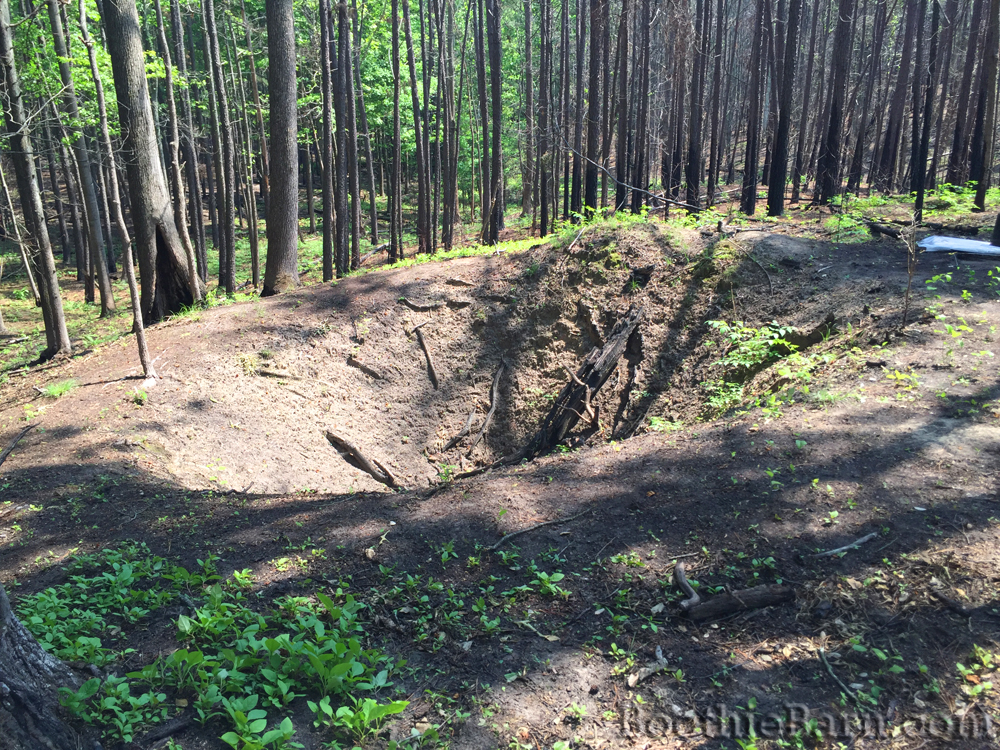
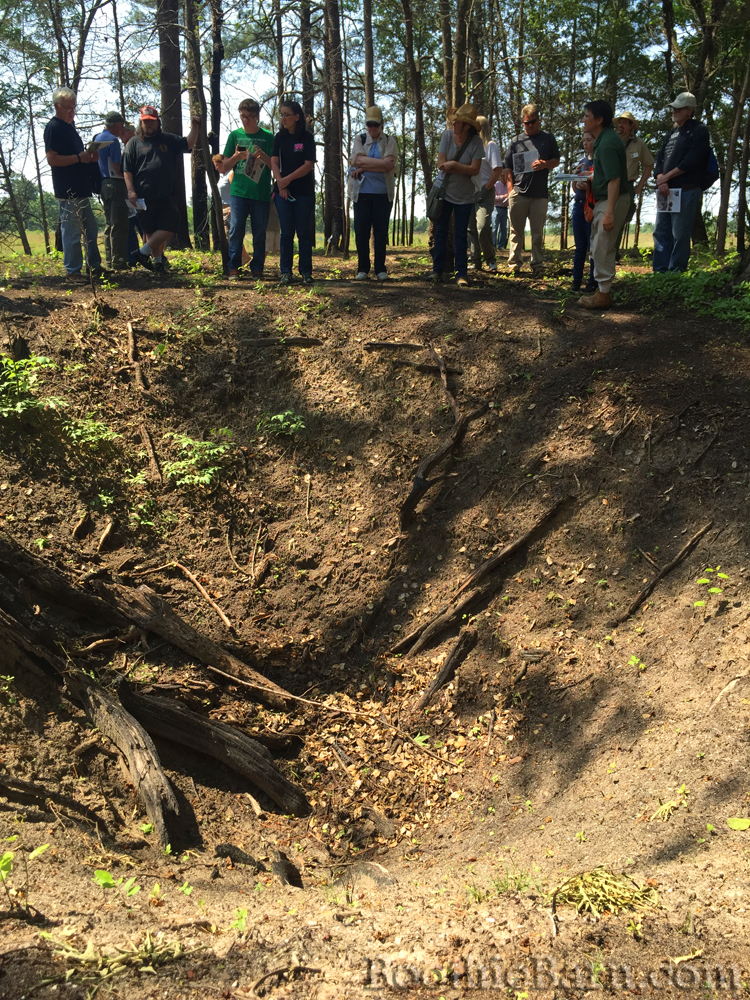
While the main residence that occupied #1 “Trap Farm” was built in the 1890’s, there are some remnants of a much earlier outbuilding in the area that was likely connected to the tavern. These pictures show what is left of an old, sizable ice house. In the days before refrigeration, families would essentially dig a large hole in the ground. The deeper you dig the cooler the earth is and at a certain point it can get close to 50 degrees Fahrenheit. You would place your ice in these deep pits and then cover it with saw dust or another insulator to slow down melting, allowing you to have ice even in the summer months. The whole thing would then be covered with a primitive roof of some sort. The size and depth of this ice house and its relative proximity to The Trap tavern has led the archaeologists to conclude that this ice house was used by the tavern to provide them with their ice.
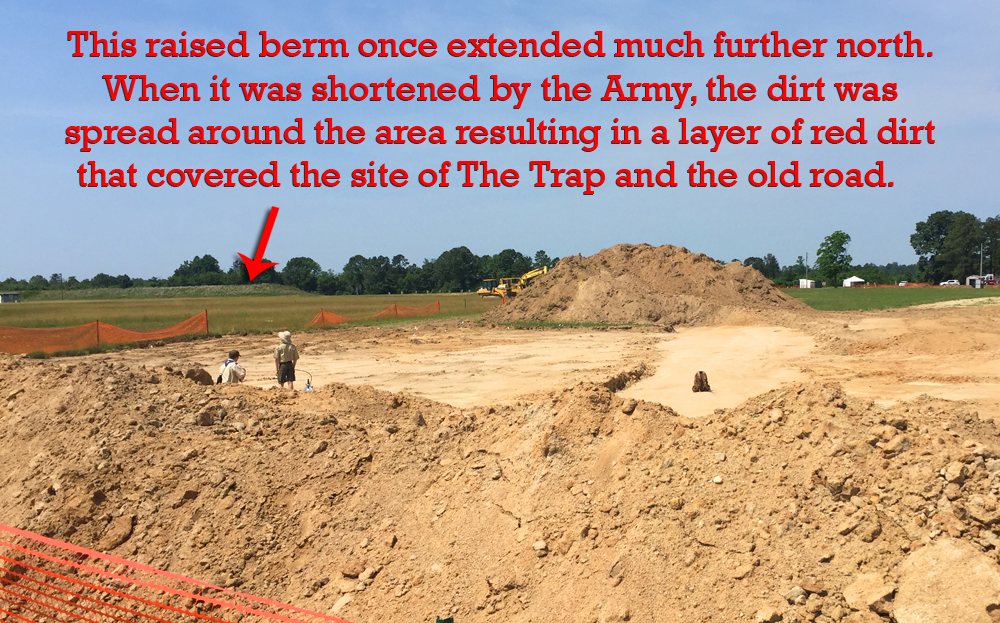
This image is a preface for the ones that follow and explains why much of The Trap site and the old road that ran right in front of it look like a construction site today. The entire site around The Trap is covered in this layer of “foreign dirt” that had to be removed before excavations could be done.
In this image you can see very clearly the traces of the old “Rolling Road” that connected Bowling Green to Port Royal. This image is taken looking southwest in the direction of Bowling Green.
This image shows the remains of the Rolling Road in the opposite direction. You can just make out at the end how the road is beginning to turn towards the left. Following that turn takes you north towards Port Royal. David Herold, Bainbridge, Ruggles, and the 16th New York Cavalry all traveled this road twice on their way to and from Bowling Green.
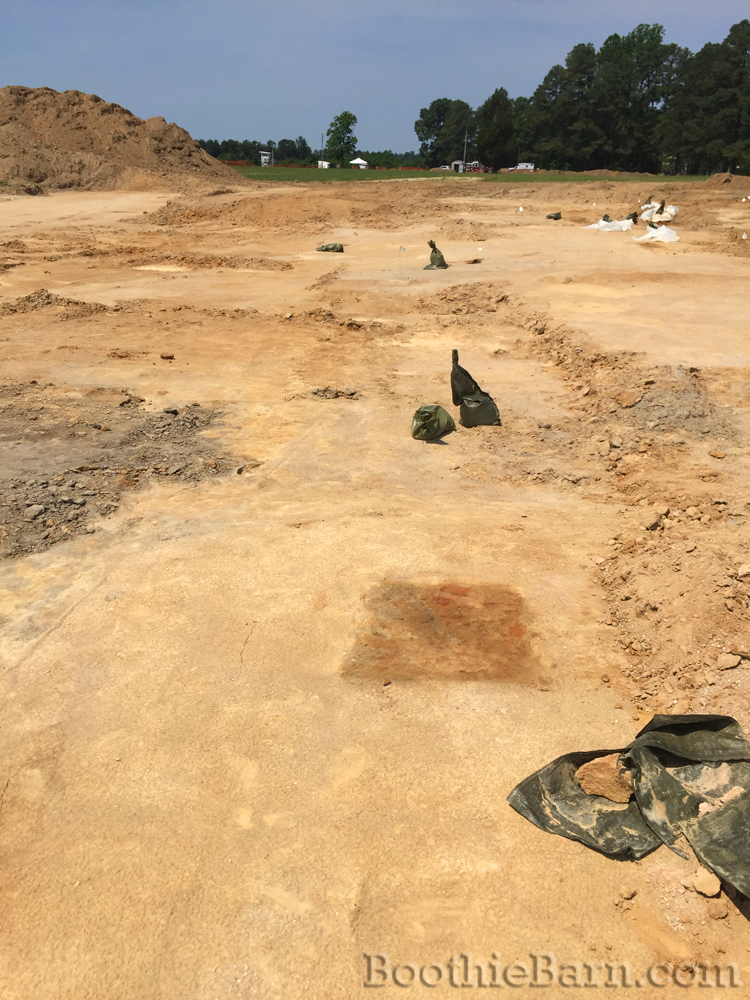
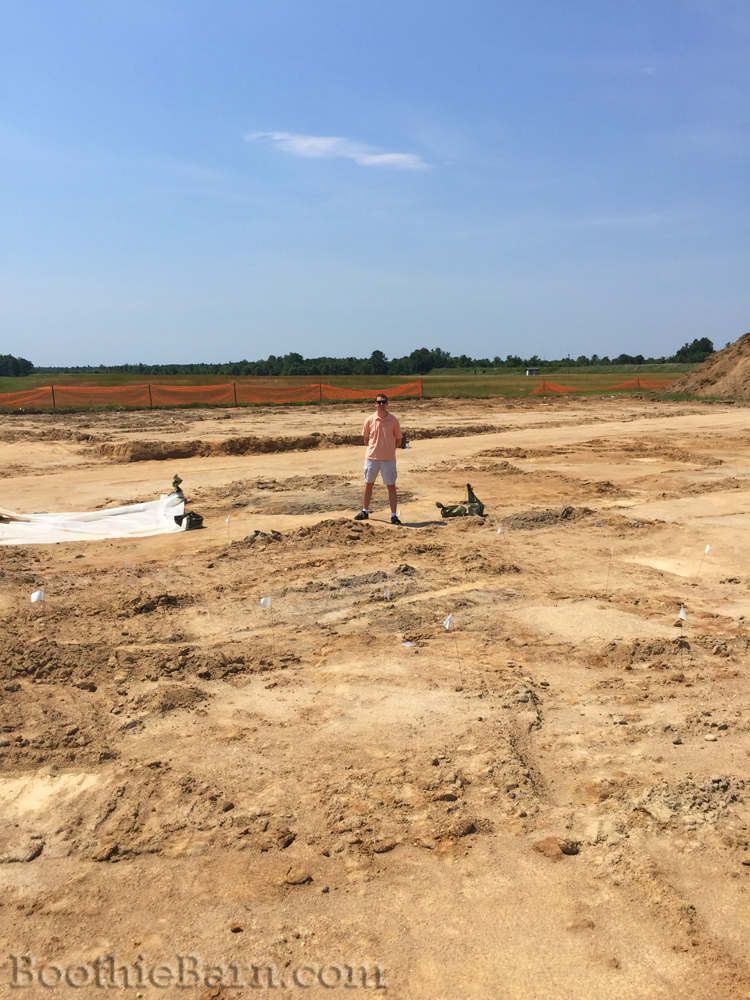
These pictures show the site of The Trap tavern itself. In the top picture you can see a dark square in the foreground. That is one of the brick piers that the tavern sat on. It was highlighted by spraying it with water to make the color more noticeable. In the bottom image you can no longer see the square as the water has evaporated but it is located between the green bags in the middle. The bottom image is taken from the Rolling Road to give you an idea of how close to the road the tavern stood. It was located on this perfect spot where the road curved north making its own intersection.
This is an images of me standing “in” The Trap. You can see the Rolling Road behind me.
The tour of The Trap site was a wonderful experience and one that I felt lucky to take part in. The location of The Trap inside the boundaries of the live range area of Fort A. P. Hill insures that it will rarely be open to the public. At the same time, Fort A. P. Hill seem to be the perfect stewards of the site and their archaeology efforts demonstrate their commitment to preserving the cultural heritage of the land they occupy.
In closing, I would be remiss if I did not address the two “elephants in the room” when it comes to The Trap. One issue is the correct spelling of the tavern. I, like many others, have always spelled it as The Trappe. You can find this spelling in other texts and articles about the assassination. According to one of our guides for the day, John Mullins, the site was originally spelled Trap and not Trappe. John says that this spelling did not come about until the 1890’s or so and was likely started after the area became known as Delos. The spelling of The Trap with the extra “pe” was likely people’s inadvertent way of referring to the old name and making it seem ever older by giving it the old English spelling.
The second item that I failed to address was the reputation of The Trap and the Carter ladies. Some texts and authors state that The Trap was a thinly disguised brothel run by Mrs. Carter and her daughters. When I first began researching the Lincoln assassination I heard from several knowledgeable individuals that The Trap had a slightly scandalous reputation. However, in researching the topic I have yet to come across anything that truly supports this idea. The origin of this misconception appears to be an April 27, 1865 statement from Luther Baker. In recounting the hunt for Booth, Baker shares the detachment’s stop at the Trap thusly: “About halfway to Bowling Green, which is 15 miles from the ferry, we stopped at a log house called the halfway house. We found there four or five ladies, who keep a house of entertainment.” Baker then proceeds to recount how no men were found in the house and how the ladies eventually gave them the information they needed. This wording that the Carter ladies kept a “house of entertainment” seems to be the fairly innocuous wellspring from which all unseemly rumors have flowed. However, in its early days, The Trap was a house of entertainment. Horse races and card games took place there. According to one of our guides for the tour, the name of The Trap was an old reference to how the tavern was a money trap for those who went there to play cards. Whether Mrs. Carter and her daughters still allowed card playing when they owned the tavern is unclear, but even if they did, a little card playing doesn’t equate to a house of sin. Unless better evidence can be found to support the idea that they were improper in anyway, I think Mrs. Carter and her daughters deserve to have their reputations vindicated.
Thomas Austin Jones has gone down in history for the assistance he gave assassin John Wilkes Booth and his accomplice David Herold. Jones not only cared for the two fugitives as they hid out in a pine thicket in Charles County, but he also transported Booth and Herold from the thicket to the shores of the Potomac from which they got into a boat and attempted to row across to Virginia.
Thomas Jones, who was born in the Port Tobacco area in 1820, owned two houses in Charles County during the Civil War. It was from his larger home on the Potomac River called Ravenscliff that Jones began his career as a mail agent for the Confederacy, but by 1865, his financial situation and death of his wife had caused him to downsize his estate to the more modest Huckleberry farm. Jones was living at Huckleberry with his nine children when Samuel Cox, Jr. showed up on the morning of April 16th and beckoned Jones to return with him to his father’s farm of Rich Hill. At Rich Hill, Jones would learn about Cox’s nighttime visitors and be given the task of caring for the fugitives while looking for an opportunity to get them across the Potomac.
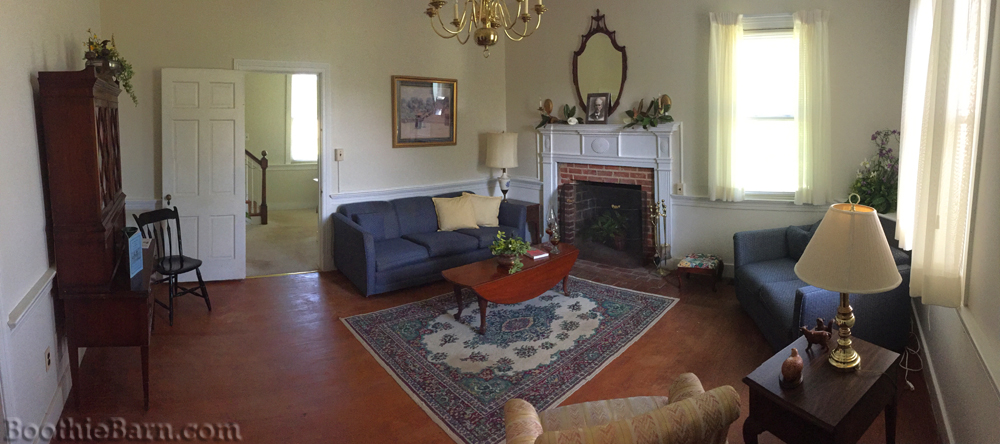
Today, as part of the Maryland House and Garden Pilgrimage in Charles County, Thomas Jones’ home of Huckleberry was open to the general public for the first time in 56 years when it was featured in the 1960 Maryland House and Garden Pilgrimage. The house has been remodeled and updated since Thomas Jones’ days but still maintains much of its same 1865 character.
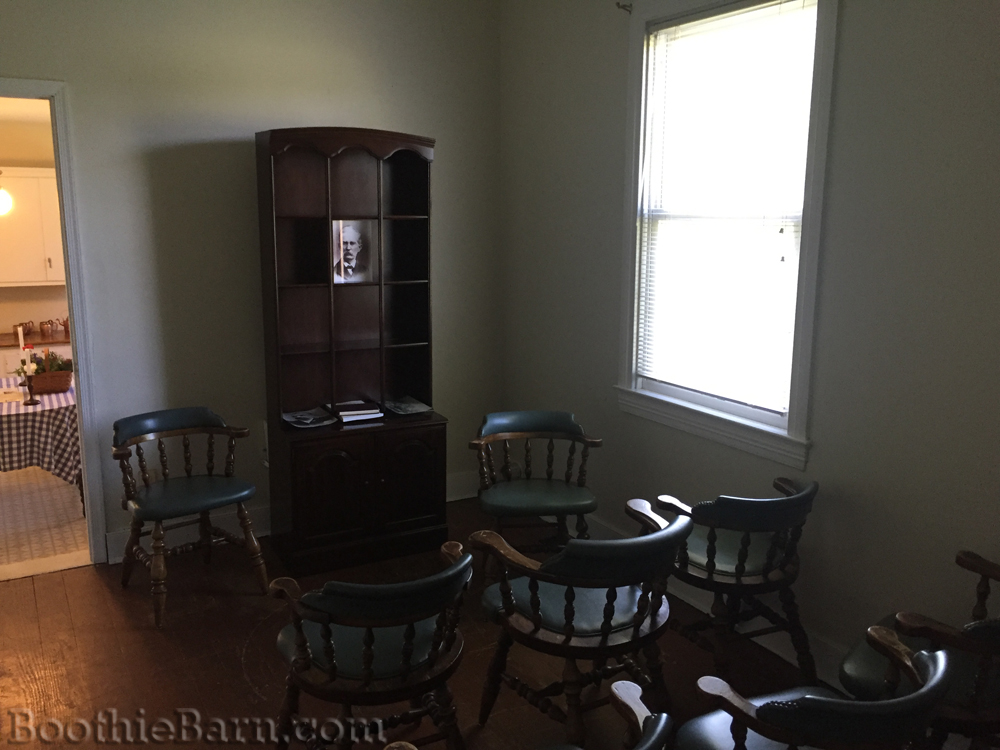
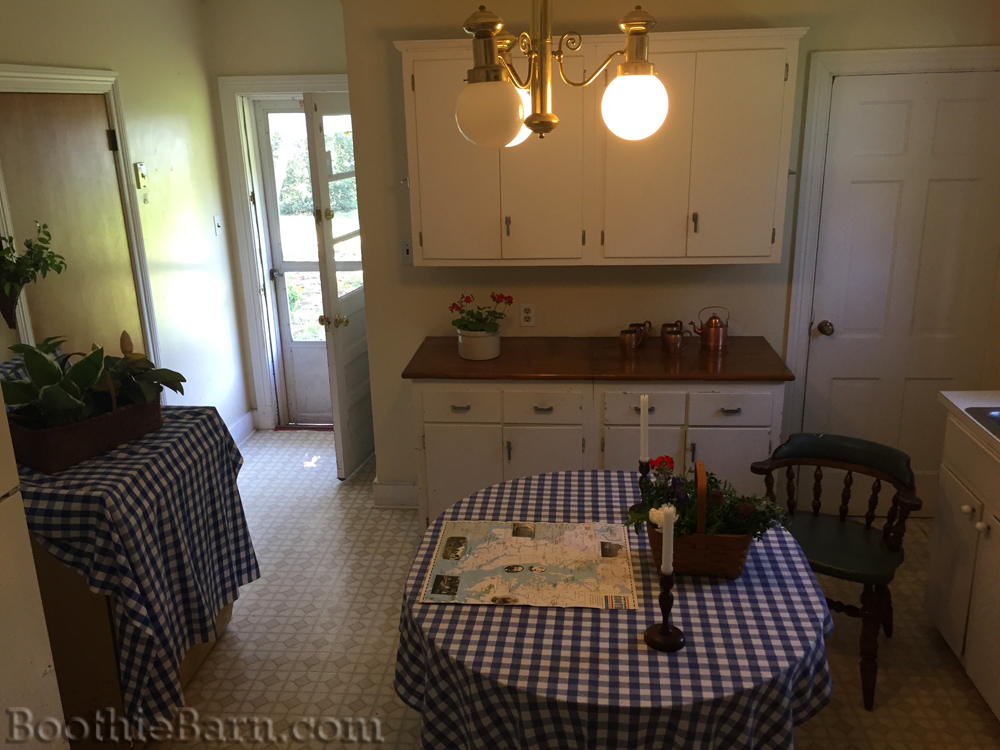
These images, along with the watchable yet somewhat motion sickness inducing video that follows, were all taken today after the garden tour was completed. About 450 people showed up and toured through Huckleberry while I stood in the room with chairs giving visitors a brief overview of Thomas Jones and his life before, during, and after John Wilkes Booth.
The visitors truly seemed to enjoy learning more about this unique man and his role in the Lincoln assassination story. Probably the most interesting little known fact about Thomas Jones is that, in 1893 when he traveled to the World’s Fair in Chicago in order to try to tell his book about helping Booth, Jones actually borrowed and brought with him two artifacts from Dr. Mudd’s house. The Mudd family allowed Jones to borrow the bed that Booth slept in at the Mudd house along with the parlor sofa on which John Wilkes Booth laid on while Dr. Mudd had inspected his leg. Having these artifacts did not help Jones much, however. His book sold very poorly in the Land of Lincoln and he came back to Charles County with many copies of the book and a great deal of debt from the venture.
Though it is impossible to say the next time that Huckleberry will be open to public tours again, the Loyola on the Potomac Retreat House has done a wonderful job as stewards of the house and property since they acquired it in the 1950’s. So even if Huckleberry waits another 56 years before being on the garden tour again, I think, in the meantime, it will stay in very good hands.
Yesterday, I posted about about Carl Bersch and his painting, Lincoln Borne by Loving Hands on the Fatal Night of April 14, 1865. At the time of Lincoln’s assassination, Bersch was living across the street from Ford’s Theatre and made sketches of the chaotic scene after the assassination. He used those sketches to paint this eyewitness image of the event.
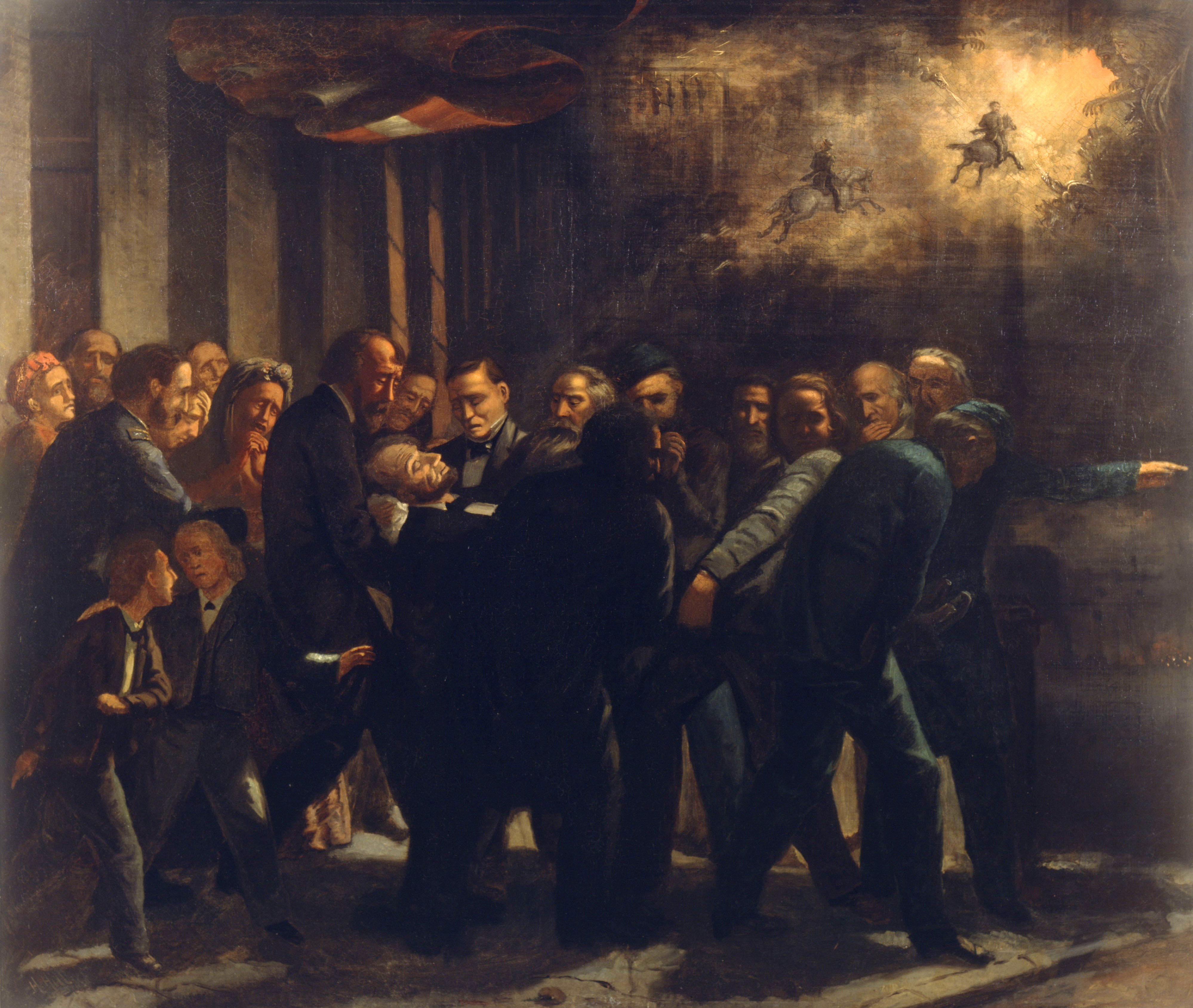
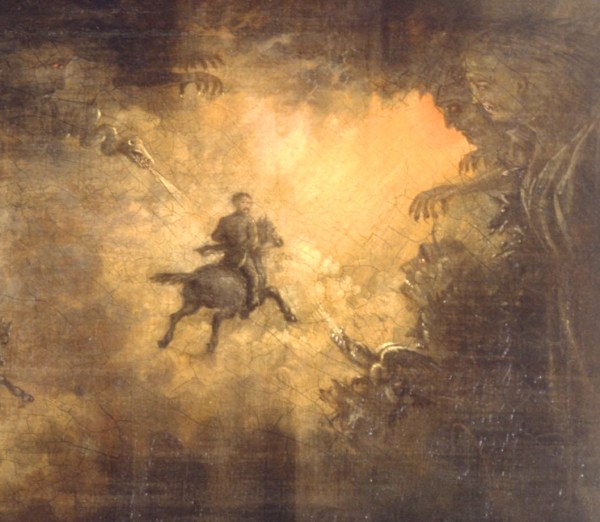
While working on that post I came across another painting that shares the same subject matter. In 1872, artist Howard Hill painted his own version of the wounded President being carried across Tenth Street. His painting is called, Assassination of Lincoln, and it is currently owned by the Albany Institute of History and Art.
Click to enlarge
Howard Hill was not present in D.C. on the night of Lincoln’s assassination and therefore his painting is not based on eyewitness sketches like Carl Bersch’s painting. Still it is clear that Hill did his research and when composing this piece. Hill’s painting includes the detailed figure of not only the wounded Abraham Lincoln but also shows grief-stricken Mary Todd Lincoln.
They are both followed by the figures of Henry Rathbone and Clara Harris, the Lincolns’ guests at Ford’s Theatre that night.
While both Bersch’s painting and Hill’s painting show Lincoln being carried across the street to the Petersen boardinghouse where he would later die, the biggest differences between them are the secondary scenes they contain. In the darker corner of Bersch’s painting (which will hopefully be more visible in the restored painting) there is a small scene of celebration marking the end of the Civil War. In his letter home, Bersch mentions that his first sketches on April 14th captured the parades and jubilation that were occurring below his balcony. Bersch still used these sketches when completing his final painting and combined two these contrasting images, one of celebration and one of sorrow, into the single painting. Lincoln Borne by Loving Hands is not centered on Lincoln but on the American flag, which continues to fly over everything, good and bad.
Hill’s painting, on the other hand, does seem to center more on the figure of Lincoln and the men carrying him. But our eyes are also drawn to the top right corner of the painting where a different scene is playing out. Hill depicts the horseback figures of David Herold and John Wilkes Booth fleeing from the tragic scene. Booth is riding away when he seems to look back at his handiwork. As he does this a legion of demons reach out to him as he effectively rides into their grasp and into hell.
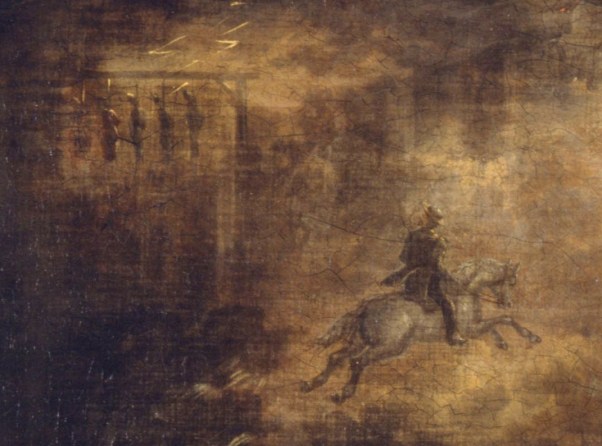
David Herold follows Booth’s course, but his attention is drawn to a premonition of the gallows that he will face for his crime.
Strangely this gallows shows the execution of five people rather than the four that actually occurred. Perhaps one of the bodies is meant to symbolize Booth’s death as well.
Howard Hill’s Assassination of Lincoln shares a similar theme with Carl Bersch’s Lincoln Borne by Loving Hands but the compositions differ in their focus and details. The inclusion of the celebratory revelers and the focus on the American flag in Bersch’s painting evokes the prospect of hope in our darkest times, while Hill’s visions of doom for the assassins emphasizes the importance of justice. Taken together, these two paintings demonstrate the complex feelings that emerged after Lincoln’s assassination.
Additional facts about the artist, Howard Hill
Howard Hill was born in England in 1830. In 1851, he married his wife, Ann Patmore, in London. Hill always considered himself an artist and normally recorded himself as such on census records. However, to make ends meet, he would also work as a house painter, his father’s trade. In 1858, Hill brought his family over to America. The Hills would live in Yonkers, NY and Hoboken, NJ. Hill originally got a job with Currier and Ives as one of many nameless English artists who created the iconic prints that so captured the spirit of America. He left this job after a short while, likely unhappy with the day to day life as a menial worker. In his own paintings, Hill was very fond of painting birds. His most common images feature ducks and quails in scenic landscapes, but he also enjoyed painting farmyard scenes as well. In 1865, four of Hill’s bird paintings were exhibited at the National Academy of Design, which was a prestigious opportunity. Sadly, true success never found Hill. He continued to paint and sell his paintings to make ends meet. Hill apparently painted Assassination of Lincoln in 1872, which was a subject quite different from most of his work. Whether it was commissioned or a piece Hill completed on his own is unknown. It was owned by an American Legion Post in Albany before it was donated to the Albany Institute of History and Art in 1961. It’s ownership prior to the American Legion Post is unknown. When a financial depression began in 1873, Hill took to visiting the homes of well to do farmers, offering to paint scenes of their farm and livestock. He also used his six children to help him create an assembly line of painters. Howard and each of his children would each complete a select part of a painting allowing him to effectively mass produce paintings to sell. Though financial difficulties caused Howard to drink more, he was instrumental in teaching all of his children the art of painting. In 1886, Howard lost his wife and artist son within a span of four months. This increased his depression and for the next year he lived the life of a vagrant, moving from boardinghouse to boardinghouse and trying to get painting commissions for money. Howard Hill eventually died on March 6, 1888, likely from a stroke. He was buried in an unmarked grave next to his wife in Yonkers.
Though Howard Hill never achieved fame for his work as a painter, it seems that he did pass on a considerable talent. Howard’s daughter, Mary Ann “Nancy” Hill, learned how to paint from her father and she would pass that love of painting down to her son. That boy, Howard Hill’s grandson, was the great American painter, Norman Rockwell. Though Rockwell never knew his grandfather (Hill died 6 years before Rockwell was born), he still felt his grandfather’s work influenced him. Rockwell was quoted as saying, “I’m sure all the detail in my grandfather’s pictures had something to do with the way I’ve always painted. Right from the beginning I always strived to capture everything I saw as completely as possible.”
Other work by Howard Hill
A Family of Grouse by Howard Hill
A Farm Scene with Ducks and Chickens by Howard Hill
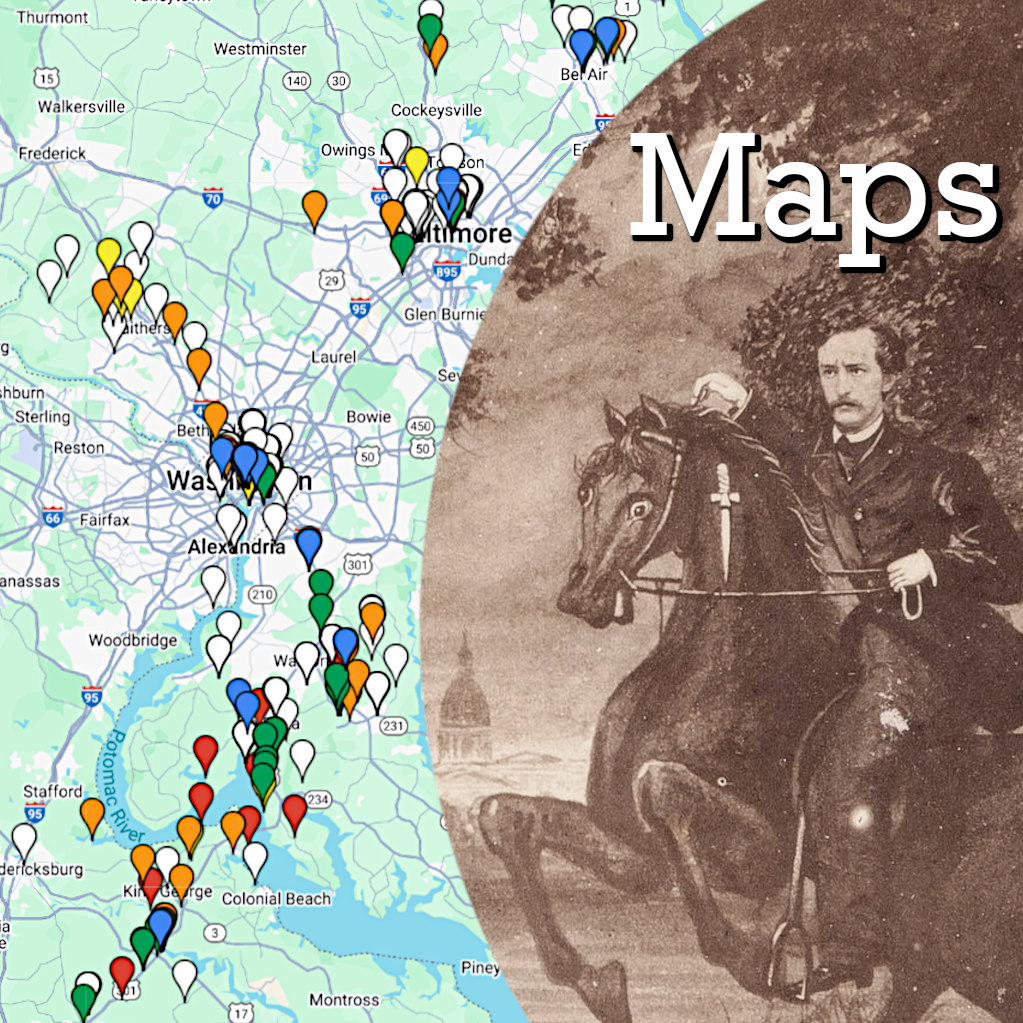
I found this free interactive mapping program online today and decided to see if I could construct a nice little map of John Wilkes Booth’s escape route. Unfortunately, this particular map will not embed straight into my site, but you can click the image below to view it.
A few days ago, a wonderful piece was published in the Southern Maryland newspapers about the renovations going on at Rich Hill, the former home of Samuel Cox and a stop on John Wilkes Booth’s escape. Up until last year, Rich Hill was a private and neglected residence which was at great risk of falling down. To illustrate this point, here are a couple pictures and a video I shot in of the interior of Rich Hill back in June of 2013:
This important piece of history was on the verge of being lost. However, in October of 2013, the Historical Society of Charles County entered into talks with the owner of Rich Hill hoping to gain custodianship over the building in the hopes of preserving it. This was good news to all those interested in the home’s history. Despite the best of efforts, however, the talks involving the manner in which the home would be donated to the Historical Society of Charles County broke down. By Christmas of 2013, the outlook for Rich Hill looked dismal once more.
To help raise awareness of the tragic condition of this historic home I wrote the article below. It was published in the January 2014 edition of the Surratt Courier. Soon thereafter (though likely not connected to my article), a deal was struck between the owner of Rich Hill and the Charles County Government. Rich Hill was donated to Charles County, and since then the county has been doing a wonderful job of working to restore the home and make it accessible to the public. In April of this year, I spent two days as part of Charles County’s Lincoln 150 event standing on the porch of Rich Hill telling visitors the history of the home. It was a wonderful two day event that attracted a large audience.
The article published this week in the newspapers highlights the work that has been done of late, including the recent removal of the 1970’s drywall to expose the period “guts” of the house.
Work is continuing, funded in part by a $750,000 state bond. Given the state of the house, however, it is known that additional funds will need to be secured to help renovate Rich Hill completely.
While Rich Hill is most associated with the escape of John Wilkes Booth, the property and house touts a far older and far reaching history than that. Here is my article that was published in January 2014 that gives a looked into this historic home. I have edited it down a bit as my original article described the collapse of talks between the Historical Society of Charles County and the previous owner and ended with a call for action.
A History of Rich Hill
by Dave Taylor
During the wee morning hours of April 16th, 1865, two men and their guide approached the door of a darkened, Charles County, Maryland home named Rich Hill. “Not having a bell,” one of its sleeping occupants later recalled, the door was, “surmounted with a brass ‘knocker’.” One of the three horseback men, under the cover of darkness, reached out a hand and grasped the brass tool. He raised it upwards and, as the hinge reached the apex of its journey, the knocker was silently suspended for the briefest moment in time. In a fraction of a second, the handle would fall, striking the metal plate beneath it and “in the stillness of night the sound from this” would resound, “with great distinctiveness”[1]. The silence of the night would be shattered and the lives of the family sleeping within the house’s walls would be changed forever. History was knocking at the door of Rich Hill and its harbingers were John Wilkes Booth, the assassin of President Lincoln, and David Herold, his accomplice.
While Rich Hill would become known in American History due to the visitors that April night, the house and property had a notable history starting about 200 years before. In April of 1666, a recent immigrant from Wales named Hugh Thomas was assigned and patented “600 acres of land, called Rich Hills, on the west side of the Wicomico river, in Charles county, Md.”[2] Two years later, Hugh Thomas would sell half of his acreage at “Rich Hills” to an English immigrant turned St. Mary’s County merchant named Thomas Lomax. Lomax paid Thomas using the standard currency of the day: tobacco. For 3,500 lbs. of tobacco, Lomax acquired the northernmost 300 acres of the Rich Hill parcel, upon which the notable house would later be built.[3] In 1676, Thomas Lomax gave his brother Cleborne (also spelled Claiborne/Cleiborne) Lomax 100 acres of the Rich Hill property. When Thomas died in the early 1680’s, he was apparently unmarried and without any heirs and so the remainder of his Rich Hill property went to his brother as well. In 1710, the Rich Hill land was sold out of the Lomax family to an intriguing widow by the name of Mary Contee.[4]
A trifecta of circumstances had made Mary Contee nee Townley a very wealthy woman:
Mary Contee’s late husband, John Contee, had previously married a wealthy widow by the name of Charity Courts in 1703. When Charity died the same year of their marriage, John Contee inherited her sizable estate. He and Mary were then married by June of 1704.
In the same year of her marriage, Mary Contee’s cousin, Col. John Seymour was appointed the 10th Royal Governor of Maryland. Mary is recounted as a “favored cousin” of the Governor and due to this her husband John was appointed to several lucrative governmental positions becoming a representative of Charles County in Maryland’s Lower House and a justice in Charles County to name a couple.[5]
Thus far, it has only been shown that John Contee had become a wealthy man. While Mary assumedly enjoyed the fruit of his abovementioned “labors”, how did she herself become wealthy? That is where the real drama comes in. John Contee died on August 3rd, 1708. At the time of his death he possessed 3,697 acres of land and his personal property was assessed at 2,252 pounds sterling and 13 slaves. According to his will which was passed by an Act of Assembly in 1708, Mary became the sole executrix of her husband’s vast estate. However, it was later discovered that this will was not as it seemed. In 1725, seventeen years after Mary Contee had inherited her husband’s holdings, John Contee’s blood nephew, a man by the name of Alexander Contee, had depositions taken with regards to the will that had made Mary such a wealthy woman. Through these depositions Alexander Contee learned that John Contee’s will was a perjured fraud that was never agreed to by the deceased. Alexander discovered that his uncle’s supposed will had actually been written by a man named Philip Lynes. According the Alexander, Mr. Lynes was a man “very officious to oblige the said Mary” while John Contee was dying in the next room. Philip Lynes was married to Anne Seymour, the Governor’s sister and therefore was also a cousin to Mary Contee. The will was apparently brought before John Contee who was still of sound mind, and he refused to sign it as it was written. Though Contee lived for about a week more, the will was never rewritten in terms he agreed to. Due to these depositions, the Maryland Assembly passed another act in 1725 repealing the 1708 act that had granted Mary Contee as sole executrix. The new act mentioned not only the maleficence of those who gained by this false will, but also the fraudulent way a knowingly unsigned will passed the Houses in the first place. According to the new act, the fake will passed due to, “particular persons in power by whose Interest and Influence the said Act past both Houses of Assembly… contrary to the Standing rules of The Lower House.” Perhaps Gov. Seymour, who was still in office in 1708, used his influence, once again, to intervene on behalf of his “favored cousin”.[6]
Therefore, it appears that Mary Contee purchased the Rich Hill property with fraudulently acquired capital. She did not own it for very long, however. By 1714, she had remarried a man by the name of Philemon Hemsley who facilitated the selling of the Rich Hill land for 21,000 lbs. of tobacco. The new buyer was Gustavus Brown.[7] Brown was a native of Dalkeith, Scotland and a surgeon by profession. His immigration to Maryland was an accidental one:
“When a youth of 19 he became a Surgeon’s mate, or Surgeon, on one of the royal or King’s ships that came to the Colony in the Chesapeake Bay, 1708. While his ship lay at anchor he went on shore, but before he could return a severe storm arose, which made it necessary for the ship to weigh anchor and put out to sea. The young man was left with nothing but the clothes on his back. He quickly made himself known, and informed the planters of his willingness to serve them if he could be provided with instruments and medicines, leaving them to judge if he was worthy of their confidence.”[8]
Brown started his medical practice in the Nanjemoy area of Charles County and quickly made a favorable reputation for himself. In 1710, he married a woman by the name of Francis Fowke and the newlyweds lived temporarily with her father in Nanjemoy.
Dr. Gustavus Brown, Sr.Source: Smithsonian Institutions
Dr. and Mrs. Brown’s 1714 purchase of the Rich Hill property ushered in a new age for the estate. Instead of solely using the land for the planting and harvesting of tobacco, Dr. Brown sought to create a home on the land. It is this home that we see today and know as Rich Hill.
The exact date of construction on Rich Hill has not been determined. According to its listing in the National Register of Historic Places, the house was “built probably in the in the early to mid 18th century”[9]. Looking at the genealogical records for Dr. Brown’s children, this author has determined that the house was built by 1720, as his daughter born that year was cited to have been born at “Rich Hills”.[10]
As it is today, Rich Hill was built as a 1 ½ story structure that appears as a full 2 story building from the exterior. The original house had a hip roof and was built on top of cut stone piers. While the front door was on the southwest side of the house as it is now, it was formerly on the center of this wall. As you walked into Dr. Brown’s Rich Hill, the first floor consisted of four similarly sized rooms with a small stair hall in back flanked by a rear door. The original building had two exterior chimneys which stood on the southeast and northwest sides of the house.[11]
The majority, if not all, of the Brown children were born at Rich Hill. Dr. Brown and Frances had a total of twelve children as his practice prospered. He had made a name for himself on both sides of the Potomac, treating residents of Maryland and Virginia. One humorous story regarding Dr. Brown’s experiences as a physician is recounted below:
“On one occasion Dr. Brown was sent for in haste to pay a professional visit in the family of a Mr. H., a wealthy citizen of King George Co., Va., who was usually very slow in paying his physician for his valuable services, and who was also very ostentatious in displaying his wealth. In leaving the chamber of his patient it was necessary for Dr. B. to pass through the dining room, where Mr. H. was entertaining some guests at dinner. As Dr. B. entered the room a servant bearing a silver salver, on which stood two silver goblets filled with gold pieces, stepped up to him and said, ‘Dr. B., master wishes you to take out your fee.’ It was winter, and Dr. B. wore his overcoat. Taking one of the goblets he quietly emptied it into one pocket, and the second goblet into another, and saying to the servant, ‘Tell your master I highly appreciate his liberality,’ he mounted his horse and returned home.”[12]
While his business grew, Gustavus Brown did suffer some of his own tragedies at home. Out of his twelve children with Frances, three died in infancy. In an odd twist, all of the children who died were boys who were named after their father. Dr. Brown himself was actually the second Gustavus Brown as his father in Scotland bore the same name. Dr. Brown named his first two boys, “Gustavus”, only to watch them both die before they were a year old. When his third son was born, Dr. Brown gave him the name Richard, and this son would survive. Perhaps thinking their curse of losing their male children was at an end, the couple named their fourth son “Gustavus Richard Brown” only to witness him perish 10 days after his birth. While not documented, it is extremely likely that the three infant Gustavus Browns were buried somewhere on the Rich Hill property.
Frances Fowke Brown died 1744 and was buried at the estate of her daughter and son-in-law in Stafford County, VA. Dr. Brown remarried a widow named Margaret Boyd in 1746. With Margaret, Dr. Brown had two more children at Rich Hill, a boy and a girl. Though tempting fate, Dr. Brown named his youngest son after himself. This “Gustavus Richard Brown” born on October 17th, 1747, would survive infancy, follow in his father’s footsteps into the medical profession, and enter the history books as one of George Washington’s friends and caregiver at the Father of Our Country’s final hour. Dr. Brown’s other child with Margaret was named after her mother and would later marry Thomas Stone, a signer of the Declaration of Independence from Maryland. Their shared home, Habre de Venture, in Port Tobacco, MD is a National Historic Site run by the National Park Service.[13]
In April of 1762, the senior Dr. Brown died at Rich Hill. His death was from “apoplexy” which was a general term that meant death happened suddenly after a loss of consciousness (i.e. severe heart attack or stroke).[14] Dr. Brown was buried at Rich Hill, though the exact spot of his grave is lost today.[15] Rich Hill and its 300 acres passed to his wife Margaret and then to his eldest son Rev. Richard Brown (who was also a medical doctor) and his wife Helen.
Rev. Richard BrownSource: Smithsonian Institutions
During his tenure in the house, Rev. Brown, through marriage and purchase, managed to acquire a large portion of the 600 acre Rich Hill parcel that was split back in 1668. A tax assessment for Rich Hill in 1783 shows Rev. Richard Brown owning 566 acres of Rich Hill. He also made some unknown “improvements” to the property, which probably entailed some work on the house.[16] When Rev. Brown died in 1789, Rich Hill and its acreage swapped hands a few times between his descendants, with a loss of some of the land the Reverend had managed regain.
The Brown family owned Rich Hill continually for 93 years. At least four generations of Browns had made that house their home. It raised the men and women who befriended and married America’s founding fathers. When it was sold out of Brown family in 1807 to a man named Samuel Cox, a new chapter for Rich Hill began. The new owner and his descendants would own Rich Hill for the next 164 years and would witness the night history came knocking on their door.
Samuel Cox, the new owner of Rich Hill, is not the same man to whom John Wilkes Booth appeared to in 1865. Rather, this Samuel Cox was the latter’s maternal grandfather. From Samuel Cox, Rich Hill descended to his daughter Margaret who had married a man by the name of Hugh Cox. What relation, if any, existed between Margaret Cox and Hugh Cox has yet to be determined. Hugh and Margaret had five children born at Rich Hill, including their son Samuel, named for his grandfather. Samuel Cox was born on November 22, 1819. When Samuel’s mother, Margaret, died, his father Hugh found himself a new wife, Mary Ann T. T. Cox. Hugh had three more children by Mary Ann.[17]
When Samuel Cox was 15 years of age, he was sent to the Charlotte Hall Military Academy. He returned home three years later and followed in his father’s footsteps as a member of the wealthy planter class. On December 6th, 1842, Samuel Cox married his Washington, D.C. cousin, Walter Ann Cox. Walter Ann was named for her father who died a couple months before she was born. By the late 1840’s Hugh Cox and his wife Mary Ann, were residing away from Rich Hill on another property they owned near La Plata called “Salem”[18]. In 1849, Hugh and Mary Ann officially gave Rich Hill to Samuel Cox as a gift. Hugh Cox would die in December of that same year at the age of 70.[19] Rich Hill was now in the hands of the man who would give aid to the assassin of the President.
Samuel Cox, Sr.
Sometime in the first half of the 1800’s a significant amount of remodeling was done to Rich Hill. Whether the work was commissioned by Hugh or Samuel Cox is unknown. Regardless, both the exterior and interior of the house were drastically changed from Dr. Brown’s initial layout. The hip roof was replaced with a gable roof. The two chimneys on either end of the house were replaced with a large, double chimney on the northwest side of the house. On the southeast side, where one of the chimneys had been, the Coxes built a one story frame addition. This new addition contained a dining room and a bedroom in which Samuel Cox and his wife slept. The front door was moved from the center of the southwest wall to its current location right near the intersection between the southwest and southeast walls. The interior layout of the house was changed, too. Originally containing four similarly sized rooms with a rear stair hall, the layout was an end hall plan with a large front room and two small rooms to the rear. Much of the layout of Rich Hill today still follows the renovations done by the Cox family in the early 1800’s.[20]
Samuel Cox was a successful farmer and participated in many political and social groups in the county. Through the exertions of Samuel and his father before him, the Rich Hill farm prospered to 845 acres, even larger than its initial 600 acres in 1666.[21] Despite his success in farming, Samuel Cox, like another previously discussed owner of Rich Hill, had difficulty producing a namesake. None of his children with Walter Ann survived infancy. Instead, Samuel Cox ended up adopting his late sister’s son, Samuel Robertson. Though this younger Samuel had spent much of his life on his uncle’s farm and property, he was officially adopted and had his named changed to Samuel Cox, Jr. three days after his 17th birthday in 1864.[22]
Samuel Cox, Jr. was present at Rich Hill when John Wilkes Booth and David E. Herold arrived in the morning hours of April 16th. Years later, he would write about the night he was awakened so early by the sound of that brass knocker on the door:
“There was at the time in the house, Col Saml Cox, his wife, his wife’s mother Mrs Lucy B. Walker, Ella M. Magruder, now my wife, two servant girls, Mary and Martha and myself. Pa’s bedroom was on the first floor – and to the extreme eastern end of the house, and to approach the front door, which opens into the hall, Pa had to pass through the dining-room, where Mary and Martha slept. The stairway to the 2nd floor is approached through a door midway the hall and at the head of this stairway Mrs. Walker slept. My room is on the second floor and directly over the hall and two windows in this room are immediately over the front door looking out upon the yard and lawn in full view of the road which approached the house. When I was aroused by the knock I jumped out of bed and went down in the hall and as I approached the front door where I found Pa standing with the door partially open with Mary standing just behind him in the doorway of the dining room only some six feet away…”[23]
Samuel Cox, his adopted son, and their servant Mary Swann would claim to investigators that Booth and Herold were never allowed entry into the house and were, instead turned away almost immediately. Cox, Jr. would hold onto this story to his dying day, telling assassination author Osborne Oldroyd in 1901 that his father found the fugitives attempting to sleep in a gully close to the house the next morning. It was only then, according to Cox, Jr., that his father instructed his farm overseer, Franklin Robey, to guide them into a nearby pine thicket while he sent Cox, Jr. to retrieve Thomas Jones, who would care for the men during their stay in the pine thicket.[24] Other sources, however, including Oswell Swann, the ignorant guide of the assassin and his accomplice, would state that Booth and Herold spent a few hours inside of Rich Hill before they departed. Some later second hand accounts also speak of Booth and Herold entering Rich Hill during that early morning for food and drink. Regardless of whether or not the men entered the house, the knocking on the door of Rich Hill by David Herold secured the home’s role in the history of the 12 day escape of the assassin of President Lincoln.
Samuel Cox, Mary Swann, and Samuel Cox, Jr. were all arrested in the aftermath of Booth’s visit to their house. They were informed on by Oswell Swann, who brought the troops to Rich Hill at about midnight on April 23rd. The three residents were transported at first to nearby Bryantown. After getting Mary Swann’s statement of events, Samuel Cox, Jr. and Mary were released, only to be rearrested a couple of days later.[25] Samuel Cox, the elder, was transported up to Washington and was imprisoned at the Old Capitol Prison. Though the authorities strongly suspected that Cox had aided the fugitives, with Mary Swann contradicting the account of Oswell Swann, there was nothing to prove their beliefs. While imprisoned at the Old Capitol Prison, Samuel Cox wrote a letter to his wife on May 21st. Addressed to “Mrs. W. A. Cox, Port Tobacco, MD”, Cox recounts, in part, the degree of his imprisonment, “…I know my dear wife it will give you as much pleasure to inform you as it was for me to receive, permission just as your letter was received, to walk in the yard for exercise, which I have been deprived of until to day, having been confined to my room now for nearly four weeks.”[26] Cox was eventually released from the Old Capitol Prison on June 3rd, and returned home to Rich Hill to his waiting family.
Samuel Cox, Jr.
The extent of Booth’s visit to Rich Hill remained quiet for a number of years. During the interim, Samuel Cox died on January 7th, 1880. In his will he left Rich Hill to his wife until her passing, after which the home and property would go to his only heir, Samuel Cox, Jr. In 1884, newspaper correspondent George Alfred Townsend (GATH) met with Thomas Jones. After years of silence, Jones shared with GATH his involvement in helping Booth and Herold during their “missing days” of the escape. Jones did nothing to shield the Coxes from their involvement, divulging how he was brought to Rich Hill by Cox, Jr. and how his father insisted Jones help get the men across the river when the time was right. In his article, entitled, How Wilkes Booth Crossed the Potomac, GATH describes Rich Hill:
“The prosperous foster brother [Cox] lived in a large two-story house, with handsome piazzas front and rear, and a tall, windowless roof with double chimneys at both ends; and to the right of the house, which faced west , was a long one story extension, used by Cox for his bedroom. The house is on a slight elevation, and has both an outer and inner yard, to both of which are gates. With its trellis-work and vines, fruit and shade trees, green shutters and dark red roofs, Cox’s property, called Rich Hill, made an agreeable contrast to the somber short pines which, at no great distance, seemed to cover the plain almost as thickly as wheat straws in the grain field.”[27]
Though Samuel Cox, Jr. was the man of the house, he officially became the sole owner of Rich Hill upon the death of his adoptive mother in 1894. By that time, Cox, Jr. had already married and had 3 children by his wife, Ella Magruder. These young Cox children, Lucy, Edith and Walter, grew up and were raised at Rich Hill. Ella died in 1890 and Cox subsequently remarried a cousin of his named Ann Robertson.
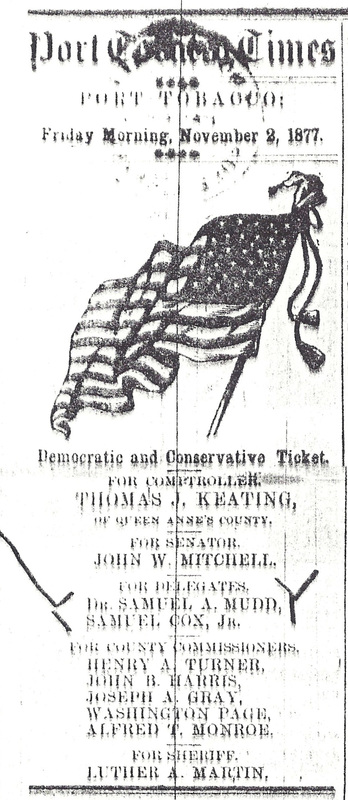
Like his father before him, Cox, Jr. became a prominent member of Charles County society. He had a sizable plantation with Rich Hill and he also owned Cox’s Station, a stop of the Baltimore and Philadelphia Railroad line that ran from Pope’s Creek on the Potomac up to Bowie in Prince George’s County where it connected to other lines. The modern town of Bel Alton (where Rich Hill is located) bore the name Cox’s Station up until Cox sold a sizable parcel of land to the Southern Maryland Development Company in 1891 and they renamed the area to its modern name. Cox, Jr. was also involved in local politics, running for and winning a seat in the Maryland general assembly in 1877. Dr. Mudd, another familiar name in the Lincoln assassination story, ran alongside Cox, but was not elected.[28]
Samuel Cox, Jr. died on May 5, 1906 at the age of 59. The ownership of the property passed to Cox’s son, Walter, who sold his share of it to his married sister, Lucy B. Neale. Lucy and her family did not live at Rich Hill. The last member of the Cox family to reside at Rich Hill was Samuel Cox, Jr.’s second wife, Ann Robertson Cox. Her death on March 4th, 1930, marked the end of the Cox family’s habitation of Rich Hill.
Between the years of 1930 and 1969, Samuel Cox, Jr.’s grandchildren operated Rich Hill’s property as a tobacco farm for sharecroppers. The land shrunk back down to 320 acres by 1971. That year, Rich Hill and its 320 acres were sold to its current owner, Joseph Vallario, a senior member of the Maryland House of Delegates.[29] In celebration for the bicentennial of the United States in 1976, Delegate Vallario restored Rich Hill to its appearance during Dr. Brown’s day. This involved removing the front and back piazzas along with the one story addition that had been added by the Cox family in the 19th century.[30] Though this did make Rich Hill look less like the house that Booth and Herold saw on April 16th, 1865, the restoration worked to preserve Rich Hill and keep it from falling down. Rich Hill served as a beautiful rental property for many years after.
Today, however, Rich Hill is suffering heavily from neglect. There are large, gaping holes in the exterior walls that expose the structure to the elements. The once beautiful rooms that housed generations of Browns and Coxes, are crumbling and filled with trash. To be frank, Rich Hill needs help and action if it is going to be saved.
While Rich Hill’s involvement in the story of Lincoln’s assassination is the house’s most discussed historical aspect, it is far more than the “stop on the trail of John Wilkes Booth” sign that stands some distance from it. As has been shown through this article, Rich Hill has had a notable and lengthy lifespan. It not only holds an important place in the history of Charles County, but it also affected the history of the nation due to the men and women who were raised under its roof. If Rich Hill is left in its current neglected state, it will crumble and collapse. If this happens, future generations will be the victims. As a restored museum run by Charles County in conjunction with the Historical Society of Charles County, Rich Hill would continue to influence and affect the history of our nation.
[1] Samuel Cox, Jr., Letter to Mrs. B. T. Johnson, July 20, 1891, James O. Hall Research Center.
[2] William F. Boogher, Gleanings of Virginia History: An Historical and Genealogical Collection (Washington, D.C.: W.. F. Boogher, 1903), 283.
[3] 26 Apr. 1668. Charles County Circuit Court Liber D, Page 14.
[4] 3 Mar. 1710. Charles County Land Records, Liber C#2, Page 245.
[5] Edward C. Papenfuse, A Biographical Dictionary of the Maryland Legislature 1635-1789 (Baltimore, MD: Johns Hopkins University Press, 1979), 230.
[6]Acts of the General Assembly hitherto unpublished 1694-1698, 1711-1729, Volume 38, ed. Bernard Steiner (Baltimore, MD: Lord Baltimore Press, 1918), 384-386.
[7] 12 Jan 1714. Charles Co. Land Records, Liber F#2, page 51
[8] Horace Edwin Hayden, Virginia Genealogies: A Genealogy of the Glassell Family of Scotland and Virginia : Also of the Families of Ball, Brown, Bryan, Conway, Daniel, Ewell, Holladay, Lewis, Littlepage, Moncure, Peyton, Robinson, Scott, Taylor, Wallace, and Others, of Virginia and Maryland (Wilkes-Barre, PA: E. B. Yorby, 1891), 152.
[9] National Registry of Historic Places Nomination Form, Rich Hill Farms (1976).
[26] Samuel Cox, Letter to Mrs. W. A. Cox, May 21, 1865, James O. Hall Research Center.
[27] George Alfred Townsend, “How Wilkes Booth Crossed the Potomac,” Century Magazine, April 1884, 827.
[28]Report of the Twelfth Annual Meeting of the Maryland State Bar Association held at Ocean City, Maryland July 3rd – 5th, 1907 (Baltimore, MD: Maryland State Bar Association, 1907), 75.
A group called “Friends of Rich Hill” was formed by the Historical Society of Charles County to raise donations for the renovation of Rich Hill. If you are interested, please send your donations to Friends of Rich Hill, P.O. Box 2806, La Plata, MD 20646




















 LincolnConspirators.com
Recent Comments