Posts Tagged With: Relics

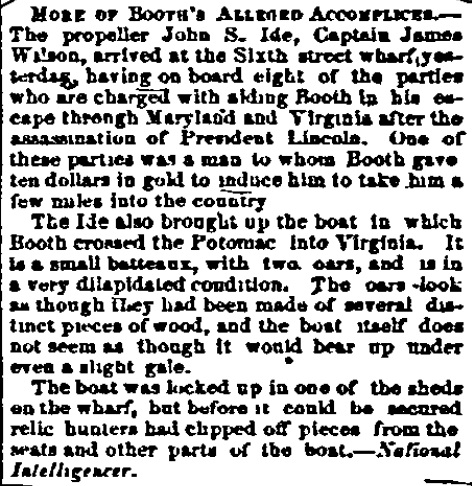
Booth’s Boat

While I sit here in the midst of a hurricane, I can’t help but think of the currents that John Wilkes Booth and David Herold had to overcome in their attempts to cross the Potomac River.

I certainly wouldn’t want to be out on the water today with this little row boat.

References:
Engraving from Frank Leslie’s Illustrated Newspaper 5/20/1865
Article from the Philadelphia North American 5/5/1865

Categories: Uncategorized | Tags: , , , | 4 Comments

Photo: Holding Booth’s Gun Part 2

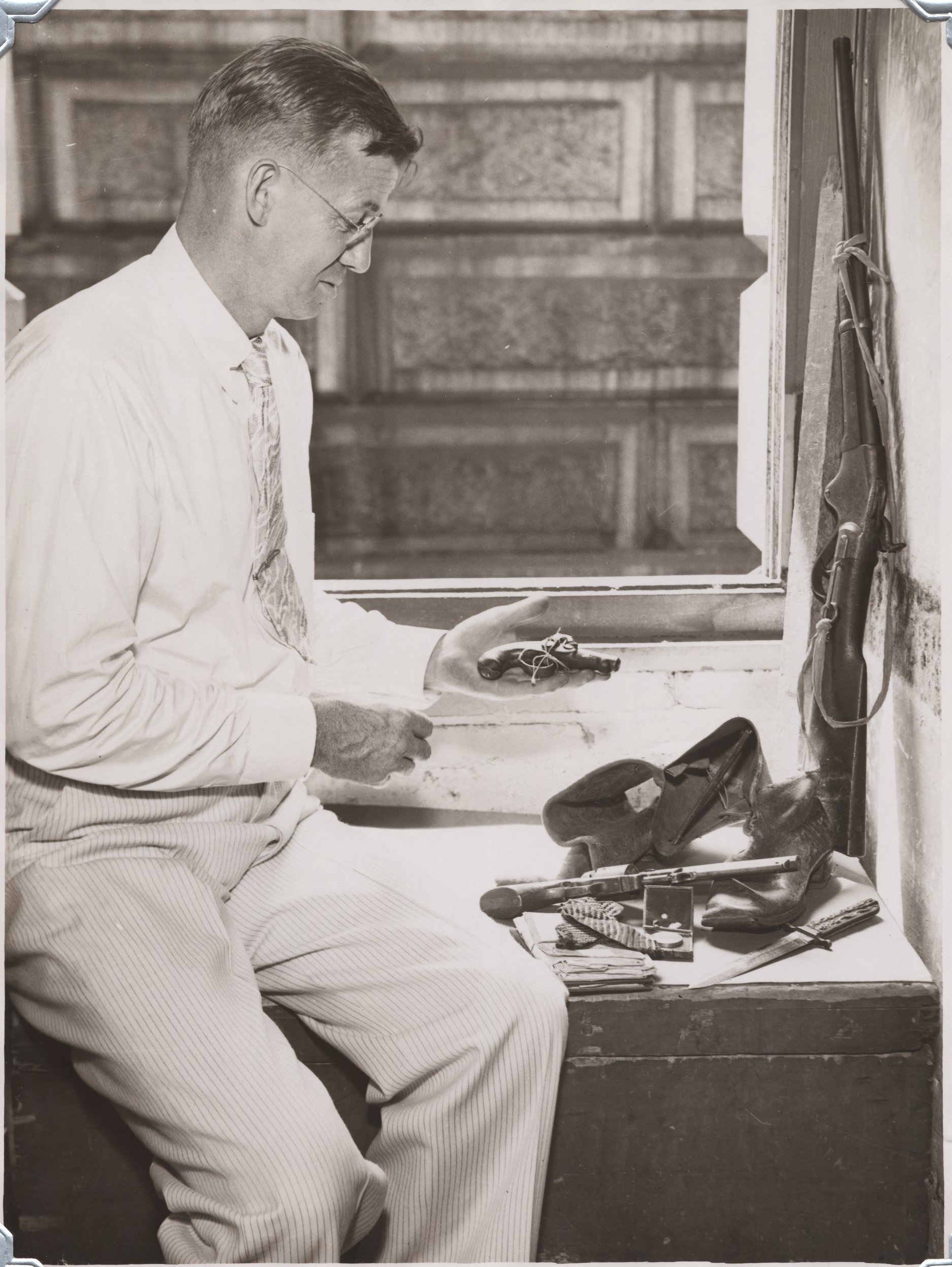
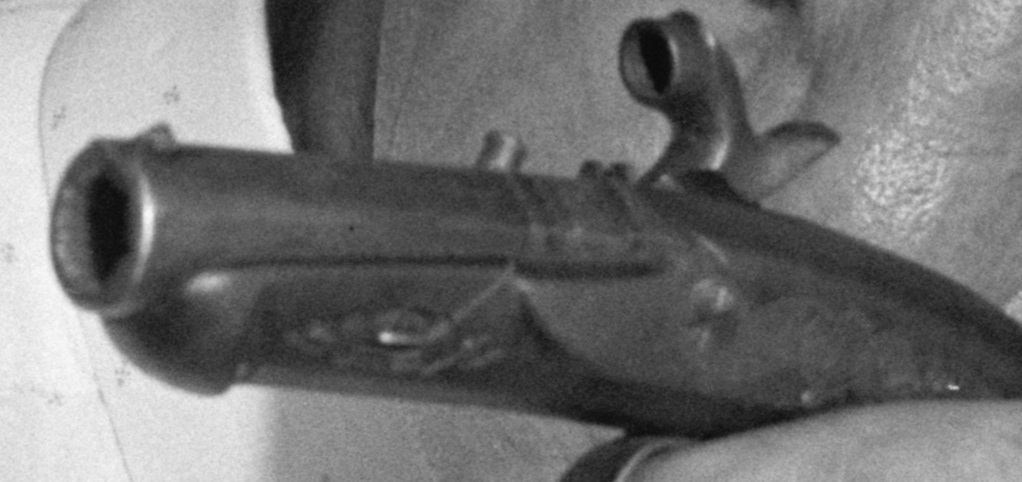
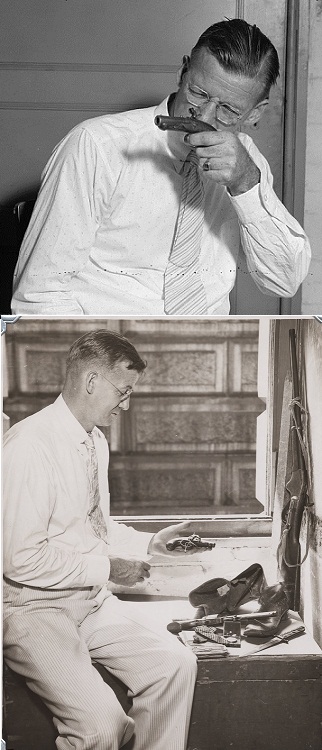
A couple of weeks ago, I posted this 1937  photograph of Edwin B. Pitts, Chief Clerk of the Judge Advocate General’s Office, posing with John Wilkes Booth’s gun:

Today, I stumbled upon another image of Edwin Pitts with Booth’s derringer:

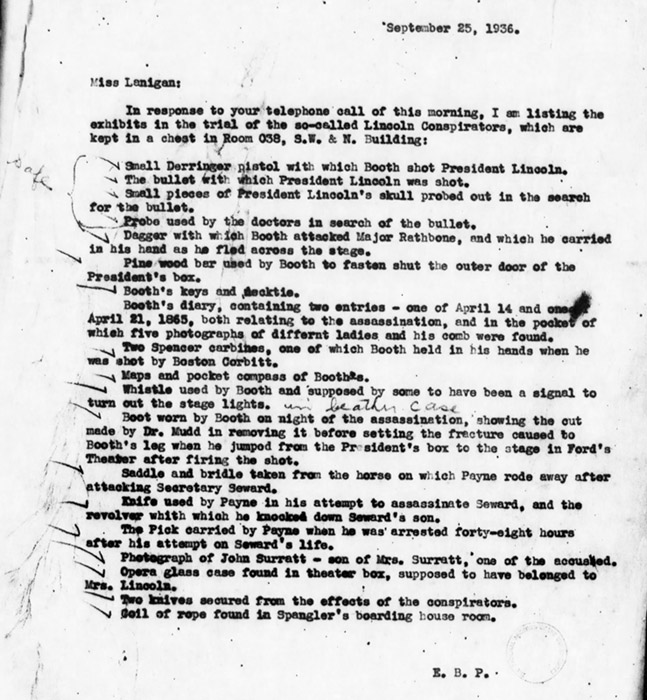
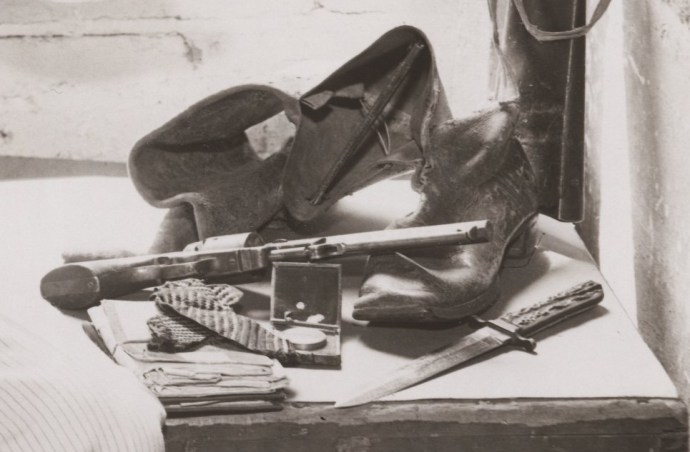
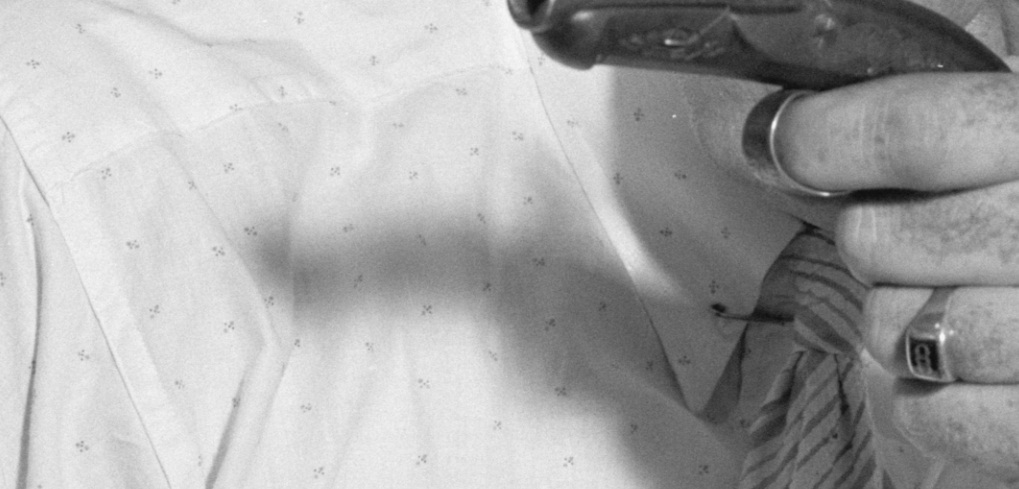
This image of Edwin Pitts also provides a nice look at some of the other assassination related artifacts.

The above portion of the image shows the Spencer carbine retrieved by Booth and Herold at the Surratt Tavern and the wooden bar used to block the door into the box at Ford’s Theatre.

Among the items shown above are Booth’s boot and compass. There is also the tie attributed to George Atzerodt and a pack of papers that looks like it could be Booth’s diary.  I’m not sure which pistol that is, but it could be one of Booth’s.  The knife shown is the etched “Liberty” knife that, while currently on display at Ford’s Theatre as Booth’s knife, was not recovered from his body at Garrett’s farm.

After finding two different images of Edwin Pitts holding Booth’s gun, I’m wondering how often Mr. Pitts took the relic out of storage to pose with it for curious photographers.

Categories: Uncategorized | Tags: , | 18 Comments

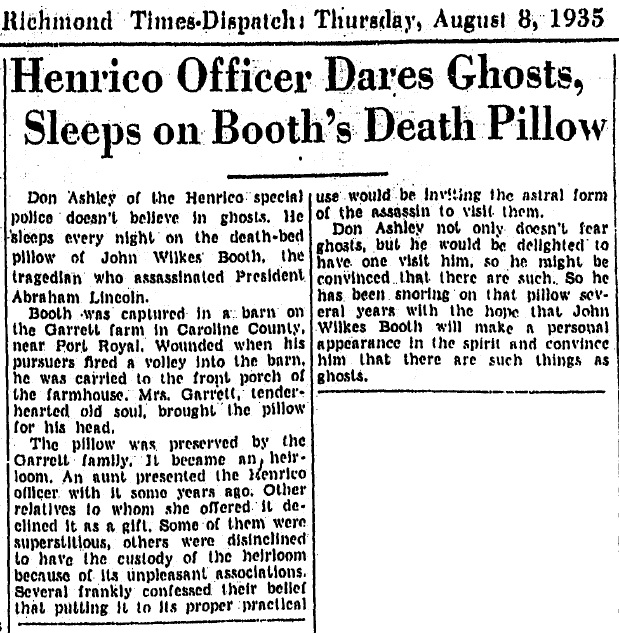
Booth’s Pillow

This is one of those relics that I would love to get my hands on today:

In case you were wondering, the chain of custody on this relic is good. Don Ashley was married to Louise “Ruddy” Garrett. Ruddy was the daughter of Robert Clarence Garrett, who was seven years old when Booth died on his father’s farm. Don and Ruddy never had children so what happened to the pillow after their deaths remains a mystery.

Categories: Uncategorized | Tags: , , | 10 Comments

Photo of the Day: Holding Booth’s gun

When it comes to researching and writing about the assassination, I am a very visual person.  I actively seek out and like to include pictures in as many of my posts as possible.  Images contain a life and message all their own.  So often though, we as human beings gloss over visual information quickly.  As an elementary teacher, I even witness this with my young readers.  Children are so eager to read quickly and efficiently like adults, that they start abandoning the pictures in their stories.  They ignore the photographs and pictures, opting instead to race through and finish.  As adults we do the same.  Efficiency runs our lives with nary a moment devoted to the mere act of looking closely at anything.  So, from time to time, I will be combating this with a simple post of a photograph.  I invite you to take some time to really see it.  Take an actual 60 second long minute, and really look at the image.  Let it bring questions into your mind.  Reflect on the feelings it might draw out of you.  Put it in its proper context as a moment in time, and not just as a graphic on a computer screen.

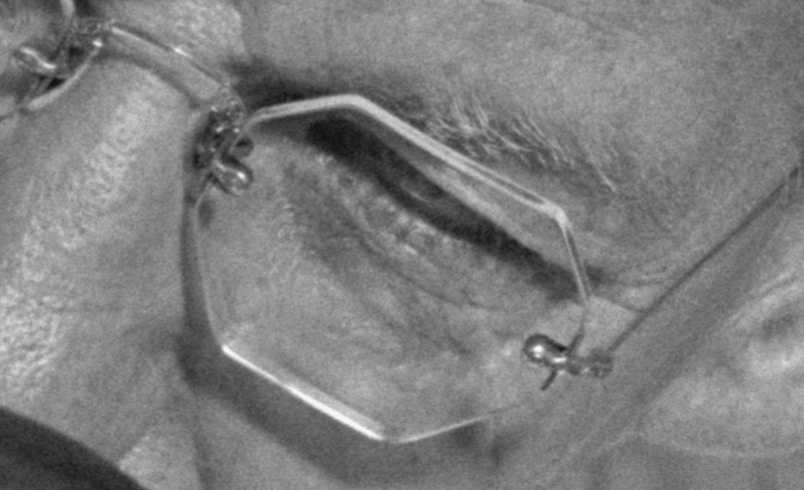
Today, I’m putting up a picture of a man holding John Wilkes Booth’s gun.  I’ve seen the gun many times and this specific photo as well, but when I really take the time to see it, this image speaks to me:  “This man in the photo chose to hold the gun.  With or without prompting, he posed himself into an aiming position with it.  This item was used to kill the President and this man is holding it centimeters from his face.  His eye is drawing an imaginary line down its barrel.  What does he see in its sights?  How did he feel when he posed for this?  Is the gun like a toy to him?  Has he been around it so long that the impact of what it did has worn off?  Or is he trying to get into the mindset of the man who pulled the trigger?…”

When you look at this picture, I hope it affects you in some way, if only for a minute.

August 10th, 1937

Edwin B. Pitts, Chief Clerk of the Judge Advocate General’s Office, poses holding Booth’s derringer:

Categories: Uncategorized | Tags: , | 11 Comments

At Lincoln’s Deathbed

When the unconscious form of Abraham Lincoln was brought out of Ford’s Theatre onto Tenth St., the men carrying the President were unsure of their destination.  The street was chaotic and getting crowded with countless individuals having been drawn to Ford’s doors after hearing the dreadful news being shouted through the streets.  Many would later claim to have been one of the men who transported the Great Emancipator’s frame out of Ford’s and onto the street.  So many in fact, that he only way all of the accounts could be true is if Abraham Lincoln was “crowd surfed” away from the theatre.  The commotion of the citizens and soldiers on Tenth street startled a young boarder across the way named Henry Safford.  Having spent the previous night doing his part, “with the rest of the multitude in the celebration of Lee’s surrender,” Safford was preparing for a restful evening in his rented room on the second floor of the Petersen house.  He threw open the window and called to the crowd of former Ford’s audience members, inquiring about what had occurred.  Their reply of, “The President’s been shot,” startled the 25 year-old man.  Safford was soon down at the door of the house, watching the crowd and keeping a close eye on Ford’s entrance for signs of a wounded, or dead, President.  When the soldiers carrying Lincoln finally emerged, Safford, noticing their lack of a set destination called out, “Bring him in here!”  Lincoln’s body was transferred inside of the Petersen house, and Safford led the troops into a back bedroom on the first floor.  Though Safford would have been more than happy to surrender his own bed and room for the President, climbing another set of stairs to the second floor would have been too inconvenient.  Safford, and other boarders in the Petersen house, would spend the night assisting the doctors by providing hot water and mustard plasters.
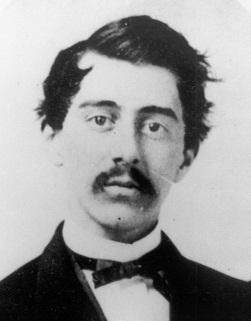
Henry Safford

Abraham Lincoln died in the Petersen House at around 7:22 am on Saturday, April 15th.  With his death, a martyr and a shrine were born.  On Sunday morning, 24 hours after Lincoln’s death, an artist by the name of Albert Berghaus arrived in Washington. Berghaus was an illustrator for Frank Leslie’s Illustrated Newspaper and specialized in created sketches of historical events from eyewitnesses.  These sketches would be transformed into woodcuts and then published.  Berghaus created this sketch of the events at Ford’s Theatre:

Albert Berghaus’ sketch of the events at Ford’s Theatre

In addition, Berghaus visited the Petersen House in hopes of sketching the room and scene of Lincoln’s demise.  He employed the help of Petersen’s boarders to describe the individuals who were present in Lincoln’s final moments.  His final sketch which was published in the April 29th issue of Frank Leslie’s Illustrated Newspaper was this:

“The Dying Moments of President Lincoln” by Albert Berghaus

The drawing was combined with the following affidavit:

“We the undersigned inmates of 453 Tenth street, Washington, D.C., the house in which President Lincoln died and being present at his death, do hereby certify that the sketches of Mr. Albert Berghaus are correct.

Henry Ulke
Julius Ulke
W. Peterson [sic]
W. Clarke [sic]
Thomas Proctor
H. S. Saffard [sic]”

In recognition for their help in helping him create the sketch as accurately as possible, Berhaus included five out of the six above named men in his drawing:

Julius and Henry Ulke – Brothers, photographers, and natural history buffs. It was said the Ulke’s room in the Petersen house would have been unfit for the President as there were too many beetle specimens and scientific instruments cluttering up the space.
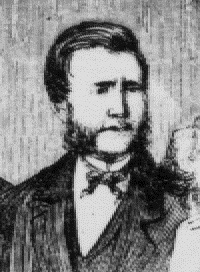
William Petersen – German tailor and owner of the house. It was written that Petersen was a great admirer of Andrew Johnson due to the fact that he had been a tailor himself who rose to such a high position in life.

Thomas Proctor – A 17 year-old clerk for the War department.

Henry Safford – 25 year-old War department clerk. According to one source, when Edwin Stanton requested a man trained in short hand to take down statements, Safford recommended a nearby neighbor Corporal James Tanner.

The only member of the Petersen household not illustrated by Berghaus was William Clark, a 23 year-old clerk in the Quartermaster’s department.  This will come into play later.

Countless other artists, period and modern, would draw their own interpretations on Lincoln’s death chamber.  Every drawing, including Berghaus’, would place too many people in the small room.  The 17’ by 9 ½’ back bedroom of the Petersen house has been coined the “rubber room” due to its ability to expand and contain so many people all at the same time.  While Berghaus’ drawing was cited by the Petersen house residents as being the most accurate – mainly due to Berghaus’ level of detail in duplicating the details in the room – Henry Safford was honest about the rubbery-ness in the drawing: “Not all of the noted men pictured were present at the time, but had been within a few hours of the death of Lincoln.”

Fast-forward fifty-six years.  In 1921, the only remaining Petersen house resident was Thomas Proctor.

Old Thomas Proctor

Proctor had moved from Washington, D.C. and had established himself as a prominent lawyer in New York.  He married, was widowed, and in the early 1900’s began a gradual mental decline.  By 1915, he had lost all of his money and had become an inmate of New York’s Blackwell’s Island, a prison and poorhouse.  Still, some of his old friends and acquaintances remembered the stories he would tell of Lincoln’s last night.  On Friday, September 30th, 1921, Thomas Proctor was visited by a reporter from the Associated Press.  They spoke of his experiences half a century before.  The next day, a news article was published across the nation:
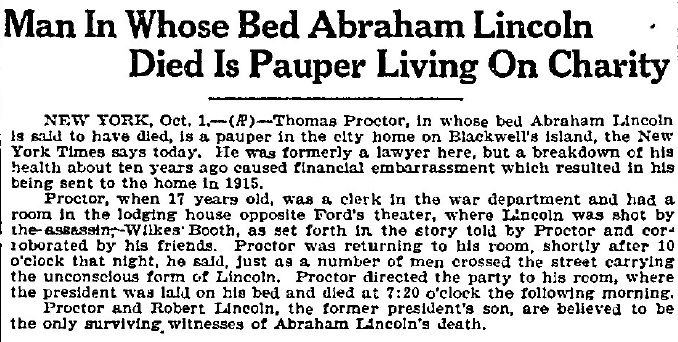
Apparently the poor pauper Thomas Proctor was the gracious man who gave up his bed for the dying President.  After reading this story, another living witness to the events of the Petersen house was intrigued.  Dr. Charles Leale, the young army surgeon who first tended to the wounded President, arranged a visit with Mr. Proctor:

As this article demonstrates, Thomas Proctor’s mental state is not what it once was.  Dr. Leale, though older than Thomas Proctor, must have observed the fragile mind of the man he conversed with.  This visit was obviously short, and consisted of Dr. Leale leaving with little in the way of reminiscences.

This news regarding Thomas Proctor as the tenant of the bed in which Lincoln died, was the start of a controversy that stretched nationwide.  At first, some papers tried to completely blow off Proctor, stating that his whole story was the invention of a troubled mind.  Then, when Berghaus’ engraving came forward as evidence to Proctor’s attendance in the Petersen house, many papers declared him vindicated.  Still the debate continued, with two other individuals claiming to have been the occupant of the bed in which Lincoln died.  The most convincing of these claimants was the late William Clark, whose face is not included in the Berghaus engraving but whose name accompanies the affidavit attached to it. Though Clark had died in 1888, his friends wrote to the newspapers about how he was the rightful occupant of the bed and room in which Lincoln died.   Suddenly, 56 yeasr after the fact, there were two legitimate groups vying for the honor of knowing the man who gave up his bed for Lincoln.  The friends of Thomas Proctor used Bergahus’ engraving as evidence, while the friends of William Clark used a letter written by Clark a few days after the assassination as their evidence:

“…The same mattress is on my bed and the same coverlid covers me nightly that covered him while dying…”

The correct answer, as many reading this already know, is that the room and bed in which Lincoln died belonged to William Clark.  The debate that surrounded Thomas Proctor was probably not his own doing.  As we can see from his interview with Leale, Proctor needed to be led in even basic conversation.  The memory of his friends were mistaken that Proctor owned the bed in which the President died and therefore led the practically senile man to that conclusion.  In support of this hypothesis is an 1899 article written about Proctor in which he correctly admits that the room and bed in which Lincoln died belonged to Clark.  In fact, through his own 1899 article and an 1895 article written by Henry Safford, we learn that Thomas Proctor and Henry Safford were roommates in the Petersen’s second floor apartment.  Proctor was there and helped attend to the President, but the honor of the death room belonged to William Clark.

Yet the question remains, why is it that Proctor and all the other members of the Petersen house are included in Berghaus’ sketch, and yet William Clark, the tenant of the sacred room is not?  Berghaus sketched all of Clark’s belongings in the room with such detail, and yet the man who lived there was not included.  In Clark’s letter to his sister, the same one in which he talks about sleeping in the bed where the President expired, he relates the following:

“I was engaged nearly all of Sunday with one of Frank Leslie’s special artists, aiding him in making a correct drawing of the last moments of Mr. Lincoln.  As I knew the position of every one present, he succeeded in executing a fine sketch which will appear in their paper the last of this week.  He intends from the same drawing to have some fine large steel engraving executed.  He also took a sketch of nearly every article in my room which will appear in their paper.  He wished to mention the names of all pictures in the room, particularly the photographs of yourself, Clara and Nannie, but I told him he must not do that as they were members of my family and I did not wish them to be made public.  He also urged me to give him my picture, or at least to allow him to take my sketch, but I could not see that either.”

William Clark

What is interesting here is that Clark seems to have been the only hold out in posing for the sketch.  To me, this seems odd.  Why wouldn’t Clark allow himself to be saved for posterity along with the others who aided the president in his final moments?  For one, Clark was not in his room when the President arrived.  After Clark’s passing, his family attempted to alter the record of his involvement.  They told Lincoln biographer Ida Tarbell, that it was William Clark who told the soldiers to bring Lincoln to the Petersen house.  This was incorrect, and Safford wrote as much to a newspaper after Tarbell’s biography was released.  What’s more, Safford included a letter written to him by Thomas Proctor when the latter was in perfect health and memory:

“Mr. Clark, as you know, of course, was not at the Petersen house – on the evening, or during the night, or any part of it, of Lincoln’s death.  To the best of my recollection he did not show up till the Sunday morning following.  I am positive, beyond a shadow of a doubt, that Mr. Clark was not in the Petersen house at any time during the period in which Lincoln or Lincoln’s body was there, unless he was hidden away somewhere below the first floor, where it would be very difficult for even a cat to secrete itself.”

Safford agrees with Proctor’s idea that Clark was never in the house when Lincoln was there.  The article ends with:

“Mr. Safford thinks that it is quite possible that Mr. Clark wrote letters home giving the impression that he was present at the time of the death.  In fact, he remembers that on Clark’s return to Washington from his visit, that he (Safford) showed Clark a letter which he had written to his relatives and that Clark said he liked it and believed that he would write about the same thing to his own people.  It is possible that he did this, and thus caused the misunderstanding.”

If we are to believe Henry Safford and the younger version Thomas Proctor, William Clark was not present at Lincoln’s death.  He did not return to the Petersen house until the morning hours of Sunday the 16th.  He arrived in time to hear the stories of what had occurred from the Ulkes, William Petersen, Safford and Proctor.  When Albert Berghaus arrived to sketch the room, Clark helped in detailing the many artifacts in his room.  However, when Berghaus sketched those who were present for the event, he did not sketch Clark.  In his letter to his family, Clark said this was by his choice but what if Berghaus chose not to sketch Clark because he knew Clark was not there when Lincoln died?  We are left with two views:

1. William Clark was the only honest man who boarded in the Petersen house with Henry Safford and Thomas Proctor spending years after his death trying to discredit him.  In addition, he must also have been the most humble man in the Petersen house since he was the only one to deny having his face saved for posterity in Berghaus’ sketch.

2. William Clark embellished his involvement in Lincoln’s death to include more than, “he died in my room and bed”.  He listened to the stories from those who were present and placed himself in the narrative.  When Albert Berghaus arrived at the house the day after Lincoln’s death, Clark told him the truth, that he was not there, and therefore was not included in the sketch.

I leave it to the reader to decide what view they feel is most likely.

Epilogue
In the end, the debate about whose bed Lincoln died in sort of puttered out.  The Sunday Herald did a wonderful job of getting to the facts and declared the old memory of Thomas Proctor to have been in error.  Some other newspapers kept up their support for the pauper who gave his bed for the President, but probably just for the headline.  In the end, the mistake was a blessing for the old and confused Thomas Proctor.  The attention that was drawn to his story and involvement in history led to an outpouring of sympathy for his living conditions.  Through the help of a Rev. Sydney Usher, Thomas Proctor was invited to relocate from the New York City poorhouse.  A month after his story first ran he found a new home at the St. Andrew’s Brotherhood Home in Gibsonia, PA.  According to a news article, “In his new home, the aged lawyer will be permitted to enjoy many comforts of which he has been deprived…”

Though Thomas Proctor did not rent the room or bed in which Lincoln died, he was a participant in the events that occurred in the Petersen house that night.  Along with the Ulke brothers and Henry Safford, Proctor helped the doctors in providing hot water and fulfilling other requests.  I have not yet been able to locate when Thomas Proctor died or where he is buried, but it can be assumed that he spent his last years enjoying charity and assistance similar to that he gave the President from those at the St. Andrew’s Brotherhood home.

Not only did Proctor’s mistaken story benefit himself, but it also was used as a seemingly effective advertising campaign for one creative insurance company:

References:
Many articles were consulted to form this post:
Henry Safford’s 1895 account
Thomas Proctor’s 1899 account
Henry Safford’s 1906 account dismissing Clark’s involvement
New York Times article supporting mistaken Thomas Proctor
Mistaken Petersen daughter stating Lincoln died in her bed
Using Safford’s material to reveal Proctor’s error
The Sunday Herald’s article conclusively proving William Clark owned the room and bed
Most images come from PictureHistory.com

Categories: Uncategorized | Tags: , , , , , , , | 9 Comments

It was Stanton!

Don’t worry, I’m not going to try to convince you all that Secretary of War Edwin Stanton was behind Lincoln’s assassination.  Lincoln’s “Mars” was crucial in the hours after the President was shot in starting the investigation into his death.  The two men had a deep, profound respect for each other – a product of four years of war.  Nevertheless, some still believe that Stanton had a hand in Lincoln’s death.  Apparently even some of Stanton’s contemporaries suspected he was involved, too.  One person believed it so much, that he created the following:

I snapped this pictures out of an auction catalog with the following description:

It is interesting to think of the individual who painstakingly engraved the death of the conspirators on a plaque of ivory only to turn it into a platform for condemning the Secretary of War.

Categories: Uncategorized | Tags: , , | 8 Comments

Visit the Surratt Tavern in…Chicago, IL?

If wealthy candy confectioner and noted collector Charles Gunther had gotten his way, Chicago would have become the home of many transplanted historical sites:

If relocating entire buildings like this sounds like an impossible feat, know that Charles Gunther had already done it once.  In the late 1880’s he purchased the Libby Prison from Richmond, Virginia.  He dismantled the prison, transported it to his hometown of Chicago, and rebuilt it there.  The Libby Prison Museum operated from 1889 to 1895 before decreasing visitors forced Gunther to dismantle it.  When this article was written in 1893 it is likely Gunther was hoping to reinvigorate his museum by creating an entire campus of historic sites.

As we know, Gunther never managed to purchase Independence Hall, the Petersen House, or the Surratt Tavern.  Despite his generous offer to Louis Schade, the Petersen house was eventually sold to the federal government instead.  Had the Petersen House been sold to Gunther, he could have reunited the building with some of the items that were there when Lincoln died.  The bed upon which Lincoln died and many other articles from the Petersen house were acquired by Gunther in 1889.  When Gunther died, the Chicago Historical Society purchased most of his extensive collection.  This is the reason why Lincoln’s true deathbed is in the Chicago History Museum and not in Washington, D.C.

I believe Charles Gunther’s proposed acquisition of these historic sites allows for a very entertaining “what if”.  Imagine what it would be like to look out a window of the Surratt Tavern and see the house where Lincoln died.  Imagine the historical DisneyWorld that could have existed in Chicago.  Instead of Mickey Mouse ears, visitor would purchase powdered wigs at the “Ye Olde Independence Hall Gift Shop” before taking the monorail to the “Lincoln Assassination Pavilion”.  Had this eccentric collector been able to build his dream, how differently our nation’s history would be interpreted today.

References:
The Chicago Historical Society has a nice website recounting Charles Gunther’s collection and Libby Prison Museum.

Categories: Uncategorized | Tags: , , , | 10 Comments

Artifact History: Nélaton probe

The collection of the National Museum of Health and Medicine (NMHM) contains several objects relating to Presidential health and care.  In regards to the Lincoln assassination, the museum contains items extracted from both the President and his assassin during their subsequent autopsies.  Booth’s vertebrae and a piece of his spinal cord, through which Boston Corbett’s bullet passed, are housed in this collection.  From Lincoln’s autopsy, the museum has pieces of Lincoln’s skull, the bullet that took his life, and some hair clippings taken by the doctors and surgeons as mementoes.  As was previously written, the collection was once housed at Ford’s Theatre from 1865 – 1887 when it was called the Army Medical Museum.   During that time at Ford’s however, the Lincoln relics were not part of the collection, only Booth’s pieces were there.  In fact, the bullet that killed Lincoln was entered as an official exhibit during the Conspiracy Trial and it, along with the skull pieces, were housed with the other evidence in the office of the Judge Advocate General.  In 1940, the exhibits were donated to the Lincoln Museum (Ford’s) who then gave the bullet and pieces of Lincoln to the Medical Museum.  So while pieces of Lincoln and Booth both returned to the venue of their last living meeting, it was not at the same time.

In addition to the bullet and the skull fragments, the National Museum of Health and Medicine also has a rather unassuming instrument housed with these Lincoln relics: a long, medical probe:

Lincoln’s skull fragments and Nélaton probe
(NMHM)

This probe has a specific name and a specific function.  Called a Nélaton probe (or Nélaton’s probe) it was used by the doctors during Lincoln’s final night to ascertain the depth and path of the bullet in Lincoln’s head.  Before delving into that, however, let’s look at the history behind this medical tool.

In 1862, Italian general Giuseppe Garibaldi, was shot while trying to take control over the city of Rome.  At that time, Italy had just completed a massive unification to create one kingdom.  This kingdom of Italy later became the republic of Italy as we know it now.  However, as of 1862, several cities in Italy did not accept unification and Rome was one of them.  Tired of waiting for them to come around, General Garibaldi decided to raise a volunteer force to take the city of Rome.  The Battle of Aspromonte, as it was called was fought between Garibaldi’s men and the Royal Army of Italy on August 29th, 1862.  Both sides were hesitant to harm the other as they were countrymen and Garibaldi was well liked and supported by the people of Italy.  When the Royal Army “attacked” Garibaldi’s forces, he ordered his forces not to fire on their brothers.  One part of his army did attack though, and during the fire fight, Garibaldi was hit three times.  The battle lasted less than ten minutes with only 15 combined casualties.  Garibaldi and the rest of his volunteers were arrested and imprisoned.

While imprisoned, Garbaldi was still given the respect and medical treatment he deserved.  Two of the three shots Garibaldi received were to the hip and proved easily treatable.  The third shot hit Garibaldi’s right ankle, just a little above and in front of what we would consider the “ankle bone” (scientifically, it was his internal malleolus).  This wound pained him greatly.  When he was on the battlefield, a surgeon had made an incision on the opposite side of the wound when he felt swelling but found nothing inside of it.  A few days after the battle, Garibaldi was re-examined by more than half a dozen doctors who all believed, save one, that the bullet was no longer in his ankle.  Meanwhile, in England, supporters of Garibaldi in the medical field took it upon themselves to see if they could help the general.  In an extremely presumptuous way, the English doctors elected that Dr. Richard Partridge, professor at King’s college, should travel to England and check on Garibaldi’s wound and treatment.  When Dr. Partridge arrived on September 16th, he examined Garibaldi himself, and came to the same conclusion of the Italian physicians: the ball was no longer in his ankle.  He returned back to England and guaranteed his colleagues and the press that, while Garibaldi was still in considerable pain, it was not caused by a bullet being lodged in his ankle.  Dr. Partridge believed his condition would improve in time.

After five weeks, though, no improvement was noted and Garibaldi was still in quite a deal of pain.  This time, the Italian doctors reached out.  They sent for Auguste Nélaton, a Parisian professor of surgery.  He arrived on October 28th and examined Garibaldi himself.  After inserting a normal probe into the wound, he was convinced that the bullet was still in there.  The Italian doctors did not concur, citing Dr. Partridge’s agreement of their initial assessment.  So, Dr. Partridge returned.  Soon, Garibaldi’s sick room became an international conference with the Italian doctors, the Frenchman Nélaton, the Englishman Partridge, and even a Russian physician all prodding and poking General Garibaldi.  Dr. Partridge actually changed his mind and started believing that the bullet was still in the general’s ankle.  Nélaton, believing amputation to be unnecessary, ordered that the wound entrance be widen with sponges so that the bullet could be removed in time.  While the Italian doctors followed this idea, they were still unconvinced that there was a bullet in Garibaldi, and were getting sick of all these foreigners going back and forth on the matter.

Auguste Nélaton attending to General Giuseppe Garibaldi in 1862 (National Library of Medicine)

When Nélaton returned to France, he started working on a way to prove that there was a bullet in Garibaldi.  The problem was that it was impossible for a physician of the time to identify the hard substance met by a probe in a wound.  It could be normal bone or a foreign substance like a bullet.  The bulk of the Italian doctors believed their probes continually hit the normal bone structure of the ankle, while Nélaton thought it was a bullet.  Nélaton began constructing a new probe for his purposes.  In the end, his probe was ingenious in its simplicity.  At the tip of a normal medical probe he attached an unglazed porcelain tip.  When the porcelain touched bone inside a wound, the probe would be unaffected.  When it rubbed against the lead of a bullet however, the tip would become marked identifying it as a foreign substance.

A simple Nélaton probe

Nélaton quickly sent his new instrument to the doctors in Italy.  After using it to confirm Nélaton’s diagnosis that the bullet was, in fact, still in Garibaldi’s ankle, the Italian physicians were able to successfully remove it on November 22nd.  Shortly thereafter General Garibaldi sent a letter to Auguste Nélaton offering his love, gratitude, and thanks.

Nélaton’s probes proved wonderfully efficient.  They started to be produced on mass and were shipped all over the world.  They quickly became an instrument of necessity for any military surgeon and found a market in the surgeons fighting on both sides of the American Civil War.  They continued to be used into the 1900’s before they were essentially replaced by the advent of less intrusive devices like the X-ray.

Let’s return now to the night of April 14th, 1865.  Lincoln was taken to the Petersen House across the street from Ford’s after being shot.  There, he was attended to by several doctors including the Surgeon General Joseph Barnes and the first responder, Dr. Charles Leale.  At first, the doctors introduced regular, silver probes into Lincoln’s wound.  However, like in Garibaldi’s case, they were unsure if the solid mass they encountered was the bullet or a piece of Lincoln’s skull.  A steward was then sent for a Nélaton probe.  From Dr. Leale’s account we can learn how they used the device:

“About 2 AM the Hospital Steward who had been sent for a Nelatons probe, arrived and an examination was made by the Surgeon General, who introduced it to a distance of about 2 ½ inches, when it came in contact with a foreign substance, which laid across the track of the ball.

This being easily passed the probe was introduced several inches further, when it again touched a hard substance, which was at first supposed to be the ball, but as the bulb of the probe on its withdrawal did not indicate the mark of lead, it was generally thought to be another piece of loose bone. The probe was introduced a second time and the ball was supposed to be distinctively felt by the Surgeon General, Surgeon Crane and Dr. Stone.”

Using Nélaton’s probe, the doctors established that the bullet was above and behind Lincoln’s right eye.  Between its use in the early hours of April 15th and today, the Nélaton probe used by the doctors on Lincoln has lost the porcelain tip that marked the bullet.

The end of the probe used by Lincoln’s deathbed physicans, missing the unglazed porcelain tip.

While the first person to utilize Auguste Nélaton’s invention made a full recovery because of it, it was well established before the probe was introduced in Lincoln’s case that he was beyond help. The Nélaton probe did not change Lincoln’s medical prognosis as it did for Garibaldi, but it is still a historically relevant artifact.  Its inclusion in the collection of the National Museum of Health and Medicine is so that it can be a testament to the devotion of the doctors who cared for President Lincoln.  Despite the hopelessness of his situation, doctors like Barnes, Leale, Taft, and others, did all in their power to aid and comfort the fallen President.

References:
National Museum of Health and Medicine 
The details regarding Auguste Nélaton’s invention came from this essay from the National Institute of Health
Dr. Leale’s account
American Brutus by Michael Kauffman

Categories: Uncategorized | Tags: , , | 15 Comments

Blog at WordPress.com.