Posts Tagged With: Relics

Visit the Surratt Tavern in…Chicago, IL?

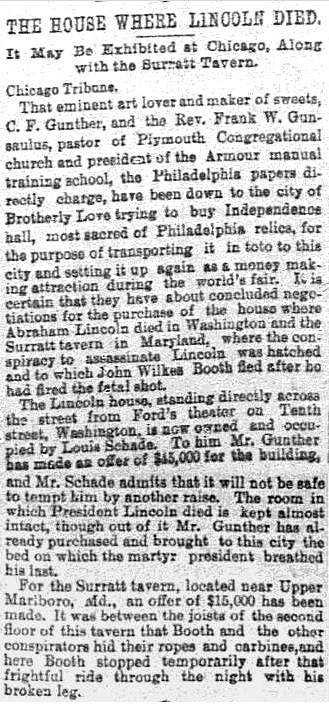
If wealthy candy confectioner and noted collector Charles Gunther had gotten his way, Chicago would have become the home of many transplanted historical sites:

If relocating entire buildings like this sounds like an impossible feat, know that Charles Gunther had already done it once.  In the late 1880’s he purchased the Libby Prison from Richmond, Virginia.  He dismantled the prison, transported it to his hometown of Chicago, and rebuilt it there.  The Libby Prison Museum operated from 1889 to 1895 before decreasing visitors forced Gunther to dismantle it.  When this article was written in 1893 it is likely Gunther was hoping to reinvigorate his museum by creating an entire campus of historic sites.

As we know, Gunther never managed to purchase Independence Hall, the Petersen House, or the Surratt Tavern.  Despite his generous offer to Louis Schade, the Petersen house was eventually sold to the federal government instead.  Had the Petersen House been sold to Gunther, he could have reunited the building with some of the items that were there when Lincoln died.  The bed upon which Lincoln died and many other articles from the Petersen house were acquired by Gunther in 1889.  When Gunther died, the Chicago Historical Society purchased most of his extensive collection.  This is the reason why Lincoln’s true deathbed is in the Chicago History Museum and not in Washington, D.C.

I believe Charles Gunther’s proposed acquisition of these historic sites allows for a very entertaining “what if”.  Imagine what it would be like to look out a window of the Surratt Tavern and see the house where Lincoln died.  Imagine the historical DisneyWorld that could have existed in Chicago.  Instead of Mickey Mouse ears, visitor would purchase powdered wigs at the “Ye Olde Independence Hall Gift Shop” before taking the monorail to the “Lincoln Assassination Pavilion”.  Had this eccentric collector been able to build his dream, how differently our nation’s history would be interpreted today.

References:
The Chicago Historical Society has a nice website recounting Charles Gunther’s collection and Libby Prison Museum.

Categories: Uncategorized | Tags: , , , | 10 Comments

Artifact History: Nélaton probe

The collection of the National Museum of Health and Medicine (NMHM) contains several objects relating to Presidential health and care.  In regards to the Lincoln assassination, the museum contains items extracted from both the President and his assassin during their subsequent autopsies.  Booth’s vertebrae and a piece of his spinal cord, through which Boston Corbett’s bullet passed, are housed in this collection.  From Lincoln’s autopsy, the museum has pieces of Lincoln’s skull, the bullet that took his life, and some hair clippings taken by the doctors and surgeons as mementoes.  As was previously written, the collection was once housed at Ford’s Theatre from 1865 – 1887 when it was called the Army Medical Museum.   During that time at Ford’s however, the Lincoln relics were not part of the collection, only Booth’s pieces were there.  In fact, the bullet that killed Lincoln was entered as an official exhibit during the Conspiracy Trial and it, along with the skull pieces, were housed with the other evidence in the office of the Judge Advocate General.  In 1940, the exhibits were donated to the Lincoln Museum (Ford’s) who then gave the bullet and pieces of Lincoln to the Medical Museum.  So while pieces of Lincoln and Booth both returned to the venue of their last living meeting, it was not at the same time.

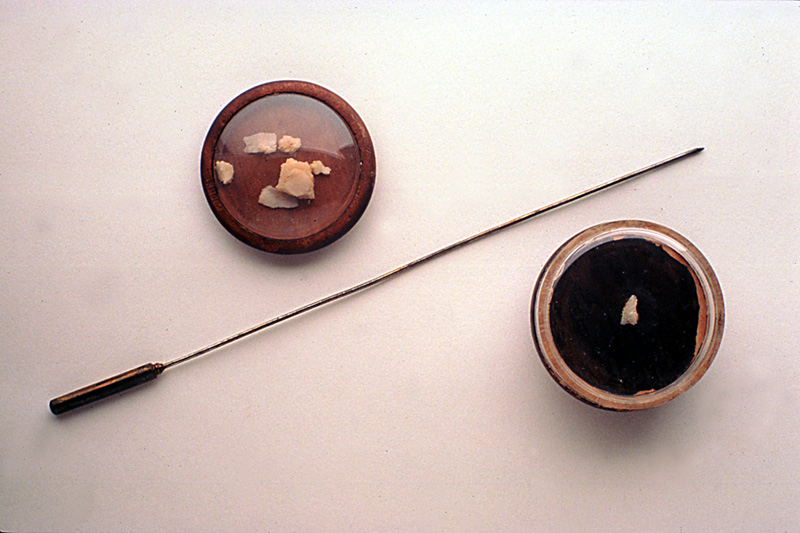
In addition to the bullet and the skull fragments, the National Museum of Health and Medicine also has a rather unassuming instrument housed with these Lincoln relics: a long, medical probe:

Lincoln’s skull fragments and Nélaton probe
(NMHM)

This probe has a specific name and a specific function.  Called a Nélaton probe (or Nélaton’s probe) it was used by the doctors during Lincoln’s final night to ascertain the depth and path of the bullet in Lincoln’s head.  Before delving into that, however, let’s look at the history behind this medical tool.

In 1862, Italian general Giuseppe Garibaldi, was shot while trying to take control over the city of Rome.  At that time, Italy had just completed a massive unification to create one kingdom.  This kingdom of Italy later became the republic of Italy as we know it now.  However, as of 1862, several cities in Italy did not accept unification and Rome was one of them.  Tired of waiting for them to come around, General Garibaldi decided to raise a volunteer force to take the city of Rome.  The Battle of Aspromonte, as it was called was fought between Garibaldi’s men and the Royal Army of Italy on August 29th, 1862.  Both sides were hesitant to harm the other as they were countrymen and Garibaldi was well liked and supported by the people of Italy.  When the Royal Army “attacked” Garibaldi’s forces, he ordered his forces not to fire on their brothers.  One part of his army did attack though, and during the fire fight, Garibaldi was hit three times.  The battle lasted less than ten minutes with only 15 combined casualties.  Garibaldi and the rest of his volunteers were arrested and imprisoned.

While imprisoned, Garbaldi was still given the respect and medical treatment he deserved.  Two of the three shots Garibaldi received were to the hip and proved easily treatable.  The third shot hit Garibaldi’s right ankle, just a little above and in front of what we would consider the “ankle bone” (scientifically, it was his internal malleolus).  This wound pained him greatly.  When he was on the battlefield, a surgeon had made an incision on the opposite side of the wound when he felt swelling but found nothing inside of it.  A few days after the battle, Garibaldi was re-examined by more than half a dozen doctors who all believed, save one, that the bullet was no longer in his ankle.  Meanwhile, in England, supporters of Garibaldi in the medical field took it upon themselves to see if they could help the general.  In an extremely presumptuous way, the English doctors elected that Dr. Richard Partridge, professor at King’s college, should travel to England and check on Garibaldi’s wound and treatment.  When Dr. Partridge arrived on September 16th, he examined Garibaldi himself, and came to the same conclusion of the Italian physicians: the ball was no longer in his ankle.  He returned back to England and guaranteed his colleagues and the press that, while Garibaldi was still in considerable pain, it was not caused by a bullet being lodged in his ankle.  Dr. Partridge believed his condition would improve in time.

After five weeks, though, no improvement was noted and Garibaldi was still in quite a deal of pain.  This time, the Italian doctors reached out.  They sent for Auguste Nélaton, a Parisian professor of surgery.  He arrived on October 28th and examined Garibaldi himself.  After inserting a normal probe into the wound, he was convinced that the bullet was still in there.  The Italian doctors did not concur, citing Dr. Partridge’s agreement of their initial assessment.  So, Dr. Partridge returned.  Soon, Garibaldi’s sick room became an international conference with the Italian doctors, the Frenchman Nélaton, the Englishman Partridge, and even a Russian physician all prodding and poking General Garibaldi.  Dr. Partridge actually changed his mind and started believing that the bullet was still in the general’s ankle.  Nélaton, believing amputation to be unnecessary, ordered that the wound entrance be widen with sponges so that the bullet could be removed in time.  While the Italian doctors followed this idea, they were still unconvinced that there was a bullet in Garibaldi, and were getting sick of all these foreigners going back and forth on the matter.

Auguste Nélaton attending to General Giuseppe Garibaldi in 1862 (National Library of Medicine)

When Nélaton returned to France, he started working on a way to prove that there was a bullet in Garibaldi.  The problem was that it was impossible for a physician of the time to identify the hard substance met by a probe in a wound.  It could be normal bone or a foreign substance like a bullet.  The bulk of the Italian doctors believed their probes continually hit the normal bone structure of the ankle, while Nélaton thought it was a bullet.  Nélaton began constructing a new probe for his purposes.  In the end, his probe was ingenious in its simplicity.  At the tip of a normal medical probe he attached an unglazed porcelain tip.  When the porcelain touched bone inside a wound, the probe would be unaffected.  When it rubbed against the lead of a bullet however, the tip would become marked identifying it as a foreign substance.

A simple Nélaton probe

Nélaton quickly sent his new instrument to the doctors in Italy.  After using it to confirm Nélaton’s diagnosis that the bullet was, in fact, still in Garibaldi’s ankle, the Italian physicians were able to successfully remove it on November 22nd.  Shortly thereafter General Garibaldi sent a letter to Auguste Nélaton offering his love, gratitude, and thanks.

Nélaton’s probes proved wonderfully efficient.  They started to be produced on mass and were shipped all over the world.  They quickly became an instrument of necessity for any military surgeon and found a market in the surgeons fighting on both sides of the American Civil War.  They continued to be used into the 1900’s before they were essentially replaced by the advent of less intrusive devices like the X-ray.

Let’s return now to the night of April 14th, 1865.  Lincoln was taken to the Petersen House across the street from Ford’s after being shot.  There, he was attended to by several doctors including the Surgeon General Joseph Barnes and the first responder, Dr. Charles Leale.  At first, the doctors introduced regular, silver probes into Lincoln’s wound.  However, like in Garibaldi’s case, they were unsure if the solid mass they encountered was the bullet or a piece of Lincoln’s skull.  A steward was then sent for a Nélaton probe.  From Dr. Leale’s account we can learn how they used the device:

“About 2 AM the Hospital Steward who had been sent for a Nelatons probe, arrived and an examination was made by the Surgeon General, who introduced it to a distance of about 2 ½ inches, when it came in contact with a foreign substance, which laid across the track of the ball.

This being easily passed the probe was introduced several inches further, when it again touched a hard substance, which was at first supposed to be the ball, but as the bulb of the probe on its withdrawal did not indicate the mark of lead, it was generally thought to be another piece of loose bone. The probe was introduced a second time and the ball was supposed to be distinctively felt by the Surgeon General, Surgeon Crane and Dr. Stone.”

Using Nélaton’s probe, the doctors established that the bullet was above and behind Lincoln’s right eye.  Between its use in the early hours of April 15th and today, the Nélaton probe used by the doctors on Lincoln has lost the porcelain tip that marked the bullet.

The end of the probe used by Lincoln’s deathbed physicans, missing the unglazed porcelain tip.

While the first person to utilize Auguste Nélaton’s invention made a full recovery because of it, it was well established before the probe was introduced in Lincoln’s case that he was beyond help. The Nélaton probe did not change Lincoln’s medical prognosis as it did for Garibaldi, but it is still a historically relevant artifact.  Its inclusion in the collection of the National Museum of Health and Medicine is so that it can be a testament to the devotion of the doctors who cared for President Lincoln.  Despite the hopelessness of his situation, doctors like Barnes, Leale, Taft, and others, did all in their power to aid and comfort the fallen President.

References:
National Museum of Health and Medicine 
The details regarding Auguste Nélaton’s invention came from this essay from the National Institute of Health
Dr. Leale’s account
American Brutus by Michael Kauffman

Categories: Uncategorized | Tags: , , | 15 Comments

The Collapse of Ford’s Theatre

On this date, June 9th, in 1893, a part of the three upper floors of Ford’s Theatre collapsed killing twenty two clerks and injuring over 100 more government employees.

NPS Photo

After the assassination of Lincoln, the government immediately seized Ford’s Theatre.  Military guards had been posted to the theatre and access was granted by War Department passes.  Matthew Brady was allowed to photograph the interior and members of the stage crew and orchestra were allowed to retrieve their items from within its walls.  After the execution of the conspirators on July 7th, 1865, John T. Ford was given permission to reopen his theatre.  He announced that the play, “The Octoroon” was to be performed on July 10th.  As is shown on the playbills and broadsides from “Our American Cousin”, “The Octoroon” was initially scheduled for April 15th.  While Ford sold over 200 tickets for the performance, there was also a large uproar over the theatre reopening after what had transpired within her walls.  Ford received this anonymous letter implying retribution if he fulfilled his plan:

 “Sir:

You must not think of opening tomorrow night.  I can assure you that it will not be tolerated.  You must dispose of the property in some other way.  Take even fifty thousand for it and build another and you will be generously supported.  But do not attempt to open it again.

One of many determined to prevent it.”

For fear of the place being burned, the Judge Advocate ordered a troop of soldiers to the theatre on the night of July 10th, to prevent anyone from attending the play.  Ford placed a sign on the door reading, “Closed by Order of the Secretary of War” and refunded the ticket holders.  He would not attempt to revive his theatre again.

The government decided its best option was to just retain the property.  They began paying John Ford $1,500 a month to lease his theatre.  By July of 1866, the government bought the property outright for Ford for $88,000.  Even before purchasing the building, the government had started renovating the theatre.  They transformed the interior into a three story office building.  In December of 1865, the Army Medical Museum moved into the third floor of the space.

Engraving of the Army Medical Museum housed in Ford’s Theatre from the book, “Ten Years in Washington: Life and Scenes in the National Capital as a Woman Sees Them” (1874).

The museum would stay in Ford’s until 1887, when a separate building was constructed for their purposes.  The Army Medical Museum’s occupancy at Ford’s provided a slightly macabre reunion between Abraham Lincoln and John Wilkes Booth.  The museum housed pieces of Lincoln’s skull and hair, and Booth’s vertebrae, each taken from their perspective autopsies.  Parts of the two men spent over twenty years together at the scene of their last meeting. EDIT: Further research has shown that Lincoln’s skull fragments were not given to the Army Medical Museum until after it had moved out of Ford’s Theatre. Darn.

Lincoln Skull Fragments and Nelaton Probe

Engraving of Booth Vertebrae

The other two floors of Ford’s housed the Office of Records and Pensions run by the War Department.  When the medical museum moved out, they took over the entire building.  The many clerks employed in the building compiled the official pension records for Civil War veterans and others.

In 1887, the Pension bureau received a new chief, Colonel Fred C. Ainsworth.  As a boss, Ainsworth was not a popular fellow.  His methods of leadership and his expectations of his clerks was a drastic change from the department’s previous leaders.  Old timers who had worked in the office for years found themselves held to greater expectations and increased workloads.  While this made Ainsworth an efficient chief, it also made him a very disliked leader.  However, Ainsworth was not heartless and tried his best to appease his clerks.    Ainsworth was aware of his clerks’ apprehension about the building they occupied.  When he first started, he heard rumors that the east wall of Ford’s was unsafe.  He made inquiries with his superiors and was assured that the wall was perfectly secure and the whole building was safe.  In 1888 and 1889, Ainsworth directed the installation of a new steam heating apparatus and a new plumbing system for the building.  Then in 1893, he received permission to install an electric light plant for the building.  In order to place the light plant and provide amble ventilation for it, it was required to excavate about twelve feet between two partition walls in the basement.  Ainsworth wrote up specifications, gave them to the War Department, and the War Department created a contract and accepted bids.  Eventually, the bid by a contractor named George W. Dant was chosen to do the work.  During this entire process, no element of danger was discussed by anyone.  With proper underpinning of the floor above, the excavation was a relatively safe job.

While this construction was going on, the clerks’ unease about the building increased.  Plaster was known to fall from the ceiling and, at one point, part of the first floor was roped off causing the clerks to worry about the structure.  None of them however, seem to have brought their concerns up with Colonel Ainsworth.  As chief, he continually went into the basement to check on Dant and his men.  Dant continually assured him that everything was fine and that the roped off area was just because that particular part of the first floor was to be removed as part of the excavation.

Then, on this day in 1893, tragedy struck Ford’s again.  During the course of the work day, with hundreds of clerks and files hustling about, a support pier in the basement excavation area collapsed.  The floors above were supported by iron beams, which rested on columns, which rested on the brick piers in the basement.  When the one pier gave way, a 40 foot section from all three floors collapsed down.  Twenty one clerks were instantly crushed and killed.  One would die a few days later from his injuries.  A total of 105 clerks suffered injuries, with two more clerks dying as a result of their injuries over the next three years.

Almost as soon as the dust settled, and the dead were dug out, the public demanded to know who was responsible for the collapse.  A Coroner’s inquest was held to determine if there was any criminal responsibility.  The surviving clerks, furious over the loss of their brethren, used this opportunity to lay the blame on their despised chief, Colonel Ainsworth.  On the witness stand they spoke of the building being a death trap long before the accident.  They claimed they were told by Ainsworth’s assistants to tip toe on the stairs because they were dangerous.  They said they were too afraid to say anything about the conditions for fear they would be fired.  The room in which the inquest was held turned into a scene of fury, with all rage directed towards the Colonel.  A man who lost his brother in the accident came up behind the sitting Colonel and yelled “You murdered my brother!”  Shouts of agreement came from others in the crowd and several rose to their feet moving to close in on the Colonel.  Luckily the police lieutenant in the court was able to disperse the impromptu mob.  As more and more witnesses took the stand, the outbursts from the crowd increased.  All the while, the Colonel sat calmly in his chair, unwavering.

With emotions high, even members of the jury broke decorum.  B. H. Warner, a juror, interrupted a testimony and asked for Ainsworth to leave as he was intimidating witnesses with his mere presence.  The crowd applauded this suggestion for a full minute glaring at Ainsworth all the while.  Ainsworth refused to leave citing it as his right to hear testimony regarding the events.  The Coroner agreed.  He had no precedent to evict Ainsworth, as he had done no wrong and merely sat there.  When the Colonel’s representative, a Mr. Perry, rose to address the room, the crowd yelled at him and hissed.  When the room finally gained its composure, Mr. Perry begged the crowd, “I appeal to you as American citizens for fair play.”  To this a member of the crowd replied with, “You didn’t give us fair play!” At that point, the tempest roared.  The shouts of, “Murderer!” changed to, “Hang him! Hang him!” and the mob approached Ainsworth who continued to sit cool and collected in his chair.  The police lieutenant was powerless to disperse the mob.  For a brief moment of time, it appeared the Colonel’s life was to end right there by the hands of his angered employees.

The only thing that brought the mob back to its senses was the when the juror who previously spoke, B. H. Warner, stood upon his chair and begged for order.  He calmed the crowd back down with the following:

“This outbreak of feeling must be suppressed not by the strong hand of the law, but by the hand of fraternity.  I appeal to you to have fair play as American citizens, and not to stain the fair name of the glorious Capitol of this Republic.  I appeal to you in the name of the Master who reigns above.”

The inquest continued for the next few days but with increased police attendance that squashed all disturbances before they could start.  The jurors of the inquest found Colonel Ainsworth, contractor Dant, the superintendent of the building, and the mechanical engineer of Ford’s guilty of criminal negligence.  However, the Coroner’s inquest had no real power.  It merely established whether or not the men could be charged with the crime.  Despite the findings, the district attorney never charged the superintendent or the mechanical engineer with any crime.  Due to the public outcry, however, he did go after Ainsworth and Dant.  The defense effectively postponed matters until time allowed the public to cool down.

In the end, the charges against Colonel Ainsworth were dropped as the Coroner’s inquest never proved that he had any knowledge that the building was unsafe.  The jurors’ verdict was a product of the emotions of the times and not the evidence.  The accident was a travesty, but the Colonel was guilty of no wrong doing.  He continued as Chief of the Records and Pensions bureau and worked his way up to becoming the Adjutant General.  He died in 1934 and is buried in Arlington.

Of all those involved, it is probably George W. Dant who is to blame for the collapse.  It appears that he and his crew did not properly shore up the brick piers around the excavation.  With the ground around them gone, the weight of the floors above was too much for the exposed piers.  The cause of the collapse was due to the improper support of these piers.  While Dant was the most liable for what occurred, by April of 1895 the prosecution gave up its case against him.

NPS Photo

For the clerks who perished, the government paid $5,000 to each of their families.  Those who were wounded in the collapse received anywhere from $50 to $5,000 depending on the extent of their injuries.

The inside of Ford’s was rebuilt immediately after the collapse.  From 1893 to 1931 the building housed the Government Printing Office under the direction of the Adjutant General.  In 1931 the building was turned over to the Department of the Interior and the Osborne Oldroyd’s Lincoln Museum opened on the first floor in 1932.  It became a National Historic Site the same year.  After being renovated and restored to its 1865 appearance, it reopened as a working theatre and museum in 1968.

While it is well known, the one item of coincidence regarding the June 9th, 1893 collapse of Ford’s is still worth repeating here.  At around the same time the clerks of Ford’s were falling to their deaths, another man was being buried in Massachusetts.  Edwin Booth, the great tragedian and brother of the assassin, died on June 7th.  On the day of the collapse, he was being interred at his final resting place in Mount Auburn cemetery.  Despite Edwin’s lifetime of success as the greatest actor of his generation, both his life and death are eclipsed by tragedies at Ford’s Theatre.

References:
Ford’s Theatre and the Lincoln Assassination by Victoria Grieve
Restoration of Ford’s Theatre by George Olszewski
There are many newspaper articles about the inquest and legal proceedings regarding the collapse.  I used GenealogyBank searches for Ainsworth and Dant to find several articles.  Others can be found in the New York Times’ archive.  The most entertaining account (which contains the material about the mob at the first session of the inquest) can be read here.
Other articles about Ainsworth’s legal process: 1, 2, 3

Categories: Uncategorized | Tags: , , | 23 Comments

The Assassination Playbills

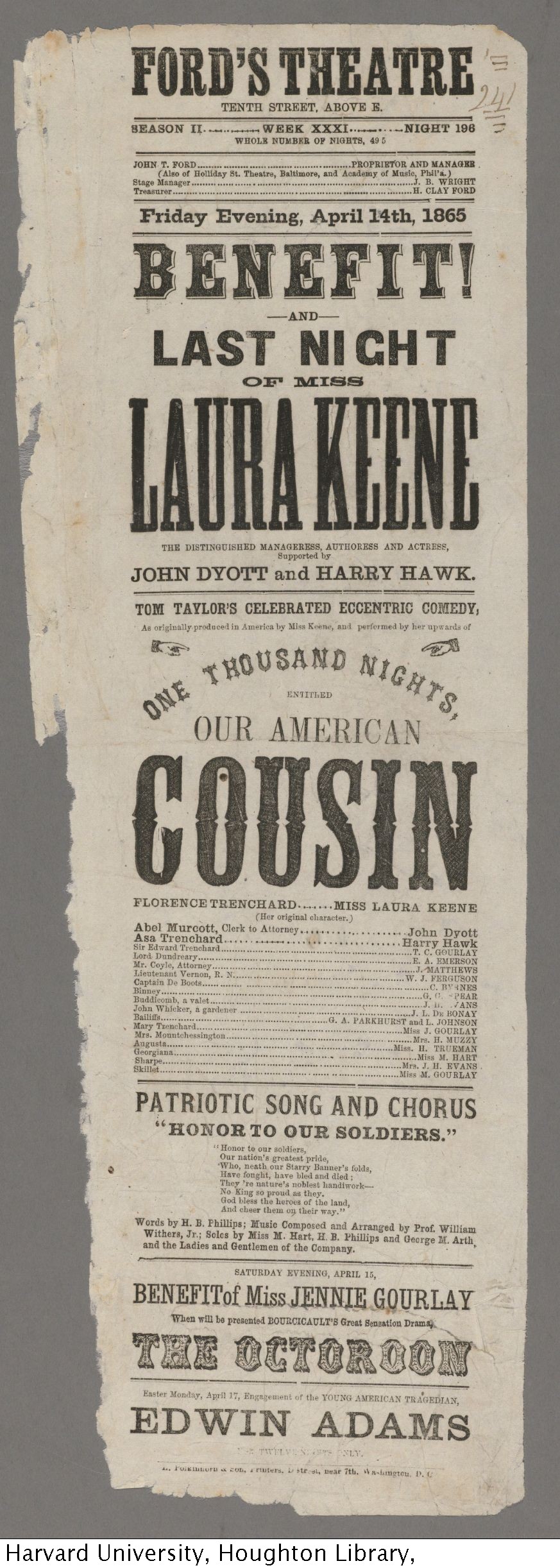
Earlier, I introduced you to Henry Polkinhorn, a Washington, D.C. printer.  From his building on D Street, Polkinhorn printed newspapers, books, and a plethora of other custom items.  Of all the items he printed over the years, the most sought after item today is the playbill from Ford’s Theatre for April 14th, 1865.  In this post we will explore the details of Polkinhorn’s work, in order to identify genuine playbills and later reprints.

We will be utilizing the wonderful, but rare book, The Ford Theatre Lincoln Assassination Playbills: A Study by Walter C. Brenner.  Mr. Brenner privately printed this 16 page book in 1937.  In it he sorted out the many misconceptions about the playbills and, for the first time, created a tool for identifying and authenticating genuine playbills.  In the foreword of his book, Mr. Brenner wisely stated that, when attempting to authenticate a playbill as genuine, “source and pedigree must be disregarded,” and many, “will not prefer to do so.”  The simple truth is there is an exceedingly small possibility that genuine playbills still exist outside of libraries, museums, and private collections.  In fact, many libraries, museums, and private collections themselves don’t even have genuine playbills.  The best of provenance must be ignored when faced with the facts and details of the printed playbill.  The evidence within is unbiased and is merely for the benefit and education of those interested in the drama at Ford’s.

As stated before, Henry Polkinhorn was the regular printer for Ford’s playbills.  His association with the theatre started when John T. Ford took over the Tenth Street Bapist Church and started putting on musical performances:

Ford continued using Polkinhorn’s services when he renovated the church into Ford’s Atheneum:

When a fire destroyed most of the building in December of 1862, Polkinhorn helped his customer by purchasing stock so that he could build Ford’s New Theatre.  Ford continued to use Polkinhorn for his playbills and printed materials all the way until when the theatre closed for good after the events of April 14th, 1865:

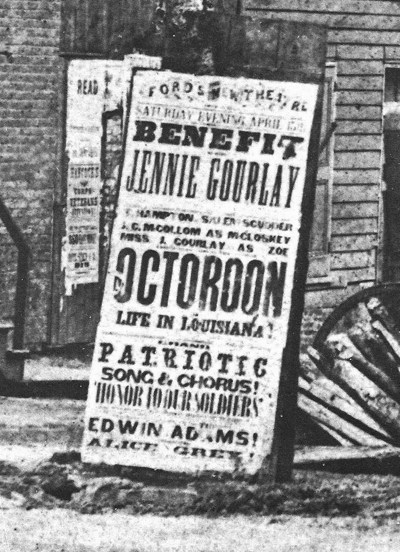
Large advertisement for Ford’s April 15th, 1865 performance of The Octoroon. The performance never occurred as the theatre was closed after Lincoln’s assassination.

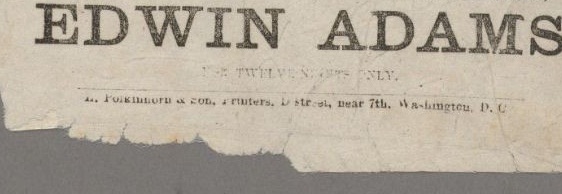
Therefore, when attempting to authenticate a playbill, it is important that it has been printed by “H. Polkinhorn & Son, Printers, D street, near 7th, Washington, D.C.”.  This is the final line on the playbill right at the bottom:

Now, just because a playbill says “H. Polkinhorn” at the bottom does not mean that it is genuine.  Practically all the later forgeries and reprints include the correct printer.

To Polkinhorn, printing the playbills for April 14th was just another job like the day before.  As a printer, he kept the previous day’s playbill set up on the press until he was given orders to change it, and then he changed only as much as was necessary.  This would save time in the printing process as long as the customer did not call for a completely redesigned playbill.  The Harvard Theatre Collection has the bound volume of playbills belonging to John B. Wright, the stage manager at Ford’s.  Looking at the playbills leading up to the 14th, Polkinhorn used the identical line of lettering for Laura Keene’s name on the 10th, 11th, 13th, and the 14th.  On the 12th, he had to resize her name to make room for an illustration on the playbill, but reverted back on the 13th.  On the morning of the 14th, Polkinhorn was printing the bills.  At around 10:30 am, Mrs. Lincoln’s messenger arrived at Ford’s to reserve the box for that night.  After this announcement happened, John Wright went to Polkinhorn’s printing shop to change the playbill.  Originally, there was going to be a special musical performance on the next night, April 15th.  On the large poster above you can see on the bottom the announcement for “Honor to Our Soldiers”.  This was a song written by Ford’s orchestra director William Withers.  With the announcement that Lincoln was attending that night, it was decided that the premiere of the song should coincide with the visit of their honored guest.  Therefore, Wright went to Polkinhorn’s to change the playbill to include mention of the song.  When Wright arrived, Polkinhorn altered the press to print the new bills.  Rather than throw out the bills Polkinhorn had already printed without the song, they were also used that night.  This is the reason why there are two issued of playbills for Our American Cousin:

Ford’s Theatre Playbills from April 14th, 1865

After Lincoln was killed, the theatre was shut down never to be used by Ford again.  Polkinhorn found that one of his most consistent clients no longer needed his services.  He removed the song playbill design off of the press and carried on with his business.  As time passed, people clamored for mementoes of the fallen President and the events at Ford’s Theatre.  John Buckingham was the door keeper at Ford’s on the night of the assassination.  In 1894, he published a short, illustrated book called Reminiscences and Souvenirs of the Assassination of Abraham Lincoln.  Before, publishing this book, however, Buckingham got into the business of reproducing playbills from that night.  When Buckingham first started printing his “souvenir” playbills is unknown.  The earliest I can confirm is by 1879, but it is likely he started much earlier than this.  One source states that the reprints were sold on the streets of Washington “a day or two after the tragedy”.  What is known is that when Buckingham decided to print his souvenirs he went right back to Polkinhorn’s printing company.  Richard Oliver Polkinhorn, Henry Polkinhorn’s nephew, is the one that helped him recreate the bills from that night.  Using Polkinhorn’s own press and type, the two printed copies and created an engraving of the first issue playbills.  Buckingham started selling the playbills as souvenirs.  At first, the reprinted bills had no markings to identify them as reprints.  Years later, Buckingham would start stamping them, “Lincoln Souvenir Engraving”, but by then countless numbers had made their way into the public and began masquerading as authentic bills.  Buckingham’s souvenir playbills look like this:

John E. Buckingham’s souvenir reprint playbill

So, there are two issues of authentic playbills printed on April 14th, 1865, and one version later printed by Ford’s doorman.  Buckingham only reprinted the first issue playbill and so the second issue, the one with “Honor to Our Soldiers”, has been saved from period forgeries.  Aside from contemporaneously forged examples, all second issue playbills that exist are most likely genuine.  For the first issue playbills, however, careful attention must be paid to identify Buckingham and other reprints.

As well as John Buckingham and Richard Polkinhorn did in recreating the first issue playbills, the devil is in the details.  As we will see, Buckingham made his own mistakes and actually corrected mistakes that were present in the original bills, when making his copies.  A close look at a genuine bill and a Buckingham copy shows the differences.

The way we know that Buckingham used Polkinhorn’s own type and press is twofold.  First, on the back of an 1891 Buckingham reprint there is a stamped note from R. O. Polkinhorn citing his involvement in creating the copies.  Second, the type itself is a match for Polkinhorn’s press.  One way to identify a bill that used Polkinhorn’s press is the particular type that is used to create the words “THE OCTOROON”.  Other period reprints from other printers, like this one housed at the University of Delaware, did not have this specific font type.  This clearly identifies it as being from another printer entirely.
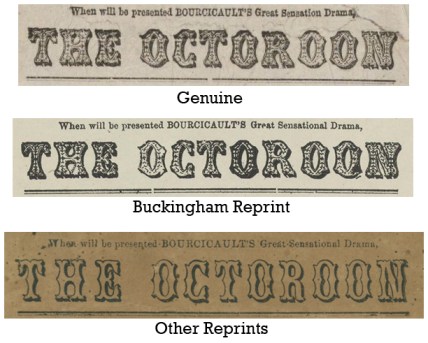
On the Buckingham reprints, however, “THE OCTOROON” is in the exact same type as on the original playbills, proving that Polkinhorn’s printing shop was used for the souvenirs.

The most obvious difference between a genuine first issue playbill and a reprint is the final “E” in LAURA KEENE.  In genuine bills, the final “E” is perfect.  This “E” is consistently undamaged on the previous Ford playbills from the week leading up to the assassination.  On the Buckingham reprints, however, the final “E” is marred:

Not only is the “E” damaged, but also the final letters and numbers on many of the lines.  According to Brenner this damage was caused by the gauge pins on the press getting in the way.  However it happened, it provides the most notable difference between a real playbill and a souvenir.

While the “E” was a mistake on the part of the printer, the pair also fixed mistakes from the original bill.  In the genuine first issue bills, right above “The OCTOROON”, it states, “When will be presented BOURCICAULT’S Great Sensation Drama,”.  This is a typo.  It should read “Great Sensational Drama”.  When Buckingham created his souvenirs he corrected it and changed it to the appropriate “Sensational” (See the Octoroon examples above).

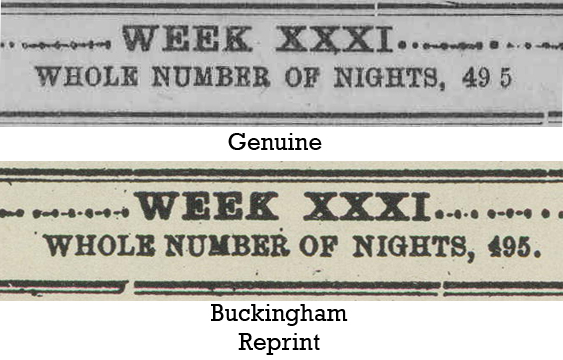
In addition, the original bill had an accidental space at the top.  Under the heading it states, “WHOLE NUMBER OF NIGHTS 49 5”.  There is a space between the 9 and 5 in “49 5”.  Buckingham corrected this unnecessary space and changed it to “495”.

In Walter Brenner’s book, he identifies 14 minute differences between Buckingham’s reprint and genuine playbills.  From missing words to the vertical alignment of letters, he provides a chart of the changes.  If a playbill has correctly passed the above criteria, this book should be consulted and the rest of the details authenticated.

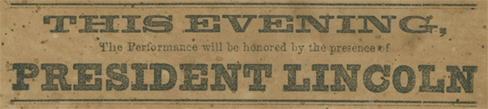
In addition to Buckingham’s souvenirs, many other printers and indiviudals of the period tried their hand at creating false bills.  Any playbill that bears the announcement that, “THIS EVENING The Performance will be honored by the presence of PRESIDENT LINCOLN” is a fake.

Forgery

As was mentioned earlier, the playbills were altered when it was ascertained that Lincoln and his guests were attending the night’s performance, however, they were only changed to include lines from the song “Honor to Our Soldiers” and not to announce his attendance.  Playbills containing Lincoln’s name are reprints from other printers, and not authentic.

While period fakes are common, there are also modern fakes that often trip people up.  Like Buckingham did so many years ago, museums sell reproduction playbills in their gift shops around the country.  Ford’s Theatre actually sells a reproduction of the Buckingham reprint.  It is attached to a reproduction wanted poster and costs $1.50.

The paper is browned and made to look old, too.  They are excellent reproductions but can add to the confusion when someone believes they have the genuine article.

When it comes to Ford’s Theatre playbills from April 14th, 1865, it is important to dismiss any stories of provenance until the bill is authenticated.  In Brenner’s book, he mentions a playbill with impeccable provenance.  Two signed affidavits accompany it; one written by the owner of the bill and another by John T. Ford himself.  In it he states, “I, John T. Ford on oath say that I presented Mr. A. K. Browne with a programme of the play of ‘Our American Cousin’ which I picked up near President Lincoln’s chair when he was assassinated…”  This superb provenance is a rare and valued thing for historical artifacts.  Unfortunately, the marred “E” on the playbill that accompanied these affidavits prove that it is not a genuine playbill, but instead a Buckingham reprint.  The best provenance in the world has to be ignored when faced with unbiased evidence.  Despite the affidavit to the contrary, John T. Ford was not even in D.C. when Lincoln was assassinated, and he did not arrive there until the Monday after the shooting.  Treasure seekers had cleaned out the theatre box long before he showed up.

As far as relics go, a genuine playbill is a treasured commodity.  On its face, it’s an advertisement for a night at the theatre.  In the context of history however, it exudes a sense of foreboding.  These playbills capture Lincoln’s assassination in a way that no other artifact can.  They are the last vestige of Lincoln as he lived, and the gateway to his immortality.  While reproductions have been made, only genuine playbills provide the emotional impact of that moment frozen in time.  They exist today as silent witnesses to Ford’s last great drama.

References:
The Ford Theatre Lincoln Assassination Playbills: A Study by Walter C. Brenner
Restoration of Ford’s Theatre by George Olszewski

Categories: Uncategorized | Tags: , , , , | 25 Comments

H. Polkinhorn, Printer

Often, I get caught up in the little people of the assassination story.  Those who had relatively minor roles seem to fascinate me for their trivial involvement in the great drama.  The first article I wrote for the Surratt Courier was about Emerick Hansell, the state department messenger wounded by Lewis Powell at Secretary Seward’s.  We know him merely because he was at the wrong place at the wrong time and got a knife in the back for it.  Nevertheless, it is the almost trivial characters of the story that continually draw me in.  This post is further proof of that.  For the past few weeks I have been researching a very minor figure to a great degree.  I contacted Harvard University for a picture, made inquiries through Ancestry to help figure out his genealogy, and searched newspaper records for hours on end.  Even while I was doing it, I couldn’t help but think, “Why are you going to all this trouble?  Who is going to care about the minor details of this minor character?”  In truth, I may be the only one who cares about this man and his background, but the search for knowledge is enough motivation for me.  Will it change our view of the assassination? No.  But in a field where the big picture is explored so many times, sometimes it’s just fun to get lost in the little things.  The following is what I have spent my time doing – researching a man who is barely on the cusp of the assassination story merely because I enjoy the hunt. 
 

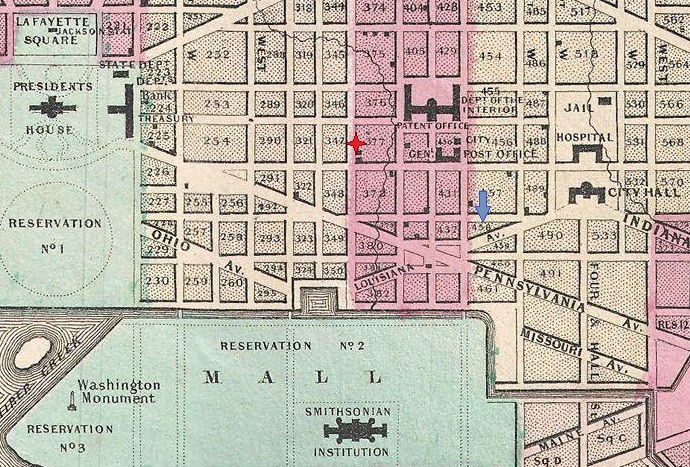
In the above map, the blue arrow points to 634 D Street NW in Washington, D.C., as it was in 1861.  During the Civil War era and for many years after it, this location held the prestigious and profitable printing company of Polkinhorn and Son.  Its founder was Henry Polkinhorn:

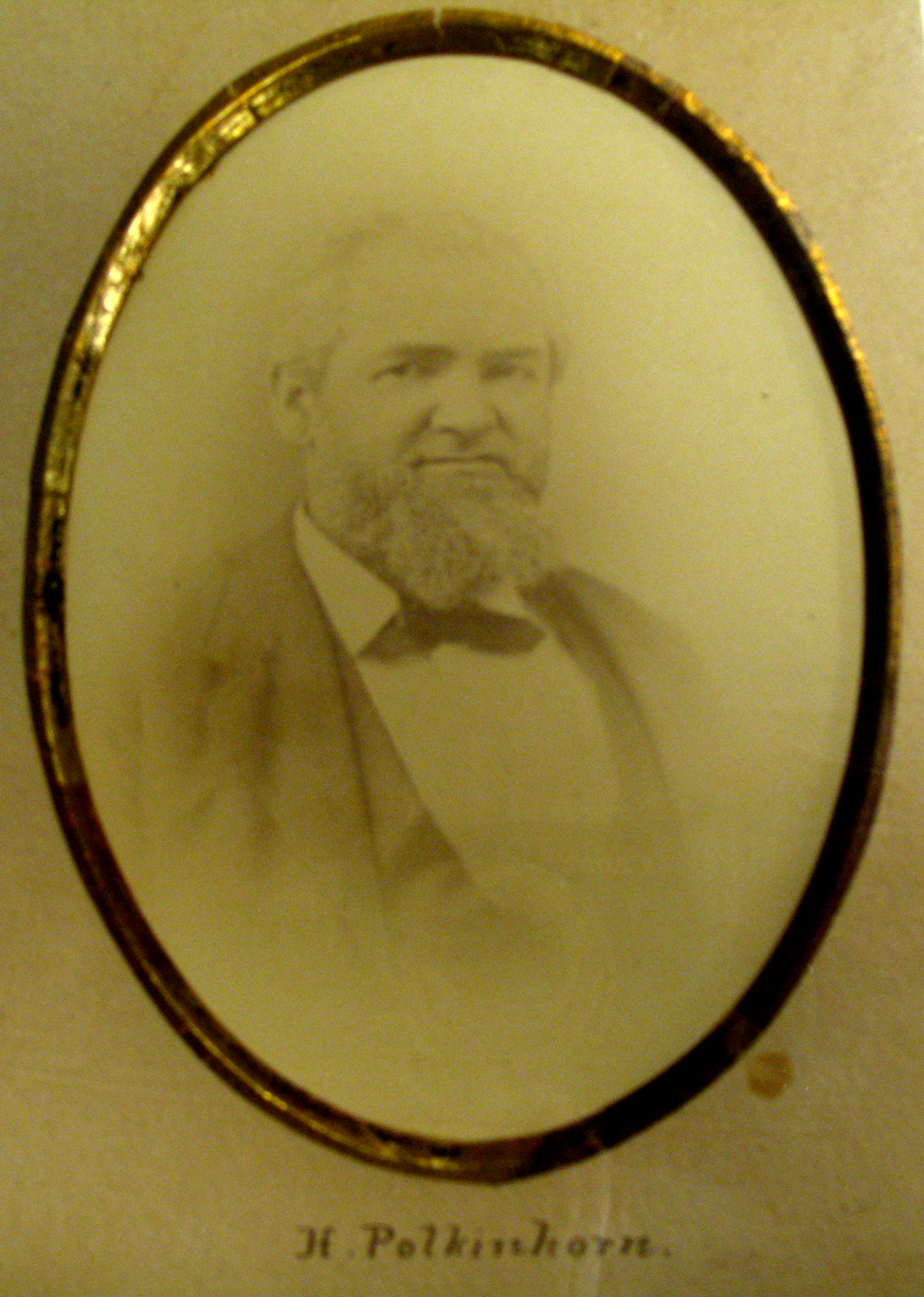
Henry Polkinhorn from the Harvard Theatre Collection

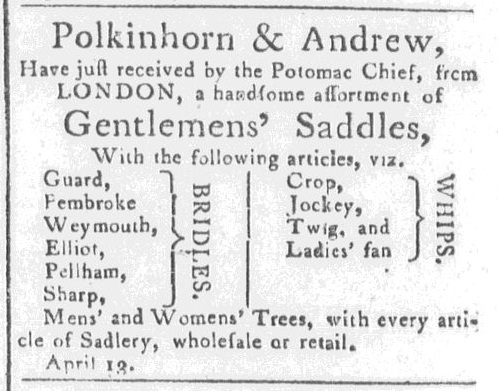
Henry Polkinhorn was born in 1813 in Baltimore.  His father, Henry, Sr., was an immigrant from England and a saddler by trade.  As a saddler in Baltimore, Henry Sr. was a very prosperous businessman himself:

A 1797 advertisement for Polkinhorn saddles

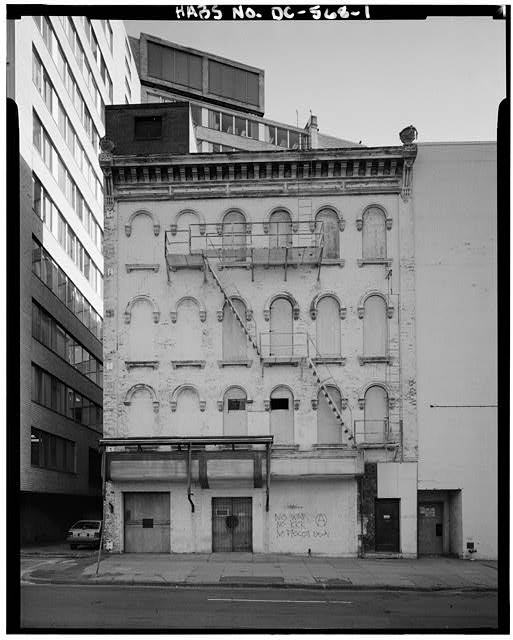
As a young man, Henry Polkinhorn, Jr relocated to D.C. and married Marianne Brown in 1839.  Together Henry and Marianne had six children.  Marianne died in 1857 and Henry married Rachel Ann Barnes less than two years later.    Differing from his father, Henry entered into the trade of a printer to support his growing family.   In his chosen occupation, Henry Polkinhorn was extremely successful.  After a few years of increasing success in his printing trade, Polkinhorn was able to erect his own building at 634 D Street NW between 6th and 7th streets.

It was a five story building in the Italianate style, which became very popular in the US after the late 1840’s.  Italianate buildings are noted for their bracket cornices and arched windows.  A newspaper article of the day described Polkinhorn’s building as having, “great height and [a] majestic appearance.”  Of the five stories, three of the floors were committed to Polkinhorn’s printing trade.  The second floor, in particular, was, “furnished with every facility for the execution for all descriptions of printing, both plain and ornamental.”  For his skills in printing and self-made success, Polkinhorn was very well respected by his peers.  The article honoring his building ended with, “We sincerely recommend the enterprising proprietor to the favorable notice of our citizens, as one, independent of his long established reputation, worthy of their highest consideration and esteem.”

As with all printers of the day, Polkinhorn ran a diversified printing company.  In each major area of his business, he printed materials connected to the assassination of Abraham Lincoln in 1865.  First, he printed newspapers.  Not only did he print them for others, he even started a couple on his own like Our Newspaper and the Constitutional Union.  Another newspaper he printed was the National Intelligencer.  The office of the Intelligencer was right across the street from Henry Polkinhorn’s printing office.  This provided steady income for Henry Polkinhorn and convenience for the Intelligencer management.  The Intelligencer also relates to the assassination of Lincoln, as it was one of the best newspapers for daily coverage of the trial of the conspirators.  Even to this day, issues of the National Intelligencer have been microfilmed by the National Archives and housed with the Lincoln assassination papers due to their relevance and content.  Polkinhorn would have even more connection with the Intelligencer after the trial was over.  By late 1868, the National Intelligencer was broke.  The owners, who had taken it over in 1865, had run it into the ground and owed thousands of dollars to many people.  The biggest debt they owed was to Henry Polkinhorn.  For his printing of their paper, they owed him over $50,000.  Fed up, he finally called to settle his tab.  With no money to pay him, the owners transferred the Intelligencer completely over to Polkinhorn.  Henry continued to make and print the Intelligencer until he himself was able to sell it off.  Shortly thereafter, the Intelligencer merged with the Washington Express and effectively died.

While newspapers provided daily work for Henry Polkinhorn, he was also well known for his book printing.  He devoted a whole floor in his five story building for Book and Job Printing.  Many famous and common citizens went to him to print their books.  An online search for “Polkinhorn printer” and alike will yield numerous nineteenth century books that were printed from his D street establishment.  On the brink of the Civil War, Polkinhorn printed, in book form, a letter by Joseph Holt explaining the dangers that were to come and his satisfaction that his own home state of Kentucky choose to stay with the Union.  Holt would later be named the Judge Advocate General, and chief prosecutor at the trial of the Lincoln conspirators.   During the trial, Polkinhorn printed many pamphlets containing the testimony of the trial pertaining to certain individuals like Dr. Mudd and Edman Spangler.  Polkinhorn also published Thomas Ewing’s argument against the jurisdiction of the military tribunal that tried the conspirators.  He also printed a plethora of other books on wide range of topics.  One book that sticks out is a doctor’s thesis about the dangers of cemeteries in populated areas.  The doctor blames many of the illnesses and sicknesses of those living in Georgetown on the nearby cemetery “Oak Hill”.  He called for the immediate closing of the cemetery and for the removal of the bodies.  When Henry Polkinhorn died in 1890, he was buried at Oak Hill.

While the newspaper and book printing jobs loosely connect him to the assassination of Lincoln, Henry Polkinhorn’s real relationship to the death of our 16th president is based on several individual pieces of paper, 18 inches long.  On top of his already multipurpose book and newspaper printing, Polkinhorn also has the honor of printing one of the most sought after relics of Lincoln’s assassination: the playbill from Our American Cousin.

A true playbill from Ford’s Theatre on April 14th, 1865.

Polkinhorn’s was the “go to” establishment for Ford’s Theatre for their playbills.  The map that started this post has a red star marking where Ford’s Theatre is.  Polkinhorn’s office was less than a half mile away, making him a perfect place for the Ford’s to do their business.  In the Harvard Theatre Collection there is a ten by twenty inch bound volume of Ford’s Theatre playbills originally belonging to John B. Wright, stage manager at Ford’s.  The volume contains 193 playbills commencing from August of 1864 until the closing of the theatre after the events of April 14th, 1865.  A look at this volume shows that “H. Polkinhorn & Son” was the regular printer of the Ford’s Theatre playbills.  The “son” in “Polkinhorn & Son” was Henry’s son Samuel Polkinhorn.  After Henry retired, Samuel would partner up with his cousin, Richard Oliver Polkinhorn, who worked in the Polkinhorn building and was a talented printer in his own right.   “S & R. O. Polkinhorn, Printers” would last about a year before Samuel decided to bow out leaving his cousin as the sole owner of “R. O. Polkinhorn, Printer”.  Richard would create “R. O. Polkinhorn & Son” with his son Joseph and the Polkinhorn printing legacy would go on.

For a detailed look at the assassination playbills read the follow up post here.  What is important to know is that the only legitimate “Our American Cousin” playbills were printed by “H. Polkinhorn & Son”.  Any playbills bearing a different printer other than Polkinhorn are reprints or souvenirs.  Also, while Polkinhorn did print two different versions of the playbill, neither of them mention anything about President Lincoln.  Another printer named Brown would later print his own, slightly similar looking playbills announcing that “this evening the performance will be honored by the attendance of President Lincoln” and many people are fooled today into thinking they are legitimate, when they are not.

After retiring from the printing game, Henry Polkinhorn’s success allowed him to purchase a couple buildings and houses that he rented out.  In 1881, his own printing building (then being run by his nephew R. O. Polkinhorn) caught fire and the was severely damaged.  The entire fifth floor burned down, and was never replaced.  The rest of the building was repaired for a cost of around $20,000.

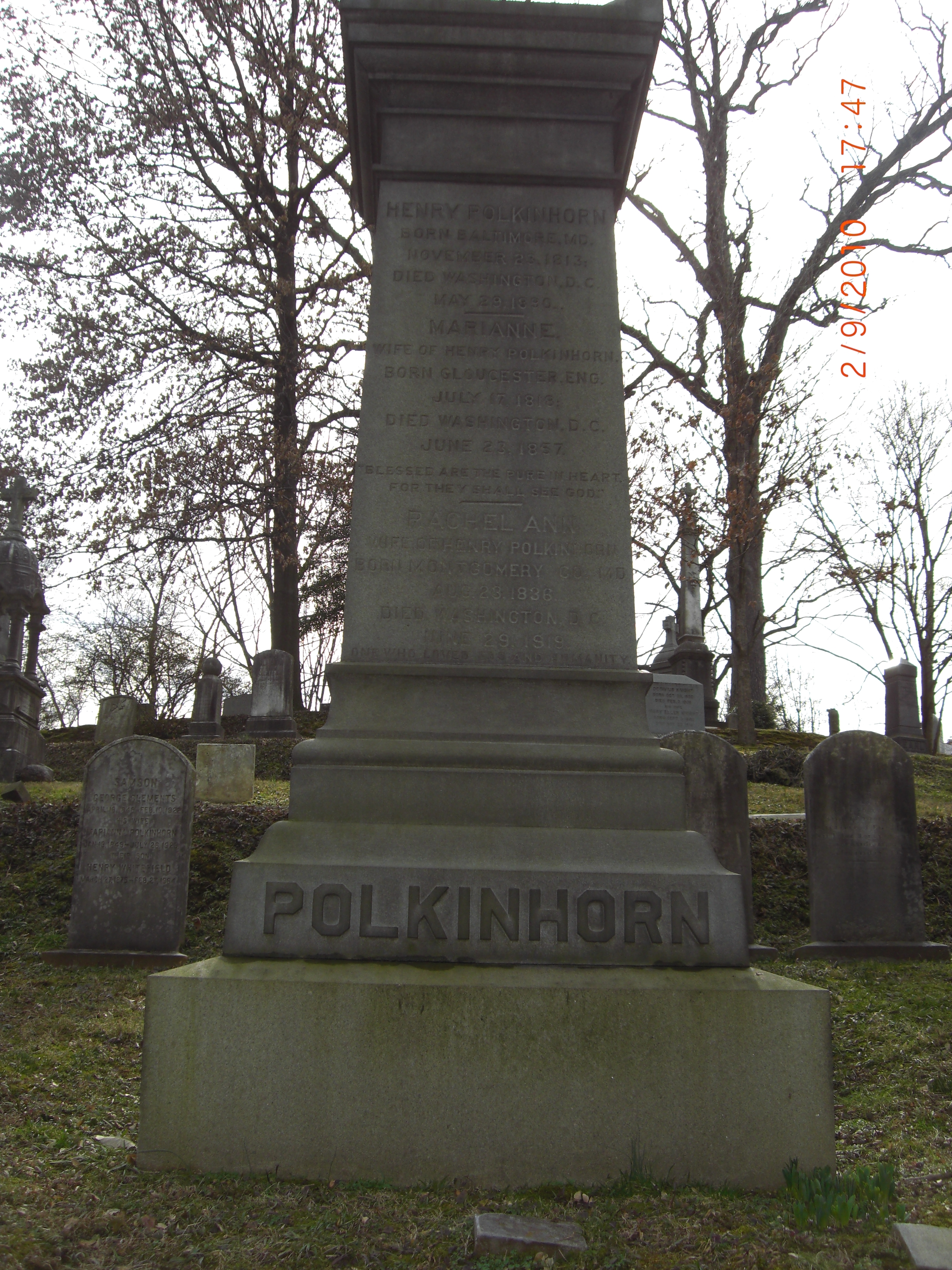
Henry Polkinhorn died on May 29th, 1890 at the age of 76.  He was interred at Oak Hill cemetery in lot #821.  Today, he rests there with his two wives and most of his children.

The Polkinhorn building, not far from Ford’s, survived until the late 1980’s when most of the block was torn down for redevelopment.

Polkinhorn Building in March of 1987 before being demolished.

At the end of it all, Henry Polkinhorn and his family represent the American dream in the best way.  His father imigrated from England, found success as a saddler, and saw his own son become one of the most respected printers in Washington, DC.

In his long and fruitful career, Henry Polkinhorn made a name for himself and today, at the bottom of one of the most sought after relics of the tragedy at Ford’s Theatre, that name get the final billing.

References:
I would like to thank Dale Stinchcomb at the Harvard Theatre Collection for the image of Mr. Polkinhorn, Kia Fennell for her assistance in figuring out his genealogy, and Rich Smyth for the picture of his grave.
Polkinhorn Building – Historic American Buildings Survey
The End of the National Intelligencer Article 1868-11-25
All newspaper clippings displayed above are from GenealogyBank.com

Categories: Uncategorized | Tags: , , , | 23 Comments

Ford’s New Center

The Ford’s Theatre Center for Education and Leadership opened on February 12th of this year.  The building, adjacent to the Petersen House where Lincoln died, continues the message of Lincoln’s legacy after his death.  The Center has four floors open to the public.  The first floor is the lobby and gift shop while the second holds space for temporary exhibits.  The third floor is deemed the “Legacy Gallery” which shows the many ways in which Lincoln has become ingrained in our culture and how his words affect us today.  While very nice and good, as a person interested in the Lincoln assassination, it is the 4th floor, named the “Aftermath Gallery” that I wish to discuss.

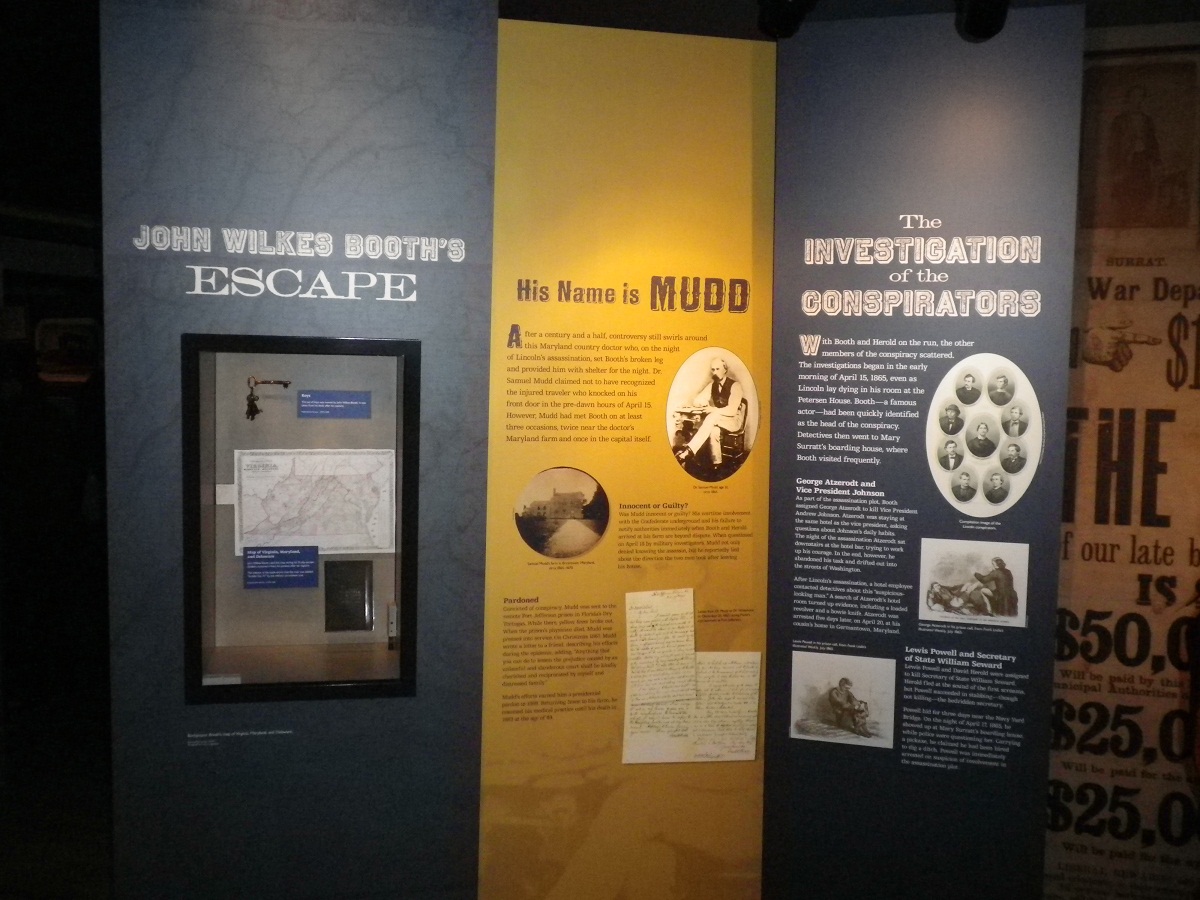
Visitors exit the Petersen House and travel via elevator to the 4th floor of the Center and work their way down.  On this floor you begin by viewing the turmoil that occurred on the morning of April 15th when the nation woke to the news of Lincoln’s death.  There is a recreation of the train car that took Lincoln’s body back to Springfield as well as an interactive map of the route.  Past this, are several wall displays recounting the manhunt for Booth and the imprisonment, trial, and execution of the conspirators:

Before approaching the stairs down to the next level, there is a recreation of the tobacco barn with audio and visual effects to show Booth’s last few moments before being shot.

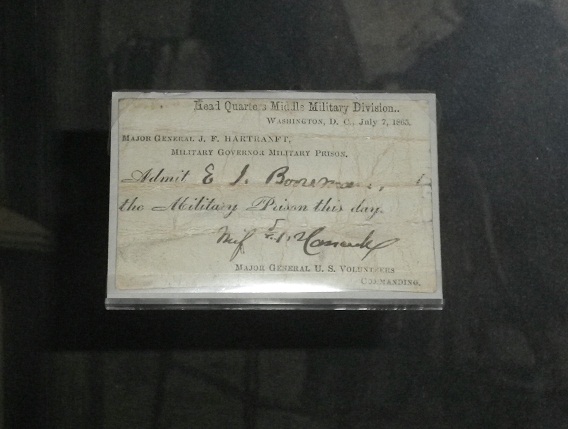
As always, it is the artifacts and relics of the assassination that draws my interest.  They have a pass to witness the execution of the conspirators on July 7th, 1865:

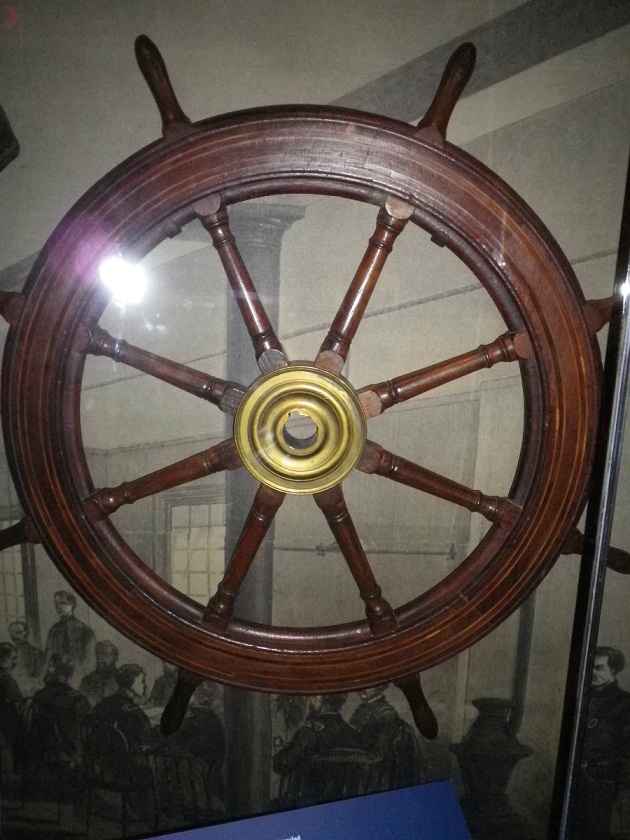
A steering wheel from the USS Montauk:

The USS Montauk and the USS Saugus were ironclad monitors which housed the conspirators during the initial investigation and arrests.  The Montauk held George Atzerodt, Edman Spangler, David Herold, John Wilkes Booth’s body, and Joao Celestino, an unrelated Portuguese sea captain.

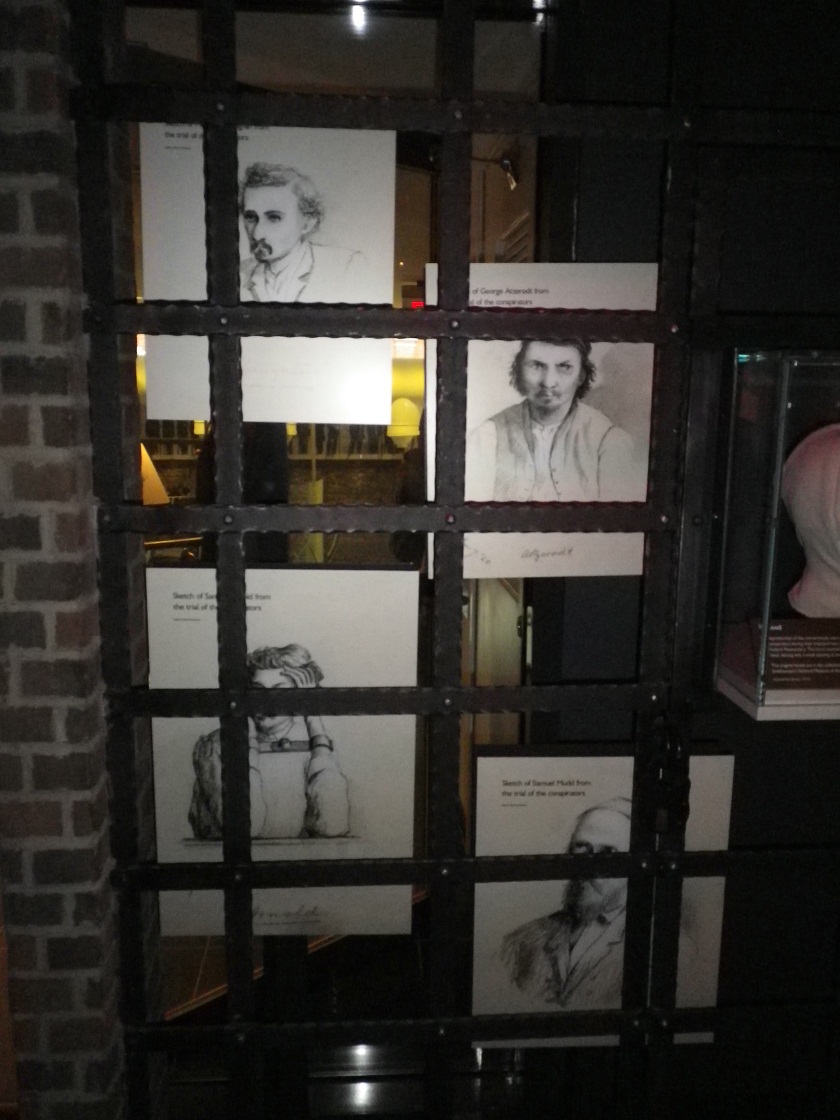
The gallery also has a nice display of the sketches military commission member Lew Wallace drew of the conspirators during the trial:

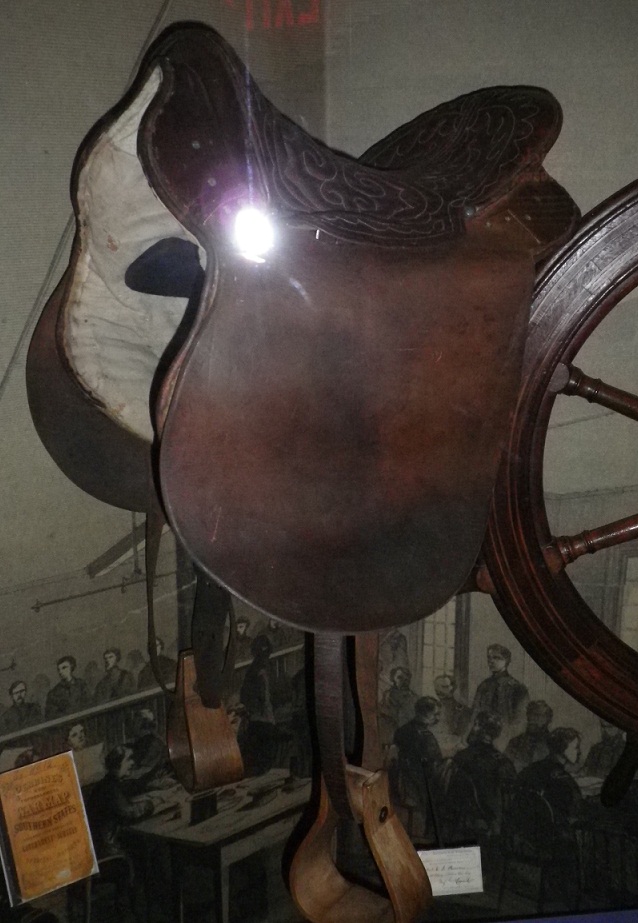
The Center also has on display Lewis Powell’s saddle:

Powell used this saddle on the night he attacked Secretary of State William Seward.  Powell biographer, Betty Ownsbey, was the first to see that this item was mislabeled as being owned by Booth (it was owned by George Atzerodt) and that it was improperly displayed.  The stirrups were shown under the saddle flap instead of over them, which would make a very uncomfortable ride for the horse.  After being made aware of the mistake, Ford’s has gladly fixed this and is now correctly displaying the beautiful saddle
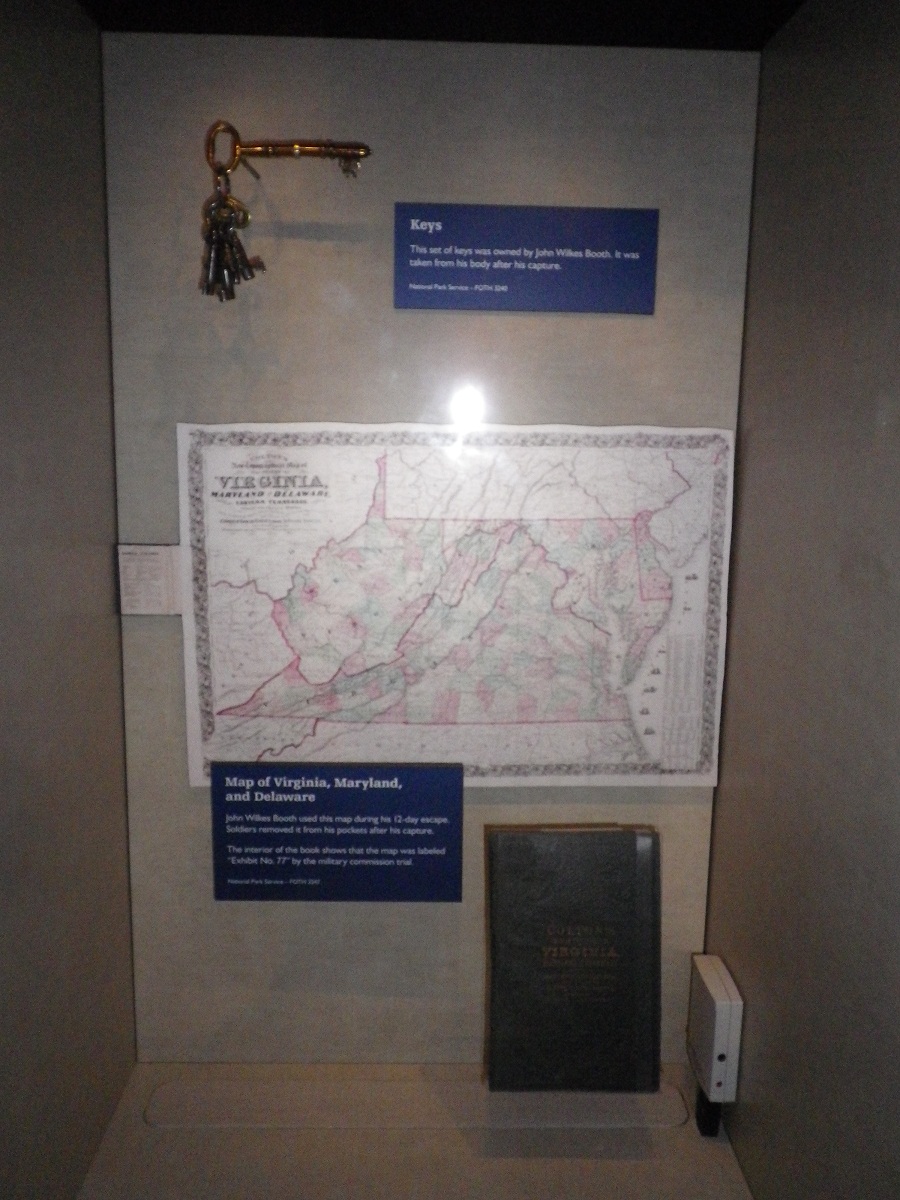
There is also an entire display case in the “Aftermath Gallery” with artifacts that I believe to be mislabeled:

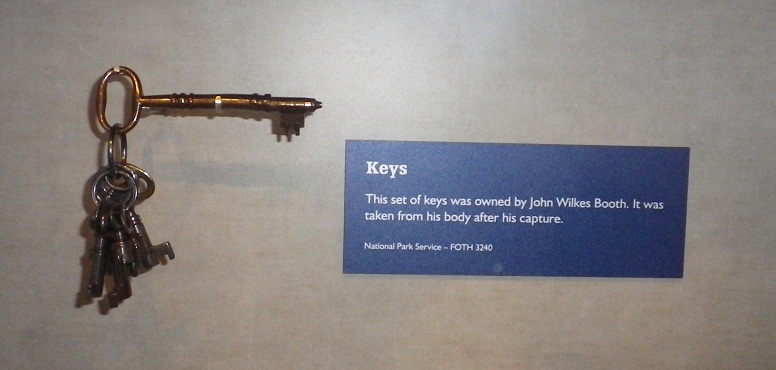
The display has two items, a set of keys and a map.  The keys are labeled as, “being owned by John Wilkes Booth” and being, “taken from his body after his capture.”

I do not believe that this is the case.  The War Department had these keys before they had even found John Wilkes Booth.  An April 24th inventory list of evidence cites, “No. 9 Envelope containing silver pencil, and a bunch of keys belonging to David Herold.”  These keys contained Davy’s key to his house and other places.  On the morning of April 15th, Detectives James McDevitt, John Clarvoe, and John Waite, along with Lewis Weichmann, visited the home of Mrs. Herold.  Here, they obtained two photographs of David Herold.  They also recovered these keys and a silver pencil.  According to a statement by Jane E. Herold, Davy, “…had to get home at 10 o’clock.  If not he would be locked out.  Always when he came he had a night key, but momma took it away from him…” While McDevitt and the others made mention of the photographs as they hoped it would increase their chances of getting some reward money, they didn’t mention the keys as they were not noteworthy.  In addition, if you read through the statements of people at Garrett’s barn when Booth was cornered and killed, none of them ever mention keys being taken from Booth’s body.  At the trials, individuals like Conger and Baker give very detailed lists of what they took off of Booth’s body, with no keys being mentioned.  Regardless, these keys could not have come off of Booth’s body as the government had them two days before Booth and Davy were found.

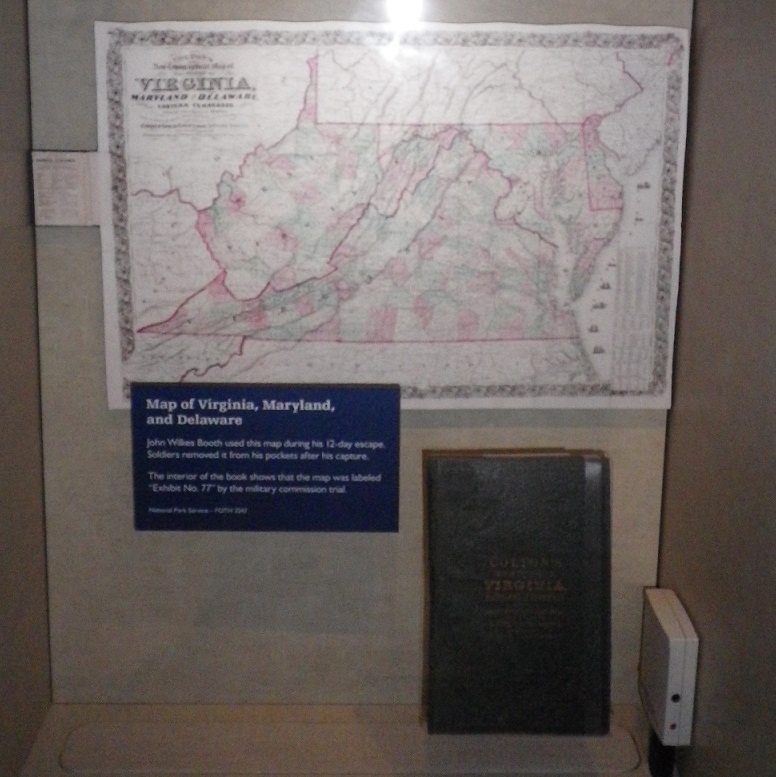
The other item in this display case is a map of Virginia, Maryland, and Delaware.  The label for it states the following, “John Wilkes Booth used this map during his 12-day escape.  Soldiers removed it from his pockets after his escape.  The interior of the book shows that the map was labeled, ‘Exhibit No. 77’ by the military commission trial.”

I believe that this label is also wrong.  Now it is true that Booth and Davy had a map with them during their escape.  That map was taken off of Davy, not Booth, when he surrendered at Garrett’s barn.  Unfortunately, this is not the map taken from Davy either.  On June 3rd, Dr. Joseph H. Blanford, brother-in-law to Dr. Mudd, retook the stand at the conspiracy trial.  The following is part of the interchange that occurred in Dr. Blandford’s testimony:

“Q. (Exhibiting a map to the witness.) Will you examine this map, and state to the Court whether the several localities that I have spoken of, and the roads, are properly marked upon it?
A. I think they are, as nearly as can be ascertained from this map; the roads not having been drawn upon it originally. The roads here, as drawn in ink, to the best of my knowledge, are the proper roads; and they would take those places in their route.
Q. Will you state whether you have examined that map before, and indicated the lines and points marked in ink upon it?
A. Yes, sir.
Q. Show to the Court, on the map, where Surrattsville, Dr. Mudd’s house, and Pope’s Creek, are.
Assistant Judge Advocate Bingham. If he is going to do that, let him write them down at once on the map.
The witness. They are already written here. Dr. Mudd’s house, T. B. and other points on the road are correctly stated.
(The map referred to was offered in evidence without objection and is marked Exhibit No. 77.)”

To preclude the idea that the map shown to Dr. Blanford was the same one recovered from Davy, we have the following testimony from Everton Conger:

“Q. What articles did you take from Herold? Anything?
A. A little piece of a map of the State of Virginia, and a part of the Chesapeake Bay on it.
Q. Do you remember whether that map embraced the region of country where they were?
A. It did. It embraced that region of country known in Virginia as the “Northern Neck.”
Q. Was it a map prepared in pencil?
A. No, sir.
Q. Was it a regular map?
A. Part of an old school map; a map that had originally been five or six inches square.
Q. (Exhibiting a map.) Is that it?
A. Yes, sir: that is it.
Q. That embraces the region of country in which they were captured?
A. Yes, sir. That is the only property I found on Herold.
Q. Look at this pocket compass. (Exhibiting a pocket compass.)
A. That was taken from Booth’s pocket, just as it is now, with the candle grease on it and all.
(The map and compass were offered in evidence without objection, and are marked Exhibit No. 38.)”

So Davy’s map, along with Booth’s compass, was entered into evidence as Exhibit #38.  Therefore, the map on display at Ford’s, marked as Exhibit #77, was not recovered from either Booth or Herold at Garrett’s.  Instead this map was used by Thomas Ewing during his defense of Dr. Mudd.

Ultimately, while the Ford’s Theatre Center for Education and Leadership has wonderful potential, I personally would care to see more space devoted to their true role in history, Lincoln’s assassination.  I understand that Ford’s has a fine line to walk in educating the public about Lincoln’s assassination, while not supporting the act.  Their big museum does this by presenting Lincoln’s entire term of office inclduign the assassination.  While this affords less space towards assassination related things, it also allows them to operate without appearing biased.  In my opinion though, people come to Ford’s because they want to learn about Lincoln’s death.  While a sad time in our history, I would prefer more attention in this area.  Regardless, as a center for education, it is Ford’s duty to present history as accurately as possible.   I hope that these artifacts will be looked into further.

References:
A Peek Inside the Walls: 13 Days Aboard the Monitors by John E. Elliott and Barry M. Cauchon
The Lincoln Assassination: The Evidence by William C. Edwards and Edward Steers, Jr.

Categories: Uncategorized | Tags: , , | 4 Comments

“Fan” of the President

After Lincoln’s death, there was an immediate demand for items that mourned the late president.  In Washington City, the whole town was draped in black mourning crepe.  Citizens wore silk ribbons, pins, badges, armbands, and images of the fallen president.  An industry of mourning goods was established overnight.

Harper's Weekly advertisement for Lincoln mourning badges.

One of the most beautiful Lincoln mourning artifacts that has survived the years, is an elegant, 22” diameter, mourning fan:

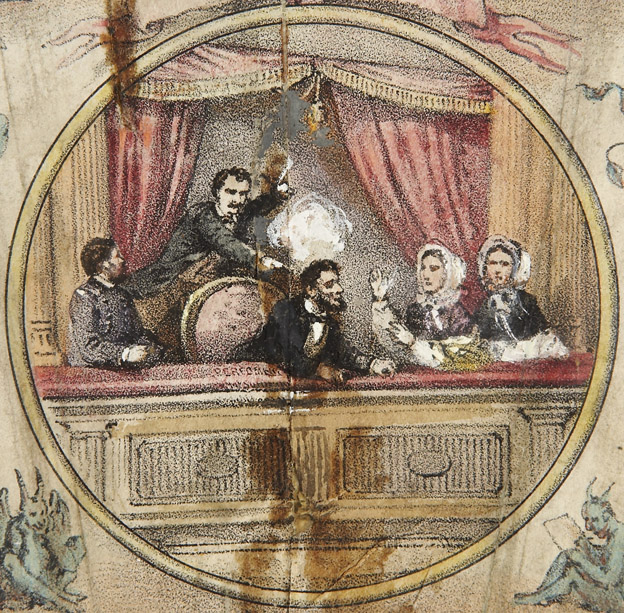
The fan is titled, “To the Martyr of his Country, Abraham Lincoln” and was created by a Central American maker who had purchased the rights from an American firm.  On the front, the fan shows Lincoln, surrounded by angels and cherubs, with Spanish memorial songs on the edges near the fan guards.  On the back, near the guards, the hand painted fan displays the battle of the Monitor and Merrimac along with a depiction of Richmondburning.  The back of the fan also displays five neatly drawn and painted scenes from the assassination of the president:

Booth, Mary Surratt, and other conspirators (one of which is probably Lewis Powell) conspiring to kill Lincoln.

Booth shooting President Lincoln.

Laura Keene and others putting on the play Our American Cousin at Ford's Theatre right before the President is killed.

Booth makes his escape south on horseback.

Cornered at Garrett's barn, Booth is shot and killed.

The fan was designed to not only be a fashionable piece, but also a means of self protection and therefore holds two surprises in its design.  In the base of one of the guards, there is a small, hinged area in which a lady could conceal poison.  If this did not work, or, if the lady needed a more direct approach, the same fan guard houses a concealed knife that could be retracted and hidden from sight.

This fan had originally belonged to Father Robert Keesler, one of the original “Boothies”.  A truly kind and generous man, he allowed the fan to be displayed at the Surratt House Museum as one of their centerpiece artifacts in their exhibit on Victorian mourning customs.  Father Keesler later gave this ornate fan as a present to Dr. John Lattimer, an esteemed Lincoln author and collector.  When part of Dr. Lattimer’s Lincoln collection was sold at auction in 2008, this fan went for $15,535.  It was last in the possession of the Abraham Lincoln Book Shop in Chicago Illinois.  They were asking $19,500 for this extraordinary piece of Lincoln mourning history.

References:
The image of the article regarding mourning badges comes from Lincoln’s Assassins: Their Trial and Execution by James Swanson and Daniel Weinberg.  Several other mourning items can be found in this book.
Abraham Lincoln Book Shop

Categories: Uncategorized | Tags: | 2 Comments

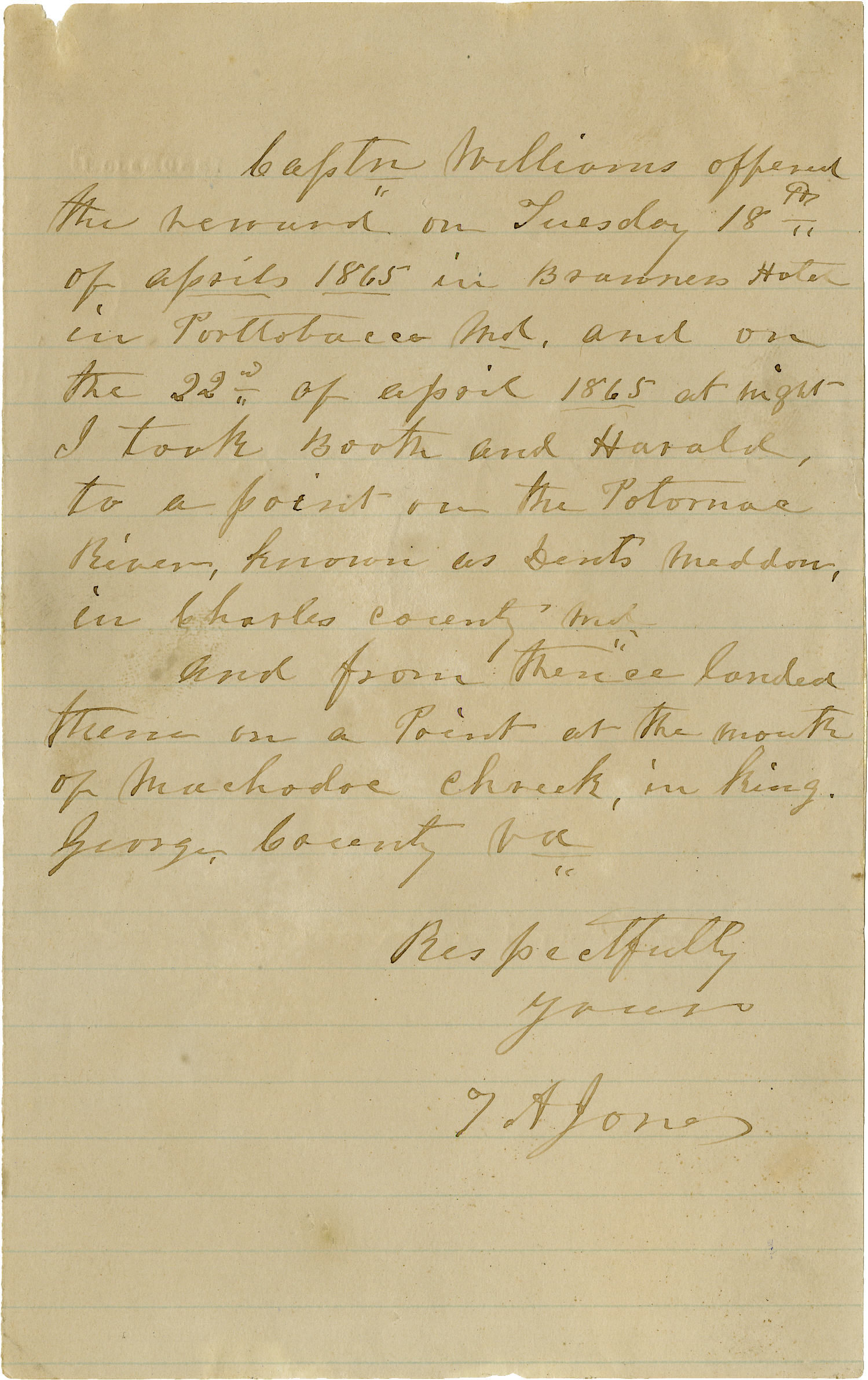
A quick note from Thomas Jones

In this undated mini-letter (or lengthy autograph), Thomas Austin Jones succinctly attests to his role in hiding the aiding the fugitives.

“Captn Williams offered the reward on Tuesday 18th of April 1865 in Brawner’s Hotel in Port Tobacco,Md.And on the 22d of April 1865 at night I took Booth and Harold to a point on thePotomac River, known as Dent’s Meadow, in Charles County, Md.

And from thence landed them on a Point at the mouth of Machodoc Chreek, in King George County, Va.

Respectfully yours

T. A. Jones”

Categories: Uncategorized | Tags: , , | 2 Comments

Blog at WordPress.com.