Posts Tagged With: Lincoln

New Section: Calendar

2015 is going to be very busy for those interested in the assassination of Abraham Lincoln. While the actual 150th anniversary of the tragedy will occur on April 14th, many groups are planning commemorative events throughout the year.

fords-150-remembering-lincoln

In an effort to provide a resource for those who may be looking to attend a Lincoln assassination remembrance this year, I have created a custom Google calendar of events.

Some events are multi-month exhibits at various museums, while others are single day speeches or activities. While most events are centered around the D.C., Maryland, and Virginia area, this calendar is not confined to that region. Clicking on any event will give you more information about it.  In addition, all of the information contained in this calendar has been translated into a list located on the side of this blog, allowing you to see upcoming events at a glance while reading any page here on BoothieBarn.  The code translating the calendar into list form isn’t perfect however, resulting in small errors and no clickable hyperlinks for more information.  If you want to learn more about an upcoming event, view the calendar below or on its own Calendar page, and the hyperlinks should function properly.

This calendar is a work in progress with new events being continually added.  If you know of an upcoming Lincoln assassination event or exhibit, please comment on the Calendar page and let us know about it so that it can be included.

A future post will highlight some of the really big events planned for this year (The Surratt Society Conference, Ford’s Theatre’s Lincoln Tribute, Charles County’s Lincoln 150, Caroline County’s Capture of John Wilkes Booth, and the Junius Brutus Booth Society’s first ever Tudor Hall and Booth Family Symposium), but until then you can check out the events for yourself in the new Calendar section!

Categories: Uncategorized | Tags: , , | 8 Comments

John Wilkes Booth: Snowbound

Today, as the New England region of the United States recovers from what is being called the “Blizzard of 2015”, I am reminded of another historic winter storm. To many in the Midwest, the winter of 1863/64 became frozen in their minds as one of the worst winters ever experienced. Between December and January, temperatures rarely went above freezing. On December 18, 1863, for example, Fort Kearny, Kansas, reported a temperature of 25 degrees below zero with snow four to five feet deep in places. New Year’s Day, 1864, brought along a massive blizzard for the Midwest, with places like Minneapolis, Minnesota, seeing a high of 25 degrees below zero that day.

It was around this time that John Wilkes Booth, a now successful and celebrated actor, was performing in Leavenworth, Kansas. He had been delayed in arriving at Leavenworth from his former engagement in Cleveland, Ohio, appropriately due to snow. However, this minor delay of a day would amount to nothing compared to what was in store for the actor.

John Wilkes Booth Gutman 24

Booth finished his engagement in Leavenworth on December 31. During his time there, critics spoke of his talents:

“Mr. Booth has not only genius, but careful culture and trained power of intellect. There is no actor now on the stage who displays so much of dramatic force and insight as Mr. J. Wilkes Booth, except, perhaps, for his brother Edwin. There is no imitation on the part of the junior, either to his renowned father or his now famous brother. He has a grace and charm all his own, though resembling them in genius, skill and painstaking care, with which his characters are presented on the stage.”

John Wilkes Booth set off from Leavenworth on January 1, 1864. In the morning, he made a brief visit to Fort Leavenworth, a few miles north of the city, to see some friends. This trip occurred on one of the coldest days on record and at a time when newspapers were describing the terrible winds thusly: “Ah, this is a blessed cold snap! Patient old Job may have seen colder weather, but he never undertook to walk up Sixth street facing such a wind as we felt yesterday. Not he. His reputation for patience would have been blasted. God help the shivering poor.” Booth later wrote of having “an ear frost bitten” by the time he arrived at the Fort.

Accompanying Booth during this western trip was a young, black man, possibly named Leav, about whom practically nothing is known other than he served as Booth’s valet and servant. Upon leaving Fort Leavenworth for the journey back to town in order to catch the ferry, Booth gave Leav some items to carry, including his pocket flask. Booth wrote the sorrowing effects of this decision in a letter to the man with whom he had been boarding with in Leavenworth:

Portion of a John Wilkes Booth letter in which he recounts the loss of his flask in the snow.

Portion of a John Wilkes Booth letter in which he recounts the loss of his flask in the snow.

“After giving my boy my flask to keep for me, I started for a run and made the river (four miles) on foot. I run without a stop all the way. I then found my boy had lost that treasured flask. I had to pay five dollars for a bare-backed horse to hunt for it. I returned within sight of the Fort and judge my dismay upon arriving to see a waggon just crushing my best friend. But I kissed him in his last moments by pressing the snow to my lips over which he had spilled his noble blood.”

Some have tried to use this visual of the actor, mourning the destruction of his flask and sucking the last bit of its spilled contents from the snow, as evidence that Booth was an alcoholic. While possible, I view the scene as entirely appropriate given Booth’s dramatic flair in a moment when the outside conditions so desperately warranted the “warming” effects of alcohol. Saddened as he was, things were still only going to get worse for the actor.

When Booth returned to the boat landing, he found that ice had prevented the ship from reaching the shore. Booth, along with others, helped to cut the ice in order to allow the boat to dock. The ship then took him across the Missouri River, and he slept that night across the river from Leavenworth in the town of Weston, Missouri. His end goal was St. Louis, where he was booked at Ben DeBar’s theater starting on January 5. On the morning of January 2, he boarded a train at Weston and took it north about 35 miles to St. Joseph. From there, he was hoping to catch a train with the Hannibal and St. Joseph Railroad, which would take him eastbound towards St. Louis. The weather, however, had other plans.

The blizzard of 1863/1864, known as “The Big Snow” by those who lived through it, occurred over an area of 3,000 miles, hitting a large portion of Illinois, Iowa, and Missouri. As one Missouri citizen later recalled, “a terrible snow storm set in and continued with unabated fury for forty-eight hours.” Near St. Joseph, the ground was covered with snow to a depth of about 27 inches, but areas east of St. Joseph had been hit even worse. Huge snow drifts occurred, completely covering the railroad tracks. Not one, not two, but eight trains along the Hannibal and St. Joseph Railroad were trapped in the snow, some buried up to thirty feet in it. The closest trapped train was only about 19 miles east of St. Joseph. All were unlikely to be freed anytime soon.

The cover of the January 23, 1864 edition of Harper's Weekly shows the condition of railroads across the Midwest.

The cover of the January 23, 1864, edition of Harper’s Weekly shows the condition of railroads across the Midwest.

By the time Booth had arrived at St. Joseph, no train had traversed the Hannibal and St. Joseph rails for the past week. Booth, like everyone else who came to St. Joseph hoping to go east, was completely snowbound. Local newspapers printed a report, later to be proven entirely too optimistic, that the train line might be up and running again in four days. With no other options available to him, Booth found a room at the now wholly overcrowded Pacific House hotel in St. Joseph.

Booth spent his first full day in St. Joseph on Sunday, January 3. Even after only a day, Booth likely empathized with the local newspaper, which wrote, “We are ‘in the wilderness,’ and can’t see any way to get out.”

On Monday, January 4, Booth’s reputation had caught up to him. After becoming aware that the famous tragedian was effectively stuck in their city, citizens of St. Joseph wrote a letter to Booth asking him to perform for them in some capacity. They wrote:

“J. Wilkes Booth, Esq., Pacific House:
Sir:
The Undersigned, citizens and travelers detained here, having learned that you were making a short visit to this city and entertaining a high appreciation of your ability as a tragedian, would most respectfully but earnestly request that you would favor us with a public reading from any of your favorite authors, at any time and place most convenient for you. When and where we pledge you an appreciative audience”

The request was then signed by 70 citizens and guests of St. Joseph, including the mayor. Booth, later wrote to a friend that he was down to his last cent in St. Joseph, and so he heartily agreed to the public’s demand of him. He wrote the following response to the invitation:

“Gentlemen:
Your flattering request has just been recieved and I endeavor to show my appreciation of it, by the promptness of my compliance. I have gained some little reputation as an actor, but a dramatic reading I have never attempted. I know there is a wide distinction as in the latter case, it is impossible to identify ones-self with any single character. But as I live to please my ones, I will do all in my power to please the kind friends I have met in St. Joseph.
I will therefore designate Tuesday evening, Jan. 5th, at Corby’s Hall. I am
Very Respectfully,
J. Wilkes Booth”

Despite his assertions to the contrary, Booth had, in fact, performed public recitations before. When he ran off with the Richmond Grays to attend the execution of John Brown, he had entertained his fellow soldiers with readings. That was, however, over four years ago when he was still but a novice actor.

The next day’s newspaper advertised the performance as its lead article, with the newspaper’s ironic political sentiments being the only thing preceding it in the issue.
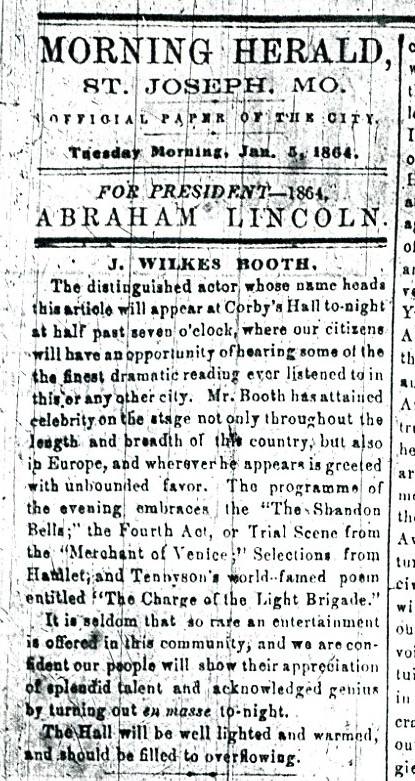
John Wilkes Booth will perfom with Lincoln ad 1-5-1864 St Joseph Morning Herald

In addition to reciting pieces contained in the article above, John Wilkes also took this chance to recite one of his favorite, and entirely appropriate, poems, “Beautiful Snow.” The newspapers hailed the performance the next day, stating:

“The dramatic reading of this celebrated actor last evening was well attended and gave universal satisfaction.  The Hall was well filled, but it was so very cold that everybody found it almost impossible to be comfortable. The selections of the reader were all rendered in a captial style, but we were particularly pleased with ‘Once I was Pure [Beautiful Snow]‘ and the ‘Charge of the Light Brigade.’ Our citizens would greet Mr. Booth with a crowded house could he be persuaded to repeat the entertainment.”

Booth did not perform again in St. Joseph despite the newspaper’s suggestion. It might have had something to do with the condition of the audience, which the newspaper scolded for their behavior during his recitations:

“It is inexplicable why full grown men will go about in a hall on such an occasion as that of last night, stamping like elephants, and moving chairs as though they were anvils. A trifle of good breeding is a capital thing to be used in keeping a hall quiet.  Stupid dolts who go thundering about the world, to the disgust of every sensible person, should be debarred from the privileges of Corby’s Hall during dramatic readings.”

Booth received $150 from the performance, which was greatly needed. Days were still passing with little sign that the trains would start running again. On Thursday, January 7, the temperature in St. Joseph at 9:00 am was twenty-one degrees below zero. Some days were better than others, however, with the newspaper celebrating the reappearance of the sun despite the “crisp, cold day”.

By Friday, January 8, it was clear that everyone was suffering from the prolonged freeze. The newspaper lamented, “Well, this is a big storm. In the memory of man, no such cold weather and no such fall of snow has been known as we are now suffering in. Hundreds of travelers are here, weatherbound.” An earlier report stated, “Our people are in a terrible fix. The snow has effectually shut us out from ‘all the world and the rest of mankind,’ and there is no prospect of relief.” John Wilkes Booth was now three days overdue for his engagement in St. Louis, 300 miles away. A man arrived in St. Joseph and related that he had taken the train west from Macon, the transfer point to St. Louis. The train made it west until Breckenridge, where the other stopped trains and snow prevented it from going further. Booth, realizing that if he could make it to Breckenridge, 60 miles to the east, he could catch the working trains to Macon and then St. Louis, decided to put an end to his snowy vacation in St. Joseph. With $100 of the money he had received from his public reading, Booth hired a four-horse sleigh to take him the 60 miles to Breckenridge. He departed on January 8, after spending about five and a half days in St. Joseph, Missouri.

The exact details of Booth’s journey by sleigh are not known for sure. He later wrote to his friend John Ellsler of the journey:

“[The performance at St. Joseph] gave me $150. with which I hired a sleigh and came 100 miles over the plains. Four days and nights in the largest snow drifts I ever saw Its a long story which I want to tell you when I see you, but I will say this that I never knew what hardship was till then.”

There are two individuals who, many years later, gave accounts regarding Booth’s time in the snow. One of them was William D. Bassett, then a 16-year-old railroad telegraph operator stationed in Cameron, Missouri. Around the turn of the century, various newspaper articles were published featuring Bassett’s recollections of The Big Snow. Bassett stated that he shared his comfortable room at the Cameron depot with Booth after Booth arrived, along with this theatrical troupe, in Cameron by train. The way Bassett portrays it, Booth was never trapped at St. Joseph, but, instead, with him at Cameron. All of this is suspect and is contrary to the facts. However, it is possible that Bassett has some truth in his accounts. Perhaps, Booth, while on his four-day sleigh journey to Breckenridge, stopped in Cameron to rest for a day or two and found hospitality with young Bassett in the depot. Cameron was just about halfway between St. Joseph and Breckenridge, making it an extremely appropriate spot to rest before moving on. In Bassett’s recollections of their time together, he states that Booth was fond of literature and that the pair spent some time reading Victor Hugo’s Les Misérables together. Booth was also apparently quite entertained when, upon visiting the local bar one morning, he found a captive audience of customers waiting patiently as the bartender was attempting to thaw out bottles of whiskey that had frozen solid.

Probably the most entertaining of Bassett’s recollections involves Booth’s interactions with the children of Cameron. From other accounts, we know that John Wilkes Booth was very fond of children and was fairly gifted at conversing with them. According to Bassett:

“Several little children played around the depot everyday while Booth was there, and with these innocent creatures he soon became a prime favorite. He would teach them games and engage in snowball battles with them. Sometimes they would all join against him and give him much the worst of it, but he took it all in perfect good nature, and was as rollicking and boisterous as the best of them. For many weeks after his departure the little girls and boys would ask me when ‘Mr. Boots’ was coming back.”

A newspaper article containing Bassett’s memories, published in 1901, includes this wonderful drawing of the event.

Snowbound John Wilkes Booth The Republic 8-4-1901

Even if Bassett’s accounts are untrue, I have no problem believing that, at some point in his life, whether it be during the many days he spent at St. Joseph or a previous snowy winter, John Wilkes Booth engaged some local children in a snowball fight. His affinity for children makes this a very likely scenario.

One of the other individuals who later spoke of Booth’s time in the snow was an actress named Mrs. McKee Rankin. According to an article by her published in 1909, she heard Booth recount some of the struggles he faced during his sleigh ride to Breckenridge. It is very difficult to put any reliability in her account, however. Not only was it published 45 years after the event, but Mrs. Rankin also admits that she is remembering the story told by Booth to a friend while she was listening through a transom in a different room. The account is filled with factual errors regarding the events and, in truth, is barely worth the paper it is written on. However, it is still an extremely entertaining read. Surprisingly, the one thing Mrs. Rankin does get right is the inclusion of Booth’s otherwise forgotten servant. She recalls an exciting tale in which Booth and Leav hire a horse named “The Girl” to lead their sleigh. At one point, it is so dark that the men went right over a snow drift, sending them flying from the sleigh. As Mrs. Rankin wrote it, after the accident, poor Leav was like a cartoon character with his head and body buried while his legs and feet stuck out of the snow. Booth pulled him out, and together they righted the sleigh. Leav was freezing cold and buried himself under robes and blankets on the sleigh. While Booth recovered himself, he bent down to get a drink of whiskey from a jug they had brought along, only to find that it had broken. After lighting a half-broken cigar, Booth heard footsteps approaching. He tried to rouse Leav, but at that point, Leav was unconscious, wrapped in the sleigh. As the footsteps got closer, Booth drew long on his cigar, hoping to see something in the darkness. Then he felt the panting of an animal before him and saw two balls of fire reflecting in the eyes of an animal before him. It was a wolf! In that instant, the “heroic” Booth grabbed the broken piece of whiskey jug and brought it down right onto the head of the beast. Before getting a chance to see how many wolves were out there, “The Girl” let out a yelp and, with a bound, was pulling the sleigh away at top speed. According to Mrs. Rankin, the horse, at a dead run, didn’t stop until they reached their destination.

While it’s safe to say that probably none of Mrs. Rankin’s account is true, it is at least possible that Booth said some of these falsehoods to make a good story. In fact, another actor by the name of Edwin Adams recalled another likely case of Booth adding flourish to a story:

“I heard [Booth] boasting over a long and tedious journey from Leavenworth across the prairies in a sleigh to St. Louis and after of having threatened a conductor’s life, who had stopped his train on account of the great depth of snow, and that by placing a pistol to his head, made him continue his journey.”

The truth of Booth’s journey, however, is far less flashy. On Monday, January 11, John Wilkes Booth, his servant, and his sleigh team had made the cold trek of sixty miles from St. Joseph to Breckenridge. The tracks on the Hannibal and St. Joseph Railroad were clear from that point eastward. Booth caught the first train he could eastward. At Macon, he transferred from the Hannibal and St. Joseph Railroad to the Northern Missouri Line. This line took him southeast, all the way to his destination of St. Louis.

He opened at the St. Louis Theatre on Tuesday, January 12, exhausted but not wanting to lose any more days from his engagement. The Big Snow had caused him to lose seven days of performances—and pay. The toils of his journey had taken much out of him. One of the stock actors in the company later wrote, “[Booth] told me of his hardships in coming down from [St. Joseph] to fill his date in St. Louis, and that he had made the greater part of the journey in sleds…He looked worn out, dejected and as melancholy as the dull, gray sky above us…After ordering beer, he sat gloomily and silent for a time, and upon my asking him the cause, he smilingly answered that no doubt it was the rough experience he had passed through lately.” Booth would only perform five times in St. Louis before he had to move on to his next engagement in Louisville, Kentucky.

Just as the residents of Boston will long remember the Blizzard of 2015, so did John Wilkes Booth retain a memory of his run-in with the Big Snow of 1863/64. He spent just under a week snowbound in St. Joseph, Missouri, and, when he could take it no longer, he braved the harsh weather by sleigh for four days. In less than a year and a half, John Wilkes Booth would again be braving the elements for a chance at freedom as he ran for twelve days, attempting to flee one of the largest manhunts in American history.

References:
John Wilkes Booth: Day by Day by Art Loux
“Right or Wrong, God Judge Me”: The Writings of John Wilkes Booth edited by John Rhodehamel and Louise Taper
January 1, 1864 – January 9, 1864 editions of the St. Joseph Morning Herald
Snowbound with John Wilkes Booth at Cameron, MO by William F. Bassett in The St. Louis Republic Magazine, August 4, 1901
The News of Lincoln’s Death by Mrs. McKee Rankin
The Lincoln Assassination: The Evidence edited by William Edwards
Recollections of an Old Actor by Charles A. Krone
Harper’s Weekly
The Art Loux Archive
GenealogyBank.com

Categories: History | Tags: , , , | 3 Comments

Mapping the Assassination

I came out to Washington, D.C. for the very first time in 2009.  It was the summer between my junior and senior year of college and the trip was an early graduation gift from my parents.  My father and I had a great time exploring the many wonderful sites before returning back home to Illinois.

Two Illinois natives visiting an old friend.

Two Illinois natives visiting an old friend.

It was a whirlwind visit as we tried to do all the touristy things D.C. has to offer.  We visited the Lincoln Memorial, Ford’s Theatre, the Air and Space Museum, the American History Museum, the National Portrait Gallery, the Library of Congress, the Jefferson Memorial, the FDR Memorial and the Newseum.  We paid our respects at the World War II, Korean, and Vietnam Memorials, as well as visited Arlington National Cemetery and the Marine Corps War Memorial.  We also went up into the Washington Monument, and viewed both the House of Representatives and the Senate in session.  It was a blast.

Admittedly though, my favorite part of the trip was the one day in which my father and I rented a car from Union Station and drove the escape route of John Wilkes Booth.  I had been learning about the assassination for years and I couldn’t wait to visit some of the places I had read so much about.  My father always appreciated Lincoln, so much so that he volunteered not once, but four times to chaperone groups of rowdy eighth graders on their annual class trip to Springfield, IL.  Though Dad doesn’t have the same interest in Lincoln’s assassination as I do, he definitely appreciates the importance of it.

In planning for our day trip, I spent hours tracking down the various locations we wanted to go and printing off directions on how to get there.  It was a difficult process.  I often had to consult many different websites just to figure out where exactly a certain place was.  It took awhile, but in the end, I managed to work up an itinerary.

Our condensed tour was great, except for one hitch.  On our way to the Mudd house I had planned for us to stop and visit the grave of Edman Spangler.  Dad and I pulled up at St. Peter’s Cemetery and spent about an hour looking at every single grave in the place to no avail.  We were almost late for the last tour of the day at the Mudd house due to our searching.  When we told the people at the Mudd house of our difficulty they informed us of our mistake.  “Spangler,” they said, “is buried in the Old St. Peter’s Cemetery.” Dad and I had spent an hour trampling through the wrong cemetery.

This completely understandable mistake has always stuck with me.  It makes me laugh to think of the time Dad and I wasted reading every grave in the new St. Peter’s Cemetery (which, by the way, is down the road from the old cemetery).  It shows how helpful and important it can be to have a guide.

Since moving to Maryland I have been lucky to have the guidance of many knowledgeable individuals.  As time has gone on, I’ve slowly become a guide myself and I am able to point out places relating to the assassination of Lincoln around D.C., Maryland, and Virginia.  Some time ago I started a project of recording the locations of various assassination places using a mapping app called Rego.  At first it was just for my own reference as I pinpointed places I had visited or places that I wanted to visit.  This summer I drove a circuitous route to Illinois and back so I could visit a few of those places on my list.

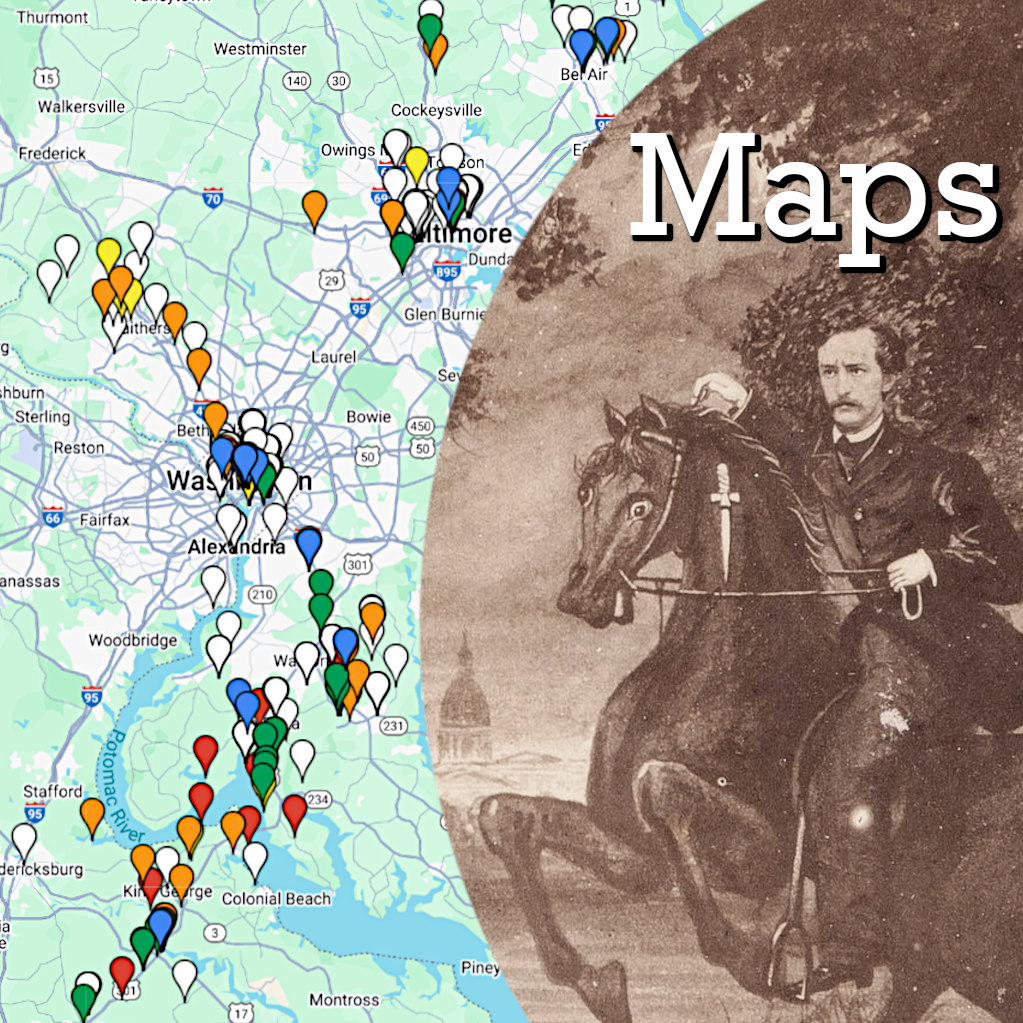
In August, I decided to make my map widely available.  I converted my Rego map into a custom Google map complete with a color coded key.  Without fanfare or announcement, the new page on BoothieBarn appeared called Lincoln Assassination Maps.

Maps Header Menu Maps Pages Menu

About a month after I created the page, I received a wonderful email from a man who took his grandson along the escape route and used my map to help them plot their course.  I emailed him back expressing how ecstatic I was that someone had not only found the map but used it as I had hoped.  Since then I’ve been slowly adding more places to the map expanding far beyond the escape route.  Using aerial views and my own knowledge, I’ve tried to pinpoint places as specifically as I can, even putting markers directly on top of where graves are in a cemetery in some cases.  Currently, the only map on the Lincoln Assassination Maps page is one that covers D.C., Maryland, and the Northern Neck of Virginia.  Though it already contains about 100 sites, it, by no means, is complete.  Future maps will highlight places in other regions such as the Midwest, the South, the Northeast, and even an International map.

With a subject as vast as the assassination of Lincoln, a guide is much needed commodity.  I hope that these maps will serve as beneficial guides for those of you who want to explore the plethora of assassination related sites.

Click HERE to check out the BoothieBarn Lincoln Assassination Maps page!

DC, MD, VA Assassination map thumb

Categories: Uncategorized | Tags: , , , , | 12 Comments

John Wilkes Booth’s Movements at Ford’s Theatre

It is well known that John Wilkes Booth assassinated President Lincoln in his theater box, jumped to the stage, and escaped out of the back door of Ford’s Theatre.  These hurried moments at Ford’s instigated a massive manhunt that lasted twelve days and ended with the death of the assassin.

The moments that preceded John Wilkes Booth’s firing of his derringer are not as well known.  John Wilkes Booth was intimately familiar with the layout, and people, of Ford’s Theatre.  It was like a second home to him insomuch that he even had his mail delivered to Ford’s when he was in Washington.  This familiarity allowed Booth to move about Ford’s Theatre without arousing suspicion.  What follows is an account of Booth’s movements at Ford’s Theatre in the time before he shot the president.

Ground Floor of Ford's Theatre and Baptist Alley plan

John Wilkes Booth had a busy day on April 14th.  His preparations to assassinate the President took him to the Herndon House hotel to alert his conspirators, the Kirkwood House hotel to leave a suspicious note for Vice President Johnson, and near Willard’s hotel to give a note to John Mathews which would justify his later actions.  Booth also visited Mary Surratt’s boarding house on H street three times that day.  It was after his third visit, where Mrs. Surratt confirmed she had given John Lloyd the message that parties would be calling for the hidden weapons tonight, that John Wilkes Booth walked to Ford’s Theatre.  He first went into the Star Saloon owned by Peter Taltavul. It was located right next door to Ford’s Theatre.  He briefly drank there with some of the stagehands from Ford’s, including Edman Spangler, since the play for that night, “Our American Cousin“, was at an intermission.  He found himself drinking alone when the men we called to curtain.

From the Star Saloon, Booth made his way to Baptist Alley behind Ford’s Theatre and got his horse, a bay mare, out of her stable. Spangler built the stable for Booth and took care of it for him.  Booth walked his horse to the back door of Ford’s Theatre. At the back door, Booth called for Spangler, who he hoped would hold his horse until he would need it.   Booth was told by another stagehand that Spangler was needed for an upcoming scene change and so Booth waited with his horse.  After the change, Spangler came out and agreed to hold Booth’s horse.  Booth entered the back door of Ford’s.  The current scene of the play left Booth with no room to sneak across.

The back wall of Ford's Theatre from backstage.  When Booth tried to go across here, there was not enough room.

The back wall of Ford’s Theatre from backstage. When Booth tried to go across here, there was not enough room.

Instead, he lifted a trap door and descended a staircase that led under the stage.  This was a T shaped passageway that was used by stagehands to cross the stage underground and for the musicians to reach the orchestra pit.  Booth emerged by ascending another flight of stairs and opening a trap door on the opposite side.

From there, Booth exited a stage door and into a covered alleyway between Ford’s Theatre and the Star Saloon.  He exited the passageway right out onto Tenth St.  Various witnesses put Booth in the theater lobby and at the Star Saloon at different times which makes knowing his precise course impossible.  However, a likely scenario would have Booth entering the lobby of Ford’s Theatre after exiting the alleyway.  He walked past the ticket taker, John Buckingham, who instinctively held out his hand for a ticket until he realized it was Booth.  Buckingham said that Booth entered the theater and stood behind the seats watching the production (and the President’s box) for some time.

As this was going on, Spangler had grown tired of caring for Booth’s horse.  He called for Peanut John, a young man who acted as an errand boy for the theater, to come out and take his place.  With Peanut holding the reigns, Spangler returned to work.

John-Wilkes-Booth-at-Ford's

An animated clip showing, approximately, Booth’s movements at Ford’s Theatre on April 14, 1865.

Booth exited the theater and walked next door to the Star Saloon.  Here he had a glass of whiskey and some water to chase it down.  He also acquired a cigar and began puffing away.  Cigar in mouth, Booth returned to the lobby of Ford’s.   Booth entered the main floor of the theater again and watched the production some more.  Upon exiting, he conversed with Harry Ford who was in the ticket office counting receipts.  Booth placed his half smoked cigar down on the window’s ledge and joked with Ford that no man should disturb his cigar.

As stated before, Booth’s movements are not an exact science.  It is likely that Booth, anxiously passing the time while waiting to strike, repeatedly traveled between Ford’s Theatre and the Star Saloon, attempting to gain courage with every drink.  Eventually, however, Booth realized that it was time to strike.  From the lobby of Ford’s Theatre, Booth ascended the staircase which led him to the balcony level.

Booth crept across the back of the dress circle level.  As he approached closer to the president’s box he stopped and noticed a guard sitting in front of the entryway to the boxes.  He removed his hat, and took out something, probably a calling card, from his pocket.  He then approached the man and presented the card to him.  He was allowed to pass and entered the vestibule with led to the boxes.  Booth closed the door and, using a bar he had hidden there earlier, he wedged the door shut.  The door to Box 8, which was at the end of the passageway, was open.  With his single shot derringer in hand and a large Rio Grande Camp knife at the ready, Booth entered the President’s box through door 8, turned left, and shot Abraham Lincoln in the head at close range.

The Shot 14 National Police Gazette 4-22-1865

Booth cried out “Sic Semper Tyrannis” and dropped the gun.  He raised the knife in his hand as Major Rathbone, one of the President’s guests that night, rushed at him.  Booth tried to stab Rathbone in the chest but Rathbone parried the strike and took it in his left arm instead.  Booth then ran to the front of the box, put his hands on the railing, and leaped over.  He fell almost twelve feet to the stage below.  He landed awkwardly, either due to a last minute grab by Rathbone or his spur catching one of the decorative flags adorning the box.  In a moment he raised himself up and with quick speed made his way across the stage, perhaps pausing briefly at center stage to raise his knife and shout “The South shall be Free!”  Booth ran into the wings and towards the back door he originally entered through.  William Withers, the orchestra director, unknowingly got in his way and Booth pushed him away, cutting his vest in the process.  Booth reached the back door, rushed through it, and shut the door close behind him.

In the alley, Booth shouted at Peanut John to, “Give me the horse!”  Booth knocked Peanut away using the butt of his knife and a firm kick.  He swiftly mounted the horse and put spurs to her.  She dashed down Baptist Alley.  Booth turned her northward and exited out onto F Street.  He would soon escape D.C. via the Navy Yard bridge and America’s largest manhunt would begin.

References:
Backstage at the Lincoln Assassination by Thomas A. Bogar
Restoration of Ford’s Theatre by George Olszewski
American Brutus by Michael W. Kauffman
The Art Loux Archive

Categories: Uncategorized | Tags: , , , , , | 7 Comments

The National Museum of Health and Medicine and the Lincoln Assassination

The National Museum of Health and Medicine is a medical museum located in Silver Spring, Maryland.  The museum has a long history and was originally founded during the Civil War as the Army Medical Museum.  Its original purpose was to be a repository for, “all specimens of morbid anatomy, surgical or medical, which may be regarded as valuable; together with projectiles and foreign bodies removed, and such other matters as may prove of interest in the study of military medicine or surgery.” Since its founding to today, the museum has amassed a collection of nearly 25 million medical artifacts.  Though less than 1% of the collection is on display at the Silver Spring facility due to space constraints, the museum is, nevertheless, filled to the brim.  Walking into the museum, guests quickly come face to face with medical oddities and fascinating exhibits.  A wonderful museum in its own right, the NMHM has also become intimately connected with the story Lincoln’s assassination through the years.

A Place to Rest My Bones

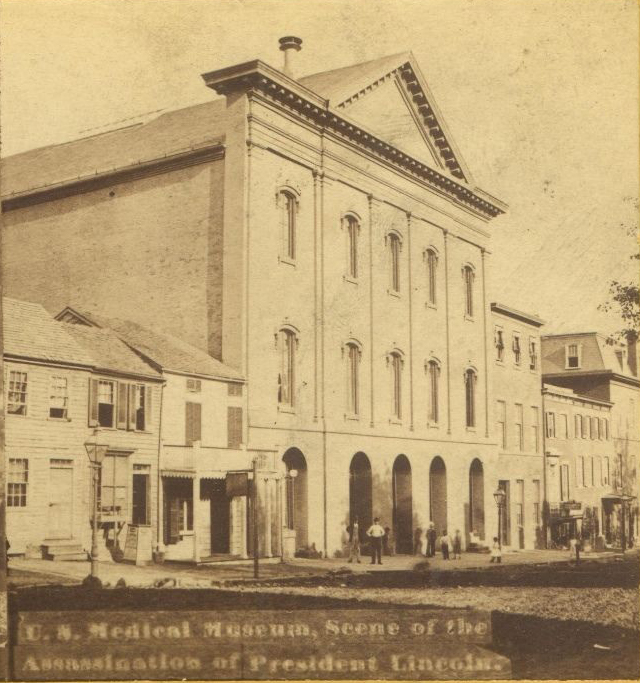
Having been founded during the Civil War, the collection grew rapidly during its first few years as surgeons on the field of battle began sending in specimens.  By 1866, the museum was on its third home in Washington, D.C. and required even more space.  Luckily for them, on April 6, 1866, an Act of Congress was passed providing for the purchase of a building “for the deposit and safekeeping of documentary papers relative to the soldiers of the army of the United States and of the Museum of the Medical and Surgical Department of the Army.”  The chosen building was Ford’s Theatre the site of Abraham Lincoln’s assassination almost a year before.

Ford's Theatre Army Medical Museum Label

The building was closed down by the U.S. government in the aftermath of the assassination.  Though the building was returned to John T. Ford for a time, public outcry and threats to burn the building if it was once again opened as a theater forced the government to seize the building permanently.  At first they rented it from Ford before buying it straight out thanks to the approval of the above mentioned Act of Congress.  The interior of the building was remodeled from a theater into a three story office building.  On December 22, 1866, the top floor of Ford’s Theatre officially became the Army Medical Museum’s fourth home.

Here are some pictures of the interior of the Army Medical Museum when it was held on the third floor of Ford’s Theatre.  Most of these come from the blog “A Repository for Bottled Monsters” which is written by a former archivist of the museum:

This slideshow requires JavaScript.

By 1887, the museum had once again outgrown its surroundings and moved into a building made solely for its purpose. This brought an end to the Army Medical Museum’s occupation of Ford’s Theatre. In hindsight the move in 1887 proved lucky. Six years later, in 1893, poor workmanship by a crew excavating in the basement of Ford’s caused a structural pier to give way, causing a 40 foot section of all three floors to come crashing down, killing over 20 government clerks and wounding many others.

Booth’s Spine Tingling Return

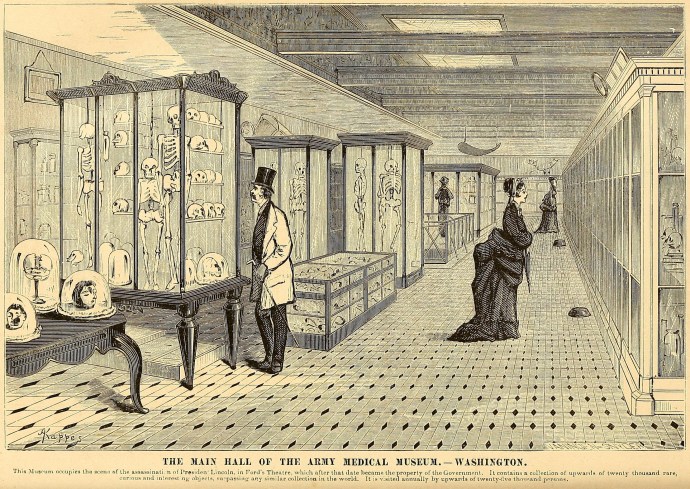
When it was housed inside Ford’s Theatre, the Army Medical Museum was a popular tourist destination in Washington. The museum saw about 40,000 visitors in 1881 alone.  In 1873, a book was published called, Ten Years in Washington: Life and Scenes in the National Capital as a Woman Sees Them by Mary Clemmer Ames.  In her book, Ms. Ames described a visit to the Army Medical Museum and points out the many oddities on display.  The book also contains this engraving of the museum inside of Ford’s:

Army Medical Museum in Ford's Theatre engraving 1873

As part of her description of some of the artifacts, Ms. Ames states the following:

“Amid the thousands of mounted specimens in glass cases, which reveal the freaks of bullets and cannon-shot, we come to one which would scarcely arrest the attention of a casual observer. It is simply three human vertebra mounted on a stand and numbered 4,086. Beside it hangs a glass phial, marked 4,087, filled with alcohol, in which floats a nebulse of white matter. The official catalogue contains the following records of these apparently uninteresting specimens:

‘No. 4,086. — The third, fourth and fifth cervical vertebrae. A conoidal carbine [sic] ball entered the right side, comminuting the base of the right lamina of the fourth vertebrae, fracturing it longitudinally and separating it from the spinous process, at the same time fracturing the fifth through its pedicles, and involving that transverse process. The missile passed directly through the canal, with a slight inclination downward and to the rear, emerging through the left bases of the fourth and fifth laminse, which are comminuted, and from which fragments were embedded in the muscles of the neck. The bullet, in its course, avoided the large cervical vessels. From a case where death occurred in a few hours after injury, April 26, 1865.’

‘No. 4,087.— A portion of the spinal-cord from the cervical region, transversely perforated from right to left by a carbine [sic] bullet, which fractured the laminse of the fourth and fifth vertebrae. The cord is much torn and is discolored by blood. From a case where death occurred a few hours after injury, April 26, 1865.’

Such are the colorless scientific records of the death wounds of John Wilkes Booth. All that remains of him above the grave finds its perpetual place a few feet above the spot where he shot down his illustrious victim.”

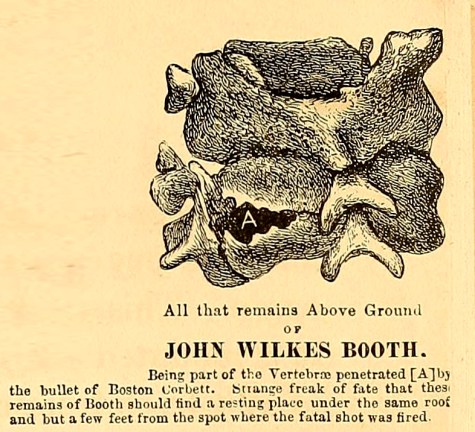
After John Wilkes Booth was killed at the Garrett farm, his body was brought back to Washington and deposited aboard the ironclad ship, the U.S.S. Montauk. It was there that Booth’s autopsy was performed. The body was thoroughly identified and the section of Booth’s vertebrae, through which Boston Corbett’s pistol ball had passed, was removed. In addition, an inspection of Booth’s broken leg was made and, for some reason, his thoracic cavity was opened. Shortly after the autopsy was performed, Booth’s body was taken to the Arsenal Penitentiary and secretly buried. In 1869, Booth’s body and the bodies of the executed conspirators were released to their families.  Booth’s vertebrae along with a piece of his spinal cord, however, found their way into the collection of the Army Medical Museum and were in the collection by 1866 according to one of the museum’s collection catalogs. John Wilkes Booth’s vertebrae and spinal cord were publicly on display at Ford’s Theatre in 1873 when Ms. Ames visited. Here is an 1873 engraving of the bones that she included in her book:

Booth's Vertebrae drawing Ten Years in Washington

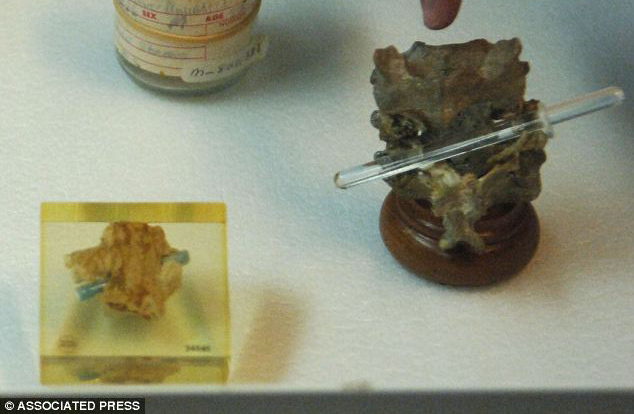
The vertebrae and spinal cord of John Wilkes Booth are still part of the collection of the National Museum of Health and Medicine though they are not currently on display at the Silver Spring facility.  Here is a picture of the specimens taken a few years ago by the AP:

Booth vertebrae spine AP

I am hoping to make an appointment to view the vertebrae and piece of spinal cord in person and to look through the NMHM’s records regarding this artifact.  Hopefully a follow up will be posted at a later date. UPDATE: Click here to read about my research visit with John Wilkes Booth’s vertebrae.

When Powell Lost his Head

At the same time that John Wilkes Booth was assassinating President Lincoln at Ford’s Theatre, conspirator Lewis Powell was attacking William Seward, the Secretary of State, in his home.  Powell stabbed and bludgeoned five people in the Secretary’s home, but, miraculously, they all survived their brushes with death.  Powell was tried with the other conspirators and executed on July 7, 1865.  His body was immediately buried next to the gallows on the Arsenal Penitentiary grounds.

9 The Pine Boxes

In 1867, Powell’s body was disinterred and reburied in a trench that was dug inside a warehouse on the Aresnal property.  There he was joined by the bodies of fellow conspirators John Wilkes Booth (minus his vertebrae), David Herold, George Atzerodt, and Mary Surratt.  The trench also contained the remains of Andersonville Prison commandant Henry Wirz who had been executed for his wartime crimes in November of 1865.  In the waning hours of Andrew Johnson’s presidency in February of 1869, Johnson finally consented to the release of the conspirators’ bodies to their respective families.  The bodies of Booth, Herold, Surratt, Atzerodt, and Wirz were all claimed and reburied by their families.  Powell’s family, who had previously tried to claim the remains and had been denied, were not made aware that they could now take possession of their kin.  For a year, Powell’s body remained the only one still buried on the Arsenal grounds.  Finally, in February of 1870, an undertaker named Joseph Gawler (who also handled the reburial of David Herold) took possession of Powell’s body and had it buried secretly in one of D.C.’s cemeteries.  1870 newspaper accounts stated that, “family and friends could find his grave by contacting him [Gawler] as he had a record of where he is buried.”  The Powell family, who had moved a few times in Florida since Lewis’ death, apparently never heard the news.

The location of Powell’s remains from 1870 onward is a little fuzzy, but an extremely probable series of events was determined by Lewis Powell’s biographer, Betty Ownsbey, in an article she wrote for the October 2012 edition of the Surratt Courier entitled, “And Now – The Rest of the Story: The Search for the Rest of the Remains of Lewis “Paine” Powell“.  Using newspaper sources and cemetery records, it appears that Powell was originally transported from the Arsenal and interred in Graceland Cemetery.  At some point between 1870 and 1884 Powell was removed from Graceland and placed in Holmead Cemetery.  Not long after he was placed there, Holmead Cemetery was discontinued as it was considered a public health hazard.  The land was slated to be sold and developed in January of 1885.  Families with means disinterred their loved ones from Holmead and reburied them elsewhere.  All the unclaimed bodies still left in Holmead were exhumed in December of  1884 and dumped into a mass grave at nearby Rock Creek Cemetery.  Joseph Gawler was one of the undertakers who assisted with this endeavor.  By 1884 it had been almost 20 years since Lewis Powell’s death and it must have been very clear to Gawler that no one was coming for the body and that he was not going to be paid for the work he had done keeping track of it over the years.  It is with a very high likelihood that Gawler added Lewis Powell’s remains to the mass grave at Rock Creek and his body is there today in Section K, Lot 23.

The assumed resting place of Lewis Powell's body, Section K, Lot 23 in D.C.'s Rock Creek Cemetery

The assumed resting place of Lewis Powell’s body, Section K, Lot 23 in D.C.’s Rock Creek Cemetery (approximate location)

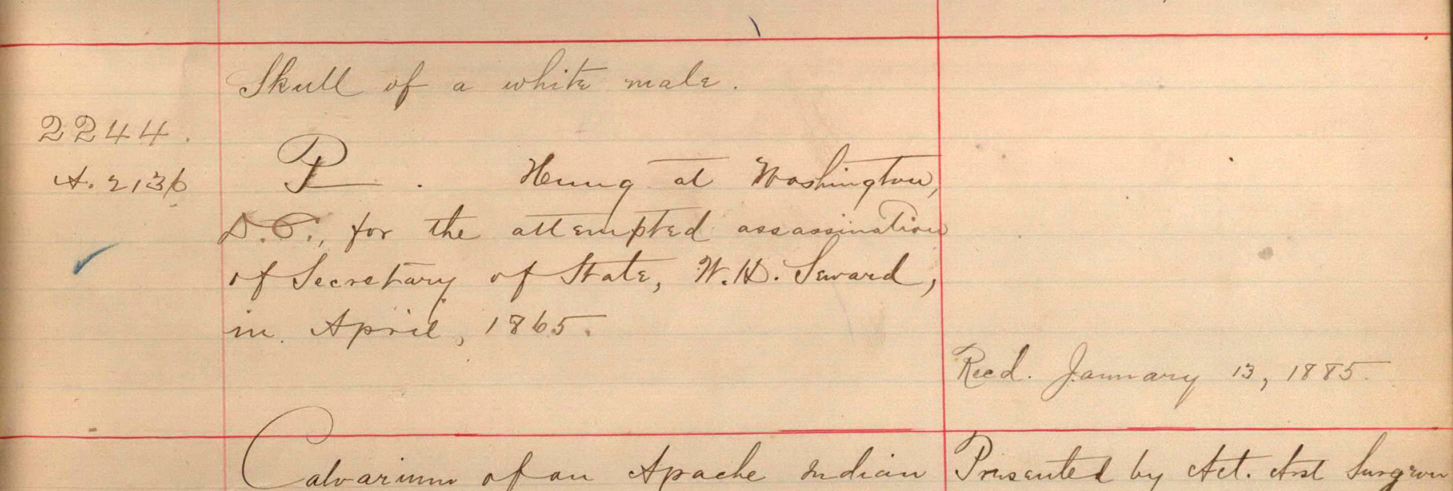
While Lewis Powell’s body may be at Rock Creek Cemetery, his head definitely isn’t.  The conspirators were not embalmed upon their deaths and through their subsequently reburials, their bodies were consistently exposed to oxygen which accelerated their decay.  The connective tissues of Powell’s head and neck, likely damaged by his hanging in 1865, would have quickly decomposed away separating his head from the body.  According to newspaper accounts, a few of the conspirator’s heads were separated from their bodies when they were disinterred in 1869.  Almost 20 years of decomposition later would have essentially stripped the bone of all tissues.  Therefore, when Joseph Gawler or his associates opened Powell’s casket at Holmead in 1884, it would have been a very easy task for them to collect the skull and take it.  That is exactly what occurred for on January 13, 1885, the Army Medical Museum added a new artifact to their collection.  Numbered 2244, the anonymous donation was entered into their catalog as a, “Skull of a white male.” A short description followed:

“P. Hung at Washington, D.C., for the attempted assassination of Secretary of State, W. H. Seward, in April, 1865.”

Powell's skull entry Army Medical Museum catalog

The museum, still located inside of Ford’s Theatre in 1885, now held the remains of not only the assassin of President Lincoln, but the would be assassin of his Secretary of State.

Lewis Powell's Skull Ownsbey

Unlike John Wilkes Booth’s vertebrae and spinal cord, Lewis Powell’s skull is no longer in the collection of the National Museum of Health and Medicine.  In 1898, the skull was transferred, along with many Native American remains, to the Smithsonian Institution.  For about 94 years the skull sat in storage in the Smithsonian’s Anthropology department.  In 1990, the Native American Graves and Repatriation Act became law.  The act required any institutions that accepted federal funding to return Native American cultural items, including remains, to their appropriate tribes.  In adherence to this law, the Smithsonian began the process of going through their collections.  In 1993, a government anthropologist named Stuart Speaker, who had once worked at Ford’s Theatre, discovered Lewis Powell’s skull among a collection of Native American remains.  Assassination researchers Michael Kauffman, Betty Ownsbey, and James O. Hall were brought in to help identify the skull:

Authors Michael Kauffman and Betty Ownsbey with Lewis Powell's skull

Authors Michael Kauffman and Betty Ownsbey with Lewis Powell’s skull

On November 11, 1994, one hundred and twenty-nine years after his death, a part of Lewis Powell was finally buried by his living relatives.  His skull rests today at Geneva Cemetery in Geneva, FL, next to the grave of his mother.

Relics of a Martyr

If you were to take a  visit to the National Museum of Health and Medicine today, you would come across an exhibit case entitled, Lincoln’s Last Hours.

NMHM Lincoln's Last Hours exhibit

This exhibit contains several artifacts relating to the death and autopsy of President Lincoln.  The items on display include the Nélaton probe used on the dying president to trace the path and depth of his wound, a snippet of his hair taken at his deathbed, fragments of his skull taken at his autopsy, a shirt cuffed stained with Lincoln’s blood, and  the bullet that ended his life.  The exhibit case also contains a plate that was given to Surgeon General Barnes by William Seward as a thank you for tending to his wounds at the hands of Lewis Powell.  Here is a slideshow of the artifacts on display:

This slideshow requires JavaScript.

Most of these Lincoln relics did not come into the collection of the medical museum until around WWII. Prior to that, the pieces were held by the War Department as the bullet which killed the president had actually been an exhibit at the trial of the conspirators in 1865. In 1940 the bullet, skull fragments, and probe were transferred from the Judge Advocate General’s office to the newly created “Lincoln Museum”. This museum was housed inside of Ford’s Theatre and contained Osborn Oldroyd’s collection of Lincolniana. While the Lincoln Museum kept most of the items given to them by the JAG office (including the murder weapon), they decided against retaining these, almost literal, blood relics of Abraham Lincoln. They were transferred from Ford’s to the Army Medical Museum. Further research is needed to determine exactly when they entered the collection but it is likely that, for the briefest of time, these pieces of Abraham Lincoln were housed at Ford’s Theatre.

Conclusion

The National Museum of Health and Medicine is a modern treasure that tells the story of America’s medical past, present, and future. If you get a chance, visit the NMHM.  They are a free museum open every single day (except Christmas) from 10:00 am to 5:30 pm. During its lifetime, the museum has crossed paths with the Lincoln assassination story several times.  It was the first museum to be housed inside of Ford’s Theatre, it reunited a piece of the assassin with one of his conspirators at the scene of the crime, and, today, it displays relics of our 16th President.

References:
National Museum of Health and Medicine History
A Repository for Bottled Monsters
NMHM’s Flicker page
Ten Years in Washington: Life and Scenes in the National Capital as a Woman Sees Them by Mary Clemmer Ames
Alias “Paine”: Lewis Thornton Powell, the Mystery Man of the Lincoln Conspiracy by Betty Ownsbey
And Now – The Rest of the Story: The Search for the Rest of the Remains of Lewis “Paine” Powell” by Betty Ownsbey, Surratt Courier, Oct. 2012
Army Medical Museum Collection, Anatomical Section IV Logbook (MM 8759-3)
The Lincoln Assassination: Where are They Now? A Guide to the Burial Places of Individuals Connected to the Lincoln Assassination in Washington, D.C. by Jim Garrett and Richard Smyth

A very special thanks to Betty Ownsbey for talking me through the saga of Lewis Powell’s burials and for providing the pictures of his skull.

Categories: Uncategorized | Tags: , , , , , | 20 Comments

Reagan Library’s former Lincoln Exhibit

Reagan Library Lincoln Exhibit catalog

From June through September of 2013, the Ronald Reagan Presidential Library in Simi Valley, California hosted an exhibit entitled, “A. Lincoln: Railsplitter to Rushmore“. The exhibit showcased a multitude of objects borrowed from the collections of private individuals; institutions like the Abraham Lincoln Presidential Library and Museum, Library of Congress, Smithsonian, and Ford’s Theatre; and even the production designers of Dreamworks Pictures who produced Steven Spielberg’s Lincoln. Over 250 unique artifacts relating to Lincoln’s life and presidency were on display along with sets from the Lincoln movie like this one of Lincoln’s office:

Lincoln Office Set Regan Library 2013

Appropriately, one room of the exhibition was devoted to the assassination and death of Abraham Lincoln.  Here is a nice panorama of the exhibit room showing the recreated bedroom of the Petersen House, a mock up of the Ford’s Theatre box, and a replica of President Lincoln’s casket:

Click to enlarge

Click to enlarge

Here is a slideshow which further highlights the artifacts and displays from the assassination gallery:

This slideshow requires JavaScript.

A few of the artifacts that were on display came from the Ford’s Theatre collection.  These included a Confederate cipher machine, a ticket to Ford’s Theatre, a key to a cell that imprisoned on of the Lincoln conspirators, and some funerary items.  One of Ford’s Theatre most iconic items was also loaned to the Reagan Library for the exhibit; a blood stained pillow from the death chamber of the President.

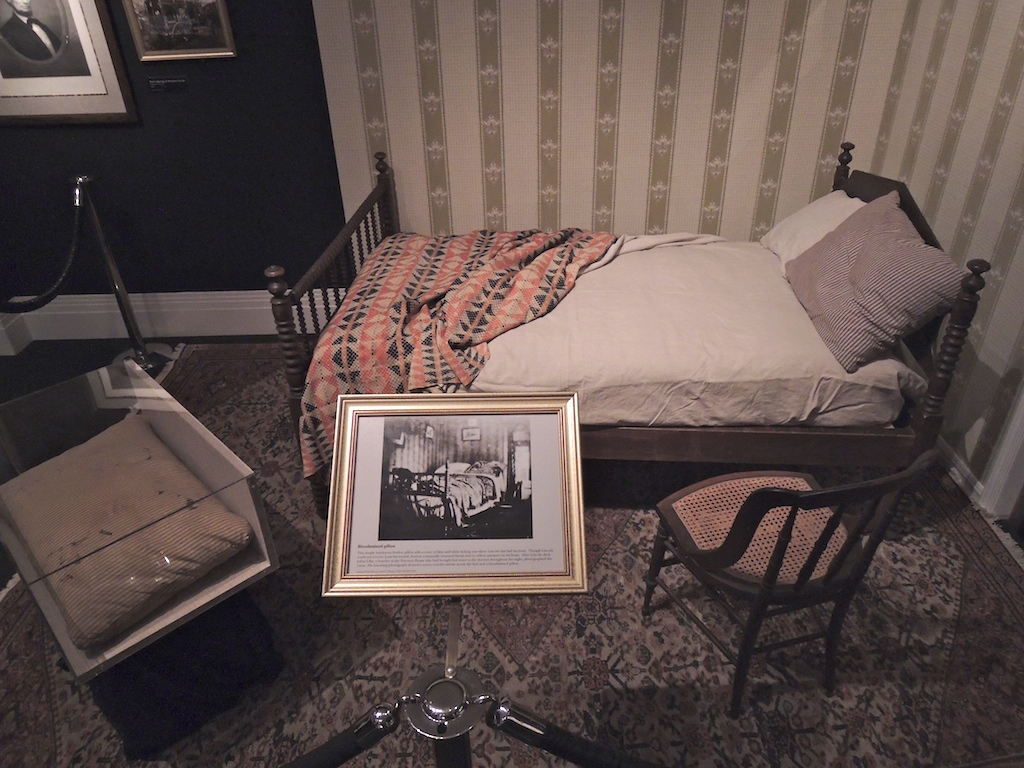
Petersen bedroom Assassination Exhibit Reagan Library

The Reagan Library’s recreation of the death chamber of Abraham Lincoln in the Petersen House. An authentic blood stained pillow from that night can be seen in a display to the left.

These images, sent to me by Carolyn Mitchell of the Spirits of Tudor Hall, show the blood stained pillow further:

Blood stained pillow Mitchell 1

Blood stained pillow Mitchell 2

Under this lighting, it’s hard to see the actual blood stains on the pillow.  The obvious dark splotches are not blood stains but ink stains that occurred long after Lincoln’s death and before modern artifact preservation techniques.  For many years, this pillow was on display at the Petersen House in Washington, D.C.  Today, however, the artifact is too fragile to be on display without a climate controlled display as seen here.  I’ve been told by a National Park Service employee that the pillow is so delicate that you could poke your finger straight through the pillow with ease.  Another, less fragile, pillow from Lincoln’s deathbed is on display in the basement museum of Ford’s Theatre.

References:
Ronald Reagan Presidential Foundation and Library
A. Lincoln: Railsplitter to Rushmore Exhibit Catalog
Ford’s Theatre NPS
A huge belated thank you to Carolyn Mitchell who visited the exhibit and sent me photographs and a copy of the exhibit catalog.  You’re the best, Carolyn!

Categories: Uncategorized | Tags: , , , , | 3 Comments

John Wilkes Booth in the Woods: Parts 1 – 3

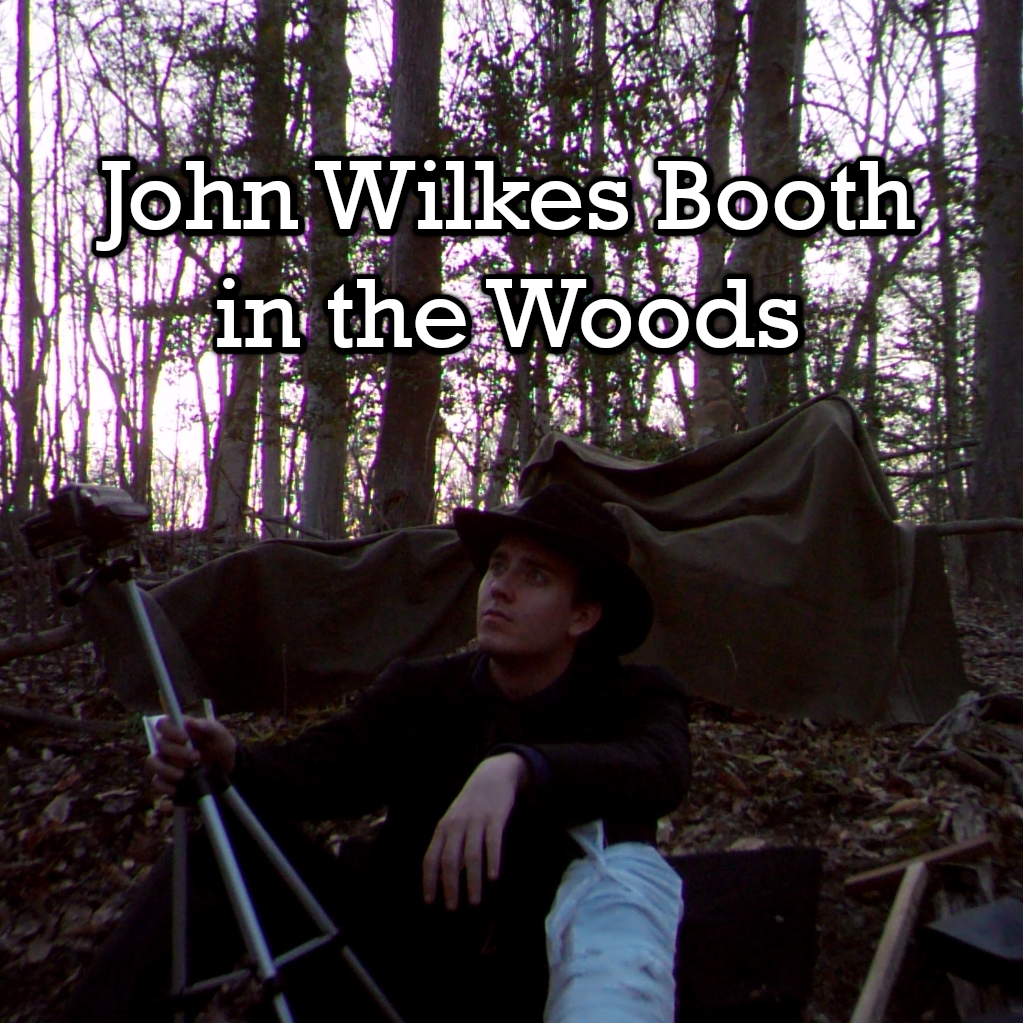
For about four and a half days between April 16 – April 21, 1865, John Wilkes Booth and his accomplice, David E. Herold, hid from federal troops in the southern Maryland woods.  Near the 149th anniversary of Abraham Lincoln’s assassination, I undertook a project to reenact, as accurately as possible, this often forgotten part of the assassin’s escape route. My hope was to gain a better understanding of Booth’s conditions and the impact those days in the woods had on his state of mind.  The follow videos are parts of a series I’m calling “John Wilkes Booth in the Woods” which documents my endeavor.

I’m very pleased to present the first three parts of the “John Wilkes Booth in the Woods” project for your viewing pleasure:

Part One:

Part Two:

Part Three:


As editing of the footage continues, new parts will be uploaded and released here on BoothieBarn.  Stay tuned for much, much more!

Categories: Uncategorized | Tags: , , , , , , , , , , , | 13 Comments

The Memorials on Tenth St.

Today, Ford’s Theatre and the Petersen House across the street constitute the “Ford’s Theatre National Historic Site”.  Operated by the National Park Service in partnership with the Ford’s Theatre Society, both buildings exist for the purpose of educating the public about Lincoln’s last hours.  Standing as they are today, it is sometimes difficult to imagine that, historically, they have not always been dedicated to serving Lincoln’s memory.  In fact, it was not until several years after Lincoln’s death that an effort was made to commemorate these buildings in anyway.  The modern museums of Ford’s Theatre and the Petersen House started off quite humbly as mere memorial plaques.

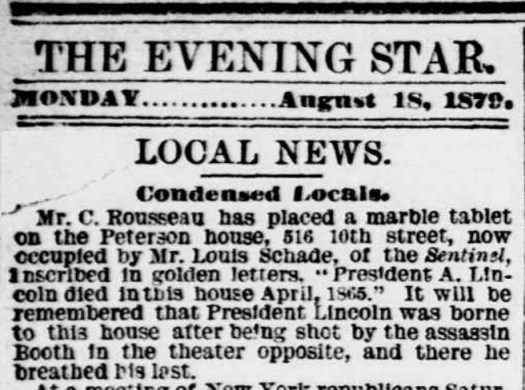
While the site of Lincoln’s assassination and the house in which he died were well known and hardly forgotten sites of Washington history, there was no move to commemorate either one of the buildings until nearly 14 years after the Great Emancipator’s death.  The first building to receive some sort of physical recognition was the Petersen House.  In 1879, it was the home of lawyer and newspaper publisher, Louis Schade.  You can read more about Mr. Schade and his connections to the assassination story HERE.  Schade had bought the Petersen House from the Petersen heirs in 1878.  In August of 1879, a couple of newspaper articles announced the installation of a marble tablet on the exterior wall of the Petersen House commemorating the historic nature of the house:

1879 marble tablet at Petersen House 2

1879 Marble tablet at Petersen House

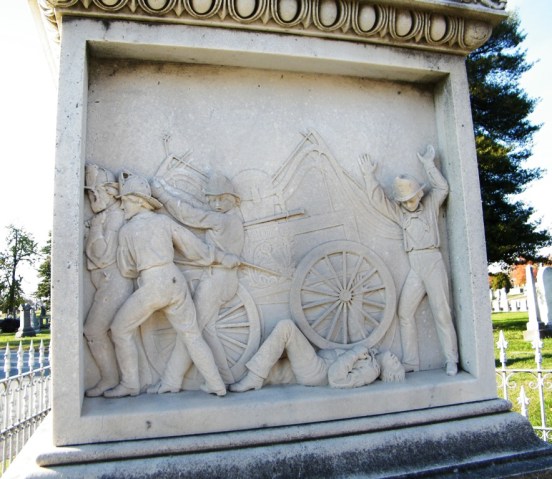
As reported, the tablet was created and put up by a private citizen, Charles Rousseau.  Mr. Rousseau was a Belgian native who learned the art of sculpture at the Royal Academy of Fine Arts in Brussels.  He made his living carving tombstones and was quite talented at it.  One of Charles Rousseau’s creations is this tombstone for Benjamin Grenup, believed to be the first Washington, D.C. fireman to have been killed in the line of duty when he was run over by the fire wagon:

Charles Rousseau Benjamin Grenup

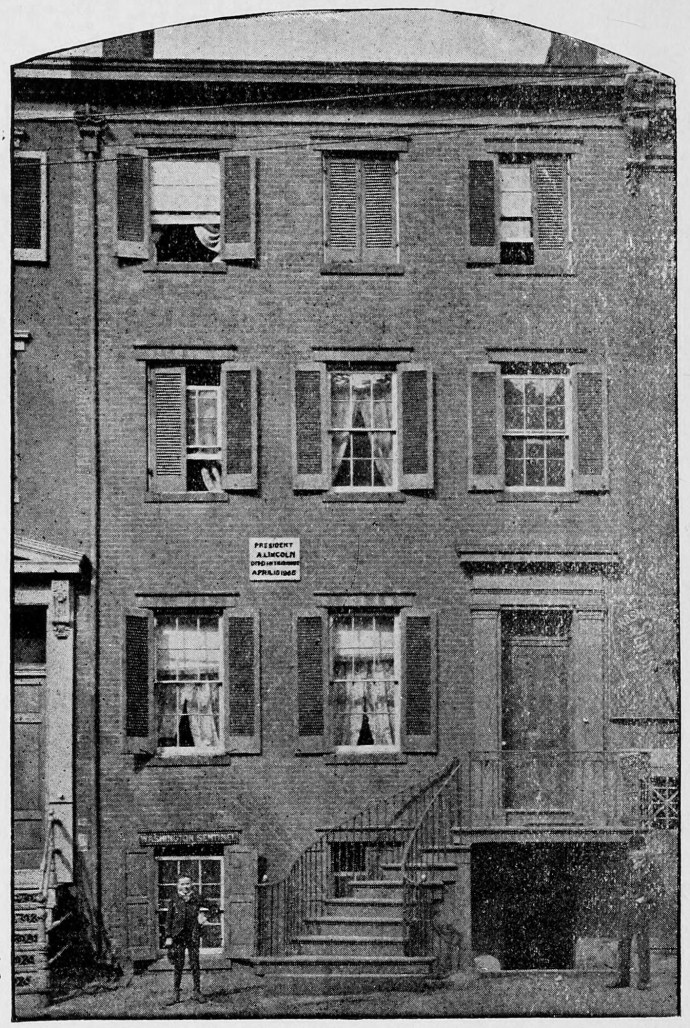
Whether Mr. Rousseau took it upon himself to make a tablet for the Petersen House, or whether Schade commissioned it, is not known.  Regardless, the tablet with its gold lettering was installed high on the exterior wall, far out of reach.  Here is a picture of the Petersen House as it appeared when Schade lived there as published in John E. Buckingham’s 1894 book, Reminiscences and Souvenirs of the Assassination of Abraham Lincoln:

Petersen House Buckingham 1894

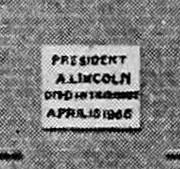
In the image, Buckingham retouched the tablet to make lettering readable:

Buckingham Marble Petersen tablet 1894

This marble tablet remained the only marker on the site for many years.  After the house was sold by Schade to the federal government in 1896, Osborn Oldroyd became its curator and started displaying his Lincoln collection inside.

Petersen House w Oldroyd Marble Tablet

As time went by, the small marble tablet began competing with Oldroyd’s large signs hawking admission to the house to see his collection.

Petersen House Oldroyd Tablet

Almost 30 years passed and the small marble tablet remained fixed high on the exterior.

Petersen Original Marble Tablet Transcription

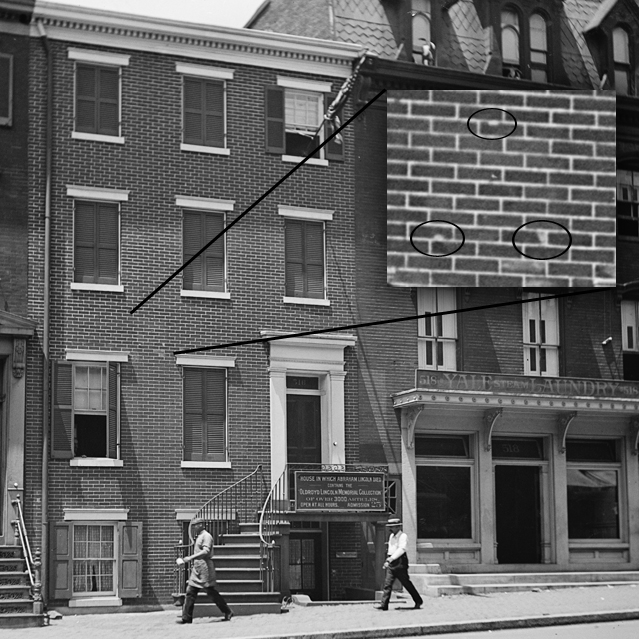
However, by 1909 the marble tablet was no longer on display.  Photographs during this time only show the three holes and the discoloration of the bricks from where the tablet had hung for so many years.

Petersen House No tablet

Whether Rousseau’s tablet fell or was purposefully removed is unknown. One text states that the tablet was removed because of complaints from visitors who stated it was placed too high up on the wall to read easily. If this is correct, perhaps Oldroyd felt his large museum signs provided the necessary information. Regardless, for a time in the early 1900’s, the only memorials on the Petersen House were the advertising for the Oldroyd collection of Lincolniana.

Meanwhile, across the street, the edifice that witnessed the horrible crime of April 14th, 1865, remained bare of any memorials. No private citizen had adorned the exterior wall of “Old Ford’s Theatre” like Charles Rousseau had done for the Petersen House. Instead, the building had been transformed into an office building, suffered a tragic collapse of the interior in 1893, and talks of demolishing it reappeared every few years or so in the press. Through it all, however, the scene of the crime remained.

It was not until 58 years after the death of Abraham Lincoln that a group of citizens decided it was time to commemorate the site of Lincoln’s assassination. The group, established by the Commissioners of the District of Columbia, was called the Citizens Committee of Historic Sites. With the help of the commissioners, the committee appealed for funds from Congress for the, “erection of suitable tablets to mark historical places in the District of Columbia”. For several years the committee was appropriated $500 and placed bronze plaques at various sites in D.C. On February 28, 1923, their appropriations were renewed and the committee started the design of two new plaques. One plaque was going to take the place of Rousseau’s marble tablet on the Petersen House while the other was to be placed on the long neglected Ford’s Theatre.

The formal unveiling of the new plaques occurred on April 29th, 1924.  I quote from the 1925 book, Abraham Lincoln in the National Capital by Allen C. Clark:

The exercises began at 3 o’clock in the afternoon. The invocation was by the Rt. Rev. Mongr. Cornelius F. Thomas. A History of the Ford Theatre Site was presented by Allen C. Clark. Eloquent addresses were made by the Hon. Henry R. Rathbone and by Frederick L. Fishback, Esq., of the Washington Bar. Mr. Rathbone vividly described and minutely, the scene of assassination. Mr. Fishback touchingly told of the last hours and of the funeral journey to Springfield. The tablet on the Ford Theatre site was revealed by Miss Maud Burr Morris; and Mrs. Osborne H. Oldroyd drew the cord which held the drapery to the tablet on the house where Lincoln died. It was the American flag which draped the tablets. The band from the Military School under the direction of Prof. W. J. Stannard interspersed selections. Frederick D. Owen was in charge of arrangements. Allen C. Clark presided.

As mentioned in the above quote, one of the speakers at the ceremony for the plaques was Representative Henry Riggs Rathbone.  Rep. Rathbone’s father was Henry Reed Rathbone, the army Major who was present in the box when Lincoln was assassinated.  Though the exact details of what he stated do not appear to have been recorded, the ceremony was attended by over 200 people.

Ford's and PetersenTablets - Washington Post 4-30-1924

In addition to this newspaper article from the Washington Post, there is also the following photograph of Rep. Rathbone speaking at the ceremony.  This fascinating photograph of a Rathbone speaking in front of Ford’s Theatre was the genesis for this post:

HEC/32200/32290a.tif

Rep. Henry Riggs Rathbone speaking at the unveiling of the memorial plaques on Ford’s Theatre and the Petersen House on April 29, 1924. Click to greatly enlarge. LOC

The plaque that the Committee of Historic Sites placed on the Petersen House still stands on the house today.  It is located at a much more readable level than its predecessor, now hanging between the basement and first floor.

Petersen House with plaque

Petersen House Plaque

The plaque on Ford’s Theatre hung on the exterior of the building for many years, marking the location of the great crime of ’65.

HEC/32200/32290a.tif

In the early 1960’s public support swelled to restore Ford’s Theatre to its former glory as a working theatre and a Lincoln museum.  During the periods of restoration and construction the plaque was taken down for obvious reasons.

Ford's during reconstruction no plaque NPS

When the newly restored Ford’s Theatre was unveiled in 1968, the plaque hung by the Committee of Historic Sites in 1924 was not restored to its place.  While the exact location of the Ford’s Theatre plaque is not known to this author at this time, it is likely that it entered the collection of the National Park Service and is being safely stored away.

The historic nature of a location is rarely appreciated in its time.  In most instances, plaques are markers to note where something historic once was but is no longer.  For many years it was a strong possibility that Ford’s Theatre or the Petersen House could be sold and torn down.  If events had played out differently, the magnificence that is Ford’s Theatre or the emotional impact that is the Petersen House would have been reduced to raised lettering on a piece of bronze.  We are fortunate that the generations that came before us had the forethought to preserve and protect these sites so that they may be enjoyed today.  Still, we also must remember that, like Rome, the structures we respect were not built in a day. The glorious museums on Tenth St. were founded on the actions of private citizens like ourselves and some memorial words on a tablet.

References:
Abraham Lincoln in the National Capital by Allen C. Clark
Restoration of Ford’s Theatre by George Olszewski
William A. Petersen House: House Where Lincoln Died – Historic Structure Report by the National Park Service
GenealogyBank.com
Washington Post
Library of Congress
Meserve Collection
Reminiscences and Souvenirs of the Assassination of Abraham Lincoln by J. E. Buckingham, Sr. (1894)
National Park Service

Categories: Uncategorized | Tags: , , , , | 6 Comments

Blog at WordPress.com.