Posts Tagged With: Graves

The Residents of St. Ignatius Cemetery

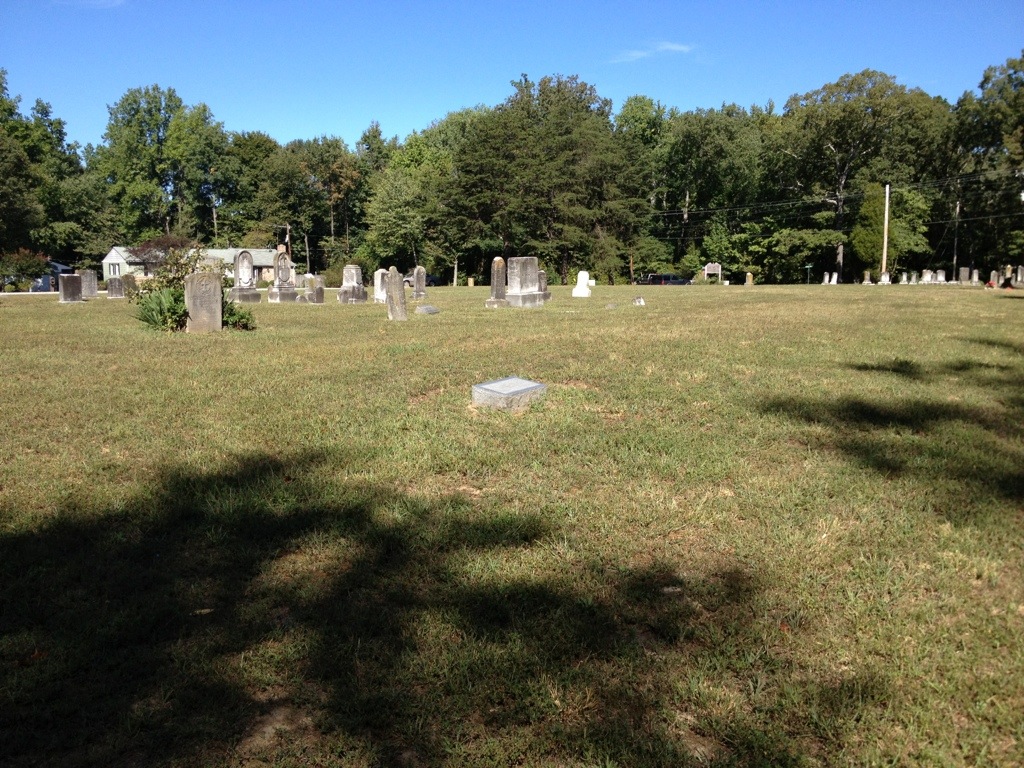
High atop beautiful Chapel Point near Port Tobacco, MD is St. Ignatius Church and St. Thomas Manor.  St. Ignatius is one of the oldest catholic parishes still in continuous service having been founded in 1641.  The present church on the site was constructed in 1798.  The cemetery surrounding the church holds the graves of many Charles County residents.
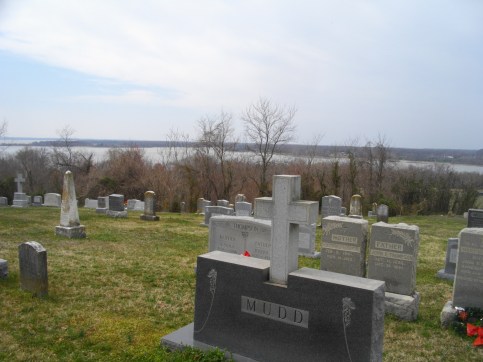
St. Ignatius Cemetery

St. Ignatius Cemetery

At least three of the people buried here at St. Ignatius are connected to the Lincoln assassination story.

Edward John Collis

Edward Collis' Grave

“Sacred
To the Memory of
Edward John Collis
Once of Angelo
Stourbridge, England
Who Died at Bel Alton
April 21, 1895
Aged 52 Years
Blessed are the dead that die in the Lord.
They rest from their labours and their works do follow them.”

I’ve previously written of Mr. Collis and his grave. He is an extremely peripheral character who wasn’t even in this country when Lincoln was assassinated. Nevertheless, he has the distinction of building his house on the Pine Thicket where Booth and Herold hid. Since my first post about Mr. Collis, I’ve learned that he was not a Catholic. This might explain why his grave is so far removed from the rest of the cemetery. After Mr. Collis died, Mrs. Collis returned to England, selling off the land and the house. It does not appear that the two had any children and no pictures of Edward John Collis have surfaced as of yet.
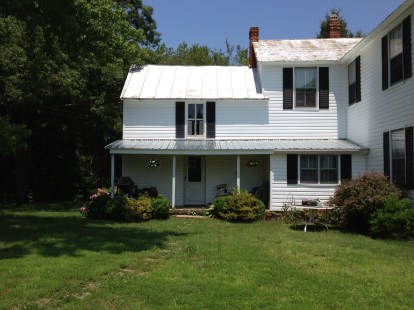
Collis House Today

The Collis House Today

Father Bernardin Wiget
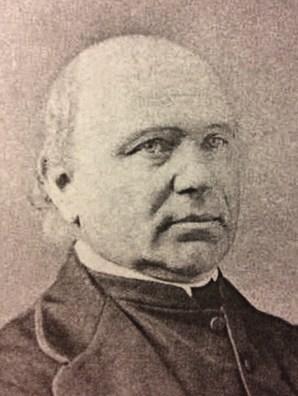
Father Bernardin Wiget

Father Bernardin Wiget

Father Wiget’s grave is right next to the church with the other parish fathers. Wiget enters the assassination story a few of times. While popularly known for being one of the two ministers who accompanied Mary Surratt when she ascended the gallows on July 7th, 1865, Father Wiget had a long history with the Surratt family. During the trial of the conspirators, Wiget was a character witness for Mary Surratt. Their association with each other started back in 1854, when Wiget performed Anna Surratt’s first communion. In 1855, Mary Surratt was looking to place her boys in a Catholic school away from their drunk father. She instilled the help of another priest, Father Nota, who wrote to Father Wiget. Wiget was, at that point, the new president of a school located right here at Chapel Point. Wiget, after getting the permission from his superiors, enrolled Isaac and John Surratt at his school at St. Thomas Manor at a discounted rate due to Mary’s poor financial situation. After Wiget left St. Thomas, the school closed and Mary was forced to look elsewhere for a place for her sons.
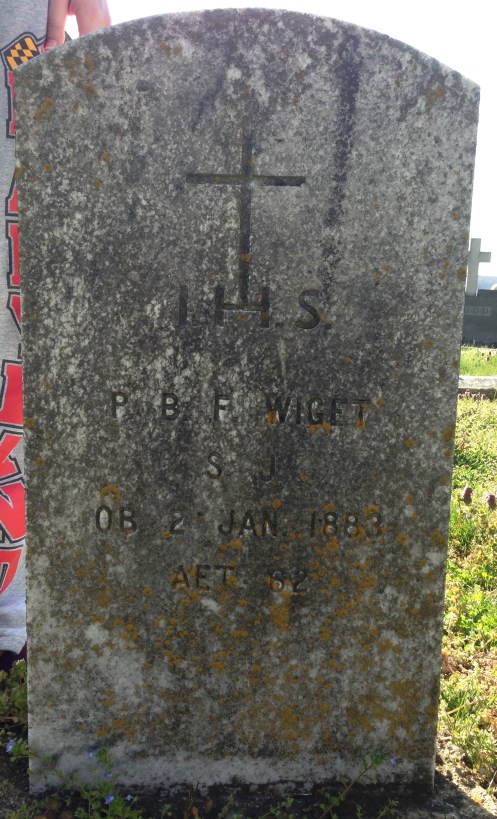
Father Bernardin Wiget's Grave

Father Bernardin Wiget’s Grave

John J. Hughes
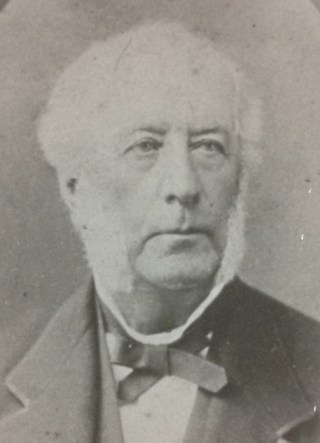
John J. Hughes

John J. Hughes

On April 20th, Booth and Herold were put in a boat and directed toward the Virginia shore by Thomas Jones. Their crossing that night did not go according to plan. Currents, gunboats, and darkness all impeded their crossing of the Potomac river. When they made landfall in the morning hours of April 21st, the men were still in Maryland, having rowed into Nanjemoy Creek. After a bit of reconnoitering, Herold realized they were near the farm of a well-known figure in Charles County named Peregrine Davis. Living in a house on Davis’ land was his son-in-law, John J. Hughes. Hughes family lore states that Booth and Herold approached John J. Hughes house, seeking lodging but that Hughes denied them entry. Instead he, suggested they stay in a slave cabin near the water which they assumedly did. They stayed on the Hughes’ property from their landing in the morning hours of April 21st, until they left the Maryland shore again on the night of April 22nd.
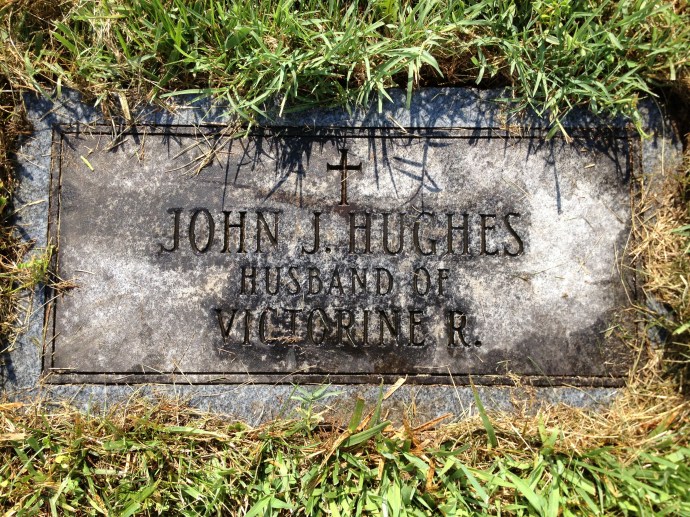
John J. Hughes' grave

John J. Hughes’ grave

Admittedly, there may be others buried at St. Ignatius that I just don’t know about…yet. It was just today, while researching at the James O. Hall Research Center on the Surratt House campus, that I learned that John J. Hughes was buried there. I drove straight from the Surratt House to Chapel Point to see if I could find his stone which, obviously, I did. If you know of someone else relating to the Lincoln assassination buried at St. Ignatius, drop me a comment below.
Categories: Uncategorized | Tags: | 16 Comments

The Grave of James W. Pumphrey

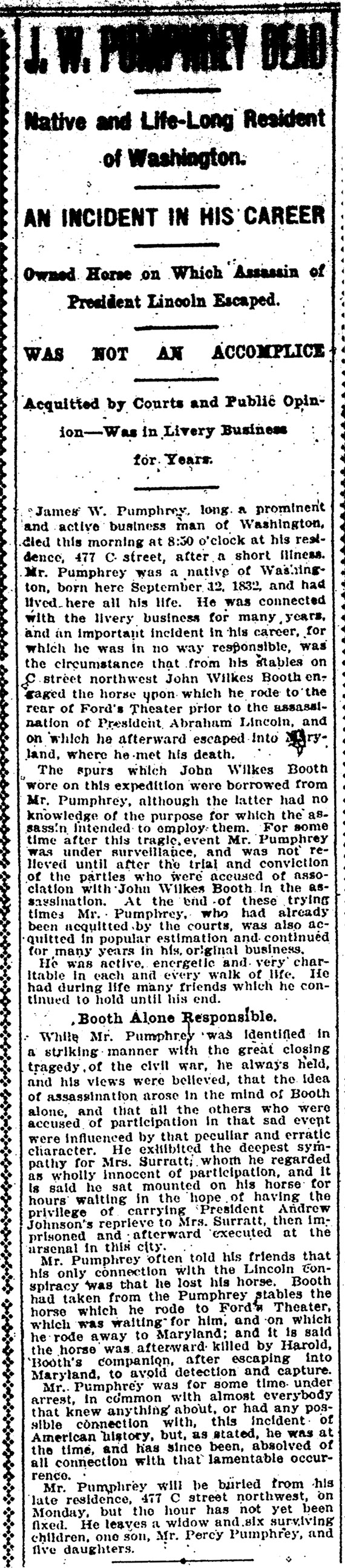
“James W. Pumphrey owned a livery stable on C Street in Washington, D.C., just behind the National Hotel where Booth stayed when he was in town. Booth became a patron of Pumphrey’s, renting horses from him on several occasions, including the night of the assassination.  Booth stopped by Pumphrey’s stable shortly after noon on April 14th, asking to reserve a particularly horse, and to have it ready at 4 o’clock that afternoon.  When Booth stopped by the livery the horse had already been rented to somone else and Booth had to settle for a bay mare.” – Steers, Assassination Encylopedia

Pumphrey's Obit

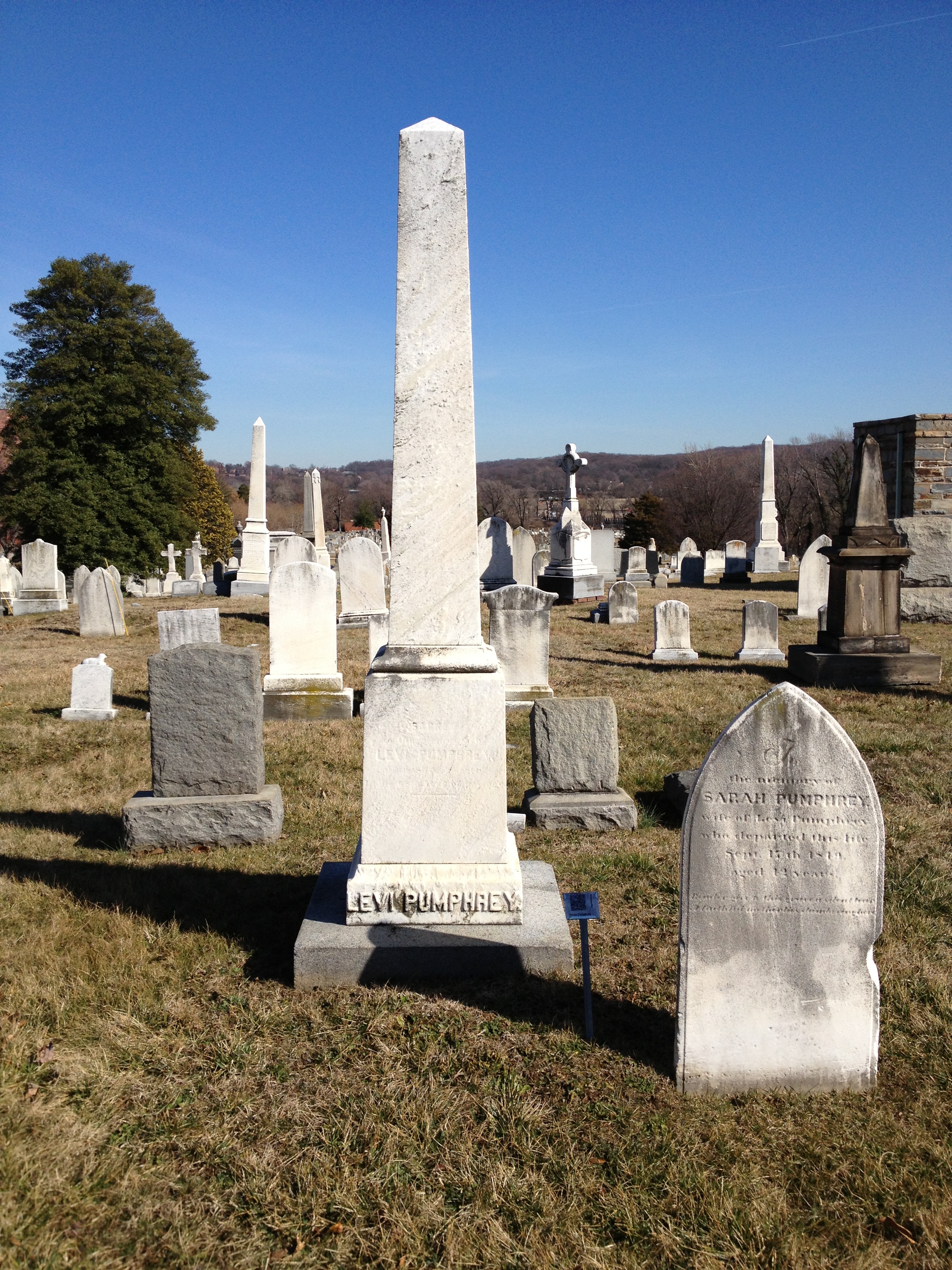
James W. Pumphrey is buried with his father Levi, in D.C.'s Congressional Cemetery.

James W. Pumphrey is buried with his father Levi, in D.C.’s Congressional Cemetery.

Congressional Cemetery has a wonderful news article about James Pumphrey trying to cheat the gas company in 1883 (bottom of page 5).

Categories: Uncategorized | Tags: , , | 1 Comment

Another jaunt through Congressional Cemetery

I visited Congressional Cemetery again today. My main purpose was to visit conspirator David Herold, but I also took the time to track down a few more people related to the assassination that I hadn’t before. Consider this post an addendum to my previous “Jaunt“.

First off, I tracked down all of David Herold’s sisters. Fortuitous for me, all of them are buried here at Congressional:

20130218-144902.jpg
Mary Ann (Herold) Nelson

20130218-145016.jpg
Margaret Cecelia (Herold) Rockwell

20130218-145225.jpg
Catharine Virginia (Herold) Brown

20130218-145357.jpg
Alice King (Herold) Earnshaw

20130218-145509.jpg
Georgia Isabel (Herold) Earnshaw

20130218-145617.jpg
Emma Frances (Herold) Keilholtz

20130218-145730.jpg
Elizabeth Jane Herold. Elizabeth is buried right on top of her unmarked brother, David.

From there I went to see a few other individuals.

20130218-151105.jpg
William Francis Walsh was a pharmacist near the Navy Yard. David Herold was employed by Walsh for 11 months until he quit in order to have more time to go hunting.

20130218-152446.jpg
As his descriptive stone states, Charles Forbes was Abraham Lincoln’s footman and was present at Ford’s the night of the assassination.

20130218-155208.jpg
John E. Buckingham was the doorman at Ford’s and later wrote a book about his souvenirs of the event.

20130218-155456.jpg

20130218-155539.jpg
William Wood was involved in the search for Booth and Herold and was the superintendent of the Old Capitol Prison when Mary Surratt and Dr. Mudd were there.

Those are all the assassination related graves we saw at Congressional Cemetery today. There are still many more people involved with the great drama buried at Congressional so don’t be surprised if there’s another jaunt in the future.

Categories: Uncategorized | Tags: , , | Leave a comment

The Story of Pink Parker and his Booth Memorial

Former John Wilkes Booth Memorial in Troy, AL

“Joseph Pinkney Parker was born in Coffee County, Alabama in 1839. He had just finished as a student at Spring Hill Academy when the War broke out. He left immediately for the front, leaving behind him on a well-stocked plantation, his sister and the slaves which every well-to-do Alabaman possessed at that time. Four years later, he returned to find his farm overgrown with weeds, his stock and his slaves disappeared and his sister embittered by her treatment received at the hands of the Northern soldiers. The property was soon eaten up by taxes, so he took a position as a “walker” on the railroad tracks carrying with him maul and spikes to keep the tracks repaired.

He became a school teacher, but the parents of the children were too poor to pay the salary, or even to clothe the pupils properly. As years went on, he did regain some of his financial position and built for himself and his family a very comfortable home in Troy, just a block or two from the famous trace which Andrew Jackson used in his battles against the Indians in Florida.

Pink was a devout member of the Baptist Church. He never called his wife anything but “Darling” and taught his children to do the same. He became a police officer in the little town of Troy and a much-respected citizen. But he had one obsession which was so deeply instilled in him that he never was able to overcome it; a deep and lasting hate for the North, its people, and particularly for the man who was the sixteenth President of the United States ; a man so great that, today, Abraham Lincoln is revered in the South, together with the famous champion of the Lost Cause, Robert E. Lee.

As Pink Parker went on nursing his wrath from year to year, the North and the name of Lincoln would cause him to burst forth into the most impassioned flights of profanity which not merely astonished but shocked his friends. The pastor of the Baptist Church labored with him to stop these outbursts. But they continued and Pink was finally removed from the church rolls for his profanity. Rather ruefully, Pink remarked to a friend, “It wasn’t quite fair. I know all the deacons in that church and any one of them can cuss better than I can.”

Time went on and each succeeding April 15, Pink would make for himself a paper badge indicating that this date was the “Anniversary of the Death of Old Abe Lincoln.” Years passed, the idea came into his head that he would erect a monument to the memory of John Wilkes Booth. Apparently, he did not share this intention with anyone, so it was a surprise to the citizens of Troy when this monument, some four feet high, was erected in the yard of Pink’s home. His neighbors did not like the idea, but they did like Pink Parker. The strange thing about the erection of this monument is the fact that it was not erected until 1906, in spite of the fact that the newspapers of the 20’s stated that it had been erected by popular subscription by the citizens of Troy in 1866.

Pink Parker on April 15th, 1906 - The day he erected his monument to Booth.  Notice his paper badge celebrating the 41st anniversary of Lincoln's death.

Pink Parker on April 15th, 1906 – The day he erected his monument to Booth. Notice his paper badge celebrating the 41st anniversary of Lincoln’s death.

No one paid much attention to the monument. Automobiles were not as plentiful as they are today and traffic did not flow through Troy as it does now. Pink was pretty proud of his handiwork and he used to regale his grandsons with the story of his sending President Theodore Roosevelt a postcard inviting him to come and visit the monument. He further informed the President that while he couldn’t furnish a carriage for him, he would get him a dray hauled by a couple of mules.
When Pink’s grandsons would twit him on the fact that he might not be able to get along with the Yankees he found in Heaven, his eyes would twinkle and he would say, “Well, I don’t suppose I will find enough up there to bother me.”

When, in 1921, Mrs. C. D. Brooks, who at the time was the president of the Woman’s League of Republican Voters in Alabama, heard of this monument, her pride for the state of Alabama was so strong that she began immediately to have the monument destroyed. Mrs. Brooks received letters from all over the country supporting her stand. One of the most interesting letters which came to her was dated June 8, 1921, El Paso, Texas, from Alexander Donald McEvoy, who states that “in the year 1879, I met Booth in Buenos Aires, Argentine Republic.” That letter would have pleased Pink Parker, for he always maintained that Booth was not the man whom Boston Corbett shot.

But three or four years prior to 1921, some boys pulled down the monument for a Hallowe’en stunt. No one had ever bothered to replace it. In 1922 after the death of Mr. Parker in December, 1921, his sons had the stone taken out to the monument works where the scars made by souvenir hunters were removed, together with the legend concerning John Wilkes Booth. The monument was then re-set as a memorial to Joseph Pinkney Parker.”

Pink Parker’s re-etched gravestone.

The preceding came from the 1951 booklet entitled, A Monument to the Memory of John Wilkes Booth. The author gained his information from two of Pink Parker’s grandsons.

References:
A Monument to the Memory of John Wilkes Booth by Stewart W. McClelland (1951)

Categories: Uncategorized | Tags: , , | 9 Comments

The Tauberts of St. Paul’s

Yesterday, I graciously received the cemetery records of St. Paul’s cemetery from Sandy Harper, church historian of Martini Lutheran Church.  Through the collaborative research of Sandy and the many others who particpate in this site, we have dissected the previously held belief that conspirator George Atzerodt was secretly buried in St. Paul’s cemetery.  Here are the facts we have managed to establish together:

1.  Gottlieb Taubert was the brother-in-law of Geroge Atzerodt.  He married George’s sister, Marion “Mary” Atzerodt.  Gottlieb was a member of Martini Lutheran Church and purchased a plot at St. Paul’s and buried two young children there prior to 1869.

2.  Victoria Atzerodt, George’s mother was buried in the Taubert plot in 1886.

Victoria Atzerodt’s death record from Martini Lutheran Church

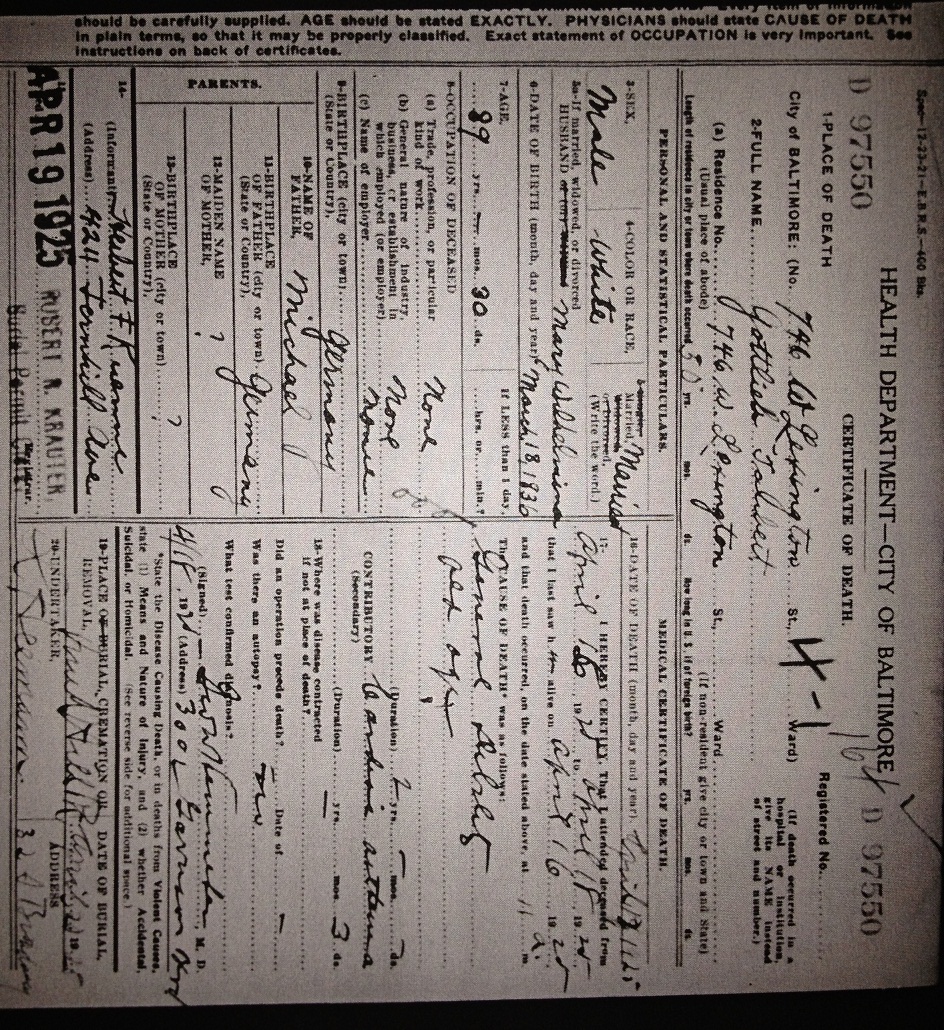
3.  Gottlieb Taubert died in 1925 and was buried in the lot.

Gottlieb Taubert’s death record from Martini Lutheran Church

Gottlieb Taubert’s death certificate

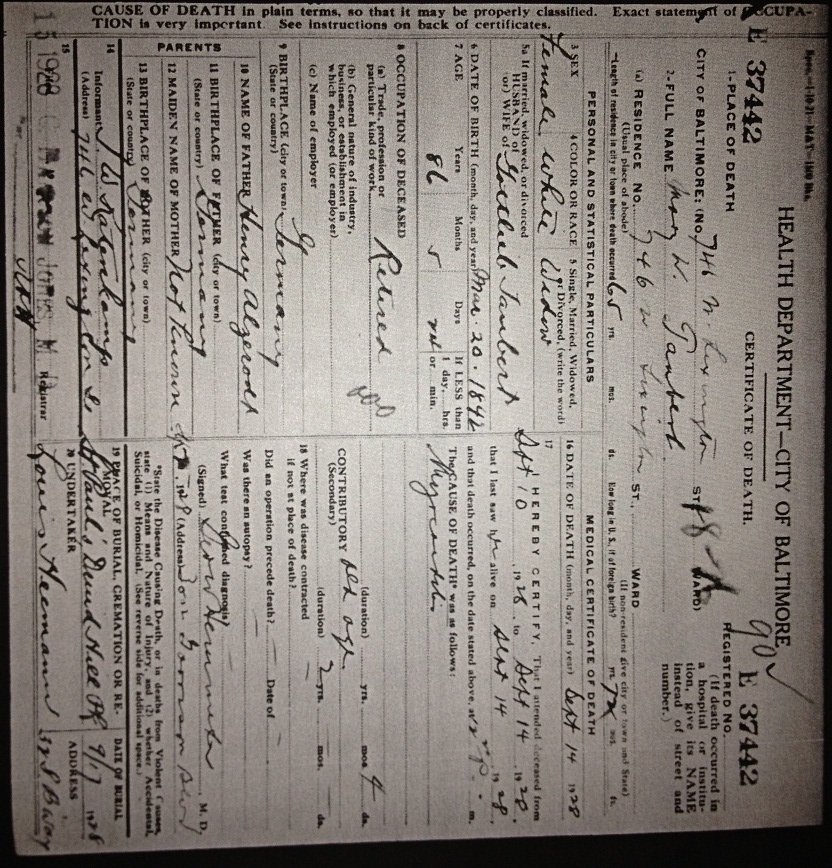
4.  Mary (Atzerodt) Taubert died in 1928 and was buried in the lot.

Mary (Atzerodt) Taubert death record from Martini Lutheran Church

Mary (Atzerodt) Taubert’s death certificate

The remaining burial in question was the one that occurred on February 19th, 1869.  It had been believed that George was secretly buried in the Taubert plot on this date.  However, through the insights of Ms. Harper and the church’s verifying records, we now know that the burial on this date was not of the 29 [30] year old brother-in-law of Gottlieb Taubert, but the 29 day old child of Gottlieb Taubert.  The dead child’s name was Freidrich Gottlieb Herman Taubert:

Friedrich Taubert’s death record from Martini Lutheran Church

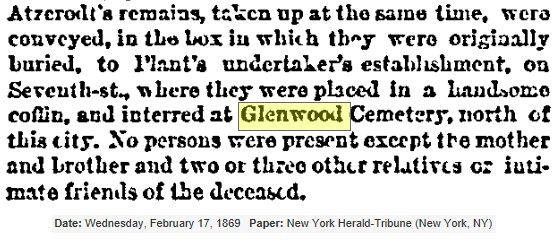
From these records, I feel comfortable saying that there is no longer any credible evidence that George Atzerodt is buried in St. Paul’s Cemetery in Baltimore. While his mother and sister are buried there, the final resting place of George is still a mystery. The last records place him in a holding vault at Glenwood Cemetery. Hopefully continual research will be able to reveal his grave.

References:
We are all indebited to Sandy Harper for volunteering her knowledge and records about St. Paul’s.
Thank you to everyone who has participated in our conversations and added so many more details to George’s time at Glenwood.

Categories: Uncategorized | Tags: , , , , | 10 Comments

Spangler’s Stone

I’m currently driving around Charles County after standing in line at the Maryland DMV for a hour to learn I was just one ID short if getting my license transferred over. I’m posting from my phone so this will be short.

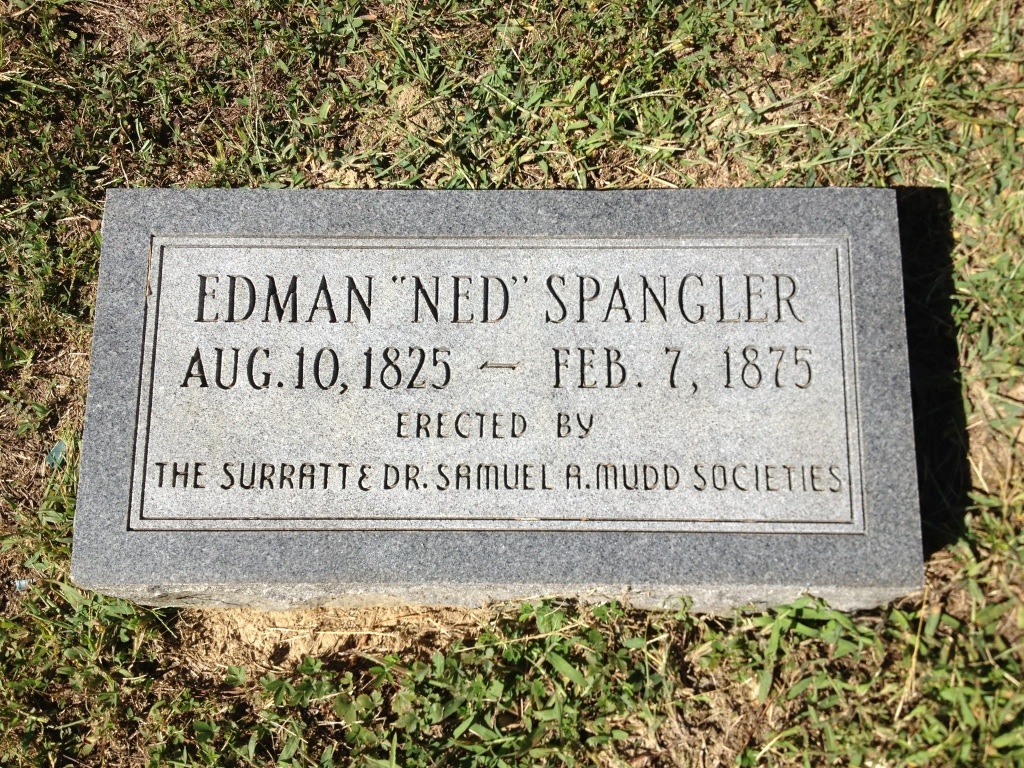
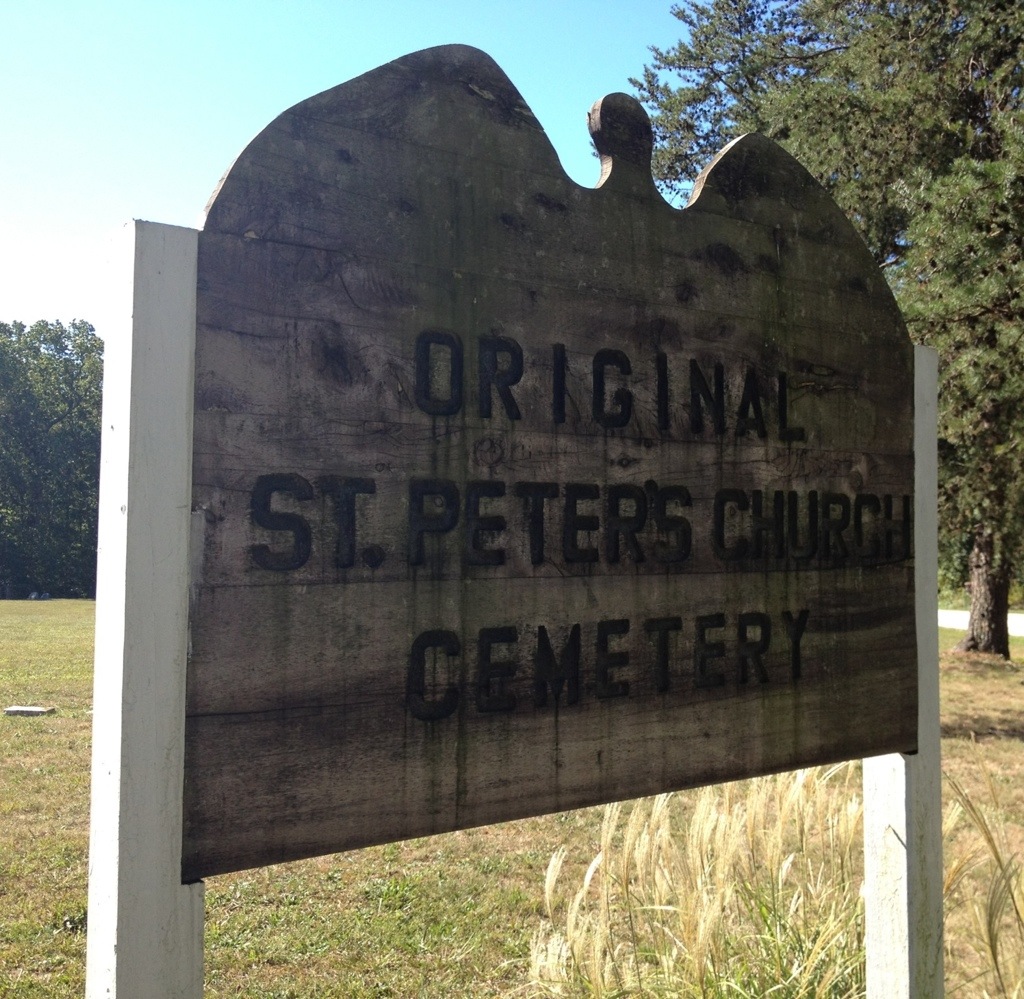
Below is a picture of Edman Spangler’s grave stone. Spangler is buried in the Original (Old) St. Peter’s Cemetery. Of all the conspirators, Spangler is agreed upon as being the most innocent. He had known the Booth family from his time helping to create Junius Brutus Booth’s Tudor Hall in Bel Air, Maryland. He built and attended to the stables behind Ford’s Theatre where Booth kept his horses. And on the night of the assassination Booth called for Spangler to hold his horse. Due to these facts and the mistaken testimony that Spangler had told another theater worker to keep quiet after the assassination, Spangler was tried as an accomplice. Even the military commission’s sentencing of six years in prison shows their relative belief of his innocence in the assassination plot. It seems that Spangler was just made and example of due to his acquaintance with John Wilkes Booth.

20120915-105747.jpg

20120915-105837.jpg

Spangler’s grave is located in the back corner of this small cemetery opposite the sign.

20120915-110008.jpg

Categories: Uncategorized | Tags: , | 6 Comments

Update: Finding George Atzerodt

UPDATE: We have verifying records as to the burial of a Taubert child in Feb. of 1869.  George is not in St. Paul’s.  Glenwood, here we come…

As is to be expected in the history field, no matter how confident you feel you “know” something, there’s always new information to be found.  In today’s case, I received some thorough and reliable comments on my previous post about George Atzerodt’s burial in St. Paul’s cemetery in Baltimore’s Druid Hill Park.  The following comment comes from Sandy Harper, church historian for Martini Lutheran Church.  Martini Lutheran is the caretaker of St. Paul’s:

“The child buried on Feb. 1869 was named Freidrich Gottleib Herman Taubert, he was 29 days old and his birth and death are in Martini Lutheran Church’s records.”

This February of 1869 burial was thought to be the secret burial of George Atzerodt.  Though this idea was partially at odds with the plot records as written in the book, Records of St. Paul’s Cemetery, in my previous post I did my best reconciling the idea that a 29 day-old child of Gottlieb Taubert was actually the 29 [30] year-old brother-in-law of Gottlieb Taubert: George Atzerodt.  Ms. Harper’s new information that it was, in fact, a coincidence that the Taubert’s were burying a child close to the same time that George was in need of re-interment, certainly requires us to continue to look elsewhere.  While I’d like to believe the research of the Boothies before me, the evidence against it is stacking up, with both the cemetery record book and the detailed information from Ms. Harper pointing towards a child not a conspirator being buried in St. Paul’s.

So, I attempted to retrace the body of George Atzerodt.  On my way home from work I called Glenwood Cemetery in DC.  The gentleman I spoke to was very knowledgeable reiterating the story that George was kept in a holding vault in Glenwood after being brought there by his brother John.  He told me that beyond that, they have no further records of what happened.  The reason for this, I was told, is that in the late 1800’s, a disgruntled board member of the cemetery stole the interment book for the first 7,000 burials in Glenwood.  He walked off with them in the middle of a meeting, never to return.  The interment information for George, if he was buried in Glenwood, would have been in this first book.  The gentleman also informed me that he was told upon his initial employment at Glenwood in 1995, that it was the belief of the cemetery that George was in Glenwood in an unmarked grave.  Glenwood believes George is buried in their cemetery, they just don’t know where.  When I asked if there would ever be a way to know for sure, I was told the only remaining chance would be for someone to sit down and look thorough their 14 books of plat maps.  Technically, George’s burial would have to be noted on a plat map to make sure no one attempted to bury a body where one already was.  The man I spoke to stated that in the seventeen years he’s worked there, he has yet to come across George in a plat map.  However, he also said he has never gone through looking for him specifically, merely that in the course of his other work, George’s name has yet to show up.

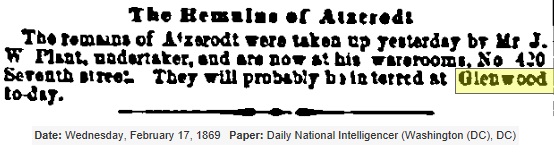
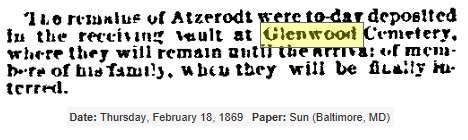
So the opinion of those working at Glenwood seems to be that George never left their cemetery.  I have to say that newspaper accounts of 1869 do seem to agree with them.  Several articles mention the undertaker that was used for Atzerodt’s remains and how his body was placed in Glenwood’s receiving vault:

Despite the substitution of John’s name for his brother George, this article had the same information:

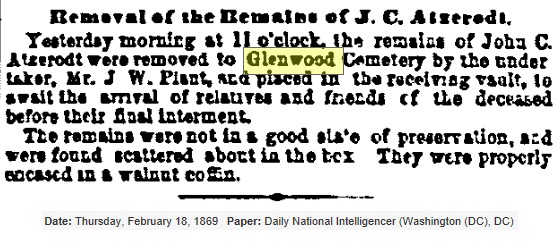
And lastly, this article mentions Atzerodt’s funeral in Glenwood:

The press of the day seemed to believe that George was buried in Glenwood.  As we know, though, they cannot always be reliable.

Just like we had for the St. Paul’s hypothesis, we are left with only circumstantial evidence regarding George’s final resting place being at Glenwood.  The last place to look for George seems to be Glenwood’s many plat maps.  However, even if a thorough search does not produce his name on a map, it is still possible that he is one of the unmarked, but occupied graves.  Sadly, it is unlikely that we will ever know for sure. Hopefully one day, I’ll make my way to Glenwood Cemetery to spend a day (or two) looking through their maps.

References:
Thank you to Sandy Harper for posting information about the Tauberts in St. Paul’s Cemetery.

Categories: Uncategorized | Tags: , , | 45 Comments

Louis Schade, Esquire

While researching for my last post about George Atzerodt’s burial, I came across an interesting character by the name of Louis Schade.  Mr. Schade happened to make his way into the Lincoln assassination realm in a couple of ways.

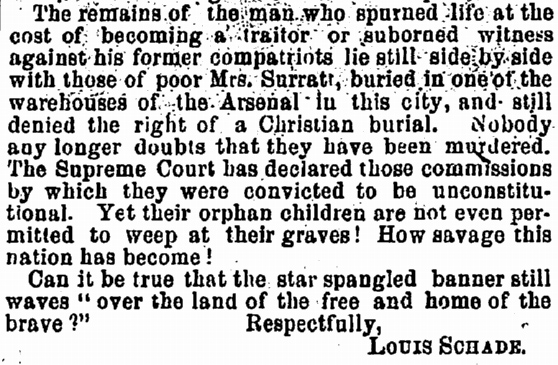
Louis F. Schade was a born in1829 in Berlin, Germany.  He studied law at the University of Berlin.  As a student, he took an active part in the failed unification of the German states known as the Revolution of 1848.  He fled to America shortly thereafter.  In 1855, Schade found himself in Chicago under the employ of Senator Stephen A. Douglas.  Schade not only visited German districts in Illinois making speeches in support of Douglas, but also became the editor of two of Douglas’ papers, “The National German Democrat” and “The National Union”.  He was admitted to the bar, becoming a certified lawyer in 1858.  After Douglas won the Illinois state Senate seat against his opponent, Abraham Lincoln, Schade returned to Washington, D.C. and practiced law.  A large client of his was the United States Brewer’s Association and Schade became an outspoken advocate against the temperance movement.  He gained nation-wide fame, however, in 1865, when he agreed to represent Captain Henry Wirz, commander of the Andersonville prison.  Schade would come to truly believe in his client’s innocence and even after Wirz’ execution, he would write publicly about the tragedy.  A few years later he would not only lament the injustice of Wirz’s execution, but the treatment of his body:
Come February of 1869, when President Andrew Johnson is evoking his presidential privilege of writing pardons without fear of political reprisals, Schade applies for the body of Henry Wirz.  It is granted and Schade arranges for his late client to be buried in Mount Olivet cemetery in D.C.  In a twist of fate, Mary Surratt would be buried here too, reuniting the pair yet again.

But the body of Henry Wirz was not the only one Louis Schade helped removed from the Arsenal grounds.  On behalf of another client, Victoria Atzerodt, Schade wrote to Andrew Johnson asking for George’s body.  He wrote in part that, “the present enlightened age…will not permit the mediaeval and barbaric custom of seeking revenge on a handful of dust and ashes.”  In addition to Schade’s appeal, John Atzerodt wrote his own letter to President Johnson asking for George’s body:

A few days later, Louis Schade and John Atzerodt would visit Andrew Johnson in person to receive the signed order for George’s remains:

So, Schade helped to rebury two executed criminals from the grounds of the Old Arsenal prison.  Louis Schade’s connection to Lincoln’s assassination does not end there, however.

On October 18, 1871, a recent widow in Washington, D.C., passed away.  Her husband had died only a few months earlier of a laudanum overdose.  The pair had left their children without a will.  To raise money, the heirs of the family sold some of the furniture in the house.  A bureau, gas jet, rocking chair, an engraving, and a bed were all sold at auction.  The family was able to retain possession of the house where they had lived, though.  It was a three story brick row house in downtown D.C.  But it was also much more than that.  It was the house where Abraham Lincoln had died, also called the Petersen House after the family that built and owned it.

The Petersen House circa 1883

By 1878, the Petersen heirs decided it was time to sell the house.  Return Louis Schade.  By this time, Schade had reignited his skills as a newspaper editor and had started his own paper, The Washington Sentinel.  It was a Democratic paper that Schade used as an outlet for his own views.  He devoted a whole back page to beer advertisements to support his client, the Brewer’s Association.  As a German immigrant he wrote largely in support of more lenient immigration policies.  The Sentinel also contained a great deal of international coverage for a paper its size.  Schade was a successful editor and lawyer in 1878, and the Petersens probably had no problem selling their shrine of a house to him.  On November 25, 1878 Schade and his wife bought the Petersen house for $4,500, a little over $100,000 in today’s currency.

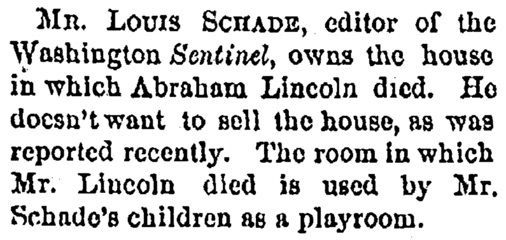
The Schade family would enjoy living at the Petersen house, at first.  Louis moved the office of his newspaper to the front of the basement.  The room where Lincoln died became a playroom for the children:

Eventually though, the Schades would tire of the many visitors that wished to gain entry into their historic home.  By 1893, the family had moved out of the house and leased it to the Memorial Association of D.C.  The association invited a tenant named Osborn Oldroyd to live in and showcase his extensive Lincoln collection inside the Petersen house.  Finally, on June 29th, 1896, the federal government purchased the Petersen House from Louis Schade for $30,000.  That is equivalent to over $775,000 in today’s money.  Louis Schade definitely made a tidy profit on his historic investment.

The noted editor and lawyer, Louis Frederick Schade died on February 25th, 1903.  He is buried in D.C.’s Prospect Hill Cemetery.  Prospect Hill, a largely German cemetery, is located right next to Glenwood Cemetery, the proposed yet abandoned burial location for George Atzerodt.

Louis Schade gained notoriety for his defense of Henry Wirz and his long career as a newspaper editor.  Yet he also managed to entwine himself in the epilogue of Lincoln’s assassination.  He helped to bury a conspirator and bought the house where Lincoln died.  He remains a minor, yet interesting side figure in history.

References:
Newspaper article abstracts were retrieved from GenealogyBank.com
William A. Petersen House – House Where Lincoln Died Historic Structure Report by the National Park Service
They Have Killed Papa Dead by Anthony Pitch
The Papers of Andrew Johnson: September 1868 – April 1869
Andrew Johnson: A Biographical Companion by Glenna Schroeder-Lein
Washington Sentinel by the Library of Congress
There are wonderful pictures of Louis Schade on his FindAGrave page.

Categories: Uncategorized | Tags: , , | 10 Comments

Blog at WordPress.com.