Posts Tagged With: Booth Family

When Junius Took the Stage – Part 4

I’m in the midst of reading the book, Junius Brutus Booth: Theatrical Prometheus by Stephen M. Archer. One of the most fascinating things I’ve come across thus far is the drama that occurred when Junius Brutus Booth made his star debut in the theaters of London. In preparation for a post about the matter, I found myself with a wealth of material on the early theatrical life of Junius Brutus Booth. Instead of summarizing key points of Junius’ initial acting career, I decided to write a series of posts examining the humble acting beginnings of the man who would later father a theatrical dynasty, including the assassin of President Lincoln. What follows is a continuing part of a series of posts entitled, “When Junius Took the Stage”. Click here for Part 1, here for Part 2, and here for Part 3 of the series.

Part 4 – When Junius Took the Lead

Back home in London after a tour of the European continent, 19 year-old Junius Brutus Booth was still struggling to make his way.  Recently married and with a baby on the way, Junius needed to make a name for himself in his chosen theatrical profession.  Upon his return from the continent, Junius used the name of a patron he had met during his travels in order to gain an audience with the manager of the Covent Garden Theatre, Henry Harris.  Junius signed a five year contract with Harris, with a salary of two pounds a week for the first four years which would double on the fifth year.  Not willing or financially able to wait until the 1815-1816 theatrical season commenced in the fall, Junius spent the summer of 1815 in the country provinces.  He joined Thomas Trotter’s theatres in the costal cities of Brighton and nearby Worthing and was paid one pound ten shillings per week.

A portion of an 1830 map of England showing London, where Junius played at Covent Garden, and the costal cities of Worthing and Brighton, where Junius played at Thomas Trotter's theatres.

A portion of an 1830 map of England showing London, where Junius played at Covent Garden, and the costal cities of Worthing and Brighton, where Junius played at Thomas Trotter’s theatres.

Pregnant Adelaide joined her husband at Brighton but, by September the couple was back in London awaiting Junius’ debut at Covent Garden.  Junius was still merely a supernumerary, a supporting player.  While he was given a weekly salary regardless of whether he worked or not, his pay was not sufficient enough to even support him.  On October 5th, 1815, Junius had another mouth to feed with the birth of his daughter, Amelia Portia Adelaide Booth.  The only way to earn an adequate amount of money to support a family as an actor was to progress into a star.  In order to become a star, a supporting character had to be on stage as much as possible in order to gain supporters and beneficial reviews.  During the 1815 – 1816 season at Covent Garden, Junius’ work was hardly consistent, hindering his efforts to create a following of fans.  Over the nine month season at the Covent Garden, Booth acted only 18 times.  His most repeated role during this time was the part of Silvius, the sheepherder, in the play, As You Like It.  Little better than a walk on role, Booth played Silvius a total of 5 times that season.

At the end of the 1815-1816 season, it was very obvious to Booth that Harris and the Convent Garden Theatre were not going to give him the chances he needed to be a star.  During the summer months, Booth returned to the provinces of Worthing and Brighton playing at Thomas Trotter’s theatres there.  Trotter increased Booth’s salary from the previous summer, and now paid him two pounds two shillings per week.  This was an increase even over his normal pay from Covent Garden and, at Trotter’s theatres, Booth was able to act regularly and in more lucrative roles.  As the summer came to a close, Booth wisely decided to remain in the provinces for the 1816-1817 season.  As his acting ability grew, Junius began to assemble a modest group of supporters in the provinces.  On September 25th, 1816, Junius got the opportunity that all supernumeraries prayed for.  At his theatre at Brighton, Thomas Trotter announced that Edmund Kean, the leading actor in England, was to play Sir Giles Overreach in A New Way to Pay Old Debts.
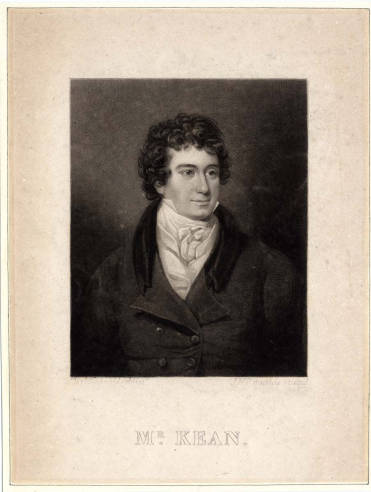
Edmund Kean

Edmund Kean

A leading London star in the provinces was a sure way to pack the houses and people came out to witness Kean’s majesty. In a serendipitous twist, Kean never showed up.  Kean later stated that he had never agreed to any such performance at Trotter’s, though it is equally likely that an attack of brandy prevented him from making the journey.  Trotter quickly brought in Booth who had been performing at his Worthing theatre.  Junius played the role meant for Kean that night, and he pleasantly surprised the expecting audience.  As Dr. Archer states in his book, “the neophyte had risen to the occasion.”  This successful, break out performance by Junius Brutus Booth led Trotter to give him more substantial roles.  In time, this greater exposure allowed Booth to gain a following of fans.  Several of these fans turned out to be better than your run of the mill theatre goers.  Three rich and influential patrons banded together on Junius’ behalf.  They collectively paid a visit to Henry Harris back at the Covent Garden Theatre in London.  They convinced Harris to give Booth a trial night in the city where he would play the leading role.  His shot as a star on the London stages occurred on February 12th, 1817.

Junius’ star debut came at a crucial time for the young actor.  He and Adelaide had suffered the devastating death of their first child, Amelia.  Though her exact date of death is unknown, it is likely that the poor girl passed away sometime during Junius’ season in the provinces.  Mourning the loss of their daughter, a needed boost in Junius’ theatrical career was just what the small family needed.  Alas, when Junius arrived at Covent Garden to rehearse for his leading role, he was greeted with less than open arms.  His former cast mates jeered him stating, “Why, I declare! It’s little Silvius of last season, come to play Richard the Third, in opposition to the great Kean!” “I wonder, now, if the manager expects respectable actors to play secondary parts to him!”  In fairness, it was probably a slap in the face to the troupe of Covent Garden to play supporting roles to an amateur that had been among the lowest in their ranks a year before, even if the arrangement was for only one night.  One of the supporting actresses, a Sally Booth, requested that Junius might add an “e” to the end of his surname so that, upon his assumed failure that night, the audience would not mistakenly believe they two were related and therefore tarnish her reputation.  In turn, Junius made a snide remark about how Ms. Booth had been trying to change her own name through marriage with an equal amount of success as her acting ability.

Despite the negativity from his colleagues, Junius prepared for his best, and perhaps only, chance at stardom.  He chose Shakespeare’s Richard the Third as his play as it was one of his successful roles in the provinces.  This was Junius Brutus Booth’s chance to replicate the success of Edmund Kean.  Kean, himself, had come from the provinces as an unknown actor in 1814 and was now the most celebrated star in London with a following of devoted fans known as Keanites.

We can only imagine the amount of stress and trepidation Junius must have felt when the curtain rose on February 12th, 1817.

Junius Brutus Booth as Richard III

Junius Brutus Booth as Richard III

When the curtain fell at the conclusion of the play, Junius’ fate as an actor was set.  Here are some quotes from London theatre critics of “Mr. Booth’s” debut at Covent Garden:

“an exact copy or parody of Mr. Kean”

“a perpetual strut and an unwielding swagger”

“He stamps too often”

“[he] traverses more extent of the stage than any Actor we ever beheld”

“Though it may pass at Brighton for grand, gracious, and magnificent, even the lowest of the mob will laugh at [it] in London”

From these reviews, it would appear that Junius was practically booed from the stage.  However, the exact opposite was true.  Despite the complaints of some theatre critics and loyal Keanites, Booth closed Richard the Third with “rapturous and unanimous applause”.  Following Junius’ bows, another actor appeared onstage to announce the next evening’s performance, as was customary.  When the audience heard that tomorrow’s play, A Midsummer’s Night’s Dream, would not feature Junius Brutus Booth, they stood shouting chants of, “Richard the Third!  Booth as Richard!”  The shocked messenger actor retreated backstage and consulted the manager.  In face of the sudden and thunderous acclamation of Booth, the manager ceded to the audience’s wishes.  He announced that Booth would repeat his role and talent the following night.  As Dr. Archer expertly sums up in his book, “No new tragedian, fresh from the country, could ask for more.”

The next night, Junius received an almost identical demonstration of support.  At the conclusion of his second performance as Richard the Third the audience once again rose to their feet and demanded a third performance for the next night, Friday.  Though this time the manager refused, he did announce that Booth would return as Richard on Monday the 17th.  Junius had succeeded in establishing himself as an exciting, new tragedian and soon had his own following of fans named “Boothites”.

There is no doubt that Adelaide and Junius’ father, Richard, were incredibly relieved at Junius’ new found success.  However, in a city such as London, there can be only one reigning monarch of the stage.  A battle, the likes of which had never been seen before, was about to start between the rising upstart Junius Brutus Booth and the king of the London stages, Edmund Kean.  Which would come out the victor in their Shakespearian scuffle? Stay tuned for the next post in this series.

References:
Junius Brutus Booth: Theatrical Prometheus by Stephen Archer

Categories: Uncategorized | Tags: | 4 Comments

Where’s Edwin?

After my last post about the whole Booth family living under one roof during the 1860 census, Art Loux posed an interesting question:

Has anyone found the Booths in the 1870 census? I have looked for Mary Ann, Rosalie, Edwin and Joseph but have not found any of them. Asia was in England.

I decided to see if I could find an answer for him.  I decided to look for Edwin first, hoping the rest of the family would be with him.  As a popular actor, I figured he would be the easiest one to track down.  Having recently bought Arthur Bloom’s wonderful new book, Edwin Booth: A Biography and Performance History, I figured I’d have the answer in just a half hours work. Boy was I wrong.  After a couple days of pouring over census pages, I’ve still come up empty trying to find the greatest Hamlet of his generation in the 1870 census.  However, I have two ideas as to why I haven’t been able to find him: Either Edwin missed the census or the census missed him.

First, utilizing Bloom’s biography of Edwin, let’s discuss Edwin Booth’s life leading up to the 1870 census.

1867 – 1869:

The three years previous to the census were very formative years in the life of Edwin Booth.  In June of 1867, Edwin purchased four adjacent land plots at the intersection of 6th avenue and 23rd street in New York City.  It was here, that Booth invested his fortune to build his own theatre, Booth’s Theatre.  Though Booth managed the building of the theater, he spent little time witnessing the progress on it.  Instead, he spent the acting seasons of 1867-1868 and 1868-1869 touring in order to fund the project.  He had hoped to have the theatre ready to go by December of 1868, but delays pushed back the grand opening of his theatre until February 3rd, 1869.  He opened his namesake theatre with Romeo and Juliet.

Booth's Theatre

Booth’s Theatre

Shortly after the theatre opened for business, Edwin most likely read in the papers about the presidential pardon of Dr. Mudd for his involvement in the assassination of Abraham Lincoln.  Pardons for conspirators Samuel Arnold and Edman Spangler followed soon after.   Seven days after his theatre’s debut, Edwin Booth wrote to President Andrew Johnson asking, again, for the remains of his misguided brother.  Edwin was successful this time, but he did not go to Washington, sending his brother and business manager Joseph in his stead.

During this period, Edwin had fallen in love again.  Mary Devlin, Edwin’s first wife and mother of his only child, Edwina, had died in 1863.  The new object of Booth’s affection was Mary McVicke.  Mary was the step-daughter of James McVicker, the actor and owner of McVicker’s Theatre in Chicago.   In mid-1867, Booth offered Mary McVicker the role of his leading lady for the 1867-1868 season.  In truth, McVicker was hardly experienced enough to be a leading lady, but Edwin was smitten with the 19 year old.  They toured together and by the summer of 1868, Edwin and Mary McVicker were living together.  They finally made the arraignment official and married on June 7th, 1869, four months after the opening of Booth’s Theatre.  By October of 1869, Mary was pregnant.

Edwin and Mary (McVicker) Booth

Edwin and Mary (McVicker) Booth

From Bloom’s biography and newspaper accounts, we learn that during this time period Edwin and Mary were living in Booth’s Theatre in a suite of rooms.

Edwin Living at the Theatre

When the summer months rolled around, Edwin and Mary liked to vacation at Long Branch, New Jersey.  Long Branch had been a beach resort town since the late 18th century.  By the 19th century, it had become a “Hollywood” of the east coast, with many actors (particularly those from New York) calling Long Branch their summer home.  In fact, Mary’s stepfather, James McVicker, owned a home in Long Branch and the family would summer there.

Actors at Long Branch

During the 1869 -1870 theatrical season, Edwin needed to make more money to help repay his debts from building Booth’s Theatre and therefore went touring.  Pregnant Mary joined her husband as he travelled to Philadelphia, Boston, and other New England cities.  By January of 1870, the Booths were back at their own theatre.  Edwin’s next documented performance outside of New York was not until the 1870 – 1871 season.

1870:

After a great deal of researching here is my timeline for Edwin Booth for the year of 1870, the census year.

January – April,  1870 – Edwin and Mary are at home, living in Booth’s Theatre on the corner of 6th avenue and 23rd street, NYC.  Edwin is performing in his own theatre.

April 16th, 1870 – Edwin’s last performance at Booth’s Theatre for the 1869 – 1870 season.

May 1870 – Edwin and (most likely) the pregnant Mary travel to Long Branch, New Jersey for a brief vacation before the baby is due in June.  Newspaper clippings support the idea that Edwin was in Long Branch.

Edwin in Long Branch May Edwin in Long Branch May 2

May 30th, 1870 – James McVicker, Mary’s stepfather, opens at Booth’s Theatre in a new play called “Taking the Chances”.

Early June, 1870 – Edwin and Mary return to their home above Booth’s Theatre in New York.

June 13th, 1870 – Edwin writes a letter to Jervis McEntee from New York, verifying that he is back home.

June, 1870 – Per Bloom’s biography: “Edwin and Mary were married in June 1869, and by late October she was pregnant.  The baby was almost a month late.  The doctors in attendance convinced the Booths that Mary miscalculated.  They all thought it was a joke, but the result was a disaster.” If the couple expected the baby was going to be born in June, this would explain why they left Long Branch after only spending a month there.  Since Mr. McVicker was playing at Booth’s Theatre, it would make sense that he would want to witness the birth of his (step) grandchild.

July 3rd, 1870 – Per Bloom: “Mary was a physically small woman, and the baby was so large (10- ½ pounds) that the attending doctors were forced to use forceps, which slipped twice and damaged the child’s head.  Edwin assisted at the birth, which came at 11:30 p.m. on July 3, 1870.”  By 4 a.m. the baby, named Edgar, had died.  The birth occurred at home in Booth’s Theatre.

July, 1870 – The birth was hard on Mary, and she was sedated with chloroform for five days after.  During her sedation, Edwin buried Edgar next to his first wife, Mary Devlin, in Massachusetts.  When he came back, he took Mary back to Long Branch to recover, likely with the McVickers in tow.

July 25th, 1870 – A letter written by Edwin Booth to Jervis McEntee from Long Branch, NJ, verifies that Booth was back at Long Branch.

August 20th, 1870 – A letter written by Edwin Booth to Charles Gayler (the playwright for the play Mr. McVicker had debited in May) from Long Branch, NJ, verifies that the couple was still at Long Branch.

September 5th, 1870 – Edwin Booth starts the 1870 – 1871 season at McVicker’s Theatre in Chicago.  Mary, now recovered from the after effects of childbirth, accompanies him, and her parents, there.

Mary McVicker back in Chicago

October – December, 1870 – Edwin Booth acts in St. Louis, Cincinnati, Pittsburgh, and Philadelphia.

December 16th, 1870 – Booth is in Philadelphia playing at the Walnut Street Theatre.  Edwin wrote to a friend on this date stating, “I shall be home at Xmas (God willing) and will follow Jefferson at Booth’s in Jan.  This is rather unexpected, tho’ I’m rather glad of it, for I am sick of traveling, and it is not the thing for Mary, who has been confined to the house for a week past…”  It appears Mary had continued to follow Edwin during his entire tour.

December 24th, 1870 – Edwin’s last performance in Philadelphia.  Edwin and Mary assumedly go home to New York.  Edwin starts playing at his own theatre starting January 9th, 1871.

Theories:

With the timeline above, I have two theories as to what happened with Edwin Booth and the census.

1. Edwin Booth missed the census.

According to Ancestry.com: “The official enumeration day of the 1870 census was 1 June 1870. All questions asked were supposed to refer to that date. The 1870 census form called for the dwelling houses to be numbered in the order of visitation; families numbered in order of visitation; and the name of every person whose place of abode on the first day of June 1870 was with the family.”  From newspaper accounts, we know that Edwin Booth was in Long Branch, NJ in May.  From a letter Booth wrote on June 13th, we know that he was then back in New York.  Two possible scenarios would eliminate Edwin Booth from being counted.  Either Edwin was still in Long Branch when his neighborhood was surveyed or Edwin was back in New York when the census enumerators came, but since he had been living in Long Branch on June 1st, they did not include him.  Two identical newspaper clippings from two different papers make a joke that supports the idea that Edwin Booth missed the census:

Edwin missed the census

2. The census missed Edwin Booth

The 1870 census was not without controversy.  After it was completed many states, including New York, believed that large portions of the population had been missed.  Could Edwin Booth have been one of those who were missed?  It may not be as ridiculous as it sounds.  Mary Booth’s step father, James McVicker, was engaged at Booth’s Theatre from May 30th –  June 11th performing in “Taking the Chances”.  Though I’ve not yet found documentation for it yet, it is extremely likely that Mr. McVicker stayed on at Booth’s Theatre to await the birth of his (step) grandchild.  This puts Mr. McVicker in New York City from May 30th to at least July 3rd.  If census takers surveyed him, he could honestly say he was living in NYC on June 1st and he would have been included.  However, like Edwin Booth, James McVicker is nowhere to be found in the 1870 census.  He’s not in New York City, he’s not in Long Branch, he’s not back home in Chicago.  Nor is there any record for Mrs. McVicker in the 1870 census either.  Perhaps the 1870 census actually missed Edwin Booth and his entire household.

The weirdest part of all of this is that, barring an obvious mistake by me, the Booths had to have been missed not once, but twice.  New York City was given permission to do a recount of the 1870 census and started a 2nd enumeration in December of 1870.  Edwin would have been at home when the enumerators were in his neighborhood in early January, but again, there is no record of him.  Perhaps, living in his own theater as he did, the census people did not think to knock on the theatre doors and ask about anyone living there.

The Rest of the Family:

While I was not successful in finding Edwin Booth for Art, I did find Mary Ann, Rosalie, and Joe.  The three of them were not living at the Booth Theatre.  In August of 1869, Edwin wrote a letter to a friend in which he stated, “I sold my house some weeks ago—obtained comfortable quarters for my brother and sister— with whom Joe resides…”  The “Joe” Edwin names is not his brother, but rather actor Joseph Jefferson.  When this letter was written, Joe Jefferson was performing his famous Rip Van Winkle character at Booth’s Theatre.  This helped me place the residence of the Booth family somewhat close to the Theatre.  When I found the following census record for a “Maria”, Rosalie, and Joseph Booth, boarding less than a mile from Booth’s Theatre down 6th avenue, I knew I had found the right family.

Mary Ann, Rosalie, and Joseph Booth in the 1870 Census.  Click the image for the full page.

Mary Ann, Rosalie, and Joseph Booth in the 1870 Census. Click the image for the full page.

They all decided to fudge their ages a bit.  In reality, Mary Ann was 68, Rosalie was 47, and Joe was 30.  Oh vanity, thy name is Booth.

Conclusion:

If I have completely wasted my time and Edwin is actually in the 1870 census, plain as day, I welcome the correction.  I’d be embarrassed for missing him, of course, but I’d rather know.

Despite his fame and fortune, Edwin Booth has proven to be an elusive man.  Though I’ve come up empty handed trying to find him in the 1870 census, the process of searching for him has taught me more about his life around that period than I would ever have known otherwise.  I searched the records, documented Edwin’s movements and read hours’ worth of census pages.  The search for knowledge is what makes this all worthwhile.  Still, if you’ll excuse me, I’m going to go and take a nap until the next census to recover.  Or maybe a vacation would do me some good.  I’ve read Long Branch, NJ is nice.

References:
Edwin Booth: A Biography and Performance History by Arthur Bloom
The 1870 Federal Census accessed through Ancestry.com
Newspaper articles from GenealogyBank.com
The Hampton-Booth Theatre Library online card catalog
Letters from Edwin Booth to John E. Russell from The Outlook magazine April 20st, 1921

Categories: Uncategorized | Tags: | 3 Comments

All Under One Roof

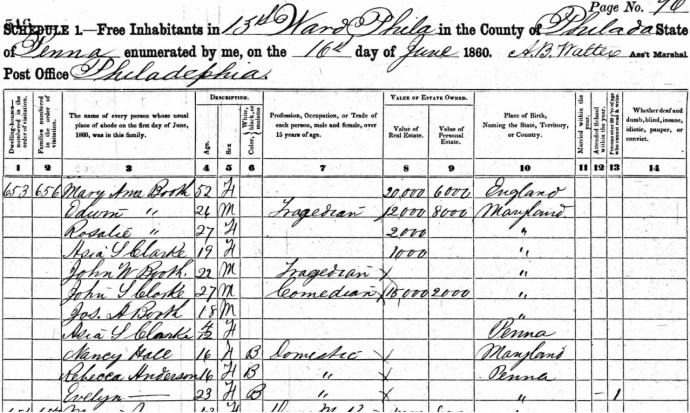
Thank you to Art Loux for sharing this interesting census record from 1860 with me.  It shows a rare instance in which practically all the members of the Booth family are living under one roof.  The only missing family members are the deceased Junius, Sr. and the living Junius, Jr. who resided in California.

Booth family in the 1860 Census

The home in Philadelphia that all the Booths were living in was the home of John Sleeper Clarke and Asia Booth.  The two had been married the previous year.  In June of 1859, about two months after their marriage, Mary Ann Booth moved in with the newlyweds.  Joe and Rosalie followed her shortly thereafter.  When this snapshot was taken Edwin, John Wilkes, and John Sleeper Clarke were all briefly home due to the completion of the acting season.  The summer heat made a crowded theater an unbearable affair and so the theater season was closed until the fall.

This full house of Booths would not last long at all, however.  Less than a month after this census record was taken, Edwin was married to his first wife, Mary Devlin.  The newlyweds honeymooned at Niagara Falls and then took up a home in New York.  By December of 1860, Asia wrote a letter to her friend Jean Anderson in which she mentions how Mary Ann, Rosalie and John Wilkes were no longer living at her home, having taken up residence at a boarding house elsewhere in Philadelphia.  Finally, Joseph Booth was enrolled in medical school in Charleston, South Carolina before the end of 1860.

As swiftly as they had all assembled, the Booths quickly separated again leaving us with only the above glimpse of a rare reunion among the entire family.

References:
Art Loux
Edwin Booth: A Biography and Performance History
John Wilkes Booth’s Enigmatic Brother: Joseph by John C. Brennan
Ancestry.com

Categories: Uncategorized | Tags: , | 11 Comments

Edwin Booth at the Trial

Edwin Booth as Hamlet

Edwin Booth as Hamlet

After his brother’s crime, Edwin Booth was spared the indignity of arrest.  The celebrated actor had just recently completed his illustrious run of 100 consecutive nights as Hamlet.  While his brothers Joe and Junius and his brother-in-law John Sleeper Clarke were arrested and imprisoned, Edwin remained untouched, as the grieving national treasure that he was.  Joe Booth spent only a couple of nights in jail before securing his release.  John Sleeper Clarke was arrested on April 27th and remained behind bars until May 26th.  Poor Junius spent the most time in prison due to his letter to John Wilkes in which he urged his brother to quit the oil business and return to the stage.  Junius was unaware that Wilkes used the term “oil business” as a cover for his plots against Lincoln.  Junius was arrested on April 25th and was remained imprisoned at the Old Capitol Prison Carroll Annex until June 23rd.

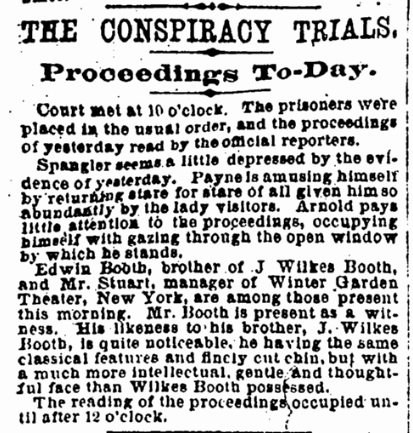
During this time, Edwin wisely shied away from the spotlight.  However, he was spotted at a high profile event in Washington on the last day of May:  the trial of the conspirators

Edwin Booth at the trial

As the Washington Star noted above, Edwin Booth was at the trial of the conspirators to act as a witness.  However, in the transcript of the trial you will never find Edwin Booth’s testimony from the witness stand.  In a letter that Edwin Booth wrote to a friend in Philadelphia the next day, he explains his reason for being there:

 “…I was called for the defense – to prove that J. Wilkes had such power over the minds of others as would easily sway those with whom he associated, &c. &c; the idea is to set up a plea of insanity for Herald or Paine – or some of them.  I told Doster all I knew of John, and he concluded it wd be as well not to call me.  The Washington ‘Star’ had a description of me – stating I was there as a witness – I daresay the press all over the country will be filled with my ‘arrest’ and all sorts of awful things…”

It was probably an act of courtesy and compassion that led William Doster to decide against using Edwin Booth on the witness stand.  The lawyer for Lewis Powell and George Atzerodt found other ways to demonstrate John Wilkes Booth’s influential character without subjecting the country’s greatest actor to further humiliation.  The request from Doster also provided Edwin with an appropriate reason to travel to Washington to visit his brother:

“I spent the day (yesterday) in Washington, and the greater part of it with my brother Junius – I dined with him – in his ‘quarters’…”

“…I then left the court (after taking a good look at the criminals) and drove to C Prison & stayed with June until 5 o’clk.  I had all sorts of good words & Junius … shd be speedily released &c.”

Not everyone felt happy that Edwin was spared imprisonment and suspicion after Lincoln’s assassination.  Years later, after Edwin himself was almost assassinated by Mark Gray Lyon, a now jaded and disgruntled John Sleeper Clarke wrote the, “Booths…get all the notoriety without suffering!! for it…Look at me I was dragged to jail by the neck – literally dragged to prison – and Edwin goes scot-free gets all the fame – sympathy – who thinks of what I endured.”

John Sleeper Clarke - not happy that Edwin wasn't arrested, too.

John Sleeper Clarke – not happy that Edwin wasn’t arrested, too.

Perhaps it was a bit unfair that Edwin Booth escaped the trials that his brothers and brother-in-law endured.  However, as a celebrated and vocal supporter of the Union during the Civil War, such preferential treatment is not unfounded.  In the years that followed, the theater world purposefully forgot Edwin’s villainous relation, however the stigma of his brother’s crime would haunt Edwin far longer than his brothers’ incarceration.

References:
Evening Star, 5/31/1865
Edwin Booth: A Biography and Performance History by Arthur Bloom

Categories: Uncategorized | Tags: , | 4 Comments

A Sister’s Sorrow

Asia Booth Clarke, John Wilkes Booth’s sister, had a lifelong pen pal named Jean Anderson.  From her early days at Tudor Hall to her isolated years in England, Asia wrote to Jean with regularity.  For years, some of Asia Booth Clarke’s letters to Jean Anderson were held at the Peale Museum in Baltimore.  What follows is a transcript of Asia’s letter to Jean in the aftermath of the assassination:

Asia Booth Clarke

Asia Booth Clarke


Philadelphia, May 22, 1865.

My Dear Jean:

I have received both of your letters, and although feeling the kindness of your sympathy, could not compose my thoughts to write — I can give you no idea of the desolation which has fallen upon us. The sorrow of his death is very bitter, but the disgrace is far heavier; – Already people are asserting that it is a political affair — the work of the bloody rebellion — the enthusiastic love of country, etc. but I am fraud to us it will always be a crime –

Junius and John Clarke have been two weeks to-day confined in the old Capital – prison Washington for no complicity or evidence — Junius wrote an innocent letter from Cincinnati, which by a wicked misconstruction has been the cause of his arrest. He begged him to quit the oil business and attend to his profession, not knowing the “oil” signified conspiracy in Washington as it has since been proven that all employed in the plot, passed themselves off as “oil merchants”.

John Clarke was arrested for having in his house a package of papers upon which he had never laid his hands or his eyes, but after the occurrence when I produced them, thinking it was a will put here for safe keeping — John took them to the U.S. Marshall, who reported to head-quarters, hence this long imprisonment for two entirely innocent men –

I would not object at present to have back for my private use all the money they have squandered on Sanitary Commissions, Hospital Endowments, Relief of Soldiers Widows, and the like, for the good done by them as actors and citizens goes nothing towards providing their innocence, and it might well have been tendered to a better purpose –

I suppose they will be examined in the leisure of the Court and return home to be nursed through a spell of illness, — as one Gent has done who was released last week, — and whose arrest proved only a farce as General somebody in authority expressed it — Poor old country, she has seen her best days, and I care not how soon I turn my back upon her shores forever, it is the history of the Republic over again.

I was shocked and grieved to see the names of Michael O’Laughlin and Samuel Arnold. I am still some surprised to learn that all engaged in the plot are Roman Catholics — John Wilkes was of that faith — preferably — and I was glad that he had fixed his faith on one religion for he was always of a pious mind and I wont speak of his qualities, you knew him. My health is very delicate at present but I seem completely numbed and hardened in sorrow.

The report of Blanche and Edwin are without truth, their marriage not to have been until September and I do not think it will be postponed so that it is a long way off yet. Edwin is here with me. Mother went home to N.Y. last week. She has been with me until he came.

I told you I believe that Wilkes was engaged to Miss Hale, — They were most devoted lovers and she has written heart broken letters to Edwin about it — Their marriage was to have been in a year, when she promised to return from Spain for him, either with her father or without him, that was the decision only a few days before the fearful calamity — Some terrible oath hurried him to this wretched end. God help him. Remember me to all and write often.

Yours every time,

Asia

The “Blanche” that Asia refers to is Blanche Hanel, Edwin Booth’s fiancée.  Edwin Booth’s first wife, Mary Devlin, died in February in 1863.  By September of 1864, Edwin was romantically involved with Blanche Hanel, a wealthy Philadelphian.  As Asia wrote above, the two were engaged to be married when the assassination occurred.  In addition to retreating from the stage, Edwin also wrote to Blanche allowing her to break off their engagement due to the circumstances.  At first Blanche stayed by Edwin and as Asia writes, their engagement continued.  In the end, however, Blanche’s father would not allow the marriage and by November of 1865, Edwin and Blanche’s relationship ended.  It wouldn’t be until June of 1869 that Edwin Booth would remarry, this time to Mary McVicker of the Chicago theatrical family.

Categories: Uncategorized | Tags: | 12 Comments

“Our dear little Henry is dead!”

John Wilkes Booth’s father, Junius Brutus Booth, was a productive progenitor. With his two wives, Adelaide Delannoy and Mary Ann Holmes, Junius fathered a total of twelve children. Of these twelve children, seven survived into adulthood, five married, and four had children of their own that survived into adulthood. This post is about two of the Booth children, both of whom died young. They are Amelia Portia and Henry Byron Booth.

Amelia Portia Adelaide Booth

I discussed Amelia briefly in my last post on the Booth family, “The Son of John Wilkes Booth“. Alas I have little more to add about young Amelia because her life was short lived and there is little documentation about her. Amelia Portia Adelaide was born on October 5th, 1815. She was baptized in the Parish of St. George Bloomsbury in London on January 7th, 1816. St. George was the same church in which Junius and Adelaide were married on May 8th, 1815. In the baptism record book, which is attached below, Junius gives his occupation as a “Solicitor” instead of an actor. Amelia’s baptism took place while Junius was still making a name for himself and so perhaps the man who suddenly had a family to support was questioning his future.

Amelia's baptism

Thus far, no death date or burial record for Amelia Booth has been found. However, a book published in 1817 called, “Memoirs of Junius Brutus Booth” gives the following footnote to the marriage of Junius and Adelaide: “Mr. Booth has had one child by his marriage, which died in its infancy”. This would place Amelia’s death in 1816 or early 1817.

Henry Byron Booth

In April of 1824, Lord Byron, the renowned British poet, died at the age of 36. It was with the romantic words of Lord Byron that Junius Brutus Booth had lured the young flower girl, Mary Ann Holmes, away from her family and life in England to abscond with him to America. The poet held a special place in the hearts of the couple. It was for this reason that Junius and Mary’s third child, the first to be born after the poet’s death, received the middle name of Byron. The exact date of Henry Byron Booth’s birth is unknown. From sources, however, I have been able to deduce that he was born between April 4th and December 28th, 1825. I attempted to deduce Henry Byron’s birthdate even further by looking at the dates in which Junius Brutus Booth was home from tour with Mary Ann and the pair could have conceived Henry. Unfortunately, Junius was home from mid June, 1824 until mid March, 1825, which, 9 months later, would leave me with the same basic spread for a birthdate. If Henry Byron was born between April and about mid August, then he would have been born on the family farm near Bel Air, Maryland, the same location where seven of his brothers and sisters were born. If he was born between mid August and the end of December, 1825, however, then Henry Byron Booth’s place of birth was the same as his half siblings: England. You see about August 22nd, 1825, Junius Brutus Booth took Mary Ann, his children, and one of his servants back to London with him. This was Junius’ first return to England since he ran off with Mary Ann in 1821. The man who had formerly trumped Junius on the London stage, Edmund Kean, had recently fled to America himself after his own adulterous relationship with a married woman became public knowledge. Hoping to usurp Kean’s title yet again, Junius brought the family to England. Alas, despite the personal distaste theatergoers had for Kean and his recent adultery, Junius was still treated and reviewed as professionally inadequate to Kean’s talents. The Booth family stayed in England for about a year before returning to Baltimore on August 15, 1826. So, whether Henry Byron Booth was born in Maryland or England, he did spend the first several months of his life on foreign shores.

Junius had high hopes for this boy and he appears to have been the favorite of his father’s. While still young, Junius wrote home asking if four year old Henry could read yet, hoping to ignite the spark of creativity and genius he saw in the young boy. Ten years had passed since Junius’ last tour of England. In the fall of 1836, having witnessed his fame grow even greater in America (and the death of Kean having occurred 3 years previous), Junius decided to try his luck again in his native land. Again he was lured with offers from London managers as to the money he (and subsequently they) could earn. Across the sea he brought along the family; Mary Ann, Junius Jr., Rosalie, Henry Byron, Edwin, four-month-old Asia, and the family’s long-time servant Hagar. Junius would later write that the tour was hardly the money making endeavor promised him, “…theatricals in England are gone to sleep – with all their puffing of full houses, I don’t believe that more than two Managers in London got even enough to pay for what they individually eat.” But Junius’ time in England in 1836/1837 would be far worse than unsatisfying house numbers. On December 28th, 1836, disaster struck the Booth family while in London. The following letter, written by Junius to his father Richard back in Maryland, explains the extreme misfortune that found the Booth’s abroad:

“We have at last cause and severe enough it is, to regret coming to England. I have delayed writing till time had somewhat softened the horror of the event. Our dear little Henry is dead! He caught the small pox and it proved fatal – he has been buried about three weeks since in the chapel ground close by. Guess what his loss has been to us – So proud as I was of him above all others. The infernal disease has placed Hagar in the hospital, but she is recovering and the two youngest who were inoculated are also getting well. Junius and Rosalie have been vaccinated – so had Henry – but on him the vaccine had not taken effect and his general health being so excellent caused us to forget the danger he was liable to.”

The death of his favorite son caused a great melancholy in Junius and, “unhinged the requisite energies for coping with the Tricksters of London.” Junius made his last appearance in England on March 17th, 1837 and shortly thereafter the family returned to America. Junius would never again return to his native land and he left poor Henry buried beneath its shores.

Henry Byron Booth was buried in the burying ground of St. James of Clerkenwell near Pentonville Chapel. According to Asia Booth Clarke’s book, “The Elder and Younger Booth“, Henry’s stone bore the following epitaph:

“Oh, even in spite of death, yet still my choice,
Oft with the inward, all-beholding eye,
I think I see thee, and I hear thy voice.”

The burial took place on January 9th, 1837 as this burial record shows:

Henry Byron's Burial

Like the London cemetery holding the body of Henry Wilkes Booth, Henry Byron Booth’s graveyard was also turned into a park around the turn of the century. As one author wrote of the burial ground in 1896, “It is nearly an acre in extent, full of tombstones and very untidy, but the Metropolitan Public Gardens Association has undertaken to convert it into a public garden.”

The cemetery in which Henry Byron Booth was buried.  This image was taken circa 1896, just before the cemetery was transformed into a park.

The cemetery in which Henry Byron Booth was buried. This image was taken just before the cemetery was transformed into a park.

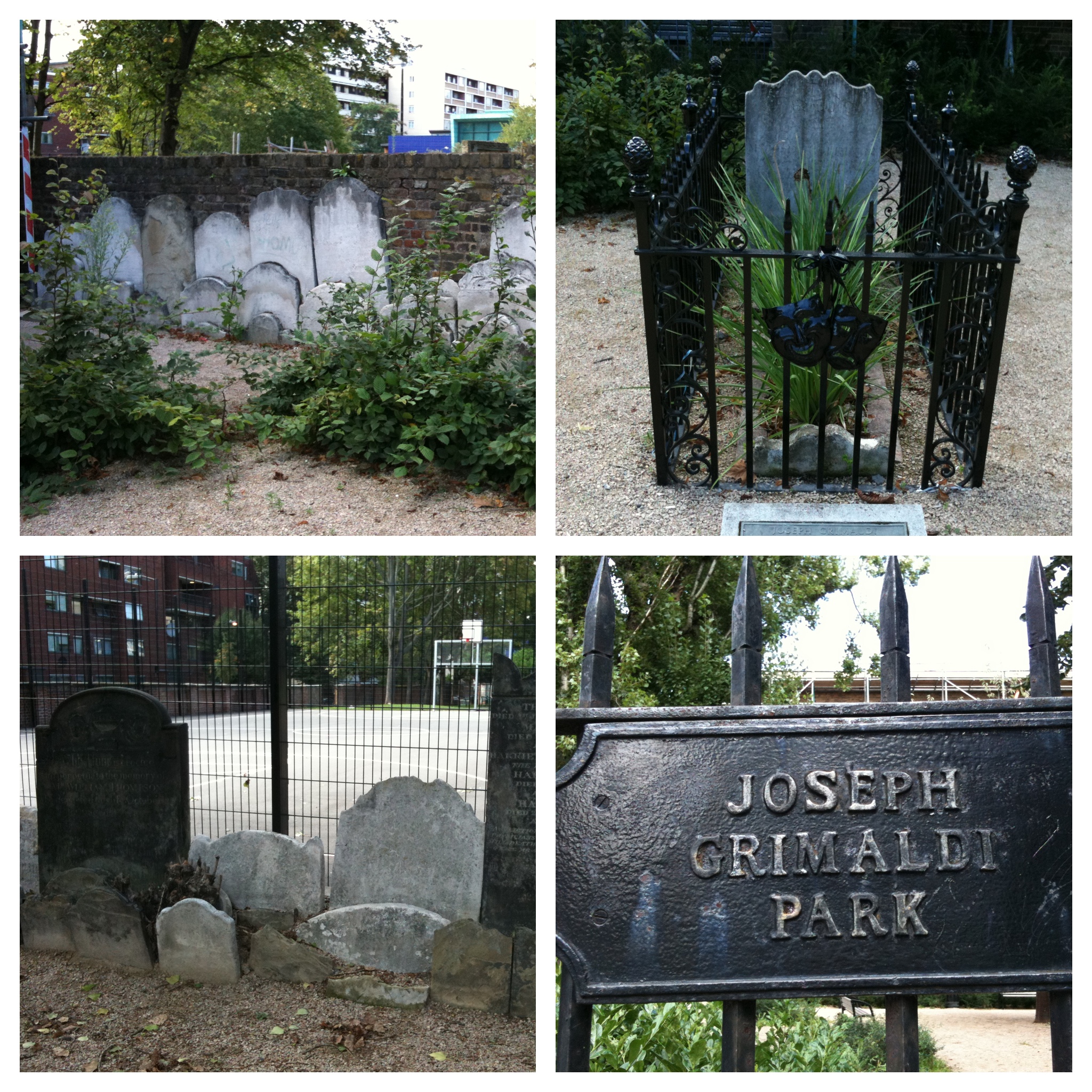
Today, Henry Byron Booth’s burial place is called Joseph Grimaldi Park. Grimaldi was a famous English clown who was buried in the cemetery before its transformation. Grimaldi’s stone is the only one to have remained untouched when the cemetery was turned into a park and today it has a small gate around it. Some of the other stones that once filled the cemetery now border the walls of the park, but it is unlikely that Henry Byron Booth’s is one of them:

Grimaldi Park collage

Junius Brutus Booth would be very distraught over the loss of Henry Byron Booth for months. It wasn’t until the birth of his next child in May of 1838, that his dark cloud would lift. In the eyes of this newborn son Junius saw again the spark of one who would change the world. This child’s name was John Wilkes Booth.

References:
London Metropolitan Archives
Junius Brutus Booth: Theatrical Prometheus by Stephen M. Archer
The Elder and Younger Booth by Asia Booth Clarke
Memoirs of Junius Brutus Booth
My Thoughts Be Bloody by Nora Titone
The London Burial Grounds by Mrs Basil Holmes

Categories: Uncategorized | Tags: | 17 Comments

The Son of John Wilkes Booth

At first blush, London may seem far removed from the story of the Lincoln assassination. However, the history of the assassin is very much based in his ancestral London roots. We can document that the Booth family had called London home since at least John Wilkes Booth’s great grandfather’s christening in London in 1723. Junius Brutus Booth, the patriarch of the theatrical dynasty that fathered the assassin, was born in and started his career on the London stages of Covent Garden and Drury Lane. A few years after the assassination, John Sleeper Clarke moved his family, including his wife and sister to the assassin, Asia Booth Clarke, to London. Asia never saw America again except for when her body was returned to Baltimore, and John Sleeper sleeps forever in a London cemetery.

So there are many possible Boothie missions for one to do when visiting London. You could find the location of Junius’ boyhood home, search through the London Metropolitan Archives for Booth birth and death certificates, or visit a theatre library to photograph early Junius playbills. There is also one small connection hidden away in a small cemetery.

hree children of Junius Brutus Booth are buried in London. The first to die, and is safely assumed to be buried in London, was Junius’ first child, Amelia. In my last post in the series regarding Junius’ early theatrical career I hinted about this unborn child conceived with Adelaide Delannoy. Amelia died in infancy and, thus far, an exact date of death and place of burial has yet to be found. The other two Booth children buried in London are Richard Booth, Junius’s other child with Adelaide who lived into adulthood, and Henry Byron Booth, Junius’ son with Mary Ann Holmes who died when the family was visiting London. A further post will document their deaths and burials once I receive paperwork in the mail from the London Metropolitan Archives.

While researching the above however, I came across an interesting letter in the James O. Hall Research Center of another Booth buried in London whose father had a familiar name:

Henry Booth letter

Coincidences occur, of course, and there are likely hundreds of Booths in London today with no connection to the assassin of the President, but the fact that this Henry Wilkes Booth was buried in St. John’s of Clerkenwell, the same neighborhood where our Booth family resided, is worth following up. It appears that James O. Hall, forever investigating every lead, agreed and in another letter he recounts a time when he was in England and attempted to find the above mentioned stone. He was unsuccessful as, “the usual London rain” cut his search short.

The rain however, was probably a blessing as it turns out Mr. Hall was in the wrong cemetery. Just from my slight research into the matter I can tell you that London cemeteries are a nightmare. They are called different names at different times and many smaller cemeteries that existed during the Civil War era were transformed into parks with the grave stones removed. However, as luck would have it, one of the few gravestones that remain in one of those small micro parks is that of Henry Wilkes Booth’s:

Henry Wilkes Booth's grave 1

Henry Wilkes Booth's Grave

So who is this Henry Wilkes Booth, son of John Wilkes Booth anyway? Before you start thinking “escape theory” no, this is not a post-assassination son of “our” John Wilkes Booth. The death date for Henry Wilkes of 1837, a full year before our John Wilkes was born, luckily nips that in the bud. In fact, Henry Wilkes and John Wilkes were second cousins as this partial family tree shows.

Henry Wilkes relation to John Wilkes

What is interesting is how the name John Wilkes Booth was already in the family before the American John Wilkes Booth was born. Many authors have written that our John Wilkes Booth gets his name from the British radical John Wilkes. We know that, in his younger days, Richard Booth attempted to sail off to the colonies in order to fight on behalf of the American Revolution. Richard wrote to John Wilkes asking for his assistance, noting a kinship between them. Richard’s mother was Elizabeth Wilkes who is assumed to be distantly related to John Wilkes. In his book, The Mad Booths of Maryland, author Stanley Kimmel wrote that Richard Booth was given the honor of naming his grandson John Wilkes Booth, though no source is given for this idea.

While it is entirely possible and seemingly appropriate that America loving Richard named his grandson John Wilkes Booth after the British agitator who sided with America during the revolution, the name had already been used in the family. The American Booths had contact with the British Booths and during Junius’ divorce proceedings with Adelaide, the British John Wilkes Booth was brought up as he controlled some of Junius’ assets that were left to him by his grandmother. Perhaps therefore, the assassin of President Lincoln was not named after the great radical John Wilkes, but after his father’s cousin, John Wilkes Booth of London.

Regardless, this one gravestone for Henry Wilkes Booth is one of the very few that remain of the illustrious Booth family in London. Today, it is one of five or so gravestones in the 320 square yard park “St. John’s Churchyard” off of St. John’s Street in London.

2013-07-20 14.00.17

References:
Junius Brutus Booth: Theatrical Prometheus by Stephen M. Archer
James O. Hall Research Center
Art Loux Archives
Lindsey Horn

Categories: Uncategorized | Tags: | 23 Comments

When Junius Took the Stage – Part 3

I’m in the midst of reading the book, Junius Brutus Booth: Theatrical Prometheus by Stephen M. Archer. Though I’m only about 40 pages into it, I already have the book brimming with Post-It notes marking items of interest requiring further investigation. The most fascinating things I’ve come across thus far, is the drama that occurred when Junius Brutus Booth made his star debut in the theaters of London. In preparation for a post about the matter, I found myself with a wealth of material on the early theatrical life of Junius Brutus Booth. Instead of summarizing key points of Junius’ initial acting career, I decided to write a series of posts examining the humble acting beginnings of the man who would later father a theatrical dynasty, including the assassin of President Lincoln. What follows is a continuing part of a series of posts entitled, “When Junius Took the Stage”. Click here for Part 1 and here for Part 2 of the series.

Part 3 – When Junius Took a Wife

After a long and arduous journey, Junius Brutus Booth, a mere supporting player in the Jonas-Penley acting troupe, made it across the sea from London to Amsterdam. On Wednesday, May 18th, 1814, the company opened in Amsterdam’s High German Theatre playing the same play Booth had made his professional debut in five months earlier, The Honey Moon. Booth reprised his extremely minor role as the servant Campillo. Though Booth put on a good face and performed as required, his feet still hurt him greatly from his lonely trek the days before. For the next two nights’ performances, Junius did not appear.

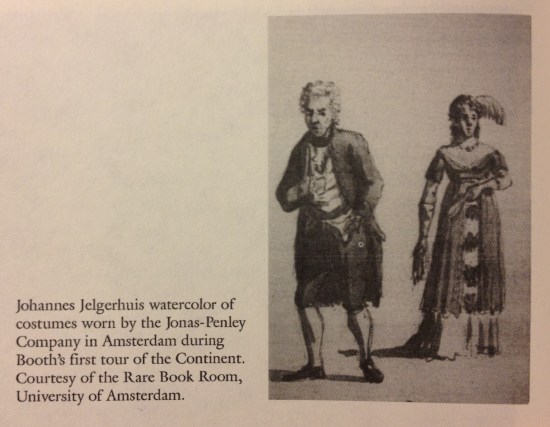
Though appearing in the High German Theatre, the troupe performed in their native English. Therefore, witnessing the troupe’s performances was an interesting experience for many Dutch theatergoers. One non-English speaking theater goer was a man named Johannes Jelgerhuis. Though unable to follow the script, Jelgerhuis judged the troupe by their mannerisms and costumes and felt they were reasonably accomplished. Jelgerhuis was a graphic artist and made sketches of the cast’s wardrobe and notes on their scenery. So, while the Jonas-Penley troupe appealed more to the English tourists and English citizens in the different cities they visited in the continent, non-English speakers still attended their performances for the visual entertainment.

The troupe stayed three months in Amsterdam before moving on to Antwerp on July 22nd. Junius was struck by the beauties of the churches in Antwerp. He felt guilty and sinful about going to perform in a morally contemptuous theatre after visiting such holy structures.

By August the 14th, the troupe moved cities again, this time establishing themselves in Brussels. As Mr. Archer states, “Jonas and Penley had picked a propitious time for a Brussels engagement. Wellington’s defeat of Napoleon at nearby Waterloo on June 18th had swelled pro-British sentiment in the Netherlands; at no period in its history had Brussels so esteemed the English.” While a fortuitously profitable time for an English theatrical troupe, finding lodging in the militarily swollen Brussels became difficult. Left to his own devices, Junius found housing from a widow who lived close to the theatre.

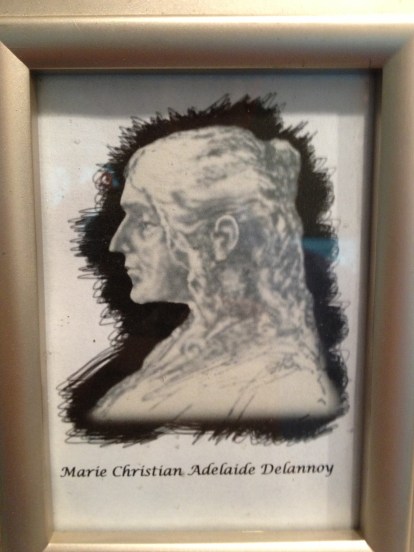
His landlord’s name was Agatha Delannoy. He paid her seventeen francs a month and would ultimately board with her from August 14th until November 25th when the troupe departed for Ghent. The troupe only performed 36 times over the 104 days that Junius stayed under Madam Delannoy’s roof. This gave him ample time to get to know Ms. Delannoy’s four daughters, all of whom were between the ages of 19 and 24. There was Marie Josepha Agatha, Marie Christine Adelaide, Therese Eleonore, and Amelie Francoise Julienne. On August 25th, the birthday of the Prince of Orange, the troupe failed to perform as two of the actors did not show up. Junius foresaw this eventuality and had prearranged for two of Ms. Delannoy’s daughters to accompany him to see the celebration. Though not known with certainty, it is assumed that one of these “fine ladies” Booth escorted was Adelaide Delannoy. “Mimi” as she was nicknamed by her mother and sisters, was four years older than Junius, but the young actor was smitten. A romantic relationship evolved between the two over the course of his stay with the family and, when the troupe was poised to move on to Ghent on November 25th, reckless Adelaide eloped with Junius much to the dismay of her mother.

The only known drawing of Adelaide Delannoy.

The only known drawing of Adelaide Delannoy.

At least twice over the years, Junius recounted, with plenty of flair, the adventure the star crossed lovers experienced while fleeing from Adelaide’s disapproving family. According to one account, on the night of November 25th, the pair decided they would escape Adelaide’s family via a covered stagecoach. At the appointed hour, Junius stood beneath Adelaide’s window, while she lowered down to him a bundle of her favorite keepsakes and relics. While in the process of doing this, one of Adelaide’s sisters discovered Junius in the yard and, while raising the alarm, ejected Junius’ from the property. In the commotion that occurred, Adelaide was able to sneak off and make it to the carriage before it passed by the home. Junius was able to catch up with the stagecoach and join Adelaide. By this time Ms. Delannoy had called on the authorities to find and retrieve her misguided daughter and save her from this actor. Upon seeing the police approaching the wagon, Adelaide bundled herself under the seats of the carriage and covered herself with the large coat of another passenger. Junius, on the other hand, chose not to hide, but used his skill of acting to disguise his appearance: “He knew the perseverance of his opposers, wherefore, casting himself to the part of an invalid at the last extremity, pulling his cap and hat over his forehead, and assuming a cast [squint] in one eye, he sat mutely in a corner of the machine.” When the pursuers searched the stagecoach, they could find no persons matching the descriptions given to them by Ms. Delannoy, and the wagon continued its route to Ghent.

To the benefit of the pair, the Jonas-Penley Company did not stay in Ghent long, leaving the city after only six performances. By December 11th, the couple was in Bruges, having now successfully eluded Adelaide’s family. The troupe stayed in Bruges through New Year’s, departing for the coastal town of Ostend on January 2nd, 1815.

Ostend was too cold for Junius’ tastes. He called it “a most wretched place.” Though it could have undoubtedly happened prior to this time as well, in Ostend, Junius and Adelaide succeeded in using the timeless method of keeping warm in a cold climate: shared body heat. It was about this time in Ostend that Adelaide became pregnant. Though two others had accused and even successfully sued Junius for paternity when he was even younger, there is no doubt that this recently conceived child of Adelaide Delannoy’s was the child of 18 year-old Junius Brutus Booth.

Young Junius Brutus Booth Drawing

A young Junius Brutus Booth

It was while performing in Ostend that the Jonas-Penley Troupe began its round of benefit performances for all of its actors. Junius received his first of many theatrical benefits on Monday, March 13th. Junius performed Richard III and brought in twenty-three pounds. He had to pay the managers twelve pounds for expenses and he was given the remaining eleven.

It had been almost four months since Adelaide ran away with Junius when the latter had his first benefit. During the period in between, Junius had managed to reconnect with Ms. Delannoy, clearly not wanting to excessively worry the woman who would be his mother-in-law. Perhaps understanding the recklessness of youth and that further protests of their relationship would only alienate her daughter further, Ms. Delannoy tried instead to talk sense into Junius in regards to his career. Ms. Delannoy attempted to secure for Junius a more respectable vocation as a clerk’s stationer. In a letter from Junius to Adelaide’s mother dated March 17th, Junius acts interested in the position but is likely humoring the poor woman as he had done many times with his own father. He brags about his salary and prestige as an actor, exaggerating it greatly. Junius writes of wanting to live in Brussels, while he is simultaneously preparing to return to England at the end of the month. He ends the letter with, “I believe you are angry, but there is no cause for it.” I would have to disagree with Junius on that. Ms. Delannoy had justifiable reasons to be angry at the rash young actor who ran off with her daughter.

On March 31st, 1815, the Jonas-Penley Company, Junius, and Adelaide sailed back to England, their continental tour having ceased. His time abroad allowed Junius to act for the first time in some of the roles he would later make famous. Like a child learning to ride a bike, this tour served as Junius’ training wheels. While the continent gave him the skills, it would be the London theaters that would make him a star. But all that would come later.

Junius arrived back to the home of his father Richard. Dr. Archer succinctly states, “What explosions rocked Queen Street when the prodigal son introduced his pregnant Adelaide to Richard we can today only imagine.” No doubt motivated by the growing pregnancy and the urging of his father, Junius and Adelaide were married on May 8th, 1815, one week after Junius’ 19th birthday. The young actor was now married, expecting, and looking to make a name for himself on the London stages.

Stay tuned for the next installment where Junius find himself as one of the key players in a war that rocks the London theatres.

References:
Junius Brutus Booth: Theatrical Prometheus by Stephen Archer
Booth Memorials: Passages and Incidents and Anecdotes in the Life of Junius Brutus Booth by Asia Booth Clark
Memoirs of Junius Brutus Booth from his Birth to the Present Time

Categories: Uncategorized | Tags: | 6 Comments

Blog at WordPress.com.