Posts Tagged With: Booth Family

When Junius Took the Stage – Part 3

I’m in the midst of reading the book, Junius Brutus Booth: Theatrical Prometheus by Stephen M. Archer. Though I’m only about 40 pages into it, I already have the book brimming with Post-It notes marking items of interest requiring further investigation. The most fascinating things I’ve come across thus far, is the drama that occurred when Junius Brutus Booth made his star debut in the theaters of London. In preparation for a post about the matter, I found myself with a wealth of material on the early theatrical life of Junius Brutus Booth. Instead of summarizing key points of Junius’ initial acting career, I decided to write a series of posts examining the humble acting beginnings of the man who would later father a theatrical dynasty, including the assassin of President Lincoln. What follows is a continuing part of a series of posts entitled, “When Junius Took the Stage”. Click here for Part 1 and here for Part 2 of the series.

Part 3 – When Junius Took a Wife

After a long and arduous journey, Junius Brutus Booth, a mere supporting player in the Jonas-Penley acting troupe, made it across the sea from London to Amsterdam. On Wednesday, May 18th, 1814, the company opened in Amsterdam’s High German Theatre playing the same play Booth had made his professional debut in five months earlier, The Honey Moon. Booth reprised his extremely minor role as the servant Campillo. Though Booth put on a good face and performed as required, his feet still hurt him greatly from his lonely trek the days before. For the next two nights’ performances, Junius did not appear.

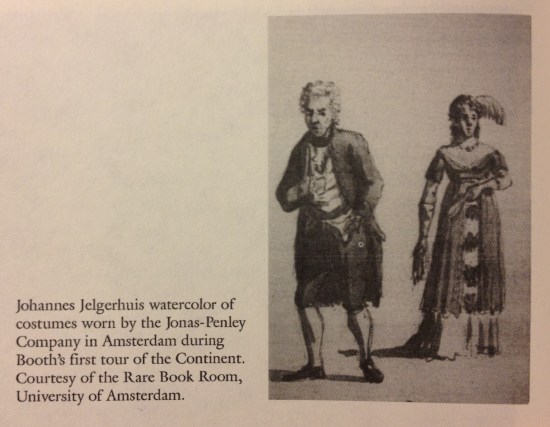
Though appearing in the High German Theatre, the troupe performed in their native English. Therefore, witnessing the troupe’s performances was an interesting experience for many Dutch theatergoers. One non-English speaking theater goer was a man named Johannes Jelgerhuis. Though unable to follow the script, Jelgerhuis judged the troupe by their mannerisms and costumes and felt they were reasonably accomplished. Jelgerhuis was a graphic artist and made sketches of the cast’s wardrobe and notes on their scenery. So, while the Jonas-Penley troupe appealed more to the English tourists and English citizens in the different cities they visited in the continent, non-English speakers still attended their performances for the visual entertainment.

The troupe stayed three months in Amsterdam before moving on to Antwerp on July 22nd. Junius was struck by the beauties of the churches in Antwerp. He felt guilty and sinful about going to perform in a morally contemptuous theatre after visiting such holy structures.

By August the 14th, the troupe moved cities again, this time establishing themselves in Brussels. As Mr. Archer states, “Jonas and Penley had picked a propitious time for a Brussels engagement. Wellington’s defeat of Napoleon at nearby Waterloo on June 18th had swelled pro-British sentiment in the Netherlands; at no period in its history had Brussels so esteemed the English.” While a fortuitously profitable time for an English theatrical troupe, finding lodging in the militarily swollen Brussels became difficult. Left to his own devices, Junius found housing from a widow who lived close to the theatre.

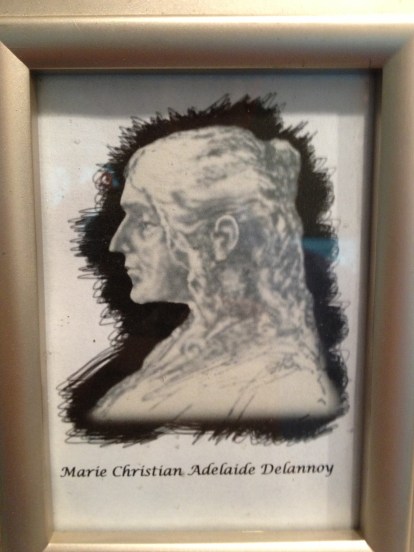
His landlord’s name was Agatha Delannoy. He paid her seventeen francs a month and would ultimately board with her from August 14th until November 25th when the troupe departed for Ghent. The troupe only performed 36 times over the 104 days that Junius stayed under Madam Delannoy’s roof. This gave him ample time to get to know Ms. Delannoy’s four daughters, all of whom were between the ages of 19 and 24. There was Marie Josepha Agatha, Marie Christine Adelaide, Therese Eleonore, and Amelie Francoise Julienne. On August 25th, the birthday of the Prince of Orange, the troupe failed to perform as two of the actors did not show up. Junius foresaw this eventuality and had prearranged for two of Ms. Delannoy’s daughters to accompany him to see the celebration. Though not known with certainty, it is assumed that one of these “fine ladies” Booth escorted was Adelaide Delannoy. “Mimi” as she was nicknamed by her mother and sisters, was four years older than Junius, but the young actor was smitten. A romantic relationship evolved between the two over the course of his stay with the family and, when the troupe was poised to move on to Ghent on November 25th, reckless Adelaide eloped with Junius much to the dismay of her mother.

The only known drawing of Adelaide Delannoy.

The only known drawing of Adelaide Delannoy.

At least twice over the years, Junius recounted, with plenty of flair, the adventure the star crossed lovers experienced while fleeing from Adelaide’s disapproving family. According to one account, on the night of November 25th, the pair decided they would escape Adelaide’s family via a covered stagecoach. At the appointed hour, Junius stood beneath Adelaide’s window, while she lowered down to him a bundle of her favorite keepsakes and relics. While in the process of doing this, one of Adelaide’s sisters discovered Junius in the yard and, while raising the alarm, ejected Junius’ from the property. In the commotion that occurred, Adelaide was able to sneak off and make it to the carriage before it passed by the home. Junius was able to catch up with the stagecoach and join Adelaide. By this time Ms. Delannoy had called on the authorities to find and retrieve her misguided daughter and save her from this actor. Upon seeing the police approaching the wagon, Adelaide bundled herself under the seats of the carriage and covered herself with the large coat of another passenger. Junius, on the other hand, chose not to hide, but used his skill of acting to disguise his appearance: “He knew the perseverance of his opposers, wherefore, casting himself to the part of an invalid at the last extremity, pulling his cap and hat over his forehead, and assuming a cast [squint] in one eye, he sat mutely in a corner of the machine.” When the pursuers searched the stagecoach, they could find no persons matching the descriptions given to them by Ms. Delannoy, and the wagon continued its route to Ghent.

To the benefit of the pair, the Jonas-Penley Company did not stay in Ghent long, leaving the city after only six performances. By December 11th, the couple was in Bruges, having now successfully eluded Adelaide’s family. The troupe stayed in Bruges through New Year’s, departing for the coastal town of Ostend on January 2nd, 1815.

Ostend was too cold for Junius’ tastes. He called it “a most wretched place.” Though it could have undoubtedly happened prior to this time as well, in Ostend, Junius and Adelaide succeeded in using the timeless method of keeping warm in a cold climate: shared body heat. It was about this time in Ostend that Adelaide became pregnant. Though two others had accused and even successfully sued Junius for paternity when he was even younger, there is no doubt that this recently conceived child of Adelaide Delannoy’s was the child of 18 year-old Junius Brutus Booth.

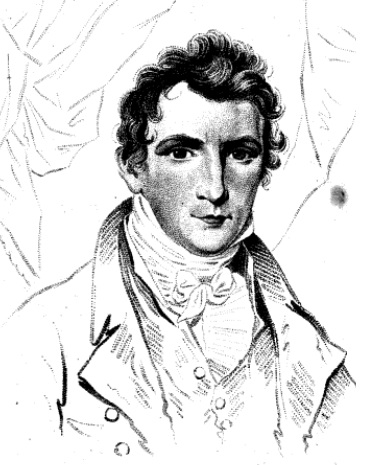
Young Junius Brutus Booth Drawing

A young Junius Brutus Booth

It was while performing in Ostend that the Jonas-Penley Troupe began its round of benefit performances for all of its actors. Junius received his first of many theatrical benefits on Monday, March 13th. Junius performed Richard III and brought in twenty-three pounds. He had to pay the managers twelve pounds for expenses and he was given the remaining eleven.

It had been almost four months since Adelaide ran away with Junius when the latter had his first benefit. During the period in between, Junius had managed to reconnect with Ms. Delannoy, clearly not wanting to excessively worry the woman who would be his mother-in-law. Perhaps understanding the recklessness of youth and that further protests of their relationship would only alienate her daughter further, Ms. Delannoy tried instead to talk sense into Junius in regards to his career. Ms. Delannoy attempted to secure for Junius a more respectable vocation as a clerk’s stationer. In a letter from Junius to Adelaide’s mother dated March 17th, Junius acts interested in the position but is likely humoring the poor woman as he had done many times with his own father. He brags about his salary and prestige as an actor, exaggerating it greatly. Junius writes of wanting to live in Brussels, while he is simultaneously preparing to return to England at the end of the month. He ends the letter with, “I believe you are angry, but there is no cause for it.” I would have to disagree with Junius on that. Ms. Delannoy had justifiable reasons to be angry at the rash young actor who ran off with her daughter.

On March 31st, 1815, the Jonas-Penley Company, Junius, and Adelaide sailed back to England, their continental tour having ceased. His time abroad allowed Junius to act for the first time in some of the roles he would later make famous. Like a child learning to ride a bike, this tour served as Junius’ training wheels. While the continent gave him the skills, it would be the London theaters that would make him a star. But all that would come later.

Junius arrived back to the home of his father Richard. Dr. Archer succinctly states, “What explosions rocked Queen Street when the prodigal son introduced his pregnant Adelaide to Richard we can today only imagine.” No doubt motivated by the growing pregnancy and the urging of his father, Junius and Adelaide were married on May 8th, 1815, one week after Junius’ 19th birthday. The young actor was now married, expecting, and looking to make a name for himself on the London stages.

Stay tuned for the next installment where Junius find himself as one of the key players in a war that rocks the London theatres.

References:
Junius Brutus Booth: Theatrical Prometheus by Stephen Archer
Booth Memorials: Passages and Incidents and Anecdotes in the Life of Junius Brutus Booth by Asia Booth Clark
Memoirs of Junius Brutus Booth from his Birth to the Present Time

Categories: Uncategorized | Tags: | 6 Comments

JWB’s “Home for Travelers” & Home for Rent

This morning I was put to work by Carolyn Mitchell, head of the Spirits of Tudor Hall Facebook page.  She was wondering if I knew the location of the “Home for Travelers” mentioned by Booth in two of his letters to William O’Laughlen (Michael’s brother).  Booth gave a lengthy description of it in one letter from 1855:

“I should say the home for travelers

Tudor Hall, Jan 25th: 1855

My Dear Friend.

I am at present seated in a very snug bar room by a comfortable log fire and the Poplar wood whish is spitting and crackling and scending forth a merry blaze up the chimney puts me in mind of home, and by the bye it is home, but not my home.  What I mean is that on the sign is written the Home For Travelers.  I don’t know wether you are acquainted with the house or no, but I think you have past it, it is situated in Churchville, a very pleasant place, and may I say a very bad place, but no wonder, it has been an old saying, (nearer the church nearer the devil)…

…Friend John W. Booth”

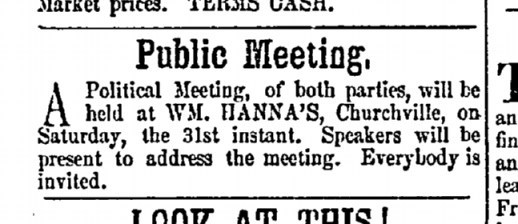
After searching for a bit, I concluded that the most likely candidate for this “Home for Travelers” was likely the hotel run by Col. William F. Hanna off of Calvary Rd. in Churchville.  Hanna’s was described as a large hotel that proved a popular place for political debate, seemingly supporting Booth’s idea of it being both “pleasant” and “bad”.

Meeting at Hanna's Oct 1857

Hanna’s hotel was also only three miles away from Tudor Hall, which would make it a convenient place for 16/17 year old John Wilkes to escape the farm and his responsibilities for awhile.

An 1878 map of Harford County showing the distance between Tudor Hall (Purchased that year by Samuel Kyle) to Hanna's Hotel in Churchville (Hanna died that year)

An 1878 map of Harford County showing the distance between Tudor Hall (Purchased that year by Samuel Kyle) to Hanna’s Hotel in Churchville (Hanna died that year)

So, while I’m not 100% certain that William Hanna’s hotel is the “Home for Travelers” Booth writes from, it is a logical possibility.

While looking into this for Carolyn, I consulted the Bel Air newspaper, The Southern Aegis. It is from there that I got the above advertisement for the public meeting at Hanna’s. I also stumbled across two 1857 advertisements that I had read about, but completely forgotten about until now:

Wilkes' advertisements in the Aegis Summer 1857

In September of 1856, Edwin Booth had returned home to Tudor Hall after four years away. He found his mother and siblings in desolate conditions, the winter of 1855/56 having almost wiped them out. With his new found wealth, he whisked the family out of the Bel Air country and set them up in Baltimore. On July 18, 1857, John Wilkes commissioned these advertisements in the Aegis, to sell the family’s horses and rent out the land around Tudor Hall.  The newspaper was published weekly, with these two advertisements appearing on July 18th, July 25, August 1, and August 8th.  It appears Wilkes was successful in selling the horses by then as the August 15th and August 22nd editions of the Aegis only contained advertisements for the renting of Tudor Hall.  Patrick Henry King and his family succeeded in renting Tudor Hall and were still living there when the assassination occurred.

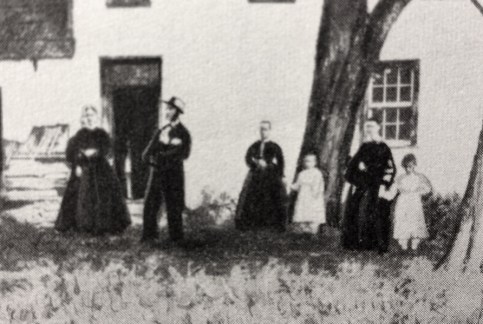
The King family in front of the Booth Log cabin after the assassination.

The King family in front of the Booth Log cabin after the assassination.

References:
“Right or Wrong God Judge Me” : The Writings of John Wilkes Booth edited by John Rhodehamel and Louise Taper
My Thoughts Be Bloody by Nora Titone
Sketches of Tudor Hall and the Booth Family by Ella Mahoney
The Southern Aegis accessed via GenealogyBank.com
 The Mad Booths of Maryland by Stanley Kimmel

Categories: Uncategorized | Tags: , | 3 Comments

When Junius Took the Stage – Part 1

I’m in the midst of reading the book, Junius Brutus Booth: Theatrical Prometheus by Stephen M. Archer. Though I’m only about 40 pages into it, I already have the book brimming with Post-It notes marking items of interest requiring further investigation. The most fascinating things I’ve come across thus far, is the drama that occurred when Junius Brutus Booth made his star debut in the theaters of London.  In preparation for a post about the matter, I found myself with a wealth of material on the early theatrical life of Junius Brutus Booth.  Instead of summarizing key points of Junius’ initial acting career, I decided to write a series of posts examining the humble acting beginnings of the man who would later father a theatrical dynasty, including the assassin of President Lincoln. What follows is the first part of a series of posts entitled, “When Junius Took the Stage”
Young Drawing of Junius Brutus Booth

Undated drawing of a young Junius Brutus Booth.

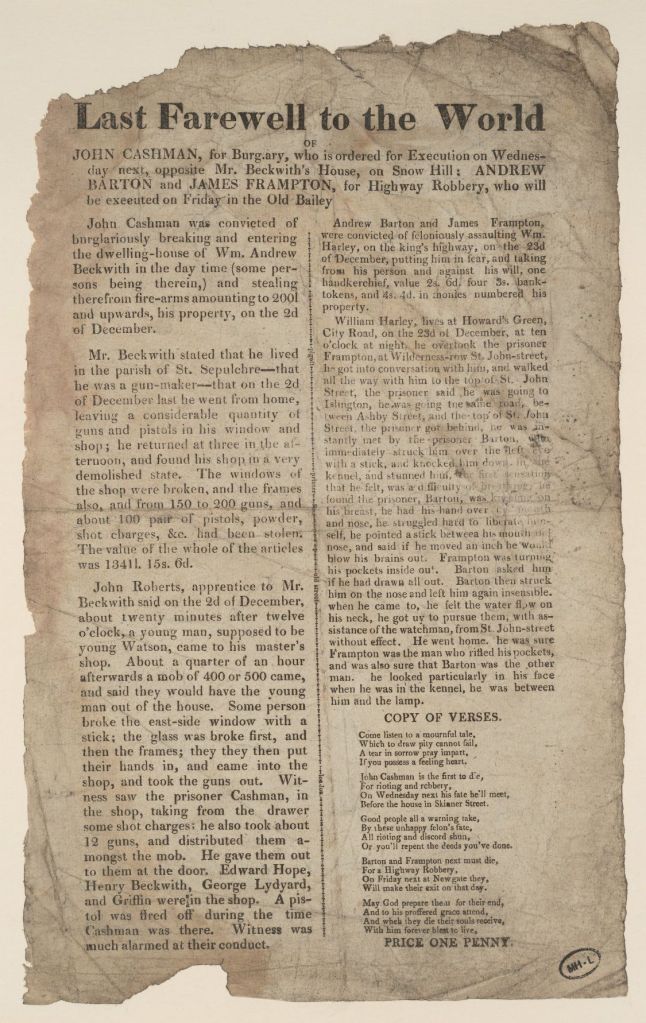
The year is 1813 and Junius Brutus Booth is 17 years old.  He is an energetic and passionate young man, rebelling at the desires of his widowed father, Richard Booth, at every turn.  Junius loathed the printing apprenticeship Richard had secured for him.  He worked under the apprenticeship of a printer by the name of George Piggot at 60 Old Street, London.  According to Junius he aided in the printing of items like “ballads, tales of wonder, and stories of fairies and goblins.”  In addition, Piggott printed the “dying speeches” of soon to be executed criminals.  These were single sided broadsides, sold in the streets of an execution to the gathered masses.  They usually contained a description of the condemned man’s last hours and a confession, often in the style of a cautionary poem:

One of George Piggot’s “dying speeches” broadsides.  Junius would have assisted in the printing of these.  Source: Harvard Law School Library

One of George Piggot’s “dying speeches” broadsides. Junius would have assisted in the printing of these. Source: Harvard Law School Library

Junius, in a move that eerily duplicated the actions of his father at his age, sought to sail away from his apprenticeship and life in England.  Had the winds been more favorable to his quest, Junius would have sailed away as a cabin boy bound for Rio de Janeiro before his father ever knew he was gone, however, Richard did find out about his plan and retrieved the boy before his ship set sail.  This was not the first time Richard had to save this misguided youth.  Not once, but twice, Richard, the lawyer, had to defend his son against paternity tests.  Though official court records of these suits against Junius have not been found, early Booth biographers state that Richard lost both suits and was forced to pay for his son’s carnal transgressions.

So what was this rebellious young man to do with his life?  Printing and the law had no appeal to him.  Then, on either October 7th or 13th, 1813, Junius Brutus Booth went to see Othello at London’s Covent Garden Theatre.  That experience would set the path that Junius would follow for the rest of his life.  Invigorated with the allure of the stage and the possibility of fame and fortune, Junius sought to make himself an actor.  It is likely that the opposition to the venture brought forth by his father only further fueled Junius’ desire to attempt the stage.

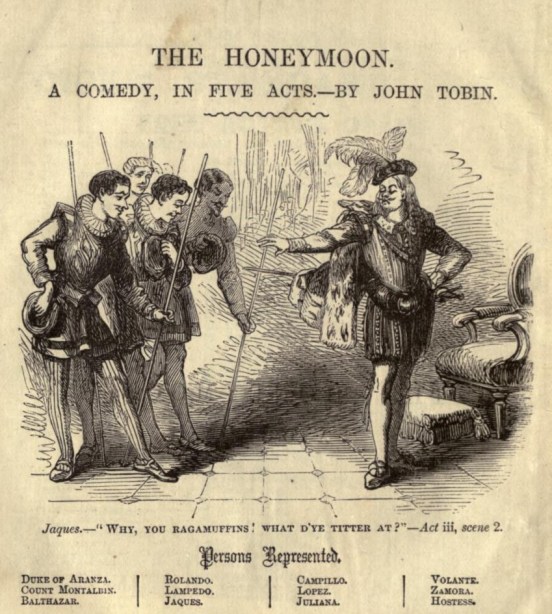
He started, as practically all aspiring actors did, in a nursery theater.  Akin to modern community theaters, these playhouses were little more than barns or lofts, where milkmen and laborers who dreamed of stardom performed for the local crowd.  From this, Junius was able to secure himself his first professional engagement when he signed on as a member of an acting troupe and toured around the dock towns and river villages of England.  This afforded him the minuscule salary of one pound sterling a week.  As a paid actor in this troupe he made his theatrical career debut on December 13th, 1813 in the comedy, The Honeymoon by John Tobin.  From my quick scanning of some of the text, I can ascertain that the main character, a Duke, has married a very beautiful, yet proud and feisty woman.  In order to “train” her to be gentler, the Duke decides, as a honey moon, to take his wife to a peasant’s hut and make to act that he is actually a commoner who has been impersonating a duke.  When his new wife goes to the duke’s castle to inform against him and request a divorce, the duke has one of his servants, Jaques, play the part of himself, hilarity ensues.  Again, this was just a cursory glance of the text and may be inaccurate.  Nevertheless, Junius Brutus Booth played the part of Campino in this professional stage debut.  Campino is an extraordinarily minor role, with only a handful of speaking lines.  Essentially, Campino is just a named servant who gets to read the words of the Duke ordering the servants to treat the simpleton, Jaques, as if he was the true Duke.  He is present when Jaques enters for the first time in royal clothing to the laughter of all the other servants, as depicted in this engraving:

Honeymoon engraving

When asked by another servant how Jaques was fairing with his newly bestowed nobility, Junius, as Campillo replied, “Like most men in whom sudden fortune combats against long-established habit.”

Junius would continue traveling with this troupe through the various dock villages, making a pittance.  His meager salary forced him to rely on only one meal a day and, by March of 1814, illness and poverty forced him back home to his father.  For a while, it appeared as if Junius’ acting days were done.

Stay tuned for future posts in this series regarding Junius Brutus Booth’s early life on the stage.

References:
Junius Brutus Booth: Theatrical Prometheus by Stephen M. Archer
The Honeymoon by John Tobin

Categories: Uncategorized | Tags: | 5 Comments

The Booth Log Cabin

As I noted in one of my previous posts, Tudor Hall was not the original Booth family home in Bel Air, Maryland.  At first, Junius Brutus Booth, Mary Ann Holmes and little Junius Brutus Booth, Jr. lived in a rented log cabin belonging to a Bel Air family by the name of Rodgers.  As Ella Mahoney, the owner of Tudor Hall from when the Booth’s gave it up in 1878 to her death in 1948, wrote:

“The little house in which they were living had been occupied by the Rogers’, who some years before, having rented the farm and gone to live in town, becoming discontented and the lease not having expired, built this for a temporary home until they could regain possession of their house.”

When Junius Brutus Booth leased the 150 acres he and his family would live on in May of 1822 (he could not buy it outright because he was not a citizen of the United States), he purchased the cabin from the Rodgers and had it moved away from their house:

“The house was strongly built, and Mr. Booth bought and moved it. It caused quite an excitement in the neighborhood, people coming to witness the novel sight of a house being rolled across the fields, and many lent a helping hand.

Mr. Booth chose a location for his home near a fine spring. In front of the house stood a large cherry tree, and at the back a sycamore, which has grown to immense size, being now eighteen feet in circumference. In that house they lived until later they built this substantial brick house [Tudor Hall]…”

With the exception of the oldest and youngest children,  Junius Jr. and Joseph Adrian Booth, all of the Booths were born in this log cabin by the spring.

Ella Mahoney goes on to describe this log cabin home even further:

“The old house still stood on the front lawn when I first knew the place. I remember it well. The main part of the house — the part that was moved — had had added at the east end a kitchen built of logs, a big stone chimney on the outside, and a wide fireplace within. At the west end also a log addition, which had never been finished, no floors laid above or below. As a child I used to play in that old house, and walk on some boards laid on the sleepers of the upper story.

The main part of the house consisted of one large room, with hall running through at one end. A door opened out at either end, and at one side a well preserved stairway and railing; a landing well up; a large closet under the stairway, and also a closet in the big room above, in which room as well as in the room below, was a fireplace, with shelves in the wall on either side. I remember these closets so well, on account of having seen a cross goose sitting in the room below, and another walk deliberately past us when we were playing in the room above, and go to her nest in the closet there.

The old house was so unattractive, standing as it did in front of this house, and in such a state of decay, that my husband had it removed when he began improvements about the place, as I suppose the Booths had intended doing. There were the remains of another building near the back of the house, a room perhaps for the servants. There was a log springhouse near the spring, through which the overflow from the spring ran; also the remains of an old cider press.”

The Booth log cabin was still in existence when Ella Mahoney’s husband bought the place from Mary Ann Booth in 1878.  As stated above he, “had it removed”.  But removed to where?

Reader Steve Lohrmann, who visited Tudor Hall when it was the private home of Dorothy and Howard Fox, recalls this story:

“I’ve been to Tudor Hall twice when it was a private residence, and met the owner of that time, Mr. Fox. He was very nice and showed me around the place. The little tour he gave me was very interesting, but there is one thing Mr. Fox told me that I forgot until I read about the cabin. He told me Tudor Hall’s kitchen is built around the old cabin. Is that true?”

After doing some research, I don’t believe this to be the case.  If the log cabin was transformed into the kitchen when Tudor Hall was built in 1851/52, then Ella Mahoney would had never even seen the log cabin since she wasn’t born until 1858.  In addition, in the Maryland Inventory of Historic Properties report about Tudor Hall, no special mention is given to the kitchen in regards to it being the original cabin but, instead, implies the kitchen on Tudor Hall was created at about the same time as Tudor Hall and then later connected to the house:

“The separate kitchen house is a very late example of an earlier custom.  Although it does not appear in the published plan, it is suggested in the published lithograph perspective…

Changes: In the late 19th century, the kitchen house was joined to the main house by infilling construction.  The space thus enclosed was incorporated into the dining room.  The kitchen chimney was reduced to a single stove flue and the kitchen stair was removed…”

So the Tudor Hall kitchen is not the original cabin.  However, this Historic Property report for Tudor Hall does provide some valuable information on what did happen to the Booth log cabin.

Before getting to that though, I have to thank another reader of the blog, Elsie Picyk.  Elsie is a resident of Port Tobacco, MD and volunteered during the archaeology project that occurred there.  Back in October, she sent me the Fall 2012 edition of the Maryland State and Highway Administration’s Cultural Resources Bulletin.  On page 8 of that bulletin appeared an article about the Booth Log Cabin:

Booth Log House article

Before reading this, I never even thought that the original home of the Booths near Bel Air could have survived into the present day.  After reading it, I made sure this was a house I visited when I went to Tudor Hall.  This article linked to the Historic Properties report for the “Booth Log House” and, despite a couple errors with dates, it explains how the house came to stand today.

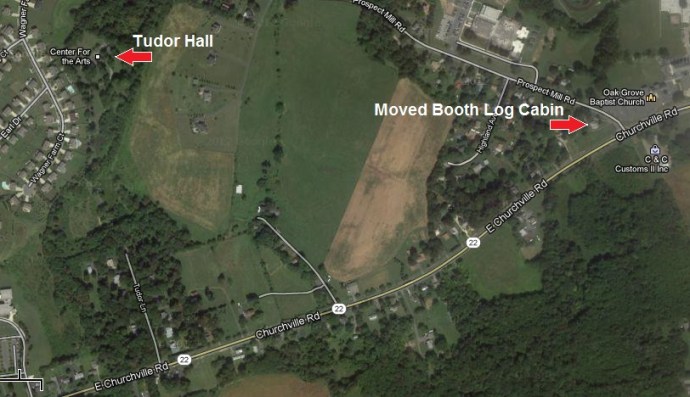
As stated by Ella Mahoney in her book, her first husband Samuel Kyle, had the Booth log cabin moved away from Tudor Hall sometime after he bought the property in 1878.  It was moved to its current location, at the intersection of Churchville Road and Prospect Mill Road in Harford County:

Tudor Hall - Cabin map

At that time, that land was still part of the Tudor Hall property.  Over the years, the “Booth Log House” has been extensively changed.  As described in the Cultural Resources Bulletin:

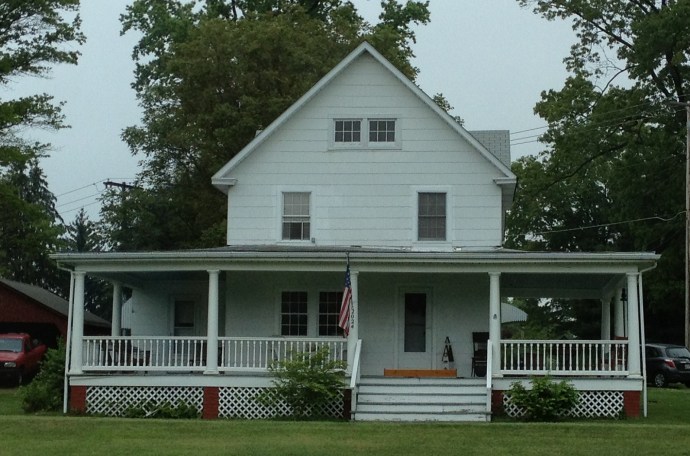
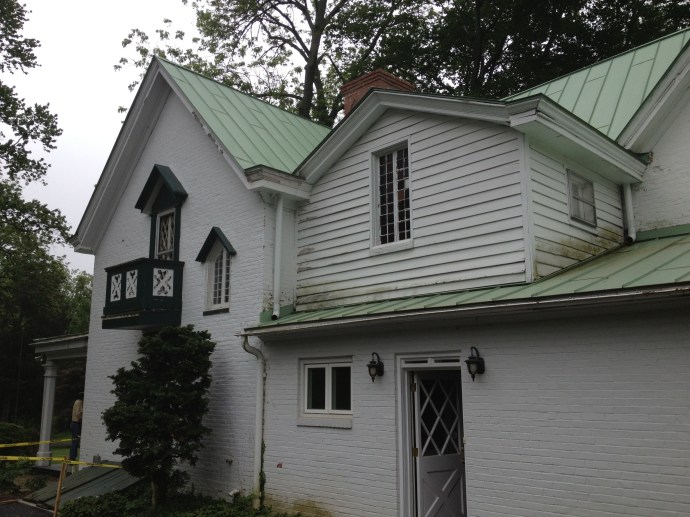
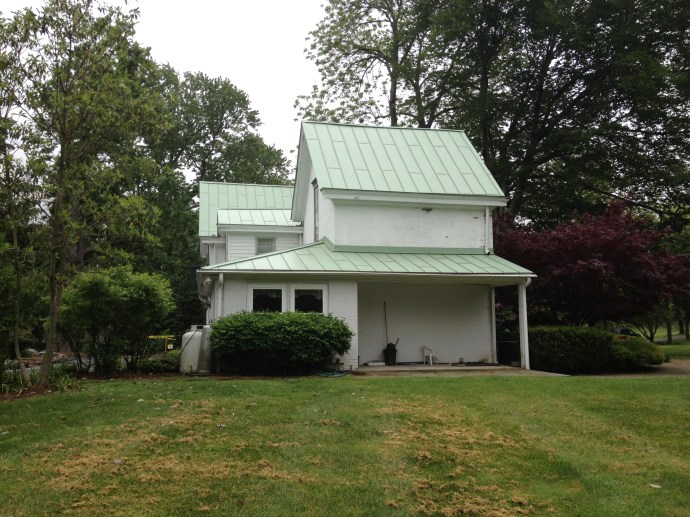
“As currently configured, the dwelling is an irregular amalgamation built in four different sections: the original side-gable log house is sandwiched between a circa 1900 single story hipped-roof kitchen addition and circa 1950 two-story shed-roof addition to the north and the circa 1925, two-story, gable-front Classical Revival addition to the south.   The original log section is hard to discern from the other sections, only notable by its steep, gable ends incorporated into the east and west elevations shown by the arrow on the above picture.”

Though added to and changed over the years the middle portion of this house, noted by the gables on the ends, is the Booth family’s log cabin.  This is the dwelling that Rosalie, Henry Byron, Mary Ann, Frederick, Elizabeth, Edwin, Asia, and John Wilkes Booth were all born into.

Booth Cabin Aerial

Here are some pictures I took of the house during our visit:

Booth cabin 1
Booth cabin 2
Booth cabin 3
Booth cabin 4

So, when you go and visit historic Tudor Hall, include a slight detour down the road to see what remains of the original Booth family log cabin – the birthplace of the Booths.

Update: As always, make sure to read the comments from others. It appears that there is some doubt as to the authenticity of this being the Booth’s log cabin.

References:
Sketches of Tudor Hall and the Booth family by Ella Mahoney
Maryland State and Highway Administration’s Cultural Resources Bulletin, Fall 2012
Maryland Historical Trust Inventory of Historic Properties Report for Tudor Hall
Maryland Historical Trust Inventory of Historic Properties Report for the Booth Log House

Categories: Uncategorized | Tags: | 16 Comments

Visiting Tudor Hall

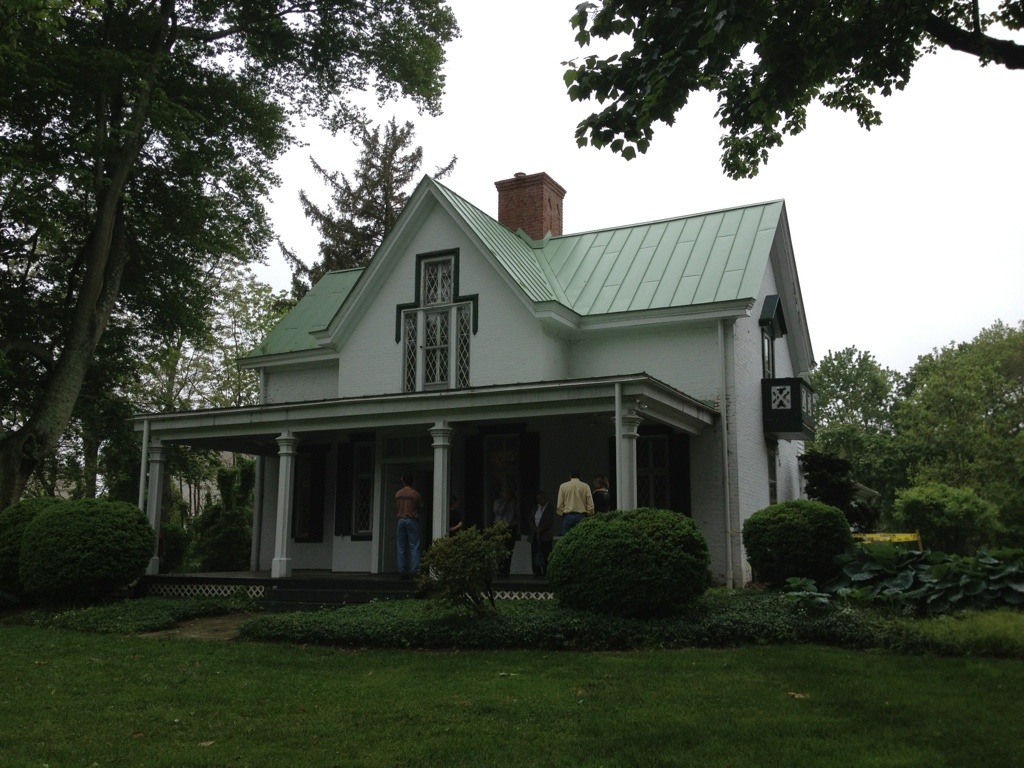
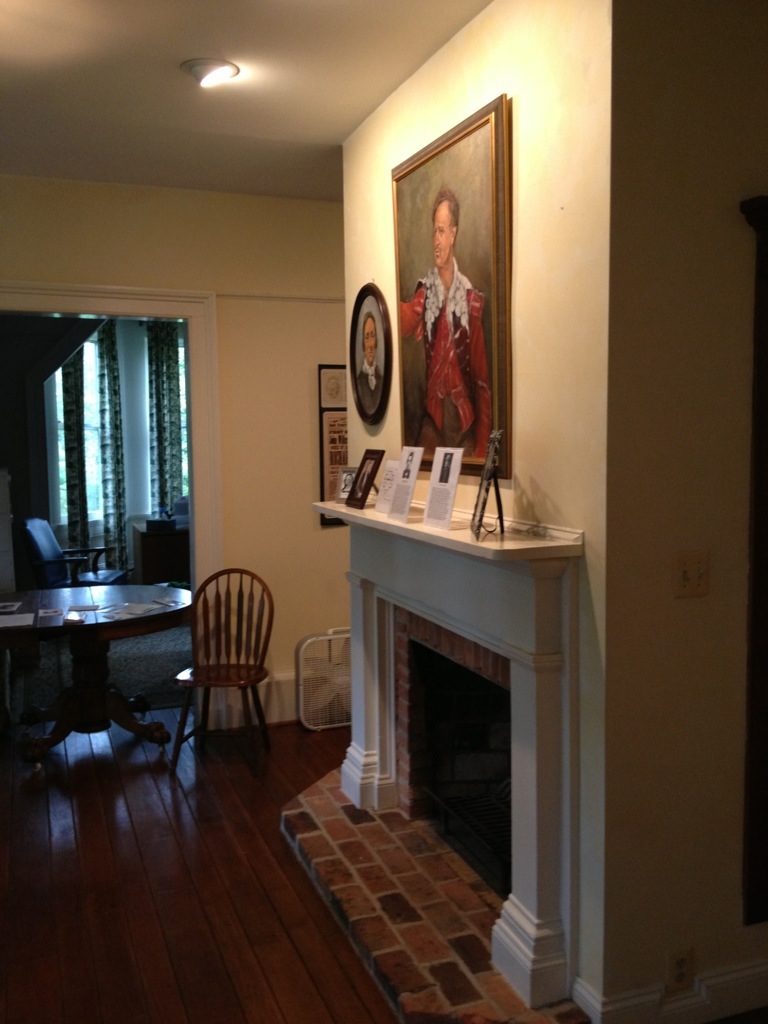
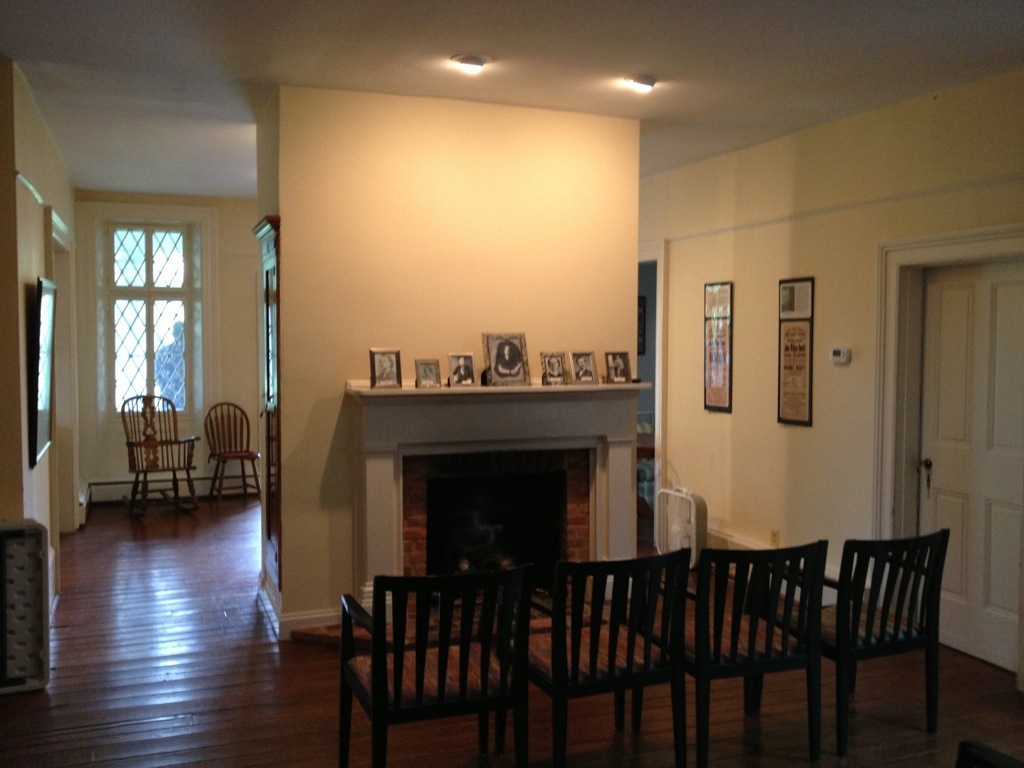
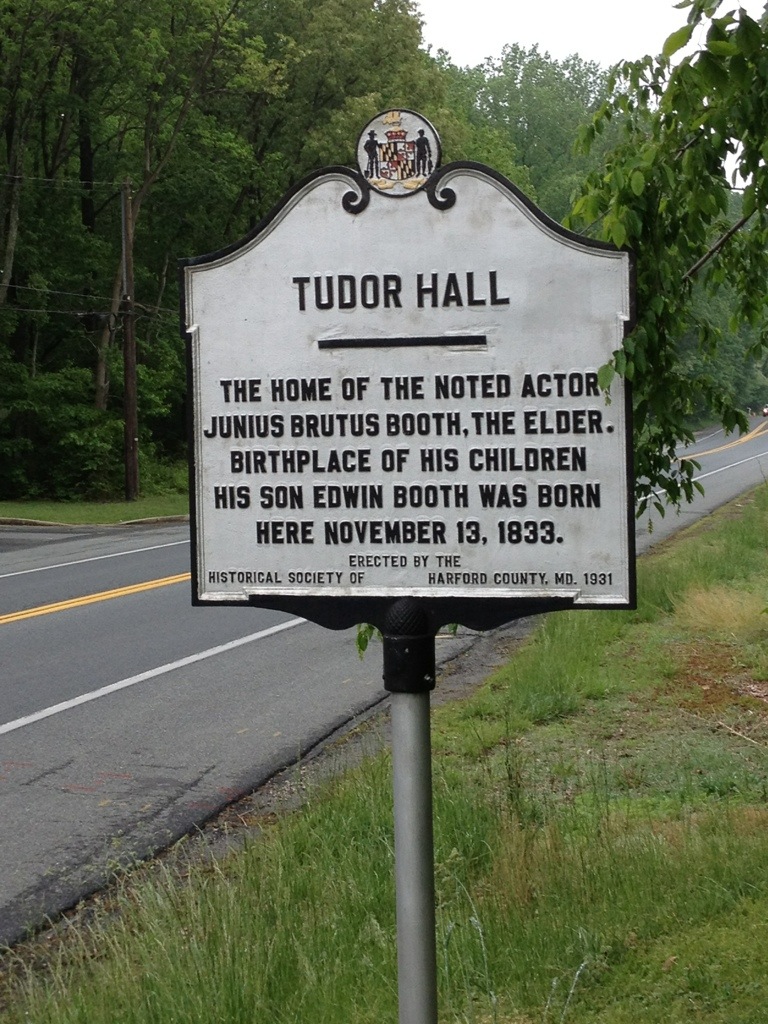
Last Sunday, May 19th, I took advantage of one of the bimonthly tours of Tudor Hall near Bel Air, Maryland.

IMG_2328

IMG_2309

On June 30, 1821, famed British tragedian Junius Brutus Booth and his pregnant lady, Mary Ann Holmes, arrived in America. Their voyage across the sea from their native England was due twofold. First, Junius hoped for greater wealth and success in the new land and second, the pair were hoping to escape and start anew to avoid the truth of their relationship. Though assumed to be man and wife, Junius and Mary Ann were not married. Spell bound over her beauty and grace, Junius had fled England with Mary Ann, leaving his true wife, Adelaide Delannoy Booth, and son, Richard Junius Booth, behind. He set foot in the new land with his new woman, determined to start anew. His reputation proceeded him and quickly he was a star on the American stage. By December of 1821, Mary Ann gave birth to their first born, Junius Brutus Booth, Jr. Junius realized quickly that his fledging family would need a place to call home beyond their boardinghouse room in Charleston, South Carolina. In May of 1822, Junius signed a thousand year lease to rent out 150 acres in Harford County, Maryland. The area was isolated about 25 miles north east of Baltimore. It provided the privacy Junius craved for himself and his illegitimate family. The Booth’s first residence on their acreage, and the only one Junius himself would ever know on the property, was a small cabin. Booth had the cabin moved from its former spot on the property to a natural spring that ran through the land.

Junius moved the family's first home, the log cabin, to a spot about where the white car is in this picture. It was close to the natural spring that ran through his newly acquired land.

Junius moved the family’s first home, the log cabin, to a spot about where the white car is in this picture. It was close to the natural spring that ran through his newly acquired land.

The act of moving the cabin to the spot by the spring was a big event:

“It caused quite an excitement in the neighborhood, people coming to witness the novel sight of a house being rolled across the fields, and many lent a helping hand.”

As his family grew, Junius had addition made to the log cabin, but ultimately had a more appropriate home in mind for his family. However, the act of caring for his family in America and sending money back home to England to keep Adelaide off of the scent forced him to continually delay his plans for another home. By 1840, Mary Ann was weary with her isolated life on the farm with so many children and so she and the kids moved to Baltimore, coming back during the summers to their Bel Air cabin.

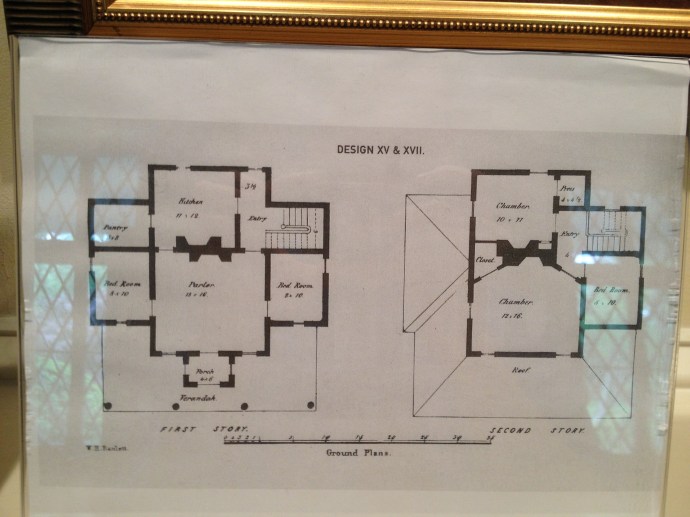
Fast forward to 1851. After finally being caught in his lies, Adelaide Booth publicly and embarrassingly divorced Junius Brutus Booth, allowing he and Mary Ann to legally wed. The 56 year old actor was looking forward to retiring and so plans were made to finally construct the dream home in Bel Air that he had desired. From architectural plans he chose an Elizabethan style home:

The original, interior layout of Tudor Hall.

The original, interior layout of Tudor Hall.

He commissioned, architect James Gifford to build his new home which he called, “Tudor Hall”:
IMG_2308

IMG_2261

IMG_2301

IMG_2304

IMG_2305

IMG_2306

IMG_2307

Sadly, Junius would never live in the completed house. He died on November 30th, 1852, before it was finished. After her husband’s death, Mary Ann would take her young children back to Bel Air to live at Tudor Hall. Eventually, when all her children had come of age, Mary Ann would leave Tudor Hall and rent it out. In 1878, she sold Tudor Hall and the Booths never returned.

Harford County managed to acquire Tudor Hall in 2006. Previous to this it was always a private residence. The owners who lived there the longest were Ella Mahoney, whose first husband bought the house straight from Mary Ann Booth, and Dorothy and Howard Fox. The second floor of the building currently houses the offices for the Center of Visual and Performing Arts of Harford County.

Tudor Hall, as a museum, is still in a transitional phase. The Junius Brutus Booth Society and Spirits of Tudor Hall, are working hard to get Harford County to give them more control in order to truly turn this gem into a museum dedicated to the Booth family. The guided tours are informative and done by volunteers with a passion for history.

IMG_2263

IMG_2265

IMG_2270

IMG_2271

IMG_2283

IMG_2285

IMG_2286

IMG_2291

IMG_2292

IMG_2298

IMG_2299

Other than the building itself, the only other thing on the Tudor Hall property today that was there when the Booths were there is this spring house (minus the roof) which was made around the same time as Tudor Hall, and this pond, which was made by the Booths:

IMG_2315

IMG_2316

Tudor Hall is a must see for those interested in the illustrious Booth family. Check out their tour schedule by visiting the Spirits of Tudor Hall Facebook page and blog the former written by Edwin Booth expert and friend of BoothieBarn, Carolyn Mitchell. And please consider joining the Junius Brutus Booth Society. The more members they have and the more funds they receive, the louder their voice becomes to transform Tudor Hall into the Booth family museum it deserves to be. Visit the Junius Brutus Booth Society here.

References:
My Thoughts Be Bloody by Nora Titone
Sketches of Tudor Hall and the Booth Family by Ella Mahoney (free online version here)

Categories: Uncategorized | Tags: | 21 Comments

Tudor Hall Teaser

Today, I made a visit to Tudor Hall, the home of the Booth family, and other sites relating to the Booths in Harford County, MD. A more thorough post will follow later but, as we drive home, I thought I’d put up this teaser of pictures from my day:

20130519-164627.jpg

20130519-164959.jpg

20130519-165028.jpg

20130519-165141.jpg

And, as a challenge to you all, what is the Boothie significance of where I am in this picture?

20130519-165327.jpg
Hint: Snoop around the Harford County Historical Society’s web page for it.

Categories: Uncategorized | Tags: , | 12 Comments

“The Mother’s Vision”

Today, May 10th, 2013, marks the 175th anniversary of John Wilkes Booth’s birth.  Before becoming the cause of such a great national tragedy, John Wilkes was merely an infant who entered the world in the presence of his father Junius Brutus Booth, a rare occasion for the traveling theatrical star.  Like the man he would later assassinate, Booth was born into a log cabin on the family’s farm near Bel Air, MD in 1838.  At the age of six months, Mary Ann Holmes, holding young John Wilkes in her arms, prayed to know what future lay in store for her then youngest child.  An answer to her prayer appeared before her in the form of a vision.  Years later, Asia Booth would translate the experience into a poem as a birthday gift to her mother:

The Mother’s Vision
Written 1854, June 2nd, by A[sia] B[ooth], Harford Co., Md

‘Tween the passing night and the coming day
When all the house in slumber lay,
A patient mother sat low near the fire,
With that strength even nature cannot tire,
Nursing her fretful babe to sleep –
Only the angels these records keep
Of mysterious Love!

One little confiding hand lay spread
Like a white-oped lily, on that soft far bed,
The mother’s bosom, drawing strength
And contentment warm –
The fleecy head rests on her circling arm.
In her eager worship, her fearful care, Riseth to heaven a wild, mute prayer
Of Foreboding Love!

Tiny, innocent white baby-hand,
What force, what power is at your command,
For evil, or good? Be slow or be sure,
Firm to resist, to pursue, to endure –
My God, let me see what this hand shall do
In the silent years we are tending to;
In my hungering Love,

I implore to know on this ghostly night
Whether ‘twill labour for wrong, or right,
For – or against Thee?
The flame up-leapt
Like a wave of blood, an avenging arm crept
Into shape; and Country shown out in the flame,
Which fading resolved to her boy’s own name!
God had answered Love –
Impatient Love!”

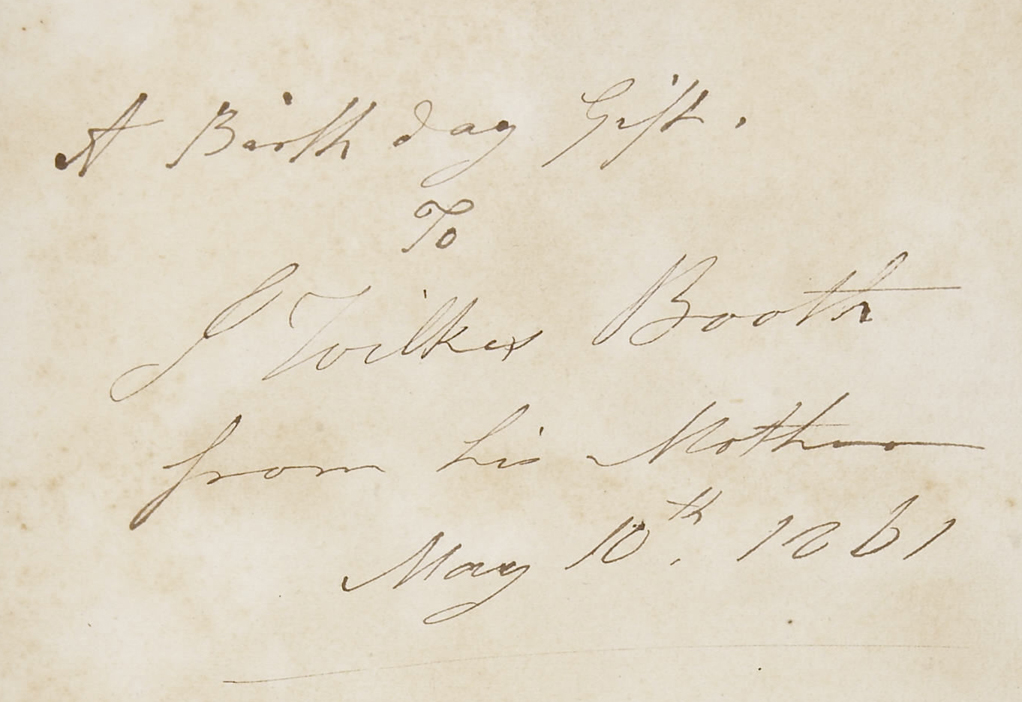
The inscription inside of a book given to John Wilkes Booth by his mother, Mary Ann Holmes Booth, on his birthday in 1861.

The inscription inside of a book given to John Wilkes Booth by his mother, Mary Ann Holmes Booth, on his birthday in 1861.

175 years ago, a boy named John Wilkes Booth was born.  And, as noted by his mother’s vision, our Country feels the ramifications of his existence even today.

References:
John Wilkes Booth: A Sister’s Memoir by Asia Booth Clarke

Categories: Uncategorized | Tags: , | 3 Comments

The Boothbay Theatre Auction

Thanks to the recent offering of books from authors Richard and Kellie Gutman, I purchased the auction catalog from the June 1990 auction of the Boothbay Theatre Museum collection.  The private museum was located in Boothbay, Maine and contained the collection of Franklyn Lenthall, a theatrical producer, director, and teacher.  Here are a couple of excerpts from Lenthall’s introduction in the catalog:

“Since the age of twelve I have had a passion for theatre, and I have always been a scavenger.  When I read Eleanor Ruggles’ “Price of Players,” my acquisitive instinct focused on the collecting of theatre memorabilia and more especially memorabilia relating to the Booth family…

In 1975 [James] Wilmot and I sold the Boothbay Playhouse and moved the collection to the perfect location, a beautiful 18th century house and barn.  When we learned that John K. Corey was born in this house, and that while he was a soldier, was present at Ford’s Theatre in Washington, D.C., April 14, 1865, when actor John Wilkes Booth assassinated President Lincoln during a performance of “Our American Cousin,” we felt that instinctively we had chosen the right building for the Boothbay Theatre Museum.  Previously we learned Edwin Booth , America’s greatest actor, had sailed into Boothbay Harbor July 27, 1887, on the steam yacht, “Oneida,” as guest of financier E. E. Benedict.  It was on that cruise that the idea of a club for actors was conceived; thus the existence of “The Players” in Gramercy Park in New York City…”

What follows is just a sampling of some of the Booth related items that were sold at the Boothbay auction.

2.  Painting of Edwin Booth, 1833-1893, by N. Clark, ’88.

2 Edwin Booth painting

Pastel on linen.  Signed “N. Clark, ‘88” lower left corner.  Framed, 27-3/4” x 24” s.s., in excellent condition

Provenance: Professional Women’s League, New York City.

($10,000 – 15,000)

4.  Painting of Edwin Booth, American actor, 1833 – 1893, just after 100th performance of “Hamlet” by Hugo Svenson

4 Edwin Booth Painting

Oil (bitumen) on canvas.  Signed “Hugo Svenson” lower right corner (very faint), and marked by label on center bottom of frame “Edwin Booth.” Framed, 24 ½” x 22 ½” s.s., in good condition.

Provenance: Minnesota Historical Society, Blanche DeBar Booth (Ophelia to Hamlet)

($8,000 – 10,000)

Hugo Svenson has a studio in New York City.  Blanche DeBar Booth, niece to Edwin, played Ophelia in the 100th performance of “Hamlet”.  Edwin presented her with the portrait, and she in turn presented it to the Minnesota Historical Society

5.  Painting of Edwin Booth, American actor, 1833 – 1893, performing “Hamlet” at the age of 30, by Gabriel Harrison, along with cabinet photo of him.

Booth painting

Oil on canvas, full length portrait.  Signed “Gabriel Harrison” and dated 1894 in lower left corner.  (Harrison as an actor himself, though not considered greatly good.) Framed, 29 ¾” x 19 ¾” s.s. General crackling of surface, otherwise good condition.

Provenance: Sankey Lemley, New York City, estate of Gabriel Harrison.

($7,000 – 10,000)

308.  John Wilkes Booth, actor, brother of Edwin Booth, and assassin of President Lincoln, 1839 – 1865 case with two canes.

Booth's cane

One cane given to Booth by Laura Keene, 1826 – 1873, marked on a silver band, “John Wilkes Booth from Laura Keen [sic], 1865.” Ivory handle, 3 ½” x 1”, 32 ¾” long overall.

Provenance: Mrs. E. Harrison Eudy and her mother

($5,000 – 10,000)

313. Edwin Booth, 1833 – 1893, original oval oil portrait by John R. Johnston, one of Baltimore’s most famous portrait artists.

Photo May 02, 8 28 46 PM

Mark on back, “Sitting From Life, Baltimore, 1851,” and signed.  This handwriting has been documented as that of Johnston, who also painted Andrew Jackson and Franklin Pierce, to name a few.  This portrait is believed to be a preliminary oil for a later portrait that was never done.  Two letters of provenance accompany work.  Framed in brass and glass, 13 ½” x 12”.

($2,000 – 3,000)

315.  Fireplace bellows from “Tudor Hall” and used in the original homestead of the Booth family in Belair, Maryland.

Tudor Hall Bellows

Wood, leather and metal, with a painted flower design on one side.  17 ½” high, 7 ½” wide, 2 ½” unextended depth.  In good, well used condition.

Provenance: Florence Williams, American actress, from member of family Elijah Rogers.

($1,800 – 2,000)

316. Five cash books from Edwin Booth’s “Booth Theatre,” and one account pad.

Booth's theatre pad

Contains names of plays and dates, net receipts and expenditures (such as the cost of a carriage for Mr. Booth), and net profits for the years 1869, 1871 – 1874, 1876 and 1877.  Every entry is initialed “J.H.M.,” by J. H. Magonigle, a theatre representative, or “J.A.B.,” by Joseph A. Booth, the youngest child.  Conditions of bindings vary, but interiors are excellent.  Minor child’s scribbling on a few blank pages, not affecting business contents.  Pad of forms marked “Booth’s Theatre” contains date, performance, weather and fascinating remarks about actors and plays, such as “’Black Crook’ at Niblo’s good, Grand Opera House bad, opening night Bryant’s Opera House all the critics present.” The dates begin Sept. 4,1873 and end May 30, 1874, with hundreds of entries.  The pad has some loose front pages, and a few of the last back pages are damp stained.

Provenance: J. A. Booth

($1,500 – 2,000)

320. Edwin Booth, John Wilkes Booth, J. B. Booth, Jr., playbill from the Booth benefit for the Shakespeare Statue Fund, Winter Garden Theatre, NYC.JWB playbill 2

This one-performance-only playbill is probably the rarest of all American playbills.  The statue still stands in Central Park.  The dedication program for the statue is also offered in this sale.  Framed and matted under glass, 20 ¾” x 8 ¾”.

($1,000 – 1,500)

325. Sydney Booth make-up box, marked across front in red, “Sydney Booth,” and “Theatre.”

Sydney Booth box

Contains crepe hair, prepared mustaches, beards and sideburns, 5 shoe lifts, face powder, dry and moist rouge, rosin, rabbit’s foot, two pair scissors, collapsible drinking cup in a leather carrier, a brush, a collapsible coat hanger, a curling iron, hair color, corkscrew, and an 11-pocketed apron with additional make-up in compartments.  Make-up box is plain black leather with intact handle, and attached to inside lid are his only child’s pink leather, lace trimmed baby slippers, 3 ½” x 2 ½”.  Case measures 12” x 15 ½” x 7”. Very good condition.

Provenance: Elizabeth Barton Booth, wearer of the baby boots.

($800 – 1,200)

326. John Wilkes Booth playbill from “Macbeth,” Willard’s Howard Atheneum, Oct. 7, 1863.

JWB playbill 1

Framed under glass, 19 ¼” x 7”. Excellent condition.

($750 – 1,000)

330. John Wilkes Booth playbill from “Richard III,” Willard’s Howard Antheneum, Boston, Oct. 10, 1863.

JWB playbill 3

Mounted in two portions and marked “Positively the last appearance of the popular young tragedian.” Above playbill is an 8-sided picture of John Wilkes Booth with his name mounted underneath.  A faded assassination reward poster with Lincoln’s photo is mounted on reverse. Framed, 25 ¾” x 8 ¾”.

($650 – 850)

603. Costume knee length, leather boots worn by Edwin Booth.

Edwin's boot

Very good condition.

Provenance: Sydney Booth

($750 – 1,000)

604.  Portion of velvet braid stole worn by Edwin Booth as “Richelieu,” with a carte de visite of Booth as “Cardinal Richelieu.”

Booth as Richelieu

In a wooden case with glass cover, 11 ½” x 8”. Excellent condition.

Provenance: Conway Barker, Charles Dominge.

($700 – 1,000)

Categories: Uncategorized | Tags: , | 10 Comments

Blog at WordPress.com.