The Player and the President

In Chicago’s Lincoln Park, there stands a magnificent bronze sculpture of Abraham Lincoln.

The statue was erected by Augustus Saint-Gaudens in 1887.  Saint-Gaudens was a celebrated sculptor and a member of Edwin Booth’s exclusive club, The Players.  This statue is one of the most celebrated of the 16th President and replicas of it are located in Springfield, Mexico City, and London.

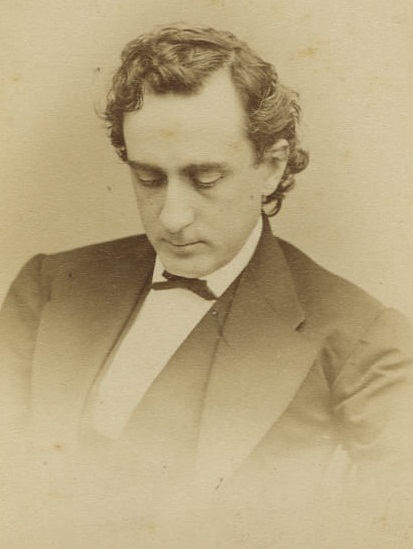
While countless individuals have visited this sculpture since its unveiling, none have done so with the same degree of personal angst as Edwin Booth.  A witness to the event described the visit of the Player to the statue of the fallen President

“When I was a boy, I lived in Chicago near Lincoln park.  Once when Edwin Booth was playing in the city, I went with another boy to hear ‘Hamlet’.  I was permitted to spend the night at my friend;s house but went home for breakfast.

At that early hour Lincoln park was deserted, but as I drew near Saint-Gaudens’ great statue of Lincoln, I saw a carriage approach, driven by a negro coachman.  It stopped before the statue, the door opened and out stepped – Edwin Booth.  Curious to see what would happen, I stepped behind a clump of shrubbery where I might watch, unobserved.

The great actor stood for a moment before the wonderful bronze, with his head bared.  Then he took a rose from his buttonhole and laid [it] at the base of the statue.  He entered the carriage and was driven away, utterly unconscious that the incident had been witnessed by one who would ever after cherish its memory.”

Though the writer of the above account is unknown, it is likely that it was written by George Middleton, a playwright who later became a member of The Players.  A similar version of this account is attributed to him in the book, A Certain Club:

“Over him constantly appeared to hang the memory of his family’s disgrace.  George Middleton, one of the earliest Players, who had met Booth at his father’s home, recalled coming upon him accidentally in the Chicago park where Augustus Saint-Gaudens’ statue of Lincoln had recently been unveiled.  Booth had driven alone in a carriage to see it.  Getting out, he did not notice Middleton and, looking around, observed no one else.  With bared head, he contemplated Lincoln’s sorrowful face for a long time, then plucked a flower from his buttonhole and placed it at the statue’s feet.  Returning to the carriage, he turned and made a gesture of sorrow and infinite regret, climbed in and drove away.”

While Edwin Booth was celebrated as the greatest tragedian of his generation, he was forever haunted by his brother’s horrible crime.  Recent conspiracy theorists have called for the exhumation of Edwin Booth’s remains in order to “prove” genetically that John Wilkes Booth wasn’t killed on April 26th, 1865.  Not only do they ignore and manipulate the thorough documentation of John Wilkes’ death at the Garrett’s farm, but they now desire to desecrate the grave of his noble brother in order to “prove” their misconceptions.  I would ask all who may choose to support their plans to read this account.  Understand the lifetime of personal suffering all the Booths were forced to endure after John Wilkes’ act.  Though it is unfortunate, history will always remember John’s anger over Edwin’s talent.  The last ounce of respect we can give to Edwin is to let him rest in peace.  His life was marred by his brother.  Let us not dishonor him further in death.

References:
My Thoughts Be Bloody by Nora Titone
A Certain Club: One Hundred Years of The Players by John William Tebbel
A Tribute to Lincoln – The Pittsburgh Press (5/2/1915)

Categories: Uncategorized | Tags: , | 9 Comments

Shooting Booth

While Boston Corbett has entered history as the man who avenged Abraham Lincoln in the morning hours of April 26th, 1865, Booth had another bullet enter his body some time before that date.  This shooting was courtesy of his own manager and agent, Matthew W. Canning.

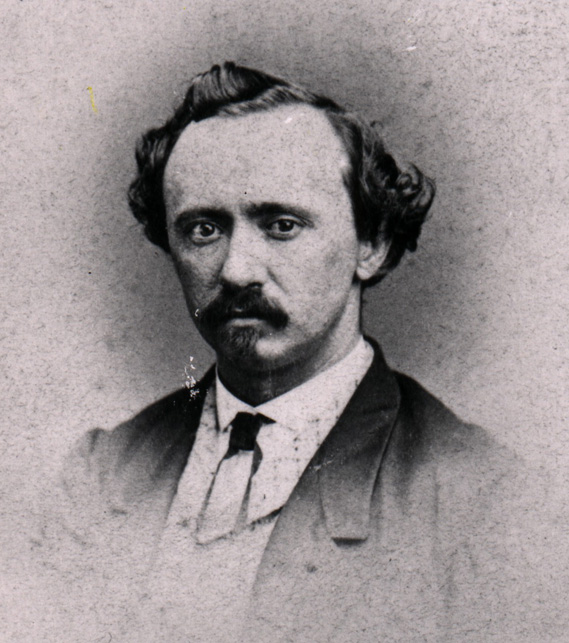
Matthew W. Canning

By 1860, John Wilkes Booth had started to tire of playing supernumerary parts.  The pay was very small, and he longed to be recognized as a talented actor.  His brother, Edwin Booth, was being lauded as his father’s creative heir and was enjoying life as a bona fide star.  While lacking the training his older brother received through his father’s tutelage, Wilkes believed himself to be on par with his famous brother.  He set out for his own “star” tour.  The theatrical star system of the day allowed the lead actor and actress to receive a part of the profits for each performance, rather than a small set salary for the season that the stock actors received.  Being the son of the great tragedian Junius Brutus Booth and brother to the successful Edwin, Wilkes had an easier time than most finding himself an agent.  Despite his amateurish experience, his Booth name was guaranteed to bring in patrons.  Wilkes was invited to play as a star by a former Philadelphia lawyer turned theatrical manager, Matthew Canning.

Matthew W. Canning was in the process of building his own theatre in Montgomery, Alabama and saw the benefits of having a Booth as his star.

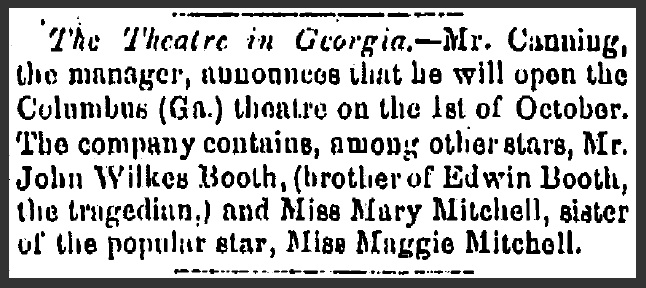
Before his own theatre opened, however, the Canning Dramatic Company toured the southern states starting in Columbus, Georgia.  The other actors in the company included the sisters Maggie, Mary, and Emma Mitchell and Samuel Knapp Chester, a man Booth later would attempt to include in his conspiracy.  Perhaps to save the Booth name for his own theatre’s success, Canning continued to bill John Wilkes Booth under his stage name, “J. B. Wilkes”.  While the lineage of the Canning Dramatic Company’s lead was becoming less and less of a secret with the press and the public, during the troupe’s entire run in Columbus, “Mr. Wilkes” was the star.

Mr. Wilkes’ first performance as a star occurred on October 1, 1860, playing Romeo to Maggie Mitchell’s Juliet.  His time in Columbus proved a success, with newspapers speaking of the company being, “much superior” from Canning’s last troupe and citing that, “Mr. Wilkes and Miss Mitchell are highly complimented.”  For an actor who had a shaky start as a stock player, Booth’s first star tour was everything he could have hoped for.  Until the night of October 12th that is, when Canning shot Booth.

The exact details on how the shooting occurred are varied.  A newspaper of the day, stated, “Mr. John Wilkes Booth was accidentally shot in the thigh at Cook’s Hotel.  Mr. Booth and Mr. Canning were practicing with a pistol, when it went off in Mr. Canning’s hand as he was letting down the hammer, inflicting a flesh wound in Mr. Booth’s thigh.”  A more amusing, though less likely account comes from The Mad Booths of Maryland by Stanley Kimmel: “The night he was to play Hamlet another actor was with him in his dressing room when Canning entered and jokingly threatened to shoot both of them.  The gun unexpectedly exploded and Wilkes ‘was shot in the rear.’”

The most reliable account, while written years after the fact and probably embellished with age, comes from Matthew Canning himself.  On January 19th, 1886 George Alfred Townsend, better known as GATH, published an interview he had with Matthew Canning in the Cincinnati Enquirer:

“No doubt your readers smile at me for having so often in this correspondence brought up incidents concerning John Brown and Booth, the assassin.  The fact is that I have just got off my hands a piece of literary work concerning these parties, which has taken so much investigation that I have at times discharged my findings into correspondences.  I shall not have the amiable defect of Lot’s wife in ever looking behind me, and therefore, these notes will end with the work for which they were obtained.

Yesterday I saw Matthew Canning, who started with Booth on a starring tour as his manager, and he said to me as follows: ‘Edwin Booth asked me to give his brother Wilkes a star.  He was not, strictly speaking, a star: he was a member of my stock company and played as a star, but of course he did not get the profits a star would receive.  I had a little circuit in the Southern States, with Montgomery for its chief center, and I was building a theater down there when I happened to shoot John Booth.  I can tell you about that curious incident.  Booth was one of the best shots in the profession, and his special passion was his physical training and strength.  That may have led him into the crime in the way he committed it.  When I took him out he was quite a young fellow, and had been known in the profession before as Mr. Wilkes.  I made it a point with Edwin Booth that he should play under his family name, as it would draw me money.  We were at Columbus, Ga., and my theater was not finished and had given me a great deal of trouble.

‘I went into my room one day, and he said to me: ‘Now, you must let me nurse you.  You are fagged out.’ I told him I only wanted to go to sleep.  I laid down on the bed and was in a doze when he saw my pistol in my rear pocket.  Every body carried weapons down in that country, and so did I.  Seeing the pistol, Booth yielded to his passion for arms, and he drew it out of my pocket.  I could feel it glide from me, but was in that state that I did not resist or rise.  Although he had just said that I wanted rest and sleep, he pointed the pistol at an iron mark on a wall opposite and discharged it right there in the room.  Of course I sprang up, complaining that he excited me by that explosion.  He then said he wanted another shot, and I objected; but he seemed to have his mind on firing again to show his accuracy of aim.  The pistol had got rusted, and when I gave him a cartridge to put in it, it would not fit easily.  He took his knife and began to scrape the pistol and the cartridge, and while in the act of doing it, down came the lock in my hand and discharged the pistol, and the ball struck him in the side, barely missing the femoral artery and it lodged in his body.  We thought he would die, but he recovered in a few weeks.”

The wound Booth received from Canning was not just a flesh wound as the newspaper stated and would lay him up for some time.  Starting from the night of the accident until Booth’s return, the lead roles were played by John W. Albaugh, Canning’s stage and acting manager.  This gave Albaugh the opportunity to act alongside Mary Mitchell, the woman who would later become his wife.

On October 19th, seven days after Booth was shot, Canning scheduled a benefit in his honor where he would receive most of the proceeds of the show.  It is likely Canning was attempting to assuage his guilt for shooting and disabling his lead actor.  Unfortunately, inclement weather in Columbus kept even the heartiest of theatre-goers away on the 19th, and so the benefit was rescheduled for the next day.  This was the company’s last day in Columbus and they performed Julius Caesar.  Booth’s injury kept him from performing in the whole play but, as a gesture of thanks for the city that supported him and celebrated him in his first starring engagement, Booth took the stage and recited Mark Anthony’s pivotal, “Friends, Romans, countrymen, lend me your ears,” speech.

From Georgia, the Canning Dramatic Company travelled to Montgomery, Alabama to perform in Matthew Canning’s own, appropriately named, Montgomery Theatre.  Though advertisements promised “Mr. John Wilkes” would make his debut on the 23rd of October, the night came and went without his appearance on stage.  The notoriously agile and active player was still not physically healed enough to perform.   He would not make his Montgomery debut until October 29th when he played the role of Pescara in The Apostate.
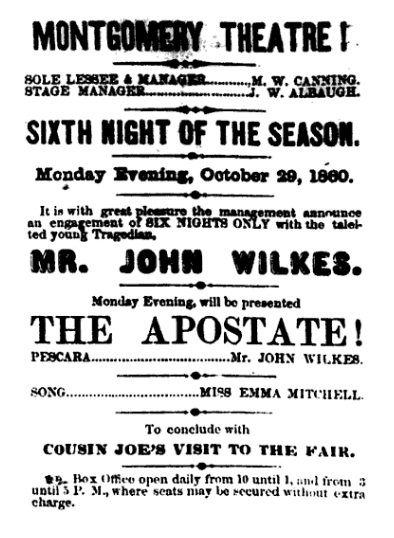
Though his wound forced him to be a little more reserved than his normal acting habits, the Montgomery audiences supported this young and talented actor.  When Booth played Hamlet, Canning’s theatre was filled to the brim with patrons.  Everyone came to see the son of Junius Brutus Booth, rival of Edwin Booth, and most agreed that, while he needed some refinement, he carried his father’s torch well.  During all of this time, however, John was still billed as “Mr. Wilkes”.

It does not appear that the transition from “Mr. Wilkes” to “J. Wilkes Booth” was instigated by John.  In fact, his star billing as “Mr. Wilkes” for weeks shows that he wanted to be celebrated for his own abilities.  In the end, John did not take the Booth name back; rather it was justly given to him.  The first billing of him as J. Wilkes Booth occurred on December 1st, when Maggie Mitchell presented a benefit in his honor.

His fellow actors had conferred his Booth name upon him and, after receiving such admiration in his first tour, he believed it to have been rightly bestowed.  He had proven himself worthy of the name Booth and would keep it for the rest of his career.

By mid-December, Booth’s time with Canning’s company was up.  He returned to Philadelphia to rest at the home his brother Edwin had rented for their mother and siblings.  Asia wrote to a friend on December 16th that, “John Booth is at home.  He is looking well but his wound is not entirely healed yet – he still carries the ball in him.”  With Canning as his agent, Booth accepted starring engagements in northern cities like Albany and Portland, Maine.  Eventually, he would become a hugely successful star and become his own agent, no longer needing Matthew Canning’s services.  Before that occurred however, the two men shared another experience that involved Booth shedding some blood:

The following is the continuation of GATH’s 1886 interview with Canning:

“Somewhere about 1862 I was playing Booth in Washington City, and he began to have a boil on the side of his neck.  It grew more and more inflamed, and at last was discernible from the house, and on his fine, youthful skin it made a bad impression.  So I said to him one morning: ‘Come here, John, and take a ride with me.  It is none of your business where I am going.’ I drove him to the house of Dr. May, a surgeon, and took him in there.  May looked at his neck and said: ‘Why, this is a tumor.  You will have to submit to an operation to be relieved of it.’ Booth said he would sit right down there and have it cut out.  The doctor said to him: ‘Young man, this is no trifling matter.  You will have to come when we are ready for you, when I have an assistant here.’

‘No,’ said Booth, ‘You can cut it out right now.  Here is Canning, who will be your assistant.’ He threw himself across a chair and leaned his head on the chair-back so as to throw up his neck.  ‘Now cut away,’ said he.  The doctor told me that if I was to assist in the operation that I must pull back the skin or flesh as he cut.  The first wipe he made with his knife nearly made me fall on the floor fainting.  The black blood gushed out, and he seemed to have cut the man’s neck partly off.  Booth did not move, but his skin turned as white as the wall.  The doctor continued to cut, and notified me that I was a remarkable assistant for an amateur.  Meantime my stomach was all giving away.  The first thing that happened was I rolled over and fell on the floor, and Booth from loss of blood reeled and fell off the chair.  When he came to the doctor told me that I was not as much of an assistant as he thought I was going to turn out to be.  Booth was laid up for about a month…”

This impromptu surgery left a discernible scar upon Booth’s neck.  That scar would be identified by Dr. May during Booth’s autopsy and is one of the many details that prove that Booth did not escape.

Dr. John Frederick May

As stated, Booth and Canning would part ways when Booth felt comfortable on his own.  Though occasionally Booth would still contact Canning to help him make engagements.  Matthew Canning’s last meeting with Booth occurred in December of 1864.

During that time, Canning was in Philadelphia, as the agent to Vestvale, the actress.  Booth was in the city as well and asked Canning for a favor.  At that time, Canning was a bit perturbed at Booth as he had made several engagements on his behalf that Booth had cancelled.  As we know now, Booth’s mind was no longer on acting but on his “oil speculations” i.e. kidnapping President Lincoln.  He had already gained the support of two of his childhood friends, Michael O’Laughlen and Samuel Arnold, for the endeavor.  His next target was a friend from his initial days with Canning.  Booth wanted Samuel Knapp Chester in his conspiracy.

Samuel Knapp Chester

During their conversations, Booth spoke to Canning about his recent visit with Chester in New York.  He found out truthfully, that Chester was unhappy at his current theatre in New York, but lacked the ability to change it.  Chester was not a star like Booth and had a harder time finding engagements.  Booth had revealed to Chester his idea to kidnap Lincoln and ferry him into the open arms of the Confederacy.  Chester had refused to join his plot, but Booth was not a man to give up easily.  He hoped that assisting Chester in his career would motivate him to reconsider.  So, under the guise of a helpful friend, Booth asked Matthew Canning to convince John T. Ford to engage him at one of his theatres.  Ford owned theatres in Baltimore and Washington, which would bring Chester closer physically into the realm of the conspiracy.  Booth, desperate to get on Chester’s good side promised Canning he would, “give [him] anything if he would see Ford.”  After some convincing, Canning agreed to do what he could.  At first Ford was hesitant but a recent party had cancelled on him and so Chester was hired to take their place.  Canning wrote to Booth of his probable success in finding Chester a job at Ford’s.  He received a telegram back from Booth stating, “Don’t fail to hush that matter at once.”  This response puzzled Canning.  Did Booth mean to stop pursuing it because Chester had reconsidered?  He wrote Booth asking for clarification.  Booth responded back with, “The telegraph operator is an ass, he telegraphed ‘don’t fail to hush the matter’ when I wrote ‘fail to push the matter.’”

Despite being grateful to Booth for getting him a new engagement, Samuel Chester remained unmoved in his views on the kidnapping plot.  He would have nothing to do with it.

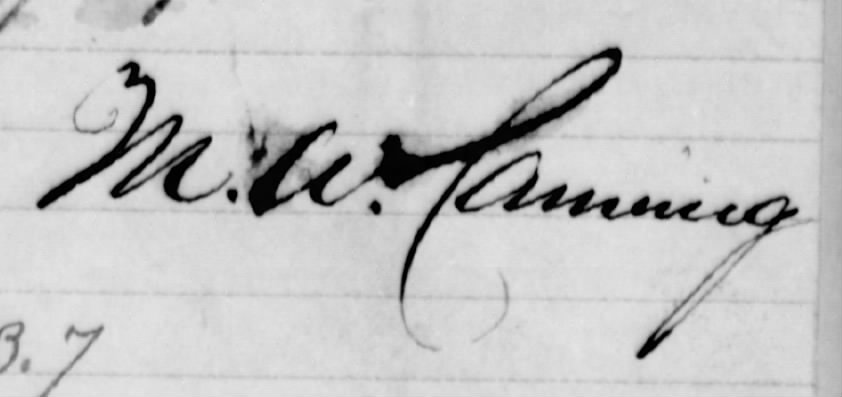
After Booth assassinated Lincoln, everyone relating to him was rounded up, including Matthew Canning.  Canning had the luck of being arrested in Philadelphia by a former actor turned solider with whom he was friendly.  Canning immediately wrote out a statement regarding his history with Booth.  While arrested on the night of April 15th, Canning was allowed to retrace his footsteps and collect signed affidavits to his recent whereabouts in the presence of Capt. John Jack, the former actor.  Only after all of this was done was Canning sent to Washington.  He was placed in the Old Capitol Prison and shared a room with John Ford.  His thorough paperwork helped him and he was released from prison on April 28th upon taking the oath of allegiance.

Canning died on August 30th, 1890 at the age of sixty.  He was a theatrical manager and agent to the end, dying in a New York hotel room while managing his “The Blue and the Gray” acting company.  His body was shipped back to his native Philadelphia and he was buried in Woodlands Cemetery there.

While Canning may have felt guilty in 1860 for accidentally shooting his star and main attraction, after the events of April 1865 he may have adopted the same “what if” beliefs as another veteran actor:

“‘If’ that shot had been fatal he would not have lived to plunge his country into the depths of despair and mourning, nor crushed with most poignant anguish those who loved him best; he would not have lived to ‘pour the sweet milk of concord into hell’, to fire the shot that shook the foundation rock upon which his country lived.”

References:
GATH’s Special Dispatch to the Enquirer – Cincinnati Enquirer, Jan 19, 1886
Lust for Fame: The Stage Career of John Wilkes Booth by Gordon Samples
The Lincoln Assassination: The Evidence by William Edwards and Ed Steers
“Right or Wrong, God Judge Me”: The Writings of John Wilkes Booth by John Rhodehamel and Louise Taper
The Mad Booths of Maryland by Stanley Kimmel
Article images from GenealogyBank.com
Matthew Canning’s handwritten affidavits are available on Fold3.com in the Turner/Baker papers (must be a paying member to view)
The article containing the ending quote is here.
An additional article recounting Matthew Canning’s arrest is here.

Categories: Uncategorized | Tags: , , , , , | 13 Comments

7/7/1865

I watched them lead him out the door,
As he exited his cell.
I followed them, as he had asked,
To give his last farewell.

“A boy” I thought of him at first,
When I was called to pray,
But with death’s knocking out in the yard,
I saw a man today.

While saddened by his coming death,
He confessed to me his crime:
“I helped a man who killed a man.
Where will I spend all time?”

I said I could not answer him,
To God he must appeal.
We sat there in redemptive prayer,
And begged his soul to heal.

So while his frame may falter,
During these, his last grains of life,
On the gallows he’ll stand, with his clenched hands,
A man, adverse to strife.

Fictional poem from the perspective of Rev. Dr. Mark Olds, David Herold’s spiritual advisor on the scaffold.

Justified or not, four individuals paid the ultimate price for their involvement with John Wilkes Booth.  Those saved from execution faced their own mortality when they heard the drops fall and would carry the stigma of their association for the rest of their lives.  Lincoln’s assassination killed not only the President and the innocence of our nation, but also the lives of the misguided supporters who knew not what they were doing.

Categories: Uncategorized | Tags: , , , , | 16 Comments

Touched by an Angel

If you have the time, I invite you all to watch this 1998 episode of Touched by an Angel entitled “Beautiful Dreamer”. In it, Della Reese’s character recounts the assassination of Lincoln through the experiences of her fellow angels, who were there at the time.  The show is filled with artistic and spiritual license (it is Touched by an Angel, after all), but it still provides an entertaining and fairly accurate representation of Lincoln’s death.  While Booth is portrayed more drunken than sinister, the writers of the show still gave him wonderful dialogue with the angel, Andrew, explaining his motivations and beliefs.  It is a unique portrayal of Booth that actually leaves us feeling sorry for him rather than hatred.   What’s more, it’s clear the producers did their homework.  They stunningly recreated the façade of Ford’s Theatre, the presidential box, and even included auxiliary characters by name like Laura Keene, Peter Taltavull, and John Parker.  In my opinion, this dramatization of Lincoln’s assassination from the mainstream media is one worth watching.

Categories: Uncategorized | Tags: , , | 7 Comments

Artifact History: Nélaton probe

The collection of the National Museum of Health and Medicine (NMHM) contains several objects relating to Presidential health and care.  In regards to the Lincoln assassination, the museum contains items extracted from both the President and his assassin during their subsequent autopsies.  Booth’s vertebrae and a piece of his spinal cord, through which Boston Corbett’s bullet passed, are housed in this collection.  From Lincoln’s autopsy, the museum has pieces of Lincoln’s skull, the bullet that took his life, and some hair clippings taken by the doctors and surgeons as mementoes.  As was previously written, the collection was once housed at Ford’s Theatre from 1865 – 1887 when it was called the Army Medical Museum.   During that time at Ford’s however, the Lincoln relics were not part of the collection, only Booth’s pieces were there.  In fact, the bullet that killed Lincoln was entered as an official exhibit during the Conspiracy Trial and it, along with the skull pieces, were housed with the other evidence in the office of the Judge Advocate General.  In 1940, the exhibits were donated to the Lincoln Museum (Ford’s) who then gave the bullet and pieces of Lincoln to the Medical Museum.  So while pieces of Lincoln and Booth both returned to the venue of their last living meeting, it was not at the same time.

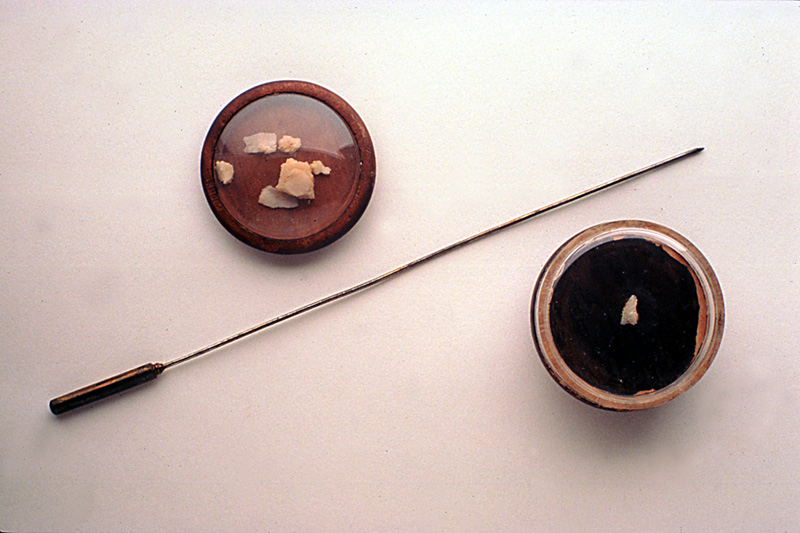
In addition to the bullet and the skull fragments, the National Museum of Health and Medicine also has a rather unassuming instrument housed with these Lincoln relics: a long, medical probe:

Lincoln’s skull fragments and Nélaton probe
(NMHM)

This probe has a specific name and a specific function.  Called a Nélaton probe (or Nélaton’s probe) it was used by the doctors during Lincoln’s final night to ascertain the depth and path of the bullet in Lincoln’s head.  Before delving into that, however, let’s look at the history behind this medical tool.

In 1862, Italian general Giuseppe Garibaldi, was shot while trying to take control over the city of Rome.  At that time, Italy had just completed a massive unification to create one kingdom.  This kingdom of Italy later became the republic of Italy as we know it now.  However, as of 1862, several cities in Italy did not accept unification and Rome was one of them.  Tired of waiting for them to come around, General Garibaldi decided to raise a volunteer force to take the city of Rome.  The Battle of Aspromonte, as it was called was fought between Garibaldi’s men and the Royal Army of Italy on August 29th, 1862.  Both sides were hesitant to harm the other as they were countrymen and Garibaldi was well liked and supported by the people of Italy.  When the Royal Army “attacked” Garibaldi’s forces, he ordered his forces not to fire on their brothers.  One part of his army did attack though, and during the fire fight, Garibaldi was hit three times.  The battle lasted less than ten minutes with only 15 combined casualties.  Garibaldi and the rest of his volunteers were arrested and imprisoned.

While imprisoned, Garbaldi was still given the respect and medical treatment he deserved.  Two of the three shots Garibaldi received were to the hip and proved easily treatable.  The third shot hit Garibaldi’s right ankle, just a little above and in front of what we would consider the “ankle bone” (scientifically, it was his internal malleolus).  This wound pained him greatly.  When he was on the battlefield, a surgeon had made an incision on the opposite side of the wound when he felt swelling but found nothing inside of it.  A few days after the battle, Garibaldi was re-examined by more than half a dozen doctors who all believed, save one, that the bullet was no longer in his ankle.  Meanwhile, in England, supporters of Garibaldi in the medical field took it upon themselves to see if they could help the general.  In an extremely presumptuous way, the English doctors elected that Dr. Richard Partridge, professor at King’s college, should travel to England and check on Garibaldi’s wound and treatment.  When Dr. Partridge arrived on September 16th, he examined Garibaldi himself, and came to the same conclusion of the Italian physicians: the ball was no longer in his ankle.  He returned back to England and guaranteed his colleagues and the press that, while Garibaldi was still in considerable pain, it was not caused by a bullet being lodged in his ankle.  Dr. Partridge believed his condition would improve in time.

After five weeks, though, no improvement was noted and Garibaldi was still in quite a deal of pain.  This time, the Italian doctors reached out.  They sent for Auguste Nélaton, a Parisian professor of surgery.  He arrived on October 28th and examined Garibaldi himself.  After inserting a normal probe into the wound, he was convinced that the bullet was still in there.  The Italian doctors did not concur, citing Dr. Partridge’s agreement of their initial assessment.  So, Dr. Partridge returned.  Soon, Garibaldi’s sick room became an international conference with the Italian doctors, the Frenchman Nélaton, the Englishman Partridge, and even a Russian physician all prodding and poking General Garibaldi.  Dr. Partridge actually changed his mind and started believing that the bullet was still in the general’s ankle.  Nélaton, believing amputation to be unnecessary, ordered that the wound entrance be widen with sponges so that the bullet could be removed in time.  While the Italian doctors followed this idea, they were still unconvinced that there was a bullet in Garibaldi, and were getting sick of all these foreigners going back and forth on the matter.

Auguste Nélaton attending to General Giuseppe Garibaldi in 1862 (National Library of Medicine)

When Nélaton returned to France, he started working on a way to prove that there was a bullet in Garibaldi.  The problem was that it was impossible for a physician of the time to identify the hard substance met by a probe in a wound.  It could be normal bone or a foreign substance like a bullet.  The bulk of the Italian doctors believed their probes continually hit the normal bone structure of the ankle, while Nélaton thought it was a bullet.  Nélaton began constructing a new probe for his purposes.  In the end, his probe was ingenious in its simplicity.  At the tip of a normal medical probe he attached an unglazed porcelain tip.  When the porcelain touched bone inside a wound, the probe would be unaffected.  When it rubbed against the lead of a bullet however, the tip would become marked identifying it as a foreign substance.

A simple Nélaton probe

Nélaton quickly sent his new instrument to the doctors in Italy.  After using it to confirm Nélaton’s diagnosis that the bullet was, in fact, still in Garibaldi’s ankle, the Italian physicians were able to successfully remove it on November 22nd.  Shortly thereafter General Garibaldi sent a letter to Auguste Nélaton offering his love, gratitude, and thanks.

Nélaton’s probes proved wonderfully efficient.  They started to be produced on mass and were shipped all over the world.  They quickly became an instrument of necessity for any military surgeon and found a market in the surgeons fighting on both sides of the American Civil War.  They continued to be used into the 1900’s before they were essentially replaced by the advent of less intrusive devices like the X-ray.

Let’s return now to the night of April 14th, 1865.  Lincoln was taken to the Petersen House across the street from Ford’s after being shot.  There, he was attended to by several doctors including the Surgeon General Joseph Barnes and the first responder, Dr. Charles Leale.  At first, the doctors introduced regular, silver probes into Lincoln’s wound.  However, like in Garibaldi’s case, they were unsure if the solid mass they encountered was the bullet or a piece of Lincoln’s skull.  A steward was then sent for a Nélaton probe.  From Dr. Leale’s account we can learn how they used the device:

“About 2 AM the Hospital Steward who had been sent for a Nelatons probe, arrived and an examination was made by the Surgeon General, who introduced it to a distance of about 2 ½ inches, when it came in contact with a foreign substance, which laid across the track of the ball.

This being easily passed the probe was introduced several inches further, when it again touched a hard substance, which was at first supposed to be the ball, but as the bulb of the probe on its withdrawal did not indicate the mark of lead, it was generally thought to be another piece of loose bone. The probe was introduced a second time and the ball was supposed to be distinctively felt by the Surgeon General, Surgeon Crane and Dr. Stone.”

Using Nélaton’s probe, the doctors established that the bullet was above and behind Lincoln’s right eye.  Between its use in the early hours of April 15th and today, the Nélaton probe used by the doctors on Lincoln has lost the porcelain tip that marked the bullet.

The end of the probe used by Lincoln’s deathbed physicans, missing the unglazed porcelain tip.

While the first person to utilize Auguste Nélaton’s invention made a full recovery because of it, it was well established before the probe was introduced in Lincoln’s case that he was beyond help. The Nélaton probe did not change Lincoln’s medical prognosis as it did for Garibaldi, but it is still a historically relevant artifact.  Its inclusion in the collection of the National Museum of Health and Medicine is so that it can be a testament to the devotion of the doctors who cared for President Lincoln.  Despite the hopelessness of his situation, doctors like Barnes, Leale, Taft, and others, did all in their power to aid and comfort the fallen President.

References:
National Museum of Health and Medicine 
The details regarding Auguste Nélaton’s invention came from this essay from the National Institute of Health
Dr. Leale’s account
American Brutus by Michael Kauffman

Categories: Uncategorized | Tags: , , | 15 Comments

Samuel Arnold’s Confession

The following is Samuel Arnold’s full confession that he gave following his arrest on April 17th.  This account is copied from William Edwards’ book The Lincoln Assassination – The Rewards Files.  Mr. Edwards is the author behind the trilogy of primary sources regarding the assassination.  The Evidence, The Court Transcripts, and The Rewards Files, are all essential materials for those studying the assassination.  They contain the bulk of the government’s microfilmed records and are priceless to the researcher.  The Evidence can be bought as both a physical book (the Surratt House Museum offers the best value on this) and as a non-searchable ebook.  The Trial Transcript can be purchased as a searchable ebook.  The Rewards Files were previously released on a CD-ROM  (still available through the Surratt House Museum) and will shortly be released as an ebook through Google Books. EDIT: The book is now available for purchase here.
I have previously written my support of Edwards’ Trial Transcripts and I will certainly let you all know when The Reward Files are available for download.  In the meantime, Arnold’s confession provides some of the most reliable information about the original abduction conspiracy:

“To Whom it May Concern,

Know that I, Saml B. Arnold, about the latter part of August or first part of September 1864, was sent for by J. Wilkes Booth, who was a guest at Barnum Hotel, City of Baltimore Md. to come to see him. Had not seen the same J. Wilkes Booth since 1852, when we both were schoolmates together at St. Timothy’s Hall, President L. Van Bokelin then having said Hall as place of tuition. Reception warm calling for wine and cigars conversing a short time upon our former school boy days. We were interrupted by a knock at the door, when Michael O’Laughlen was ushered in. After a formal introduction, we sat sipping our wine, and then smoke a cigar. During smoking he having heard previously of my feelings or sentiments, he spoke in glowing terms of the confederacy and of the number of surplus prisoners in the hands of the United States, and then ensued the proposition by J. Wilkes Booth and which he J. Wilkes Booth thought could be accomplished viz; Kidnapping President Lincoln as he frequently went unguarded out to Soldiers Home, and he thought he could be picked up, carried to Richmond, and for his exchange produce the exchange (for the President) of all the prisoners in the Federal hands. He, J. Wilkes Booth the originator asked if we would enter into it. After the painting of the chance of success in such glowing colors, we consented viz; Michael O’Loughlin and myself. Secrecy bound not to divulge it to a living soul. Saw him no more. Yes I saw him again and then he J. Wilkes Booth left to arrange the business north. First to New York then to the Oil region, from there to Boston and finally to Canada. Was to be back in a month. Received a letter which I destroyed stating he was laid up with Eryeocippolis in the arm and as soon as he was able, he would be with us. Months rolled around, he did not make his appearance until some time in January. In his trunk he had two guns (maker unknown), cap cartridges which were placed in the gun stock (Spencer Rifle I think called) revolver, knife belts, cartridge boxes, cartridge caps, canteen, all fully fixed out which were to be used in case of pursuit, and two pairs handcuffs to handcuff the President. His trunk being so heavy he gave the pistols knives and handcuffs to Michael O’Laughlen and myself to have shipped or bring to Washington to which place he had gone. Bought horse buggy, wagon and harness leaving the team &c. to drive on to Washington. Started from Baltimore about twelve or one o’clock after having shipped the box containing the knives, handcuffs and pistols, arriving in Washington at seven or half past seven. Met him on the street as we were passing theater. We alighted, took a drink and he told us of the theater plan slightly, saying he would wait till we put the horse away and tell us more fully. He had previously as I now remember spoken of the chance in the theater if we could not succeed in the other at Soldiers Home. We went to theater that night, he J. Wilkes Booth telling us about the different back entrances and how feasible the plan was. He, J. Wilkes Booth, had rented a stable in rear of the theater having bought two horses down the country, one in stable behind theater and the other at livery. Met him next day went to breakfast together. He was always pressed with business with a man unknown and then only by name, John Surratt. Most of his Booth’s time was spent with him. We were left entirely in the dark. Michael O’Loughlen and myself rented a room in D Street 420 No. Obtained meals at Franklin House cor of 8th and D St. and there lived for nearly two months, seeing him perhaps three or four times per week and when seen always but a short time still pressing business aleays on hand viz. John Surratt.

Michael O’Laughlen and myself drove out occasionally the horse liveried at Nailor’s Stable drove always (but once) in the city and Georgetown. The once excepted across Eastern Branch Bridge when we went upwards of five miles and returned I suppose. That was the only time I ever went over the Bridge. How often J. Wilkes Booth crossed I cannot state, but from his own words often. Thus was Michael O’Laughlens time spent and mine for the most part down at Ruhlman’s Hotel and Lichau House on Pennsylvania and Louisiana Avenues in drinking and amusements with other Baltimoreans besides ourselves congregating there all of whom knew nothing of our business but selling oil stock. Oil stock was the blind for them as well as my family. During the latter part of March while standing on Ruhlman’s and Lichau’s porch between 11 & 12 o’clock PM a young man name unknown, as I cannot remember names, about 5 feet 5 or 6 inches high thick set, long nose, sharp chin, wide cheek, small eye, I think grey, dark hair, and well dressed, color don’t remember, said called Michael O’Laughlen aside and said J. Wilkes Booth wish to see us both at Gaither’s Saloon on Avenue. I was there for the first time introduced to him, but forgot his name. We walked up together, Michael O’Laughlen, this unknown and myself were ushered into the presence of J. Wilkes Booth who introduced me to John Surratt, Atzerodt (alias Port Tobacco) (alias) Mosby making in all seven persons. J. Wilkes Booth had stated to Michael O’Laughlen to bring me up in good humor (still always in the dark). Then commenced the plan. Each had his part to perform. First I was to rush in the box and seize the President whilst Atzerodt “alias” Port Tobacco and J. Wilkes Booth were to handcuff him and lower him on the stage whilst Mosby was to catch him and hold him until we all got down. Surratt and unknown to be on the other side of Bridge to facilitate escape, afterwards changed to Mosby and Booth to catch him in box throw him down to me on stage, O’Laughlen and unknown to put gas out. Surratt, Atzerodt “alias” Port Tobacco to be on the other side of Bridge. I was opposed to the whole proceeding, said it could not be done or accomplished if even which was of itself an impossibility to get him out of the box and to the Bridge. We would be stopped by sentinel. Shoot the sentinel says Booth. I said that would not do for if an alarm was given then the whole thing was up. As for me I wanted a shadow of a chance. M. O’Laughlen wanted to argue the same thing, whereupon J. Wilkes Booth remarked, you find fault with everything concerned about it. I said no I wanted to have a chance and I intended to have it, that he could be the leader of the party but not my executioner. Whereupon J. Wilkes Booth remarked in a stern commanding and angry voice, do you know you are liable to be shot your oath.[sic] I told him the plan a basis had been changed and a compact broken, on the part of one is broken by all. If you feel inclined to shoot me you have no further to go. I shall defend myself. This if I remember arightly was on a Thursday or a Friday night. When I said Gentlemen if this is not accomplished this week I forever withdraw from it. Staid up till about 6 or 7 o’clock AM Friday or Saturday and then to bed, remained indoors till twelve. I arose and went to get my breakfast. M. O’Laughlen and myself room together both arose at the same time and were always together in a measure. About two or three o’clock J. Wilkes Booth called at Lichau House to see O’Laughlen. What passed I know not. I told him I wanted to see him. Says he speak out. Well John what I said last night I mean if not done this week I withdraw. Went to bed about 7 ½ o’clock PM. Next day twas to be accomplished on the 7th Street road, it failed. Sunday I staid in Washington and Monday or Tuesday I returned to the city of Baltimore and thence to Hookstown. J. Wilkes Booth in meantime went to New York and returned during week, Saturday I think. Said he wished to see me on very urgent business. Father sent for me. I came from country and he had gone to Washington, whereupon I wrote him the letter published. Richmond authorities as far as I know knew nothing of the conspiracy. The letter was written after my return to country, after finding he could not wait to see me in Baltimore. During week I came in City again. Met M. O’Laughlen who asked me to go to Washington to finally arrange his affairs. I went in the morning Friday, returning same day. Cut loose forever from it. Received a letter J. H. Wharton at Fort Monroe giving me employment; went to country got my clothing and Saturday first day of April left Baltimore for Fort Monroe at which place I have remained, never corresponding with Booth or seeing him from above named date to the present writing. The groundwork was to kidnap the President without any violence none other were included therein. He never to me said he would kill him, further than this I know nothing and am innocent of having taken any part whatever in the dark deed committed.

The plan of escape was place Mr. Lincoln in the buggy purchased for that purpose, cross Eastern Branch Bridge, Surratt and Atzerodt “alias” Port Tobacco to pilot them to where a boat was concealed, turn horses loose, place the President in the boat and cross the Potomac to Virginia Shore and thence to make our way to Richmond. Surratt knew the route and was to act as pilot.

A box painted black like unto a sword box was sent to Booth from Hotel by a Porter there, to our room. Next day transferred in wagon, O’Laughlen acting pilot to some place. I was not present. After giving box to driver went to Georgetown and O’Laughlen had the full charge of it. M. O’Laughlen said he took it to a Mr. Heard and from thence the unknown carried it to his house, took guns out and carried them to Peedee. This latter clause Booth told me.

Saml. B. Arnold

Baltimore April 18th 1865

Categories: Uncategorized | Tags: , , , | 15 Comments

The Nine Lives of Sam Arnold

Samuel Bland Arnold was born on September 6, 1834 to Benedict “George” and Mary (Bland) Arnold.  In his early days, he and his brother William attended St. Timothy’s Hall, a military academy in Catonsville, MD.  St. Timothy’s was a firm school requiring the students to wear steel-grey uniforms and maintain strict military discipline.  In 1852, Sam and Billy became introduced to a fellow student, John Wilkes Booth.  Booth was not the best of students, fighting against the regimental nature of the school.  The death of John’s father in November of 1852 put an end to his time at St. Timothy’s.  Sam, on the other hand learned well from his time at the academy.  When John Wilkes Booth was developing his career as an actor, Sam signed up for service in the Confederate States of America.  He joined the First Maryland Infantry in 1861 before he was discharged for illness.  He later joined another brother, George, who was serving in the Nitre and Mining Bureau in Georgia.  He left this position in early 1864 to care for his ailing mother in Baltimore.  In August of 1864, John Wilkes Booth happened to run into his old schoolmate, William Arnold in Washington, D.C.  William said that his brother Sam, a veteran of the CSA, was also in D.C. at the time, and he arranged a meeting with him and Booth.

The two old schoolmates quickly rekindled their friendship over drinks.  During their meeting, another of Booth’s childhood friends, Michael O’Laughlen, appeared, having been invited by Booth.   After a bit, Booth brought the two men into his confidence about his plan to abduct President Lincoln and hold him for ransom.  Arnold and O’Laughlen, both influenced by and sharing in Booth’s dream for a drastic turn in the war, pledged themselves to help Booth fulfill his goal.  This support in the kidnapping plot and an ambiguous letter from Sam found in Booth’s room would prove his undoing.  After the assassination, Sam Arnold was sentenced to life imprisonment at Fort Jefferson, Dry Tortugas.

Fast forward 37 years later.  Arnold was pardoned in 1869 after four years of the most grueling imprisonment possible.  From his day of release, he lived a quiet, reserved life away from public eye.  He denied interviews at every turn.  Then on October 7th, 1902, Sam Arnold died…kind of:

As this article states, Arnold had promised to release a statement regarding his involvement upon his death.  As of a few days later, however, no newspapers had been able uncover any such statement.  The reason for this was discovered by another newspaper that reported the following:

Yes, it appears that the Samuel Arnold that died on October 7th was not the Sam Arnold involved in the conspiracy.  Rather he was just a man that shared the same name as the conspirator.  As Osborn Oldroyd had written, the real Sam Arnold had already died.  He did so quietly and without any statement having been released upon his death.  And so the world was left without ever hearing the words of the last Lincoln conspirator tried by military tribunal in 1865.

All of this breaking news about Sam Arnold’s death proved confusing to a 68 year-old resident of Friendship, MD.

As he read the many obituaries about the Lincoln conspirator, he saw how the newspapers continually perpetrated the same misconceptions and injustices of years past.  Finally, he had seen enough.  This man decided to change his previous arrangement regarding telling his story.  The real, and very much alive, Samuel Bland Arnold decided to release his account:

Arnold’s account became a daily column for two weeks in many national newspapers.  Most of his account detailed his imprisonment at Dry Tortugas.  In 1995, author Michael Kauffman reprinted the account as the book Memoirs of a Lincoln Conspirator.  It is an essential, albeit biased, version of the conspiracy that led to Lincoln’s assassination.

The real Sam Arnold actually died on September 21, 1906 at the home of his sister-in-law Helen Arnold.  He is buried in Greenmount Cemetery in Baltimore.  His nondescript “Arnold” stone rests in the same cemetery as John Wilkes Booth and Michael O’Laughlen, recreating his visit with the two men so many years before.

Post Script – Even after the mistakes that were made when the other Sam Arnold died, the press still made mistakes when the real one passed on.  For example, did you know the conspirators were imprisoned in Hawaii?

References:
My Thoughts Be Bloody by Nora Titone
American Brutus by Michael Kauffman
Memoirs of a Lincoln Conspirator by Michael Kauffman
Newspaper accounts retrieved from Genealogybank.com

Categories: Uncategorized | Tags: , , | 21 Comments

“An old codger like me” – Samuel Seymour, Eyewitness to History

Prologue: This post is dedicated to the memory of my grandfather, Robert James Taylor, who passed away on July 4, 2013, at the age of 95, a year after this post was written. Thanks for sparking my interest in the past, Umpa.


Today, June 20, 2012, my grandfather celebrates his 94th birthday. The son of an Irish immigrant and his Illinois-born wife, my grandfather was educated at Illinois Wesleyan University, served as a Captain in the Marines during WWII and the Korean War, and raised a family of three boys with my grandmother. To me, though, he has always been Umpa: the devoted church going grandfather who would take me fishing and was always working his garden. I never knew until I was older that he was a Marine, and while he would openly tell me stories about the war, it always brought tears to his eyes. My grandfather taught me that war was always a regrettable thing, even when it is justified. He was proud of his service to his country but would never glorify what he had experienced. Nowadays, his life has slowed down considerably. He talks less, sleeps more, but is still the kind and inquisitive grandfather I’ve always known. Unfortunately, he will be spending this birthday in the hospital. I’ve logged about 18 hours with him over the last two days after a recent medical setback. As a 94-year-old, it is to be expected. Nevertheless, he still enjoys sharing one fact about his life with the nurses that always throws them for a loop. When asked where he was born, he answers truthfully, “Nani-Tal, India.” The nurses briefly stare at him, before turning to us, his family members, with a worried look that this characteristically Caucasian man has gone senile. We, of course, respond in the affirmative, and recall how his parents were missionaries and that he and two of his siblings were born in India. My grandfather was almost three years old when the family returned to America. His memory of India is now just a few Christian hymns in the Hindi language that he sang as a child. Nevertheless, he can still recall all the lyrics to “Jesus Loves Me” in Hindi.

My 94-year-old grandfather’s ability to remember one of his earliest experiences mirrors that of another 94-year-old man who recounted his experience of Lincoln’s assassination.

Many of us have seen the following episode of the TV show, I’ve Got a Secret, which aired on February 9, 1956.  In it, the American viewing audience is presented with the last surviving witness to Abraham Lincoln’s assassination, 96-year-old Samuel J. Seymour of Baltimore. You will want to fast forward to the 11:57 mark in the video below:

In the video, the host mentions that they learned about Mr. Seymour due to an article written by him in The American Weekly magazine.  That article was published on February 7th of 1954, when Samuel Seymour was 94 years old.

After some searching, I found the original article by Mr. Seymour and transcribed it from the newspaper record.  Here it is in full:

I Saw Lincoln Shot

By Samuel J. Seymour

As told to Frances Spatz Leighton

The only living witness re-creates the drama of that tragic night

This is an eyewitness account of one of history’s great tragedies – the assassination of Abraham Lincoln – told by the only living witness to the fateful drama enacted at Ford’s Theater on the night of April 14th, 1865 – THE EDITORS

Even if I were to live another 94 years, I’d still never forget my first trip away from home as a little shaver five years old.

My father was overseer on the Goldsboro estate inTalbot County, Maryland, and it seems that he and Mr. Goldsboro has to go to Washington on business – something to do with the legal status of their 150 slaves. Mrs. Goldsboro asked if she couldn’t take me and my nurse, Sarah Cook, along with her and the men, for a little holiday.

We made the 150-mile trip by coach and team and I remember how stubborn those horses were about being loaded onto an old fashioned side-wheeler steamboat for part of the journey.

It was going on toward supper time – on Good Friday, April 14th, 1865 – when we finally pulled up in front of the biggest house I ever had seen. It looked to me like a thousand farmhouses all pushed together, but my father said it was a hotel.

I was scared. I had seen men with guns, all along the street, and every gun seemed to be aimed right at me. I was too little to realize that all of Washington was getting ready to celebrate because Lee has surrendered a few days earlier.

I complained tearfully that I couldn’t get out of the coach because my shirt was torn – anything to delay the dread moment – but Sarah dug into her bag and found a big safety pin.

“You hold still now, Sammy,” she said, “and I’ll fix the tear right away.” I shook so hard, from fright, that she accidentally stabbed me with the pin and I hollered, “I’ve been shot! I’ve been shot!”

When I finally had been rushed upstairs, shushed and scrubbed and put into fresh clothes, Mrs. Goldsboro said she had a wonderful surprise.

“Sammy, you and Sarah and I are going to a play tonight,” she explained. “A real play – and President Abraham Lincoln will be there.”

I thought a play would be a game like tag and I liked the idea. We waited a while outside the Ford Theater for tickets, then walked upstairs and sat in hard rattan-backed chairs.

Mrs. Goldsboro pointed directly across the theater to a colorfully draped box. “See those flags, Sammy?” she asked. “That’s where President Lincoln will sit.” When he finally did come in, she lifted me high so I could see. He was a tall, stern-looking man. I guess I just thought he looked stern because of his whiskers, because he was smiling and waving to the crowd.

When everyone sat down again and the actors started moving and talking, I began to get over the scared feeling I’d had ever since we arrived inWashington. But that was something I never should have done.

All of a sudden a shot rang out – a shot that always will be remembered – and someone in the President’s box screamed. I saw Lincoln slumped forward in his seat. People started milling around and I thought there’d been another accident when one man seemed to tumble over the balcony rail and land on the stage.

“Hurry, hurry, let’s go help the poor man who fell down,” I begged.

But by that time John Wilkes Booth, the assassin, had picked himself up and was running for dear life. He wasn’t caught until 12 days later when he was tracked to a barn where he was hiding.

Only a few people noticed the running man, but pandemonium broke loose in the theater, with everyone shouting:

“Lincoln’s shot! The President’s dead!”

Mrs. Goldsboro swept me into her arms and held me close and somehow we got outside the theater. That night I was shot 50 times, at least in my dreams – and I sometimes still relive the horror of Lincoln’s assassination, dozing in my rocker as an old codger like me is bound to do.”

Of the many firsthand accounts given in books (like We Saw Lincoln Shot by Timothy Good), I prefer this one by Mr. Seymour. There is an innocence in his account that can’t be found anywhere else. While Major Rathbone and others give more details regarding the actual event, young “Sammy” gives a unique perspective. We become more connected to this child and his young life. We can empathize with his sense of uncertain fear and even feel the disappointment he must have had when he experienced what a “play” truly was. Most of all, I marvel at Sammy’s kindness and compassion. Ignorant of the context of what had occurred, this boy only wanted to help the man who had fallen.

Mr. Seymour died two months after his appearance on I’ve Got a Secret, possibly related to his fall the day before the show. He died on April 13, 1956, just a day shy of the anniversary of the event he witnessed.  Mr. Seymour is buried in Loudon Park Cemetery in Baltimore, MD; however, his grave is unmarked.

References:
We Saw Lincoln Shot by Timothy Good
Mr. Seymour’s article in The American Weekly
Roger Norton’s Abraham Lincoln’s Assassination Research Site has a nice picture of Mr. Seymour

Categories: History | Tags: , , , | 9 Comments

Blog at WordPress.com.