The Marking of Frederick Aiken’s Grave

On June 14, 2012, the Surratt Society dedicated a new grave marker for Frederick A. Aiken.

Mr. Aiken was part of Mary Surratt’s legal consul during the Conspiracy trial. The production and release of Robert Redford’s film about Mary Surratt and Frederick Aiken entitled The Conspirator, led to the discovery by researcher Christine Christensen that Mr. Aiken was buried in an unmarked grave in Washington D.C.’s Oak Hill Cemetery.

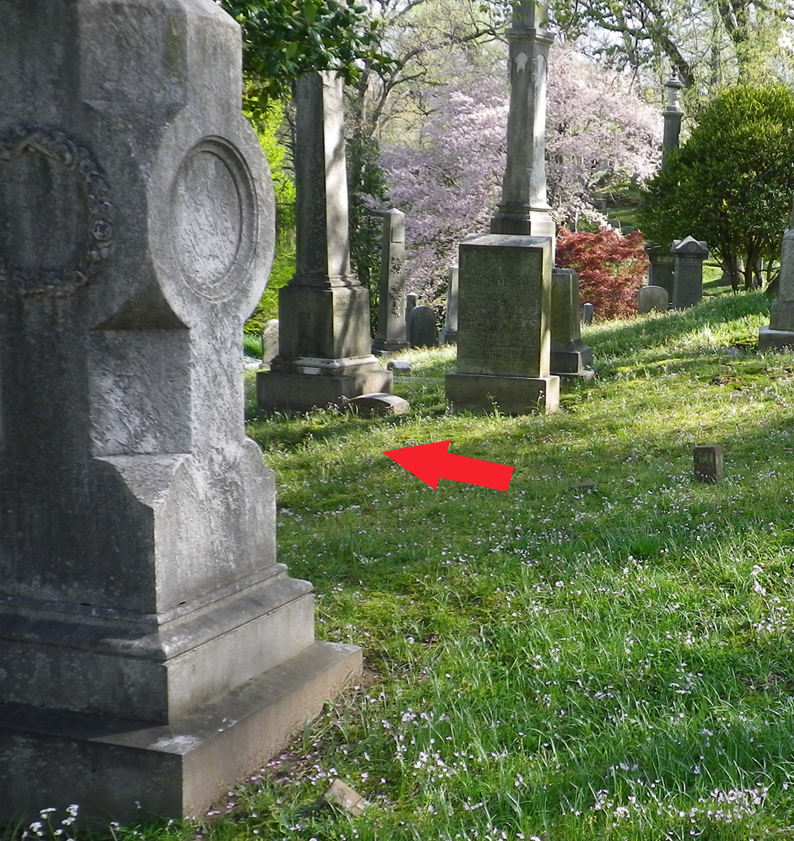
Aiken’s resting place when it was unmarked

The Surratt Society, having previously taken up funds to mark the graves of Edman Spangler and Elizabeth Keckly, started a fundraising campaign to mark his grave. The dedication service was attended by members of the Surratt Society and Museum, a group of Honor Guard reenactors, and even some descendants of the Aiken and Clampitt family (Aiken’s legal partner in Mary Surratt’s case). Short speeches were given based on the biographical details gained from Christine Christensen’s impressive research (Her 29 page document about Aiken can be read by clicking HERE). The Aiken descendant gave a nice speech while playing a recording he had made of the chimes of a grandfather clock. That grandfather clock was in an Aiken house that Frederick spent time in as a child. You can hear a short recording of them by clicking HERE. At the close of the ceremony, as the group was dispersing, the cemetery was visited by a doe and her fawn. The following are just a few images of that day sent to me by Betty Ownsbey, Lewis Powell’s biographer:

A descendant of the Aiken family (left) and Clampitt family (right). Sadly, Frederick Aiken had no children of his own and so he has no direct line.

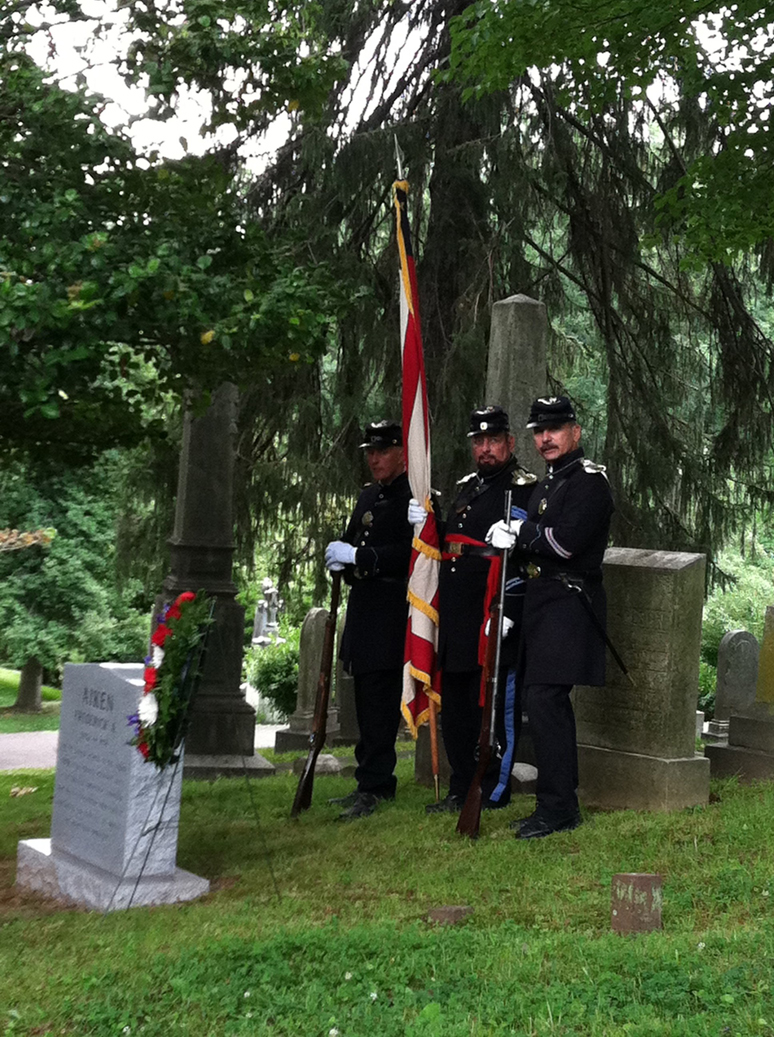
The Honor Guard at Aiken’s Grave

Visitors at the Cemetery

References:
Finding Frederick by Christine Christensen
Betty Ownsbey

Categories: Uncategorized | Tags: , , | 11 Comments

On this date: June 16th, 1842

Conspirator David Edgar Herold was born in Washington, D.C.

David Herold was the son of Adam George and Mary (Porter) Herold.  He attended Gonzaga College High School, Rittenhouse Academy, and Georgetown College.  Davy studied pharmacology and was employed as a druggist’s assistant and clerk when he became part of John Wilkes Booth’s plot.  He enjoyed hunting and had learned the routes and trails of Southern Maryland well during his hunting excursions.  This made Davy a perfect guide for Booth’s escape.  At the time of the assassination Davy was just 22 years old.

Davy’s true activities on the night of the 14th are hard to pin down.  It is most commonly written that he escorted Lewis Powell to the Seward house, and then fled when the onslaught began.  Another theory is that he was a point man – directing Powell to Seward’s and then returning to the Kirkwood house to see if Atzerodt had completed his assault on the Vice President.  Lastly, in his confession Atzerodt states that he refused to kill the Vice President, and that it was Davy who was assigned to do so in his place.

What we do know for certain is that stable man John Fletcher saw Davy Herold riding his horse around the time that the assassination occurred.  Fletcher chased after him as Davy was supposed to have returned his rented horse hours ago.  First Fletcher chased him on foot before going to his stables to get a horse for the pursuit.  When Fletcher came to the Navy Yard bridge he learned from the leader of the guard house, Silas Cobb, that Davy had already passed over the bridge.  Cobb told Fletcher he could pass and cross the bridge, but that he would not be allowed to return over it until daybreak.  At this point Fletcher gave up his pursuit.  Davy caught up with Booth who had crossed the bridge before him.  Davy would stay by Booth’s side during their entire escape.  In the end, Davy surrendered himself to the Garrett’s Farm patrol.  Davy was brought back to D.C. and placed on the ironclad ship the Montauk.  Then he was transferred to the Old Arsenal Penitentiary.  Davy celebrated his twenty-third birthday behind those bars and in the midst of the conspiracy trial.  Two of his sisters, Jane and Kate, gained passed to visit him two days later on June, 18th.  They sat and spoke with him in the courtroom from three o’clock until six o’clock.  Davy’s sisters had visited him in prison at least four times prior to this, making him one of the more visited conspirators after Anna Surratt’s attendance of her mother.

David Herold was found guilty on all counts against him except having conspired with Edman Spangler.  He was sentenced to hang and the sentence was carried out on July 7th.

His body was released back to the Herold family in February of 1869 and he was interred in Congressional Cemetery in Washington D.C.  He is buried underneath his sister Jane in the family plot, bearing no headstone of his own.

The press of 1865 was not kind to David Herold.  He was denounced as an idiot boy, with no sense or intelligence of his own.  They portrayed Davy as Booth’s lapdog.  While Davy did display a great deal of devotion to Booth, he was also an intelligent and crafty young man.  Upon his capture, Davy expertly avoided his interrogator’s attempt to implicate him further.  In addition, while on the run, Davy displayed his own creativity and intelligence by co-authoring a poem with Booth.  Instead of an autograph, he and Booth presented Willie Jett the following poem.  Davy wrote the second half:

“He put aside the dainty bribe
The little proffered hand
Albeit he held it in his thought
The dearest in the land
Not sharply nor with sudden heart
But with regretful grace
Meanwhile the shadow of his pain
Fell white upon his face

Dark daughter of the Sultry South
Thy dangerous eyes & lips
Essayed to win the prize and leave
Dear honor we Eclipse
She shyly clung upon his brow
He stayed now at the door
I could not love thee, dear so much
Loved I not Honor more.
Adieu, forever mine, my dear
Adieu forever more!”

Today marks the 170th anniversary of David Herold’s birth.  To me, Davy was a well educated, well off, young man who truly believed in the cause Booth expounded.  Davy was the only surviving son in a home filled with daughters and he longed for adventure.  In Booth’s ideas he found a cause to fight for, an adventure to pursue.  While those ideas were proven to be wrong and misguided, he believed in them nevertheless.  As with the others in Booth’s clan, Davy wanted to make a difference.  So on this, the day of his birth, we remember a man who choose his actions poorly, but do so with the best of intentions.

David Herold’s Signature

References:
Original document images are from Fold3.com
American Brutus by Michael Kauffman
The Lincoln Assassination Conspirators: Their Confinement and Execution, as Recorded in the Letterbook of John Frederick Hartranft by Ed Steers and Harold Holzer

Categories: Uncategorized | Tags: , | 19 Comments

Mail for Mr. Booth

Previously, I posted about one of the letters that was found in Booth’s room at the National Hotel.  As a popular actor, Booth received many letters from friends, fans, and theatre owners.  Another letter found in Booth’s room is the following from McVicker’s Theatre in Chicago:

“Chicago, Dec. 25, 1864

Friend Booth,
What do you say to filling three weeks with me May 29th?  I have not yet filled your time in January and see no chance of doing so with an attraction equal to yourself.  There are plenty of little fish but I don’t want them if I can help it.  So as you can’t come then come at the above date.
With a Merry Christmas and Happy New Year.
Yours Truly,
McVicker”

While Booth’s ability as an actor has been questioned by many authors, he nevertheless had the ability to draw a crowd.  This letter appears to state that Booth was, at one time, asked to play in Chicago in January of 1865 and declined the invitation.  Historically, McVicker’s had been very kind the John Wilkes Booth.  In January of 1862, he made his premiere there selling out the 2,500 seat theatre.  He would return there several times over the next two years.  But, as the years turned from 1864 to 1865, Booth’s mind was on other aspects.  He had suffered large losses in his oil ventures but told family and friends of his success.  He spoke of big plans that would allow him to retire from acting for good.  While wanting of money, an engagement in Chicago would separate him for too long from his new plan and target: Abraham Lincoln.

What makes this letter interesting is not just the content, but also the envelope that held it:

We can see that the letter was originally addressed to “J.Wilkes Booth, 28 East 19th St., New York”.  Written along the left hand side, in McVicker’s handwriting is the note, “forward if from home”.  McVicker had initially sent the letter to the Booth home in New York.

In September of 1863, Edwin Booth purchased the house on 19th St. near Gramercy Park in New York City as a permanent residence for his family.  Mary Ann, Rosalie, and Edwin’s daughter Edwina, lived there year round.  During breaks in touring and when the theatrical season ended, Edwin and John would both reside in the house.  Despite the brothers’ desire to keep the peace in the presence of their mother, the close quarters caused Edwin and John to engage in many arguments, usually stemming from their opposite political beliefs.  In late November of 1864, Edwin finally had enough of his brother’s secessionist talk, and kicked him out of the house.  Booth would briefly stay with his sister Asia in Philadelphia, before moving to Washington.

As the note on the envelope requested, someone in the Booth’s New York house forwarded the letter to John in Washington, D.C.  Specifically, they sent it to Ford’s Theatre.  Noted actors received liberties at theatres and receiving mail was one of them.  Harry Clay Ford, treasurer of the theatre, recounted the morning of April 14th, when Booth, once again, received his mail at the theatre:

“When [Booth] came there I do not know whether he asked for a letter or not, but Mr. Raybold ran into the office and brought him out a letter.  He generally had his letters directed to the theatre…He then commence[d] opening his letter.  Then I left for a while and went into the office.  On coming out again, I found him seated on the steps where he was on Thursday, the steps leading into the office…I think he was reading the letter then.  He did not make any remark in reference to the letter.  I do not know whether the letter consisted of two or three sheets written over.  It was notepaper I think; appeared to be written all over both sheets.  I don’t recollect positively, but I think the writing was rather large.  If I remember right it was zigzag all full of writing.  Did not see any blank on it al all.  He had not finished the letter when I left him.  Was reading it still.”

Harry Ford provides a tremendous amount of detail regarding Booth’s letter.  It seems that this was done to direct attention away from the fact that it was probably him (or someone in his office) that divulged to Booth that Lincolnwas coming.

How our history could be different if, on April 14th, 1865,  Booth had not received a similarly addressed letter like the one above.  He may have continued on past Ford’s never knowing Lincoln was going to be there that night.

References:
My Thoughts Be Bloody by Nora Titone
The Lincoln Assassination – The Evidence by William Edwards and Ed Steers

Categories: Uncategorized | Tags: , , | 1 Comment

Mystery Pictures

Time to test your knowledge of assassination related places and objects.  Look at the mystery pictures below and take a guess as to where/what it is.  When you’ve guessed on all nine of the pictures click the Answer button at the bottom to see how you did.  Good luck!

Mystery Picture #1:

Mystery Picture #2:

Mystery Picture #3:

Mystery Picture #4:

Mystery Picture #5:

Mystery Picture #6:

Mystery Picture #7:

Mystery Picture #8:

Mystery Picture #9:

Got them all figured out?

Check the Answers!

How did you do?

Categories: Uncategorized | Tags: | Leave a comment

Thoughts From Major Rathbone

When Booth’s dark deed was committed at Ford’s, no one had a closer seat to the action than the occupants of the theatre box. Mary Todd Lincoln, Clara Harris, and her fiancée and stepbrother Major Henry Rathbone, had the horror of watching the scene play out within arm’s length. Shortly after the crime, Henry Rathbone gave a lengthy and detailed statement recalling the events as he remembered them. Rathbone’s account (which can be read here) provides a wonderful description of the scene of the crime and his activities after the shot was fired. While a re-reading of Rathbone’s account doesn’t provide any ground breaking new claims, it does contain a few details worthy of address and consideration. This post will discuss two minor details set forth by Rathbone in his testimony.

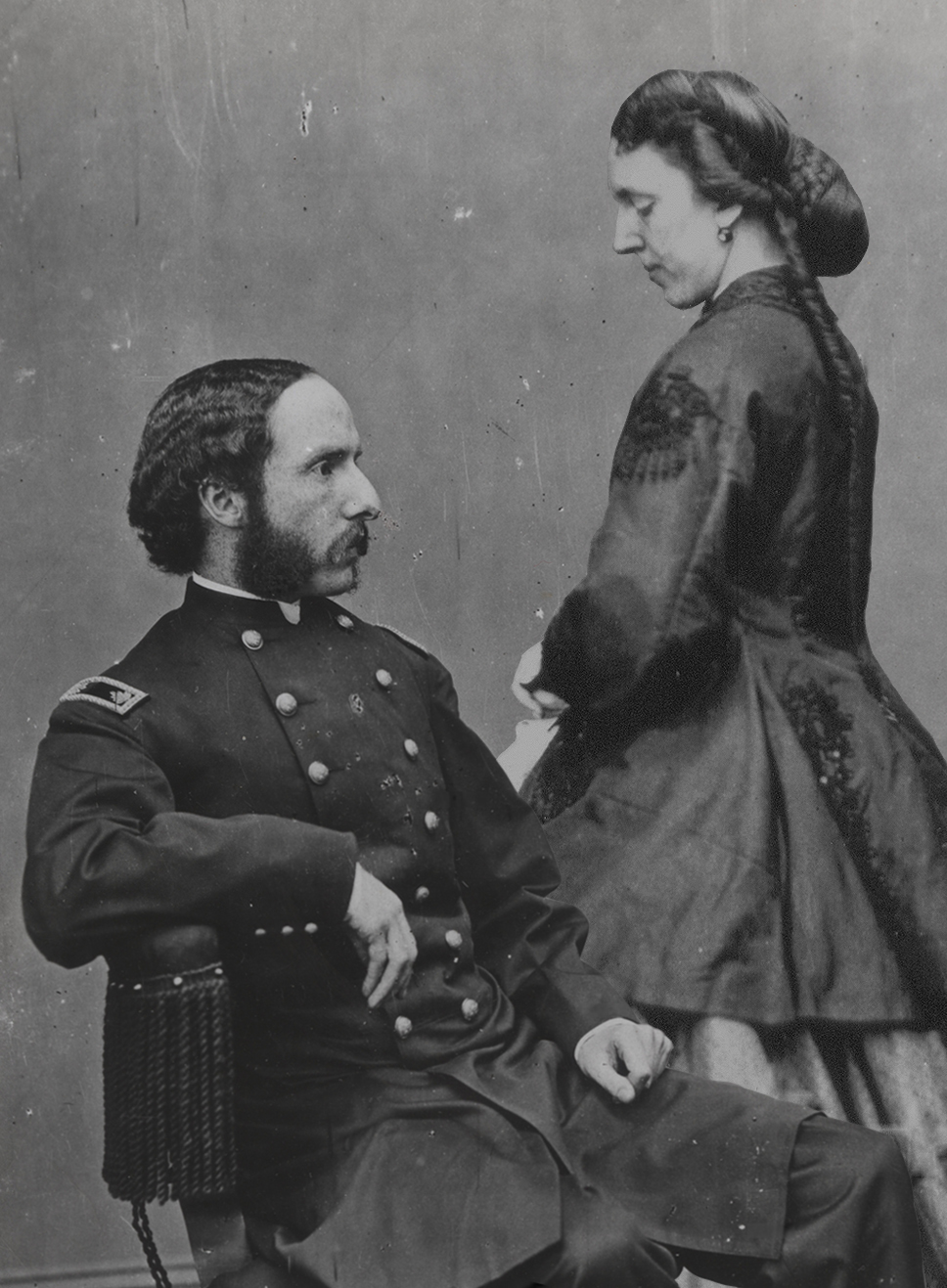
Major Henry Rathbone and Clara Harris (composite by the author)

After Booth shot Lincoln, Major Rathbone, alarmed by the report of a pistol and cloud of powder in the box, raised himself and attempted to subdue the assailant. During the struggle Booth thrust at Rathbone with his knife, which Rathbone parried upwards. In the course of this parry, Rathbone received a deep cut on his left arm between his elbow and his shoulder. It was a painful blow that knocked Rathbone back a bit. At this moment, free from grappling with Rathbone, Booth moved to the front of the theatre box, and leapt over it.

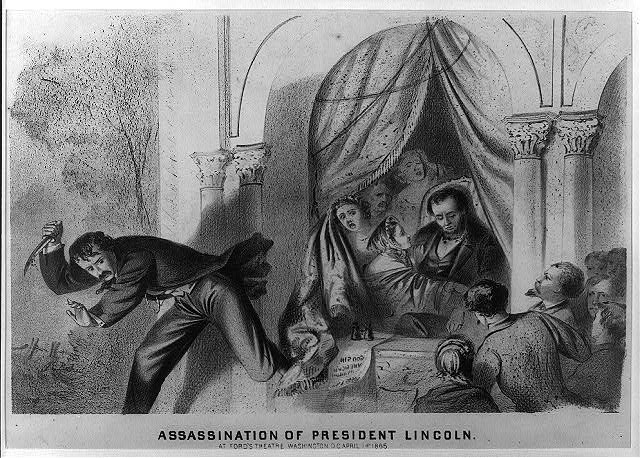
Many witnesses at the time said that Booth’s jump from the box was a noticeably ungraceful one. One eye witness account stated that, “He did not strike the stage fairly on his feet, but appeared to stumble slightly.” Immediately following the events, several others described similar stumbles Booth made upon reaching the stage.

A quite ungraceful engraving of Booth’s jump from the box

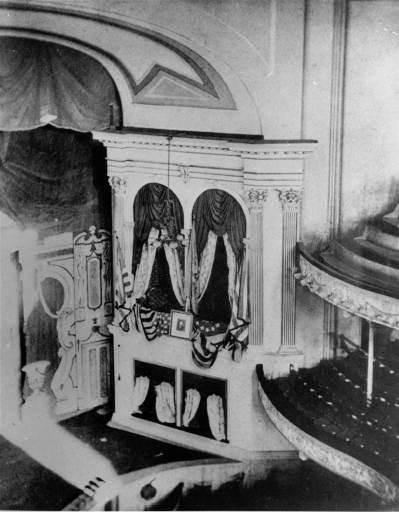
Granted, the distance he leapt was twelve feet off the ground and it can be a hard landing for any man to make properly. In his act of jumping, Booth disturbed the flags decorating the box. This, of course, makes perfect sense. The flags decorating the box were merely attached to the outside and weren’t expected to be moved during the President’s attendance. Instead of jumping straight from inside the box down to the stage in a hurdler’s motion, Booth likely leapt over the railing of the box, paused briefly on the small ledge on the other side, and then jumped down. This small ledge is where many flags were resting and draped about. A witness at Ford’s described that, during the jump, Booth, “partially t[ore] down the flag”.

Photograph of the box shortly a day or two after the assassination. Notice the partially pulled down flags.

Another witness had a similar account about his riding spur getting caught up in the decorations, causing his awkward fall. The American mythos of the assassination states that, while jumping, Booth was tangled in an American flag causing him to land poorly onto the stage and breaking his leg. In his diary, the vain Booth, probably attempting to save face for his less than perfect “performance”, claimed that in jumping from the box he broke his leg. Most Boothies accept this as fact while also entertaining the idea set forth by author Michael Kauffman that Booth broke his leg later that night, when his horse fell on him during the rough ride south. With it being impossible to prove one theory over another, historians just pick the idea they like better and concede that differences of opinion exist on the matter.

What is not really debated is that Booth fell uneasily upon the stage, making one of his worst entrances ever. While the flags generally receive the attention for causing Booth’s missteps, Rathbone’s account provides another possible reason:

“The man rushed to front of the box and [I] endeavored to seize him again but only caught his clothes as he was leaping… The clothes, as [I] believe, were torn in this attempt to seize him.”

While Rathbone gets credit for struggling with Booth and sacrificing his own arm attempting to subdue him, is it possible that Rathbone was also the reason Booth landed so hard upon the stage? As Booth was making his jump, could the grasp of Major Rathbone on his clothes have thrown the actor’s balance off and caused his clumsy landing? Further, if this is indeed when Booth broke his leg, effectively slowing down his escape, could it be Rathbone and not the flags, that deserve the credit? These questions and the overall scenario produced by them are merely items to contemplate and I make no claims of them being in anyway definitive.

A second item Rathbone mentions in his testimony is about the set up of the box itself. From the beginning Rathbone gives a wonderful description of the box and the locations of the parties therein. From his description the following diagram of the box seems to correct display the set up:

Booth entered the box through the outer passageway door marked H on the diagram. Remember, during normal nights the box in which the President’s party occupied severed as two boxes. A partition would separate it into two smaller boxes. That is why there are two doors inside the passageway. The door marked as G, was actually the closest door to the President, but was closed during the whole night. It was the entrance to Box 7. The Presidential party and Booth all entered the box through door F. That was the door to Box 8.

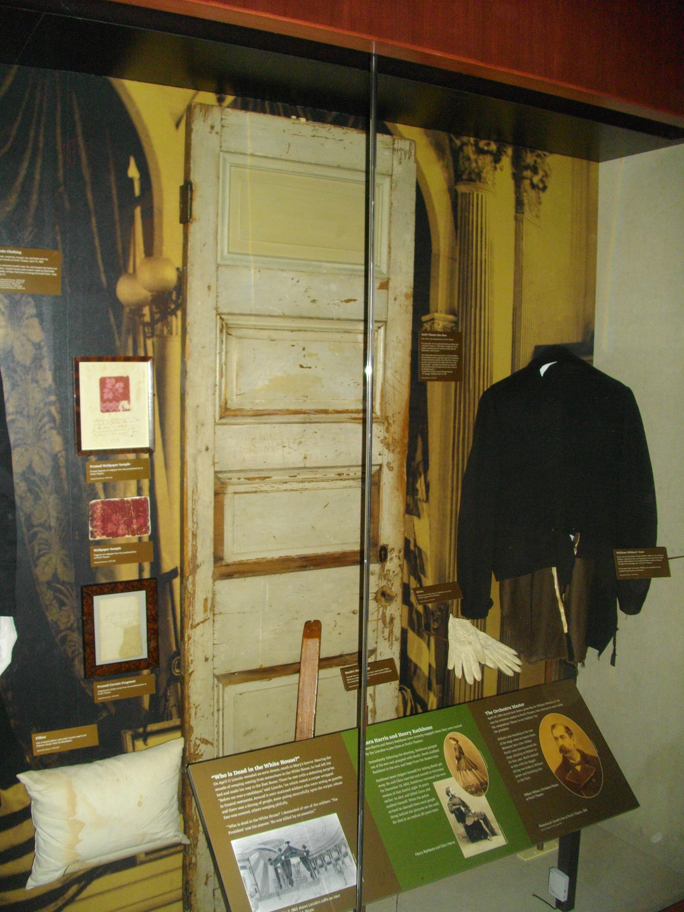
This inner door to Box 7 is on display at in the Ford’s Theatre Museum.

This door has a unique feature as it has a peep hole bored into. For many years it was written that this hole was bored by John Wilkes Booth on the morning of the assassination. After learning about Lincoln’s attendance that night, Booth did enter the theatre and found a wooden bar with which to jam the outer door so that it could not be opened. The wooden bar can be seen in the above picture sticking out from the bottom of the door. It was assumed that during this prep work, that he also bored a hole into the door in order to have an eye on the President before entering the box.

A letter written by Frank Ford (son of Harry Clay Ford, the theatre’s treasurer) denounced this idea. Frank stated that his father ordered the hole to be bored into the door so that the President’s guard, and others employed in their duties for the government or theatre, could look in on the President and his party instead of barging in straight away and disturbing them. Frank quotes his father as saying, “John Booth had too much to do that day other than to go around boring holes in theatre doors.” However, a period statement from Harry Ford has him saying, “Did not notice a hole in the door or in the wall. Did not take particular notice of the wall or door however.” So the mystery regarding the hole remains.

Even if this hole was bored at the bequest of the Ford’s, Booth still used it to eye the President before making his move, right? Not necessarily. According to Rathbone:

“The distance between the President as he sat and the door was about four or five feet. The door, according to [my] recollection, was not closed during the evening.”

Rathbone claims that the door to Box 8 was never closed during the performance. If this is the case, Booth may not have used the peephole to spy on the President through Box 7. After entering the passageway door, Booth stealthily put the wooden bar in place to “lock” the outside door, and either peered through the slightly open Box 8 door into the box, or just waited until the lines of the play were right to bust in and get his first real view. With all eyes directed on stage and not towards the rear, it seems that Booth could have been standing in the shadows of the passageway eyeing the President for some time before he acted. If Rathbone is to be believed and the door was open during the performance, the image of Booth before he shot Lincoln could change. Instead of a man hiding behind door 7 nervously peeking at his target through a hole, Booth becomes a shadowy figure, standing motionless in the doorway to box 8 eyeing his prey. To me the latter image is in line with Booth’s brazen persona. He brought an unreliable single shot derringer to kill the President, assured that he would succeed. I have no problem picturing this arrogant Booth, lurking near an open door a few feet away from the President, coiled like a viper waiting to strike.

Again, these small pieces of Rathbone’s account are posted here merely to initiate contemplation and conversation. Feel free to post your thoughts about them by clicking on the “comment” button below.

References:
The Lincoln Assassination – The Evidence by William Edwards and Ed Steers
We Saw Lincoln Shot by Timothy S. Good

Categories: Uncategorized | Tags: , , , | 20 Comments

The Collapse of Ford’s Theatre

On this date, June 9th, in 1893, a part of the three upper floors of Ford’s Theatre collapsed killing twenty two clerks and injuring over 100 more government employees.

NPS Photo

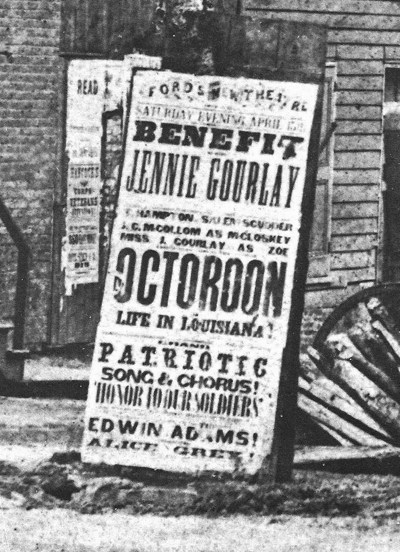
After the assassination of Lincoln, the government immediately seized Ford’s Theatre.  Military guards had been posted to the theatre and access was granted by War Department passes.  Matthew Brady was allowed to photograph the interior and members of the stage crew and orchestra were allowed to retrieve their items from within its walls.  After the execution of the conspirators on July 7th, 1865, John T. Ford was given permission to reopen his theatre.  He announced that the play, “The Octoroon” was to be performed on July 10th.  As is shown on the playbills and broadsides from “Our American Cousin”, “The Octoroon” was initially scheduled for April 15th.  While Ford sold over 200 tickets for the performance, there was also a large uproar over the theatre reopening after what had transpired within her walls.  Ford received this anonymous letter implying retribution if he fulfilled his plan:

 “Sir:

You must not think of opening tomorrow night.  I can assure you that it will not be tolerated.  You must dispose of the property in some other way.  Take even fifty thousand for it and build another and you will be generously supported.  But do not attempt to open it again.

One of many determined to prevent it.”

For fear of the place being burned, the Judge Advocate ordered a troop of soldiers to the theatre on the night of July 10th, to prevent anyone from attending the play.  Ford placed a sign on the door reading, “Closed by Order of the Secretary of War” and refunded the ticket holders.  He would not attempt to revive his theatre again.

The government decided its best option was to just retain the property.  They began paying John Ford $1,500 a month to lease his theatre.  By July of 1866, the government bought the property outright for Ford for $88,000.  Even before purchasing the building, the government had started renovating the theatre.  They transformed the interior into a three story office building.  In December of 1865, the Army Medical Museum moved into the third floor of the space.

Engraving of the Army Medical Museum housed in Ford’s Theatre from the book, “Ten Years in Washington: Life and Scenes in the National Capital as a Woman Sees Them” (1874).

The museum would stay in Ford’s until 1887, when a separate building was constructed for their purposes.  The Army Medical Museum’s occupancy at Ford’s provided a slightly macabre reunion between Abraham Lincoln and John Wilkes Booth.  The museum housed pieces of Lincoln’s skull and hair, and Booth’s vertebrae, each taken from their perspective autopsies.  Parts of the two men spent over twenty years together at the scene of their last meeting. EDIT: Further research has shown that Lincoln’s skull fragments were not given to the Army Medical Museum until after it had moved out of Ford’s Theatre. Darn.

Lincoln Skull Fragments and Nelaton Probe

Engraving of Booth Vertebrae

The other two floors of Ford’s housed the Office of Records and Pensions run by the War Department.  When the medical museum moved out, they took over the entire building.  The many clerks employed in the building compiled the official pension records for Civil War veterans and others.

In 1887, the Pension bureau received a new chief, Colonel Fred C. Ainsworth.  As a boss, Ainsworth was not a popular fellow.  His methods of leadership and his expectations of his clerks was a drastic change from the department’s previous leaders.  Old timers who had worked in the office for years found themselves held to greater expectations and increased workloads.  While this made Ainsworth an efficient chief, it also made him a very disliked leader.  However, Ainsworth was not heartless and tried his best to appease his clerks.    Ainsworth was aware of his clerks’ apprehension about the building they occupied.  When he first started, he heard rumors that the east wall of Ford’s was unsafe.  He made inquiries with his superiors and was assured that the wall was perfectly secure and the whole building was safe.  In 1888 and 1889, Ainsworth directed the installation of a new steam heating apparatus and a new plumbing system for the building.  Then in 1893, he received permission to install an electric light plant for the building.  In order to place the light plant and provide amble ventilation for it, it was required to excavate about twelve feet between two partition walls in the basement.  Ainsworth wrote up specifications, gave them to the War Department, and the War Department created a contract and accepted bids.  Eventually, the bid by a contractor named George W. Dant was chosen to do the work.  During this entire process, no element of danger was discussed by anyone.  With proper underpinning of the floor above, the excavation was a relatively safe job.

While this construction was going on, the clerks’ unease about the building increased.  Plaster was known to fall from the ceiling and, at one point, part of the first floor was roped off causing the clerks to worry about the structure.  None of them however, seem to have brought their concerns up with Colonel Ainsworth.  As chief, he continually went into the basement to check on Dant and his men.  Dant continually assured him that everything was fine and that the roped off area was just because that particular part of the first floor was to be removed as part of the excavation.

Then, on this day in 1893, tragedy struck Ford’s again.  During the course of the work day, with hundreds of clerks and files hustling about, a support pier in the basement excavation area collapsed.  The floors above were supported by iron beams, which rested on columns, which rested on the brick piers in the basement.  When the one pier gave way, a 40 foot section from all three floors collapsed down.  Twenty one clerks were instantly crushed and killed.  One would die a few days later from his injuries.  A total of 105 clerks suffered injuries, with two more clerks dying as a result of their injuries over the next three years.

Almost as soon as the dust settled, and the dead were dug out, the public demanded to know who was responsible for the collapse.  A Coroner’s inquest was held to determine if there was any criminal responsibility.  The surviving clerks, furious over the loss of their brethren, used this opportunity to lay the blame on their despised chief, Colonel Ainsworth.  On the witness stand they spoke of the building being a death trap long before the accident.  They claimed they were told by Ainsworth’s assistants to tip toe on the stairs because they were dangerous.  They said they were too afraid to say anything about the conditions for fear they would be fired.  The room in which the inquest was held turned into a scene of fury, with all rage directed towards the Colonel.  A man who lost his brother in the accident came up behind the sitting Colonel and yelled “You murdered my brother!”  Shouts of agreement came from others in the crowd and several rose to their feet moving to close in on the Colonel.  Luckily the police lieutenant in the court was able to disperse the impromptu mob.  As more and more witnesses took the stand, the outbursts from the crowd increased.  All the while, the Colonel sat calmly in his chair, unwavering.

With emotions high, even members of the jury broke decorum.  B. H. Warner, a juror, interrupted a testimony and asked for Ainsworth to leave as he was intimidating witnesses with his mere presence.  The crowd applauded this suggestion for a full minute glaring at Ainsworth all the while.  Ainsworth refused to leave citing it as his right to hear testimony regarding the events.  The Coroner agreed.  He had no precedent to evict Ainsworth, as he had done no wrong and merely sat there.  When the Colonel’s representative, a Mr. Perry, rose to address the room, the crowd yelled at him and hissed.  When the room finally gained its composure, Mr. Perry begged the crowd, “I appeal to you as American citizens for fair play.”  To this a member of the crowd replied with, “You didn’t give us fair play!” At that point, the tempest roared.  The shouts of, “Murderer!” changed to, “Hang him! Hang him!” and the mob approached Ainsworth who continued to sit cool and collected in his chair.  The police lieutenant was powerless to disperse the mob.  For a brief moment of time, it appeared the Colonel’s life was to end right there by the hands of his angered employees.

The only thing that brought the mob back to its senses was the when the juror who previously spoke, B. H. Warner, stood upon his chair and begged for order.  He calmed the crowd back down with the following:

“This outbreak of feeling must be suppressed not by the strong hand of the law, but by the hand of fraternity.  I appeal to you to have fair play as American citizens, and not to stain the fair name of the glorious Capitol of this Republic.  I appeal to you in the name of the Master who reigns above.”

The inquest continued for the next few days but with increased police attendance that squashed all disturbances before they could start.  The jurors of the inquest found Colonel Ainsworth, contractor Dant, the superintendent of the building, and the mechanical engineer of Ford’s guilty of criminal negligence.  However, the Coroner’s inquest had no real power.  It merely established whether or not the men could be charged with the crime.  Despite the findings, the district attorney never charged the superintendent or the mechanical engineer with any crime.  Due to the public outcry, however, he did go after Ainsworth and Dant.  The defense effectively postponed matters until time allowed the public to cool down.

In the end, the charges against Colonel Ainsworth were dropped as the Coroner’s inquest never proved that he had any knowledge that the building was unsafe.  The jurors’ verdict was a product of the emotions of the times and not the evidence.  The accident was a travesty, but the Colonel was guilty of no wrong doing.  He continued as Chief of the Records and Pensions bureau and worked his way up to becoming the Adjutant General.  He died in 1934 and is buried in Arlington.

Of all those involved, it is probably George W. Dant who is to blame for the collapse.  It appears that he and his crew did not properly shore up the brick piers around the excavation.  With the ground around them gone, the weight of the floors above was too much for the exposed piers.  The cause of the collapse was due to the improper support of these piers.  While Dant was the most liable for what occurred, by April of 1895 the prosecution gave up its case against him.

NPS Photo

For the clerks who perished, the government paid $5,000 to each of their families.  Those who were wounded in the collapse received anywhere from $50 to $5,000 depending on the extent of their injuries.

The inside of Ford’s was rebuilt immediately after the collapse.  From 1893 to 1931 the building housed the Government Printing Office under the direction of the Adjutant General.  In 1931 the building was turned over to the Department of the Interior and the Osborne Oldroyd’s Lincoln Museum opened on the first floor in 1932.  It became a National Historic Site the same year.  After being renovated and restored to its 1865 appearance, it reopened as a working theatre and museum in 1968.

While it is well known, the one item of coincidence regarding the June 9th, 1893 collapse of Ford’s is still worth repeating here.  At around the same time the clerks of Ford’s were falling to their deaths, another man was being buried in Massachusetts.  Edwin Booth, the great tragedian and brother of the assassin, died on June 7th.  On the day of the collapse, he was being interred at his final resting place in Mount Auburn cemetery.  Despite Edwin’s lifetime of success as the greatest actor of his generation, both his life and death are eclipsed by tragedies at Ford’s Theatre.

References:
Ford’s Theatre and the Lincoln Assassination by Victoria Grieve
Restoration of Ford’s Theatre by George Olszewski
There are many newspaper articles about the inquest and legal proceedings regarding the collapse.  I used GenealogyBank searches for Ainsworth and Dant to find several articles.  Others can be found in the New York Times’ archive.  The most entertaining account (which contains the material about the mob at the first session of the inquest) can be read here.
Other articles about Ainsworth’s legal process: 1, 2, 3

Categories: Uncategorized | Tags: , , | 23 Comments

The Passionate Booths

When John Wilkes Booth pulled the trigger on his derringer, he released not only a lead ball, but also the pent up angst and fervor that had darkened his soul.  His deed was misguided and barbaric; however, in his eyes, it was justified.  As a son, an actor, and an American, John Wilkes Booth was fuelled by his passions.  While he won acclaim for his ability to direct his passions on the stage, they were not products of the stage.  He inherited these passions from his forefathers and, mixed with his own experiences, channeled them on that fateful night.

Much has been written about John Wilkes Booth’s father, Junius Brutus Booth.  The noted tragedian was the greatest of his generation and developed many peculiarities that has provided rich fodder for writers.  The book My Thoughts be Bloody by Nora Titone provides a wonderful look at the romantic side of Junius Brutus Booth.  Junius was a proponent of Lord Byron’s free love philosophy.  He won over his mistress and mother of his theatrical clan, Mary Ann Holmes, with volumes of Byron’s work and notes of his affection.  Despite being married to another woman and having two children with her (only one of which survived infancy), Junius was enamored with Mary Ann and, together, the pair ran off to America.  Love and the pleasures of the flesh were Junius Brutus Booth’s first passion.

In fact, his passion in this area started before he had even met his first wife, Adelaide.  As a mere boy, Junius had engaged his passions.  I quote from the book, Prince of Players: Edwin Booth by Eleanor Ruggles:

“Junius Brutus Booth was thirteen when a neighbor’s servant girl accused him of having got her ‘in the family way’ and was hurriedly paid off. He was seventeen and had enlisted as a midshipman on the brig Boxer when he was kept from sailing by a court summons to answer the same charge made by another servant girl, employed in the Booths’ own house. Richard Booth went into court himself to be Junius’ lawyer and defended him hotly, but the father and son lost their case and the father was compelled to pay up again.”

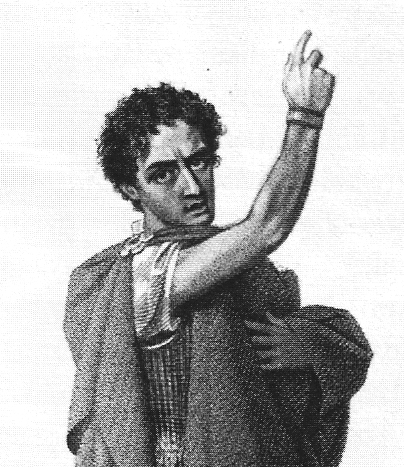
Drawing of Junius Brutus Booth in 1817

The above, modern account is greatly contrasted by another.  A book was published in 1817 called, Memoirs of Junius Brutus Booth: From his Birth to the Present Time.  The book is an early testament to the genius of the young actor.  Written by his fans during the heyday of his English popularity (before he met Mary Ann Holmes and ran away with her), the book recounts the matter in the most predisposed, yet eloquent, manner possible:

“He then became desirous of learning the art of printing, but soon relinquished it for the law, which again he quitted from an inclination to become a sculptor, and he pursued the first steps towards that divine art very assiduously, with the intention of entertaining it as a profession.  But here his views were interrupted by an occurrence of rather an extraordinary nature.  Our hero, for so we must now emphatically call him, was accused of a degree of susceptibility towards that sex, whose charms form the great stimulus – the bright reward of every act in which the heart of man takes part, rarely exemplified at his age.  He was charged by a frail nymph with a deed – of which she could no longer conceal the evidence.  His father, astonished at this deposition to his son’s precocity, was at first disposed to wear the aspect of displeasure; but relying on the sagacity and experience of the Bench on these subjects, he determined to answer it by taking his child in his hand, and presenting him to the Justices, merely ask their worships whether they thought the fact came within the limits of probability, or even possibility.  They, however, decreed that he should wear this attestation of his persuasive powers – or this stain on the pudency of his boyhood, (as it will be variously interpreted by various commentators) for the remainder of his life.

The consequence of this decision, and the subsequent anger of his father, was that, being unable to raise the supplies necessary on this emergency, he was forced to resort to stratagem to elude the vigilance of the parish officers, (which, when in the pursuit of gain, or in the prevention of loss, is not often found napping), and mounting a high brick-wall, he baffled his pursuers, and for nine months escaped this attack on his purse, or rather his father’s; – he was at length, however, discovered, and obliged to make the usual amende.”

As Junius grew older, his passions shifted from matters of the heart, towards that of the bottle.  Mirroring his son to a less extreme, Junius let his passions overwhelm him and lead him to his own destruction.

John Wilkes Booth’s father was not the only passionate forefather.  Richard Booth, Junius’ father and John Wilkes’ grandfather, had his own obsession.  Many of us know how Richard Booth hung a portrait of George Washington in his London home and required visitors to bow before it.  In his youth, however, Richard Booth took a much more active role in demonstrating his commitment to America.  I quote from The Edler and Younger Booth by Asia (Booth) Clarke:

“Richard Booth, the father of the subject of the present sketch, was educated for the law; but, becoming infatuated with Republicanism, he left home, in company with his cousin John Brevitt, to embark for America (then at war with England), determined to fight in her cause. Booth was taken prisoner and brought back toEngland, where he subsequently devoted himself to the acquirement of knowledge and the practice of his profession…”

In their attempt to join the Americans in their fight for independence, Richard Booth and John Brevitt wrote to a Member of Parliament noted for his support of the American Revolution, asking for a letter of introduction on their behalf.  The man they wrote to would later be honored by the Booth family by giving his name to one of Richard’s grandson’s: John Wilkes.

“To John Wilkes, Esq., Princes Court, Westminster.
Paris, Oct. 28th, ’77.
Sir, — You will certainly be much surprised at the receipt of this letter, which comes from two persons of whom you cannot possibly have the least knowledge, who yet at the same time claim the Honour of being of the same Family as yourself. Our conduct has certainly been in some respects reprehensible, for too rashly putting in execution a project we had for a long time conceived. But as it was thro’ an ardent desire to serve in the Glorious cause of Freedom, of which you have always been Fam’d for being the Strict and great Defender, we trust the request we are about to make will be paid regard to. As Englishmen, it may be urged that we are not altogether Justified in taking arms against our native Country, but we hope such a vague argument will have no weight with a Gentleman of your well-known abilities; for as that country has almost parted with all its Rights, which have been given up to the present Tyrannic Government, it must be thought the Duty of every true Briton to assist those who oppose oppression and lawless Tyranny. And as the people of America are composed of men who have still the spirit of their brave Forefathers remaining, it becomes all who are Englishmen to exert their utmost efforts in their behalf, leaving their Country for that purpose; being no more (as we presume) than the Romans, in the war between Octavius and Anthony on the one part, and those illustrious worthys, Brutus and Cassius, on the other, going from the army of the Tyrants to serve in that of the latter, and therefore equally justifiable.

‘Dulce et Decorum est pro patria mori,
Sed pro Libertate mori, Dulcissimum est.’

The manner in which we have conducted ourselves has been so very extraordinary as to be scarcely credible, but we are assured the Bearer of this Letter will convince you of its Authenticity. In short, we leftEngland, and all the advantageous prospects we had there, purposely to go and serve in the Army of the Sons of Liberty, the brave Americans. In order to complete the Enterprise we came from London under a pretence of going on a party of pleasure to the Camp at Warley Common, but instead of proceeding thither, we went immediately for Margate and thence to Ostend, and have since arrived here, where we came to wait upon the Gentlemen who are Agents for the Congress in America, in order to the full completion of our Design of getting appointed officers in the Provincial Service, but for that purpose have since found it necessary to procure a Letter of recommendation from some Gentleman in the Interest of Liberty in England, and understand from Mr. Arthur Lee (who has promised to interest himself greatly in our behalf), that no recommendation will be of more service to us than yours. Our request therefore is, that you will condescend to give one in our favour, directed to that Gentleman at the “Hotel de la Reine, la Rue des Bons Enfants, a Paris,” which you will please to deliver to the Bearer hereof, as soon as possibly convenient. And the favour will be gratefully remembered, and the name of Wilkes be always held in the greatest respect and veneration.
Your most and obed’ Serv’ts at command,
R. Booth.
John Brevitt”

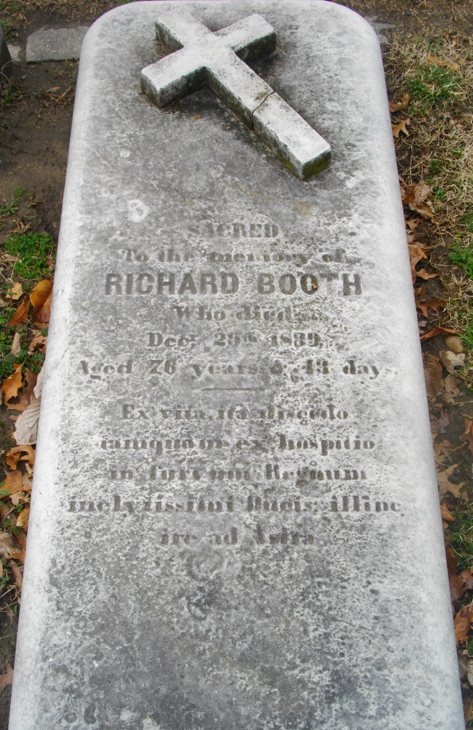
Richard Booth’s Grave

These elder Booths, Richard and Junius, tread a path that their progeny, John, would later follow.  From Richard, John Wilkes inherited a revolutionary spirit.  From Junius, he learned to submit himself to his passions regardless of the consequences.   Combined with the tyrannicidal nature of Shakespeare and the bloodiness of the Civil War, John acted according to his beliefs.

Ultimately, in his own horrific way, John Wilkes Booth upheld the passion of the Booth name.

References:
The Edler and Younger Booth by Asia Clarke
Memoirs of Junius Brutus Booth: From his Birth to the Present Time
Prince of Players: Edwin Booth by Eleanor Ruggles
My Thoughts Be Bloody by Nora Titone

Categories: Uncategorized | Tags: , | 3 Comments

The Assassination Playbills

Earlier, I introduced you to Henry Polkinhorn, a Washington, D.C. printer.  From his building on D Street, Polkinhorn printed newspapers, books, and a plethora of other custom items.  Of all the items he printed over the years, the most sought after item today is the playbill from Ford’s Theatre for April 14th, 1865.  In this post we will explore the details of Polkinhorn’s work, in order to identify genuine playbills and later reprints.

We will be utilizing the wonderful, but rare book, The Ford Theatre Lincoln Assassination Playbills: A Study by Walter C. Brenner.  Mr. Brenner privately printed this 16 page book in 1937.  In it he sorted out the many misconceptions about the playbills and, for the first time, created a tool for identifying and authenticating genuine playbills.  In the foreword of his book, Mr. Brenner wisely stated that, when attempting to authenticate a playbill as genuine, “source and pedigree must be disregarded,” and many, “will not prefer to do so.”  The simple truth is there is an exceedingly small possibility that genuine playbills still exist outside of libraries, museums, and private collections.  In fact, many libraries, museums, and private collections themselves don’t even have genuine playbills.  The best of provenance must be ignored when faced with the facts and details of the printed playbill.  The evidence within is unbiased and is merely for the benefit and education of those interested in the drama at Ford’s.

As stated before, Henry Polkinhorn was the regular printer for Ford’s playbills.  His association with the theatre started when John T. Ford took over the Tenth Street Bapist Church and started putting on musical performances:

Ford continued using Polkinhorn’s services when he renovated the church into Ford’s Atheneum:

When a fire destroyed most of the building in December of 1862, Polkinhorn helped his customer by purchasing stock so that he could build Ford’s New Theatre.  Ford continued to use Polkinhorn for his playbills and printed materials all the way until when the theatre closed for good after the events of April 14th, 1865:

Large advertisement for Ford’s April 15th, 1865 performance of The Octoroon. The performance never occurred as the theatre was closed after Lincoln’s assassination.

Therefore, when attempting to authenticate a playbill, it is important that it has been printed by “H. Polkinhorn & Son, Printers, D street, near 7th, Washington, D.C.”.  This is the final line on the playbill right at the bottom:

Now, just because a playbill says “H. Polkinhorn” at the bottom does not mean that it is genuine.  Practically all the later forgeries and reprints include the correct printer.

To Polkinhorn, printing the playbills for April 14th was just another job like the day before.  As a printer, he kept the previous day’s playbill set up on the press until he was given orders to change it, and then he changed only as much as was necessary.  This would save time in the printing process as long as the customer did not call for a completely redesigned playbill.  The Harvard Theatre Collection has the bound volume of playbills belonging to John B. Wright, the stage manager at Ford’s.  Looking at the playbills leading up to the 14th, Polkinhorn used the identical line of lettering for Laura Keene’s name on the 10th, 11th, 13th, and the 14th.  On the 12th, he had to resize her name to make room for an illustration on the playbill, but reverted back on the 13th.  On the morning of the 14th, Polkinhorn was printing the bills.  At around 10:30 am, Mrs. Lincoln’s messenger arrived at Ford’s to reserve the box for that night.  After this announcement happened, John Wright went to Polkinhorn’s printing shop to change the playbill.  Originally, there was going to be a special musical performance on the next night, April 15th.  On the large poster above you can see on the bottom the announcement for “Honor to Our Soldiers”.  This was a song written by Ford’s orchestra director William Withers.  With the announcement that Lincoln was attending that night, it was decided that the premiere of the song should coincide with the visit of their honored guest.  Therefore, Wright went to Polkinhorn’s to change the playbill to include mention of the song.  When Wright arrived, Polkinhorn altered the press to print the new bills.  Rather than throw out the bills Polkinhorn had already printed without the song, they were also used that night.  This is the reason why there are two issued of playbills for Our American Cousin:

Ford’s Theatre Playbills from April 14th, 1865

After Lincoln was killed, the theatre was shut down never to be used by Ford again.  Polkinhorn found that one of his most consistent clients no longer needed his services.  He removed the song playbill design off of the press and carried on with his business.  As time passed, people clamored for mementoes of the fallen President and the events at Ford’s Theatre.  John Buckingham was the door keeper at Ford’s on the night of the assassination.  In 1894, he published a short, illustrated book called Reminiscences and Souvenirs of the Assassination of Abraham Lincoln.  Before, publishing this book, however, Buckingham got into the business of reproducing playbills from that night.  When Buckingham first started printing his “souvenir” playbills is unknown.  The earliest I can confirm is by 1879, but it is likely he started much earlier than this.  One source states that the reprints were sold on the streets of Washington “a day or two after the tragedy”.  What is known is that when Buckingham decided to print his souvenirs he went right back to Polkinhorn’s printing company.  Richard Oliver Polkinhorn, Henry Polkinhorn’s nephew, is the one that helped him recreate the bills from that night.  Using Polkinhorn’s own press and type, the two printed copies and created an engraving of the first issue playbills.  Buckingham started selling the playbills as souvenirs.  At first, the reprinted bills had no markings to identify them as reprints.  Years later, Buckingham would start stamping them, “Lincoln Souvenir Engraving”, but by then countless numbers had made their way into the public and began masquerading as authentic bills.  Buckingham’s souvenir playbills look like this:

John E. Buckingham’s souvenir reprint playbill

So, there are two issues of authentic playbills printed on April 14th, 1865, and one version later printed by Ford’s doorman.  Buckingham only reprinted the first issue playbill and so the second issue, the one with “Honor to Our Soldiers”, has been saved from period forgeries.  Aside from contemporaneously forged examples, all second issue playbills that exist are most likely genuine.  For the first issue playbills, however, careful attention must be paid to identify Buckingham and other reprints.

As well as John Buckingham and Richard Polkinhorn did in recreating the first issue playbills, the devil is in the details.  As we will see, Buckingham made his own mistakes and actually corrected mistakes that were present in the original bills, when making his copies.  A close look at a genuine bill and a Buckingham copy shows the differences.

The way we know that Buckingham used Polkinhorn’s own type and press is twofold.  First, on the back of an 1891 Buckingham reprint there is a stamped note from R. O. Polkinhorn citing his involvement in creating the copies.  Second, the type itself is a match for Polkinhorn’s press.  One way to identify a bill that used Polkinhorn’s press is the particular type that is used to create the words “THE OCTOROON”.  Other period reprints from other printers, like this one housed at the University of Delaware, did not have this specific font type.  This clearly identifies it as being from another printer entirely.
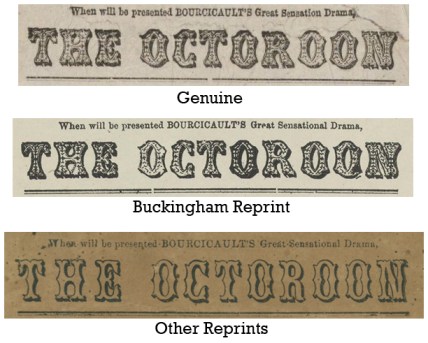
On the Buckingham reprints, however, “THE OCTOROON” is in the exact same type as on the original playbills, proving that Polkinhorn’s printing shop was used for the souvenirs.

The most obvious difference between a genuine first issue playbill and a reprint is the final “E” in LAURA KEENE.  In genuine bills, the final “E” is perfect.  This “E” is consistently undamaged on the previous Ford playbills from the week leading up to the assassination.  On the Buckingham reprints, however, the final “E” is marred:

Not only is the “E” damaged, but also the final letters and numbers on many of the lines.  According to Brenner this damage was caused by the gauge pins on the press getting in the way.  However it happened, it provides the most notable difference between a real playbill and a souvenir.

While the “E” was a mistake on the part of the printer, the pair also fixed mistakes from the original bill.  In the genuine first issue bills, right above “The OCTOROON”, it states, “When will be presented BOURCICAULT’S Great Sensation Drama,”.  This is a typo.  It should read “Great Sensational Drama”.  When Buckingham created his souvenirs he corrected it and changed it to the appropriate “Sensational” (See the Octoroon examples above).

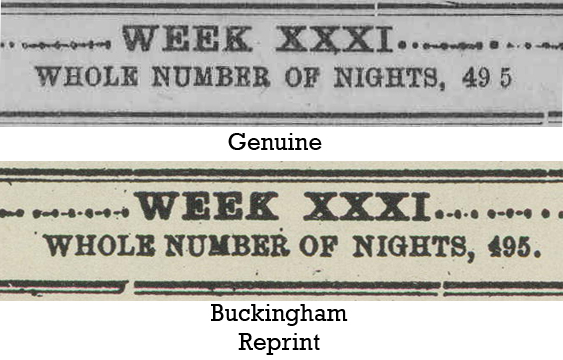
In addition, the original bill had an accidental space at the top.  Under the heading it states, “WHOLE NUMBER OF NIGHTS 49 5”.  There is a space between the 9 and 5 in “49 5”.  Buckingham corrected this unnecessary space and changed it to “495”.

In Walter Brenner’s book, he identifies 14 minute differences between Buckingham’s reprint and genuine playbills.  From missing words to the vertical alignment of letters, he provides a chart of the changes.  If a playbill has correctly passed the above criteria, this book should be consulted and the rest of the details authenticated.

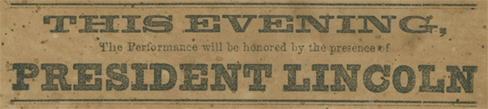
In addition to Buckingham’s souvenirs, many other printers and indiviudals of the period tried their hand at creating false bills.  Any playbill that bears the announcement that, “THIS EVENING The Performance will be honored by the presence of PRESIDENT LINCOLN” is a fake.

Forgery

As was mentioned earlier, the playbills were altered when it was ascertained that Lincoln and his guests were attending the night’s performance, however, they were only changed to include lines from the song “Honor to Our Soldiers” and not to announce his attendance.  Playbills containing Lincoln’s name are reprints from other printers, and not authentic.

While period fakes are common, there are also modern fakes that often trip people up.  Like Buckingham did so many years ago, museums sell reproduction playbills in their gift shops around the country.  Ford’s Theatre actually sells a reproduction of the Buckingham reprint.  It is attached to a reproduction wanted poster and costs $1.50.

The paper is browned and made to look old, too.  They are excellent reproductions but can add to the confusion when someone believes they have the genuine article.

When it comes to Ford’s Theatre playbills from April 14th, 1865, it is important to dismiss any stories of provenance until the bill is authenticated.  In Brenner’s book, he mentions a playbill with impeccable provenance.  Two signed affidavits accompany it; one written by the owner of the bill and another by John T. Ford himself.  In it he states, “I, John T. Ford on oath say that I presented Mr. A. K. Browne with a programme of the play of ‘Our American Cousin’ which I picked up near President Lincoln’s chair when he was assassinated…”  This superb provenance is a rare and valued thing for historical artifacts.  Unfortunately, the marred “E” on the playbill that accompanied these affidavits prove that it is not a genuine playbill, but instead a Buckingham reprint.  The best provenance in the world has to be ignored when faced with unbiased evidence.  Despite the affidavit to the contrary, John T. Ford was not even in D.C. when Lincoln was assassinated, and he did not arrive there until the Monday after the shooting.  Treasure seekers had cleaned out the theatre box long before he showed up.

As far as relics go, a genuine playbill is a treasured commodity.  On its face, it’s an advertisement for a night at the theatre.  In the context of history however, it exudes a sense of foreboding.  These playbills capture Lincoln’s assassination in a way that no other artifact can.  They are the last vestige of Lincoln as he lived, and the gateway to his immortality.  While reproductions have been made, only genuine playbills provide the emotional impact of that moment frozen in time.  They exist today as silent witnesses to Ford’s last great drama.

References:
The Ford Theatre Lincoln Assassination Playbills: A Study by Walter C. Brenner
Restoration of Ford’s Theatre by George Olszewski

Categories: Uncategorized | Tags: , , , , | 25 Comments

Blog at WordPress.com.