

Undated drawing of a young Junius Brutus Booth.
The year is 1813 and Junius Brutus Booth is 17 years old. He is an energetic and passionate young man, rebelling at the desires of his widowed father, Richard Booth, at every turn. Junius loathed the printing apprenticeship Richard had secured for him. He worked under the apprenticeship of a printer by the name of George Piggot at 60 Old Street, London. According to Junius he aided in the printing of items like “ballads, tales of wonder, and stories of fairies and goblins.” In addition, Piggott printed the “dying speeches” of soon to be executed criminals. These were single sided broadsides, sold in the streets of an execution to the gathered masses. They usually contained a description of the condemned man’s last hours and a confession, often in the style of a cautionary poem:
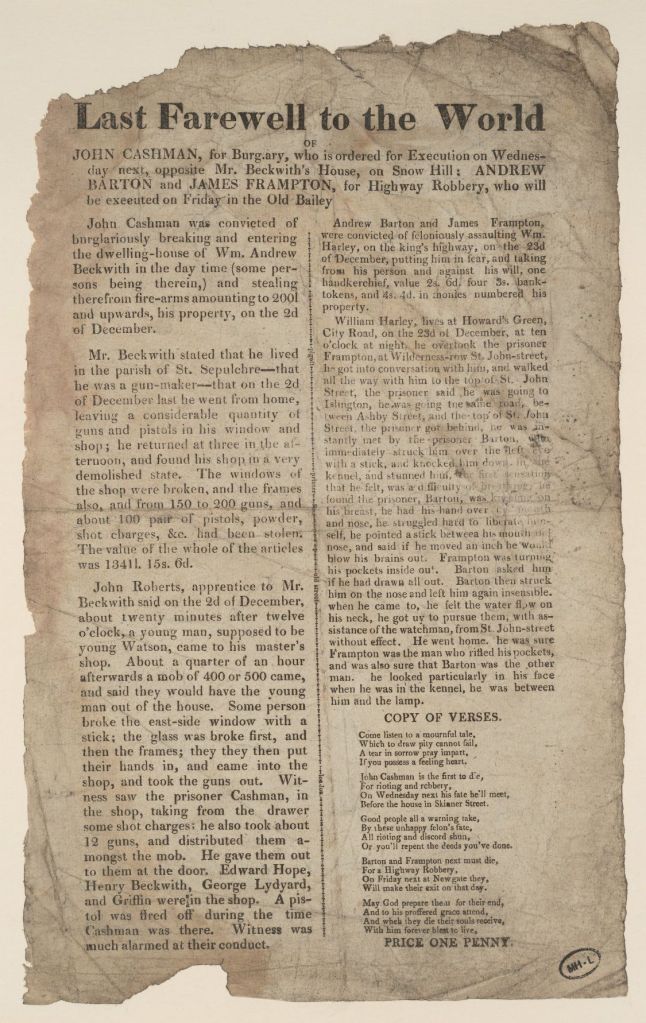
One of George Piggot’s “dying speeches” broadsides. Junius would have assisted in the printing of these. Source: Harvard Law School Library
Junius, in a move that eerily duplicated the actions of his father at his age, sought to sail away from his apprenticeship and life in England. Had the winds been more favorable to his quest, Junius would have sailed away as a cabin boy bound for Rio de Janeiro before his father ever knew he was gone, however, Richard did find out about his plan and retrieved the boy before his ship set sail. This was not the first time Richard had to save this misguided youth. Not once, but twice, Richard, the lawyer, had to defend his son against paternity tests. Though official court records of these suits against Junius have not been found, early Booth biographers state that Richard lost both suits and was forced to pay for his son’s carnal transgressions.
So what was this rebellious young man to do with his life? Printing and the law had no appeal to him. Then, on either October 7th or 13th, 1813, Junius Brutus Booth went to see Othello at London’s Covent Garden Theatre. That experience would set the path that Junius would follow for the rest of his life. Invigorated with the allure of the stage and the possibility of fame and fortune, Junius sought to make himself an actor. It is likely that the opposition to the venture brought forth by his father only further fueled Junius’ desire to attempt the stage.
He started, as practically all aspiring actors did, in a nursery theater. Akin to modern community theaters, these playhouses were little more than barns or lofts, where milkmen and laborers who dreamed of stardom performed for the local crowd. From this, Junius was able to secure himself his first professional engagement when he signed on as a member of an acting troupe and toured around the dock towns and river villages of England. This afforded him the minuscule salary of one pound sterling a week. As a paid actor in this troupe he made his theatrical career debut on December 13th, 1813 in the comedy, The Honeymoon by John Tobin. From my quick scanning of some of the text, I can ascertain that the main character, a Duke, has married a very beautiful, yet proud and feisty woman. In order to “train” her to be gentler, the Duke decides, as a honey moon, to take his wife to a peasant’s hut and make to act that he is actually a commoner who has been impersonating a duke. When his new wife goes to the duke’s castle to inform against him and request a divorce, the duke has one of his servants, Jaques, play the part of himself, hilarity ensues. Again, this was just a cursory glance of the text and may be inaccurate. Nevertheless, Junius Brutus Booth played the part of Campino in this professional stage debut. Campino is an extraordinarily minor role, with only a handful of speaking lines. Essentially, Campino is just a named servant who gets to read the words of the Duke ordering the servants to treat the simpleton, Jaques, as if he was the true Duke. He is present when Jaques enters for the first time in royal clothing to the laughter of all the other servants, as depicted in this engraving:
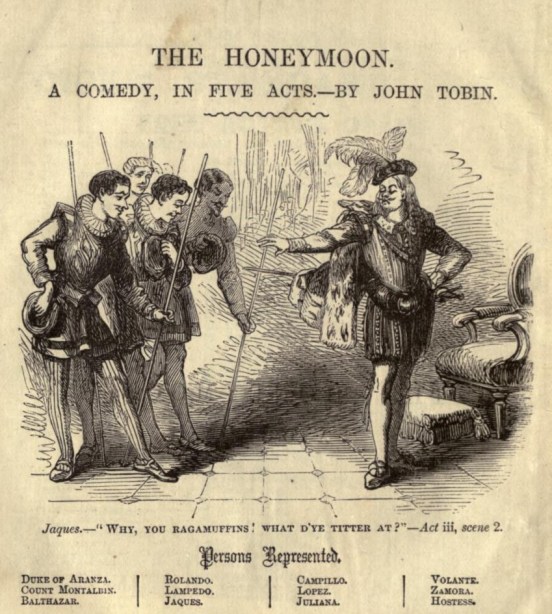
When asked by another servant how Jaques was fairing with his newly bestowed nobility, Junius, as Campillo replied, “Like most men in whom sudden fortune combats against long-established habit.”
Junius would continue traveling with this troupe through the various dock villages, making a pittance. His meager salary forced him to rely on only one meal a day and, by March of 1814, illness and poverty forced him back home to his father. For a while, it appeared as if Junius’ acting days were done.
Stay tuned for future posts in this series regarding Junius Brutus Booth’s early life on the stage.
References:
Junius Brutus Booth: Theatrical Prometheus by Stephen M. Archer
The Honeymoon by John Tobin























 LincolnConspirators.com
Recent Comments