Osborn Oldroyd and his Lincoln Museums

The Abraham Lincoln Home in Springfield, IL and the Petersen House in Washington, D.C. have shared similar histories.

Lincoln Petersen Home

  • Both homes witnessed the death of a Lincoln:

On February 1st, 1850, Eddie Lincoln, the second son of Abraham and Mary Todd, died at the age of 3 at the Lincoln Home in Springfield.

On April 15th, 1865 at 7:22 am, President Abraham Lincoln died at the age of 56 at the Petersen House in Washington, D.C.

  • Both homes had few owners:

The Lincoln Home was built in 1839 for the Reverend Charles Dresser.  The Lincolns bought it from him in 1844.  Robert Todd Lincoln inherited the property from his parents and he subsequently gave it to the government in 1887.  This gives the Lincoln home two owners, Rev. Dresser and the Lincoln family, before it was purchased by the government.

The Petersen House was commissioned by William and Anna Petersen in 1849 and built that same year.  When they died in 1871, the house was inherited by their children.  They sold the house to Louis Schade in 1878.  By 1896, Louis Schade sold the house to the government for $30,000.  This gives the Petersen House two owners, the Petersens and Louis Schade, before it was purchased by the government.

  • Both homes had considerable remodeling done when their namesakes lived there:

The Lincoln Home had about 5 renovations while the Lincolns lived there.  Most drastically was the alteration of the home from a 1 ½ story structure to a full 2 story home, as it still is today.

The room that would later be known as the room where Lincoln died, was not even part of the Petersen House when it was originally built.  That addition was put on in 1858.  Fire gutted it in 1863 and William Petersen rebuilt it that same year.

  • Both homes had renters:

When Abraham Lincoln was elected President and moved into the White House, he rented out his Springfield home.  When Robert Todd gained ownership of the place, he continued the practice of renting the house out until he gave it to the government.

The Petersens ran their home as a boarding house for many years.  From Congressmen to soldiers, to actors, they rented out rooms to  many needy Washingtonians.

  • Lastly, both homes shared a long-term occupant, Osborn Hamilton Ingham Oldroyd:
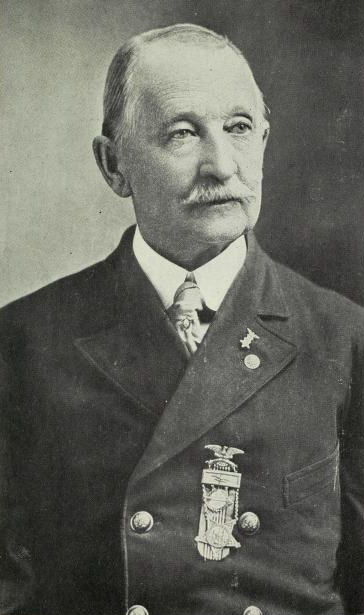
Osborn Oldroyd

Osborn Oldroyd was a Civil War veteran and a devoted collector of Lincoln memorabilia.  In 1883, 41 year-old Oldroyd succeeded in fulfilling the dream of any man who idols another.  Robert Todd Lincoln made Oldroyd the fifth renter of the Lincoln Home in Springfield since his father left the city to claim the Presidency.  Into this historic house, Oldroyd brought his vast collection of nearly 2,000 Lincoln items.  As had been commonplace since the death of Lincoln, many visitors came to call on the Lincoln Home, seeking to visit the home of the great martyr.  Oldroyd let them in like all of his predecessors had, but was the first to charge them admission.  He turned his collection and rented space in a Lincoln Museum.  Robert Todd accepted this exploitation as long as Oldroyd paid his rent, however, by 1885, Oldroyd was starting to fall behind his payments.  Despite not paying him, Robert Todd did not want to bring a lawsuit against Oldroyd as he feared it, “may easily cause me more personal annoyance than the loss of ten times the money.”  Rumors spread that Oldroyd was also cutting off parts of the curtains, wallpaper, and flooring, selling them as souvenirs.  Robert Todd was getting angry with his tenant whom he referred to as a “dead beat” and “rascal”, when an Illinois legislative committee approached him in 1887 to purchase the Lincoln Home.  A similar offer had been given to him in 1883, but at that time he had declined.  Even though, Robert Todd was fairly certain Oldroyd had been the catalyst for this offer, he decided to donate the property to the state of Illinois.  His donation contained two caveats, however.  “…Said homestead shall be, forever, kept in good repair and free of access to the public.”  This latter requirement was probably meant as a final jab towards his “rascal” of a tenant and his entrepreneurial exploits.  Regardless, Osborn Oldroyd was hired by the state of Illinois to be the first custodian of the house and gave him a salary of $1,000 per year.  Oldroyd undoubtedly used this salary to increase his collection at every turn.

Oldroyd’s tenure at the Lincoln Home came to an end in 1893 when he was fired by recently elected Gov. John Peter Altgeld.  Altgeld replaced him with a political friend named Herman Hofferkamp.  Out of a cushy job and a free place to live, Oldroyd was in trouble.  Meanwhile, in Washington, D.C., the Schade family had moved out of the Petersen House apparently fed up with the number of visitors constantly asking to see the death room of the President.  They leased the building to the Memorial Association of the District of Columbia, a group formed by Congress the year before.   When and how Oldroyd managed to convinced this group to make him custodian of the Petersen House is unknown.  According to a biography about Oldroyd written when he was alive, in 1893 Oldroyd moved his collection to the Petersen House, “at the request” of the association.  The earliest account the NPS has managed to find of Oldroyd residing at the Petersen House is June of 1898.  This was after the government purchased the house outright from the Schades in 1896.  So, whether Oldroyd went straight from the Lincoln Home to the Petersen House, or whether he had five years in between, he ultimately found a new location to show off his collection.

While he lived rent free at the Petersen House, Oldroyd did not receive a salary there.  Instead, he got back to his roots and was allowed to charge admission to his museum.  He made the whole first floor of the house his exhibit floor and he and his family lived upstairs.  The first floor of the Petersen House contained considerably less real estate than what he had previously used to showcase his collection at the Lincoln Home.  He covered practically every surface of the Peterson House with material to make up for it.  Oldroyd also had a lot of changes made to the building while he lived there.  Most noticeably, he had the back wall of the room where Lincoln died, removed.

The following are some pictures of the interior of the Petersen House when it housed Osborn Oldroyd’s Lincoln Museum:

Petersen Museum 1922

This picture was taken from within the front parlor of the Petersen House facing towards the rear parlor.  The door to the right leads into the hallway with the room where Lincoln died at one end and the entrance to the Petersen House at the other.

Oldroyd Museum 1

This photo was taken from within the rear parlor of the Petersen House in the direction of the front parlor.  This photo shows only the front parlor.

Oldroyd Museum 2

This photo was taken from the entrance of the room where Lincoln died. The bed Lincoln died in would have been located in the bottom right hand corner of this photo.
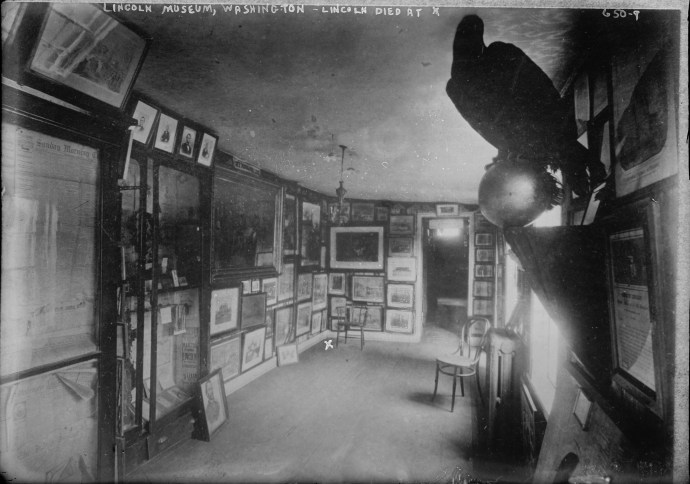
The white X marks the spot where the bed Lincoln died in was.

This photo was taken from the rear of the room where Lincoln died in the direction of hallway and Petersen House entrance. The X marks the location of Lincoln’s deathbed.
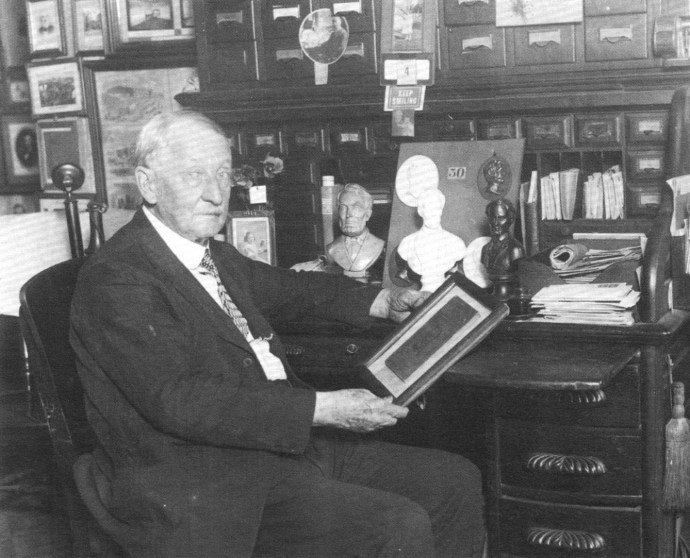
Oldroyd in his museum

During his tenure at the Petersen House, Oldroyd continued to collect and correspond with many individuals associated with Lincoln’s life and death.  In 1901, after walking the escape route of Lincoln’s assassin on foot with a camera, he published his book, “The Assassination of Abraham Lincoln”.  This volume contains many of the earliest photographs we have of different parts of the escape route.

Oldroyd walking the route

By 1926, after about 30 years curating his collection at Petersen House, Oldroyd sought the help of Congressman Henry Rathbone of Illinois, to insure its preservation.  The son of Henry Rathbone and Clara Harris, the ill fated pair who joined Mr. and Mrs. Lincoln at Ford’s Theatre that night, managed to pass a bill in Congress authorizing the purchasing of Oldroyd’s collection.  Experts at the Smithsonian noted that the collection “was of little practical value”.  Despite this, Oldroyd was paid $50,000.  Oldroyd later stated that he had been offered far greater amounts for the collection by private individuals but that he wanted the collection to be in the hands of the government so that it would be preserved and enjoyed by the public for years to come.  When offered continued curatorship over the collection Oldroyd replied, “the responsibility would be too much for me to assume at my age of eighty-four years.”  Oldroyd was then given the key to the Petersen House and told that he was free to come and go as he pleased and that his accustom chair would always be there for him.

Osborn Hamilton Ingham Oldroyd died four years later in 1930.  He  is buried next to his wife of over 54 years, Lida, at Rock Creek Cemetery in Washington, D.C.
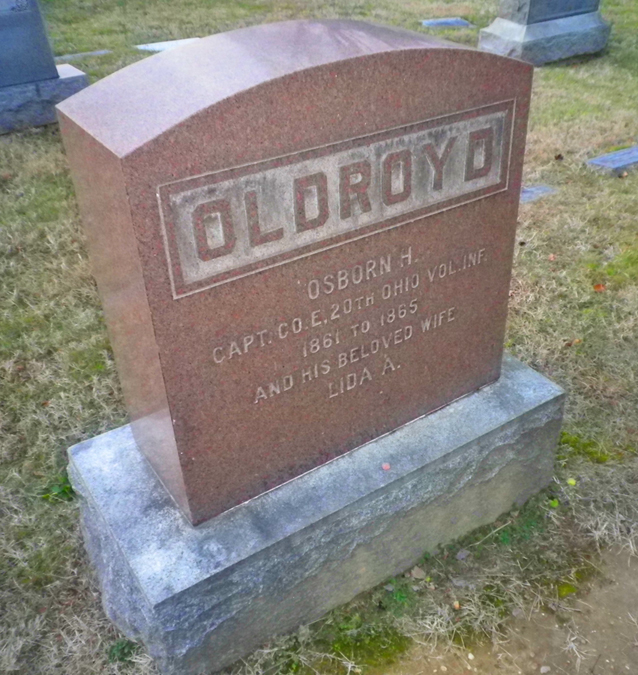
Oldroyd's grave

He may have been a “rascal” as Robert Todd Lincoln called him, but Osborn Oldroyd was also the epitome of a collector.  He devoted his whole life to acquiring everything relating to Abraham Lincoln.  For nearly half of his life, Osborn Oldroyd made his home in houses relating to the 16th President.  To the collection and study of Lincoln, Osborn Oldroyd’s name is unavoidable, particularly in the study of his assassination.  I find it entirely appropriate then, that in this picture of Rep. Henry Rathbone in front of the Petersen House Lincoln Museum, the presence of Osborn Oldroyd in his favored setting is enshrined forever:

Rathbone in front of Oldroyd's Petersen

Oldroyd in the window

References:
House Where Lincoln Died Historic Structures Report by the National Parks Service
Life of Osborn H. Oldroyd by William Burton Benham
Giant in the Shadows: The Life of Robert Todd Lincoln by Jason Emerson
Lincoln Home National Historic Site
The Lincoln Assassination: Where Are They Now? by Jim Garrett and Rich Smyth

Categories: Uncategorized | Tags: , , , | 14 Comments

A Sister’s Sorrow

Asia Booth Clarke, John Wilkes Booth’s sister, had a lifelong pen pal named Jean Anderson.  From her early days at Tudor Hall to her isolated years in England, Asia wrote to Jean with regularity.  For years, some of Asia Booth Clarke’s letters to Jean Anderson were held at the Peale Museum in Baltimore.  What follows is a transcript of Asia’s letter to Jean in the aftermath of the assassination:

Asia Booth Clarke

Asia Booth Clarke


Philadelphia, May 22, 1865.

My Dear Jean:

I have received both of your letters, and although feeling the kindness of your sympathy, could not compose my thoughts to write — I can give you no idea of the desolation which has fallen upon us. The sorrow of his death is very bitter, but the disgrace is far heavier; – Already people are asserting that it is a political affair — the work of the bloody rebellion — the enthusiastic love of country, etc. but I am fraud to us it will always be a crime –

Junius and John Clarke have been two weeks to-day confined in the old Capital – prison Washington for no complicity or evidence — Junius wrote an innocent letter from Cincinnati, which by a wicked misconstruction has been the cause of his arrest. He begged him to quit the oil business and attend to his profession, not knowing the “oil” signified conspiracy in Washington as it has since been proven that all employed in the plot, passed themselves off as “oil merchants”.

John Clarke was arrested for having in his house a package of papers upon which he had never laid his hands or his eyes, but after the occurrence when I produced them, thinking it was a will put here for safe keeping — John took them to the U.S. Marshall, who reported to head-quarters, hence this long imprisonment for two entirely innocent men –

I would not object at present to have back for my private use all the money they have squandered on Sanitary Commissions, Hospital Endowments, Relief of Soldiers Widows, and the like, for the good done by them as actors and citizens goes nothing towards providing their innocence, and it might well have been tendered to a better purpose –

I suppose they will be examined in the leisure of the Court and return home to be nursed through a spell of illness, — as one Gent has done who was released last week, — and whose arrest proved only a farce as General somebody in authority expressed it — Poor old country, she has seen her best days, and I care not how soon I turn my back upon her shores forever, it is the history of the Republic over again.

I was shocked and grieved to see the names of Michael O’Laughlin and Samuel Arnold. I am still some surprised to learn that all engaged in the plot are Roman Catholics — John Wilkes was of that faith — preferably — and I was glad that he had fixed his faith on one religion for he was always of a pious mind and I wont speak of his qualities, you knew him. My health is very delicate at present but I seem completely numbed and hardened in sorrow.

The report of Blanche and Edwin are without truth, their marriage not to have been until September and I do not think it will be postponed so that it is a long way off yet. Edwin is here with me. Mother went home to N.Y. last week. She has been with me until he came.

I told you I believe that Wilkes was engaged to Miss Hale, — They were most devoted lovers and she has written heart broken letters to Edwin about it — Their marriage was to have been in a year, when she promised to return from Spain for him, either with her father or without him, that was the decision only a few days before the fearful calamity — Some terrible oath hurried him to this wretched end. God help him. Remember me to all and write often.

Yours every time,

Asia

The “Blanche” that Asia refers to is Blanche Hanel, Edwin Booth’s fiancée.  Edwin Booth’s first wife, Mary Devlin, died in February in 1863.  By September of 1864, Edwin was romantically involved with Blanche Hanel, a wealthy Philadelphian.  As Asia wrote above, the two were engaged to be married when the assassination occurred.  In addition to retreating from the stage, Edwin also wrote to Blanche allowing her to break off their engagement due to the circumstances.  At first Blanche stayed by Edwin and as Asia writes, their engagement continued.  In the end, however, Blanche’s father would not allow the marriage and by November of 1865, Edwin and Blanche’s relationship ended.  It wouldn’t be until June of 1869 that Edwin Booth would remarry, this time to Mary McVicker of the Chicago theatrical family.

Categories: Uncategorized | Tags: | 12 Comments

Reconstructing Ford’s Theatre

A few years ago, I went and saw the musical, The Civil War, at Ford’s Theatre. It was a very entertaining and moving production. There are several times throughout the show where you hear quotations from historic individuals involved in the Civil War. Quotations from Abraham Lincoln are, appropriately, quite prevalent. Each time we heard the words of Lincoln, the stage would go dark and a light inside the Presidential Box would brighten. The first time I saw this, I got shivers. It was very moving to hear the words of our 16th President echoing forth from the box where he was shot. I expect many others who witnessed the play found this to be quite moving.

In truth though, that is not the box where Lincoln was shot. That specific box was destroyed long ago. Ford’s Theatre, as beautiful as it is, is a complete reconstruction except for its exterior walls. It was recreated to appears as it did in 1865 by a group of experts and historians in the 1960’s. While they thoroughly documented their work in this book, sometimes a picture is worth a thousand words. Here are some pictures of the inside of Ford’s when it was being rebuilt in the ’60’s:

20130825-193935.jpg

20130825-194034.jpg

20130825-194142.jpg

20130825-194228.jpg

20130825-194432.jpg

20130825-194603.jpg

20130825-194712.jpg

20130825-194845.jpg

Categories: Uncategorized | Tags: | 23 Comments

The Name Game

After Oswell Swann led John Wilkes Booth and David Herold through the Zekiah Swamp, he brought the pair to Rich Hill, the home of Col. Samuel Cox. The fugitives allegedly spent a few hours inside the house in conversation with Col. Cox, who ultimately agreed to do what he could for the men. He told them he would send his foster brother, Thomas A. Jones, to meet them in a nearby pine thicket and that he would care for them and help get them across the Potomac River. In the morning, Col. Cox sent his son, Samuel Cox, Jr., over to Huckleberry to retrieved Thomas Jones. When Cox, Jr. got to Huckleberry, he said his father wished to meet with Jones to discuss the purchase of some seed corn. Jones found such an ill timed request, on Easter Sunday no less, to be a cryptic one. When Cox, Jr. then spoke to Jones privately and stated that two strangers had come by Rich Hill house during the night, Jones seemed to already comprehend the situation before him. He made his way to Rich Hill with Samuel Cox, Jr.

My reason for summarizing this event is to give some context for the following. Samuel Cox, Jr. was not Col. Cox’s son. Rather, he was his nephew.

Samuel Cox, Jr.

Samuel Cox, Jr.

Samuel Cox, Jr. was born Samuel Robertson. He was the son of John R. Robertson and Rebecca Cox. Rebecca and Col. Cox were siblings. Rebecca died two months after Samuel’s birth. During his youth, Samuel spent a lot of time on his uncle’s farm of Rich Hill. By 1852, Samuel’s father, John Robertson, had remarried and started having children with his new wife. Meanwhile Col. Cox and his wife Walter Ann, had not been able to have any surviving children of their own. It appears that Samuel Robertson found himself with his uncle more and more, and Col. Cox was more than happy to have a child to raise. Col. Cox officially became “Pa” to Sammy Robertson three days after his 17th birthday.  On February 11th, 1864, the families decided to make their long held relationship official and Col. Cox adopted Samuel Robertson and gave the young man his name:

Cox Jr Name Change

It’s clear that Sammy Cox, Jr. was well loved by his adoptive parents. In the aftermath of the assassination Col. Cox, Samuel Cox, Jr. and their devoted servant Mary Swann, were all arrested and kept at the Bryantown Tavern. Col. Cox was later taken to Washington, D.C. and was imprisoned at the Old Capitol Prison. A few days after this, Samuel Cox, Jr. and Mary were brought to Washington and were required to report to the Provost Marshall’s office every day for about three weeks before they were allowed to return home. While Col. Cox was imprisoned at the Old Capitol, he wrote a letter to his wife to keep her spirits up. “Unite with me in devout prayer to our Merciful Father to guide, sustain, and so direct all things that we may soon be restored to each other,” Col. Cox wrote in his May 21st letter. The Col. also spoke of his son when he told his wife, “I have received one [letter] from Sammy today dated yesterday stating that he would leave for home today (also Mary)…I hope Sammy arrived home safe.”

Samuel Cox, Jr. nee Robertson, may not have been Col. Cox’s biological son but he proved himself to be a worthy heir. He became a prominent pillar of the community as he lived out the rest of his life at his father’s home of Rich Hill. And today, father and son share the same burial plot at Mt. Rest Cemetery in La Plata, Maryland.

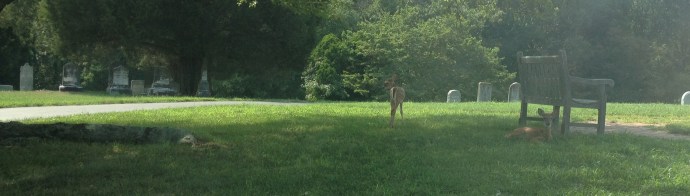
Deer fawns at Mt. Rest Cemetery in La Plata, MD.  The Cox family graves can be seen on the left side of the image.

Deer fawns at Mt. Rest Cemetery in La Plata, MD. The Cox family graves can be seen on the left side of the image.

Categories: Uncategorized | 5 Comments

Following the Escape Route: Dent’s Meadow

Yesterday, I visited Dent’s Meadow, the spot where John Wilkes Booth and David E. Herold first set across the Potomac River.  What follows is the short video clip that I made while standing on that Maryland shoreline:

Further images will come later as I complete a Crossing the Potomac Picture Gallery. In the meantime, here is an animated image of the spot in 1901 and now:

Dent's-Meadow-Spot-Animated

EDIT: One reader was a little confused regarding the location where I shot my video versus the location of Henry Woodland in the photograph taken by Osborn Oldroyd in 1901. I created this little map to hopefully alleviate that confusion:

Dent's Meadow Map

Categories: Uncategorized | Tags: , , , | 17 Comments

Booth on the shores of Nanjemoy Creek

“As I was in the act of shoving the boat off Booth exclaimed, “Wait a minute, old fellow.” He then offered me some money. I took eighteen dollars, the price of the boat I knew I would never see again. He wanted me to take more, but I said no, what I had done was not for money. In a voice choked with emotion he said, “God bless you, my dear friend, for all you have done for me. Good-bye, old fellow.” I pushed the boat off and it glided out of sight into the darkness. I stood on the shore and listened till the sound of the oars died away in the distance and then climbed the hill and took my way home.”

These are the words written by Thomas A. Jones as he recounted the night he put John Wilkes Booth and David E. Herold onto the Potomac River. For days, Jones had tended to the fugitives as they remained hidden from Union troops in a pine thicket. Finally, on the night of April 20th, 1865, Jones brought them to a boat on the bank of the Potomac and directed them to the Virginian shore. However, Booth and Herold did not greet the morning sun of April 21st on Virginian land. Rather, they found themselves making landfall in Maryland, further away from their intended destination than before.

When it comes to the escape route of John Wilkes Booth, millions of people visit Ford’s Theatre in Washington, D.C. every year. Ten thousand visit the Surratt House Museum in Clinton, MD. Thousands visit the Dr. Mudd House, and a few hundred participate in the John Wilkes Booth Escape Route Bus Tours put on by the Surratt House. The B.E.R.T. (Booth escape route tour)provides you with the most bang for your buck, but still has the limitations of fitting the entire route (and return trip) into a 12 hour tour. Due to this, some of the minor places in the escape are left unseen. The place where John Wilkes Booth and David E. Herold found themselves on the morning of April 21s and where they stayed until dusk of April 22nd, is one of these unseen places. Today, I wanted to rectify this and see if I could at least get close to this forgotten stop during the escape.

After Booth and Herold left Thomas Jones and ventured into the Potomac, something occurred to steer the men off course. Thomas Jones attributed the flood tide and unfriendly currents as to the reason why Booth and Herold did not keep to their course. Booth dramatically wrote in his diary, “After being hunted like a dog through swamps, woods, and last night being chased by gunboats till I was forced to return wet, cold, and starving, with every man’s hand against me, I am here in despair.” Booth may be exaggerating the reason for their return to Maryland, but something, manmade or otherwise, kept the pair from making it to Mrs. Quesenberry’s. Instead, Booth and Herold arrived northwest from their departure point and landed in Nanjemoy Creek. Crossing the Potomac map The exact point the two men made landfall in Nanjemoy Creek is unknown. On the map above you will see two creeks on the eastern side of Nanjemoy Creek. They are Burgess Creek (with Gumtree Cove at its mouth) to the north and King’s Creek to the south. Booth and Herold rowed into one of these creeks and hid their boat among the marshy shores. I’m of the opinion that the pair entered King’s Creek,but, again, there is no documentation one way or the other. Eastern side of Nanjemoy Creek According to reporter George Alfred Townsend (GATH) in 1884, it was after beaching the boat that, Booth and Herold, “discovered a house nearby, to which Herold made his way, the latter saw something familiar about the place, he knowing all that country well.” The pair had inadvertently reached the farm of Peregrine Davis, a verbose character in Charles County who was described by General Hooker as, “one of the noisiest” rebels in the area. The land was called Indiantown Farm, and it was tended by Davis’ son-in-law, John J. Hughes, who lived on the property with his family. Booth and Herold would spend about 36 hours on Indiantown property.

The exact details of this 36 hour layover are very much lacking. As author William Tidwell wrote, after the death of Booth, “It became common knowledge in Charles County, Maryland that Booth had visited Indiantown, occupied by Peregrine Davis’ son-in-law, John J. Hughes. Unfortunately there is no contemporary documentation of the visit.” What we know about Booth and Herold and their inadvertent return to the Maryland is largely based on three sources: David Herold’s statement after his arrest, GATH’s 1884 account of Booth crossing the Potomac, and family lore from the Hughes family.

David Herold’s Account:

Herold 1 After Davy Herold was arrested at the Garrett Farm, he gave a lengthy statement while imprisoned. Davy is evasive and cunning in what he tells the investigators, mixing a tale of truth and lies. Nevertheless, Davy does provide period documentation that he and Booth did not cross the river the first time and made land at Nanjemoy:

“…We started to cross the Potomac. It was very foggy. We got along the Maryland shore to Nanjemoy Creek, and went to a man’s house and wanted to buy some bread. He said he hadn’t baked, and would not bake any. He said he had nothing to drink either. I said we were wet and would like to have something to drink. I had a bottle, and asked if he would sell me some whiskey. He said he would not do it. Booth gave the man’s little boy a quarter of a dollar for filling the bottle with milk…”

Taking Davy Herold at his word would imply that John Hughes provided no aid to the fugitives at all. According to Davy, Hughes refused to give them, literally, bread and water. However, we cannot take David Herold at his word. This is the same man who claimed not to have known about the assassination until later and was then forcibly coerced by Booth to accompany him. While not trustworthy, Davy does provide evidence that there was some interaction between Hughes and the fugitives.

GATH’s article:

How Wilkes Booth Crossed the Potomac In April 1884, Century Magazine ran George Alfred Townsend’s article, “How Wilkes Booth Crossed the Potomac“. The article was mostly about Thomas Jones and the assistance he gave Booth and Herold in the pines and then, sending them across. GATH interviewed Jones and got the story from him. GATH was also a successful reporter who had a long history reporting on the assassination. In addition to the piece I quote before, GATH wrote the following regarding Booth and Herold on the Nanjemoy Creek shores:

“It was the residence of Col. John J. Hughes, near Nanjemoy Stores, in Maryland, directly west of Pope’s Creek, about eight or nine miles. The Potomac is here so wide, and has so many broad inlets, that in the darkness the Virginia shore and the Maryland shore seem the same. Herold went up to the house and asked for food, and said that Booth was in the marsh nearby, where they had pulled up the boat out of observation. The good man of the house was much disturbed, but gave Herold food…The keeper of the house at Nanjemoy became frightened after they left, and rode into Port Tobacco and told his lawyer of the circumstance, who took him at once before a Federal officer.”

In GATH’s account, Hughes provided food to the pair. GATH also mentions that John J. Hughes later went to Port Tobacco to report the men. While there is no documentation to support that Hughes talked to officials about the men at his house, there was a letter that the provost marshal of Washington received from a man named William R. Wilmer of Port Tobacco. In the letter, Mr. Wilmer recalled that on Friday, April 21st, he saw two men in Nanjemoy Creek, one of whom answered to the description of John Wilkes Booth. By the time the letter got to the provost marshal, Booth had already been cornered and killed, so the matter was not investigated further. However, it is possible that this report from Mr. Wilmer is the one that GATH is recalling. John J. Hughes had studied law and passed the bar himself, so it unlikely that he would have needed to consult a lawyer as GATH claims.

3. Family Lore of the Hughes family:

John J. Hughes

John J. Hughes

In 1975, assassination researcher James O. Hall interviewed one of John J. Hughes’ grandsons. According to the family story given to him, Booth and Herold did not make their presence known to the family members in the house, but somehow made contact with John J. Hughes. Hughes, uncomfortable with having the men stay at his house, allowed the pair to stay in a nearby slave cabin near the water’s edge. Hughes proceeded to take food out to the pair without the rest of the family knowing it.

By putting these different pieces together, it is possible to make a probable accounting of Booth and Herold’s time at Indiantown farm. After coming ashore and pulling up their boat, Booth had Herold make his way towards the nearest house, while the former stayed at the boat with his broken leg. Herold recognized the farm from his hunting days and somehow, secretively or otherwise, made contact with John J. Hughes. Hughes did not want the men at his house but allowed them to stay nearby in the slave quarters. During the course of the two days and one night Booth and Herold stayed there, Hughes brought the pair food and water. The fugitives may have had interactions with Hughes’ children or former slaves, as presented in Davy’s statement, or they were completely hidden from the family. After dusk on April 22nd, Booth and Herold pushed off from the Nanjemoy Creek shores, leaving John J. Hughes and Indiantown Farm behind.

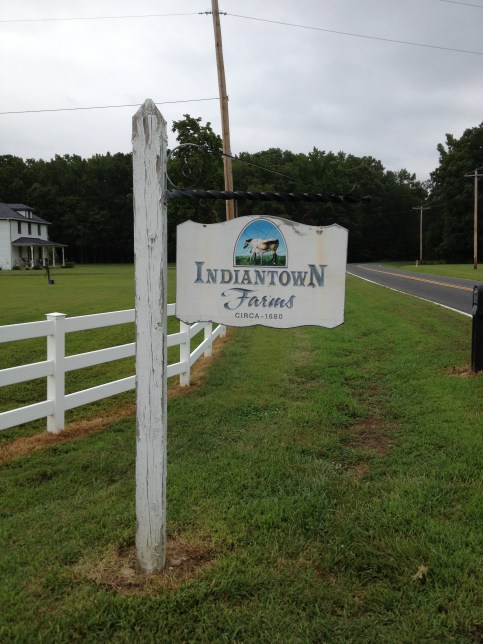
With this history in my head today, I made my way down the peninsula created by Nanjemoy Creek and the Potomac River. From looking at a map, I noticed that “Blossom Point Rd.” would take me all the way down the peninsula. I planned to drive to the end of the road, hop out of my car, and take a few pictures of the shore where the Potomac meets Nanjemoy Creek. It wouldn’t be exactly where Booth and Herold landed, but it would be as close to the water as I could get. On my way back north, I planned on taking a picture of the sign for Indiantown Farms, which, like it was in 1865, is privately owned. The entrance to the farm is about a mile and a half from the water, so I knew I wouldn’t see anything except for the sign.

Though the map showed a clear road straight down to the point of the peninsula and, in truth, it probably goes there, the map did not warn me that three miles from the end of the peninsula northward is the property of the U.S. Army and is used for ordinance testing and the like. When I was presented with a fancy looking gate bearing signs stating, “Restricted Access”, I quickly turned around. I was going to have to settle for just pictures of the Indiantown Farm sign.

As I pulled my car off the road and walked towards the sign to take a picture I made eye contact with, a very kind woman who had just finished her laborious work of weed whacking a long stretch of perfectly manicured white fence, and her granddaughter. I walked up and introduced myself, asking them if I was indeed on the same property John Wilkes Booth was said to have temporarily stayed on. They replied that it was and, with their own generosity of spirit shining through, they offered to give this stranger before them a tour of the property. I was ecstatic by the offer and graciously took them up on it.

As I got in their truck and we proceeded to drive the mile and half to the water’s edge, I was struck by how much nature was around me. I saw countless deer, eagles, ospreys, kestrels, rabbits, and songbirds among the hay fields. My host was very generous in sharing what she knew about the history of the place. When we got to the water’s edge, she pointed out to me the house that is believed to have been where John J. Hughes and his family would have been living when Booth showed up. She was not certain that it was the same house, but recounted that they believed it was. While there have obviously been several additions made to the house, the chimney looks to old enough to me.

Hughes House 2

Hughes House 3

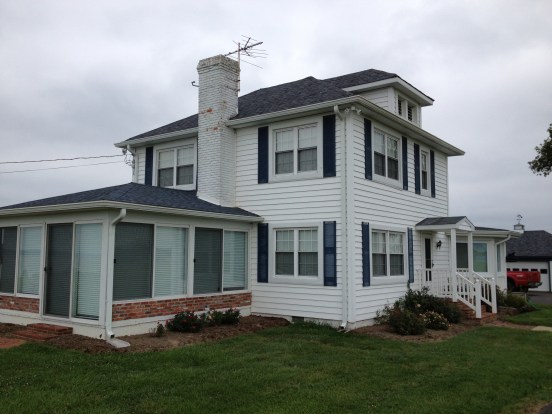
The assumed former home of John J. Hughes on the Indiantown property.  The entrance to Burgess Creek by way of Gumtree Cove is to the left of the house.  Burgess Creek is one of the two possible creeks that Booth and Herold could have landed at.

The assumed former home of John J. Hughes on the Indiantown property. The entrance to Burgess Creek by way of Gumtree Cove is to the left of the house. Burgess Creek is one of the two possible creeks that Booth and Herold could have landed at.

From the main home (which, by the way, has one of the most splendid view of the water I have ever seen) we proceeded to a place that I had seen a picture of once, but could not believe still existed: the slave cabin where Booth and Herold are said to have slept and spent time in.

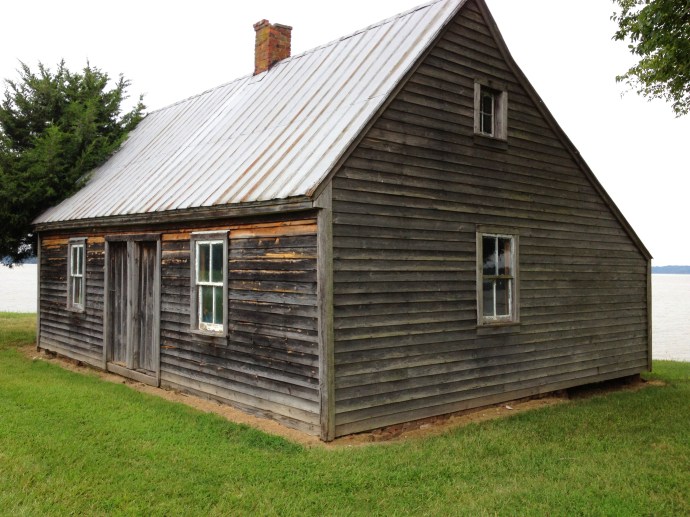
The slave cabin that Booth and Herold are said to have slept in.

The slave cabin that Booth and Herold are said to have slept in.

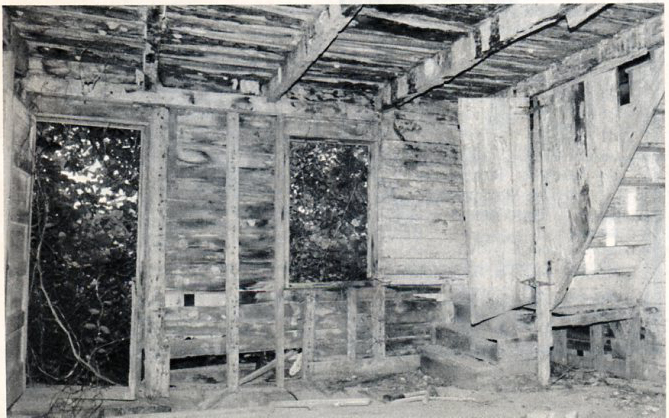
In the June, 1990 issue of Blue & Gray Magazine, author Michael Kauffman included this picture of the inside of the cabin: Hughes Cabin Kauffman 1990 Since that time, the exterior of the cabin has been restored. The following are some of the pictures and a short video I took of the interior of this cabin:

Inside Hughes Booth Cabin 1

View of Nanjemoy Creek from one of the cabin's windows.

View of Nanjemoy Creek from one of the cabin’s windows.

Inside Hughes Booth Cabin 3


After departing the cabin, my host took me to where King’s Creek border’s the property. The marshy landscape of the creek and its relatively close distance to the main house and slave cabin, makes me think this was the place where Booth and Herold would have hidden their boat. My host stated that she often goes kayaking here and that Booth and Herold could have easily rowed their boat into King’s Creek and hidden it among the marshy shores. Once on land and beyond the few trees around the shore, John Hughes’ house would have been easily visible to them.

The entrance to King's Creek from Nanjemoy Creek.  King's Creek is south of Indiantown and the supposed Booth cabin.

The entrance to King’s Creek from Nanjemoy Creek. King’s Creek is south of Indiantown and the supposed Booth cabin.

King's Creek

King’s Creek

Indiantown Farm is a quiet and tranquil place (at least when the nearby military facility isn’t blasting, my host told me). With a roof over his head and some time to rest, it seems logical that the John Wilkes Booth would take out his pocket diary and write. His last entry was dated as “Friday, 21” and, if he was being true in his dating, that would have placed his writing at Indiantown.

The Booth cabin with the Hughes house in the background.

The Booth cabin with the Hughes house in the background.

As I departed Indiantown Farm, I thanked my generous host immensely. She was hoping to learn more about the role Indiantown Farm had in John Wilkes Booth’s escape, and so I gave her my website’s name and told her that I would be blogging about my trip later that day. I hope that I have done a decent enough job here of presenting what little is known about Booth and Herold’s largely unknown layover at Indiantown.

Indiantown Farms

Indiantown Farm will continue to be one of the unseen places of John Wilkes Booth’s escape. However, today we were able to see that the history that still exists, thanks to the kindness and openness of those who live there. Hughes Booth Cabin on the Shore

References:
On the Way to Garrett’s Barn: John Wilkes Booth & David E. Herold in the Northern Neck of Virginia April 22 – 26, 1865 by James O. Hall
How Wilkes Booth Crossed the Potomac by George Alfred Townsend
Abstracts from the Port Tobacco Times by Roberta Wearmouth
Come Retribution by William Tidwell, James O. Hall, and David Gaddy
J. Wilkes Booth by Thomas A. Jones
American Brutus by Michael Kauffman
In the Footsteps of an Assassin by Michael Kauffman
Booth’s Escape Route: Lincoln’s Assassin on the Run by Michael Kauffman (Blue & Gray Magazine, June 1990)
Booth Crosses the Potomac: An Exercise in Historical Research by William Tidwell (Civil War History, 1990)
Art Loux Archive

Categories: Uncategorized | Tags: , , , , | 30 Comments

Gifts from Fort Jefferson

A few weeks ago, I posted a thank you note that Edman Spangler wrote while incarcerated at Fort Jefferson, Dry Tortugas.  In it, he mentioned several items he was sending along to John T. Ford as tokens of his appreciation.  Spangler also included other carpentry items created by the conspirators and asked for them to be passed along to their respective families.  Though undated, I deduced that the note must have been written in mid 1867, during the John Surratt trial but before Michael O’Laughlen’s death.  Today, I stumbled across a related newspaper article that seems to agree with that conclusion:

Gifts from Fort Jefferson articleWhile it is unknown if any of the items contained in this package exist today, there are several items on display at the Dr. Samuel A. Mudd House Museum made by Dr. Mudd (with assumed guidance from Edman Spangler) while he was imprisoned at Fort Jefferson:

Jewelry box 2

Cribbage board

Decorative table

Categories: Uncategorized | Tags: , , | 3 Comments

New Gallery: Mrs. Quesenberry’s Home

In the early morning of April 23rd, 1865, John Wilkes Booth and David Herold finally managed to cross the mighty Potomac River into Virginia.  This was the second attempt the two men had made to cross the river.  When they departed the Maryland shores the first time, their guide Thomas A. Jones directed the pair to aim for Machodoc Creek and stated, “Mrs. Quesenberry lives near the mouth of this creek.  If you tell her you come from me I think she will take care of you.”  Though now on Virginian soil, Booth and Herold did not land at Machodoc Creek as directed, but rather accidentally made landfall at Gambo Creek about a mile from Mrs. Quesenberry’s home.  Booth, with his broken leg mind you, stayed with the boat at Gambo Creek while Herold walked through the marshy terrain to Mrs. Quesenberry’s home, known as “The Cottage”.  Elizabeth Rousby Green Quesenberry (pronounced Kwee-zen-berry) was a widow who lived in a modest home on the land of a fairly nice sized plantation.  During the war, her home on the Machodoc Creek had many visitors, including Confederate agents who found it to be a hospitable place to conduct the secret mail line.  Not far away from Mrs. Quesenberry’s home were stationed Confederate agents Thomas Harbin and Joseph Baden.  Harbin helped run the mail line on the Virginian side of the Potomac while his brother-in-law, Thomas Jones, ran things on the Maryland side.  Thomas Jones sent Booth and Herold to Quesenberry, knowing that she would put them in contact with someone who could help them further.

When Herold arrived at the Quesenberry cottage, Mrs. Quesenberry was not at home.  Herold chatted with her daughter, offering is the Booth’s boat to the young lady as compensation for some assistance, while the Mrs. was sent for.  According to her own statement, when Mrs. Quesenberry arrived at her home she refused to help the stranger at all.  He asked for a conveyance for his injured brother, but she told him she had none.  Herold then asked if she would sell him a horse, to which she callously replied that if she had wanted to help him she would have given him a horse, but that she did not want to help him and would not even sell him one.  According to Mrs. Quesenberry, the man then started walking away from the house dejectedly after that.  She apparently took pity on him and called to ask if he and his brother had eaten anything recently.  When Herold replied no, she said she would send some dinner to them.

The man she sent to bring Booth and Herold some dinner was none other than Thomas Harbin.  Booth had been introduced to Thomas Harbin in December of 1864 by Dr. Mudd.  Harbin agreed, at that time, to aid Booth in his proposed kidnapping plot of Abraham Lincoln.  Now, here Booth was four months later, needing his assistance.  What happened next is a little fuzzy.  What we know is that Booth and Herold hired a local farmer by the name of William Bryant to take them to Dr. Stuart’s house, Cleydael.  Whether Bryant was another Confederate agent conscripted by Harbin to take them, or an oblivious farmer that Harbin directed Booth and Herold to approach, remains unclear.

Mrs. Quesenberry was later arrested and brought to Washington to give a statement.  There is no record showing she was imprisoned, however.  Her statement, which is extremely self serving, must be taken with a grain of salt.  Her home had long been a stop for Confederate agents and, while she claimed to not have helped Booth and Herold, her action of sending Thomas Harbin to bring the pair some food was exactly what the fugitives needed to continue their escape.

Mrs. Quesenberry later sold “The Cottage” and moved to Texas where she died in 1896.  Her body was transported back to her childhood home of Washington D.C. and she is buried in Holy Rood Cemetery in Georgetown.  Her modest home was altered greatly from its 1865 appearance and, while known to descendants in the area, it was temporarily lost to historians who thought it was consumed when Naval Surface Warfare Center Dahlgren was created .  However, her house did survive outside of the boundaries of the Dahlgren Naval base and today is the home to the Machodoc Creek Marina (formerly Dahlgren Marine Works).

Click here to visit the Mrs. Quesenberry’s Home Picture Gallery!

References:
“I told him he must go away”: Elizabeth Rousby Quesenberry and the Escape of Lincoln’s Assassin by Rick Smith and Bill Richter

Categories: Uncategorized | Tags: | 2 Comments

Blog at WordPress.com.