Booth From the Great Beyond

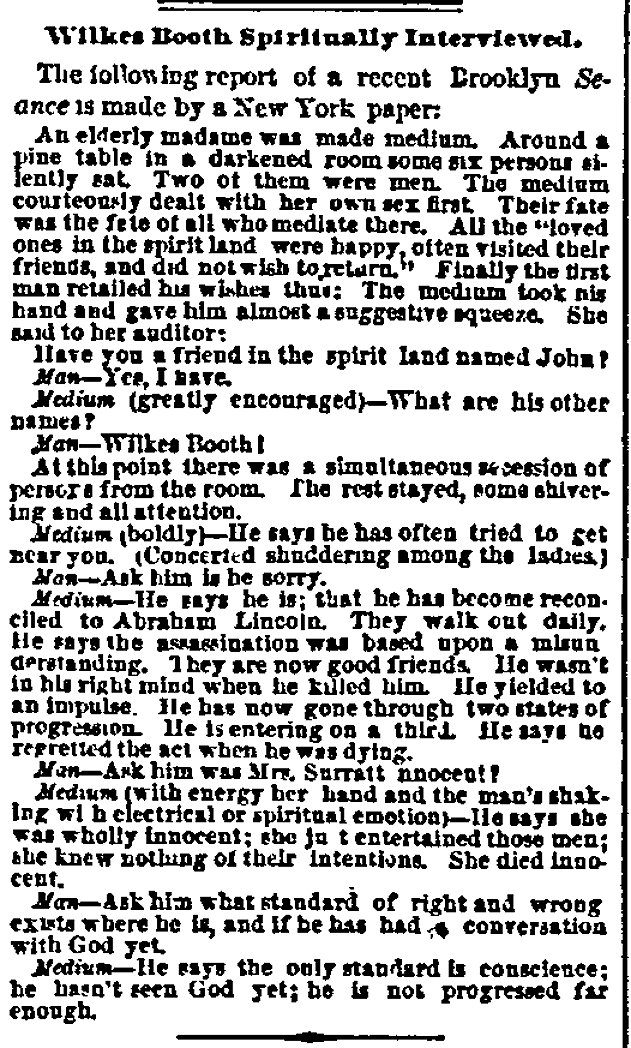
While researching Edwin Booth in 1870, I stumbled across this article about his dead brother that I knew I had to share:

Talking With John Wilkes Booth's Spirit

I think it’s great that John Wilkes Booth and Abraham Lincoln were able to work out their differences in death. I’m sure their daily walks on the other side are filled with interesting and lively discussions highlighted, of course, by the shared laughter of the two “good friends”. In truth we should have known that, given the chance, Lincoln and Booth would have been friends. Look at how attentively Lincoln’s spirit followed Booth after the latter murdered the former:

Assassin's Vison

Clearly Lincoln was waiting patiently for his walking buddy to arrive so the two could work things out.

This article reminded me of another instance where Booth’s spirit is resurrected, as it were.

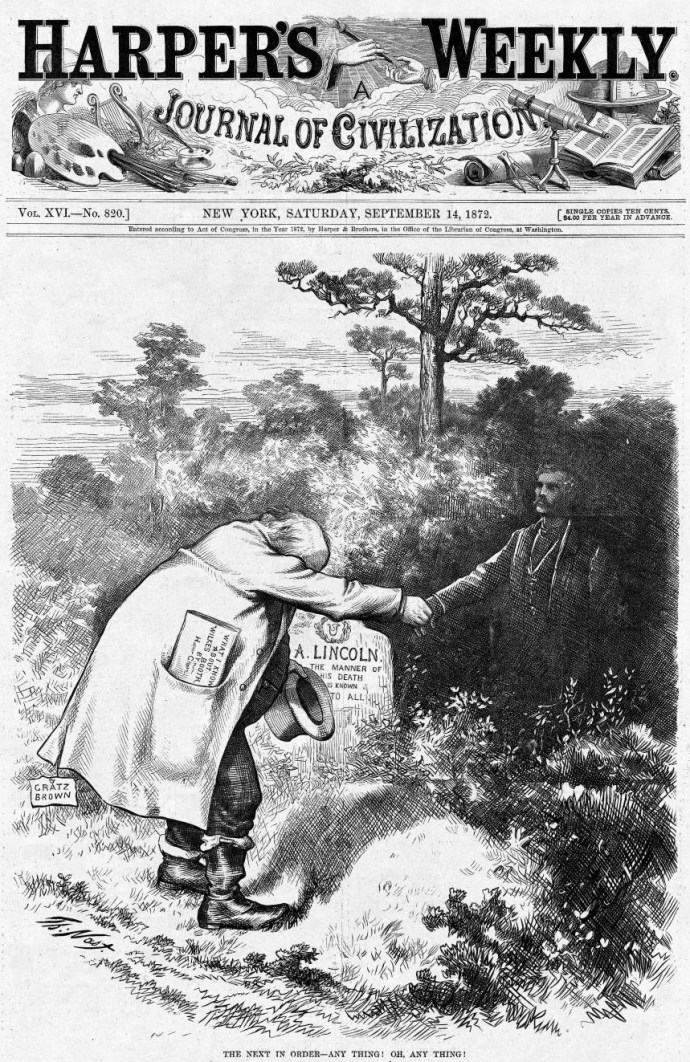
1872 Harper's Weekly political cartoon by Thomas Nast showing Presidential candidate Horace Greeley shaking hands with John Wilkes Booth's spirit over Abraham Lincoln's grave.  Due, in part, to Nast's severe character assassination of Greeley through his cartoons, Greeley lost the election to U.S. Grant.

The 1872 presidential election was between incumbent U.S. Grant and the candidate Horace Greeley. Greeley was the founder and editor of the New York Tribune, and one of the most outspoken abolitionists leading up to the Civil War. During and after the Civil War, Greeley’s views often seemed contradictory.  Though ardently opposed to slavery, he attempted to pursue a peace policy with the Confederacy in 1863/1864.  During Reconstruction he sided with the Radical Republicans and pursued harsh policies for ex-Confederates with simultaneously signing a bond for the release of Jefferson Davis.   He supported Grant in the 1868 election, but became unhappy with his presidency.  He broke away from the Republican party and helped form the Liberal Republican party.  The Liberal Republicans made Greeley their candidate for the President in the 1872.  The Democratic party at that time consisted of mainly Copperheads and former Confederates.  Desperate to get Grant out of the White House, the Democratic party also endorsed Greeley as their candidate too.  Greeley was now aligned with a party he had fought against for years.

Republican supporters of President Grant like artist Thomas Nast seized upon the illogical pairing of Greeley and the Democrats.  Nast proceeded on a campaign of character assassination through his cartoons, demonstrating Greeley’s willingness to side with anyone in order to get votes.  The above cartoon showing Greeley shaking hands with John Wilkes Booth over Lincoln’s grave, is one of several in a series demonstrating Greeley’s willingness to ignore travesties of the past to win the election.  You can see more of Nast’s political cartoons about Greeley on this fascinating site.

Not only did Horace Greeley lose the election of 1872 to Grant, but he also died between the popular vote and the electoral college.  Perhaps he and Thomas Nast took a page out of Booth and Lincoln’s book and are up there now, taking a walk and working out their differences.

References:
Daily Eagle, 9-19-1870
Harper’s Weekly, 9-14-1872
Cartoonist Thomas Nast vs. Candidate Horace Greeley

Categories: Uncategorized | Tags: , | 4 Comments

Where’s Edwin?

After my last post about the whole Booth family living under one roof during the 1860 census, Art Loux posed an interesting question:

Has anyone found the Booths in the 1870 census? I have looked for Mary Ann, Rosalie, Edwin and Joseph but have not found any of them. Asia was in England.

I decided to see if I could find an answer for him.  I decided to look for Edwin first, hoping the rest of the family would be with him.  As a popular actor, I figured he would be the easiest one to track down.  Having recently bought Arthur Bloom’s wonderful new book, Edwin Booth: A Biography and Performance History, I figured I’d have the answer in just a half hours work. Boy was I wrong.  After a couple days of pouring over census pages, I’ve still come up empty trying to find the greatest Hamlet of his generation in the 1870 census.  However, I have two ideas as to why I haven’t been able to find him: Either Edwin missed the census or the census missed him.

First, utilizing Bloom’s biography of Edwin, let’s discuss Edwin Booth’s life leading up to the 1870 census.

1867 – 1869:

The three years previous to the census were very formative years in the life of Edwin Booth.  In June of 1867, Edwin purchased four adjacent land plots at the intersection of 6th avenue and 23rd street in New York City.  It was here, that Booth invested his fortune to build his own theatre, Booth’s Theatre.  Though Booth managed the building of the theater, he spent little time witnessing the progress on it.  Instead, he spent the acting seasons of 1867-1868 and 1868-1869 touring in order to fund the project.  He had hoped to have the theatre ready to go by December of 1868, but delays pushed back the grand opening of his theatre until February 3rd, 1869.  He opened his namesake theatre with Romeo and Juliet.

Booth's Theatre

Booth’s Theatre

Shortly after the theatre opened for business, Edwin most likely read in the papers about the presidential pardon of Dr. Mudd for his involvement in the assassination of Abraham Lincoln.  Pardons for conspirators Samuel Arnold and Edman Spangler followed soon after.   Seven days after his theatre’s debut, Edwin Booth wrote to President Andrew Johnson asking, again, for the remains of his misguided brother.  Edwin was successful this time, but he did not go to Washington, sending his brother and business manager Joseph in his stead.

During this period, Edwin had fallen in love again.  Mary Devlin, Edwin’s first wife and mother of his only child, Edwina, had died in 1863.  The new object of Booth’s affection was Mary McVicke.  Mary was the step-daughter of James McVicker, the actor and owner of McVicker’s Theatre in Chicago.   In mid-1867, Booth offered Mary McVicker the role of his leading lady for the 1867-1868 season.  In truth, McVicker was hardly experienced enough to be a leading lady, but Edwin was smitten with the 19 year old.  They toured together and by the summer of 1868, Edwin and Mary McVicker were living together.  They finally made the arraignment official and married on June 7th, 1869, four months after the opening of Booth’s Theatre.  By October of 1869, Mary was pregnant.

Edwin and Mary (McVicker) Booth

Edwin and Mary (McVicker) Booth

From Bloom’s biography and newspaper accounts, we learn that during this time period Edwin and Mary were living in Booth’s Theatre in a suite of rooms.

Edwin Living at the Theatre

When the summer months rolled around, Edwin and Mary liked to vacation at Long Branch, New Jersey.  Long Branch had been a beach resort town since the late 18th century.  By the 19th century, it had become a “Hollywood” of the east coast, with many actors (particularly those from New York) calling Long Branch their summer home.  In fact, Mary’s stepfather, James McVicker, owned a home in Long Branch and the family would summer there.

Actors at Long Branch

During the 1869 -1870 theatrical season, Edwin needed to make more money to help repay his debts from building Booth’s Theatre and therefore went touring.  Pregnant Mary joined her husband as he travelled to Philadelphia, Boston, and other New England cities.  By January of 1870, the Booths were back at their own theatre.  Edwin’s next documented performance outside of New York was not until the 1870 – 1871 season.

1870:

After a great deal of researching here is my timeline for Edwin Booth for the year of 1870, the census year.

January – April,  1870 – Edwin and Mary are at home, living in Booth’s Theatre on the corner of 6th avenue and 23rd street, NYC.  Edwin is performing in his own theatre.

April 16th, 1870 – Edwin’s last performance at Booth’s Theatre for the 1869 – 1870 season.

May 1870 – Edwin and (most likely) the pregnant Mary travel to Long Branch, New Jersey for a brief vacation before the baby is due in June.  Newspaper clippings support the idea that Edwin was in Long Branch.

Edwin in Long Branch May Edwin in Long Branch May 2

May 30th, 1870 – James McVicker, Mary’s stepfather, opens at Booth’s Theatre in a new play called “Taking the Chances”.

Early June, 1870 – Edwin and Mary return to their home above Booth’s Theatre in New York.

June 13th, 1870 – Edwin writes a letter to Jervis McEntee from New York, verifying that he is back home.

June, 1870 – Per Bloom’s biography: “Edwin and Mary were married in June 1869, and by late October she was pregnant.  The baby was almost a month late.  The doctors in attendance convinced the Booths that Mary miscalculated.  They all thought it was a joke, but the result was a disaster.” If the couple expected the baby was going to be born in June, this would explain why they left Long Branch after only spending a month there.  Since Mr. McVicker was playing at Booth’s Theatre, it would make sense that he would want to witness the birth of his (step) grandchild.

July 3rd, 1870 – Per Bloom: “Mary was a physically small woman, and the baby was so large (10- ½ pounds) that the attending doctors were forced to use forceps, which slipped twice and damaged the child’s head.  Edwin assisted at the birth, which came at 11:30 p.m. on July 3, 1870.”  By 4 a.m. the baby, named Edgar, had died.  The birth occurred at home in Booth’s Theatre.

July, 1870 – The birth was hard on Mary, and she was sedated with chloroform for five days after.  During her sedation, Edwin buried Edgar next to his first wife, Mary Devlin, in Massachusetts.  When he came back, he took Mary back to Long Branch to recover, likely with the McVickers in tow.

July 25th, 1870 – A letter written by Edwin Booth to Jervis McEntee from Long Branch, NJ, verifies that Booth was back at Long Branch.

August 20th, 1870 – A letter written by Edwin Booth to Charles Gayler (the playwright for the play Mr. McVicker had debited in May) from Long Branch, NJ, verifies that the couple was still at Long Branch.

September 5th, 1870 – Edwin Booth starts the 1870 – 1871 season at McVicker’s Theatre in Chicago.  Mary, now recovered from the after effects of childbirth, accompanies him, and her parents, there.

Mary McVicker back in Chicago

October – December, 1870 – Edwin Booth acts in St. Louis, Cincinnati, Pittsburgh, and Philadelphia.

December 16th, 1870 – Booth is in Philadelphia playing at the Walnut Street Theatre.  Edwin wrote to a friend on this date stating, “I shall be home at Xmas (God willing) and will follow Jefferson at Booth’s in Jan.  This is rather unexpected, tho’ I’m rather glad of it, for I am sick of traveling, and it is not the thing for Mary, who has been confined to the house for a week past…”  It appears Mary had continued to follow Edwin during his entire tour.

December 24th, 1870 – Edwin’s last performance in Philadelphia.  Edwin and Mary assumedly go home to New York.  Edwin starts playing at his own theatre starting January 9th, 1871.

Theories:

With the timeline above, I have two theories as to what happened with Edwin Booth and the census.

1. Edwin Booth missed the census.

According to Ancestry.com: “The official enumeration day of the 1870 census was 1 June 1870. All questions asked were supposed to refer to that date. The 1870 census form called for the dwelling houses to be numbered in the order of visitation; families numbered in order of visitation; and the name of every person whose place of abode on the first day of June 1870 was with the family.”  From newspaper accounts, we know that Edwin Booth was in Long Branch, NJ in May.  From a letter Booth wrote on June 13th, we know that he was then back in New York.  Two possible scenarios would eliminate Edwin Booth from being counted.  Either Edwin was still in Long Branch when his neighborhood was surveyed or Edwin was back in New York when the census enumerators came, but since he had been living in Long Branch on June 1st, they did not include him.  Two identical newspaper clippings from two different papers make a joke that supports the idea that Edwin Booth missed the census:

Edwin missed the census

2. The census missed Edwin Booth

The 1870 census was not without controversy.  After it was completed many states, including New York, believed that large portions of the population had been missed.  Could Edwin Booth have been one of those who were missed?  It may not be as ridiculous as it sounds.  Mary Booth’s step father, James McVicker, was engaged at Booth’s Theatre from May 30th –  June 11th performing in “Taking the Chances”.  Though I’ve not yet found documentation for it yet, it is extremely likely that Mr. McVicker stayed on at Booth’s Theatre to await the birth of his (step) grandchild.  This puts Mr. McVicker in New York City from May 30th to at least July 3rd.  If census takers surveyed him, he could honestly say he was living in NYC on June 1st and he would have been included.  However, like Edwin Booth, James McVicker is nowhere to be found in the 1870 census.  He’s not in New York City, he’s not in Long Branch, he’s not back home in Chicago.  Nor is there any record for Mrs. McVicker in the 1870 census either.  Perhaps the 1870 census actually missed Edwin Booth and his entire household.

The weirdest part of all of this is that, barring an obvious mistake by me, the Booths had to have been missed not once, but twice.  New York City was given permission to do a recount of the 1870 census and started a 2nd enumeration in December of 1870.  Edwin would have been at home when the enumerators were in his neighborhood in early January, but again, there is no record of him.  Perhaps, living in his own theater as he did, the census people did not think to knock on the theatre doors and ask about anyone living there.

The Rest of the Family:

While I was not successful in finding Edwin Booth for Art, I did find Mary Ann, Rosalie, and Joe.  The three of them were not living at the Booth Theatre.  In August of 1869, Edwin wrote a letter to a friend in which he stated, “I sold my house some weeks ago—obtained comfortable quarters for my brother and sister— with whom Joe resides…”  The “Joe” Edwin names is not his brother, but rather actor Joseph Jefferson.  When this letter was written, Joe Jefferson was performing his famous Rip Van Winkle character at Booth’s Theatre.  This helped me place the residence of the Booth family somewhat close to the Theatre.  When I found the following census record for a “Maria”, Rosalie, and Joseph Booth, boarding less than a mile from Booth’s Theatre down 6th avenue, I knew I had found the right family.

Mary Ann, Rosalie, and Joseph Booth in the 1870 Census.  Click the image for the full page.

Mary Ann, Rosalie, and Joseph Booth in the 1870 Census. Click the image for the full page.

They all decided to fudge their ages a bit.  In reality, Mary Ann was 68, Rosalie was 47, and Joe was 30.  Oh vanity, thy name is Booth.

Conclusion:

If I have completely wasted my time and Edwin is actually in the 1870 census, plain as day, I welcome the correction.  I’d be embarrassed for missing him, of course, but I’d rather know.

Despite his fame and fortune, Edwin Booth has proven to be an elusive man.  Though I’ve come up empty handed trying to find him in the 1870 census, the process of searching for him has taught me more about his life around that period than I would ever have known otherwise.  I searched the records, documented Edwin’s movements and read hours’ worth of census pages.  The search for knowledge is what makes this all worthwhile.  Still, if you’ll excuse me, I’m going to go and take a nap until the next census to recover.  Or maybe a vacation would do me some good.  I’ve read Long Branch, NJ is nice.

References:
Edwin Booth: A Biography and Performance History by Arthur Bloom
The 1870 Federal Census accessed through Ancestry.com
Newspaper articles from GenealogyBank.com
The Hampton-Booth Theatre Library online card catalog
Letters from Edwin Booth to John E. Russell from The Outlook magazine April 20st, 1921

Categories: Uncategorized | Tags: | 3 Comments

All Under One Roof

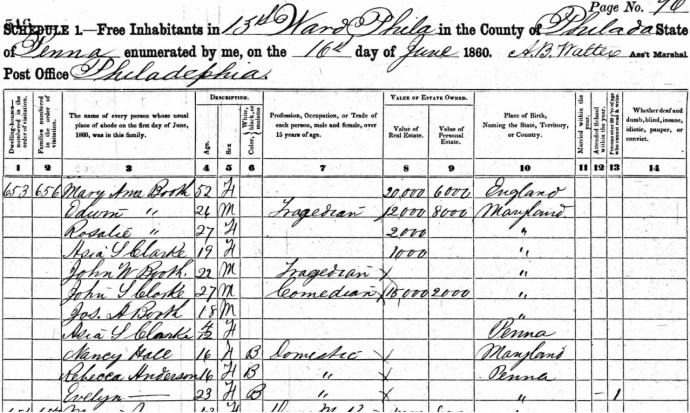
Thank you to Art Loux for sharing this interesting census record from 1860 with me.  It shows a rare instance in which practically all the members of the Booth family are living under one roof.  The only missing family members are the deceased Junius, Sr. and the living Junius, Jr. who resided in California.

Booth family in the 1860 Census

The home in Philadelphia that all the Booths were living in was the home of John Sleeper Clarke and Asia Booth.  The two had been married the previous year.  In June of 1859, about two months after their marriage, Mary Ann Booth moved in with the newlyweds.  Joe and Rosalie followed her shortly thereafter.  When this snapshot was taken Edwin, John Wilkes, and John Sleeper Clarke were all briefly home due to the completion of the acting season.  The summer heat made a crowded theater an unbearable affair and so the theater season was closed until the fall.

This full house of Booths would not last long at all, however.  Less than a month after this census record was taken, Edwin was married to his first wife, Mary Devlin.  The newlyweds honeymooned at Niagara Falls and then took up a home in New York.  By December of 1860, Asia wrote a letter to her friend Jean Anderson in which she mentions how Mary Ann, Rosalie and John Wilkes were no longer living at her home, having taken up residence at a boarding house elsewhere in Philadelphia.  Finally, Joseph Booth was enrolled in medical school in Charleston, South Carolina before the end of 1860.

As swiftly as they had all assembled, the Booths quickly separated again leaving us with only the above glimpse of a rare reunion among the entire family.

References:
Art Loux
Edwin Booth: A Biography and Performance History
John Wilkes Booth’s Enigmatic Brother: Joseph by John C. Brennan
Ancestry.com

Categories: Uncategorized | Tags: , | 11 Comments

100,000+!

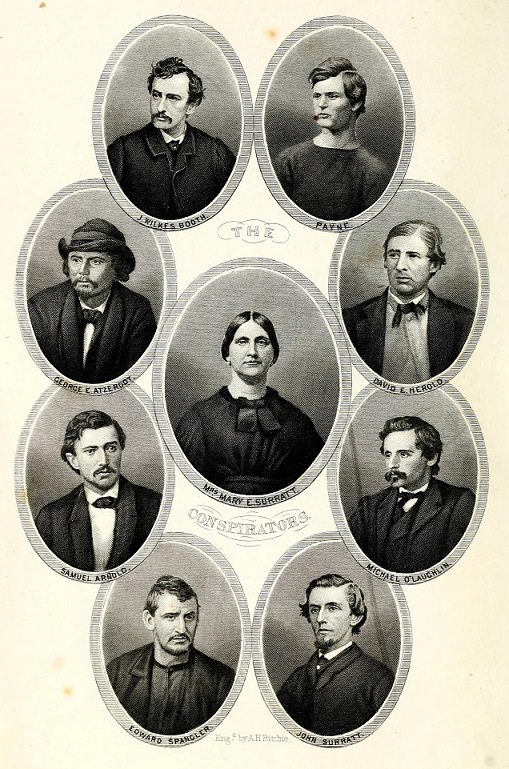
Ring of Conspirators

On September 12th, 2012, I put up a quick little post highlighting the 10,000th “hit” to this site. As a blog devoted to a fairly small niche of American History, I was very happy that so many people were visiting and finding the site to be valuable. Now, a little over a year later, I’m ecstatic that BoothieBarn is over the 110,000 mark!

110,000 stats

This means that over the last year this blog had over 100,000 clicks on it. The majority came from repeat visitors and followers who are so engaging with their comments. Thank you all for your continued support.

The creation of the BoothieBarn Picture Galleries during this last year also gave a boost to the number of visitors and clicks. As a visual learner myself, I’m striving to provide a beneficial archive of images relating to the assassination of Abraham Lincoln.

Lastly, my foray into recording parts of the escape route has been very well received. As a recent transplant to Maryland, I’m happy to show the escape route locations that are now in my backyard.

While I rarely know what I’m going to blog about when I sit down to write, I thank you all for coming back day after day to check it out. At the very least, there are still many Picture Galleries to add and I’m actively developing a plan to recreate Booth and Herold’s time in the pine thicket during their escape.  I’m really excited over the prospect of immersing myself into the history and sharing my experiences with you all.

Thank you so much for reading BoothieBarn and for keeping me motivated to write about a subject I find endlessly fascinating.

Sincerely,

Dave Taylor

P.S. Tomorrow (9/21) I will be going on one of the John Wilkes Booth Escape Route Tours run by the Surratt House Museum. While I won’t be “live blogging” it like last time, I’d be happy to take pictures of any requested site or artifact. Just let me know in the comment section.

Categories: Uncategorized | 28 Comments

Harry Hawk’s Letter to his Parents

Harry Hawk 1

Actor Harry Hawk was the only person on stage when Booth assassinated Lincoln.  When Booth jumped to the stage, brandishing a bloody knife in his hands, Hawk turned and ran from him, fearing for his life.  In the hours  following the assassination, Hawk gave a statement to Corporal Tanner who, under orders from Secretary of War Edwin Stanton, was collecting evidence in the parlor of the Petersen House.  In addition to this official statement, Hawk also wrote a letter to his parents in Chicago to tell them of the events.  Here is his letter, dated April 16th, recounting the tragedy:

“Washington, April 16, 1865

My Dear Parents,

This is the first time I have had to write to you since the assassination of our dear President on Friday night, as I have been in custody nearly ever since, I was one of the principal witnesses of that sad affair, being the only one on the stage at the time of the fatal shot. I was playing Asa Trenchard, in the “American Cousin,” The “old lady” of the theatre had just gone off the stage, and I was answering her exit speech when I heard the shot fired. I turned, looked up at the President’s box, heard the man exclaim, “Sic semper tyrannis,” saw him jump from the box, seize the flag on the staff and drop to the stage; he slipped when he gained the stage, but got upon his feet in a moment, brandished a large knife, saying, “The South shall be free!” turned his face in the direction I stood, and I recognized him as John Wilkes Booth. He ran toward me, and I, seeing the knife, thought I was the one he was after, ran off the stage and up a flight of stairs. He made his escape out of a door, directly in the rear of the theatre, mounted a horse and rode off.

The above all occurred in the space of a quarter of a minute, and at the time I did not know that the President was shot; although, if I had tried to stop him, he would have stabbed me.

I am now under one thousand dollars bail to appear as a witness when Booth is tried, if caught.

All the above I have sworn to. You may imagine the excitement in the theatre, which was crowded, with cries of “Hang him!” “Who was he?” &c., from every one present.

In about fifteen minutes after the occurrence, the President was carried out and across the street. I was requested to walk down to police headquarters and give my evidence. They then put me under one thousand dollars bond to appear at 10 o’clock next morning. I then walked about for some time as the city was wild with excitement, and then I went to bed. At half-past three I was called by an aid of the President, to go the house where he was lying, to give another statement before Judge Carter, Secretary Stanton, and other high officials assembled there. I did so, and went to bed again. On Saturday I gave bail.

It was the saddest thing I ever knew. The city only the night before was illuminated, and everybody was so happy. Now it is all sadness. Everybody looks gloomy and sad.

On that night the play was going off so well. Mr. and Mrs. Lincoln enjoyed it much. She was laughing at my speech when the shot was fired. In fact it was one laugh from the time the curtain went up until it fell — and to think of such a sorrowful ending! It is an era in my life that I shall never forget. Inclosed is a piece of fringe of the flag the President was holding when shot.”

To learn more about Harry Hawk, the other actors, and employees of Ford’s Theatre that fateful night, I recommend pre-ordering Dr. Tom Bogar’s upcoming book, “Backstage at the Lincoln Assassination: The Untold Story of the Actors and Stagehands at Ford’s Theatre“. Dr. Bogar spoke at the 2013 Surratt Society Conference and has done a phenomenal job delving into the history of these forgotten souls.  The book is due to be released in November, so pre-order it from Amazon today!

References:
Harry Hawk letter published in the Evening Star, April 24, 1865

Categories: Uncategorized | Tags: | 10 Comments

The Oldest Photographs of the Escape Route

Photography as we know it was only about 40 years old when Abraham Lincoln was assassinated.  Though some photographers had risked life and limb taking battlefield shots of the Civil War, the bulk of a photographer’s business consisted of portraits in their studio.  In the aftermath of Lincoln’s assassination photographers like Matthew Brady and Alexander Gardner took photographs of Ford’s Theatre, the conspirators, and the hanging of the condemned.  When it came to the escape route, however, no cameras attempted to make the trip.  Granted, in those early days no one was completely sure of the route Booth took or of all the places he visited before his death at the Garrett farm.  Newspapermen travelled the route and drew sketches, many of which were later turned into engravings, but none of these can truly capture the detail of a location as well as a camera can.  However, the bulky nature of early photography equipment (such as the required glass plates) made photographing the escape route an undesirable endeavor.

So, what are the earliest photographs we have of the escape route?  The most readily available ones were done by Osborn Oldroyd in 1901, 36 years after Lincoln’s death.  Armed with the newly invented “Brownie” camera from Kodak, Oldroyd walked and photographed the route.  Oldroyd’s book, The Assassination of Abraham Lincoln, is still so popular and historically valuable thanks, in part, to his many photographs of the escape route.

Oldroyd walking the route

Osborn Oldroyd, most likely with his Brownie camera in his pack

But Oldroyd was not the first to photograph the sites of Booth’s escape.  In 1888, Kodak, and it’s founder George Eastman, had released the first box camera using the recently invented “roll” of film.  Like the Brownie that followed, these original Kodak cameras allowed individuals to take their pictures and then mail in their film to Kodak to be developed.  These first, mass market cameras produced a circular image while the later Brownie created a rectangular exposure.

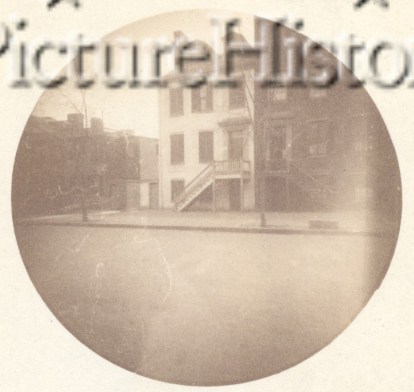
Sometime between 1893 and 1895, a writer for Century Magazine either commissioned someone or took a Kodak camera for a walk himself and photographed part of the escape route.  The writer’s name was Victor L. Mason, and here are some of his pictures:

Mrs. Surratt's boarding house circa 1895

Mrs. Surratt’s boarding house circa 1895

The Surratt Tavern circa 1895

The Surratt Tavern circa 1895

Dr. Mudd's house circa 1895

Dr. Mudd’s house circa 1895

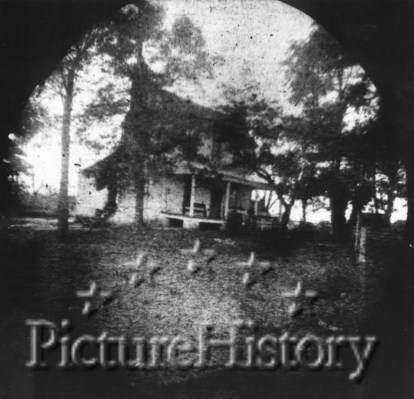
The Garrett house circa 1895

The Garrett house circa 1895

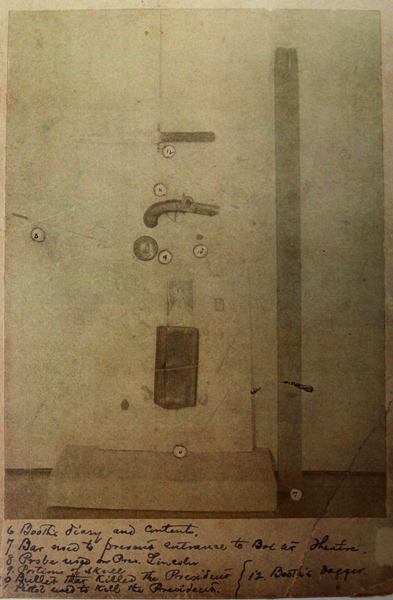
Victor Mason was working on an article about Lincoln’s assassination for Century Magazine.  In addition to these exterior shots of the escape route with a Kodak, Mason also used a more professional camera to take images of several of the trial exhibits in storage at the War Department such as this one:

Trial Exhibits circa 1895

In April of 1896, Victor Mason’s article, Four Lincoln Conspiracies, was published in Century Magazine.  Click here to view the article and look through the pages.  You will notice that while photographs of the conspirators and the relics of the assassination are replicated in the article, the photos of the escape route are not.  Instead, the article contains several drawings of each escape route location “Drawn by Harry Fenn” “From a Recent Photograph.”  Look at the drawings for the Surratt boarding house, the Surratt Tavern, Dr. Mudd’s House, and the Garrett house, and you will see that they are exact matches to the photos above.  It’s clear that Mason’s photographs were turned into these drawings.  Due to this, we can surmise that Mason also photographed Bryantown, Huckleberry, and Cleydael, since there are drawings of those places in the article too.

To my knowledge, these circa 1895 images are the earliest photographs of the escape route.  If any one knows otherwise, or has copies of these images (especially the “missing” ones of Bryantown, Huckleberry, and Cleydael), please comment below or shoot me a message at boothiebarn (at) gmail (dot) com.

References:
History of Kodak
PictureHistory.com
Four Lincoln Conspiracies by Victor L. Mason, Century Magazine, April 1896

Categories: Uncategorized | Tags: , , , | 8 Comments

Edwin Booth at the Trial

Edwin Booth as Hamlet

Edwin Booth as Hamlet

After his brother’s crime, Edwin Booth was spared the indignity of arrest.  The celebrated actor had just recently completed his illustrious run of 100 consecutive nights as Hamlet.  While his brothers Joe and Junius and his brother-in-law John Sleeper Clarke were arrested and imprisoned, Edwin remained untouched, as the grieving national treasure that he was.  Joe Booth spent only a couple of nights in jail before securing his release.  John Sleeper Clarke was arrested on April 27th and remained behind bars until May 26th.  Poor Junius spent the most time in prison due to his letter to John Wilkes in which he urged his brother to quit the oil business and return to the stage.  Junius was unaware that Wilkes used the term “oil business” as a cover for his plots against Lincoln.  Junius was arrested on April 25th and was remained imprisoned at the Old Capitol Prison Carroll Annex until June 23rd.

During this time, Edwin wisely shied away from the spotlight.  However, he was spotted at a high profile event in Washington on the last day of May:  the trial of the conspirators

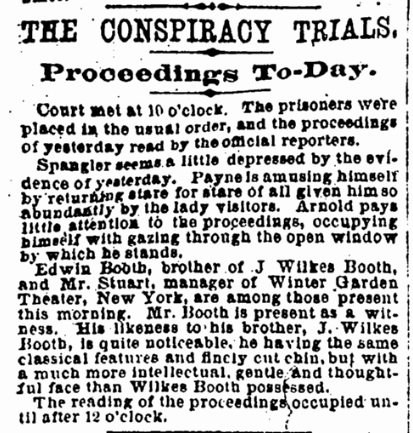
Edwin Booth at the trial

As the Washington Star noted above, Edwin Booth was at the trial of the conspirators to act as a witness.  However, in the transcript of the trial you will never find Edwin Booth’s testimony from the witness stand.  In a letter that Edwin Booth wrote to a friend in Philadelphia the next day, he explains his reason for being there:

 “…I was called for the defense – to prove that J. Wilkes had such power over the minds of others as would easily sway those with whom he associated, &c. &c; the idea is to set up a plea of insanity for Herald or Paine – or some of them.  I told Doster all I knew of John, and he concluded it wd be as well not to call me.  The Washington ‘Star’ had a description of me – stating I was there as a witness – I daresay the press all over the country will be filled with my ‘arrest’ and all sorts of awful things…”

It was probably an act of courtesy and compassion that led William Doster to decide against using Edwin Booth on the witness stand.  The lawyer for Lewis Powell and George Atzerodt found other ways to demonstrate John Wilkes Booth’s influential character without subjecting the country’s greatest actor to further humiliation.  The request from Doster also provided Edwin with an appropriate reason to travel to Washington to visit his brother:

“I spent the day (yesterday) in Washington, and the greater part of it with my brother Junius – I dined with him – in his ‘quarters’…”

“…I then left the court (after taking a good look at the criminals) and drove to C Prison & stayed with June until 5 o’clk.  I had all sorts of good words & Junius … shd be speedily released &c.”

Not everyone felt happy that Edwin was spared imprisonment and suspicion after Lincoln’s assassination.  Years later, after Edwin himself was almost assassinated by Mark Gray Lyon, a now jaded and disgruntled John Sleeper Clarke wrote the, “Booths…get all the notoriety without suffering!! for it…Look at me I was dragged to jail by the neck – literally dragged to prison – and Edwin goes scot-free gets all the fame – sympathy – who thinks of what I endured.”

John Sleeper Clarke - not happy that Edwin wasn't arrested, too.

John Sleeper Clarke – not happy that Edwin wasn’t arrested, too.

Perhaps it was a bit unfair that Edwin Booth escaped the trials that his brothers and brother-in-law endured.  However, as a celebrated and vocal supporter of the Union during the Civil War, such preferential treatment is not unfounded.  In the years that followed, the theater world purposefully forgot Edwin’s villainous relation, however the stigma of his brother’s crime would haunt Edwin far longer than his brothers’ incarceration.

References:
Evening Star, 5/31/1865
Edwin Booth: A Biography and Performance History by Arthur Bloom

Categories: Uncategorized | Tags: , | 4 Comments

In the Dog House

There is a special connection between man and canine.  As a species, dogs provide humans a degree of loyalty that is unmatched in the animal world.  What’s even more interesting is how we, as people, develop the need to reciprocate that loyalty and devotion to our four legged friends.  Just this month, New York enacted a new regulation allowing pet cemeteries to accept cremated human remains, so that humans could be buried for eternity with their beloved pets.

Dogs provide a comforting effect.  Even in the most dire of circumstances they can provide an individual with a degree of ease and calm.  Therefore, it seems fitting that, while imprisoned as accessories in the assassination of Abraham Lincoln, at least three of the conspirators’ thoughts were of their dogs.

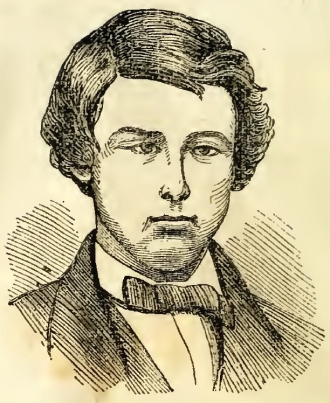
David Herold Engraving

David Herold met his end on the scaffold on July 7th, 1865.  He demonstrated dog like devotion to John Wilkes Booth during his flight from justice.  Despite many opportunities to leave the wounded assassin behind, Herold remained loyal to him and that loyalty eventually cost him his life.  According to one newspaper account however, he was allowed the comfort of his own loyal friend before he died.  In 1888, Captain Christian Rath gave an interview to the newspapers about his legacy of being the conspirators’ executioner.  In part of the interview he stated, “I always regarded Harold as an unthinking boy – a spoiled child.  He was a great sportsman, though, fond of shooting, and the owner of a splendid pointer dog.  We kept the dog for him in the prison, and at his death he left it to Gen. Hartranft.”  If Rath’s memory is correct and true, then it is likely that Herold spent his last few days on Earth uniting with the creature he so expertly replicated in life.

Spangler Drawing Trial book

Edman Spangler survived the executions of July 7th.  Instead he was sentenced to 6 years in prison, a relative slap on the wrist compared to the sentences of the other conspirators.  Thomas Ewing, Jr., lawyer for Dr. Mudd, Samuel Arnold, and Spangler, wrote a letter to his father dated the day of the execution.  In it, he described his continued efforts to gain the freedom of his clients through a writ of habeas corpus.  He also wrote the following, “They say Spangler was delighted at escaping hanging.  He sent a special request to Ford today to send him to prison his large testament, and his small dog!”  Whether Spangler was successful in acquiring his dog remains uncertain as there is no mention of it, or David Herold’s dog, in General Frederick Hartranft’s letterbook about his supervision of the Old Arsenal Prison.

I find it ironically appropriate that Spangler owned a “small” dog.  Years later, after his release from Fort Jefferson, Edman Spangler went to visit, and ultimately live with, his former cellmate, Dr. Mudd.  As Nettie Mudd wrote later in her book about her father, “A short time after Spangler’s release, he came to our home early one morning, and his greeting to my mother, after father had introduced him, was: ‘Mrs. Mudd, I came down last night, and asked some one to tell me the way here.  I followed the road, but when I arrived I was afraid of your dogs, and I roosted in a tree.'”  Clearly Spangler preferred his small dog over big ones like Dr. Mudd’s.

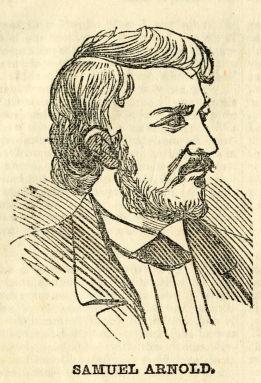
Arnold Drawing Trial Book

Samuel Arnold was imprisoned with Dr. Mudd, Spangler and Michael O’Laughlen at Fort Jefferson.  His later memoirs describe how painful and tortuous he found his imprisonment there.  With only rats and crabs as his animal companions, Arnold’s thoughts turned to his dog.  In a letter to his mother in 1867, Sam Arnold writes elegantly of his beloved pet:

“Keep my dog till he dies.  For my sake let him be treated well, and when dead bury him.  Erect a slab inscription, ‘A true friend,’ for he would never forsake me even should the whole world do so.  He loved me, even the ground I walked upon, and I loved him.  Poor Dash! We have forever parted.  Thou without a soul, yet did you love me, and thou art not forgotten.”

Samuel Arnold in later life, enjoying the company of another devoted dog.

Samuel Arnold in later life, enjoying the company of another devoted dog.

The connection between man and dog transcends guilt or innocence.  Whether its owner is a President or a criminal, a dog will stay by an owner who loves him.  Even the worst criminals can demonstrate their humanity by the way they treat their dogs.  In the midst of their confinement for the crime of the century, David Herold, Edman Spangler, and Samuel Arnold showed their humanity in this way.

References:
Mrs. Surratt’s Case, The Evening Repository, 2/16/1888
Thomas Ewing Family Papers, LOC
The Life of Dr. Samuel A. Mudd by Nettie Mudd
Memoirs of a Lincoln Conspirator by Michael Kauffman

Categories: Uncategorized | Tags: , , | 17 Comments

Blog at WordPress.com.