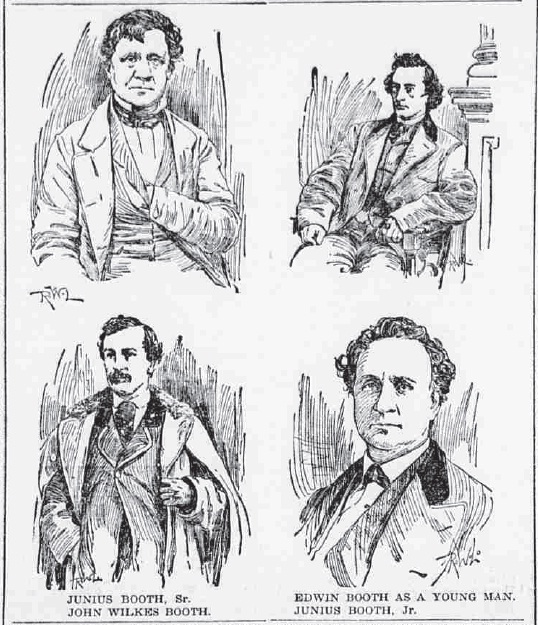
The Booth family of Harford County, Maryland, is best known for its fame and infamy. The infamous John Wilkes has gone down in history for assassinating Abraham Lincoln, with his crime sadly overshadowing the accomplishments of his relatives. Junius Brutus Booth was a famous actor who spent about thirty years traveling America as a celebrated tragedian. His namesake, Junius Brutus Booth, Jr., followed in his father’s footsteps, and while he never reached the same level of fame as his father, June was still a widely respected actor and theater manager. Edwin Booth eclipsed the fame of both his brother and father. His soft, brooding method of acting revolutionized the stage, and Edwin is still known today as the greatest talent to ever perform the role of Hamlet. Asia Booth, while never one to take to the stage herself, became a devoted chronicler of her family. She wrote books about her father and brothers, including a memoir about her misguided brother, which was published posthumously. In their own way, each of these Booths left a mark on the world.
Yet there are more Booths. They consist of the largely forgotten Booths. Mary Ann Booth, the matriarch of the Booth family, managed to keep her family afloat after her husband’s death and the near-bankruptcy she faced in the mid-1850s. Rosalie Booth, the eldest daughter, lovingly cared for her mother in her old age and supported her siblings’ endeavors throughout their lives. And then there is the youngest child, Joseph. Impulsive, moody, and not having any interest in the “family business” of acting, the youngest Booth was often an enigma to his family. In fact, prior to April 14, 1865, it was Joe, not John Wilkes, who was the black sheep of the family.

Joseph Adrian Booth was born on February 8, 1840, either at the Booth family farm of Tudor Hall in Harford County or at a home they rented in Baltimore. At the time of his birth, his siblings consisted of June (18), Rosalie (17), Edwin (6), Asia (4), and John Wilkes (1). As can be seen, his eldest two siblings were practically adults when their baby brother was born. Joseph was given the middle name of Adrian after his eldest brother June’s performance of Adrian De Mauprat in the play Richelieu. Despite being thus christened into the acting profession, Joseph never shared the spark of his three brothers. When he grew up, he performed on stage only a handful of times, mostly to cover a minor role while traveling as a valet for his brothers, Edwin and John Wilkes.

At times, Joseph was thrust into jobs at theaters, working as a treasurer at the Holliday Street Theatre and later at his brother Edwin’s “Booth Theatre.” But he never developed a passion for the stage or, in fairness, for working in general. Though his early teenage years were a bit rocky after the death of his father in 1852, his life became largely financially stable after his brother Edwin Booth returned as a celebrated star from the West Coast. Despite pressure from his family to pursue a profession, Joe discovered he could live just fine on the resources his brother provided. While it is true that Joseph eventually became a doctor, this did not occur until he was 49 years old.
There is much that can be said about Joseph Booth, especially his travels from 1862 to 1865, when he ran off without telling any of his family members where he was going. However, for the purpose of this article, we’re going to explore the visual record of Joseph Booth.
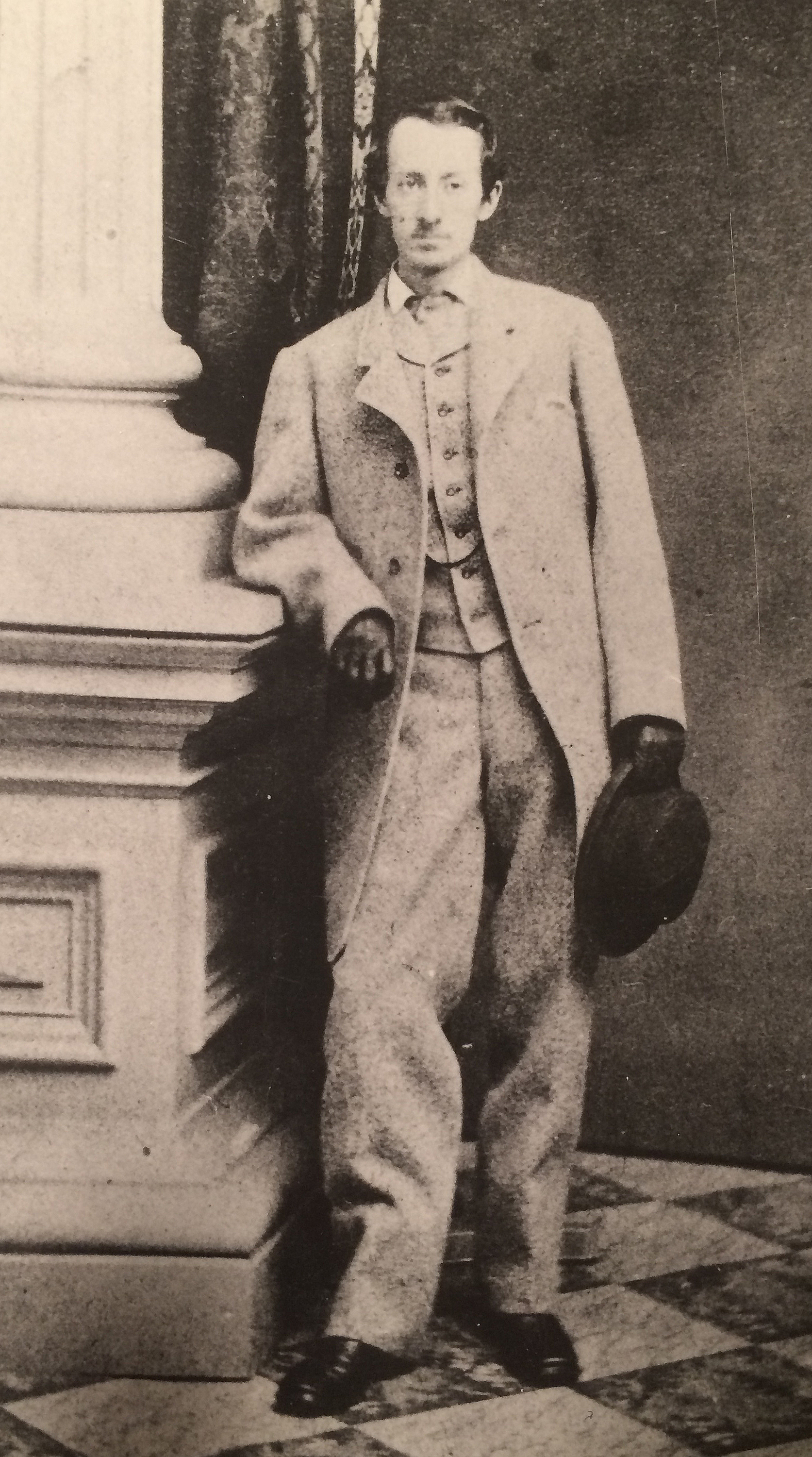
The main issue we have with the forgotten Booths is the lack of many images of them. While the public clamored for photographs of the acting Booths and the infamous John Wilkes, images of the family members who stayed out of the spotlight are much harder to find. For the longest time, only one photograph of Joseph Booth was known, and that was this one:
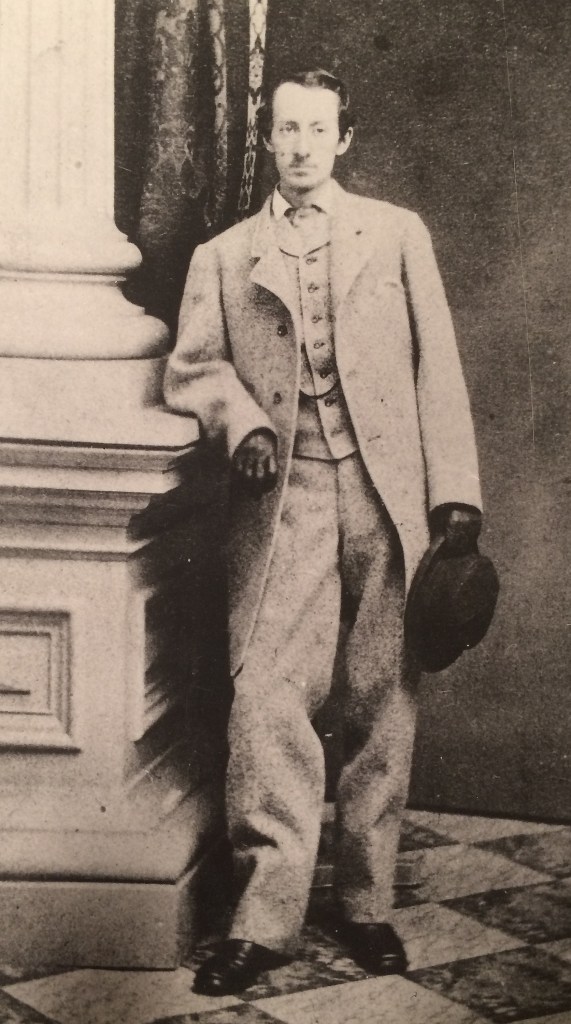
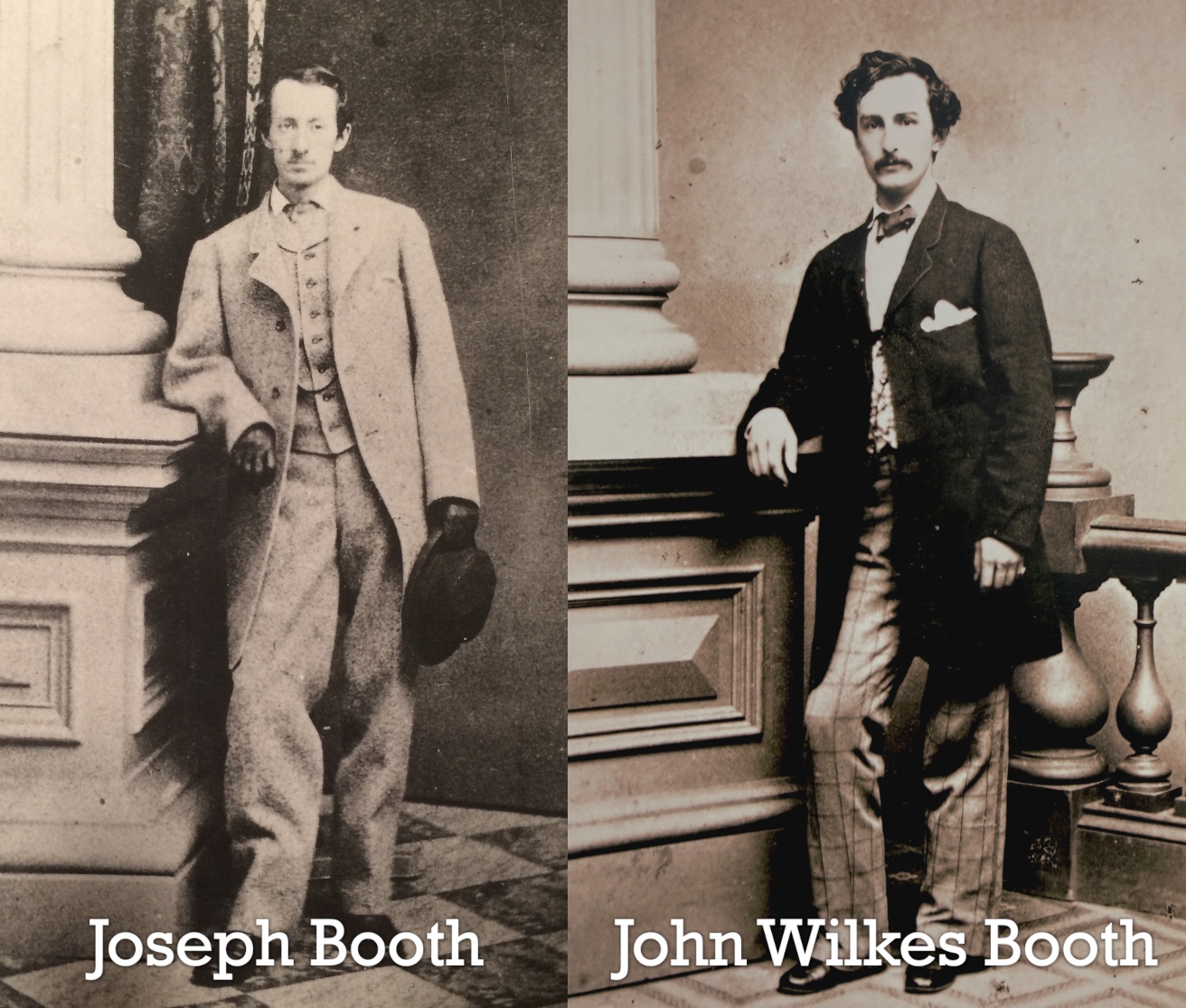
This image dates to the 1860s and was taken by photographer Charles D. Fredericks & Co. in New York. It shows a man standing next to a pillar, wearing a light colored suit, dark gloves, and holding a dark hat. While the full body pose makes it difficult to make out facial details, from what we can see, this figure shares the hawk-like Booth nose and far back hairline that was a trait among the Booth men. For comparison, here is a side-by-side of this image of Joseph next to a similarly posed image of John Wilkes Booth.
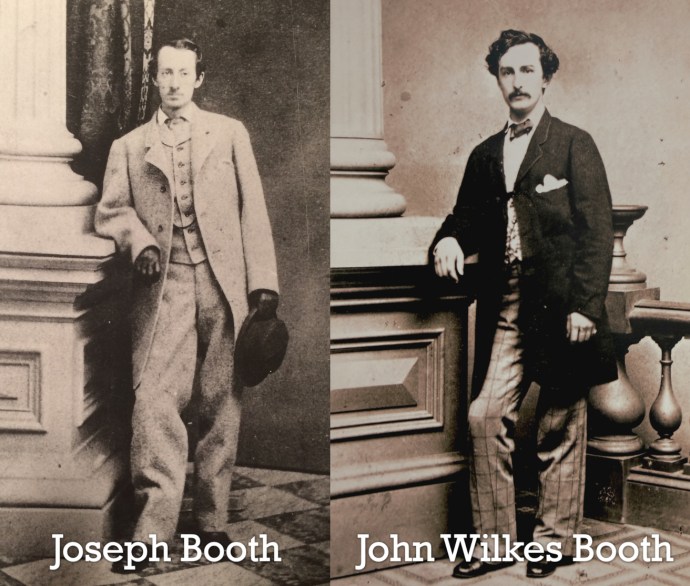
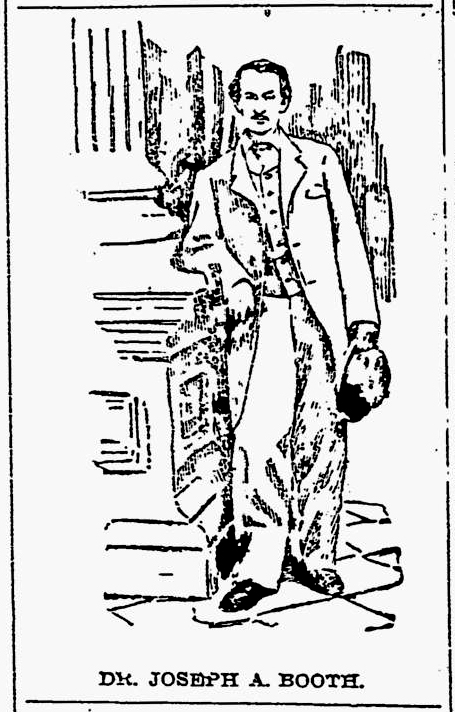
This particular image of Joseph Booth is in the collection of The Players, the social club that Edwin Booth founded in 1888, in New York City. Supporting the idea that this image is of Joseph Booth was an article that was published in the Baltimore American in 1896. An actor named James Young, Jr., shared his collection of images of the Booths, soon to be presented to The Players. The illustrated article contained several depictions of the Booth family members, including this image of Joseph.
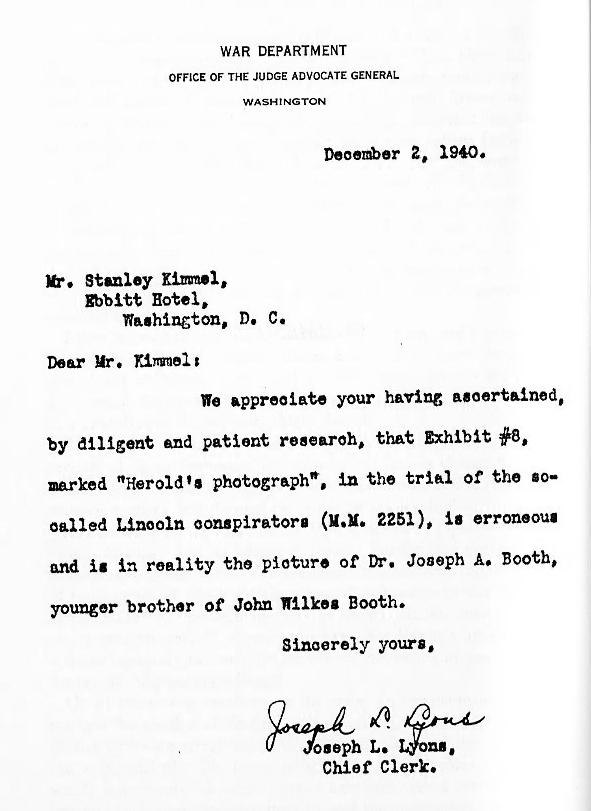
Strangely enough, a CDV of this particular image of Joseph Booth is also in the National Archives in the collection of evidence regarding the assassination of Lincoln. At some point after the trial of the Lincoln conspirators, as the pieces of evidence were being held in the office of the Judge Advocate General, an image of David Herold was erroneously exchanged for this picture of Joseph Booth. How the misfiling occurred is unclear, but the image that is in the envelope labeled as “Herold’s photograph” that was used at the trial of the conspirators has been replaced with this picture of the youngest Booth sibling. This mistake was noted by author Stanley Kimmel as he was consulting the JAG files for his book, The Mad Booths of Maryland in the 1930s. Having already come across the Baltimore American article featuring the Joseph Booth image earlier in his research, Kimmel informed the War Department of the mistake. In the second edition of his book, Kimmel includes the War Department’s letter of thanks for informing them of the mistake. What happened to David Herold’s photograph is not known.
In the late 1970s, Lincoln assassination researcher John C. Brennan began looking into the life of Joseph Booth. His efforts resulted in a wonderful article in the Spring 1983 edition of the Maryland Historical Magazine entitled, “John Wilkes Booth’s Enigmatic Brother Joseph.” In the article, Mr. Brennan discussed his search for images of Joseph Booth, writing, “All the likely places having photographic collections have been canvassed in an effort to locate pictures of Joe.” Unfortunately, all Mr. Brennan could find was this one known image.
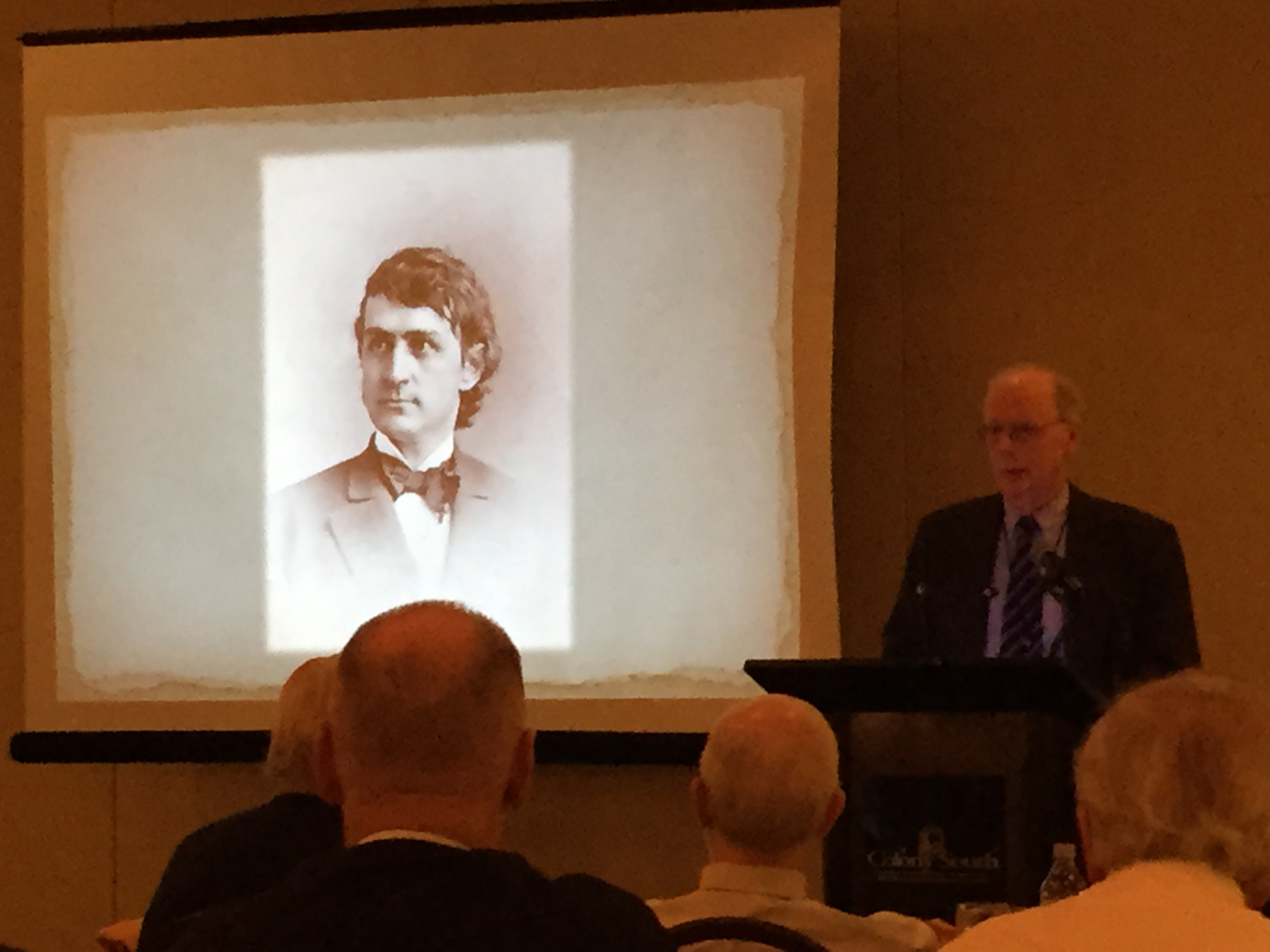
Fast forward to 2015. At the annual Surratt Society conference, Booth biographer Terry Alford presented on his book Fortune’s Fool. When discussing members of the Booth family, Dr. Alford surprised those of us in the audience by showing a new image of Joseph Adrian Booth in his slideshow.
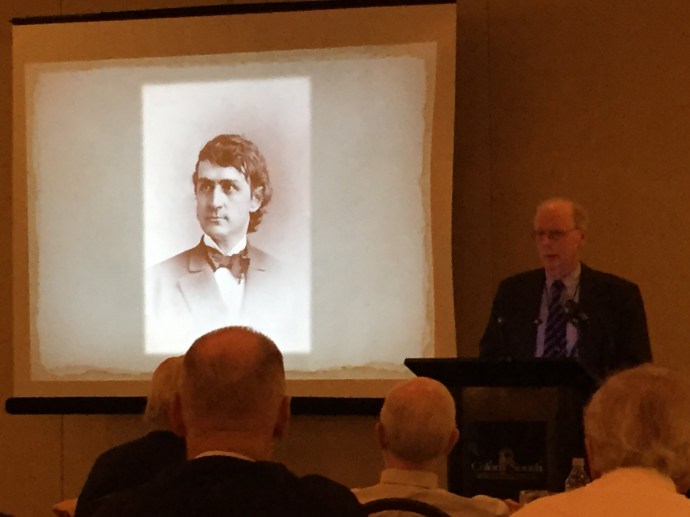
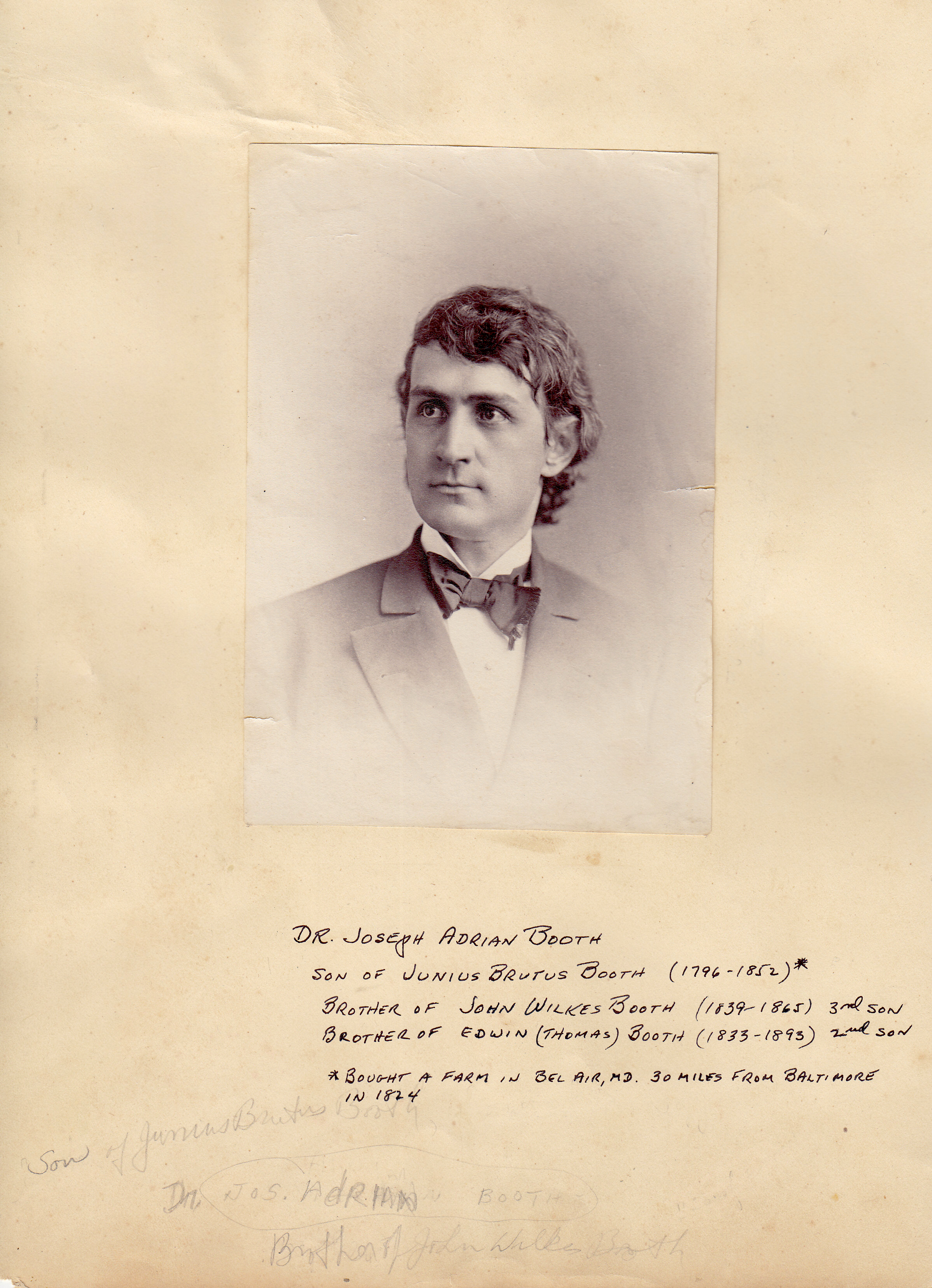
Dr. Alford stated he had stumbled across this image as part of an auction listing that had sold during the previous year. My interest was very much piqued by this development. After returning home from the conference, I found the online auction listing. On May 4, 2014, that photograph was part of a lot of “Documents: Four Maryland items” and sold for $80 by Alex Cooper Auctions. It was a random assortment of items. Here is the full photograph, which includes notes in two unknown hands identifying the subject as Joseph Booth.
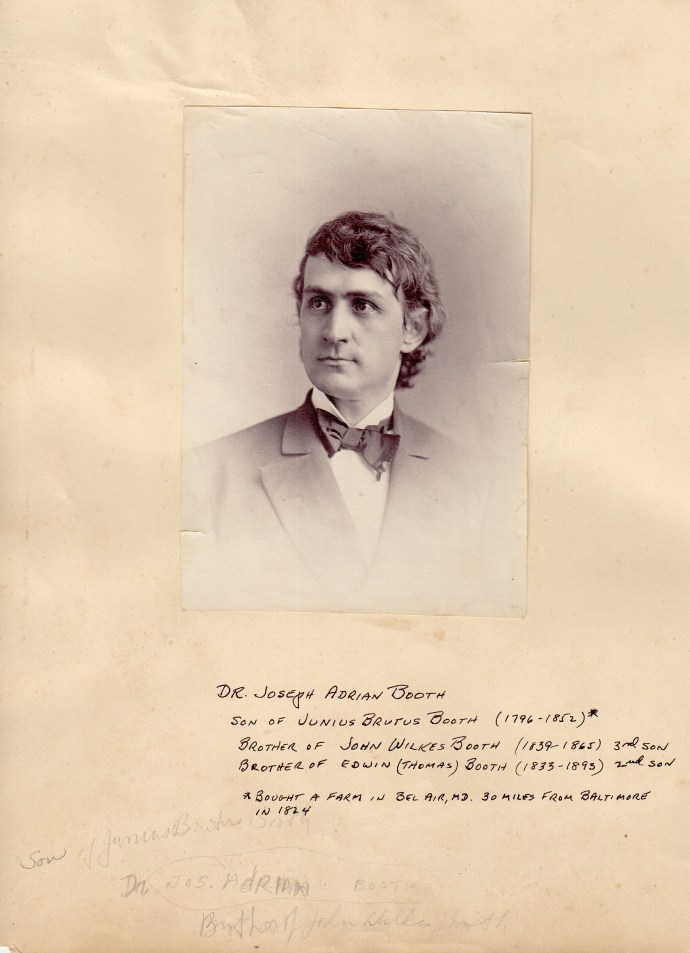
We were all so pleased to find, after long last, another picture of the youngest Booth brother. And it was such a striking image as well. Rather than a standing pose lacking in quality, here was a strong portrait image. With the written identifications on the image and the figures’ strong resemblance to his brother, Edwin, it was a slam dunk. I added this photo to my online gallery for Joseph Booth, and the folks at Tudor Hall started using this much better image in their promotional materials about the Booths.
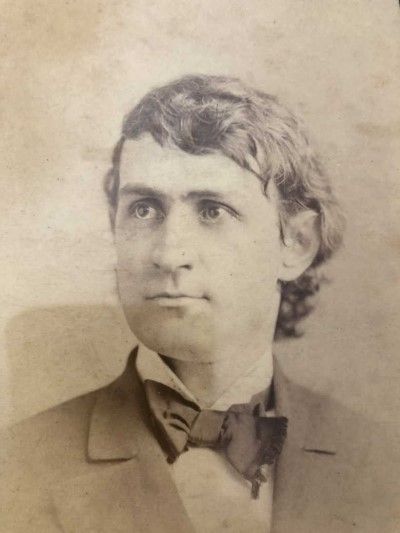
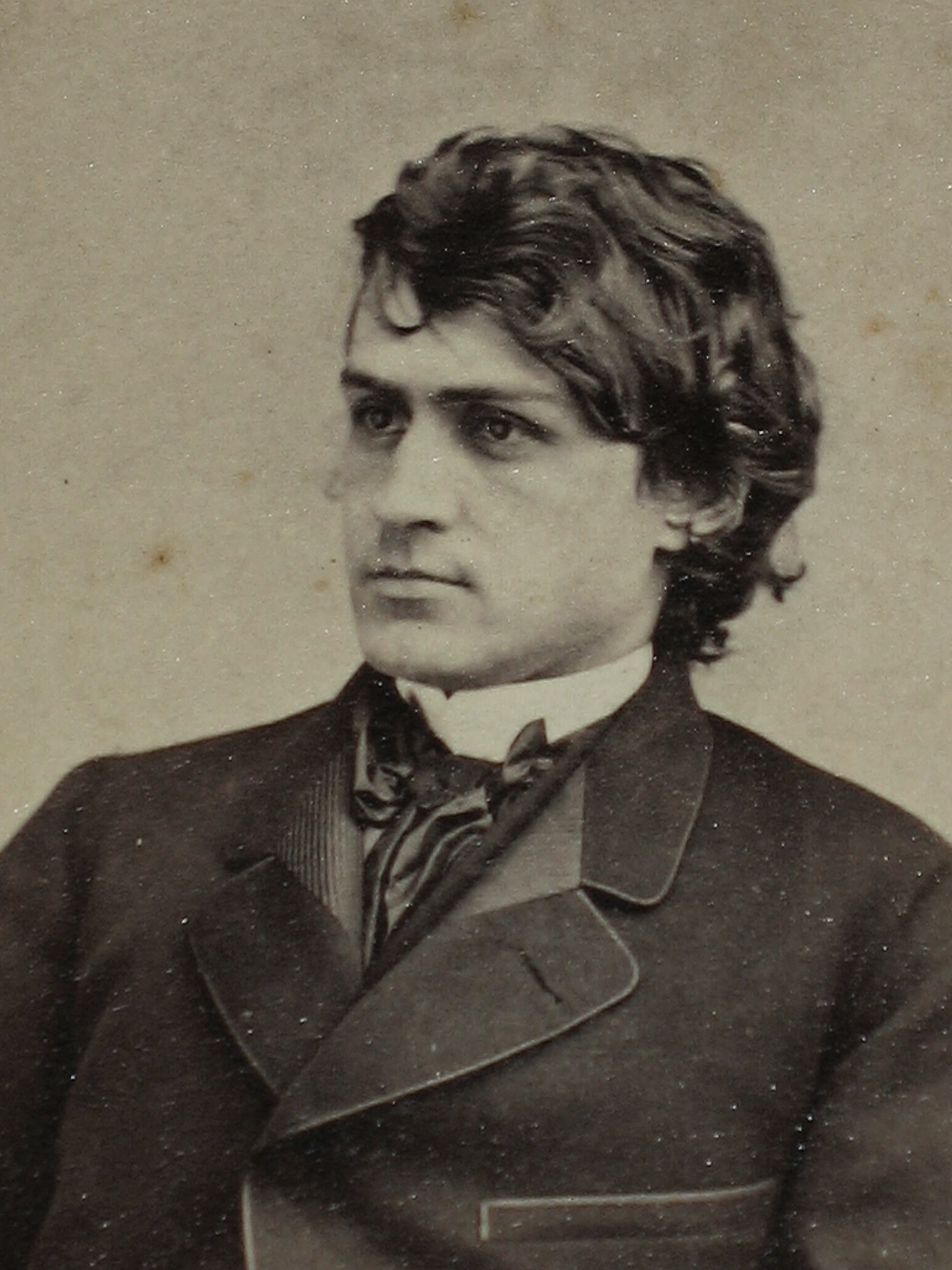
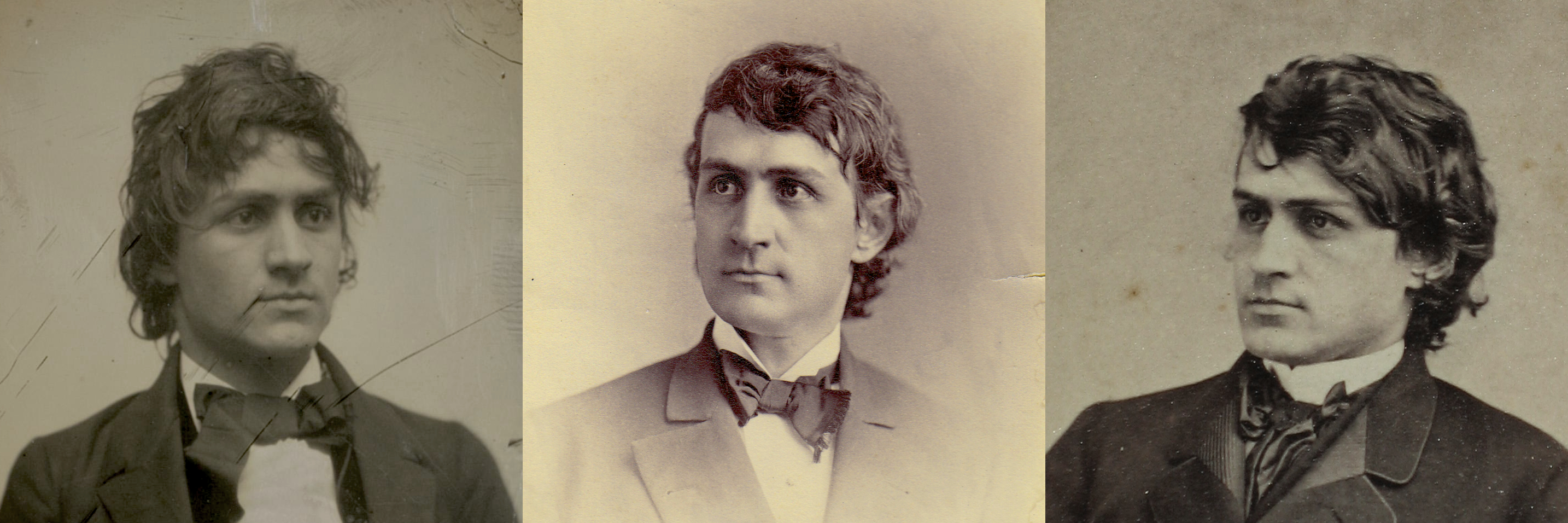
Then just this past week, lightning appeared to strike again. I received an email from a gentleman named David who had recently purchased a collection of unidentified carte de visites off of eBay. In an effort to identify the subjects of the photographs, David photographed the CDVs and tried using the Google Lens search tool to see if there were any matches. This is a form of Google Image search where you provide the image, and Google tries to find matching or similar versions of it. I have used this form of visual search when trying to find higher-quality versions of different illustrations. It can be a useful tool, but it is not always reliable, especially when it comes to facial recognition. Still, in this case, the image search found enough similarities between Dr. Alford’s picture of Joseph Booth and one of the unidentified CDVs that David had purchased. Here is the image:
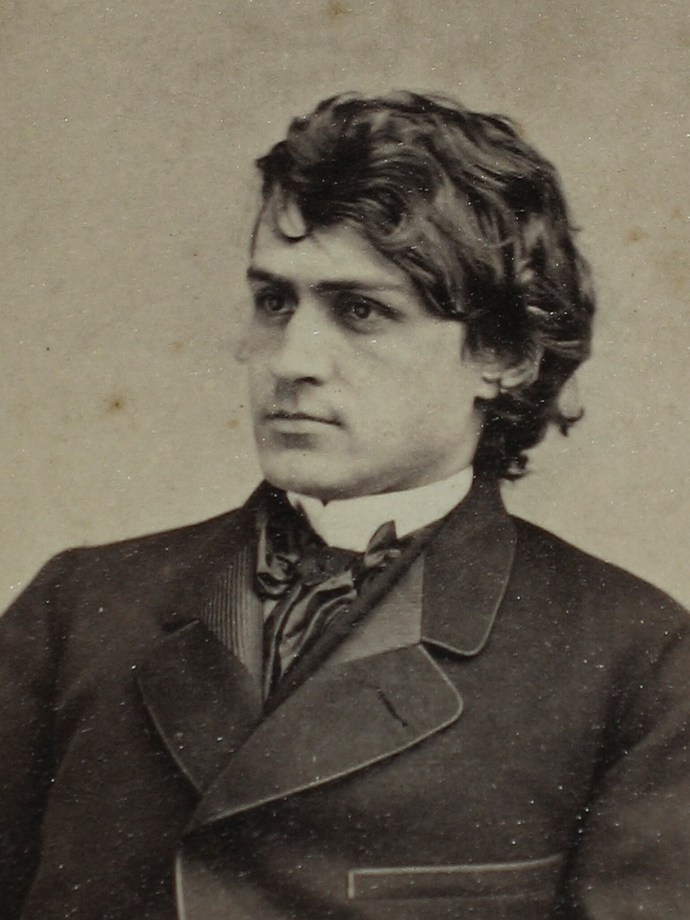
For once, I tend to agree with the computer here. While the figure is in a different pose and wearing a different suit of clothing, he very closely resembles Dr. Alford’s find from a decade earlier. Even the visible part of the ear matches. I was ecstatic that yet another new photo of Joseph Booth had appeared.
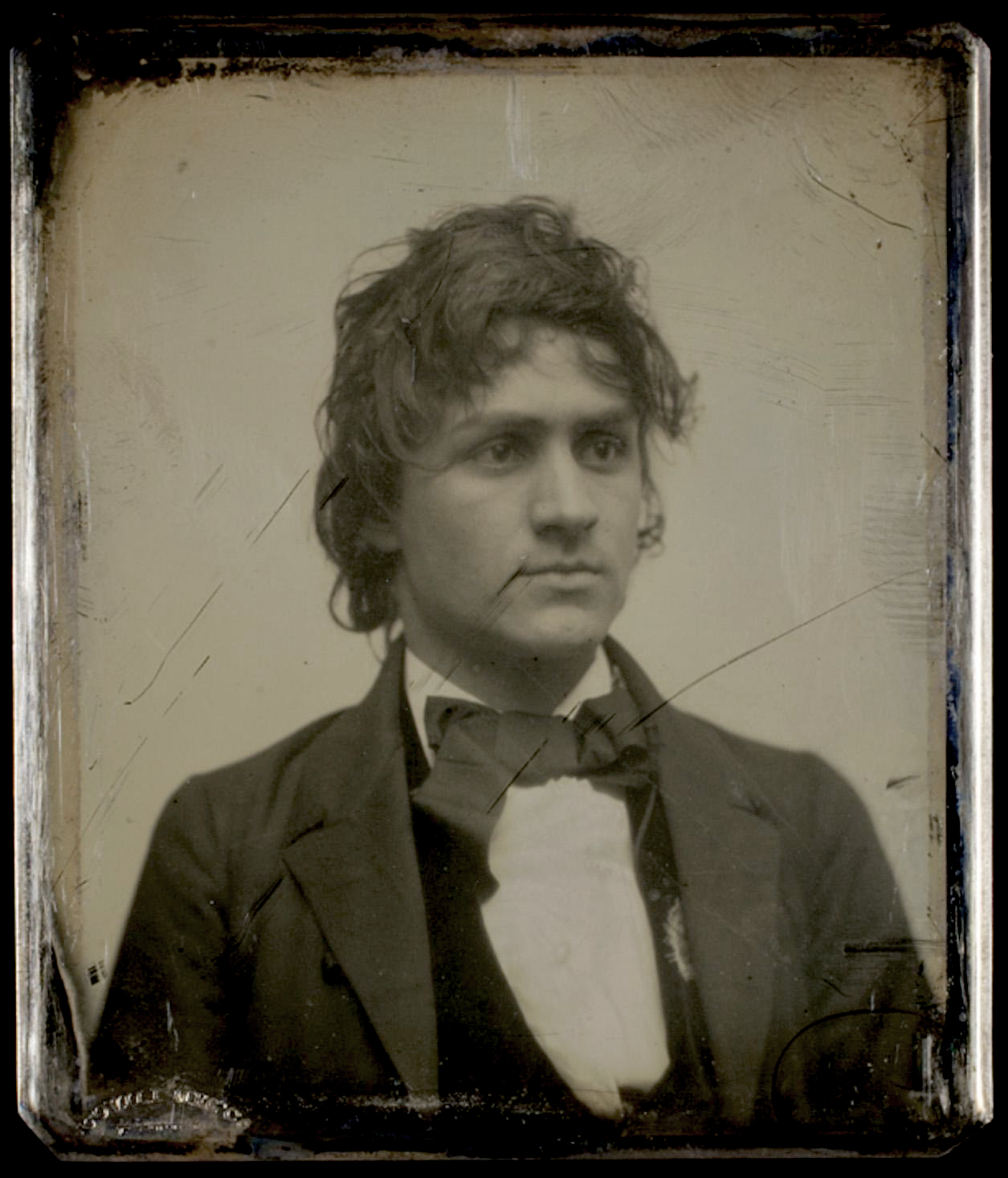
But David was not done. He also informed me that during his search, another image popped up as a possible match. It consisted of this unidentified daguerrotype taken by the Boston photographer Southworth & Hawes in the collection of the George Eastman Museum in Rochester, New York.
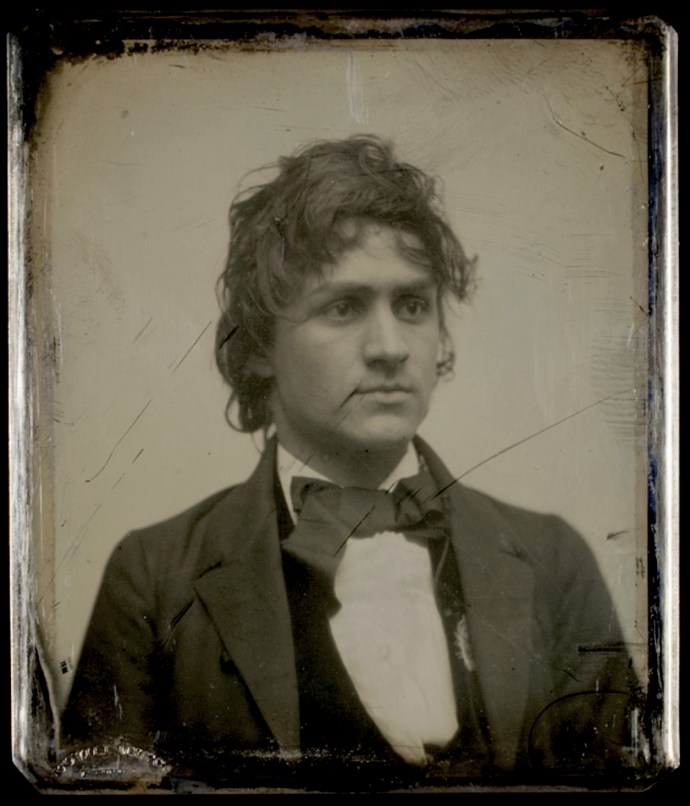
While obviously taken a few years before the other exemplars, I was once again struck by the visual similarity of this daguerrotype with Dr. Alford’s image and the new CDV image. Once again, I found myself agreeing with the Google search that this image is a match. I truly believe that all three images depict the same person.
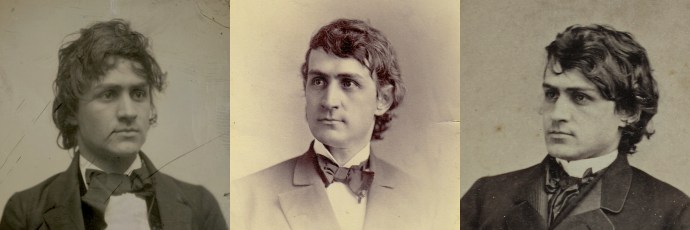
I was very excited and even offered to buy the CDV image from David if he was willing to sell it. Before hearing back from him on that, I likewise played around with the Google visual image search using Dr. Alford’s image. It connected me with the Southworth & Hawes daguerrotype as well, but it also found this copy of the same image as Dr. Alford’s.
While this is the exact same pose as Dr. Alford’s photo, I knew this was a completely different copy. There is a noticeable difference in picture quality between the two. But, even more apparent to me was that the photo on Ancestry lacked a small watermark that I snuck into the photo when I uploaded it to my site. At the time, I faintly put the then name of my website, “BoothieBarn.com,” in the figure’s messy hair. This image lacks that small watermark, so it had to come from a different source image. That meant another print of Dr. Alford’s photo existed somewhere.
I came to find that this image was attached to a FindaGrave page. However, it was not connected to Dr. Joseph A. Booth, as I expected, but rather to a man named Col. Verres Nicholas Smith.
FindaGrave is a great resource, but you always have to be careful when it comes to images you might find on there. There is very little moderation for photo uploads, and there are those who mistakenly (or purposefully) upload spurious photographs. The FindaGrave pages for many of the Booths contain images of people who look nothing like them (all from one user who clearly has face blindness). But, I’d like to think the majority of folks try to be honest in their photo uploads, so I sent a message to the user who had attached Dr. Alford’s image to Col. Smith’s page. I asked him where he came across the image and told him that it has been identified as Joseph Booth. I wasn’t sure if I would hear back, but figured it didn’t hurt to send the message.
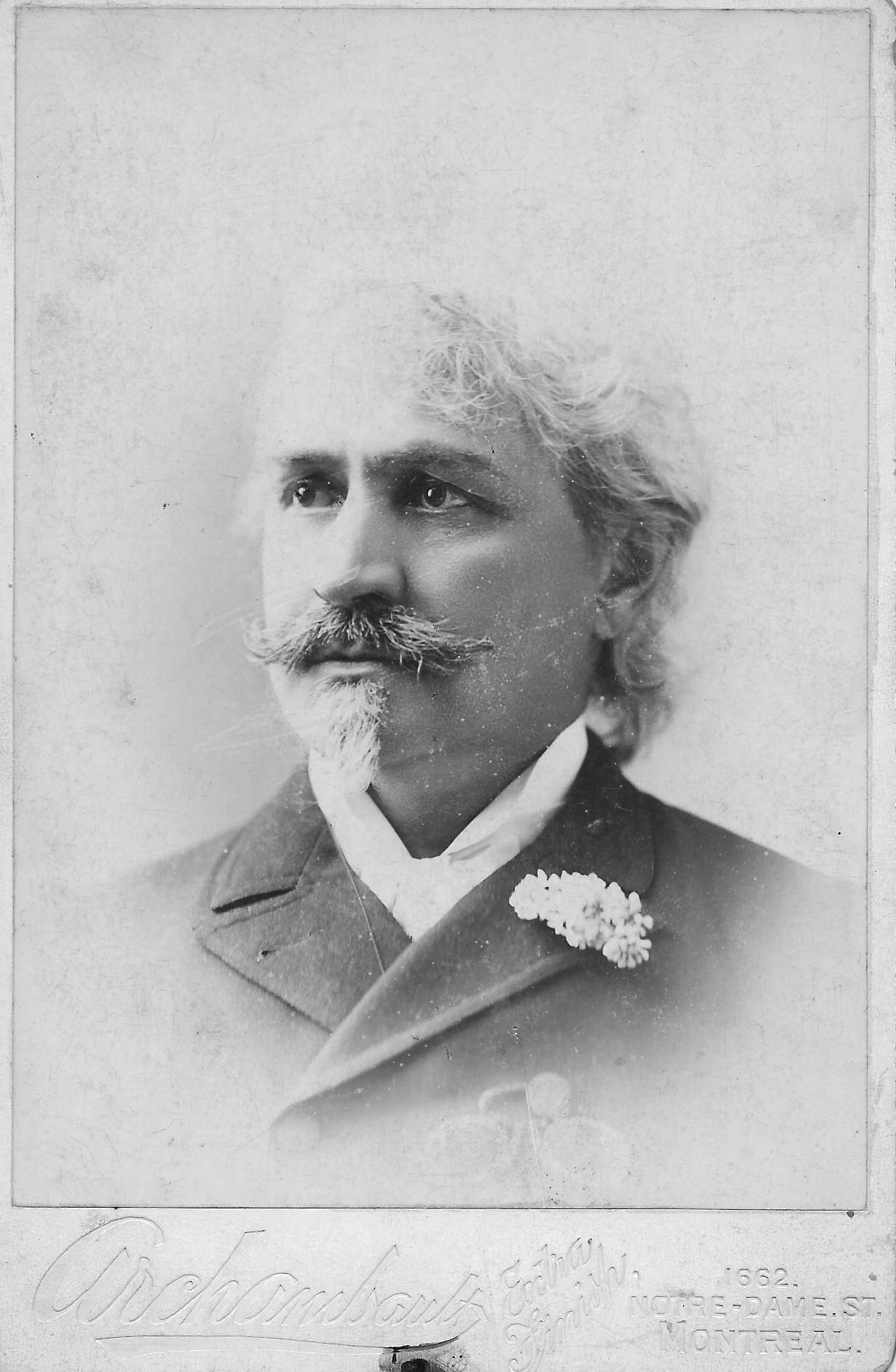
Luckily for me, the FindaGrave user named Ed got back to me right away in a detailed email. Ed stated that he was a distant relative of Horace Greeley, the noted newspaper editor who founded the New York Tribune. He told me that Col. Smith had married Ida Greeley, one of Horace’s children. He found this different print of Dr. Alford’s photograph attached to Col. Smith in a Greeley family tree on Ancestry.com. Ed was also kind enough to send me another image of Col. Smith, this time as an older man, that was attached to the same family tree.
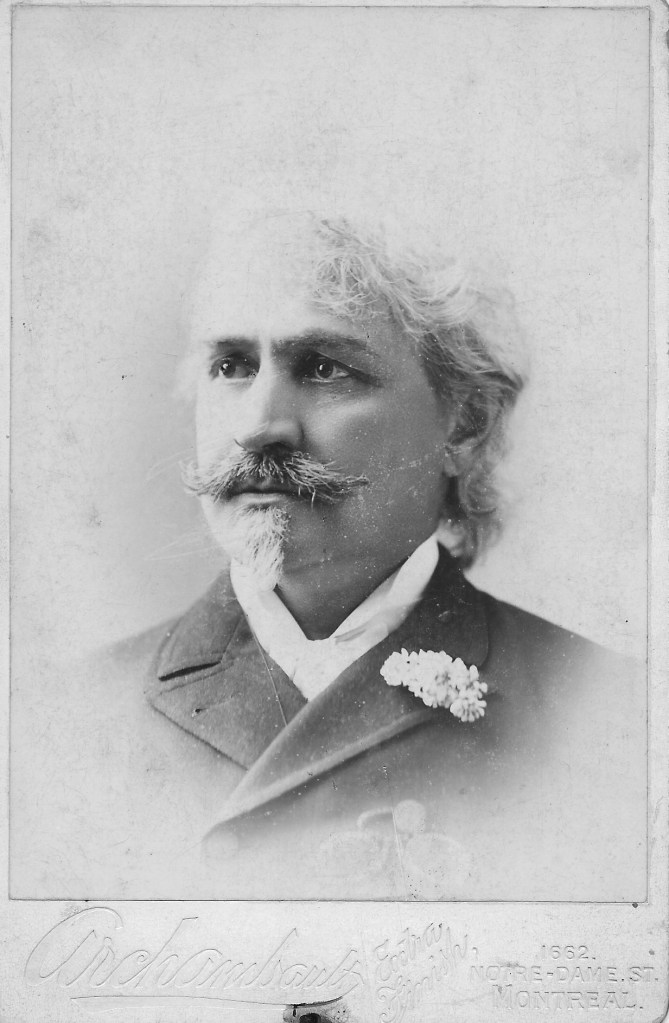
The same family tree uploaded an image of the back of this photo, on which contained the words, “‘Col.’ Nicholas Smith / U.S. Consul at 3 Rivers [illegible] / about 1891 (Widower) / was married to Horace / Greely’s daughter. Had a / son & two daughters.”
Comparing this older photograph of Col. Smith and Dr. Alford’s photograph of Joseph Booth gave me a sinking feeling in my gut. While the older man has gained a mustache and imperial Napoleon III-style beard, the similarities in the remaining features are uncanny. It would be incredibly difficult to argue that these images don’t show the same man taken years apart. Armed with Ed’s lead, I started researching this Col. Smith fellow.
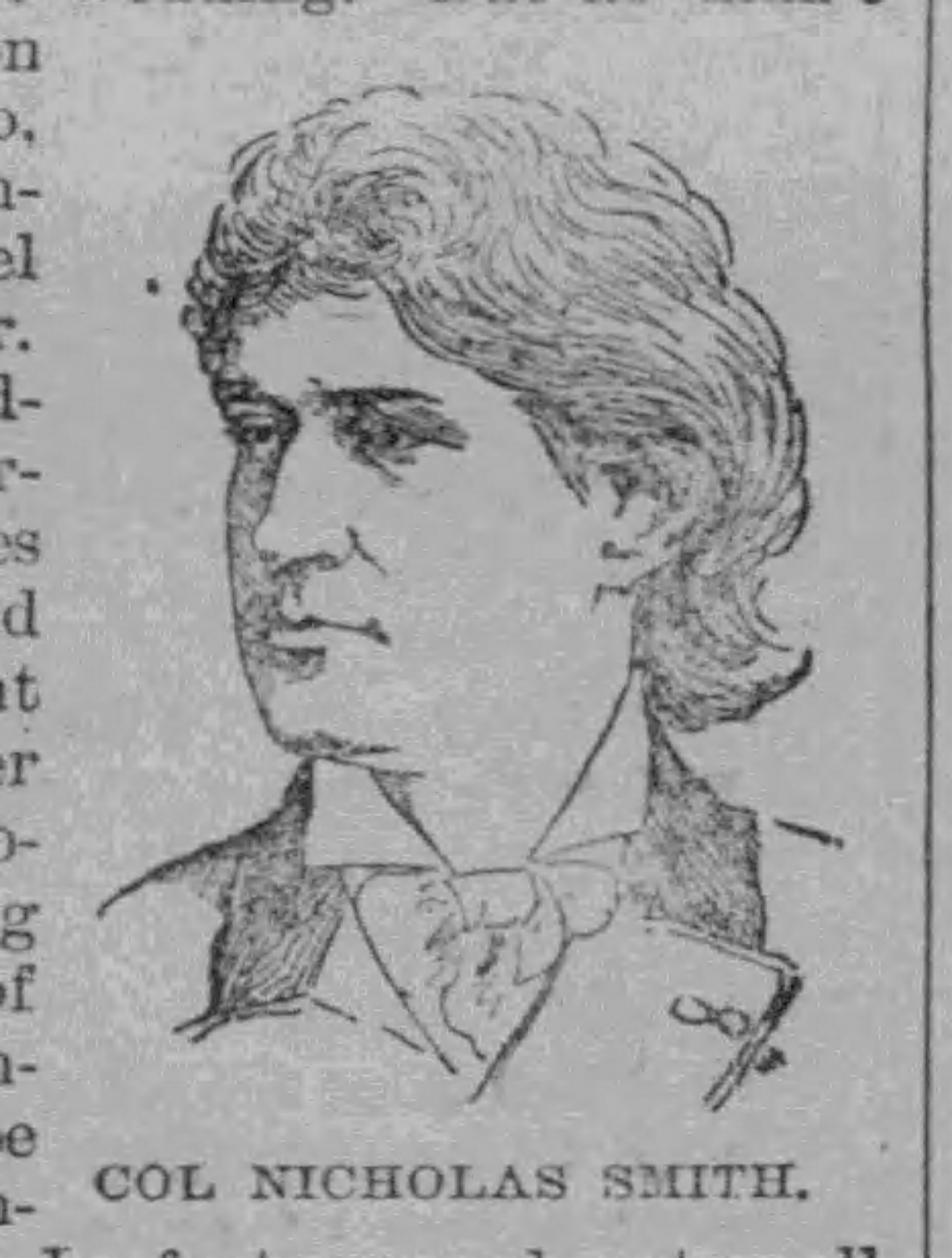
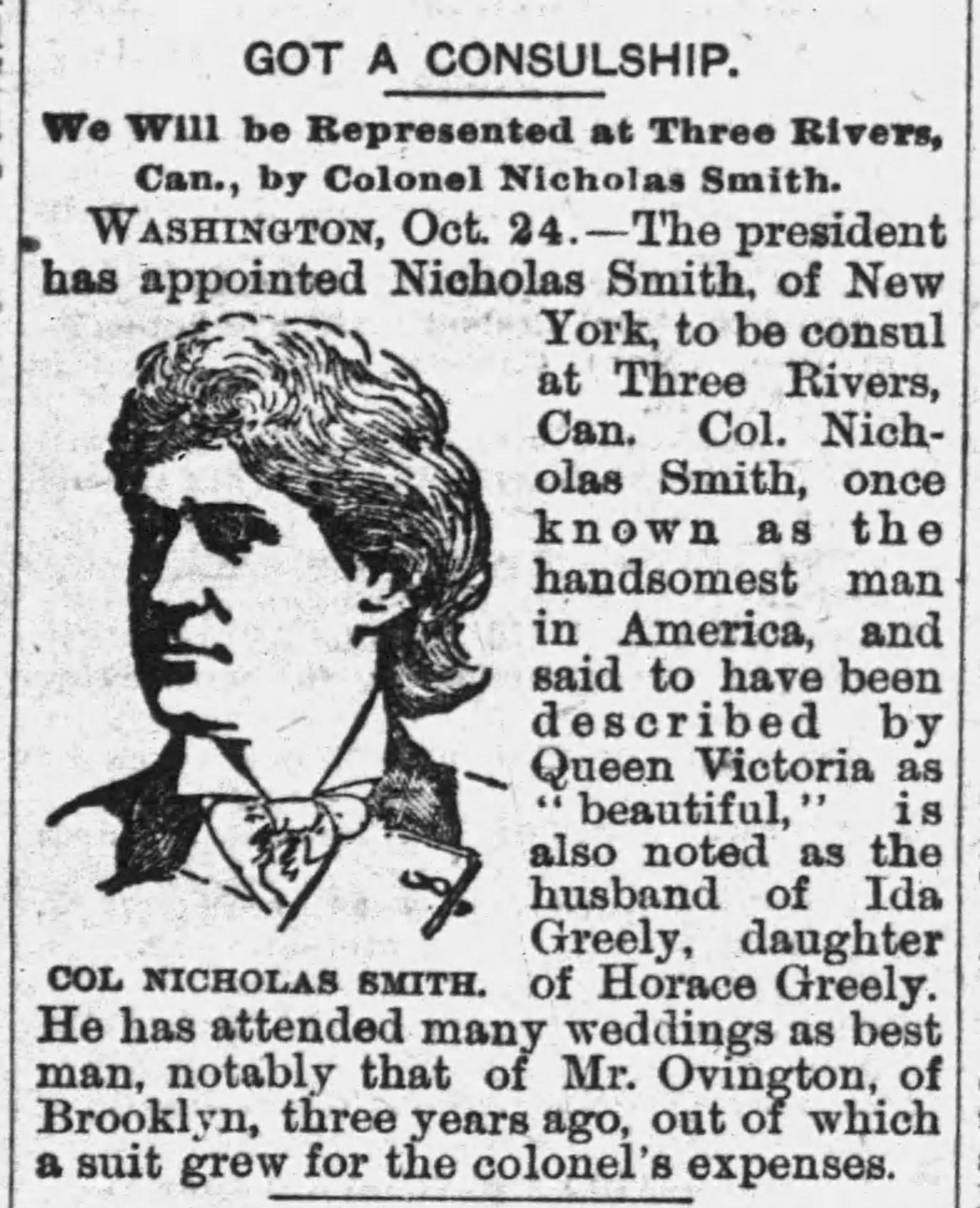
What I found proved my fears to be true. A drawing of Colonel Smith was included in an article about him in 1887. It was once again a dead ringer for the images we had come to believe to be Joseph Booth.
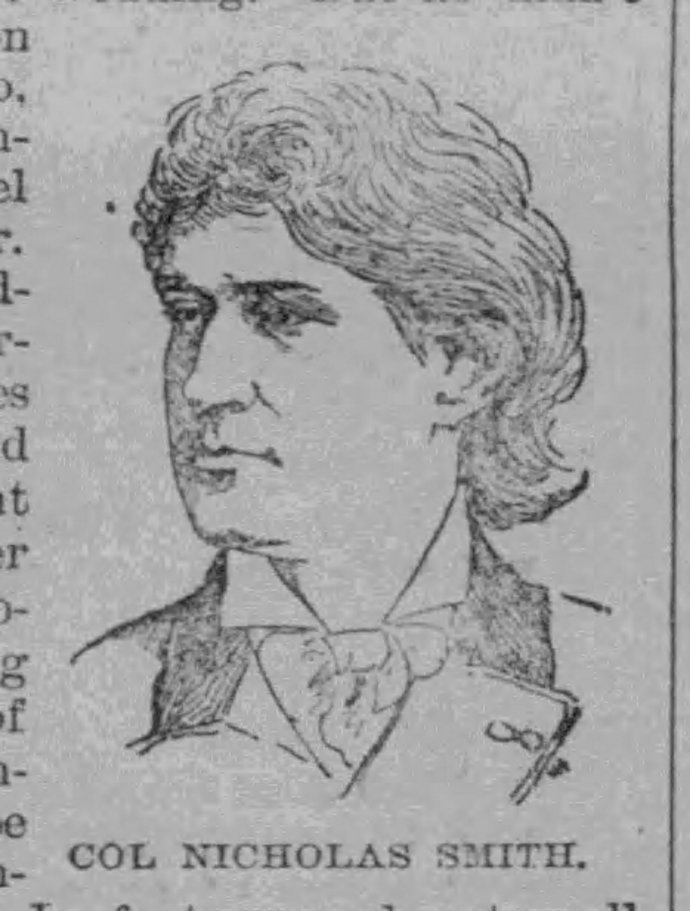
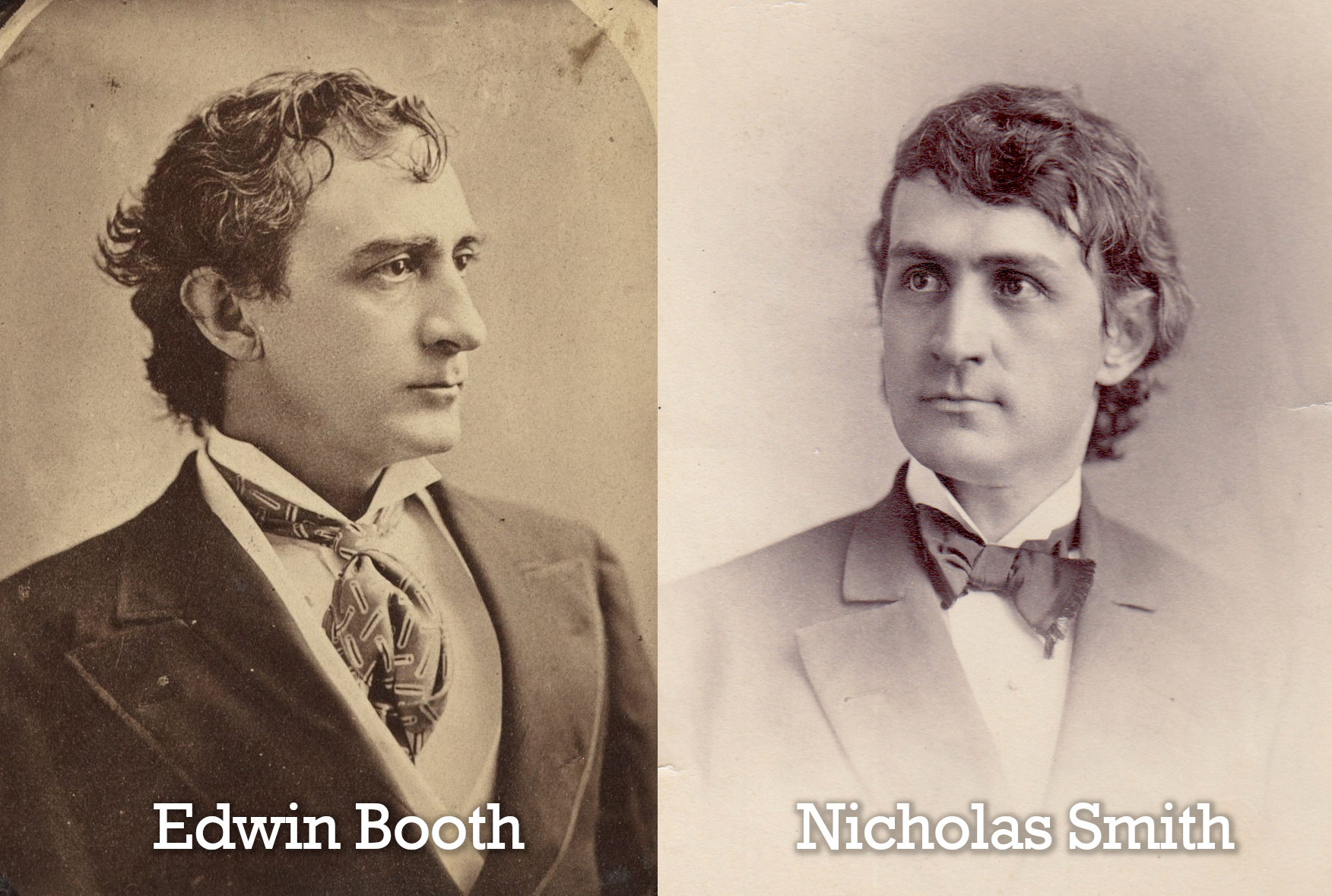
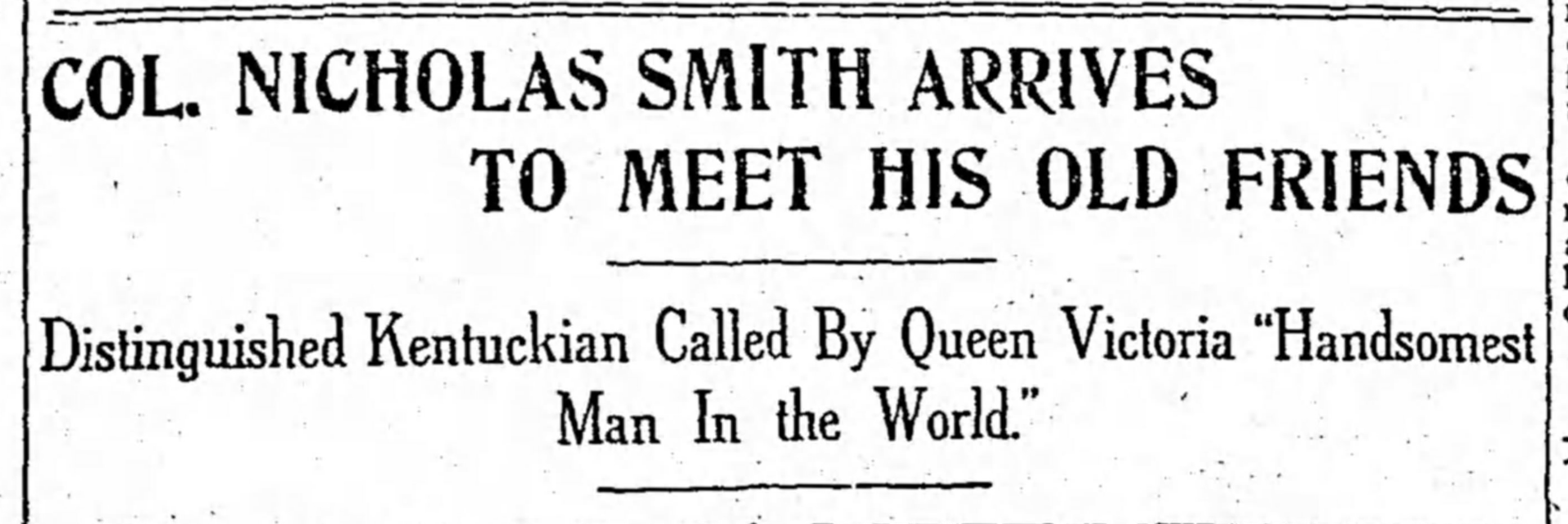
Moreover, I found many instances where Col. Smith’s appearance was described in the press. As strange as it sounds, he became well-known for being an exceptionally handsome man. Many articles described Col. Smith’s beauty, with the most referenced comparison being a famous actor of the day:
- “In appearance he greatly resembles Edwin Booth, and is often taken for that gentleman. One night he entered a box at the theater, when he was immediately the object of all eyes. ‘There is Edwin Booth,’ they all exclaimed, as they leveled their opera glasses at what they supposed to be the great actor.” – The Tennessean, April 30, 1875
- “He is a fine specimen of refined manly beauty. Our lady readers will believe this when we say that he is ‘a perfect image’ of Mr. Edwin Booth” – Brooklyn Eagle, May 1, 1875
- “He resembles Edwin Booth, and has often been taken for the great actor, but upon close inspection is always conceded to be a better looking man.” – The Landmark, May 7, 1875
- “His beauty is of the Edwin Booth type, if that may be called a type of its own.” – Chicago Tribune, May 8, 1875.
- “Nicholas Smith, Ida Greeley’s husband, is followed in the streets because of his likeness to Edwin Booth, whom he imitates in make-up.” – Springfield Daily Republican, January 28, 1876
- “He has a clear-cut, handsome face, somewhat after the style of Edwin Booth’s, and dresses himself like a Puritan captain.” – Buffalo Courier, July 3, 1881
- “His face is as sharp and shaven as Edwin Booth’s.” – The Times-Democrat, February 12, 1883
- “At Saratoga one summer it was reported that a lady said to him: ‘Colonel Smith, how much you resemble Edwin Booth.’ The Colonel drew his form up to full height, as he responded in a tragic tone of offended dignity: ‘Madame, I am a much handsomer man than Edwin Booth.’” – Pittsburgh Post-Gazette, July 4, 1885
- “He is tall, strong and athletic, with full and regular features crowned by a wealth of white hair, worn a la Edwin Booth, whom he markedly resembles in expression, although he is a much larger man.” – Brooklyn Eagle, November 30, 1887
- “He somewhat resembles Edwin Booth and prides himself upon his often being mistaken for the great actor.” – Reading Times, July 13, 1888
Taken together, it seems clear that Dr. Alford’s photograph and the subsequent matching images found by David the eBay collector are not of Joseph Booth but of “Col.” Verres Nicholas Smith. The written identification of Joseph Booth on Dr. Alford’s image was incorrect.
What probably happened was that someone saw this photograph, which was unidentified, and noticed the figure’s strong resemblance to Edwin Booth. Yet, while the future looked a lot like Edwin Booth, there were enough differences to tell that it was clearly not the famous tragedian. Nor did the photo perfectly match Edwin’s father, Junius, or brothers June and John Wilkes, of whom many exemplars of comparison exist. Therefore, someone decided that it must be the forgotten brother, Joseph Booth, of whom only one photo was known to exist. They mistakenly identified the image as Joseph and, due to the strong Booth-ness of the figure’s features, we readily accepted it as the lost Booth brother.
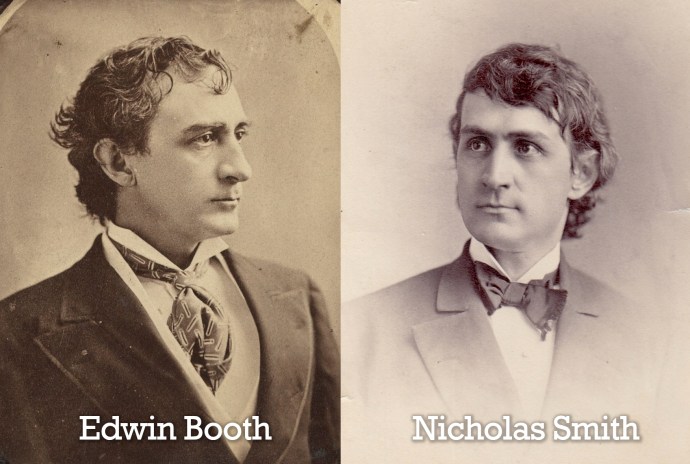
But, in fact, this was an image of Nicholas Smith, a man whose resemblance to Edwin Booth was well documented in the papers, and for whom we have matching identified images in the papers, and in his later life. Rather than being able to announce new pictures of Joseph Booth, I must, unfortunately, report that the number of Joseph Booth photographs has dwindled back down to one. The only confirmed photo we have of Joseph is the standing pose from The Players.
Over the course of my research, I assembled a large amount of information about our would-be Joseph Booth, Nicholas Smith. He lived an interesting life, not without controversy. For those interested in reading more, here is a biography about the man who, during his prime, was claimed to have been the handsomest man in the world:
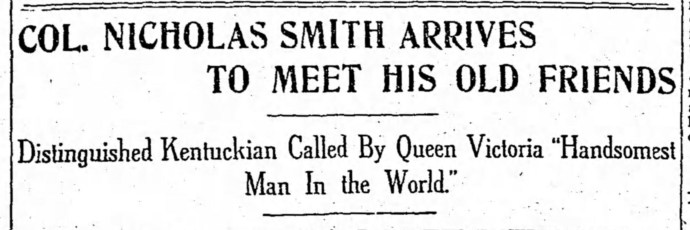
Verres Nicholas Smith was born in Shelbyville, Kentucky, on December 25, 1836. In his younger years, he sometimes went by V. N. Smith or V. Nicholas Smith. When he was about three years old, his father died. His mother, Mary, did not remarry, and in the 1850 census, she is listed as a farmer with real estate property valued at over $11,000. She passed away in 1854. In 1855, Nicholas went to live with his older sister Kezia, who had married a man named Hamilton P. Johnson. The family left Kentucky and took up residence in Leavenworth, Kansas, in the midst of Bleeding Kansas. It is said that, originally, Hamilton Johnson was a strong pro-slavery man, but after his move to Kansas, he changed his mind and ended up freeing the men and women he had enslaved. It appears that Nicholas Smith also came out against the practice of slavery during this period.
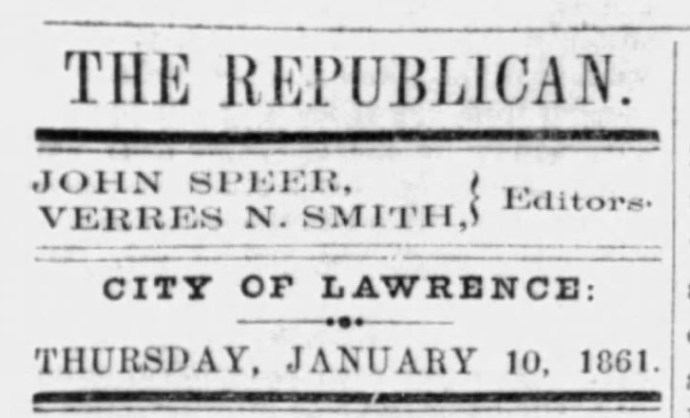
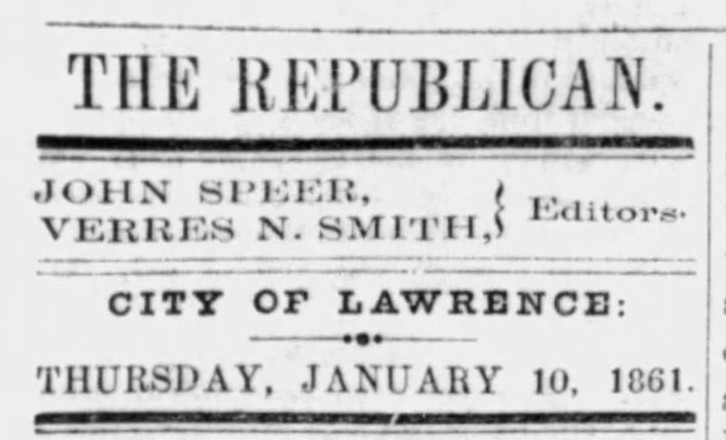
In the late 1850s, Smith traveled to the East Coast, where he attended Dartmouth College for a time, as well as Harvard Law School. It does not appear that Smith actually graduated from either school, though he was enumerated in the 1860 census as being back in Leavenworth with his sister’s family as an “attorney at law.” For about a four-month period in early 1861, Smith tried his hand at being a newspaper editor for a Lawrence, Kansas, paper called The Republican. This paper heavily supported Kansas Senator James Lane, and it was through this advocacy that Smith became a familiar figure in state politics.
Yet even at this young age, Smith was known for his eccentricities. As an editor, he wrote in very flowery and Roman-esque prose. “Nick was never heard to use short words when long words would answer,” recalled an associate. “His literature was a little too classical for his audience, and regular ‘corn-field talk’ would have done better,’ recalled another. Smith was also very particular about his appearance. He dressed in the finest clothes he could find and went out of his way to keep them immaculate. Once, Smith refused to cross the street to enter the newspaper office because the road was very muddy and he didn’t want to soil his boots. It also became a regular sight to see Smith, dressed in a white suit, riding his horse with newspapers wrapped around his legs so that his pants would remain clean. For these eccentricities of speech and dress, many in his area of Kansas began calling Verres Nicholas Smith by the nickname “Very Ridiculous Smith.”
That “Very Ridiculous” was handsome, however, no one could deny. Here is a lengthy description of Nicholas Smith’s beauty written in 1886:
“[He] is a handsome man, and he knows it. He has enjoyed this reputation for twenty years, and it does not worry him in the least. His presence is irresistible. His eyes are dark, and have a ravishing glow that would melt the pen of Thomas Moore into a new houri haunted ecstasy… There is an admixture of Greek distinctness and Oriental richness in the lines of his face, the profile being clear-cut and regular and the contour of the oval pattern so much admitted in Asiatic maidens. Smooth-shaven, with rounded cheeks and a pale wine-glow to his skin that helps to brighten the effect, [Smith’s] handsome face is strikingly framed in a profusion of curled and tossed… hair that he evidently cultivates with great care and that is not parted at all, but falls forward upon his forehead in bewitching little beau-catchers, as they are called when girls wear them, that droop to either side… Fully six feet in height, well built, well dressed, and…fully equipped for heart conquests among the other sex, and if all that is said about him be true, is one of the most successful fascinators now before the public.”
At the end of April 1861, Smith sold his interest in his paper. Never one to be humble, Smith reassured his readers that the new editor was “as clever a fellow as I am.” For the next two months, Smith remained around Lawrence, interacting with members of the anti-slavery political elite as the Civil War began. Likely through the influence of Senator James Lane, Smith received a commission in the regular army. He accepted the position of a Captain in the 19th U.S. Infantry. He reported to Indiana, where he was assigned to recruiting duty in Evansville for a time. He was later transferred from Indiana to Louisville, Kentucky, not far from where he was born, to continue on recruiting and disbursing duties.
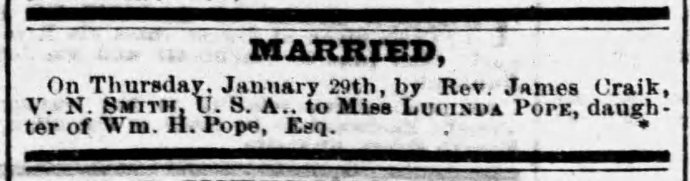
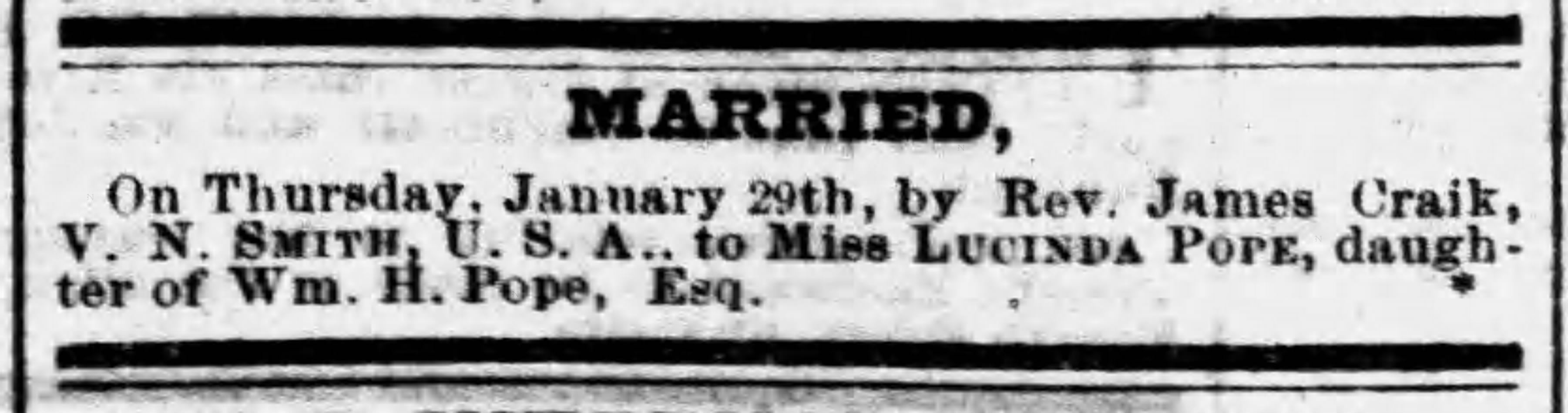
While stationed in Louisville, Smith made the acquaintance of Lucinda Pope. She was the daughter of a wealthy farmer and merchant named William Pope. The two courted and married on January 29, 1863, while Captain Smith was still in the service.
As an Army captain, Smith left much to be desired. In April 1863, Union Maj. General David S. Stanley arrived in Louisville. Not long after, Gen. Stanley wrote a letter to the adjutant general’s department about different reports he had heard from locals and other officers regarding Captain Smith’s conduct:
“It is complained of him that his associations are entirely with people of rebel proclivities. He has married since coming here, and his father in law and wife are outspoken rebels, and ‘tis said… that old Pope his father-in-law would not allow him to visit his house in uniform. He goes habitually in citizens dress, and was married in that costume. No officers of the army being invited to the ceremony.”
In addition to his new wife and in-laws being on the side of the Confederacy, Captain Smith was also not one to work very hard in his recruiting duties. Years later, the newspapers joked that during his two years of service, “he recruited two men at an expense of $6,000 to the Government.” His service record supports that there were issues with Captain Smith’s accounting books. In February 1863, an order went out relieving recruitment officers of the 19th Infantry from their duties and requiring them to return to their regiment. Captain Smith did not obey this command, choosing instead to stay in Louisville. When officers followed up with him after he failed to report, Smith claimed he had been away from Louisville for several weeks on mustering duty and had not seen the order. He was then again ordered to report to his regiment back in Evansville, Indiana. Yet, Captain Smith did not leave, and Maj. General Stanley wrote in his letter that Smith was proven to have said, “he could not go to such a horrid place as Evansville and if ordered there he must resign.”
Gen. Stanley was at a loss for such poor behavior of an officer. Yet he was not without a solution:
“You know such a specimen of humanity brings disgrace on the regular army, and his example is ‘nuts’ for the secessionists. You can use this information as you desire. The only desire anyone in the army here has is to see the fellow moved to the front, to give him an opportunity to learn the principles of outpost duty. As he had never been in the field, this would only complete his elegant military education… One thing is certain, all loyal people are tired of seeing the fellow here.”
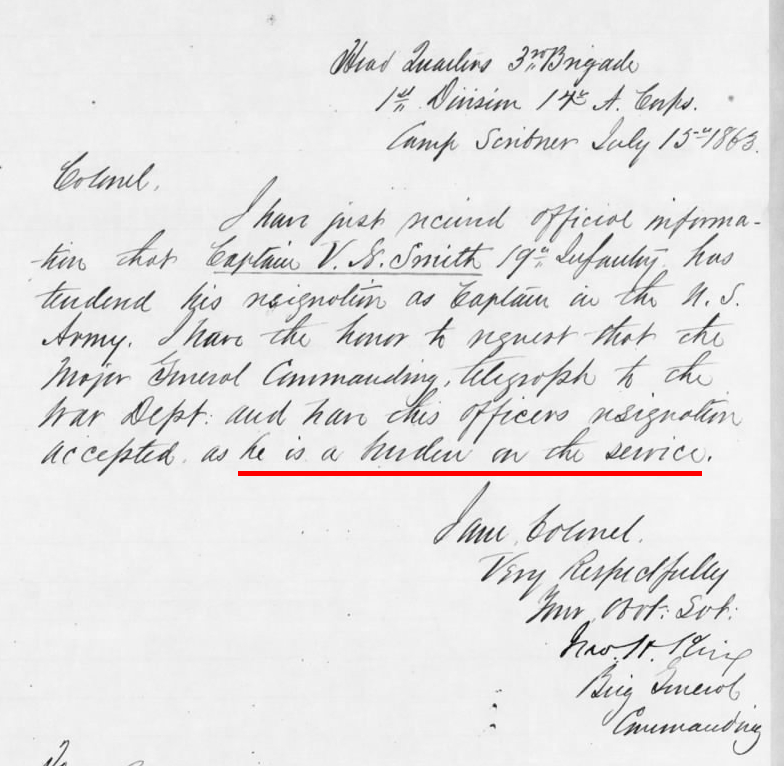
Gen. Stanley’s suggestion was acted upon, and on May 11, a new order came in specifically relieving Captain Smith of all duties in Louisville and ordered him to report to the front without delay. Smith responded with a letter of his own writing, “For some time past I have been physically unfit for duty and would have applied for a leave of absence had not my duties been so light and I unwilling to be wholly without employment. But as it is impossible for me, in my present state of health, to go into the field, I have to ask a leave of absence for three months.” Captain Smith included a certificate signed by an army surgeon verifying that Captain Smith was suffering from “external hemorrhoids with irritable rectum.” Unfortunately, the surgeon only recommended a leave of twenty days for his ailment, so Capt. Smith was forced to reduce his leave request. But headquarters denied even a twenty-day reprieve for this wayward soldier, who should have reported back in February, and it was now June. Fearful of having to do real work, Captain Smith submitted his resignation from the Army. Despite it being in the middle of wartime, where drafts were being instituted to keep up the supply of soldiers, even the Union had had enough of Captain Smith. His commanding officers supported Smith’s resignation request, asking the War Department to approve it because Captain Smith was “a burden on the service.”
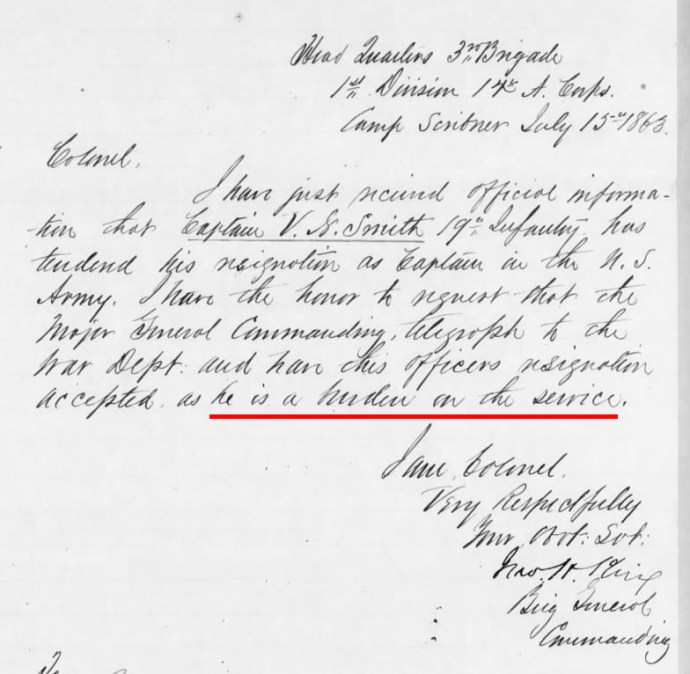
Secretary of War Edwin Stanton accepted the request, and Captain Smith’s resignation took effect on July 16, 1863.
This would prove to be the end of Nicholas Smith’s military career. While in his later years he would be known as Col. Smith, he never actually attained this rank. Nicholas Smith was as much a colonel as Col. Sanders of Kentucky Fried Chicken fame.
Smith’s whereabouts during the remaining war years are a bit uncertain. He likely remained in Louisville with Lucinda for a time, but eventually he returned to Leavenworth, Kansas. Between 1865 and 1869, Nichaols and Lucinda had three children, all of whom sadly died before the age of three. Lucinda Smith also died in 1871 at the age of 30, leaving Smith a widower.
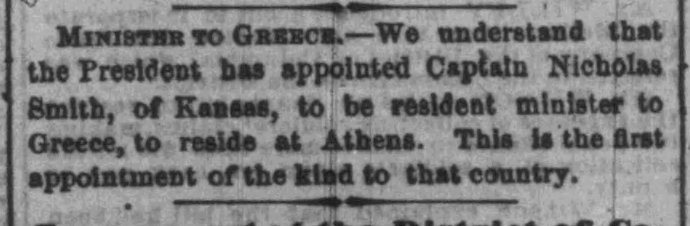
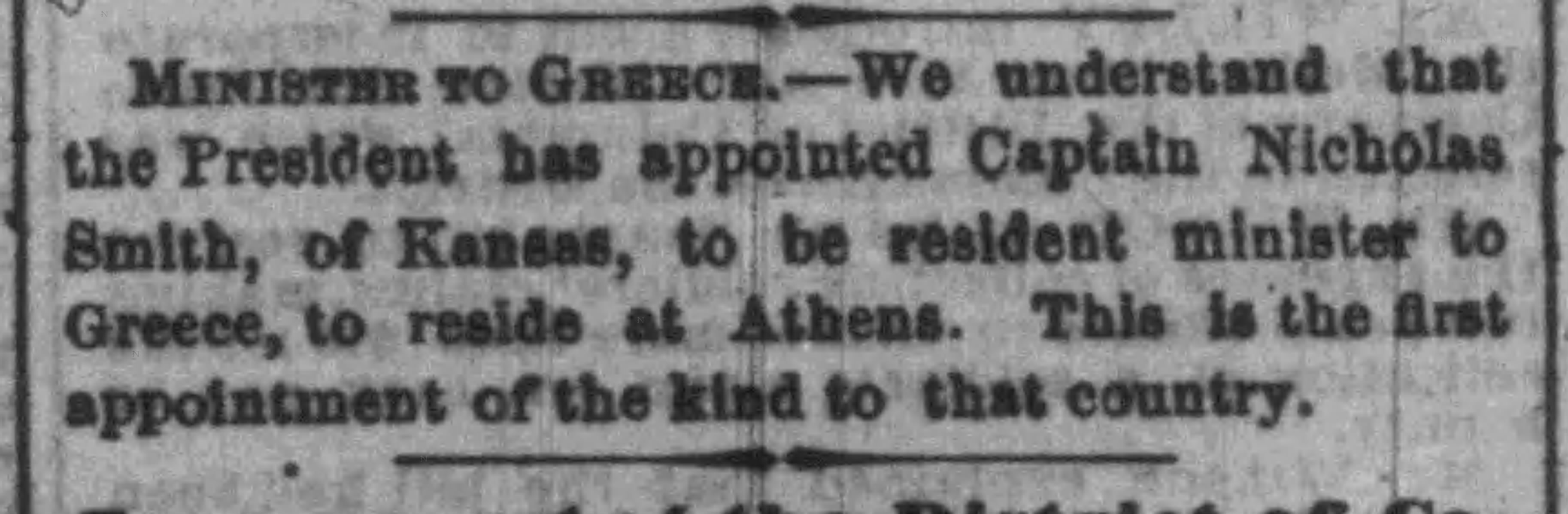
Still involved in Kansas politics and with connections to those in Washington, Nicholas Smith secured a nomination from President Johnson to be minister to Athens, Greece in 1866. If approved, the 29-year-old would have been the first ambassador to Greece. However, four months later, the President withdrew his nomination. One newspaper account stated this was because the Senate Committee had signaled they were against his nomination due to rumors he had “resigned a Captaincy in the regular army rather than fight the rebels.” However, other papers stated the Senate was against the establishment of a consulate in Athens due to the cost, and the withdrawal was no reflection on Smith. It wasn’t until two years later that the U.S. appointed its first ambassador to Greece.
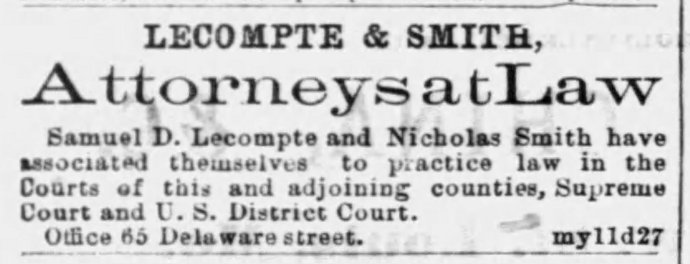
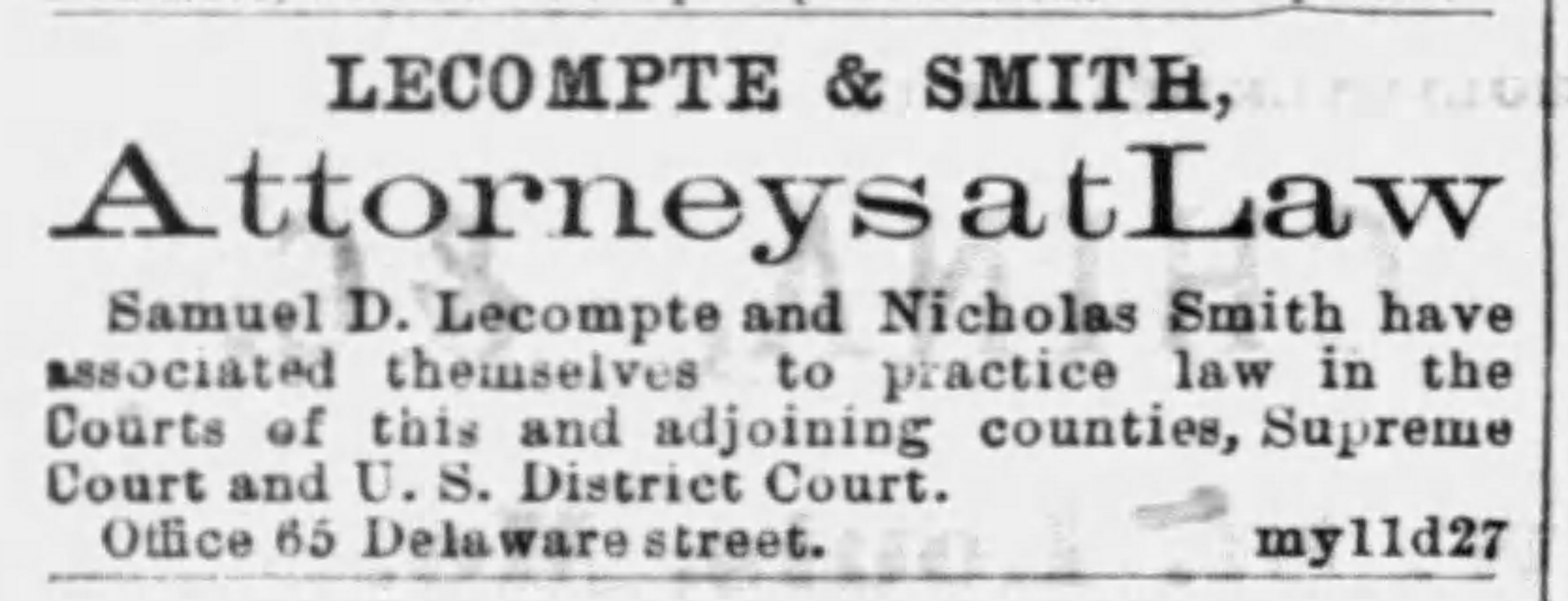
In the late 1860s and early 1870s, Nicholas Smith became an established figure in Leavenworth. He started a law practice, but as a Kansas paper later recalled, “there was nothing in the firm beyond the gilded sign which creaked on the iron rod at the foot of the stairs. Other work the ‘colonel’ could not or would not do. That would have been deucedly ignoble.”
In time, Smith headed east to New York. There, he became ingratiated into high society, welcomed in by his good looks, elegant manners, and pristine wardrobe. “Col Smith is undeniably the handsomest man anywhere. He is gifted also with that wonderful manner which, for the time being, makes the person to whom he is talking, be it man or woman, think him or herself the one object in the world in which or in whose opinions and ideas he is most interested. He is a picturesque talker, full of that peculiar mixture of originality, chivalry, and honesty which seems to distinguish the natives of the border states.” Smith eventually made the acquaintance of Ida Greeley, also well known for her looks and sophistication.
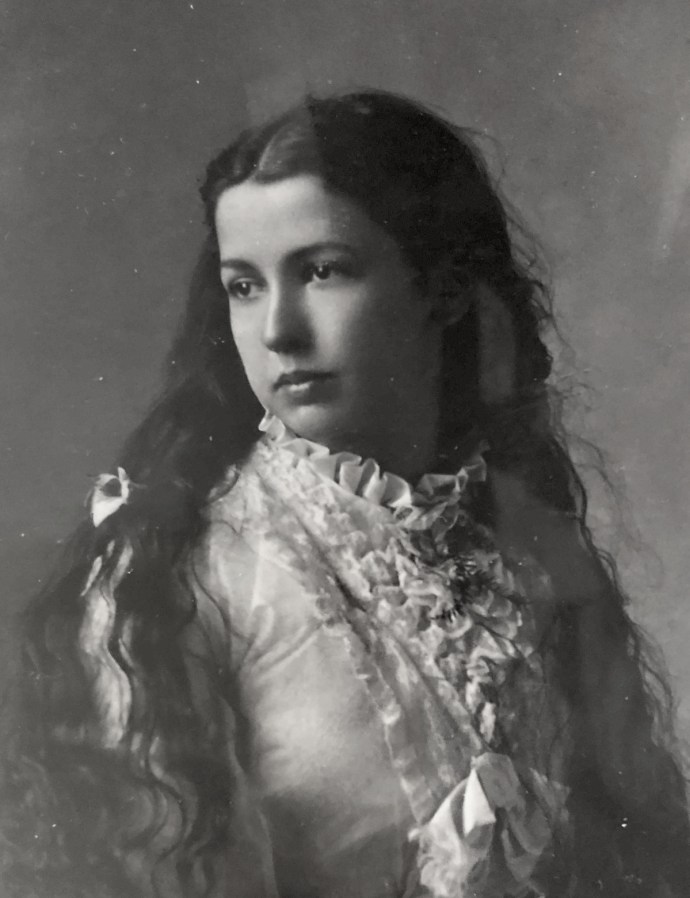
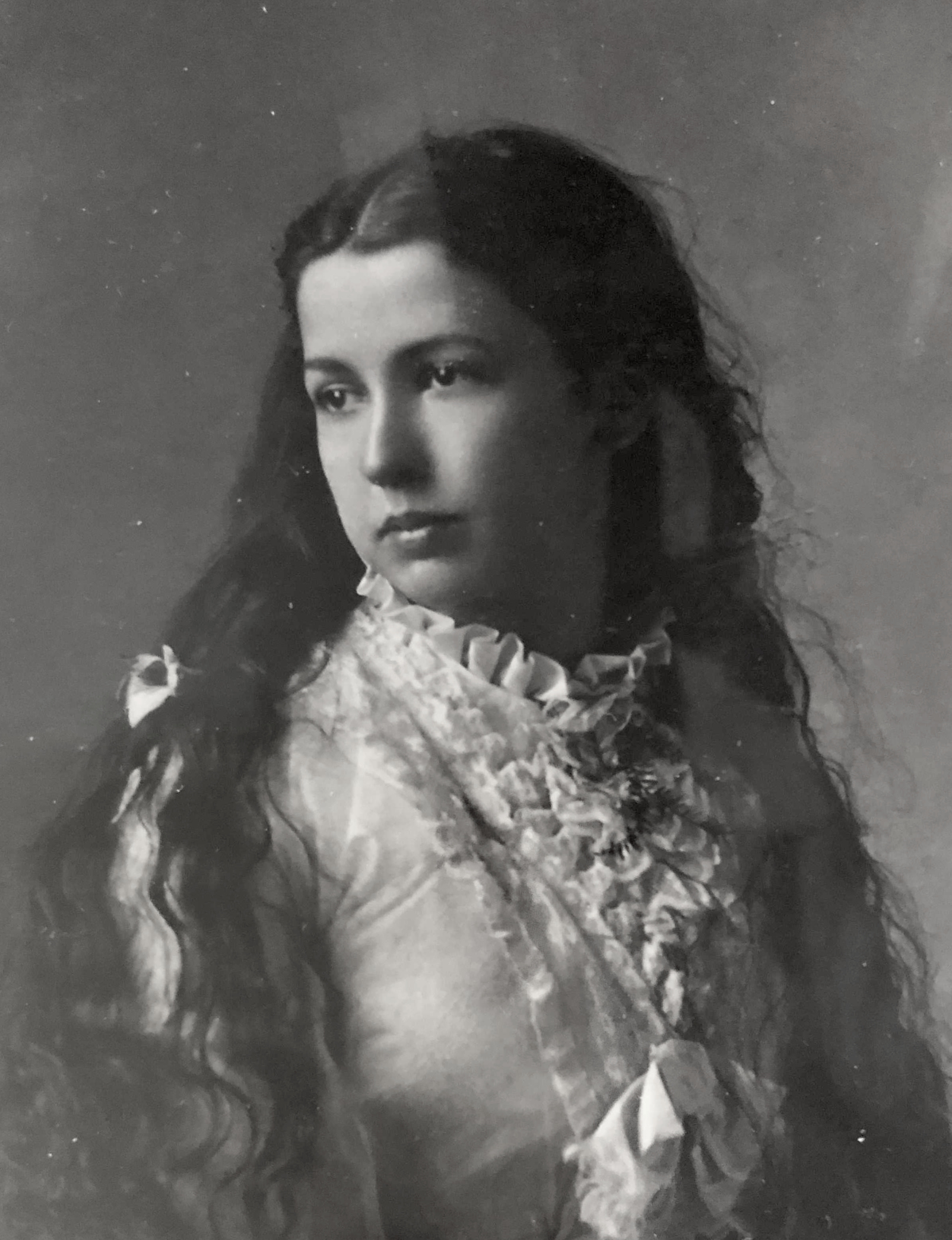
Ida Greeley
Many a suitor had tried to woo this daughter of the noted newspaper editor who had died in 1872, but none had been successful. Nicholas Smith’s charms won the day, and the two were married on May 1, 1875. The newlyweds took a European honeymoon where they rubbed elbows with the Prince of Wales and, allegedly, Queen Victoria herself. Just a few years after their marriage, the story would emerge that the Queen, upon seeing “Col.” Nicholas Smith at her court, “pronounce[d] him the handsomest man in the world.”
Ida and Nicholas had three children together, the first of whom they named Horace Greeley (without the Smith last name) in honor of Ida’s father. Nichols quickly settled nicely into the Greeley estate in Chappaqua, New York, hoping to once again be able to live the life of a gentleman of leisure. However, the Greeley estate was not as it once was, with the elder editor having lost most of his fortune before his death. Smith, himself, had spent all of his late wife Lucinda’s money over the course of courting Ida. While a friendly newspaper report stated that Nicholas, “made up his mind to marry Miss Ida Greeley, if he ever could get to her, before he ever saw her, from the newspapers accounts of her goodness and devotion to her parents,” it’s likely her assumed wealth also played a role in Smith’s courtship.
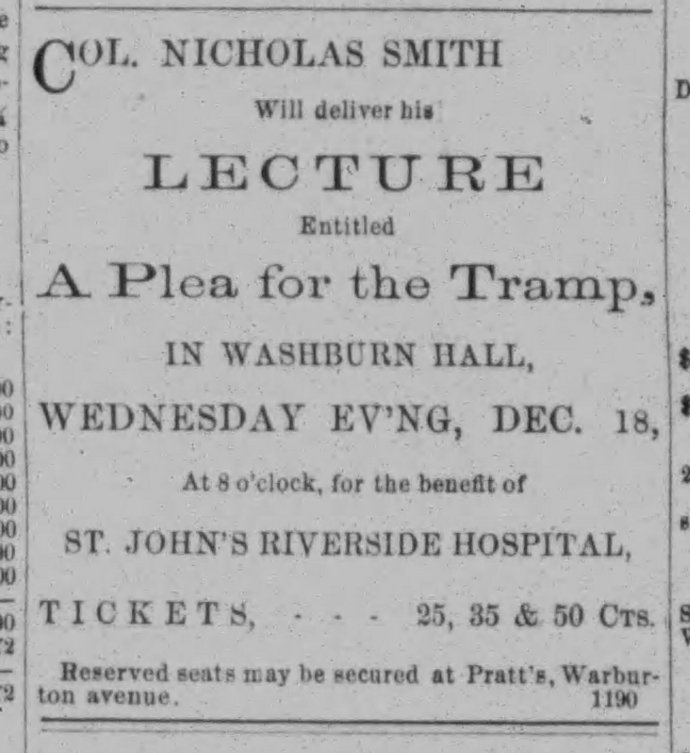
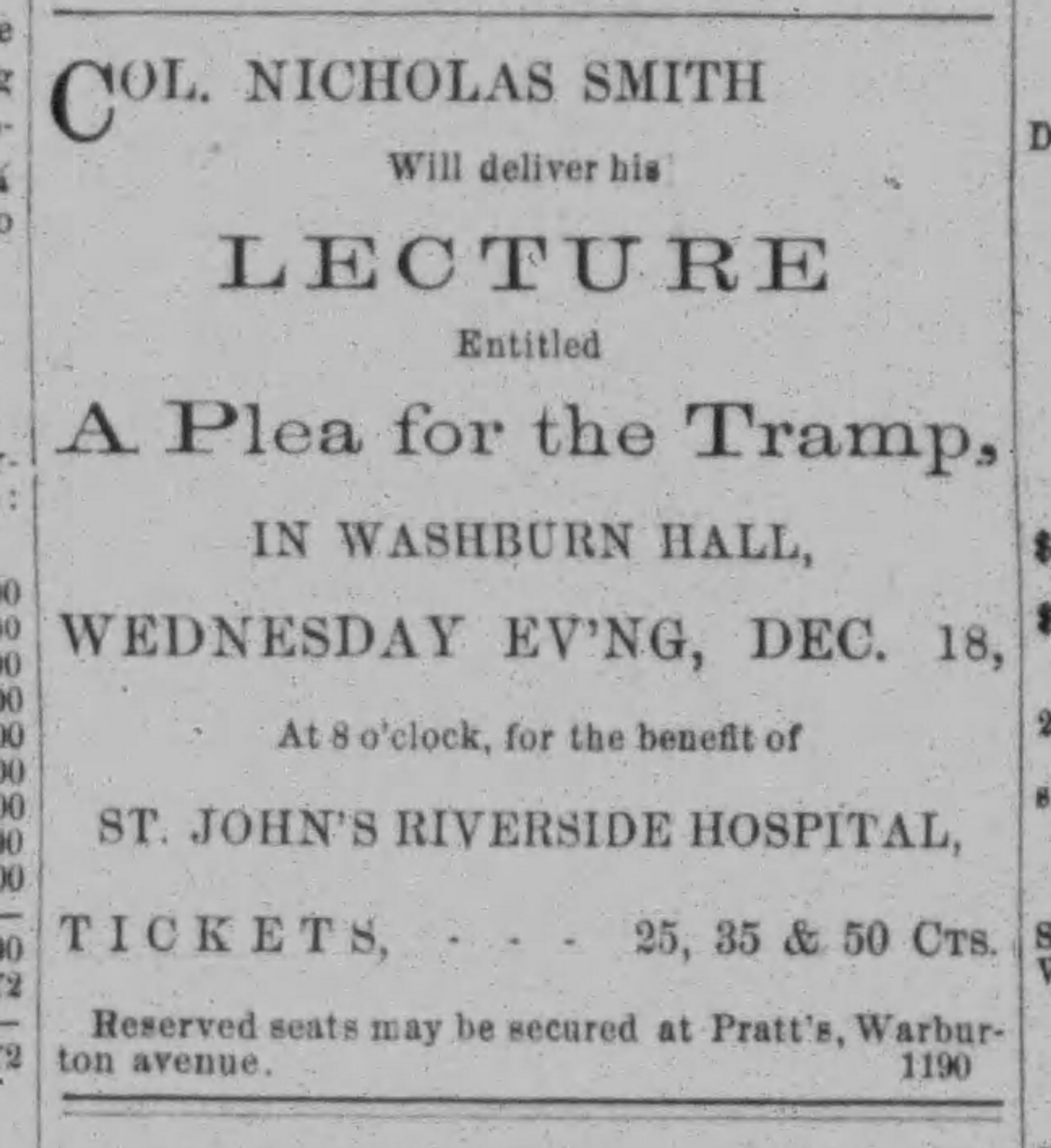
Work was anathema to Smith. For a time, he did try his hand at being a professional lecturer. He would trade on his well-known good looks and the Horace Greeley name (though the editor never met his son-in-law) to get crowds in seats, but his lecturing career was uneventful. He also wrote some articles and poems for various magazines, but the payment for these was low, and Smith soon began racking up debts on the Greeley name.
In 1878, Smith attempted to run for public office. He was nominated by the short-lived Greenback Party for U.S. Representative for New York’s 12th district, located in New York City. The incumbent at the time, Democrat Clarkson Potter, did not run for re-election, and it was believed that the race would be close between Smith and a Democrat named Cobb. In the end, an upset occurred with the Republican candidate, Alexander Smith, receiving the most votes. Unfortunately, this other Smith died the day after election day, just a few hours after being informed he had won. Newspapers back in Kansas and Kentucky clarified to their audiences that it was not their hometown beauty who had died. Nicholas Smith had placed a distant third in the race. A month after the election, an article in The New York Times reported that Col. Smith had refused to pay his bill for the printing of his campaign materials.
Before the elder Greely’s death, he had loaned about $49,000 to Cornelius Vanderbilt, Jr., who had been estranged from his business magnate father. After marrying Ida, Smith began regularly pestering Vanderbilt to repay the debt with interest. Vanderbilt was involved in a legal battle with his brother over his father’s estate, but, in 1879, received his share and moved to pay the Greeleys. Yet Vanderbilt refused to include Smith in the transaction since he was not a true Greeley heir and due to Smith’s “repeated and vigorous attempts to get control of the business of settlement and the funds connected therewith.”
When it came to the funds specifically earmarked for Ida and her sister, Vanderbilt attempted to protect the ladies from what he felt was Smith’s influence by providing them notes only in their names that they could invest. “These notes, Smith claims, are not negotiable, and he is, therefore, unable to get immediate possession of the money, which, as a friend of Mr. Greeley and his daughter, I feel the Colonel ought not be allowed to do,” Vanderbilt told the newspapers. In the end, however, Smith managed to convince his wife and her sister against Vanderbilt’s plan, and the notes were turned into cash.
On April 11, 1882, Ida Greeley Smith died of diphtheria at the age of 33. Nicholas Smith once again found himself a widower, this time with three young children. He sent the children off to Leavenworth to live with his sister. After she died in November, Smith found a family back home in Shelby, Kentucky, who took in the children. For the next few years, different stories emerged accusing Smith of squandering what remained of the Greeleys’ money, or about rumors he was wooing yet another heiress in hopes of regaining his financial station. He was said to have chased after actress Mary Anderson in an effort to win her heart, but this was unsuccessful.
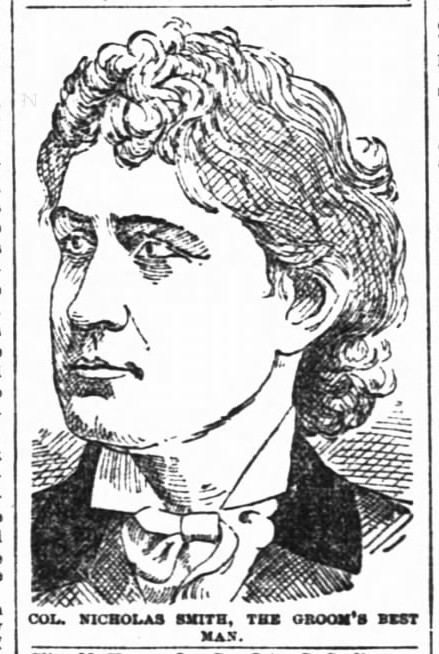
In 1887, Smith became the subject of national newspapers when he acted as best man at the wedding of a wealthy china dealer named Edward Ovington. While Ovington had only known Smith for a short period of time, he was charmed by the man and, believing him to be of similar class and wealth, invited him to act as his best man, which Smith did. Knowing that Ovington was wealthy and well-connected, Smith also tried to get the newlywed to endorse a note for him to the tune of $2,000 or $3,000. This Ovington refused. Smith then presented a bill to Ovington of $180 for the costs he incurred as part of his best man duties. Ovington was insulted by the command, but eventually acquiesced to send Smith $100, feeling $180 was too extravagant a cost for the services rendered. But this was not enough for Smith, who continued to hound Ovington for the rest. Fed up with his former best man, Ovington then took the matter to the press, where Smith was lambasted as “a groomsman for money.”
Smith’s financial situation was dire indeed. He had lost practically all of the Greeleys’ money, forcing Horace Greeley’s sister to live and work at a hotel. Meanwhile, “no business has been predicated of him. He has not been identified with any forms of labor or any public movements.” Unwilling to work, Smith hit a low point in 1888 when he was arrested at the hotel where he was living in New York for failing to pay for his room and meal bills for the past five months. After spending a night in jail, Smith was released on bail paid for by former (and future) New York Senator Tom Platt.
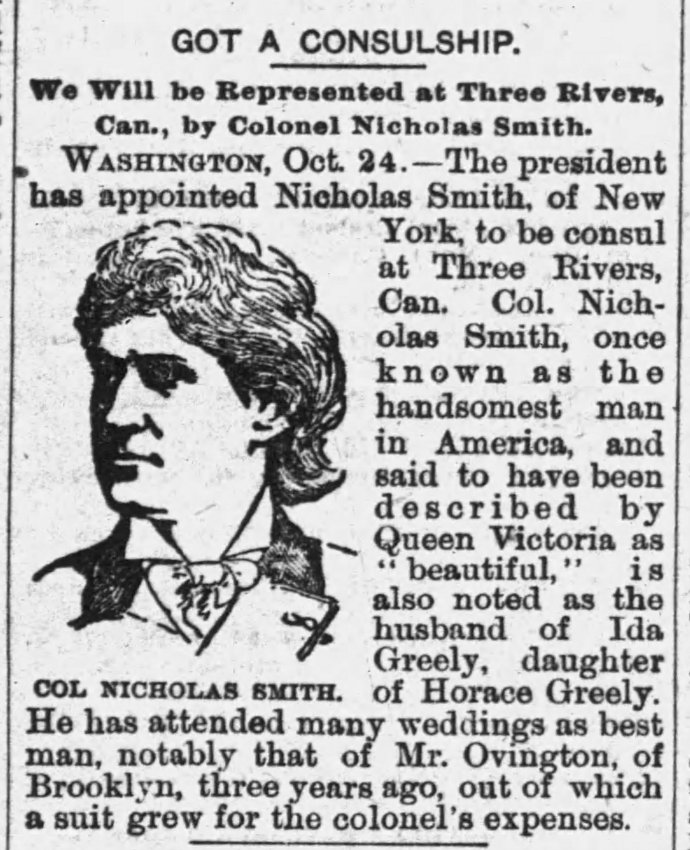
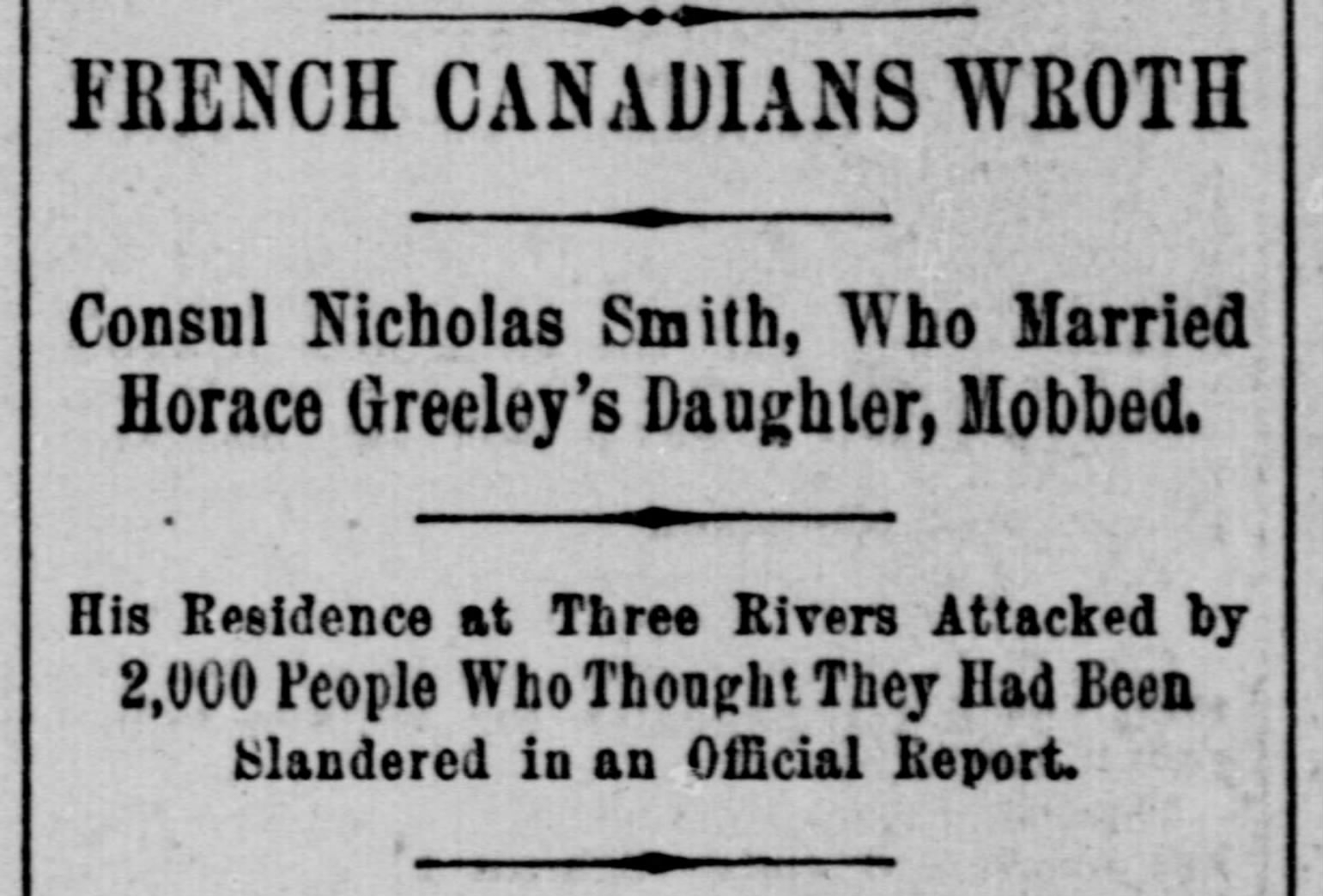
It appears that Senator Platt and other politicians known to Smith took pity on him and once again attempted to find him an ambassadorship. In 1889, President Harrison appointed Smith to become consul of the United States at Three Rivers, Quebec, Canada. For this position, Smith was paid $1,500 a year. Smith brought his three children to Quebec with him, and for a time, he seemed happy with the ambassadorship. Yet he still lived beyond his means. In 1890, the furniture at the consul’s home was seized for non-payment. The accusation was that the U.S. government had sent the money to furnish the home, but that Smith had pocketed it and refused to pay the Canadian furniture dealer. Then, in 1892, Consul Smith insulted the French Canadians. In describing the residents of Three Rivers in an official dispatch home, Smith wrote, “Seven persons and a pig, which is made to feel at home, constitute the average family.” He went on to insult the sanitary conditions of his Canadian home, accusing the city of being a cesspool for flies and cholera. As a result of his words, a mob of residents in Three Rivers proceeded to break the windows of the consulate where Smith resided.
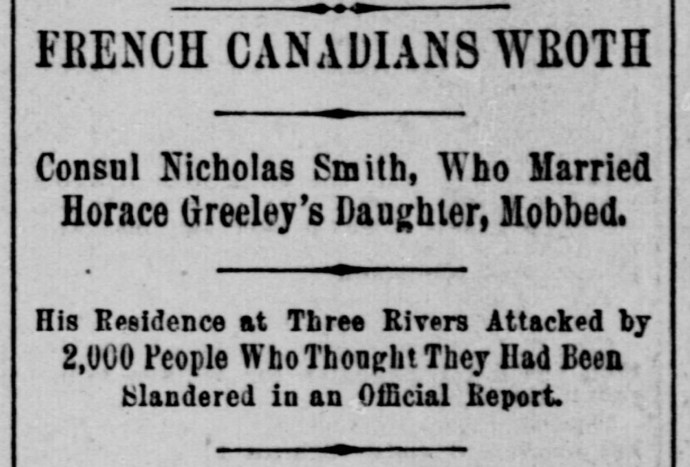
The whole affair caused a minor international incident with Ottawa calling for Consul Smith’s removal. This was done, but rather than kick Smith from the State Department completely, the ambassador was merely transferred from Canada to Liege, Belgium. During his time in Belgium, Smith is credited with introducing the Belgians to the concept of Kentucky-style cornbread. The Belgians, meanwhile, introduced Smith to the concept of using dogs as draft animals like horses. At the end of 1894 or the beginning of 1895, Smith’s consulship in Liege came to an end, and he returned home to America.
In the 1900 census, Nicholas Smith and his three children (now aged 22 – 17) were all residing in a rented home in Brooklyn, New York. No occupation for Smith is listed. Two years later, Smith made the newspapers once again. He was evicted from his home for failing to pay rent for himself and his two daughters.
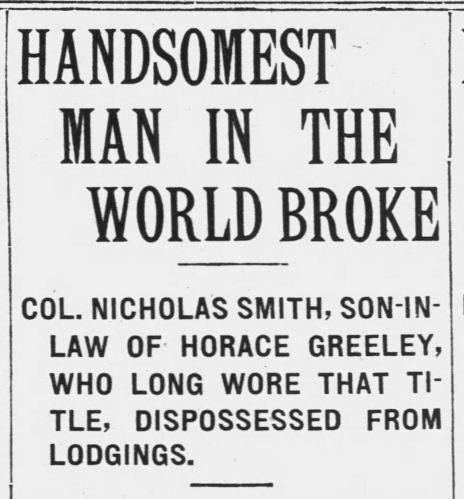
In addition to the back rent, his landlady wanted funds to fix her parlor ceiling, which had experienced water damage when the Col. had left the sink above the parlor running with the plug still in it. When the landlady’s husband asked why Smith had allowed the sink to overflow, he allegedly responded with, “My dear sir. I had just washed my hands. You wouldn’t expect me to put clean hands into soiled water just to pull out a paltry plug, would you?” The newspapers discovered that Smith had many unpaid bills throughout the city, he also owing the local grocer and newspaper seller.
In the end, Smith’s three children had to take responsibility for him. His son, Horace Greeley, became a doctor; his eldest daughter, Nixola, became a noted newspaper columnist and reporter; and the youngest, Ida, was an actress for a time. Smith spent his final years living with his children.
In 1908, Smith wrote to a newspaper in response to an editorial questioning the legitimacy of the many articles of folks who claimed to have known Abraham Lincoln. Smith decided to connect his own name to the Great Emancipator by claiming he witnessed Lincoln’s first inauguration and was presented to the president two days later at the White House. According to Smith, he and Lincoln spoke of their shared home of Kentucky. In another, much earlier account, Smith claimed that upon meeting the President, “Lincoln placed his paternal hands on [Smith’s] cheeks and said: ‘ Capt. Smith, you are a pretty man; you ought to have been a woman.’” Whether there is any truth in Smith’s claims regarding Lincoln is for you, dear reader, to decide for yourself.
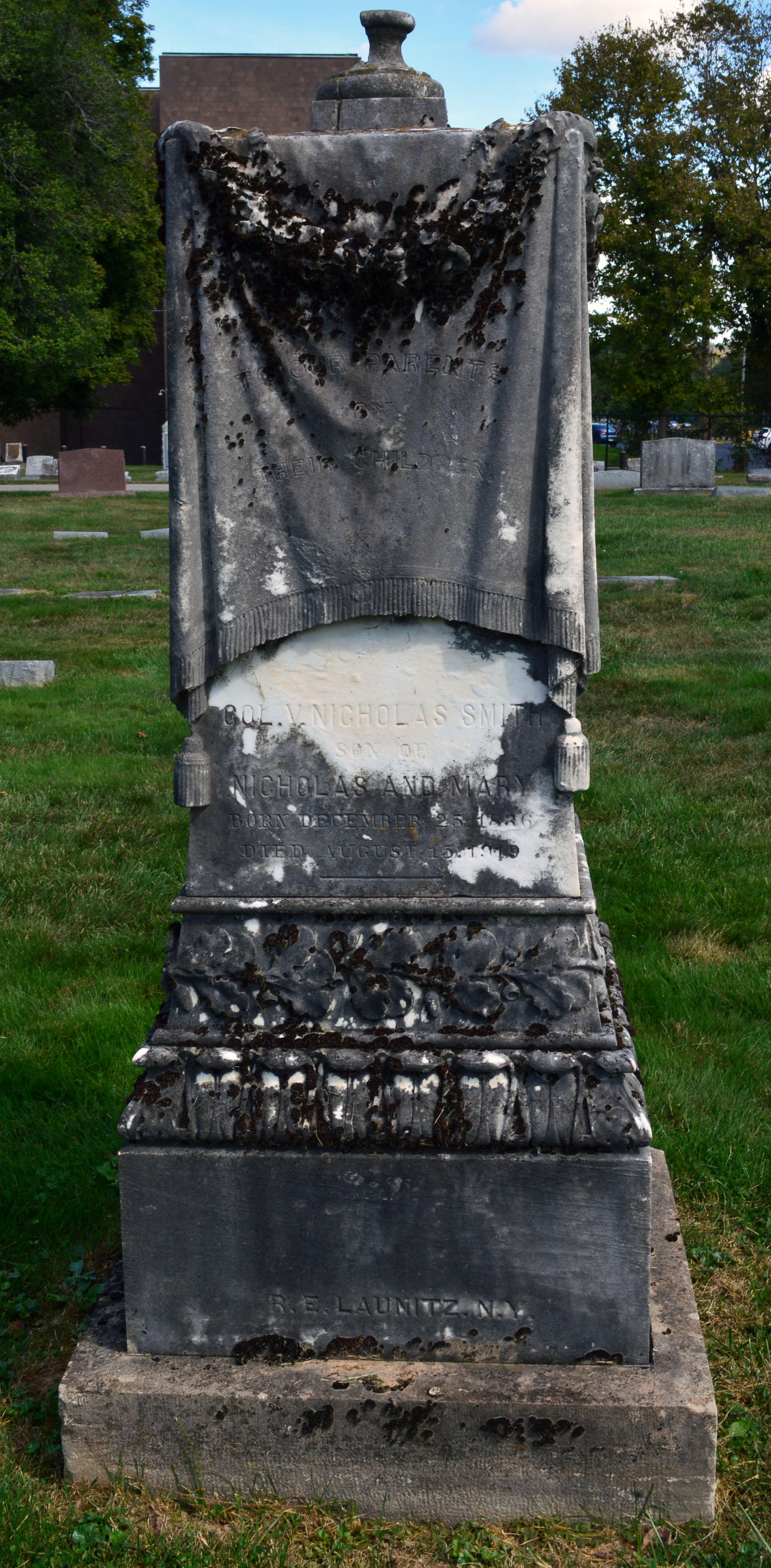
The end came for Nicholas Smith on August 15, 1919. He died at the summer home of his daughter, Ida Smith Geissler, in Fort Salonga, on New York’s Long Island. He was 82 years old and had been suffering from Bright’s disease for some time. His original hometown of Shelby, Kentucky, ran a glowing obituary of Smith, omitting any details that might appear to speak ill of the dead, justified or otherwise. He was not buried next to either of his wives who had predeceased him. Rather, his body was cremated and returned to Kentucky, where he was placed next to his parents in Frankfort Cemetery.
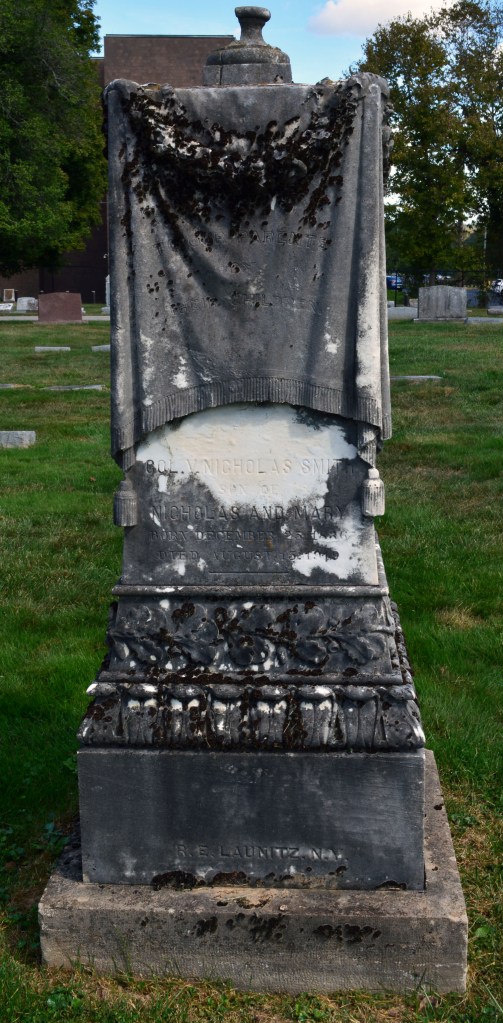
FindaGrave.com
Thus was the life and career of Verres Nicholas Smith, a man whose elegant dress and fine manners allowed him to continually “fall up” into society and politics. He was made a Captain in the Army and an American Ambassador despite having no work ethic. He married into two wealthy families and squandered the fortunes of both. His was a life of flashy appearances with no substance beneath. Had he not been blessed with such a handsome and Booth-like visage, it’s unlikely he would have made any mark on history. But, as one newspaper account related after his dust-up in Quebec, “There is only one Col. Nicholas Smith, and we’ve got him… Smith, Smith is beyond comparison. He is absolutely a new kind of an ass, and we can not afford to have him marred, even if we have to go to war with Canada.”
“Very Ridiculous,” indeed.
My deepest thanks to Ed Dunscombe and David Cress for helping to solve the mystery of the Joseph Booth/Nicholas Smith photographic mix-up.

















 LincolnConspirators.com
Recent Comments