
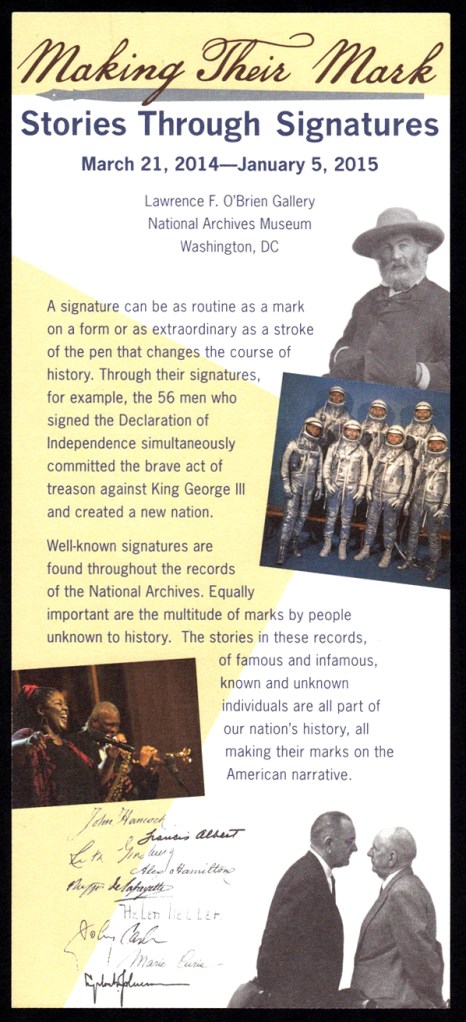
Yesterday, I found myself in Washington, D.C. for a time. I braved the snow and waited, cold and wet, in line outside the National Archives for an hour. When I finally got in, I made a beeline not for the Constitution or the Declaration of Independence, but rather for the special exhibit on signatures, “Making Their Mark”:
 My quest today was to see the note that John Wilkes Booth left for Vice President Andrew Johnson, hours before he assassinated President Lincoln. In the online exhibit guide for “Making Their Mark” you can see a high resolution image of the front and back of the note:


Fun fact: They do not allow you to take pictures inside of the National Archives. This is particularly true in the rotunda where the lights are dimmed and there are many guards to protect our country’s charters of freedom from the damaging effects of flash photography. The core documents to our freedom have faded so much over the years that this very much justified, despite the desire of many to take a selfie with the Bill of Rights.
Luckily, the “Making Their Mark” exhibit was not housed in the rotunda but, instead, in a special exhibit room with more lighting and only one patrolling guard. While I take the rules of any museum very seriously (you should have seen the way I was giving the evil eye to some high school kids engaging in a snowball fight on the grounds of the Archives before I got in), I just couldn’t pass up the chance to snap a few photos of Booth’s note to share with you all. If it helps, I did turn off the flash on my phone so that it would not harm the document in any way. I hope the Archives will forgive me.
 I was both shocked with how small the actual note was. It was smaller than my 2″ x 3 1/2″ business card that I carry around with me. After I got back home, I decided that the note was a little bigger than 1 1/2 inches tall and almost 3 inches long. Here’s a closer picture of the note with an approximate scale:

For some background, here is the conspiracy trial testimony of Col. William A. Browning, Andrew Johnson’s private secretary, in which he mentions the note:
“William A. Browning,
a witness called for the prosecution, being duly sworn, testified as follows:
By the Judge Advocate:
Q. Will you state if you are the private secretary of the President?
A. Yes, sir: I am.
Q. Were you with him on the 14th of April last?
A. I was.
Q. (Exhibiting a card to the witness.) What knowledge, if any, have you of that card having been sent to him by John Wilkes Booth?
A. Between the hours of four and five o’clock in the afternoon, I left Vice-President Johnson’s room in the Capitol, and went to the Kirkwood House, where I was boarding with him. Upon entering, I went up to the office, as was my custom; and I saw a card in my box. Vice-President Johnson’s box and mine were adjoining: mine was 67, his was 68. In 67 I noticed a card. The clerk of the hotel, Mr. Jones, handed it to me. This I recognize as the card.
Q. Will you read what is on it?
A. “Don’t wish to disturb you. Are you at home? J. Wilkes Booth.” It was in my box.
(The card was offered in evidence without objection and is marked exhibit no. 29.)
Q. You do not know anything about the handwriting of Booth?
A. No, sir.
Q. You had no acquaintance whatever with J. Wilkes Booth, had you?
A. Yes, sir: I had known him when he was playing in Nashville, Tenn. I met him there several times. That was the only acquaintance that I had with him.
Q. Did you understand the card as sent to the President, or to yourself?
A. At the time, I attached no importance to it. I had known him in Nashville; and, seeing the card, I made the remark, when it was handed to me by the clerk, “It is from Booth: is he playing here?” I had some idea of going to see him. I thought, perhaps, he might have called upon me, having known me; but, when his name was connected with this affair, I looked upon it differently. It was a very common mistake in the office to put the cards intended for me in the Vice-President’s box; and his would find their way into mine, they being together.”
Appropriately enough, even though I snapped a few more pictures of the note before we left, I was so nervous about being caught and possibly banned from the National Archives for life (a horrible punishment for a researcher) that all the rest of my pictures are blurry messes. If you want nice pictures of the note, I refer back to the images of it from the “Making Their Mark” online exhibit guide.
References:
“Making Their Mark: Stories Through Signatures” at the National Archives, March 21, 2014 – January 5, 2015
“Making Their Mark” online exhibit guide
The Lincoln Assassination Trial – The Court Transcripts edited by William Edwards














 LincolnConspirators.com
Recent Comments