Posts Tagged With: Research

Samuel Arnold’s Confession

The following is Samuel Arnold’s full confession that he gave following his arrest on April 17th.  This account is copied from William Edwards’ book The Lincoln Assassination – The Rewards Files.  Mr. Edwards is the author behind the trilogy of primary sources regarding the assassination.  The Evidence, The Court Transcripts, and The Rewards Files, are all essential materials for those studying the assassination.  They contain the bulk of the government’s microfilmed records and are priceless to the researcher.  The Evidence can be bought as both a physical book (the Surratt House Museum offers the best value on this) and as a non-searchable ebook.  The Trial Transcript can be purchased as a searchable ebook.  The Rewards Files were previously released on a CD-ROM  (still available through the Surratt House Museum) and will shortly be released as an ebook through Google Books. EDIT: The book is now available for purchase here.

I have previously written my support of Edwards’ Trial Transcripts and I will certainly let you all know when The Reward Files are available for download.  In the meantime, Arnold’s confession provides some of the most reliable information about the original abduction conspiracy:

“To Whom it May Concern,

Know that I, Saml B. Arnold, about the latter part of August or first part of September 1864, was sent for by J. Wilkes Booth, who was a guest at Barnum Hotel, City of Baltimore Md. to come to see him. Had not seen the same J. Wilkes Booth since 1852, when we both were schoolmates together at St. Timothy’s Hall, President L. Van Bokelin then having said Hall as place of tuition. Reception warm calling for wine and cigars conversing a short time upon our former school boy days. We were interrupted by a knock at the door, when Michael O’Laughlen was ushered in. After a formal introduction, we sat sipping our wine, and then smoke a cigar. During smoking he having heard previously of my feelings or sentiments, he spoke in glowing terms of the confederacy and of the number of surplus prisoners in the hands of the United States, and then ensued the proposition by J. Wilkes Booth and which he J. Wilkes Booth thought could be accomplished viz; Kidnapping President Lincoln as he frequently went unguarded out to Soldiers Home, and he thought he could be picked up, carried to Richmond, and for his exchange produce the exchange (for the President) of all the prisoners in the Federal hands. He, J. Wilkes Booth the originator asked if we would enter into it. After the painting of the chance of success in such glowing colors, we consented viz; Michael O’Loughlin and myself. Secrecy bound not to divulge it to a living soul. Saw him no more. Yes I saw him again and then he J. Wilkes Booth left to arrange the business north. First to New York then to the Oil region, from there to Boston and finally to Canada. Was to be back in a month. Received a letter which I destroyed stating he was laid up with Eryeocippolis in the arm and as soon as he was able, he would be with us. Months rolled around, he did not make his appearance until some time in January. In his trunk he had two guns (maker unknown), cap cartridges which were placed in the gun stock (Spencer Rifle I think called) revolver, knife belts, cartridge boxes, cartridge caps, canteen, all fully fixed out which were to be used in case of pursuit, and two pairs handcuffs to handcuff the President. His trunk being so heavy he gave the pistols knives and handcuffs to Michael O’Laughlen and myself to have shipped or bring to Washington to which place he had gone. Bought horse buggy, wagon and harness leaving the team &c. to drive on to Washington. Started from Baltimore about twelve or one o’clock after having shipped the box containing the knives, handcuffs and pistols, arriving in Washington at seven or half past seven. Met him on the street as we were passing theater. We alighted, took a drink and he told us of the theater plan slightly, saying he would wait till we put the horse away and tell us more fully. He had previously as I now remember spoken of the chance in the theater if we could not succeed in the other at Soldiers Home. We went to theater that night, he J. Wilkes Booth telling us about the different back entrances and how feasible the plan was. He, J. Wilkes Booth, had rented a stable in rear of the theater having bought two horses down the country, one in stable behind theater and the other at livery. Met him next day went to breakfast together. He was always pressed with business with a man unknown and then only by name, John Surratt. Most of his Booth’s time was spent with him. We were left entirely in the dark. Michael O’Loughlen and myself rented a room in D Street 420 No. Obtained meals at Franklin House cor of 8th and D St. and there lived for nearly two months, seeing him perhaps three or four times per week and when seen always but a short time still pressing business aleays on hand viz. John Surratt.

Michael O’Laughlen and myself drove out occasionally the horse liveried at Nailor’s Stable drove always (but once) in the city and Georgetown. The once excepted across Eastern Branch Bridge when we went upwards of five miles and returned I suppose. That was the only time I ever went over the Bridge. How often J. Wilkes Booth crossed I cannot state, but from his own words often. Thus was Michael O’Laughlens time spent and mine for the most part down at Ruhlman’s Hotel and Lichau House on Pennsylvania and Louisiana Avenues in drinking and amusements with other Baltimoreans besides ourselves congregating there all of whom knew nothing of our business but selling oil stock. Oil stock was the blind for them as well as my family. During the latter part of March while standing on Ruhlman’s and Lichau’s porch between 11 & 12 o’clock PM a young man name unknown, as I cannot remember names, about 5 feet 5 or 6 inches high thick set, long nose, sharp chin, wide cheek, small eye, I think grey, dark hair, and well dressed, color don’t remember, said called Michael O’Laughlen aside and said J. Wilkes Booth wish to see us both at Gaither’s Saloon on Avenue. I was there for the first time introduced to him, but forgot his name. We walked up together, Michael O’Laughlen, this unknown and myself were ushered into the presence of J. Wilkes Booth who introduced me to John Surratt, Atzerodt (alias Port Tobacco) (alias) Mosby making in all seven persons. J. Wilkes Booth had stated to Michael O’Laughlen to bring me up in good humor (still always in the dark). Then commenced the plan. Each had his part to perform. First I was to rush in the box and seize the President whilst Atzerodt “alias” Port Tobacco and J. Wilkes Booth were to handcuff him and lower him on the stage whilst Mosby was to catch him and hold him until we all got down. Surratt and unknown to be on the other side of Bridge to facilitate escape, afterwards changed to Mosby and Booth to catch him in box throw him down to me on stage, O’Laughlen and unknown to put gas out. Surratt, Atzerodt “alias” Port Tobacco to be on the other side of Bridge. I was opposed to the whole proceeding, said it could not be done or accomplished if even which was of itself an impossibility to get him out of the box and to the Bridge. We would be stopped by sentinel. Shoot the sentinel says Booth. I said that would not do for if an alarm was given then the whole thing was up. As for me I wanted a shadow of a chance. M. O’Laughlen wanted to argue the same thing, whereupon J. Wilkes Booth remarked, you find fault with everything concerned about it. I said no I wanted to have a chance and I intended to have it, that he could be the leader of the party but not my executioner. Whereupon J. Wilkes Booth remarked in a stern commanding and angry voice, do you know you are liable to be shot your oath.[sic] I told him the plan a basis had been changed and a compact broken, on the part of one is broken by all. If you feel inclined to shoot me you have no further to go. I shall defend myself. This if I remember arightly was on a Thursday or a Friday night. When I said Gentlemen if this is not accomplished this week I forever withdraw from it. Staid up till about 6 or 7 o’clock AM Friday or Saturday and then to bed, remained indoors till twelve. I arose and went to get my breakfast. M. O’Laughlen and myself room together both arose at the same time and were always together in a measure. About two or three o’clock J. Wilkes Booth called at Lichau House to see O’Laughlen. What passed I know not. I told him I wanted to see him. Says he speak out. Well John what I said last night I mean if not done this week I withdraw. Went to bed about 7 ½ o’clock PM. Next day twas to be accomplished on the 7th Street road, it failed. Sunday I staid in Washington and Monday or Tuesday I returned to the city of Baltimore and thence to Hookstown. J. Wilkes Booth in meantime went to New York and returned during week, Saturday I think. Said he wished to see me on very urgent business. Father sent for me. I came from country and he had gone to Washington, whereupon I wrote him the letter published. Richmond authorities as far as I know knew nothing of the conspiracy. The letter was written after my return to country, after finding he could not wait to see me in Baltimore. During week I came in City again. Met M. O’Laughlen who asked me to go to Washington to finally arrange his affairs. I went in the morning Friday, returning same day. Cut loose forever from it. Received a letter J. H. Wharton at Fort Monroe giving me employment; went to country got my clothing and Saturday first day of April left Baltimore for Fort Monroe at which place I have remained, never corresponding with Booth or seeing him from above named date to the present writing. The groundwork was to kidnap the President without any violence none other were included therein. He never to me said he would kill him, further than this I know nothing and am innocent of having taken any part whatever in the dark deed committed.

The plan of escape was place Mr. Lincoln in the buggy purchased for that purpose, cross Eastern Branch Bridge, Surratt and Atzerodt “alias” Port Tobacco to pilot them to where a boat was concealed, turn horses loose, place the President in the boat and cross the Potomac to Virginia Shore and thence to make our way to Richmond. Surratt knew the route and was to act as pilot.

A box painted black like unto a sword box was sent to Booth from Hotel by a Porter there, to our room. Next day transferred in wagon, O’Laughlen acting pilot to some place. I was not present. After giving box to driver went to Georgetown and O’Laughlen had the full charge of it. M. O’Laughlen said he took it to a Mr. Heard and from thence the unknown carried it to his house, took guns out and carried them to Peedee. This latter clause Booth told me.

Saml. B. Arnold

Baltimore April 18th 1865

Categories: Uncategorized | Tags: , , , | 15 Comments

Researching with Primary Sources

When we want to learn more about the Lincoln assassination, the first place we all start is with the books.  American Brutus by Michael Kauffman, Blood on the Moon by Edward Steers, and Manhunt by James Swanson, seem to be the top three choices for those starting off.  While many other wonderful books have been written on the subject, these three provide the most up to date research and findings about the assassination.  What makes these books the best modern writings on the subject, is their use of primary sources.  The chapter notes in American Brutus, for example, are filled with new discoveries and sources ignored or unknown to previous writers.  That is why, when looking to do research into the Lincoln assassination, it is crucial to use primary sources.  Ten years ago, this would have meant a visit to the National Archives to look through rolls of microfilm.  Today, however, some of the best primary sources have been published as standalone books or digitized.  This post explores using two such resources in tandem to aid in researching and learning about our great American drama.

One source that is absolutely necessary for any serious research into the assassination is, The Lincoln Assassination: The Evidence by William Edwards and Edward Steers.  This book contains practically all of the paper materials involved with the investigation of Lincoln’s murder.  The 1400 page book is filled with witness statements about nearly every aspect of the assassination.  William Edwards transcribed the book one microfilmed page at a time from the original evidence files in the National Archives.  Then, teamed with Edward Steers, they indexed, categorized and annotated the piece.  The sheer work involved in making this book is astounding, and we all owe the authors a sincere thank you for producing it.  While the size of the book increases the price tag (it can be bought cheap for $99 through the Surratt House Museum), it is worth every penny for the convenience and treasures that lay inside.  My copy of The Evidence, sits right next to my computer within arm’s reach, and I reference it practically every day.  The Evidence is not only vastly helpful because it saves me a trip to D.C. to look at microfilm, but it also has an index, allowing me to quickly and easily find the material I am looking for.

Another great resource to find the same materials is through the website, Fold3.com.  Previously known as Footnote.com until a recent merger with Ancestry.com, Fold3 provides millions of digitized historical documents.  Their partnerships with institutions like the Library of Congress and the National Archives, have allowed them to digitize and present pieces of history to a wider audience than ever before.  Most beneficial for our interest are the Lincoln Assassination Papers hosted by them.  Fold3 has digitized all of the microfilmed pages included in The Evidence and more.  Even better, while most of the site requires a paid membership to view and save images of the documents, the Lincoln Assassination Papers are free to view and (with a free account) free to save.  While Fold3 is a wonderful way to look at the images of the documents themselves, the pages have not been transcribed in any way.  Individual members can go through and annotate and transcribe names and places, but a full digital transcription of these hand-written documents seems unlikely to ever happen.  That is where The Evidence book comes in.

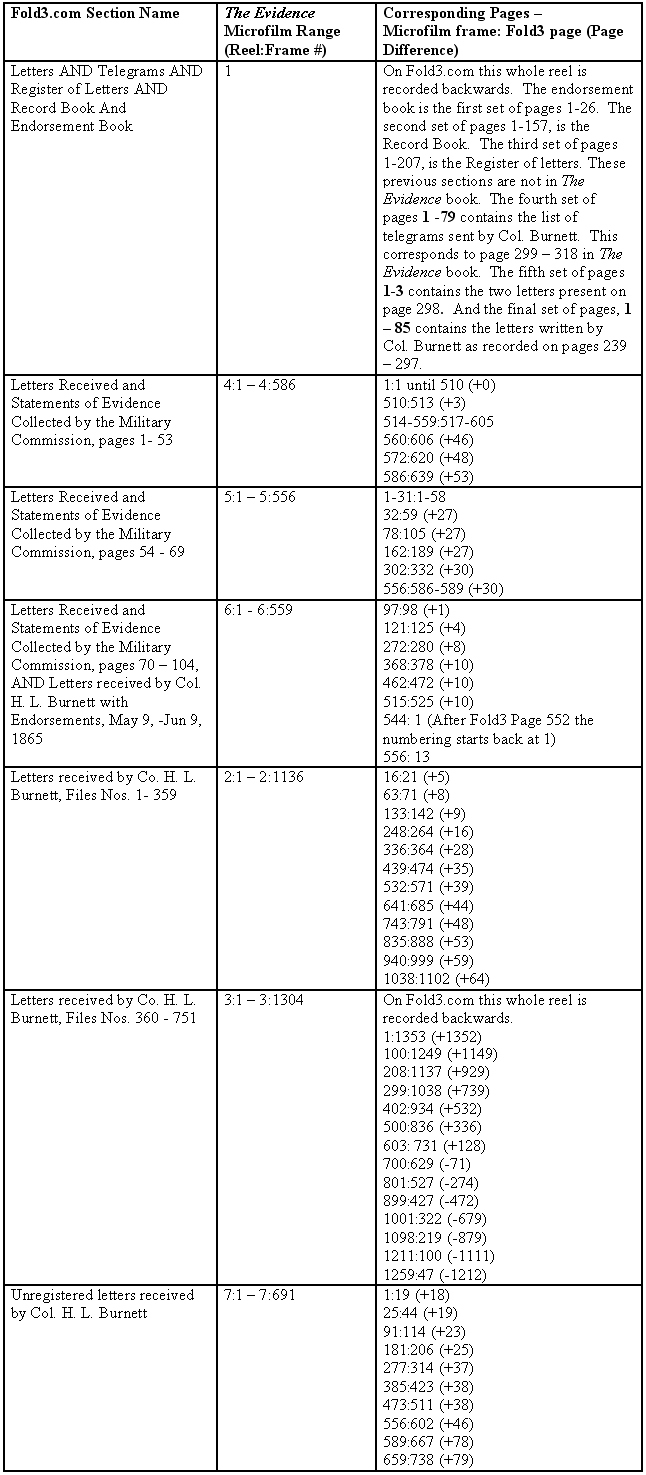
There have been many times where I have found it to be helpful to see the original document that I found in The Evidence.  Unfortunately, the naming used on Fold3 does not match with the original reel and frame number cited in The Evidence.  That is why I created a key that allows me to use the citation in The Evidence to find the actual document on Fold3.  Here is that key:

Click to Enlarge

Looks confusing, huh?  Let me show you how to use it.

First, after you find the statement you want to see in The Evidence, you have to look for the reel and frame citation.  For example, this is the header and citation for a letter written by Richard Baynham Garrett:

This tells me that this letter is found on reel 7: frames 77 – 79.  Then we have to use the key I posted above.  I spilt the key up into three columns.  The first column gives the name that Fold3.com has for its different sections.  The second column gives the reel and frame numbers that correspond to that section.  The third column gives examples of frame numbers from The Evidence and matching page numbers on Fold3.com.

So, the Garrett letter was located on reel 7 in The Evidence.  On Fold3, reel 7 is named “Unregistered letters received by Col. H. L. Burnett” so we’d choose that one to view.  Finding the correct page number is next.  If you would click on page 77 under the “Unregistered letters received by Col. H. L. Burnett” reel you would not find Richard Garrett’s letter but instead a letter from J. L. McPhail.  I have the following in my key under this reel:
25:44 (+19)
91:114 (+23)
This means that frame 25 in The Evidence is on page 44 on Fold3, and that frame 91 in The Evidence is on page 114 on Fold3.  After each I placed the differences between them.  Since I’m looking for frame 77 according to The Evidence, this is telling me that I need to add between 19 and 23 to find the correct page on Fold3.  You’ll still have to do a bit of searching to track down the exact page, but this should make it much easier.  Garrett’s letter can be found on page 99 on Fold3, a difference of 22 pages.

One important thing to note is that two of the reels, (Reel 1 and Reel 3) were digitized backwards.  The last page of the reel is page 1 in these ones.  For the Reel 1 (Letters AND Telegrams AND Register of Letters AND Record Book And Endorsement Book) this is alright because the telegrams have page numbers at the top that make it easy to follow.  Reel 3 is harder to navigate, but hopefully this key will give you some idea of where to start in it.

Used together, these two resources, The Evidence and Fold3.com, are a Boothie’s dream.  Publishing and digitizing these primary sources allows all Boothies to read, learn, and discover more than ever before.  As companies like Google, Fold3, and Ancestry continue on their digitalization efforts, more discoveries and insights about the Lincoln assassination will be found.

Categories: Uncategorized | Tags: , , | 5 Comments

Blog at WordPress.com.