Posts Tagged With: Our American Cousin

An Assassination Playbill Goes to Auction

Update: This playbill sold for $85,000. After adding the 25% Buyer’s Premium, the total cost of the playbill was $106,250. At the same auction, a John Wilkes Booth wanted poster sold for $105,000 ($131,250 with Buyer’s Premium).

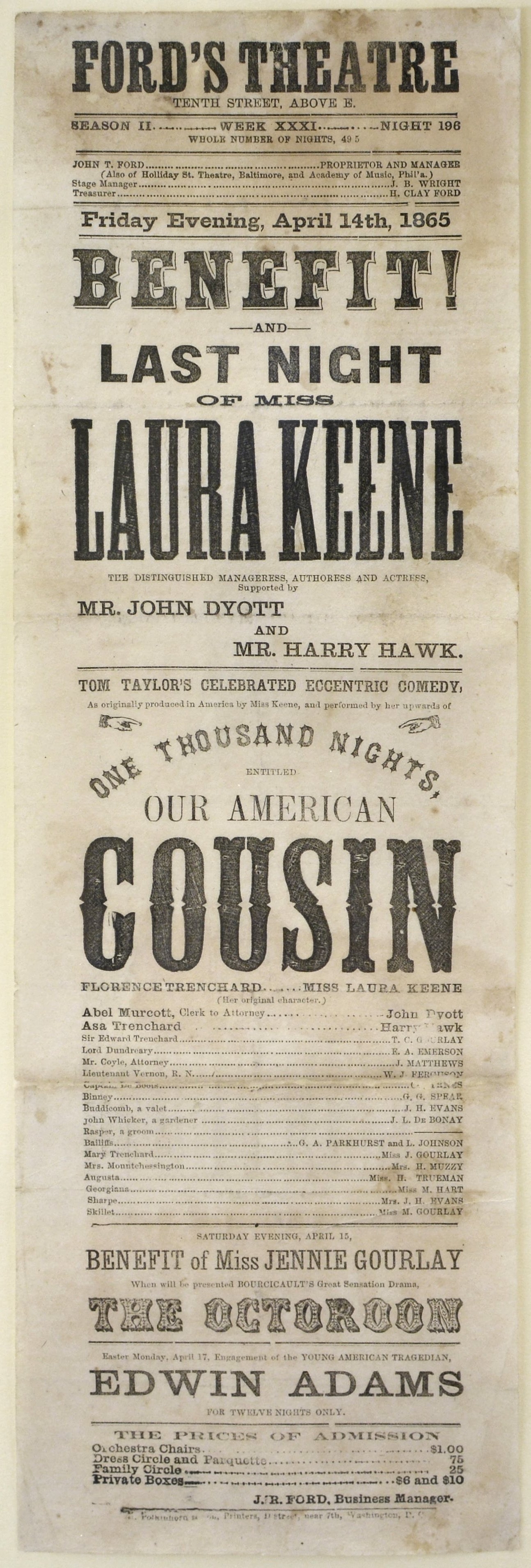
This Saturday (9/28/2024), R.R. Auctions is set to sell an iconic and rare Lincoln assassination-related item: a Ford’s Theatre playbill from the night of Abraham Lincoln’s assassination.

While there are a plethora of period reprints and modern replicas of assassination playbills, genuine playbills are very elusive things, and examples rarely come up for auction. One of the most recent sales of a genuine Ford’s Theatre assassination playbill was by Christie’s auction house. In 2003, they sold a second issue playbill (those included an added section near the bottom advertising the planned singing of “Honor to Our Soldiers”) for $31,000.

Normally, I don’t post about all the interesting items that come up for auction, but this playbill is different. If you check out the auction listing for this playbill, you might notice a familiar name:

It turns out I have a little history with this specific playbill.

One of my earliest posts on this blog concerned the assassination playbills and how you can tell real playbills from fakes and replicas. In addition to regularly being asked my opinion on possible “new” John Wilkes Booth photographs, I have been sent pictures of a few playbills in the past. Each time I have had to break it to people that they have a reprint or a forgery. Last year, I received an email from a couple who had read my post and were hoping to get my thoughts on a Ford’s Theatre playbill that they owned. I happily agreed to take a look at it while mentally preparing to let down yet another disappointed replica owner.

As I looked at the pictures sent me, I was surprised to see that I was not able to instantly discount the playbill. I scoured over the small details of typography, spacing, and printing, and each seemed to align with genuine bills. I sent some follow-up questions to the owners, not tipping my hand that I was getting excited by what I was seeing. I asked about the provenance behind the piece and set to work investigating that. After a few days of research, I came to the astonished conclusion that this was a genuine first-issue playbill for Our American Cousin.

In my excitement, I went about writing up a research report for the owners explaining my conclusions. Never one for brevity, that report ended up being nine pages long. In advance of the sale on Saturday, I asked the owners if I could publish my report for them on this blog. They agreed, so I have published my report below. For the privacy of the current owners, I have redacted their names from the report and replaced them with John and Jane Doe.


Report on an April 14, 1865 “Our American Cousin” playbill owned by John and Jane Doe

By Dave Taylor
LincolnConspirators.com

Introduction: On April 25, 2023, I was contacted through my website, LincolnConspirators.com, by Jane Doe. Several years ago, I published an article on my site discussing the different playbills issued by Ford’s Theatre on the night of Lincoln’s assassination. Given my experience in analyzing authentic and fraudulent Lincoln assassination playbills, Jane asked me if I would look at a playbill owned by her and her husband, John, and give my opinion of it. I accepted and was provided with several images. The following is a report of my research process and ultimate conclusions regarding the playbill in question.

Background: Abraham Lincoln was shot by assassin John Wilkes Booth on the evening of April 14, 1865, while the President and his party were attending a performance at Ford’s Theatre in Washington, D.C. The play they were attending was a comedy entitled Our American Cousin, with actress Laura Keene as the lead star. After the shooting of Lincoln, the theater was shut down and would not see another performance for over 100 years. Very shortly after the tragedy, there was a demand for playbills of the last play Lincoln saw. This demand led to a secondary market of replica and forged playbills. Some of the fraudulent bills were so convincing that they even managed to fool those who were present at the assassination into swearing to their authenticity. In 1937, researcher Walter C. Brenner privately published a monograph entitled The Ford Theatre Lincoln Assassination Playbills: A Study. Brenner analyzed several variations of bills housed in different collections in an attempt to definitively determine which version or versions of playbills were actually printed and present on the night of Lincoln’s assassination. Through his research, Brenner was able to locate proven examples of legitimate assassination playbills in the Harvard Theatre Collection. He published his findings and included a chart noting the small details that can prove or disprove a suspected assassination playbill. In 1940, Brenner published a small supplement to his original research, reproducing an 1898 article that narrated the history of the playbills and why there were two different, but both equally legitimate, versions of playbills used at Ford’s Theatre on April 14, 1865. During my own analysis of the Doe playbill, I heavily referenced Brenner’s work.

Visual Analysis: The Doe playbill measures approximately 18.5” long and 5.5” wide. It is currently matted inside of a frame with a handwritten piece of provenance below it (Fig. 1).

Figure 1: Framed playbill

On the left edge of the bill near the name of Laura Keene is written in pencil the words “Genuine bill – [illegible] J H Brown” (Fig. 2).
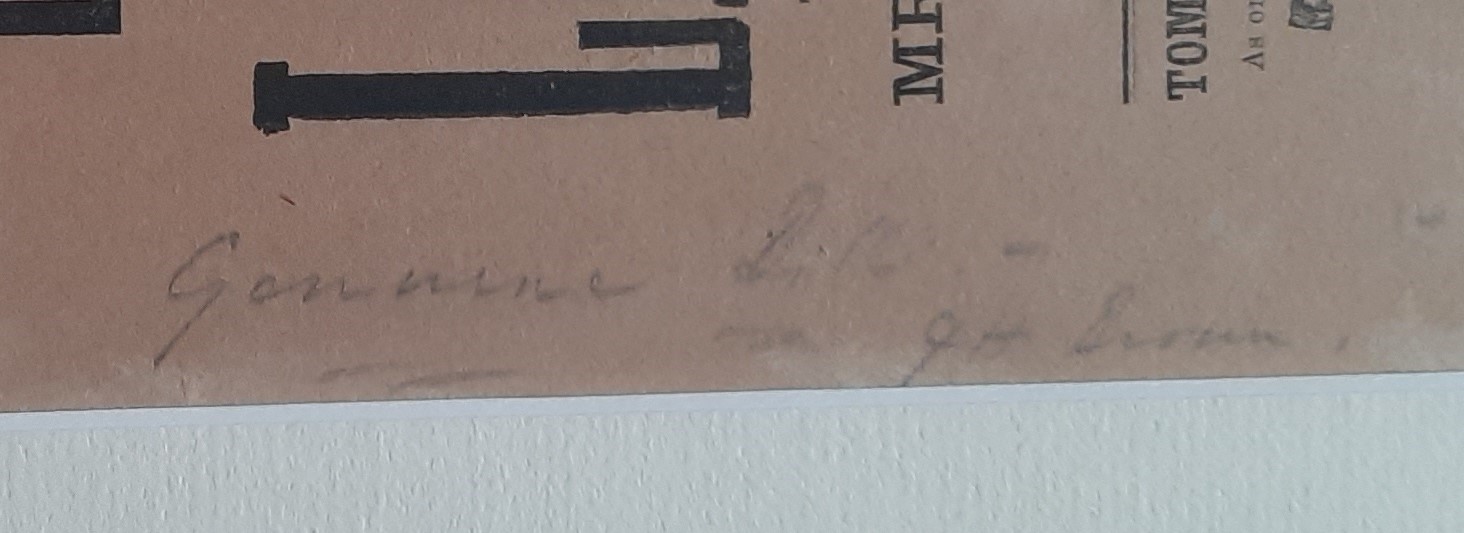
Figure 2: Notation reading “Genuine Bill – [illegible] J H Brown”

The paper of the bill is browned. There are some discolorations and mild defects around the visible edges. A circular shaped defect about ¼” in size can be seen about 7 inches from the top near the name of John Dyott (Fig. 3).

Figure 3: Small defect near the name of John Dyott

There is evidence that the bill was previously folded with a light horizontal crease through the line containing the text “Buddicomb, a valet” (Fig. 4).

Figure 4: Faint horizontal crease through the entry for “Buddicomb, a valet”

Minor discoloration can be seen in other places. Still, overall, the bill is very clean, albeit browned from prior display. The bill was not examined out of the frame.

Compositional Analysis: At first glance, this bill represents an example of the first issue playbill for April 14, 1865. Bills of this sort were initially the only bills in production by printer H. Polkinhorn and Son in preparation for the evening’s show. After it was ascertained that President Lincoln was going to be attending the theater that night, it was decided that the singing of a patriotic song that was planned for the following evening was to be included. As a result of this change, the type of the printed bill was adjusted to include a paragraph about the now-planned singing of “Honor to Our Soldiers.” The Doe bill does not contain this paragraph, thus making it a possible first-issue playbill.

The Huntington Library in San Marino, CA, owns a genuine first-issue playbill for Our American Cousin. They have digitized this playbill at a high resolution, and it is available to view here: https://hdl.huntington.org/digital/collection/p16003coll6/id/5034/rec/1 Using this bill as an example, I then conducted a detailed comparison between it and the Doe playbill.

During my comparison, I looked for the different details documented by Brenner as those present on a genuine first-issue playbill, all of which are borne out on the Huntington playbill. Among those details are:

  • A space between the digits 9 and 5 in the text “NUMBER OF NIGHTS, 49 5”
  • The condition of the final E in the name of “LAURA KEENE”
  • The condition of the final R in the word “MANAGER”
  • The alignment of the letter H in the name “H. CLAY FORD”
  • The alignment of the letter S in the words “Supported by”
  • A small interior misprint on the letter C in “COUSIN”
  • A small circular defect on the letter N in “COUSIN”
  • The spelling of “Sensation”
  • The word “Chairs” after the word “Orchestra”
  • Several breaks in the horizontal lines separating different blocks of text

For each point of comparison, I found that the Doe playbill matched the details of the Huntington playbill. Everything was compositionally correct and in the right place to match a genuine first-issue bill.

I then looked for evidence of duplication. There have been other bills that I have examined in the past that have had the correct content, but they have distinct evidence that were merely copies of a legitimate bill. When copies of bills are made, there is a distinct drop in quality and detail. This is very noticeable in the font of “THE OCTOROON,” where the small details are lost. In addition, duplication removes the minor irregularities present during the original printing process. In addition to examining the font of “THE OCTOROON,” I requested and was provided with close-up images of the word “COUSIN” so that I could assess the natural deviations in this boldly printed word.

In my opinion, this bill does not show signs of being a duplicate. The fine details are present and consistent with an original printing, not a copy done by modern means.

Based on my visual and compositional analysis, I believe that the Doe playbill is a genuine first issue from April 14, 1865. It matches all points of comparison as laid out by Walter Brenner in his study of genuine assassination playbills, and there is no evidence of the bill being a period of modern reproduction.

Provenance Analysis: From my communications with Jane, I learned that this playbill has been in her husband’s family for over a hundred years. Mr. Doe’s great-grandfather was named Frederick S. Lang, the owner of a sizable Lincoln collection. According to Jane, this playbill and some other materials are what remains of the former Lang collection of Lincolniana.

In June of 1919, C. F. Libbie and Co. auctioned off what was advertised as a “Lincoln Collection formed by Frederick S. Lang, Boston.” Mr. and Mrs. Doe still retain two copies of this auction catalog. A digitized version of the catalog, housed on the Internet Archive, can be viewed here: https://archive.org/details/catalogueoflinco00libb. In examining the catalog, we find the following lot description:

“1129 Play Bill. Ford’s Theatre, April 14, 1864[sic]. One of the original play bills, first issue. Neatly matted in a narrow oak frame. Folio. This is one of the original play bills purchased from the Estate of John B. Wright, who was stage manager, by J. H. Brown.”

This lot appears to describe the playbill still in possession by the Does. Jane sent images of the original frame the playbill was housed in before it was reframed by her in-laws. One of these images is included below. This frame appears to match the description of “a narrow oak frame.”

Given the presence of the playbill with a descendant of Frederick Lang today, it would appear that this lot did not sell in 1919. Perhaps the misprint in the auction catalog of 1864 rather than 1865 caused it to fall under the radar.

In addition to the playbill’s entry in the 1919 auction catalog, the bill is framed alongside a small handwritten note. This note is faded and brown but is still legible. It states, “I purchased this Bill from the Estate of John B. Wright who was Stage Manager / J H Brown”
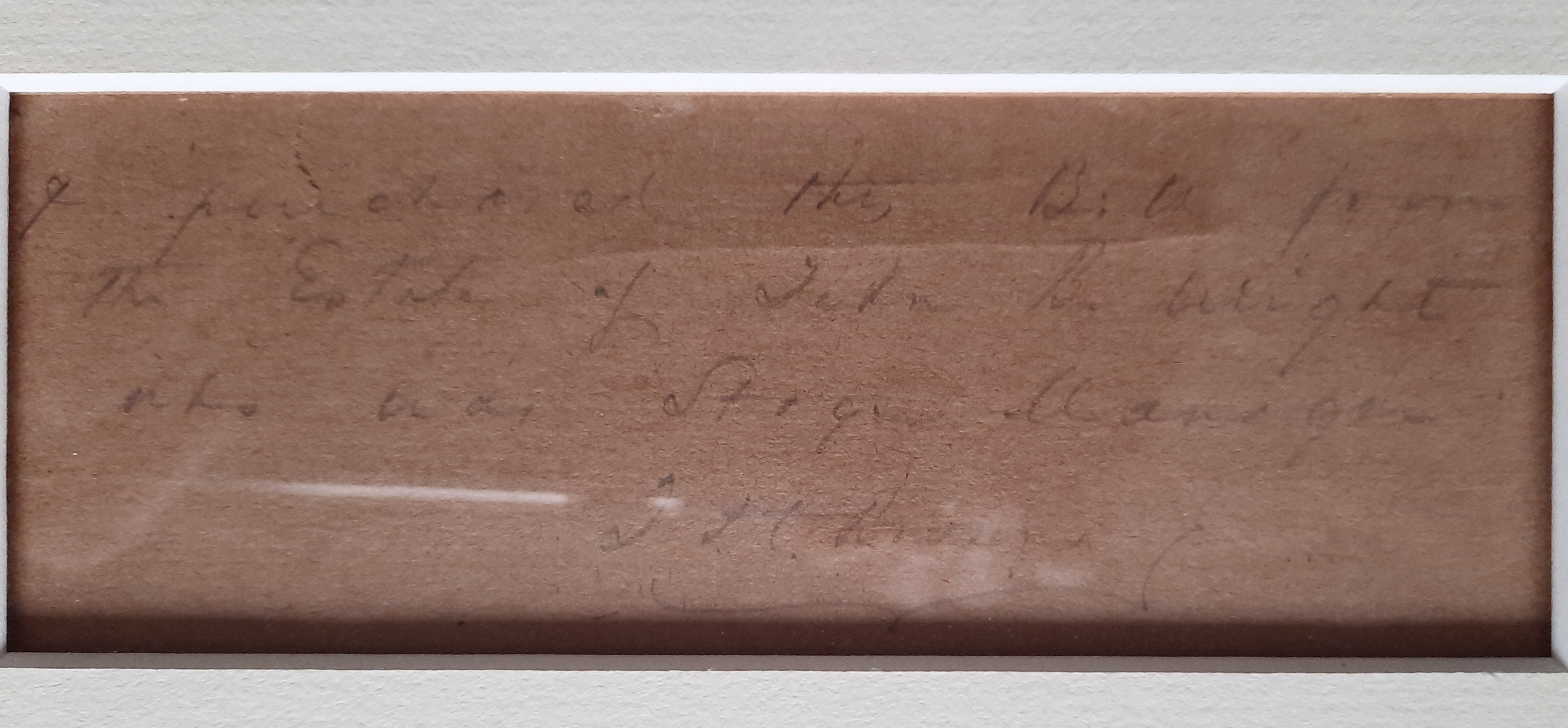
Further information about the bill is included in a transcript of a circa 1909 typewritten essay or article about Frederick Lang’s collection. This transcript is owned by Mr. Doe. Jane provided a picture of a page from this essay that mentions the playbill. The text is as follows:

“occupying[sic] a prominent place on the wall is the exceedingly rare, genuine play-bill of Ford’s Theatre, April 14th, 1865 the night of Lincoln’s assassination. The attraction was Laura Keene, in Our American Cousin, and in the cast were many players well known in Boston, among them being W. J. Ferguson, Harry Hawk, and Geo. G. Spear. This play-bill was obtained from the collection of the late J. H. Brown, one of the best known theatrical collectors in the country. It is accompanied by his affidavit that it was purchased from the estate of J. B. Wright, the stage manager of Ford’s Theatre at the time of the tragedy. Mr. Wright was well known in Boston, as he was for many years connected with the National Theatre of this city, as stage manager and lessee. Mr. Lang also has a copy of the fac-simile of the genuine bill, copyrighted 1891, with affidavit by R. O. Polkinhorn who was pressman at the time of the assassination, and certificate from J. F.[sic] Ford, proprietor of the threatre[sic]. Accompanying this is a copy of this bogus bill which had a wide sale before the fraud was disclosed. This bill contains the following announcement, ‘This evening the performance will be honored by the presence of President Lincoln.’ As it was not known at the time of printing the bills, that Lincoln would attend the threatre[sic], this alone stamps the bill as spurious, but as this fact was not widely known, many of them were disposed of at fancy prices. This bogus bill is seldom met with now, and the three items make a rare and interesting collection in themselves. The latter two are not framed but are in a Booth portfolio.”

Through research, I determined that the J. H. Brown mentioned in the provided provenance was James Hutchinson Brown, a Massachusetts theatrical collector who lived from 1827 to 1897. In 1898, C. F. Libbie and Co. sold off Brown’s extensive collection of dramatic books, autographs, and playbills over the course of three different auctions. The third and final of these auctions occurred on June 15 and 16, 1898. This auction contained a collection of around 180,000 American and English playbills, “formed by the late James H. Brown, Esq., of Malden, Mass.” A digitized version of this auction catalog, housed on the Internet Archive, can be viewed here: https://archive.org/details/cu31924031351533. In examining this catalog, we find the following lot description:
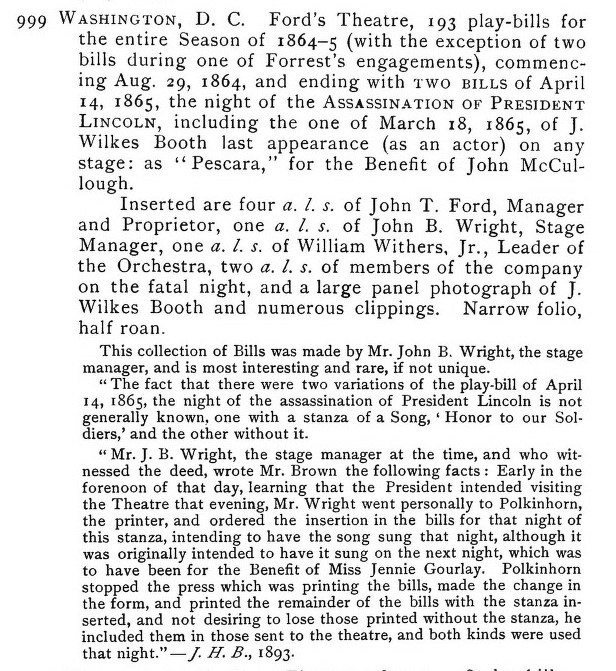
“999 Washington, D. C. Ford’s Theatre, 193 play-bills for the entire Season of 1864-5 (with the exception of two bills during one of Forrest’s engagements), commencing Aug. 29, 1864, and ending with TWO BILLS of April 14, 1865, the night of the ASSASSINATION OF PRESIDENT LINCOLN, including the one of March 18, 1865, of J. Wilkes Booth last appearance (as an actor) on any stage: as ‘Pescara,’ for the Benefit of John McCullough. Inserted are four a.l.s. of John T Ford, Manager and Proprietor, one a.l.s. of John B. Wright, Stage Manager, one a.l.s. of William Withers, Jr., Leader of the Orchestra, two a.l.s. of members of the company on the fatal night, and a large panel photograph of J. Wilkes Booth and numerous clippings. Narrow folio, half roan. This collection of Bills was made by Mr. John B. Wright, the stage manager, and is most interesting and rare, if not unique. ‘The fact that there were two variations of the play-bill of April 14, 1865, the night of the assassination of President Lincoln is not generally known, one with a stanza of a Song, ‘Honor to our Soldiers,’ and the other without it. ‘Mr. J. B. Wright, the stage manager at the time, and who witnessed the deed, wrote Mr. Brown the following facts: Early in the forenoon of that day, learning that the President intended visiting the Theatre that evening, Mr. Wright went personally to Polkinhorn, the printer, and ordered the insertion in the bills for that night of this stanza, intending to have the song sung that night, although it was originally intended to have it sung on the next night, which was to have been the Benefit of Miss Jennie Gourlay. Polkinhorn stopped the press which was printing bills, made the change in the form, and printed the remainder of the bills with the stanza inserted, and not desiring to lose those printed without the stanza, he included them in those he sent to the theatre, and both kinds were used that night.’ – J.H.B., 1893.”

Interestingly, while the assumption would be that Mr. Lang purchased this lot of Ford’s Theatre playbills at auction in 1898, we know that not to be the case. This lot was purchased by another collector named Evert Jansen Wendell (1830 – 1917). After Wendell’s death, this specific collection of Ford’s Theatre playbills was donated to Harvard University. It was this same collection of playbills that Walter Brenner consulted for his 1937 study. At the time of Brenner’s research, the collection still had the two April 14, 1865 bills mentioned in the Brown auction catalog, making it impossible for Lang to have purchased this lot of 193 playbills.

John B. Wright, former stage manager at Ford’s Theatre

However, this auction catalog does confirm that James H. Brown had dealings with the estate of John Burroughs Wright, the former stage manager of Ford’s Theatre. Wright was a Massachusetts native who maintained a home in the Boston area even when he was working for John T. Ford in Baltimore and D.C. during the Civil War years. After the shooting of Lincoln, Wright returned to Boston. After several seasons touring with star Edwin Forrest and managing theaters in New York, Wright retired from the theater business in 1880. He died in 1893. His wife Annie, who had been present in the audience on the night Lincoln was assassinated, outlived her husband and eventually died in 1924.

The catalogs for the Brown auctions contain several pieces associated to John B. Wright, showing that Brown’s purchases from the Wright estate were more than just the collection of Ford’s Theatre playbills from 1864 – 1865, which eventually went to Evert Wendell. It is, therefore, reasonable to assume that John B. Wright possessed more than one copy of the first issue playbill used on the night of Lincoln’s assassination and that James H. Brown purchased it along with the rest of the materials he acquired from the Wright estate. From there, this specific bill was purchased by Frederick Lang, a collector not of theater memorabilia but of Lincolniana.

The framed note, along with the Frederick Lang auction catalog, conclusively traces this playbill back to Ford’s Theatre stage manager John B. Wright. Two other genuine playbills from the Wright collection exist in the Harvard Theatre Collection, demonstrating that Wright retained genuine playbills after the assassination of Lincoln.

In my opinion, the provenance associated with the Doe playbill is strong.

Conclusions: The Doe playbill has all the marks of a first-issue Ford’s Theatre playbill from the night of Abraham Lincoln’s assassination. By looking at the minute details, it can be seen that the bill is not a period reproduction, nor is there any evidence of modern duplication. The provenance demonstrates an unbroken line of ownership from John B. Wright, stage manager of Ford’s Theatre, to the current owners, John and Jane Doe. The claims of provenance can be backed up with supplementary evidence in prior auction catalogs.

It is my opinion that the Doe playbill is a genuine playbill from the night of April 14, 1865. As such, it is a rare and unique piece of American history.

Dave Taylor

List of sources and references used in this research:

  • Bogar, Thomas A. Backstage at the Lincoln Assassination: The Untold Story of the Actors and Stagehands at Ford’s Theatre. Washington, D.C.: Regnery, 2013.
  • Brenner, Walter C. The Ford Theatre Lincoln Assassination Playbills: A Study. Philadelphia: Privately Printed, 1937.
  • Brenner, Walter C. Supplement for insertion in The Ford Theatre Lincoln Assassination Playbills: A Study. Philadelphia: Privately Printed, 1940.
  • Catalogue of a Lincoln collection formed by Frederick S. Lang, Boston. Boston: C. F. Libbie & Co., 1919.
  • Catalogue of the valuable collection of play-bills, portraits, photographs, engravings, etc., etc., formed by the late James H. Brown, Esq., of Malden, Mass. Boston: C. F. Libbie & Co, 1898.
  • The Huntington Library, Art Museum, and Botanical Gardens
  • Harvard Theatre Collection
  • Emails with Jane Doe

I hope you enjoyed a dive into the research and provenance behind the Ford’s Theatre playbill that will be sold by R.R. Auctions. If you’ve always wanted to own one of the rarest pieces of assassination history, you might want to keep on eye on Saturday’s auction. But be prepared to shell out quite a nest egg to add this to your collection. At the time of this writing, during the pre-auction bidding period, this playbill is already up to $55,000 and will likely go much higher before the gavel falls.

Even if you’re like me and will never have the scratch to own something like this, I hope you still enjoyed learning about the playbill and its history. And, if anyone else has any cool priceless artifacts you’d like me to look at, I’m happy to give my opinion. This genuine playbill just goes to show that there are still treasures to be found out there.

Categories: History, News | Tags: , , , , | 10 Comments

The Last Words Lincoln Heard

In January of 1890, an article appeared in the Century Magazine by John Nicolay and John Hay, the personal secretaries of President Abraham Lincoln. For the past four years, the pair had been releasing regular articles in Century documenting the life and Presidency of their former boss. Nearing the end of their project, this 1890 chapter of their ongoing Abraham Lincoln: A History series was titled “The Fourteenth of April” and covered Lincoln’s assassination. Nicolay and Hay set the scene well, documenting Lincoln’s movements that day and highlighting the fateful events at Ford’s Theatre that evening. When discussing the moments just before the fatal shot was fired, the duo wrote:

“No one, not even the comedian on the stage, could ever remember the last words of the piece that were uttered that night – the last Abraham Lincoln heard upon earth. The whole performance remains in the memory of those who heard it a vague phantasmagoria, the actors the thinnest of specters.”

This claim –  that no one could recall the words spoken on stage before the shot was fired – came as a surprise to several people who had witnessed the assassination or had heard the story from those who had been there. While the memory of the last words may have waned in Hay and Nicolay, there were some alive in 1890 who remembered well the last lines of Our American Cousin that were uttered before the building erupted into chaos. Not the least of those who remembered the event vividly was the described “comedian on the stage” himself, actor Harry Hawk.

In 1865, William Henry “Harry” Hawk was a star performer in Laura Keene’s acting troupe. Our American Cousin had been a breakout hit for the trailblazing actress and theater owner when she debuted it in 1858. Even seven years later, the play was immensely popular, so much so that Keene had gone to court against actors like John Wilkes Booth’s brother-in-law, John Sleeper Clarke, who had put on the show themselves without her consent. Even though Harry Hawk had not been part of the original 1858 cast, as part of Laura Keene’s troupe for the season of 1864-65, he aptly played the titular role of the American cousin, Asa Trenchard.

Just before Booth fired his derringer at Ford’s Theatre, Hawk’s character had been upbraided for his lack of proper English manners by the character of Mrs. Mountchessington, played by Ford’s Theatre stock actress Helen Muzzy. The flummoxed Mrs. Mountchessington, unaware that Asa had selflessly burnt the will granting him a large portion of the English estate so that members of the immediate family were not dispossessed of their inheritance, lambasted the backwoods American for not being used to “the manners of good society.” She then exited in a huff along with her daughter. This left Harry Hawk’s character as the only person present on the stage.

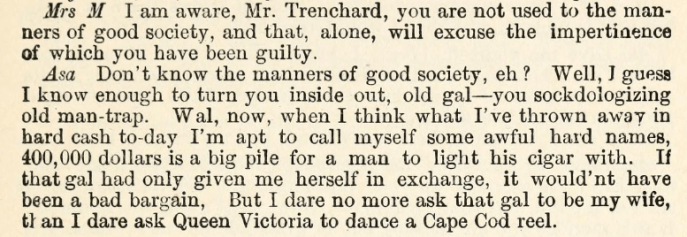
So, what were the last lines that Lincoln heard on stage? Well, according to the play’s script, after Mrs. Mountchessington leaves the stage, the somewhat frustrated Asa Trenchard is supposed to call after her with the comment, “Don’t know the manners of good society, eh? Wal, I guess I know enough to turn you inside out, old gal – you sockdologizing old man-trap.”

This famous line has gone down in history as the last words Abraham Lincoln ever heard, for according to witnesses, Booth used the laughter that followed this line to help cover the report of his pistol.

There is a minor fly in the ointment, however. What appears in the “script” for Our American Cousin may not be the exact lines that were spoken that night. Our American Cousin was very much a “living play” at the time it was being performed. The original version that British playwright Tom Taylor had written and sold to Laura Keene was very different from the show that became famous. Taylor’s version was a melodrama with some instances of farce. To spice the play up a bit, Keene and her original cast made drastic changes to Taylor’s work and increased the comedic aspects. Most notably, the character of Lord Dundreary was altered from a minor role with only 40 or so lines into the major comic relief of the entire play. Rather than being just a slightly out-of-touch aristocrat, E. A. Sothern, the original actor of Lord Dundreary, wholly reinvented the part, transforming Dundreary into a laughably loveable buffoon with a crazy style who talked with a lisp and uttered his own uniquely rearranged aphorisms such as “birds of a feather gather no moss.” The changes Keene and Sothern made to Tom Taylor’s work are what made the show a hit. Sothern became so popular in the role that he penned his own Dundreary spin-off shows that he acted in for the rest of his life.

By 1865, much of the show had become more structured, but ad-libbing and the alteration of lines were still common. In the years after the assassination, the show continued to evolve as well, making it unclear how much the 1869 printed version of Our American Cousin differs from what was heard in 1865. We know, for example, that Laura Keene herself did some ad-libbing at Ford’s Theatre, adding a line to draw attention to the President’s arrival after the show had started. Another adlib was made after one character stated their line about their being a draft in the English manor house, only for one of the actors to reassure the audience that, with the Civil War now practically at an end, there would no longer be a “draft” in the military sense.

One would think that our best source for the exact words said on stage would be from the man who uttered them, Harry Hawk. In the hours after the assassination, Hawk was interviewed by Corporal James Tanner in the front parlor of the Petersen House, where Lincoln lay dying. While Hawk discussed his placement on the stage and was among the first to formally identify John Wilkes Booth as the assassin, he did not mention the words he had spoken just before the shot. Over a decade ago, I transcribed a letter Harry Hawk wrote to his parents in the aftermath of the assassination. In that letter, Hawk confirms he was “answering [Mrs. Mountchessington’s] exit speech” when the shot was fired, but he does not include his lines.

The genesis of this post was a letter from Harry Hawk that I recently viewed in the Harry Ransom Center at the University of Texas in Austin. The letter is merely dated “Sept. 21” with no year given. However, based on the reference to the Century Magazine article, we can conclude that the letter was likely written in 1890 or perhaps 1891. Hawk is writing from the Camden House, a lodging establishment in Boston. The recipient of the letter is unknown, but it appears that they originally wrote to Hawk asking him about his experience the night of Lincoln’s assassination. This letter from Hawk is transcribed below:

Camden House
331 Tremont St.
Sept. 21st [1890 or 91]

Dear Sir

In reply to yours I will state, first that Mr. John Mathews, W. J. Ferguson, Thos Byrns [sic], Emerson, and myself are the last survivors of the men of that sad fateful event. That is to my knowledge. I haven’t a bill with the cast by me. In contradiction to the statement made by The Century Article last January, that, not even the comedian who was speaking at the time could remember the last words spoken is all rot. I was speaking at the time being entirely alone on the stage, and as I played the character many times after it would be very strange if I did not remember the lines and incidents. They are all indelibly impressed on my mind, and as clear as thought it occurred last night. I have positively refused to be interviewed on account of my friendship for Edwin Booth. And would not wound his feelings by permitting the papers publishing what I did and did not say. A few days after the Graphic article, I was awakened early in the morning at the Lindel Hotel St. Louis, by a reporter for the World, N.Y., to interview me regarding it. The last words spoken on that stage and the last ones dear old Martyr Abe Lincoln heard, these in reply to the old lady Mrs. Muzzy, who had just gone off the stage – I knew enough to turn you inside out – old woman, you darned old sock dolagin man trap 

Resp. Yours

Harry Hawk

In this way, Harry Hawk describes the last lines heard by Lincoln as a slight variation of the lines printed in Our American Cousin. While I would like to take Hawk at his word here, we should be cognizant to remember that this letter was written at least 25 years after the events it describes. Despite Hawk’s claim that the lines and incidents are “indelibly impressed” on his mind, human memory is a fickle and unreliable thing. That is why, as historians, we try our best to find sources as close to the event as possible while the memory is still fresh and is unlikely to have been inadvertently altered by the passage of time.

A photo of Edwin Booth taken in 1892.

It appears that Hawk stayed true to his word to not discuss the events of that night with reporters so long as Edwin Booth lived. The famous tragedian died in 1893, which is probably why, in 1894, Hawk agreed to be interviewed by reporters. An article about Hawk was published in March by the Washington Post, followed by a slightly different one from a Chicago reporter in April. The second article, republished across the country, described the events at Ford’s Theatre and Harry Hawk’s experiences. In this recounting of the last words said before the shot, Hawk stated, “My lines were: ‘Not accustomed to the manners of good society, eh? Well, I guess I know enough to turn you inside out, old woman. You darned old sockdologing mantrap.’

In some other similar articles from Hawk in 1894, the only significant change in the lines given is the use of the word “damned” rather than “darned.”

An engraving of the assassination from Frank Leslie’s Illustrated Newspaper. Here we can see Booth brandishing his knife on stage and uttering “Sic Semper Tyrannis” while a stupefied Harry Hawk looks on. In reality, Hawk fled from the stage when he saw Booth running towards him with a knife.

The exact phrasing Harry Hawk used to say his lines in Act 3, Scene 2 of Our American Cousin will never be known for absolute certainty, but through the printed script and Hawk’s own reminiscences from that night, we can get very close to the last words heard by President Lincoln. Regardless of the phrasing, as Hawk uttered these lines, “the audience clapped their hands and laughed in glee, in which the President joined with a smile.” For all the tragedy of that fateful night, we should take some solace in the fact that Abraham Lincoln’s last moments of consciousness were filled with joy and laughter.

Epilogue:

I’ve often heard the Park Rangers at Ford’s Theatre give their presentation about the assassination. As part of their schtick, they tell the audience that Lincoln was shot during the “biggest laugh line of the play” and then recite the printed line above. Other than some nervous laughter from a few who fear they’ve missed the joke, the line regularly goes over like a lead balloon. Part of the problem is that the line alone is just not that funny. It’s the character of Asa Trenchard as the American country bumpkin finally breaking loose and telling his British counterparts “what for” that makes the line funny. There’s also irony that the stuck-up Mrs. Mountchessington claims Asa doesn’t know his manners when he has demonstrated better manners than the entire household by selflessly renouncing his inheritance so that his British relatives would be taken care of. Out of context, the line just doesn’t pack the same comedic punch.

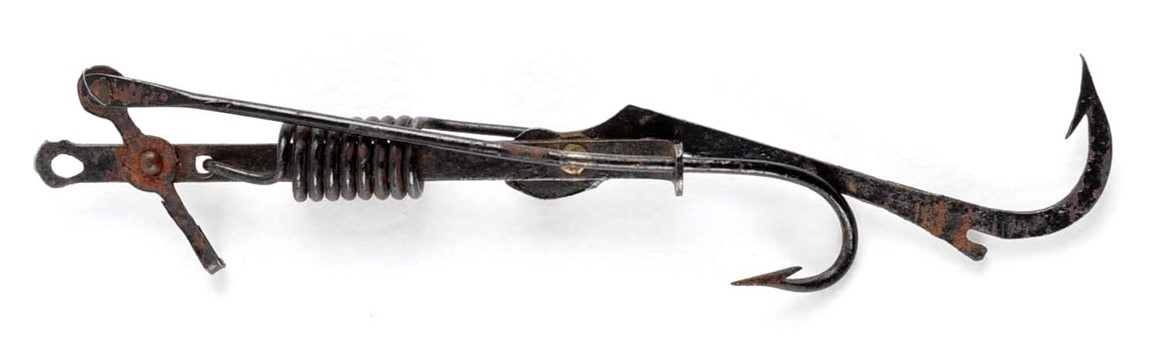
The other issue is likely to do with the word “sockdologizing.” It’s a completely foreign word to a modern audience, which creates confusion. But, in truth, it was a slightly made-up word in 1865 as well. The basis of the word appears to be “sockdolager” which an 1897 Dictionary of Slang struggled to define. The Dictionary of Slang attempts to connect it to the word “doxology,” a religious verse that is sung at the end of a prayer. In this way, a sockdolager could mean something conclusive that settles or ends something. If interpreted this way, Asa Trenchard is criticizing Mrs. Mountchessington for acting like she is the final word on everything, which is ironic since she doesn’t even know what Asa has done, and his news could “turn her inside out.” However, a “sockdolager” was also the name of a type of fish hook that closed via a spring.

A circa 1847 sockdolager fish hook. (Don’t ask me to explain how it works)

Given that the word “sockdologizing” is followed by the phrase “old man-trap,” this line could be interpreted to mean that Asa is calling Mrs. Mountchessington out for her own aggressive barbs and ruses hidden under the facade of her so-called “good manners.” In the end, we can’t be sure how to interpret the word “sockdologizing” in this line, but, at the same time, it really doesn’t matter. The creative wordplay alone invokes the sense of exasperation Asa is feeling, and that, above all, is where the humor comes from.

Categories: History | Tags: , , , , , , | 7 Comments

The Lincoln Assassination on this Day (December 12 – December 31)

Taking inspiration from one of my favorite books, John Wilkes Booth: Day by Day by Art Loux, I’ve been documenting a different Lincoln assassination or Booth family event each day on my Twitter account. If you click on any of the pictures in the tweet, it will take you to its individual tweet page on Twitter where you can click to make the images larger and easier to see. Since Twitter limits the number of characters you can type in a tweet, I often include text boxes as pictures to provide more information. I hope you enjoy reading about the different events that happened over the last week.

NOTE: After weeks of creating posts with multiple embedded tweets, this site’s homepage now tends to crash from trying to load all the different posts with all the different tweets at once. So, to help fix this, I’ve made it so that those viewing this post on the main page have to click the “Continue Reading” button below to load the full post with tweets. Even after you open the post in a separate page, it may still take awhile for the tweets to load completely. Using the Chrome browser seems to be the best way to view the tweets, but may still take a second to switch from just text to the whole tweet with pictures.

Continue reading

Categories: History, OTD | Tags: , , , , , , , , , , , , , , , , , , , , , , , , , , , , , , , , , , , , , , , , , , | Leave a comment

The Lincoln Assassination on this Day (December 5 – December 11)

Taking inspiration from one of my favorite books, John Wilkes Booth: Day by Day by Art Loux, I’m documenting a different Lincoln assassination or Booth family event each day on my Twitter account. In addition to my daily #OTD (On This Day) tweets, each Sunday I’ll be posting them here for the past week. If you click on any of the pictures in the tweet, it will take you to its individual tweet page on Twitter where you can click to make the images larger and easier to see. Since Twitter limits the number of characters you can type in a tweet, I often include text boxes as pictures to provide more information. I hope you enjoy reading about the different events that happened over the last week.

NOTE: After weeks of creating posts with multiple embedded tweets, this site’s homepage now tends to crash from trying to load all the different posts with all the different tweets at once. So, to help fix this, I’ve made it so that those viewing this post on the main page have to click the “Continue Reading” button below to load the full post with tweets. Even after you open the post in a separate page, it may still take awhile for the tweets to load completely. Using the Chrome browser seems to be the best way to view the tweets, but may still take a second to switch from just text to the whole tweet with pictures.

Continue reading

Categories: History, OTD | Tags: , , , , , , , , , , , , , | Leave a comment

The Lincoln Assassination on this Day (October 31 – November 13)

Taking inspiration from one of my favorite books, John Wilkes Booth: Day by Day by Art Loux, I’m documenting a different Lincoln assassination or Booth family event each day on my Twitter account. In addition to my daily #OTD (On This Day) tweets, each Sunday I’ll be posting them here for the past week. If you click on any of the pictures in the tweet, it will take you to its individual tweet page on Twitter where you can click to make the images larger and easier to see. Since Twitter limits the number of characters you can type in a tweet, I often include text boxes as pictures to provide more information. I hope you enjoy reading about the different events that happened over the last week.

NOTE: After weeks of creating posts with multiple embedded tweets, this site’s homepage now tends to crash from trying to load all the different posts with all the different tweets at once. So, to help fix this, I’ve made it so that those viewing this post on the main page have to click the “Continue Reading” button below to load the full post with tweets. Even after you open the post in a separate page, it may still take awhile for the tweets to load completely. Using the Chrome browser seems to be the best way to view the tweets, but may still take a second to switch from just text to the whole tweet with pictures.

Continue reading

Categories: History, OTD | Tags: , , , , , , , , , , , , , , , , , , , , , , , , , , , | Leave a comment

The Lincoln Assassination on this Day (September 12 – September 25)

Taking inspiration from one of my favorite books, John Wilkes Booth: Day by Day by Art Loux, I’m documenting a different Lincoln assassination or Booth family event each day on my Twitter account. In addition to my daily #OTD (On This Day) tweets, each Sunday I’ll be posting them here for the past week. If you click on any of the pictures in the tweet, it will take you to its individual tweet page on Twitter where you can click to make the images larger and easier to see. Since Twitter limits the number of characters you can type in a tweet, I often include text boxes as pictures to provide more information. I hope you enjoy reading about the different events that happened over the last week.

NOTE: After weeks of creating posts with multiple embedded tweets, this site’s homepage now tends to crash from trying to load all the different posts with all the different tweets at once. So, to help fix this, I’ve made it so that those viewing this post on the main page have to click the “Continue Reading” button below to load the full post with tweets. Even after you open the post in a separate page, it may still take awhile for the tweets to load completely. Using the Chrome browser seems to be the best way to view the tweets, but may still take a second to switch from just text to the whole tweet with pictures.

Continue reading

Categories: History, OTD | Tags: , , , , , , , , , , , , , , , , , , , , , , , , , , , , , , , , , , , , , , , | Leave a comment

The Lincoln Assassination On This Day (April 11 – April 17)

This week’s OTD tweets cover the 157th anniversary of Lincoln’s assassination. As such there are a lot of extra tweets in the Bonus section. As a result, it may take longer than normal for this post to fully load.

Taking inspiration from one of my favorite books, John Wilkes Booth: Day by Day by Art Loux, I’m documenting a different Lincoln assassination or Booth family event each day on my Twitter account. In addition to my daily #OTD (On This Day) tweets, each Sunday I’ll be posting them here for the past week. If you click on any of the pictures in the tweet, it will take you to its individual tweet page on Twitter where you can click to make the images larger and easier to see. Since Twitter limits the number of characters you can type in a tweet, I often include text boxes as pictures to provide more information. I hope you enjoy reading about the different events that happened over the last week.

NOTE: After weeks of creating posts with multiple embedded tweets, this site’s homepage now tends to crash from trying to load all the different posts with all the different tweets at once. So, to help fix this, I’ve made it so that those viewing this post on the main page have to click the “Continue Reading” button below to load the full post with tweets. Even after you open the post in a separate page, it may still take awhile for the tweets to load completely. Using the Chrome browser seems to be the best way to view the tweets, but may still take a second to switch from just text to the whole tweet with pictures.

Continue reading

Categories: History, OTD | Tags: , , , , , , , , , , , , , , , , , , , , , , , , , , , , , , , , , , , | Leave a comment

The Lincoln Assassination On This Day (March 7 – March 13)

Taking inspiration from one of my favorite books, John Wilkes Booth: Day by Day by Art Loux, I’m documenting a different Lincoln assassination or Booth family event each day on my Twitter account. In addition to my daily #OTD (On This Day) tweets, each Sunday I’ll be posting them here for the past week. If you click on any of the pictures in the tweet, it will take you to its individual tweet page on Twitter where you can click to make the images larger and easier to see. Since Twitter limits the number of characters you can type in a tweet, I often include text boxes as pictures to provide more information. I hope you enjoy reading about the different events that happened over the last week.

NOTE: After weeks of creating posts with multiple embedded tweets, this site’s homepage now tends to crash from trying to load all the different posts with all the different tweets at once. So, to help fix this, I’ve made it so that those viewing this post on the main page have to click the “Continue Reading” button below to load the full post with tweets. Even after you open the post in a separate page, it may still take awhile for the tweets to load completely. Using the Chrome browser seems to be the best way to view the tweets, but may still take a second to switch from just text to the whole tweet with pictures.

Continue reading

Categories: History, News, OTD | Tags: , , , , , , , , , , , , , , , , , | 3 Comments

Blog at WordPress.com.