Posts Tagged With: National Hotel

Breakfast with Booth: Cynthia Ann Brooks

This post is the third and final entry in my recent series exploring who might have breakfasted with John Wilkes Booth on the morning of Lincoln’s assassination. The first installment explored the identity of Carrie Bean, a young socialite that journalist George Alfred Townsend claimed shared breakfast with Booth on April 14, 1865. The second post discussed the theory that Booth was joined that morning by his own secret fiancee, Lucy Hale. For this third post, we’re going to consider a third woman to whom an intriguing connection to Booth’s breakfast has been made. Her name is Cynthia Ann Brooks. According to articles from her granddaughter, John Wilkes Booth gave Cynthia Brooks his picture at breakfast on the morning of Lincoln’s assassination.

First, the verifiable facts I have been able to glean about the family in question. Cynthia Ann was the daughter of Joseph and Elizabeth Allen. She was born in about 1812 in Maine. Her family claimed kinship to the Revolutionary War patriot Ethan Allen, who, along with Benedict Arnold, captured Fort Ticonderoga from the British in May of 1755 without firing a shot. As a young child, Cynthia’s family moved to Hamilton, Ohio, a town just north of Cincinnati. At around the age of 20, Cynthia married Eri V. Brooks, a police officer and justice of the peace in Hamilton. The couple had at least five children. In 1850, Eri Brooks died, so Cynthia Brooks and her children moved in with her brother, William Allen.

In 1857, Cynthia’s eldest daughter, Clara Belle Brooks, married a man named Richard Hall. The young couple moved to Superior, Wisconsin, where Richard and Clara’s brother, Eri Brooks, Jr., set up a law firm. The firm eventually moved to Houghton in the Upper Peninsula of Michigan. While Eri became a justice of the peace in the area, Richard and Clara were unhappy with life in the isolated far north. The couple moved to Indianapolis, which was Richard’s hometown. There, in 1859, the Halls gave birth to a daughter, Clara “Carrie” Hall. In 1860, Richard accepted a position as a clerk in the Census Bureau in D.C. As a result, he moved his family to the nation’s capital. Young Carrie Hall would grow up in the bustling streets of Washington.

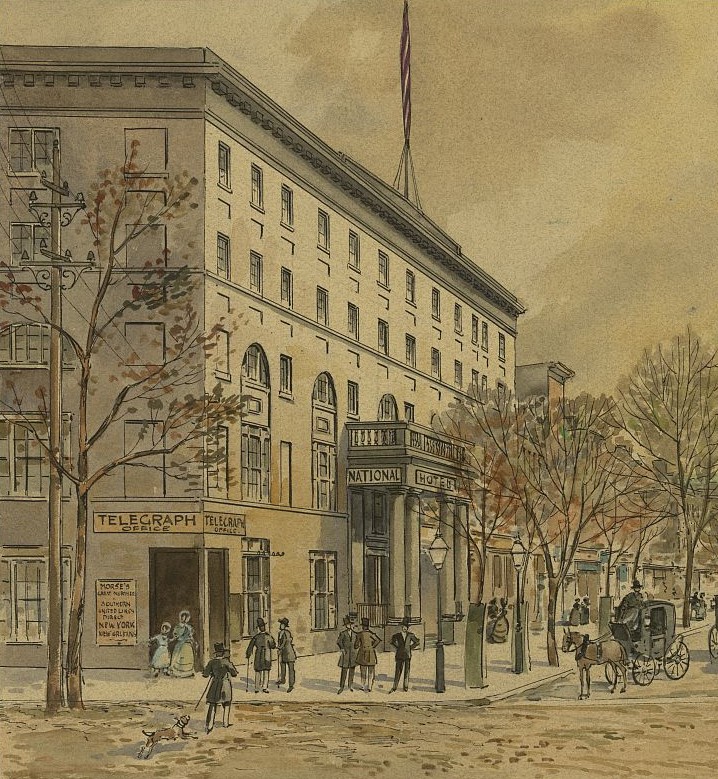
In 1861, Richard Hall was transferred over to the Pension Bureau. He was employed there until 1864, when he resigned from his government position in order to become a real estate broker. Richard was involved in political matters and took part in events at the city’s Union League. He was a strong supporter of Abraham Lincoln and spoke passionately in favor of the President at the Union League in the lead-up to the 1864 election. During their time in D.C., the Hall family lived in a variety of residences. By 1865, however, the Washington city directory shows the Halls lodging at everyone’s favorite locale: the National Hotel.
Between 1865 and 1867, Richard served a stint as the D.C. Recorder of Deeds. Near the middle of 1867, Richard left the government once again in order to return to his life as a real estate dealer. Not long after starting up his real estate business again, Richard was called for jury duty in the district. On June 13, Richard reported to the courthouse, and, like every American, he tried hard to get out of jury duty. Richard informed the court that, being a real estate agent, “the interests of other persons would suffer, perhaps, a great deal more than my own” if he were chosen to serve on a jury. The court was unmoved by Mr. Hall’s claims that his business could not wait for him to complete jury service.  The court responded that his business excuse “would let off nine out of every ten of the jury” if they accepted it. He was ordered to stay and became one of the prospective jurors for an upcoming trial. Later that day, Richard Hall was interviewed again by the court, with the addition of lawyers from the prosecution and defense. This process, known as voir dire, allows the lawyers to judge prospective jurors’ knowledge of the case and their ability to be impartial based on the evidence. The case that Richard Hall was a prospective juror for was that of the escaped Lincoln conspirator, John Surratt, Jr., who had recently been captured abroad and returned to the United States.
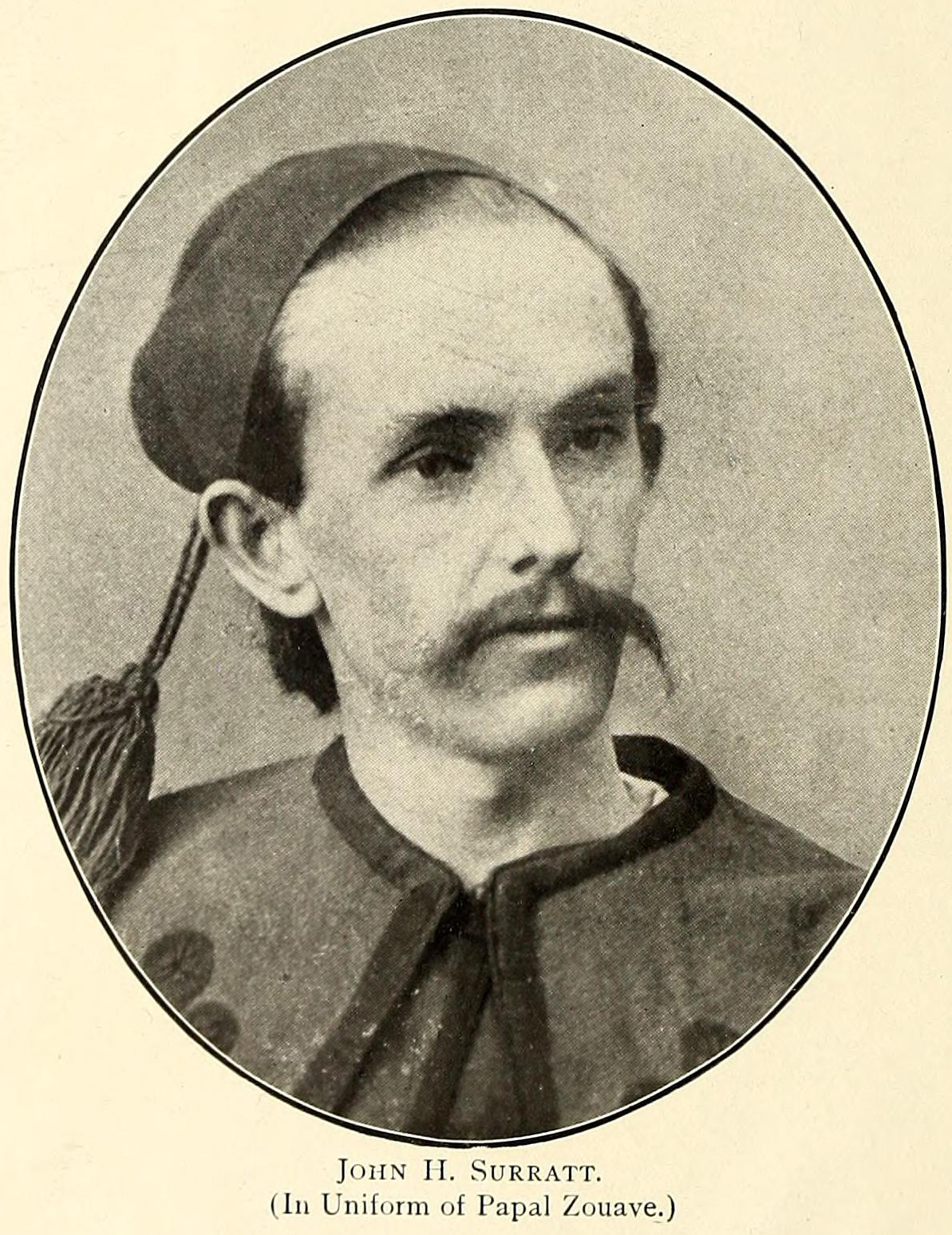
Richard Hall knew that John Surratt’s trial would be a lengthy one, and he had no desire to sit on the jury day in and day out. Thus, when asked by the court if he had already “formed or expressed an opinion in relation to the guilt or innocence” of John Surratt, Richard replied with “Yes, sir; I have.” Pressed further whether his opinion on the case would bias or prejudice him in listening to the evidence and rendering a verdict, Richard Hall stated, “There are some facts in connection with the case that I think would very strongly prejudice my mind.” When asked a similar question by the prosecution, Mr. Hall reiterated that “I would, if compelled to sit as a juror, listen to the facts and to the evidence, but I have no hesitancy in saying that my judgment would be greatly influenced by circumstances.” Richard Hall was trying his hardest to get out of jury duty for John Surratt’s trial, yet his responses didn’t relieve him. The defense made no objection to his selection as a juror, perhaps seeing his honesty as the best they could hope for from a jury pool where everyone had an opinion about John Surratt. Richard Hall did not come across as biased enough to be dismissed.

Jury selection for John Surratt’s trial took much longer than anticipated. June 15 had been set as the cutoff for when the jury had to be impaneled, or else Surratt’s trial could not begin until the next court term. As a result, the prosecution was scrambling to narrow down the possible jurors to the 12 they needed. This worked to Richard Hall’s advantage. On June 15, he was called, once again, to be interviewed for voir dire. However, he failed to respond to his name, with it later being reported that he was “sick”. His absence, combined with the requirement that the jury be selected on this date, meant that Mr. Hall successfully avoided becoming a member of John Surratt’s jury of his peers.

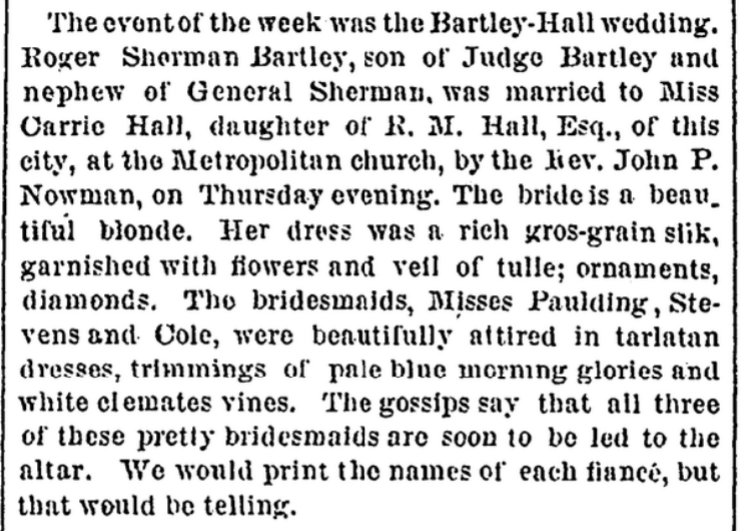
In the 1870 census, Richard, Clara, and Carrie Hall are all recorded as living at the National Hotel. Seven years later, 18-year-old Carrie was engaged to be married. Her beau was a man named Roger Sherman Bartley, and he was the nephew of General William Tecumseh Sherman. The couple’s wedding on December 27, 1877, was a celebrated event that made the D.C. papers.
In addition to the famous general, one of Roger Sherman Bartley’s other uncles was John Sherman, who had a long career in politics. From 1877- 1881, John Sherman was the Secretary of the Treasury, and through this connection, Roger Bartley was able to find employment. In 1880, Roger and Carrie moved to Denver, Colorado, where Roger was assigned as an assistant clerk in the small branch of the U.S. Mint located there. The branch tested and melted down gold into bullion for shipment to other branches. Roger and Carrie made their home in Colorado and had four children together.

In the early 1900s, at least three articles were published in the Denver Post newspaper featuring interviews with Carrie Hall Bartley. The first occurred on October 7, 1901, and was titled “The Souvenir of an Assassin“. This was followed by the article “Booth Gave Her His Picture Day He Assassinated Lincoln” on February 8, 1909. And finally, “Autograph Lincoln Pictures Treasured by Mrs. Welker” was published on February 12, 1917. Carrie divorced Roger Bartley in 1910 and, in 1912, married a Christian Science practitioner named Lloyd William Welker. This is the reason her name has changed in this last article.

In each of these articles, Carrie Hall recalls her time as a young girl living at the National Hotel in 1865. The middle article actually contains an image of Carrie Hall taken when she was a young girl in Washington:

Carrie recounts that her grandmother, Cynthia Brooks, resided in D.C. along with her and her parents during the Civil War. The 1865 city directory and 1870 census confirms the Halls resided at times at the National Hotel. As our previous entries have demonstrated, the National Hotel was often a convergence point for the who’s who of D.C. As a result, Mrs. Brooks had the opportunity to rub elbows with the high society of Washington. In 1864 and 1865, this came to include the famous actor John Wilkes Booth. Carrie stated that:

“My grandmother was a very interesting conversationalist…[she] and John Wilkes Booth, who stayed at the National also, had many lively arguments about the merits of the war, and she was as enthusiastic in her praise of the administration as Mr. Booth was opposed to it… She used to say Mr. Booth was very polished and interesting.”

The three articles also describe Cynthia Brooks’ supposed run-in with John Wilkes Booth at breakfast on the morning of Lincoln’s assassination. Each is a bit different, so we’ll take them one at a time.

“The Souvenir of an Assassin” from 1901 tells Carrie Hall’s story, but she is not quoted in the article. It narrates that Carrie and her grandmother were among the last people at breakfast on the morning of April 14, 1865. This was due to young Carrie feeling ill that morning. John Wilkes Booth was the only other person at the breakfast table with them at this late hour. Apparently, Mrs. Brooks shared with Mr. Booth that the family had plans to attend Ford’s Theatre that night. Before departing from the table, Booth, “gave a penny” to Carrie, “and his picture to her grandmother – both child and grandmother comparative strangers to him – as souvenirs. The penny was spent for candy, but the picture was preserved with a pitiful likeness of the martyred president to offset it.”

There isn’t much more detail in this first article about the interaction, and it portrays Mrs. Brooks and Booth as being relative strangers. In addition, the article implies the image was given to Mrs. Brooks because Booth knew “what part he was to play in the performance” at Ford’s Theatre later that night. However, while assassination was certainly on Booth’s mind, he did not know at breakfast that the Lincolns had accepted the invitation to attend Ford’s Theatre. That knowledge was only conveyed to him when he visited Ford’s after breakfast to pick up his mail.

The 1909 article “Booth Gave Her His Picture Day He Assassinated Lincoln” is the most detailed of the three and includes quotes from Carrie Hall. It is from this article that we learn that Cynthia Brooks was a “prominent figure in Washington society before and during the war of the rebellion” and where the prior quotes about her conversations with Booth come from. Carrie starts her narration with an acknowledgment of the imperfect nature of memory:

“‘I have only a dim recollection of the morning Mr. Wilkes gave that picture to my grandmother,’ says Mrs. Bartley. ‘I have heard it told so often that I perhaps confuse what I have been told with what I actually observed.”

Carrie then recounts that she and her grandmother were late to breakfast on April 14th but that “Mr. Booth was later still.” When he came into the breakfast room, Booth sat down next to Mrs. Brooks, and they talked as usual.

“Well, before he left the table that morning he took from an inside pocket his picture and handed it to her unsolicited. She accepted it graciously but with some surprise, and he remarked that she might like to have it after a while.

She thought it strange since he did not say anything about intending to leave.”

Carrie recalled that her parents and grandmother were planning on attending Ford’s Theatre that night, but they didn’t go because the young girl was sick. They heard the news like everyone else in the city, and Clara Hall woke Carrie up to tell her of Lincoln’s assassination.

“Grandmother said the next day that she understood then why Mr. Booth had given her his picture. She never could reconcile his kind ways and polished manner with the brutal murder of Mr. Lincoln.”

While the 1901 article reproduced the image of Booth that was given to Cynthia Brooks, the process of digitizing it made it difficult to see. From this 1909 article, we can more clearly see that Mrs. Brooks was gifted with a copy of this photograph of Booth:

This article was decorated not only with the image of Lincoln mentioned in the 1901 article but with other images of the Lincoln family as well. According to a throwaway caption, these were “photographs of members of the Lincoln family presented to Mrs. Cynthia Brooks shortly before the assassination of the President.” We’ll address these images again in a little bit.

The final article that I have been able to find comes from 1917, just a year before Carrie’s death. On the anniversary of Lincoln’s birth, the now-named Carrie Welker showed off her collection of images to the Denver Post once again. Carrie is not quoted in this piece, and her story is told by the reporter who interviewed her:

“On the morning of the day Lincoln was assassinated, Mrs. Brooks, who was living at the then famous old National hotel on Pennsylvania avenue, was late for breakfast. As the main dining room was closed, she ate in a small private dining room, just off the main parlor. While breakfasting, J. Wilkes Booth, whom she knew well, entered the parlor, and, seeing her in the next room, entered and sat down with her at the table to chat a few minutes. Before leaving, he said: ‘Mrs. Brooks, may I present you with my photograph?’ And he took a picture from his pocket and gave it to her.”

There is no mention of Carrie having been present with her grandmother at breakfast that morning. The article does recount the story that the Halls had tickets to attend Ford’s Theatre that night but did not go on account of Carrie’s illness.

While there is little information in relation to the story of Booth presenting his image to Mrs. Brooks, this article does add a brand new story revolving around the images of the Lincoln family in Carrie’s collection. According to this 1917 article, Richard Hall was “Lincoln’s friend” who was, “very closely associated with the president.” It continues:

“Shortly before Lincoln was assassinated he had some new photographs taken of himself and the members of his family. He considered these particularly good. Almost at the same hour that Booth was giving his picture to Mrs. Brooks[,] Lincoln presented a set of the new photographs of himself and family to Mr. Hall. Included in the set were pictures of the president, Mrs. Lincoln, Thaddeus [sic] Lincoln and Robert Lincoln.”

This entire paragraph is almost assuredly untrue. Richard Hall was a Lincoln supporter, and perhaps he had been fortunate enough to meet the President at a social function once or twice, but there is nothing to support the idea that the two men were friends. In addition, the images supposedly given to Mr. Hall by the President were not “recent” images of the Lincolns, as stated. The photograph of Mrs. Lincoln was taken in January of 1862, while the portrait of Lincoln in profile dates to February of 1864.

It’s interesting how the images of the Lincoln family increased in importance over the years. In the 1901 article, the portrait of Lincoln was described as “pitiful” and merely an image kept adjacent to the image gifted to Mrs. Brooks by John Wilkes Booth. In the 1909 article, a caption merely states the Lincoln family images were “presented” to Mrs. Brooks, with no statement of by whom. Then, in this 1917 article, the images of the Lincolns are the most important pictures, gifted to Richard Hall by Abraham Lincoln personally. In addition, the article’s title called them “Autographed Lincoln Pictures,” even though there is nothing in the article that suggests any of the images are autographed.

While there’s no reason to believe the part of the 1917 article that deals with the Lincoln images, what about the overall claim that Cythnia Ann Brooks spoke with John Wilkes Booth at breakfast on the morning of the assassination and was given a photograph by the actor? While there were some small changes across these three articles, this part of the story stayed largely consistent over the 16 years.

John Wilkes Booth was known to present his photographs to friends and acquaintances. In fact, on February 9, 1865, Booth wrote to his friend Orlando Tompkins in Boston, asking the man to visit the photography studio of Silsbee, Case and Company in that city for him. He wanted the proprietor, John G. Case, to “send me without a moments delay one dozen of my card photghs… as there are several parties whom I would like to give one.” As much as I would love for Cynthia Brooks to have been the recipient of one of these images, Booth specifically requested not the photograph in Carrie Hall’s collection, but this one of him seated with a black cravat and cane:

After the assassination of Lincoln, this same image would be used on the wanted posters for Booth and his conspirators.

Unfortunately, there is no way to verify the story of Cynthia Brooks and her Booth photograph. Richard, Clara, and Carrie Hall were living at the National Hotel in 1865. However, try as I might, I have not been able to verify that Cynthia Brooks lived at the National or was even in Washington at the time of the assassination. It’s very possible that she did visit D.C. during the war years to see her daughter and granddaughter, but I don’t have any documentation to prove it. In truth, I have been unable to find records of Cynthia Brooks after the 1860 census. In 1871, Clara Hall included her mother’s name on an application for an account at the Freedman’s Bank, insinuating that Mrs. Brooks was still alive at that time, but I have not been able to find her anywhere.

The account of John Wilkes Booth presenting his image to Cynthia Brooks at breakfast on April 14, 1865, is an example of family lore. It’s a story that was passed down to Carrie Hall, who was too young to truly remember the events herself. It could be a real event, or perhaps it was a misremembered story of having seen Booth while the Halls were living at the National Hotel that merely evolved over time.

This series on John Wilkes Booth’s breakfast ends with far more questions than answers. Did he share a silent, but polite meal with Cara Bean? Did Lucy Hale make an appearance and interact with her fiancee for perhaps the last time? Or did Booth dine alongside Cynthia Ann Brooks and her granddaughter before presenting them both with small tokens of his esteem? In truth, we’ll never know the exact circumstances of this meal. All we do know for sure is that this was the last breakfast John Wilkes Booth ever ate as an actor. The next morning, the nation gathered at their own breakfast tables and read the shocking news of how John Wilkes Booth had now become an assassin.

Extra content:

While researching the family of Cynthia Brooks, I came across several interesting things. I already shared how her son-in-law, Richard Hall, was almost a jury member on John Surratt’s trial in 1867. This connected the family to Lincoln’s assassination in two different ways. However, the family actually has a connection to more than Lincoln’s assassination.

According to the article from 1901, Cynthia’s daughter Clara Hall attended the trial of Charles Guiteau in 1881. While there, Mrs. Hall shared a similar interaction with the assassin of President Garfield as her mother did with Lincoln’s killer years before:

“Mrs. Hall was attending the Guiteau trial and was seated facing the murderer. Feeling that he was the center of international interest, and that any little attention from him would be of great moment, Guiteau wrote his name with the customary flourish and handed it over to the surprised lady. Guiteau’s personal vanity stood out strongly to the very moment of execution.”

The article reproduced the autograph Charles Guiteau handed to Clara Hall, including Mrs. Hall’s explanatory notes about it:
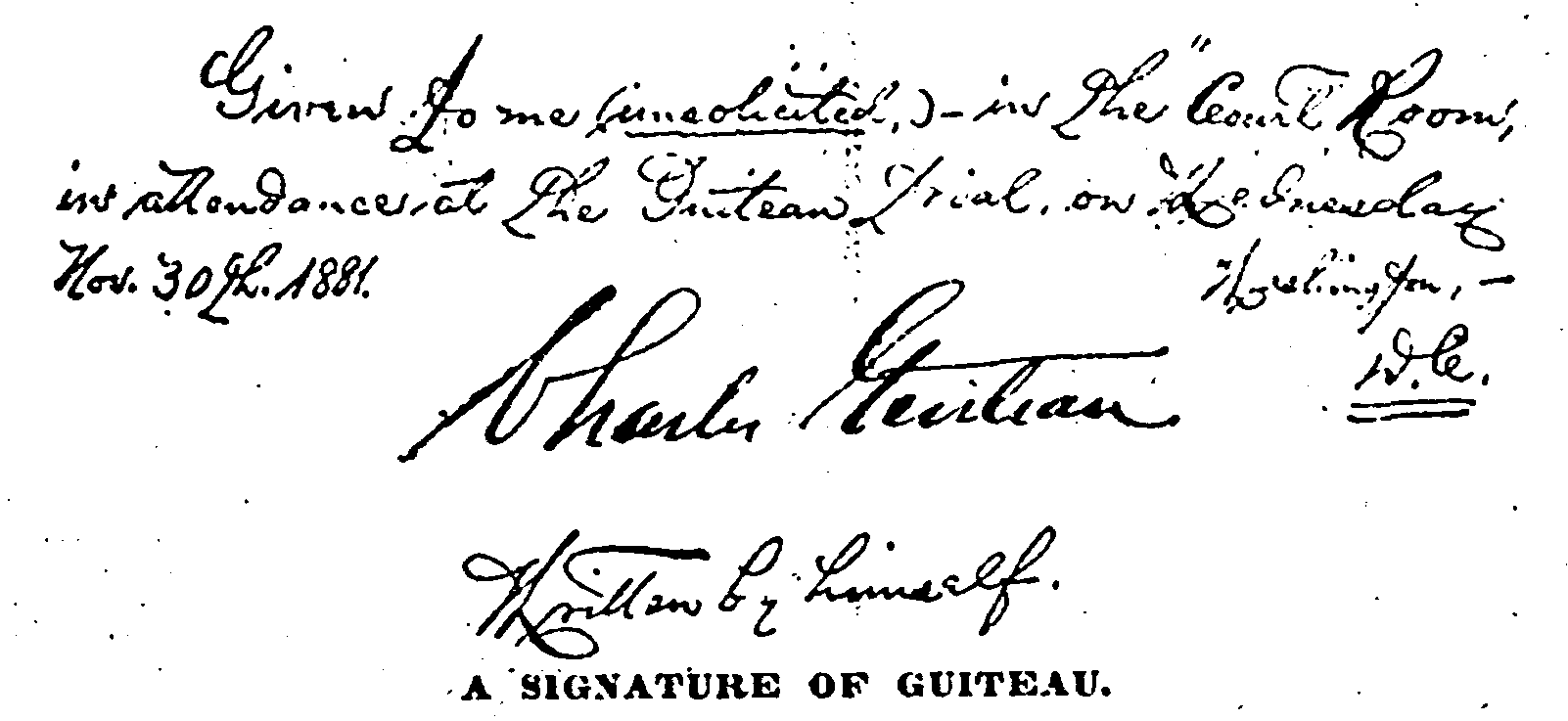
The Brooks/Hall women had connections to unstable men beyond their interactions with Presidential assassins. In 1880, Clara divorced Richard Hall after he abandoned her and left D.C. for Tucson, Arizona, attempting to make a fortune as a miner. During a visit back east a year later, Richard Hall was said to have suffered a bout of paralysis in which he “lost his mind”. Richard was committed to an asylum in Indiana and died there in 1882 at the age of 49.

In 1910, Carrie Hall Bartley filed for divorce against her husband, Roger Sherman Bartley, on account of “another woman”:

“Mrs. Bartley testified that her husband packed up his belongings in October, 1908, when they were living in Fort Collins, and went to a hotel, instructing her to vacate the house in a short time, as he proposed to be responsible for her shelter and support no longer.”

After 32 years of marriage, Carrie requested $25 a month in alimony from Roger due to his desertion and entanglements with another woman. The judge ordered that Roger pay Carrie $50 a month instead. After the divorce, Roger Sherman Bartley eventually went on to marry a woman 31 years his junior named Edith Stoneback.

However, Carrie was actually the first of the two to remarry. Her second husband was Lloyd William Welker, a musician turned Christian Science practitioner. Their marriage was a seemingly happy and affluent enough one, as an article from 1917 noted that Mr. and Mrs. L. Will Welker were, “driving one of the handsomest new inclosed roadsters in town.”

Carrie Welker was a Christian Science practitioner like her husband. These are effectively faith healers who attempt to heal illness and pain through prayer. Carrie and L. Will operated out of an office where they met with and prayed with patients. According to Carrie’s obituary, “she was to all appearances enjoying perfect health” while tending to patients on Friday. Then, while at home on Saturday, June 15, 1918, Carrie Welker, “laid down for a few moment’s rest and while sleeping passed to the great beyond.” She was 58 years old.

In 1920, L. Will Welker remarried a singer by the name of Elsa Weffing. Elsa Welker died in 1930. In 1932, L. Will married a fellow Christian Science practitioner named Nelle Carr. Nelle Welker died in 1936. In December of 1937, L. Will married a woman named Agnes Durham who died two months later. Now, when I was relating this history to my true crime podcast-obsessed wife, Jen, she immediately told me that L. Will Welker seemed like a serial killer slowly knocking off his wives. I’ll admit that the numbers don’t look great for L. Will Welker. The fact that Carrie’s obituary stated she was in perfect health before she just fell asleep and died looks mighty suspicious as well. Additionally, there is an account of a man named Claude Poston who disappeared on December 3, 1915. The last place Poston had been seen was at L. Will’s Christian Science practitioner office where he had come for a session. His body was found seventeen days later, frozen solid in a ravine. All of this seems to support Jen’s hunch that L. Will Welker just might have been a serial killer.

But, at the same time, the view of Christian Scientists was that all healing was possible through prayer, so many did not seek out traditional medical help for their illnesses. This led to much higher fatality rates among Christian Scientists. L. Will Welker’s other wives may have died from a lack of medical treatment, believing they could solely pray their way to healing. Elsa Welker was noted to have been in ill health for a year before she died, even though she was only 45. Claude Poston, the man who ended up frozen in a ravine, had been praying with Welker in an attempt to help with his bouts of amnesia. His wife believed that Claude got confused after leaving Welker’s office, stumbled out into the woods, and ended up dying from exposure in the ravine he was found in. So perhaps there is nothing nefarious about the many deaths surrounding Lloyd William Welker. He lived a long life, himself, dying in California in 1959. (Jen still posits he might have been a serial killer, though).

There was one final little nugget I was able to uncover that still needs more investigation. While trying to determine what happened to Cynthia Brooks after her appearance in the 1860 census, I tried tracking down her other children aside from Clara Hall, hoping she might have moved in with one of them. I didn’t have much luck, but I did stumble across an article that mentioned Cynthia’s eldest son, Eri V. Brooks, Jr. As I wrote before, Eri had formed a law firm with his brother-in-law, Richard Hall, in Wisconsin and then Michigan before Richard and Clara moved away. When that happened, Eri Brooks, Jr. stayed in the Upper Peninsula of Michigan and became a judge there. In 1910, a small article appeared in different newspapers stating that a discovery had been made at the Eagle River Court House among the effects of Judge Brooks, who had died several years before. The discovery was a document containing a case from 1857. The case concerned the disposition of a canal boat called the White Cloud. The boat had been ordered seized due to a $40 debt owed by the owners of the boat to a 14-year-old boy. The fourteen-year-old who was owed the money and had brought the suit was a young William McKinley.

I’m not an expert on President McKinley, but I am curious about this suit and whether there is any truth to this article. I’ve reached out to the experts at the McKinley Presidential Library, and we’ll see if they can find anything about this case. If I learn anything about it, I’ll post a comment below at a later date. Still, if Eri Brooks did have this document in his papers, then the Brooks family has a small connection to yet a third assassinated U.S. President.

Categories: History | Tags: , , , , , , | 3 Comments

Breakfast with Booth: Lucy Hale

In an earlier post, I introduced you to Carrie Bean, a young socialite from New York who journalist George Alfred Townsend claimed had breakfast with John Wilkes Booth on the morning of Lincoln’s murder. GATH is our only source for this event, but Miss Bean’s connection to the National Hotel and some of its residents makes it possible that this breakfast did occur. However, Carrie Bean is not the only one who has been linked to the assassin’s morning meal. There are sources that state that Booth spent his final breakfast before his infamous deed in the presence of his fiancée, Lucy Hale.

Lucy Hale likely needs no introduction to readers of this blog. In 1865, Lucy was the 24-year-old daughter of New Hampshire Senator John P. Hale and his wife, Lucy Lambert. The Hales often resided at the National Hotel when staying in Washington. At the time of the assassination, Senator Hale was in a sort of limbo. In June of 1864, the statesman had lost his bid for renomination by the New Hampshire Republican party and was replaced by Aaron Cragin. When Lincoln took office for his second term on March 4, 1865, Hale was officially out of a job. However, the staunch abolitionist lobbied for an ambassadorship position. On March 10, Hale was nominated to become the administration’s new minister to Spain. At the time of the assassination, the Hales were preparing for their new lives abroad.

At what point John Wilkes Booth and Lucy Hale met and subsequently became romantically involved is unknown. A commonly repeated yet erroneous story claims their romance began in 1862 when Booth sent Lucy a valentine signed “A Stranger.” This is too early of a period for the two to have become entwined. John Wilkes Booth didn’t even make his first appearance on the D.C. stage until 1863. The source of this erroneous story is a letter to a “Miss Hale” that was found in an antique store by Richmond “Boo” Morcom. In 1970, American Heritage published an article written by Morcom titled, They All Loved Lucy, in which he attributed the letter to Booth without evidence. After Morcom’s passing in 2012, his papers were donated to the New Hampshire Historical Society. A look at the original document shows that the letter is not in John Wilkes Booth’s handwriting. To demonstrate this, here is the end of the “Stranger” valentine found by Morcom with a sample of John Wilkes Booth’s writing underneath it. I’ve underlined some of the same words found in each letter for easy comparison.

The letter and word formations are just too different to have been written by John Wilkes Booth.

Part of the reason this incorrect story continues to live on is due to the fact that John Wilkes Booth is known to have composed a valentine for Lucy Hale. Junius Brutus Booth, Jr. wrote a letter to his sister Asia, updating her on family matters. John Wilkes was visiting Junius in New York at the time and June wrote to Asia that:

“John sat up all Mondays night to put Miss Hales valentine in the mail – and slept on the sofa – to be up early & kept me up last night until 3 1/2 AM – to wait while he wrote her a long letter & kept me awake by every now and then useing me as a dictionary…”

While John Wilkes is documented as having composed a valentine for Lucy Hale, this occurred in February of 1865, and we do not have any idea what his valentine said. It was likely destroyed, along with all other correspondences from Booth, by Lucy Hale or her family in the aftermath of Lincoln’s assassination.

While Lucy and Booth may have known of each other as early as 1863, when Booth made his Washington debut, it doesn’t seem like they had much in the way of a relationship until late 1864. During the summer and early fall months of 1864, John Wilkes Booth stayed with his family in New York and then traveled into the Pennsylvania oil region. He was actually infatuated with another woman at this time, 16-year-old Isabel Sumner, whom he had met during his Boston engagement in the spring. It wasn’t until November of 1864 that Booth’s residency at the National Hotel started as Washington became his base of operations in his conspiracy against Lincoln. Thus, his and Lucy’s romance was a relatively quick one.

A few years ago, I wrote about an envelope dated March 5, 1865, that contains poems by John Wilkes Booth and Lucy Hale. I explained that while some authors have used this envelope as evidence that the couple broke up on this date, I believe this conclusion to be incorrect. The two were planning a life together despite the difficulties involved with her father’s nomination to be the next minister to Spain. Lucy was expected to accompany her family to their new country. As a result, John P. Hale started having his family learn some of the Spanish language they would soon be immersed in. In mid to late March, Lucy Hale traveled to New York City and stayed with friends as she took some rudimentary Spanish lessons. On March 21, Booth traveled up to New York City ostensibly to be there for his brother Edwin’s 100th night of Hamlet the next day. However, according to Junius Brutus Booth, Jr.’s diary entry on March 22, “John came on to see Miss Hale.”

In the aftermath of John’s crime, Asia Booth wrote a letter to her friend Jean Anderson where she described the relationship between John and Lucy as the Booth family understood it:

“I told you, I believe, that Wilkes was engaged to Miss Hale. They were devoted lovers and she has written heart-broken letters to Edwin about it. Their marriage was to have been in a year, when she promised to return from Spain for him, either with her father or without him. That was the decision only a few days before this awful calamity. Some terrible oath hurried him to this wretched end. God help him.”

There is no evidence that Lucy Hale had any foreknowledge of what her secret fiance was planning.

Due to her being the daughter of a former Senator, Lucy Hale’s name was mainly kept out of the papers in the aftermath of Booth’s crime. There were a few references to Booth having been engaged to a New England Senator’s daughter, but propriety kept her actual name out of it. As years went by, however, more details came out about their relationship from some of Booth’s former friends and acquaintances.


In December of 1881, a journalist by the name of Col. Frank A. Burr wrote at length about John Wilkes Booth for the Philadelphia Sunday Press. Burr had done an immense amount of research into the life and death of John Wilkes Booth. He traveled down to the Garrett Farm and interviewed members of the Garrett family about Booth’s final days. He visited Green Mount Cemetery and described the Booth family plot. Burr also interviewed friends of Booth’s in order to flesh out his motivations. The result was one, or perhaps two, lengthy articles covering many aspects of Booth’s life, crime, and death. The reason I am uncertain about how many articles Burr’s work was split into is because, try as I might, I have been unable to track down the relevant Sunday issue(s) of the Philadelphia Press. These particular editions seem to be an endangered (or possibly extinct) species in archives and libraries today.

While Burr’s original piece has proven elusive, continued interest in Lincoln’s assassination meant that several newspapers reprinted parts of his work, often splitting it up into more manageable portions. The Evening Star out of Washington, D.C., appears to be one of the first to reprint part of Burr’s work. A lengthy article called “Booth’s Bullet” credited to the Philadelphia Press and “F.A.B.” was published in the Evening Star on December 7, 1881.

It appears that the Evening Star chose to cut out the whole section about Burr’s trip to the Garrett farm. Instead, the article was broken into three sections. The first section documented Burr’s visit to John Wilkes Booth’s grave in Green Mount Cemetery. The second was an interview Burr had with John T. Ford, and the third section was Burr’s interview with actor John Mathews. On the day of the assassination, Booth had given Mathews a sealed envelope, which he instructed Mathews to give to the newspapers the next day. The envelope contained Booth’s written explanation for why he assassinated Lincoln. Mathews was a member of the Ford’s Theatre cast and witnessed Lincoln’s assassination firsthand. Afterward, he returned to his boarding house, which happened to be the Petersen House, where Lincoln was taken. As the President lay dying in an adjacent bedroom, John Mathews opened the sealed envelope and read the assassin’s manifesto. After finishing it, Mathews made the decision to burn the letter, fearing it would implicate him in Booth’s great crime. The entirety of the “Booth’s Bullet” from the Evening Star can be read here.

Within this article, there are several references to Lucy Hale. John T. Ford stated to Burr that:

“Booth was a very gifted young man, and was a great favorite in society in Washington. He was engaged, it was said, to a young lady of high position and character. I understood that she wrote to Edwin Booth after the assassination telling him that she was his brother’s betrothed, and would marry him, even at the foot of the scaffold.”

John Mathews related a lengthy exchange he had with Booth regarding love and Lucy Hale:

“‘John, were you ever in love?’
‘No. I never could afford it.’ I replied.
‘I wish I could say as much. I am a captive. You cannot understand how I feel. What are those lines in Romeo and Juliet describing love? I have played them a hundred times but they have flown from me.’
‘Will you stand a bottle if I’ll give them to you?’ I asked.
‘I will – two of them,’ replied Booth.
‘Here are the lines,’ I answered:
O! anything, of nothing first create!
O! heavy lightness! Serious vanity!
Mis-shapen chaos of well-seeming forms!
‘That’s it,’ replied Booth. ‘If it were not for this girl I could feel easy. Think of it, John, that at my time of life – just starting, as it were – I should be in love!’

[Burr:] Did he mention the lady’s name?
[Mathews:] Oh, yes; but that shall be sacred with me. She is married now, and it would serve no good purpose either to his memory or to the truth of history to revive it. He loved her as few men love. He had a great mind and a generous heart, and both were centered upon this girl, whom he intended to make his wife. Her picture was taken from his person after he was killed.”

In addition to these mentions of Booth and Lucy’s romance, this article is the earliest source that places Lucy Hale with Booth at breakfast on the morning of his great crime. John T. Ford stated the following:

“The facts in the case are that he never knew the President was to attend the theater until nearly noon of that day. He was always a late riser. He came down to breakfast about ten o’clock on that morning, and his fiancee, who also boarded at the National Hotel with her parents, met him. They had a short conversation, and after breakfast he walked up to the Surratt mansion on H street, as is supposed from the direction in which he was first seen coming by the attaches of the theater that morning.”

To be fair, this description is a little vague as to whether Lucy Hale joined Booth for breakfast or merely had a conversation with him during his breakfast. Lucy’s inclusion is really a throwaway reference in a section about Booth’s movements. However, it still connects the two on the morning of the assassination.

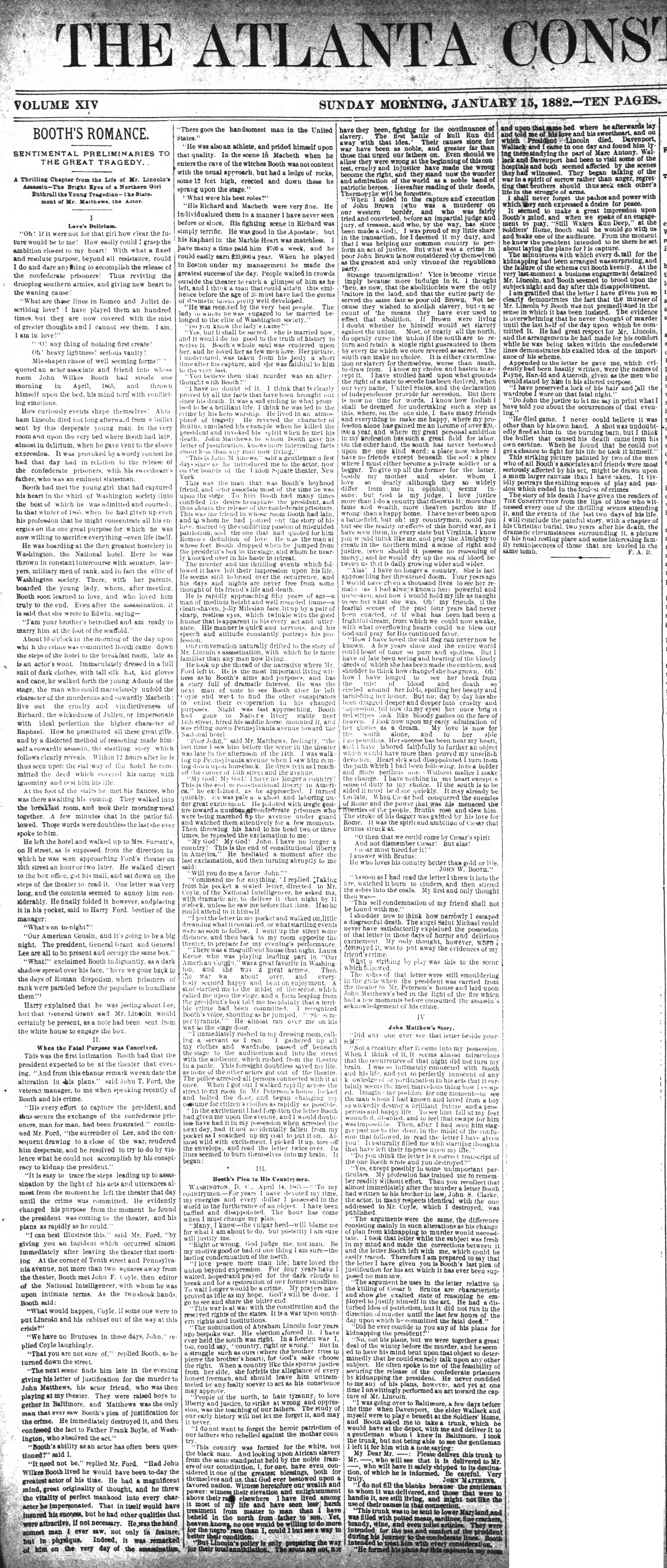
Another paper that reprinted Frank A. Burr’s work was The Atlanta Constitution. They published the story of Burr’s visit to the Garrett farm on Sunday, December 11, 1881. A month later, on Sunday, January 15, 1882, the Constitution published another article attributed to Burr titled “Booth’s Romance”.

This article was similar to the earlier article found in the Evening Star, but “Booth’s Romance” is markedly different in spots from “Booth’s Bullet.” The section about visiting Booth’s grave is not present in the Constitution, and while the interviews with John T. Ford and John Mathews are present, they have been moved around, reworded, and elaborated on in different places.

For example, here is the beginning of “Booth’s Romance”:

“‘Oh! If it were not for that girl how clear the future would be to me! How easily could I grasp the ambition closest to my heart! With what a fixed and resolute purpose, beyond all resistance, could I do and dare anything to accomplish the release of the confederate prisoners! Thus reviving the drooping southern armies, and giving new heart to the waning cause!

What are those lines in Romeo and Juliet describing love? I have played them an hundred times, but they are now covered with the mist of greater thoughts and I cannot see them. I am, I am in love!’

‘O! any thing of nothing first create!
Oh! heavy lightness! serious vanity!
Mis-shapen chaos of well seeming forms!’
quoted an actor associate and friend into whose room John Wilkes Booth had strode one morning in April, 1865, and thrown himself upon the bed, his mind torn with conflicting emotions.”

In content, this introduction is similar to the exchange between Booth and John Mathews as written in “Booth’s Bullet,” but it is portrayed and narrated differently in “Booth’s Romance.” A similar change is present in the part about Booth’s breakfast. “Booth’s Romance” does not talk about Booth’s breakfast in the same section as John T. Ford’s interview but merely narrates Booth’s movements uncredited:

“About 10 o’clock in the morning of the day upon which the crime was committed Booth came down the steps of the hotel to the breakfast room, late as an actor’s wont. Immaculately dressed in a full suit of dark clothes, with tall silk hat, kid gloves and cane, he walked forth the young Adonis of the stage… At the foot of the stairs he met his fiancee, who was there awaiting his coming. They walked into the breakfast room, and took their morning meal together. A few minutes chat in the parlor followed. Those words were doubtless the last she ever spoke to him.”

In this version, Booth and Lucy Hale definitively shared breakfast together before they departed from each other’s company. However, there is no attribution for this added detail, and it appears to be an unsupported elaboration. “Booth’s Romance” is filled with confusing attributions when compared to “Booth’s Bullet”. For example, in the section cited as the interview with John T. Ford, we get this exchange:

“‘He was received by the very best people. The lady to whom he was engaged to be married belonged to the elite of Washington society.’
‘Do you know the lady’s name?’
‘Yes, but it shall be sacred. She is married now and it would do no good to the truth of history to revive it. Booth’s whole soul was centered upon her, and he loved her as few men love. Her picture, I understand, was taken from his body a short time after his capture, and she was faithful to him to the very last.'”

These statements are said to be from John T. Ford, but the ending part about Lucy Hale’s name being “sacred” was attributed to John Mathews in the article “Booth’s Bullet.” It appears the composer of “Booth’s Romance” combined the two statements by Ford and Mathews together and attributed them all to Ford. However, without access to Burr’s original work in the Philadelphia Press, it’s hard to know which account, if either, is the accurate portrayal.

Regardless, these articles from Frank Burr seem to provide John T. Ford as the source for the claim that John Wilkes Booth shared his breakfast with Lucy Hale on April 14, 1865. But how reliable is that story?


It’s important to remember that John T. Ford was not in Washington, D.C., on the day of the assassination. In truth, Ford was not all that involved with the day-to-day operations of his namesake theater. He had spent most of the winter and spring of 1864-1865 in Baltimore, running his Holliday Street Theatre. He left the management of Ford’s Theatre in the hands of his brothers, Harry and Dick Ford. When Lincoln was shot at Ford’s Theatre, John T. Ford was in Richmond. Before the war, Ford had operated a theater in Richmond, and he still had family in the area. With the fall of the Confederate capital earlier that month, Ford had applied for and received a military pass to travel south. All of John Ford’s knowledge about the specifics of the assassination comes from what he learned from his brothers, employees, and eyewitnesses after his return to the city.

This isn’t to say that John T. Ford is someone we should ignore. While he wasn’t in town when Lincoln was shot, when he returned to Washington, Ford was arrested and held at the Old Capitol Prison. He wrote a great deal about his time in prison and his interactions with some of the other folks imprisoned with him. Ford became a big proponent of Mary Surratt’s innocence as a result of what he witnessed while incarcerated.

In April of 1889, John T. Ford published an article in the North American Review entitled, “Behind the Curtain of a Conspiracy”. If you want, you can read the full article here. The bulk of the piece was a defense of Mary Surratt and an attack on Judge Advocate General Joseph Holt for allowing Mrs. Surratt to be executed. However, Ford also took the time to narrate John Wilkes Booth’s movements on the morning of the assassination. When discussing Booth’s breakfast, John T. Ford wrote this:

“On the morning of April 14, 1865, it was fully 11 a.m. when John Wilkes Booth came from his chamber and entered the breakfast-room at the National Hotel, Washington. He was the last man at breakfast that day; one lady only was in the room, finishing her morning meal. She knew him and responded to his bow of recognition. He breakfasted leisurely, left the room when he had finished, went to the barber-shop…”

Ford makes no mention of Lucy Hale in this 1889 article. His allusion to a single lady in the breakfast room more closely matches GATH’s description of Carrie Bean from 1865.

The reality is that John T. Ford was extremely inconsistent when discussing Booth’s breakfast over the years. In an article from 1878, he stated that Booth, “was the last guest at breakfast” and makes no mention of any ladies being present. To Col. Burr in 1881, he stated that Lucy Hale met Booth at breakfast, but it is unclear if she joined him for the meal. Then, in 1889, he wrote that another unnamed lady was also eating breakfast at the time. John T. Ford is all over the map.

Perhaps the most interesting of all of John T. Ford’s descriptions of Booth’s breakfast is one that he gave to the Evening Star on April 18, 1885. In this account, Ford includes both Carrie Bean and Lucy Hale.

“The last male guest at the National hotel breakfast, on the morning of April 14th, 1865, was John Wilkes Booth. When he entered the breakfast room, a young lady, Miss B—. was finishing her meal at a small table near by the one assigned him by the waiter in charge. He glanced over the bill of fare and pleasantly whispered his order for a light meal, which was soon brought. The young lady lingered at her table. The young actor was an acquaintance, and a known admirer of one of her feminine friends – (the daughter of a distinguished public man, whose family occupied a suite of rooms at the same hotel,) besides he was young graceful, and exceedingly handsome. His breakfast was soon finished, he rose as the lady did, and they walked together to the door, where his silk hat, light overcoat, cane and gloves were lying on a table. He laid the coat on his left arm, and with hat, gloves and cane in his hands, he bowed to the young lady and passed along the hall way and down the steps to the office, placing his hat and coat on and leisurely gloving one hand, he noticed that it was after eleven by the hotel clock, as he sauntered towards the door on the Avenue. At this time two handsomely dressed young ladies were passing – he bowed, they acknowledged the salutation and entered the parlor hallway of the hotel. Had any one been looking on when he drew and opened an encased picture from a side pocket, the likeness of one of the two ladies would have been recognized in the subject of the ambrotype. He quickly replaced the picture in his pocket, and started in an easy loitering walk towards 6th street…”

Ford paints a compelling and almost theatrical scene in this article. Booth shares a meal in the same room as an acquaintance, Carrie Bean, who admires the matinee idol and delays completing her meal so that they will finish at the same time. Always the gentleman, Booth escorts Carrie Bean from the breakfast room and bids her adieu. Preparing to depart the hotel, Booth comes across Lucy Hale, his secret fiancee, with an escort, most likely her sister Lizzie. The public nature of their meeting in the hotel parlor, along with Lizzie’s presence, prevents the lovers from acknowledging each other with anything beyond the same polite pleasantries Booth had just demonstrated with Miss Bean. But the couple still lock eyes and exchange a knowing smile. As the Hale sisters pass him, Booth takes out the image of Lucy he keeps on his person, the same image that will later be found in his pocket diary upon his death. Booth looks upon Lucy’s face before placing it in his pocket. He exits the National Hotel on his way to Ford’s Theatre where he will get confirmation that Lincoln would be attending that night, altering his future, and Lucy’s, forever. If I were to direct such a scene, I pan away from the hotel door after Booth exits out onto the street and turn back to Lucy Hale. Lizzie would be prattling on about something innocuous but our focus would be on Lucy’s face, which would still be a bit blushed from having a small moment of connection with her secret fiancee. She continues ignoring Lizzie and looks at the door Booth exited out of, longing for him to come back. But she never sees him again.

It’s a scene worthy of a theater owner and a pair of star-crossed lovers like John Wilkes Booth and Lucy Hale, but this account is likely just as fictitious as Romeo and Juliet. While John T. Ford no doubt took an interest in learning as much as he could about the events that led up to the President’s assassination at his namesake theater, his absence from the city on the day in question, and his many contradictions throughout the years, make it impossible to put any faith in his accounts regarding Booth’s breakfast. Sadly, aside from John T. Ford, I have been unable to find any compelling evidence to support the idea that John Wilkes Booth had breakfast with Lucy Hale on the morning of April 14, 1865. I don’t believe John Wilkes Booth dined with Lucy Hale that morning. At what point the pair saw each other for the last time will likely always be a mystery.


Epilogue

When I first started reading and doing research about the Lincoln assassination, I avoided the topic of John Wilkes Booth’s romantic entanglements like the plague. Booth was rumored to have been involved with so many different women that the late Dr. Ernie Abel wrote an entire 352-page book about them all. Booth engaged in numerous flings with women that he merely used and then disposed of. While Lucy Hale appears to have been a special case, I still don’t believe that Booth had the capacity to make any long-term relationship work, especially a marriage. Booth was a narcissist with an insatiable desire to be admired and revered. While Booth tried to portray Lincoln’s assassination as an act of justice for the South, it was more an attempt for glory and immortality for himself. Even if he had chosen not to assassinate Lincoln, I believe his relationship with Lucy was still doomed. Booth’s inability to feel fulfilled by any single person would have caused him to stray and ruined Lucy’s life as a result.

With that being said, I do believe that John Wilkes Booth thought he loved Lucy Hale. I say he thought he loved her because I don’t know how capable Booth was of truly loving someone other than himself. Booth’s version of love was not enough to stop him from killing Lincoln, but I believe he did think of Lucy Hale during his final days on the run. In fact, I think he left a final message for Lucy in his diary.

As mentioned earlier, before committing his crime, John Wilkes Booth left a lengthy letter for publication in the newspapers. This was his detailed explanation of why he had taken the drastic action of killing the President. John Mathews destroyed the letter shortly after the assassination for fear of being connected to the crime. While on the run from the authorities, the assassin clambered for newspapers and was dejected to find his words had not been published. Perhaps predicting that he would not survive long enough to try and justify his actions to the world in person, Booth decided to compose another manifesto. With a notable lack of paper, John Wilkes Booth was forced to take down his thoughts in his small datebook from 1864. It was in a pocket of this datebook that he held Lucy Hale’s photograph. Booth ripped out the previously used pages and started the datebook fresh, labeling his main entry as “April 14, Friday the Ides”.

Much has been written about the text of John Wilkes Booth’s diary. Yet, a central section of his diary has been mainly ignored in practically all analyses of his motivations, mindset, and mood. Before writing anything about his deed or his reasonings, Booth opens his diary with two words that stand alone.

The words are “Ti Amo“. The phrase is Italian and translates to, “I love you.”

If Booth had written “I love you” in English, the message could be interpreted as being for anyone, a final note to his mother and siblings perhaps. But writing the phrase as “Ti Amo” codes this phrase in a way that makes it more specific. It is intended for a specific person, who, upon reading it, should know it was for them and them alone.

I contend that this “Ti Amo” was Booth’s final message for Lucy Hale. We know that Lucy was learning Spanish in preparation for her family’s departure to Spain. John Wilkes Booth traveled from D.C. to New York City in March of 1865 in order to visit Lucy, who was taking Spanish lessons in the city. While “Ti Amo” is Italian and not Spanish, it is only one letter different from the Spanish phrase for “I love you”. Perhaps Booth meant to write the Spanish “Te Amo” but ended up with the Italian “Ti Amo” by mistake. Or perhaps the Italian version was a playful response to Lucy’s own “Te amo”. In my view, writing “I love you” in a foreign language in his diary was a way for Booth to announce his love specifically for Lucy without endangering her further by mentioning her name. I might be giving John Wilkes Booth more romantic credit than I should, but I truthfully cannot think of who else this message was meant for other than his secret fiancee, Lucy Hale.

Categories: History | Tags: , , , , , , | 7 Comments

Breakfast with Booth: Carrie Bean

On the night of April 13, 1865, Washington, D.C. was a city of jubilation. The nation’s capital was decked out in beautiful displays of celebration and light. Described as the Grand Illumination, countless businesses and private homes burned candles and were lavishly decorated in order to mark the essential end of the Civil War due to Confederate General Robert E. Lee’s surrender to Union General Ulysses S. Grant on April 9th. The event brought many visitors to D.C. and the streets were filled with revelers until late into the night.

Among the throng of people who viewed the Grand Illumination in all its grandeur was a solemn and dejected John Wilkes Booth. The cheering and good humor of the citizens of Washington was nothing but a reminder to Booth that his prior months’ plan to abduct President Lincoln and surrender him to the Confederacy had come to naught. With the war being celebrated as practically over, Booth had to admit to himself that he had done nothing substantive on behalf of his cause.

At around 2:00 a.m., Booth returned to his rented room at the National Hotel. He composed a quick note to his mother stating of the illumination, “Everything was bright and splendid. More so in my eyes if it had been a display in a nobler cause. But so goes the world. Might makes right.” With that, Booth retired.

Booth’s whereabouts in the subsequent hours leading up to the assassination of Abraham Lincoln have long been the subject of study. We know several of the places he visited during this time – such as Ford’s Theatre to get his mail and the Surratt boarding house to ask Mrs. Surratt to take a package to her tavern for him. However, creating a minute-by-minute timeline of his movements is difficult as witnesses sometimes place him in contradictory places at the same time. Arthur Loux has done the best job of trying to establish Booth’s routine on assassination day with his book John Wilkes Booth: Day By Day. Still, plenty of uncertainties remain.

One example that demonstrates the unknowns regarding Booth and his movements on assassination day is in regard to his earliest of tasks: eating breakfast.


The first source that attempts to explain Booth’s breakfast on April 14, 1865, is journalist George Alfred Townsend. GATH, as he was known, was a correspondent for The World newspaper out of New York City. On the night of Lincoln’s assassination, GATH was actually in Richmond, having arrived shortly after the Confederate capital fell. After the news of Lincoln’s assassination reached Richmond, GATH quickly returned to Washington. From there, he wrote several dispatches to The World, detailing the crime, manhunt, capture of Booth, and the eventual trial of the conspirators. GATH had good relationships with civilians, government leaders, and military officers alike. As a result, he was able to compose fairly detailed reports back to his readers.

On April 28, 1865, The World published a biographical article about John Wilkes Booth written by GATH. The lengthy biography ended with a paragraph titled “Closing Scenes” which stated:

“On the morning of the murder, Booth breakfasted with Miss Carrie Bean, the daughter of a merchant and a very respectable young lady, at the National Hall. He arose from the table at, say eleven o’clock. During this breakfast, those who watched him say that he was very lively, piquant and self-possessed as ever in his life.”

While GATH does not provide the source for his knowing that Booth dined with “Miss Carrie Bean”, the entire article about Booth was supposedly “complied for The World from the statements of his personal friends and companions”. GATH’s knack for sniffing out details had always served him well. In this instance, I’m willing to believe that GATH visited the National Hotel himself and heard the story from some people there.

So who was this Carrie Bean that GATH wrote about? Well, for the longest time, I believed that Carrie Bean was this woman buried in D.C.’s Congressional Cemetery. I’ve visited her grave in the past and even had her marked on my Lincoln assassination maps as the woman who might have shared breakfast with the assassin of Lincoln.

However, as I was researching for this piece, I became less and less convinced that the Carrie Bean buried in Congressional Cemetery is the correct woman. GATH described Carrie Bean as a “Miss”, “young”, and the “daughter of a merchant”. Congressional Carrie doesn’t really fit any of these descriptors. Her father, Thomas Copeland, had been dead since 1856. He was never a merchant but spent most of his career as a “master machinist and engineer of the U.S. Navy Yard.” Next, Congressional Carrie wouldn’t have been considered all that “young” by Victorian standards. At the time of Lincoln’s assassination, she was 34 years old and the mother of three children. Her first husband, William Bean, had died ten years previously. Lastly, in 1862, Carrie remarried a man named John Russell. Thus, in 1865, Congressional Carrie was technically Mrs. Carrie Russell. While she did have a similar name as the person referred to by GATH, it no longer seems possible for her to have been the one he was writing about.

Trying to track down the identity of GATH’s “Miss Carrie Bean” has been quite a struggle as his description provided so little to go on. However, after following up on many false leads over the course of two weeks, I think I have actually found the person he was referencing. If you’ll indulge me, I’d like to walk you through my research process on this. I did not take the most linear path, but I still believe I managed to find the most likely candidate.


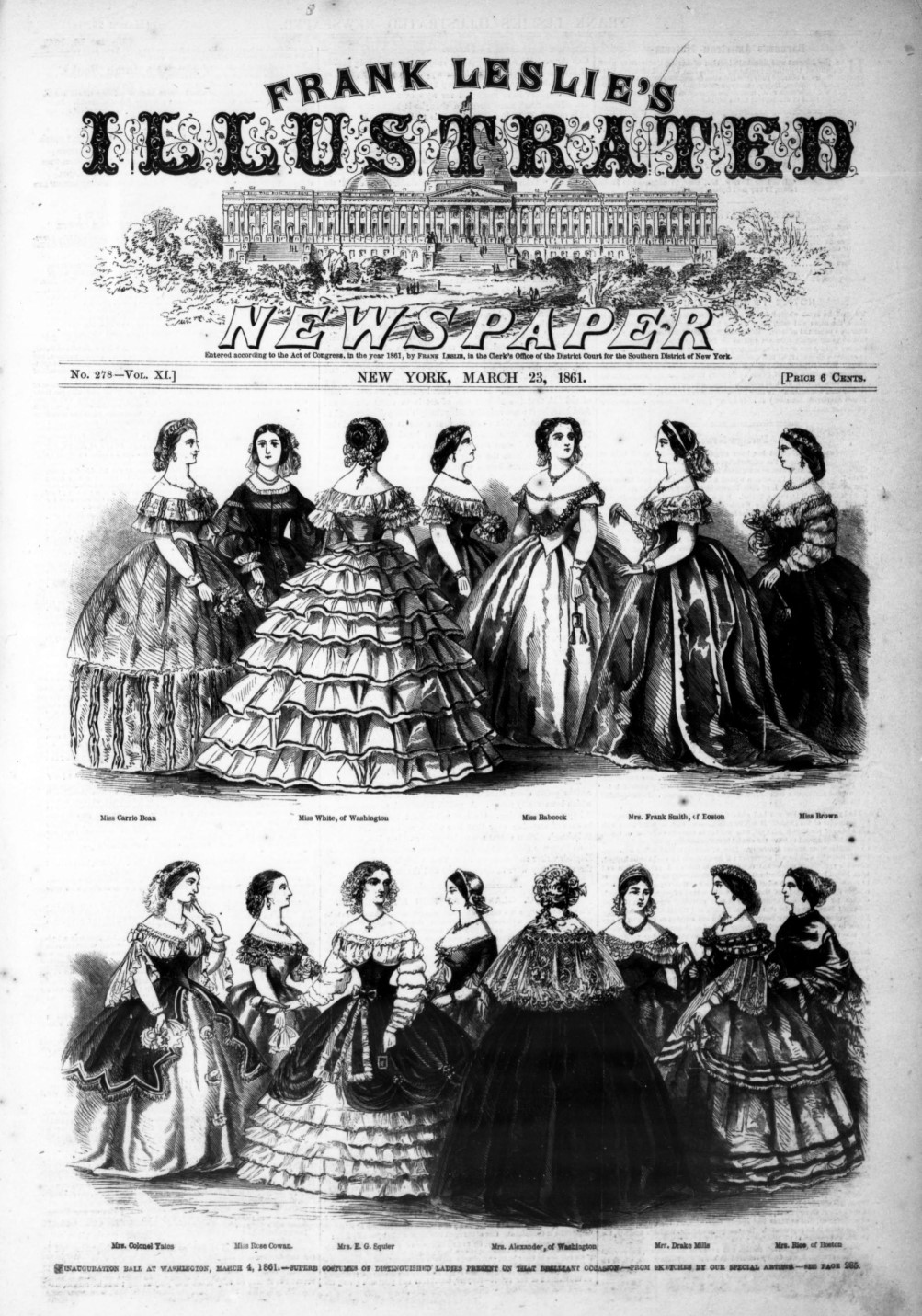
My investigation started when I saw a version of the following image attached to the FindaGrave page for Carrie Bean Russell buried at Congressional Cemetery:

This drawing comes from the cover of the March 23, 1861 edition of Frank Leslie’s Illustrated Newspaper. On this cover several of the ladies who attended President Lincoln’s first inaugural ball are shown, wearing their beautiful gowns.

Now, this labeled image seems to be proof that Congressional Carrie was quite the socialite and had attended Lincoln’s inauguration in 1861, thus making it more likely she could have later rubbed elbows with John Wilkes Booth at the National Hotel. However, attributing this image to Carrie Bean Russell is yet another case of mistaken identity.

What bothered me about Carrie’s drawing was how some of the other ladies present on the cover had their home cities listed, while Carrie Bean did not. For example, the lady right next to Carrie is “Miss White, of Washington” and two ladies down from her is “Mrs. Frank Smith, of Boston”. Yet Carrie and others on the page are not attributed to a certain city. I found a digitized copy of the whole issue on the Internet Archive and flipped through the pages. Near the end of the issue is the article about the inaugural ball and its attendees. The dresses of the different ladies on the cover are described, some more than others. The description for Carrie Bean is short but provides one key piece of information. It states: “Miss Bean, of New York, in white tarletan.”

Suddenly things made sense. Frank Leslie’s was a New York City paper. Thus, Carrie Bean and the other New York ladies present on the cover did not need any introduction to the paper’s New York audience. Only the ladies from outside of New York got special treatment.
I decided to try and track down this Carrie Bean of New York. While Frank Leslie’s only placed her in D.C. in March of 1861, I was hoping that she might have had enough clout to get another invitation to Lincoln’s second inauguration in March of 1865, just one month before his assassination. Plus, since GATH was writing for the New York World, it would make sense for him to include this detail about Booth’s breakfast since it involved a New Yorker.

Doing different searches for “Carrie Bean” and “New York” provided several newspaper articles that appeared to be the subject in question, but none of them really provided more information on who she was. However, they all helped establish that Miss Bean was a well-known socialite who hobnobbed with important figures of the day, many of whom had connections to the National Hotel. For example, in February of 1864, “Miss Bean, of New York” attended a ball in Washington, D.C. put on by General Gouverneur Warren in honor of the II Corps of the Union Army. The exclusive event was attended by Vice President Hanibal Hamlin, General George Meade, Senator John P. Hale “and daughter” (Lucy Hale, perhaps?), along with other senators and generals. Steve Williams, a fellow researcher on Roger Norton’s Lincoln Discussion Symposium, found the following article describing “Mrs. Bean and Miss Bean” attending a reception at the home of Ohio Senator John Sherman in February of 1865. The guest list was the very elite of Washington society:

In February of 1865, Senators James Harlan of Iowa and John P. Hale of New Hampshire were both living at the National Hotel. The fact that these Senators were connected to Miss Bean and her mother enough to include them in their party or escort one of them made it seem like I was on the right track. This reception took place just two months before the assassination of Lincoln.

It must be remembered that Washington became a bustling city as a result of the Civil War and the hotel industry there boomed. It was common for people to engage in long hotel stays in those days. Politicians especially lived out of hotels and boarding houses while Congress was in session, only to return to their home states when in recess. The Vice President didn’t have an official residence in D.C. until the 1970s, which is why Andrew Johnson was living at the Kirkwood House hotel at the time of Lincoln’s death. But long hotel stays were not limited to politicians. John Wilkes Booth had been residing at the National Hotel for months before the assassination. Correspondents from all the nation’s papers lived full-time in D.C. hotels. Lawyers with business in the federal courts spent weeks or months living out of hotels waiting for their cases to come up. Countless lobbyists, salespeople, and contract-type employees in connection with the federal government took up residence in hotels rather than purchasing property. If you had the money, then staying long-term at a hotel was the way to go.

Despite these and other finds showing that Miss Bean of New York was a known social figure in Washington during the Civil War years, I still lacked any additional identifying information. A big break came from a couple of articles that were published by GATH in June of 1865. These articles had nothing to do with the assassination but covered the annual examinations at the United States Military Academy in West Point, NY. The West Point examinations were a celebrated public event in which members of the public watched as the cadets were drilled and tested. In the first article, GATH included the name of “Miss Carrie Bean” among the ladies who had helped to make the examinations a successful social affair.

However, the big break came in the second article about the West Point examinations. It focused on the attendance of Generals Winfield Scott and Ulysses S. Grant at the trials. When GATH wrote out the list of visitors who watched as the cadets were tested in the academy’s library, he included the following:

“The ladies list included Mr. F. B. Conkling, Mrs. Sherwood, Mrs. Bigelow, the Misses Fish, Mrs. Strong, Mrs. Lavery, and many of equal social prominence, Mrs. Carrie Bean, Miss Roe and other bright faces represented the Highlands.”

Ignoring the change in salutation for the moment, it was the note that this Carrie Bean and others “represented the Highlands” that finally gave me a lead.

The Highlands is the area right around West Point on either side of the Hudson River. The land here is technically part of the Appalachian Mountains, though most of the mountains here are quite low in comparison with other parts of the range. Still, along the Hudson River in this area, the land is quite hilly earning the name the Hudson Highlands. If GATH was writing truthfully, then Carrie Bean was a resident of this particular area of New York, which greatly narrowed down the search.

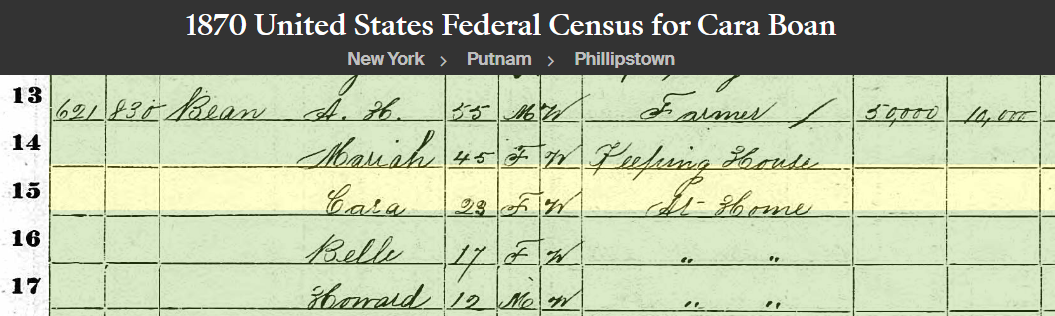
Armed with this information, I quickly found my most promising lead yet in the 1870 census. I found a 23-year-old named Cara Bean living in Phillipstown, NY which was located just across the Hudson River from West Point.
After spending over a week researching her and painstakingly creating her family tree, I’m very confident that this is the Carrie Bean referenced by GATH. Allow me to introduce you to her.


Cara Bean was the daughter of Aaron Hook Bean and Maria Louise Remer. Aaron was a New Hampshire native who moved to New York City with his brother, Moses Dudley Bean. The two men entered into the liquor business and quickly became successful merchants. After a few years, Dudley left the partnership, leaving Aaron with a successful solo business.

Aaron married Maria Remer in New York City in October of 1841. On December 22, 1842, the couple announced the birth of a daughter named Cara Louise. Two other children followed, Anabel in 1853, and Howard Dudley in 1857. In addition to his thriving liquor business, Aaron Bean got involved in other ventures. In 1844, Aaron’s sister Susan Bean Marston, a widow with two children, married Thomas “Peg Leg” Ward of Austin, Texas. Ward was a celebrated figure in Texas as a result of his having lost a leg in the fight for Texas independence. While the marriage between Ward and Susan Bean would later prove to be acrimonious and abusive, in the first few years Ward was a celebrated member of the family. Aaron used his brother-in-law’s fame and reputation to jump-start more business ventures. As a merchant, Aaron provided patent documents and clerical supplies to Ward when the latter was engaged as a Texas Land Commissioner. Aaron also invested in the Galveston, Houston, and Henderson Railroad bringing him further financial success. In the 1860 census, Aaron Bean’s real estate holdings were valued at $300,000 and his personal estate was valued at around $50,000. It was in this way that Cara Bean, her siblings, and her cousins, all lived a life without want.

When Cara Bean began living the life of a young socialite is unclear. Her family certainly had the money to support such a lifestyle. While they were New York residents, the Bean family were no strangers to the nation’s capital. Aaron Bean’s name can be found on the arrival lists of various D.C. hotels starting as early as 1853. On the last day of February 1861, Aaron Bean checked into Clay’s Hotel in Washington. Cara Bean joined her father in the city as preparations for Lincoln’s inauguration were underway.

In support of this claim is a letter written by Blanche Butler, the daughter of future Union General Benjamin Butler. In 1861, 14-year-old Blanche was attending boarding school in Washington. She regularly corresponded with her father and mother back home in Massachusetts. On March 11, 1861, Blanche wrote a letter to her mother about the events surrounding Lincoln’s inauguration and her attendance at the inaugural ball. In the letter, she mentions Carrie Bean and Clay’s Hotel specifically:

“[Uncle] came over quite early in the morning, and we had breakfast at Clay’s Hotel, with the Misses Bean, and we stood on the balcony all the morning and saw the procession go by; then Uncle took me up to Mr. Baker’s and there he decided that I had better go to the Ball; although I was not anxious to do so. Carrie Bean lent me a white muslin dress, which with a cherry sash, white gloves, a cherry and white fan, a pair of white kid slippers with little rosettes on the top, completed my outfit. We went about half past nine and returned at half past three. As I refused to dance every set but one, ate a very light supper, I did not experience any ill effects from it excepting a slight cold, which you know was impossible to avoid.”

Blanche Butler was the beneficiary of Carrie Bean’s kindness in lending the young girl a dress and the two joined the other celebrants at the ball on March 4. But it was Carrie, not Blanche, who got her dress memorialized in the pages of Frank Leslie’s.

When the Civil War broke out, Aaron Bean sold many of his business assets, including his lucrative liquor business. With the funds, he purchased the 252-acre piece of property near West Point, NY where the family is found in the 1870 census. However, Aaron Bean was not completely divested of all his businesses. In the middle of the war, Aaron partnered with a cousin of his named Moses Hook Bean to lease the former Clay’s Hotel in D.C. and run it as the United States Hotel. Aaron was also active in pushing for an expansion of the D.C. street car system. His name was on a list of incorporators for a line that would connect the Navy Yard to Georgetown. Aaron’s business interests in D.C. meant that the family had plenty of reasons to return to Washington. The various mentions of “Miss Bean” at different social gatherings in D.C. make it clear that Cara was easily able to ingratiate herself with important members of Washington society during the Civil War years.

Elizabeth “Libbie” Custer

In the spring of 1864, a new woman came to reside in Washington. Her name was Elizabeth “Libbie” Custer, and she was the wife of Major General George Armstrong Custer. The Custers had just married in February of ’64, but George’s duties to the Union army had cut their honeymoon short. Libbie, a Michigan native, was brand new to the capital city but her husband’s service at the Battle of Gettysburg had made him famous. Thus, she was quickly welcomed by the political elite of the city.

Given that both ladies ran in the same social circles, it was only inevitable that Libbie Custer and Cara Bean would meet. When this happened exactly is unclear but soon the pair had formed a friendship. In addition, Libbie became friends with Cara’s cousin, Fanny. Blanche Butler mentioned the “Misses Bean” in the plural when writing her letter in 1861. Cara Bean was 18 years old at the time of Lincoln’s first inauguration while her younger sister, Anabel, was only about 8. It’s possible that Anabel joined her sister for that trip to Washington, but I posit that there is also a chance that Blanche was referring to Cara’s cousin, Fanny.

Fanny Ellen Bean was the daughter of Moses Dudley Bean and his wife Mary Curtis. The two cousins, practically identical in age, grew up together. Aaron and Dudley’s families are shown all living together under the same roof in the 1850 and 1860 censuses. Fanny was close to Cara their whole lives and when Fanny died in 1899, she left Cara part of her estate.

Cara Bean appears to have become quite close with the Custers. It is because of them that we actually have a picture of Cara Bean. According to photography expert D. Mark Katz, on October 23, 1864, Libbie, Custer, and “Cora” Bean posed together for this photograph in Mathew Brady’s studio in Washington:

Here’s a close-up of Cara Bean from a different copy of this image:

If the date this photograph is attributed to is correct, then this is Cara Bean as she appeared just a couple months shy of her 22nd birthday.

I found this image fairly early on in my research. However, the name attributed to this image is “Miss Cora Bean”. During my initial searches, I found a couple mentions of Cora Bean but I had no way of knowing if this was the same person as the Carrie Bean mentioned by GATH and featured on the cover of Frank Leslie’s. For a time, I had actually dismissed all the references to Cora Bean entirely as I found that there was a Cora L. Bean from New York who was alive during the Civil War.

However, when I discovered Cara L. Bean and saw how easily her unique name could be confused for Cora (and how it often was when she was older), I delved more into the other Cora Bean. It ends up that Cora and Cara were second cousins. Cora was the daughter of Cotton Ward Bean, a cousin of Aaron H. Bean. But beyond the family connection, the important thing I learned is that Cora Bean wasn’t born until 1858. That means she would have only been about 6 when this picture with the Custers was taken. But it’s clear that the person in this photograph is not 6 years old. This photograph cannot be of the actual Cora L. Bean. It must be of Cara L. Bean. This helped establish the fact that, in addition to Carrie and Cara, I had another name I would have to search for in order to flesh out her life story.

The shared photograph is not the only connection between the Custers and Cara Bean. In March of 1866, George Custer was in New York without Libbie. On March 29th, George wrote a letter to Libbie recounting his activities. Libbie’s biographer, Shirley Leckie, summarized the contents of the letter in her book:

“[George] took Cora [sic] and Fannie Bean, two of Libbie’s friends, to dinner and shopping. Later the three attended Maggie Mitchell’s performance in Little Barefoot. The blond actress had become one of the most popular figures on stage, following her role in Fanchon, the Cricket, a play she now owned. During curtain calls, Custer and the two young women threw a bouquet with a card: ‘from an admiring trio.'”

Leckie continues, describing how a few days later on April 5th, Custer and the Bean cousins attended a Bal d’Opera at the Academy of Music. This was a masquerade ball in which Custer dressed up as the devil. Later, he wrote to Libbie noting Thomas Nast had drawn the scene of the ball and that a caricature of his costume was published in Harper’s Weekly. While the drawing doesn’t seem to capture either Cara or Fanny Bean, here apparently is George Armstong Custer as the devil.

General Custer was famously killed at the Battle of the Little Bighorn in 1876. A year later, his body was shipped to New York for burial at West Point Cemetery. According to newspaper articles, Libbie was attended at the funeral by her friend, Cora [sic] Bean.

The Custers were not the only individuals with whom Cara Bean established a friendship during the Civil War years. As mentioned before Senator James Harlan of Iowa had resided at the National Hotel in 1864 and 1865 and was connected to the Beans. In the early years of the war, he had lived at Clay’s Hotel, another usual haunt of the Beans. Senator Harlan’s eldest child was Mary Eunice Harlan. She was born in 1846 and was educated both in Iowa and in Washington due to her father’s position as Senator. At some point during her months in Washington, Mary Harlan met Cara Bean, likely because they ran in the same circles and often boarded at the same hotels. In 1864, a courtship began between Mary Harlan and Robert Todd Lincoln. At his father’s second inaugural ball, Robert Lincoln escorted Mary Harlan as his date. The two were planning a wedding when Abraham Lincoln’s assassination occurred. For a time, it looked like their courtship was over as a result. Eventually, however, the two renewed their courtship and on September 24, 1868, Robert Lincoln and Mary Harlan were married.

Mary Harlan in her wedding dress

By this time the Harlans had ceased living out of hotels and so the wedding was held at their home on H Street in Washington. While the wedding of Lincoln’s eldest child would have been the most celebrated event in Washington, the couple decided to keep it very small. They only invited about thirty of their closest friends. It was a very exclusive event but one person who made the cut was Cara Bean. Her outfit for the wedding was described in the D.C. papers:

“Miss Cora [sic] Bean, of New York, was dressed in white French mouslin, elegantly embroidered over a purple silk, with amethyst necklace, earrings and bracelets. Her dress was made in the latest and most fashinable [sic] style.”

From these examples, it’s clear that Cara Bean was an active participant in the social circles of Washington, D.C. during the Civil War years.

After the Civil War ended, it appears that Cara Bean returned home to New York to live at the family’s estate near West Point. References to her in the D.C. papers end with Robert Lincoln’s marriage in 1868. In 1879, the Beans sold their estate and moved back into New York City. In the 1880 census, Cara, her parents, and her brother are all living in a hotel. Also boarding in the same hotel is Cara’s cousin Fanny. Aaron Bean died in 1883 and was buried in Woodlawn Cemetery in the Bronx.

Cara Bean never married. In the 1890s she lived with her widowed mother and fellow spinster cousin Fanny at The Albany, an apartment complex on Broadway and 51st streets in New York City. Yet she was still engaged in social activities. She was a patron of the music scene and contributed her time and money to worthwhile causes, especially those catering to needy children.

1899 – 1900 was a period of great loss to Cara Bean. Her cousin Fanny died in November of 1899. A month later, her mother Maria also passed. Six months after that her brother Howard Dudley died. By 1901, she was alone at The Albany. Cara sought company with the only close relative she had left, her sister Anabel. The younger middle Bean sibling was the only one who had children. Anabel lived with her husband Edward Leavitt in Stamford, Connecticut. Cara Bean departed New York City to live with her sister and her five nieces and nephews.

On November 16, 1902, Cara Louise Bean died at the home of her sister in Stamford. She was 59 years old. Her obituary in the New York Times was short but did recount how Cara and her cousin Fanny (misidentifed as Blanche) were, “well known in New York society”.

Cara Bean’s body was transported back to New York and she was interred in Woodlawn Cemetery with her parents.


I believe that the “Miss Carrie Bean” described by George Alfred Townsend in his article about John Wilkes Booth was Cara Louse Bean of New York. The pieces of Cara Bean’s life and influence in D.C. society all seem to fit GATH’s description of that, “daughter of a merchant and a very respectable young lady”. Cara Bean knew and interacted with so many important figures in D.C. society. She resided for long periods of time at the National Hotel. She went to parties and balls with the daughters of Senators like Mary Harlan and Lucy Hale. She was escorted to events by the like of Lincoln’s private secretary John Hay and was well known to Robert Todd Lincoln. I have no doubt in my mind that Cara Bean also knew the famous actor, John Wilkes Booth.

With that being said, nothing in my research can definitively prove GATH’s claim that Cara Bean ate breakfast with John Wilkes Booth on the morning of April 14, 1865. I think it’s certainly possible that she did, but without another witness or something from Cara herself attesting to the shared meal, we can never be sure.

I never intended to do this deep dive on Cara Bean. Remember, I originally thought the Carrie Bean mentioned in GATH’s article was the woman buried in Congressional Cemetery. Talking about Carrie Bean was supposed to be the quick and easy part of a completely different blog post. I was just going to mention Carrie Bean in order to give context to an interesting article I had stumbled across. You see, Carrie Bean is not the only person who was connected with John Wilkes Booth’s breakfast on April 14, 1865. In my next post, I’ll discuss the two other ladies who have been linked to the assassin’s breakfast. One of them has a doozy of a story:


References:
The family history of Cara Bean was assembled through documents accessible through Ancestry.com and newspaper articles accessed through GenealogyBank, Newspapers.com, and the Internet Archive.
“Right or Wrong, God Judge Me”: The Writings of John Wilkes Booth edited by John Rhodehamel and Louise Taper (1997)
“John Wilkes Booth and George Alfred Townsend: A Marriage Made in Hell?” by Terry Alford (1992)
Peg Leg: The Improbable Life of a Texas Hero, Thomas William Ward, 1807 – 1872 by David C. Humphrey (2009)
Chronicles from the Nineteenth Century: Family letters of Blanche Butler and Adelbert Ames, married July 21st, 1870 by Blanche Butler Ames (1957)
Custer in Photographs by D. Mark Katz (1985)
Elizabeth Bacon Custer and the Making of a Myth by Shirley Leckie (1993)
NYPL Digital Collections
Wikimedia Commons
Giant in the Shadows: The Life of Robert T. Lincoln by Jason Emerson (2012)
Proceedings of the John Bean (1660) Association at its Annual Reunion at Boston, September 5, 1900
Burial records from Woodlawn Cemetery
My thanks to Steve Williams and others at Roger Norton’s Lincoln Discussion Symposium for helping in my initial searches for Carrie Bean.

Categories: History | Tags: , , , , , , | 14 Comments

The Lincoln Assassination On This Day (April 4 – April 10)

Taking inspiration from one of my favorite books, John Wilkes Booth: Day by Day by Art Loux, I’m documenting a different Lincoln assassination or Booth family event each day on my Twitter account. In addition to my daily #OTD (On This Day) tweets, each Sunday I’ll be posting them here for the past week. If you click on any of the pictures in the tweet, it will take you to its individual tweet page on Twitter where you can click to make the images larger and easier to see. Since Twitter limits the number of characters you can type in a tweet, I often include text boxes as pictures to provide more information. I hope you enjoy reading about the different events that happened over the last week.

NOTE: After weeks of creating posts with multiple embedded tweets, this site’s homepage now tends to crash from trying to load all the different posts with all the different tweets at once. So, to help fix this, I’ve made it so that those viewing this post on the main page have to click the “Continue Reading” button below to load the full post with tweets. Even after you open the post in a separate page, it may still take awhile for the tweets to load completely. Using the Chrome browser seems to be the best way to view the tweets, but may still take a second to switch from just text to the whole tweet with pictures.

Continue reading

Categories: History, OTD | Tags: , , , , , , , , , , , , , , , , , , | 1 Comment

Blog at WordPress.com.