Posts Tagged With: Lucy Hale

Breakfast with Booth: Lucy Hale

In an earlier post, I introduced you to Carrie Bean, a young socialite from New York who journalist George Alfred Townsend claimed had breakfast with John Wilkes Booth on the morning of Lincoln’s murder. GATH is our only source for this event, but Miss Bean’s connection to the National Hotel and some of its residents makes it possible that this breakfast did occur. However, Carrie Bean is not the only one who has been linked to the assassin’s morning meal. There are sources that state that Booth spent his final breakfast before his infamous deed in the presence of his fiancée, Lucy Hale.

Lucy Hale likely needs no introduction to readers of this blog. In 1865, Lucy was the 24-year-old daughter of New Hampshire Senator John P. Hale and his wife, Lucy Lambert. The Hales often resided at the National Hotel when staying in Washington. At the time of the assassination, Senator Hale was in a sort of limbo. In June of 1864, the statesman had lost his bid for renomination by the New Hampshire Republican party and was replaced by Aaron Cragin. When Lincoln took office for his second term on March 4, 1865, Hale was officially out of a job. However, the staunch abolitionist lobbied for an ambassadorship position. On March 10, Hale was nominated to become the administration’s new minister to Spain. At the time of the assassination, the Hales were preparing for their new lives abroad.

At what point John Wilkes Booth and Lucy Hale met and subsequently became romantically involved is unknown. A commonly repeated yet erroneous story claims their romance began in 1862 when Booth sent Lucy a valentine signed “A Stranger.” This is too early of a period for the two to have become entwined. John Wilkes Booth didn’t even make his first appearance on the D.C. stage until 1863. The source of this erroneous story is a letter to a “Miss Hale” that was found in an antique store by Richmond “Boo” Morcom. In 1970, American Heritage published an article written by Morcom titled, They All Loved Lucy, in which he attributed the letter to Booth without evidence. After Morcom’s passing in 2012, his papers were donated to the New Hampshire Historical Society. A look at the original document shows that the letter is not in John Wilkes Booth’s handwriting. To demonstrate this, here is the end of the “Stranger” valentine found by Morcom with a sample of John Wilkes Booth’s writing underneath it. I’ve underlined some of the same words found in each letter for easy comparison.

The letter and word formations are just too different to have been written by John Wilkes Booth.

Part of the reason this incorrect story continues to live on is due to the fact that John Wilkes Booth is known to have composed a valentine for Lucy Hale. Junius Brutus Booth, Jr. wrote a letter to his sister Asia, updating her on family matters. John Wilkes was visiting Junius in New York at the time and June wrote to Asia that:

“John sat up all Mondays night to put Miss Hales valentine in the mail – and slept on the sofa – to be up early & kept me up last night until 3 1/2 AM – to wait while he wrote her a long letter & kept me awake by every now and then useing me as a dictionary…”

While John Wilkes is documented as having composed a valentine for Lucy Hale, this occurred in February of 1865, and we do not have any idea what his valentine said. It was likely destroyed, along with all other correspondences from Booth, by Lucy Hale or her family in the aftermath of Lincoln’s assassination.

While Lucy and Booth may have known of each other as early as 1863, when Booth made his Washington debut, it doesn’t seem like they had much in the way of a relationship until late 1864. During the summer and early fall months of 1864, John Wilkes Booth stayed with his family in New York and then traveled into the Pennsylvania oil region. He was actually infatuated with another woman at this time, 16-year-old Isabel Sumner, whom he had met during his Boston engagement in the spring. It wasn’t until November of 1864 that Booth’s residency at the National Hotel started as Washington became his base of operations in his conspiracy against Lincoln. Thus, his and Lucy’s romance was a relatively quick one.

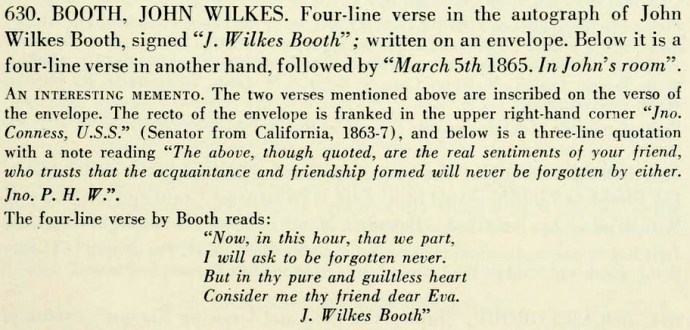
A few years ago, I wrote about an envelope dated March 5, 1865, that contains poems by John Wilkes Booth and Lucy Hale. I explained that while some authors have used this envelope as evidence that the couple broke up on this date, I believe this conclusion to be incorrect. The two were planning a life together despite the difficulties involved with her father’s nomination to be the next minister to Spain. Lucy was expected to accompany her family to their new country. As a result, John P. Hale started having his family learn some of the Spanish language they would soon be immersed in. In mid to late March, Lucy Hale traveled to New York City and stayed with friends as she took some rudimentary Spanish lessons. On March 21, Booth traveled up to New York City ostensibly to be there for his brother Edwin’s 100th night of Hamlet the next day. However, according to Junius Brutus Booth, Jr.’s diary entry on March 22, “John came on to see Miss Hale.”

In the aftermath of John’s crime, Asia Booth wrote a letter to her friend Jean Anderson where she described the relationship between John and Lucy as the Booth family understood it:

“I told you, I believe, that Wilkes was engaged to Miss Hale. They were devoted lovers and she has written heart-broken letters to Edwin about it. Their marriage was to have been in a year, when she promised to return from Spain for him, either with her father or without him. That was the decision only a few days before this awful calamity. Some terrible oath hurried him to this wretched end. God help him.”

There is no evidence that Lucy Hale had any foreknowledge of what her secret fiance was planning.

Due to her being the daughter of a former Senator, Lucy Hale’s name was mainly kept out of the papers in the aftermath of Booth’s crime. There were a few references to Booth having been engaged to a New England Senator’s daughter, but propriety kept her actual name out of it. As years went by, however, more details came out about their relationship from some of Booth’s former friends and acquaintances.


In December of 1881, a journalist by the name of Col. Frank A. Burr wrote at length about John Wilkes Booth for the Philadelphia Sunday Press. Burr had done an immense amount of research into the life and death of John Wilkes Booth. He traveled down to the Garrett Farm and interviewed members of the Garrett family about Booth’s final days. He visited Green Mount Cemetery and described the Booth family plot. Burr also interviewed friends of Booth’s in order to flesh out his motivations. The result was one, or perhaps two, lengthy articles covering many aspects of Booth’s life, crime, and death. The reason I am uncertain about how many articles Burr’s work was split into is because, try as I might, I have been unable to track down the relevant Sunday issue(s) of the Philadelphia Press. These particular editions seem to be an endangered (or possibly extinct) species in archives and libraries today.

While Burr’s original piece has proven elusive, continued interest in Lincoln’s assassination meant that several newspapers reprinted parts of his work, often splitting it up into more manageable portions. The Evening Star out of Washington, D.C., appears to be one of the first to reprint part of Burr’s work. A lengthy article called “Booth’s Bullet” credited to the Philadelphia Press and “F.A.B.” was published in the Evening Star on December 7, 1881.

It appears that the Evening Star chose to cut out the whole section about Burr’s trip to the Garrett farm. Instead, the article was broken into three sections. The first section documented Burr’s visit to John Wilkes Booth’s grave in Green Mount Cemetery. The second was an interview Burr had with John T. Ford, and the third section was Burr’s interview with actor John Mathews. On the day of the assassination, Booth had given Mathews a sealed envelope, which he instructed Mathews to give to the newspapers the next day. The envelope contained Booth’s written explanation for why he assassinated Lincoln. Mathews was a member of the Ford’s Theatre cast and witnessed Lincoln’s assassination firsthand. Afterward, he returned to his boarding house, which happened to be the Petersen House, where Lincoln was taken. As the President lay dying in an adjacent bedroom, John Mathews opened the sealed envelope and read the assassin’s manifesto. After finishing it, Mathews made the decision to burn the letter, fearing it would implicate him in Booth’s great crime. The entirety of the “Booth’s Bullet” from the Evening Star can be read here.

Within this article, there are several references to Lucy Hale. John T. Ford stated to Burr that:

“Booth was a very gifted young man, and was a great favorite in society in Washington. He was engaged, it was said, to a young lady of high position and character. I understood that she wrote to Edwin Booth after the assassination telling him that she was his brother’s betrothed, and would marry him, even at the foot of the scaffold.”

John Mathews related a lengthy exchange he had with Booth regarding love and Lucy Hale:

“‘John, were you ever in love?’
‘No. I never could afford it.’ I replied.
‘I wish I could say as much. I am a captive. You cannot understand how I feel. What are those lines in Romeo and Juliet describing love? I have played them a hundred times but they have flown from me.’
‘Will you stand a bottle if I’ll give them to you?’ I asked.
‘I will – two of them,’ replied Booth.
‘Here are the lines,’ I answered:
O! anything, of nothing first create!
O! heavy lightness! Serious vanity!
Mis-shapen chaos of well-seeming forms!
‘That’s it,’ replied Booth. ‘If it were not for this girl I could feel easy. Think of it, John, that at my time of life – just starting, as it were – I should be in love!’

[Burr:] Did he mention the lady’s name?
[Mathews:] Oh, yes; but that shall be sacred with me. She is married now, and it would serve no good purpose either to his memory or to the truth of history to revive it. He loved her as few men love. He had a great mind and a generous heart, and both were centered upon this girl, whom he intended to make his wife. Her picture was taken from his person after he was killed.”

In addition to these mentions of Booth and Lucy’s romance, this article is the earliest source that places Lucy Hale with Booth at breakfast on the morning of his great crime. John T. Ford stated the following:

“The facts in the case are that he never knew the President was to attend the theater until nearly noon of that day. He was always a late riser. He came down to breakfast about ten o’clock on that morning, and his fiancee, who also boarded at the National Hotel with her parents, met him. They had a short conversation, and after breakfast he walked up to the Surratt mansion on H street, as is supposed from the direction in which he was first seen coming by the attaches of the theater that morning.”

To be fair, this description is a little vague as to whether Lucy Hale joined Booth for breakfast or merely had a conversation with him during his breakfast. Lucy’s inclusion is really a throwaway reference in a section about Booth’s movements. However, it still connects the two on the morning of the assassination.

Another paper that reprinted Frank A. Burr’s work was The Atlanta Constitution. They published the story of Burr’s visit to the Garrett farm on Sunday, December 11, 1881. A month later, on Sunday, January 15, 1882, the Constitution published another article attributed to Burr titled “Booth’s Romance”.
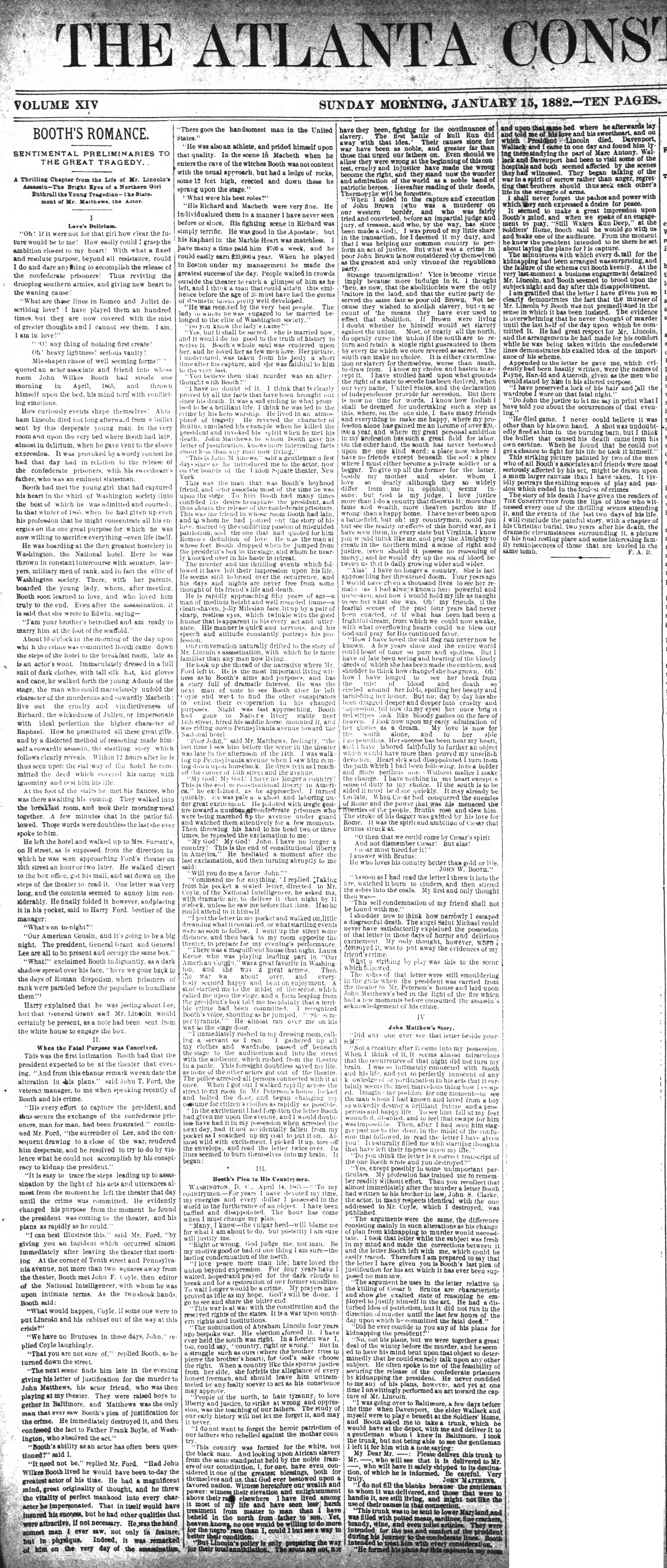
This article was similar to the earlier article found in the Evening Star, but “Booth’s Romance” is markedly different in spots from “Booth’s Bullet.” The section about visiting Booth’s grave is not present in the Constitution, and while the interviews with John T. Ford and John Mathews are present, they have been moved around, reworded, and elaborated on in different places.

For example, here is the beginning of “Booth’s Romance”:

“‘Oh! If it were not for that girl how clear the future would be to me! How easily could I grasp the ambition closest to my heart! With what a fixed and resolute purpose, beyond all resistance, could I do and dare anything to accomplish the release of the confederate prisoners! Thus reviving the drooping southern armies, and giving new heart to the waning cause!

What are those lines in Romeo and Juliet describing love? I have played them an hundred times, but they are now covered with the mist of greater thoughts and I cannot see them. I am, I am in love!’

‘O! any thing of nothing first create!
Oh! heavy lightness! serious vanity!
Mis-shapen chaos of well seeming forms!’
quoted an actor associate and friend into whose room John Wilkes Booth had strode one morning in April, 1865, and thrown himself upon the bed, his mind torn with conflicting emotions.”

In content, this introduction is similar to the exchange between Booth and John Mathews as written in “Booth’s Bullet,” but it is portrayed and narrated differently in “Booth’s Romance.” A similar change is present in the part about Booth’s breakfast. “Booth’s Romance” does not talk about Booth’s breakfast in the same section as John T. Ford’s interview but merely narrates Booth’s movements uncredited:

“About 10 o’clock in the morning of the day upon which the crime was committed Booth came down the steps of the hotel to the breakfast room, late as an actor’s wont. Immaculately dressed in a full suit of dark clothes, with tall silk hat, kid gloves and cane, he walked forth the young Adonis of the stage… At the foot of the stairs he met his fiancee, who was there awaiting his coming. They walked into the breakfast room, and took their morning meal together. A few minutes chat in the parlor followed. Those words were doubtless the last she ever spoke to him.”

In this version, Booth and Lucy Hale definitively shared breakfast together before they departed from each other’s company. However, there is no attribution for this added detail, and it appears to be an unsupported elaboration. “Booth’s Romance” is filled with confusing attributions when compared to “Booth’s Bullet”. For example, in the section cited as the interview with John T. Ford, we get this exchange:

“‘He was received by the very best people. The lady to whom he was engaged to be married belonged to the elite of Washington society.’
‘Do you know the lady’s name?’
‘Yes, but it shall be sacred. She is married now and it would do no good to the truth of history to revive it. Booth’s whole soul was centered upon her, and he loved her as few men love. Her picture, I understand, was taken from his body a short time after his capture, and she was faithful to him to the very last.'”

These statements are said to be from John T. Ford, but the ending part about Lucy Hale’s name being “sacred” was attributed to John Mathews in the article “Booth’s Bullet.” It appears the composer of “Booth’s Romance” combined the two statements by Ford and Mathews together and attributed them all to Ford. However, without access to Burr’s original work in the Philadelphia Press, it’s hard to know which account, if either, is the accurate portrayal.

Regardless, these articles from Frank Burr seem to provide John T. Ford as the source for the claim that John Wilkes Booth shared his breakfast with Lucy Hale on April 14, 1865. But how reliable is that story?


It’s important to remember that John T. Ford was not in Washington, D.C., on the day of the assassination. In truth, Ford was not all that involved with the day-to-day operations of his namesake theater. He had spent most of the winter and spring of 1864-1865 in Baltimore, running his Holliday Street Theatre. He left the management of Ford’s Theatre in the hands of his brothers, Harry and Dick Ford. When Lincoln was shot at Ford’s Theatre, John T. Ford was in Richmond. Before the war, Ford had operated a theater in Richmond, and he still had family in the area. With the fall of the Confederate capital earlier that month, Ford had applied for and received a military pass to travel south. All of John Ford’s knowledge about the specifics of the assassination comes from what he learned from his brothers, employees, and eyewitnesses after his return to the city.

This isn’t to say that John T. Ford is someone we should ignore. While he wasn’t in town when Lincoln was shot, when he returned to Washington, Ford was arrested and held at the Old Capitol Prison. He wrote a great deal about his time in prison and his interactions with some of the other folks imprisoned with him. Ford became a big proponent of Mary Surratt’s innocence as a result of what he witnessed while incarcerated.

In April of 1889, John T. Ford published an article in the North American Review entitled, “Behind the Curtain of a Conspiracy”. If you want, you can read the full article here. The bulk of the piece was a defense of Mary Surratt and an attack on Judge Advocate General Joseph Holt for allowing Mrs. Surratt to be executed. However, Ford also took the time to narrate John Wilkes Booth’s movements on the morning of the assassination. When discussing Booth’s breakfast, John T. Ford wrote this:

“On the morning of April 14, 1865, it was fully 11 a.m. when John Wilkes Booth came from his chamber and entered the breakfast-room at the National Hotel, Washington. He was the last man at breakfast that day; one lady only was in the room, finishing her morning meal. She knew him and responded to his bow of recognition. He breakfasted leisurely, left the room when he had finished, went to the barber-shop…”

Ford makes no mention of Lucy Hale in this 1889 article. His allusion to a single lady in the breakfast room more closely matches GATH’s description of Carrie Bean from 1865.

The reality is that John T. Ford was extremely inconsistent when discussing Booth’s breakfast over the years. In an article from 1878, he stated that Booth, “was the last guest at breakfast” and makes no mention of any ladies being present. To Col. Burr in 1881, he stated that Lucy Hale met Booth at breakfast, but it is unclear if she joined him for the meal. Then, in 1889, he wrote that another unnamed lady was also eating breakfast at the time. John T. Ford is all over the map.

Perhaps the most interesting of all of John T. Ford’s descriptions of Booth’s breakfast is one that he gave to the Evening Star on April 18, 1885. In this account, Ford includes both Carrie Bean and Lucy Hale.

“The last male guest at the National hotel breakfast, on the morning of April 14th, 1865, was John Wilkes Booth. When he entered the breakfast room, a young lady, Miss B—. was finishing her meal at a small table near by the one assigned him by the waiter in charge. He glanced over the bill of fare and pleasantly whispered his order for a light meal, which was soon brought. The young lady lingered at her table. The young actor was an acquaintance, and a known admirer of one of her feminine friends – (the daughter of a distinguished public man, whose family occupied a suite of rooms at the same hotel,) besides he was young graceful, and exceedingly handsome. His breakfast was soon finished, he rose as the lady did, and they walked together to the door, where his silk hat, light overcoat, cane and gloves were lying on a table. He laid the coat on his left arm, and with hat, gloves and cane in his hands, he bowed to the young lady and passed along the hall way and down the steps to the office, placing his hat and coat on and leisurely gloving one hand, he noticed that it was after eleven by the hotel clock, as he sauntered towards the door on the Avenue. At this time two handsomely dressed young ladies were passing – he bowed, they acknowledged the salutation and entered the parlor hallway of the hotel. Had any one been looking on when he drew and opened an encased picture from a side pocket, the likeness of one of the two ladies would have been recognized in the subject of the ambrotype. He quickly replaced the picture in his pocket, and started in an easy loitering walk towards 6th street…”

Ford paints a compelling and almost theatrical scene in this article. Booth shares a meal in the same room as an acquaintance, Carrie Bean, who admires the matinee idol and delays completing her meal so that they will finish at the same time. Always the gentleman, Booth escorts Carrie Bean from the breakfast room and bids her adieu. Preparing to depart the hotel, Booth comes across Lucy Hale, his secret fiancee, with an escort, most likely her sister Lizzie. The public nature of their meeting in the hotel parlor, along with Lizzie’s presence, prevents the lovers from acknowledging each other with anything beyond the same polite pleasantries Booth had just demonstrated with Miss Bean. But the couple still lock eyes and exchange a knowing smile. As the Hale sisters pass him, Booth takes out the image of Lucy he keeps on his person, the same image that will later be found in his pocket diary upon his death. Booth looks upon Lucy’s face before placing it in his pocket. He exits the National Hotel on his way to Ford’s Theatre where he will get confirmation that Lincoln would be attending that night, altering his future, and Lucy’s, forever. If I were to direct such a scene, I pan away from the hotel door after Booth exits out onto the street and turn back to Lucy Hale. Lizzie would be prattling on about something innocuous but our focus would be on Lucy’s face, which would still be a bit blushed from having a small moment of connection with her secret fiancee. She continues ignoring Lizzie and looks at the door Booth exited out of, longing for him to come back. But she never sees him again.

It’s a scene worthy of a theater owner and a pair of star-crossed lovers like John Wilkes Booth and Lucy Hale, but this account is likely just as fictitious as Romeo and Juliet. While John T. Ford no doubt took an interest in learning as much as he could about the events that led up to the President’s assassination at his namesake theater, his absence from the city on the day in question, and his many contradictions throughout the years, make it impossible to put any faith in his accounts regarding Booth’s breakfast. Sadly, aside from John T. Ford, I have been unable to find any compelling evidence to support the idea that John Wilkes Booth had breakfast with Lucy Hale on the morning of April 14, 1865. I don’t believe John Wilkes Booth dined with Lucy Hale that morning. At what point the pair saw each other for the last time will likely always be a mystery.


Epilogue

When I first started reading and doing research about the Lincoln assassination, I avoided the topic of John Wilkes Booth’s romantic entanglements like the plague. Booth was rumored to have been involved with so many different women that the late Dr. Ernie Abel wrote an entire 352-page book about them all. Booth engaged in numerous flings with women that he merely used and then disposed of. While Lucy Hale appears to have been a special case, I still don’t believe that Booth had the capacity to make any long-term relationship work, especially a marriage. Booth was a narcissist with an insatiable desire to be admired and revered. While Booth tried to portray Lincoln’s assassination as an act of justice for the South, it was more an attempt for glory and immortality for himself. Even if he had chosen not to assassinate Lincoln, I believe his relationship with Lucy was still doomed. Booth’s inability to feel fulfilled by any single person would have caused him to stray and ruined Lucy’s life as a result.

With that being said, I do believe that John Wilkes Booth thought he loved Lucy Hale. I say he thought he loved her because I don’t know how capable Booth was of truly loving someone other than himself. Booth’s version of love was not enough to stop him from killing Lincoln, but I believe he did think of Lucy Hale during his final days on the run. In fact, I think he left a final message for Lucy in his diary.

As mentioned earlier, before committing his crime, John Wilkes Booth left a lengthy letter for publication in the newspapers. This was his detailed explanation of why he had taken the drastic action of killing the President. John Mathews destroyed the letter shortly after the assassination for fear of being connected to the crime. While on the run from the authorities, the assassin clambered for newspapers and was dejected to find his words had not been published. Perhaps predicting that he would not survive long enough to try and justify his actions to the world in person, Booth decided to compose another manifesto. With a notable lack of paper, John Wilkes Booth was forced to take down his thoughts in his small datebook from 1864. It was in a pocket of this datebook that he held Lucy Hale’s photograph. Booth ripped out the previously used pages and started the datebook fresh, labeling his main entry as “April 14, Friday the Ides”.

Much has been written about the text of John Wilkes Booth’s diary. Yet, a central section of his diary has been mainly ignored in practically all analyses of his motivations, mindset, and mood. Before writing anything about his deed or his reasonings, Booth opens his diary with two words that stand alone.

The words are “Ti Amo“. The phrase is Italian and translates to, “I love you.”

If Booth had written “I love you” in English, the message could be interpreted as being for anyone, a final note to his mother and siblings perhaps. But writing the phrase as “Ti Amo” codes this phrase in a way that makes it more specific. It is intended for a specific person, who, upon reading it, should know it was for them and them alone.

I contend that this “Ti Amo” was Booth’s final message for Lucy Hale. We know that Lucy was learning Spanish in preparation for her family’s departure to Spain. John Wilkes Booth traveled from D.C. to New York City in March of 1865 in order to visit Lucy, who was taking Spanish lessons in the city. While “Ti Amo” is Italian and not Spanish, it is only one letter different from the Spanish phrase for “I love you”. Perhaps Booth meant to write the Spanish “Te Amo” but ended up with the Italian “Ti Amo” by mistake. Or perhaps the Italian version was a playful response to Lucy’s own “Te amo”. In my view, writing “I love you” in a foreign language in his diary was a way for Booth to announce his love specifically for Lucy without endangering her further by mentioning her name. I might be giving John Wilkes Booth more romantic credit than I should, but I truthfully cannot think of who else this message was meant for other than his secret fiancee, Lucy Hale.

Categories: History | Tags: , , , , , , | 7 Comments

The Lincoln Assassination on this Day (October 10 – October 16)

Taking inspiration from one of my favorite books, John Wilkes Booth: Day by Day by Art Loux, I’m documenting a different Lincoln assassination or Booth family event each day on my Twitter account. In addition to my daily #OTD (On This Day) tweets, each Sunday I’ll be posting them here for the past week. If you click on any of the pictures in the tweet, it will take you to its individual tweet page on Twitter where you can click to make the images larger and easier to see. Since Twitter limits the number of characters you can type in a tweet, I often include text boxes as pictures to provide more information. I hope you enjoy reading about the different events that happened over the last week.

NOTE: After weeks of creating posts with multiple embedded tweets, this site’s homepage now tends to crash from trying to load all the different posts with all the different tweets at once. So, to help fix this, I’ve made it so that those viewing this post on the main page have to click the “Continue Reading” button below to load the full post with tweets. Even after you open the post in a separate page, it may still take awhile for the tweets to load completely. Using the Chrome browser seems to be the best way to view the tweets, but may still take a second to switch from just text to the whole tweet with pictures.

Continue reading

Categories: History, OTD | Tags: , , , , , , , , , , , , , , , , , | 1 Comment

The Lincoln Assassination On This Day (February 28 – March 6)

Taking inspiration from one of my favorite books, John Wilkes Booth: Day by Day by Art Loux, I’m documenting a different Lincoln assassination or Booth family event each day on my Twitter account. In addition to my daily #OTD (On This Day) tweets, each Sunday I’ll be posting them here for the past week. If you click on any of the pictures in the tweet, it will take you to its individual tweet page on Twitter where you can click to make the images larger and easier to see. Since Twitter limits the number of characters you can type in a tweet, I often include text boxes as pictures to provide more information. I hope you enjoy reading about the different events that happened over the last week.

NOTE: After weeks of creating posts with multiple embedded tweets, this site’s homepage now tends to crash from trying to load all the different posts with all the different tweets at once. So, to help fix this, I’ve made it so that those viewing this post on the main page have to click the “Continue Reading” button below to load the full post with tweets. Even after you open the post in a separate page, it may still take awhile for the tweets to load completely. Using the Chrome browser seems to be the best way to view the tweets, but may still take a second to switch from just text to the whole tweet with pictures.

Continue reading

Categories: History, OTD | Tags: , , , , , , , , , , , , , , , , | Leave a comment

The Lincoln Assassination On This Day (February 7 – February 13)

Taking inspiration from one of my favorite books, John Wilkes Booth: Day by Day by Art Loux, I’m documenting a different Lincoln assassination or Booth family event each day on my Twitter account. In addition to my daily #OTD (On This Day) tweets, each Sunday I’ll be posting them here for the past week. If you click on any of the pictures in the tweet, it will take you to its individual tweet page on Twitter where you can click to make the images larger and easier to see. Since Twitter limits the number of characters you can type in a tweet, I often include text boxes as pictures to provide more information. I hope you enjoy reading about the different events that happened over the last week.

NOTE: After weeks of creating posts with multiple embedded tweets, this site’s homepage now tends to crash from trying to load all the different posts with all the different tweets at once. So, to help fix this, I’ve made it so that those viewing this post on the main page have to click the “Continue Reading” button below to load the full post with tweets. Even after you open the post in a separate page, it may still take awhile for the tweets to load completely. Using the Chrome browser seems to be the best way to view the tweets, but may still take a second to switch from just text to the whole tweet with pictures.

Continue reading

Categories: History, OTD | Tags: , , , , , , , , , , , , , , | 4 Comments

The Lincoln Assassination On This Day (October 11 – October 17)

Taking inspiration from one of my favorite books, John Wilkes Booth: Day by Day by Art Loux, I’m documenting a different Lincoln assassination or Booth family event each day on my Twitter account. In addition to my daily #OTD (On This Day) tweets, each Sunday I’ll be posting them here for the past week. If you click on any of the pictures in the tweet, it will take you to its individual tweet page on Twitter where you can click to make the images larger and easier to see. Since Twitter limits the number of characters you can type in a tweet, I often include text boxes as pictures to provide more information. I hope you enjoy reading about the different events that happened over the last week.

NOTE: After weeks of creating posts with multiple embedded tweets, this site’s homepage now tends to crash from trying to load all the different posts with all the different tweets at once. So, to help fix this, I’ve made it so that those viewing this post on the main page have to click the “Continue Reading” button below to load the full post with tweets. Even after you open the post in a separate page, it may still take awhile for the tweets to load completely. Using the Chrome browser seems to be the best way to view the tweets, but may still take a second to switch from just text to the whole tweet with pictures.

Continue reading

Categories: History, OTD | Tags: , , , , , , , , , , , , , | Leave a comment

John Wilkes Booth’s “Mysterious Beauty”

“Some Photographs of Females”

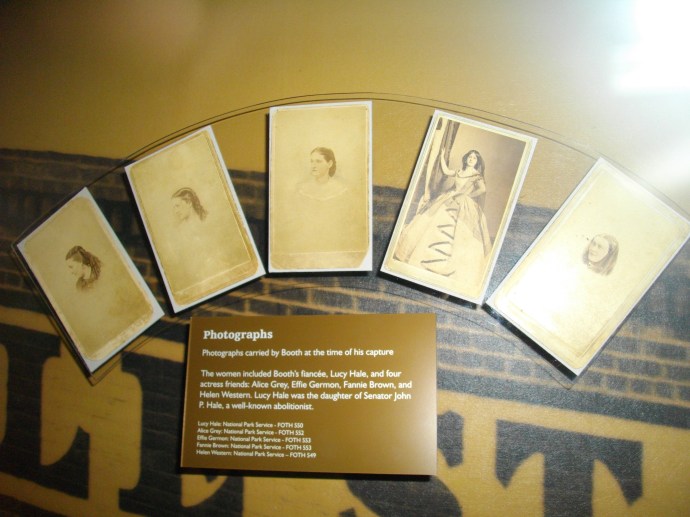
After John Wilkes Booth was shot and pulled from the Garretts’ burning tobacco barn, his body was subjected to a search. While the assassin of President Lincoln lay paralyzed and dying on the front porch of the Garrett farmhouse, the detectives rifled through his pockets, removing pieces of evidence. The items the detectives discovered worked to confirm his identity (which was never really in question), and give them the evidence they needed to prove back in Washington that Booth had, indeed, been taken. With reward money on their minds, such proof was of the utmost importance. Detective Everton Conger was so anxious to spread the news that Booth had been captured that he departed with some of Booth’s possessions before Booth had even died. One of the objects Conger brought back to Washington with him was Booth’s diary which contained the photographs of five ladies.

Historians Richard Sloan and Art Loux view the five photographs found on John Wilkes Booth's body when he was killed. The man in the middle is former Ford's Theatre curator Michael Harmon.

Historians Richard Sloan and Art Loux view the five photographs found on John Wilkes Booth’s body when he was killed. The man in the middle is former Ford’s Theatre curator Michael Harmon.

These images, like the diary itself, were turned over to the War Department where they languished for quite some time. Booth’s collection of ladies were deemed unimportant to the official investigation and were not used at the trial of the conspirators or at the 1867 trial of John Surratt. They eventually were boxed up along with some other evidence used at the trial and Booth’s other possessions. They were stored with the War Department files in the Judge Advocate General’s Office.

It was quite some time before the existence of these photographs became known to the general public. When the text of John Wilkes Booth’s diary was published for the first time in 1867, the affidavit attached to it from Secretary of War Edwin Stanton stated that only the quoted entries and “some photographs of females” comprised the contents of the diary. There appears to have been no follow up or inquiry about who these females were or why Booth had their photographs in his diary. It wasn’t until several years later, when the occasional newspaper reporter convinced the Judge Advocate General’s Office to let them take a peak at the relics of the assassination, that any discussion of the photographs began.

An inquisitive reporter with the Cleveland Herald visited the relics in the JAG office in 1884. Entranced with the more vivid relics such as Booth’s derringer and pieces of Lincoln’s skull, the reporter only made a passing mention of the ladies in Booth’s diary. He stated, “among the articles found in the ‘pocket’ of the book are five photographs of young women, presumably actresses.” It appears that the identities of the ladies in Booth’s pocket had not been researched much prior to this, seeing as this reporter was given no information about who they were.

Visitors to see the relics were relatively scarce and those who were able to view the artifacts could only do so with advance permission from either the Secretary of War or Judge Advocate General. The artifacts were viewed by “about three or four people a year,” considerably slowing down the process of identifying the ladies. It was essentially left to the few clerks who acted as custodians over the relics to attempt to identify them, which they did with varying degrees of success.

Effie Germon and Lucy Hale

It appears that the identity of two of the ladies contained in Booth’s diary were identified a bit earlier than the rest. A reporter who was given access to view the relics in 1891 was correctly told that two of the images in the set were of actress Effie Germon and of “a daughter of one distinguished Senator from a New England state.”

On the night of Lincoln’s assassination, Effie Germon was performing the lead of Aladdin at Grover’s Theatre in D.C. In the audience was young Tad Lincoln, who heard the news of his father’s assassination when the play at Grover’s was halted to announce the tragedy. The 1891 reporter was kind in describing the image Booth possessed of this easily recognizable star of the stage, “Miss Effie Germon, once leading lady at Wallack’s, is one. It is a fair young face, strikingly beautiful.” However the reporter is not so kind when he relates Ms. Germon’s current state, “Miss Germon, if living, is now an old woman, and they say she is fat.”

Lucy Hale was the daughter of U.S. Senator John Parker Hale of New Hampshire. She was also John Wilkes Booth’s secret fiancée. The main evidence for believing that Booth and Lucy were actually in love is not only the collections of the Booth family who supported the idea of an engagement but also from Booth’s own words. Some of Booth’s final thoughts were of Lucy and this is demonstrated in his diary.

It is largely forgotten or ignored that the very first words written in Booth’s diary are “Ti Amo.” “Ti Amo” is Italian but seems to be an understandable misspelling of the Spanish “Te Amo.” Regardless, both translate into English as “I love you”. This announcement of love, coded a bit, seems out of place in Booth’s diary. Before starting his manifesto about why he shot the President, John Wilkes Booth was compelled to write a brief note of love to someone. It seems likely that this message was meant for Lucy Hale.
Ti Amo

Prior to the assassination, Lucy’s father, Senator Hale, had been appointed as a minister to Spain.  All of the Hales were in earnest to learn some Spanish before heading abroad with their father. Lucy vowed to John Wilkes that she would return in a year, with or without her father’s permission, in order to marry him. Lucy lived in the same Washington hotel as Booth, and he would have almost assuredly witnessed his fiancée practicing Spanish.

It may be a romantic idea, but it’s possible that the Ti Amo in Booth’s diary was his final message to the woman he loved. It was a message Lucy would know was meant for her and for no one else. It was a way for him to announce his love for her, for the last time, without endangering her further.

What would have become of Booth and Lucy’s relationship had he not assassinated the President is unknown. Perhaps it was always doomed to fail due to Booth’s womanizing as evidenced by his diary’s collection of other beautiful women. Still, the presence of Lucy’s image and the coded “I love you” message in Booth’s diary could easily demonstrate that, in his final days on the run, John Wilkes Booth thought of, and loved, Lucy.

Mistakes and Misidentifications

Though it was correctly concluded that Effie Germon and Lucy Hale were among those represented in Booth’s photographs, this did not mean that they were always identified correctly. In 1891, a reporter was shown the relics by a clerk of the Judge Advocate General’s office named Mr. Saxton. You can read the reporter’s article about the visit by clicking this line. Unfortunately, Mr. Saxton appears to have been all mixed up when it came to which image was of which woman.  In addition, he provided incorrect identifications for the rest of the images and only seemed to show the reporter four out of the five images.

Mr. Saxton’s mistakes and misidentifications, which demonstrate the JAG office’s lingering uncertainty about who these women were, are as follows:

Actress Alice Grey was mistaken for fellow actress Effie Germon:

Lucy Hale was misidentified as a singer named Caroline Richings:

Actress Helen Western was mistaken for actress Olive Logan by the reporter before Mr. Saxton misidentified her as Lucy Hale:

And actress Effie Germon was mistaken for another actress named Rose Eytinge:

While we may laugh today about the numerous mistakes in Mr. Saxton’s 1891 identifications, it does demonstrate that there was somewhat of an attempt by someone in the JAG office to learn the identities of these women. This leads us to the last image in the set photographs and the case of John Wilkes Booth’s “Mysterious Beauty”.

“The Mysterious Beauty”

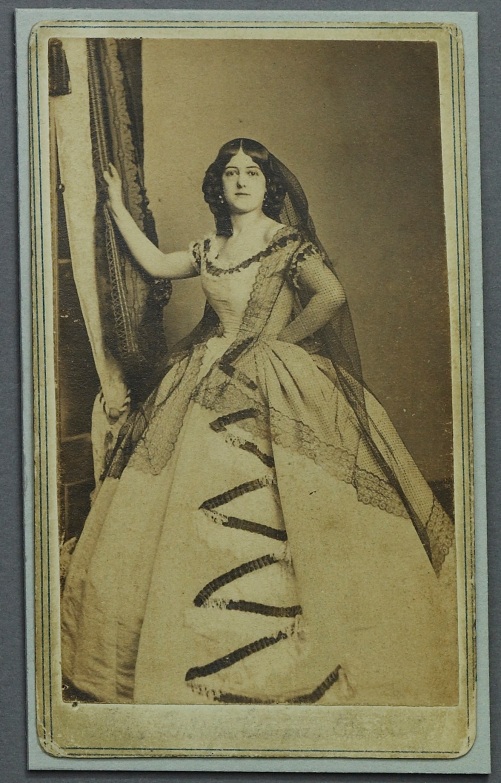
Fannie Brown CDV

We know that, eventually, the first four vignetted photographs were correctly identified as Alice Grey, Effie Germon, Helen Western and Lucy Hale. It is likely that the clerks of the JAG office consulted a few more visitors who possessed far better knowledge about the theatrical leading ladies of the 1860’s and that they helped fix the mistakes. However, even after four out of the five women were identified, the identity of the woman in the last image was still uncertain. This woman, her image different from the rest in that it showed her full body rather than just a vignette of her face, was still unknown. A more active search was undertaken to learn who she was.

As has been demonstrated by other images of artifacts in possession of the Judge Advocate General’s office (this one for example), the items relating to Lincoln’s assassination were not always treated with the same degree of preservation or care as they receive today. Some of the smaller pieces found on Booth’s body mysteriously disappeared over the years, such as a small horseshoe charm, a diamond stick pin, and a Catholic medallion. In addition to these losses, the clerks at the JAG office even burned some of the clothing collected as evidence when moths began to eat away at it. Modern museum curators would cringe at the way in which these artifacts were locked up in a box with no thought of temperature or humidity.

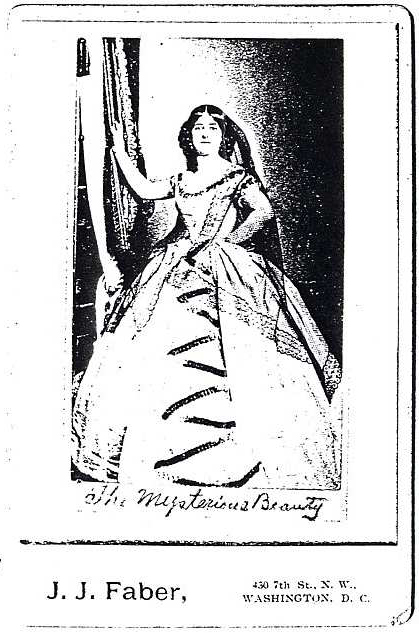
It is therefore unsurprising that the images of Booth’s ladies would also be subjected to neglect or ignorant mistreatment. Such was the case when one of the custodians of the artifacts decided he really wanted to know the identity of the woman in the standing photo. Until she was recognized, some unnamed clerk nicknamed her “The Mysterious Beauty” and went so far as to write that moniker on the bottom of the original image itself.

The Mysterious Beauty Cabinet card

One must remember that the entire collection of assassination related artifacts stored by the Judge Advocate General’s office was still considered to be official evidence and property of the U.S. government. In the years after the assassination, several organizations had tried, and failed, to gain ownership of the artifacts. There were even efforts by various Judge Advocate Generals to rid themselves of the pesky items that garnered such macabre interest. The items were almost transferred to the Smithsonian before the Judge Advocate General’s office declared that even if they were transferred to the Smithsonian, the government would still own them and the Smithsonian essentially couldn’t do anything with them other than store them. After that, the Smithsonian was no longer interested.

With this in mind, it is amazing to picture a clerk of the Judge Advocate General’s office causally taking this CDV, a piece of government owned evidence that even the Smithsonian couldn’t be trusted with, out of the JAG office and into the Washington streets. The clerk walked to the nearby photography studio of J.J. Faber and had the photographer duplicate the image with “The Mysterious Beauty” inscription onto larger format images known as cabinet cards. A photocopy of one of the cabinet cards is pictured above. How many copies were made of this image is unknown, but it is likely that the unnamed clerk made enough copies to pass around. The original, defaced, image was subsequently returned to its governmental prison.

How long it took to correctly identify this beauty after her image was duplicated and passed around, or who eventually made the correct identification, is not known, but eventually the unnamed clerk’s effort paid off. On the back of the photocopied cabinet card pictured above (which was sent to author Francis Wilson in the 1910’s – 1920’s as he was working on his book about John Wilkes Booth), the following statement was recorded:

“The original of this picture was found, after his death, in the diary of John Wilkes Booth, the assassin of President Lincoln. It was not known for a long time who the subject of the picture was and the custodian of the ‘Booth diary’ and other articles connected with the great tragedy, stored in the archives of the War Department, had some copies made of it for the purpose of identification. It was finally recognized as being the picture of Fanny Brow, an actress who died many years ago. Since that time the words “The Mysterious Beauty” have been effaced from the original in the War Department.

War Department
Office of the Judge Advocate General

John P. Simonton
Custodian”

Indeed, this final image was determined to be that of actress Fanny Brown.

Revealed at last, John Wilkes Booth's "Mysterious Beauty" was Fanny Brown.

Revealed at last, John Wilkes Booth’s “Mysterious Beauty” was Fanny Brown.

Fanny Brown had known John Wilkes Booth since at least 1863 when they performed together throughout cities in New England. Gossip of the day even hinted at a romantic relationship between the pair, which would not be surprising given Booth’s established success in wooing women:

JWB and Fanny Brown Gossip

As clerk John Simonton* states, after Fanny Brown’s identity was established, the words “The Mysterious Beauty” were erased from the original image. However, as any museum curator will tell you, alterations to an artifact can never truly be erased. A close inspection of the bottom of Fanny Brown’s CDV shows the faint outline of the words that were once carelessly scribbled onto her gift to John Wilkes Booth:

The-Mysterious-Beauty-anima

A Fitting Repose

Eventually Alice Grey, Effie Germon, Helen Western, Lucy Hale, and Fanny Brown escaped their prison in the Judge Advocate General’s office. On February 5, 1940, the artifact evidence held by the JAG was officially transferred to the Lincoln Museum, also known as Ford’s Theatre. In the years since then, the ladies have spent some on display but still spent more time in a couple of National Park Service storage facilities. Today, however, all five of these beauties are on display in the assassination section of the Ford’s Theatre Museum.

Booth's Ladies

After so many years of being confined to a box, ignored, misidentified, and forgotten, it’s great to see these ladies on display so prominently at Ford’s Theatre. Their innocent beauty is a much needed contrast to the dark tools of the assassination that surround them. These images of Lucy Hale, Alice Grey, Effie Germon, Fanny Brown, and Helen Western perfectly represent the beautiful life that John Wilkes Booth mysteriously threw away when he committed his violent act of hate on April 14, 1865.

References:
Denver Rocky Mountain News, January 13, 1884 (republishes the article from the Cleveland Herald)
“Relics of a Tragedy”, The World, April, 26, 1891
The Richard and Kellie Gutman Collection
The Art Loux Archive
Ford’s Theatre Museum
Library of Congress
New York Public Library

*John Paul Simonton, the clerk who wrote the note on the back of the cabinet card explaining the story of “The Mysterious Beauty” is occasionally referenced by those who believe John Wilkes Booth was not killed on April 26, 1865. Simonton worked as a law clerk in the JAG office from 1877 – 1920. After his retirement, he wrote an affidavit in 1925 stating, in part, “I studied the evidence in this case and examined all the exhibits as an expert and found no definite proof that John Wilkes Booth was ever captured. The fact that John Wilkes Booth was captured could not be established before any court in the United States on the evidence submitted at the time of the trial and now on file at the War Department.” Conspiracy theorists use this as “proof” that Booth escaped. Interestingly, they largely ignore an 1898 letter from Simonton to Finis Bates (of the Booth mummy story) in which Simonton stated, “While I have not what may be styled direct or positive evidence that the man killed was Booth, I have such circumstantial evidence as would seem to prove the fact beyond doubt.” In addition, Simonton clearly states on the back of this cabinet card that “this picture was found, after his death, in the diary of John Wilkes Booth,” solidifying that it was his firm opinion that it was John Wilkes Booth who was killed. When it comes to his 1925 statement, Simonton is very clearly pointing out the fact of Booth’s death was not definitely proven at the trial of the conspirators and in this he would be correct. The object of the trial of the conspirators was not to conclusively prove that Booth was dead, it was was to try the conspirators for their involvement in Lincoln’s death. The files and evidence of the conspiracy trial do not definitely or directly prove Booth’s death as this was not the objective of the trial. However, evidence from sources outside the conspiracy trial (i.e. autopsy reports, the numerous identification of Booth’s body by his friends and family, official statements from David Herold, the Garrett family, the troopers that captured him, etc.) along with the circumstantial evidence presented at the conspiracy trial (i.e. Booth’s possessions taken from him after he was shot) do conclusively prove that Booth was killed.

Categories: History | Tags: , , , , , , , , | 11 Comments

John Wilkes Booth’s Poetic Envelope

One of the more curious relics belonging to John Wilkes Booth, is a brief poem he wrote on the reverse of an envelope on March 5th, 1865.

Booth Hale Poem Envelope 3-5-1865 Sotheby's

There are some mysteries regarding this poetic envelope. What does Booth’s poem say? Who wrote the second poem beneath Booth’s? Why were these poems written at all? Let’s explore these questions as we analyze this piece on the 150th anniversary of its creation.

What Does Booth’s Poem Say?

This relic was first brought to the attention of the general public thanks to Carl Sandburg’s 1939 book, Abraham Lincoln: The War Years Volume 4. In writing and illustrating his book, Sandburg borrowed heavily from his friend and Lincoln collector, Oliver R. Barrett. Barrett had a massive Lincoln collection and allowed Sandburg to include a small picture of these poems. Sandburg also transcribed the poems and added the following context:

“On March 5 of ’65 signing his name to a verse on an envelope back:

Now, in this hour, that we part,
I will ask to be forgotten never.
But in thy pure and guiltless heart
Consider me thy friend dear Eva
J. Wilkes Booth

And the daughter of a United States Senator, her name protected during ensuing scandals, Eva joined her quoted lines on the same envelope back: ‘For all sad words from tongue or pen – the Saddest are these – It might have been,’ dating it March 5, 1865, In John’s room-“

When Barrett died in 1950, his Lincoln collection went up for auction. In the 1952 auction catalog, this envelope was advertised thusly:

Booth Hale poem envelope Barrett catalog

The auction company, which heavily utilized Sandburg for his expertise, again concluded that Booth’s poem stated:

Now, in this hour, that we part,
I will ask to be forgotten never.
But in thy pure and guiltless heart
Consider me thy friend dear Eva
J. Wilkes Booth

A careful analysis, however, will show that this transcription has a few omissions and errors. As knowledgeable as Carl Sandburg was, he was not a Booth expert and was  far more experienced reading the President’s writing as opposed to that of his assassin. The true and complete text of Booth’s poem is as follows:

Now, in this moment
Now, in this hour, that we part,
I will ask to be forgotten, never
But in thy pure and guileless heart,
Consider me thy friend dear, Ever
J Wilkes Booth

Booth’s hasty scrawl pushed the final two letters in “ever” together to create, in lower quality copies, what appeared to be the single letter “a”. However, after consulting a slightly better quality image of the envelope, like the one that begins this post, one can make out the slight gap separating the two letters. “Ever” is also the logical conclusion as it completes the poem’s rhyme, while “Eva” does not.

This accidental, yet completely understandable substitution of the name “Eva” as the final word in the poem instead of the correct word, “Ever”, caused a great deal of confusion and speculation among Booth historians who consulted Sandburg’s book and the Barrett catalog. Theodore Roscoe, author of the 1959 book, The Web of Conspiracy, trusted Sandburg’s account to include his own mention of the nonexistent “Eva” as having, “dallied for some time in a state of betrothal with the amorous actor.” While Roscoe had the name wrong, he was not far off from the truth.

Who Wrote the Second Poem?

The larger poem, comprising the bulk of the envelope back states the following:

“For of all sad words from
tongue or pen.
The saddest are these –
It might have been.”
March 5th 1865
In John’s room –

The text of this poem is a quote from John Greenleaf Whittier’s 1856 poem, “Maud Muller. The individual who wrote these lines on the envelope was John Wilkes Booth’s secret fiancée, Lucy Hale, daughter of United States Senator John Parker Hale.

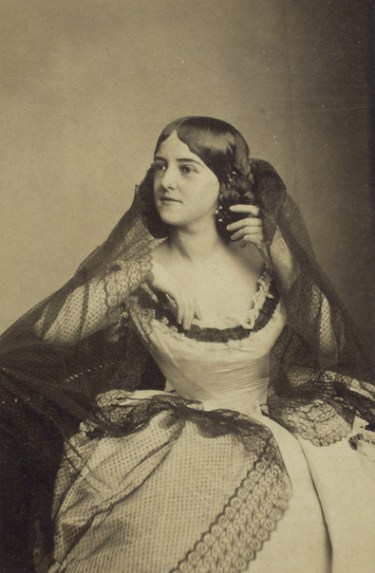
Lucy Hale

CDV of Lucy Hale that was found in John Wilkes Booth’s possession when he was killed

Though the poem is unsigned, handwriting analysis conducted by researcher James O. Hall concluded that this second poem was indeed written by Lucy Hale. Booth and Miss Hale had been acquainted since 1863, when Miss Hale witnessed the actor perform in Washington and sent him a congratulatory bouquet of flowers. The relationship between the two had flourished after Booth stopped touring and spent more time in Washington in the months leading up the assassination. Both John Wilkes Booth and the Hale family lodged at the National Hotel in Washington. This easily explains Lucy’s presence in his room on March 5th, though it would have still been against social custom. By that date they were engaged, albeit secretly. An actor, even one as famous and acclaimed as Booth, was still considered a poor match for woman of high class such as Miss Hale. Even after the assassination, when Lucy was racked with grief over the actions of her fiancée, the authorities still protected her honor by being careful not to publicly disclose their intimate involvement. She was quickly whisked away to Spain where her father had been appointed as an ambassador.

Why were these Poems Written?

The poems written by John Wilkes Booth and Lucy Hale are heartfelt lines that speak of remembrances and separation. Due to this a couple of authors have written possible explanations for them. Michael Kauffman, author of American Brutus, suggests that these lines were written by John Wilkes and Lucy as they lamented Lucy’s future departure for Spain:

“March 5, the morning after the inauguration, was bleak and cheerless for Booth and Lucy Hale. They sat in Booth’s room at the National Hotel commiserating on life’s troubles and despairing of future happiness. They might not have a life together; Lucy would soon accompany her father to Spain, where he was about to begin his duties as an ambassador. The emptiness of the moment reminded Lucy of Whittier’s “Maud Muller,” and she jotted down some lines on an envelope…Booth added a few lines of his own”

In Terry Alford’s upcoming book, Fortune’s Fool: The Life of John Wilkes Booth, he paints an even sadder picture regarding the circumstances of these poems’ creation:

“The day after the inauguration, Booth and Lucy ended their courtship. The timing suggests that his odd behavior had attracted the notice of her family. Or their parting may have been due to the fact that the Hales were leaving Washington. His term in the Senate having expired, Hale was moving his family to prepare for his new assignment as American minister to Spain.

Booth and McCullough had shared their room during the inaugural crunch with John Parker Hale Wentworth, Lucy’s first cousin. Wentworth proved a handy go-between for their courtship. Now he offered a final service.  He handed Booth an envelope from Lucy. If there was a letter inside, it is long gone. The envelope survives. On it Lucy copied the celebrated lines from John Greenleaf Whittier’s poem “Maud Muller”…Wentworth gave the envelope to Booth, who added his own sentiment just above Lucy’s…”

As much as I respect and admire these two authors, I believe them both to be mistaken in regards to the nature of these poems. The reason I don’t agree with Kauffman and Alford’s theories that the poems are mournful notes between John Wilkes Booth and Lucy Hale is due to the fact that Lucy’s father, John Parker Hale, had not yet been appointed minister of Spain when these poems were written. Senator Hale may have been petitioning for the position on March 5th, but he was not nominated for it until March 10th. In fact, the position was still very much in play on March 7th, two days after these poems were written. On that day, Secretary of the Navy Gideon Welles recalled having a cabinet meeting during which Secretary of State William Seward offered the position of Minister to Spain to anyone in the cabinet. This was intended to be a kind gesture towards Secretary of the Interior John Usher, who had lost his political base and was being forced out of Lincoln’s cabinet. No one, including Usher, responded to the offer. John Usher tendered his resignation to Lincoln on March 9th without inquiring about the ambassador position and so Seward found John Parker Hale for the job.

Senator John Parker Hale, Lucy Hale's father

Senator John Parker Hale, Lucy Hale’s father

Rather than being dejected poems of loss written by John Wilkes Booth and Lucy Hale for each other, I believe these poems are the couple’s farewell messages to Lucy’s cousin, John Parker Hale Wentworth. I believe that Kauffman and Alford are both missing one key piece of evidence regarding this relic: the contents written on the front side of the envelope.

The Front Side of the Envelope

From the 1952 Barrett auction catalog, we know that there is some writing on the front side of this envelope. For one, the envelope is franked with the name of John Conness. Franking was a practice at the time in which members of Congress, the President, cabinet members and other elected officials could send mail without the need of a stamp. The official in question would sign his name in the top right corner of an envelope and that would be as good as a stamp for the postal service. Officials pre-signed hundreds of envelopes for later use in this way. The envelope with Booth and Lucy’s poems was signed by John Conness who was a Senator from California.

The 1952 auction catalog also states that the front of the envelope has, “a three line quotation with a note” on it. While the catalog provides the note, written by John Parker Hale Wentworth, it does not give the quotation. For that we must consult a more recent auction. After being purchased in the 1952 auction for $210, the poetic envelope disappeared for many years. Assassination researcher James O. Hall tried to locate it but to no avail. Finally, in 2004, it popped up in a Sotheby’s auction. From their archived auction page, we finally learn that the full text on the envelope’s front is:

“Touched by change have all things been
Yet I think of thee as when
We had speech of lip and pen.”

Beneath this, in the same hand is the sentiment:

“The above, though quoted, are the real sentiments of your friend, who trusts that the acquaintance and friendship formed will never be forgotten by either, Jno P. M. W.”

The poem John Parker Hale Wentworth quotes from is entitled “Remembrance“. It was written by the poet John Greenleaf Whittier, the same author of Lucy’s, “Maud Miller” excerpt.

Wentworth, Booth, and Lucy

While John Parker Hale Wentworth and Lucy Hale were first cousins, they do not appear to have been particularly close growing up. There was quite an age difference between them with Wentworth having been born in Maine in 1828 and Hale in New Hampshire in 1841. In 1849, Wentworth, then 21, made his way to California to seek his fortune.  He would reside in California for the rest of his life. In about 1862 or so, Wentworth was appointed the Indian Affairs Agent of Southern California by Abraham Lincoln himself. Whether Wentworth wrote to his Senator uncle, John Parker Hale, for some assistance in gaining this position is unknown, but it’s clear that Wentworth was grateful to President Lincoln for the job. He was also apparently well suited for it with newspapers reporting that, “Mr. Wentworth has worked miraculous changes in the condition of the Indians in this district; more particularly of the degenerated, wasting tribes of this vicinity.”

With Lincoln’s re-election in 1864, Wentworth made the decision to travel from California to Washington, D.C. His motives for travelling aren’t known for sure. He may have just desired to be present at Lincoln’s second inauguration and hoped to thank the President for granting him his position. Or, perhaps he was like many other office seekers, looking to advance himself further in California’s political circle. Regardless, he arrived in D.C. and took up lodging at the National Hotel, where his uncle and cousins resided. On February 22, 1865, he checked into a room with John Wilkes Booth and another actor named John McCullough.

John Wilkes Booth Gutman 23

It was probably during this time that Wentworth had his first real opportunity to get to know his younger cousin Lucy, who was 8 years old when he left for California and was now a beautiful lady of 24. Being Booth’s roommate, Wentworth would have undoubtedly been aware of the relationship between his little cousin and the actor. The three of them likely spent time together, with Booth displaying his amazing ability to connect deeply with people.

In his free time leading up to the inauguration, it seems plausible that Wentworth would have wanted to report to his Congressmen on the condition of Indian affairs in his section of the state. This would have put him into the offices of his Senator, John Conness. This, I believe, explains Conness’ franked signature on the poetic envelope.  Perhaps Coness offered Wentworth some franked envelopes with which to send future correspondence, or maybe Wentworth decided to help himself to an envelope. Wentworth seems to be the only logical intermediary between the office of Senator John Conness and John Wilkes Booth.

Though I have not been able to track Wentworth’s movements, it appears he departed Washington right after the inauguration. In those days it was quite a long journey back to California, requiring steamboat travel to Panama, a train ride across the isthmus, and a second long steamboat journey to California. It is not unreasonable to assume that Wentworth decided to begin his journey as soon as possible. Even the very next day after the inauguration.

A Farewell Among Friends

With all of this in mind, I submit that the poetic envelope displayed above initially held John Parker Hale Wentworth’s farewell message to either his cousin, Lucy, his roommate, Booth, or to them both as a couple. In this scenario, Wentworth wrote a note, placed it in an envelope he had received from John Conness’ office, and wrote Whittier’s “Remembrance” poem on the front. He then either presented it or left the note for Lucy & Booth. Lucy opened the envelope and read the contents. She then wrote her own Whittier poem on the back of the envelope. Given its position, it appears that Booth’s response was an after thought. Since Lucy used all of the space on the back of envelope, Booth squeezed his own poem on the top flap. The envelope, but not the contents, was then given back to Wentworth as a representation of the couple’s affection.

The above is, of course, just a theory, but it is a theory that I believe logically explains how poems from John Wilkes Booth, Lucy Hale and John Parker Hale Wentworth all came to be on a single envelope franked by Senator John Conness.

References:
American Brutus by Michael Kauffman
Fortune’s Fool: The Life of John Wilkes Booth by Terry Alford
John Wilkes Booth: Day by Day by Art Loux
The Oliver R. Barrett Lincoln Collection Auction Catalog
The Web of Conspiracy by Theodore Roscoe
Sotheby’s Auctions
Right or Wrong, God Judge Me: The Writings of John Wilkes Booth edited by John Rhodehamel and Louise Taper
Ancestry.com
News Notes of California Libraries, Volume 14
“Indian Affairs in Southern California”, Daily Alta California, January 24, 1863
Mr. Lincoln’s White House: Cabinet
Diary of Gideon Welles
Special thanks to Roger Norton for providing me with Carl Sandburg’s quote in a pinch

Categories: History | Tags: , , | 35 Comments

Blog at WordPress.com.