Posts Tagged With: Graves

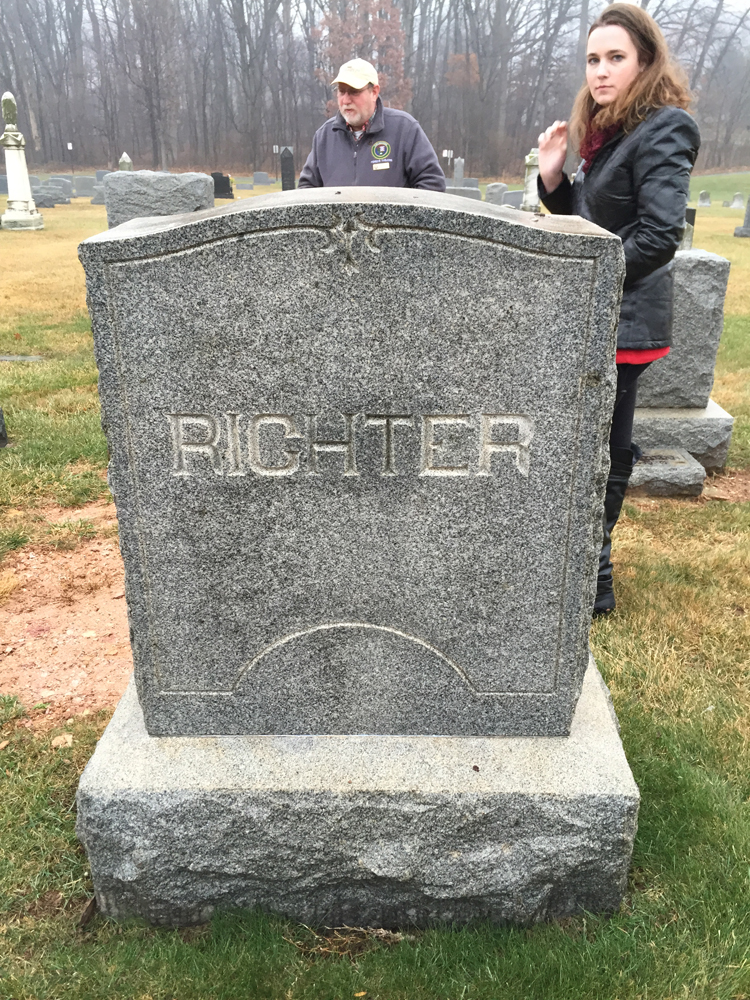
Grave Thursday: Hartman Richter

Each week I am highlighting the final resting place of someone related to the Lincoln assassination story. It may be the grave of someone whose name looms large in assassination literature, like a conspirator, or the grave of one of the many minor characters who crossed paths with history. Welcome to Grave Thursday.


Ernest Hartman Richter

hartman-richter

Burial Location: Neelsville Presbyterian Church Cemetery, Germantown, Maryland

hartman-richters-grave-1-3-2015

Hartman Richter's grave

Connection to the Lincoln assassination:

Ernest Hartman Richter, often known as just Hartman Richter in assassination literature, was the first cousin of conspirator George Atzerodt. Richter’s mother’s maiden name was Christanna Maria Atzerodt, the sister of George’s father, Johann. Like his cousin, Hartman Richter was born in Germany. In 1844, the Atzerodts and Richters immigrated to the United States  where they settled in Montgomery County, Maryland. Johann Atzerodt and his brother-in-law Frederick Richter invested in a farm in what is now Germantown, Maryland, and the families lived there together for some time. After a few years, Atzerodt sold his interest in the farm to his brother-in-law and moved his family to Westmoreland County, Virginia.

After the assassination of Lincoln, conspirator George Atzerodt escaped Washington City and headed north towards this former family home, now owned by his uncle and cousin. Atzerodt arrived at the Richter farm on April 16th and was welcomed in with open arms. George stayed about the home for several days until the early hours of April 20th, when Union soldiers came knocking at the door. It was George’s cousin, Hartman Richter who answered the soldiers knock that morning. I’ll let Sgt. Gemmill, the lead officer who arrived at the Richter home, explain what happened next:

“I went to the house of a man named Richter, I think, and asked him if there was a man there named [Atwood]. I had two men with me at the time. I understood him to say that he was his cousin but [he] had left and gone to Frederick. One of my men understood the same, but the other did not. I then told him I would search the house. He then said there was a man in the house. He commenced telling me a yarn and I was suspicious of him. I then searched the house and went up to his room. There were three men in one bed, two of them young men by the name of Nichols living in the neighborhood, who did not explain how they came there; but as my orders were to arrest Atzerodt alone, I did not arrest them [Note: the two Nichols men were the brothers of Hartman Richter’s wife]. When the door opened the two of them awoke. He [Atzerodt] did not awake or at least pretended not to till I went up to the bed. I asked him his name. He gave me a name which I though was Atwood, but I heard it indistinctly as he spoke with a German accent and I was not certain about it.”‘

Despite Sgt. Gemmill having orders to only arrest Atzerodt, Richter’s attempt to hide his cousin’s presence in the home was very suspicious and led Gemmill to return to the Richter home. “I told his cousin to get ready, as I wanted him to go with me. He said he did not want to go; that he did not know what he was arrested for. Atzerodt never asked me a question in relation to the cause of his arrest, although he was in my custody several hours.”

Hartman Richter was taken down to Washington and imprisoned aboard the USS Saugus just like his cousin. Richter also has the distinction of having his mug shot photograph taken just like the main conspirators. From time to time you’ll find people who mistake Richter’s mug shot photographs for ones of Dr. Mudd. Dr. Mudd was never placed, or photographed, on the monitors.

Richter, like the conspirators, was transferred to the Old Arsenal Penitentiary where he would be imprisoned until May 13th. By that date it had been well determined that Richter had no knowledge of his cousin’s involvement in the plot against Lincoln. He was transferred to the more “minimum security” prison, the Old Capitol Prison, where some of the other “suspicious but not evidently guilty” persons were held. On May 30th, Richter was released from jail completely.

Ernest Hartman Richter far outlived the cousin he tried to protect, dying on February 21, 1920. He is buried in the Neelsville Presbyterian Church Cemetery, in Germantown, Maryland, not too far from the site of his former home. Check out the Maps page for more details. For more images of Hartman Richter and the other “non-conspirator” who had mug shot photographs taken, visit the Fake Conspirators Gallery.

GPS coordinates for Ernest Hartman Richter’s grave: 39.1958242, -77.2431242

Categories: Grave Thursday, History | Tags: , , , | 15 Comments

Grave Thursday: General Levi Dodd

In an effort to get back to posting on a more regular schedule, I’ve decided to attempt a weekly post entitled, Grave Thursday. Each week I will highlight the final resting place of someone related to the Lincoln assassination story. It may be the grave of someone whose name looms large in assassination literature, like a conspirator, or the grave of one of the many minor characters who crossed paths with history. They won’t be lengthy posts, but they will be something to look forward to between my increasingly irregular research intensive pieces.


Bvt. Brig. Gen. Levi Axtell Dodd

Gen Levi Dodd

Burial Location: Green Mount Cemetery, Baltimore, Maryland

Levi Dodd's Grave Green Mount

Connection to the Lincoln assassination:

On May 2, 1865, Col. Levi Axtell Dodd of the 211th Pennsylvania Volunteers was assigned duty under the command of Maj. Gen. John Hartranft. At that time, General Hartranft had been assigned as the commander of the Old Arsenal Penitentiary in Washington, D.C. and was charged with the imprisonment and care of the Lincoln assassination conspirators as they underwent trial. Col. Dodd joined Hartranft’s staff and would serve under him. Dodd’s major duties were to supervise the prisoners. Reports show that he supervised George Atzerodt as the latter bathed. After the day’s trial proceedings were over, Dodd would also stay in the court room with some of the prisoners when their lawyers wished to counsel with them. Dodd also supervised visits between the conspirators and their guests, sitting in on a meeting between Mary Surratt and her friend Mr. Kirby. After the execution of four of the conspirators, Dodd, who was subsequently brevetted as a brigadier general due to the recommendation of General Hartranft, was given the task of escorting the four remaining conspirators to their distant prison of Fort Jefferson off of the coast of Florida. This task he completed, earning the appreciation of Dr. Mudd who stated that Gen. Dodd allowed the lily iron handcuffs to be removed from the conspirators during part of the voyage. Dr. Mudd’s appreciation of Gen. Dodd would not last, however. Upon returning back from Fort Jefferson, Dodd, along with two others who accompanied the conspirators, would state that on the journey to the island prison Dr. Mudd confessed that he had known the identity of John Wilkes Booth the moment the assassin showed up at his door. According to Dodd and the others, Dr. Mudd lied about not knowing Booth due to his own fear of punishment.

It is also interesting to note that Levi Dodd was born in Franklin, a small town in Venango County, Pennsylvania. In 1864, John Wilkes Booth traveled to Franklin and invested a great deal of his wealth in the oil fields nearby. Booth and some of his pals sunk quite a lot of money into a well in Franklin called the Wilhelmina, but the enterprise was a failure.

Gen. Dodd is buried in Green Mount Cemetery in Baltimore, the very same cemetery as John Wilkes Booth and many others connected to the assassination of Lincoln. Check out the Maps page for more details.

GPS coordinates for Gen. Levi Dodd’s grave: 39.306333, -76.604881

Categories: Grave Thursday, History | Tags: , , , , | 24 Comments

Emerick Hansell: The Forgotten Casualty

The following article was my very first foray into researching and writing about the Lincoln assassination story. It was originally published in the November 2010 issue of the Surratt Courier.


Emerick Hansell: The Forgotten Casualty
Fight in the Room - The Assassination and History of the Conspiracy

By Dave Taylor

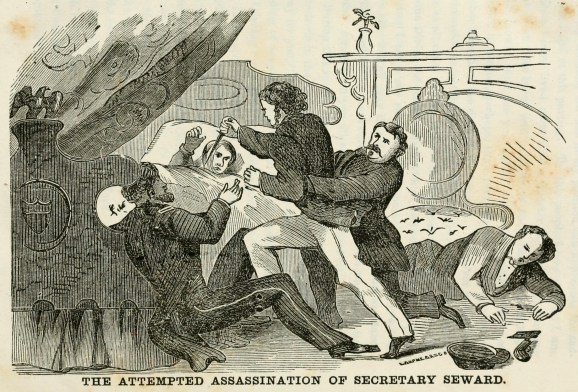
“I’m mad, I’m mad,” were the alleged words of the assassin Powell as he fled from the bloodied scene behind him.  Assigned by John Wilkes Booth to assassinate Secretary of State William Seward at his home, Lewis Powell encountered a small resistant force that hindered the battle trained Confederate from completing his task.  In his wake, Powell left a menagerie of wounds and wounded:

  • Secretary Seward’s face was slashed, opened, and forever scarred by Powell’s blade.
  • Frederick Seward, who was spared a bullet when Powell’s gun misfired, received, instead, a skull splitting slam from the butt of the insolent weapon.
  • Private George Robinson, the newly assigned male nurse to the Secretary, endured stabs and blows while wrestling with the assailant.
  • Augustus Seward joined Private Robinson in defense of his father and withstood similar swipes from Powell’s fists and knife.
  • The last victim of that night, and the subject of this article, is an oft forgotten State Department messenger named Emerick Hansell.

Even in the most detailed of assassination texts, Hansell’s involvement that night is generally summed up with a variation of the following sentence: “As Powell, raced down the stairs of the Seward home, he met State Department messenger, Emerick Hansell, and stabbed him in the back.”  With that, Emerick Hansell usually enters and leaves the pages of documented history.  However, further research into Emerick Hansell’s past and future yields further connections to his actions on April 14th, 1865.

Emerick W. Hansell was born near Philadelphia in 1817.  In 1840, he married D.C. native Elizabeth Ann Robinson and moved into the Capital.  Together they had one son, George, and two daughters, Emma and Roberta.  They also had one child who died in childbirth.  This death would be the first of many sorrows in Hansell’s life.  Hansell’s occupation prior to his government work is unknown, but by 1855 he was employed by the State Department as an “acting” messenger.  For this position he was paid $700 a year.[1]  By 1858, Hansell was a full messenger and made $900 a year, a pay rate he sustained throughout his tenure.[2]  With the onset of the Civil War, the State Department inherited ever increasing duties.  Later, Frederick Seward reflected on the department employees during wartime and stated that Hansell was a man, “of proved efficiency and integrity.”[3]  Along with his government work, Hansell was a member of the International Order of Odd Fellows, a charitable fraternity.  The Hall of Odd Fellows in D.C., a common meeting place for the Order, is also the same venue in which John H. Surratt Jr. was scheduled to appear during his post-trial lecture circuit.[4]  Hansell was also an active member in St. Paul’s English Lutheran Church, attending and teaching adult Christian classes.  By 1865, Hansell was a respected and integral employee of the State Department, ferrying messages between the department headquarters and the Secretary of State.  On the night of April 14th, Hansell’s continued “efficiency and integrity” would be tested by Powell’s blade.

In the aftermath of Lincoln’s assassination, the coincidental stabbing of a messenger at Seward’s was unimportant and almost undocumented in the conspiracy trial.  While Mr. Hansell’s name is included with the other wounded parties in the charges against Lewis Powell, his involvement in the affair is limited to the testimony of only one witness: Dr. Tullio S. Verdi.

Dr Tullio Verdi

Dr Tullio Verdi

When the call for doctors rang out following the massacre, Dr. T. S. Verdi was the first to arrive at the Seward home in Lafayette Park.  As he recounted in an article a month later, “I found terror depicted on every countenance and blood everywhere.”[5]  As the initial doctor present, Verdi began triage duty.  He first saw to the Secretary.  After announcing that the facial wound was not fatal and applying ice to stop the bleeding, he was told of Frederick’s condition.  Dr. Verdi barely finished applying ice to Frederick’s hemorrhage when he was sent to tend to Augustus’ stabs.  Initially, Dr. Verdi was shocked as the number of wounded increased only to have this shock eclipsed by growing terror.  After seeing to Private Robinson’s wounds, he was called to see Emerick Hansell.

In the conspiracy trial transcript as compiled by T. B. Peterson & Brothers, Dr. Verdi’s account of Hansell’s wound is limited to a single sentence: “I found Mr. Hansell, a messenger of the State Department, lying on a bed, wounded by a cut in the side some two and a half inches deep.”[6]

Luckily, Benjamin Perley Poore’s transcript of the trial did not condense Dr. Verdi’s account:  “I found Mr. Hansell in the south east corner, on the same floor with Mr. Seward, lying on a bed.  He said he was wounded: I undressed him, and found a stab over the sixth rib, from the spine obliquely towards the right side.  I put my fingers into the wound to see whether it had penetrated the lungs.  I found that it had not; but I could put my fingers probably two and a half inches or three inches deep.  Apparently there was no internal bleeding.  The wound seemed to be an inch wide, so that the finger could be put in very easily and moved all around.”  Dr. Verdi was then asked if the stab had the appearance of being just made to which he responded, “Yes, sir: it was bleeding then, very fresh to all appearances.  Probably it was not fifteen or twenty minutes since the stab occurred.” [7]

While at the conspiracy trial Dr. Verdi asserted that the wound was not fatal, there must have been some uncertainty at the time.  When Secretary of War Edwin Stanton arrived at the Secretary of State’s home, he found Seward, Frederick and Hansell each “weltering in their own gore.”[8]  Later, as Stanton was attending to President Lincoln’s deathwatch, he sent a dispatch to Major-General Dix stating, among other things, that, “The attendant who was present [at Seward’s] was stabbed through the lungs, and is not expected to live.”[9]  Contrary to Stanton’s dispatch, Hansell’s wound, like all those inflicted by Powell that night, proved to be non-fatal.

Dr. Verdi’s brief testimony contains the only official mentioning of Emerick Hansell in the conspiracy trial.  While beneficial, it does little to explain Hansell’s presence and whether he had just arrived or was departing the scene when he was stabbed.  Hansell, unlike Augustus Seward, Private Robinson, and doorman William Bell, was never called to testify about his experiences.  Oddly enough, these men did not mention Hansell in their testimonies at all.  This is surprising since it seems that someone had to have helped Hansell up the stairs and into the third floor bedroom where he was found by Dr. Verdi.  These omissions led one author in the 1960’s to propose that Augustus Seward perjured himself on the stand and that it was actually Hansell who helped Robinson eject the assassin from the Secretary’s room[10].  However, further research disproves this theory.

During the trial for John H. Surratt Jr. in 1867, the prosecution recalled many of the same witnesses from the initial conspiracy trial.  William Bell, Augustus Seward, and Private Robinson returned to give their accounts.  The prosecution also brought in new witnesses: Frederick Seward and his wife Anna.  Dr. Verdi was not recalled and Emerick Hansell was still absent.  Nevertheless, in this trial, it is Private Robinson who recounts Mr. Hansell’s actions that night, “On [Powell’s] way down, on the first flight, he overtook Mr. Hansell, a messenger at the State department, who had been roused by the noise that had been made, and had apparently turned to go down stairs for help.  He came within reach of him and struck him in the back.”  Robinson was then asked if Hansell said anything to which he responded, “He started to say ‘O!’ I presume, but he did not say it exactly.  He hallooed out pretty loud.  He did not utter any particular word that I heard.” [11]
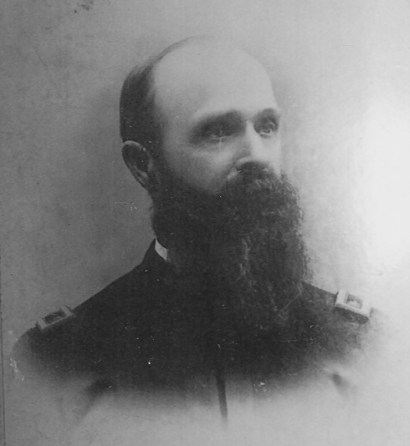
Pvt. George Foster Robinson

Pvt. George Foster Robinson

Robinson’s 1867 testimony is supported in a May of 1865 letter from Secretary Seward’s wife, Frances.  In this letter she wrote, “While [Augustus] was stepping into his room for a pistol, the man made his escape down the stairs, on his way wounding Mr. Hansell, a messenger from the department, who came out of a lower room and was going to the street door to give the alarm.”[12]

From the above witnesses, we can conclude that Hansell had taken up residence in the Seward home the night of the 14th and was awakened by the commotion upstairs.  As he left his room to either flee or raise the alarm, Powell overtook him and stabbed him callously in the back.  It was a long and deep cut that barely missed penetrating his lungs.  Then, someone in or around the Seward house helped the wounded Hansell up the stairs and into a third floor bedroom.

The bedroom he was placed in was Fanny Seward’s, the Secretary’s treasured daughter.  In her diary Fanny wrote, “I went across the hall into my own room.  I was there twice.  The first time they were dressing poor Hansell’s back (he was stabbed in the back) the second time he lay on the bed.  Eliza the seamstress was there to attend to him.”[13]

Lastly, Dr. Verdi, in an article published in May of 1865, gave the same basic story as the others with a slight change in where Hansell was sleeping and with an assumption about Emerick Hansell’s character.  All emphases are Dr. Verdi’s: “Mr. Ansel (sic), the fifth person who was wounded, is a messenger in the State Department, and was sleeping that night over the Secretary’s room, waiting for his turn of watching.  Hearing the fearful screams of Miss Fanny, he (a very weak-kneed gentleman) was making his way out of the house as fast as possible, when, after having descended a flight of stairs, he met the murderer, also on the landing.  Mr. Ansel, however, endeavored to run faster; but the assassin, fearing he might give the alarm, gave him a memento of his brutality by plunging the dagger in his back.”[14]

Dr. Verdi’s description of Hansell as a “weak-kneed” gentleman may explain why Hansell was never called to testify and is barely mentioned in the trial testimonies.  In contrast to the brave Private Robinson who fought off the assassin, Hansell was running away when he was stabbed.  His assumed cowardice made it so very little was said about his role that night.  When the media did report on him and his recovery, the matter in which he received his wound was generally left out, as this excerpt from the April 18th New York Times will show: “Mr. Hansell, the Messenger of the State Department who was stabbed in the back at the same time, is a great sufferer, but believed to be out of danger.”[15]

Emerick Hansell would be in pain for the rest of his life.  Following some time to convalesce, Hansell managed to return to his duties as a messenger and faithfully continued to carry them out.  Records show that he was still a messenger of the State Department in 1869.[16]  In 1870, however, tragedy stuck Emerick Hansell again.  On October 8th, 1870, Emerick Hansell’s wife of thirty years, Elizabeth, died of tuberculosis.[17]  The loss of his wife, along with the ever growing pain from his wound caused Emerick to retire from the State Department at the age of 56.

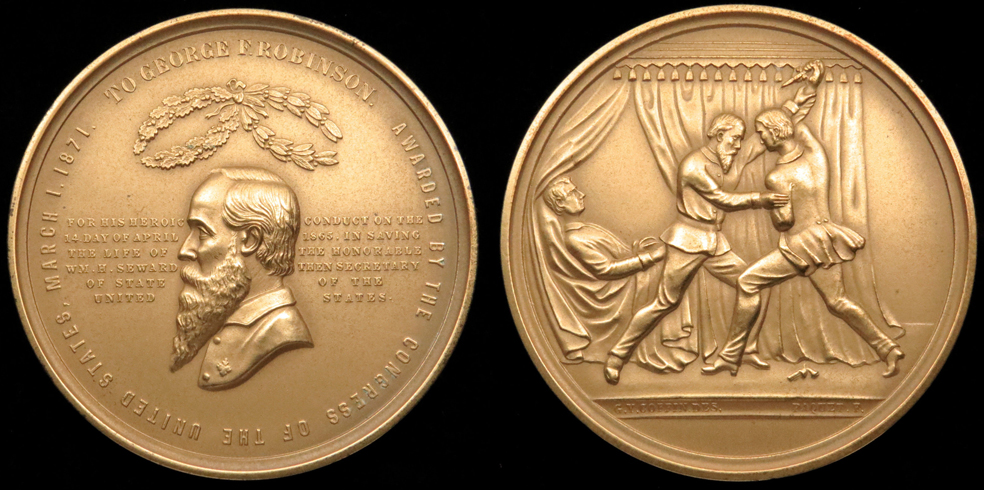
Nothing is known about Emerick Hansell’s life for the next three years following his wife’s death.  Some time during that period however, he must have been introduced to Mary E. Cross, a widow.  Though twenty years his younger, the two courted and on June 4th, 1873, Emerick and Mary were married.  Also during this period, a congressional action honoring Private Robinson for his bravery occurred.  In 1871, for saving the life of Secretary Seward, Private Robinson was presented a Congressional Gold Medal and awarded the sum of $5,000.
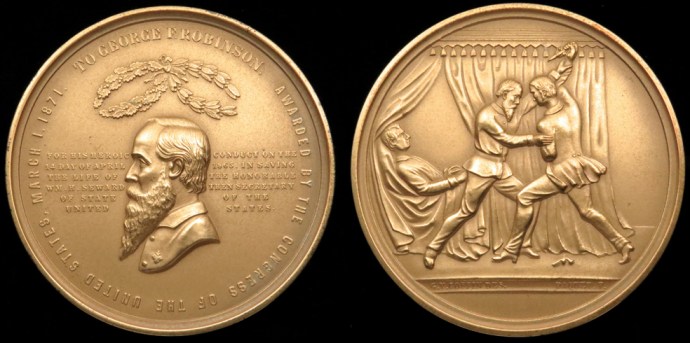
The congressional medal awarded to Pvt. George Foster Robinson for protecting Secretary William Seward.

The Congressional medal awarded to Pvt. George Foster Robinson for protecting Secretary William Seward.

By 1874, Hansell had been in constant pain for almost ten years.  He elicited the help of Dr. Verdi and his own physician, Dr. Sonnenschmidt, to write letters on his behalf explaining the nature of his wound and its impact on his physical being.  Dr. Verdi wrote back confirming that, “The wound is at present in such a condition as will preclude ever after his engaging in any active work for any length of time.”[18]  Hansell’s reasoning for such confirmations of his condition?  He was appealing the Congress to grant him a federal pension for his sustained wounds.

By 1876, the House of Representatives Committee of Claims had reviewed Hansell’s petition for a pension.  Previous to this petition, federal pensions were limited to those who served the government in times of war in the Army or Navy.  Except for the recent federal judiciary pension list, no civilians were granted pensions.  Nevertheless, the Committee of Claims granted Mr. Hansell’s request.  They justified their decision thusly:

“Mr. Hansell is now advanced in years, infirm, and disabled, as stated. In the opinion of the committee he is entitled to the just and generous consideration of the Government, and the most appropriate form of relief is that adopted toward those who have honorably served the country in the common defense and been disabled in its service. They therefore recommend that the name of the petitioner be placed upon the pension roll at the rate of $8 per month, to date from the 14th day of April, 1865, and submit a bill to that effect, with the recommendation that it pass.”[19]

While Hansell did not serve in the Army or Navy, the committee construed his actions on the 14th as being in defense of Secretary Seward, and therefore in defense of the country.  His petition was transformed into “A bill (H. R. 3184) granting a pension to Emerick W. Hansell”.  Upon reaching the House of Representatives, the bill was passed, and he was put on the pension roll.

Emerick Hansell's signature

Emerick Hansell’s signature

Then the bill was looked at by the Senate’s Committee on Pensions who were concerned about the precedent this bill would set.  They challenged the House’s Committee of Claim’s justification for giving the civilian Hansell a pension.  However, they did not disagree with granting him some money for his pain and suffering.  The Senate, therefore, proposed, in lieu of a pension, the following amendment:

“That the Secretary of the Treasury be, and hereby is, authorized and directed to pay to Emerick W. Hansell, of the city of Washington, in the District of Columbia, out of any money in the Treasury not otherwise appropriated, the sum of $2,000, on account of injuries received by said Hansell while in attendance upon the late William H. Seward, former Secretary of State, on the occasion of the attempted assassination of said Seward”[20]

This amendment was approved.  A small debate then occurred when Senator Henry Anthony of Rhode Island proposed an amendment that would increase the amount from $2,000 to $5,000.  Senator Anthony supported his amendment thusly:

“I should like very much to have the amount in the bill increased to $5,000. I think it is a great shame that this Government did not pay the expenses of the sickness, slow recovery, and surgical treatment of the illustrious Secretary of State and all others who were injured in that attempt at assassination which sent a thrill of horror throughout every part of the country, the South as well as the North. I should very much like, if it will not interfere with the bill and if my friend from Iowa will accept it, to amend it so as to give him $5,000, which I think is a very small compensation for the injuries which this faithful man suffered and which have disabled him for the whole of his future life.”

Many of the Senators asked for more information about Hansell, his injury, and his age.  Unfortunately, their only source of information was the report from the Committee of Claims based on Hansell’s petition which, assumedly, was less than specific.  One Senator, John Ingalls of Kansas, expressed his disagreement to the proposed increase fairly eloquently:

“I am aware that it is a very ungracious thing and a very difficult thing to attempt to argue against a sentiment, to resist an appeal that is made upon the ground of sympathy.  So far as Mr. Hansell is concerned, of course no Senator here desires to say that he shall not be remunerated; but it seems to me that we ought not to give any more than he has asked; inasmuch as he himself has asked for but $8 a month, I can conceive that no good will be obtained by doubling the sum…”[21]

In the end, Senator Anthony withdrew his amendment.  The new bill, granting Hansell $2,000 was renamed “A bill (H.R. 3184) for the relief of Emerick Hansell” and passed the Senate.  It was then sent back to the House for concurrence, where Representative William Holman of Indiana recited his approval of the amendment thusly:

“I want to say a single word. I do not object to this, but I think the amendments made by the Senate are very wise and prudent amendments. Although this is an entire gratuity, it is one of those gratuities, perhaps, which are proper for the Government to give…”[22]

The House concurred with the amendments of the bill and it was signed by the Presidents pro tempore of both the House and Senate.  President Ulysses S. Grant approved and signed the finished act on August 15th, 1876.  Emerick Hansell was given $2,000 for the wound he received on the night of April 14th, 1865.

While many of the Senators spoke of Emerick Hansell’s advanced age, he was only 59 when his petition was granted.  Though indeed infirmed, Emerick Hansell would live for seventeen more years after receiving his relief money.  His actions during this time are unknown except that he continued to be active in both the International Order of Odd Fellows and in St. Paul’s English Lutheran Church.

At six o’clock in the morning on February 14th, 1893, Emerick Hansell died at the age of 75.[23]  His death certificate lists “loco-motor ataxia” as his cause of death.  In addition, he had experienced partial paralysis for several years as a result of his wound.  In his will, Emerick left one dollar to each of his children and fifty dollars to St. Paul’s English Lutheran Church.  The rest of his estate was left to his wife, Mary.[24]  His funeral was enacted under the charge of the Odd Fellows.

Emerick Hansell’s final resting place is in D.C.’s Congressional Cemetery.  There, he is buried next to his first wife, Elizabeth, who preceded him in death twenty-three years earlier.  His gravestone bears the following epitaph:

HansellGrave

“Emerick W. Hansell

1817-1893

Wounded with Hon. Wm. H. Seward, Sec. of State

By the Assassin Payne, April 14, 1865.

Erected by his Grandson Marvin Emerick Eldridge”

While Emerick Hansell’s actions on April 14th, 1865 could be debated as either cowardly or valiant, the wound he sustained; the one that infirmed him for the remainder of his life, should be looked upon with sympathy.  His wound personified the savagery of the assassin Powell who deviated from his sole target of Secretary Seward, to attack and maim four others.  For twenty-eight years after his death, Emerick Hansell continued to feel Lewis Powell’s brutality in every breath and movement of his body.  When the assassination slowly faded from public memory, people like Secretary Seward, Frederick Seward, Augustus Seward, Private Robinson and Emerick Hansell bore the scar it forever.  It is due to this suffering and this constant reminder of our dark history, that Emerick Hansell was granted $2,000 from a repentant and forgetful government.

Sources:

[1] U.S. Department of State. (1855). Register of officers and agents, civil, military, and naval, in the service of the United States, on the thirtieth September, 1855. Washington City, DC: A. O. P. Nicholson. (pg. 2).

[2] U.S. House of Representatives. (1858). Reports of committees of the House of Representatives, made during the first session of the thirty-fifth Congress. Washington City, DC: James B. Steedman. (pg. 22).

[3] Seward, F. W. (1891). Seward at Washington as Senator and Secretary of State. (Vol. 1). New York, NY: Derby and Miller. (pg. 633).

[4] Swanson, J. L. (2006). Manhunt: The twelve day chase for Lincoln’s killer. New York, NY: HarperCollins. (pg. 376).

[5] Verdi, T. S. (1865). Interesting correspondence – full particulars of the attempted assassination of the Hon. Secretary Seward, his family and attendants. The Western Homoeopathic Observer, 2(7), 81.

[6] Peterson, T. B. (Ed.), (1865). The trial of the assassins and conspirators at Washington City, D.C., May and June, 1865, for the murder of President Abraham Lincoln. Philadelphia, PA: T. B. Peterson & Brothers. (pg. 82).

[7] Poore, B. P. (Ed.), (1865). The conspiracy trial for the murder of the president, and the attempt to overthrow the government by the assassination of its principal officers. (Vol. 2). Boston, MA: J. E. Tilton and Company. (pgs. 100-101).

[8] Storey, M. (1930, April). Dickens, Stanton, Sumner, and Storey. The Atlantic Monthly, 145, 463-465.

[9] Kauffman, M. W. (2004). American Brutus: John Wilkes Booth and the Lincoln conspiracies. New York, NY: Random House. (pg. 62).

[10] Shelton, V. (1965). Mask for treason: The Lincoln murder trial. Harrisburg, PA: Stackpole Books. (pgs. 126-129).

[11] (1867) Trial of John H. Surratt in criminal court for the District of Columbia. (Vol. 1). Washington City, DC: Government Printing Office. (pg. 263).

[12] Seward, F. W. (1891). Seward at Washington as Senator and Secretary of State. (Vol. 2). New York, NY: Derby and Miller. (pg. 279).

[13] Johnson, P. C. (1963). Sensitivity and Civil War: The Selected Diaries and Papers, 1858-1866, of Frances Adeline (Fanny) Seward. Retrieved from http://www.lib.rochester.edu/index.cfm?page=1420&Print=436

[14] Verdi, Interesting, pg. 85.

[15] (1865, April 18). The assassination… The New York Times.  Retrieved from http://www.nytimes.com/1865/04/18/news/assassination-condition-secretary-seward-improving-new-facts-about-murderers.html

[16] U.S. Department of State. (1869). Register of officers and agents, civil, military, and naval, in the service of the United States, on the thirtieth September, 1869. Washington City, DC: Government Printing Office. (pg. 2).

[17] (1870, October 9). Obituary – Hansell. The Philadelphia Ledger.  Retrieved from http://www.congressionalcemetery.org/hansell-elizabeth

[18] House of Representatives. (1876). Index to reports of committees of the House of Representatives for the first session of the forty-fourth Congress, 1875-’76. (Vol. 2). Washington City, DC: Government Printing Office. (pg. 141).

[19] Ibid, pg. 142.

[20] U.S. Congress. (1876). Congressional record containing the proceedings and debates of the forty-fourth Congress, first session; also special session of the Senate. (Vol. 4). Washington City, DC: Government Printing Office. (pgs. 5059, 5060, 5080, 5659, 5663, 5683, 5689, 5698).

[21] Ibid, pg. 5059.

[22] Ibid, pg. 5683.

[23] (1893, February 14). Death of Emerick Hansell. The Evening Star.  Retrieved from http://www.congressionalcemetery.org/sites/default/files/Obits_Hansell.pdf

*Note* This article, along with his death certificate, lists Hansell’s age as 74.  However, basic math shows that Hansell, born sometime in 1817, would have to have been at least 75 when he died in February of 1893.  If he was born in January or early February, he would have been 76 at the time of his death.

[24] Copies of Emerick Hansell’s last will and testament along with his death certificate were courteously provided by David Vancil of the Neff-Guttridge Collection at Indiana State University.  The collection also contains a possible photograph of Mr. Hansell, though its provenance is disputed.

Categories: Uncategorized | Tags: , , , , | 1 Comment

Take an Assassination Vacation!

With summer in full swing, now is the time to get out there and take a vacation. Whether it be a lengthy week long trip to a city or shore far distant, or a day’s drive to a “not so nearby” locale, there’s nothing like the thrill of going somewhere new. For the historically minded, vacations often involve adventures such as visiting a museum, rediscovering a National Park, or just taking a selfie with a historical marker off the highway. No matter what form they may take, vacations allow us to make our own marks and memories in places outside our everyday lives.

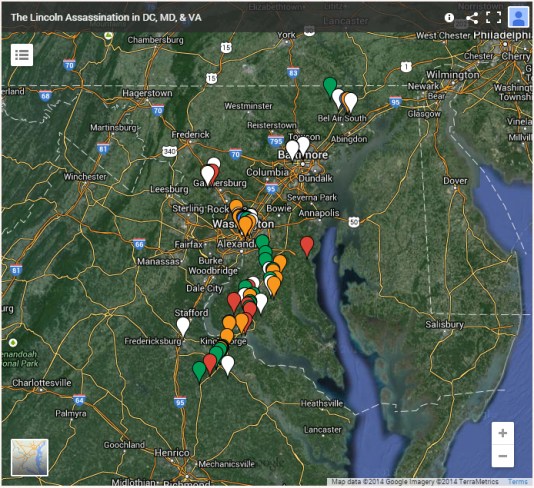
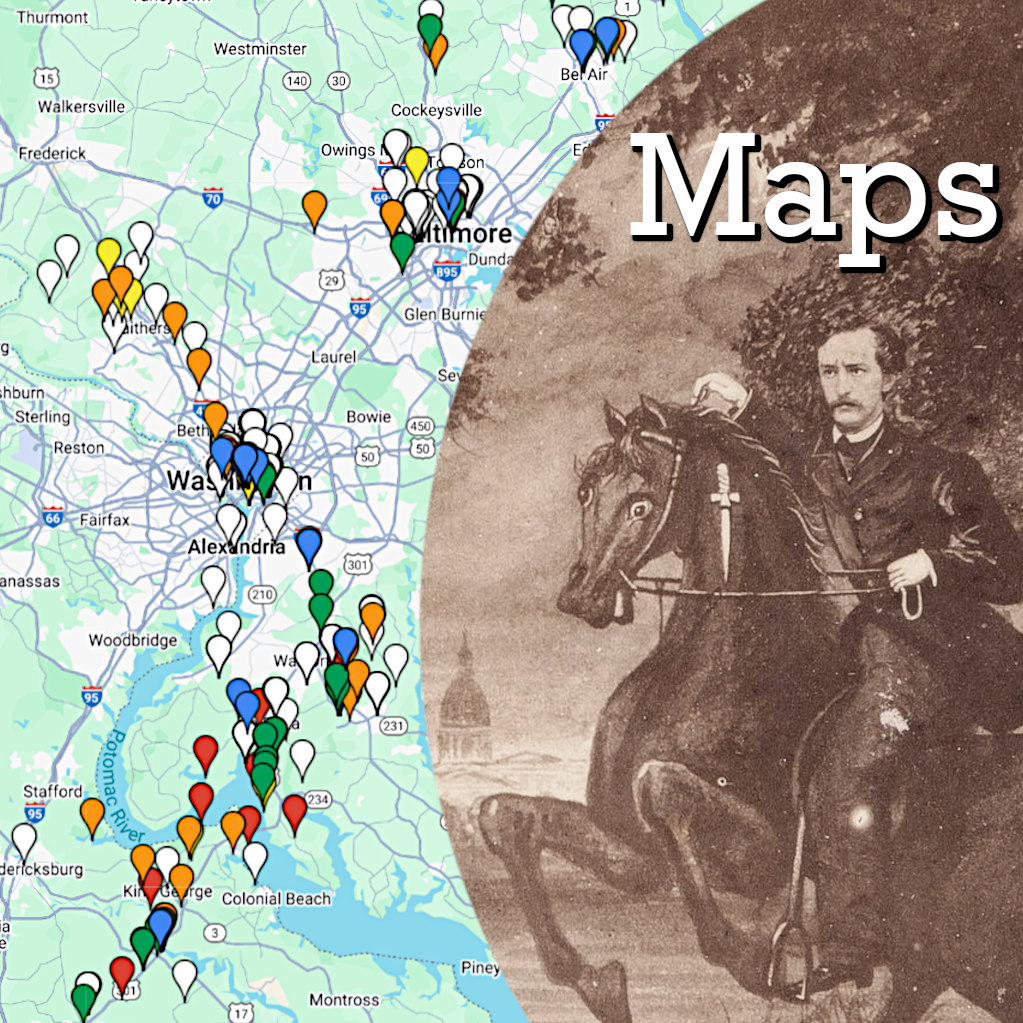
I’ve long said that the story of Lincoln’s assassination is told all over this nation. I cannot tell you how many times I’ve been in the middle of nowhere when suddenly I find a reference to the assassination staring me right in the face. The impact of Lincoln’s death and the manhunt for John Wilkes Booth reached around the globe. Over the last week, I have been working diligently to update the Maps section of this website in order to demonstrate how far reaching it truly is. The result has been the creation of five new maps, four which cover the entirety of the United States and a fifth map representing the rest of the world. All of these maps provide the locations, a brief description and the exact GPS coordinates of different sites related in some way to the assassination of Abraham Lincoln and his assassin, John Wilkes Booth.

Lincoln Assassination Maps

The maps are still in the beginning stages. The 225 locations currently marked are little more than a drop in the bucket of the potential sites worldwide. Everyday, however, new sites pop into my head and I diligently research to determine their exact GPS coordinates. I’ve analyzed Civil War era maps to determine their modern counterparts, struggled with foreign languages in order to find international sites, and I have even spent hours staring at aerial pictures of cemeteries trying to determine the exact locations of specific graves. It is very slow work, but by pinpointing these sites with GPS coordinates, we can ensure that they will never be lost. The buildings and terrain around them may change but, with GPS, where they once stood can always be found.

With this in mind, I encourage you all to check out the newly updated Maps section of BoothieBarn. See if there’s something “not so nearby” that you might want to drive and see. Better yet, if you are already planning a trip somewhere, take a look and see if you’ll be passing by something assassination related. I mean what kid wouldn’t love to make a detour on their way to Disney World in order to visit a cemetery in Geneva, Florida? “Forget Cinderella’s Castle, Mommy. What I really want to see is the grave of Lewis Powell’s skull!”

So check out the Maps section here on BoothieBarn by clicking the image above. Then get out there and have yourself an assassination vacation!

Categories: Uncategorized | Tags: , , , , , | 9 Comments

Assassination Maps Update

DC, MD, VA Assassination map thumb

I just wanted to publish a quick post highlighting a big update to the Maps section of BoothieBarn.  First, I have added about 30 more sites to the D.C., Maryland, and Northern Virginia map, bringing the total up to over 120 sites on this map alone.  Maps for other regions of the U.S. are planned, but, since most of the action occurred in the Maryland area, I have been focusing on adding to and improving that map first.  To that end, I have gone through and added a new aspect to the map which should make it even easier to locate and visit these sites, especially “on the go”.

We know, from studying an event that occurred 150 years ago, that landscapes have changed.  In many instances, places that were once isolated farms and open land are now housing developments or busy highways.  Old roads are lost to new roads and bypasses.  Due to this, it is important to mark historic sites with something more long term than a street address, which could change (or disappear) in a few short years.  Recording latitude and longitude coordinates based on the Global Positioning System (GPS) is, therefore, the best way to mark sites on an ever changing landscape.  Regardless of what transformation occurs on the site itself, the GPS coordinates will always mark what was once there.

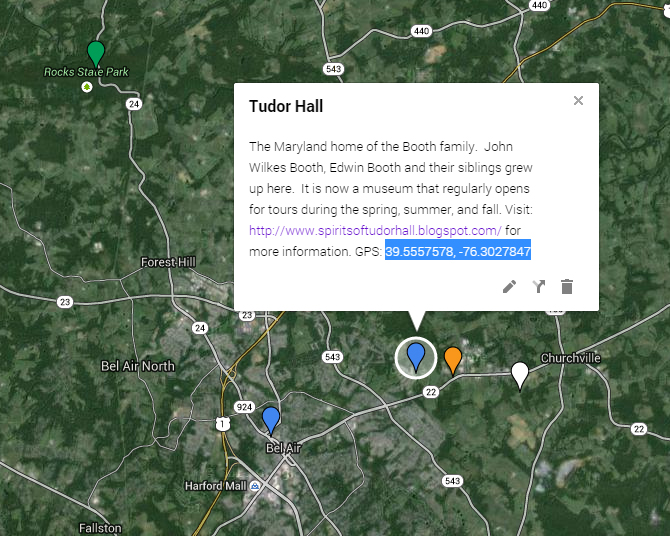
With this in mind, I have gone through and added the GPS coordinates for every site marked on my map.  This is not only for posterity’s sake, but also serves to improve the functionality of the map itself.  Practically every “smart” cell phone built today has the capability of providing driving directions.  Now, with the GPS coordinates included in the description for every Lincoln assassination site, all you have to do is click the place you want to visit on my map, copy the GPS coordinates, and direct your phone or GPS device to give you directions there.

Assassination maps GPS coordinates example

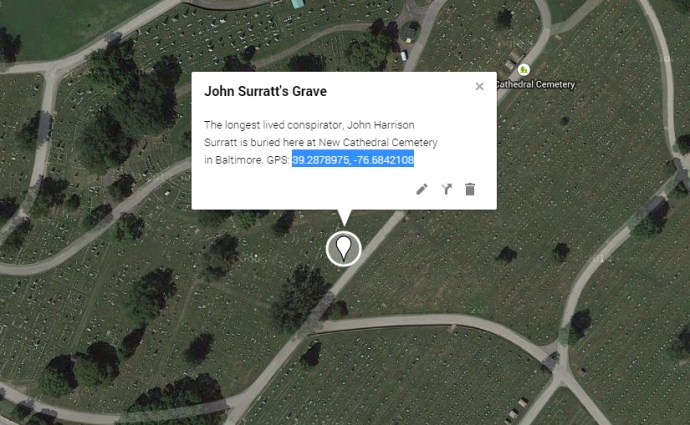
For places like cemeteries, the GPS coordinates are even more helpful, as they direct you almost exactly to the grave you are looking for.  No more wandering around a huge cemetery hopelessly looking for that one grave.  My coordinates will put you right at it.  As I visit more graves in more cemeteries (using a wonderful book by Jim Garrett and Rich Smyth as my guide), I’ll be updating the map with even more grave GPSes.

Grave coordinates example

Me Surratt Grave Jan 2015

So, if you’re planning a trip to the area or, better yet, planning to drive John Wilkes Booth’s escape route on your own, be sure to check out my D.C., Maryland, and Northern Virginia Lincoln assassination map for all the GPS coordinates you’ll need.

Click here to view the updated Maps section of BoothieBarn, now with GPS coordinates!

Categories: Uncategorized | Tags: , , , , | 5 Comments

The Burial of a Confederate Veteran

On November 12th, 1994, 20 years ago today, the remains of a Civil War veteran were laid to rest in Geneva Cemetery in Geneva, Florida.

Geneva Cemetery 1994 Ownsbey

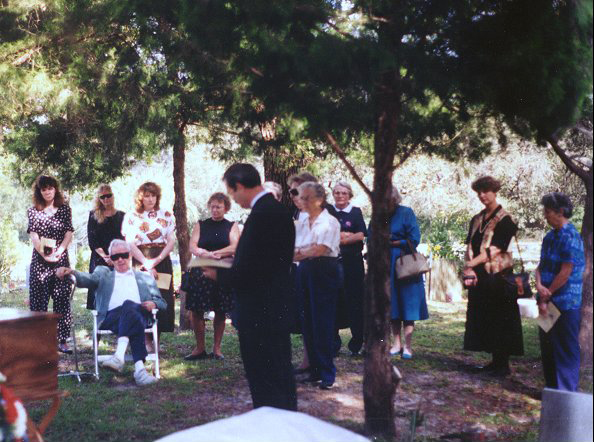
As was to be expected at the burial of a man who had died 129 years before, the number of attendees were few.  He had no direct descendants to speak of. Those present were comprised mainly of collateral relatives (great grand nieces and nephews), a Baptist minister, a newspaper reporter, members of the local chapter of Sons of Confederate Veterans, and two historians.

Reverend Parmenter Preaching Lew's Funeral 1994 Ownsbey

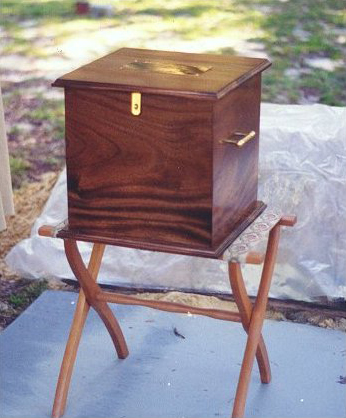
The casket had been custom made for the occasion.  The wood was a beautiful mahogany and the interior was lined with red velvet.  A bronze plate affixed to the top of the casket was engraved with the service record of the deceased: “2nd Florida Infantry, Co. I – Hamilton Blues” and the”43rd Battalion Virginia Cavalry – Mosby’s Rangers”.

Powell's casket 1994 Ownsbey

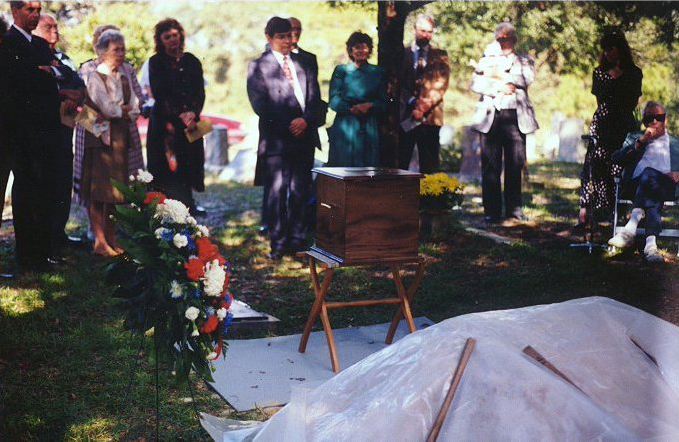
The service was brief, but fitting.  Remarks were made by the deceased’s elderly grand niece about the family’s memory of her great uncle.  A historian spoke candidly and compassionately about the man’s life, service, and death.  The invited Baptist preacher, whose church had been founded by the veteran’s father, spoke about the trials of the Civil War.  “Had I lived when he did,” the minister said, “I probably would have done the same thing. War is war, and I believe he did what he did believing he was right.” To conclude the service, a local SCV chaplain recited a prayer. The casket was lowered delicately into the ground in a  grave adjacent to that of his mother, reuniting mother and son for the first time since the man’s death so many years ago.

Lowering Powell into the ground Kauffman 1994 Ownsbey

The burial of this forgotten soldier occurred on the day after Veterans Day.  This coincidence is quite fitting considering that, to most, this man’s service as a veteran will forever be forgotten due to the actions he took that ultimately led to his death.

For you see, it was no ordinary Confederate veteran that was laid to rest this day 20 years ago in Florida.  Rather, the casket that was buried contained the skull of Lewis Thornton Powell, the attempted assassin of Secretary of State William Seward.

Lewis Powell

Lewis Powell's Skull Ownsbey

As has been previously written, the skull of Lewis Powell was removed from his body by a D.C. undertaker.  It was donated to the Army Medical Museum who later turned it over to the Smithsonian along with many Native American remains.  The skull was rediscovered in 1993 when the collection was being documented in order to return the Native American remains to their respective tribes.  Assassination authors Betty Ownsbey (Lewis Powell’s biographer) and Michael Kauffman helped to identify the skull.  With the help of these two researchers, the skull was turned over to descendants of the Powell family and the interment service was arranged.  The following are some more pictures of the reburial of Lewis Powell next to his mother at Geneva Cemetery all courtesy of Betty Ownsbey:

Powell's Funeral Service 1994 Ownsbey

Powell's funeral 1994 Ownsbey

Powell's funeral Kauffman and Ownsbey 1994References:
Betty Ownsbey, whose knowledge of Lewis Powell and generosity are both unsurpassed
Read more about Powell here: http://www.lewisthorntonpowell.com/
Lincoln Conspirator’s Remains Buried In Seminole County by Jim Robison

Categories: Uncategorized | Tags: , | 9 Comments

Graves of the Conspirators

Over the last week, I had the opportunity to visit and photograph many of the graves of the Lincoln assassination conspirators. Here are some black and white stills of their final resting places.


Mary Surratt, Lewis Powell, David Herold, George Atzerodt

Location: Old Arsenal Penitentiary, Washington, D.C.
Period of interment: 1865 – 1867
Pine Boxes B&W

Site of the burial of the executed conspirators

Immediately following their execution, the four conspirators were buried in pine boxes next to the gallows.  In 1867, their bodies, along with the body of John Wilkes Booth, were reburied in a warehouse on the grounds of the Arsenal.  In 1869, President Johnson released the remains to their respective families.  Today, the site of the conspirators’ execution and initial burial location are part of the tennis courts at Fort Lesley McNair in D.C.


John Wilkes Booth

Location: Green Mount Cemetery, Baltimore, MD.
Period of interment: 1869 – Present
Booth B&W Grave

After Booth’s body was returned to Washington and an autopsy was preformed, he was initially buried in a gun box beneath the floor of a storage room at the Arsenal. In 1867, he was moved and his remains were placed with those of the other conspirators in a warehouse on the Arsenal grounds. President Johnson released Booth’s body in 1869. Edwin Booth purchased a family lot at Green Mount Cemetery in Baltimore and had his grandfather, father, three infant siblings, and brother John Wilkes buried together in the plot. John Wilkes Booth is unmarked in the plot.


David Herold

Location: Congressional Cemetery, Washington, D.C.
Period of interment: 1869 – Present
Herold B&W Grave

The Herold family had owned a burial plot at Congressional Cemetery since 1834. Davy was the seventh person to be buried there when his body was released in 1869. While Davy is unmarked, his sister Elizabeth Jane was later buried right on top of him. Her stone is the farthest right in the plot.


Mary Surratt

Location: Mount Olivet Cemetery, Washington, D.C.
Period of interment: 1869 – Present
Mary B&W Grave

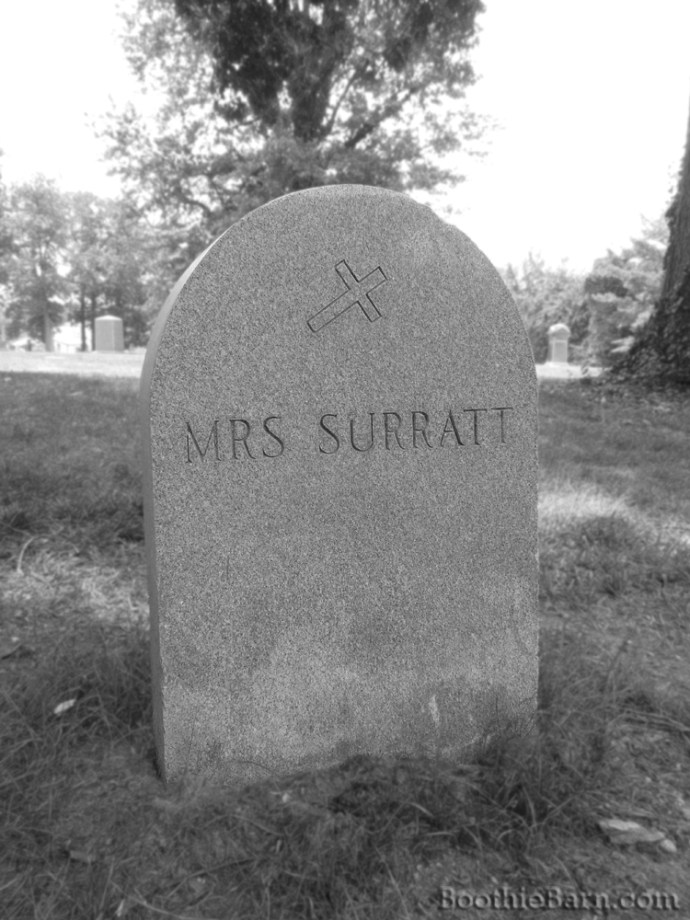
This basic stone bearing only “Mrs. Surratt”, is a replacement for an earlier stone that bore the same text. It is all that marks the plot of Mary Surratt, her children Isaac and Anna, her son-in-law, and some of her grandchildren.


Lewis Powell (body)

Location: Rock Creek Cemetery, Washington, D.C.
Period of interment: 1884 – Present
Grave of Lewis Powell's body Rock Creek Section K, Lot 23

While Lewis Powell’s skull is buried with his mother in Florida, the rest of his body is likely at D.C.’s Rock Creek Cemetery in a mass unmarked grave in Section K, lot 23. A portion of that section is pictured above. Eerily, one of the headstones in that section is marked “Lewis”. For more about the travels of Lewis Powell’s remains, read the middle section of this post.


George Atzerodt

Last confirmed location: Glenwood Cemetery, Washington, D.C.
Period of interment: 1869 – ?
Public Vault Glenwood Cemetery ExteriorPublic Vault Glenwood Cemetery Interior

The location of George Atzerodt’s remains are still a bit of a mystery. It is known that they were placed in the public vault of Glenwood Cemetery (pictured above) after being disinterred from the Arsenal. It was erroneous believed that he was then buried in a family plot at St. Paul’s Cemetery in Baltimore. Research facilitated by this website has proven this to be false. It is possible that Atzerodt is buried somewhere at Glenwood but the interment book for that period of time was stolen in the late 1800’s. More research is needed.


Dr. Samuel A. Mudd

Location: St. Mary’s Catholic Church Cemetery, Bryantown, MD
Period of interment: 1883 – Present
Mudd B&W Grave

After Dr. Mudd died in 1883, a tall monument with a stone cross on the top was placed on his grave at St. Mary’s Church. Around 1940, some of Dr. Mudd’s descendants decided to replace the weathered stone. The new stone (pictured above) contained Mrs. Mudd’s birth and death dates as well as the doctor’s.


John Surratt

Location: New Cathedral Cemetery, Baltimore, MD
Period of interment: 1916 – Present
Surratt B&W Grave

The longest lived of all the conspirators, John Surratt and his family are buried under this plain cross stone bearing only the family name in Baltimore’s New Cathedral Cemetery.


Samuel Arnold

Location: Green Mount Cemetery, Baltimore, MD
Period of interment: 1906 – Present
Arnold B&W Grave

Samuel Bland Arnold, one of John Wilkes Booth’s schoolboy friends, was involved in the abduction plot but was not in D.C. when the assassination occurred. Sam was the last member of his family to be buried in the plot upon his death in 1906.


Michael O’Laughlen

Location: Green Mount Cemetery, Baltimore, MD
Period of interment: 1870 – Present
O'Laughlen B&W Grave

Another childhood friend of Booth’s who was involved in the initial abduction plot, Michael O’Laughlen was sentenced to life in prison at Fort Jefferson, Dry Tortugas. He died from yellow fever while in jail despite the attentive care he received from his fellow prisoner, Dr. Mudd. He was initially buried on an island adjacent to Fort Jefferson. After his fellow conspirators had been pardoned, O’Laughlen’s body was transported from Florida to Balitmore. He was interred in the family plot on December 14th, 1870.


Edman Spangler

Location: Old St. Peter’s Church Cemetery, Waldorf, MD
Period of interment: 1875 – Present
Spangler B&W Grave

After his release from Fort Jefferson, Edman Spangler returned to working at John Ford’s different theatres. Eventually he made he way to Charles County Maryland and reunited with Dr. Mudd. Spangler lived on Dr. Mudd’s property doing carpentry work and farming until his death there in 1875. His grave was marked in the 1980’s by the Surratt and Mudd Societies.

References:
The Lincoln Assassination: Where Are They Now?: A Guide to the Burial Places of Individuals Connected to the Lincoln Assassination in Washington, DC by Jim Garrett and Rich Smyth
Betty Ownsbey

Categories: Uncategorized | Tags: , , , , , , , , , , , | 7 Comments

St. Clement’s Island and the Forgotten Tragedy on the Potomac

A half mile from Colton’s Point, Maryland, located in the Potomac River, lies St. Clement’s Island.

St Clements island

St. Clement’s Island is the site of the first landing of European settlers in Maryland.  The landing occurred on March 25, 1634, when the 150 or so colonists aboard the ships The Ark and The Dove made landfall here having departed England four months earlier.  St. Clement’s is, essentially, Maryland’s birthplace and the anniversary of the landing, March 25, is a state holiday known as Maryland Day.

In a few days, most of the colonists would move off of St. Clement’s Island, after having negotiated with the Yaocomico Native American tribe to create a permanent settlement on the mainland.  That settlement would become St. Mary’s City, the first capital of Maryland.

During the Revolutionary War and the War of 1812, the British captured St. Clement’s Island using it as a base for their operations.  It was known then as Blackistone Island.  The Blackistone family had inherited the island in 1669 and continued to own it until 1831. In 1848, the U.S. Congress appropriated $3,500 to build a lighthouse on the island, which was finally completed in 1851.

Blackistone lighthouse 1928 Coast Guard

The Blackistone Island Light in 1928

During the Civil War, the lighthouse became a target for the Confederacy. On the night of May 19, 1864, Confederate Captain John W. Goldsmith and his men landed on the island. It was Goldsmith’s intention to dynamite the lighthouse. The keeper of the lighthouse, Jerome McWilliams, begged the Captain not to destroy the building as his wife was pregnant and her life would be in danger if they had to go back to the mainland before the baby came. Goldsmith was a St. Mary’s county native who had crossed the Potomac to fight for the Confederacy and he knew McWilliams. In sympathy to McWilliams’ circumstances, instead of destroying the building Goldsmith destroyed the lighthouse’s lens and lamp, and took all of the oil. Union troops eventually were able to repair the light and stationed a unit of guardsmen on the island.

The aborted destruction of the lighthouse on St. Clement’s was not the only Civil War era event to happen near the island.  A largely forgotten naval incident also occurred there during the night of April 23 and 24, 1865.  This tragedy has a connection to the assassination of Abraham Lincoln and the search for his assassin.

The incident involves two steamer ships, the USS Massachusetts and the Black Diamond.  The Massachusetts was a steam ship built in Boston in 1860.  She was purchased by the U.S. Navy in May of 1861 and became the USS Massachusetts.  During the Civil War, the Massachusetts was involved in enforcing the blockade of Confederacy and later worked as a supply carrier between the Northern ports and the other blockading forces.

An engraving from Harper's Weekly showing the naval forces at Ship Island, Louisiana.  The Massachusetts is the ship on the far right.

An engraving from Harper’s Weekly showing the naval forces at Ship Island, Louisiana. The Massachusetts is the ship on the far right.

A close up view of the USS Massachusetts at Ship Island, Louisiana.

A close up view of the USS Massachusetts at Ship Island, Louisiana.

On April 23, 1865, the Massachusetts was assigned the task of ferrying Union troops from Alexandria to Norfolk, Virginia.  At 5 o’clock p.m., about 400 men boarded the Massachusetts at Alexandria, with one soldier recalling later that the boat was “unfit to carry more than half the number she had on board”.  The troops on board had lived through the darkest parts of the war.  There were men on the Massachusetts who had survived the deadliest day in American history at the battle of Antietam.  Many had been prisoners of war in the horrible prison camps of North Carolina and Georgia.  Too many had witnessed their comrades perish at Andersonville prison.  These men had been through the worst circumstances and had managed to survive.

As the Massachusetts steamed on one soldier remembered,  “We glided along down the river very nicely until a little after dark, when a strong wind began to blow and the river became very rough…”  They were nearing St. Clement’s Island.

The Black Diamond was an iron hull steam propeller canal boat built in 1842.  At the time of the Civil War, the Black Diamond was being chartered by the U.S. Quartermaster Department.  She regularly transported coal between Washington, D.C. and Alexandria, which was a Union occupied city.  Her crew consisted of men from the Alexandria fire department.

After the assassination of President Lincoln on April 14, 1865, the Black Diamond was assigned picket duty on the Potomac River.  Her job was to patrol the Potomac, keeping an eye out for the assassin, John Wilkes Booth, if he attempted to cross the river.  On the night of April 23, the world was unaware that Booth and his conspirator David Herold had already crossed the Potomac and were that night sleeping in the cabin of William Lucas in King George County, Virginia.  The Black Diamond lay at anchor about a mile south of St. Clement’s Island.

It was a clear night but there was no moon.  The Black Diamond was said to have had only had one light showing.  Somehow, it wasn’t seen in the darkness.  At around 10 o’clock p.m. on April 23, the Massachusetts and its 400 passengers collided with the Black Diamond and her twenty crew.

What follows is a newspaper account of the incident recalled by Corporal George Hollands in 1914.  Hollands was one of the soldiers aboard the Massachusetts who had spent time at Andersonville prison.  His account provides a vivid description of the tragedy:

“…About 10 o’clock at night, when we were all cuddled down for a night’s sleep, part on the upper deck and part below — myself and my bunkmates were stretched out on the lower deck — we heard an awful crash and felt a sudden jar. We all sprang to our feet, pulled on our coats and ran up on deck to see what the trouble was. All was confusion and excitement, as we discovered we had crashed into the side of another boat, striking her amidship.

I ran to the bow of our boat, as most of the others had done, and found her bow was settling fast. The Captain was shouting to us to go aft, so as to keep her bow out of the water as much as possible. In the meantime we were shouting to the boat we had run into — the Black Diamond — to come to our assistance. She circled around and came up alongside of us, and about 150 jumped from the Massachusetts to the deck of the Black Diamond. I was among the first to board her, and I ran immediately to the man at the wheel and asked him if the boat was all right. He said: “No; she is sinking.” I then made up my mind that we had “jumped out of the frying-pan into the fire.” I immediately turned to go toward the stern of the boat, and in going I stumbled onto a stepladder which had been torn from the hurricane deck. I grabbed up the ladder and was about to jump overboard with it — scores of the boys had already jumped overboard to avoid the suction of the boat as she went down — when all of a sudden the thought came to me that the river was not deep enough to engulf the masts and all, so I threw down the ladder, grabbed one of the guyropes and began climbing up toward the mast.

I soon landed my foot on the yard-arm and got my arms around the mast, and about that time the boat struck bottom, with her deck only about two feet under water. I found three or four of the crew among the rigging, so they evidently were of the same mind as I concerning the depth of the river.

We clung to our positions all night, and could hear the cries for help in all directions from the boys who had jumped overboard.

A drummer boy of the 16th Conn. had been washed overboard and had grasped hold of the keel of the boat, or something else, and was hanging on for dear life and calling for help. One of the crew up in the rigging got hold of a rope and time and time again threw it to where the boy was, telling him to grab for it. The boy couldn’t get hold of it. Every now and then a wave would wash over him and strangle him, and as he would emerge from it he would call for the rope. He finally became exhausted and cried out to us that he could hold out no longer. He told us his name, but I have forgotten it. [George W. Carter] He said he was a drummer of Co. D, 16th Conn., and asked us to inform his mother that he was drowned. He bade us goodby, and as the next wave washed over him he loosened his hold and sank beneath the waves.

We clung to our position until daylight, when we were discovered and picked up by a small United States gunboat or revenue cutter and transferred to our old boat, the Massachusetts, which, with one wheel out of commission and part of her bow carried away, had floated about in the vicinity during the night and picked up those she could of our comrades who had jumped overboard.

After we were safe onboard the Massachusetts made her way slowly down the river, and about 11 o’clock a.m. she sighted a large steamer lying at anchor. She steered for her and ran alongside, and we were immediately transferred to the larger boat…”

As recalled by Hollands, in the moments after the collision many aboard the Massachusetts thought that it was their ship that was going to sink.  The panicked soldiers, who had already experienced hardship and fear far beyond their years, jumped into the river with anything that would float.  Many, like Hollands, sought sanctuary on the Black Diamond.  However, the impact of the Massachusetts had struck the Black Diamond in the boiler and she quickly took on water.  It was said the Black Diamond sank in about three minutes.

In the immediate aftermath, the death toll was estimated to be about 50 people drowned.  While the newspapers of the day contained reports of the collision and the presumed number of dead, the killing of John Wilkes Booth on April 26 ensured that the focus on the crash was fleeting.  Only local Alexandria and Washington, D.C. newspapers continued to report on the accident a week after it occurred.  What they did report, however, showed the grim aftermath and growing number of dead that washed up on shore of St. Clement’s Island:

Sinking of the black diamond Evening Star 5 -1- 1865

Bodies Recovered Alexandria Gazette 5 - 6 - 1865

87 victims Alexandria Gazette 5-12-1865

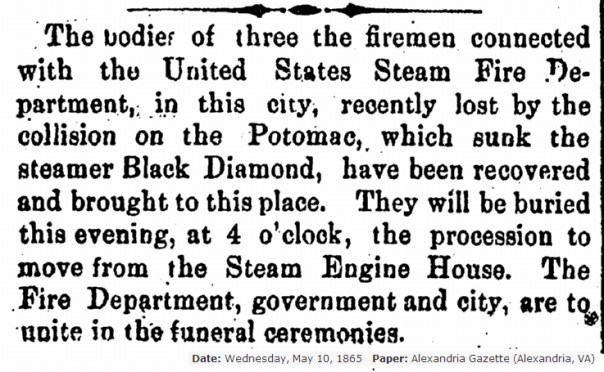
Out of the eighty-seven people who died when the Massachusetts crashed into the Black Diamond, only four of them were from the Black Diamond‘s twenty person crew.  They were Peter Carroll, Christopher Farley, Samuel Gosnell, and George Huntington.  The bodies of these four men received special treatment when they were returned to their native Alexandria:

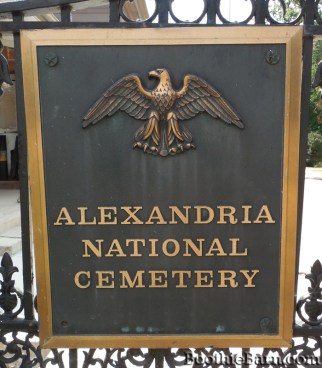
Black Diamond deaths Alexandria Gazette 5-10-1865These four men, though employed by the Quartermaster’s Department through its charter of the Black Diamond, were civilians and yet they received a high honor and were buried together in the Soldier’s Cemetery in Alexandria, now known as Alexandria National Cemetery.

Alexandria National Cemetery

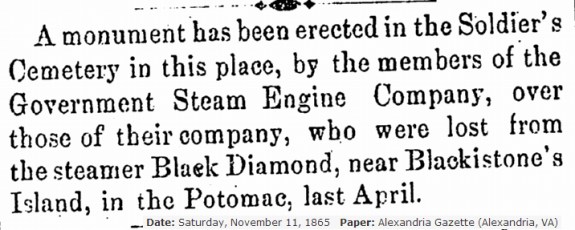
One source states that President Andrew Johnson gave authorization for these civilians to be buried in the Soldier’s Cemetery, although substantiating evidence has yet to be found by this author.  In November of 1865, some of the fallen men’s comrades erected a monument to their memory in the cemetery.

Monument to Black Diamond Alexandria Gazette 11-11-1865

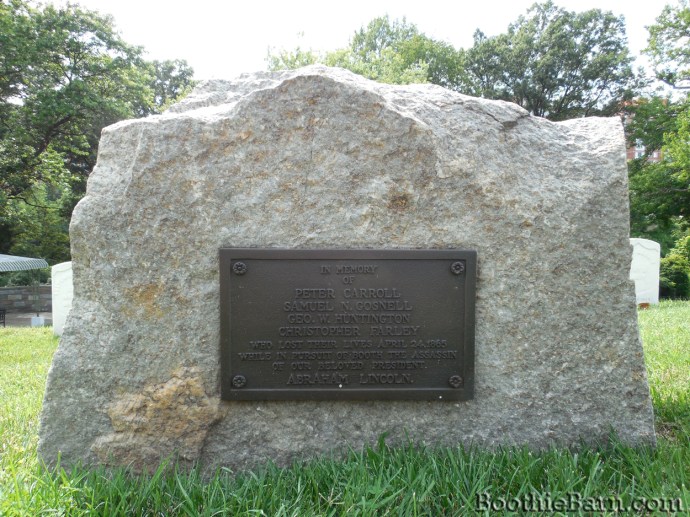
Over the years, this first monument to the lost crew of the Black Diamond deteriorated.  On July 7, 1922, a new granite monument with a bronze plaque was unveiled to honor the men:

Modern monument to Black Diamond victims

Black Diamond victims plaque

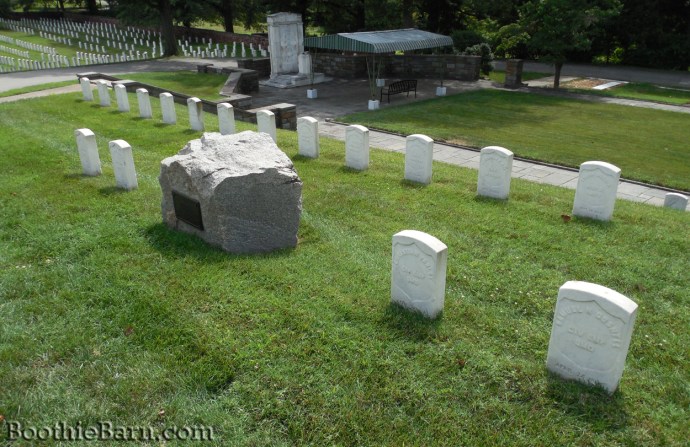
In the 1950’s the headstones for each of the four men were also quite deteriorated.  They were replaced around 1955 with the new ones being of the same design as those used for Union soldiers:

Black Diamond victims graves

The other victims of the Massachusetts – Black Diamond collision are buried all over the country but many of the bodies of those who drowned were never recovered.  For example, the body of George Carter, the regimental drummer who drowned after several attempts to throw him a rope, was never found.  He has a memorial cenotaph in West Suffield Cemetery in Suffield, Connecticut.  It states that he “died April 24, 1865, age 20 yrs.” and that he, “Drowned near the mouth of the Potomac River”.

Today, seasonal visitors can take a quick ferry ride to St. Clement’s Island from its museum at Colton’s Point.  The island is home to a recreated Blackistone Lighthouse (the original was destroyed by fire in 1956).  It also boasts a 40 foot tall commemorative cross which was dedicated on Maryland Day in 1934.

Many people come to the island to tour the lighthouse, go birdwatching, hike, or just relax on the beach.  Like most beaches, the sands of St. Clement’s Island are spotted with pieces of beach glass – fragments of broken glass containers that have been weathered by the wind and the waves.  During my visit yesterday, I filled my pocket with pieces of the smooth glass.  After taking the ferry back to the mainland, I drove straight to Alexandria, Virginia to see the graves of four men who lost their lives near the shore I had visited.  On each grave I placed a small piece of my St. Clement’s Island beach glass as a reunion of sorts between the men and the place where they lost their lives.

Beach glass on Black Diamond graves

If you visit St. Clement’s Island, you will not find any mention of the collision between the Massachusetts and the Black Diamond.  The story is not told on any of the historical markers on the island nor is it mentioned (or seemingly known) in its museum on the mainland.  It truly is a forgotten tragedy and its victims are more blood upon the hands of John Wilkes Booth.  Had he not assassinated President Lincoln, there would have been no need for the Black Diamond to perform picket duty off of St. Clement’s.  The men on the Massachusetts, who had already experienced the worst of war, would have steamed into Norfolk without incident.  The shot in Ford’s Theatre on April 14, 1865, killed far more than the President; it also created a ripple effect that caused eighty-seven men to lose their lives.

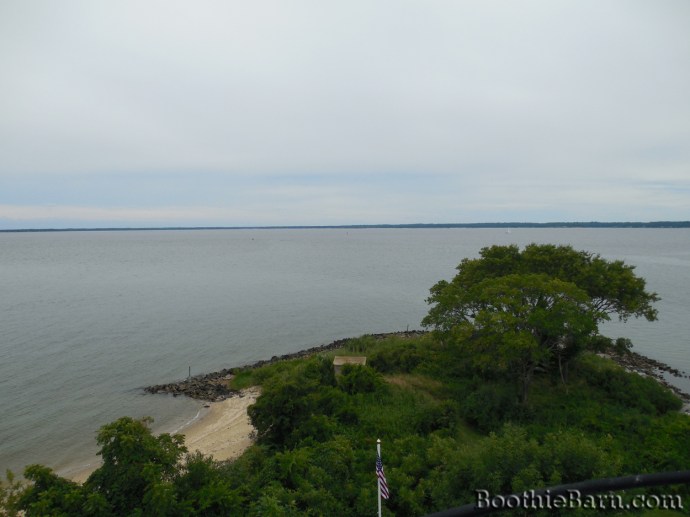
If you’re ever at St. Clement’s Island, take the spiral staircase up the recreated Blackistone Lighthouse.  At the top of the stairs ascend the ladder into the cupola.  Take your pictures and enjoy the view for a bit.  Then, turn your eyes to the water in the south.  It was there on the night of April 23 and early morning of April 24 that eighty seven men lost their lives, collateral damage of John Wilkes Booth.

South of St Clement's Island

References:
A History of St. Clement’s Island by Edwin W. Beitzell
Slipped into Oblivion: A Connecticut Tragedy on the Potomac by John Banks
George Hollands’ account “On the Massachusetts“, National Tribune, 5-14-1914
American Canals, No. 48 – February, 1984, Page 9
Alexandria National Cemetery
St. Clement’s Island Museum
Newspaper articles from GenealogyBank.com

Categories: Uncategorized | Tags: , , | 32 Comments

Blog at WordPress.com.