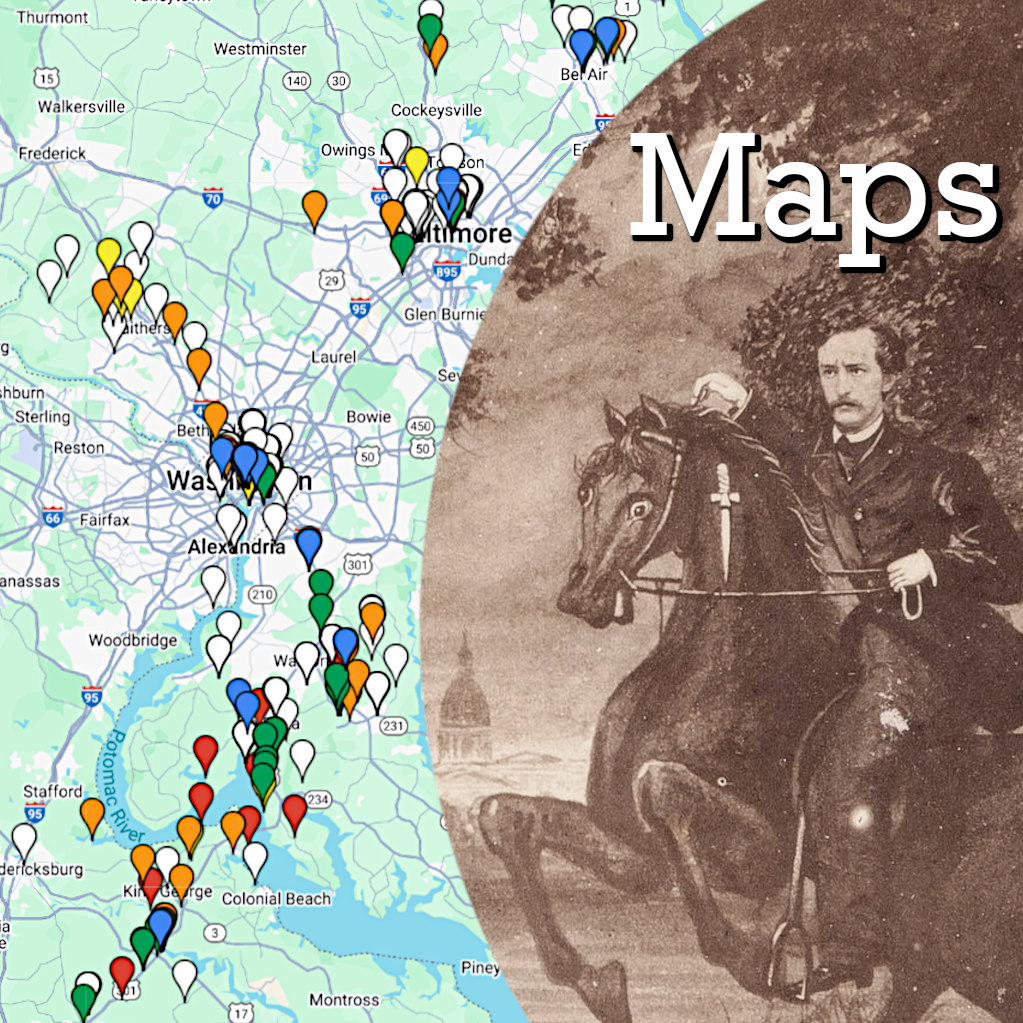
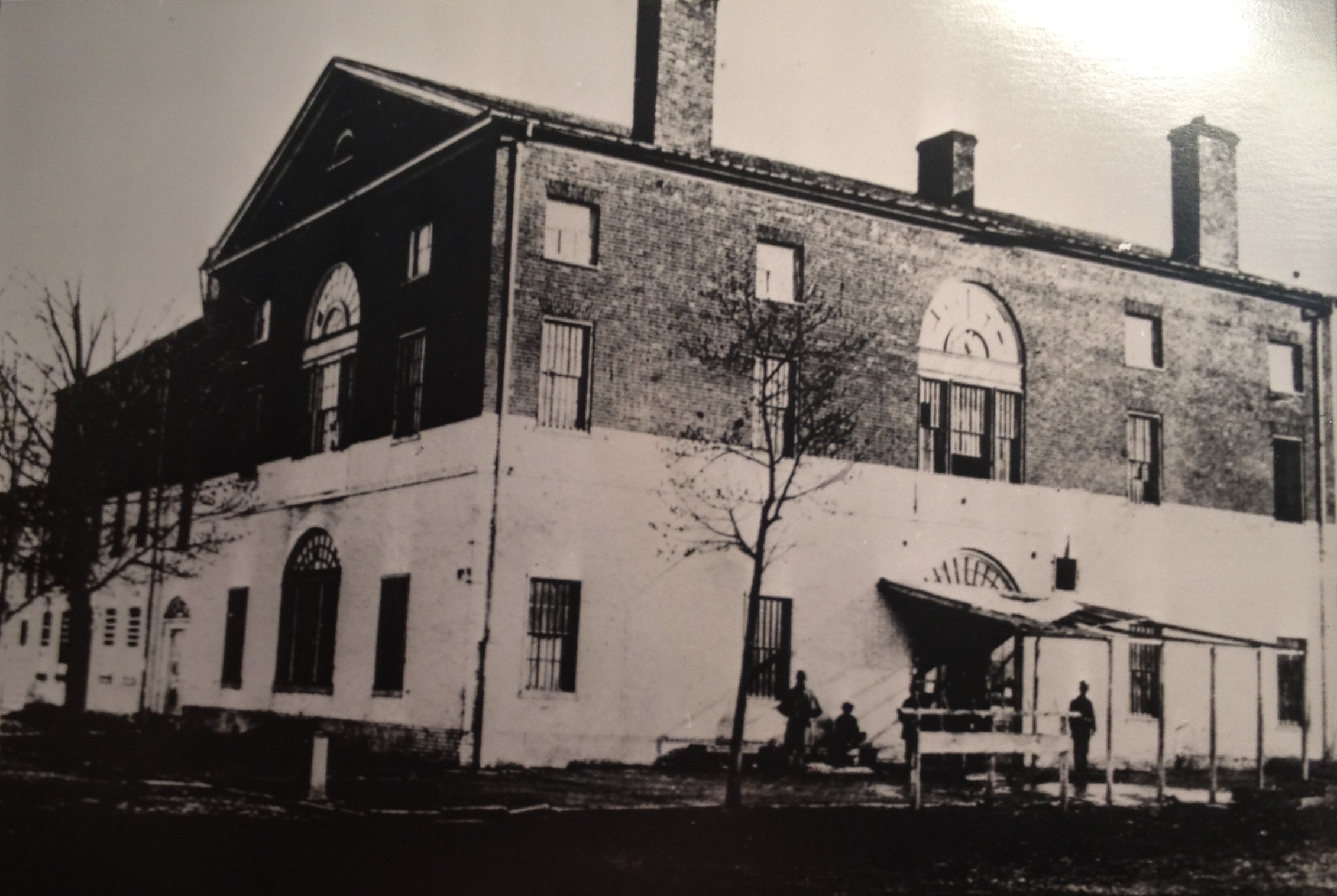
Imprisoned at the Old Capitol Prison

Right now, 148 years ago, John Wilkes Booth and Davy Herold are hiding in the pine thicket not far from Samuel Cox’s plantation, Rich Hill. They are being aided by Thomas Jones, who is providing them with food, water, and newspapers. Eventually, Thomas Jones will help send the pair across the Potomac river into Virginia. Though unable to prove anything against him, Jones would be arrested and imprisoned into the Old Capitol Prison in Washington. Here, he will be joined by several other individuals who had run ins with Booth and Herold during their escape. Some will become witnesses at the trial. One, Dr. Mudd, will become a conspirator. Some others, like Jones and Cox, will eventually be released with their true involvement unknown to the military commission. Here’s a list of people related to Booth and Herold’s escape who were imprisoned at the Old Capitol Prison.

Old Capitol Prison 1

Name Date Committed Age Occupation Residence Date Captured Where Captured Charges Notes
Bryant, William May 3 Farmer King George County, VA May 1 Mathias Point Held as witness by order of Secretary of War Released June 7 order General Baker
Cox, Samuel April 26 46 Farmer Charles County, MD April 24 Charles County, MD By order Col. Foster’s investigating committee Released June 3 on oath – order General Augur
Davis, Thomas April 24 18 Farmer[Dr. Mudd’s farmhand] Charles County, MD April 24 Charles County, MD For Major Turner’s investigation Released May 18 by order General Augur
Garrett, John May 6 24 Clerk Caroline County, VA April 26 Caroline County, VA Committed by order Col. Burnett orders Released May 8, order Secretary of War thru Col. Baker
Garrett, William May 6 20 Farmer Caroline County, VA April 26 Caroline County, VA Committed by order Col. Burnett orders Released May 8, order Secretary of War thru Col. Baker
Jones, Thomas A. April 27 45 Farmer Charles County, MD April 23 Charles County, MD Col Foster’s orders Released May 29 on parole to appear and answer charges when requested
Lloyd, John M April 23 41 Tavern keeper Surrattsville, MD April 23 Near T.B., MD For Major Turner’s investigation. Released June 30 order of Secretary of War on file
Lucas, William May 3 65 Farmer King George County, VA May 1 Mathias Point, VA Held as witness Released June 7, General Augur
Mudd, Samuel A. April 24 30 Dr. Charles County, MD April 21? Charles County, MD For M. I. Comm. Transfer to custody of Col. Baker, Agt. War Department
Rollins, William May 4 46 Farmer King George County, VA May 1 Mathias Point, VA Held as witness Released June 7. Delivered to Col. Baker to be returned over to civil authorities
Swan, Oswell (colored) April 27 30 Farmer Near Bryantown April 24 (or 21?) Near Bryantown Col. Foster Released May 18 Gen. Augur
Stewart [sic], Richard H. May 5 59 Physician King George County, VA May 6 King George County, VA Order Col. Baker Released June 7 by order Gen. Parke
Washington, Frank (colored) April 24 53 [Dr. Mudd’s farmhand] Charles County, MD April 24 Charles County, MD For investigation of Commission Released Gen Augur May 18

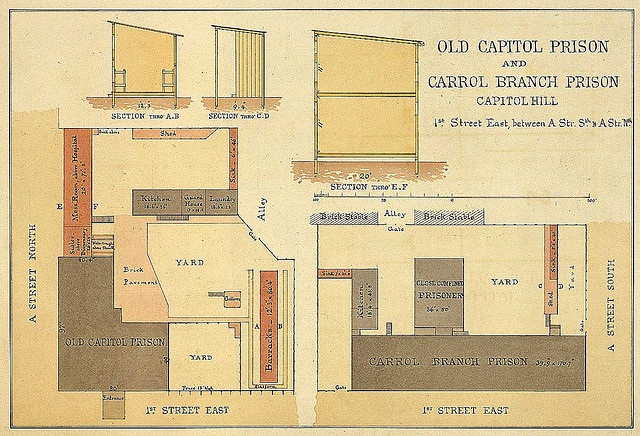
Old Capitol Prison Map

Categories: Uncategorized | Tags: , | 13 Comments

April 14th, 2013

On this, the 148th anniversary of  Lincoln’s assassination, I reflect on my own interest in the tragedy at Ford’s Theatre.  In high school, I was in speech and drama.  One day, a good friend of mine who had soundtracks to many musicals, starting playing Assassins by Stephen Sondheim in his car.  At first I thought, “what a dark thing to write a musical about”.  However, as I listened deeply to the lyrics, I was struck by how little I knew about the history of the people I heard.  The songs spoke of their misguided hopes and I was convinced to learn more about these people I knew little to nothing about.  I had heard of John Wilkes Booth of course, but only as the crazy, racist actor who shot Lincoln.  Beyond that, he was a mystery to me.  The more I read about Booth, the more I felt him to be such an oddity compared to the other Assassins.  In his song, entitled “The Ballad of Booth”, he sings of his crime, “Let them cry ‘dirty traitor’, they will understand it later.”

Despite all of the books that I’ve read on the subject since hearing this song for the first time, I still don’t truly understand what made Booth commit his deed.  There are many wonderful books that expertly dissect Booth, and the authors provide wonderful insights as to why he acted as he did.  However, the more I read, the more impossible I find it to put Booth into just one of these corners.  That is what keeps me drawn to this history.  Even after all this time, Booth and his band of conspirators are still an enigma to me.  So I will continue to read and learn about them.  This is what helps keep Lincoln’s legacy alive, in my eyes.  When we dismiss the men and women involved in the ‘dreadful affair’, we allow Lincoln to die.  When we claim to know all we need to know about the Lincoln assassination, we end his story.  So while my interest in Lincoln may be focused on the final chapter of his life, to me, that chapter will never close.  As long as others feel the same as I do, then Abraham Lincoln will never die.

Categories: Uncategorized | Tags: , , | 6 Comments

Chimney House and Atzerodt’s Carriage Shop

Last weekend, in a bit of serendipitous luck, I visited the village of Port Tobacco and saw that the home of Chimney House was having an open house. Oddly enough, I had met the realtors for Chimney House last August while antiquing with Herb Collins in Tappahannock, VA.  Jay and his wife Mary Lilly are not only the realtors for Chimney House, but Mr. Lilly is also the president of the Society for the Restoration of Port Tobacco.  I was invited in by the Lillys and we proceeded to tour the house.  At the end of the day, I was in awe of Chimney House’s size, beauty, and impeccable furnishings.   Here are some of the pictures I took of the of the house:

This slideshow requires JavaScript.

Now, Chimney House is more than just a period building in historic Port Tobacco, Maryland.  It also connects to George Atzerodt who made his home and business in Port Tobacco.  In 1857, George Atzerodt and his brother John moved to Port Tobacco and began operating a carriage shop in town.
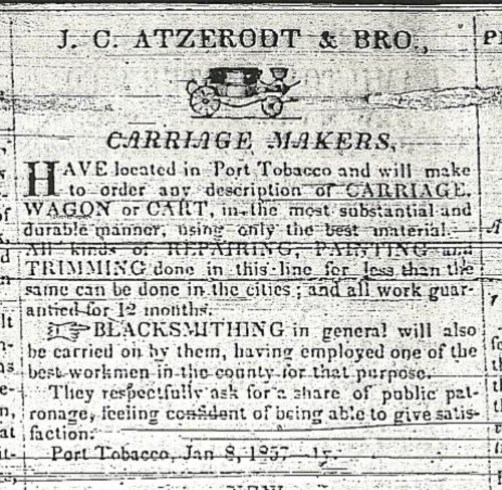
Atzerodt Carriage Shop Advertisement 1857

When the war came, the brothers closed down the business as John found a job working for the Maryland Provost Marshal as a detective.  Living in Port Tobacco, George found himself in the company of a twice widowed woman by the name of Elizabeth Adams Boswell.  She is better known to assassination historians as Rose Wheeler, an amalgamation of her former husbands’ last names (Charles Wheeler and Henry Rose).  George had one child by Mrs. Wheeler, a girl named Edith.  George and Rose lived together as common law man and wife until George was pulled into Booth’s conspiracy.  Mrs. Wheeler even visited George at the Arsenal Penitentiary before he was executed for his involvement in the tragedy at Washington.

So where does Chimney House play a role?  Well, at one point columnist and author George Alfred Townsend, better known by his nom de plume: GATH, visited and sketched Chimney House in Port Tobacco.  In his sketch of the house, GATH included a small outbuilding near the Chimney House which he attributed to be the Atzerodts’ carriage shop.  With very few others of his day taking an interest in George’s life prior to his non attempt on Andrew  Johnson, GATH’s drawing has been taken as correct.  With Chimney House lasting the tests of time, people could point to the area behind the house as the location of George’s former shop.

GATH's sketch of Chimney House with Atzerodt's carriage shop in the rear

GATH’s sketch of Chimney House with Atzerodt’s carriage shop in the rear

However, between 2007 and 2010 Port Tobacco underwent a major archaeological project funded in part by a $60,000 Preserve America grant from the NPS.  Though no longer updated, the website for the Port Tobacco Archaeological Project has some tremendous information regarding the wonderful work that was done there.  One area that the project leaders wanted to work on was to attempt to find the Atzerodts’ carriage shop.  On a cold December day in 2007, the team made a few shovel test pits (STPs) behind Chimney House looking for evidence of the former carriage shop structure.

That was near the end of the season, and the workers restarted their work in March of 2008.  Here is a report of their efforts:

“Yesterday we set out to finish what we had started. It was warm and sunny so the conditions seemed right. But it did not take us long to realize that the rear yard of the Chimney House is just too marshy for shovel testing to work. Determined, we excavated a few STPs but soon hit wet clays and sands with little soil development above them. The digging was difficult, the screening was difficult, and there just was not enough artifact content to draw any conclusions. We stopped digging and spent a bit of time wondering why anyone would build in this marshy area.”

The archaeological team was starting to have doubts about the long-held “behind Chimney House” theory.  Here’s another look into their thought processes from September of 2008 after still coming up empty behind Chimney House:

“Look at the sketch again. Notice anything else odd about it? In all the photos we have of Chimney House, not one of them has a covered front porch on it or even what appear to be remnants of one. If this sketch was done in 1885 and our earliest photographs of the house are in the early 1900’s (roughly 1910), then it was torn down before. Could this be a journalist’s imagination just trying to make the house look in better condition than it was? Remember that most of Port Tobacco was in shambles after the Civil War as people migrated out of town. Is the repair/paint shop located behind Chimney House?”

With no archaeological evidence to support it, the team did not believe the Atzerodts’ shop was behind Chimney House.  In September of 2010, as the team leader was completing his report for the Preserve America grant, he reported his belief of the true location of the Atzerodts’ carriage shop:

“Today, while working on our final report for the Preserve America grant, which funded our exploration of Civil War era Port Tobacco, I put together several bits of information that resulted in the formulation of a hypothesis: the Atzerodt carriage shop and the house in which George Atzerodt lived with Mrs. Elizabeth Wheeler might have been leased from wheelwright Griffin Carter, and that property lies on the east side of Chapel Point Road, where we have not undertaken any archaeological investigations, directly across from the road that runs west to the courthouse.”

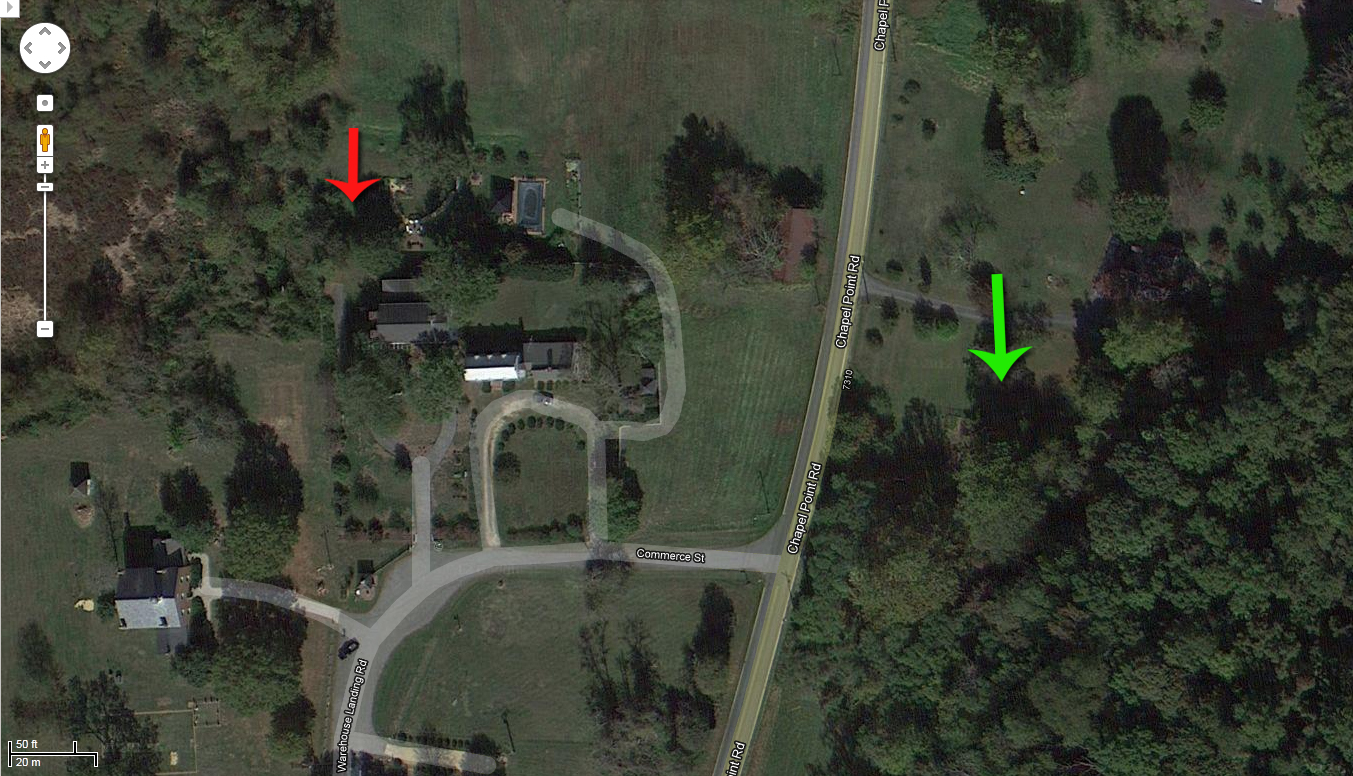
You can read more about his hypothesis here, here, and on page 38 of this.  Here’s an aerial shot showing the area.

Atzerodt's Carriage Shop Theory

The red arrow marks the land behind Chimney House where the team found no evidence of any shops whatsoever.  The green arrow points out the general area where the team leader now suspects George Atzerodt’s shop actually was.

However, even if George’s shop was not behind Chimney House, it is my belief that Rose Wheeler, her daughters including Edith, and maybe even George himself, slept in Chimney House.  Mrs. Wheeler’s maiden name was Boswell.  Her brother, William Boswell, purchased Chimney House in 1859 and it didn’t leave the family until 1904 when it was sold by his daughter.  In the 1870 and 1880 census, one of Mrs. Wheeler’s daughters from her first marriage is living with William Boswell in Chimney House.  To me, it seems reasonable that William Boswell would invite his twice widowed sister and her children to live with him in Chimney House, at least for a while.  Whether he would allow George Atzerodt into his home would be a different matter.

Chimney House is a truly beautiful piece of history in Port Tobacco, and yet another interesting sidebar in the Lincoln assassination story.
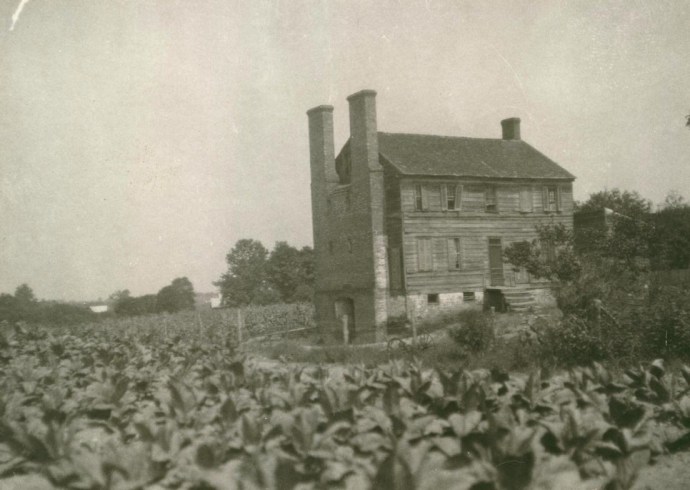
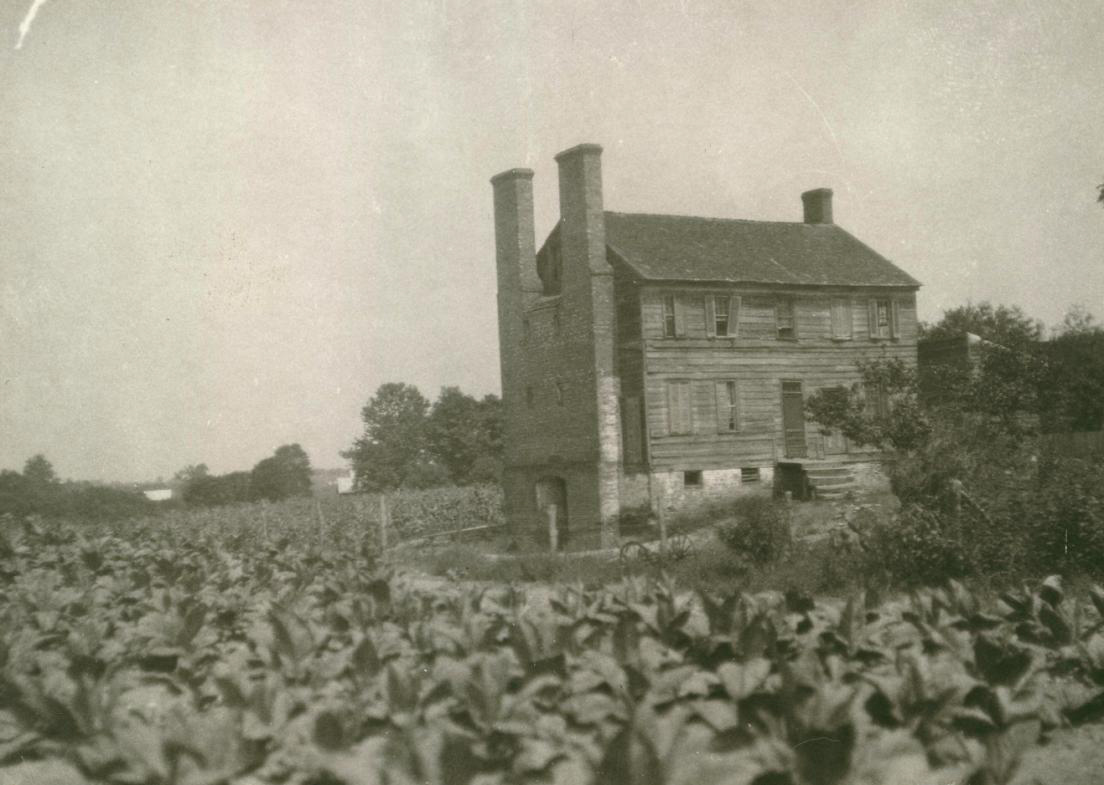
Port Tobacco's Chimney House  surrounded by tobacco plants circa 1930

Port Tobacco’s Chimney House surrounded by tobacco plants circa 1930

References:
Port Tobacco Archaeological Project
Society for the Restoration of Port Tobacco
Times of Port Tobacco by John and Roberta Wearmouth
Thomas A. Jones, Chief Agent of the Confederate Secret Service in Maryland by John and Roberta Wearmouth

Categories: Uncategorized | Tags: , | 13 Comments

New Gallery – Fake Conspirators

As you probably could have guessed, I have been on spring break from school during this last week.  During this time off, I entertained my parents who flew in from Illinois.  I’ve been living in Maryland for eight months now and this was the first time that they have been able to come out and see my place.  I gave them a poor man’s Booth Escape Route Tour, and we spent some days doing Southern Maryland things before heading into D.C.  When they departed, I was able to spend a day researching the files at Ford’s Theatre which I have never done before but thoroughly enjoyed. Since then, I’ve been doing my best to update this site.

Alas, today is the last day of my spring break.  Still I was able to create and put up one more Picture Gallery, albeit a smaller one from the Davy Herold gallery from yesterday.  While these galleries do not contain much in the way of new research, it still takes a considerable amount of time to find appropriate pictures, locate the highest quality versions of them, perform any minor picture editing needed in Photoshop, upload them to this site, write descriptions and citations for them, and then post about them.  I hope that you all are enjoying the galleries as they have been added, as it is my hope, above all else, for this site to be a resource.

The newest Picture Gallery is one that features images from the two Fake Conspirators who were photographed by Alexander Gardner aboard the iron clad monitors: Ernest Hartman Richter and Joao Celestino (aka John M. Celeste).

Ernest Hartman Richter was arrested in his home in Germantown, MD when detectives found his cousin, conspirator George Atzerodt, sleeping there.  Richter, who went by his middle name, Hartman, made the mistake of trying to protect his cousin and originally told invstigators that Atzerodt wasn’t there.  He was brought back to Washington, imprisoned aboard the U.S.S. Saugus, and photographed by Alexander Gardner on April 25th.  After that, he was sent to the Arsenal Penitentiary, transferred to the Old Capitol Prison, and eventually released.

Joao M. Celestino was a Portuguese ship captain who had his schooner and valuables confiscated by the U.S. government in 1864 for running the blockade.  He held a strong hatred for Secretary of State William Seward, whom he blamed for his losses.  The night of the assassination, he was heard to say he wanted to kill Secretary Seward.  After Lewis Powell attempted to do just so later that evening, people remembered his remarks, and Celestino was arrested and placed aboard the Saugus before being moved to the U.S.S. Montauk.  He had his photographs taken on April 27th with conspirator David Herold, who had just been captured.  Celestino was transferred to the Arsenal as well, before being released, himself.

These are the Fake Conspirators – the men whose faces are preserved alongside those of John Wilkes Booth’s inner circle.  They are a farmer protecting his cousin and ship captain with a justifiable grudge against William Seward.  Click here to see the new Fake Conspirators Picture Gallery!

References:
Inside the Walls – 13 Days Aboard the Monitors by John Elliott and Barry Cauchon
Conspiracy: The Portuguese Arressted in Connection with Lincoln’s Assassination by Pedro Jorge Castro

Categories: Uncategorized | Tags: , | 5 Comments

New Gallery – David Herold

David Edgar Herold had a unique role among John Wilkes Booth’s conspirators.  Beyond the failed abduction plot and the assassination itself, Davy was the only individual who accompanied John Wilkes Booth throughout his escape.  Though given ample opportunities to leave Booth behind and make his own, swifter escape, Davy Herold stayed by Booth’s side.  While many authors have tried to downplay Davy’s intelligence and character (Gore Vidal personified this when he described inventing, “a low life for him,” in his book, Lincoln), with the devotion he demonstrated, Davy Herold may very well be the most complex of all of Booth’s associates.

Our newest Picture Gallery here on BoothieBarn consists of images relating to the life of David Herold.  The images show snapshots of his life before Booth, his involvement in Booth’s plot and their shared escape south, his capture at the Garrett’s farm, the trial of the conspirators, and his eventual execution on July 7th, 1865.  Click here to see the new David Herold Picture Gallery!

Categories: Uncategorized | Tags: | 3 Comments

New Gallery – Horsehead Tavern

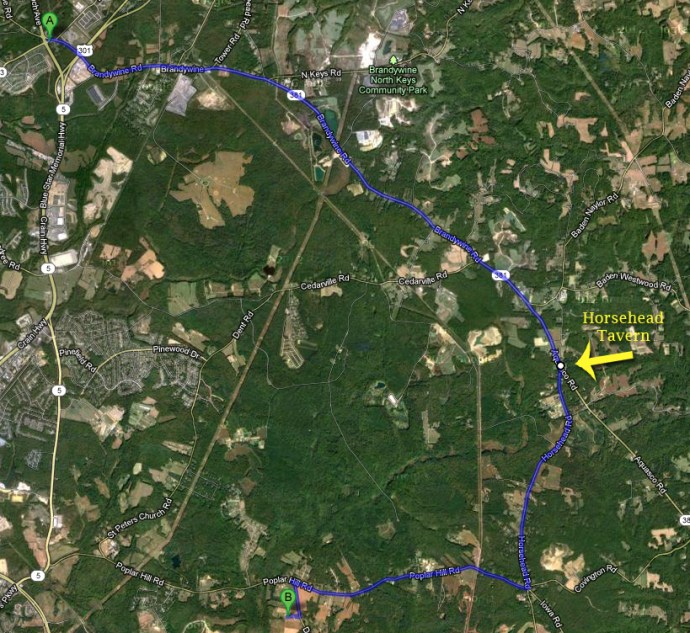
Horsehead Tavern in Baden, MD, is an extremely minor place in the story of the Lincoln assassination.  After leaving John Lloyd at the Surratt Tavern in Clinton, we know that John Wilkes Booth and Davy Herold rode their way through the small neighborhood of T.B.  After this, the next stop the pair made was at Dr. Mudd’s house.  A modern-day highway marker on the side of Route 301/5, states the following:

Entering Charles County

Those individuals who have taken the Surratt Society’s Booth Escape Route Tours will not recognize this sign, as the tour does not pass it. This is due to the fact that, despite the assertion by this sign, we are not exactly sure where Booth and Herold crossed over into Charles County. While the sign provides a possible route, many “old timers” in the field have long-held that the more probable route the assassins took between T.B. and Dr. Mudd’s is one that goes by the Horsehead Tavern.

Route from TB to Mudd's via Horsehead

Horsehead Tavern was similar to the Surratt Tavern. Both served as the local post offices with the communities around them bearing their names (Surrattsville/Horsehead). Both were on the stagecoach lines and often had visitors making their way north or south. The two served as taverns and rented rooms to those who needed a place to stay. And lastly, both had run ins with John Wilkes Booth.

The only known time of John Wilkes Booth going to the Surratt Tavern was his escape after shooting President Lincoln. Rumor has it though that John Wilkes Booth visited and slept at Horsehead Tavern in the fall of 1864 while scouting his future abduction/escape route. An image from 1903 marks the bedroom where Booth is said to have slept.

Old Horse Head 1903

If the story is true, then we know that John Wilkes Booth was at least familiar with the roads around Horsehead, making it a possible route for him to take on his way to Dr. Mudd’s.  In truth, Horsehead Tavern is little more than a possible waypoint on the escape route.  Nevertheless, it is still standing today and the newest Picture Gallery here on BoothieBarn.

Categories: Uncategorized | Tags: , | 2 Comments

New Gallery – Seward Assassination Attempt

“Crashing into a wall, Powell sought to disengage [Frederick’s] iron hold.  Together they maneuvered toward the secretary’s room, and Powell crashed against the heavy door with his shoulder.  His own weight, combined with that of his clinging adversary, burst the door wide open, and together they stumbled across the threshold…The enraged intruder now drew his knife, and, stumbling into Robinson, sent the man reeling across the floor with a quick slash on his forehead…Powell frantically thrust Fanny Seward aside and bounded upon the old gentleman’s bed.  Placing his left hand on Seward’s chest, he struck repeatedly with the knife.  As the secretary was supported by a framework backrest, the weapon glanced off the metal in a shower of sparks…” -Betty Ownsbey in “Alias Paine”

The newest Picture Gallery here on BoothieBarn highlights illustrations and images relating to the other attack on an elected offical that occurred on April 14th, 1865: the attempted assassination of Secretary of State William Henry Seward by Lewis Thornton Powell.  Click here to see the new Seward Assassination Attempt Picture Gallery!

Categories: Uncategorized | Tags: , | Leave a comment

Update – Replica Booth Diaries for Sale

Mr. Marsella graciously sent me some more images of one of his completed Booth diaries to share.  I think you’ll agree that his work is extremely detailed and the very best reproduction available.

As I stated before, you can purchase your own, hand-made, replica John Wilkes Booth diary from Mr. Marsella for the low price of $400 plus $25 shipping paid through PayPal.  I’ve already helped facilitate the sale of seven of Mr. Marsella’s creations.  If you would like to order one please email me at: boothiebarn (at) gmail (dot) com and I’ll send you instructions on how to send payment. Update: Pasquale has no more John Wilkes Booth diaries for sale and will not be making any more. Thank you all for supporting his wonderful creations.

Categories: Uncategorized | Tags: , | 5 Comments

Blog at WordPress.com.