Harry Hawk’s Letter to his Parents

Harry Hawk 1

Actor Harry Hawk was the only person on stage when Booth assassinated Lincoln.  When Booth jumped to the stage, brandishing a bloody knife in his hands, Hawk turned and ran from him, fearing for his life.  In the hours  following the assassination, Hawk gave a statement to Corporal Tanner who, under orders from Secretary of War Edwin Stanton, was collecting evidence in the parlor of the Petersen House.  In addition to this official statement, Hawk also wrote a letter to his parents in Chicago to tell them of the events.  Here is his letter, dated April 16th, recounting the tragedy:

“Washington, April 16, 1865

My Dear Parents,

This is the first time I have had to write to you since the assassination of our dear President on Friday night, as I have been in custody nearly ever since, I was one of the principal witnesses of that sad affair, being the only one on the stage at the time of the fatal shot. I was playing Asa Trenchard, in the “American Cousin,” The “old lady” of the theatre had just gone off the stage, and I was answering her exit speech when I heard the shot fired. I turned, looked up at the President’s box, heard the man exclaim, “Sic semper tyrannis,” saw him jump from the box, seize the flag on the staff and drop to the stage; he slipped when he gained the stage, but got upon his feet in a moment, brandished a large knife, saying, “The South shall be free!” turned his face in the direction I stood, and I recognized him as John Wilkes Booth. He ran toward me, and I, seeing the knife, thought I was the one he was after, ran off the stage and up a flight of stairs. He made his escape out of a door, directly in the rear of the theatre, mounted a horse and rode off.

The above all occurred in the space of a quarter of a minute, and at the time I did not know that the President was shot; although, if I had tried to stop him, he would have stabbed me.

I am now under one thousand dollars bail to appear as a witness when Booth is tried, if caught.

All the above I have sworn to. You may imagine the excitement in the theatre, which was crowded, with cries of “Hang him!” “Who was he?” &c., from every one present.

In about fifteen minutes after the occurrence, the President was carried out and across the street. I was requested to walk down to police headquarters and give my evidence. They then put me under one thousand dollars bond to appear at 10 o’clock next morning. I then walked about for some time as the city was wild with excitement, and then I went to bed. At half-past three I was called by an aid of the President, to go the house where he was lying, to give another statement before Judge Carter, Secretary Stanton, and other high officials assembled there. I did so, and went to bed again. On Saturday I gave bail.

It was the saddest thing I ever knew. The city only the night before was illuminated, and everybody was so happy. Now it is all sadness. Everybody looks gloomy and sad.

On that night the play was going off so well. Mr. and Mrs. Lincoln enjoyed it much. She was laughing at my speech when the shot was fired. In fact it was one laugh from the time the curtain went up until it fell — and to think of such a sorrowful ending! It is an era in my life that I shall never forget. Inclosed is a piece of fringe of the flag the President was holding when shot.”

To learn more about Harry Hawk, the other actors, and employees of Ford’s Theatre that fateful night, I recommend pre-ordering Dr. Tom Bogar’s upcoming book, “Backstage at the Lincoln Assassination: The Untold Story of the Actors and Stagehands at Ford’s Theatre“. Dr. Bogar spoke at the 2013 Surratt Society Conference and has done a phenomenal job delving into the history of these forgotten souls.  The book is due to be released in November, so pre-order it from Amazon today!

References:
Harry Hawk letter published in the Evening Star, April 24, 1865

Categories: Uncategorized | Tags: | 10 Comments

The Oldest Photographs of the Escape Route

Photography as we know it was only about 40 years old when Abraham Lincoln was assassinated.  Though some photographers had risked life and limb taking battlefield shots of the Civil War, the bulk of a photographer’s business consisted of portraits in their studio.  In the aftermath of Lincoln’s assassination photographers like Matthew Brady and Alexander Gardner took photographs of Ford’s Theatre, the conspirators, and the hanging of the condemned.  When it came to the escape route, however, no cameras attempted to make the trip.  Granted, in those early days no one was completely sure of the route Booth took or of all the places he visited before his death at the Garrett farm.  Newspapermen travelled the route and drew sketches, many of which were later turned into engravings, but none of these can truly capture the detail of a location as well as a camera can.  However, the bulky nature of early photography equipment (such as the required glass plates) made photographing the escape route an undesirable endeavor.

So, what are the earliest photographs we have of the escape route?  The most readily available ones were done by Osborn Oldroyd in 1901, 36 years after Lincoln’s death.  Armed with the newly invented “Brownie” camera from Kodak, Oldroyd walked and photographed the route.  Oldroyd’s book, The Assassination of Abraham Lincoln, is still so popular and historically valuable thanks, in part, to his many photographs of the escape route.

Oldroyd walking the route

Osborn Oldroyd, most likely with his Brownie camera in his pack

But Oldroyd was not the first to photograph the sites of Booth’s escape.  In 1888, Kodak, and it’s founder George Eastman, had released the first box camera using the recently invented “roll” of film.  Like the Brownie that followed, these original Kodak cameras allowed individuals to take their pictures and then mail in their film to Kodak to be developed.  These first, mass market cameras produced a circular image while the later Brownie created a rectangular exposure.

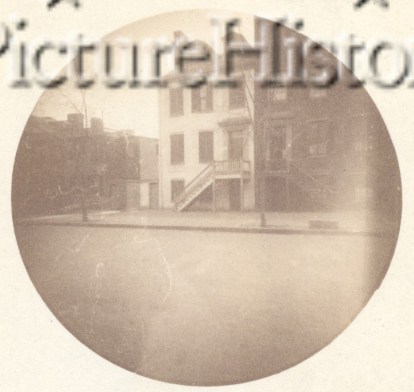
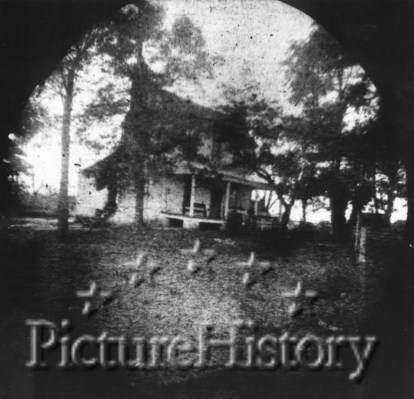
Sometime between 1893 and 1895, a writer for Century Magazine either commissioned someone or took a Kodak camera for a walk himself and photographed part of the escape route.  The writer’s name was Victor L. Mason, and here are some of his pictures:

Mrs. Surratt's boarding house circa 1895

Mrs. Surratt’s boarding house circa 1895

The Surratt Tavern circa 1895

The Surratt Tavern circa 1895

Dr. Mudd's house circa 1895

Dr. Mudd’s house circa 1895

The Garrett house circa 1895

The Garrett house circa 1895

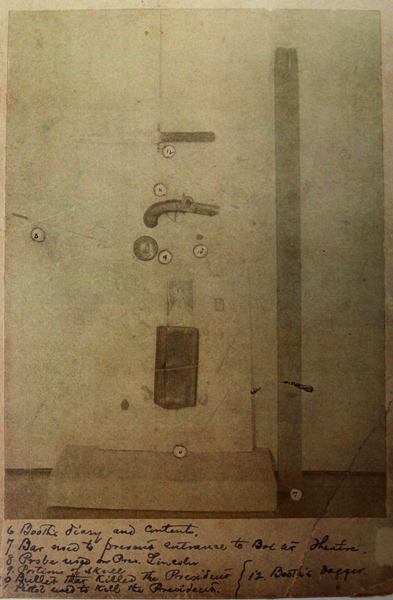
Victor Mason was working on an article about Lincoln’s assassination for Century Magazine.  In addition to these exterior shots of the escape route with a Kodak, Mason also used a more professional camera to take images of several of the trial exhibits in storage at the War Department such as this one:

Trial Exhibits circa 1895

In April of 1896, Victor Mason’s article, Four Lincoln Conspiracies, was published in Century Magazine.  Click here to view the article and look through the pages.  You will notice that while photographs of the conspirators and the relics of the assassination are replicated in the article, the photos of the escape route are not.  Instead, the article contains several drawings of each escape route location “Drawn by Harry Fenn” “From a Recent Photograph.”  Look at the drawings for the Surratt boarding house, the Surratt Tavern, Dr. Mudd’s House, and the Garrett house, and you will see that they are exact matches to the photos above.  It’s clear that Mason’s photographs were turned into these drawings.  Due to this, we can surmise that Mason also photographed Bryantown, Huckleberry, and Cleydael, since there are drawings of those places in the article too.

To my knowledge, these circa 1895 images are the earliest photographs of the escape route.  If any one knows otherwise, or has copies of these images (especially the “missing” ones of Bryantown, Huckleberry, and Cleydael), please comment below or shoot me a message at boothiebarn (at) gmail (dot) com.

References:
History of Kodak
PictureHistory.com
Four Lincoln Conspiracies by Victor L. Mason, Century Magazine, April 1896

Categories: Uncategorized | Tags: , , , | 8 Comments

Edwin Booth at the Trial

Edwin Booth as Hamlet

Edwin Booth as Hamlet

After his brother’s crime, Edwin Booth was spared the indignity of arrest.  The celebrated actor had just recently completed his illustrious run of 100 consecutive nights as Hamlet.  While his brothers Joe and Junius and his brother-in-law John Sleeper Clarke were arrested and imprisoned, Edwin remained untouched, as the grieving national treasure that he was.  Joe Booth spent only a couple of nights in jail before securing his release.  John Sleeper Clarke was arrested on April 27th and remained behind bars until May 26th.  Poor Junius spent the most time in prison due to his letter to John Wilkes in which he urged his brother to quit the oil business and return to the stage.  Junius was unaware that Wilkes used the term “oil business” as a cover for his plots against Lincoln.  Junius was arrested on April 25th and was remained imprisoned at the Old Capitol Prison Carroll Annex until June 23rd.

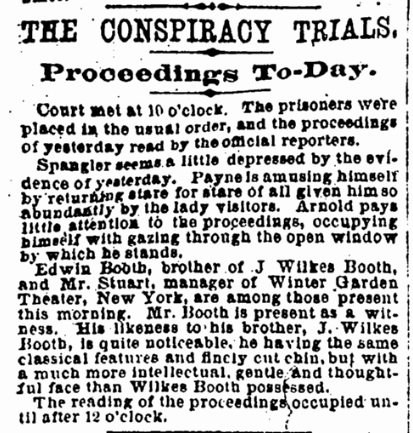
During this time, Edwin wisely shied away from the spotlight.  However, he was spotted at a high profile event in Washington on the last day of May:  the trial of the conspirators

Edwin Booth at the trial

As the Washington Star noted above, Edwin Booth was at the trial of the conspirators to act as a witness.  However, in the transcript of the trial you will never find Edwin Booth’s testimony from the witness stand.  In a letter that Edwin Booth wrote to a friend in Philadelphia the next day, he explains his reason for being there:

 “…I was called for the defense – to prove that J. Wilkes had such power over the minds of others as would easily sway those with whom he associated, &c. &c; the idea is to set up a plea of insanity for Herald or Paine – or some of them.  I told Doster all I knew of John, and he concluded it wd be as well not to call me.  The Washington ‘Star’ had a description of me – stating I was there as a witness – I daresay the press all over the country will be filled with my ‘arrest’ and all sorts of awful things…”

It was probably an act of courtesy and compassion that led William Doster to decide against using Edwin Booth on the witness stand.  The lawyer for Lewis Powell and George Atzerodt found other ways to demonstrate John Wilkes Booth’s influential character without subjecting the country’s greatest actor to further humiliation.  The request from Doster also provided Edwin with an appropriate reason to travel to Washington to visit his brother:

“I spent the day (yesterday) in Washington, and the greater part of it with my brother Junius – I dined with him – in his ‘quarters’…”

“…I then left the court (after taking a good look at the criminals) and drove to C Prison & stayed with June until 5 o’clk.  I had all sorts of good words & Junius … shd be speedily released &c.”

Not everyone felt happy that Edwin was spared imprisonment and suspicion after Lincoln’s assassination.  Years later, after Edwin himself was almost assassinated by Mark Gray Lyon, a now jaded and disgruntled John Sleeper Clarke wrote the, “Booths…get all the notoriety without suffering!! for it…Look at me I was dragged to jail by the neck – literally dragged to prison – and Edwin goes scot-free gets all the fame – sympathy – who thinks of what I endured.”

John Sleeper Clarke - not happy that Edwin wasn't arrested, too.

John Sleeper Clarke – not happy that Edwin wasn’t arrested, too.

Perhaps it was a bit unfair that Edwin Booth escaped the trials that his brothers and brother-in-law endured.  However, as a celebrated and vocal supporter of the Union during the Civil War, such preferential treatment is not unfounded.  In the years that followed, the theater world purposefully forgot Edwin’s villainous relation, however the stigma of his brother’s crime would haunt Edwin far longer than his brothers’ incarceration.

References:
Evening Star, 5/31/1865
Edwin Booth: A Biography and Performance History by Arthur Bloom

Categories: Uncategorized | Tags: , | 4 Comments

In the Dog House

There is a special connection between man and canine.  As a species, dogs provide humans a degree of loyalty that is unmatched in the animal world.  What’s even more interesting is how we, as people, develop the need to reciprocate that loyalty and devotion to our four legged friends.  Just this month, New York enacted a new regulation allowing pet cemeteries to accept cremated human remains, so that humans could be buried for eternity with their beloved pets.

Dogs provide a comforting effect.  Even in the most dire of circumstances they can provide an individual with a degree of ease and calm.  Therefore, it seems fitting that, while imprisoned as accessories in the assassination of Abraham Lincoln, at least three of the conspirators’ thoughts were of their dogs.

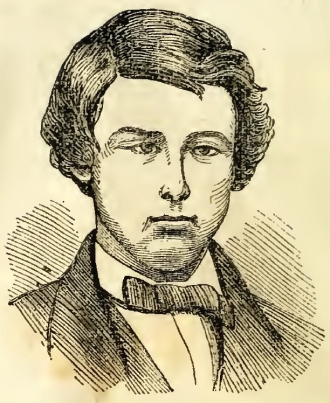
David Herold Engraving

David Herold met his end on the scaffold on July 7th, 1865.  He demonstrated dog like devotion to John Wilkes Booth during his flight from justice.  Despite many opportunities to leave the wounded assassin behind, Herold remained loyal to him and that loyalty eventually cost him his life.  According to one newspaper account however, he was allowed the comfort of his own loyal friend before he died.  In 1888, Captain Christian Rath gave an interview to the newspapers about his legacy of being the conspirators’ executioner.  In part of the interview he stated, “I always regarded Harold as an unthinking boy – a spoiled child.  He was a great sportsman, though, fond of shooting, and the owner of a splendid pointer dog.  We kept the dog for him in the prison, and at his death he left it to Gen. Hartranft.”  If Rath’s memory is correct and true, then it is likely that Herold spent his last few days on Earth uniting with the creature he so expertly replicated in life.

Spangler Drawing Trial book

Edman Spangler survived the executions of July 7th.  Instead he was sentenced to 6 years in prison, a relative slap on the wrist compared to the sentences of the other conspirators.  Thomas Ewing, Jr., lawyer for Dr. Mudd, Samuel Arnold, and Spangler, wrote a letter to his father dated the day of the execution.  In it, he described his continued efforts to gain the freedom of his clients through a writ of habeas corpus.  He also wrote the following, “They say Spangler was delighted at escaping hanging.  He sent a special request to Ford today to send him to prison his large testament, and his small dog!”  Whether Spangler was successful in acquiring his dog remains uncertain as there is no mention of it, or David Herold’s dog, in General Frederick Hartranft’s letterbook about his supervision of the Old Arsenal Prison.

I find it ironically appropriate that Spangler owned a “small” dog.  Years later, after his release from Fort Jefferson, Edman Spangler went to visit, and ultimately live with, his former cellmate, Dr. Mudd.  As Nettie Mudd wrote later in her book about her father, “A short time after Spangler’s release, he came to our home early one morning, and his greeting to my mother, after father had introduced him, was: ‘Mrs. Mudd, I came down last night, and asked some one to tell me the way here.  I followed the road, but when I arrived I was afraid of your dogs, and I roosted in a tree.'”  Clearly Spangler preferred his small dog over big ones like Dr. Mudd’s.

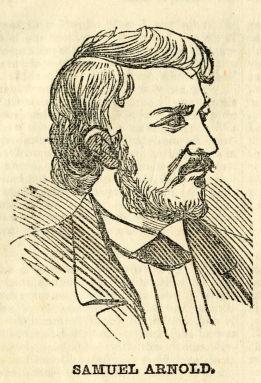
Arnold Drawing Trial Book

Samuel Arnold was imprisoned with Dr. Mudd, Spangler and Michael O’Laughlen at Fort Jefferson.  His later memoirs describe how painful and tortuous he found his imprisonment there.  With only rats and crabs as his animal companions, Arnold’s thoughts turned to his dog.  In a letter to his mother in 1867, Sam Arnold writes elegantly of his beloved pet:

“Keep my dog till he dies.  For my sake let him be treated well, and when dead bury him.  Erect a slab inscription, ‘A true friend,’ for he would never forsake me even should the whole world do so.  He loved me, even the ground I walked upon, and I loved him.  Poor Dash! We have forever parted.  Thou without a soul, yet did you love me, and thou art not forgotten.”

Samuel Arnold in later life, enjoying the company of another devoted dog.

Samuel Arnold in later life, enjoying the company of another devoted dog.

The connection between man and dog transcends guilt or innocence.  Whether its owner is a President or a criminal, a dog will stay by an owner who loves him.  Even the worst criminals can demonstrate their humanity by the way they treat their dogs.  In the midst of their confinement for the crime of the century, David Herold, Edman Spangler, and Samuel Arnold showed their humanity in this way.

References:
Mrs. Surratt’s Case, The Evening Repository, 2/16/1888
Thomas Ewing Family Papers, LOC
The Life of Dr. Samuel A. Mudd by Nettie Mudd
Memoirs of a Lincoln Conspirator by Michael Kauffman

Categories: Uncategorized | Tags: , , | 17 Comments

Osborn Oldroyd and his Lincoln Museums

The Abraham Lincoln Home in Springfield, IL and the Petersen House in Washington, D.C. have shared similar histories.

Lincoln Petersen Home

  • Both homes witnessed the death of a Lincoln:

On February 1st, 1850, Eddie Lincoln, the second son of Abraham and Mary Todd, died at the age of 3 at the Lincoln Home in Springfield.

On April 15th, 1865 at 7:22 am, President Abraham Lincoln died at the age of 56 at the Petersen House in Washington, D.C.

  • Both homes had few owners:

The Lincoln Home was built in 1839 for the Reverend Charles Dresser.  The Lincolns bought it from him in 1844.  Robert Todd Lincoln inherited the property from his parents and he subsequently gave it to the government in 1887.  This gives the Lincoln home two owners, Rev. Dresser and the Lincoln family, before it was purchased by the government.

The Petersen House was commissioned by William and Anna Petersen in 1849 and built that same year.  When they died in 1871, the house was inherited by their children.  They sold the house to Louis Schade in 1878.  By 1896, Louis Schade sold the house to the government for $30,000.  This gives the Petersen House two owners, the Petersens and Louis Schade, before it was purchased by the government.

  • Both homes had considerable remodeling done when their namesakes lived there:

The Lincoln Home had about 5 renovations while the Lincolns lived there.  Most drastically was the alteration of the home from a 1 ½ story structure to a full 2 story home, as it still is today.

The room that would later be known as the room where Lincoln died, was not even part of the Petersen House when it was originally built.  That addition was put on in 1858.  Fire gutted it in 1863 and William Petersen rebuilt it that same year.

  • Both homes had renters:

When Abraham Lincoln was elected President and moved into the White House, he rented out his Springfield home.  When Robert Todd gained ownership of the place, he continued the practice of renting the house out until he gave it to the government.

The Petersens ran their home as a boarding house for many years.  From Congressmen to soldiers, to actors, they rented out rooms to  many needy Washingtonians.

  • Lastly, both homes shared a long-term occupant, Osborn Hamilton Ingham Oldroyd:
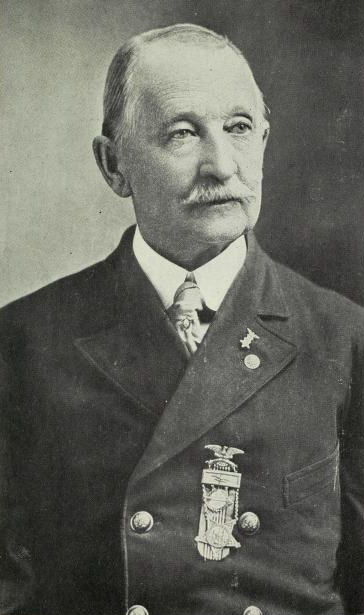
Osborn Oldroyd

Osborn Oldroyd was a Civil War veteran and a devoted collector of Lincoln memorabilia.  In 1883, 41 year-old Oldroyd succeeded in fulfilling the dream of any man who idols another.  Robert Todd Lincoln made Oldroyd the fifth renter of the Lincoln Home in Springfield since his father left the city to claim the Presidency.  Into this historic house, Oldroyd brought his vast collection of nearly 2,000 Lincoln items.  As had been commonplace since the death of Lincoln, many visitors came to call on the Lincoln Home, seeking to visit the home of the great martyr.  Oldroyd let them in like all of his predecessors had, but was the first to charge them admission.  He turned his collection and rented space in a Lincoln Museum.  Robert Todd accepted this exploitation as long as Oldroyd paid his rent, however, by 1885, Oldroyd was starting to fall behind his payments.  Despite not paying him, Robert Todd did not want to bring a lawsuit against Oldroyd as he feared it, “may easily cause me more personal annoyance than the loss of ten times the money.”  Rumors spread that Oldroyd was also cutting off parts of the curtains, wallpaper, and flooring, selling them as souvenirs.  Robert Todd was getting angry with his tenant whom he referred to as a “dead beat” and “rascal”, when an Illinois legislative committee approached him in 1887 to purchase the Lincoln Home.  A similar offer had been given to him in 1883, but at that time he had declined.  Even though, Robert Todd was fairly certain Oldroyd had been the catalyst for this offer, he decided to donate the property to the state of Illinois.  His donation contained two caveats, however.  “…Said homestead shall be, forever, kept in good repair and free of access to the public.”  This latter requirement was probably meant as a final jab towards his “rascal” of a tenant and his entrepreneurial exploits.  Regardless, Osborn Oldroyd was hired by the state of Illinois to be the first custodian of the house and gave him a salary of $1,000 per year.  Oldroyd undoubtedly used this salary to increase his collection at every turn.

Oldroyd’s tenure at the Lincoln Home came to an end in 1893 when he was fired by recently elected Gov. John Peter Altgeld.  Altgeld replaced him with a political friend named Herman Hofferkamp.  Out of a cushy job and a free place to live, Oldroyd was in trouble.  Meanwhile, in Washington, D.C., the Schade family had moved out of the Petersen House apparently fed up with the number of visitors constantly asking to see the death room of the President.  They leased the building to the Memorial Association of the District of Columbia, a group formed by Congress the year before.   When and how Oldroyd managed to convinced this group to make him custodian of the Petersen House is unknown.  According to a biography about Oldroyd written when he was alive, in 1893 Oldroyd moved his collection to the Petersen House, “at the request” of the association.  The earliest account the NPS has managed to find of Oldroyd residing at the Petersen House is June of 1898.  This was after the government purchased the house outright from the Schades in 1896.  So, whether Oldroyd went straight from the Lincoln Home to the Petersen House, or whether he had five years in between, he ultimately found a new location to show off his collection.

While he lived rent free at the Petersen House, Oldroyd did not receive a salary there.  Instead, he got back to his roots and was allowed to charge admission to his museum.  He made the whole first floor of the house his exhibit floor and he and his family lived upstairs.  The first floor of the Petersen House contained considerably less real estate than what he had previously used to showcase his collection at the Lincoln Home.  He covered practically every surface of the Peterson House with material to make up for it.  Oldroyd also had a lot of changes made to the building while he lived there.  Most noticeably, he had the back wall of the room where Lincoln died, removed.

The following are some pictures of the interior of the Petersen House when it housed Osborn Oldroyd’s Lincoln Museum:

Petersen Museum 1922

This picture was taken from within the front parlor of the Petersen House facing towards the rear parlor.  The door to the right leads into the hallway with the room where Lincoln died at one end and the entrance to the Petersen House at the other.

Oldroyd Museum 1

This photo was taken from within the rear parlor of the Petersen House in the direction of the front parlor.  This photo shows only the front parlor.

Oldroyd Museum 2

This photo was taken from the entrance of the room where Lincoln died. The bed Lincoln died in would have been located in the bottom right hand corner of this photo.
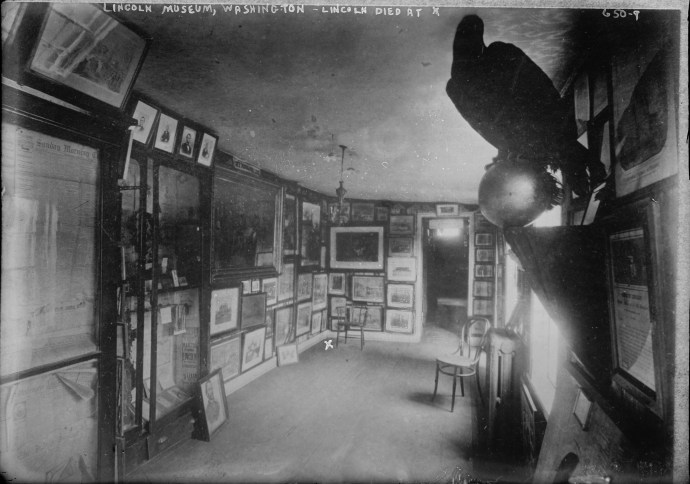
The white X marks the spot where the bed Lincoln died in was.

This photo was taken from the rear of the room where Lincoln died in the direction of hallway and Petersen House entrance. The X marks the location of Lincoln’s deathbed.
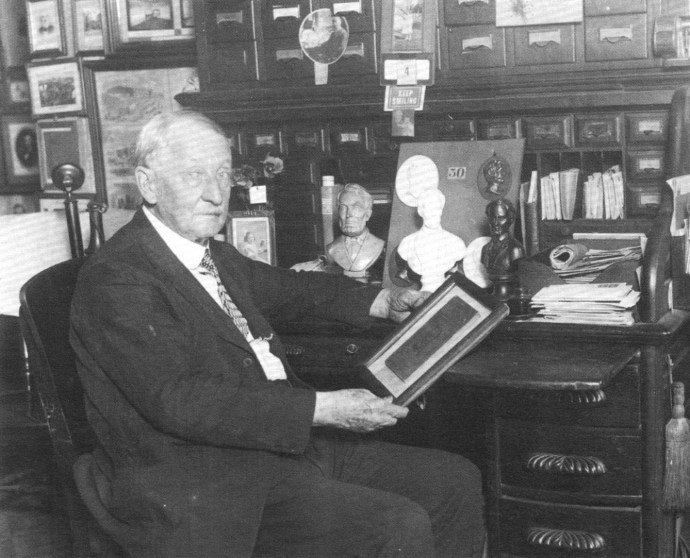
Oldroyd in his museum

During his tenure at the Petersen House, Oldroyd continued to collect and correspond with many individuals associated with Lincoln’s life and death.  In 1901, after walking the escape route of Lincoln’s assassin on foot with a camera, he published his book, “The Assassination of Abraham Lincoln”.  This volume contains many of the earliest photographs we have of different parts of the escape route.

Oldroyd walking the route

By 1926, after about 30 years curating his collection at Petersen House, Oldroyd sought the help of Congressman Henry Rathbone of Illinois, to insure its preservation.  The son of Henry Rathbone and Clara Harris, the ill fated pair who joined Mr. and Mrs. Lincoln at Ford’s Theatre that night, managed to pass a bill in Congress authorizing the purchasing of Oldroyd’s collection.  Experts at the Smithsonian noted that the collection “was of little practical value”.  Despite this, Oldroyd was paid $50,000.  Oldroyd later stated that he had been offered far greater amounts for the collection by private individuals but that he wanted the collection to be in the hands of the government so that it would be preserved and enjoyed by the public for years to come.  When offered continued curatorship over the collection Oldroyd replied, “the responsibility would be too much for me to assume at my age of eighty-four years.”  Oldroyd was then given the key to the Petersen House and told that he was free to come and go as he pleased and that his accustom chair would always be there for him.

Osborn Hamilton Ingham Oldroyd died four years later in 1930.  He  is buried next to his wife of over 54 years, Lida, at Rock Creek Cemetery in Washington, D.C.
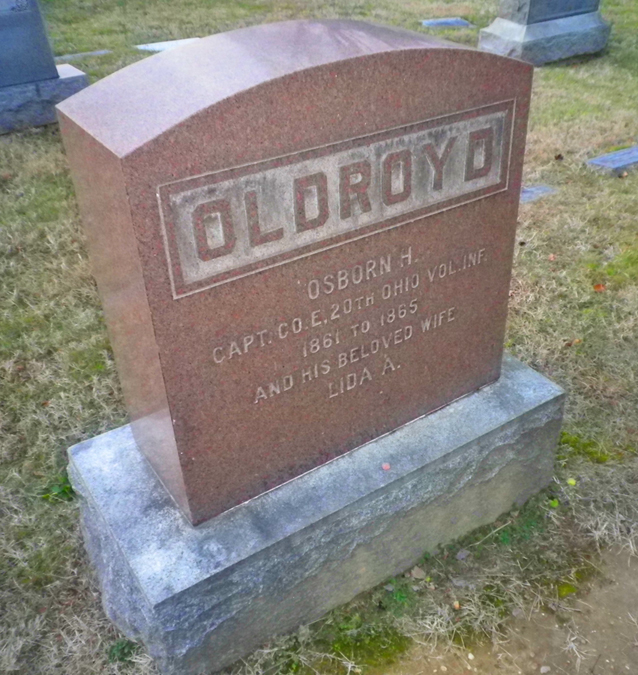
Oldroyd's grave

He may have been a “rascal” as Robert Todd Lincoln called him, but Osborn Oldroyd was also the epitome of a collector.  He devoted his whole life to acquiring everything relating to Abraham Lincoln.  For nearly half of his life, Osborn Oldroyd made his home in houses relating to the 16th President.  To the collection and study of Lincoln, Osborn Oldroyd’s name is unavoidable, particularly in the study of his assassination.  I find it entirely appropriate then, that in this picture of Rep. Henry Rathbone in front of the Petersen House Lincoln Museum, the presence of Osborn Oldroyd in his favored setting is enshrined forever:

Rathbone in front of Oldroyd's Petersen

Oldroyd in the window

References:
House Where Lincoln Died Historic Structures Report by the National Parks Service
Life of Osborn H. Oldroyd by William Burton Benham
Giant in the Shadows: The Life of Robert Todd Lincoln by Jason Emerson
Lincoln Home National Historic Site
The Lincoln Assassination: Where Are They Now? by Jim Garrett and Rich Smyth

Categories: Uncategorized | Tags: , , , | 14 Comments

A Sister’s Sorrow

Asia Booth Clarke, John Wilkes Booth’s sister, had a lifelong pen pal named Jean Anderson.  From her early days at Tudor Hall to her isolated years in England, Asia wrote to Jean with regularity.  For years, some of Asia Booth Clarke’s letters to Jean Anderson were held at the Peale Museum in Baltimore.  What follows is a transcript of Asia’s letter to Jean in the aftermath of the assassination:

Asia Booth Clarke

Asia Booth Clarke


Philadelphia, May 22, 1865.

My Dear Jean:

I have received both of your letters, and although feeling the kindness of your sympathy, could not compose my thoughts to write — I can give you no idea of the desolation which has fallen upon us. The sorrow of his death is very bitter, but the disgrace is far heavier; – Already people are asserting that it is a political affair — the work of the bloody rebellion — the enthusiastic love of country, etc. but I am fraud to us it will always be a crime –

Junius and John Clarke have been two weeks to-day confined in the old Capital – prison Washington for no complicity or evidence — Junius wrote an innocent letter from Cincinnati, which by a wicked misconstruction has been the cause of his arrest. He begged him to quit the oil business and attend to his profession, not knowing the “oil” signified conspiracy in Washington as it has since been proven that all employed in the plot, passed themselves off as “oil merchants”.

John Clarke was arrested for having in his house a package of papers upon which he had never laid his hands or his eyes, but after the occurrence when I produced them, thinking it was a will put here for safe keeping — John took them to the U.S. Marshall, who reported to head-quarters, hence this long imprisonment for two entirely innocent men –

I would not object at present to have back for my private use all the money they have squandered on Sanitary Commissions, Hospital Endowments, Relief of Soldiers Widows, and the like, for the good done by them as actors and citizens goes nothing towards providing their innocence, and it might well have been tendered to a better purpose –

I suppose they will be examined in the leisure of the Court and return home to be nursed through a spell of illness, — as one Gent has done who was released last week, — and whose arrest proved only a farce as General somebody in authority expressed it — Poor old country, she has seen her best days, and I care not how soon I turn my back upon her shores forever, it is the history of the Republic over again.

I was shocked and grieved to see the names of Michael O’Laughlin and Samuel Arnold. I am still some surprised to learn that all engaged in the plot are Roman Catholics — John Wilkes was of that faith — preferably — and I was glad that he had fixed his faith on one religion for he was always of a pious mind and I wont speak of his qualities, you knew him. My health is very delicate at present but I seem completely numbed and hardened in sorrow.

The report of Blanche and Edwin are without truth, their marriage not to have been until September and I do not think it will be postponed so that it is a long way off yet. Edwin is here with me. Mother went home to N.Y. last week. She has been with me until he came.

I told you I believe that Wilkes was engaged to Miss Hale, — They were most devoted lovers and she has written heart broken letters to Edwin about it — Their marriage was to have been in a year, when she promised to return from Spain for him, either with her father or without him, that was the decision only a few days before the fearful calamity — Some terrible oath hurried him to this wretched end. God help him. Remember me to all and write often.

Yours every time,

Asia

The “Blanche” that Asia refers to is Blanche Hanel, Edwin Booth’s fiancée.  Edwin Booth’s first wife, Mary Devlin, died in February in 1863.  By September of 1864, Edwin was romantically involved with Blanche Hanel, a wealthy Philadelphian.  As Asia wrote above, the two were engaged to be married when the assassination occurred.  In addition to retreating from the stage, Edwin also wrote to Blanche allowing her to break off their engagement due to the circumstances.  At first Blanche stayed by Edwin and as Asia writes, their engagement continued.  In the end, however, Blanche’s father would not allow the marriage and by November of 1865, Edwin and Blanche’s relationship ended.  It wouldn’t be until June of 1869 that Edwin Booth would remarry, this time to Mary McVicker of the Chicago theatrical family.

Categories: Uncategorized | Tags: | 12 Comments

Reconstructing Ford’s Theatre

A few years ago, I went and saw the musical, The Civil War, at Ford’s Theatre. It was a very entertaining and moving production. There are several times throughout the show where you hear quotations from historic individuals involved in the Civil War. Quotations from Abraham Lincoln are, appropriately, quite prevalent. Each time we heard the words of Lincoln, the stage would go dark and a light inside the Presidential Box would brighten. The first time I saw this, I got shivers. It was very moving to hear the words of our 16th President echoing forth from the box where he was shot. I expect many others who witnessed the play found this to be quite moving.

In truth though, that is not the box where Lincoln was shot. That specific box was destroyed long ago. Ford’s Theatre, as beautiful as it is, is a complete reconstruction except for its exterior walls. It was recreated to appears as it did in 1865 by a group of experts and historians in the 1960’s. While they thoroughly documented their work in this book, sometimes a picture is worth a thousand words. Here are some pictures of the inside of Ford’s when it was being rebuilt in the ’60’s:

20130825-193935.jpg

20130825-194034.jpg

20130825-194142.jpg

20130825-194228.jpg

20130825-194432.jpg

20130825-194603.jpg

20130825-194712.jpg

20130825-194845.jpg

Categories: Uncategorized | Tags: | 23 Comments

The Name Game

After Oswell Swann led John Wilkes Booth and David Herold through the Zekiah Swamp, he brought the pair to Rich Hill, the home of Col. Samuel Cox. The fugitives allegedly spent a few hours inside the house in conversation with Col. Cox, who ultimately agreed to do what he could for the men. He told them he would send his foster brother, Thomas A. Jones, to meet them in a nearby pine thicket and that he would care for them and help get them across the Potomac River. In the morning, Col. Cox sent his son, Samuel Cox, Jr., over to Huckleberry to retrieved Thomas Jones. When Cox, Jr. got to Huckleberry, he said his father wished to meet with Jones to discuss the purchase of some seed corn. Jones found such an ill timed request, on Easter Sunday no less, to be a cryptic one. When Cox, Jr. then spoke to Jones privately and stated that two strangers had come by Rich Hill house during the night, Jones seemed to already comprehend the situation before him. He made his way to Rich Hill with Samuel Cox, Jr.

My reason for summarizing this event is to give some context for the following. Samuel Cox, Jr. was not Col. Cox’s son. Rather, he was his nephew.

Samuel Cox, Jr.

Samuel Cox, Jr.

Samuel Cox, Jr. was born Samuel Robertson. He was the son of John R. Robertson and Rebecca Cox. Rebecca and Col. Cox were siblings. Rebecca died two months after Samuel’s birth. During his youth, Samuel spent a lot of time on his uncle’s farm of Rich Hill. By 1852, Samuel’s father, John Robertson, had remarried and started having children with his new wife. Meanwhile Col. Cox and his wife Walter Ann, had not been able to have any surviving children of their own. It appears that Samuel Robertson found himself with his uncle more and more, and Col. Cox was more than happy to have a child to raise. Col. Cox officially became “Pa” to Sammy Robertson three days after his 17th birthday.  On February 11th, 1864, the families decided to make their long held relationship official and Col. Cox adopted Samuel Robertson and gave the young man his name:

Cox Jr Name Change

It’s clear that Sammy Cox, Jr. was well loved by his adoptive parents. In the aftermath of the assassination Col. Cox, Samuel Cox, Jr. and their devoted servant Mary Swann, were all arrested and kept at the Bryantown Tavern. Col. Cox was later taken to Washington, D.C. and was imprisoned at the Old Capitol Prison. A few days after this, Samuel Cox, Jr. and Mary were brought to Washington and were required to report to the Provost Marshall’s office every day for about three weeks before they were allowed to return home. While Col. Cox was imprisoned at the Old Capitol, he wrote a letter to his wife to keep her spirits up. “Unite with me in devout prayer to our Merciful Father to guide, sustain, and so direct all things that we may soon be restored to each other,” Col. Cox wrote in his May 21st letter. The Col. also spoke of his son when he told his wife, “I have received one [letter] from Sammy today dated yesterday stating that he would leave for home today (also Mary)…I hope Sammy arrived home safe.”

Samuel Cox, Jr. nee Robertson, may not have been Col. Cox’s biological son but he proved himself to be a worthy heir. He became a prominent pillar of the community as he lived out the rest of his life at his father’s home of Rich Hill. And today, father and son share the same burial plot at Mt. Rest Cemetery in La Plata, Maryland.

Deer fawns at Mt. Rest Cemetery in La Plata, MD.  The Cox family graves can be seen on the left side of the image.

Deer fawns at Mt. Rest Cemetery in La Plata, MD. The Cox family graves can be seen on the left side of the image.

Categories: Uncategorized | 5 Comments

Blog at WordPress.com.