Samuel Cox of Charles County

Recently, I’ve been working on an article for the Surratt Courier about the history of Rich Hill.  Rich Hill was the home of Col. Samuel Cox and is located in modern day Bel Alton, Charles County, Maryland.  After leaving Dr. Mudd’s house on the evening of April 15th, 1865 and getting partially lost, John Wilkes Booth and David Herold commissioned the help of a local Charles County man named Oswell Swann to guide them to Rich Hill.  Col. Cox was a known Confederate sympathizer, and Booth and Herold knew they could rely on him for help.  The arrived at Rich Hill in the early morning of April 16th, and woke the house.  Cox listened to the men and their request for help but was unwilling to let them stay in his house for long.  He had his overseer guide the fugitives into a nearby pine thicket and sent his adopted son, Samuel Cox, Jr., to fetch Thomas Jones.  Jones cared for the men for the next five days before helping them cross the Potomac.

IMG_2523

In my article for the Courier, I have been recounting the history of the Rich Hill property and house.  While I have shared some interesting anecdotes about the house’s past owners, space precludes me from delving too much into their biographies.

When it comes to the history of Samuel Cox, the source I have been referencing the most is an article written by Norma L. Hurley in the October 1991 edition of The RecordThe Record is the newsletter of the Charles County Historical Society, a wonderful organization devoted to the preservation of history.  Ms. Hurley’s article about Samuel Cox is the best resource out there about this intriguing character in the Lincoln assassination story.

Samuel Cox

Samuel Cox

Click Here to read the excellent article, Samuel Cox of Charles County by Norma L. Hurley.

Also, keep your eyes peeled on the next few Surratt Couriers for my upcoming article about Rich Hill. As a sneak peek, here’s a floor plan I created to show what the interior of the house looks like today:

Rich Hill Floorplan 2013

Categories: Uncategorized | Tags: | 4 Comments

When Junius Took the Stage – Part 4

I’m in the midst of reading the book, Junius Brutus Booth: Theatrical Prometheus by Stephen M. Archer. One of the most fascinating things I’ve come across thus far is the drama that occurred when Junius Brutus Booth made his star debut in the theaters of London. In preparation for a post about the matter, I found myself with a wealth of material on the early theatrical life of Junius Brutus Booth. Instead of summarizing key points of Junius’ initial acting career, I decided to write a series of posts examining the humble acting beginnings of the man who would later father a theatrical dynasty, including the assassin of President Lincoln. What follows is a continuing part of a series of posts entitled, “When Junius Took the Stage”. Click here for Part 1, here for Part 2, and here for Part 3 of the series.

Part 4 – When Junius Took the Lead

Back home in London after a tour of the European continent, 19 year-old Junius Brutus Booth was still struggling to make his way.  Recently married and with a baby on the way, Junius needed to make a name for himself in his chosen theatrical profession.  Upon his return from the continent, Junius used the name of a patron he had met during his travels in order to gain an audience with the manager of the Covent Garden Theatre, Henry Harris.  Junius signed a five year contract with Harris, with a salary of two pounds a week for the first four years which would double on the fifth year.  Not willing or financially able to wait until the 1815-1816 theatrical season commenced in the fall, Junius spent the summer of 1815 in the country provinces.  He joined Thomas Trotter’s theatres in the costal cities of Brighton and nearby Worthing and was paid one pound ten shillings per week.

A portion of an 1830 map of England showing London, where Junius played at Covent Garden, and the costal cities of Worthing and Brighton, where Junius played at Thomas Trotter's theatres.

A portion of an 1830 map of England showing London, where Junius played at Covent Garden, and the costal cities of Worthing and Brighton, where Junius played at Thomas Trotter’s theatres.

Pregnant Adelaide joined her husband at Brighton but, by September the couple was back in London awaiting Junius’ debut at Covent Garden.  Junius was still merely a supernumerary, a supporting player.  While he was given a weekly salary regardless of whether he worked or not, his pay was not sufficient enough to even support him.  On October 5th, 1815, Junius had another mouth to feed with the birth of his daughter, Amelia Portia Adelaide Booth.  The only way to earn an adequate amount of money to support a family as an actor was to progress into a star.  In order to become a star, a supporting character had to be on stage as much as possible in order to gain supporters and beneficial reviews.  During the 1815 – 1816 season at Covent Garden, Junius’ work was hardly consistent, hindering his efforts to create a following of fans.  Over the nine month season at the Covent Garden, Booth acted only 18 times.  His most repeated role during this time was the part of Silvius, the sheepherder, in the play, As You Like It.  Little better than a walk on role, Booth played Silvius a total of 5 times that season.

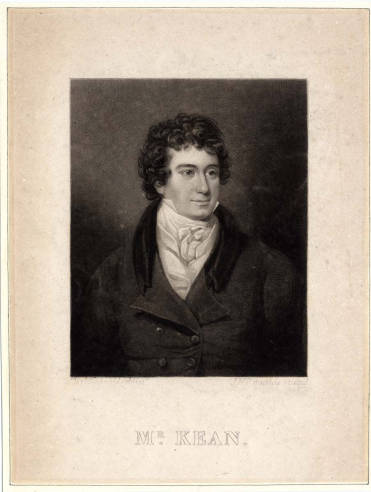
At the end of the 1815-1816 season, it was very obvious to Booth that Harris and the Convent Garden Theatre were not going to give him the chances he needed to be a star.  During the summer months, Booth returned to the provinces of Worthing and Brighton playing at Thomas Trotter’s theatres there.  Trotter increased Booth’s salary from the previous summer, and now paid him two pounds two shillings per week.  This was an increase even over his normal pay from Covent Garden and, at Trotter’s theatres, Booth was able to act regularly and in more lucrative roles.  As the summer came to a close, Booth wisely decided to remain in the provinces for the 1816-1817 season.  As his acting ability grew, Junius began to assemble a modest group of supporters in the provinces.  On September 25th, 1816, Junius got the opportunity that all supernumeraries prayed for.  At his theatre at Brighton, Thomas Trotter announced that Edmund Kean, the leading actor in England, was to play Sir Giles Overreach in A New Way to Pay Old Debts.

Edmund Kean

Edmund Kean

A leading London star in the provinces was a sure way to pack the houses and people came out to witness Kean’s majesty. In a serendipitous twist, Kean never showed up.  Kean later stated that he had never agreed to any such performance at Trotter’s, though it is equally likely that an attack of brandy prevented him from making the journey.  Trotter quickly brought in Booth who had been performing at his Worthing theatre.  Junius played the role meant for Kean that night, and he pleasantly surprised the expecting audience.  As Dr. Archer states in his book, “the neophyte had risen to the occasion.”  This successful, break out performance by Junius Brutus Booth led Trotter to give him more substantial roles.  In time, this greater exposure allowed Booth to gain a following of fans.  Several of these fans turned out to be better than your run of the mill theatre goers.  Three rich and influential patrons banded together on Junius’ behalf.  They collectively paid a visit to Henry Harris back at the Covent Garden Theatre in London.  They convinced Harris to give Booth a trial night in the city where he would play the leading role.  His shot as a star on the London stages occurred on February 12th, 1817.

Junius’ star debut came at a crucial time for the young actor.  He and Adelaide had suffered the devastating death of their first child, Amelia.  Though her exact date of death is unknown, it is likely that the poor girl passed away sometime during Junius’ season in the provinces.  Mourning the loss of their daughter, a needed boost in Junius’ theatrical career was just what the small family needed.  Alas, when Junius arrived at Covent Garden to rehearse for his leading role, he was greeted with less than open arms.  His former cast mates jeered him stating, “Why, I declare! It’s little Silvius of last season, come to play Richard the Third, in opposition to the great Kean!” “I wonder, now, if the manager expects respectable actors to play secondary parts to him!”  In fairness, it was probably a slap in the face to the troupe of Covent Garden to play supporting roles to an amateur that had been among the lowest in their ranks a year before, even if the arrangement was for only one night.  One of the supporting actresses, a Sally Booth, requested that Junius might add an “e” to the end of his surname so that, upon his assumed failure that night, the audience would not mistakenly believe they two were related and therefore tarnish her reputation.  In turn, Junius made a snide remark about how Ms. Booth had been trying to change her own name through marriage with an equal amount of success as her acting ability.

Despite the negativity from his colleagues, Junius prepared for his best, and perhaps only, chance at stardom.  He chose Shakespeare’s Richard the Third as his play as it was one of his successful roles in the provinces.  This was Junius Brutus Booth’s chance to replicate the success of Edmund Kean.  Kean, himself, had come from the provinces as an unknown actor in 1814 and was now the most celebrated star in London with a following of devoted fans known as Keanites.

We can only imagine the amount of stress and trepidation Junius must have felt when the curtain rose on February 12th, 1817.

Junius Brutus Booth as Richard III

Junius Brutus Booth as Richard III

When the curtain fell at the conclusion of the play, Junius’ fate as an actor was set.  Here are some quotes from London theatre critics of “Mr. Booth’s” debut at Covent Garden:

“an exact copy or parody of Mr. Kean”

“a perpetual strut and an unwielding swagger”

“He stamps too often”

“[he] traverses more extent of the stage than any Actor we ever beheld”

“Though it may pass at Brighton for grand, gracious, and magnificent, even the lowest of the mob will laugh at [it] in London”

From these reviews, it would appear that Junius was practically booed from the stage.  However, the exact opposite was true.  Despite the complaints of some theatre critics and loyal Keanites, Booth closed Richard the Third with “rapturous and unanimous applause”.  Following Junius’ bows, another actor appeared onstage to announce the next evening’s performance, as was customary.  When the audience heard that tomorrow’s play, A Midsummer’s Night’s Dream, would not feature Junius Brutus Booth, they stood shouting chants of, “Richard the Third!  Booth as Richard!”  The shocked messenger actor retreated backstage and consulted the manager.  In face of the sudden and thunderous acclamation of Booth, the manager ceded to the audience’s wishes.  He announced that Booth would repeat his role and talent the following night.  As Dr. Archer expertly sums up in his book, “No new tragedian, fresh from the country, could ask for more.”

The next night, Junius received an almost identical demonstration of support.  At the conclusion of his second performance as Richard the Third the audience once again rose to their feet and demanded a third performance for the next night, Friday.  Though this time the manager refused, he did announce that Booth would return as Richard on Monday the 17th.  Junius had succeeded in establishing himself as an exciting, new tragedian and soon had his own following of fans named “Boothites”.

There is no doubt that Adelaide and Junius’ father, Richard, were incredibly relieved at Junius’ new found success.  However, in a city such as London, there can be only one reigning monarch of the stage.  A battle, the likes of which had never been seen before, was about to start between the rising upstart Junius Brutus Booth and the king of the London stages, Edmund Kean.  Which would come out the victor in their Shakespearian scuffle? Stay tuned for the next post in this series.

References:
Junius Brutus Booth: Theatrical Prometheus by Stephen Archer

Categories: Uncategorized | Tags: | 4 Comments

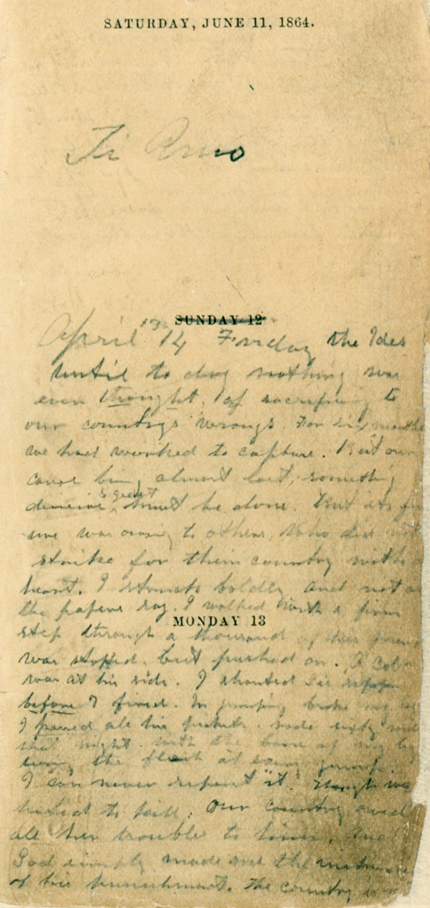
The Text of John Wilkes Booth’s Diary

Booth's Handwriting Page 1

Ti Amo

April 13 – 14 Friday the Ides
Until to day nothing was
ever thought of sacrificing to
our country’s wrongs. For six months
we had worked to capture. But our
cause being almost lost, something
decisive ^& great must be done. But its fail
ure was owing to others, who did not
strike for their country with a
heart. I struck boldly and not as
the papers say. I walked with a firm
step through a thousand of his friends
was stopped, but pushed on. A Col
was at his side. I shouted Sic semper
before I fired. In jumping broke my leg.
I passed all his pickets, rode sixty miles
that night with the bone of my leg
tearing the flesh at every jump.
I can never repent it, though we
hated to kill, Our Country owed
all her troubles to him, and
God simply made me the instrument
of his punishment. The country is not

Booth's Handwriting Page 2

April 1865
what it was. This forced union is not
what I have loved.. I care not what
becomes of me” I have no desire
to out-live my country. This night
(before the deed), I wrote a long
article in which and left it for one of the
Editors of the national Intelligencer
In which I fully set forth our reasons
for our proceedings. He or the Govmt

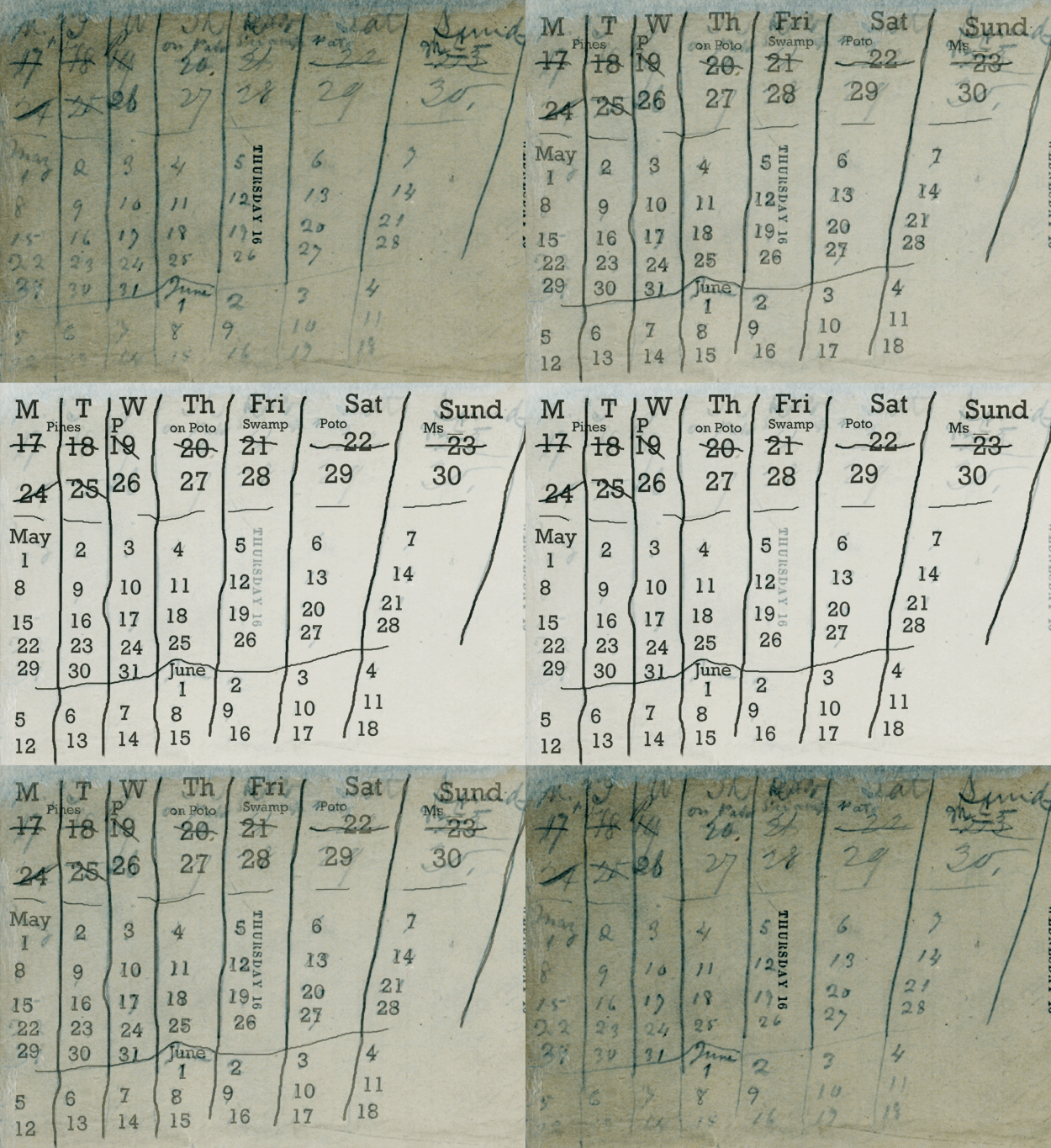
Booth's-Calendar-Animation

EDIT: On the animation above I incorrectly transcribed the letters underneath Sunday as “Ms” when it should be “M__ C__”. This likely stands for Machodoc Creek, the place where Mrs. Quesenberry’s house stood. The pair thought they entered Machodoc Creek as directed by Jones, but were actually in Gambo Creek.

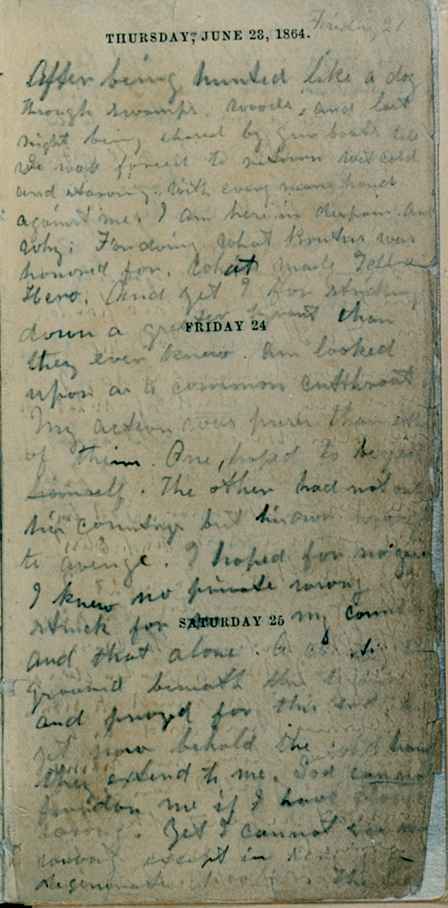
Booth's Handwriting Page 3

Friday 21
After being hunted like a dog
through swamps, woods, and last
night being chased by gun boats till
we I was forced to return wet cold
and starving. With every man’s hand
against me. I am here in despair. And
why. For doing what Brutus was
honored for. What made Tell a
Hero. And yet I for striking
down a greater tyrant than
they ever knew I’m looked
upon as a common cutthroat.
My action was purer than either
of theirs. One hoped to be great
himself. The other had not only
his country’s but his own wrongs
to avenge. I hoped for no gain.
I knew no private wrong. I
struck for * my country
and that alone. A country that
groaned beneath this tyranny
and prayed for this end and
yet now behold the cold hand
they extend to me. God cannot
pardon me if I have done
wrong. Yet I cannot see my
wrong except in serving a
degenerate people. The little

Booth's Handwriting Page 4

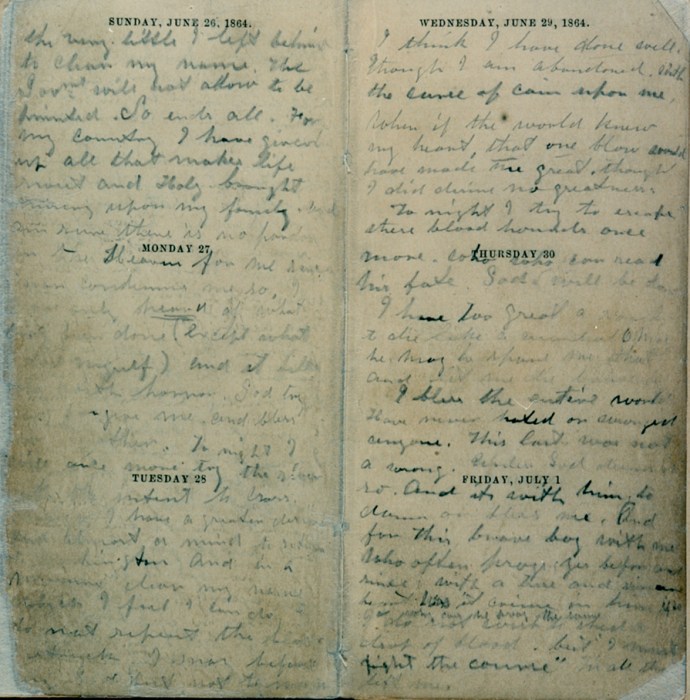
the very little I left behind
to clear my name the
Govmt will not allow to be
printed. So ends all. For
my country I have given
up all that makes life
sweet and Holy brought
misery upon my family and
am sure there is no pardon
in the Heaven for me since
man condemns me so. I
have only heard of what
has been done (except what
I did myself) and it fills
me with horror. God try
and forgive me and bless
my mother. To night I
will once more try the river
with the intent to cross.
Though I have a greater desire
and almost a mind to return
to Washington And in a
measure clear my name
which I feel I can do. I
do not repent the blow
I struck. I may before
my God but not to man.

I think I have done well.
Though I am abandoned with
the curse of Cain upon me,
When if the world knew
my heart, that one blow would
have made me great. though
I did desire no greatness.
To night I try to escape
these blood hounds once
more. Who who can read
his fate. God’s will be done.
I have too great a soul
to die like a criminal. O May
he, May he spare me that
and let me die bravely.
I bless the entire world.
Have never hated or wronged
anyone. This last was not
a wrong. Unless God deems it
so. And its with him to
damn or bless me. And
for this brave boy with me
who often prays (yes before and
since) with a true and sincere
heart was it crime in him. if so
why can he pray the same
I do not wish to shed a
drop of blood but “I must
fight the course” Tis all that’s
left me.

Categories: Uncategorized | Tags: , | 8 Comments

Michael O’Laughlen’s Forgotten Ability

I found this oil painting of conspirator Michael O’Laughlen today:
Laser Eyed O'Laughlen Painting Sadly, it has already sold for $126. It would have looked just lovely above our mantle, too…

Categories: Uncategorized | Tags: , | 5 Comments

Booth From the Great Beyond

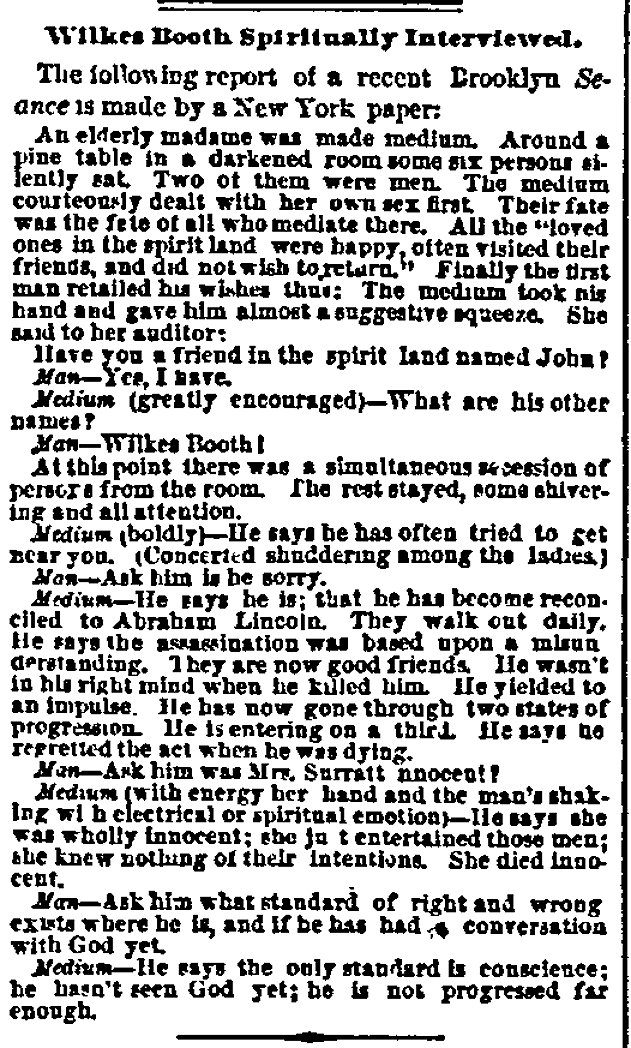
While researching Edwin Booth in 1870, I stumbled across this article about his dead brother that I knew I had to share:

Talking With John Wilkes Booth's Spirit

I think it’s great that John Wilkes Booth and Abraham Lincoln were able to work out their differences in death. I’m sure their daily walks on the other side are filled with interesting and lively discussions highlighted, of course, by the shared laughter of the two “good friends”. In truth we should have known that, given the chance, Lincoln and Booth would have been friends. Look at how attentively Lincoln’s spirit followed Booth after the latter murdered the former:

Assassin's Vison

Clearly Lincoln was waiting patiently for his walking buddy to arrive so the two could work things out.

This article reminded me of another instance where Booth’s spirit is resurrected, as it were.

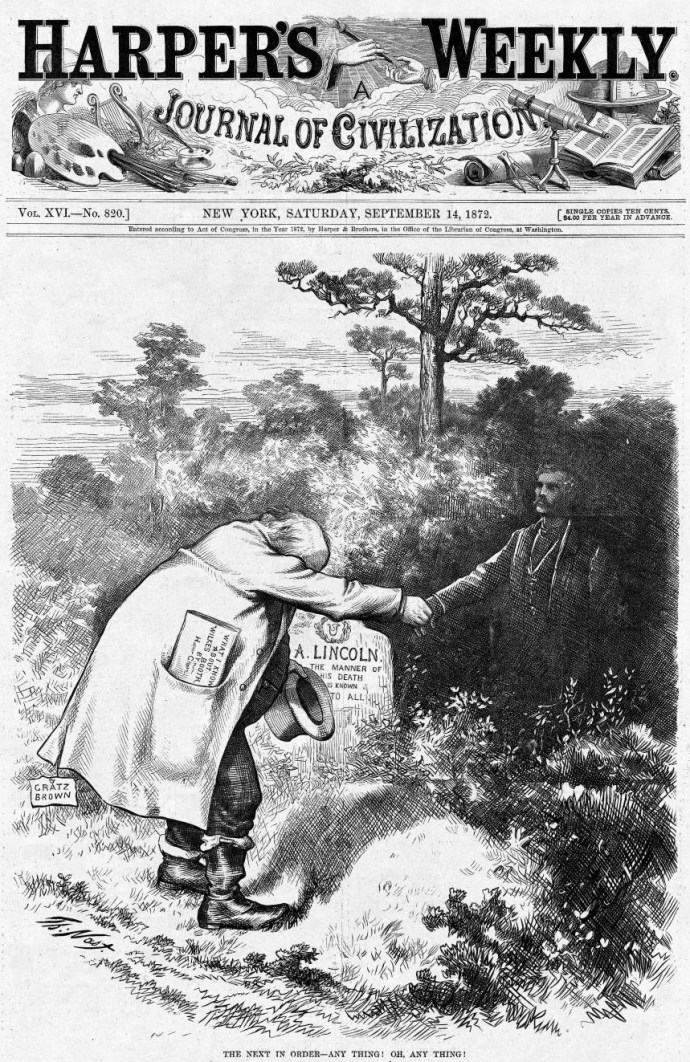
1872 Harper's Weekly political cartoon by Thomas Nast showing Presidential candidate Horace Greeley shaking hands with John Wilkes Booth's spirit over Abraham Lincoln's grave.  Due, in part, to Nast's severe character assassination of Greeley through his cartoons, Greeley lost the election to U.S. Grant.

The 1872 presidential election was between incumbent U.S. Grant and the candidate Horace Greeley. Greeley was the founder and editor of the New York Tribune, and one of the most outspoken abolitionists leading up to the Civil War. During and after the Civil War, Greeley’s views often seemed contradictory.  Though ardently opposed to slavery, he attempted to pursue a peace policy with the Confederacy in 1863/1864.  During Reconstruction he sided with the Radical Republicans and pursued harsh policies for ex-Confederates with simultaneously signing a bond for the release of Jefferson Davis.   He supported Grant in the 1868 election, but became unhappy with his presidency.  He broke away from the Republican party and helped form the Liberal Republican party.  The Liberal Republicans made Greeley their candidate for the President in the 1872.  The Democratic party at that time consisted of mainly Copperheads and former Confederates.  Desperate to get Grant out of the White House, the Democratic party also endorsed Greeley as their candidate too.  Greeley was now aligned with a party he had fought against for years.

Republican supporters of President Grant like artist Thomas Nast seized upon the illogical pairing of Greeley and the Democrats.  Nast proceeded on a campaign of character assassination through his cartoons, demonstrating Greeley’s willingness to side with anyone in order to get votes.  The above cartoon showing Greeley shaking hands with John Wilkes Booth over Lincoln’s grave, is one of several in a series demonstrating Greeley’s willingness to ignore travesties of the past to win the election.  You can see more of Nast’s political cartoons about Greeley on this fascinating site.

Not only did Horace Greeley lose the election of 1872 to Grant, but he also died between the popular vote and the electoral college.  Perhaps he and Thomas Nast took a page out of Booth and Lincoln’s book and are up there now, taking a walk and working out their differences.

References:
Daily Eagle, 9-19-1870
Harper’s Weekly, 9-14-1872
Cartoonist Thomas Nast vs. Candidate Horace Greeley

Categories: Uncategorized | Tags: , | 4 Comments

Where’s Edwin?

After my last post about the whole Booth family living under one roof during the 1860 census, Art Loux posed an interesting question:

Has anyone found the Booths in the 1870 census? I have looked for Mary Ann, Rosalie, Edwin and Joseph but have not found any of them. Asia was in England.

I decided to see if I could find an answer for him.  I decided to look for Edwin first, hoping the rest of the family would be with him.  As a popular actor, I figured he would be the easiest one to track down.  Having recently bought Arthur Bloom’s wonderful new book, Edwin Booth: A Biography and Performance History, I figured I’d have the answer in just a half hours work. Boy was I wrong.  After a couple days of pouring over census pages, I’ve still come up empty trying to find the greatest Hamlet of his generation in the 1870 census.  However, I have two ideas as to why I haven’t been able to find him: Either Edwin missed the census or the census missed him.

First, utilizing Bloom’s biography of Edwin, let’s discuss Edwin Booth’s life leading up to the 1870 census.

1867 – 1869:

The three years previous to the census were very formative years in the life of Edwin Booth.  In June of 1867, Edwin purchased four adjacent land plots at the intersection of 6th avenue and 23rd street in New York City.  It was here, that Booth invested his fortune to build his own theatre, Booth’s Theatre.  Though Booth managed the building of the theater, he spent little time witnessing the progress on it.  Instead, he spent the acting seasons of 1867-1868 and 1868-1869 touring in order to fund the project.  He had hoped to have the theatre ready to go by December of 1868, but delays pushed back the grand opening of his theatre until February 3rd, 1869.  He opened his namesake theatre with Romeo and Juliet.

Booth's Theatre

Booth’s Theatre

Shortly after the theatre opened for business, Edwin most likely read in the papers about the presidential pardon of Dr. Mudd for his involvement in the assassination of Abraham Lincoln.  Pardons for conspirators Samuel Arnold and Edman Spangler followed soon after.   Seven days after his theatre’s debut, Edwin Booth wrote to President Andrew Johnson asking, again, for the remains of his misguided brother.  Edwin was successful this time, but he did not go to Washington, sending his brother and business manager Joseph in his stead.

During this period, Edwin had fallen in love again.  Mary Devlin, Edwin’s first wife and mother of his only child, Edwina, had died in 1863.  The new object of Booth’s affection was Mary McVicke.  Mary was the step-daughter of James McVicker, the actor and owner of McVicker’s Theatre in Chicago.   In mid-1867, Booth offered Mary McVicker the role of his leading lady for the 1867-1868 season.  In truth, McVicker was hardly experienced enough to be a leading lady, but Edwin was smitten with the 19 year old.  They toured together and by the summer of 1868, Edwin and Mary McVicker were living together.  They finally made the arraignment official and married on June 7th, 1869, four months after the opening of Booth’s Theatre.  By October of 1869, Mary was pregnant.

Edwin and Mary (McVicker) Booth

Edwin and Mary (McVicker) Booth

From Bloom’s biography and newspaper accounts, we learn that during this time period Edwin and Mary were living in Booth’s Theatre in a suite of rooms.

Edwin Living at the Theatre

When the summer months rolled around, Edwin and Mary liked to vacation at Long Branch, New Jersey.  Long Branch had been a beach resort town since the late 18th century.  By the 19th century, it had become a “Hollywood” of the east coast, with many actors (particularly those from New York) calling Long Branch their summer home.  In fact, Mary’s stepfather, James McVicker, owned a home in Long Branch and the family would summer there.

Actors at Long Branch

During the 1869 -1870 theatrical season, Edwin needed to make more money to help repay his debts from building Booth’s Theatre and therefore went touring.  Pregnant Mary joined her husband as he travelled to Philadelphia, Boston, and other New England cities.  By January of 1870, the Booths were back at their own theatre.  Edwin’s next documented performance outside of New York was not until the 1870 – 1871 season.

1870:

After a great deal of researching here is my timeline for Edwin Booth for the year of 1870, the census year.

January – April,  1870 – Edwin and Mary are at home, living in Booth’s Theatre on the corner of 6th avenue and 23rd street, NYC.  Edwin is performing in his own theatre.

April 16th, 1870 – Edwin’s last performance at Booth’s Theatre for the 1869 – 1870 season.

May 1870 – Edwin and (most likely) the pregnant Mary travel to Long Branch, New Jersey for a brief vacation before the baby is due in June.  Newspaper clippings support the idea that Edwin was in Long Branch.

Edwin in Long Branch May Edwin in Long Branch May 2

May 30th, 1870 – James McVicker, Mary’s stepfather, opens at Booth’s Theatre in a new play called “Taking the Chances”.

Early June, 1870 – Edwin and Mary return to their home above Booth’s Theatre in New York.

June 13th, 1870 – Edwin writes a letter to Jervis McEntee from New York, verifying that he is back home.

June, 1870 – Per Bloom’s biography: “Edwin and Mary were married in June 1869, and by late October she was pregnant.  The baby was almost a month late.  The doctors in attendance convinced the Booths that Mary miscalculated.  They all thought it was a joke, but the result was a disaster.” If the couple expected the baby was going to be born in June, this would explain why they left Long Branch after only spending a month there.  Since Mr. McVicker was playing at Booth’s Theatre, it would make sense that he would want to witness the birth of his (step) grandchild.

July 3rd, 1870 – Per Bloom: “Mary was a physically small woman, and the baby was so large (10- ½ pounds) that the attending doctors were forced to use forceps, which slipped twice and damaged the child’s head.  Edwin assisted at the birth, which came at 11:30 p.m. on July 3, 1870.”  By 4 a.m. the baby, named Edgar, had died.  The birth occurred at home in Booth’s Theatre.

July, 1870 – The birth was hard on Mary, and she was sedated with chloroform for five days after.  During her sedation, Edwin buried Edgar next to his first wife, Mary Devlin, in Massachusetts.  When he came back, he took Mary back to Long Branch to recover, likely with the McVickers in tow.

July 25th, 1870 – A letter written by Edwin Booth to Jervis McEntee from Long Branch, NJ, verifies that Booth was back at Long Branch.

August 20th, 1870 – A letter written by Edwin Booth to Charles Gayler (the playwright for the play Mr. McVicker had debited in May) from Long Branch, NJ, verifies that the couple was still at Long Branch.

September 5th, 1870 – Edwin Booth starts the 1870 – 1871 season at McVicker’s Theatre in Chicago.  Mary, now recovered from the after effects of childbirth, accompanies him, and her parents, there.

Mary McVicker back in Chicago

October – December, 1870 – Edwin Booth acts in St. Louis, Cincinnati, Pittsburgh, and Philadelphia.

December 16th, 1870 – Booth is in Philadelphia playing at the Walnut Street Theatre.  Edwin wrote to a friend on this date stating, “I shall be home at Xmas (God willing) and will follow Jefferson at Booth’s in Jan.  This is rather unexpected, tho’ I’m rather glad of it, for I am sick of traveling, and it is not the thing for Mary, who has been confined to the house for a week past…”  It appears Mary had continued to follow Edwin during his entire tour.

December 24th, 1870 – Edwin’s last performance in Philadelphia.  Edwin and Mary assumedly go home to New York.  Edwin starts playing at his own theatre starting January 9th, 1871.

Theories:

With the timeline above, I have two theories as to what happened with Edwin Booth and the census.

1. Edwin Booth missed the census.

According to Ancestry.com: “The official enumeration day of the 1870 census was 1 June 1870. All questions asked were supposed to refer to that date. The 1870 census form called for the dwelling houses to be numbered in the order of visitation; families numbered in order of visitation; and the name of every person whose place of abode on the first day of June 1870 was with the family.”  From newspaper accounts, we know that Edwin Booth was in Long Branch, NJ in May.  From a letter Booth wrote on June 13th, we know that he was then back in New York.  Two possible scenarios would eliminate Edwin Booth from being counted.  Either Edwin was still in Long Branch when his neighborhood was surveyed or Edwin was back in New York when the census enumerators came, but since he had been living in Long Branch on June 1st, they did not include him.  Two identical newspaper clippings from two different papers make a joke that supports the idea that Edwin Booth missed the census:

Edwin missed the census

2. The census missed Edwin Booth

The 1870 census was not without controversy.  After it was completed many states, including New York, believed that large portions of the population had been missed.  Could Edwin Booth have been one of those who were missed?  It may not be as ridiculous as it sounds.  Mary Booth’s step father, James McVicker, was engaged at Booth’s Theatre from May 30th –  June 11th performing in “Taking the Chances”.  Though I’ve not yet found documentation for it yet, it is extremely likely that Mr. McVicker stayed on at Booth’s Theatre to await the birth of his (step) grandchild.  This puts Mr. McVicker in New York City from May 30th to at least July 3rd.  If census takers surveyed him, he could honestly say he was living in NYC on June 1st and he would have been included.  However, like Edwin Booth, James McVicker is nowhere to be found in the 1870 census.  He’s not in New York City, he’s not in Long Branch, he’s not back home in Chicago.  Nor is there any record for Mrs. McVicker in the 1870 census either.  Perhaps the 1870 census actually missed Edwin Booth and his entire household.

The weirdest part of all of this is that, barring an obvious mistake by me, the Booths had to have been missed not once, but twice.  New York City was given permission to do a recount of the 1870 census and started a 2nd enumeration in December of 1870.  Edwin would have been at home when the enumerators were in his neighborhood in early January, but again, there is no record of him.  Perhaps, living in his own theater as he did, the census people did not think to knock on the theatre doors and ask about anyone living there.

The Rest of the Family:

While I was not successful in finding Edwin Booth for Art, I did find Mary Ann, Rosalie, and Joe.  The three of them were not living at the Booth Theatre.  In August of 1869, Edwin wrote a letter to a friend in which he stated, “I sold my house some weeks ago—obtained comfortable quarters for my brother and sister— with whom Joe resides…”  The “Joe” Edwin names is not his brother, but rather actor Joseph Jefferson.  When this letter was written, Joe Jefferson was performing his famous Rip Van Winkle character at Booth’s Theatre.  This helped me place the residence of the Booth family somewhat close to the Theatre.  When I found the following census record for a “Maria”, Rosalie, and Joseph Booth, boarding less than a mile from Booth’s Theatre down 6th avenue, I knew I had found the right family.

Mary Ann, Rosalie, and Joseph Booth in the 1870 Census.  Click the image for the full page.

Mary Ann, Rosalie, and Joseph Booth in the 1870 Census. Click the image for the full page.

They all decided to fudge their ages a bit.  In reality, Mary Ann was 68, Rosalie was 47, and Joe was 30.  Oh vanity, thy name is Booth.

Conclusion:

If I have completely wasted my time and Edwin is actually in the 1870 census, plain as day, I welcome the correction.  I’d be embarrassed for missing him, of course, but I’d rather know.

Despite his fame and fortune, Edwin Booth has proven to be an elusive man.  Though I’ve come up empty handed trying to find him in the 1870 census, the process of searching for him has taught me more about his life around that period than I would ever have known otherwise.  I searched the records, documented Edwin’s movements and read hours’ worth of census pages.  The search for knowledge is what makes this all worthwhile.  Still, if you’ll excuse me, I’m going to go and take a nap until the next census to recover.  Or maybe a vacation would do me some good.  I’ve read Long Branch, NJ is nice.

References:
Edwin Booth: A Biography and Performance History by Arthur Bloom
The 1870 Federal Census accessed through Ancestry.com
Newspaper articles from GenealogyBank.com
The Hampton-Booth Theatre Library online card catalog
Letters from Edwin Booth to John E. Russell from The Outlook magazine April 20st, 1921

Categories: Uncategorized | Tags: | 3 Comments

All Under One Roof

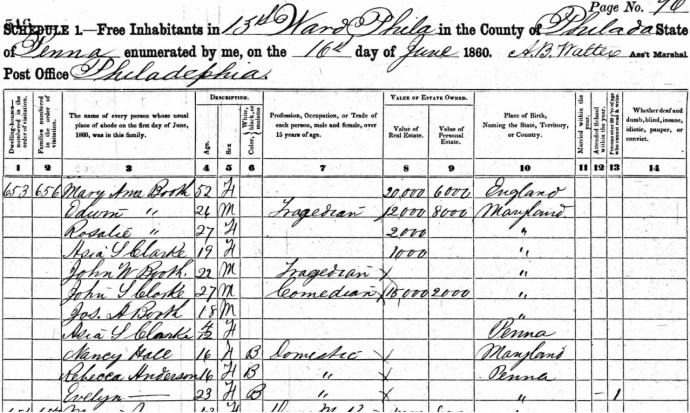
Thank you to Art Loux for sharing this interesting census record from 1860 with me.  It shows a rare instance in which practically all the members of the Booth family are living under one roof.  The only missing family members are the deceased Junius, Sr. and the living Junius, Jr. who resided in California.

Booth family in the 1860 Census

The home in Philadelphia that all the Booths were living in was the home of John Sleeper Clarke and Asia Booth.  The two had been married the previous year.  In June of 1859, about two months after their marriage, Mary Ann Booth moved in with the newlyweds.  Joe and Rosalie followed her shortly thereafter.  When this snapshot was taken Edwin, John Wilkes, and John Sleeper Clarke were all briefly home due to the completion of the acting season.  The summer heat made a crowded theater an unbearable affair and so the theater season was closed until the fall.

This full house of Booths would not last long at all, however.  Less than a month after this census record was taken, Edwin was married to his first wife, Mary Devlin.  The newlyweds honeymooned at Niagara Falls and then took up a home in New York.  By December of 1860, Asia wrote a letter to her friend Jean Anderson in which she mentions how Mary Ann, Rosalie and John Wilkes were no longer living at her home, having taken up residence at a boarding house elsewhere in Philadelphia.  Finally, Joseph Booth was enrolled in medical school in Charleston, South Carolina before the end of 1860.

As swiftly as they had all assembled, the Booths quickly separated again leaving us with only the above glimpse of a rare reunion among the entire family.

References:
Art Loux
Edwin Booth: A Biography and Performance History
John Wilkes Booth’s Enigmatic Brother: Joseph by John C. Brennan
Ancestry.com

Categories: Uncategorized | Tags: , | 11 Comments

100,000+!

Ring of Conspirators

On September 12th, 2012, I put up a quick little post highlighting the 10,000th “hit” to this site. As a blog devoted to a fairly small niche of American History, I was very happy that so many people were visiting and finding the site to be valuable. Now, a little over a year later, I’m ecstatic that BoothieBarn is over the 110,000 mark!

110,000 stats

This means that over the last year this blog had over 100,000 clicks on it. The majority came from repeat visitors and followers who are so engaging with their comments. Thank you all for your continued support.

The creation of the BoothieBarn Picture Galleries during this last year also gave a boost to the number of visitors and clicks. As a visual learner myself, I’m striving to provide a beneficial archive of images relating to the assassination of Abraham Lincoln.

Lastly, my foray into recording parts of the escape route has been very well received. As a recent transplant to Maryland, I’m happy to show the escape route locations that are now in my backyard.

While I rarely know what I’m going to blog about when I sit down to write, I thank you all for coming back day after day to check it out. At the very least, there are still many Picture Galleries to add and I’m actively developing a plan to recreate Booth and Herold’s time in the pine thicket during their escape.  I’m really excited over the prospect of immersing myself into the history and sharing my experiences with you all.

Thank you so much for reading BoothieBarn and for keeping me motivated to write about a subject I find endlessly fascinating.

Sincerely,

Dave Taylor

P.S. Tomorrow (9/21) I will be going on one of the John Wilkes Booth Escape Route Tours run by the Surratt House Museum. While I won’t be “live blogging” it like last time, I’d be happy to take pictures of any requested site or artifact. Just let me know in the comment section.

Categories: Uncategorized | 28 Comments

Blog at WordPress.com.