When Junius Took the Stage – Part 5

I’m in the midst of reading the book, Junius Brutus Booth: Theatrical Prometheus by Stephen M. Archer. One of the most fascinating things I’ve come across thus far is the drama that occurred when Junius Brutus Booth made his star debut in the theaters of London. In preparation for a post about the matter, I found myself with a wealth of material on the early theatrical life of Junius Brutus Booth. Instead of summarizing key points of Junius’ initial acting career, I decided to write a series of posts examining the humble acting beginnings of the man who would later father a theatrical dynasty, including the assassin of President Lincoln. What follows is a continuing part of a series of posts entitled, “When Junius Took the Stage”. Click here for Part 1, here for Part 2, here for Part 3, and here for Part 4 of the series.

Part 5 – When Junius Took on Kean

On February 12th, 1817, Junius Brutus Booth made his staring debut at the Covent Garden Theatre in London.  A thunderous round of applause and acclaim followed his efforts and the crowd demanded a repeat of the spectacle the following night.  This reprise also proved to be extremely successful for the young actor and also buoyed the spirits of Henry Harris, the manager of Covent Garden who had been convinced to give Booth a shot at stardom.  When the audience once again called for a repeat of Booth’s performance the next night, Harris assured the crowd that Booth would return, just not that next night.  Harris not only scheduled Booth to play Richard the Third again on Monday the 17th, but also entered into negotiations to sign Booth to a three year contract with his theatre.  Junius had exceeded his “try out” as a star at Covent Garden, and Harris was eager to have the rising star remain in his employ.

Junius Brutus Booth as Richard the Third.  This engraving was made in 1817.

Junius Brutus Booth as Richard the Third. This engraving was made in 1817.

The press caused by Booth’s appearances at Covent Garden caught the attention not only of the theater-going public, but also the leading star of the London stages, Edmund Kean.  Kean was the unrivaled star of London and had been since his staring debut in 1814.  Kean had an extremely devoted group of fans and was almost universally adored and acclaimed by the newspapers and theatrical magazines.  Kean’s supporters were called “Keanites” but a faction of extremely devoted fans was appropriately known by the name of “The Wolf Club”.  In their appreciation and fanaticism for Kean, the Wolves made it a practice to effectively quell any prospective rivals to Kean’s dominance in London.  They openly heckled actors who had the audacity to act in roles “perfected” by Kean.  Booth’s successful and seemingly ongoing engagement at Covent Garden proved a threat to Kean’s throne.  The Wolves responded by describing Booth’s acting as a mere imitator of the great Kean.  Perhaps hoping to contain this rival before he had a chance to eclipse him, Edmund Kean, himself, entered the scene.

A caricature of Edmund Kean and his "Wolf Club"

A caricature of Edmund Kean and his “Wolf Club”

After Booth’s second staring performance, Kean heard through sources that Booth and Henry Harris had disagreed on an appropriate contract for him to play at Covent Garden.  Kean rushed into a carriage and found Booth dining.  He greeted Booth as a fellow colleague and informed him that he had a theatrical engagement for him.  Kean took Booth over to Drury Lane Theatre, the theatre he acted in and had a great deal of influence.  Over drinks and accolades, Kean convinced Junius to sign a contract with Drury Lane.  It was inferred that the two would be partners and, together, they would astound London with their mutual talents.  For their first shared debut it was decided that they would act in Othello.  Kean would play the heroic Venetian general, Othello, while Junius would play the antagonistic ensign bent on his leader’s destruction, Iago.  For Junius this likely appeared to be the opportunity of a lifetime.  He would act side by side of the great Kean and show all of London that they were equals, skyrocketing his popularity.  Perhaps even, the audience would deem him the superior actor, essentially establishing him for life as the premiere actor in London.  So much was on the line for this performance in Junius’ eyes.  To Kean’s perspective, however, their debut was a chance to put this young upstart down for good.  It was an opportunity for Kean to prove his preeminence in the most direct way possible.

In Dr. Archer’s book on Junius Brutus Booth, he entitled the chapter on the Kean-Booth performance as, “Showdown at Old Drury”.  This perfectly encompasses the tone that occurred on February 20th, 1817, when the curtain rose on Shakespeare’s Othello.
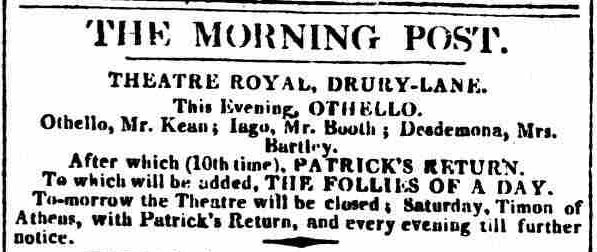
A newspaper advertisement announcing the shared performance of Booth and Kean for February 20, 1817.

A newspaper advertisement announcing the shared performance of Booth and Kean for February 20, 1817.

It was a night to be talked about for years to come and the audience came out in droves to see which man earned his laurels.  I quote from Dr. Archer:

“Booth lost. Most accounts suggest that Kean acted Booth off the stage, driving him out of London and to America.  While not exactly the case, Kean took the palm for the evening, and London theatregoers never again considered Booth a rival to Kean, even after the older actor fell from public favor.”

Kean had brought out all the stops for this much anticipated performance.  “On this occasion,” the London Sun reported, “[Kean] exerted himself more than he ever did before.  His energy was great, and his execution of many touches very fine.  Indeed the whole third Act was a masterpiece in his style.”  Kean’s increased vigor and passion was easily observed by the audience and elicited thunders of applause and esteem by his “Wolves”.
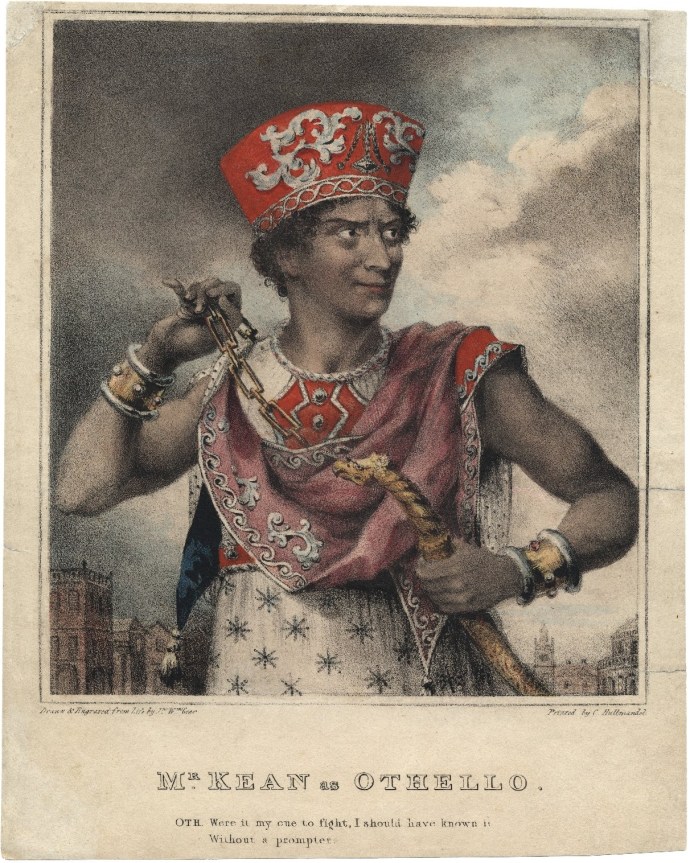
Edmund Kean as Othello

Edmund Kean as Othello

Junius’ performance, it was written, “was a creditable performance, but it was nothing like what a too [sanguine] public fondly anticipated it would prove.”  The young actor was no match for eminent Kean.  In one performance, Kean established his perpetual dominance over Junius Booth.  Reviews were consistent that Junius performed well, and that, “with another actor [as Othello] the Iago of the evening might have been thought of great, but by the side of Kean we could discover in him nothing strikingly original in thought, vivid in conception, or brilliant in execution.”  It seems clear that the two men were on completely different levels and that Kean’s star shined higher and brighter than Junius’.  The cruelest reviews for Junius continued the idea that Booth was merely an imitator of Kean and unworthy to act in his presence.

It is likely that his inability to topple Kean and the practically universal reviews announcing his submission to the reigning star, depressed the young actor.  His misfortune was not over yet, however.  With a clear victor established, Drury Lane proceeded to cast plays headlining Kean and banishing Booth to less prominent roles.  Junius quickly learned that he would not be able to play any roles that “belonged” to Kean.  In Richard the Third, the play that had brought him accolades at Covent Garden, he was banished to playing the smaller role to Richmond to Kean’s Richard.  He could not play Hamlet, Sir Giles Overreach, or Bertram either.  He was to be essentially shelved, allowed in to act in roles barely better than the stock actors, so that he would never dream of rivaling Kean again.

At the same time, Junius was once again approached by Henry Harris at the Covent Garden Theatre.  Harris did not consider their negotiations regarding a contract with his theatre to be over and he still desired Junius for his stage.  A performance was scheduled at Drury Lane for February 22nd, in which Junius would act as Richmond to Kean’s Richard III.  Junius was overwhelmed.  As Dr. Archer puts it, “he had acted only slightly more than three years, and he now found himself torn between the two leading theatres of the English-speaking world.”  He had signed a contract with Drury Lane to act with Edmund Kean but, on the other hand, fulfilling that contract would subjugate him to less prominent roles and he was receiving an offer from Covent Garden which would allow him to act in his leading roles once again.

Junius Brutus Booth circa 1817

Junius Brutus Booth circa 1817

A second performance of Othello at the Drury Lane Theatre was scheduled for February 22nd.  Audiences, already knowing that Booth was no match for their beloved Kean, came out in droves to express their admiration for the victor.  Junius was not anxious for another round of reviews calling him grossly inferior to Kean.  He needed time to think and reflect on his future.  He wrote a letter to the manager of Drury Lane which was delivered to the theater by 3:30 pm.  In it he expressed his inability to perform that night due to being, “extremely ill from the agitation,” he had suffered the previous week.  Junius, along with a friend named James Salter, departed London and traveled by coach to a suburb of London called Tottenham.  Here, he attempted to restore his body and spirit.

Trouble was brewing back in London, however.  Though the manager of the Drury Lane Theatre, Alexander Rae, had received Junius’ letter early enough in the day to have the playbills changed and an announcement of his illness posted, he chose not to.  Whether this inaction was prompted by Kean is unknown, but the outcome of this certainly worked in his favor.  When the audience members arrived to see Kean and Booth in Othello and were told that Booth was not there, they were furious.  The performance went on with stage manager Rae playing the part of Othello to Kean’s Iago.

Due to the crafty behavior of Rae, Kean and the Drury Lane Theatre, Booth’s absence from the performance that night was seen as a slight to London’s theatre going public.  In an occupation where one thrived, or died, based on the whims of the audience, this offense would have major ramifications for Junius Brutus Booth.  Stay tuned for the next installment in this series, “When Junius Took on the Mob”.

References:
Junius Brutus Booth: Theatrical Prometheus by Stephen Archer
Categories: Uncategorized | Tags: | 3 Comments

Lincoln Assassination sites via View-Master

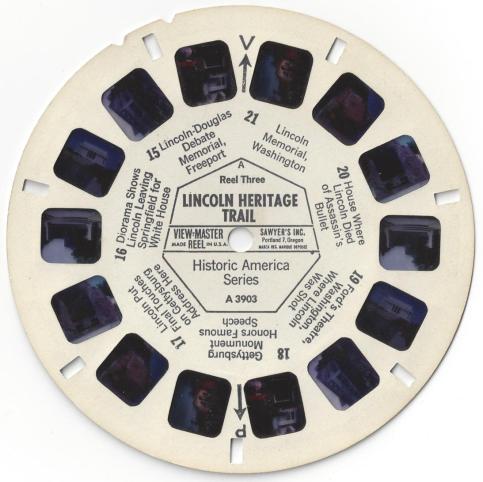
One of the great things about being home for the holidays is the chance to engage in some nostalgia. Today, I was looking through some of the old toys that my siblings and I played with as kids. My eyes came across a large container full of old View-Master cards. I found my favorite reels containing images of Mickey Mouse, Muppets, Snoopy, and other childhood characters. After playfully clicking through and looking at the familiar 3D images, I discovered some non-familiar View-Master reels. We probably inherited from my grandparents collection and it’s doubtful that I ever took any interest in these, non character, related reels as a child. Among the different views of national parks and seascapes was a set of three reels entitled the, “Lincoln Heritage Trail”.

Lincoln viewmaster

Though I have not been able to come up with a date for the images or the reels, there were two pictures from the reels that connect to Lincoln’s assassination.

Photo Dec 25, 8 53 21 PM

Ford’s Theatre from the “Lincoln Heritage Trail” View-Master reel

Photo Dec 25, 8 54 23 PM

Petersen House from the “Lincoln Heritage Trail” View-Master reel

I put the other 19 images from the “Lincoln Heritage Trail” View-Master reels up on Roger Norton’s Abraham Lincoln Discussion Symposium. Check them out here.

Categories: Uncategorized | Tags: , | 6 Comments

Lewis Powell is Coming For You

Leading up to the holidays last year I posted three Christmas carols that I had rewritten to be Lincoln assassination themed. You can read them here, here, and here. Tonight, as many children are going to sleep and dreaming of a man in a red suit who will soon enter their house, I present one more carol about a different, less jolly man who entered a house on April 14th, 1865.

lewcoming

Lewis Powell is Coming For You
As sung to, “Santa Claus is Coming to Town”

You better watch out.
You better not cry.
You better not pout.
I’m telling you why.
Lewis Powell is coming for you.

He’s made up his rounds,
He’s checked up on you.
He’s found all about,
Your injury, Sew.
Lewis Powell is coming for you.

He’ll wait ‘til you are sleeping.
He’ll say he has some meds.
He’ll follow Bell right up your stairs,
Then bash Fred in the head.

You better watch out.
You better not cry.
You better not pout.
I’m telling you why.
Lewis Powell is coming for you.

Then Lew will draw a dagger,
He’ll slash and hit your brace.
So you’ll survive another day,
With a scar upon your face.

So, you better watch out.
You better not cry.
You better not pout.
I’m telling you why.
Lewis Powell is coming for you!

On a serious note, thank you for your continual support and friendship. I hope all of your Christmases are merry and bright and that you have a blessed holiday season.

Sincerely,

Dave Taylor
BoothieBarn.com

Categories: Uncategorized | Tags: , | 7 Comments

Views of Fort Jefferson

My sincerest thanks go out to fellow blogger, Dop Troutman, who sent me the following images he took of Fort Jefferson, Florida.  Fort Jefferson was a military fortress built on an island off of the coast of Florida near Key West.  During the Civil War, the base was also used as a military prison by the Union.  After the assassination of Abraham Lincoln and the trial of the conspirators, Dr. Samuel Mudd, Samuel Arnold, Michael O’Laughlen, and Edman Spangler were sentenced to prison at Fort Jefferson.  They were imprisoned here from 1865 until their subsequent pardons in February of 1869.  Michael O’Laughlen died at Fort Jefferson in 1867 from a Yellow Fever epidemic that struck the base.

Dop, who writes about a variety of topics on his blog “View From the Jeep“, emailed me a couple weeks ago telling me he was planning on visiting the Fort and asked if I would like any photographs of anything in particular.  I happily took him up on his offer telling him I would love any pictures he might be willing to send me, especially pictures of the conspirators’ cell from different angles.  True to his word, Dop graciously sent me several photographs.  I’m happy to share them along with Dop’s very detailed descriptions.

This slideshow requires JavaScript.

“Sally Port is the only entrance to the fort. The 4 conspirators were all housed together in one open-air cell. That cell is directly above the Sally Port door. The three narrow windows above the door mark the cell:”
C. Sally Port

“These are of Mudd’s Cell after he was thrown in the “dungeon” following his attempted escape. There is no proof this was the actual location, but the conditions would have been the same. The interesting thing about the fort is that there were no doors, cells, or bars. It was an open-air prison. No “cages”, just guards stationed everywhere to keep prisoners in their place. However, the lack of food & fresh water and the oppressive heat usually took the spunk out of everyone:”
D. Mudd Dungeon Cell
E. Mudd's Dungeon Cell Entrance - Looking South

I. Mudd Dungeon Cell SignFor the story of this plaque, click here.

J. Mudd Dungeon Cell - Looking East
K. Passage Leading to Dungeon

“There used to be a sign above the door that read something like “Abandon Hope All Ye Who Enter”, but its been removed:”
F. Mudd Dungeon Cell Entrance - Looking West

“You can see how large the space is. I’m sure Mudd shared this space with other prisoners. We estimate it to be about 1100 square feet:”
G. Mudd Dungeon Cell - Looking SW
H. Mudd Dungeon Cell - Looking NW

“This is the conspirators’ shared cell. All 4 were housed here beginning in late January 1866 until their release. O’Laughlen died here of yellow fever. Included are a few pics of the floor. You’ll see small canals cut into the floor. These were done by Mudd to divert rainwater from his bed. We measured the space as being 15′ by 40′:”
M. Conspirators' Cell Above Sally Port
N. Conspirators' 15x40 Group Cell - Looking South
O. Mudd's Trench in Cell
P. Mudd's Trench in Cell - Looking SE
Q. Conspirators' Cell Above Sally Port - Looking North

This slideshow requires JavaScript.

Thanks again, Dop, for these great views of Fort Jefferson!

Categories: Uncategorized | Tags: | 2 Comments

Everyone has bad hair days

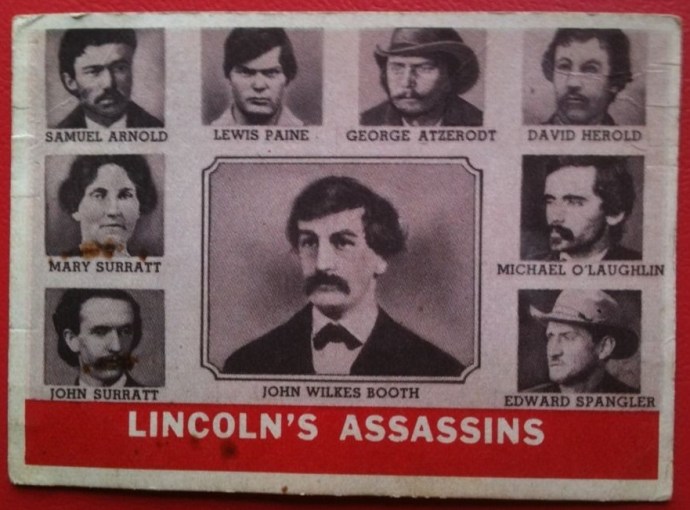
I found this little gem of an image for sale on eBay today.  It comes from a 1965 set of “Civil War Picture” cards – essentially Civil War themed baseball cards.

Bettman Civil War Booth Gang Card

I’m not quite sure what my favorite part of this hilarious image is:

  • Mary Surratt, who was experimenting with volumizing shampoo with horrible results?
  • Sam Arnold, who appears to have suffered a massive blow to the head causing a cartoonishly large lump?
  • David Herold, who had his eyebrows waxed off, penciled back on, grew a mustache, and then went for the wind swept look for his hair?

If I have to choose, however, I guess my favorite part would have to be John Wilkes Booth, who, in his attempt to remain undetected during his escape, apparently sported a wig.  Oh, the things you learn from the internet.

Categories: Uncategorized | Tags: | 5 Comments

“Tis the Season” at the Surratt House Museum

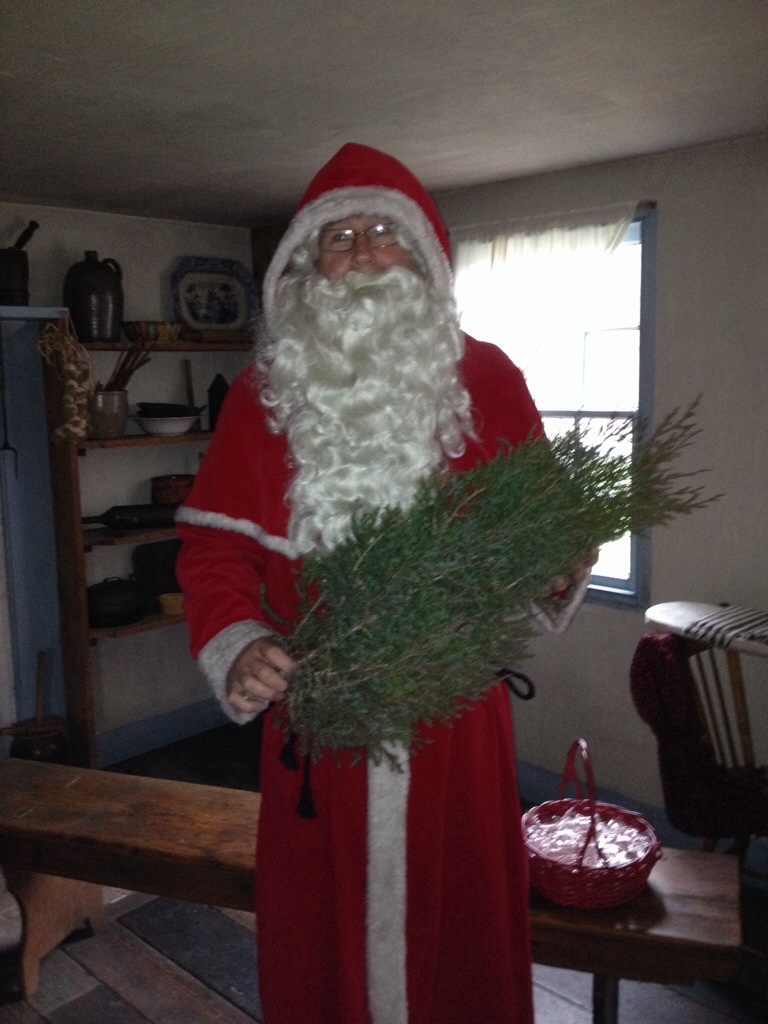
If you’re in the Clinton area today (12/14) stop by the Surratt House Museum for their special Christmas program ‘Tis the Season. This is the second to last time you can see the house decked with boughs of holly and other festive decorations before the museum closes for a month. The house will be full of dressed docents discussing Christmas in the 19th century along with special guest, Father Christmas! The first tour today starts at 12:00 pm and runs until the last tour at 3:30 pm.

20131214-105610.jpg

20131214-113725.jpg

20131214-120526.jpg

Categories: Uncategorized | 1 Comment

The Rear Wall and Doors of Ford’s Theatre

A visitor of this blog named Justin posed the following question on the “Reconstructing Ford’s Theatre” post:

“Random question – but the rear doors of the theater, are those period to the assassination? Not the actual doors themselves but is Booth’s escape door in the same place as they were the night of the assassination or has the façade been redone?”

Excellent question, Justin.  With regard to the location of the doors, the short answer is yes.  The large, rolling, scenery door and normal stage door you see on the back of Ford’s Theatre today are both in the same locations as their 1865 counterparts.  When Ford’s Theatre was restored in the 1960’s the architectural branch of the National Park Service was able to “definitely reestablish” the locations of the doors.

Baptist Alley - Detective McDevitt 3

The answer to the second part of your question, whether or not the rear façade of Ford’s Theatre has changed, is also yes, but this answer will take longer to explain.

In the aftermath of Lincoln’s assassination, the government shut Ford’s Theatre down.  While it looked as though John T. Ford would regain his theater and even reopen it after the execution of the conspirators, a large public outcry prevented this.  The government started renting the Ford’s Theatre building from John Ford before purchasing the structure outright in July of 1866.  Even before purchasing the building, however, the government began renovating the theatre.  They transformed the interior into a three story office building.  The top floor housed the Army Medical Museum.   The other two floors of Ford’s housed the Office of Records and Pensions run by the War Department.  When the medical museum moved out in 1887, they took over the entire building.

During this time the rear wall of Ford’s was altered to facilitate its new use as an office building.  The large, and now pointless, scenery door was bricked up and transformed into a regular sized door.  The former stage door, through which Booth escape was bricked up and transformed into a window.  If you look closely at the picture below, you can still see the outline of where the scenery door and its rollers once were, having been bricked up into a normal sized door:

Back Wall of Ford's

On June 9th, 1893, while construction and excavation was being done in the basement of the building, a stone pier near the west (front) end of the building collapsed.  It brought down a forty foot section from all three floors above it.  It was a tragic accident, crushing and killing 21 War Department clerks instantly.  You can read more about the aftermath of that accident here.

While the majority of the damage occurred at the front of the building, it was decided to take down the rear wall to complete the clean up.  In this way, the front “face” of Ford’s Theatre, with its decorative and elaborate architectural components, was spared from having a gaping hole put into it.  When the interior was rebuilt (again as an office building) the rear wall was also rebuilt, but now it no longer resembled the same wall Booth escaped out of.   The new rear wall was made with many windows on all three floors.  The new rear door was placed in the approximate area as the old scenery door (centered on the wall).  Though a few post-1893 newspaper engravings identify this new door as the one Booth escaped out of, the true location of the former stage door was farther north on the rear wall and was now a window:

Not the door Booth escaped out of.  The rear wall of Ford's was taken down and rebuilt after the 1893 collapse.  This door was placed in the approximate location of where the large scenery door had been.

Not the door Booth escaped out of. The rear wall of Ford’s was taken down and rebuilt after the 1893 collapse. This door was placed in the approximate location of where the large scenery door had been.

Here’s another picture showing the “new” rear wall and door built after the 1893 collapse:

Baptist Alley Later

Though the building of Ford’s Theatre underwent additional interior changes from 1893 until it was restored by the National Park Service in the 1960’s, the rear wall remained relatively unchanged during this time period.  When the NPS was looking to restore Ford’s they consulted sketches from Harper’s Weekly and Frank Leslie’s Illustrated Newspaper, along with depositions from Ford’s Theatre employees, to determine the original appearance of Ford’s Theatre.  Using these materials, they determined the original locations for the scenery door and the original stage door and had them placed back into the walls.  They also bricked up the windows that had been added post-1893.

20130825-194712.jpg

Photograph showing the rear wall of Ford’s Theatre taken during its reconstruction and restoration in the 1960’s. From this view you can see the scenery door that was put back in and the post-1893 windows that have been bricked up.

To sum up, the scenery and stage doors on the back of Ford’s Theatre today are in the same locations as their 1865 counterparts.  They are not, however, on the original doorways that Booth would have used. The originally scenery door was bricked up into a normal sized door and the original stage door, through which Booth escaped, was bricked up into a window.  Following the collapse in 1893, the whole wall was torn down and then completely rebuilt, removing even the outlines of the original doors.  In the 1960’s, the NPS, using sketches and accounts, put the scenery and stage doors back into their proper place while restoring the building.

Thanks for the great question, Justin!

References:
Historic Structures Report – Restoration of Ford’s Theatre by George Olszewski

Categories: Uncategorized | Tags: , | 5 Comments

“A Sure Defense: The Bowie Knife in America”

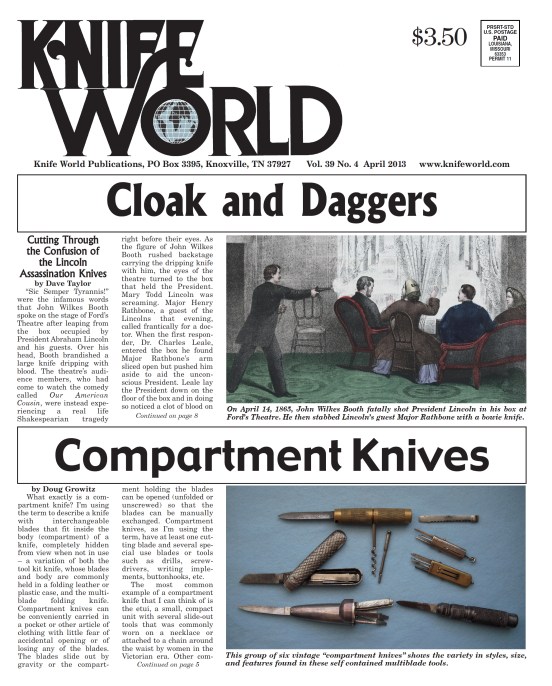
Earlier this year, I had the pleasure of writing a piece for Knife World magazine in which I discussed the bowie knives used by John Wilkes Booth and his conspirators.  The article, entitled, “Cloak and Daggers: Cutting Through the Confusion of the Lincoln Assassination Knives“, highlighted my conclusion that the knife currently on display at Ford’s Theatre as “Booth’s knife” is not the one taken from John Wilkes Booth’s body at the Garrett farm.  I am still working on convincing and motivating those in charge of the Ford’s Theatre museum to correct this mistake.

Cloak and Daggers Knife World April 2013

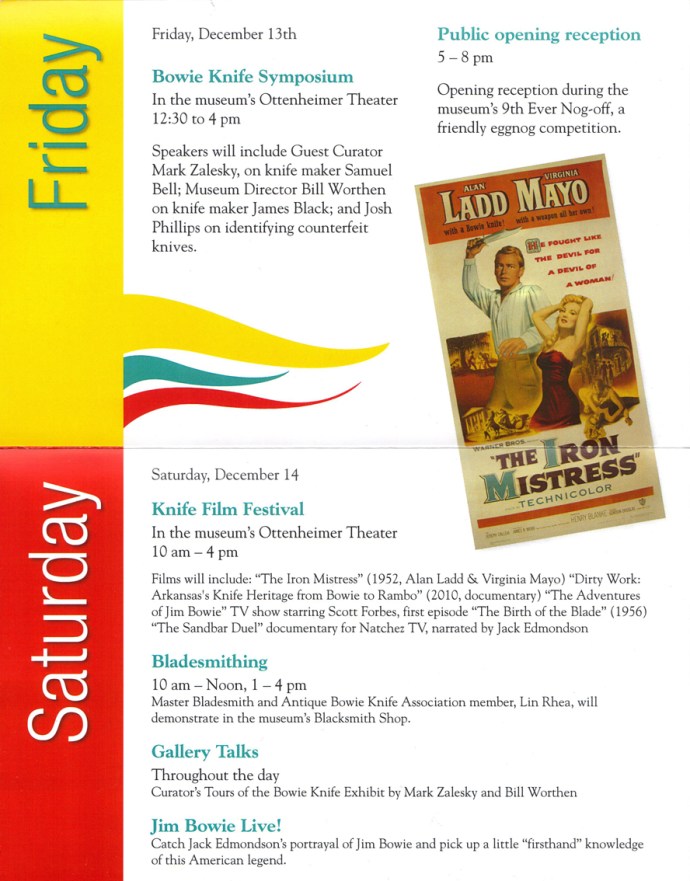
Since the article was published in April, I have kept in touch with the wonderfully nice editor of Knife World, Mark Zalesky.  Mark has been working exceedingly hard recently having been asked to guest curate an upcoming exhibit on the history of the bowie knife in America.  The exhibit, which is called “A Sure Defense: The Bowie Knife in America“, opens this Friday at the Historic Arkansas Museum in Little Rock.  I received this mailer today, advertising some of the events that will be occurring on Friday and Saturday to celebrate the opening of the exhibit:

Bowie Knife Exhibit Events

I’m personally excited for this exhibition for two reasons. First of all, the press release for the exhibit, which can be read here, includes the following paragraph:

“Visitors to the public exhibit will have the opportunity to see knife designs associated with Alamo martyr James Bowie and his less famous brother Rezin, and to examine bowie knives once owned by such historic figures as Davy Crockett, Theodore Roosevelt, General Winfield Scott and John Fox “Bowie Knife” Potter. The role of the bowie knife in the Antebellum era is explored along with the Civil War and the opening of the west, and there’s a special focus on the role bowie knives played in the events surrounding the assassination of Abraham Lincoln.

Using resources such as my article for Knife World, Mark has created a nice display about the knives used by the conspirators. In it, he has been kind enough to give my conclusion regarding Booth’s knife further press and attention.

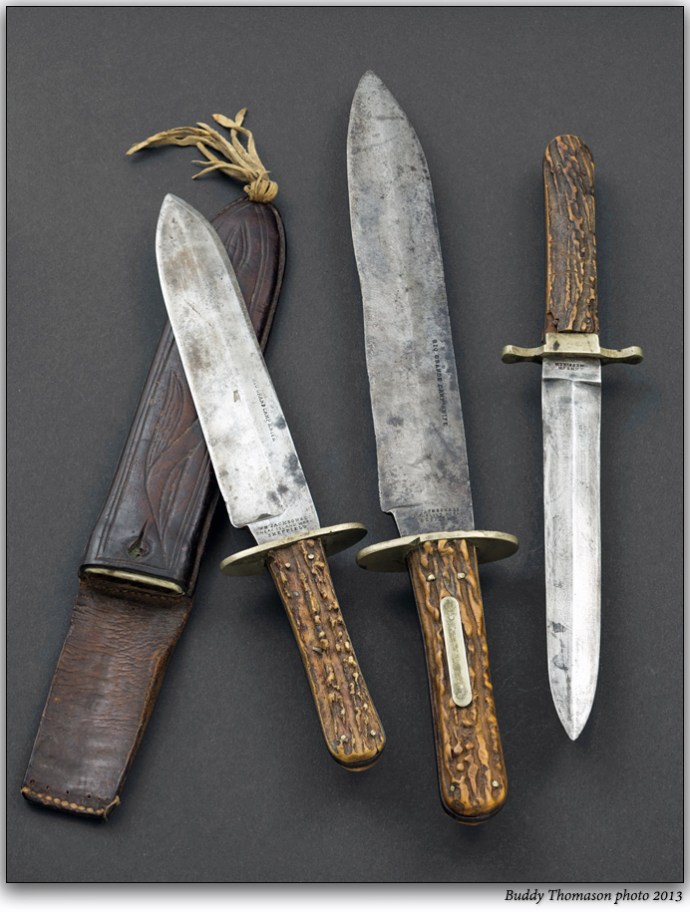
The knives in the Lincoln display for the bowie knife exhibit are period knives, identical to the ones used by the conspirators. They are the same, “make and model” as it were, as the ones on display at Ford’s Theatre and in storage at the NPS or Huntington Library. Here is a picture of “Lincoln knives” in the upcoming exhibit at the Historic Arkansas Museum:

Bowie Knives Exhibit Assassination knves

The rightmost knife above is identical to the “Liberty knife” currently on display at Ford’s Theatre as Booth’s knife. From my research I do not believe this knife was retrieved from Booth’s body as it claimed to have been by the display at Ford’s. Though I am not 100% certain of its origin, my hypothesis is that it came from Mary Surratt’s boarding house in D.C.

The middle knife is identical to the knife found in George Atzerodt’s rented room at the Kirkwood House hotel. David Herold was seen carrying this long knife in his boot during the day of the assassination and probably removed it when visiting in George’s room on that day.  It’s counterpart is on display at Ford’s Theatre.

The leftmost knife is identical to the knife Lewis Powell used to stab Secretary Seward and the knife retrieved from John Wilkes Booth when he was shot at the Garret farm.  Powell’s knife is in the Huntington Library in California.  Booth’s knife is in storage at the NPS’ Museum Resource Ceneter in Landover, Maryland.  I’m working on getting this knife out of storage and properly displayed at the Ford’s Theatre Museum.

It is also with a deal of pride that I state that the leftmost knife and sheath in the above picture, belong to me.  I bought the knife a few years ago, wanting a duplicate of the knife Booth used to stab Major Rathbone.  According to Mark, these “smaller” Rio Grand Camp knives are harder to find as most people want the big ones like the one in the middle.  During the course of our collaboration on the Knife World article, I told him I had an identical knife to Booth’s and he asked if I would consider lending it to the Historic Arkansas Museum for the exhibition.  Though I’m not sure if I will be able to, I’m hoping to find the time to make the journey to Arkansas to see my knife along with over 200 other bowie knives.

For anyone who may live around, or are planning a trip near Little Rock, the exhibit, “A Sure Defense: The Bowie Knife in America” runs from December 13th, 2013 until June 22nd, 2014 at the Historic Arkansas Museum. The Historic Arkansas Museum is open 9 a.m. – 5 p.m. Monday through Saturday, 1 – 5 p.m. on Sunday and admission to the galleries and parking are free.

For those who can’t make it to the museum, a full color catalog documenting this historic exhibit is planned, and will be available from the museum’s gift shop and online store some time in the near future.

I hope those of you in the area will check out the exhibit at the Historic Arkansas Museum. You can learn all about the fascinating history of the bowie knife and say “hi” to my knife and sheath while you are there.

References:
Historic Arkansas Museum
Mark Zalesky, guest curator of “A Sure Defense: The Bowie Knife in America

Categories: Uncategorized | Tags: , | 1 Comment

Blog at WordPress.com.