Winner of John Wilkes Booth: Day by Day

It’s been one week since the contest ended for a free copy of Art Loux‘s masterful book, John Wilkes Booth: Day by Day.  The contest was a terrific success with over 80 comments being posted by people expressing what facet of the assassination story interested them the most.  I want to thank each and every person who commented and joined in on the conversations.  It was all great fun.

Art Loux's JWB DBD

To select a winner, all of the eligible comments were assigned a sequential number based on when they were posted.  Then an online random number generator was used to select the winning comment.  I’m pleased to announce the winner of the free copy of John Wilkes Booth: Day by Day is…

Herb Swingle!

Herb posted the following comment(s) about what he finds interesting in the Lincoln assassination story:

Booth, “jumped the gun” and took it upon himself to extinguish the flame of what America needed at that time of History!

What makes me, “Sit up and take interest”, is how easy Booth was able to do what he thought he could get away with!

I feel that John Surratt enjoyed Sarah Slater’s companionship while in Canada also.

Thank you so much for commenting, Herb, and congratulations on winning.  Your free book should be arriving in a couple of days.

To everyone else out there, please make sure you purchase your own copy of this wonderful book.  As I stated in the original contest page, this book is the perfect book for everyone with an interest in the Lincoln assassination.  It will easily prove to be one of the most consulted and respected texts on the subject of John Wilkes Booth and his deed.  Please take the time to purchase your own copy from an online retailer of books like Amazon or support the gateway to the Lincoln assassination story, the Surratt House Museum, by ordering your copy from them.  See the ordering information below for details.

Your purchase of John Wilkes Booth: Day by Day will not only provide you with unmatched scholarship into John Wilkes’ life and movements, but it will also support the legacy of the late Art Loux.  It is one of the cruelest fates that Art is not here with us today to appreciate the acclaim he so justly deserves.  JWB: DBD was Art’s life’s work and through it, his generosity and passion live on.  If you have not already, please take a moment to read my short remembrances of this great man.

Again, I want to thank everyone who commented and took part in the contest.  It was wildly successful and so I may do another one in the future.  In the meantime, go out and purchase your own copy of John Wilkes Booth: Day by Day by Art Loux.  I promise you won’t regret it.


John Wilkes Booth: Day by Day is available from the Surratt House gift shop for $50 (+6% Maryland tax if ordering from within the state).  The cost for shipping is $3.  Life members and/or volunteers of the Surratt Society receive a 15% discount.  Place your credit card order by calling the museum at (301) 868-1121, or send a check payable to Surratt House Gift Shop to 9118 Brandywine Road, Clinton, MD 20735.  While you’re at it, take the time to peruse some of the other wonderful books they have for sale by clicking here.
Categories: Uncategorized | Tags: , , | 16 Comments

Don’t Shoot!: The Journey of Booth’s Deringer Pistol

From the Ford’s Theatre Blog. David McKenzie has written a nice piece regarding a familiar face to BoothieBarn, Edwin B. Pitts, Chief Clerk of the Judge Advocate General’s Office. You can see another picture of Mr. Pitts and learn more about his custodianship over Booth’s artifacts here: http://boothiebarn.com/2012/11/25/edwin-pitts-chief-clerk-of-the-judge-advocate-generals-office/

Categories: Uncategorized | 2 Comments

John Wilkes Booth: Day by Day by Art Loux

John Wilkes Booth: Day by Day by the late Art Loux is a truly remarkable gift to the historical community.  As a history of the assassin of Abraham Lincoln, it is unmatched in its scope and detail.  It represents Mr. Loux’s life’s work with his decades of in-depth research cataloging the movements of John Wilkes Booth.  The book was released on August 20th, almost eight months since Mr. Loux’s passing.

Art Loux's JWB DBD

There are always new books being written about the various aspects of Lincoln’s assassination. There are the big name authors like Kauffman, Steers, and Swanson who give wonderfully detailed accounts of the whole assassination story.  There are biographers like Ownsbey, Larson, and Titone who explore the lives of specific conspirators and their families. And, as always, the true drama of the Lincoln assassination is the perfect muse for pieces of historical fiction like “Wild” Bill Richter’s new, well researched and footnoted, novel.

At the same time, however, there are many poorly researched and poorly written books out there that saturate the topic with misinformation and supposition costumed up as fact. Authors of these volumes usually delude themselves into truly believing their own views regardless of the mountains of evidence against them.  Some even go as far as to spam every nook and cranny of the internet attempting to portray their views as fact.

This is why books like John Wilkes Booth: Day by Day are so important.  In an age of historical sensationalism misconstrued as fact, Mr. Loux’s book provides a model for how to conduct and present one’s research. John Wilkes Booth: Day by Day is devoted solely to the education, not manipulation, of its readers.  Each chapter provides an excellent narrative of the important events in that period of John Wilkes Booth’s life followed by a detailed record of his daily movements and activities.  It is the perfect book for everyone with an interest in the Lincoln assassination.  The casual reader will love to follow the 26 year journey of John Wilkes Booth to see what led him into Ford’s Theatre on April 14th, 1865.  The researcher will love pouring over the daily record and the thousands of fascinating footnotes.

Every chapter, even every page, provides new insight into the man who would later kill the 16th President.  For example, did you know that John Wilkes Booth once had to extinguish a fellow actress on stage when her dress caught on fire?

John Wilkes Booth extinguishes a fellow actress

John Wilkes Booth: Day by Day is filled with fascinating stories like this that have never been published anywhere else.   You can purchase your copy from online retailers like Amazon, or you might consider supporting the Surratt House Museum (the gateway to the assassination story) by purchasing your copy from them.

I sincerely believe that this book should be read by everyone interested in the Lincoln assassination. Due to this belief, I have purchased an extra copy of the book to give away here on the blog.  If you would like to win one free copy of Art Loux’s masterpiece John Wilkes Booth: Day by Day, all you have to do is leave a comment on this post describing what aspect of the Lincoln assassination interests you the most.  In one week’s time, on September 21st, I will pick one of the commenters at random to receive a free copy of this indispensable book. The contest is now over. You may continue to comment, but any new comments will not be entered into any drawing.  Thank you all for participating.

Though Art is no longer with us, he has left behind an inspiring legacy of scholarship and generosity. So get commenting below for your chance to win a free copy of John Wilkes Booth: Day by Day courtesy of BoothieBarn.com.


Contest Rules: To win a copy of John Wilkes Booth: Day by Day you must write one (1) comment on this post explaining what aspect of the Lincoln assassination interests you the most. A valid email address must be attached to the comment in order to win. Multiple comments from the same person will be counted as one entry.  Contest will end on September 21st, 2014 at 20:00 PST.  The winner will be notified via email.  If no response is received within three (3) days, a new winner will be chosen.  In the event that the winner chooses to forfeit the prize, another winner will be selected.  Winners agree to have their name and comment used in a future post. Click here for the announcement of the winner of this contest.
Categories: Uncategorized | Tags: , , | 87 Comments

Photos from the Archives: A Case of Mistaken Identity?

The wonderful folks at Ford’s Theatre have brought attention to a long held case of mistaken identity and I was honored to help them.

Categories: Uncategorized | 1 Comment

Graves of the Conspirators

Over the last week, I had the opportunity to visit and photograph many of the graves of the Lincoln assassination conspirators. Here are some black and white stills of their final resting places.


Mary Surratt, Lewis Powell, David Herold, George Atzerodt

Location: Old Arsenal Penitentiary, Washington, D.C.
Period of interment: 1865 – 1867
Pine Boxes B&W

Site of the burial of the executed conspirators

Immediately following their execution, the four conspirators were buried in pine boxes next to the gallows.  In 1867, their bodies, along with the body of John Wilkes Booth, were reburied in a warehouse on the grounds of the Arsenal.  In 1869, President Johnson released the remains to their respective families.  Today, the site of the conspirators’ execution and initial burial location are part of the tennis courts at Fort Lesley McNair in D.C.


John Wilkes Booth

Location: Green Mount Cemetery, Baltimore, MD.
Period of interment: 1869 – Present
Booth B&W Grave

After Booth’s body was returned to Washington and an autopsy was preformed, he was initially buried in a gun box beneath the floor of a storage room at the Arsenal. In 1867, he was moved and his remains were placed with those of the other conspirators in a warehouse on the Arsenal grounds. President Johnson released Booth’s body in 1869. Edwin Booth purchased a family lot at Green Mount Cemetery in Baltimore and had his grandfather, father, three infant siblings, and brother John Wilkes buried together in the plot. John Wilkes Booth is unmarked in the plot.


David Herold

Location: Congressional Cemetery, Washington, D.C.
Period of interment: 1869 – Present
Herold B&W Grave

The Herold family had owned a burial plot at Congressional Cemetery since 1834. Davy was the seventh person to be buried there when his body was released in 1869. While Davy is unmarked, his sister Elizabeth Jane was later buried right on top of him. Her stone is the farthest right in the plot.


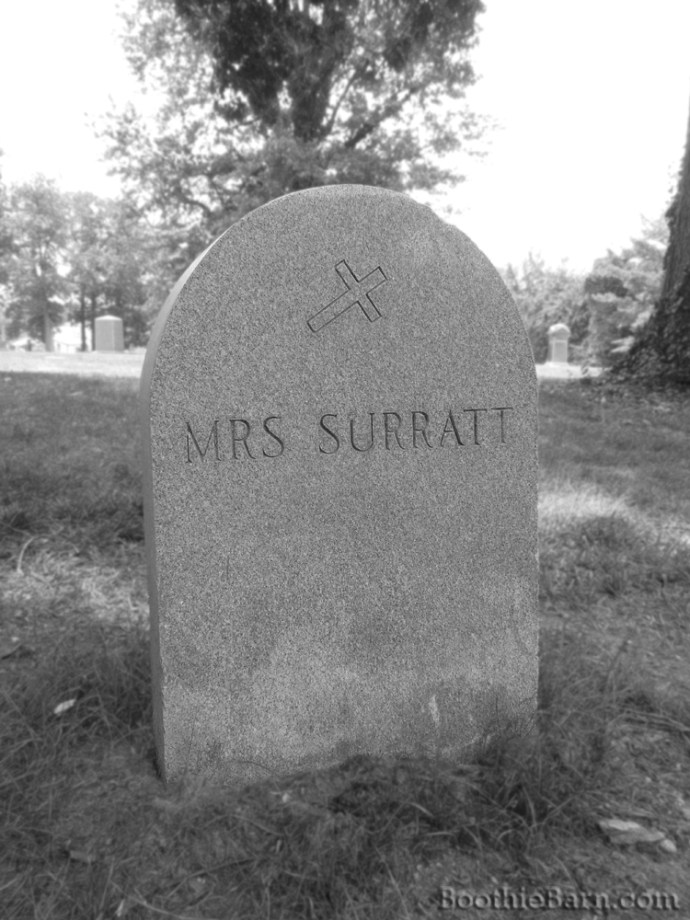
Mary Surratt

Location: Mount Olivet Cemetery, Washington, D.C.
Period of interment: 1869 – Present
Mary B&W Grave

This basic stone bearing only “Mrs. Surratt”, is a replacement for an earlier stone that bore the same text. It is all that marks the plot of Mary Surratt, her children Isaac and Anna, her son-in-law, and some of her grandchildren.


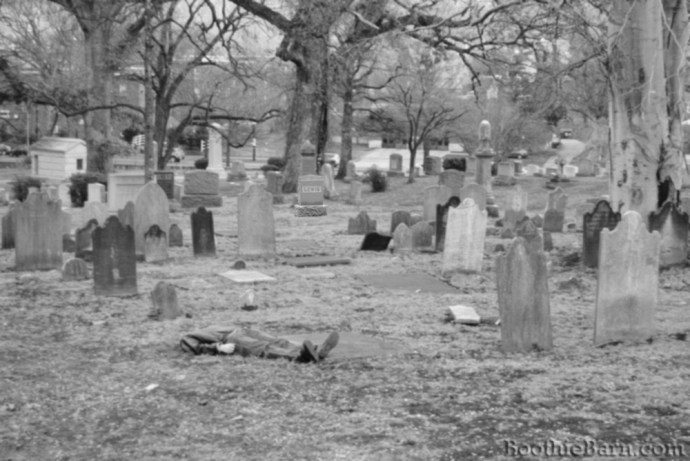
Lewis Powell (body)

Location: Rock Creek Cemetery, Washington, D.C.
Period of interment: 1884 – Present
Grave of Lewis Powell's body Rock Creek Section K, Lot 23

While Lewis Powell’s skull is buried with his mother in Florida, the rest of his body is likely at D.C.’s Rock Creek Cemetery in a mass unmarked grave in Section K, lot 23. A portion of that section is pictured above. Eerily, one of the headstones in that section is marked “Lewis”. For more about the travels of Lewis Powell’s remains, read the middle section of this post.


George Atzerodt

Last confirmed location: Glenwood Cemetery, Washington, D.C.
Period of interment: 1869 – ?
Public Vault Glenwood Cemetery ExteriorPublic Vault Glenwood Cemetery Interior

The location of George Atzerodt’s remains are still a bit of a mystery. It is known that they were placed in the public vault of Glenwood Cemetery (pictured above) after being disinterred from the Arsenal. It was erroneous believed that he was then buried in a family plot at St. Paul’s Cemetery in Baltimore. Research facilitated by this website has proven this to be false. It is possible that Atzerodt is buried somewhere at Glenwood but the interment book for that period of time was stolen in the late 1800’s. More research is needed.


Dr. Samuel A. Mudd

Location: St. Mary’s Catholic Church Cemetery, Bryantown, MD
Period of interment: 1883 – Present
Mudd B&W Grave

After Dr. Mudd died in 1883, a tall monument with a stone cross on the top was placed on his grave at St. Mary’s Church. Around 1940, some of Dr. Mudd’s descendants decided to replace the weathered stone. The new stone (pictured above) contained Mrs. Mudd’s birth and death dates as well as the doctor’s.


John Surratt

Location: New Cathedral Cemetery, Baltimore, MD
Period of interment: 1916 – Present
Surratt B&W Grave

The longest lived of all the conspirators, John Surratt and his family are buried under this plain cross stone bearing only the family name in Baltimore’s New Cathedral Cemetery.


Samuel Arnold

Location: Green Mount Cemetery, Baltimore, MD
Period of interment: 1906 – Present
Arnold B&W Grave

Samuel Bland Arnold, one of John Wilkes Booth’s schoolboy friends, was involved in the abduction plot but was not in D.C. when the assassination occurred. Sam was the last member of his family to be buried in the plot upon his death in 1906.


Michael O’Laughlen

Location: Green Mount Cemetery, Baltimore, MD
Period of interment: 1870 – Present
O'Laughlen B&W Grave

Another childhood friend of Booth’s who was involved in the initial abduction plot, Michael O’Laughlen was sentenced to life in prison at Fort Jefferson, Dry Tortugas. He died from yellow fever while in jail despite the attentive care he received from his fellow prisoner, Dr. Mudd. He was initially buried on an island adjacent to Fort Jefferson. After his fellow conspirators had been pardoned, O’Laughlen’s body was transported from Florida to Balitmore. He was interred in the family plot on December 14th, 1870.


Edman Spangler

Location: Old St. Peter’s Church Cemetery, Waldorf, MD
Period of interment: 1875 – Present
Spangler B&W Grave

After his release from Fort Jefferson, Edman Spangler returned to working at John Ford’s different theatres. Eventually he made he way to Charles County Maryland and reunited with Dr. Mudd. Spangler lived on Dr. Mudd’s property doing carpentry work and farming until his death there in 1875. His grave was marked in the 1980’s by the Surratt and Mudd Societies.

References:
The Lincoln Assassination: Where Are They Now?: A Guide to the Burial Places of Individuals Connected to the Lincoln Assassination in Washington, DC by Jim Garrett and Rich Smyth
Betty Ownsbey

Categories: Uncategorized | Tags: , , , , , , , , , , , | 7 Comments

The Booth Children and Mary Ann’s Acting Career

In his later years, Edwin Booth would reflect, “What big families they used to raise!”  when discussing his brothers and sisters.  The world famous tragedian was one of ten children.  Today, these siblings are generally eclipsed by their infamous brother John Wilkes, but, as this blog has often shown, each member of the Booth clan led fascinating lives of their own.  Junius, Jr. was a moderately successful actor and theater manager. Henry Byron, who died at the age of 11 in England, was his father’s favorite. Edwin is easily considered the best actor of his generation and perhaps the best Hamlet ever.  Asia thoroughly documented the lives of her father and brothers through books.  Young Joe became a doctor.  Even Rosalie, the Booth I had dubbed the “forgotten” one, lived a devoted life caring for her siblings and mother.

In truth, the only forgotten Booths seem to be the ones who died quite young.  They are Mary Ann, Frederick, and Elizabeth.  So little is known about these three Booths because their lives were so short.  The small blurb they receive in books (if they are even mentioned at all) recounts their deaths from a cholera epidemic on the family farm in 1833 and the difficulty Junius Brutus Booth had accepting their loss.  A multitude of questionable newspaper accounts and later recollections paint a picture of a crazed Junius, unable to accept the death of his children, digging up the bodies of one or more of them from the family cemetery, hoping to revive them.  While there is some truth in these accounts the majority are dramatic exaggeration.

Back of the Booth monument

However, there is one mistake that has been accidentally perpetuated in books about these Booths for years.  Only two of the Booth children died of cholera in 1833.  These poor victims were Mary Ann and Elizabeth.  Their brother, Frederick, had actually died a few years earlier away from the family farm.

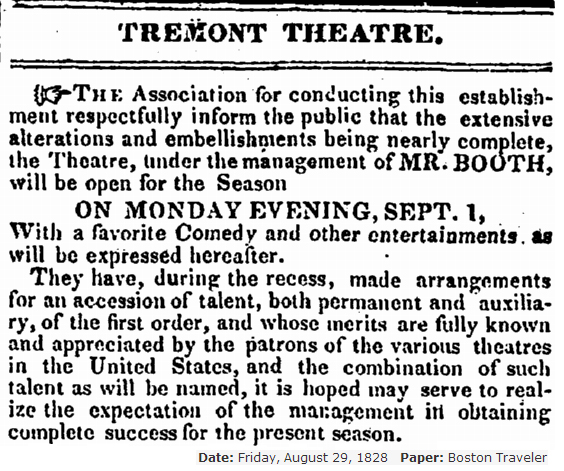
In fall of 1828, thirty-two year old Junius Brutus Booth, Sr. decided to try his hand at being a theater manager.  He rented the Tremont Theatre in Boston and began preparations to open for the season.
JBB Manager in Boston 1828

JBB as Manager in Boston 1828 1

JBB as Manager in Boston 1828 2

In Stephen Archer’s book, Junius Brutus Booth: Theatrical Prometheus, he proposes that with this managerial position, “the touring tragedian seemed to be trying to find a place to settle down.”  As a touring star, Junius was often away from his wife and five children.  They lived on the family farm in Harford County, and he could only make brief stops home when he was performing in Baltimore or during the summer break between theatrical seasons.  It appears the Junius was hoping this managerial position would not only provide for his family, but also allow him to stay in one place for a prolonged period.  His “wife” Mary Ann actually joined him in Boston during this time.  Whether she brought all of their children with her to Boston, or left some of them at the Bel Air farm, is unknown.  At the very least, it is known that Frederick, a little bit older than a year at that point, was with his parents in Boston.

It was during this point, when Junius was the manager of the Tremont Theatre, that Mary Ann may have made her acting debut.   Theater lore states that Mary Ann Booth did try her hand at acting for a very brief period of time.  The problem is that there has been little evidence found to support this idea.  The small evidence we do have is this advertisement:

Mrs Booth's 2nd appearance on stage 1828

Dr. Archer calls it a “mystery” but states that we can’t be certain this is our “Mrs. Booth”.  Actors and actresses were commonly referred to only by their surnames as you can see in the advertisement above.  Dr. Archer also points out that “later appearances of a Mrs. Booth further suggest someone other than the tragedian’s wife.”  However, in an article written for the Surratt Courier in 1991, John Wilkes Booth biographer Terry Alford seems to believe that this was our Mrs. Booth.  A clipping of this advertisement can be found in a scrapbook that was owned by Junius Brutus Booth, Jr.  Why else, Dr. Alford suggests, would June preserve a clipping of this advertisement unless it was of his mother?

After some searching, I found a newspaper advertisement which claims to be Mrs. Booth’s first appearance on stage:

Mrs Booth's 1st appearance on stage 1828

If this is Mary Ann Booth, then her first performance was not at the Tremont Theatre in Boston but at the Salem Theatre in nearby Salem, Massachusetts.  Salem and Boston are only separated by about 16 miles.  James H. Caldwell, the actor for whom both these benefits were for was well known to Booth.  In fact, earlier in 1828 Junius acted for over a month at the American Theatre in  New Orleans where Caldwell was the manager.  It seems possible that Mary Ann Booth knew the part of Rosalie Somers in the play Town and Country and Junius asked his friend Caldwell if she could play it alongside him.  Caldwell was looking to make as much money as he could in Boston, as he was hoping to build a new theater in St. Louis.  One Boston newspaper, the Boston Traveler, had a strong allegiance to the Tremont Theatre and partly chastised Caldwell for making his first appearance in the city at the rival Federal Street Theatre.  They wrote, “The old house offered him $100 a night, and he chose to go there for money, rather than appear at the Tremont for money and applause.”  Caldwell responded back to them humorously: “He informs us of his benefit, and gives us liberty, for one dollar, to speak of him as we like – provided we set down nothing in malice.”  After finishing three nights in Salem, it was announced that Caldwell was coming back to Boston and that this time he would perform at the Tremont instead of the Federal Street Theatre.  The Boston Traveler praised his choice and, as a last jab at the rival theater, stated, “He will now have an opportunity of appearing before such an audience as he has not yet seen in Boston.”  With this in mind, it’s likely that Caldwell would have welcomed Mrs. Booth’s company on stage as she might have proved a curiosity and drawn a larger crowd to his benefits.

Additionally, when it comes to Mrs. Booth’s appearance on the Tremont stage, she might have been acting at the insistence of her manager husband.  Mrs. Mary Ann Duff was a leading lady of the day and was scheduled to appear at the Tremont starting on October 15th.  However, she fell ill and did not make her debut until October 29th. Perhaps, Junius, needing someone to play Rosalie Somers in Town and Country asked his wife to fill in.  Her first performance at the far smaller Salem Theatre could have been her “try-out” before Booth had her play the same role the next day at his theater.  This, of course, is just a theory.  Mary Ann Booth’s supposed theatrical career is still a mystery.

Junius Brutus Booth departed the Tremont Theatre at the end of October after managing it for two months.  The Tremont Theatre Association presented him with a silver cup and plate valued at $100 as a token of their esteem.  For some time after Junius left to act in New York, Mary Ann and at least little Frederick were still residing in Boston.

Then, on November 5th, 1828, Mary Ann Booth lost her first child.  The exact circumstances of Frederick’s death are not known.  Thus far, no mention of the boy’s death has been found in the newspapers.  His death record states he was 1 year, 4 months old but no cause of death is given.

Frederick Booth's Death Record in Boston

His body was taken to the South Burying Ground in Boston.  The grounds have been described as, “a working man’s burying ground, where families paid a small fee to the City for burials”.  More research is being conducted to determine the exact disposition of Frederick’s body, i.e. whether he was buried or placed in a vault.  Nevertheless, the loss of their child must have affected Mary Ann and Junius deeply.  This was the second child Junius had lost.  The first had been a daughter, Amelia Portia, who he had with his first wife, Adelaide.  She too had died as an infant.  Young mother Mary Ann, experiencing the first of her many losses, was likely beside herself with grief over her dead son.

Frederick’s death record proves that he was not one of the victims of the 1833 cholera epidemic as was previously thought.  It also corrects his birth date which was thought to have been 1829.  It can now be accurately determined that Frederick Booth was born between June 6th and July 5th, 1827 and that he died on November 5th, 1828 in Boston.

In 1869, after John Wilkes Booth’s body was released by the federal government, Edwin Booth bought a family plot at Baltimore’s Green Mount Cemetery.  Here he placed the remains of his grandfather Richard, his father Junius, and his brother John Wilkes.  Edwin also had the bodies of his three young siblings who had died in America exhumed from the family cemetery at Tudor Hall.  These were the bodies of Mary Ann, Elizabeth, and little Frederick.  The touching story of how Frederick came “home” is recounted by his older sister Asia Booth:

“During the engagement in Boston, their infant child Frederick had died, and Mrs. Booth was lamenting the loss (on her return to the country home at Belair) and burial of her baby so far away.  Her husband said, “Do you wish the child to be buried here?”  “Oh it would cost so much,” hesitatingly answered the grateful mother.  “Come out and walk with me,” her husband rejoined.  Mrs. Booth thought this a feint to distract her mind from grief, and they strolled about together, then, directing his steps towards the Barn, Mr. Booth said tenderly, “I have brought your child home.”  She was not shocked then, when on entering the Barn, he took the straw from a box in the corner, on which rested the leaden cover containing the little coffin.  Mrs. Booth, relating this occurrence, remarked on the thoughtful tenderness of keeping this unknown to her, also the deep parental love of the father for so young a child.”

The reason the truth about Frederick’s death was unknown until now is because this passage from Asia Booth Clarke’s book, The Elder and Younger Booth is only located in one copy of her book.  At the University of Illinois in their Rare Book room there is a copy of Asia’s book inscribed, “To my dear son Wilfrid Booth Clarke, Oct. 29th, 1885, from his mother, Asia Booth Clarke”.  This copy of her book is different from all the other.  It has extra pages and notations inside of it which are assumed to have been either material that was edited out of the original or Asia’s suggestions for a second edition that never came to pass.  This passage about Frederick’s death is on one of these extra pages in this one, unique book.

The death of Frederick and the desire to have him buried at the family farm necessitated a family graveyard.

“…a little graveyard was railed in, where the Jewish althea bushes had their places among the yews and weeping-willows. In country homesteads these private graveyards are common, and the duty of reading the burial service devolves upon the master of the house when it is impracticable to obtain a clergyman. Mr. Booth was often called upon to officiate at the interment of members of his household here (the blacks being buried outside the rails).”

Mary Ann and Elizabeth were also buried in this graveyard after their deaths from cholera in February of 1833.  Another extra page from Asia’s personal copy of her book recounts Junius’ actions after the death of the first child from cholera.

“…[Junius] dug up the little grave at night and secreted the child’s coffin, while he wandered about silent and despondent.  Joe [Hall, their slave] for a day and a night searched over the farm and miles of country, with dogs and lantern, for the hidden coffin, and with heavy heart was returning to tell to the poor mother his failure when the dogs led him to some thickly-platted bushes quite near the house.  The child was re-buried, and the wretched father taken care of.”

Far more dramatic accounts emerged over the years exaggerating this occurrence to degrees fitting the public perception of the mad Junius Brutus Booth.

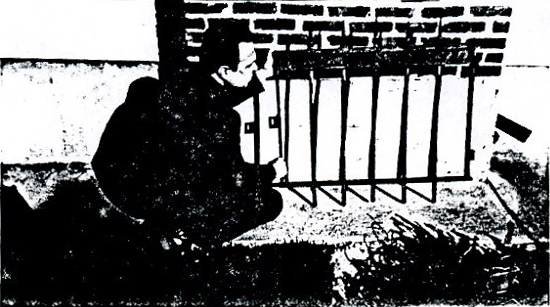
The Booths installed a metal gate at the entrance to the family graveyard.  When author Stanley Kimmel visited the Bel Air region to research his book, The Mad Booths of Maryland, he discovered that a neighbor had salvaged the gate after the Booth family sold the farm in the 1870’s and that the gate had been in that family’s possession ever since.  Stanley Kimmel purchased the gate around the 1930’s but its location today is unknown.
Stanley Kimmel and the gate to the Booth family cemetery

Stanley Kimmel and the gate to the Booth family cemetery

Frederick, Mary Ann and Elizabeth Booth never knew their four youngest siblings.  They never got to share in the success and fame of their brother Edwin, nor did they have to endure the tragedy and pain caused by John Wilkes.  When the trio was disinterred from the family graveyard at Tudor Hall in 1869, their small remains were placed together in one coffin.  At the Booth family plot at Green Mount Cemetery these three innocent Booths were buried right on top of their guilty brother.  When the misguided conspiracy theorists attempted to exhume John Wilkes Booth in the 1990’s, one of the reasons why Green Mount Cemetery blocked the exhumation was due to the fact that such a procedure would disturb the remains of these three Booths as well.  So, even though Frederick, Mary Ann and Elizabeth never knew their brother John Wilkes, even in death they managed to protect their little brother.

Area behind the Booth obelisk

References:
Junius Brutus Booth: Theatrical Prometheus by Stephen Archer
The Elder and Younger Booth by Asia Booth Clarke
Author’s copy of the Elder and Younger Booth by Asia Booth Clarke held by the University of Illinois
Mary Ann Booth – Actress? by Terry Alford, Surratt Courier, May 1991
Joseph and Ann Hall: Behind the Scenes at Tudor Hall by Dianh Faber, Harford Historical Bulletin, Fall 2006
The Mad Booths of Maryland by Stanley Kimmel
Behind the Scenes with Edwin Booth by Katherine Goodale
Mrs. Duff by Joseph Norton Ireland
South End Burying Ground
Newspaper articles are from GenealogyBank.com
Ancestry.com
The Art Loux Archive


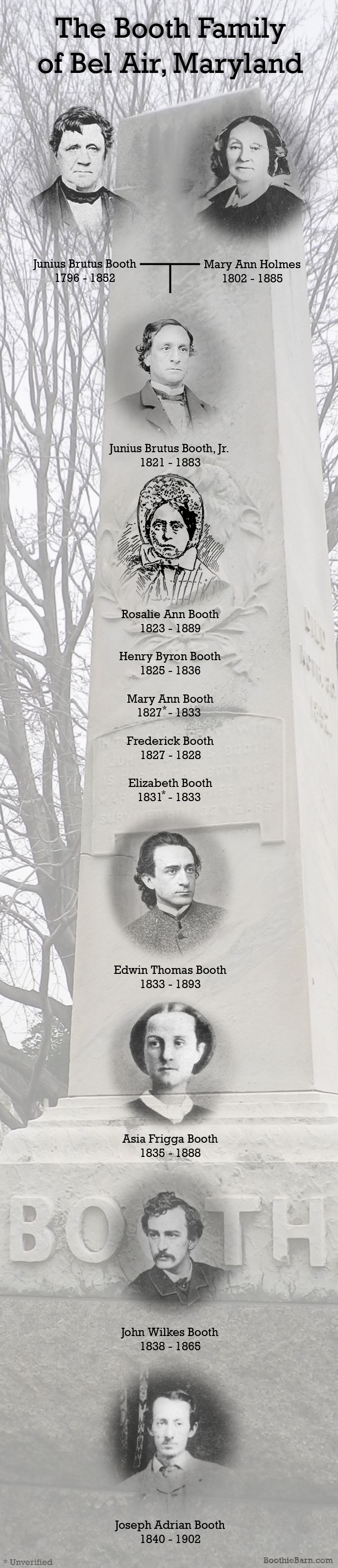
New Picture Galleries have been created for the “forgotten” Booth children: Rosalie, Henry Byron, Mary Ann, Fredrick, and Elizabeth Booth.  Click HERE to visit Rosalie’s Gallery or HERE to visit a combined gallery for the other Booth children.  You can also click their names on the image below to visit their respective gallery.
Click for Junius Brutus Booth Click for Mary Ann Holmes Booth Click for Junius Brutus Booth, Jr. Click for Rosalie Ann Booth Click for the Booth children Click for Edwin Thomas Booth Click for John Wilkes Booth Click for Joseph Adrian Booth
Categories: Uncategorized | Tags: | 10 Comments

Jett, Ruggles, and Bainbridge

A few days ago, commenter Kees van den Berg posed the following question:

“I wonder, what happened with Jett, Ruggles and Bainbridge? I suppose they were arrested and confined in the Old Capitol Prison in Washington. Is it true that they never were tried, but came free after a couple of weeks after taking the oath of allegiance to the US? Have you dates of confinement and release? Thank you beforehand.”

His question refers to Willie Storke Jett, Mortimer Bainbridge Ruggles, and Absalom Ruggles Bainbridge. Ruggles and Bainbridge were cousins which explains the last names as middle names coincidence.  These three men were Confederate soldiers who ran into John Wilkes Booth and David E. Herold during their escape.

About midday on April 24th, the fugitives were at Port Conway, VA on the banks of the Rappahannock River. They were waiting for the ferry to come so they could get to Port Royal on the other side. As they waited, Jett, Ruggles, and Bainbridge came riding up.  The three men were heading towards Richmond, ultimately to get their paroles. At first, Herold lied to the men and told them that he and his wounded brother were also Confederate veterans. Thinking the three soldiers were on their way south to meet up with others in order to continue the fight, Herold pulled Jett aside and asked him if they could join them. Surprised by Herold’s desperation, especially when he and his comrades had accepted the defeat of their cause, Jett asked Herold straight away who they really were. Herold replied back, “We are the assassinators of the President”.

After more conversation, Jett, Ruggles, and Bainbridge agreed to help the men. The five men and their three horses crossed the Rappahannock on the ferry guided by ferryman Jim Thornton. When they arrived at Port Royal, Jett searched out a place for Booth to stay. He came to the home of Sarah Jane Peyton, who agreed, sight unseen, to care for a wounded solider.

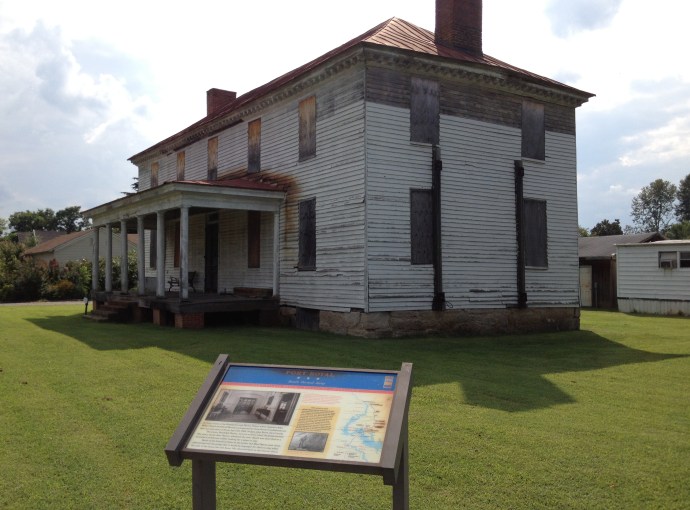
The home of Sarah Jane Peyton in Port Royal, VA

The home of Sarah Jane Peyton in Port Royal, VA

When Booth hobbled into her parlor, however, her hospitality changed. She no longer thought it proper for her to entertain a guest while her brother, the man of the house, was absent. She suggested to Jett that he might find better lodging for the wounded man a couple of miles down the road, at the farm of Richard Garrett. The three men rode to the Garrett place, with Booth and Herold sharing horses with Ruggles and Bainbridge, respectively. When they arrived at the Garrett farm, Bainbridge and Herold stayed by the outer gate as Jett, Booth and Ruggles approached the house. The Garretts agreed to care for Booth, whom Jett said was a wounded soldier named Boyd, until Jett’s return in a couple of days. Jett, Ruggles, Bainbridge, and Herold rode further south. They stopped at the Trappe, a house of entertainment, before separating for the evening. Jett and Ruggles went to the Star Hotel in Bowling Green. Jett was courting Izora Gouldman, the hotel-keeper’s daughter.  Bainbridge and Herold traveled to the home of Virginia Clarke. Coincidentally, both Bainbridge and Herold knew Virginia’s son James and were welcomed into her home for the night.

The next day, Bainbridge and Herold met back up with Ruggles, likely in Bowling Green. The three men rode back to the Garrett house where Booth had comfortably spent the night in an upstairs bedroom. Bainbridge and Ruggles dropped Herold off and then continued on to Port Royal. When they arrived, they found a troop of Union cavalry crossing the ferry from Port Conway to Port Royal. They turned around and put spurs to their horses. They rushed back to Booth and Herold at the Garrett farm long enough to tell them of the approaching troops, then they continued quickly south.

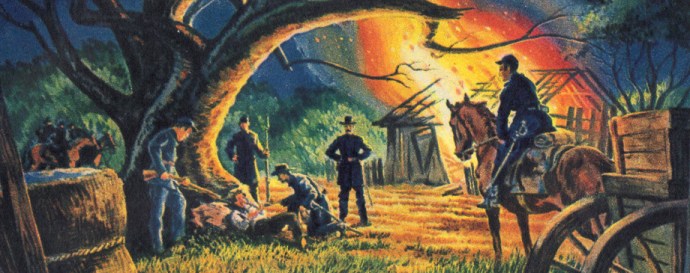
The rest is well-known. The Union troops learned from one of the residents of Port Conway that Willie Jett was among the men who crossed with John Wilkes Booth. What’s more, they learned of Jett’s affinity for Izora Gouldman. Unknowingly, the troops rode right past the Garret farm where Booth was hiding on their way to Bowling Green. They captured Jett at the Star Hotel and he agreed to take them to the Garrett farm. When the troops arrived, they kept Jett under guard near the gate of the farm while the rest surrounded the house and barn. Eventually Herold surrendered himself and the barn was lit on fire to smoke Booth out. Boston Corbett fired at Booth inside of the burning barn, paralyzing him. Booth was dragged from the barn, first placed under a tree and then on to the front porch of the house.  He died around dawn on April 26th.

pulled-from-the-barn-header.jpg

During the lengthy crossing of the soldiers on their way back across the Rappahannock after killing Booth, Detective Luther Baker took possession of Booth’s body and the prisoner Jett. With two other soldiers, Baker departed Port Conway ahead of the rest of the troops. At some point during their travel to Belle Plain, where a steamboat would take them up to Washington, Baker let Willie Jett go. Jett had led the soldiers right to the assassin without a fight, and Baker did not believe there was any need to detain him further. When Baker got back to Washington, he was severely berated by Edwin Stanton for releasing Jett without authorization. An arrest order for Jett was quickly sent out:

An arrest order for Willie Jett dated April 28th.

An arrest order for Willie Jett dated April 28th.

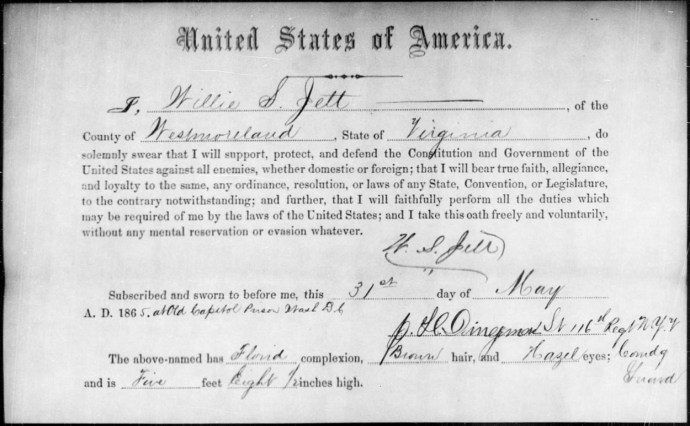
Jett was re-arrested in Westmoreland County, VA on May 1st. He was transferred to Washington and imprisoned at the Old Capitol Prison with the other Lincoln assassination related suspects. On May 6th, he gave a lengthy statement to the authorities about his interaction with Booth, ending it with the assurance, “I have tried to evade nothing. From the beginning I have told everything.”  Jett was also called to testify at the trial of the conspirators, giving his testimony on May 17th.  Willie Jett was imprisoned for a month and was released on May 31st when he took an oath of allegiance at the Old Capitol Prison:

Willie Jett's Oath of Allegiance NARA

Though Jett had been a major player in the escape of John Wilkes Booth, he was not tried as a conspirator since he had never met Booth prior to April 24th and Jett had also assisted in Booth’s capture.  The government was only concerned with prosecuting those they believed had real knowledge of the conspiracy before it was carried out.  Jett did not fit this criteria.

In January of 1890, an account written by Lieutenant Ruggles was published in The Century Magazine. Not all of the details in Ruggles’ recollections almost 25 years after the fact are correct, but he does give this account of what happened to him and Bainbridge:

“Learning that Jett was a prisoner, and that we were to be arrested, tried, and hanged, as aiders and abetters, Bainbridge and myself stood not on the order of going, but went at once. Making our way into Essex County and crossing to Westmoreland, we went to our home up in King George County. Some ten days after, I was arrested at night by a squad of United States cavalry. Bainbridge was also captured. We were taken to Washington and placed in the Old Capitol Prison. We were not alone in our misery, however, for Dr. Stewart, at whose house Booth had stopped, William Lucas, the negro who had driven him to the ferry, and a number of others, were there, among them being Jett, who had escaped from Captain Doherty, and had been recaptured at his home in Westmoreland County.”
Lieutenant Ruggles was arrested in King George County either on May 2nd or May 3rd (both dates are given on two different records).  Private Bainbridge was arrested in King George County on May 4th or 5th (again two different dates on two different records).  They were both transported to the Old Capitol Prison and were incarcerated there starting on May 5th.  For some unknown reason (Ruggles thought it was by mistake), the two men were transferred out of the Old Capitol and sent all the way to Johnson’s Island, a prisoner of war camp for Confederate prisoners located near Sandusky, Ohio.  They left the Old Capitol Prison on May 11th and arrived at Johnson’s Island on the 13th.

Johnson's Island 1865 LOC

It didn’t take very long for those in charge at Johnson’s Island to determine that these two men were much more than your average prisoners of war.  It certainly looks like their transfer to Johnson’s Island was a mistake because, on May 15th, Ruggles and Bainbridge were being transferred back to D.C.  They arrived at the Old Capitol Prison on May 17th and this time they stayed there.

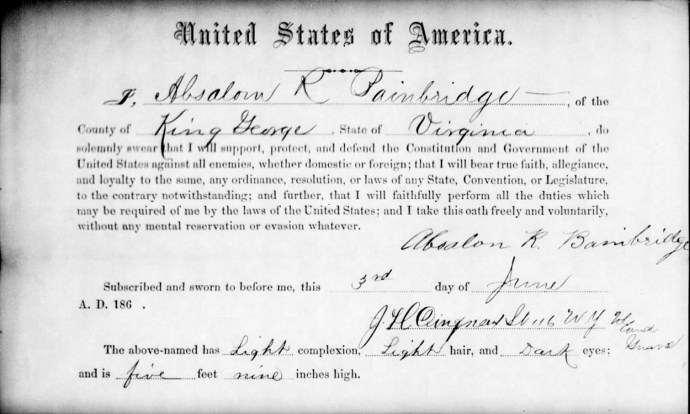
Neither Ruggles or Bainbridge were ever called to testify at the trial of the conspirators.  On June 3rd, both men were released from their confinement after taking the oath of allegiance:

Mortimer Ruggles Oath of Allegiance NARA

Absalom Bainbridge Oath of Allegiance NARA

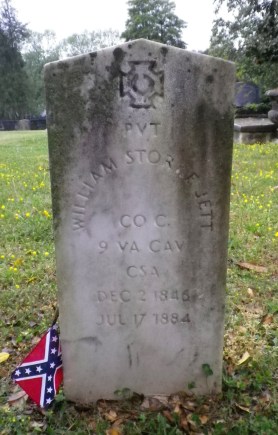
Willie Jett never ended up marrying Izora Gouldman of the Star Hotel.  Instead he moved to Baltimore, married, went insane (possibly because of untreated syphilis), and died in an insane asylum in Virginia.  His body is buried in Fredericksburg.

Willie Jett's grave

After the war, Mortimer Bainbridge Ruggles and Absalom Ruggles Bainbridge continued to imitate each other.  Both men married and had two children.  Both moved to New York.  Both found occupations that forced them to move around; Ruggles as a traveling salesman and Bainbridge as an interior decorator.  Finally, both men died not only in the same year, but in the same month.  These two Confederate veterans are buried in two different cemeteries in New York:

Mortimer Ruggles' grave

Grave of Absalom Ruggles Bainbridge


While Jett, Ruggles, and Bainbridge spent a bit more time imprisoned than some of the other suspects in Lincoln’s assassination, their incarceration could have been longer, especially since it was known that they had contact with Booth and assisted him during his escape.  Booth’s brother, Junius Brutus Booth, Jr., who knew nothing about the assassination, was imprisoned until June 22nd.  John Lloyd, the man who gave Booth and Herold a carbine, field glasses, and some whiskey at the Surratt Tavern, wasn’t released until June 30th.  One of the last people released from the Old Capitol Prison was Joao Celestino, the Portuguese ship captain whose ill-timed threats against William Seward made authorities believe he was a main conspirator.  Celestino was released from the Old Capitol Prison on July 8th and was ordered to leave the U.S. within 10 days, never to return.  And, of course, Dr. Mudd, Edman Spangler, Samuel Arnold, and Michael O’Laughlen were imprisoned at Fort Jefferson for three and a half years before the surviving three were pardoned in 1869.

The imprisonment endured by Jett, Ruggles, and Bainbridge could have certainly been worse had the government truly wanted to punish all those who assisted John Wilkes Booth.

References:
American Brutus by Michael W. Kauffman
Brutus’ Judas: Willie Jett by Eric J. Mink
“Pursuit and Death of John Wilkes Booth” by Prentiss Ingraham, Century Magazine, Jan, 1890
Jett, Ruggles and Bainbridge’s prison records and oath of allegiances were accessed via Fold3.com
FindaGrave.com (Bainbridge, Ruggles)
Rich Smyth

Categories: Uncategorized | Tags: , , , , , , , | 18 Comments

John Wilkes Booth in the Woods: Part 8

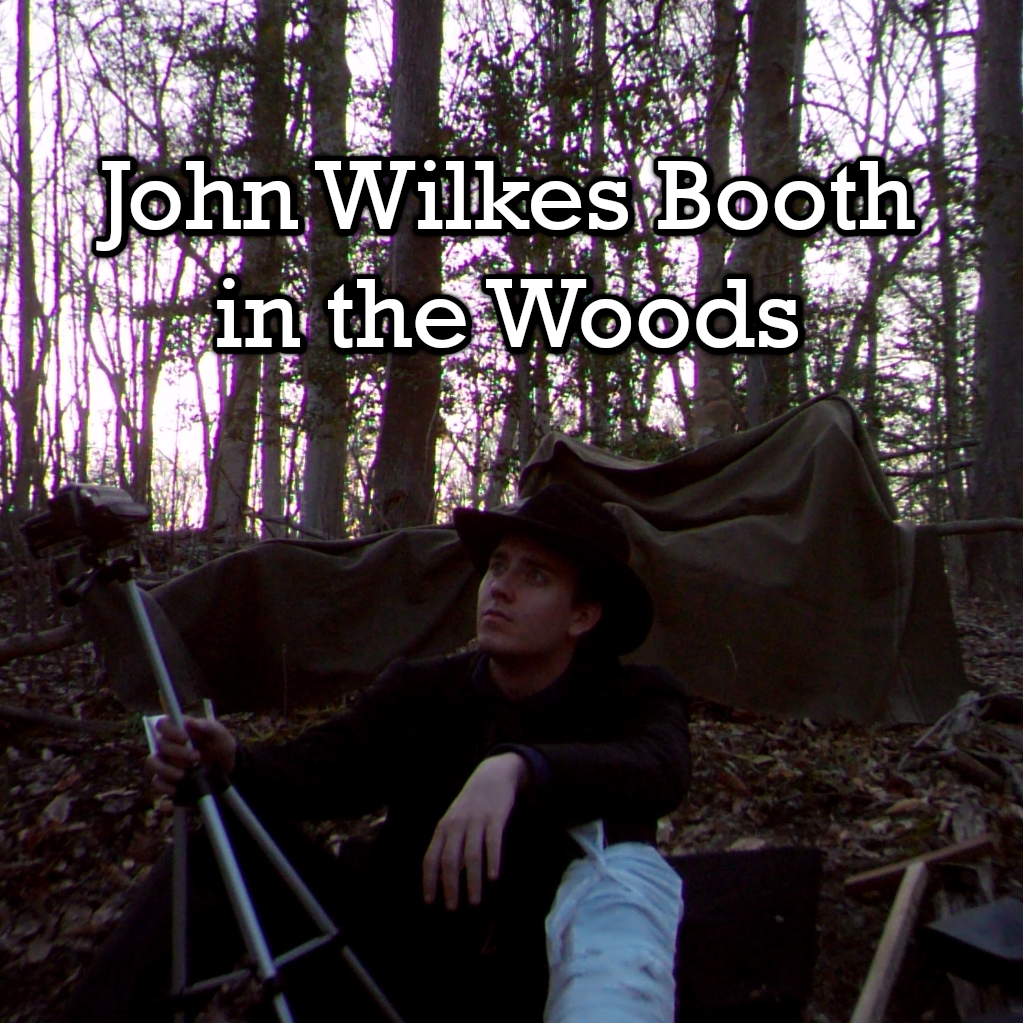
John Wilkes Booth in the Woods

Part 8 of my series “John Wilkes Booth in the Woods” is now complete and available for viewing.

In this part I discuss Booth’s comfort and the ways he could have passed the hours of waiting.

To watch the video, you can either click on the image above and scroll down, click HERE to watch the video on YouTube, or play the embedded video below.

Categories: Uncategorized | Tags: , , , , , , | Leave a comment

Blog at WordPress.com.