Uncategorized

John Wilkes Booth Crossword Puzzle

In April of 1980, Americana magazine published an article about Richard and Kellie Gutman.  The pair had just completed their groundbreaking study on all of the known photographs of John Wilkes Booth.  Their final product was the volume John Wilkes Booth Himself.  The article highlighted the Gutmans’ six year search for Booth photographs in collections around the nation and also discussed some of the Gutmans’ own personal Booth treasures.  Coincidentally, one item that formerly belonged to the Gutmans was an over-sized autograph of John Wilkes Booth to his brother Junius, which sold at auction for $14,000 ($17,500 after the 25% buyer’s premium) on January 24th.

The article was well written and helped bring awareness of “Boothophiles” (as the article termed them), like the Gutmans, to a wider audience.  Even back then, Richard Gutman expertly explained what it meant to be a Boothophile/Boothie/BoothBuff stating:

“We’re not apologists for Booth.  The enormity of his deed precludes that.  But we are fascinated by Booth as a romantic, enigmatic character – by how a talented actor became unhinged enough to assassinate Lincoln.”

If you have a couple minutes to spare, I would highly recommend reading the three page article about the Gutmans which can be found here.

Due to the inclusion of the Booth article, the man in charge of creating the crossword puzzle for that issue of Americana decided to make the puzzle John Wilkes Booth themed.  While not every clue is related to John Wilkes Booth, I thought it might be entertaining to post the crossword puzzle here for you all to print out and try on your own.  Consider it another bit of levity and a nice rainy day Boothie activity like the coloring page I posted awhile back.

John Wilkes Booth Crossword Puzzle - Americana Magazine - April 1980

Click the puzzle to download (.pdf) or print

Have fun and let me know how you do!


P.S. How times have changed. At the end of the Gutman article was the following box of information:

IMG_7428

While the Surratt Society still puts on their excellent John Wilkes Booth Escape Route Tours (BERTs), the price has gone up in the 35 years since this article was published.  The price is now $80 for Surratt Society members and $85 for non-members.  Also, I would have loved to have been around to pick up multiple copies of John Wilkes Booth Himself for the original price of $18.50.  Nowadays, the asking price for this book is about $300 and up.  It just goes to show you, forget buying stocks and bonds, the best long term investments are in Booths!

Categories: Uncategorized | Tags: , | 3 Comments

New Section: Calendar

2015 is going to be very busy for those interested in the assassination of Abraham Lincoln. While the actual 150th anniversary of the tragedy will occur on April 14th, many groups are planning commemorative events throughout the year.

fords-150-remembering-lincoln

In an effort to provide a resource for those who may be looking to attend a Lincoln assassination remembrance this year, I have created a custom Google calendar of events.

Some events are multi-month exhibits at various museums, while others are single day speeches or activities. While most events are centered around the D.C., Maryland, and Virginia area, this calendar is not confined to that region. Clicking on any event will give you more information about it.  In addition, all of the information contained in this calendar has been translated into a list located on the side of this blog, allowing you to see upcoming events at a glance while reading any page here on BoothieBarn.  The code translating the calendar into list form isn’t perfect however, resulting in small errors and no clickable hyperlinks for more information.  If you want to learn more about an upcoming event, view the calendar below or on its own Calendar page, and the hyperlinks should function properly.

This calendar is a work in progress with new events being continually added.  If you know of an upcoming Lincoln assassination event or exhibit, please comment on the Calendar page and let us know about it so that it can be included.

A future post will highlight some of the really big events planned for this year (The Surratt Society Conference, Ford’s Theatre’s Lincoln Tribute, Charles County’s Lincoln 150, Caroline County’s Capture of John Wilkes Booth, and the Junius Brutus Booth Society’s first ever Tudor Hall and Booth Family Symposium), but until then you can check out the events for yourself in the new Calendar section!

Categories: Uncategorized | Tags: , , | 8 Comments

Assassination Maps Update

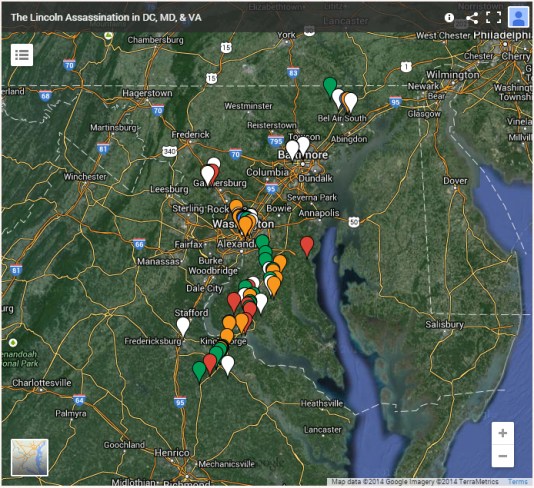
DC, MD, VA Assassination map thumb

I just wanted to publish a quick post highlighting a big update to the Maps section of BoothieBarn.  First, I have added about 30 more sites to the D.C., Maryland, and Northern Virginia map, bringing the total up to over 120 sites on this map alone.  Maps for other regions of the U.S. are planned, but, since most of the action occurred in the Maryland area, I have been focusing on adding to and improving that map first.  To that end, I have gone through and added a new aspect to the map which should make it even easier to locate and visit these sites, especially “on the go”.

We know, from studying an event that occurred 150 years ago, that landscapes have changed.  In many instances, places that were once isolated farms and open land are now housing developments or busy highways.  Old roads are lost to new roads and bypasses.  Due to this, it is important to mark historic sites with something more long term than a street address, which could change (or disappear) in a few short years.  Recording latitude and longitude coordinates based on the Global Positioning System (GPS) is, therefore, the best way to mark sites on an ever changing landscape.  Regardless of what transformation occurs on the site itself, the GPS coordinates will always mark what was once there.

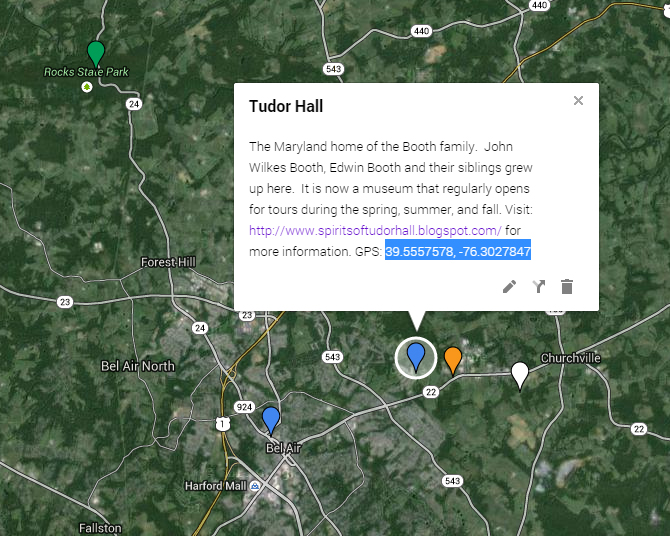
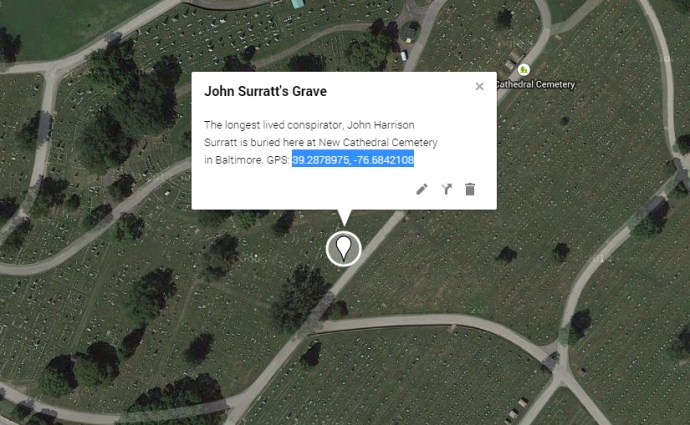
With this in mind, I have gone through and added the GPS coordinates for every site marked on my map.  This is not only for posterity’s sake, but also serves to improve the functionality of the map itself.  Practically every “smart” cell phone built today has the capability of providing driving directions.  Now, with the GPS coordinates included in the description for every Lincoln assassination site, all you have to do is click the place you want to visit on my map, copy the GPS coordinates, and direct your phone or GPS device to give you directions there.

Assassination maps GPS coordinates example

For places like cemeteries, the GPS coordinates are even more helpful, as they direct you almost exactly to the grave you are looking for.  No more wandering around a huge cemetery hopelessly looking for that one grave.  My coordinates will put you right at it.  As I visit more graves in more cemeteries (using a wonderful book by Jim Garrett and Rich Smyth as my guide), I’ll be updating the map with even more grave GPSes.

Grave coordinates example

Me Surratt Grave Jan 2015

So, if you’re planning a trip to the area or, better yet, planning to drive John Wilkes Booth’s escape route on your own, be sure to check out my D.C., Maryland, and Northern Virginia Lincoln assassination map for all the GPS coordinates you’ll need.

Click here to view the updated Maps section of BoothieBarn, now with GPS coordinates!

Categories: Uncategorized | Tags: , , , , | 5 Comments

Retracing the Steps of the 16th New York

When John Wilkes Booth looked out between the slats of Mr. Garrett’s tobacco barn in the early morning hours of April 26, 1865, the faces he saw staring back at him belonged to the troopers of the 16th New York Cavalry.  Through perseverance and a good bit of luck, the troop of twenty-six men commanded by Lieutenant Edward P. Doherty, detectives Luther Baker and Everton Conger, managed to locate and surround the assassin of President Lincoln.  On the last day of the 2014,  I retraced some of the steps the troopers took which concluded in them successfully locating the most wanted man in America.

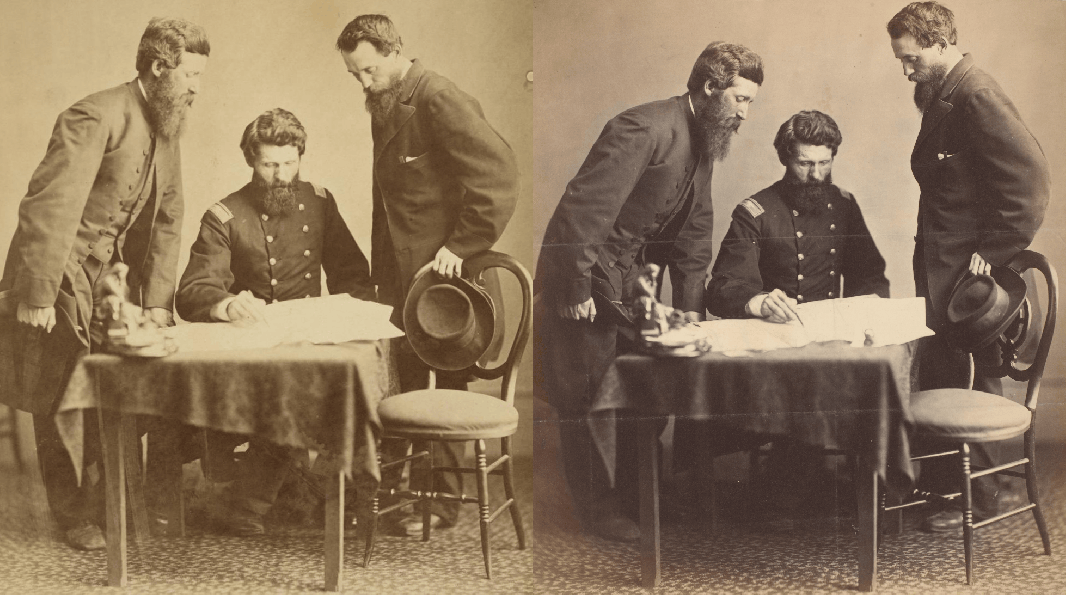
Luther Baker, Lafayette Baker, and Everton Conger posed as if planing the capture of John Wilkes Booth. Image animated by Chubachus (http://chubachus.blogspot.com/2014/12/time-lapse-photographs-of-colonel.html)

Following the crime of April 14th, numerous troop detachments were sent out to scour the countryside in search of the assassin.  However, with the assistance of others, Booth and Herold always managed to stay one or two steps ahead of the soldiers.  When the pair crossed over into Virginia, they had a huge lead over their pursuers.  While the manhunt succeeded in identifying and arresting some of the major players in the escape (John M. Lloyd, Dr. Samuel Mudd, even Thomas Jones), up until the moment he was killed, the widespread belief among those searching for him held that Booth was still hiding out in Maryland.  The reason the 16th New York had even made its way into Virginia to search for the assassin was due to a serendipitous case of mistaken identity.

On April 16th, two Confederate agents named Thomas Harbin and Joseph Baden, Jr. crossed the Potomac river from a point on the Maryland shore called Banks O’Dee.  Harbin had been introduced to John Wilkes Booth by Dr. Mudd and had apparently agreed to help the actor in his initial abduction plot against Lincoln.  The increased troop detail in Southern Maryland and his acquaintance with the assassin probably motivated Harbin to cross to safer shores in Virginia.  On the 19th of April, while detectives from James O’Beirne’s Washington D.C. provost marshal’s office were in Southern Maryland looking for information and acting as spies, a farmer in Banks O’Dee named Richard Claggett mentioned having seen two men cross the river on the 16th.  As days passed with no other signs of the fugitives, two of O’Beirne’s men followed up on this lead and traveled into the Northern Neck of Virginia where few troops had been deployed.  The detectives found a boat but nothing more.  On the morning of the 24th O’Beirne, himself in the field at Port Tobacco, had a telegraph sent to the War Department about the theory that the fugitives may have already crossed into Virginia.  Lafayette Baker, head of the National Detective Police, decided O’Beirne’s theory warranted further investigation and received permission from  Secretary of War Edwin Stanton to send a cavalry troop.  An order went out for a “reliable and discreet commissioned officer” to command the mission.  Lt. Edward Doherty of the 16th New York Cavalry answered the order.

Edward P. Doherty of the 16th New York Cavalry

Edward P. Doherty of the 16th New York Cavalry

A call then went out for twenty five privates from the 16th New York to join him, and Doherty took the first twenty-five who responded, regardless of their rank.  Lafayette Baker also sent two detectives with the 16th New York.  One was his cousin, Luther Byron Baker, and the other was a former Lieutenant Colonel Everton Conger.  Both had served with Lafayette Baker in the District of Columbia Cavalry.  Technically, Luther Baker and Everton Conger were civilians at the time which would have left Doherty as the de facto leader of the group.  However, once Booth was cornered and killed and the applications for reward money came in, battle lines were drawn with Conger and Baker both refuting Doherty’s ownership of the operation, making it difficult to ascertain who Lafayette Baker truly put in charge (if anyone).

Regardless, after receiving their orders to investigate the Northern Necks of Virginia, the detectives and the soldiers of the 16th NY made their way to the Sixth Street wharf in Washington D.C. and boarded the propeller-driven steamer, John S. Ide.  The Ide steamed them down the Potomac, depositing them at Belle Plain, Virginia which is right at the border of King George and Stafford counties.  It had taken Booth and Herold nine days to reach King George County. The troops made it there from D.C. in four hours.

Belle Plain map 1

Here are some pictures Belle Plain today showing the location where the John S. Ide docked and unloaded the soldiers:

Belle Plain 2

Belle Plain 1

Belle Plain Pano

The detachment unloaded here at around 10 pm on April 24th.  Knowing that Booth was suffering from a broken leg, they immediately set about looking for doctors in the area.  Luther Baker recalled the long night of April 24/25th thusly:

“The direction we took I could not tell positively.  We went under the bluffs, and waked up the inhabitants of a house, to ascertain if any physicians resided in that locality.  We learned the names of three of them, found them, and questioned them closely as to whether or not they had attended anyone with a fractured limb, or had heard of anyone with a fractured limb in the vicinity.  We also questioned a negro and a few white persons upon the subject.  All had heard of no such case.”

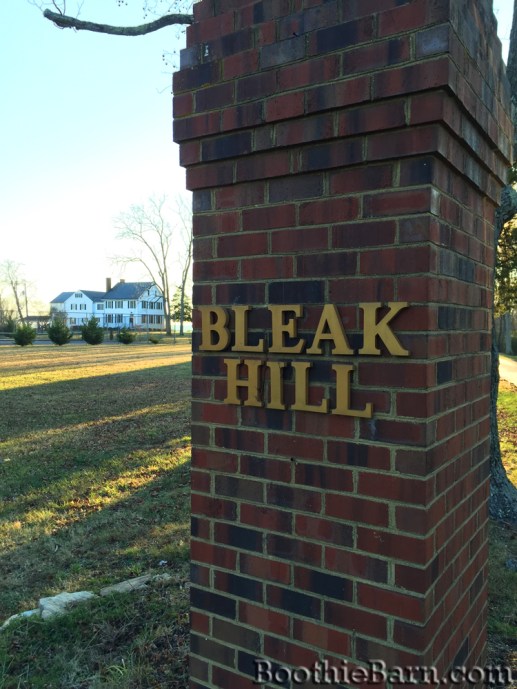
Around daybreak on the 25th, the 16th New York arrived at the home of Dr. Horace Ashton, the last doctor on their list.  Like the other doctors in the area, Dr. Ashton had neither seen or heard anything in regard to a man with a broken leg in the area.  The doctor was a fairly wealthy man with a large plantation which he called, Bleak Hill.

Bleak Hill map

The doctor fed the troopers’ horses and provided the soldiers with a well deserved breakfast.  Bleak Hill still stands today though the large building on the property apparently dates to 1870.
Bleak Hill 1

Bleak Hill 2

When the troops departed Bleak Hill, they split into two groups, each tracing a different route down to Port Conway on the Rappahannock River.  Lt. Doherty and the majority of his men took the main road to Port Conway passing through Office Hall.  Unbeknownst to the men, they were now on the trail of Booth and Herold as the pair had also passed through Office Hall on their way between Cleydael and Port Conway 24 hours before.  Baker, Conger and four troopers took a less traveled route and eventually met up with the posse in Port Conway around lunch time.

The horses were again in need of feed and were lucky enough to find hospitality at the home of a wealthy planter named Carolinus Turner.  His large and beautiful home was called Belle Grove and had the distinction of being the site of President James Madison’s birth.  About half of the troopers were served lunch at Belle Grove with the rest being fed elsewhere.  After lunch, Col. Conger, exhausted and suffering the long term effects of previous battle wounds, fell asleep from exhaustion in the hall of Belle Grove.

Belle Grove map

Today, Belle Grove is operated as a beautiful bed and breakfast. As refreshing as Col. Conger’s rest in the hallway must have been, I can say from personal experience that is nothing compared to a night or two in their luxurious Madison Suite.

Belle Grove 1

Belle Grove Front

Belle Grove Hallway

Belle Grove Hallway with Conger

As Conger slept, Lt. Doherty and some of his men made their way the half mile down the road to Port Conway, where they interviewed the inhabitants. It was here, in tiny little Port Conway on the Rappahannock River that the 16th New York finally got their first real lead on Booth’s whereabouts. Local fisherman William Rollins, had seen Booth and Herold as they were waiting to cross the Rappahannock the day before. Even more helpful, Rollins’ wife not only recognized the Confederate soldiers who ended up crossing the ferry with the pair, but knew that one of them, Willie Jett, was courting Izora Gouldman who lived in nearby Bowling Green. With this information in hand, Doherty sent one of his men to wake up Conger and the whole posse began the task of crossing the Rappahannock river. It took a while as the small ferry could only carry a few horses at a time. When the entire group made it across the river, they set about galloping at full speed to Bowling Green. Unknowingly, they rode right past the Garrett farm where Booth and Herold were hiding out.

Bowling Green map

Once in Bowling Green (a place I did not visit on New Year’s but you can see other pictures relating to it in the Bowling Green Picture Gallery), the company found Jett sleeping in the Star Hotel. Surrounded by troopers, he “offered” to take the men to the Garrett place where he had dropped off Booth two days before. The troops, with Jett in tow, headed back to the Garrett Farm.

Garrett's farm map

The rest, as they say, is history. Booth and Herold had been exiled to the tobacco barn that night due to their strange behavior when the troops were originally galloping past on the way to Bowling Green. With the barn surrounded, Herold surrendered while an obstinate Booth asked for 50 paces so that he could come out shooting. Eventually Conger tired of the ongoing parley and set fire to the barn. Sergeant Boston Corbett aimed his pistol through the slats of the barn and shot Booth, striking him in the neck, and paralyzing him. He was pulled to the porch of the farmhouse and died there right after sunrise.

Today the site of the Garrett house is in the wooded median of Route 301, surrounded on all sides by Fort A. P. Hill. The only marker at the site, aside from a warning that digging for artifacts in illegal, is a metal pipe sticking out of the ground which marks the center line of the western most chimney of the Garrett house.
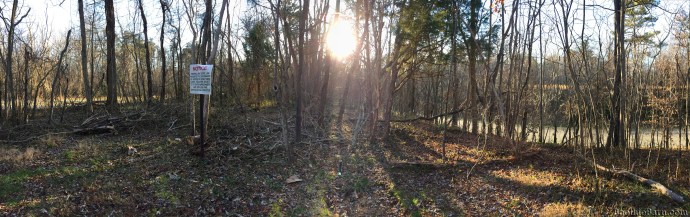
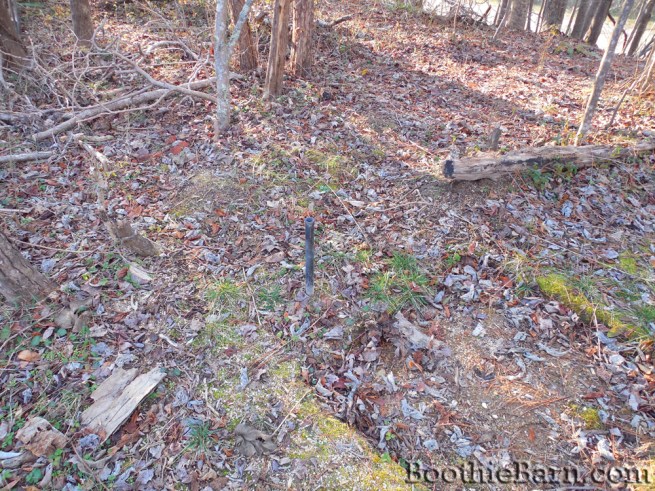
Garrett site 1-1-2015 Pano

Garrett Site 1-1-2015

A visit to the Garrett site on New Year’s day (a tradition of mine ever since I moved to Maryland) ended our retracing of the route of the 16th New York Cavalry. After getting a breakfast and food for their horses at Garrett’s, the troopers returned to Belle Plain. With Booth’s body in tow and Herold taken prisoner, the victorious men reboarded the John S. Ide and steamed back up to D.C. They were Lincoln’s Avengers and no doubt spent that steamship ride dreaming of the fame and reward money that awaited them.

References:
American Brutus by Michael W. Kauffman
The Lincoln Assassination: The Reward Files by William Edwards
Belle Grove Plantation

Categories: Uncategorized | Tags: , , , | 20 Comments

New Gallery – Asia Booth Clarke

Asia Booth Clarke 1

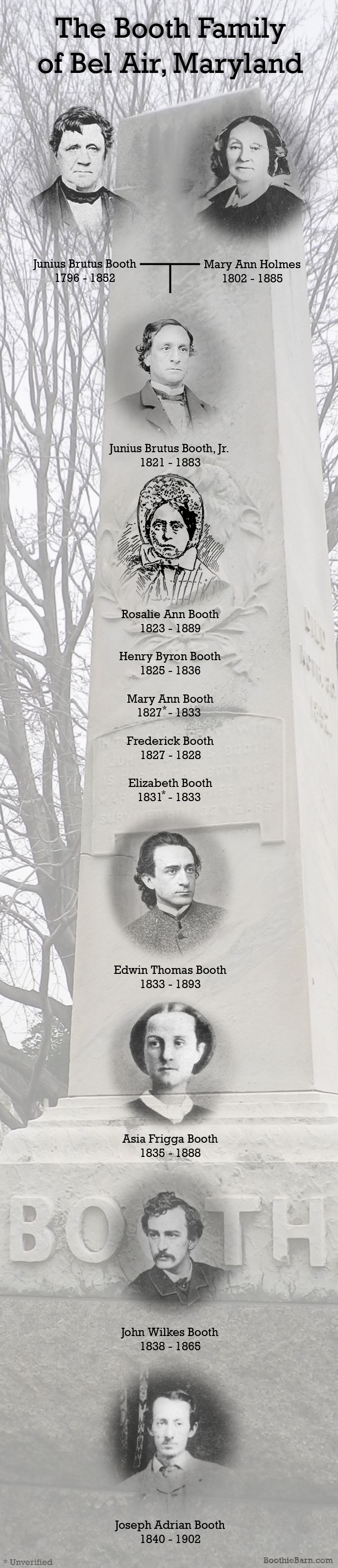
Asia Frigga Booth was the youngest daughter of Junius Brutus Booth and Mary Ann Holmes.  She was born on the Booth family farm in Harford County, MD, on November 20, 1835.  While growing up in the secluded wilderness of their Tudor Hall home, Asia grew very close to her younger brother, John Wilkes.  The two would often play, with Asia acting as Wilkes’ first acting teacher by helping him run lines and practice his elocution.  Asia was described by those who knew her as, “beautiful”, “educated and mathematical”, and “strong-minded”.  She was courted for years by a family friend named John Sleeper.  He, like the Booth sons, wanted a career in the theater.  In order to avoid the connotation that a performance by him would put an audience to sleep, he changed his named to John Sleeper Clarke.  The two married in 1859.  At first, life for the two was good.  Clarke and Asia’s rising acting brother, Edwin, were close business partners and friends.  Asia and Clarke had three children by 1865, all of whom were all named after various members of the Booth family.  The eldest, Asia Dorothy, named for her mother, was nicknamed “Dollie”.  Their next child, Edwin Booth Clarke, was named for his uncle and went by the nickname “Teddy”.  Another daughter Adrienne, received her name from Asia’s youngest brother, Joseph Adrian.

The assassination of Abraham Lincoln by the hands of her favorite brother, John Wilkes, was a massive blow to Asia and her family.  John Sleeper Clarke was imprisoned for a time and pregnant Asia was put under house arrest.  Hoping to do something to redeem the family name, Asia set her sights on a long forgotten project she had once started: writing a biography about her father.  She plunged back into her work, attempting to forget the tragedy that had befallen her.  In August of 1865, she gave birth to twins, Creston and Lillian.  By December she had finished her biography of Junius Sr. and it was published under the title, Booth memorials : Passages, incidents, and anecdotes in the life of Junius Brutus Booth (the Elder) by His Daughter.

In 1867, another son, Wilfred, was born.  Despite the passage of time, Asia still felt the stigma of her brother’s crime and Clarke discovered he had strong star power on the London stage.  Asia agreed to move the family there, despite their strained relationship.  She hoped that England would give her the fresh air and foreign setting she needed to start over.  Asia and her children depart America in 1868.  Asia wrote that she expected to be gone for two or three years.  In fact, she would never see her homeland again.

Life in England lost its appeal fairly quickly to Asia and her relationship with Clarke continued to sour.  The pair had three more children in England, all of which died, furthering Asia’s grief and separating her even more from her husband.  In 1874, she began writing a biography of her misguided brother, John Wilkes.  It contained her memories of his younger days and painted a far more human picture of the man who assassinated Lincoln.  She knew, however, that this sympathetic view of her brother would never be tolerated during her lifetime and so put the biography aside to be published after her death.

In the 1880’s Asia finished a book entitled, The Elder and Younger Booth, which detailed the careers of her father, Junius, and her brother, Edwin.  By this point Clarke was making regular trips back to the States to perform with Asia being left behind in England.  She referred to Clarke as “a bachelor in all but name” and described his hatred for her and the Booth name.

Asia Booth Clarke died on May 16, 1888 at the age of 52.  Before her death she made Clarke promise to return her body to America so that she could be buried in the family plot in Baltimore.  This was done and Asia Booth now lies with her parents and siblings in Green Mount Cemetery. Clarke would later die in England and is buried there.

Two of Asia and Clarke’s children followed the family tradition and became actors.  Creston and Wilfred Clarke both had decent careers upon the American stage and vaudeville.

Asia’s secret biography of her brother was given to a family friend upon her death due to her fears that Clarke would destroy it.  It was not published until 1938, sixty years after Asia’s death.  Though more a collection of Asia’s pleasant memories of her brother than a true biography, the book provides a unique and much needed view of John Wilkes’ early life and interactions with his family.

While Asia Booth never found fame (or infamy) like her other siblings, she remains a valuable chronicler of their achievements.

The newest Picture Gallery here on BoothieBarn has to do with Asia Booth Clarke and her family.  To visit the gallery, click HERE or on Asia’s picture in the image below:

References:
John Wilkes Booth: A Sister’s Memoir by Asia Booth Clarke edited by Terry Alford

Click for Junius Brutus Booth Click for Mary Ann Holmes Booth Click for Junius Brutus Booth, Jr. Click for Rosalie Ann Booth Click for the Booth children Click for Edwin Thomas Booth Click for John Wilkes Booth Click for Joseph Adrian Booth
Categories: Uncategorized | Tags: , , | 6 Comments

A Victorian Christmas at the Dr. Mudd House Museum

For one weekend every December, the Dr. Samuel A. Mudd House Museum in Waldorf, MD reopens out of season in order to present, “A Victorian Christmas”.  A devoted team of volunteers work hard to elegantly festoon the house and grounds with Christmas decor. During the event, costumed docents fill each room of the house eager to discuss not only Dr. Mudd and his involvement with John Wilkes Booth, but also the Christmas customs and traditions of years past. The event is highlighted with Civil War reenactors, music, and a visit from Santa Claus.

Mudd Victorian Xmas 1

Though I have been living in Maryland for three Christmases now, this year marked the first time I was able to attend this special event. The following are some of the pictures I took of my visit today.

Mudd Victorian Xmas 4

Mudd Victorian Xmas 9

Mudd Victorian Xmas 8

Mudd Victorian Xmas 7

Mudd Victorian Xmas 3

Mudd Victorian Xmas 2

Mudd Victorian Xmas 5

Mudd Victorian Xmas 6

Sadly, St. Nick was not present during my time at the house otherwise I would have been sure to photograph him. I did, however, use the festive opportunity to purchase a much needed item from the museum’s gift shop: a Dr. Mudd House ornament.

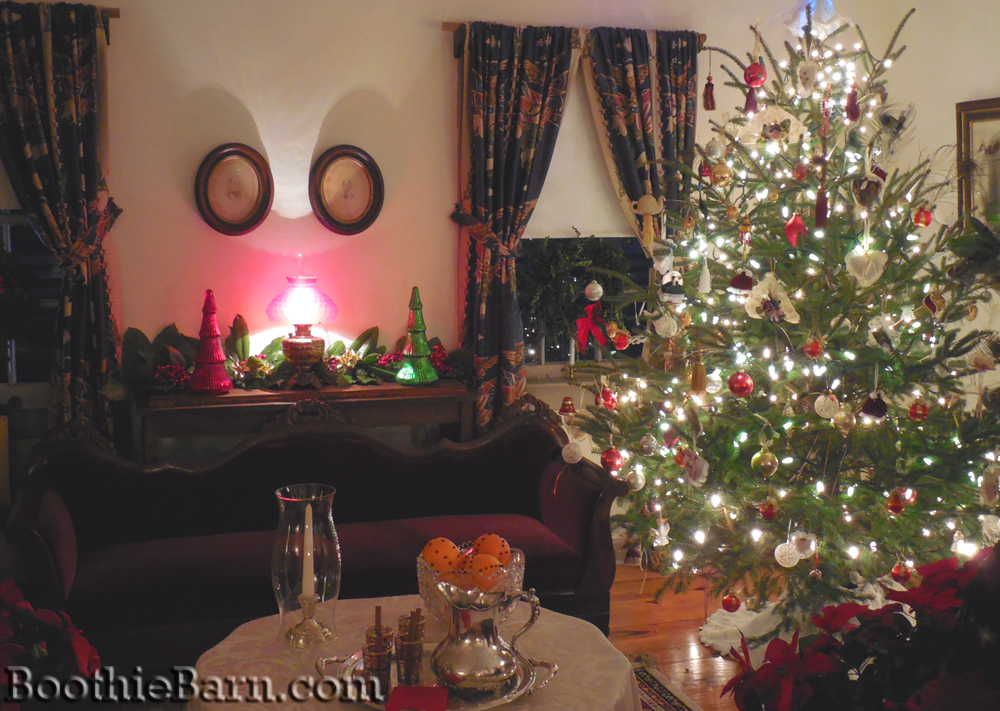
Mudd Victorian Xmas 10 As you can see, the ornament looks great on my Christmas tree hanging right next to my ornaments of John Wilkes Booth and the Surratt House Museum.

For those of you who live in the area, “A Victorian Christmas” will also take place at the Dr. Mudd House Museum tomorrow, December 7, 2014 from 11 am to 8 pm.  Admission is $8.  If you can’t make it this year, be sure to keep an eye out for this annual event next December.

Since the Mudd house has effectively put me in the holiday mood, it seems fitting to close this post with another one of my Boothie Christmas carols.  This revised rendition is entitled “Little Doctor Mudd” and it is sung to the tune of “Little Drummer Boy”.  Enjoy!

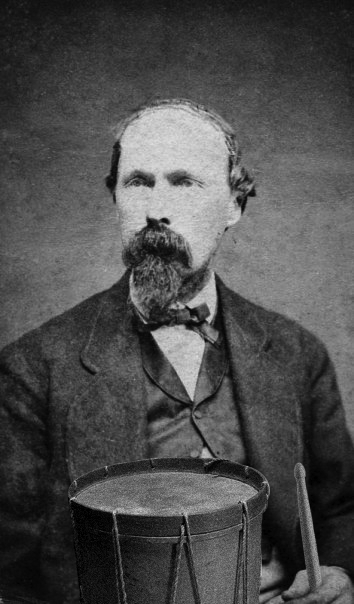
drummermudd

Little Doctor Mudd
As sung to, “Little Drummer Boy”

“Come”, Dave told me,
Mudd Mudd-Mudd-Mudd Mudd
“An injured John to see.”
Mudd Mudd-Mudd-Mudd Mudd
“My horse, it fell on me,”
Mudd Mudd-Mudd-Mudd Mudd
“As I was trying to flee.”
Mudd Mudd-Mudd-Mudd Mudd, Mudd-Mudd-Mudd Mudd, Mudd-Mudd-Mudd Mudd.
On my couch went he,
Mudd Mudd-Mudd-Mudd Mudd
Down with a thud.

“We must make do.”
Mudd Mudd-Mudd-Mudd Mudd
“This splint will see you through.”
Mudd Mudd-Mudd-Mudd Mudd
“The troops will soon pursue.”
Mudd Mudd-Mudd-Mudd Mudd
“I dare not harbor you.”
Mudd Mudd-Mudd-Mudd Mudd, Mudd-Mudd-Mudd Mudd, Mudd-Mudd-Mudd Mudd
“We are joined, we two, Mudd Mudd-Mudd-Mudd Mudd”
“In cold blood.”

When they left here,
Mudd Mudd-Mudd-Mudd Mudd
Our story we made clear.
Mudd Mudd-Mudd-Mudd Mudd
Our lies and truths cohere.
Mudd Mudd-Mudd-Mudd Mudd
I knew we’d persevere.
Mudd Mudd-Mudd-Mudd Mudd, Mudd-Mudd-Mudd Mudd, Mudd-Mudd-Mudd Mudd

But, I had one fear.
Mudd Mudd-Mudd-Mudd Mudd
“Here’s a boot.”
“Crud!”

(You can read some of my previous Boothie carols by clicking here, here, here, and here.)

Categories: Uncategorized | Tags: , , , | 8 Comments

“Honor to Our Soldiers”: Civil War Veteran William Withers, Jr. and the Song that was Never Sung

After you read this wonderful post from the Ford’s Theatre Blog, click here to listen to the “song that was never sung”: https://www.youtube.com/watch?v=HMVq2xS-pl0

Categories: Uncategorized | 3 Comments

John Wilkes Booth in the Woods Finale

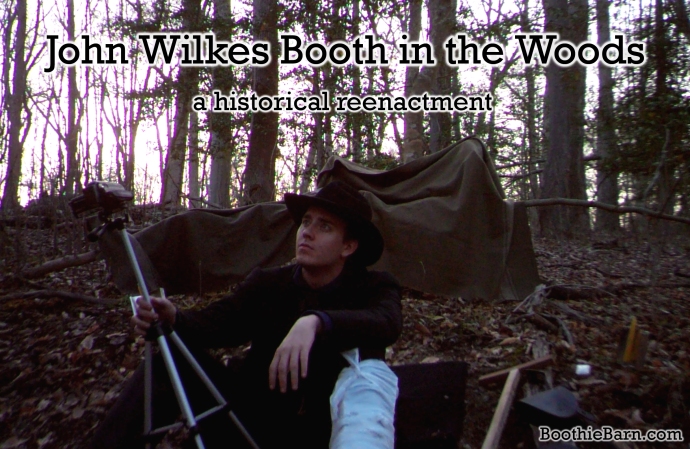
John Wilkes Booth in the Woods

On April 12th of this year, I underwent a journey into history.  For 3 days and 2 nights, I completely immersed myself in the conditions John Wilkes Booth faced while hiding out in a pine thicket after he assassinated Abraham Lincoln.  The project took months of preparation and the assistance of countless individuals who alerted me to new research, informed me of the intricacies of 19th century attire, and provided much needed moral support for such an endeavor. I strove to ensure that this experience was as genuine as possible and committed to feeling the same discomfort Booth felt.

Even from the beginning I knew I wanted to document the experience in order to share it with others.  While the 19th century method of documentation would have been limited to the written word, modern technology allows us to go further.  Therefore, with camera gear as my only anachronism, I walked into the woods with the same meager supplies that were afforded to Booth hoping to shed some light on this forgotten part of his escape.

Today, I publish the final installment of the series, bringing the project to its completion.  I am extremely grateful to not only those listed in this final video but also the many others who helped my along the way and prayed for my safety.  I hope that you have enjoyed this series as I hope to produce more like it in the future.

To watch the final video, you can either click on the image above and scroll down, click HERE to watch the video on YouTube, or play the embedded video below.

Remember that all of the videos in the series can be found in one place by clicking the “John Wilkes Booth in the Woods” image at the top of this post.

Thank you all for coming on this journey with me.

~ Dave Taylor

Categories: Uncategorized | Tags: , , , , , | 8 Comments

Blog at WordPress.com.