History

A Visit to “The Trap”

On April 24, 1865, John Wilkes Booth, the fugitive assassin of President Abraham Lincoln, was dropped off at the Garrett farm just outside of Port Royal, Virginia. Over the prior ten days, Booth and his accomplice David Herold had successfully eluded the massive manhunt searching for them in Maryland and had made their way into Virginia. By portraying himself as a wounded Confederate soldier named James Boyd, John Wilkes Booth was welcomed in by the Garrett family and given the hospitality of their home and farm. David Herold, on the other hand, decided for the first time to depart from Booth’s company. Whether this was his own choice or whether Booth sent him away on purpose, perhaps to scout the route ahead, is unknown. Regardless, Herold did not stay at the Garrett farm on April 24th and, instead, continued on towards Bowling Green with the three Confederate soldiers that he and Booth had met in Port Conway. When the sun went down on April 24th,  Herold and one of the soldiers, Absalom Bainbridge, would spend the night outside of Bowling Green, Virginia at the home of a Mrs. Virginia Clarke. Before that would occur, however, David Herold and the three Confederate soldiers would all make a pit stop on the road between Port Royal and Bowling Green at a tavern known as “The Trap.”

The Trap was built around 1752 and initially operated as a private home. Its location of being about half way between Port Royal and Bowling Green earned it the nickname of the “Halfway House.” In 1777, a wealthy man by the name of Peyton Stern (whose land holdings in Caroline County at that time stretched over 2,000 acres and included what would become the Garrett family farm) started operating the building as a tavern. In the 1830’s the tavern was acquired by a man named George Washington Carter, whose family owned an adjacent land tract of 452 acres. George Washington Carter died in 1853 leaving his widow, Martha, to care for their large family of children. Similar to the Surratt Tavern in Prince George’s County, Maryland, Mrs. Carter would continue to operate the tavern as a means of income and offer lodging for visitors passing by on the road. The Trap also operated as the local post office in the same way the Surratt Tavern did.

In 1865, Mrs. Carter was running The Trap with the help of her four daughters. The daughters were twins Martha and Mary (27), Sarah (23), and Agnes (20). On April 5, The Trap briefly received a fairly distinguished guest by the name of Thomas Conolly.

Thomas Conolly

Thomas Conolly

Conolly was an Irish member of British parliament who had crossed the Atlantic to visit the Confederacy. He was well connected, wealthy, and was able to meet many of the Confederacy’s elite. Conolly was lavishly wined and dined during his trip, likely in the hopes that impressing him would motivate him to convince his countrymen to support the Confederacy. Conolly had departed Richmond just before the Union troops seized it and was making his way north. He mentions his stop at The Trap in his diary which has been published as An Irishman in Dixie: Thomas Conolly’s Diary of the Fall of the Confederacy.

“Stopped again from the exhausted state of our horse at the Trap 1/2 way to Port Royal where we find Mrs Carter & her 4 pretty daughters. The house was full of Virginia Cavalry going to join their Regts & the girls & mother serving them all round with all they had. Got some dinner bacon & greens & pickled peaches & corn bread & milk. Matty [Martha] & I had a pleasant chat & I gave her the other gold stud wh[ich] pleased her much.”

Conolly’s diary paints The Trap as a bustling and busy tavern with soldiers anxious to get food and drink. It was, therefore, not out of the ordinary when, on April 24th, David Herold, Willie Jett, Mortimer Ruggles and Absalom Bainbridge stopped by The Trap after dropping John Wilkes Booth off at the Garrett farm.

The men all took drinks while at The Trap and apparently discussed, within earshot of Mrs. Carter or her daughters, their plan to split up at Bowling Green and for Herold and Bainbridge to find lodging at Mrs. Clarke’s while Jett and Ruggles stayed at the Star Hotel. After their rest stop at The Trap, the man saddled back up and rode on to Bowling Green.

About 12 hours later, on April 25th, David Herold, Absalom Bainbridge and Mortimer Ruggles returned to The Trap this time headed in the opposite direction. They had followed through on their plan to spend the night in and outside of Bowling Green and now Herold was heading back towards Booth with Ruggles and Bainbridge as his guides. Once again, Herold, Bainbridge and Ruggles took drinks at The Trap. Sadly we do not really know any of the conversation or even the amount of time the men stayed at The Trap before they bade the Carter ladies goodbye.

Herold 1

David Herold was dropped off at the Garrett farm on April 25th and rejoined John Wilkes Booth who had been treated with much generosity and kindness by the unsuspecting Garretts. Bainbridge and Ruggles continued on the road until they reached Port Royal and witnessed a detachment of Union troops crossing the Rappahannock river. This was the 16th New York Cavalry and they had finally found John Wilkes Booth trail. The troops had learned from William Rollins in Port Conway that Booth had been seen in the company of Confederate soldiers, one of whom was Willie Jett. Mrs. Rollins knew that Willie Jett was dating a girl in Bowling Green and that they would likely be heading there. Bainbridge and Ruggles turned around and rode back to the Garretts to warn Booth and Herold before heading out of the area themselves.

The 16th NY Cavalry, with William Rollins in tow, successfully crossed the Rappahannock and then began riding down the same road Booth and Herold had been on the day before. They unknowingly passed John Wilkes Booth and David Herold as they rode by the Garrett farm on their way to Bowling Green. By 9:00 pm, the band of soldiers found themselves at that old half way house, The Trap.

When the Union soldiers entered The Trap and began searching the premises, Mrs. Carter and her daughters were understandably excited and distraught at the intrusion by Yankee soldiers. The soldiers found no men in the large, log house as the Carter ladies “raised and kept up such a clamor.” In order to try to get some needed information from the Carters, two of the detectives with the 16th NY, Everton Conger and Luther Baker, told them that they were in pursuit of “a party that had committed an outrage on a girl.”

Everton Conger and Luther Baker

Everton Conger and Luther Baker

This claim softened the Carter ladies’ dispositions and made them inclined to tell the soldiers all they could. They verified that a group of men had stopped by the day before on their way to Bowling Green and that three of them had come back a few hours before the troopers arrival. The Carters also mentioned having overheard the conversation about the men splitting up with some lodging at Mrs. Clarke’s home. The detectives contemplated splitting up the detachment in order to send some men to Mrs. Clarke’s and the rest on to Bowling Green, but decided to move, as a whole group, on to Bowling Green. The 16th NY was at The Trap for about a half hour to forty-five minutes before carrying on.

In Bowling Green, the troopers found Willie Jett asleep in the Star Hotel. He immediately surrendered and informed the men that Booth was at the Garrett farm and that they had unwittingly gone right past him. They placed Jett under arrest and then hightailed it back up the road, passing right by The Trap again without stopping.

The rest, as they say, is history. The 16th NY successfully corner John Wilkes Booth in the Garretts’ tobacco barn, light the barn on fire to smoke him out, and then Sergeant Boston Corbett paralyzes Booth with a gunshot wound to the neck. John Wilkes Booth dies around dawn on April 26, 1865. David Herold, two of the Garrett sons, William Rollins, and Booth’s body are all taken back up to Washington for trial, imprisonment and questioning, and burial, respectively.

Mrs. Carter and her daughters likely heard later that the men the troopers were looking for at their tavern were not wanted for an outrage on a girl but, rather, for the assassination of Abraham Lincoln.

After the Civil War, Mrs. Carter and her daughters continued to run The Trap as tavern. Out of the four daughters, only Agnes would marry but would be widowed soon after the birth of her own daughter. Unfortunately, times continued to be tough for the Carters and in 1870’s Mrs. Carter had defaulted on her loans. She sold off some of her land to try to stay afloat but in 1888 the land containing the tavern was auctioned off to pay for her debts. The tavern property was purchased by a man named George Lonesome who, in 1913, sold it to man named J. Harvey Whittaker. Sometime between 1900 and 1924, The Trap tavern was demolished. A subsequent owner named J. D. Smithers built and ran a store on the site from 1924 until 1941.

During World War II, the United States government, in need of suitable training and maneuvering ground, seized and purchased over 77,000 acres of Caroline County, Virginia. Residents in the area were given between two weeks and two days to move out of their homes, taking all of their belongings with them, never to return. For many, the land seized by the government had been their homesteads for generations. It was a difficult time for many families in the area who had to leave the farms that had been in their families for years. Yet, the land provided to create the training grounds of Fort A.P. Hill was essential for the war effort. Today, Fort A.P.Hill is split in half by a highway, Route 301. The southern half, which contains the area of The Trap, is the home of various live weapons ranges and is practically always off limits to the public, even to those whose ancestors lived, died, and were buried there.

That being said, today, June 11, 2016, was the 75th anniversary of the establishment of Fort A. P. Hill and as such they had various history exhibits and activities planned for the day that were open to the public. The activities included a one time tour of the Delos area where The Trap was located. What follows are some pictures of The Trap site that David Herold and the members of the 16th New York Cavalry visited.

Trap Tour Map

This map was provided in a booklet tour participants received and shows a modern aerial photo of the sites with former land tracts superimposed over the image. The Trap tavern where Herold et al stopped is actually labelled here as #2 Smithers’ Store, as a man named Smithers ran a store on the former site of The Trap from 1924 – 1941. As stated above, the farm owned by George Washington Carter and inherited by Martha Carter was 452 acres which is why #1 is labeled as the Trap farm but is actually the location of a later home built on the property around the 1890’s.

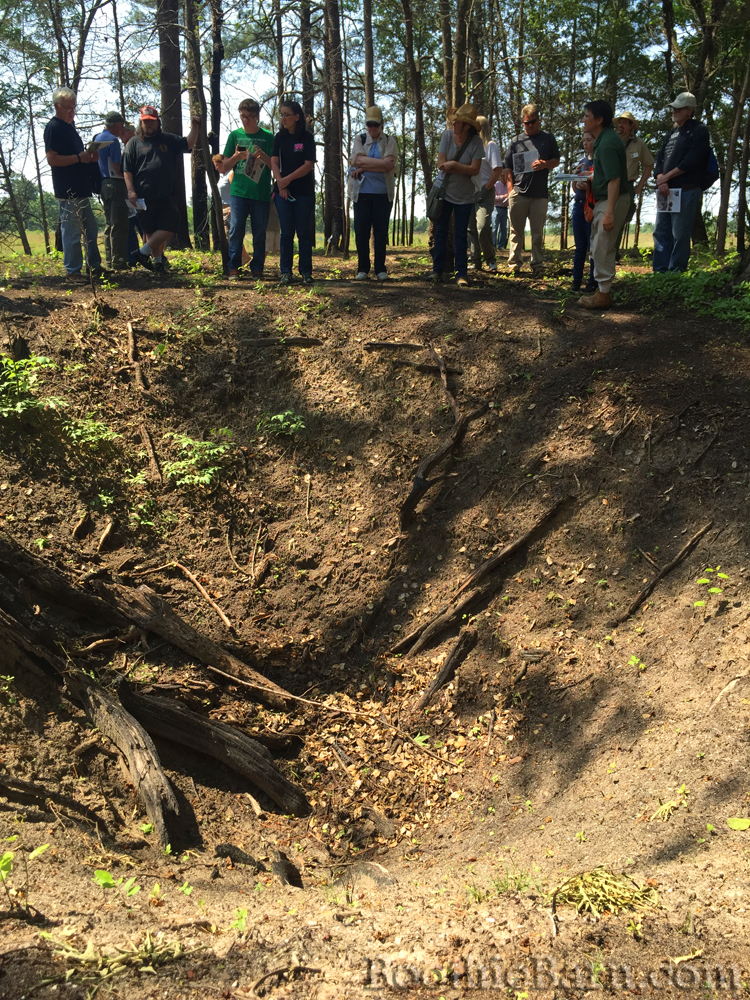
Trap Ice House 1

Trap Ice House 2

While the main residence that occupied #1 “Trap Farm” was built in the 1890’s, there are some remnants of a much earlier outbuilding in the area that was likely connected to the tavern. These pictures show what is left of an old, sizable ice house. In the days before refrigeration, families would essentially dig a large hole in the ground. The deeper you dig the cooler the earth is and at a certain point it can get close to 50 degrees Fahrenheit. You would place your ice in these deep pits and then cover it  with saw dust or another insulator to slow down melting, allowing you to have ice even in the summer months. The whole thing would then be covered with a primitive roof of some sort. The size and depth of this ice house and its relative proximity to The Trap tavern has led the archaeologists to conclude that this ice house was used by the tavern to provide them with their ice.
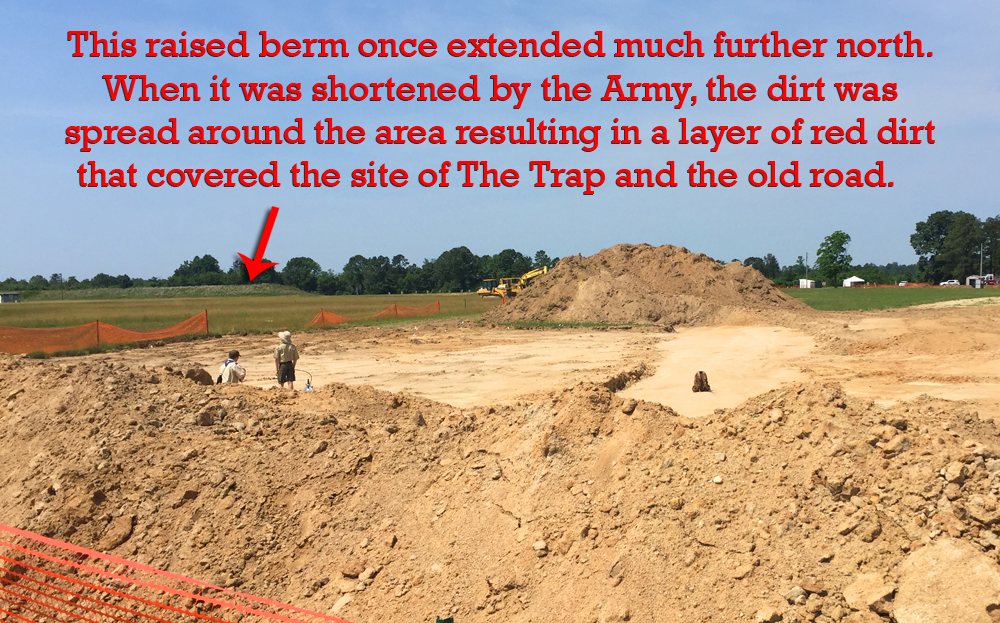
Trap dirt explanation

This image is a preface for the ones that follow and explains why much of The Trap site and the old road that ran right in front of it look like a construction site today. The entire site around The Trap is covered in this layer of “foreign dirt” that had to be removed before excavations could be done.

Trap Rolling Road

In this image you can see very clearly the traces of the old “Rolling Road” that connected Bowling Green to Port Royal. This image is taken looking southwest in the direction of Bowling Green.

Trap Rolling Road 2

This image shows the remains of the Rolling Road in the opposite direction. You can just make out at the end how the road is beginning to turn towards the left. Following that turn takes you north towards Port Royal. David Herold, Bainbridge, Ruggles, and the 16th New York Cavalry all traveled this road twice on their way to and from Bowling Green.
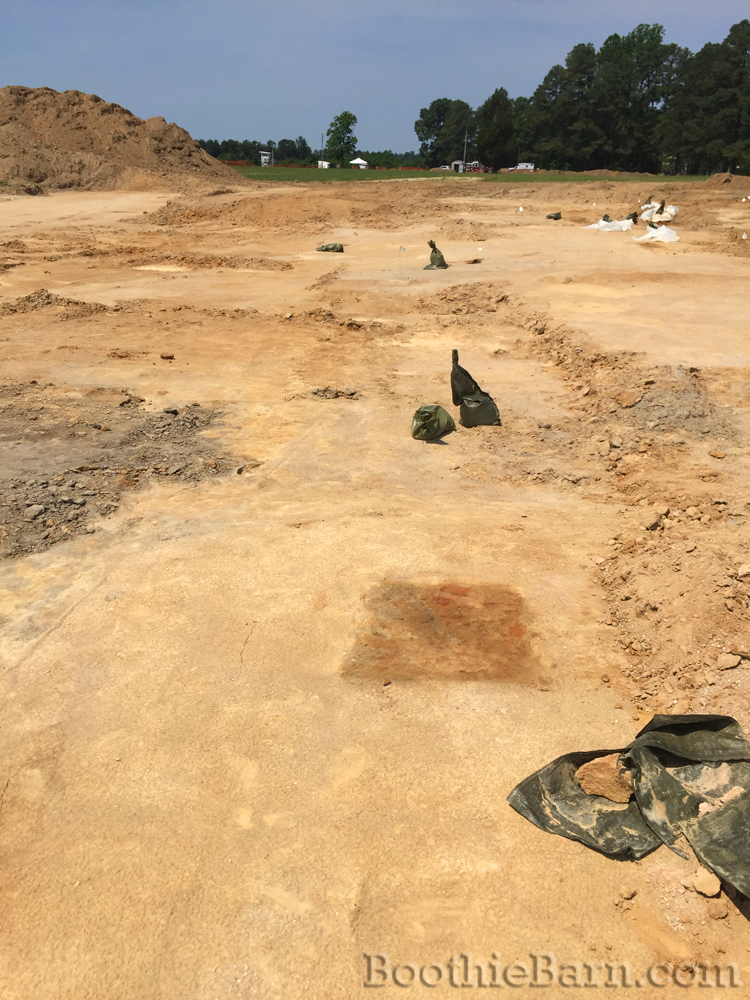
The Trap Site 6-11-16

The Trap site 2 6-11-16

These pictures show the site of The Trap tavern itself. In the top picture you can see a dark square in the foreground. That is one of the brick piers that the tavern sat on. It was highlighted by spraying it with water to make the color more noticeable. In the bottom image you can no longer see the square as the water has evaporated but it is located between the green bags in the middle. The bottom image is taken from the Rolling Road to give you an idea of how close to the road the tavern stood. It was located on this perfect spot where the road curved north making its own intersection.

Dave in The Trap

This is an images of me standing “in” The Trap. You can see the Rolling Road behind me.

The tour of The Trap site was a wonderful experience and one that I felt lucky to take part in. The location of The Trap inside the boundaries of the live range area of Fort A. P. Hill insures that it will rarely be open to the public. At the same time, Fort A. P. Hill seem to be the perfect stewards of the site and their archaeology efforts demonstrate their commitment to preserving the cultural heritage of the land they occupy.

In closing, I would be remiss if I did not address the two “elephants in the room” when it comes to The Trap. One issue is the correct spelling of the tavern. I, like many others, have always spelled it as The Trappe. You can find this spelling in other texts and articles about the assassination. According to one of our guides for the day, John Mullins, the site was originally spelled Trap and not Trappe. John says that this spelling did not come about until the 1890’s or so and was likely started after the area became known as Delos. The spelling of The Trap with the extra “pe” was likely people’s inadvertent way of referring to the old name and making it seem ever older by giving it the old English spelling.

The second item that I failed to address was the reputation of The Trap and the Carter ladies. Some texts and authors state that The Trap was a thinly disguised brothel run by Mrs. Carter and her daughters. When I first began researching the Lincoln assassination I heard from several knowledgeable individuals that The Trap had a slightly scandalous reputation. However, in researching the topic I have yet to come across anything that truly supports this idea. The origin of this misconception appears to be an April 27, 1865 statement from Luther Baker. In recounting the hunt for Booth, Baker shares the detachment’s stop at the Trap thusly: “About halfway to Bowling Green, which is 15 miles from the ferry, we stopped at a log house called the halfway house. We found there four or five ladies, who keep a house of entertainment.” Baker then proceeds to recount how no men were found in the house and how the ladies eventually gave them the information they needed. This wording that the Carter ladies kept a “house of entertainment” seems to be the fairly innocuous wellspring from which all unseemly rumors have flowed. However, in its early days, The Trap was a house of entertainment. Horse races and card games took place there. According to one of our guides for the tour, the name of The Trap was an old reference to how the tavern was a money trap for those who went there to play cards. Whether Mrs. Carter and her daughters still allowed card playing when they owned the tavern is unclear, but even if they did, a little card playing doesn’t equate to a house of sin. Unless better evidence can be found to support the idea that they were improper in anyway, I think Mrs. Carter and her daughters deserve to have their reputations vindicated.

References:
Former Community of Delos (The Trap) Tour Itinerary booklet
“The Trappe” by James O. Hall published in the Surratt Courier June 1987
John Mullins, Kerri Holland, Rich Davis – Archaeologists
The Lincoln Assassination – The Reward Files edited by William Edwards
An Irishman in Dixie: Thomas Conolly’s Diary of the Fall of the Confederacy edited by Nelson D. Lankford

Categories: History | Tags: , , , , , , , | 19 Comments

Inside Thomas Jones’ Huckleberry

Thomas Austin Jones has gone down in history for the assistance he gave assassin John Wilkes Booth and his accomplice David Herold. Jones not only cared for the two fugitives as they hid out in a pine thicket in Charles County, but he also transported Booth and Herold from the thicket to the shores of the Potomac from which they got into a boat and attempted to row across to Virginia.

Thomas Jones 1

Thomas Jones, who was born in the Port Tobacco area in 1820, owned two houses in Charles County during the Civil War. It was from his larger home on the Potomac River called Ravenscliff that Jones began his career as a mail agent for the Confederacy, but by 1865, his financial situation and death of his wife had caused him to downsize his estate to the more modest Huckleberry farm. Jones was living at Huckleberry with his nine children when Samuel Cox, Jr. showed up on the morning of April 16th and beckoned Jones to return with him to his father’s farm of Rich Hill. At Rich Hill, Jones would learn about Cox’s nighttime visitors and be given the task of caring for the fugitives while looking for an opportunity to get them across the Potomac.

Huckleberry-Animation

Today, as part of the Maryland House and Garden Pilgrimage in Charles County, Thomas Jones’ home of Huckleberry was open to the general public for the first time in 56 years when it was featured in the 1960 Maryland House and Garden Pilgrimage. The house has been remodeled and updated since Thomas Jones’ days but still maintains much of its same 1865 character.

Huckleberry exterior

Huckleberry door

Huckleberry Parlor

Huckleberry stairs

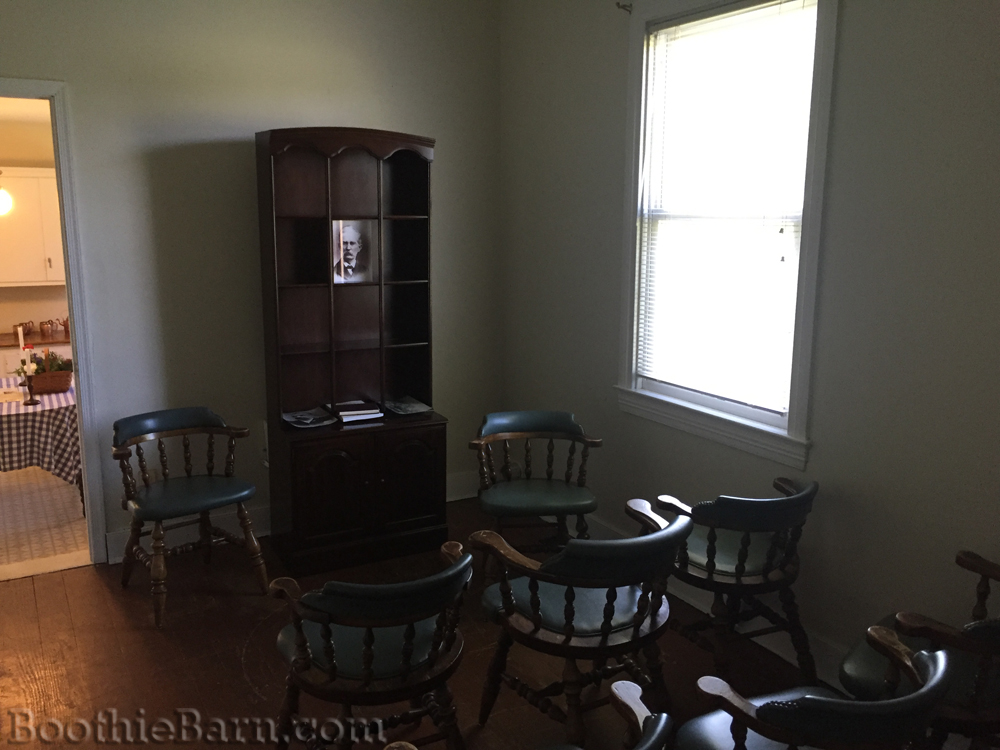
Huckleberry meeting room

Huckleberry kitchen

Jones Mantle

These images, along with the watchable yet somewhat motion sickness inducing video that follows, were all taken today after the garden tour was completed. About 450 people showed up and toured through Huckleberry while I stood in the room with chairs giving visitors a brief overview of Thomas Jones and his life before, during, and after John Wilkes Booth.

The visitors truly seemed to enjoy learning more about this unique man and his role in the Lincoln assassination story. Probably the most interesting little known fact about Thomas Jones is that, in 1893 when he traveled to the World’s Fair in Chicago in order to try to tell his book about helping Booth, Jones actually borrowed and brought with him two artifacts from Dr. Mudd’s house. The Mudd family allowed Jones to borrow the bed that Booth slept in at the Mudd house along with the parlor sofa on which John Wilkes Booth laid on while Dr. Mudd had inspected his leg. Having these artifacts did not help Jones much, however. His book sold very poorly in the Land of Lincoln and he came back to Charles County with many copies of the book and a great deal of debt from the venture.

Though it is impossible to say the next time that Huckleberry will be open to public tours again, the Loyola on the Potomac Retreat House has done a wonderful job as stewards of the house and property since they acquired it in the 1950’s. So even if Huckleberry waits another 56 years before being on the garden tour again, I think, in the meantime, it will stay in very good hands.

Categories: History | Tags: , , , , , | 18 Comments

“To Whom it May Concern”

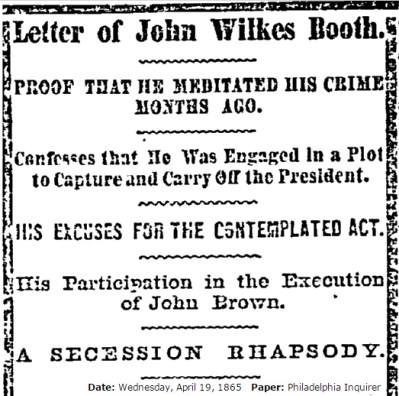
On this date in 1865, the Philadelphia Inquirer published a telling letter written by John Wilkes Booth, the recent assassin of President Lincoln.

To Whom is Published

The letter is known to readers of the Lincoln assassination story as John Wilkes Booth’s, “To Whom it May Concern” letter. Its title is derived from the letter’s greeting which was appropriated by Booth from a letter written by Lincoln in July of 1864. At that time, a small delegation of “peace emissaries” representing the Confederacy had approached the Union government under the guise of facilitating a cessation of hostilities and possible re-unification of the nation under the condition that they be allowed to continue the practice of slavery. It was a difficult period in the war and Lincoln himself knew his chance of winning re-election later that year was slim. Knowing that Lincoln would never agree to their terms, the so-called “Niagara Falls peace conference” was a piece of propaganda for the Confederacy, which was more aimed to further diminish Lincoln’s approval and chance of re-election. Lincoln was likely well aware of conference’s true purpose and wrote to the “peace emissaries” that any discussion of peace must include the “abandonment of slavery”.

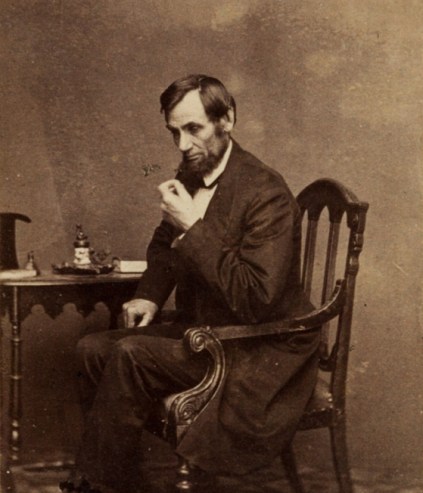
Abraham Lincoln

Abraham Lincoln

Knowing that his position would be viewed and lamented as stubbornness by the Confederacy and by the Democrats running against him, Lincoln decided to add further insult to injury by refusing to address the emissaries by name. Instead, Lincoln wrote his note “To Whom it May Concern,” diminishing the importance and respectability of the so-called “peace emissaries.” John Wilkes Booth subsequently used this somewhat insulting address in his own explanatory letter that follows.

The letter was published due to the efforts of Booth’s brother-in-law, John Sleeper Clarke. Following the assassination of Lincoln, Clarke and his wife, Asia Booth, recalled that John Wilkes had left a package of papers in the safe of their home in Philadelphia. Upon opening the package they found this letter, another addressed to his mother, Mary Ann Booth, and some oil stocks. As more and more Booths arrived at the Clarkes’ home (Mary Ann came from New York very soon after hearing the tragic news in order to comfort Asia, who was pregnant, and Junius Jr. arrived from an acting engagement in Cincinnati to be with the family), John Sleeper thought that the letters would be of help in proving the family’s innocence as to John’s plan. Clarke had copies made of both the To Whom it May Concern letter and the one addressed to Mrs. Booth. Then, accompanied by a member of the Philadelphia press corps, Clarke went to the office of William Millward, the Provost Marshal of Philadelphia.

John Sleeper Clarke

John Sleeper Clarke

Clarke asked the Marshal for permission to publish the letters and the circumstances surrounding their discovery in order to demonstrate that the family had no foreknowledge of John Wilkes’ crime. Millward approved the publication of the To Whom it May Concern letter for the next day but not the letter that John Wilkes wrote to his mother. Millward did not want anything published that might garner sympathy for the assassin. This was a let down to Clarke, as Booth’s letter to his mother more effectively demonstrated how completely unaware the family was as to John Wilkes’ intentions. While the To Whom it May Concern letter was published, it did not assuage the suspicion on the Booth family. Shortly after the letter was published, both John Sleeper Clarke and Junius Brutus Booth, Jr. were arrested and taken down to Washington, D.C. The youngest Booth, Joseph, would also be arrested leaving Edwin as the only male Booth not to be locked up. This series of events greatly bothered Clarke, who would complain about his improper treatment and the favored treatment of Edwin for the rest of his days. The assassination and the events that followed it marked the beginning of John Sleeper Clarke rejecting all things Booth, including his wife, Asia, whom he would grow to loathe.

Though not dated besides the year, Booth’s letter was likely written just following Lincoln’s miraculous re-election in November of 1864. The letter lays out John Wilkes Booth’s political and ideological beliefs and provides his reasons for his plan to abduct President Lincoln. Booth had started, sort of halfheartedly at first, to assemble a crew of conspirators in the summer of 1864 with the idea of abducting the President and taking him South. In this manner, Booth hoped to use Lincoln as a hostage to reinstate the prisoner exchange program between the Union and the Confederacy. This idea took on an increased importance in Booth’s mind after Lincoln’s surprise re-election on November 8, 1864. Immediately following this date, John Wilkes Booth began acting more in earnest and less than a week after the election, he was in Southern Maryland scouting the area and looking for others who might help him in his plot.

John Wilkes Booth Gutman 27

John Wilkes Booth

This letter, therefore, was written right at the beginning of Booth’s plot to abduct the President. It contains perhaps the most honest look into the mind and thoughts of John Wilkes Booth. In less than six months after this letter was written, the same motivations that led Booth to consider abduction, led him to assassinate Abraham Lincoln.

"To Whom It May Concern" 1864 RG 60 Department of Justice Segregated Documents from Attorney General Letters Received, 1809-1870 Box 4 ReDiscovery Identifier: 6542

My Dear Sir                                                                                                                  1864.

You may use this, as you think best. But as some, may wish to know the when, the who, and the why, and as I know not, how, to direct, I give it (in the words of your master)

“To whom it may concern”

Right, or wrong, God, judge me, not man. For be my motive good or bad, of one thing I am sure, the lasting condemnation of the North.

I love peace more than life. Have loved the Union beyond expression. For four years have I waited, hoped, and prayed, for the dark clouds to break, and for the restoration of our former sunshine. To wait longer, would be a crime. All hope for peace is dead. My prayers have proved as idle as my hopes. ‘God’s’ will be done: I go to see, and share the bitter end.

I have ever held the South were right. The very nomination of Abraham Lincoln four years ago, spoke plainly – war – war upon Southern rights and institutions, his election proved it. “Await an overt act.” Yes till you are bound and plundered. What folly. The South were wise. Who thinks of argument and patience when the finger of his enemy presses on the trigger. In a foreign war, I too could

To Whom it May Concern Letter Page 1 NARA

say, “Country right or wrong”, but in a struggle such as ours (where the brother tries to pierce the brothers heart) for God’s sake choose the right. When a country such as ours like this, spurns justice from her side, she forfeits the allegiance of every honest freeman, and should leave him untrammeled by any fealty soever, to act, as his conscience may approve.

People of the North, to hate tyranny to love liberty and justice, to strike at wrong and oppression, was the teaching of our fathers. The study of our early history will not let me forget it. And may it never.

This country was formed for the white not for the black man. And looking upon African slavery from the same stand-point, held by those noble framers of our Constitution, I for one, have ever considered it, one of the greatest blessings (both for themselves and us,) that God ever bestowed upon a favored nation. Witness heretofore our wealth and power, witness their elevation in happiness and enlightenment above their race, elsewhere. I have lived among it most of my life and have seen less harsh treatment from master to man, than I have beheld in the North from father to son. Yet Heaven

To Whom it May Concern Letter Page 2 NARA

knows no one would be willing to do, more for the negro race than I. Could I but see a way to still better their condition. But Lincoln’s policy is only preparing the way, for their total annihilation. The South are not, nor have they been, fighting for the continuance of slavery, the first battle of Bull-run did away with that idea. Their causes since for war, have been as noble, and greater far than those that urged our fathers on. Even should we allow, they were wrong at the beginning of this contest, cruelty and injustice, have made the wrong become the right. And they stand now (before the wonder and admiration of the world,) as a noble band of patriotic heroes. Hereafter, reading of their deeds, Thermopylae will be forgotten.

When I aided in the capture and the g execution of John Brown, (who was a murderer on our Western Border, and who was fairly tried and convicted, – before an impartial judge & jury – of treason, – and who by the way has since been made a God – I was proud of my little share in the transaction, for I deemed it my duty and that I was helping our common country to perform an act of justice. But what was a crime in poor John Brown, is now considered (by themselves) as the greatest and only virtue, of the whole

To Whom it May Concern Letter Page 3 NARA

Republican party. Strange transmigration. Vice to become a virtue. Simply because more indulge in it. I thought then, as now, that the abolitionists, were the only traitors in the land, and that the entire party deserved the fate of poor old Brown. Not because they wish to abolish slavery, but on account of the means they have ever used endeavored to use, to effect that abolition. If Brown were living, I doubt if he himself would set slavery, against the Union. Most, in or many, in the North do, And openly curse the Union, if the South are to return and retain a single right guaranteed them by every tie which we once revered as sacred. The south can make no choice. It is either extermination, or slavery for themselves, (worse than death) to draw from. I would know my choice.

I have, also, studied hard to discover upon what grounds, the rights of a state to secede have been denied, when our very name (United States) and the Declaration of Independence, both provide for secession. But there is no time for words. I write in haste. I know how foolish I shall be deemed, for undertaking such a step, as this, where on the one side, I have many friends, and everything to make me happy. Where my profession alone has gained me an income of more than twenty thousand dollars a year. And where my great personal ambition in my profession has such a great field for labor. On the other hand- the south have

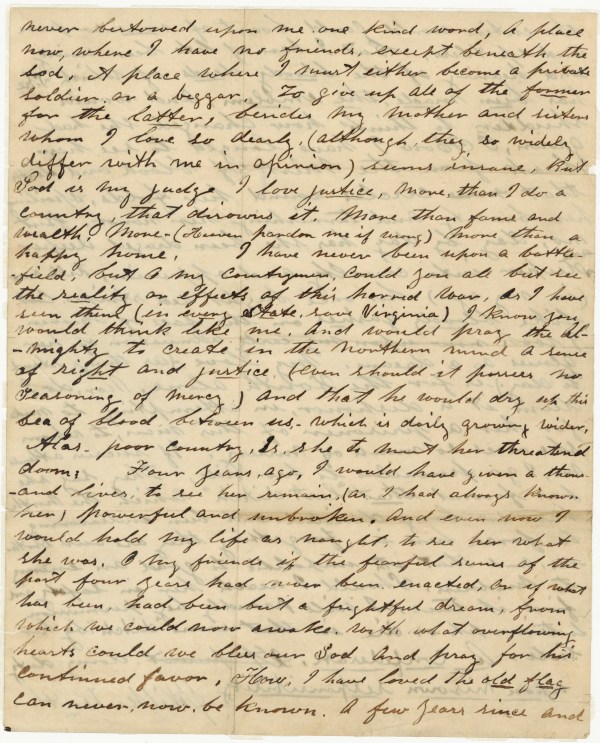
To Whom it May Concern Letter Page 4 NARA

never bestowed upon me one kind word. A place now, where I have no friends, except beneath the sod. A place where I must become either become a private soldier, or a beggar. To give up all of the former for the latter, besides my mother and sisters whom I love so dearly, (although they so widely differ with me in opinion) seems insane. But God is my judge. I love justice, more than I do a country, that disowns it. More than fame and wealth. More – (Heaven pardon me if wrong) more than a happy home. I have never been upon a battlefield, but O my countrymen, could you all but see the reality or effects of this horrid war, as I have seen them (in every State, save Virginia) I know you would think like me. And would pray the Almighty to create in the Northern mind a sense of right and justice, (even should it possess no seasoning of mercy), and that he would dry up this sea of blood between us, – which is daily growing wider.

Alas, poor country, is, she to meet her threatened doom. Four years ago I would have given a thousand lives to see her remain, (as I had always known her) powerful and unbroken. And even now I would hold my life as naught, to see her what she was. O my friends if the fearful scenes of the past four years had never been enacted, or if what had been, had been but a frightful dream, from which we could now awake, with what overflowing hearts could we bless our God and pray for his continued favor. How I have loved the old flag can never, now, be known. A few years since and

To Whom it May Concern Letter Page 5 NARA

the entire world could boast of none so pure and spotless. But I have of late been seeing and hearing of the bloody deeds of which she has been made, the emblem, and would shudder to think how changed she had grown. O How I have longed to see her break from the mist of blood and death that now circles round her folds, spoiling her beauty and tarnishing her honor. But no, day by day has she been draged deeper and deeper into cruelty and oppression, till now (in my eyes) her once bright-red stripes look like bloody gashes on the face of Heaven. I look now upon my early admiration of her glories as a dream. My love, (as things stand to day,) is for the South alone. Nor, do I deem it a dishonor, in attempting to make for her a prisoner of this man, to whom she owes so much of misery. If success attends me, I go penniless to her side. They say she has found that “last ditch” which the North have so long derided, and been endeavoring to force her in, forgetting they are our brothers, and that its impolitic to goad an enemy to madness. Should I reach her in safety and find it true, I will proudly beg permission to triumph or die in that same “ditch” by her side.

A Confederate, at present doing duty upon his own responsibility

J WilkesBooth

To Whom it May Concern Letter Page 6 NARA

References:
“Right or Wrong, God Judge Me” : The Writings of John Wilkes Booth edited by John Rhodehamel and Louise Taper
NARA

Categories: History | Tags: , , , , , | 9 Comments

Do You See It?

151 years ago tonight, President Abraham Lincoln was fatally shot by John Wilkes Booth. This singular event changed the course of American history forever. While this website provides research and insight regarding Lincoln’s assassination every day of the year, the anniversary of April 14th gives the knowledge contained here greater perspective. The reality of the event and its aftermath take on a renewed life when the clock marks the exact moment of the fatal gunshot or the final breath of the Great Emancipator. For those fleeting minutes and seconds, history is no longer this abstract idea. Rather, on exact anniversaries such as tonight, history is very much in the present. The events of the past travel through time and connect us all together, but, like an eclipse, the connection only lasts for the briefest of moments before the alignment is gone.

I teach and learn about Lincoln’s assassination as a way to honor Lincoln, and though my methods often involved delving deeply into the lives of those who plotted his death, I do so with the hope that learning more about the men and women who caused this great national calamity might help me better appreciate and comprehend the complex nature of Lincoln’s life.

So, on this night, at this moment, while I do see John Wilkes Booth readying his derringer and waiting to strike, I also see the crowd at Ford’s Theatre. I see the happy faces stealing glances at their revered President as he sits in his box. Most of all, though, I see Abraham Lincoln in his last moments of consciousness. I see him holding Mary Todd’s hand and enjoying the play. I hear the line, “Don’t know the manners of good society, eh? Well I guess I know enough to turn you inside out, old gal. You sockdologizing old man-trap.”

In that moment though, I don’t see John Wilkes Booth in the shadows firing his gun. I don’t see an assassin releasing all of his hate and anger at an unarmed man. Instead, I see the joy and happiness in Abraham Lincoln’s eyes as reacts to the play with a deep and full laugh.

The assassination of Abraham Lincoln is an event filled with horror and tragedy but for the briefest of seconds on its anniversary, I always see our 16th President, in his last moments,  engaging in a well deserved laugh.

Rest in Peace, Mr. Lincoln.

Categories: History | Tags: | 9 Comments

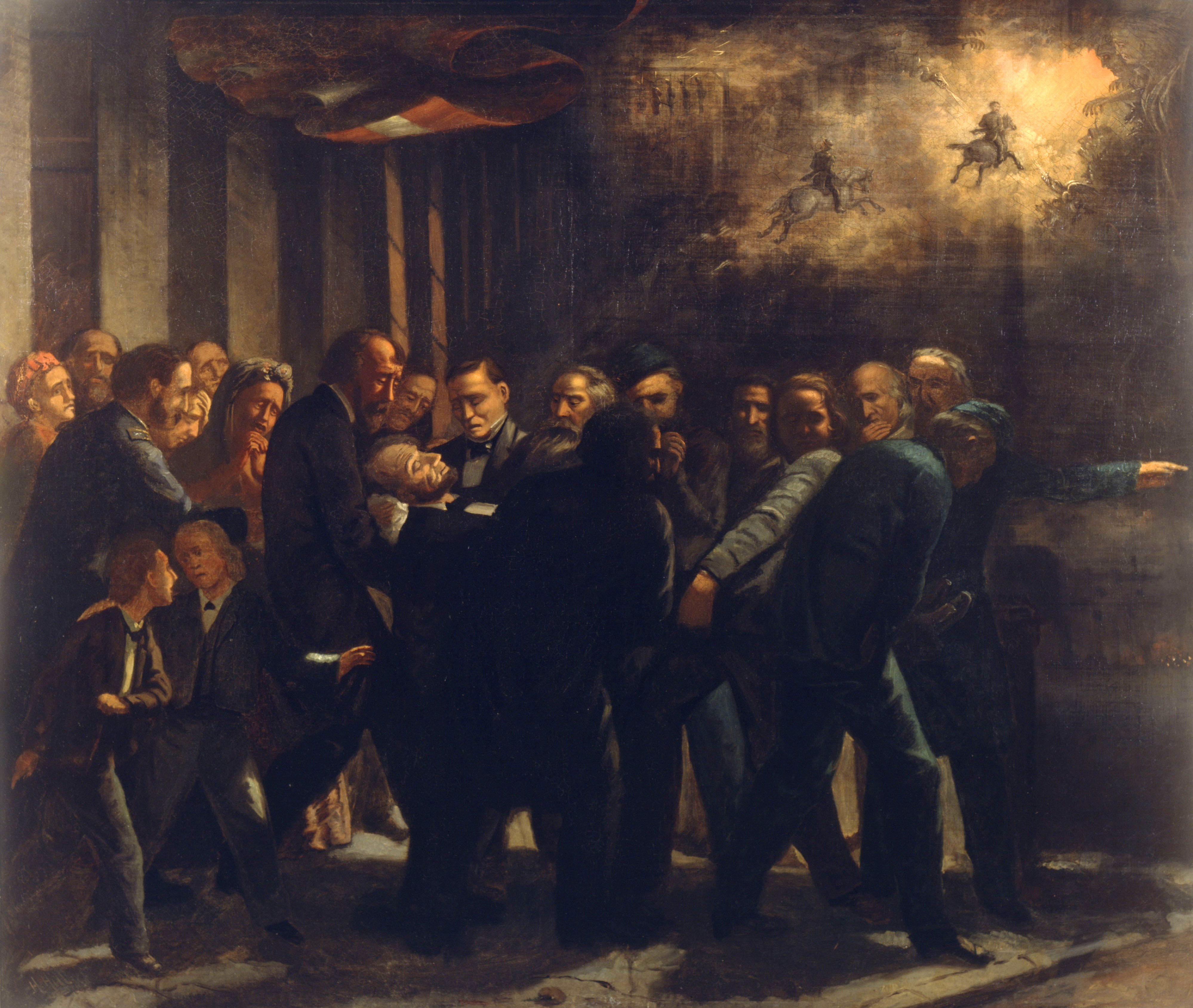
Assassination of Lincoln by Howard Hill

Yesterday, I posted about about Carl Bersch and his painting, Lincoln Borne by Loving Hands on the Fatal Night of April 14, 1865At the time of Lincoln’s assassination, Bersch was living across the street from Ford’s Theatre and made sketches of the chaotic scene after the assassination. He used those sketches to paint this eyewitness image of the event.

Borne by Loving Hands - Carl Bersch

While working on that post I came across another painting that shares the same subject matter. In 1872, artist Howard Hill painted his own version of the wounded President being carried across Tenth Street. His painting is called, Assassination of Lincoln, and it is currently owned by the Albany Institute of History and Art.

Click to enlarge

Click to enlarge

Howard Hill was not present in D.C. on the night of Lincoln’s assassination and therefore his painting is not based on eyewitness sketches like Carl Bersch’s painting. Still it is clear that Hill did his research and when composing this piece. Hill’s painting includes the detailed figure of not only the wounded Abraham Lincoln but also shows grief-stricken Mary Todd Lincoln.

Assassination of Lincoln by Howard Hill Mary Todd and Lincoln closeup

They are both followed by the figures of Henry Rathbone and Clara Harris, the Lincolns’ guests at Ford’s Theatre that night.

Assassination of Lincoln by Howard Hill Rathbone and Harris closeup

While both Bersch’s painting and Hill’s painting show Lincoln being carried across the street to the Petersen boardinghouse where he would later die, the biggest differences between them are the secondary scenes they contain. In the darker corner of Bersch’s painting (which will hopefully be more visible in the restored painting) there is a small scene of celebration marking the end of the Civil War. In his letter home, Bersch mentions that his first sketches on April 14th captured the parades and jubilation that were occurring below his balcony. Bersch still used these sketches when completing his final painting and combined two these contrasting images, one of celebration and one of sorrow, into the single painting. Lincoln Borne by Loving Hands is not centered  on Lincoln but on the American flag, which continues to fly over everything, good and bad.

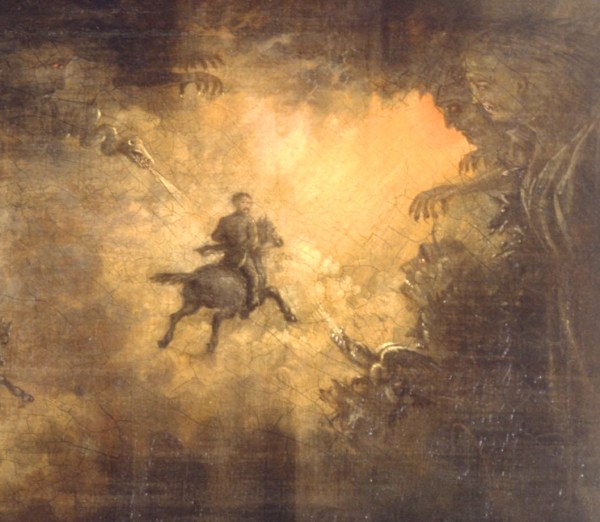
Hill’s painting, on the other hand, does seem to center more on the figure of Lincoln and the men carrying him. But our eyes are also drawn to the top right corner of the painting where a different scene is playing out. Hill depicts the horseback figures of David Herold and John Wilkes Booth fleeing from the tragic scene. Booth is riding away when he seems to look back at his handiwork. As he does this a legion of demons reach out to him as he effectively rides into their grasp and into hell.

Assassination of Lincoln by Howard Hill Booth closeup

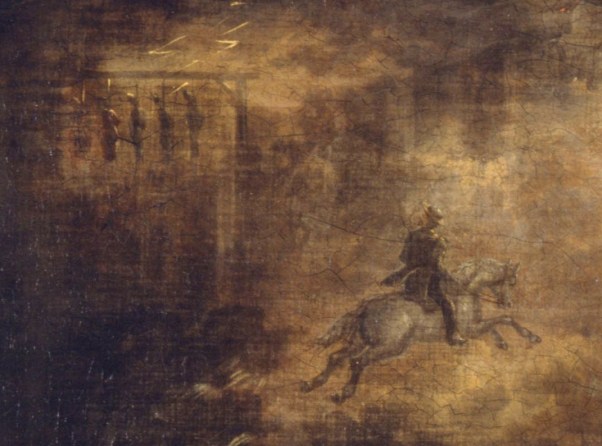
David Herold follows Booth’s course, but his attention is drawn to a premonition of the gallows that he will face for his crime.

Assassination of Lincoln by Howard Hill Herold closeup

Strangely this gallows shows the execution of five people rather than the four that actually occurred. Perhaps one of the bodies is meant to symbolize Booth’s death as well.

Howard Hill’s Assassination of Lincoln shares a similar theme with Carl Bersch’s Lincoln Borne by Loving Hands but the compositions differ in their focus and details. The inclusion of the celebratory revelers and the focus on the American flag in Bersch’s painting evokes the prospect of hope in our darkest times, while Hill’s visions of doom for the assassins emphasizes the importance of justice. Taken together, these two paintings demonstrate the complex feelings that emerged after Lincoln’s assassination.


Additional facts about the artist, Howard Hill

Howard Hill was born in England in 1830. In 1851, he married his wife, Ann Patmore, in London. Hill always considered himself an artist and normally recorded himself as such on census records. However, to make ends meet, he would also work as a house painter, his father’s trade. In 1858, Hill brought his family over to America. The Hills would live in Yonkers, NY and Hoboken, NJ. Hill originally got a job with Currier and Ives as one of many nameless English artists who created the iconic prints that so captured the spirit of America. He left this job after a short while, likely unhappy with the day to day life as a menial worker. In his own paintings, Hill was very fond of painting birds. His most common images feature ducks and quails in scenic landscapes, but he also enjoyed painting farmyard scenes as well. In 1865, four of Hill’s bird paintings were exhibited at the National Academy of Design, which was a prestigious opportunity. Sadly, true success never found Hill. He continued to paint and sell his paintings to make ends meet. Hill apparently painted Assassination of Lincoln in 1872, which was a subject quite different from most of his work. Whether it was commissioned or a piece Hill completed on his own is unknown. It was owned by an American Legion Post in Albany before it was donated to the Albany Institute of History and Art in 1961. It’s ownership prior to the American Legion Post is unknown. When a financial depression began in 1873, Hill  took to visiting the homes of well to do farmers, offering to paint scenes of their farm and livestock. He also used his six children to help him create an assembly line of painters. Howard and each of his children would each complete a select part of a painting allowing him to effectively mass produce paintings to sell. Though financial difficulties caused Howard to drink more, he was instrumental in teaching all of his children the art of painting. In 1886, Howard lost his wife and artist son within a span of four months. This increased his depression and for the next year he lived the life of a vagrant, moving from boardinghouse to boardinghouse and trying to get painting commissions for money. Howard Hill eventually died on March 6, 1888, likely from a stroke. He was buried in an unmarked grave next to his wife in Yonkers.

Though Howard Hill never achieved fame for his work as a painter, it seems that he did pass on a considerable talent. Howard’s daughter, Mary Ann “Nancy” Hill, learned how to paint from her father and she would pass that love of painting down to her son. That boy, Howard Hill’s grandson, was the great American painter, Norman Rockwell. Though Rockwell never knew his grandfather (Hill died 6 years before Rockwell was born), he still felt his grandfather’s work influenced him. Rockwell was quoted as saying, “I’m sure all the detail in my grandfather’s pictures had something to do with the way I’ve always painted. Right from the beginning I always strived to capture everything I saw as completely as possible.”

Other work by Howard Hill

References:
Albany Institute of History and Art
The biographical information on Howard Hill comes from American Mirror: The Life and Art of Norman Rockwell by Deborah Solomon

Categories: History | Tags: , , , , , , , | 11 Comments

Lincoln Borne by Loving Hands on the Fatal Night of April 14, 1865

On the evening of April 14, 1865, a 30 year-old German artist by the name of Carl Bersch was enjoying the celebratory mood that permeated the city of Washington. With General Lee’s surrender to General Grant just a few days earlier, the Civil War was effectively over. Washington had just conducted a grand illumination the night before and it seemed people were still celebrating. From his rented room on Tenth street, Bersch observed the festivities and joy that occurred around him:

Carl Bersch's balcony is visible on the right-hand building in this drawing from Frank Leslie's Illustrated Weekly 5/20/1865.

Carl Bersch’s balcony is visible on the right-hand building in this drawing from Frank Leslie’s Illustrated Weekly 5/20/1865.

“All Washington was celebrating, delirious with joy. Houses were lighted up and hung with bunting. Parades marched through the streets, waving flags and carrying many transparencies. Women with wide skirts, and wearing large poke bonnets, were about as numerous as men. President Lincoln was known to be at Ford’s Theater, so Tenth street was on the line of march. I observed no rowdyism, just a crowd of jubilant people, crazed with joy. The scene was so unusual and inspiring, that I stepped out upon the balcony in front of my windows, with my easel and sketch papers, determined to make a picture of the whole scene and transfer it to canvas. The very weirdness of the scene— aside from the historic nature of it— appealed to my artistic sense. Quickly, but very accurately, I made detailed drawings. I had more than an hour in which to do this.”

Sadly, however, a tragic act that occurred right across the street from Bersch’s residence would put an end to the jubilant atmosphere.

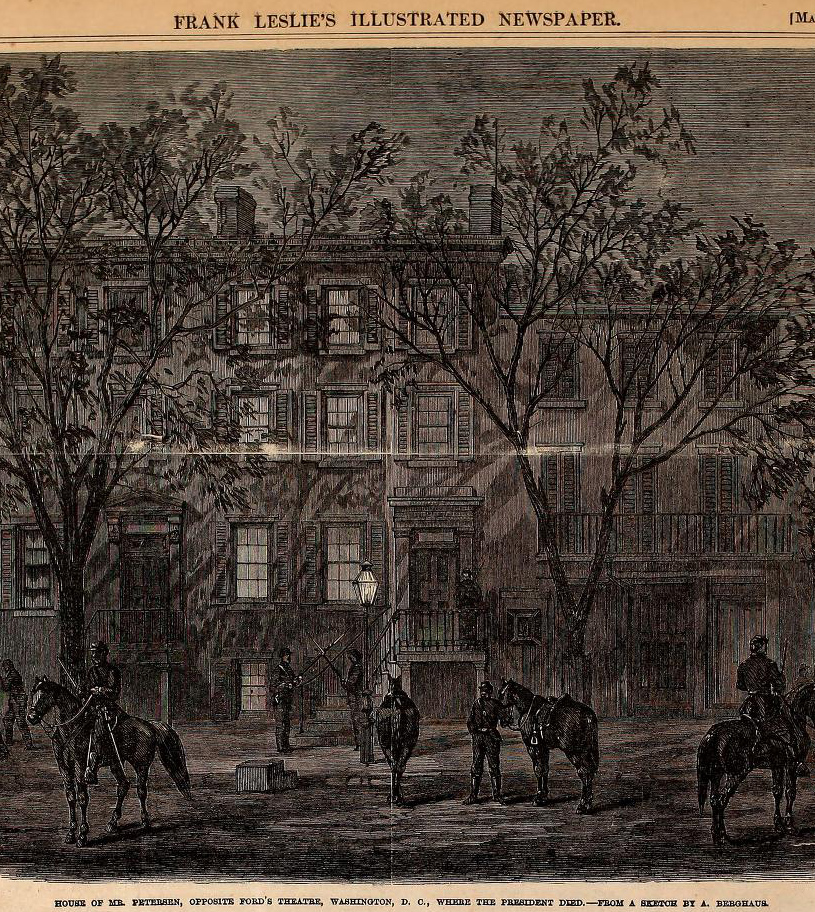
“Shortly after 10 o’clock a silence fell upon the surging crowd of revelers. The marching line halted. A loud cry came from a window of the theater, ‘President Lincoln has been shot; clear the street,’ soldiers and police attended to that. In the course of 10 or 15 minutes, out of the north door of the theater appeared a group of men, carrying the prostrate form of an injured man on an improvised stretcher. They stopped a few moments at the curb, hastily debating where to take the injured man to give him the best attention most quickly. They observed lights in the house, of William Petersen, my next door neighbor, and a young man, Willie Clark [sic], whom I know very well, standing on the topmost step of the winding stairs, leading to the Petersen house.  Clark [sic] was beckoning to those who had charge, to bring the injured man right in. This was done as quickly as the soldiers could make a pathway through the crowd.”

Bersch makes a mistake here in his letter written right after the assassination. The man who beckoned for the soldiers to bring Abraham Lincoln into the Petersen boarding house was not Willie Clark, but another boarder named Henry Safford. You can read more about Safford and about how Willie Clark was not even present at the Petersen House when Lincoln was there by clicking here.

Bersch goes on and notes how he was in the unique position to document this solemn occasion:

“My balcony being 12 or 14 feet above the sidewalk and street, I had a clear view of the scene, above the heads of the crowd. I recognized the lengthy form of the President by the flickering light of the torches, and one large gas lamp post on the sidewalk. The tarrying at the curb and the slow, careful manner in which he was carried across the street, gave me ample time to make an accurate sketch of that particular scene; make it the center and outstanding part of the large painting I shall make, using the sketches I made earlier in the evening, as an appropriate background. A fitting title for the picture would, I think, be ‘Lincoln Borne by Loving Hands on the Fatal Night of April 14, 1865.’ Altogether It was the most tragic and impressive scene I have ever witnessed. I am already busy with palette and brush and hope to transfer to canvas what may be one of the strangest pictures of all time.”

After finishing this letter to his family, Carl Bersch did complete his painting of Lincoln being carried across the street from Ford’s Theatre. The large format painting was kept by the family for many years. It was not until 1932 that Bersch’s daughter, Carrie Fischer, loaned the painting to the newly created Lincoln Museum inside of Ford’s Theatre. When the museum opened on February 12, 1932, the anniversary of Lincoln’s birthday, Bersch’s painting was publicly displayed for the first time.

Borne by Loving Hands - Carl Bersch

This painting hung in the Lincoln Museum for some time, and the Lincoln Museum even sold a postcard with the painting on it:

Borne by Loving Hands Postcard

It is not known how long Bersch’s painting was on display at Ford’s Theatre the first time. It was a loan and therefore subject to the will of Bersch’s descendants who were still the owners. The ownership of the painting passed from Carrie Fischer to her daughter Gerda Vey, upon Carrie’s death in 1955. Then, when Gerda died in 1977, she willed the painting to the White House. The White House decided against keeping it but transferred it to the National Park Service instead where it ended back up at Ford’s Theatre. It was on display at some time during the 1980’s – 1990’s but, eventually, it was put into storage.

Then came 2015, the 150th anniversary of the assassination of Lincoln. Increased interest in Lincoln’s assassination motivated the National Park Service to conduct restoration on the painting for the first time since 1980. A wonderful article appeared in the Washington Post detailing the efforts to conserve this painting:

HYATTSVILLE, MD - APRIL 8: The National Park Service museum has a painting by an eyewitness of Lincoln being carried from Ford's Theater after being shot, on April, 08, 2015 in Hyattsville, MD. Pictured, from left, Lyndon Novotny, materials handler, Bob Sonderman, Director & regional curator, and Laura Anderson, National Park Service museum curator for the National Mall. (Photo by Bill O'Leary/The Washington Post)

HYATTSVILLE, MD – APRIL 8:
The National Park Service museum has a painting by an eyewitness of Lincoln being carried from Ford’s Theater after being shot, on April, 08, 2015 in Hyattsville, MD. Pictured, from left, Lyndon Novotny, materials handler, Bob Sonderman, Director & regional curator, and Laura Anderson, National Park Service museum curator for the National Mall.
(Photo by Bill O’Leary/The Washington Post)

Conserving Borne by Loving Hands WaPo 2015

Over the many years of display the painting had accumulated dirt and grime, darkening the colors and obscuring details. The article from October 2015, spoke of the future hope to put the painting back on display at Ford’s Theatre once the restoration of the piece was done.

It appears that the restoration process has been completed and currently the museum in the Ford’s Theatre basement is being  remodeled to make room for Carl Bersch’s painting. A tweet from Heather Hoagland, the Ford’s Theatre Society’s Exhibitions & Collections Manager, shows the work that is being done to prepare a place for this large, yet meaningful painting:

In the not too distant future, Carl Bersch’s “Lincoln Borne by Loving Hands” will return to the Ford’s Theatre Museum, eighty four years after its initial debut. It is a unique painting from an eyewitness to the events outside of Ford’s Theatre on April 14, 1865 and deserves to a be a fixture at Ford’s Theatre once again.


Additional facts about the artist, Carl Bersch

Carl Bersch was born on May 3, 1834 (year is disputed) in Zweibrücken, Germany which is located near the border with France. He originally studied theology at the University of Munich before taking up art. He came to America around 1861 and is said to have worked in Matthew Brady’s photography studio. He married his wife, Angelica Bode, in 1865. Together they had one child, Carrie. Bersch worked in Tennessee, Ohio, D.C., and Baltimore. He was a successful portrait artist in Baltimore and also briefly tried his hand at his own photography studio in the early 1880’s. Between artistic commissions he hired himself out as a German tutor. Bersch died on May 1, 1914 at the age of 80 and is buried with his wife, daughter, and granddaughter, in Baltimore’s Govans Presbyterian Churchyard.

Other work by Carl Bersch

Graves of the Bersch Family (from FindaGrave.com)

References:
Carl Bersch’s letter quoted in The Washington Star, April 16, 1932
“Lincoln assassination emerges in painting from 150 years of grime” from the Washington Post, October 5, 2015
The biographical material on Bersch comes from his obituary in the Baltimore Sun, May 3, 1914.

Categories: History | Tags: , , , , , | 12 Comments

Alice Gray: Successful Partnerships

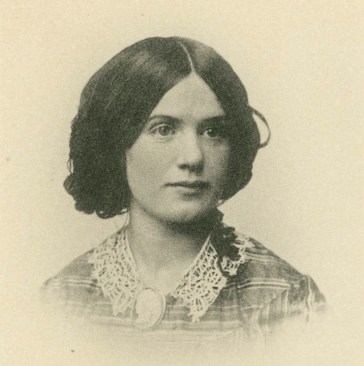
This is the second installment in a series about actress, Alice Gray. Gray’s photograph was one of the five discovered upon the body of John Wilkes Booth when he was cornered and killed on April 26, 1865. Gray’s theatrical career has largely been forgotten with very little biographical material readily available about her. The following post was developed by consulting a variety of sources including digitized newspapers such as the Buffalo Courier, Baltimore Sun, New York Clipper and D.C.’s National Intelligencer. In all, it took several days’ worth of work to find and organize the material. This post is the second in a series about Alice Grey’s life, career, and connection to the Booth family. To read Part One entitled, Alice Gray: An Actress is Born, please click HERE.

Alice Gray

Part Two: Successful Partnerships

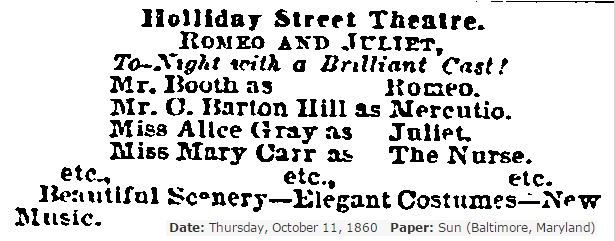
Research completed thus far has yet to solve the mystery of how Alice Gray became acquainted with theater owner John T. Ford. Alice had met many prominent actors and actresses during her run at the Metropolitan, Charleston, and Mobile Theatres. During that time she had acted side by side to both Edwin Booth and H. B. Phillips, two men who were very close to John T. Ford. Perhaps one of them told Ford about Gray’s acting abilities and encouraged him to seek her out. Or perhaps Gray reached out to Ford on her own and inquired about working for him. Regardless of how it happened, when the 1860-1861 theatrical season began, Alice Gray found herself employed by John T. Ford to be the leading stock actress at his Holliday Street Theatre.

In the year prior, John T. Ford had lavishly renovated the Holliday Street Theatre in Baltimore. The Holliday Street Theatre was the only theater Ford owned outright at this time, but he had prior experience leasing and managing other theaters. This was Gray’s first time in Baltimore but the public there quickly took a liking to her. The August 29th, the Baltimore Sun newspaper reported that, “Miss Gray sustained the part of Mrs. Haller last night with quite unexpected grace, talent and effect and received in this case no unmeaning tribute of a call before the curtain to receive the congratulations of the audience. She is a brilliant accession.”

While in Baltimore in the fall of 1860, Alice Gray became acquainted with another member of the Booth family, John Sleeper Clarke. Clarke had known the Booth family from childhood when he played with young Edwin and John Wilkes in Baltimore. Clarke had been a member of Edwin’s kiddie acting troupe that put on plays for the neighbor kids. Clarke followed the Booths into the acting profession but became a comedian rather than a tragedian. In 1859, John Sleeper Clarke married Asia Booth, the youngest Booth daughter. Clarke was a popular comedian for John T. Ford and would make frequent appearances in his theaters. These first performances with Clarke in September of 1860 would be the first of many for Gray.

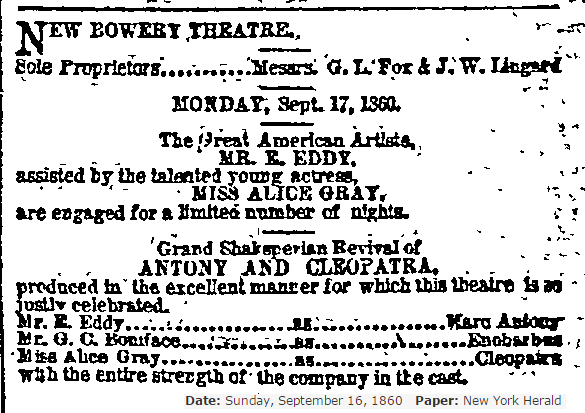
The respect and approval Gray received from Baltimore audiences was no doubt gratifying to Gray, but once again she was called back to New York City’s stages by her friend, Edward Eddy. Eddy was performing an engagement at the New Bowery Theatre and must have requested Alice Gray by name to be his leading lady. Ford gave Gray permission to leave the Holliday Street Theatre to join Eddy for his engagement in New York.

Engraving of Edward Eddy in the role of Posthumus (click to see the full image)

Engraving of Edward Eddy in the role of Posthumus (click to see the full image)

1860 With Eddy in NY Alice Gray

Alice Gray eventually ended her engagement with Eddy early. Whether this was contracted by Ford when he allowed her to leave or whether she returned back to the Holliday Street Theatre before the end of Eddy’s New York engagement on her own is unknown. Regardless, the decision to depart New York early to return to Baltimore was well founded. That eminent star of the stage, Edwin Booth, was starting an engagement at the Holliday Street Theatre. It had been almost three years since Booth and Gray had performed together back in Buffalo and the young actor’s fame had only increased since then. Booth in Baltimore was more of a draw than Eddy in New York and so Gray took her place alongside him.

Edwin Booth circa 1860

1860 Performing with Edwin Alice Gray

Gray played Juliet to Edwin’s Romeo, Katherina to Edwin’s Petruchio and Desdemona to Edwin’s Othello. Ford no doubt witnessed these performances and felt contented that he had chosen his leading stock actress wisely. By the end of October of 1860, Edwin departed for his next engagement in Philadelphia. Gray continued to act at the Holliday Street Theatre for the remainder of the 1860-1861 season, regularly receiving advertised benefits.

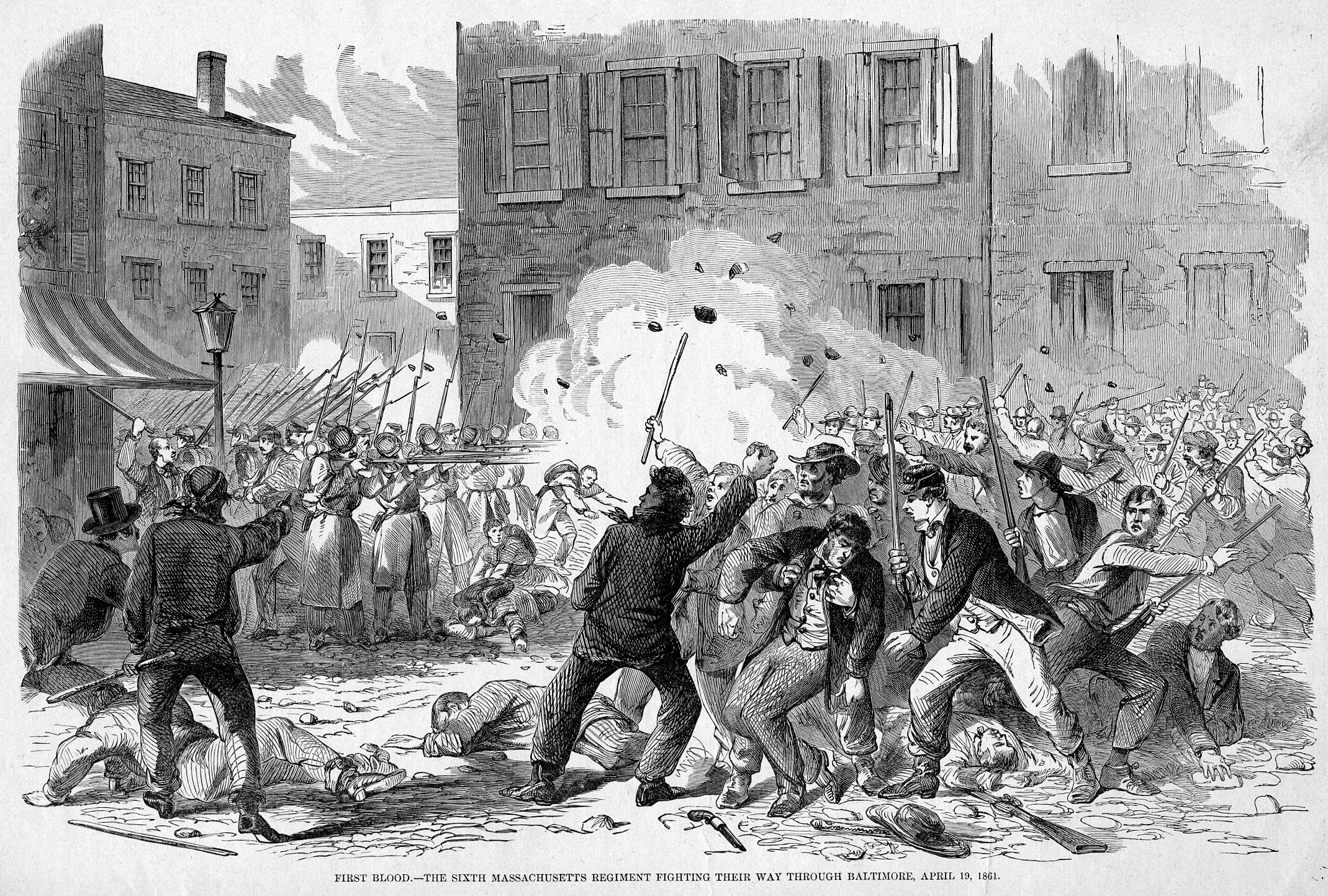
It was while Gray was in Baltimore that the Civil War began. The conflict commenced on April 12, 1861, when Confederate forces laid siege upon Fort Sumter in Charleston, South Carolina. The simmering cauldron of the secession crisis had finally boiled over due to the election of Abraham Lincoln. Working and residing in Baltimore, Alice Gray would have been acutely aware of the anti-Lincoln and anti-war feeling that permeated the city. On April 19, 1861, a deadly riot occurred in Baltimore, causing the first hostile deaths in the Civil War. The Sixth Massachusetts Militia was passing through Baltimore on their way to Washington, D.C. when they found themselves surrounded by anti-war and pro-Confederacy sympathizers who called themselves the National Volunteers. After some tense moments, members of the National Volunteers attacked some of the members of the Militia with rocks, bricks, and pistols. In response, the Militia fired at the mob. A melee broke out and ended only after the Sixth Massachusetts Militia left behind most of their supplies and made it to Camden Station. In the end, four soldiers with the Militia and 12 civilians with the mob were killed.

Baltimore Riot 1861 Harper's

The pro-Southern residents of Baltimore used this event as propaganda, comparing it to the 1770 Boston Massacre that helped spur the American Revolutionary War. However, the pro-Northern public decried the violence and bloodshed caused by the rebels in Baltimore and demanded swift action against them. The federal government responded quickly and showed Baltimore and the rest of Maryland in no uncertain terms that it would not be allowed to foment insurrection like this again. In May of 1861, General Benjamin Butler entered Baltimore with about 1,000 soldiers, occupied the city and declared martial law.

All of these events were likely troubling to Alice Gray. Gray had lived most of her life in western New York, which was a largely anti-slavery region. Her home of Buffalo, New York was filled with safe houses for the Underground Railroad and was a common meeting place for abolitionist societies. It is unlikely that Gray shared the same pro-slavery sympathies as many of those she was surrounded by in Baltimore. John T. Ford was largely anti-Lincoln, though he would become more pragmatic as the war continued. In March of 1861 however, Ford seized upon the fact that Lincoln had to slip through Baltimore incognito on his way to his own inauguration for fear of physical harm. He included the scene in a patriotic piece called “Uncle Sam’s Magic Lantern” in which the audience was presented with several scenes of America’s gloried past, present, and future. “The Flight of Abraham” was included as a scene along with “Our National Troubles,” demonstrating Ford’s pro-Confederate sympathies. Alice Gray no doubt played her assigned role in these “patriotic scenes.”

It is perhaps for these reasons that, when the 1861-1862 season commenced, Alice Gray did not stay at the Holliday Street Theatre with John Ford. Instead she made her way to Philadelphia where she was employed at the Walnut Street Theatre. The 1861-1862 theatrical season was a lean one for the entertainment industry. Many of the big British stars decided against visiting the United States with the Civil War raging. Even some American actors, like Edwin Booth, left the country for European tours of their own during this year. Audiences were smaller as the news from the war occupied everyone’s thoughts. At the Walnut Street Theatre, Alice Gray once again performed with John Sleeper Clarke when the comedian was engaged there for three weeks straight. She received little press during her time at the Walnut Street Theatre. One quick mention described her as a “handsome young actress, who evidently has not very much stage experience.” Such a review must have hurt the 26 year old actress who had been acting on the stage for almost 10 years at that point. When Gray’s season with the Walnut Street Theatre ended she decided to try her luck somewhere else.

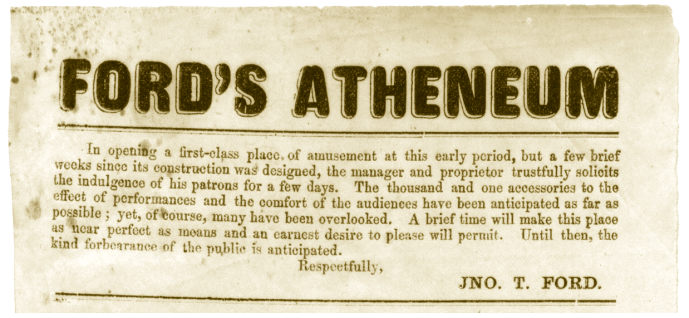
It was during Gray’s time in Philadelphia that John Ford had decided to invest in a new theater. Ford may have disliked Lincoln and the war but he was an astute business man. Washington, D.C. was a growing city during the war with thousands of soldiers and private citizens coming to the nation’s capital. Ford believed he could succeed in establishing a new theater in this growing metropolis. In December of 1861, Ford signed a five year lease on the First Baptist Church of Washington. The parishioners of the First Baptist Church had merged their congregation with another church and were no longer using the edifice on Tenth Street. The church already had a raised platform on which the pulpit and choir would be situated and so Ford realized that the building could be remodeled fairly inexpensively to serve as a theater. At first Ford rented the church to a minstrel group, but then, in February of 1862, he began a $10,000 renovation on the building. The building reopened on March 19, 1862 under the name “Ford’s Atheneum.” Ford’s renovations had been done quickly so as to preempt the reopening of another of Washington’s theater’s, Leonard Grover’s New National Theater, which completed its renovations on April 21st.

Ford's Atheneum 1862

Ford’s Atheneum proved a considerable success from the start. With his connections, Ford was able to attract first rate stars despite the war. The stationed soldiers and citizens of Washington proved devout theater goers. Even President and Mrs. Lincoln attended an operatic performance at Ford’s on May 28, 1862.

When the 1862-1863 theatrical season opened, Ford renamed the building “Ford’s New Theatre” and looked forward to another prosperous year. The theater opened with an engagement by John Sleeper Clarke and it’s possible that Ford missed his former leading actress. When Gray had departed for Philadelphia, Ford had replaced her at the Holliday Street Theatre with actress Annie Graham. Graham was brought down to Ford’s New Theatre for a few performances with John Sleeper Clarke, but it doesn’t seem like they had the same chemistry (or marketability) as Clarke and Gray once had. It appears that Ford reached out to Gray with an offer to be his leading stock actress again. Perhaps this time he promised she would act in his new D.C. theater and therefore not have to relive the unpleasant scenes in Baltimore.

Gray had spent the summer and fall months of 1862 up in Montreal, Canada. The Theatre Royal was famous for “importing” American talent during the summer months. This was also a wise way for American performers to keep a steady paycheck between seasons. Alice Gray played to good crowds but as fall gave way to winter, an engagement down in D.C. likely looked more hospitable to her.

Whether John T. Ford originally intended for Gray to perform at his new D.C. theater or whether he wanted her back at his Baltimore establishment we may never know for sure because on the evening of December 30, 1862, cruel fate made the decision for him. Under the stage of Ford’s New Theatre in D.C. a fire was started by a faulty gas meter. While there was no loss of life from the severe blaze that followed, the fire completely consumed the inside of the theater. Ford lost over $20,000 in the inferno but the outside walls of the theater survived. While other theater owners might have given up and left the capital, Ford decided to rebuild his theater and make it bigger and more grand than had ever been seen in D.C. before. Ford would spend the next eight months raising money for and constructed his new theater. In the mean time, at the Holliday Street Theatre in Baltimore, the show must go on.

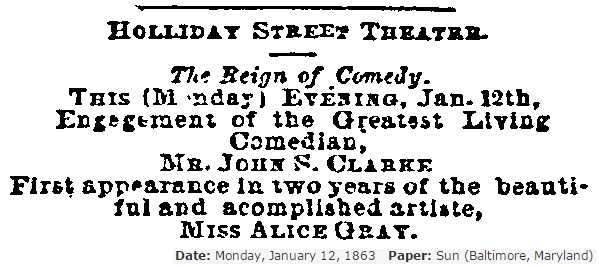
Alice Gray made her return to the Holliday Street Theatre in January of 1863 with great fanfare in the press:
1863 Return to Baltimore 1 Alice Gray 1863 Return to Baltimore 2 Alice Gray 1863 Return to Baltimore 3 Alice Gray

Gray acted alongside John Sleeper Clarke again, with Ford highly advertising their partnership. In this way, Gray replaced her own replacement, Annie Graham, who was assigned smaller female roles when Gray came back. Gray and Clarke performed together at the Holliday Street Theatre throughout Clarke’s engagement which ended on February 14th. Clarke himself must have realized that he and Gray had good chemistry together. They had performed several long engagements with each other since 1860 and the results had been paying off in the box office. When Clarke went off to his next engagement in nearby D.C., he brought Alice Gray with him.

Clarke was scheduled to make his debut at the Washington Theatre on February 23, 1863. The Washington Theatre was a slightly rundown edifice that only had intermittent productions when there was a lessee. The building lacked a full time manager/owner and was instead leased out to different individuals who staged their own shows at their own expense. It was essentially a rental theater, and hardly a five star establishment. However, John T. Ford had proven with his Atheneum that theaters were a sound business in war-time Washington. With that establishment burnt, the only other theaters of note were Grover’s New National Theater, the Washington Theatre, and Grover’s Canterbury Hall – a far seedier establishment which only catered to men. Until Ford completed his construction on his new theater, the only real places to act in Washington were the New National Theater or the Washington Theatre.

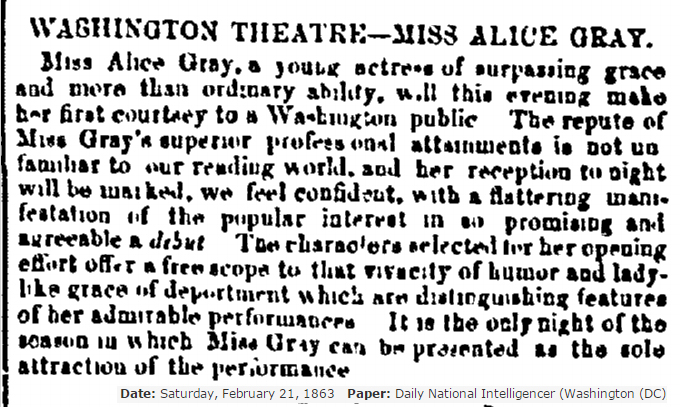
On the Saturday before Clarke’s engagement began, the managers of the Washington Theatre gave Alice Gray a headlining performance of her own.

1863 Solo in Washington Alice Gray

This was Alice’s first appearance in D.C. and the papers did a nice job of advertising it:
1863 First time in Washington

Aside from her summer engagements in Cleveland and Montreal, this was Alice Gray’s first time being the “sole attraction” for a performance. For once she was not playing second fiddle to a visiting star or receiving the assistance of other stars for her benefit. To paraphrase Shakespeare’s Richard III, “She was herself alone.” Gray likely reveled this chance, even if it was only for one night. She had a good reputation in nearby Baltimore and a good solo performance here would help her establish herself as a star quality actor to the Washington public. The next day, Gray’s performance was described as a “decided sensation” but was sadly overshadowed by her anticipated debut with Clarke, who took much of the press. Clarke was scheduled to make his debut alongside Gray in Our American Cousin on February 23rd. However, when the curtain rose, Clarke was markedly absent. An advertisement in the next day’s newspaper announced that Gray would appear alongside a different comedian, C. B. Bishop, with the following note from the management:

“The Managers regret exceedingly the disappointment to their patrons last evening in not being able to present the popular Comedian, Mr. J. S. CLARKE, in his celebrated characters, and beg to assure them that the severe domestic affliction which compelled his absence will only defer his first appearance for a night or two.”

In all, Clarke would be absent from the stage until Thursday, February 26th. The “severe domestic affliction” that prevented Clarke from performing during that time was a death in the family. Mary Devlin Booth, the wife of Edwin Booth, died on the morning of February 21st. Clarke and his wife Asia (who, coincidentally, had never cared for Mary Devlin) rushed to Edwin’s side at his time of need. They were also joined by John Wilkes Booth, who had left his upcoming engagement in Philadelphia to be with his brother. Clarke and the rest of the Booth’s attended Mary’s funeral and burial at Mount Auburn Cemetery in Cambridge, Massachusetts.

Mary Devlin Booth, Edwin Booth's first wife

Mary Devlin Booth, wife of Edwin Booth

Alice Gray had continued to perform at the Washington Theatre without Clarke: “During Mr. Clarke’s temporary absence they have introduced a young and beautiful actress, Miss Alice Gray, who has made a decided sensation in every character she has appeared in.” When Clarke returned to town, he and Gray once again began their successful partnership. Clarke’s absence for a few days increased his appeal and so Clarke and Gray performed to full houses for the rest of his engagement. However, when Clarke left for his next engagement in Philadelphia in mid March, Gray did not join him. Instead, she returned to Ford’s Holliday Street Theatre to act alongside a new member of the Booth family. This young, handsome actor would make an indelible mark on Alice Gray and, in a couple years, would alter the course of American history.


This concludes part two of the series about Alice Gray’s life, career and connection to the Booth family. The third installment, “Alice Gray and John Wilkes Booth,” will be posted soon.

References:
Backstage at the Lincoln Assassination by Thomas Bogar
Additional research graciously provided by Thomas Bogar
Restoration of Ford’s Theatre by George J. Olszewski
American Tragedian: The Life of Edwin Booth by Dr. Daniel Watermeier
Edwin Booth: A Biography and Performance History by Arthur Bloom
John Wilkes Booth: Day by Day by Arthur Loux
Images of America: Ford’s Theatre by Brian Anderson for the Ford’s Theatre Society
Ford’s Theatre Society
Ancestry.com
Library of Congress
Newspaper extracts from: University of Illinois (free), FultonHistory.com (free), GenealogyBank.com (subscription)

Categories: History | Tags: , , , , , , , , , | 11 Comments

Alice Gray: An Actress is Born

As John Wilkes Booth was running from the authorities after assassinating President Abraham Lincoln, he carried with him a total of five carte-de-visite photographs. These photographs were placed safely in a wallet like pocket of Booth’s diary as he struggled through swamp and stream, darkness and dawn, for 12 long days. When Booth was finally cornered and killed on April 26, 1865, these photographs were removed from his dying body. A previous post highlighted how the process of identifying these ladies was a slow one that did not even commence until several years after the assassination. In the end, the women of Booth’s wallet were determined to be Lucy Hale, his fiancée, and four actress friends, Effie Germon, Helen Western, Fanny Brown, and Alice Gray.

This slideshow requires JavaScript.

Though these actresses were each talented and respected during their careers, they have largely become footnotes to history. Their photographic presence on the body of the assassin has become the defining moment of their entire lives. For one of these actresses in particular, very little exists about her life outside of John Wilkes Booth. While Fanny Brown may have been dubbed “The Mysterious Beauty,” the truly mysterious and unknown beauty in Booth’s possession was Alice Gray.

While there is some biographical information readily available about Effie Germon, Helen Western, and Fanny Brown, the fourth actress in Booth’s pocket is a bit more elusive. The Lincoln Financial Foundation Collection, which contains copies of Booth’s CDVs, had this to say about Alice Gray when they highlighted the photographs in a post on their blog:

“Little is known about Alice Grey.  In 1858 she toured with Barry Sullivan and performed at the Walnut Street Theatre in Philadelphia in the early 1860s.  She appeared as Juliet opposite John Wilkes Booth as Romeo in Baltimore in 1863.  By 1865, she was a leading lady in the company at Ford’s Theatre in Washington, where she again played opposite Booth in a production of The Apostate on March 18.  She was not at the theater the night of Lincoln’s assassination.”

With so little known about Alice Gray, an in depth search was enacted to discover more about the life and career of this forgotten lady.  The following biographical sketch was developed by consulting a variety of sources including digitized newspapers such as the Buffalo Courier, Baltimore Sun, New York Clipper and D.C.’s National Intelligencer. Further information was discovered using creative searches on Ancestry.com and in cemetery records. In all, it took several days’ worth of work to find and organize the material. This post is the first in a series about Alice Grey’s life, career, and connection to the Booth family. To read part two, Successful Partnerships click HERE.

Alice Gray

Part One: An Actress is Born

In order to find out about Alice Gray’s beginning, it was first necessary to look at her end. Initially, the only information found about her birth came from her later obituaries.  According to most of the obituaries, Alice Gray was born in Boston in 1833 to Irish parents. The more detailed obituaries also stated that she commenced her acting career when she was 16 years old by performing in the Federal Street Theatre in Boston. Numerous genealogical searches were conducted with this information to try and find out more about Alice Gray’s family. All were fruitless until one final obituary contained the partially blurred name of a brother in Cincinnati. The brother’s true name was discovered by searching an old Cincinnati directory, which led to his burial record, which gave the incorrect name of his father (which wasted a lot of time looking for and led me back dejectedly to the brother’s burial record) and correct name of his mother, which led me to Alice’s mother, which led me to the true identity of Alice Gray.

Alice Gray’s true name was Alice Dehan. According to census records, she was born in New York between June 16 – July 31, 1835. Her parents were Patrick and Ann Dehan who were both immigrants from Ireland.

1850 Census Alice Gray

I have been unable to find a record of the family living in Boston, but in the 1870 census Alice’s brother John gives his birthplace as Boston. This is a contradiction to the 1850 and 1860 censuses which give his birthplace as New York, however. If the family did live in Boston, it was for a short time. By 1850, the family was living in Livingston County, New York, near Buffalo. Alice’s father, Patrick, was a laborer and likely worked on the expansion of the Erie Canal. Patrick died sometime between 1850 and 1860, leaving his wife and two children without a means of support. It appears that it was after the death of her father that Alice, then around 16 years of age, began her career as an actress. She chose the stage name of Alice Gray and would be billed as such for the rest of life.

Metropolitan Theater advertisement 1855Since her family had settled near Buffalo, NY, it was appropriate for Alice to commence her career in that city. She was able to acquire a position at the recently opened Metropolitan Theatre.

A theater historian in Buffalo later recalled, “When she came to the Metropolitan Theatre in 1851 or ’52, she could neither read nor write, but she was naturally bright and advanced rapidly.” Alice must have started with minor roles as her name did not receive billing very often in the early years. If she was learning the craft it is likely that she merely acted in walk on roles and silent characters. It was not until 1854, that Alice’s name began to make appearances in the advertisements for the Metropolitan Theatre performances. Over the next few years she stayed at the Metropolitan, honing her craft and receiving larger and larger roles. In 1856 she met and acted alongside a visiting star named Mr. Edward Eddy. Though Eddy’s engagement at the Metropolitan was short, Gray made an impression on him. In the upcoming years, Eddy would keep in touch with Gray and provide her with further acting opportunities. By 1857, Alice Gray had graduated to the main stock actress for the Metropolitan Theatre, in which she was responsible for playing the leading female roles opposite the visiting stars.Edwin Booth circa 1860

In November of 1857, a young, 24 year-old star billed as, “The Wonder of the Age” made his first appearance at the Metropolitan Theatre. The noted star who was greeted with such fan fare was Edwin Booth. Though the weather was poor during Booth’s time in Buffalo, the theater was packed every night. This was not only good for Edwin, but also for Alice Gray who ably played alongside Booth as his female counterpart. The increased crowd at the Metropolitan allowed more of Buffalo’s theater patrons to see how much Alice Gray’s abilities had progressed over the last few years. These performances with a member off the Booth family would be the first of many for Alice Gray. In a few short years she would become extremely familiar with practically all acting members of the Booth family.

After Edwin departed Buffalo, the very next performance at the Metropolitan Theatre was a benefit in Alice Gray’s honor. Her performances with Edwin had clearly garnered her some more attention. The newspapers, in describing her benefit, gave kind, but realistic descriptions of Gray’s abilities:

“…the merit of of Miss Gray as an actress deserves to be substantially recognized. The steady improvement she has made since her first appearance in Buffalo, is acknowledged by all. She personates the leading female characters acceptably; is uniformly accurate in the text, and evinces care and study in the business of the stage. Her many friends should encourage and reward her efforts by their presence this evening.”

Gray was undoubtedly becoming a better actress, but had not yet achieved the talent of a star. She continued with the Metropolitan Theatre for the remainder of the 1857-1858 season with a small break in March of 1858 where she performed briefly at the Bowery Theatre in New York City. At that time, the Bowery Theatre was being leased by her friend Edward Eddy. The chance to act in New York City and possibly become a star performer on those elite stages was the dream of many actresses. While Alice Gray acted ably alongside Eddy and even received a benefit in her honor one night, once Eddy was finished leasing out the Bowery Theatre, Gray’s first foray in New York City was over.  While she had not been “discovered” by the New York City patrons, this experience would help her in the future. She returned home to Buffalo.

When the theatrical season of 1858-1859 was advertised, Alice Gray was given top billing as the leading lady of the Metropolitan Theatre once more. However, when the season debuted on September 20, 1858 and Gray took the stage for the first time as Lady Teazle in School for Scandal, she found herself faced with an agitated audience:

1858 Hissed from the stage Alice Gray

Gray must have been traumatized by this sudden betrayal of the audience. The same people who had supported her growth over the last few years were now hissing her from the stage. A newspaper from a few days later explained the reason:

1858 reason for hiss Alice Gray

As reported, Alice Gray had apparently made some enemies in the Buffalo theatrical world. The business then was just as cut-throat as it is today (if not more so). Perhaps the other actresses were jealous of Gray’s recent debut in New York City due to the generosity and assistance of Edward Eddy. Whatever the reason, the scheme against Alice Gray worked as planned. Whether by her own choice or the decision of the manager, Gray did not appear at the Metropolitan Theatre for the rest of the 1858 season. Coincidentally, she was replaced at first with “Mrs. J. B. Booth”. This was Clementina DeBar Booth, the first wife of Junius Brutus Booth, Jr. Though Mr. and Mrs. Booth were divorced due to Junius running off to California with another woman in 1851, Clementina kept the name and used it professionally. Not long after this, the gossip reported in the above article came to fruition when the manager of the Metropolitan Theatre had his own wife take over some of the main female roles.

After being shunned from the Metropolitan Theatre, Alice Gray made her way back to New York City, where she had briefly performed in March. At that point, her friend Edward Eddy had leased the Broadway Theatre for the season. Though the season had already begun and Eddy already had his stock company, he hired Alice Gray. She acted at the Broadway Theatre with the rest of the stock actors until the end of the season. She received very little press during her time at the Broadway Theatre and without good press and attention, it was practically impossible for a supernumerary to make it as a star. During the next season, Alice began to travel outside her home state of New York, perhaps hoping that good word of mouth from audiences in smaller cities would help her establish herself the next time she acted in New York City.

The beginning of the 1859 season found Alice in Charleston, South Carolina. She was the lead stock actress for the Charleston Theatre, an establishment which promised its public a diverse selection of entertainment. The theatrical portion of the season only lasted until November 12, 1859, which was a benefit performance for Henry B. Phillips, a Charleston native. Phillips was a well known actor who had toured the eastern states. He was also known for helping to coach novice actors and teach them the proper points and recitations.  In a few short years, H.B. Phillips would be hired by John T. Ford to be the acting manager of Ford’s Theatre in Washington, D.C. In that capacity, Phillips sole job would be to train inexperienced actors on how not to make fools of themselves. For his benefit performance, Phillips choose two pieces, The Poor Gentleman, in which Alice Gray was billed as his leading lady, and the very popular comedy of the day, Our American Cousin. This would be Alice Gray’s first experience with the play, Our American Cousin, but, due to the events connected with it in the future, this performance would hardly be the most memorable. After the Phillips’ benefit in Charleston, the whole theatrical company traveled to Mobile, Alabama. In the mean time, the Charleston Theatre opened to an opera troupe while advertising its next, diverse entertainment offering to the public, stating that a “troupe of learned monkeys, goats, and dogs, will present themselves,” in the week to come.

Alice Gray found a welcoming audience in Mobile and her abilities were praised when she was given a benefit performance there:

1860 Nice review Alice Gray

The company stayed in Mobile until late March of 1860, when the Charleston Theatre reopened (hopefully after they cleaned up the mess from the “learned” monkeys, goats, and dogs) for theatrical events.  The headlining star for the reopening was none other than Edwin Booth. Though there were no advertisements billing him as the “The Wonder of the Age” as there were in Buffalo more than two years ago, he was nevertheless warmly welcomed by the Charleston public. Booth played at the Charleston Theatre until April 4th, likely teaming up once again with Alice Gray as his leading lady. Not long after his departure, however, Alice became sick. An article in the April 14th edition of the New York Clipper reported that Alice had “been quite ill” and “confined to her room for more than a week”. She recovered from her illness and finished up the rest of the season in Charleston but this would not be the first time that illness and other personal matters would preclude Alice from performing.

During the summer of 1860, Alice Gray made extra money by taking a little more than a week long summer engagement at Cleveland’s Academy of Music. For most performers, summers were the dry times. Most theaters closed down or engaged cheaper entertainments for the few patrons who would visit during the hot months. The few theaters that did engage actors at this time, however, generally did a wonderful job advertising them. Alice Gray received star billing in the Cleveland newspapers for her brief run with her name in the largest type size that she would ever see in her career:

1860 Star billing Alice Gray

As Alice Gray performed as a star in Cleveland, back home in Buffalo the census taker was knocking at her mother’s door for the 1860 census. Despite her almost year long absence in the South and Midwest, Alice’s mother included her daughter as a member of the household. Ann Dehan gave the census taker her daughter’s real name, Alice Dehan, and set in stone what she was going to be for the rest of her life: a “Theater Actress”.

1860 Census Alice Gray


This concludes part one of the series about Alice Gray’s life, career and connection to the Booth family. To read the second installment, “Successful Partnerships,” click HERE.

References:
Backstage at the Lincoln Assassination by Thomas Bogar
Additional research graciously provided by Thomas Bogar
American Tragedian: The Life of Edwin Booth by Dr. Daniel Watermeier
Edwin Booth: A Biography and Performance History by Arthur Bloom
John Wilkes Booth: Day by Day by Arthur Loux
Images of America: Ford’s Theatre by Brian Anderson for the Ford’s Theatre Society
Ford’s Theatre Society
Ancestry.com
Library of Congress
Newspaper extracts from: University of Illinois (free), FultonHistory.com (free), GenealogyBank.com (subscription)

Categories: History | Tags: , , , , , , , , , | 9 Comments

Blog at WordPress.com.