Monthly Archives: January 2021

“Treason Chokers” and “Wooden Overcoats”: An Eyewitness Account of the Conspirators’ Execution

On July 7, 1865, four of the convicted conspirators in the assassination of Abraham Lincoln were put to death on the grounds of the Old Arsenal Penitentiary in Washington, D.C. The condemned prisoners consisted of Lewis Powell who had attacked and nearly fatally wounded Secretary of State William Seward, David Herold who had assisted and joined John Wilkes Booth on his ill fated escape after the shooting of the President, George Atzerodt who had been commissioned to kill Vice President Andrew Johnson but failed to make the attempt, and Mary Surratt the owner of a D.C. boardinghouse who assisted Booth by transporting field glasses to her Maryland tavern on the afternoon of the assassination.

The execution of these three men and one woman marked an ending in the country’s quest for vengeance after the death of the Chief Executive. Coming after a military trial which lasted for 8 weeks and heard from 347 witnesses, the end of the conspirators was well documented in the press of the day. Vivid descriptions of the hanging on that hot July afternoon were published in newspapers nationwide from Associated Press reporters and others on the scene.

But perhaps one of the most compelling accounts of that day’s events comes from one of the soldiers who was present at the Old Arsenal when the drops fell. This soldier’s name was William D. F. Landon. Originally a private with the 14th Indiana Infantry, he was wounded at the Battle of the Wilderness and then transferred to the 1st U.S. Veteran Volunteers. In this way he was a member of General Winfield Scott Hancock’s corps with duty in and around Virginia and Washington. One thing that was unique about Sgt. Landon was his role as an unofficial field reporter for his local newspaper back in Indiana, The Weekly Vincennes Western Sun. Over the course of the war, Landon wrote many letters to the editor of the Western Sun documenting the life of a soldier along with the events and battles he took part in. He wrote all of these letters under the pen name of Prock, affording him a degree of anonymity to speak honestly about what he was witnessing.

From July through November of 1865 alone, Prock wrote a series of nine letters to the Sun about his experiences. Most notably is the letter he wrote on July 11, 1865 documenting his recent duty at the execution of the conspirators. This letter was published in the July 22, 1865 edition of The Weekly Vincennes Western Sun. If you would like to read Prock’s account in its original form, click here, otherwise what follows is a transcription made from the article.

This account provides us with a unique perspective on the execution of the conspirators written in a tone that is not to be found in any other descriptions of the event. There is a surprising amount of humor in what Prock writes. But it’s also an honest accounting, adding a degree of human realism to the otherwise stark proceedings.

“Camp First Regiment U.S. Veteran Vol.
Hancock’s Corps.
Near Washington, D.C., July 11, 1865

Dear Greene:

At 4 o’clock on the morning of the 7th inst. we marched with one day’s rations and “forty rounds” to the Arsenal, or Old penitentiary building, to take part in the “drop game.” As we filed into the enclosure and formed two sides of a square (the prison wall and the high brick parapet forming the other two) I observed first four graves and four “wooden overcoats;” then the scaffold, with two drops, and the four “treason chokers” swaying to and fro in the wind. I had not anticipated all this so soon, presuming the XEQtion would of course be a public one, and that having already marched five miles in a broiling July sun and through dense clouds of stifling dust, fancied our troubles but begun, and that we were to escort the wretches to some of the high and barren hilltops surrounding the city; we were all most agreeably disappointed and stood at ease, leaning on our well burnished arms and gazing with mere curiosity at the workmen putting the finishing touches to the “assassins’ derrick.” Guards being posted everywhere, we stacked arms and broke ranks. Some of the carpenters in the regiment lent a hand in adjusting beams and traces, occasionally tossing the boys a block that was sawn off, or a strip of scantling for a walking stick. A grand rush was always made for these by the “relic hunters of the Wilderness,” occasioning much amusement amongst the soldiery. In removing some caisson boxes, &c., from one part of the yard, a fatigue party captured a huge rat. He was immediately court-martialed, sentenced and (a miniature gallows being erected and a piece of fish line procured) hung – his carcass chucked into one of the pits near the coffins.

A piece of the conspirators’ gallows. From the collection of the Smithsonian Museum of American History.

The prison wall is at least eighteen feet high and shut out not only the view from the Potomac, but the “ten knot” breeze that was filling more than one white sail on the broad stream. Occasionally a circling puff whirling over the enclosure would stir up everything that was laying around loose, dust included, and cause the “human hawsers” to writhe as I have seen wounded snakes before now.

Some hundred citizens were admitted – not twenty-five of them but what were attached to either the “press gang” or detective’s force of Washington City. All these “roosters” carried umbrellas, and soon had them spread skywards. The sentinels took revenge by quietly punching their sharp glittering bayonets through the “silk Sibleys;” so, had it rained, many a chap would have wondered why his “round-house” leaked so badly.

Finally, everything was in readiness and “Time!” called. The soldiers stood to their arms and the four culprits appeared on the scene. The usual formula was gone through with, lasting perhaps twenty minutes, when the ropes were adjusted, the white caps pulled over their heads, and they were literally jerked into Eternity. I have an idea that from the time a fellow feels the rope coiling round his neck till he is “hood-winked” and actually “rubbed out” of existence, ye past presents the finest – aye, perhaps the most terrible – panorama he ever witnessed. I have no desire to see it (when my turn comes for “going under”) “roped in,” with a frame of bayonets and bronzed, unsympathising faces.

Life having been pronounced extinct by the U.S. surgeons present, the yard was cleared of all but members of our regiment or division by order of Major Gen. Hancock; a “detail” was then made to take down the bodies and bury them. The soldiers performing this task whacked off as much rope from each dangling quirl as they could reach, and, cutting it into small pieces, threw it among their comrades below. The scramble for the twine far exceeded that for the blocks and scraps of wood an hour or two before.

Pieces of the ropes used to hang the conspirators. From the collection of the Ford’s Theatre Museum.

Two men scuffling good humoredly for a “rope-relic,” rolled into one of the freshly dug graves, and before they could extricate themselves half a dozen shovel fulls of earth had been thrown upon them by laughing comrades.

The bodies were placed in the “wooden overcoats” just as they fell, with the exception that the fatal nooses were taken off – the white “death-hoods” were not removed. I noticed the rope in every instance had cut to the bone.

Mrs. Surratt died without a struggle, merely a clenching of the left hand. Payne or Powell was on the “drop” next in order. He took great pains to place his toes right on the edge – stood straight as an arrow – said nothing to the lookers-on – gave a slight shrug of the shoulders when the coil fell about his bare neck, but not a tremor of a nerve or winking of an eye could be noticed. He died, to use the slang term, “game to the last.” Harrold and Atzerott were both half dead with terror and the consciousness of their awful situation. Their knees knocked together as they bade each other “good bye.” There was but a single disturbance that I saw during the day. One of the 6th regiment, U.S. Veteran Volunteers, Hancock’s corps, attempting to pass the guard at the outer gate with an empty canteen for water, was halted, and some words passed, when the sergeant of the guard coming up drew his sabre and stabbed the unarmed soldier in the face, putting out his right eye and giving him a dangerous if not fatal wound. The sergeant and the guard on at this post are from the “Veteran Reserve or Invalid corps” (our boys call them the Diarrhea Corps,”) and no troops “in the field” are on good terms with these d—-d overbearing “Invalids and hospital bummers” – that’s what’s the matter. Well my item is not finished yet: a brother of the wounded man, hearing of the uncalled for and cowardly act, came up and put an ounce and a half of cold lead into the brain-pan of the “reserve sergeant,” killing him instantly, and then walked cooly on to see after his brother’s wounds. That’s the right kind of vengeance, for you! – he had heard that his brother was mortally wounded and was determined on revenge first – that is as it should be!

Truly Yours,
Prock”

In an odd twist of fate, it seems that Prock unknowingly predicted his own death when he wrote, “when my turn comes for ‘going under’” in this letter. One year after the conspirators’ execution, then Lt. William D. F. Landon completely disappeared while stationed at Fort Leavenworth, Kansas. While the army originally thought Lt. Landon may have just gone AWOL, he was never heard from again, not even among his friends and relations in Indiana. After an investigation by the army in 1867, it was concluded that Landon had met with an accident and died around July 8, 1866. According to a letter written by the Assistant Adjutant General to an inquiring Indiana congressman, “it is supposed that he was drowned while bathing in the Missouri river.” Seems like ol’ Prock went under the waves himself, almost a year to the day that he witnessed the conspirators bade their own final good byes.

Sources:
“Letter from ‘Prock’,” The Weekly Vincennes Western Sun (Vincennes, IN), July 22, 1865, 1.
“Prock’s Last Letters to the Vincennes Western Sun,” Indiana Magazine of History 35, no. 1 (1939): 76-94.
My thanks to Monique Howell at the Indiana State Library for directing me to the digitized copy of Prock’s letter in the Vincennes Western Sun.

Categories: History | Tags: , , , , | 10 Comments

Lincoln Assassination Ephemera

When you first start researching and “doing history”, there are several new vocabulary words that you have to learn. In the same way that doctors have a long list of subject-specific jargon, so too, do historians. When dealing with artifacts, it’s key to know the items provenance, or personal history. How do we know this thing is what it claims to be? What evidence do we have of its journey from there to here? Historiography is the study of how history has been written. How has the study of a specific event or period changed over subsequent years or decades? How have the ideals and beliefs of historians during different time periods influenced their presentation and understanding of history? What does it mean to study history? One must be careful not to include anachronisms in their writing of history. These are items, places, phrases or customs that would not exist in the time period being discussed. One would not speak of President Lincoln in the Oval Office since the Oval Office did not exist in Lincoln’s day. The list goes on and on.

One of my favorite history jargon words is ephemera. It relates to items that were made to exist for a short period of time and not expected to be preserved or retained. An advertisement for a sale at a grocery store is an example of ephemera. Within a matter of days, the advertisement is no longer accurate and thus disposed. Ephemeral things are meant to be temporary and fleeting. This idea has evolved into digital platforms as well with apps like SnapChat being based around the idea that the pictures and videos sent over the app only exist for a short time before they cease to exist. Today marks the beginning of a brand new year and many of us may be eagerly disposing of our old 2020 calendars, they having served their purposes. While the vast majority of ephemeral things are disposed or destroyed in this way, examples of ephemera that have survived through the years can give us a unique look into the past.

Here are some examples of ephemera related to the Lincoln assassination story.


Newspaper classifieds for the Surratt boardinghouse

In 1853, John H. Surratt Sr. acquired a ten-room house located at 541 H Street in Washington, D.C. The elder Surratt never lived in this house and the family spent the next 11 years renting it out. By 1864, Mary Surratt struggled to keep up the family’s tavern in Prince George’s County, Maryland. The widowed Mary made the decision to move her family to this D.C. home and operate it as a boardinghouse. In addition to her often absent son John Jr. and her daughter Anna, several other boarders came to take up residence in the H street boardinghouse. On October 6, an 18 year old named Honora Fitzpatrick moved in and shared a room with Anna. On November 1, Louis J. Weichmann, a friend of John Jr.’s, moved in. Weichmann would come to be one of the key witnesses against Mary Surratt at the trial of the Lincoln conspirators. Anxious for more boarders to help pay off some of her deceased husband’s many debts, Mary Surratt decided to advertise in the Evening Star newspaper. The excerpts above show some of the advertisements she ran in November and December of 1864 looking for additional gentlemen tenants. While John Wilkes Booth was never a lodger at the Surratt boardinghouse, his introduction to John Surratt in December of 1864 through the assistance of Dr. Mudd, made Booth a regularly visitor to the house on H street. For a short period, Mary did house conspirator Lewis Powell, though he was not living there at the time of the assassination. Like the many countless classifieds that appear and then disappear from newspapers each day, these ads would have been completely forgotten if not for their connection to the story of Lincoln’s assassination.


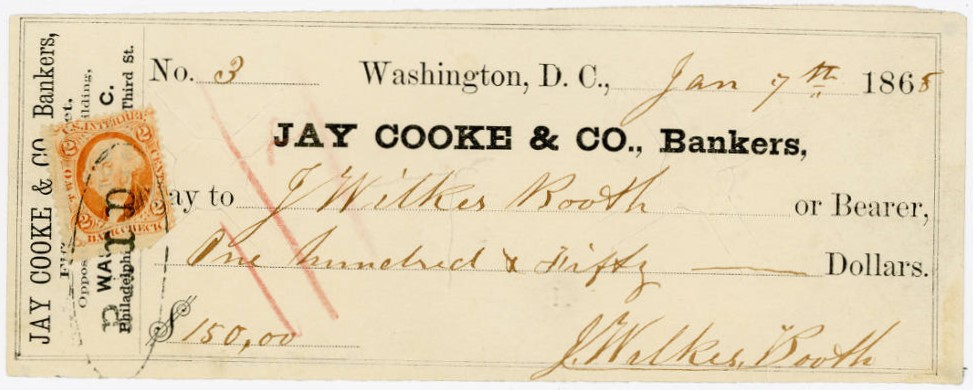
John Wilkes Booth’s check to himself

Talk about ephemeral! With online banking and online money transfer services, writing checks are a thing of the past. But even those of us who still write checks every once and awhile, have to admit that they are not things we generally hold on to once we cash or deposit it. But perhaps if you were a bank and had a check signed by a Presidential assassin just a few months before he committed his deed, you might hold onto it. John Wilkes Booth opened his account with Jay Cooke & Company on November 16, 1864 with an initial deposit of $1,500. This deposit occurred just a few days after Booth had returned from visiting Southern Maryland (and Dr. Mudd) for the first time. Over the next few months, he made different withdrawals on the account withdrawing the final balance of $25 on March 16, 1865, just a day after his meeting at Gautier’s Restaurant in which he laid out his abduction plot to all of his conspirators. The check above was a withdrawal of $150 made out to Booth himself on January 7, 1865. Two days later, Booth would make another deposit of $750. Part of this larger sum would be used to pay for part of the boat that was intended to be used to ferry the kidnapped Lincoln across the Potomac. In short, John Wilkes Booth’s account with Jay Cooke & Co. was where he kept the money he was using to finance his plot against Lincoln. This ephemeral check that Booth wrote to himself likely paid out some very real blood money. This check come from the collection of the Allen County Public Library in Fort Wayne, Indiana.


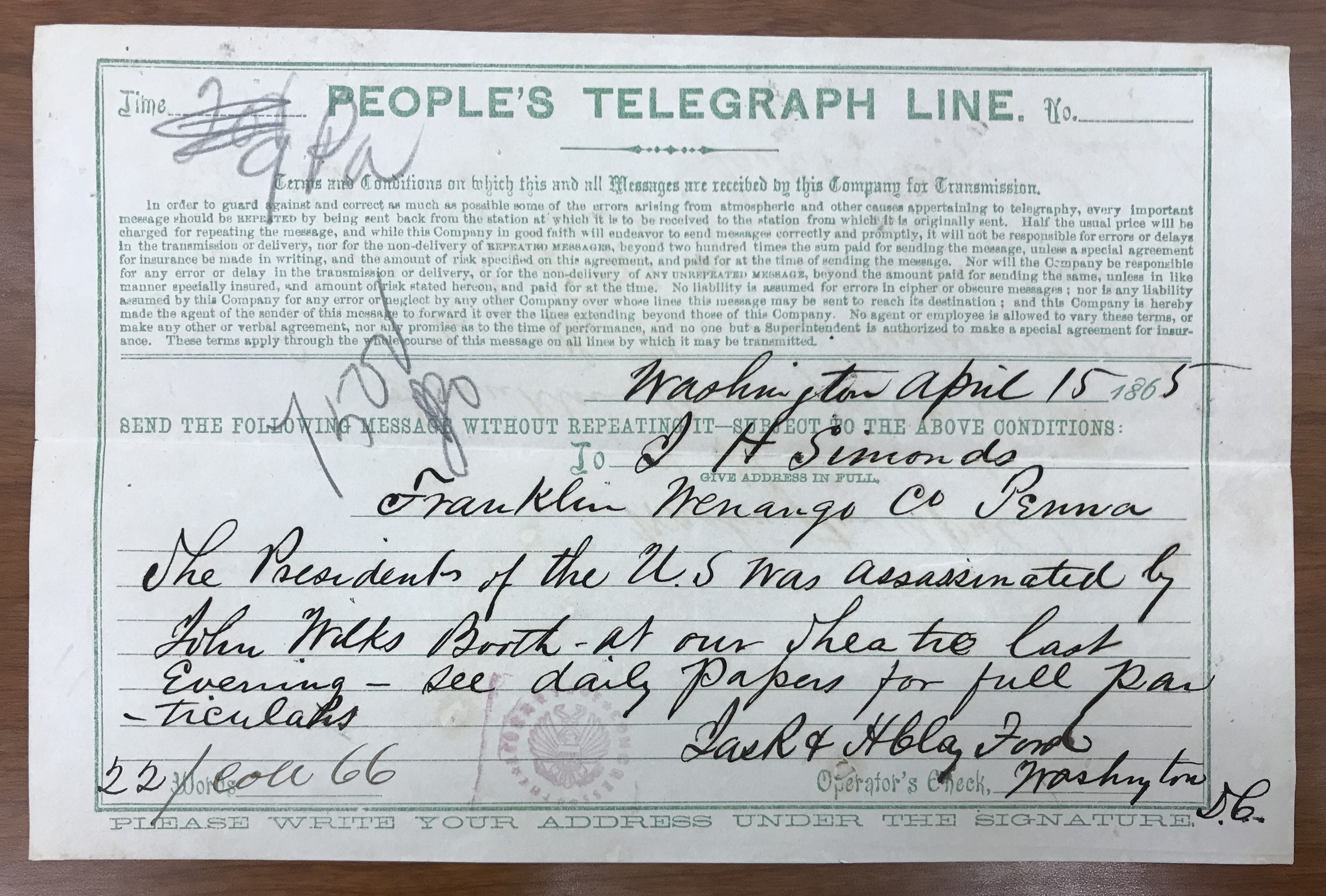
Telegram from the Ford brothers

There are many telegrams that are a part of the story of Lincoln’s death. As the main method of rapid communication across distances in the 1860s, John Wilkes Booth and his conspirators often communicated with each other via telegram. However, the telegram above does not come from Booth or any of his conspirators. Rather it was a note sent by two of the Ford brothers from Ford’s Theatre. Harry Clay Ford had been present at his theatre when Booth shot Lincoln. His brother, James Reed “Dick” Ford, had been present earlier in the day and evening, but was away at the moment of the assassination. At some point on April 15, Harry and Dick sent off this telegram stating that, “The President of the U.S. was assassinated by John Wilks [sic] Booth at our theatre last evening – see daily papers for full particulars.” Interestingly, the recipient of this telegram was Joseph Simonds, a friend of John Wilkes Booth’s who acted as his agent in the Pennsylvania oil region. Booth had recruited Simonds, a former banker from Boston, to help him in the oil business in 1864 and even though most of Booth’s investments had ended Simonds had stayed in the oil business. Simonds often sent mail to Booth care of Ford’s Theatre and so the Ford brothers may have felt compelled to alert Simonds of what had occurred as soon as possible. At the trial of the Lincoln conspirators all three men, Dick Ford, Harry Ford, and Joseph Simonds, would be called to testify about their relationship with Booth. This telegram is in the collection of the Library of Congress.


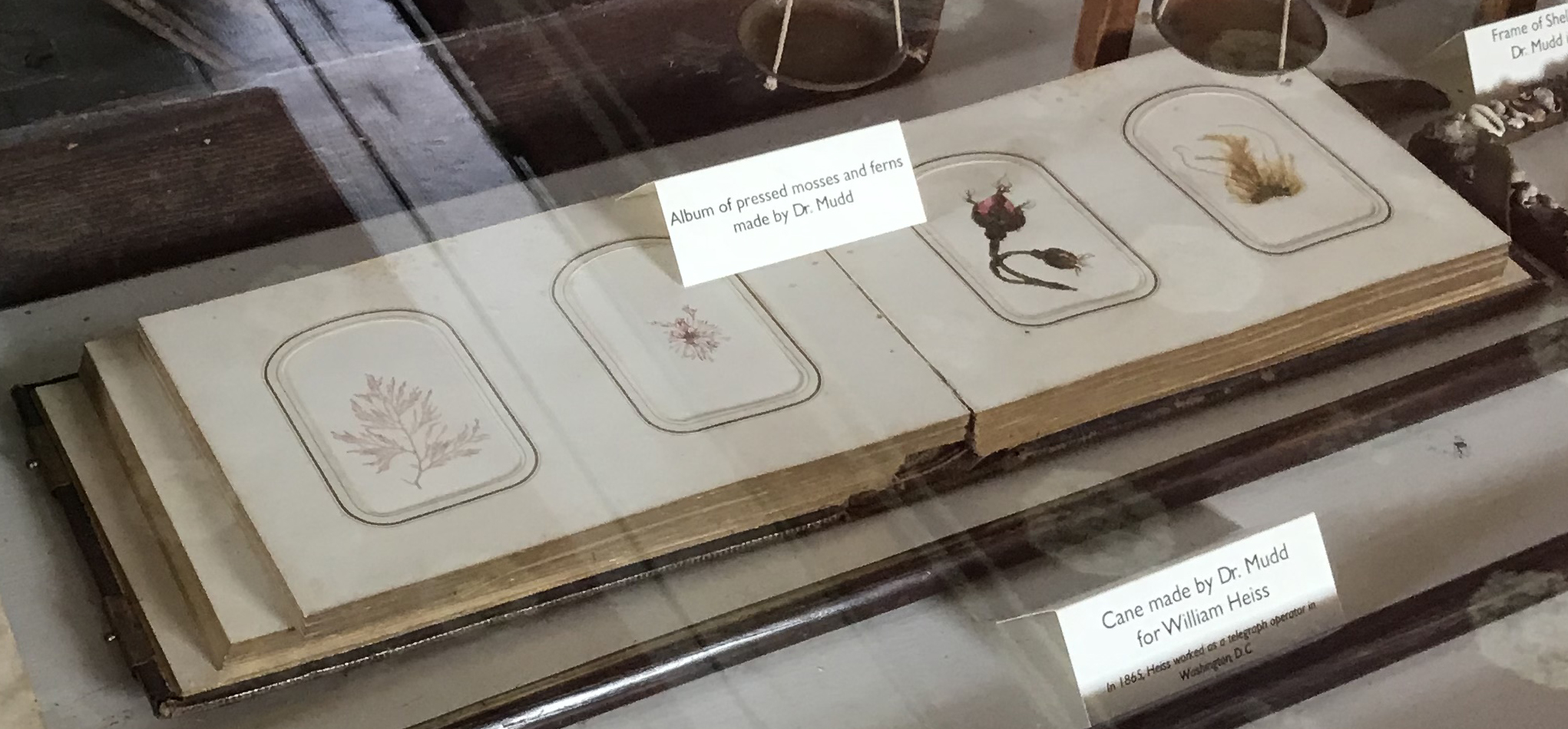
Pressed flowers from Dr. Mudd’s island prison

Ephemeral objects go far beyond humanmade creations. Nature is the largest producer of ephemera as everything living must inevitably die. We treasure the sweet blossoms that appear in springtime because we know that their existence is short lived. So much of the beauty behind a flower is because it is fragile and temporary. As the saying goes, “To every thing there is a season.” Dr. Mudd spent some time during his many seasons at Fort Jefferson attempting to preserve some of the naturally fleeting floral specimens in his tropical island prison. He collected several examples of mosses, ferns, and flowers from around the Dry Tortugas and pressed them into an album that generally housed photographs. The album can be found at the Dr. Samuel A. Mudd House Museum alongside some of Dr. Mudd’s other creations from his imprisonment.


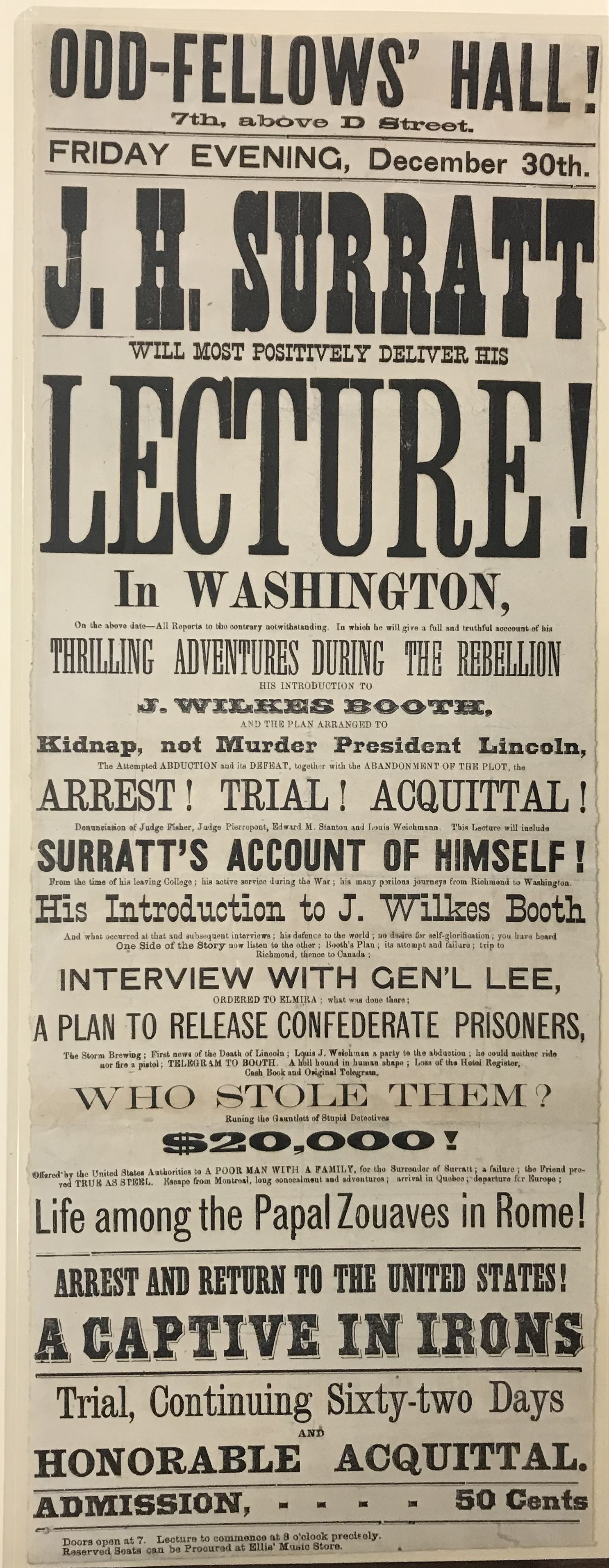
Broadside advertising John Surratt’s lecture

Rather than today’s practice of putting on the same play or musical for a prolonged engagement lasting several weeks, in the Victorian era theater specific shows generally changed each night. The main draw of the stage was the celebrated touring actor or actress who was gracing the boards at that time. The audience came out to see a certain performer who chose which shows they wanted to perform in as the lead role. Each theater’s playbills were. therefore, extremely ephemeral items, meant to capture a single performance only. Instead of using a copy of one of the most sought after playbills in the world, an authentic copy of Ford’s Theatre’s Our American Cousin playbill from April 14, 1865, I decided to show off another rarity. This playbill of sorts advertises a lecture by John Surratt, the sole Lincoln conspirator to avoid conviction for his role in the President’s death. At the time of Lincoln’s assassination, John Surratt was in Elmira, New York. When he heard the news of what Booth had done and that he was wanted in connection with the crime, Surratt flew to Canada. He hid out in Montreal for most of the trial of his mother and other conspirators and was eventually safely transported to Europe. He was eventually discovered hiding out in the Vatican as a Papal Guard. He fled the Papal States but was eventually cornered and arrested in Alexandria, Egypt and extradited to the U.S. in 1867. John Surratt was put on trial but was given a civilian trial rater than a military commission like the one that adjudicated his mother and co-conspirators. The civilian jury of majority Southerners could not come to a decision and resulted in a hung jury. Surratt was then released from custody and returned to civilian life. In 1870, hoping to parlay his notable story into a lucrative speaking career, Surratt embarked on the lecture circuit. He told the story of how he had conspired with John Wilkes Booth to abduct President Lincoln, but denied having any knowledge of Booth’s plan to kill the President. He gave his compelling lecture in Rockville and Baltimore, Maryland, and even at the Cooper Union in New York City where Lincoln had given his 1860 speech that had propelled him to national prominence. The above broadside was for speech John Surratt planned to give on December 30, 1870 in Washington, D.C. This specific lecture never happened, however. A group of locals were outraged that Surratt would be allowed to give a speech detailing his involvement in the plot against Lincoln in the same town were the President was martyred. It is believed that someone in authority contacted Surratt before the speech could start and warned him that though he had been released by the government, he had not been formally acquitted. If he continued to make waves, the government would be happy to use his words against him and re-charge him for complicity in Lincoln’s death. As a result, John Surratt never made another lecture. This broadside for the lecture that never happened is from the collection of the University of Iowa.


Paperwork of Edwin Booth’s 1886 – 1887 tour

Not every financial record need be as doom and gloom as an assassin’s check. For example, here is a look at the inner workings of a far more celebrated touring star. This is the statement showing all of Edwin Booth’s expenses and income during the week of April 25, 1887. During this period of time, Booth was taking part in what is known as the Booth-Barrett Tours. From 1886 – 1890, Edwin and fellow actor Lawrence Barrett traveled around the country. The pair traveled over 14,000 miles and gave 233 performances. It’s fun to see the details of what the accounting for tours like this looked like. For this week of the tour, we can see what shows were produced and where, the total box office gross, and the amount Booth and Barrett received from their efforts. On the other side we see their expenses which included railroad tickets, the printing of playbills and advertisements, the purchase of calcium lights, telegrams, the expenses of their prop and wardrobe keepers, and even miscellaneous expenses like the repairing of a picture frame for $2. These bookkeeping records rarely survived long past their authors but demonstrate the importance of proper records in order to be successful as a traveling actor. This financial record comes from the Harry Ransom Center in Austin, Texas.


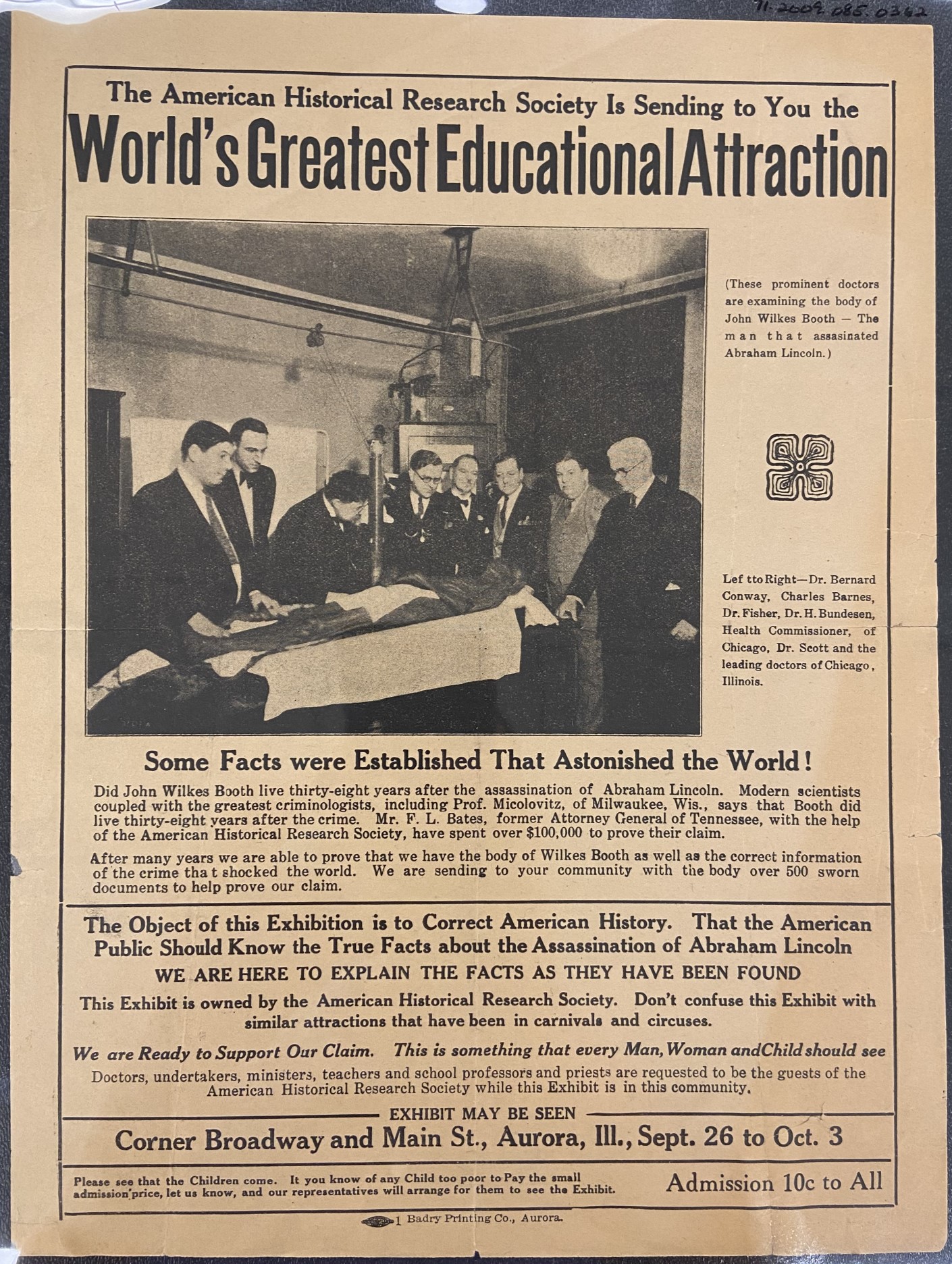
Advertisement for the “Booth” mummy

The post-mortem career of drifter David E. George has been the subject of many programs on the so called History Channel and others, but is hardly a new piece of pseudo history. As obliquely referred to on this broadside from the 1930s, it has been claimed that John Wilkes Booth escaped justice in 1865 only to take his own life 38 years later in Enid, Oklahoma. This ad portrays itself as a traveling exhibit of immense educational value that hopes to “correct American history” by showing that Booth had lived. With a name like the American Historical Research Society, I’m sure several people were convinced that they had been presented with the actual mummified remains of the assassin of President Lincoln. However, this advertisement is little more than an ad for snake oil. Despite its claim that one should not, “confuse this Exhibit with similar attractions that have been in carnivals and circuses,” that is exactly was this was. The “Booth” mummy had been traveling with carnivals since the the early 1920s and while it was now a solo attraction that visited towns and cities off the main thoroughfares, it was still little more than a sideshow hustle. The American Historical Research Society was nothing but an imaginary name incorporated by two hucksters of the mummy. They hoped the title would provide some legitimacy to their little sideshow attraction. But a pig is a pig, no matter how much lipstick you put on it! This advertisement for the “Booth” mummy exhibit comes from the collection of the Allen County Public Library in Fort Wayne, Indiana.


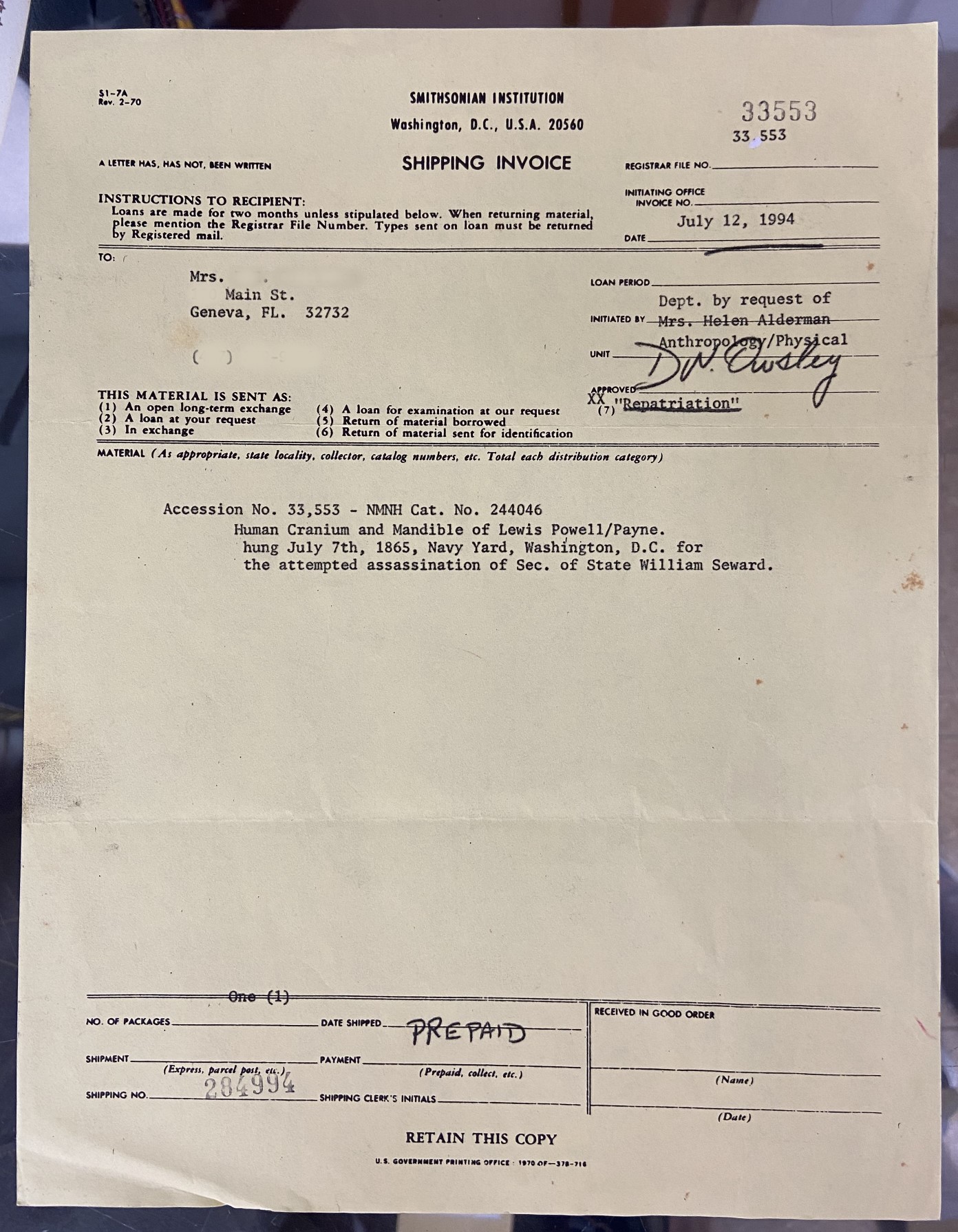
Shipping Invoice for Lewis Powell’s head

Most of us can’t wait to toss the shipping invoices that accompany our delivered online purchases. Like all receipts, shipping invoices are largely ephemeral, designed to survive the trip to their destinations. But in some cases, especially when it comes to historical artifacts, receipts can be used as a form of provenance to help prove where a specific item came from. In these cases, shipping invoices may become part of a formal record of an item. It’s perhaps not so surprising then that this shipping invoice from the Smithsonian Institution in Washington, D.C. was retained when it accompanied a very unique relic in 1994. As stated on the paperwork, this invoice accompanied the transfer of the, “Human Cranium and Mandible of Lewis Powell/Payne” from the Smithsonian to a descendant of the Powell family living in Geneva, Florida. Noted as a matter of “repatriation”, this document represents the final trip that Secretary of State William Seward’s would-be assassin, Lewis Powell, took after his skull had been rediscovered among the Smithsonian’s anthropology collection in the 1990s. Through the help of historians Michael Kauffman and Betty Ownsbey, descendants of the Powell family took ownership of their ancestor’s remains and laid his skull to rest next to his mother in Geneva Cemetery. For more about Lewis Powell’s post-mortem travels click here. For a video I shot at Geneva Cemetery in 2020, check out this post. This shipping invoice comes from the collection of the Geneva History Museum in Geneva, Florida.

Categories: History | Tags: , , , , , , , , , | 15 Comments

Blog at WordPress.com.