Posts Tagged With: Rewards

The Other Reward Offers for John Wilkes Booth’s Capture By Steven G. Miller

 “It is hard to get them all in court”

The Other Reward Offers for John Wilkes Booth’s Capture

By Steven G. Miller

One of the most famous broadsides in American History was the one issued by the War Department on April 20, 1865, announcing a $100,000 reward for the capture of John Wilkes Booth, David Herold, and John H. Surratt. This poster is one of the best-known features of the assassination of President Lincoln, and is easily identifiable by people who know little of the details of Booth’s deed and its aftermath.

One of the least-known aspects of the Lincoln Assassination is the existence, specifics, and disposition of other monetary offers for Booth’s capture. I’ve discovered that there were at least nine of them, and they were made by cities and states from “coast to coast.” All of these offers were repudiated, ignored, or combined with other schemes. The only one that was settled was the one made by the Secretary of War.

  • The first reward offer was made on the 15th of April by General Christopher Columbus Augur, the commander of the Twenty-Second Army Corps, the man in charge of the Defenses of Washington. He proclaimed that $10,000 would be given to the person or persons who aided in the arrest of the assassins.
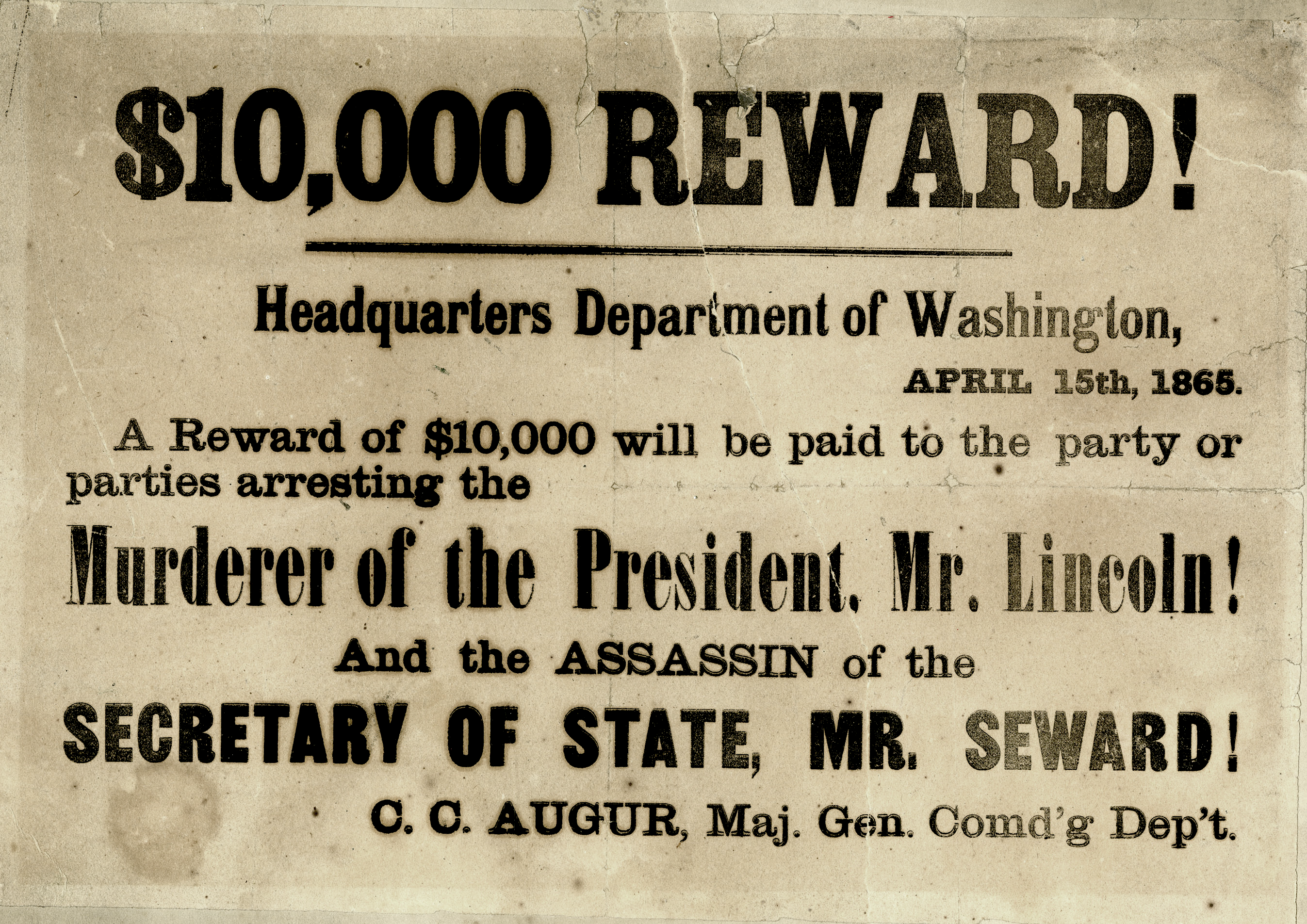
Courtesy The Historical Society of Washington, D.C.

  • Two days later, the Mayor and Common Council of the City of Washington passed “Chapter 274 of the Special Laws of the Council of the City of Washington.” This Act stated: “Be it enacted by the Board of Aldermen and Board of Common Council of the City of Washington, that the Mayor be, and he is hereby authorized and requested to offer a reward of twenty thousand dollars for the arrest and conviction of the person or persons who were concerned in the assassination of President Lincoln, and attempted murder of Secretary Seward and family on the evening of the 14th inst. Provided that if more than one should be arrested and convicted, then said amount shall be apportioned accordingly. Approved April 17, 1865.”
  • Later that day, Colonel L.C. Baker, the infamous War Department detective-chief, published a handbill proclaiming a $30,000 Reward. It described John Wilkes Booth and offered a description of the “Person Who Attempted to Assassinate Hon. W.H. Seward, Secretary of State.” As a matter of explanation, Baker stated, “The Common Council of Washington, D.C. have offered a reward of $20,000 for the arrest and conviction of these Assassins, in addition to which I will pay $10,000.”
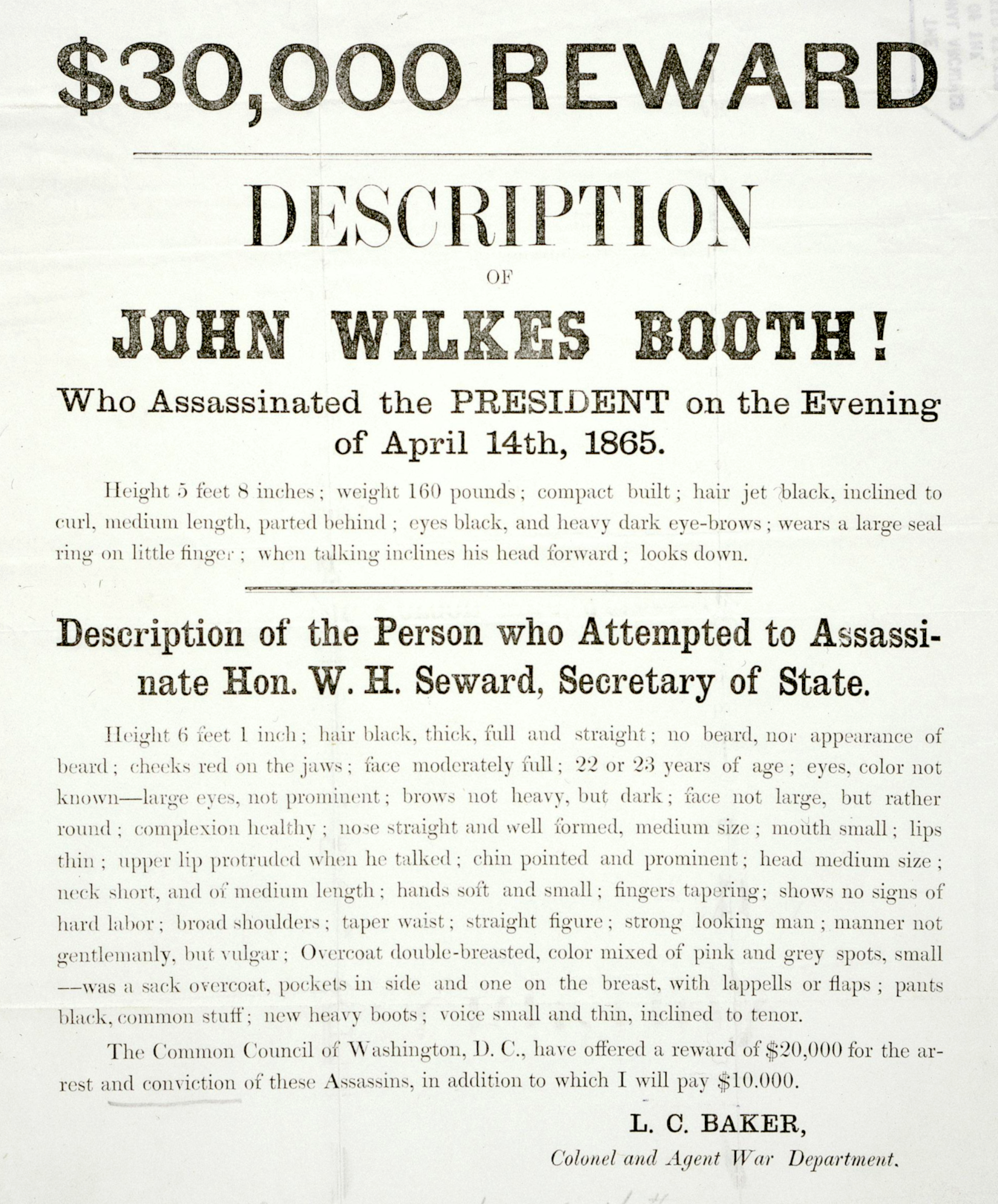
  • On some date unknown—possibly April 17—a $10,000 reward was supposedly offered by the Common Council of Philadelphia.
  • The City Council of Baltimore also offered $10,000 for the arrest of the assassin, a former hometown boy. An untitled squib, in the Davenport (IA) Daily Gazette, April 19, 1865, commented on the offer saying, “The feeling here (Baltimore) against Booth is greatly intensified by the fact that he is a Baltimorean, and it is desired by the people that one who has so dishonored the family should meet with speedy justice.”
  • On April 20th, Governor A.G. Curtin of Pennsylvania announced $10,000 for the capture of the assassin. However, this offer had a catch: the assassin had to be arrested on Pennsylvania soil.

  • On April 20, Edwin Stanton published his famous $100,000 reward, offering sums of $50,000 for Booth and $25,000 each for David Herold and John Surratt. A version of Stanton’s reward poster even had photos of the three major conspirators attached. Since this was in the days before the technique of printing halftone photos was developed, photographic prints of the three suspects were actually glued onto the printed piece. This is reportedly the first time actual photographs were added to a wanted poster. Copies of this broadside were distributed throughout Maryland and carried by search parties. The poster was also “re-composed” (re-typeset, in other words) and reprinted in New York City.

  • On some unspecified date, the State of California offered $100,000 in gold to the captors. The claim agents for Private Emory Parady, one of the captors of Booth and Herold, contacted the California officials, but nothing came of it, and nothing specific is known about this offer.
  • New York State supposedly offered a reward, too. Details are sketchy, but John Millington, another of the Garrett’s Farm patrol members, mentioned this in a 1913 letter to the National Tribune.

Most of these proposals died a quiet death and were forgotten in the aftermath of the arrest, trial, and execution of the conspirators. But attorneys pursued the offers made by the City of Baltimore, and the Washington City.

The Baltimore effort ended quickly. An article headlined “Capt. Doherty’s Story” in the August 22, 1879, New York Times explained what happened: “In the case of the claim against the City of Baltimore, which offered $30,000 {sic, should be $10,000} for the arrest of the assassin, Capt. Doherty did not sue to recover, the Mayor and Aldermen telling him point blank that they would not pay it, as the reward was offered under a previous administration. The claim has now lapsed by limitation.”

On November 24, 1865, the War Department issued “General Order No. 64”, which announced that a special commission would be set up to determine the validity of claims for the Reward and that all applications for a share had to be submitted by the end of the year.
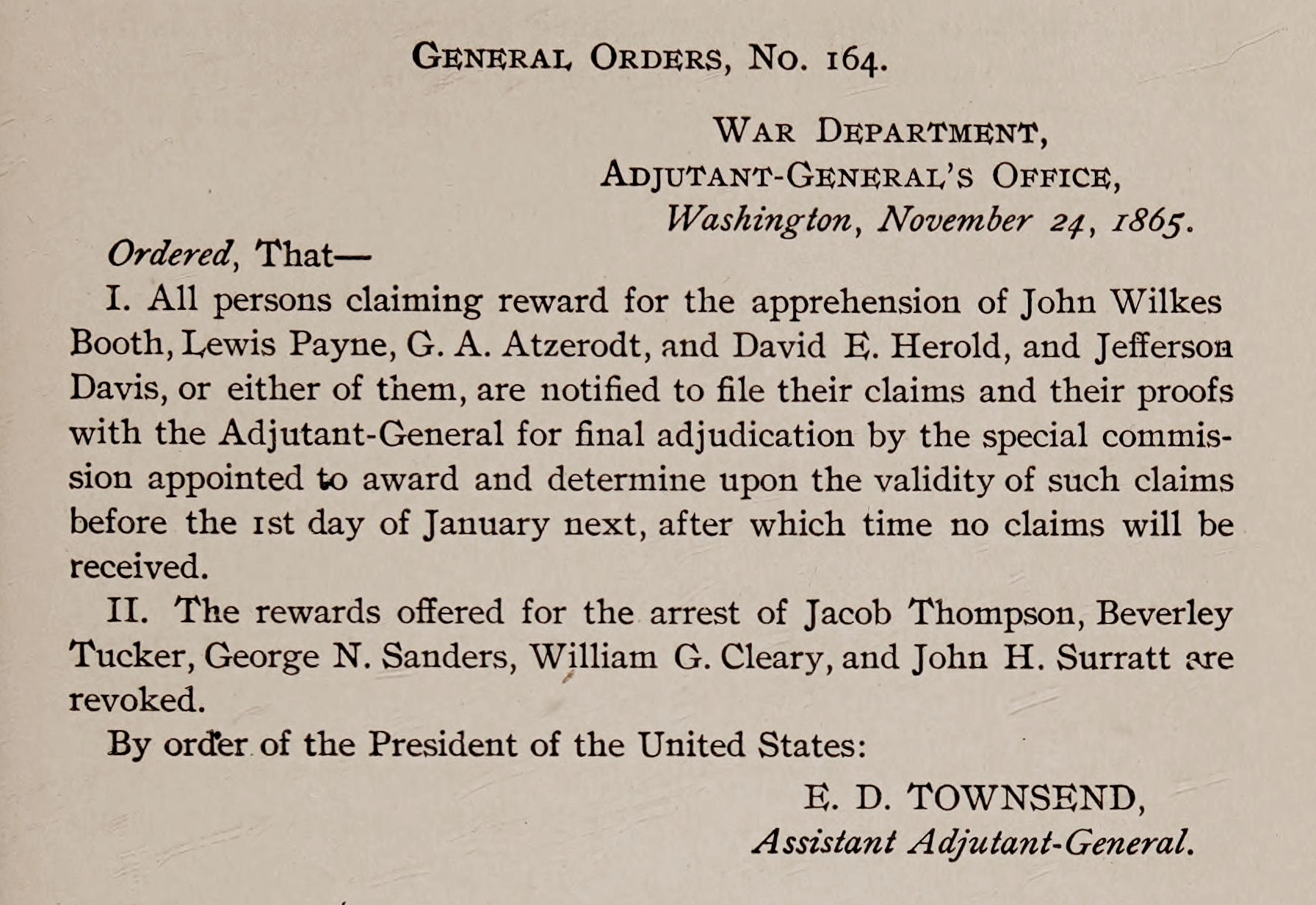
It also announced that any other offered rewards were withdrawn. This applied to the $25,000 reward offered for John H. Surratt, who was still a fugitive, and to other amounts posted for members of the so-called Confederate “Canadian Cabinet.” When the final report of the commission was issued, the offers by General Augur and Colonel Baker had been incorporated into the Stanton offer of April 20th.

There was a great deal of wrangling involved in the settlement of the War Department $100,000 offer (as detailed in my article “Were The War Department Rewards Ever Paid?” February 1994, Surratt Courier), but that was minor as compared to the struggle over the reward offered by the officials of the City of Washington. A lawsuit was filed by the three National Detective Police officers in an effort to get the city fathers to live up to their promise. This fight involved a huge cast of characters and dragged on for over a dozen years. It took so long, in fact, that by the time it started moving through the courts, one of the major players was dead.

Here’s the story of that case:
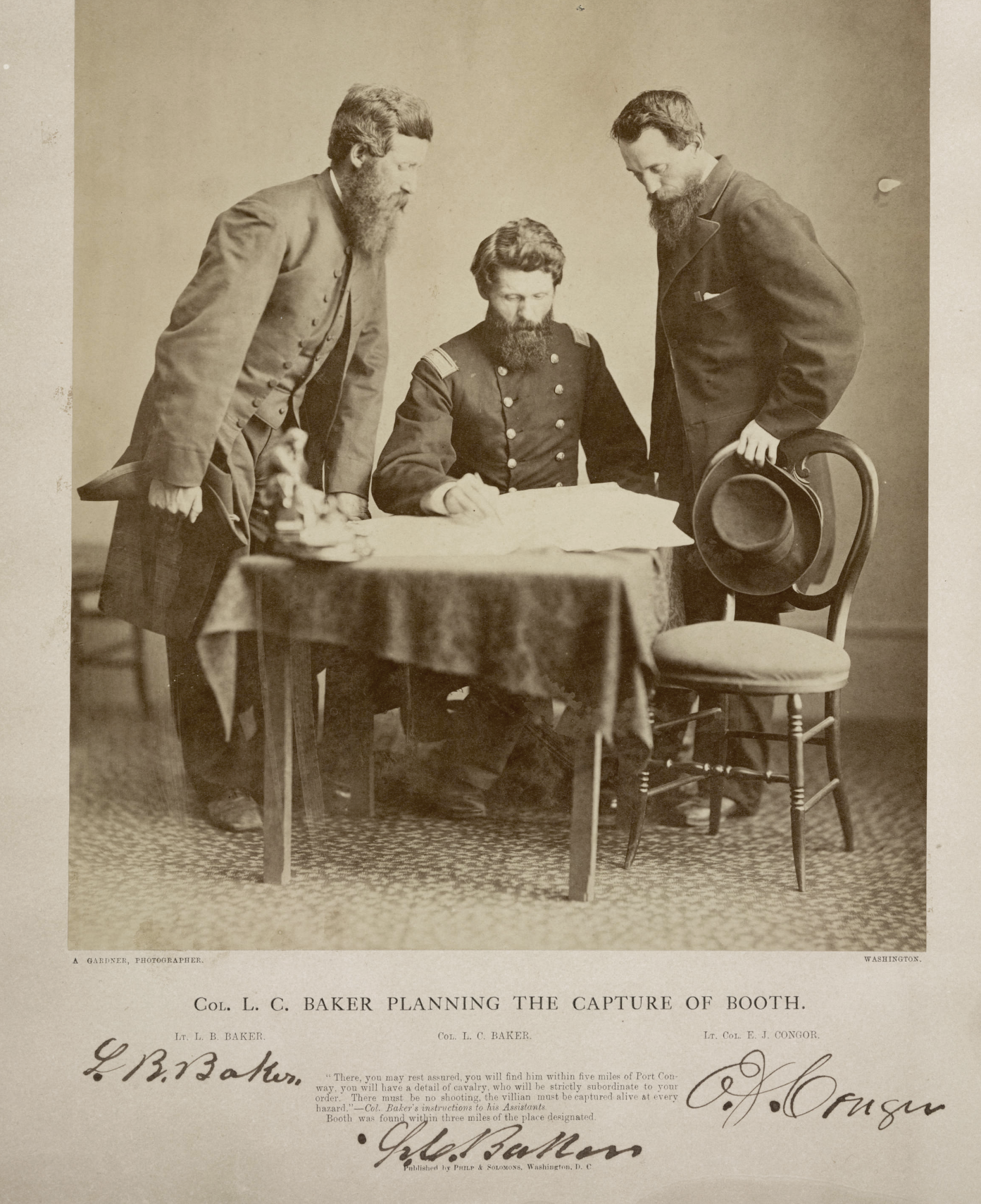
On October 10, 1866, an equity case was filed in the Supreme Court of the District of Columbia in General Term by the three detectives and their attorneys. It was designated case “No. 790” and was known as “L.C. Baker, E.J. Conger and L.B. Baker v. The City of Washington, et al.” There were forty-six individuals involved in the suit, all of whom had gotten shares of the War Department reward for the capture of Booth, Herold, Atzerodt, and Payne. The stated purpose of the case was: “For Distribution of the Reward offered by the City of Washington for Assassins of Abraham Lincoln, President of the U.S.”

As I pointed out in my earlier article, the troopers of the Garrett’s Farm patrol monitored the progress of the suit. One of the men who captured Booth, former private Emory Parady, received periodic progress reports from his agents, attorneys Owen & Wilson of Washington. On December 26, 1866, for instance, they wrote: “The suit on the city is progressing — there are so many parties it is hard to get them all in court so we can try. Capt. Dougherty is in North Carolina & we have not got service upon him and there are several others of the same character. When they are all properly before the Court we shall call it up & have it tried.”

The filing of motions, gathering and introduction of affidavits took the rest of 1866, 1867, and all of 1868. During this process, one of the prime movers, Col. Lafayette C. Baker, died in Philadelphia on July 3, 1868. Finally, all of the papers were submitted, and the Court took the matter under consideration. On April 20, 1869, the D.C. Supreme Court announced their verdict. They dismissed the case against the City, ordering that the plaintiffs pay the court costs.

The decision was appealed. On April 25, 1870, a re-argument of the case was granted by a Special Term of the D.C. Supreme Court. On September 29, 1870, the court received an “Amended Answer of the Mayor & Board of Aldermen & Common Council – motion for leave to file made in the Court sitting in General Term.”

The New York Herald summed up the case in an article on September 30th. There were several plaintiffs, the Herald said; the three detectives, Capt. Doherty, attorneys representing the 26 soldiers of the Garrett’s Farm patrol, and three civilians involved in the planning or capture of Mrs. Surratt and Louis Powell. The Herald laid out the positions of the various parties pretty clearly: The attorney for the Corporation of Washington opined that the City had had no authority to offer the reward, and that “the parties claiming this reward did nothing more than, as good citizens, they should have done.” He also stated that they were merely following the orders of their officers.

The counsel for Prentiss M. Clark, one of the civilians involved in the Mary Surratt arrest, stated that police, detectives, and soldiers had no claim since they were only doing their normal duties. By this argument, then, only civilians who gave evidence would be entitled to a chunk of the reward. (Clark was a mere civilian at the time of the arrest, naturally.)

The attorney for the troopers responded that it was not part of their duty as soldiers to assist in the capture of offenders against the law, and, besides, they were not subject to any orders from the officials of Washington City.

In the official documents of the case, counsel for the defendants stated that “the Mayor, Board of alderman and Board of Common Council of the City of Washington did not and do not possess any legal authority to offer or to pay out of the monies of the tax payers of said city any sum whatsoever for the purposes mentioned in the (1865) ordinance.”
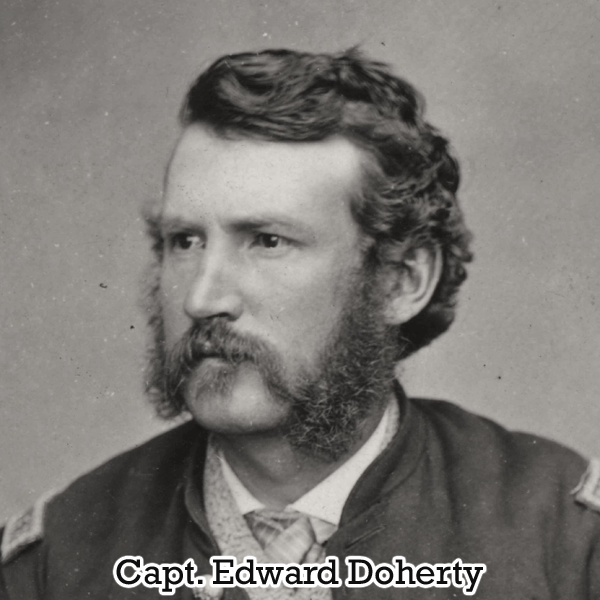
Edward Doherty responded with evidence that the mayor had issued a Message on June 30, 1868, indicating that he would seek permission from Congress (which then, as now, governed the District and Washington City) to raise $550,000 in bonds. These were to pay city debts. One of the debts specifically mentioned in the message by the mayor was the $20,000 reward, Doherty noted.

On October 15, 1870, the Special term of the Supreme Court of the District of Columbia dismissed the appeal. They found in favor of the City of Washington, et al, and against Stedpole (the executor of the estate of L.C. Baker, deceased), et al.

A long period of silence ensued, but on October 12, 1875, an appeal was filed with the United States Supreme Court. The two individuals who put up the $550 bond for the filing were Prentiss Clark and George F. Robinson, the attendant who helped save Secretary William Seward’s life in 1865.

The appeal was labeled Case No. 691. Which was soon changed to case number 441, and then to 200. It was placed on the docket for October Term 1877, but not called. It carried over to October Term 1878.

The High Court finally dealt with it, but not in a way that the plaintiffs hoped: on November 15, 1878, the U.S. Supreme Court ordered the appeal “dismissed with costs” and ordered that the defendants get their costs from the complainants.

In the end, only the War Department paid any reward for the capture of the assassins of President Lincoln. In 1898, former Pvt. John W. Millington summed up the situation to a reporter in Sioux City, Iowa. The journalist stated: “Other rewards had been offered by different states, but Mr. Millington never saw any part of them and long ago came to the conclusion that most of them were in the nature of ‘grand stand plays’.”

Sources:
Boston Corbett-George A. Huron Papers, Kansas State Historical Society, Topeka, Kansas
“Lafayette C. Baker, Everton J. Conger and Luther B. Baker, v. City of Washington, et al,” Equity docket, Supreme Court of the District of Columbia, Equity Case 790, National Archives, Washington.
Miller, Steven G., “Were The War Department Rewards Ever Paid?” February 1994, Surratt Courier.
The Millington-Parady Papers, Steven G. Miller Collection.
“One of Booth’s Captors,” National Tribune (Washington, DC), June 26, 1913. (John Millington “wants to know why” the rewards offered by the governors of New York and Pennsylvania were never paid.)
“The Reward for the Discovery of the Lincoln Assassins,” New York Herald, September 30, 1870.
“Thirty-Three Years Ago. Anniversary of the Assassination of Lincoln by John Wilkes Booth. A Resident of Sioux City Who Assisted in the Capture of the Murderer. Story of the Pursuit and the Final Scene When He Refused to Be Taken Alive and Was Shot,” The Sioux City (IA) Times, April 14, 1898.


I’m grateful to my friend Steve Miller for allowing me to republish this very interesting article he wrote about the rewards offered for the capture of John Wilkes Booth. This article was originally published in the September 2006 edition of the Surratt Courier.
Categories: History, Steven G. Miller | Tags: , , , , , , | 7 Comments

Campfire Tales about Old Joe Zisgen by Steven G. Miller

With the success of his post earlier this month, I’m happy to report that Steve Miller is making a return appearance. This time, Steve shares a new discovery he has just made bout the fate of one of the members of the patrol that cornered Lincoln’s assassin.


Campfire Tales about Old Joe Zisgen

By Steven G. Miller

In my portion of the Booth Exhumation reunion that was recently hosted by Dave and posted on this site, I mentioned that Joseph Zisgen had never spoken about the death of Booth so far as I was aware.

Wouldn’t you know it, just over a month after I made that statement, I stumbled onto such an account!

Who was Joseph Zisgen? A brief biography of “Old Joe” was contained in this obituary:

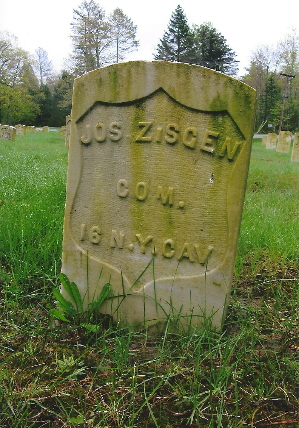
“The death of Joseph Zisgen occurred in the hospital here Thursday after a long illness. He was born in Germany and had been a resident of this country since boyhood. He served in Co. M, 16th. N.Y. Cav., and in Co. G, 3d N. Y. Pro. Cav. during the Civil War. He was admitted to the Branch from New York City, Dec. 14, 1871, and was one of the oldest members of the Branch. Mr. Zisgen was one of the party who captured John Wilkes Booth, the assassin of President Lincoln, and he received $2000 of the reward, it is said on good authority. He had been a member of the Branch so many years that all knew “Joe” and he had become a ‘character.’”

Zisgen’s grave in Maine from FindaGrave.com

His share of the Booth-Herold Reward money was actually $1,654.83, and he received it in August 1866. There has always been a minor mystery (in my mind, at least) about what became of the money. That amount was enough to set someone up with a comfortable life. Joe didn’t seem to have any health issues until old age, yet he ended up in the Soldiers and Sailors Home. It seems that the article I found solves that question.

The author of the article was Josiah Smith Maxcy (1854-1936), the son of a wealthy businessman from Gardiner, Maine. Maxcy went on to great success as a banker, railway executive, and, finally, the president of the Maine Trust Banking Company and Gardiner General Hospital. Always fond of his hometown, Maxcy also presented a speech on Gardiner’s early history for its centennial celebration in 1903.

In his article, Maxcy recounts how, when he was a teenager, he and others had gone camping on the shores of Boothbay Harbor one summer and became aware of the potential for establishing a campground on Squirrel Island in the Gulf of Maine. Eventually, the property came up for sale, and Maxcy and a group invested in the site and established a colony on the land. It became a successful summer getaway, and Maxcy was one of the officers of the organization.

He gives a history of the resort and the people involved in its creation, but digresses to tell a story which he describes as “an incident of that camping trip (in the summer of 1873), which was of much interest.”

Here’s the interesting part of Maxcy’s article:

“A Civil War Veteran

“Near our tent was another occupied by about a dozen Civil War veterans from the Government House at Togus, and one of their number, a German, was a member of the squad that captured J. Wilkes Booth, He graphically described the pursuit and capture, the burning barn and the paleness of Booth, leaning on his crutch, and of his being shot against orders by Boston Corbitt. Then he told of receiving his share of the reward, of becoming gloriously drunk, of walking thru the streets of New York and meeting an organ grinder with his monkey, of purchasing the outfit for a fabulous sum, of the monkey going up a conductor into window for a tip, of his encounter with a pet bull pup, of the soldier and the dog’s owner engaging in a free fight, of finding himself next morning locked in a cell, and nearly destitute of money. He was taken before a magistrate, and the reward was paid to the Judge, saloons, organ-grinder, jail inmates and magistrate who got it all.”

Though he does not identify the soldier by name, Maxcy was undoubtedly referring to Joseph Zisgen, of the Garrett’s Farm patrol. Now we know we apparently know what happened to his bounty money! Other troopers who received a share of the War Department Reward applied it to boring things: houses, farms, raising families, and starting a modest business or two. If this story is true, here we seem to have one who blew it on a drunken bender and a furry little critter.

Wasn’t it Billy Rose who cautioned: “Never invest in anything that eats or needs painting”? Joe should have heeded this advice.

References:
“A Historical Sketch by Josiah S. Maxcy of Gardiner. Mr. Maxcy Recalls His Own Experiences and Searches thru the Records for Matters of Fact and History,” Sun-Journal (Lewiston, ME), August 20, 1921.
“National Home. Joseph Zisgen,” Kennebec (ME) Journal, January 9, 1914.

Categories: History, Steven G. Miller | Tags: , , , | Leave a comment

The Lincoln Assassination on this Day (December 5 – December 11)

Taking inspiration from one of my favorite books, John Wilkes Booth: Day by Day by Art Loux, I’m documenting a different Lincoln assassination or Booth family event each day on my Twitter account. In addition to my daily #OTD (On This Day) tweets, each Sunday I’ll be posting them here for the past week. If you click on any of the pictures in the tweet, it will take you to its individual tweet page on Twitter where you can click to make the images larger and easier to see. Since Twitter limits the number of characters you can type in a tweet, I often include text boxes as pictures to provide more information. I hope you enjoy reading about the different events that happened over the last week.

NOTE: After weeks of creating posts with multiple embedded tweets, this site’s homepage now tends to crash from trying to load all the different posts with all the different tweets at once. So, to help fix this, I’ve made it so that those viewing this post on the main page have to click the “Continue Reading” button below to load the full post with tweets. Even after you open the post in a separate page, it may still take awhile for the tweets to load completely. Using the Chrome browser seems to be the best way to view the tweets, but may still take a second to switch from just text to the whole tweet with pictures.

Continue reading

Categories: History, OTD | Tags: , , , , , , , , , , , , , | Leave a comment

The Lincoln Assassination on this Day (November 14 – November 27)

Taking inspiration from one of my favorite books, John Wilkes Booth: Day by Day by Art Loux, I’m documenting a different Lincoln assassination or Booth family event each day on my Twitter account. In addition to my daily #OTD (On This Day) tweets, each Sunday I’ll be posting them here for the past week. If you click on any of the pictures in the tweet, it will take you to its individual tweet page on Twitter where you can click to make the images larger and easier to see. Since Twitter limits the number of characters you can type in a tweet, I often include text boxes as pictures to provide more information. I hope you enjoy reading about the different events that happened over the last week.

NOTE: After weeks of creating posts with multiple embedded tweets, this site’s homepage now tends to crash from trying to load all the different posts with all the different tweets at once. So, to help fix this, I’ve made it so that those viewing this post on the main page have to click the “Continue Reading” button below to load the full post with tweets. Even after you open the post in a separate page, it may still take awhile for the tweets to load completely. Using the Chrome browser seems to be the best way to view the tweets, but may still take a second to switch from just text to the whole tweet with pictures.

Continue reading

Categories: History, OTD | Tags: , , , , , , , , , , , , , , , , , , , , , , , , | Leave a comment

The Lincoln Assassination on this Day (August 8 – August 14)

Taking inspiration from one of my favorite books, John Wilkes Booth: Day by Day by Art Loux, I’m documenting a different Lincoln assassination or Booth family event each day on my Twitter account. In addition to my daily #OTD (On This Day) tweets, each Sunday I’ll be posting them here for the past week. If you click on any of the pictures in the tweet, it will take you to its individual tweet page on Twitter where you can click to make the images larger and easier to see. Since Twitter limits the number of characters you can type in a tweet, I often include text boxes as pictures to provide more information. I hope you enjoy reading about the different events that happened over the last week.

NOTE: After weeks of creating posts with multiple embedded tweets, this site’s homepage now tends to crash from trying to load all the different posts with all the different tweets at once. So, to help fix this, I’ve made it so that those viewing this post on the main page have to click the “Continue Reading” button below to load the full post with tweets. Even after you open the post in a separate page, it may still take awhile for the tweets to load completely. Using the Chrome browser seems to be the best way to view the tweets, but may still take a second to switch from just text to the whole tweet with pictures.

Continue reading

Categories: History, OTD | Tags: , , , , , , , , , , , , | 1 Comment

The Lincoln Assassination On This Day (July 4 – July 31)

Taking inspiration from one of my favorite books, John Wilkes Booth: Day by Day by Art Loux, I’m documenting a different Lincoln assassination or Booth family event each day on my Twitter account. In addition to my daily #OTD (On This Day) tweets, each Sunday I’ll be posting them here for the past week. If you click on any of the pictures in the tweet, it will take you to its individual tweet page on Twitter where you can click to make the images larger and easier to see. Since Twitter limits the number of characters you can type in a tweet, I often include text boxes as pictures to provide more information. I hope you enjoy reading about the different events that happened over the last week.

This post is an especially long one, comprising of almost an entire month of tweets. It will take quite a long time to load.

NOTE: After weeks of creating posts with multiple embedded tweets, this site’s homepage now tends to crash from trying to load all the different posts with all the different tweets at once. So, to help fix this, I’ve made it so that those viewing this post on the main page have to click the “Continue Reading” button below to load the full post with tweets. Even after you open the post in a separate page, it may still take awhile for the tweets to load completely. Using the Chrome browser seems to be the best way to view the tweets, but may still take a second to switch from just text to the whole tweet with pictures.

Continue reading

Categories: History, OTD | Tags: , , , , , , , , , , , , , , , , , , , , , , , , , , , , , , , , , , , , , , , , | Leave a comment

Honor, God, and Reward Money: A New Boston Corbett Letter

You’d be amazed what you can turn up nowadays with a just Google search and a friendly inquiry. A few weeks ago I was working on the Maps page of BoothieBarn looking for more sites around the country that have a connection to the Lincoln assassination. While most of the time I’m looking for the graves of certain individuals involved in the story, for some reason I decided to change my method and focus on an certain city and see what I could turn up by Googling. For no reason in particular, I chose Omaha, Nebraska as a place to search for folks connected to the assassination. I happily discovered that Omaha is the final resting place of Pvt. Augutus Lockner, a Union soldier who was saved by conspirator Lewis Powell in December of 1864. If you want to read more about that fascinating story, pick up the second edition of Betty Ownsbey’s book, Alias “Paine”: Lewis Thornton Powell, the Mystery Man of the Lincoln Conspiracy.

KENT SIEVERS/THE WORLD-HERALDI also stumbled across an article from the Omaha World-Herald in which the newspaper went behind the scenes of The Durham Museum to see some of the objects in the museum’s large and varied Byron Reed collection. One of the items mentioned in the article was a playbill from Edwin Booth’s namesake theater (pictured).

After tweeting out the image of the playbill, both myself and Carolyn Mitchell from Tudor Hall, the home of the Booth family, sent a message asking The Durham Museum if they had any other artifacts connected to the Booths or the assassination. The collection’s manager graciously searched their archives and found four other playbills for Booth’s Theatre and two 1865 newspapers announcing the news of Lincoln’s death.

The collections manager also informed us that the Byron Reed collection contained a letter written by the avenger of Lincoln himself, Sergeant Boston Corbett. She kindly photographed the letter and sent the images to us. I then contacted Steve Miller, a fellow assassination researcher and the foremost expert on Boston Corbett. I was happily surprised to find that this letter was a new discovery for him and that he had not yet come across it during his years of research. Working together, Steve and I were able to produce a transcript of the letter which had been somewhat damaged with age.

Corbett wrote the letter to his former commanding officer, the then Lieutenant of the 16th New York Cavalry that tracked down John Wilkes Booth and David Herold, Edward P. Doherty. Writing on December 1, 1866, Corbett is responding to Doherty’s request for an affidavit relating to his role in the capture of Booth. Before sharing the letter, however, some historical context is needed.


On July 26, 1866, Representative Giles Hotchkiss of New York presented to the House of Representatives the findings of the Committee of Claims in reference to the reward money. Prior to this, the War Department had presented Congress with their recommendations of how to divide up the money. Mr. Hotchkiss’ committee took the War Department’s advice when it came to the division of monies for the capture of Jefferson Davis and only made a few changes to the War Department’s allotment for reward money for the arrests of George Atzerodt, Lewis Powell, and Mary Surratt. However when it came to the reward money for capture of Booth and Herold, there was much debate. Rep. Hotchkiss’ committee put forth a bill recommending that Gen. Lafayette Baker, the head of the National Detective Police who sent detectives Everton Conger and Luther Baker with Doherty and the 16th New York into Virginia, receive $17,500 in reward money. Detective Conger was also to receive $17,500. Luther Baker would get $5,000, Lieutenant Doherty would receive $2,500, and Corbett and the rest of the 16th NY would each get $1,000. This allotment did not sit well will some of the other members of the House. Several felt it unfair for Gen. Baker to receive such a lion’s share of the reward money when he was not even present at Booth’s capture. Rep. Hotchkiss replied that Gen. Baker had been the mastermind of the entire manhunt and therefore desired the highest amount, with Conger receiving the same amount since he was in charge of the group that captured Booth. This point about Conger being in charge was disputed by Lieut. Doherty who had produced papers to counter the claim. However, within the House of Representatives there was great sympathy for Everton Conger since he was a veteran who had been wounded earlier in the war.

Representative Giles Hotchkiss of New York circa 1865

Representative Giles Hotchkiss of New York circa 1865

As the debate over amounts continued, Hotchkiss seemed to become angry with his fellow lawmakers. One of the other congressmen tactlessly pressed Hotchkiss to provide more money for one of his constituents who aided in the manhunt, noting how he had presented this claim to Hotchkiss personally and was disappointed to see how little had been allotted. This exasperated Hotchkiss, leading him to express that this whole matter had been trouble from the start. Hotchkiss said he had consulted the mountains of reward claims that had been submitted to the War Department in an effort to divvy up the money as best as he could, noting that there was no protocol for him to follow. He did not like the insinuation that he was playing favorites, noting that neither Gen. Baker or the other claimants were friends of his and that he was merely doing, “the duty I was called upon to perform”.

In attempting to show his impartiality, an angry Hotchkiss decided to make a point using Lieut. Doherty:

“During this session a telegram has been shown me from Lieutenant Doherty, saying that there was a great fraud being perpetrated here, and he wanted the American Congress to stop the wheels of legislation and wait until he could be here. Lieutenant Doherty has been here pretty much all winter, and has been before me time and time again in regard to this matter. I have had rolls of documents from him, and I wish to avoid saying anything about him. But now, since he has had the impudence to come here and charge a man who has been engaged in the honest discharge of his duty, without fear or favor, one who is a stranger to all these men, who does not care personally whether they get a cent, and since gentlemen have shown the want of confidence in the committee to make the remarks they have, I feel constrained to say that I believe Lieutenant Doherty was a downright coward in this expedition.

From all the evidence, I believe that while these five men where guarding that tobacco-house where these prisoners were secreted, and while Lieutenant Colonel Conger was endeavoring to get a guard around the building, Doherty stayed under a shed, and no power could drive him out of it. And now he comes in and claims that he did the whole. Such is the evidence in the case, as it has been presented. If there is anything to contradict it, let it be brought in.”

Hotchkiss then points out that despite his strong belief that Lt. Doherty was an coward who deserved no portion of the reward money, the committee still allotted him some funds “in deference in part to popular clamour”.

Hotchkiss also spoke harshly of Boston Corbett. He said the evidence he saw supported the idea that Corbett defied orders by leaving his assigned post, made his way close to the barn where he was not supposed to be, and then shot Booth who was attempting to surrender himself. He described Corbett as, “an insane man” at the shooting of Booth. “I am told that Corbett has since died in a lunatic asylum, and he was then evidently an insane man. Yet he is given the same sum as the other soldiers receive. For a two days’ ride I think that is an ample compensation.”

While Hotchkiss provided a defense of the committee’s reasoning for their proposed reward allotments, he didn’t feel it worth a prolonged fight. After an hour of debate, Hotchkiss was tired of the insinuations from his colleagues and just wanted the whole mess to be over. Another representative had put forth an amendment to his bill, changing the amounts provided for Booth and Herold’s capture and, in the end, Hotchkiss did not fight it and the amended bill was approved. “When you cannot do as you would, you must do as you must,” Hotchkiss stated.

The amended bill still gave Everton Conger the largest share of reward money at $15,000, a decrease from Hotchkiss’ $17,500. General Lafayette Baker dropped way down from $17,500 to $3,750. Luther Baker fell from $5,000 to $3,000. Ironically, it was Lt. Doherty, Boston Corbett, and the rest of the soldiers who benefited the most from this amended bill. Doherty’s reward money went from $2,500 in Hotchkiss’ bill to $5,250 in the amended version. Corbett and all the other soldiers also got pay increases from $1,000 to $1,653.84 each. In the end, it would be these amounts that would be passed in the Senate and given out.

Lieutenant Doherty's reward money

Lieutenant Doherty’s reward money

While Doherty ended up receiving a good deal of money, when he learned of what Giles Hotchkiss had said about him on the floor of the House of Representatives, remarks that were carried in newspapers around the country, he became very offended at the attack on his honor. On August 1st, while stationed in South Carolina, Doherty sent off a letter to the New York Herald promising a rebuttal to Hotchkiss’ lies.

“I cannot remain quiet under such charges affecting my character as a soldier, and my conduct as an officer, coming from such a quarter. In the course of a short time I shall place before the people of the United States such evidence as will convince them that the charges made by the honorable member are untrue. The language used by the member from New York, did not come to my notice until after the adjournment of Congress, and when I no longer had an opportunity of vindicating myself before that body.

Chance has connected my name with a great historical event; and I simply desire that the army with whom I served, and the people for whom I fought, should know that in the performance of my duty I was not a laggard and a coward.

Edward P. Doherty
Second Lieutenant Fifth Cavalry, U. S. Army”

Doherty quickly sent off a letter to Boston Corbett, a man he knew would support him and could help tell the real story of what happened at the Garrett farm. Corbett was still a bit of a hero for slaying Booth and Doherty was hoping he could depend on Corbett to publicly refute Hotchkiss since he, too, had been a victim of the Congressman’s lies. The very much alive and not (quite) insane former sergeant responded just as Doherty had hoped. He wrote a letter back to Doherty in South Carolina on August 6, 1866. Doherty then had the text of the letter was published in the New York Citizen on August 25th:

“God bless you, my dear sir; the slander and lie that was told by Mr. Hotchkiss, in Congress, about you, makes me love you more than ever. And I do not believe that such a wicked lie and such a malicious slander will be allowed to go altogether unpunished, or to have the effect on the public mind that was intended. I do not doubt, though, that it did have the effect desired in Congress; and I do truly believe that it was told and used there for the express purpose of getting the largest share of the reward for the Detectives, and getting the military into disgrace, and consequently the small apportionment that was made to us.

I do without hesitation pronounce the assertion that you was under a shed, and that the Detective could not force you out, to be a wicked lie. For I well know that you not only commanded the party, but commanded it well; and at the time that the house and barn of Mr. Garrett was surrounded, it was done by your orders; and that you took the leading part in all that was done there, as also in the whole expedition.

I am aware, also, that you placed me next in command to yourself before leaving Washington, giving me charge as acting orderly sergeant, and had you been killed I should myself have been in command of the party, and not the Detective. I am also aware of the fact that when you got track of the assassins, you had to send men after the Detective (Conger), who was off in another direction at the time.

Boston Corbett and Edward Doherty

Boston Corbett and Edward Doherty

The injury that has been done us by giving us a small share, instead of the principal share of the rewards, cannot now be remedied, since it has passed Congress in that way. But be assured, dear sir, that I stand ready to give a certificate at any time, properly attested if needs be, that I have ever known you to be a brave and efficient officer, and never in my life saw any act on your part that indicated cowardice in the least degree.

I always liked to go on a scout with you, because I knew you to go forward in the work, and a true officer and soldier, having the welfare of your command always in view, and losing no opportunity of doing good service for your country.

With kindest regards and earnest prayers for your welfare, and that you may outlive all such wicked slanders, I remain, as ever

Boston Corbett”

As grateful as Doherty must have been for Corbett to come to his aid, Hotchkiss’ slanderous remarks apparently continued to gnaw at the lieutenant. Over three months later, on November 26th, Doherty wrote another letter to Corbett seemingly asking the late sergeant to write out a more thorough or perhaps notarized affidavit regarding Doherty’s services in apprehending Booth. It is Boston Corbett’s letter to Doherty’s second communique, months after the Hotchkiss affair, that is housed in The Durham Museum in Omaha.


Even though Corbett had written in August of 1866 that he stood ready, “to give a certificate at any time, properly attested if needs be,” regarding Doherty’s actions and character, in this response to his former commander in December of 1866, it appears that Corbett is trying to get Doherty to put the whole incident aside.

boston-corbett-1866-letter-to-doherty-durham-1

91 Attorney St
New York
Dec 1st 1866

Lieut E. P. Doherty

Dear Sir

Your letter of Nov 26th reached me yesterday. And as I was not sure by the heading of it wether [sic] it meant South Carolina, or Lower Canada; I concluded to write to you for the Address in full; And also to suggest that it might be best to drop the whole matter; And let it end as it is.

For my own part as a Christian I freely forgive Mr. Hotchkiss for the injury that he has done; And so would rather let end thus. But if you still insist upon the Affidavit being made to clear your character, I feel that I owe it to you to do it. And so would not further refuse.

But while I sincerely desire to see your Character Vindicated: how much rather would I see your soul saved, And you brought to love and serve God with all your heart. I expect you think it very strange that I appear so indifferent to that which is a point of honor; but the secret of it all is this the Christian knows that the time will soon come when the secrets of all hearts will be made bare in the judgement And he feels that he can well afford to be hid about here.  So that he stands justified there. This with me is the only cause of reluctance to make the Affidavit, which I believe I can do with a clear conscience if you think best after reading this.

If you have written me lately before; the letter never reached me, for the only letter that I have got from you before this since you have been in the Service again; was dated Sumter, S.C. August 1st. Which I promptly answered

Will you please inform me if you have taken any steps to get the Local Rewards collected. When I was in Washington to get the Amount that Congress Awarded me, I went to Johnson, Brown & Co, at the Intelligencer Building and put my interest in their [sic] hands to collect for me. They advised me to consult with you, which I fully intended doing before, but rather expected to hear from you. They have written to the Pennsylvania Govt. and received Answer by Official Document which I have. That this Reward was on condition that Booth be taken in the State.

With kindest regards Boston Corbett

boston-corbett-1866-letter-to-doherty-durham-signature

Please direct to 91 Attorney St. Mr. Peck is out of Business now and no longer holds the store where I was working.

Boston Corbett was a deeply devoted Christian almost to the point of being a zealot (the man castrated himself in order to avoid the temptations of the flesh, after all). While his preaching helped to bring hope to his fellow prisoners at the Andersonville prisoner of war camp during the war, I highly doubt Lieut. Doherty was pleased to find that Corbett had responded to his request for help with a lesson on Christian forgiveness.

After side-stepping the issue of Hotchkiss with his talk of saving Doherty’s soul, Corbett then went into a topic he knew would be of mutual interest to them both: more reward money. While both of them had received their share of the reward money offered by the federal government, Corbett mentioned his attempt to procure some of the smaller rewards that certain states and cities were offering after the assassination of Lincoln. He apparently made application in Pennsylvania for a reward they had offered, only to learn that the reward was contingent on the fact that Booth was actually found in Pennsylvania.

Coincidentally, Doherty was pursuing the same type of course with a reward that had been offered in D.C.. It’s possible that Doherty’s renewed desire to get an affidavit from Corbett was not just to seek vindication against Hotchkiss, but was designed to strengthen his bid for this local reward.  Doherty certainly did not want to be maligned again as he sought a portion of the $20,000 the city of Washington had offered. This is especially true since most of the major players from the federal rewards case sought out their own share of the D.C. rewards as well.

For the D.C. money, Doherty was once again up against General Baker, Everton Conger, and Luther Baker. But the other claimants quickly grew as the case went through the courts. Washington was not as willing to pay out their reward and so the legal process lasted years. Lieutenant Doherty had submitted his claim in November of 1866, and by September of 1870, the case was still unresolved. By that time the number of claimants had swelled to 39, and rather than fighting with each other over who should get what amount, they were all working together to force D.C. to pay out the money they had promised. In the end, however, their case was dismissed when the judge determined that the city of Washington, funded by Congress, never had the authority to offer the $20,000 reward in the first place. The only legitimate reward the claimants could have hoped for in the city of Washington was the federal one which had been paid out in 1866.


This letter by Boston Corbett provides a new look into the unique mind of the man who avenged Abraham Lincoln. It is also a great artifact for teaching about the drama and intrigue that was involved in the avengers’ quest for reward money. I’m thankful to The Durham Museum for sharing it with us. It never hurts to ask a museum what they might have hiding in their collections. As shown from this letter, the results can be pretty interesting.

boston-corbett-cdv-boothiebarn

References:
The Byron Reed collection at The Durham Museum
Steven G. Miller
The Congressional Globe: Containing the Debates and Proceedings of First Session of the 39th Congress
The Lincoln Archives Digital Project
Genealogybank.com
The Omaha World-Herald

Categories: History | Tags: , , , , , , , | 3 Comments

Blog at WordPress.com.