Posts Tagged With: Relics

John Wilkes Booth’s Poetic Envelope

One of the more curious relics belonging to John Wilkes Booth, is a brief poem he wrote on the reverse of an envelope on March 5th, 1865.

Booth Hale Poem Envelope 3-5-1865 Sotheby's

There are some mysteries regarding this poetic envelope. What does Booth’s poem say? Who wrote the second poem beneath Booth’s? Why were these poems written at all? Let’s explore these questions as we analyze this piece on the 150th anniversary of its creation.

What Does Booth’s Poem Say?

This relic was first brought to the attention of the general public thanks to Carl Sandburg’s 1939 book, Abraham Lincoln: The War Years Volume 4. In writing and illustrating his book, Sandburg borrowed heavily from his friend and Lincoln collector, Oliver R. Barrett. Barrett had a massive Lincoln collection and allowed Sandburg to include a small picture of these poems. Sandburg also transcribed the poems and added the following context:

“On March 5 of ’65 signing his name to a verse on an envelope back:

Now, in this hour, that we part,
I will ask to be forgotten never.
But in thy pure and guiltless heart
Consider me thy friend dear Eva
J. Wilkes Booth

And the daughter of a United States Senator, her name protected during ensuing scandals, Eva joined her quoted lines on the same envelope back: ‘For all sad words from tongue or pen – the Saddest are these – It might have been,’ dating it March 5, 1865, In John’s room-“

When Barrett died in 1950, his Lincoln collection went up for auction. In the 1952 auction catalog, this envelope was advertised thusly:

Booth Hale poem envelope Barrett catalog

The auction company, which heavily utilized Sandburg for his expertise, again concluded that Booth’s poem stated:

Now, in this hour, that we part,
I will ask to be forgotten never.
But in thy pure and guiltless heart
Consider me thy friend dear Eva
J. Wilkes Booth

A careful analysis, however, will show that this transcription has a few omissions and errors. As knowledgeable as Carl Sandburg was, he was not a Booth expert and was  far more experienced reading the President’s writing as opposed to that of his assassin. The true and complete text of Booth’s poem is as follows:

Now, in this moment
Now, in this hour, that we part,
I will ask to be forgotten, never
But in thy pure and guileless heart,
Consider me thy friend dear, Ever
J Wilkes Booth

Booth’s hasty scrawl pushed the final two letters in “ever” together to create, in lower quality copies, what appeared to be the single letter “a”. However, after consulting a slightly better quality image of the envelope, like the one that begins this post, one can make out the slight gap separating the two letters. “Ever” is also the logical conclusion as it completes the poem’s rhyme, while “Eva” does not.

This accidental, yet completely understandable substitution of the name “Eva” as the final word in the poem instead of the correct word, “Ever”, caused a great deal of confusion and speculation among Booth historians who consulted Sandburg’s book and the Barrett catalog. Theodore Roscoe, author of the 1959 book, The Web of Conspiracy, trusted Sandburg’s account to include his own mention of the nonexistent “Eva” as having, “dallied for some time in a state of betrothal with the amorous actor.” While Roscoe had the name wrong, he was not far off from the truth.

Who Wrote the Second Poem?

The larger poem, comprising the bulk of the envelope back states the following:

“For of all sad words from
tongue or pen.
The saddest are these –
It might have been.”
March 5th 1865
In John’s room –

The text of this poem is a quote from John Greenleaf Whittier’s 1856 poem, “Maud Muller“. The individual who wrote these lines on the envelope was John Wilkes Booth’s secret fiancée, Lucy Hale, daughter of United States Senator John Parker Hale.

Lucy Hale

CDV of Lucy Hale that was found in John Wilkes Booth’s possession when he was killed

Though the poem is unsigned, handwriting analysis conducted by researcher James O. Hall concluded that this second poem was indeed written by Lucy Hale. Booth and Miss Hale had been acquainted since 1863, when Miss Hale witnessed the actor perform in Washington and sent him a congratulatory bouquet of flowers. The relationship between the two had flourished after Booth stopped touring and spent more time in Washington in the months leading up the assassination. Both John Wilkes Booth and the Hale family lodged at the National Hotel in Washington. This easily explains Lucy’s presence in his room on March 5th, though it would have still been against social custom. By that date they were engaged, albeit secretly. An actor, even one as famous and acclaimed as Booth, was still considered a poor match for woman of high class such as Miss Hale. Even after the assassination, when Lucy was racked with grief over the actions of her fiancée, the authorities still protected her honor by being careful not to publicly disclose their intimate involvement. She was quickly whisked away to Spain where her father had been appointed as an ambassador.

Why were these Poems Written?

The poems written by John Wilkes Booth and Lucy Hale are heartfelt lines that speak of remembrances and separation. Due to this a couple of authors have written possible explanations for them. Michael Kauffman, author of American Brutus, suggests that these lines were written by John Wilkes and Lucy as they lamented Lucy’s future departure for Spain:

“March 5, the morning after the inauguration, was bleak and cheerless for Booth and Lucy Hale. They sat in Booth’s room at the National Hotel commiserating on life’s troubles and despairing of future happiness. They might not have a life together; Lucy would soon accompany her father to Spain, where he was about to begin his duties as an ambassador. The emptiness of the moment reminded Lucy of Whittier’s “Maud Muller,” and she jotted down some lines on an envelope…Booth added a few lines of his own”

In Terry Alford’s upcoming book, Fortune’s Fool: The Life of John Wilkes Booth, he paints an even sadder picture regarding the circumstances of these poems’ creation:

“The day after the inauguration, Booth and Lucy ended their courtship. The timing suggests that his odd behavior had attracted the notice of her family. Or their parting may have been due to the fact that the Hales were leaving Washington. His term in the Senate having expired, Hale was moving his family to prepare for his new assignment as American minister to Spain.

Booth and McCullough had shared their room during the inaugural crunch with John Parker Hale Wentworth, Lucy’s first cousin. Wentworth proved a handy go-between for their courtship. Now he offered a final service.  He handed Booth an envelope from Lucy. If there was a letter inside, it is long gone. The envelope survives. On it Lucy copied the celebrated lines from John Greenleaf Whittier’s poem “Maud Muller”…Wentworth gave the envelope to Booth, who added his own sentiment just above Lucy’s…”

As much as I respect and admire these two authors, I believe them both to be mistaken in regards to the nature of these poems. The reason I don’t agree with Kauffman and Alford’s theories that the poems are mournful notes between John Wilkes Booth and Lucy Hale is due to the fact that Lucy’s father, John Parker Hale, had not yet been appointed minister of Spain when these poems were written. Senator Hale may have been petitioning for the position on March 5th, but he was not nominated for it until March 10th. In fact, the position was still very much in play on March 7th, two days after these poems were written. On that day, Secretary of the Navy Gideon Welles recalled having a cabinet meeting during which Secretary of State William Seward offered the position of Minister to Spain to anyone in the cabinet. This was intended to be a kind gesture towards Secretary of the Interior John Usher, who had lost his political base and was being forced out of Lincoln’s cabinet. No one, including Usher, responded to the offer. John Usher tendered his resignation to Lincoln on March 9th without inquiring about the ambassador position and so Seward found John Parker Hale for the job.

Senator John Parker Hale, Lucy Hale's father

Senator John Parker Hale, Lucy Hale’s father

Rather than being dejected poems of loss written by John Wilkes Booth and Lucy Hale for each other, I believe these poems are the couple’s farewell messages to Lucy’s cousin, John Parker Hale Wentworth. I believe that Kauffman and Alford are both missing one key piece of evidence regarding this relic: the contents written on the front side of the envelope.

The Front Side of the Envelope

From the 1952 Barrett auction catalog, we know that there is some writing on the front side of this envelope. For one, the envelope is franked with the name of John Conness. Franking was a practice at the time in which members of Congress, the President, cabinet members and other elected officials could send mail without the need of a stamp. The official in question would sign his name in the top right corner of an envelope and that would be as good as a stamp for the postal service. Officials pre-signed hundreds of envelopes for later use in this way. The envelope with Booth and Lucy’s poems was signed by John Conness who was a Senator from California.

The 1952 auction catalog also states that the front of the envelope has, “a three line quotation with a note” on it. While the catalog provides the note, written by John Parker Hale Wentworth, it does not give the quotation. For that we must consult a more recent auction. After being purchased in the 1952 auction for $210, the poetic envelope disappeared for many years. Assassination researcher James O. Hall tried to locate it but to no avail. Finally, in 2004, it popped up in a Sotheby’s auction. From their archived auction page, we finally learn that the full text on the envelope’s front is:

“Touched by change have all things been
Yet I think of thee as when
We had speech of lip and pen.”

Beneath this, in the same hand is the sentiment:

“The above, though quoted, are the real sentiments of your friend, who trusts that the acquaintance and friendship formed will never be forgotten by either, Jno P. M. W.”

The poem John Parker Hale Wentworth quotes from is entitled “Remembrance“. It was written by the poet John Greenleaf Whittier, the same author of Lucy’s, “Maud Miller” excerpt.

Wentworth, Booth, and Lucy

While John Parker Hale Wentworth and Lucy Hale were first cousins, they do not appear to have been particularly close growing up. There was quite an age difference between them with Wentworth having been born in Maine in 1828 and Hale in New Hampshire in 1841. In 1849, Wentworth, then 21, made his way to California to seek his fortune.  He would reside in California for the rest of his life. In about 1862 or so, Wentworth was appointed the Indian Affairs Agent of Southern California by Abraham Lincoln himself. Whether Wentworth wrote to his Senator uncle, John Parker Hale, for some assistance in gaining this position is unknown, but it’s clear that Wentworth was grateful to President Lincoln for the job. He was also apparently well suited for it with newspapers reporting that, “Mr. Wentworth has worked miraculous changes in the condition of the Indians in this district; more particularly of the degenerated, wasting tribes of this vicinity.”

With Lincoln’s re-election in 1864, Wentworth made the decision to travel from California to Washington, D.C. His motives for travelling aren’t known for sure. He may have just desired to be present at Lincoln’s second inauguration and hoped to thank the President for granting him his position. Or, perhaps he was like many other office seekers, looking to advance himself further in California’s political circle. Regardless, he arrived in D.C. and took up lodging at the National Hotel, where his uncle and cousins resided. On February 22, 1865, he checked into a room with John Wilkes Booth and another actor named John McCullough.

John Wilkes Booth Gutman 23

It was probably during this time that Wentworth had his first real opportunity to get to know his younger cousin Lucy, who was 8 years old when he left for California and was now a beautiful lady of 24. Being Booth’s roommate, Wentworth would have undoubtedly been aware of the relationship between his little cousin and the actor. The three of them likely spent time together, with Booth displaying his amazing ability to connect deeply with people.

In his free time leading up to the inauguration, it seems plausible that Wentworth would have wanted to report to his Congressmen on the condition of Indian affairs in his section of the state. This would have put him into the offices of his Senator, John Conness. This, I believe, explains Conness’ franked signature on the poetic envelope.  Perhaps Coness offered Wentworth some franked envelopes with which to send future correspondence, or maybe Wentworth decided to help himself to an envelope. Wentworth seems to be the only logical intermediary between the office of Senator John Conness and John Wilkes Booth.

Though I have not been able to track Wentworth’s movements, it appears he departed Washington right after the inauguration. In those days it was quite a long journey back to California, requiring steamboat travel to Panama, a train ride across the isthmus, and a second long steamboat journey to California. It is not unreasonable to assume that Wentworth decided to begin his journey as soon as possible. Even the very next day after the inauguration.

A Farewell Among Friends

With all of this in mind, I submit that the poetic envelope displayed above initially held John Parker Hale Wentworth’s farewell message to either his cousin, Lucy, his roommate, Booth, or to them both as a couple. In this scenario, Wentworth wrote a note, placed it in an envelope he had received from John Conness’ office, and wrote Whittier’s “Remembrance” poem on the front. He then either presented it or left the note for Lucy & Booth. Lucy opened the envelope and read the contents. She then wrote her own Whittier poem on the back of the envelope. Given its position, it appears that Booth’s response was an after thought. Since Lucy used all of the space on the back of envelope, Booth squeezed his own poem on the top flap. The envelope, but not the contents, was then given back to Wentworth as a representation of the couple’s affection.

The above is, of course, just a theory, but it is a theory that I believe logically explains how poems from John Wilkes Booth, Lucy Hale and John Parker Hale Wentworth all came to be on a single envelope franked by Senator John Conness.

References:
American Brutus by Michael Kauffman
Fortune’s Fool: The Life of John Wilkes Booth by Terry Alford
John Wilkes Booth: Day by Day by Art Loux
The Oliver R. Barrett Lincoln Collection Auction Catalog
The Web of Conspiracy by Theodore Roscoe
Sotheby’s Auctions
Right or Wrong, God Judge Me: The Writings of John Wilkes Booth edited by John Rhodehamel and Louise Taper
Ancestry.com
News Notes of California Libraries, Volume 14
“Indian Affairs in Southern California”, Daily Alta California, January 24, 1863
Mr. Lincoln’s White House: Cabinet
Diary of Gideon Welles
Special thanks to Roger Norton for providing me with Carl Sandburg’s quote in a pinch

Categories: History | Tags: , , | 35 Comments

Samuel Arnold’s Letter at the Lincoln Library and Museum

Over the summer, I had the opportunity to visit the Abraham Lincoln Library and Museum for the first time. Not to be confused with the Presidential library and museum in Springfield, Illinois, this museum is attached to Lincoln Memorial University in Harrogate, Tennessee.  As part of its charter, LMU has been collecting and displaying Lincoln and Civil War era artifacts since its founding.  In 1977, the collection moved to its current space in the form of the Abraham Lincoln Library and Museum building.

Abraham Lincoln Library and Museum Harrogate, TN

While the museum itself is very impressive and has a plethora of Lincoln artifacts and images on display, I made prior arrangements to conduct research while I was there in order to see some of the assassination related objects they have in storage.  The day went by fast and I got to see and touch (with white gloves mind you) many relics connected to the death of Lincoln.  I’m especially grateful to Michelle Ganz, the head archivist there who was extremely friendly and helpful during my research into the collection.

One object that I got to see at the ALLM is the following letter.  It was written by conspirator Samuel Arnold in 1905.  Arnold, as you might recall, was a childhood friend of John Wilkes Booth who joined the actor in his initial plot to abduct President Lincoln.  When that plan fell through and it was clear that nothing of consequence could be done to save the Confederacy, Arnold bowed out of Booth’s plot.

Drawing of Sam Arnold done by military commission member Lew Wallace.

Drawing of Sam Arnold done by military commission member Lew Wallace.

After Booth assassinated Lincoln, Arnold was tried as a co-conspirator under the law of vicarious liability.  He was sentenced to life imprisonment and served about three and a half years at Fort Jefferson before he was pardoned by outgoing President Andrew Johnson in 1869.  Arnold held various jobs after being released from prison, the longest of which was as a butcher in Baltimore.  In his later years, however, he retreated from the world and the humanity contained therein.  He retired to farm in Ann Arundel County, Maryland where he spent his days in the presence of his animal companions.  In 1902, another man named Samuel Arnold died in Anne Arundel County and the press mistook him for the Lincoln conspirator.  After reading the poor obituaries he received, Arnold allowed his memoirs of his interactions with Booth to be published in the Baltimore American newspaper.

After his memoirs were published, at least a couple people decided to reach out to the hermit-like Samuel Arnold.  One interested man’s name was Al Emmett Fostell.  Fostell was a minstrel performer and theatrical manager with a deep interest in Abraham Lincoln.  He also owned and operated a traveling exhibit of Abraham Lincoln artifacts.  Fostell wrote to Arnold in 1904 with a simple request to have an autographed picture that he could add to his collection.  Arnold replied to Fostell saying that he had but one recent photograph of himself, it having been used to illustrate his memoirs in the Baltimore American.  “The negative of which,” Arnold wrote, “I suppose was destroyed during the conflagration which devastated the city of Baltimore, February 8th.”  Arnold wrote of the isolated nature of his surroundings and his own inability to get a photograph taken any time soon.  Fostell was not one to give up, however, and so a bit of a correspondence began between the two.  Over the next year the pair wrote intermittently to each other.  It was during this time that Arnold suffered several health problems including a broken hip and bouts of bronchitis and pneumonia.  Eventually, however, Arnold found the time to travel to Washington and pose for a photograph.  He instructed Fostell to write to the photographer, J. Orville Johnson, so that a copy may be made from the negative in his possession.  “Should you write,” Arnold instructed him, “do not use my name as I had them taken under under the name of Mr. Charles M. Prout (to avoid notoriety) this is my adjoining neighbor.” Fostell did just that and, upon receiving the image of “Charles Prout” from the photographer, he sent the image to Arnold for his autograph.  Arnold attached his name, age and date to the photograph and also sent along the following letter, now in the collection of the ALLM.  The letter speaks volumes about Arnold’s opinion of his treatment by the government in 1865:

“Friendship
A Arundel Co Md
March 14th 1905

Mr. A. E. Fostell
Dear Sir,
Yours of the 10th at hand also Photo. I thank you for your kind wishes and trust the after part of my life, may have some little pleasures. At the age of 70 years and 6 months, I have attached my autograph to my photo, this 14th day of March 1905. Forty years have nearly passed since my young life was clouded and crushed, my reputation tarnished and character before unsullied destroyed through the venality of my country. When so robbed, after suffering agony, torture both of mind and body, incarceration in narrow cells, guarded by the Military arm of the U. States Govt. I prophesied that if convicted and deprived of my liberty by that unconstitutional Military commission (Lynch Law), before which perjury of the most glaring character as well as subordination of perjury the most dominant feature were resorted to that I would outlive each and every individual who took part in that unholy crime. How true my prophecy has been filled let the following decide. I have stood upon the river bank eagerly gazing upon Charon as he conveyed their bodies across the river Styx. The Secretary of War at that time, has long since been ferryed over. The Judge Advocate Genl and his associates have one by one passed over. Each members of the Court has followed in their wakes, accompanied by many if not all the witnesses of importance, the crowning wedge Genl. Lew Wallace lately has gone to meet his associates. Even those who zealously guarded us with their cordon of arms at the time, are with their former associates in that unknown world. Their victims are there also to meet them face to face, whilst I the only and last survivor still live, (Charon having completed his work) a sentinel upon its bank. Retributive justice has had its reward – pomp and power have been destroyed and innocence still lives, thru disease, sickness, tortures, irons, shackles, incarceration and machinations & all other evils attending therewith. Death of their victims either by the rope or imprisonment had been determined upon in the beginning, twas the intended goal contemplated for each, but I thank my God he preserved my life – a miracle, to conclusively establish that man the pigmy in his exalted power over his fellow man, to give life or death, as he may propose is powerless to enforce his edict against the power of his Creator. Every drop of ink consumed in chronicling upon the page of history of the country implying connection, knowledge or assistance rendered by me in that abominable & damnable crime, the Assassination of Abraham Lincoln, is a base lie, and fully known at the time. Preston King and Genl Lane answered their question and demands, the former by finding a watery grave the latter by the bullet. All nations are guilty of similar crimes and will again happen in serving the ambitions of man. I await my end calmly and placidly when God will justly decide the guilt or innocence of all from the blood stained Secty of War to the most abject prisoner who sat before that Court in all its pomp, splendor & power. The body dies but the Spirit lives forever. This is my consolation.

Samuel Arnold Signature Fostell letter LMU

While the ALLM holds this letter from Samuel Arnold in their collection, they do not have the autographed photograph that once accompanied it.  That image was somehow acquired by the late Lincoln collector, Dr. John K. Lattimer. After Dr. Lattimer’s death, most of his vast collection was sold at auction, including Sam Arnold’s autographed picture:

Old Sam Arnold L

At least one other letter occurred between Arnold and Fostell following the latter’s receipt of the autographed photo. However, any further communication between the men would have been limited due to Samuel Arnold’s increasingly ill health and his subsequent death in September of 1906.

It is highly likely that Al Emmett Fostell added the letter and the photograph to his personal Lincoln exhibit.  The Abraham Lincoln Library and Museum contains a vast collection of Lincoln related books and pamphlets, including a rare catalog of Fostell’s exhibit.  This catalog was made in 1904, before he had received Arnold’s photograph.  Nevertheless, Fostell had quite an extensive collection of Lincoln artifacts, especially assassination related ones.  A sampling of his collection follows below, or you can click HERE to view the whole catalog courtesy of the ALLM.

  • A playbill for “Our American Cousin” supposedly stained with Lincoln’s blood. Provenance: Mrs. Harry Clay Ford
  • Key to the box at Ford’s Theatre in which Lincoln was assassinated. Provenance: Joseph Sessford
  • Letters and portraits of Lincoln, Mrs. Lincoln, Henry Rathbone, Pauline [sic] Harris, Laura Keene, Harry Hawk, the Ford brothers, John B. Wright (Ford’s stage manager), J. E. Buckingham (doorkeeper), Joseph Sessford (ticket seller), William Withers (orchestra director), H. B. Phillips (lyricist for “Honor to Our Soldiers), Boston Corbett.
  • Piece of lace curtain that draped the box. Provenance: R. A. Whitehand
  • Signed check by John Wilkes Booth
  • Set of tickets used on April 14th. Provenance: Joseph Sessford
  • Some of the printer’s type that was used to print the Ford’s Theatre playbills for April 14th. Provenance: R. O. Polkinhorn
  • A Ford’s Theatre ticket, dated March 27th, 1865, said to have been confiscated from Lewis Powell after his arrest.  The ALLM has this ticket in their collection today.
  • An original $100,000 reward poster for the conspirators.
  • Undertaker J. H. Weaver’s bill for the burial of John Wilkes Booth in Green Mount Cemetery. Provenance: Alex Russell foreman of Green Mount Cemetery
  • A piece of President Lincoln’s coat (the one from Alphonso Donn) from the night he was assassinated. The ALLM has a pieced of Lincoln’s coat in their collection today, possibly it is this one.
  • Ticket to the impeachment trial of Andrew Johnson.

Al Emmett Fostell died in 1920 and his collection was sold off to various collectors. To this day you can still find his name as provenance for various auction pieces that were once housed in his traveling Lincoln exhibit.

Samuel Arnold was, at times, a contradictory individual. In his twilight years he chose to retire to a farm away from mankind. He had his photograph taken incognito to “avoid notoriety”. And yet, in contrast, he released a tell all memoir about his involvement with John Wilkes Booth and his mistreatment by the government. He was also a seemingly open correspondent to anyone who wrote to him inquiring about his life. It appears that Samuel Arnold’s desire to be left alone was always eclipsed by his need to clear his name and tell his story.

This letter, housed at the Abraham Lincoln Library and Museum in Harrogate, Tennessee, demonstrates that Arnold never truly recovered from the effects of 1865 and the stigma of those events followed him until his dying day.

References:
Abraham Lincoln Library and Museum
Heritage Auctions
Cowan’s Auctions
Harry Ransom Center
Art Loux Archive

Categories: Uncategorized | Tags: , , | 9 Comments

The Execution on Warehouse 13

Almost two years ago, I noticed the Syfy show Alphas (now cancelled) used a doctored version of Davy Herold’s mugshot photo as a piece of set filler in an episode.  Tonight, I was surprised to notice another Lincoln assassination related photograph in yet another SyFy channel show.  This time the show was Warehouse 13, which actually ended its five season run in May of this year.  Warehouse 13 revolves around a group of Secret Service agents who search for historical artifacts that have become imbued with supernatural powers connected to their origin.  The effects of the artifacts can be both good and bad with most episodes revolving around the team identifying, searching for, and then taking possession of an artifact that is causing problems in the real world.  For example, one artifact in the series is a glass bottle from the Donner party which causes those who handle it to develop hypothermia and insatiable hunger.  The artifacts the agents retrieve are then kept in a huge “Indiana Jones” style warehouse under lock and key.  It’s a unique and interesting show.

As stated, Warehouse 13 ended back in May.  Nevertheless, I decided to relive the show and start watching it from the beginning again.  Tonight, as I was bedding down for the night, I was watching an episode from the show’s first season entitled, “Regrets”.  In this episode the main characters, Pete and Myka, are investigating what is causing prisoners at a penitentiary to hallucinate visions of their victims and then commit suicide due to their fear and guilt.  At one point the agents are in a room of the prison which contains photographs of the history of the prison.  One of the photographs on the wall caught my eye:

Execution photo on Warehouse 13 1

Execution photo on Warehouse 13 2

Execution photo on Warehouse 13 3

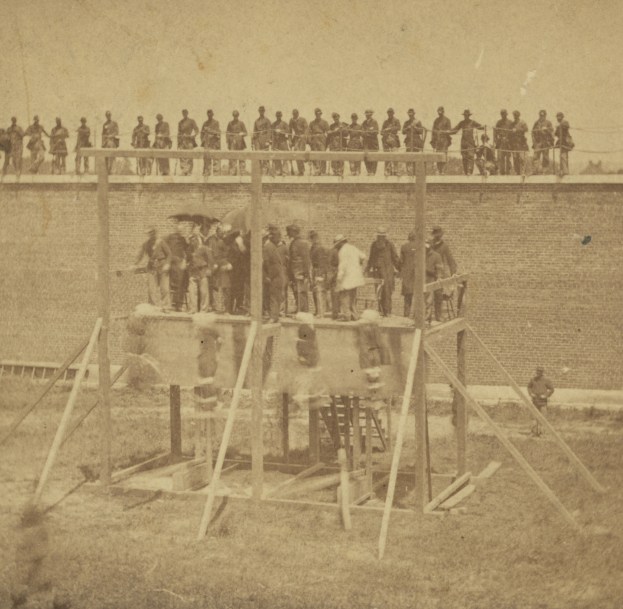
Clearly, that is not a photograph of the prison in Florida where they are supposed to be.  Instead, a history minded set designer used a photograph of the execution of the Lincoln conspirators to round off the prison related wall.

Execution 6 The Drop

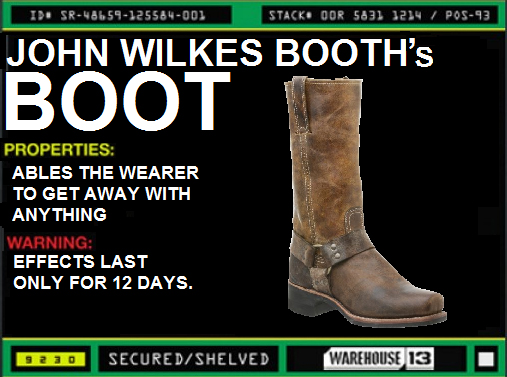
This is actually not the only Lincoln assassination related item connected to Warehouse 13.  As you would expect, fans of the show were always discussing historical artifacts that could be included in the show and the various “powers” they could have.  One fan thought that John Wilkes Booth’s boot would make an interesting artifact for the show and created his own “Inventory Display” for it:

John Wilkes Booth's Boot Warehouse 13 Fan

I give the fan credit for his creative thinking and mixing of fact and fiction, but I wish he would have used a picture of Booth’s actual boot, on display in the Ford’s Theatre museum:

John Wilkes Booth's Boot FOTH LOC

Like David Herold’s appearance on Alphas, I’m amazed to find another reference to the Lincoln assassination in such an unlikely place.  It’s good to know that the people at the SyFy channel seem to appreciate history, at least for set dressings.

References:
Warehouse 13, Season 1, Episode 9, “Regrets”
LOC
John Wilkes Booth’s Boot on the Warehouse 13 Wiki

Categories: Uncategorized | Tags: , , | Leave a comment

General Lew Wallace Study & Museum

In the city of Crawfordsville, Indiana, surrounded by modern houses, well kept yards, and the friendly people that the rural Midwest breeds, there lies a a building and museum dedicated to a man who lived a fascinating and multifaceted life.  His name was Lew Wallace and he lived from 1827 to 1905.

Gen Lew Wallace NARA

Wallace achieved early fame by becoming the youngest Major General in the Union Army during the Civil War.  His valiant command at the Battle of Monocacy, while a loss for the Union, delayed Confederate General Jubal Early’s forces long enough for the proper reinforcements to arrive in Washington D.C., which later prevented Early from taking the nation’s capital.  Following the Civil War, Lew Wallace was appointed the Governor of the New Mexico Territory, and then the U.S. Minister to Turkey.  In Turkey, Wallace broke traditional social customs and diplomatic protocol by asking to shake hands with Sultan Abdul Hamid II.  Surprisingly the Sultan consented and from this unique start blossomed a mutual respect and friendship between the two men.  Wallace was an avid reader, fisherman, painter, and would-be inventor.

As remarkable as these accomplishments are, however, Wallace’s great fame comes from his literary contributions.  One of his books, in particular, made him a household name in the 19th century and granted him immense wealth and prestige.  The book has been adapted for the stage, radio, television, and four motion pictures, the most famous being Charlton Heston’s 1959 version.  This book is Ben-Hur: A Tale of the Christ.  It was the best selling American novel from its publication in 1880 until 1936, when it was replaced by Gone With the Wind.  To date, Ben-Hur has never been out of print.

Lew Wallace wrote much of Ben-Hur while sitting under a tree at his Crawfordsville home.  After its success, Wallace decided to build himself a study, away from his main house, in which he could write, research, and tinker with his other interests.  The study took three years to build and was completed in 1898.  Today, the study is a museum relating to the life of Lew Wallace, the solider, diplomat, and author:

Lew Wallace Study 1

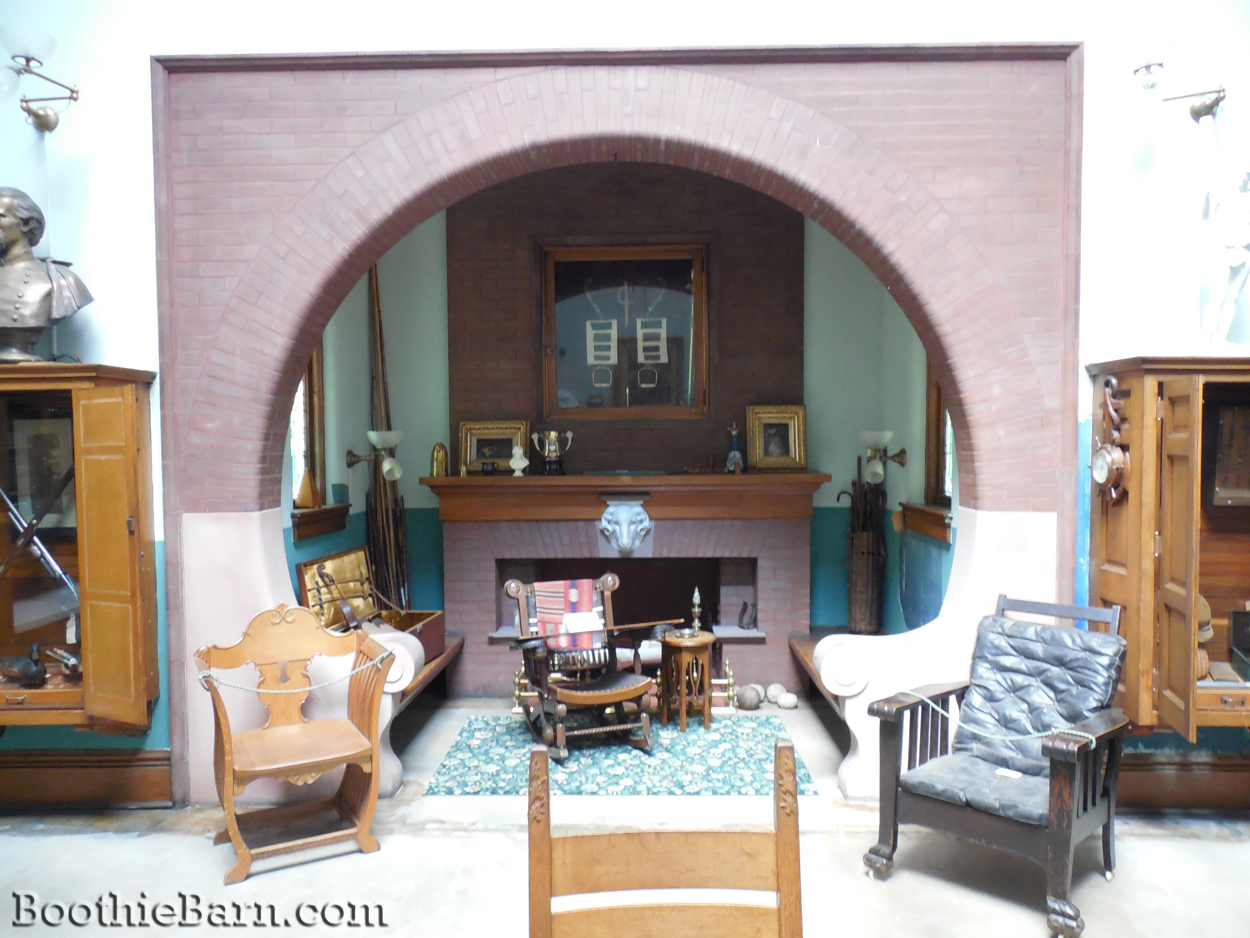
The exterior of the study is a mixture of different architectural styles, many gleamed from Wallace’s time in Turkey.  The interior of the study is basically one large room with a fireplace alcove, a small room to the side in which Wallace would nap, and a set of stairs which leads down to the basement which held the furnace, bathroom, and electrical system in Wallace’s day.  To use a colloquialism, this study was Wallace’s “man cave”.  It was the home of Wallace’s many passions and hobbies.  There are shelves all around the room containing his huge collection of books and research materials that he used in his writing.  The walls are covered with paintings he owned and ones he painted himself.  There are cases for his hunting and fishing gear and his other experimental hobbies like sculpting and violin making.

Interior Lew Wallace Study 3

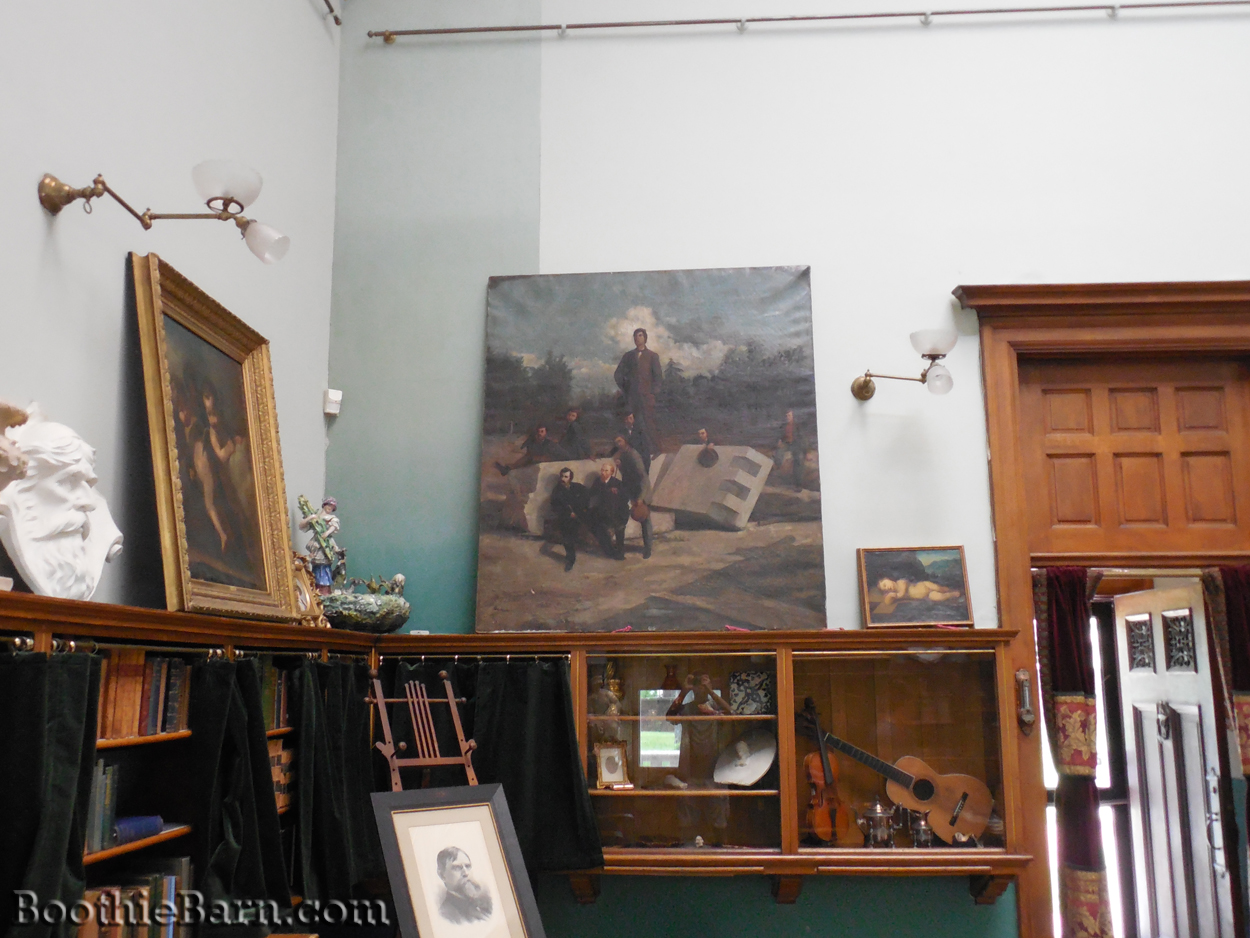
Books and paintings on one wall of the Lew Wallace Study in Crawfordsville, Indiana. The painting on the left was painted by Lew Wallace himself and the center painting was a gift to him from the Sultan of Turkey.

Interior Lew Wallace Study 1

Interior Lew Wallace Study 2

The chair closest to the fireplace was the chair in which Lew Wallace wrote much of Ben-Hur in.

While Lew Wallace may be best known for Ben-Hur, he also was involved in the Lincoln assassination story.  General Wallace was one of the nine members of the military commission which tried the Lincoln assassination conspirators:

Part of the military commission which tried the Lincoln conspirators.  Lew Wallace is seated, second from the right. NARA

Part of the military commission which tried the Lincoln conspirators. Lew Wallace is seated, second from the right. NARA

During the trial, Wallace passed the time by making sketches of all the Lincoln conspirators (except Mrs. Surratt).  Those sketches, which show a great degree of talent, are now housed at the Indiana Historical Society, but are reproduced below:

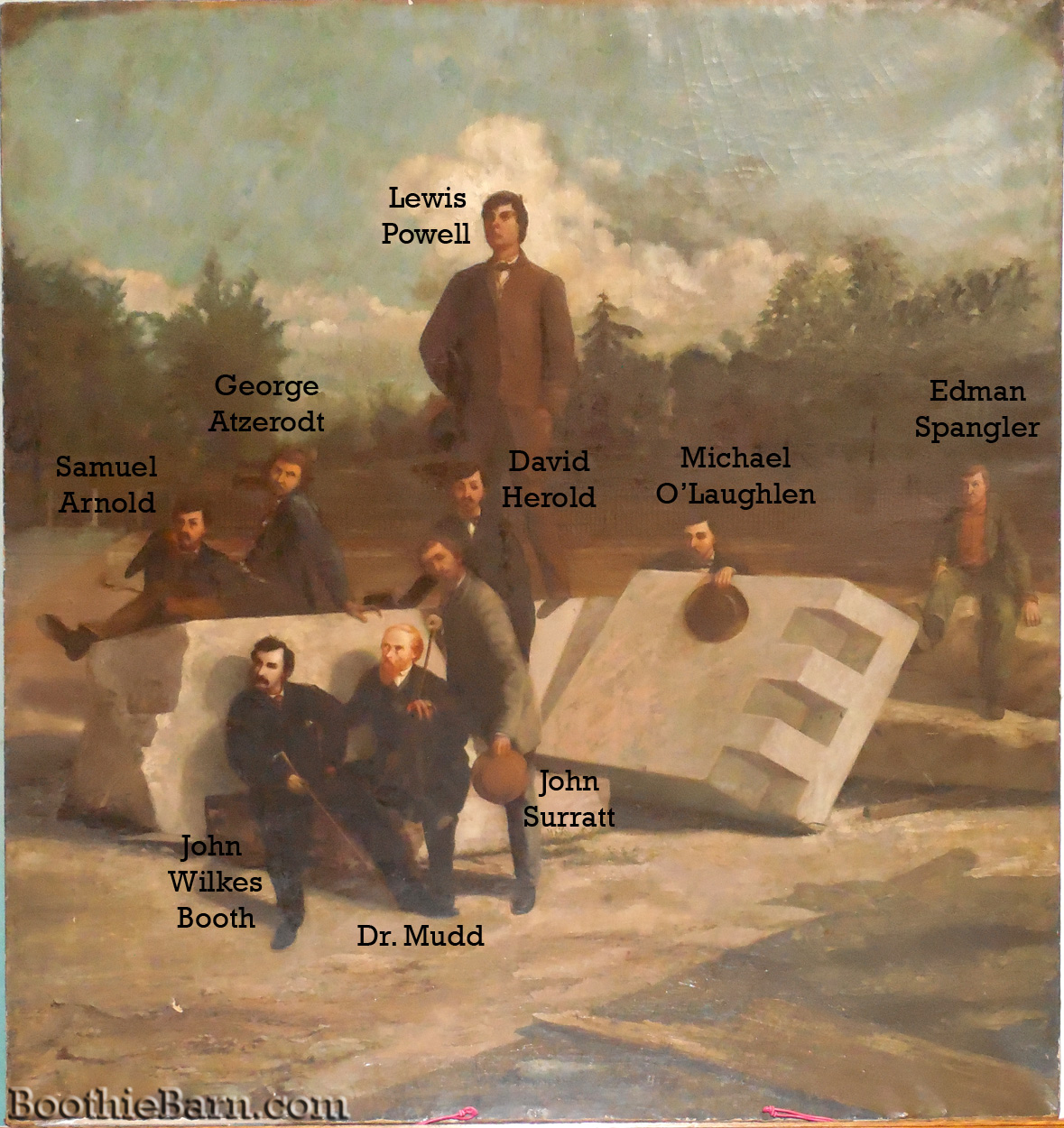
Wallace would later use these sketches as models for a painting.  That painting, known as “The Conspirators”, but actually unnamed and unsigned by Wallace is housed in the study:

The Conspirators in the Lew Wallace Study 3

In addition to the conspirators he made life sketches of during the trial, Lew Wallace also included depictions of John Wilkes Booth and John Surratt.  The painting is said to be of the conspirators present at Abraham Lincoln’s second inauguration.  While Booth was present at the inauguration, it is unlikely any of the others were.

The Conspirators in the Lew Wallace Study Labeled

It is a very large painting, measuring 60″ by 66.5″.  It dwarfs over all the other works of art in the study.

The Conspirators in the Lew Wallace Study 1

In Wallace’s time, he had the painting displayed on an easel in a corner of the room.  Due to concerns for its safety, the study currently puts it up and out of reach.

Study during Wallace's day

This photograph of Lew Wallace’s study during his life, shows the painting of the conspirators with a prominent place on an easel.

Over the years, the painting of the conspirators has darkened.  General Wallace likely contributed to this due to his avid smoking habit.  The study hopes to restore the painting, along with some of the ornate designs on the interior of the study.

If you’re in the area of Crawfordsville, Indiana, a stop at the General Lew Wallace Study & Museum is definitely worth it.  For $5 admission you are presented with an introductory video about Lew Wallace’s life and then are given a personalized tour of the study by one of the knowledgeable  guides.  You are also free to roam around the grounds and visitor center free of charge.  The study also has brochures giving directions to Lew Wallace’s grave which is only 3 or so miles from the study.

Lew Wallace Grave 1

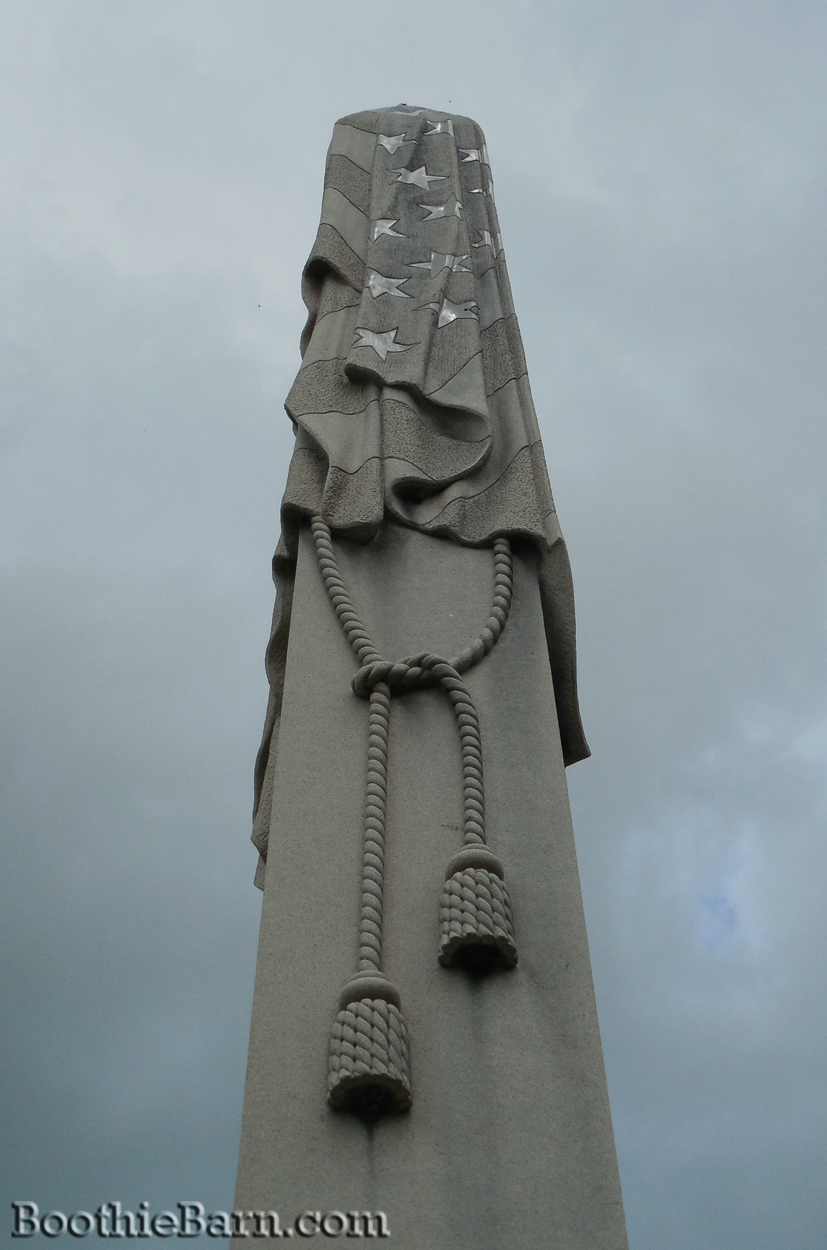
It appears to be the tallest monument in the whole cemetery and the top of the obelisk is carved to look like there is a flag draped on it.

Lew Wallace Grave 3

Lew Wallace lived a unique life and his former study in Crawfordsville does a great job of educating its visitors about his accomplishments and legacy.  For more information, visit their website: http://www.ben-hur.com

Lew Wallace Grave 2

References:
Thanks to the participants of Roger Norton’s Lincoln Discussion Symposium from whom I first learned of this museum and decided to visit.
General Lew Wallace Study & Museum
Indiana Historical Society

Categories: Uncategorized | Tags: , , | 18 Comments

John Wilkes Booth’s Vertebrae

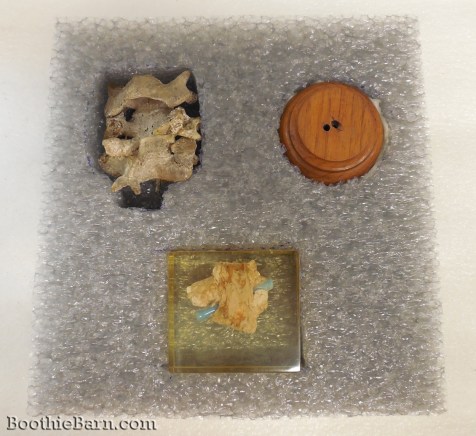
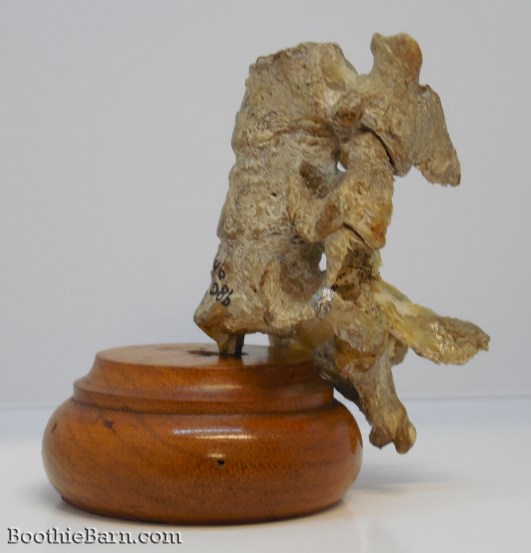
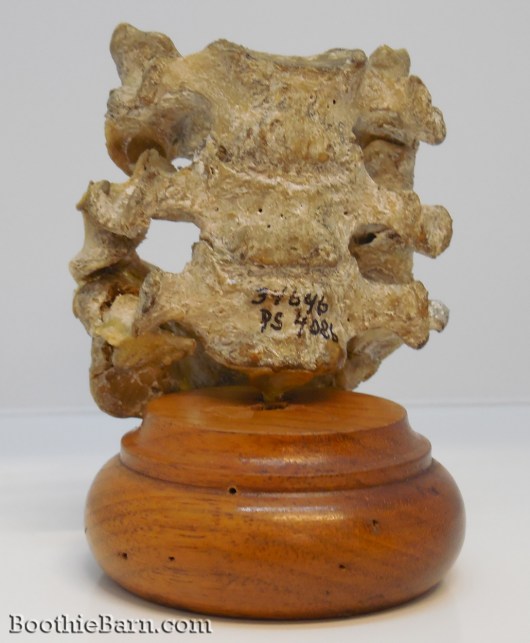
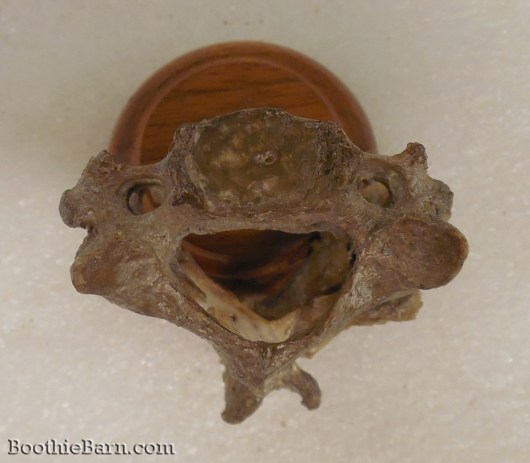
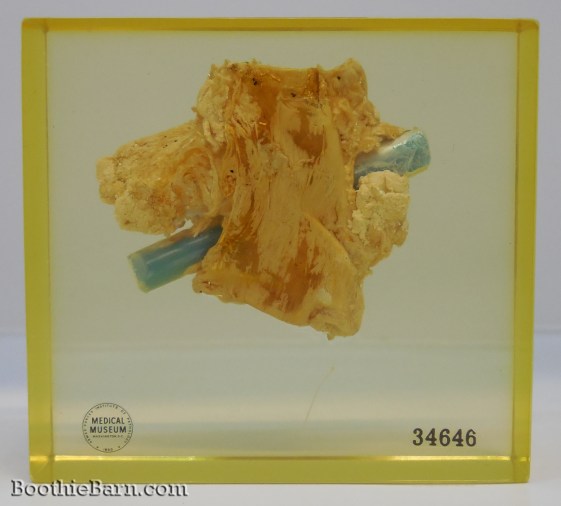
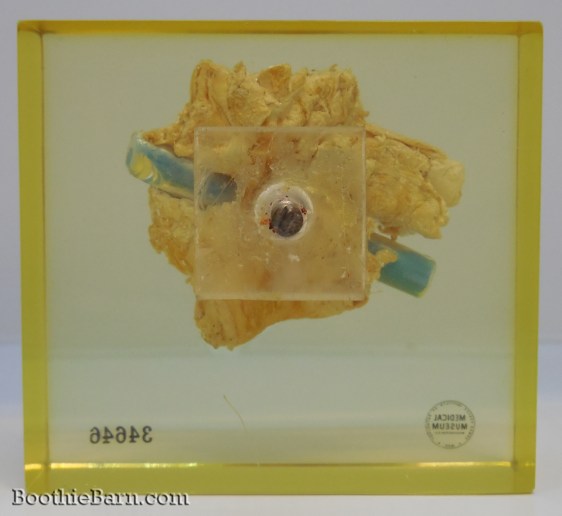
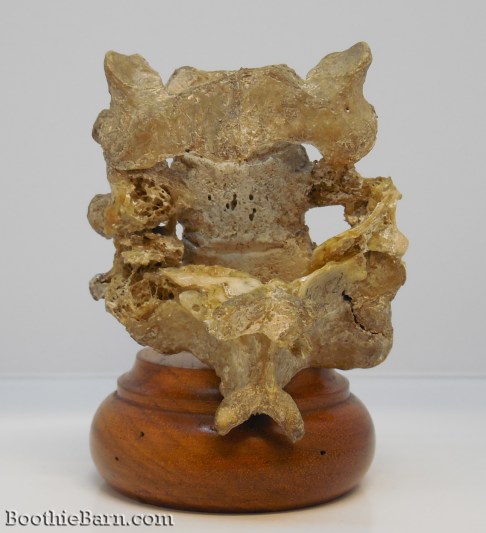
Not long ago, I visited the National Museum of Health and Medicine in Silver Spring, Maryland.  I wrote a post for this site which highlighted the connection between the museum (which at one time was called the Army Medical Museum and housed inside of Ford’s Theatre) and the assassination story, including the assassination related artifacts contained in the museum.  You can read that article by clicking HERE.  There were a couple of items that I was very interested in seeing, but they were not on display during my initial visit.  I made a return trip to the NMHM, having secured a research appointment to see some artifacts in storage there.  The artifacts I saw consisted of John Wilkes Booth’s third, fourth, and fifth cervical vertebrae, along with a piece of his spinal cord and tissue:

John Wilkes Booth Vertebrae and Spinal Cord

John Wilkes Booth's vertebrae 5

John Wilkes Booth's vertebrae 3

John Wilkes Booth's vertebrae 2

John Wilkes Booth's vertebrae 4

John Wilkes Booth's Spinal Cord 1

John Wilkes Booth's Spinal Cord 2

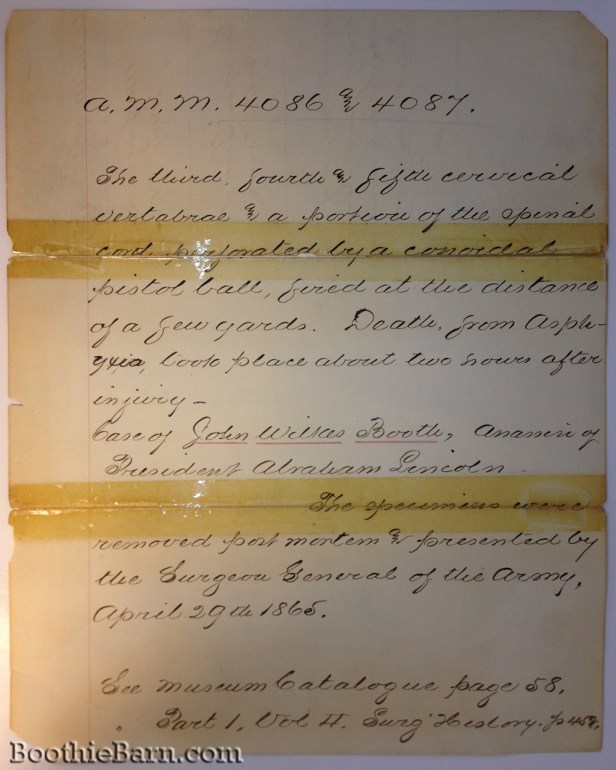
These pieces were removed from John Wilkes Booth during his autopsy aboard the USS Montauk.  The autopsy was preformed by Surgeon General Joseph K. Barnes and Dr. Janiver Woodward on April 27.  Two days later, on April 29, Dr. Barnes donated these pieces of Booth to the Army Medical Museum.  Here is some paperwork that went along with them:

Booth vertebrae paperwork

Description of Booth's Vertebrae

For convenience, here’s a transcript of the autopsy report written by Surgeon General Barnes.  The original is in the National Archives.

“Surgeon General’s Office
Washington City, D.C.
April 27th, 1865
Hon: E.M. Stanton
Secretary of War
Sir,

I have the honor to report that in compliance with your orders, assisted by Dr. Woodward, USA, I made at 2 pm this day, a postmortem examination of the body of J. Wilkes Booth, lying on board the Monitor Montauk off the Navy Yard.

The left leg and foot were encased in an appliance of splints and bandages, upon the removal of which, a fracture of the fibula (small bone of the leg) 3 inches above the ankle joint, accompanied by considerable ecchymosis, was discovered.

The cause of death was a gun shot wound in the neck – the ball entering just behind the sterno-cleido muscle – 2-1/2 inches above the clavicle – passing through the bony bridge of fourth and fifth cervical vertebrae – severing the spinal chord and passing out through the body of the sterno-cleido of the right side, 3 inches above the clavicle.

Paralysis of the entire body was immediate, and all the horrors of consciousness of suffering and death must have been present to the assassin during the two hours he lingered.

Very respectfully
Your obt servt.
J. K. Barnes
Surgeon General”

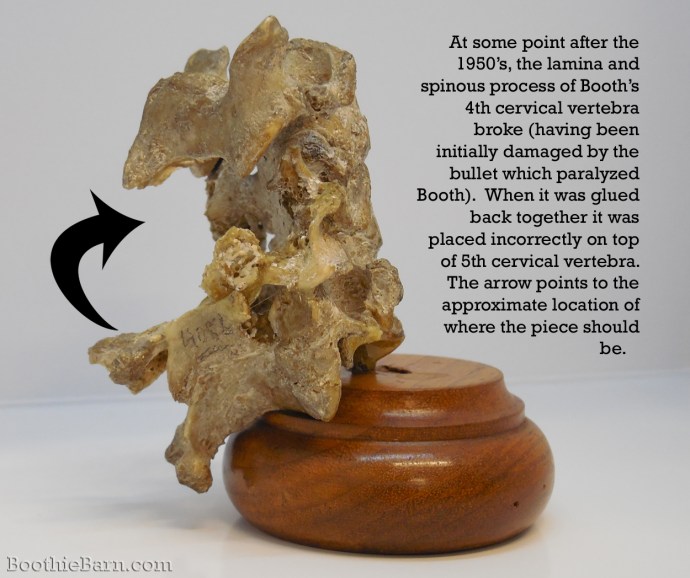
Those with medical expertise might have noticed that Booth’s vertebrae don’t look quite right. That is because, at some point after the 1950’s or so, the specimen broke. A piece of the fourth cervical vertebra broke off and it is likely that even when it was improperly repaired, a piece was still missing.

John Wilkes Booth's broken vetebrae

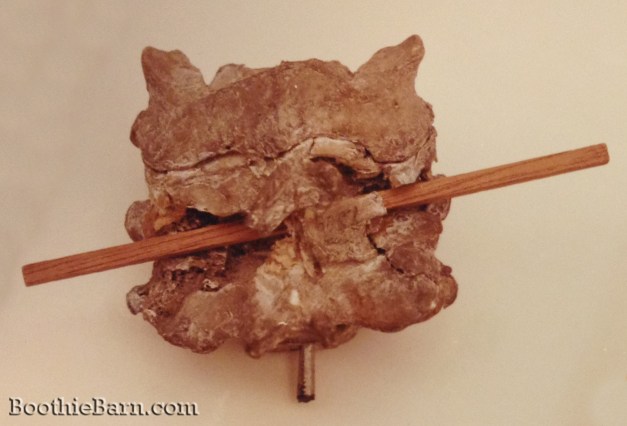
Here are two other pictures, one which shows the vertebrae before the break occurred and how it appears today for comparison.  Unfortunately, the angles are not the same between the two pictures:

John Wilkes Booth Vertebrae pre-break

John Wilkes Booth's vertebrae 1

While the National Museum of Health and Medicine expertly safeguards the artifact in order to prevent any future damage, there are those who are determined to destroy it further.  The advocates of this are the misguided escape theorists who believe that John Wilkes Booth did not die on April 26, 1865 and, instead, believe an impractical conspiracy was expertly enacted by “the government”.  Most of them have fallen for Finis Bates’ book and mummy sideshow which, while interesting in their own rights, are easily disproved.  Still, certain forces continually seek to gain approval from the NMHM to “sample” (i.e. drill a piece out of) the vertebrae in an attempt to extract DNA from it.  From there they hope to commit an even bigger moral crime  by exhuming the body of Edwin Booth, the greatest actor of the 19th century, in order to get a sample from him to compare the two.  To me, the proposed exhumation of Edwin, a man who suffered immense tragedy due to his brother’s crime and for the rest of his days was plagued with guilt and melancholy, is nothing short of morally reprehensible.  Desecrating the final resting place of the greatest Hamlet of all time just to appease those who refuse to acknowledge the mountain of evidence against them, is even worse than the destruction of this priceless artifact.  Even so, vertebrae are not good candidates for DNA extraction due to the type of bone desired for such an analysis.  In order to get a viable DNA sample, one cannot simply chip off a small piece from the side, but, instead, would need to drill into the thickest part of the vertebrae a good distance, causing severe damage to the specimen.  Luckily the National Museum for Health and Medicine understands this fully and continues to refuse any proposals that would place this artifact at risk, even when the escape theorists try to get their congressmen involved.  One of the more recent attempts occurred last year and was covered by newspapers and online articles which tricked unknowing individuals into thinking the case had merit.  Did people claim to have seen, or even been, John Wilkes Booth after his death in April of 1865? Of course, but people have also claimed to have seen (or been) Louis XVII, Elvis and even Adolf Hitler long after their deaths.  The John Wilkes Booth escape theory is an interesting sidebar, a form of pseudo-history as it were, that can be studied and enjoyed as the fanciful story it is.  However, when people actually start believing this pseudo-history and attempt to desecrate the grave of an innocent man or destroy a one-of-a-kind artifact in our nation’s museums, they are not to be humored any longer.

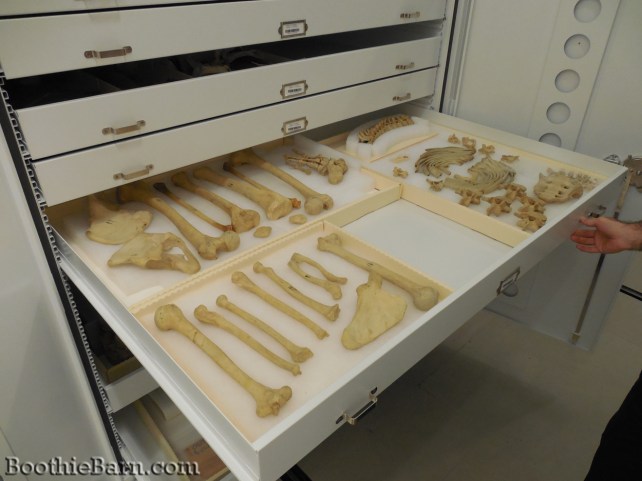
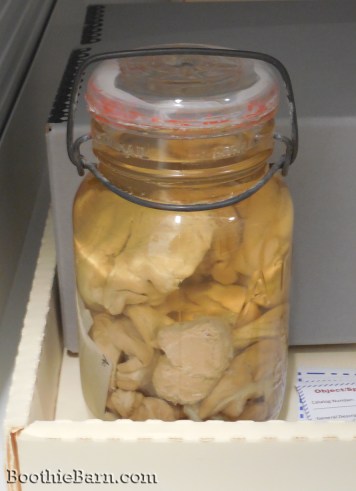
According to the National Museum of Health and Medicine they are not expecting to put the Booth items on display any time in the near future.  They remain in storage, in a drawer close to the near complete skeleton (and brain) of Charles Guiteau, the assassin of President James Garfield:

Charles Guiteau's skeleton NMHM

Charles Guiteau's brain NMHM

References:
National Museum of Health and Medicine
The Body in the Barn: The Controversy Over the Death of John Wilkes Booth by the Surratt Society 

Categories: Uncategorized | Tags: , , | 15 Comments

The National Museum of Health and Medicine and the Lincoln Assassination

The National Museum of Health and Medicine is a medical museum located in Silver Spring, Maryland.  The museum has a long history and was originally founded during the Civil War as the Army Medical Museum.  Its original purpose was to be a repository for, “all specimens of morbid anatomy, surgical or medical, which may be regarded as valuable; together with projectiles and foreign bodies removed, and such other matters as may prove of interest in the study of military medicine or surgery.” Since its founding to today, the museum has amassed a collection of nearly 25 million medical artifacts.  Though less than 1% of the collection is on display at the Silver Spring facility due to space constraints, the museum is, nevertheless, filled to the brim.  Walking into the museum, guests quickly come face to face with medical oddities and fascinating exhibits.  A wonderful museum in its own right, the NMHM has also become intimately connected with the story Lincoln’s assassination through the years.

A Place to Rest My Bones

Having been founded during the Civil War, the collection grew rapidly during its first few years as surgeons on the field of battle began sending in specimens.  By 1866, the museum was on its third home in Washington, D.C. and required even more space.  Luckily for them, on April 6, 1866, an Act of Congress was passed providing for the purchase of a building “for the deposit and safekeeping of documentary papers relative to the soldiers of the army of the United States and of the Museum of the Medical and Surgical Department of the Army.”  The chosen building was Ford’s Theatre the site of Abraham Lincoln’s assassination almost a year before.
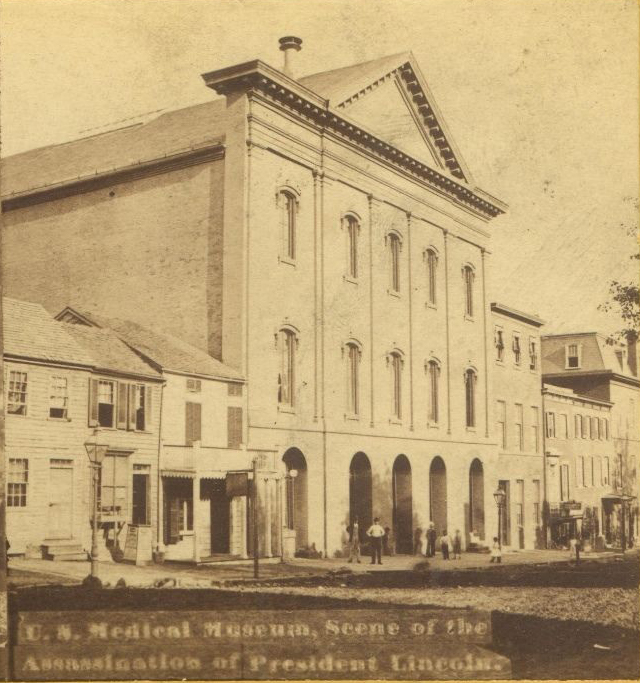
Ford's Theatre Army Medical Museum Label

The building was closed down by the U.S. government in the aftermath of the assassination.  Though the building was returned to John T. Ford for a time, public outcry and threats to burn the building if it was once again opened as a theater forced the government to seize the building permanently.  At first they rented it from Ford before buying it straight out thanks to the approval of the above mentioned Act of Congress.  The interior of the building was remodeled from a theater into a three story office building.  On December 22, 1866, the top floor of Ford’s Theatre officially became the Army Medical Museum’s fourth home.

Here are some pictures of the interior of the Army Medical Museum when it was held on the third floor of Ford’s Theatre.  Most of these come from the blog “A Repository for Bottled Monsters” which is written by a former archivist of the museum:

This slideshow requires JavaScript.

By 1887, the museum had once again outgrown its surroundings and moved into a building made solely for its purpose. This brought an end to the Army Medical Museum’s occupation of Ford’s Theatre. In hindsight the move in 1887 proved lucky. Six years later, in 1893, poor workmanship by a crew excavating in the basement of Ford’s caused a structural pier to give way, causing a 40 foot section of all three floors to come crashing down, killing over 20 government clerks and wounding many others.

Booth’s Spine Tingling Return

When it was housed inside Ford’s Theatre, the Army Medical Museum was a popular tourist destination in Washington. The museum saw about 40,000 visitors in 1881 alone.  In 1873, a book was published called, Ten Years in Washington: Life and Scenes in the National Capital as a Woman Sees Them by Mary Clemmer Ames.  In her book, Ms. Ames described a visit to the Army Medical Museum and points out the many oddities on display.  The book also contains this engraving of the museum inside of Ford’s:
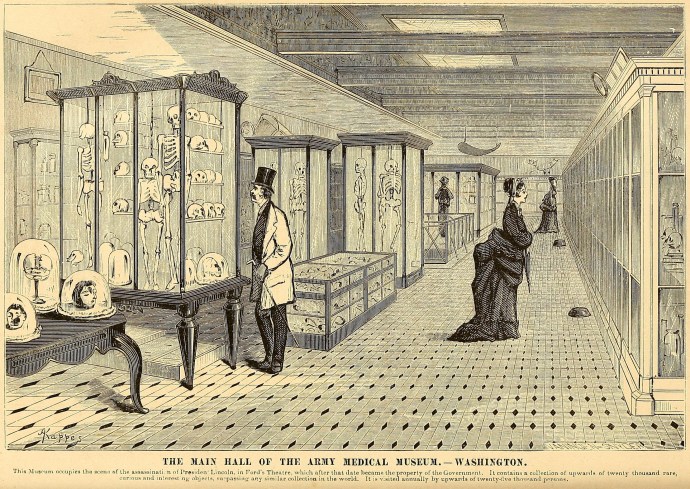
Army Medical Museum in Ford's Theatre engraving 1873

As part of her description of some of the artifacts, Ms. Ames states the following:

“Amid the thousands of mounted specimens in glass cases, which reveal the freaks of bullets and cannon-shot, we come to one which would scarcely arrest the attention of a casual observer. It is simply three human vertebra mounted on a stand and numbered 4,086. Beside it hangs a glass phial, marked 4,087, filled with alcohol, in which floats a nebulse of white matter. The official catalogue contains the following records of these apparently uninteresting specimens:

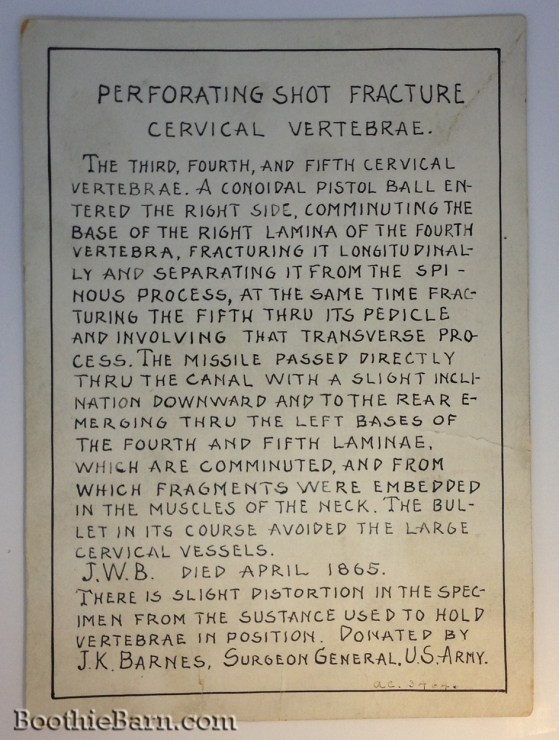
‘No. 4,086. — The third, fourth and fifth cervical vertebrae. A conoidal carbine [sic] ball entered the right side, comminuting the base of the right lamina of the fourth vertebrae, fracturing it longitudinally and separating it from the spinous process, at the same time fracturing the fifth through its pedicles, and involving that transverse process. The missile passed directly through the canal, with a slight inclination downward and to the rear, emerging through the left bases of the fourth and fifth laminse, which are comminuted, and from which fragments were embedded in the muscles of the neck. The bullet, in its course, avoided the large cervical vessels. From a case where death occurred in a few hours after injury, April 26, 1865.’

‘No. 4,087.— A portion of the spinal-cord from the cervical region, transversely perforated from right to left by a carbine [sic] bullet, which fractured the laminse of the fourth and fifth vertebrae. The cord is much torn and is discolored by blood. From a case where death occurred a few hours after injury, April 26, 1865.’

Such are the colorless scientific records of the death wounds of John Wilkes Booth. All that remains of him above the grave finds its perpetual place a few feet above the spot where he shot down his illustrious victim.”

After John Wilkes Booth was killed at the Garrett farm, his body was brought back to Washington and deposited aboard the ironclad ship, the U.S.S. Montauk. It was there that Booth’s autopsy was performed. The body was thoroughly identified and the section of Booth’s vertebrae, through which Boston Corbett’s pistol ball had passed, was removed. In addition, an inspection of Booth’s broken leg was made and, for some reason, his thoracic cavity was opened. Shortly after the autopsy was performed, Booth’s body was taken to the Arsenal Penitentiary and secretly buried. In 1869, Booth’s body and the bodies of the executed conspirators were released to their families.  Booth’s vertebrae along with a piece of his spinal cord, however, found their way into the collection of the Army Medical Museum and were in the collection by 1866 according to one of the museum’s collection catalogs. John Wilkes Booth’s vertebrae and spinal cord were publicly on display at Ford’s Theatre in 1873 when Ms. Ames visited. Here is an 1873 engraving of the bones that she included in her book:
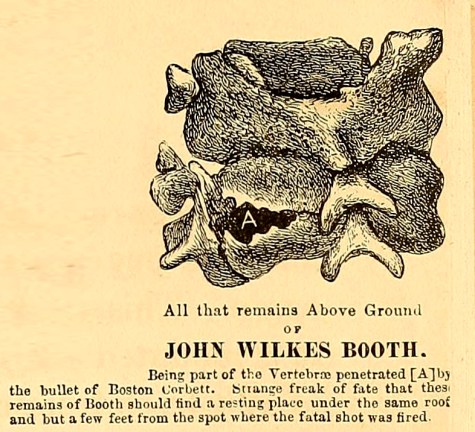
Booth's Vertebrae drawing Ten Years in Washington

The vertebrae and spinal cord of John Wilkes Booth are still part of the collection of the National Museum of Health and Medicine though they are not currently on display at the Silver Spring facility.  Here is a picture of the specimens taken a few years ago by the AP:
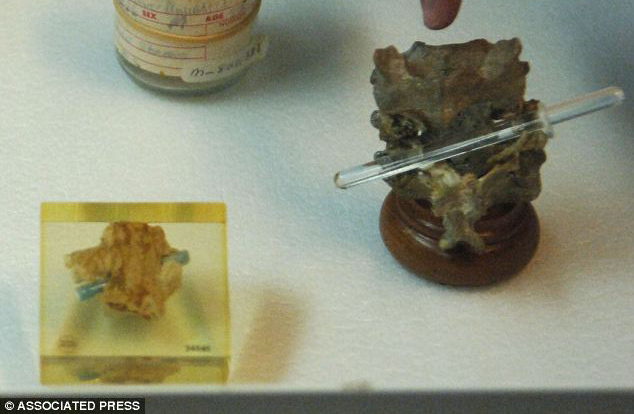
Booth vertebrae spine AP

I am hoping to make an appointment to view the vertebrae and piece of spinal cord in person and to look through the NMHM’s records regarding this artifact.  Hopefully a follow up will be posted at a later date. UPDATE: Click here to read about my research visit with John Wilkes Booth’s vertebrae.

When Powell Lost his Head

At the same time that John Wilkes Booth was assassinating President Lincoln at Ford’s Theatre, conspirator Lewis Powell was attacking William Seward, the Secretary of State, in his home.  Powell stabbed and bludgeoned five people in the Secretary’s home, but, miraculously, they all survived their brushes with death.  Powell was tried with the other conspirators and executed on July 7, 1865.  His body was immediately buried next to the gallows on the Arsenal Penitentiary grounds.

9 The Pine Boxes

In 1867, Powell’s body was disinterred and reburied in a trench that was dug inside a warehouse on the Aresnal property.  There he was joined by the bodies of fellow conspirators John Wilkes Booth (minus his vertebrae), David Herold, George Atzerodt, and Mary Surratt.  The trench also contained the remains of Andersonville Prison commandant Henry Wirz who had been executed for his wartime crimes in November of 1865.  In the waning hours of Andrew Johnson’s presidency in February of 1869, Johnson finally consented to the release of the conspirators’ bodies to their respective families.  The bodies of Booth, Herold, Surratt, Atzerodt, and Wirz were all claimed and reburied by their families.  Powell’s family, who had previously tried to claim the remains and had been denied, were not made aware that they could now take possession of their kin.  For a year, Powell’s body remained the only one still buried on the Arsenal grounds.  Finally, in February of 1870, an undertaker named Joseph Gawler (who also handled the reburial of David Herold) took possession of Powell’s body and had it buried secretly in one of D.C.’s cemeteries.  1870 newspaper accounts stated that, “family and friends could find his grave by contacting him [Gawler] as he had a record of where he is buried.”  The Powell family, who had moved a few times in Florida since Lewis’ death, apparently never heard the news.

The location of Powell’s remains from 1870 onward is a little fuzzy, but an extremely probable series of events was determined by Lewis Powell’s biographer, Betty Ownsbey, in an article she wrote for the October 2012 edition of the Surratt Courier entitled, “And Now – The Rest of the Story: The Search for the Rest of the Remains of Lewis “Paine” Powell“.  Using newspaper sources and cemetery records, it appears that Powell was originally transported from the Arsenal and interred in Graceland Cemetery.  At some point between 1870 and 1884 Powell was removed from Graceland and placed in Holmead Cemetery.  Not long after he was placed there, Holmead Cemetery was discontinued as it was considered a public health hazard.  The land was slated to be sold and developed in January of 1885.  Families with means disinterred their loved ones from Holmead and reburied them elsewhere.  All the unclaimed bodies still left in Holmead were exhumed in December of  1884 and dumped into a mass grave at nearby Rock Creek Cemetery.  Joseph Gawler was one of the undertakers who assisted with this endeavor.  By 1884 it had been almost 20 years since Lewis Powell’s death and it must have been very clear to Gawler that no one was coming for the body and that he was not going to be paid for the work he had done keeping track of it over the years.  It is with a very high likelihood that Gawler added Lewis Powell’s remains to the mass grave at Rock Creek and his body is there today in Section K, Lot 23.

The assumed resting place of Lewis Powell's body, Section K, Lot 23 in D.C.'s Rock Creek Cemetery

The assumed resting place of Lewis Powell’s body, Section K, Lot 23 in D.C.’s Rock Creek Cemetery (approximate location)

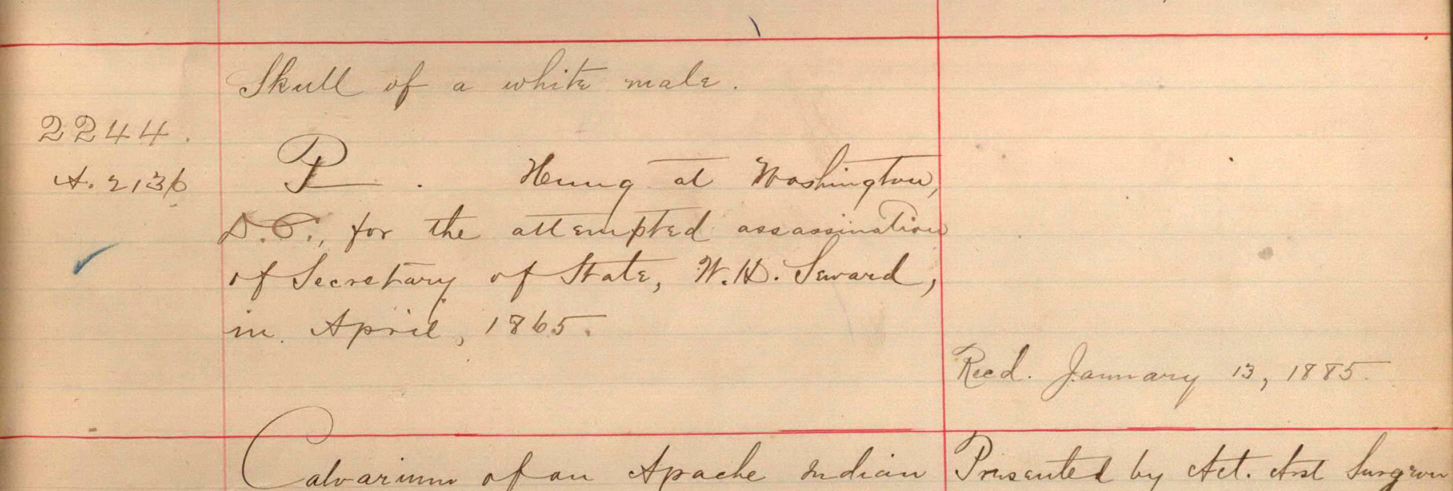
While Lewis Powell’s body may be at Rock Creek Cemetery, his head definitely isn’t.  The conspirators were not embalmed upon their deaths and through their subsequently reburials, their bodies were consistently exposed to oxygen which accelerated their decay.  The connective tissues of Powell’s head and neck, likely damaged by his hanging in 1865, would have quickly decomposed away separating his head from the body.  According to newspaper accounts, a few of the conspirator’s heads were separated from their bodies when they were disinterred in 1869.  Almost 20 years of decomposition later would have essentially stripped the bone of all tissues.  Therefore, when Joseph Gawler or his associates opened Powell’s casket at Holmead in 1884, it would have been a very easy task for them to collect the skull and take it.  That is exactly what occurred for on January 13, 1885, the Army Medical Museum added a new artifact to their collection.  Numbered 2244, the anonymous donation was entered into their catalog as a, “Skull of a white male.” A short description followed:

“P. Hung at Washington, D.C., for the attempted assassination of Secretary of State, W. H. Seward, in April, 1865.”

Powell's skull entry Army Medical Museum catalog

The museum, still located inside of Ford’s Theatre in 1885, now held the remains of not only the assassin of President Lincoln, but the would be assassin of his Secretary of State.

Lewis Powell's Skull Ownsbey

Unlike John Wilkes Booth’s vertebrae and spinal cord, Lewis Powell’s skull is no longer in the collection of the National Museum of Health and Medicine.  In 1898, the skull was transferred, along with many Native American remains, to the Smithsonian Institution.  For about 94 years the skull sat in storage in the Smithsonian’s Anthropology department.  In 1990, the Native American Graves and Repatriation Act became law.  The act required any institutions that accepted federal funding to return Native American cultural items, including remains, to their appropriate tribes.  In adherence to this law, the Smithsonian began the process of going through their collections.  In 1993, a government anthropologist named Stuart Speaker, who had once worked at Ford’s Theatre, discovered Lewis Powell’s skull among a collection of Native American remains.  Assassination researchers Michael Kauffman, Betty Ownsbey, and James O. Hall were brought in to help identify the skull:

Authors Michael Kauffman and Betty Ownsbey with Lewis Powell's skull

Authors Michael Kauffman and Betty Ownsbey with Lewis Powell’s skull

On November 11, 1994, one hundred and twenty-nine years after his death, a part of Lewis Powell was finally buried by his living relatives.  His skull rests today at Geneva Cemetery in Geneva, FL, next to the grave of his mother.

Relics of a Martyr

If you were to take a  visit to the National Museum of Health and Medicine today, you would come across an exhibit case entitled, Lincoln’s Last Hours.

NMHM Lincoln's Last Hours exhibit

This exhibit contains several artifacts relating to the death and autopsy of President Lincoln.  The items on display include the Nélaton probe used on the dying president to trace the path and depth of his wound, a snippet of his hair taken at his deathbed, fragments of his skull taken at his autopsy, a shirt cuffed stained with Lincoln’s blood, and  the bullet that ended his life.  The exhibit case also contains a plate that was given to Surgeon General Barnes by William Seward as a thank you for tending to his wounds at the hands of Lewis Powell.  Here is a slideshow of the artifacts on display:

This slideshow requires JavaScript.

Most of these Lincoln relics did not come into the collection of the medical museum until around WWII. Prior to that, the pieces were held by the War Department as the bullet which killed the president had actually been an exhibit at the trial of the conspirators in 1865. In 1940 the bullet, skull fragments, and probe were transferred from the Judge Advocate General’s office to the newly created “Lincoln Museum”. This museum was housed inside of Ford’s Theatre and contained Osborn Oldroyd’s collection of Lincolniana. While the Lincoln Museum kept most of the items given to them by the JAG office (including the murder weapon), they decided against retaining these, almost literal, blood relics of Abraham Lincoln. They were transferred from Ford’s to the Army Medical Museum. Further research is needed to determine exactly when they entered the collection but it is likely that, for the briefest of time, these pieces of Abraham Lincoln were housed at Ford’s Theatre.

Conclusion

The National Museum of Health and Medicine is a modern treasure that tells the story of America’s medical past, present, and future. If you get a chance, visit the NMHM.  They are a free museum open every single day (except Christmas) from 10:00 am to 5:30 pm. During its lifetime, the museum has crossed paths with the Lincoln assassination story several times.  It was the first museum to be housed inside of Ford’s Theatre, it reunited a piece of the assassin with one of his conspirators at the scene of the crime, and, today, it displays relics of our 16th President.

References:
National Museum of Health and Medicine History
A Repository for Bottled Monsters
NMHM’s Flicker page
Ten Years in Washington: Life and Scenes in the National Capital as a Woman Sees Them by Mary Clemmer Ames
Alias “Paine”: Lewis Thornton Powell, the Mystery Man of the Lincoln Conspiracy by Betty Ownsbey
“And Now – The Rest of the Story: The Search for the Rest of the Remains of Lewis “Paine” Powell” by Betty Ownsbey, Surratt Courier, Oct. 2012
Army Medical Museum Collection, Anatomical Section IV Logbook (MM 8759-3)
The Lincoln Assassination: Where are They Now? A Guide to the Burial Places of Individuals Connected to the Lincoln Assassination in Washington, D.C. by Jim Garrett and Richard Smyth

A very special thanks to Betty Ownsbey for talking me through the saga of Lewis Powell’s burials and for providing the pictures of his skull.

Categories: Uncategorized | Tags: , , , , , | 20 Comments

Reagan Library’s former Lincoln Exhibit

Reagan Library Lincoln Exhibit catalog

From June through September of 2013, the Ronald Reagan Presidential Library in Simi Valley, California hosted an exhibit entitled, “A. Lincoln: Railsplitter to Rushmore“. The exhibit showcased a multitude of objects borrowed from the collections of private individuals; institutions like the Abraham Lincoln Presidential Library and Museum, Library of Congress, Smithsonian, and Ford’s Theatre; and even the production designers of Dreamworks Pictures who produced Steven Spielberg’s Lincoln. Over 250 unique artifacts relating to Lincoln’s life and presidency were on display along with sets from the Lincoln movie like this one of Lincoln’s office:

Lincoln Office Set Regan Library 2013

Appropriately, one room of the exhibition was devoted to the assassination and death of Abraham Lincoln.  Here is a nice panorama of the exhibit room showing the recreated bedroom of the Petersen House, a mock up of the Ford’s Theatre box, and a replica of President Lincoln’s casket:

Click to enlarge

Click to enlarge

Here is a slideshow which further highlights the artifacts and displays from the assassination gallery:

This slideshow requires JavaScript.

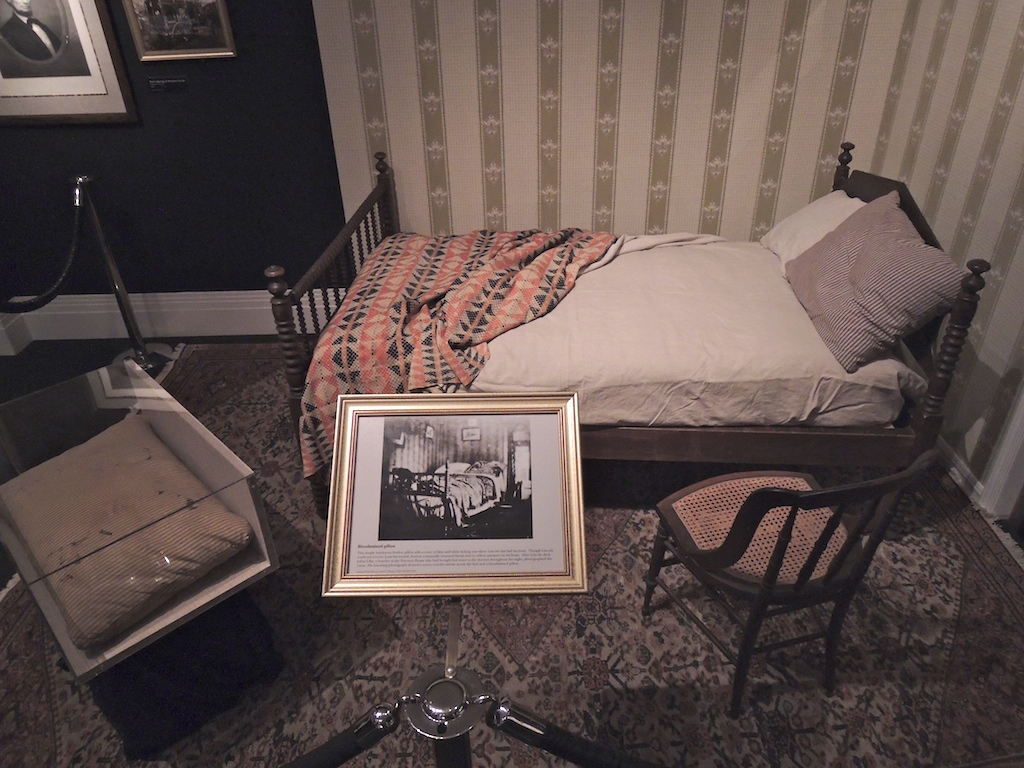
A few of the artifacts that were on display came from the Ford’s Theatre collection.  These included a Confederate cipher machine, a ticket to Ford’s Theatre, a key to a cell that imprisoned on of the Lincoln conspirators, and some funerary items.  One of Ford’s Theatre most iconic items was also loaned to the Reagan Library for the exhibit; a blood stained pillow from the death chamber of the President.

Petersen bedroom Assassination Exhibit Reagan Library

The Reagan Library’s recreation of the death chamber of Abraham Lincoln in the Petersen House. An authentic blood stained pillow from that night can be seen in a display to the left.

These images, sent to me by Carolyn Mitchell of the Spirits of Tudor Hall, show the blood stained pillow further:

Blood stained pillow Mitchell 1

Blood stained pillow Mitchell 2

Under this lighting, it’s hard to see the actual blood stains on the pillow.  The obvious dark splotches are not blood stains but ink stains that occurred long after Lincoln’s death and before modern artifact preservation techniques.  For many years, this pillow was on display at the Petersen House in Washington, D.C.  Today, however, the artifact is too fragile to be on display without a climate controlled display as seen here.  I’ve been told by a National Park Service employee that the pillow is so delicate that you could poke your finger straight through the pillow with ease.  Another, less fragile, pillow from Lincoln’s deathbed is on display in the basement museum of Ford’s Theatre.

References:
Ronald Reagan Presidential Foundation and Library
A. Lincoln: Railsplitter to Rushmore Exhibit Catalog
Ford’s Theatre NPS
A huge belated thank you to Carolyn Mitchell who visited the exhibit and sent me photographs and a copy of the exhibit catalog.  You’re the best, Carolyn!

Categories: Uncategorized | Tags: , , , , | 3 Comments

Update: JWB’s Note at the Archives

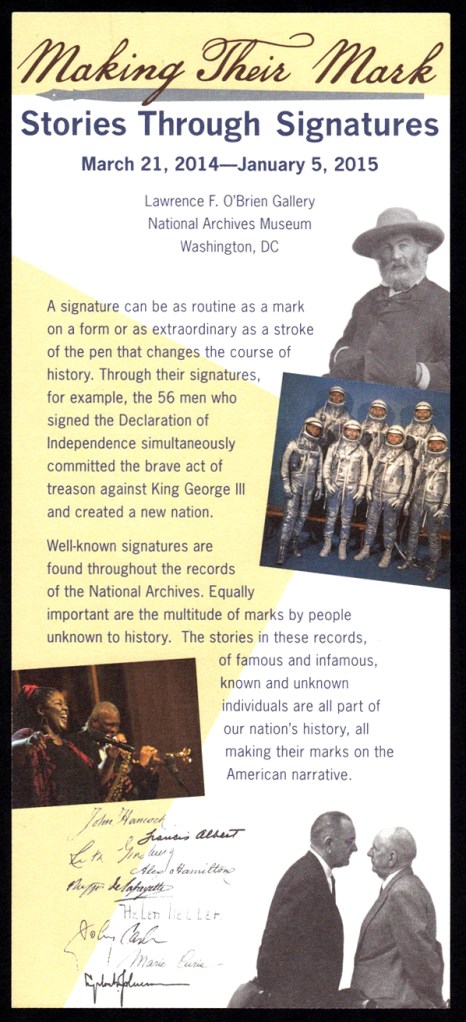
Yesterday, I found myself in Washington, D.C. for a time.  I braved the snow and waited, cold and wet, in line outside the National Archives for an hour.  When I finally got in, I made a beeline not for the Constitution or the Declaration of Independence, but rather for the special exhibit on signatures, “Making Their Mark”:

Making Their Mark exhibit card  My quest today was to see the note that John Wilkes Booth left for Vice President Andrew Johnson, hours before he assassinated President Lincoln.  In the online exhibit guide for “Making Their Mark” you can see a high resolution image of the front and back of the note:

Booth's note to Johnson


Back of Booth's note to Johnson

Fun fact: They do not allow you to take pictures inside of the National Archives.  This is particularly true in the rotunda where the lights are dimmed and there are many guards to protect our country’s charters of freedom from the damaging effects of flash photography.  The core documents to our freedom have faded so much over the years that this very much justified, despite the desire of many to take a selfie with the Bill of Rights.

Luckily, the “Making Their Mark” exhibit was not housed in the rotunda but, instead, in a special exhibit room with more lighting and only one patrolling guard.  While I take the rules of any museum very seriously (you should have seen the way I was giving the evil eye to some high school kids engaging in a snowball fight on the grounds of the Archives before I got in), I just couldn’t pass up the chance to snap a few photos of Booth’s note to share with you all.  If it helps, I did turn off the flash on my phone so that it would not harm the document in any way.  I hope the Archives will forgive me.
Booth's note display  I was both shocked with how small the actual note was.  It was smaller than my 2″ x 3 1/2″ business card that I carry around with me.  After I got back home, I decided that the note was a little bigger than 1 1/2 inches tall and almost 3 inches long.  Here’s a closer picture of the note with an approximate scale:

Booth's note with approximate scale

For some background, here is the conspiracy trial testimony of Col. William A. Browning, Andrew Johnson’s private secretary, in which he mentions the note:
“William A. Browning,
a witness called for the prosecution, being duly sworn, testified as follows:
By the Judge Advocate:
Q. Will you state if you are the private secretary of the President?
A. Yes, sir: I am.
Q. Were you with him on the 14th of April last?
A. I was.
Q. (Exhibiting a card to the witness.) What knowledge, if any, have you of that card having been sent to him by John Wilkes Booth?
A. Between the hours of four and five o’clock in the afternoon, I left Vice-President Johnson’s room in the Capitol, and went to the Kirkwood House, where I was boarding with him. Upon entering, I went up to the office, as was my custom; and I saw a card in my box. Vice-President Johnson’s box and mine were adjoining: mine was 67, his was 68. In 67 I noticed a card. The clerk of the hotel, Mr. Jones, handed it to me. This I recognize as the card.
Q. Will you read what is on it?
A. “Don’t wish to disturb you. Are you at home? J. Wilkes Booth.” It was in my box.
(The card was offered in evidence without objection and is marked exhibit no. 29.)
Q. You do not know anything about the handwriting of Booth?
A. No, sir.
Q. You had no acquaintance whatever with J. Wilkes Booth, had you?
A. Yes, sir: I had known him when he was playing in Nashville, Tenn. I met him there several times. That was the only acquaintance that I had with him.
Q. Did you understand the card as sent to the President, or to yourself?
A. At the time, I attached no importance to it. I had known him in Nashville; and, seeing the card, I made the remark, when it was handed to me by the clerk, “It is from Booth: is he playing here?” I had some idea of going to see him. I thought, perhaps, he might have called upon me, having known me; but, when his name was connected with this affair, I looked upon it differently. It was a very common mistake in the office to put the cards intended for me in the Vice-President’s box; and his would find their way into mine, they being together.”

Appropriately enough, even though I snapped a few more pictures of the note before we left, I was so nervous about being caught and possibly banned from the National Archives for life (a horrible punishment for a researcher) that all the rest of my pictures are blurry messes.  If you want nice pictures of the note, I refer back to the images of it from the “Making Their Mark” online exhibit guide.

References:
“Making Their Mark: Stories Through Signatures” at the National Archives, March 21, 2014 – January 5, 2015
“Making Their Mark” online exhibit guide
The Lincoln Assassination Trial – The Court Transcripts edited by William Edwards

Categories: Uncategorized | Tags: , , , | 12 Comments

Blog at WordPress.com.