Posts Tagged With: News

Herbert Ridgeway Collins – A Living Legend

As opposed to most of the people I talk about here on BoothieBarn, the subject of this post is a man with no historical connection to the Lincoln assassination.  Even further afield from my modus operandi, the subject of this post is also very much alive.  In fact, this week he celebrated his birthday.  My reasoning for departing from my ‘regularly scheduled assassination programming’ is to highlight a very unique man who has lived the most interesting life of anyone I have ever known.

To start this off, I have to admit that I only met Herb Collins for the first time less than a month ago.  Through our mutual friend and researcher Jim Garrett, I had the opportunity to make the acquaintance of Mr. Collins when a group of us went exploring in his home county of Caroline County, VA.  After this relatively brief introduction and tour of his historic house, I called him up and spent an entire Sunday attentively listening to this remarkable man.  This weekend, I will again be driving into Virginia to spend the day learning from him.  What follows is merely a small sampling of some of the unique experiences he has had and shared with me.  There may be some mistakes in my narrative, as I am going from memory.

Herbert Ridgeway Collins is a native born son of Caroline County, Virginia.  The house he grew up in, still owns, and has transformed into a personal museum is called Green Falls and was built in 1711.  It has been in the Collins family since the 1787 and is on the National Register of Historic Places.

Green Falls in Caroline County, VA

Herb has furnished the house with many beautiful antiques and he can give the origin of every single one.  From a mirror belonging to President James Madison to rare chairs with matching pairs in Mount Vernon, Green Falls is remarkable in its furnishings and history.  Some local historical societies schedule tours of his magnificent place, while Herb occasionally gives private tours to those he catches admiring the house from the road.

Herb Collins giving a tour of his beautiful Green Falls estate

In addition to the main house, Herb also purchased a period plantation overseer’s house from a neighbor.  He had the structure physically moved a few miles down the road and placed next to his house.  He then painstakingly restored the very dilapidated building to its original glory and furnished it accordingly.  The most amazing part, however, is that this has been what Herb Collins has done, merely in his retirement.

As a young man, Herb was always interested in history.  When he joined the army as a young man, fate smiled on Herb.  A secretary of a Missouri congressman bought a house opposite of Herb’s Green Falls home.  Through her, Herb was able to secure a position assigned to the Pentagon.  Here he was responsible for preparing the top secret briefing charts for the Secretary of the Army.  He was also able to take a genealogy class through the National Archives that coincided with his love of history.  When he wasn’t on duty or in class, he was working on a book of his own family’s genealogy.  At the age of 22, he published it.  It would be the first of many books that he would write.  After six years in the army at the Pentagon, Herb was discharged.  The class he had taken in genealogy made him very desirable to three different institutions, the Library of Congress, the National Archives, and the Smithsonian.  In the end, Herb decided to join the Smithsonian where he became a junior researcher in the Smithsonian’s political history collection.  He eventually made his way to the top, retiring as the Executive of the American History Museum and division chief of the political history collection.  It is during this period that Herb Collins met, dined with, and acquired items from practically every President and First Lady from Harry Truman to George Bush, Sr.  Here are some of the stories, both long and short, that he told me about his time at the Smithsonian:

  • Herb recounted to me his first trip to meet Harry Truman.  The Smithsonian did not have a lot of items from Truman’s time as President.  Herb traveled to Truman’s home of Independence, Missouri and met with the former President and First Lady Bess Truman.  Herb’s genealogical education made him aware that he was distantly related to Bess Truman, and that both Bess and Harry Truman were related to families from Port Royal, VA (on a side note, Herb seems to know the genealogy of every old family in Virginia.  His memory of families and connections is uncanny).  According to Herb, Harry Truman was the kind of guy that enjoyed making a person feel uneasy.  Every sentence that Herb spoke, Harry Truman would battle a response right back to him, trying to throw him off.  When asked if he had any sports memorabilia to give the Smithsonian, Truman said he didn’t because he couldn’t see well to bat in baseball so they made him play umpire because you didn’t need to see to be umpire.  When Herb said he didn’t have anything from Truman in the Smithsonian, Truman just answered, “Well why don’t you get something?”  Eventually, Truman found that for everything he said, Herb was able to come up with an answer for him.  After that he stopped acting difficult and slapped Herb on the back and invited him to see some political cartoons he had framed out in the back office.  Truman enjoyed when people took punches at him like Herb had done and he had framed some of his favorite political cartoons that had mocked him when he was president.  Together Herb and Harry Truman laughed and joked about them, and Truman genially offered some of his items to Herb for the Smithsonian.
  • When President Dwight Eisenhower died, he wanted to be buried his complete uniform.  At the funeral home that was preparing the body, they found that they did not have a shirt or socks that matched his uniform.  The funeral home called the military history department of the Smithsonian and asked them if they had any extra matching shirts and socks that they could have to bury Eisenhower in.  As a matter of fact they did.  When Herb had left the army, he donated his uniforms to the Smithsonian for his period in history.  The shirt contained Herb’s laundry mark.  With his blessing, the Smithsonian sent over Herb’s old shirt and socks to the funeral home.  President Eisenhower was buried in Herb Collin’s issued shirt and socks.
  • Herb Collins became good friends with JFK’s secretary, Evelyn Lincoln.  Two books in his collection are autographed copies of hers with long messages of appreciation and friendship.  Evelyn Lincoln was married to a man named Harold Lincoln.  Herb was unaware that Harold’s nickname was ‘Abe’ Lincoln.  One day he received an invitation in the mail to attend a rally for Abe Lincoln, who was running for Congress.  He ignored the mailer.  Days after the event, Evelyn called Herb and asked him why he didn’t come to support her husband’s run for Congress.  Herb told her that he didn’t know Harold went by Abe, and that he thought “Abe Lincoln running for Congress” was just a joke.  The two had a good laugh about it.
  • After JFK was killed, Jackie Kennedy and others toured the country trying to raise money for a JFK museum.  They traveled with exhibits about the late president to raise funds.  Herb wrote to Jackie informing her that the flag that flew over the Capitol on the day of the President’s funeral was hers.  She wrote him back thanking him for letting her know that.  One item that went traveling to raise money was the famous Resolute desk from the Oval Office.  Johnson didn’t want to use the desk as he found it too big.  Those of you who have seen the movie, National Treasure 2: Book of Secrets, will know that the Resolute desk plays an important part of Nicholas Cage’s clue finding.  In the movie he makes his way into Oval Office and, by pulling out drawers to the right length, unlocks a secret compartment in the desk: While you may all be shocked to learn this, there is no hidden compartment in the Resolute desk.  Herb Collins has taken the Resolute desk apart, “a dozen times”.  He told me it all comes apart fairly easily and he helped pack it up when it went on tour to raise money for the JFK museum.  When it was done touring, Herb took control of it and placed it in the collection of the Smithsonian.  It stayed, on display in the Smithsonian until Carter asked for it back.  According to Herb, he was out to lunch one Wednesday and when he returned to the Smithsonian he had a message from Jimmy Carter asking for the Resolute desk to be placed back into the Oval Office by Friday, as he wanted to show it off to some foreign delegates.  Herb said he took it apart, had it transported over to the White House, and reassembled it for Carter in the Oval Office right on time.
  • Herb had the chance to meet many Presidents but he spent more time with the First Ladies.  He stated that his favorite first lady was Pat Nixon.  According to him she was the most down to earth.  In conversations with Herb, she never said, “The President” or “Mr. Nixon”, it was always just, “Dick” and she invited Herb to refer to him as the same.
  • Herb has written over 25 books.  During his time at the Smithsonian he created almost encyclopedic volumes about political flags and lanterns, as well as writing books about the transportation methods of the presidents.  He was one of the first to call attention to a fall that Mary Todd Lincoln suffered in a carriage accident that caused her to suffer recurring dizzy spells that may have exasperated her mental decline.
  • Herb has a credit in the Lincoln assassination book by Dorothy and Phillip Kunhardt entitled , Twenty Days.  He recalled when they came to the Smithsonian and wanted to photograph the conspirators’ hoods and jail keys.  At one point, they wanted a picture of what was thought to be Mary Surratt’s hood.  Looking around, Herb couldn’t find a female bust to place the hood over.  In a pinch he saw a bust of Henry Clay, Kentucky’s noted politician who served multiple times as Speaker of the House and was John Quincy Adams’ Secretary of State.  According to Herb, Henry Clay had a small, feminine enough looking head to pass as Mary Surratt’s.  So, Herb slipped the hood onto Henry Clay’s bust and the Kunhardts photographed it.  Sadly, that particular shot did not make it into their Twenty Days book.

There were other stories and insights Herb shared with me from his time with the Smithsonian, but these are the main ones I can remember for now.  Herb is an unending fountain of information and I am looking forward to the many conversations I will have with him in the future.

UPDATE:

Yesterday I once again spent the day with Herb.  We visited the Caroline County library in Bowling Green, VA where Herb has his Herbert Collins Room.  The room holds his massive collection of books about genealogy, Virginia history, and the history of Caroline county.  It is a private research room accessible by appointment only.  After that Herb and I traveled to nearby Essex County to visit an antique store in Tappahannock that he regularly purchases items from.  Herb’s only purchase for the day was a copper kettle that he said would match one he already had at Green Falls.  While at the antique store, Herb openly talked with other patrons and helped them pick out pieces.  Through these conversations with strangers, I met the president of the Restore Port Tobacco organization.  He was pleasantly surprised that I knew about the Chimney House in Port Tobacco, behind which George Atzerodt’s carriage shop was purported to be. Apparently the Chimney House is on the market now.  After this we traveled back to Herb’s home and subsequently ended our day together.  The following is some of the pictures I took yesterday:


The Herbert Collins room at the Caroline County Library

Herb Collins researching in his room

The left image is what the Overseer’s house (mentioned above) looked like before it was moved to Green Falls and restored. The right image is what the house looked like while renovations were underway. The house is a sight to see today.


Herbert Ridgeway Collins and his portrait 

Categories: Uncategorized | Tags: , , | 26 Comments

Junius and Jackson

Tragedian Junius Brutus Booth, Sr., and President Andrew Jackson

Did John Wilkes Booth’s father, Junius Brutus Booth, Sr., write a letter threatening President Andrew Jackson’s life?  PBS’ History Detectives investigate:

Click here to watch the “Booth Letter” episode on PBS.org

This episode features author Gene Smith.  Mr. Smith wrote a wonderful biography of the Booth family entitled, American Gothic: the Story of America’s Legendary Theatrical family, Junius, Edwin, and John Wilkes Booth.  I decided to post this video after learning the sad news that Mr. Smith passed away on July 25th.  His book was one of the first “Boothie” books I ever read, and it drew me more and more into the assassination story.  Thank you, Mr. Smith.

Categories: Uncategorized | Tags: , , | 7 Comments

We are now BoothieBarn.com!

In this month’s (August 2012) issue of the Surratt Courier the Surratt Society not only carried a revised version of my Michael O’Laughlen: Quilter article, but also endorsed this blog and Roger Norton’s forum. This is on top of their already kind mention on the Surratt.org website.

In the Courier, this site was listed as BoothieBarn.com. Up until now, that was incorrect as I had been using the free version of the WordPress blogging site. The mistake convinced me to finally take the plunge and purchase the BoothieBarn.com domain name. Looking at my site stats I knew that many others had found this site after searching for BoothieBarn.com so I feel it will be worth it.

Therefore, from now on, there are two ways to reach this site. The old address (https://boothiebarn.wordpress.com) will continue to work indefinitely. The newly created http://www.boothiebarn.com will work too. Both addresses will bring you to the same site and material. So if you have this site already bookmarked you could change it to BoothieBarn.com but you don’t really have to.

As BoothieBarn.com, I hope I’ll be able to continue to provide interesting articles for your reading pleasure.

Categories: Uncategorized | Tags: | 1 Comment

A Sketch of Seward’s Assassin

“Looking again to the right, and omitting the alternate guard, we come to one of the most remarkable faces of the group – a face which, once seen, may never be forgotten; on whose moral stature is readily determined by his face.  This man is clothed sparingly.  He is in his shirt sleeves – a sort of steel mixed woolen shirt; his pantaloons dark blue cloth; his neck bare and shirt collar unbuttoned.  He is fully six feet high; slender body; angular form; square and narrow across the shoulders; hollow breast; hair black, straight and irregularly cut and hanging indifferently about his forehead, which is rather low and narrow.  Blue eyes, large, staring, and at times wild, returning your look steadily and unflinchingly.  Square face; jaw irregular; nose turned at the top but expanding abruptly at the nostrils; thin lips, and slightly twisted; mouth curved unsymmetrically a little to the left of the middle line of the face; a wild, savage-looking man, bearing no culture or refinement – the most perfect type of the ingrained hardened criminal…” – Milwaukee Sentinel (05/16/1865)

For the time being all I can manage to post is this self created montage of Lewis Powell and a description of him from a period newspaper account. Of course Powell’s biographer, Betty Ownsbey, is the best source for information on Lewis Powell and happily discusses him on Roger Norton’s Lincoln Discussion Symposium.

I, myself, have been busy preparing for an upcoming move out of my home state of Illinois to the great state Maryland.  I recently got a new teaching job in Maryland and I am very excited about being closer to the history that I love.

Categories: Uncategorized | Tags: , , | 7 Comments

Newish News

Most of what follows is probably already known to those who regularly read this blog.  Nevertheless here’s some newish news on the Lincoln assassination front.

Booth reading the news

 1.  New Site

When it comes to learning about Abraham Lincoln’s life, there really is no better resource than the Abraham Lincoln Research Site run by Roger Norton.  The website at http://rogerjnorton.com is actually composed of three equally valuable sections: the life of Abraham Lincoln, the life of Mary Todd Lincoln, and Lincoln’s assassination.  The proprietor of the site is Roger Norton, a retired Illinois social studies teacher.  His website is the top choice for students, both young and old, to learn about Lincoln.  In 2006, his site received the prestigious honor of being completely archived by the Library of Congress.  Just as the LOC archives and preserves movies and TV shows deemed culturally significant, Mr. Norton’s site was archived for all time due to its educational significance.  It is a very high honor for an individual’s site to achieve and speaks to the quality of Mr. Norton’s work.

Recently, Mr. Norton has expanded his website to now include a public forum.  The Lincoln Discussion Symposium is open to all who wish to discuss the many aspects of Abraham Lincoln.  It is a collaborative community where amateurs and experts alike can post questions and comments regarding our 16th President.  Due to the large amount of traffic Mr. Norton receives from students in the school setting, forum members are expected to be courteous and respectful in their remarks.  While it is still growing, the forum already houses a wonderful community of experts from the Lincoln community eager to answer questions and take part in discussions.  I, myself, am a member there and endorse it fully.  While my main interest lies in Lincoln’s assassination, the forum has already taught me so much that I didn’t know about the living Lincoln.  Membership is growing every day, so I invite you all to visit the Lincoln Discussion Symposium and join the wonderful community of learners.

2.  New Links

On the right side of the blog you might have noticed a list of “Links to Learn More”.  Here I have placed links to some of the best websites out there for Lincoln assassination material.  Hovering over each link will give you a short description of the site.  To this list, I have recently added two new links.  The first is the above mentioned Lincoln Discussion Symposium.  The second is the Facebook page for the Spirits of Tudor Hall.  The Tudor Hall estate was the Booth family homestead in Maryland.  The theatrical patriarch of the Booth clan, Junius Brutus bought the land when he and Mary Ann Holmes emigrated from England.  The Booth family originally lived in a log cabin on the property before Junius commissioned the building of the beautiful Tudor Hall manor house in the fall of 1851.  Sadly, Junius never got to live in the main house as he died while on tour on November 30th 1852.  The Booth family lived on the Tudor Hall property on and off from 1822 to 1858.  Nowadays, Tudor Hall is used as an office for the Harford County Center for the Arts.  It is also home to the Junius B. Booth Society.   The house is open on select weekends for public tours about the Booth family and the history of Tudor Hall.  The Spirits of Tudor Hall Facebook page advertises the house’s tour dates and times, along with highlighting wonderful pictures and articles on the Booth family (including some from here, Woot!).  If I was a member of Facebook, I would Share it/Like it/Poke it/Friend it/Hug it/High Five it, whatever it is that you young people do there.  One thing they are advertising on Tudor Hall’s behalf is the sale of a genuine brick from a Tudor Hall chimney.  While the bricks can’t be completely authenticated to when the Booths lived there, it’s still a relic you can own dating back to Edwin Booth’s lifetime.  Add the Spirits of Tudor Hall Facebook page to your favorites today.

3.  New(ish) Books

I am happy to report that William Edwards’ book, The Lincoln Assassination – The Reward Files, is now available for purchase as an ebook through GoogleBooks.  Previously released as a book on CD-ROM, Mr.  Edwards has revamped his collection of primary source documents into a searchable ebook.  The Reward Files hold many details about the military’s search for Booth and contains firsthand accounts (like Samuel Arnold’s confession) not found in other sources.  This text along with The Evidence and the Court Transcripts, make up the trilogy of the government’s primary documents into the assassination of Abraham Lincoln.

Also, Ed Steers, the noted Lincoln author and co-author on The Evidence with William Edwards, has also just released an updated Kindle ebook version of his popular booklet, The Escape and Capture of John Wilkes Booth.  Mr. Steers originally posted the news of his revised book on the Lincoln Discussion Symposium.

Well, that’s all the newish news that’s fit to print.  Back to our regularly scheduled programming.

Categories: Uncategorized | Tags: , , , , | 10 Comments

The Lincoln Assassination Trial – The Court Transcripts

I have previously written about the wonderful resource tool that is, The Lincoln Assassination: The Evidence by William Edwards and Ed Steers. William Edwards went through and painstakingly transcribed the bulk of the National Archives’ record group M599, the government’s collected evidence after Lincoln’s assassination. With editorial annotations by Ed Steers, the book is the best tool for researching the Lincoln assassination primary sources. When used in conjunction with Fold3.com to view the documents themselves, the book becomes of even greater value.

While I could sing the accolades of The Evidence for hours, this post is actually about a new and equally wonderful resource by William Edwards, The Lincoln Assassination Trial – The Court Transcripts.

Now I know what you are thinking, “I already have a copy of the conspiracy trial. Why would I buy another one?” It is true that there are many editions and reprints of the conspiracy trial out there. There were three different versions of the trial (Pitman, Poore, and Peterson) and each have been reprinted many times over the years. Even William Edwards’ partner on The Evidence, Ed Steers, released his own reprint of the Pitman edition of the trial. However, as valuable as all of these versions are, William’s new eBook is better. Let me tell you why:

1. This transcription is the most accurate. This transcription was made straight from the microfilmed images of the court’s official copy of each day’s trial proceedings. The words and testimonies have not been summarized or altered in anyway. The words presented are exactly as they were written by the court’s team of stenographers in 1865.

2. This transcription is the most complete. While publisher Benjamin Perley Poore’s editions of the trial are equally accurate since they were taken from the same source material, they are also incomplete. His fourth and final volume of the trial transcript was never released due to a lack of public interest and low sales of the other volumes. Poore’s editions, therefore, are missing the testimonies of around twenty witnesses. In addition, Poore’s versions lack the closing arguments made by the prosecution and defense attorneys. These missing testimonies and closing arguments are found, in full, in this account.

3. This digitized version of the trial employs four different finding aids and is searchable. This digitized version of the trial makes reading and researching easy. Any part of the trial can be found based on section, NARA reel number, date of testimony, or witness name. Also, by pressing Ctrl+F while reading, you can do a search for any keyword in the entire trial.

Ultimately, if you are looking for a version of the conspiracy trial to purchase, look no further. If you already have a copy of the trial, you also need to get this version. For researching, there is no better version of the trial out there.

Buy it from Google Books today. You won’t regret it.

Categories: Uncategorized | Tags: , , | 9 Comments

Why Lincoln and Booth are Intertwined

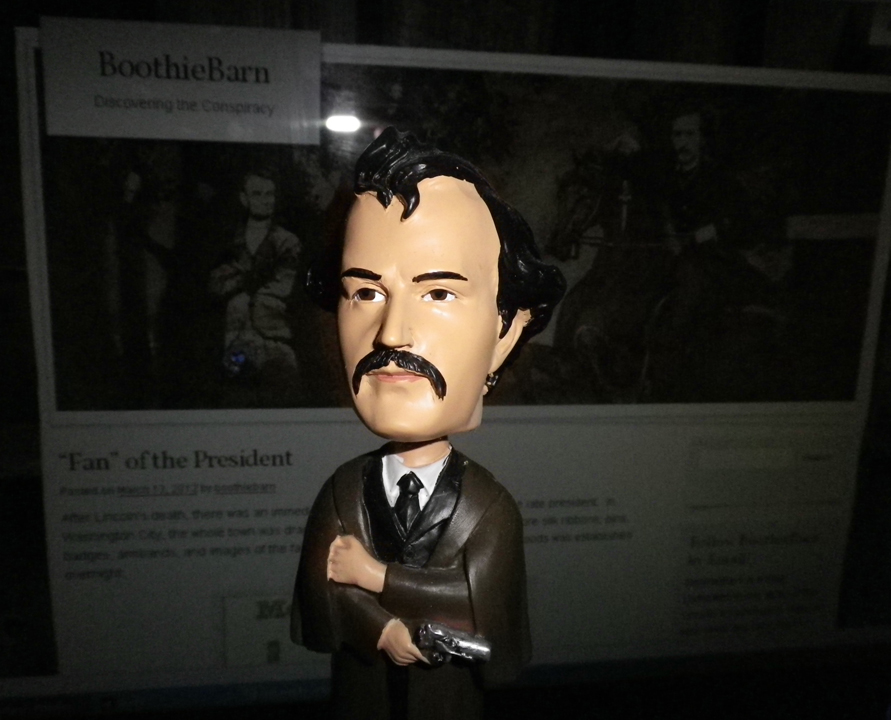
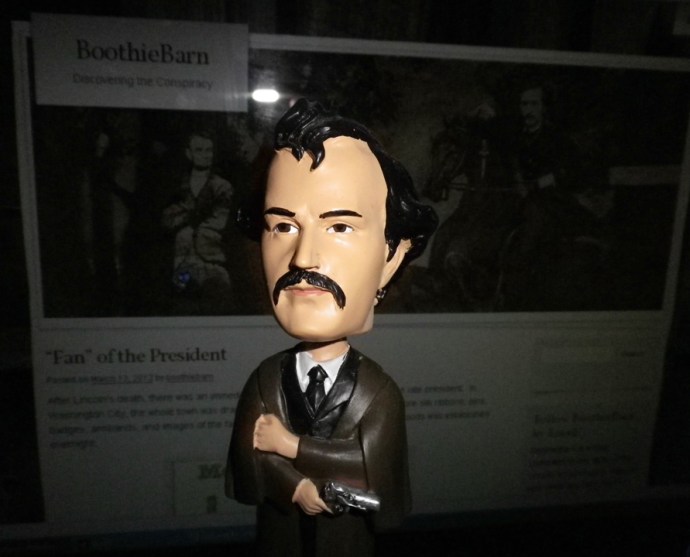
Recently, there has been a minor controversy regarding the sale of John Wilkes Booth bobblehead dolls.  A reporter from The Evening Sun of Hanover, PA, received an anonymous complaint about the dolls being sold at the Gettysburg National Military Park gift shop.  When he inquired about them, the gift shop removed them from their shelves within a couple of days.  Shortly thereafter, without any noted complaints or inquires, the Abraham Lincoln Museum and Library in Springfield, IL, followed suit and removed the bobbleheads from their gift shop.

What interests me the most about this controversy is how people have reacted to the dolls.  The original article notes that, “At first, the bobblehead drew chuckles from some of the students. But most reconsidered that reaction when asked to comment.”  This “chuckling” reaction would be the one I would expect from most people.  As a bobblehead doll, it is made to be a gag gift.  People either like them enough to buy them, or they move on, instantly forgetting them.

When probed about the dolls, the students being interviewed responded with the remarks akin to, “Yes, I suppose it is wrong to make them.” What changed their minds?  A few seconds earlier they were chuckling at the John Wilkes Booth bobblehead, and now they are calling for its immediate removal.  Their new-found disgust is a product of their education about Lincoln.  It is this education that we all receive.  We rightfully idolize and revere Lincoln for his strengths and courage as president.  He freed the slaves, kept the nation together and paid for it all with his life.  All of these things are true, but, in order to keep Lincoln as  the penultimate American president, we all ignore the complexity of his death.  The man who killed him was a crazy, racist, cold-blooded killer.  We simplify Lincoln’s death into its simplest but, inherently, incorrect terms.  Did Booth commit an atrocious deed that should be condemned?  Of course.  However, we should not dismiss his importance to the Lincoln we know and love.

This is the fine line that “Boothies” walk pursuing our interest.  As those who study the assassination, we look at the factors and motivations of Booth and other groups, North and South, who wished for and plotted to end Lincoln’s life.  While Lincoln was a great man and a great president, he was also one of our most hated presidents.  This version of Lincoln was buried and forgotten with Booth’s body.  One bullet, fueled by the anguish of the ravaged South, transformed Lincoln into a saint.  Booth should be studied not only for this crucial act, but for the complexity of his character that led him to such a crime.

Of all the reactions given in the articles and comments regarding the bobbleheads, I am slightly disappointed on a purely scholarly level with Mr. Harold Holzer’s quote in which he states that selling the John Wilkes Booth bobbleheads are, “…like selling Lee Harvey Oswald stuffed dolls at the Kennedy Center.”  While both Lincoln and Kennedy’s assassinations were traumatic events in our history, the men who committed them were polar opposites.  The times and events they lived through defined them as uniquely troubled individuals and each had vastly different motivations for their crimes.  By painting these two assassins with the same brush, we actually diminish the honored men they killed.  The story of Lincoln’s assassination is a dark one and an unpleasant one.  However, looking at the men and women who conspired to kill Lincoln helps us better understand the harsh period of time in which Lincoln lived and led a nation.

According to the original Evening Sun article, 11 out of the 12 people interviewed stated that the Booth bobblehead was inappropriate.  The sole hold out was a 15-year-old boy who stated, “It’s a part of history and we can’t just ignore it because it’s a bad part.”

I couldn’t agree more:
References:
Evening Sun articles: 1, 2, 3
Abraham Lincoln Museum and Library article

Categories: Uncategorized | Tags: , , , | 1 Comment

Welcome to the BoothieBarn Blog!

The story is a well known one:  On April 14th, 1865, President Abraham Lincoln was shot while attending a play at Ford’s Theatre in Washington D.C.  His death the next morning was viewed as the great sacrifice of the leader who had pulled the nation through a bloody civil war.  Instantly, and appropriately, Lincoln became an American saint.  He gave his last, full measure for the country and was struck down just after completing his goal.  Abraham Lincoln’s actions and resolve have earned him the title of our country’s greatest president.  His story is told all over this country and he is the most written about figure after Jesus Christ.

But, there is another part of this story.  It is the story of a young actor driven to extremes.  It is the story of that man and his conspirators who were determined to strike back against a government that destroyed the United States they had known and loved.  It is the stories and facts about these individuals that this blog hopes to share.  Not because we agree with their actions or because we share their values.  We learn about them because the darker parts of history can shed the most light on the past.  While the actions they took were abhorrent, the sentiments that motivated those actions were shared by many.

Many of us who study the Lincoln assassination refer to ourselves as “Boothies”.  This does not mean we condone the actions of the assassin.  Rather, our moniker states our commitment to studying, analyzing, and interpreting the actions of John Wilkes Booth and others involved in the great American drama that is the Lincoln assassination.  Ignoring and dismissing the lives and actions of the men and women involved in the conspiracy does a great disservice to history and to the memory of Abraham Lincoln.  We cannot truly honor and appreciate the man without understanding the complexity of his death.

As a Boothie, I hope that this blog will be a source of education as well as levity every once and awhile.  It is my first time starting a blog, so who knows how it will turn out.  Regardless, I invite you all to come back from time to time to see the man, and the conspiracy, in the barn.

Categories: Uncategorized | Tags: | 19 Comments

Blog at WordPress.com.