Posts Tagged With: Museums

A John Wilkes Booth Poem

In the spirit of Valentine’s Day and the many poems being shared today, here is a poem written by John Wilkes Booth in February of 1860.

john-wilkes-booths-poem-to-mary-white-2-18-1860-alplm

This poem by Booth is an acrostic poem and as such the beginning letter in each line spells out the names of the poem’s recipient and author. Here is a transcript of the poem including Booth’s incorrect spelling of the words distressed and despair.

Miss White

May all good angels guard & bless thee.
And from thy heart remove all care.
Remember you should ne’re distrest be.
Youth & hope, can crush dispare.
+
Joy can be found, by all, who seek it.
Only be, right, the path, we move upon
Heaven has marked it; Find & keep it
Ne’re forget the wish of – John.

Richmond Feb 18th 1860

He who will ever be your friend

J. Wilkes Booth

Booth wrote this poem as he was learning the acting trade in Richmond’s Marshall Theatre. The date of this poem places it just a couple of months after Booth had returned from his soldiering. For two weeks in late November and early December Booth had stood guard at the imprisonment and execution of abolitionist John Brown. When he returned to his theatrical company only the pleas of his friends allowed him to rejoin the troupe after his impromptu departure. At this point he was still being billed, when his minor part warranted any sort of billing that is, as Mr. J. B. Wilkes.

j-b-wilkes-in-romeo-juliet-1860

The recipient of this poem was a woman by the name of Mary C. White. Little is known about her. Booth’s poem is located in a “Forget Me Not” autograph album that is inscribed with Ms. White’s name and the words “Richmond, Va. December 10 1859”. In addition to the poem by Booth, there are also other farewell like notes from W. H Caskie (a Richmond native who would later join the Confederacy), George Wren (a fellow actor in Booth’s troupe), two poems signed under the aliases of Fido and Junius (not Booth’s brother), and Samuel Knapp Chester (another troupe member and a man Booth would try to recruit into his abduction plot against Lincoln in the future).

In their book, “Right or Wrong, God Judge Me”: The Writings of John Wilkes Booth, editors John Rhodehamel and Louise Taper suggest that Mary C. White might be a fellow actress. They cite an entry in T. Allston Brown’s History of the American Stage, which is essentially an early encyclopedia of actors and actresses, for a Mary Ann White “attached to the Richmond, Va. Theatre for some time” who “died 1860, in that city, June 20”. Rhodehamel and Taper point out that there are no other poems or farewells in the album past June of 1860, which might coincide with the owner’s death. I have been unable to find a record of a Ms. White in the theater troupe, but, if she was young, as many of the poems about her allude to, she may have played only minor roles in which she would receive no mention in the papers. I’m not 100% convinced Ms. White was an actress, but without more information, it’s as good a guess as any.

The album containing Booth’s signature is in the collection of the Abraham Lincoln Presidential Library and Museum in Springfield, Illinois. I was fortunate enough to see it in person after my talk to the ALPLM’s volunteers last summer. The ALPLM has digitized this poem and many other Booth related items they acquired from the collection of Louise Taper. You can see more of their digitized items here.

References:
The Taper Collection at the ALPLM
“Right or Wrong, God Judge Me”: The Writings of John Wilkes Booth edited by John Rhodehamel and Louise Taper

Categories: History | Tags: , , , , | 1 Comment

Honor, God, and Reward Money: A New Boston Corbett Letter

You’d be amazed what you can turn up nowadays with a just Google search and a friendly inquiry. A few weeks ago I was working on the Maps page of BoothieBarn looking for more sites around the country that have a connection to the Lincoln assassination. While most of the time I’m looking for the graves of certain individuals involved in the story, for some reason I decided to change my method and focus on an certain city and see what I could turn up by Googling. For no reason in particular, I chose Omaha, Nebraska as a place to search for folks connected to the assassination. I happily discovered that Omaha is the final resting place of Pvt. Augutus Lockner, a Union soldier who was saved by conspirator Lewis Powell in December of 1864. If you want to read more about that fascinating story, pick up the second edition of Betty Ownsbey’s book, Alias “Paine”: Lewis Thornton Powell, the Mystery Man of the Lincoln Conspiracy.

KENT SIEVERS/THE WORLD-HERALDI also stumbled across an article from the Omaha World-Herald in which the newspaper went behind the scenes of The Durham Museum to see some of the objects in the museum’s large and varied Byron Reed collection. One of the items mentioned in the article was a playbill from Edwin Booth’s namesake theater (pictured).

After tweeting out the image of the playbill, both myself and Carolyn Mitchell from Tudor Hall, the home of the Booth family, sent a message asking The Durham Museum if they had any other artifacts connected to the Booths or the assassination. The collection’s manager graciously searched their archives and found four other playbills for Booth’s Theatre and two 1865 newspapers announcing the news of Lincoln’s death.

The collections manager also informed us that the Byron Reed collection contained a letter written by the avenger of Lincoln himself, Sergeant Boston Corbett. She kindly photographed the letter and sent the images to us. I then contacted Steve Miller, a fellow assassination researcher and the foremost expert on Boston Corbett. I was happily surprised to find that this letter was a new discovery for him and that he had not yet come across it during his years of research. Working together, Steve and I were able to produce a transcript of the letter which had been somewhat damaged with age.

Corbett wrote the letter to his former commanding officer, the then Lieutenant of the 16th New York Cavalry that tracked down John Wilkes Booth and David Herold, Edward P. Doherty. Writing on December 1, 1866, Corbett is responding to Doherty’s request for an affidavit relating to his role in the capture of Booth. Before sharing the letter, however, some historical context is needed.


On July 26, 1866, Representative Giles Hotchkiss of New York presented to the House of Representatives the findings of the Committee of Claims in reference to the reward money. Prior to this, the War Department had presented Congress with their recommendations of how to divide up the money. Mr. Hotchkiss’ committee took the War Department’s advice when it came to the division of monies for the capture of Jefferson Davis and only made a few changes to the War Department’s allotment for reward money for the arrests of George Atzerodt, Lewis Powell, and Mary Surratt. However when it came to the reward money for capture of Booth and Herold, there was much debate. Rep. Hotchkiss’ committee put forth a bill recommending that Gen. Lafayette Baker, the head of the National Detective Police who sent detectives Everton Conger and Luther Baker with Doherty and the 16th New York into Virginia, receive $17,500 in reward money. Detective Conger was also to receive $17,500. Luther Baker would get $5,000, Lieutenant Doherty would receive $2,500, and Corbett and the rest of the 16th NY would each get $1,000. This allotment did not sit well will some of the other members of the House. Several felt it unfair for Gen. Baker to receive such a lion’s share of the reward money when he was not even present at Booth’s capture. Rep. Hotchkiss replied that Gen. Baker had been the mastermind of the entire manhunt and therefore desired the highest amount, with Conger receiving the same amount since he was in charge of the group that captured Booth. This point about Conger being in charge was disputed by Lieut. Doherty who had produced papers to counter the claim. However, within the House of Representatives there was great sympathy for Everton Conger since he was a veteran who had been wounded earlier in the war.

Representative Giles Hotchkiss of New York circa 1865

Representative Giles Hotchkiss of New York circa 1865

As the debate over amounts continued, Hotchkiss seemed to become angry with his fellow lawmakers. One of the other congressmen tactlessly pressed Hotchkiss to provide more money for one of his constituents who aided in the manhunt, noting how he had presented this claim to Hotchkiss personally and was disappointed to see how little had been allotted. This exasperated Hotchkiss, leading him to express that this whole matter had been trouble from the start. Hotchkiss said he had consulted the mountains of reward claims that had been submitted to the War Department in an effort to divvy up the money as best as he could, noting that there was no protocol for him to follow. He did not like the insinuation that he was playing favorites, noting that neither Gen. Baker or the other claimants were friends of his and that he was merely doing, “the duty I was called upon to perform”.

In attempting to show his impartiality, an angry Hotchkiss decided to make a point using Lieut. Doherty:

“During this session a telegram has been shown me from Lieutenant Doherty, saying that there was a great fraud being perpetrated here, and he wanted the American Congress to stop the wheels of legislation and wait until he could be here. Lieutenant Doherty has been here pretty much all winter, and has been before me time and time again in regard to this matter. I have had rolls of documents from him, and I wish to avoid saying anything about him. But now, since he has had the impudence to come here and charge a man who has been engaged in the honest discharge of his duty, without fear or favor, one who is a stranger to all these men, who does not care personally whether they get a cent, and since gentlemen have shown the want of confidence in the committee to make the remarks they have, I feel constrained to say that I believe Lieutenant Doherty was a downright coward in this expedition.

From all the evidence, I believe that while these five men where guarding that tobacco-house where these prisoners were secreted, and while Lieutenant Colonel Conger was endeavoring to get a guard around the building, Doherty stayed under a shed, and no power could drive him out of it. And now he comes in and claims that he did the whole. Such is the evidence in the case, as it has been presented. If there is anything to contradict it, let it be brought in.”

Hotchkiss then points out that despite his strong belief that Lt. Doherty was an coward who deserved no portion of the reward money, the committee still allotted him some funds “in deference in part to popular clamour”.

Hotchkiss also spoke harshly of Boston Corbett. He said the evidence he saw supported the idea that Corbett defied orders by leaving his assigned post, made his way close to the barn where he was not supposed to be, and then shot Booth who was attempting to surrender himself. He described Corbett as, “an insane man” at the shooting of Booth. “I am told that Corbett has since died in a lunatic asylum, and he was then evidently an insane man. Yet he is given the same sum as the other soldiers receive. For a two days’ ride I think that is an ample compensation.”

While Hotchkiss provided a defense of the committee’s reasoning for their proposed reward allotments, he didn’t feel it worth a prolonged fight. After an hour of debate, Hotchkiss was tired of the insinuations from his colleagues and just wanted the whole mess to be over. Another representative had put forth an amendment to his bill, changing the amounts provided for Booth and Herold’s capture and, in the end, Hotchkiss did not fight it and the amended bill was approved. “When you cannot do as you would, you must do as you must,” Hotchkiss stated.

The amended bill still gave Everton Conger the largest share of reward money at $15,000, a decrease from Hotchkiss’ $17,500. General Lafayette Baker dropped way down from $17,500 to $3,750. Luther Baker fell from $5,000 to $3,000. Ironically, it was Lt. Doherty, Boston Corbett, and the rest of the soldiers who benefited the most from this amended bill. Doherty’s reward money went from $2,500 in Hotchkiss’ bill to $5,250 in the amended version. Corbett and all the other soldiers also got pay increases from $1,000 to $1,653.84 each. In the end, it would be these amounts that would be passed in the Senate and given out.

Lieutenant Doherty's reward money

Lieutenant Doherty’s reward money

While Doherty ended up receiving a good deal of money, when he learned of what Giles Hotchkiss had said about him on the floor of the House of Representatives, remarks that were carried in newspapers around the country, he became very offended at the attack on his honor. On August 1st, while stationed in South Carolina, Doherty sent off a letter to the New York Herald promising a rebuttal to Hotchkiss’ lies.

“I cannot remain quiet under such charges affecting my character as a soldier, and my conduct as an officer, coming from such a quarter. In the course of a short time I shall place before the people of the United States such evidence as will convince them that the charges made by the honorable member are untrue. The language used by the member from New York, did not come to my notice until after the adjournment of Congress, and when I no longer had an opportunity of vindicating myself before that body.

Chance has connected my name with a great historical event; and I simply desire that the army with whom I served, and the people for whom I fought, should know that in the performance of my duty I was not a laggard and a coward.

Edward P. Doherty
Second Lieutenant Fifth Cavalry, U. S. Army”

Doherty quickly sent off a letter to Boston Corbett, a man he knew would support him and could help tell the real story of what happened at the Garrett farm. Corbett was still a bit of a hero for slaying Booth and Doherty was hoping he could depend on Corbett to publicly refute Hotchkiss since he, too, had been a victim of the Congressman’s lies. The very much alive and not (quite) insane former sergeant responded just as Doherty had hoped. He wrote a letter back to Doherty in South Carolina on August 6, 1866. Doherty then had the text of the letter was published in the New York Citizen on August 25th:

“God bless you, my dear sir; the slander and lie that was told by Mr. Hotchkiss, in Congress, about you, makes me love you more than ever. And I do not believe that such a wicked lie and such a malicious slander will be allowed to go altogether unpunished, or to have the effect on the public mind that was intended. I do not doubt, though, that it did have the effect desired in Congress; and I do truly believe that it was told and used there for the express purpose of getting the largest share of the reward for the Detectives, and getting the military into disgrace, and consequently the small apportionment that was made to us.

I do without hesitation pronounce the assertion that you was under a shed, and that the Detective could not force you out, to be a wicked lie. For I well know that you not only commanded the party, but commanded it well; and at the time that the house and barn of Mr. Garrett was surrounded, it was done by your orders; and that you took the leading part in all that was done there, as also in the whole expedition.

I am aware, also, that you placed me next in command to yourself before leaving Washington, giving me charge as acting orderly sergeant, and had you been killed I should myself have been in command of the party, and not the Detective. I am also aware of the fact that when you got track of the assassins, you had to send men after the Detective (Conger), who was off in another direction at the time.

Boston Corbett and Edward Doherty

Boston Corbett and Edward Doherty

The injury that has been done us by giving us a small share, instead of the principal share of the rewards, cannot now be remedied, since it has passed Congress in that way. But be assured, dear sir, that I stand ready to give a certificate at any time, properly attested if needs be, that I have ever known you to be a brave and efficient officer, and never in my life saw any act on your part that indicated cowardice in the least degree.

I always liked to go on a scout with you, because I knew you to go forward in the work, and a true officer and soldier, having the welfare of your command always in view, and losing no opportunity of doing good service for your country.

With kindest regards and earnest prayers for your welfare, and that you may outlive all such wicked slanders, I remain, as ever

Boston Corbett”

As grateful as Doherty must have been for Corbett to come to his aid, Hotchkiss’ slanderous remarks apparently continued to gnaw at the lieutenant. Over three months later, on November 26th, Doherty wrote another letter to Corbett seemingly asking the late sergeant to write out a more thorough or perhaps notarized affidavit regarding Doherty’s services in apprehending Booth. It is Boston Corbett’s letter to Doherty’s second communique, months after the Hotchkiss affair, that is housed in The Durham Museum in Omaha.


Even though Corbett had written in August of 1866 that he stood ready, “to give a certificate at any time, properly attested if needs be,” regarding Doherty’s actions and character, in this response to his former commander in December of 1866, it appears that Corbett is trying to get Doherty to put the whole incident aside.

boston-corbett-1866-letter-to-doherty-durham-1

91 Attorney St
New York
Dec 1st 1866

Lieut E. P. Doherty

Dear Sir

Your letter of Nov 26th reached me yesterday. And as I was not sure by the heading of it wether [sic] it meant South Carolina, or Lower Canada; I concluded to write to you for the Address in full; And also to suggest that it might be best to drop the whole matter; And let it end as it is.

For my own part as a Christian I freely forgive Mr. Hotchkiss for the injury that he has done; And so would rather let end thus. But if you still insist upon the Affidavit being made to clear your character, I feel that I owe it to you to do it. And so would not further refuse.

But while I sincerely desire to see your Character Vindicated: how much rather would I see your soul saved, And you brought to love and serve God with all your heart. I expect you think it very strange that I appear so indifferent to that which is a point of honor; but the secret of it all is this the Christian knows that the time will soon come when the secrets of all hearts will be made bare in the judgement And he feels that he can well afford to be hid about here.  So that he stands justified there. This with me is the only cause of reluctance to make the Affidavit, which I believe I can do with a clear conscience if you think best after reading this.

If you have written me lately before; the letter never reached me, for the only letter that I have got from you before this since you have been in the Service again; was dated Sumter, S.C. August 1st. Which I promptly answered

Will you please inform me if you have taken any steps to get the Local Rewards collected. When I was in Washington to get the Amount that Congress Awarded me, I went to Johnson, Brown & Co, at the Intelligencer Building and put my interest in their [sic] hands to collect for me. They advised me to consult with you, which I fully intended doing before, but rather expected to hear from you. They have written to the Pennsylvania Govt. and received Answer by Official Document which I have. That this Reward was on condition that Booth be taken in the State.

With kindest regards Boston Corbett

boston-corbett-1866-letter-to-doherty-durham-signature

Please direct to 91 Attorney St. Mr. Peck is out of Business now and no longer holds the store where I was working.

Boston Corbett was a deeply devoted Christian almost to the point of being a zealot (the man castrated himself in order to avoid the temptations of the flesh, after all). While his preaching helped to bring hope to his fellow prisoners at the Andersonville prisoner of war camp during the war, I highly doubt Lieut. Doherty was pleased to find that Corbett had responded to his request for help with a lesson on Christian forgiveness.

After side-stepping the issue of Hotchkiss with his talk of saving Doherty’s soul, Corbett then went into a topic he knew would be of mutual interest to them both: more reward money. While both of them had received their share of the reward money offered by the federal government, Corbett mentioned his attempt to procure some of the smaller rewards that certain states and cities were offering after the assassination of Lincoln. He apparently made application in Pennsylvania for a reward they had offered, only to learn that the reward was contingent on the fact that Booth was actually found in Pennsylvania.

Coincidentally, Doherty was pursuing the same type of course with a reward that had been offered in D.C.. It’s possible that Doherty’s renewed desire to get an affidavit from Corbett was not just to seek vindication against Hotchkiss, but was designed to strengthen his bid for this local reward.  Doherty certainly did not want to be maligned again as he sought a portion of the $20,000 the city of Washington had offered. This is especially true since most of the major players from the federal rewards case sought out their own share of the D.C. rewards as well.

For the D.C. money, Doherty was once again up against General Baker, Everton Conger, and Luther Baker. But the other claimants quickly grew as the case went through the courts. Washington was not as willing to pay out their reward and so the legal process lasted years. Lieutenant Doherty had submitted his claim in November of 1866, and by September of 1870, the case was still unresolved. By that time the number of claimants had swelled to 39, and rather than fighting with each other over who should get what amount, they were all working together to force D.C. to pay out the money they had promised. In the end, however, their case was dismissed when the judge determined that the city of Washington, funded by Congress, never had the authority to offer the $20,000 reward in the first place. The only legitimate reward the claimants could have hoped for in the city of Washington was the federal one which had been paid out in 1866.


This letter by Boston Corbett provides a new look into the unique mind of the man who avenged Abraham Lincoln. It is also a great artifact for teaching about the drama and intrigue that was involved in the avengers’ quest for reward money. I’m thankful to The Durham Museum for sharing it with us. It never hurts to ask a museum what they might have hiding in their collections. As shown from this letter, the results can be pretty interesting.
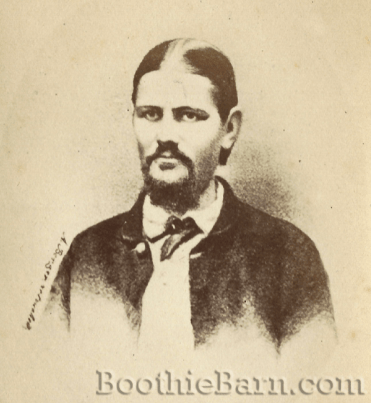
boston-corbett-cdv-boothiebarn

References:
The Byron Reed collection at The Durham Museum
Steven G. Miller
The Congressional Globe: Containing the Debates and Proceedings of First Session of the 39th Congress
The Lincoln Archives Digital Project
Genealogybank.com
The Omaha World-Herald

Categories: History | Tags: , , , , , , , | 3 Comments

“The Murderer: John Wilkes Booth and the Plot Against Lincoln” at the ALPLM

Almost a year ago, I was contacted by representatives from the Abraham Lincoln Presidential Library and Museum in Springfield, Illinois. Though I was right in the middle of setting up my classroom for a new school year (at a brand new school, and grade, actually), I dropped everything to take the call from employees of such an esteemed institution. As part of their volunteer educational programming, the ALPLM asked me if I would be willing to come to Springfield in the upcoming year and give a talk about the assassin of President Lincoln. I suppose it is not difficult to ascertain what my response was. After a few victory laps around my minefield of classroom, I settled in for the long wait until summer.

Dave Taylor at the ALPLM 6-29-2016

Less than a month ago, on June 29, I was humbled to present my speech, “The Murderer: John Wilkes Booth and the Plot Against Lincoln” for the wonderful folks at the ALPLM. The museum was kind enough to record my presentation and put it on YouTube, and so I have embedded the video below. It misses some of the fancy animations I included in my PowerPoint but is of far better quality than I could have ever done. The video below includes the lively question and answer session that followed the speech where we cover several other Lincoln assassination topics beyond John Wilkes Booth.

In addition to the speech, I spent my time in Springfield visiting the Lincoln sites and viewing several of the ALPLM’s assassination related letters and artifacts. Altogether, the speech and visit to the ALPLM are among the highlights of my “career” as a “historian.” I would like to thank Jeremy Carrell, Barbara McKean, Samuel Wheeler, Dr. James Cornelius, David Grimm, and Chuck Hand for setting everything up and for their hospitality in, and around, the ALPLM.

It was truly an honor to speak at the ALPLM and, if you have the time, I hope you enjoy the speech below.

Categories: History, News | Tags: , , , , | 20 Comments

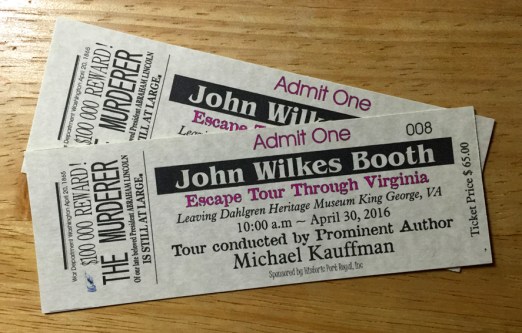
John Wilkes Booth Escape Route Tour Through Virginia

While there have been many wonderful books written about the Lincoln assassination, whenever someone asks for my opinion about the best book on the subject I always direct them to American Brutus: John Wilkes Booth and the Lincoln Conspiracies. In terms of depth of research and wealth of knowledge I believe American Brutus to be unparalleled in Lincoln assassination scholarship. In turn, I also view its author, Michael Kauffman, to be the foremost expert on the Lincoln assassination. The man has spent over 50 years delving into every single side story relating to Booth and the assassination. Not only that but Mr. Kauffman has also “walked the walked” in personally recreating many of the events relating to the history. His stories of jumping from a ladder onto the stage at Ford’s Theatre and his own attempt to row across the Potomac were big motivations to me and inspired me to create my “John Wilkes Booth in the Woods” reenactment.  Mr. Kauffman is a walking encyclopedia and also happens to be one of the nicest people you could meet. Needless to say that whenever I get a chance to talk and learn from Mr. Kauffman, I am definitely in awe of his knowledge and experience.

The reason I am saying all of this is because there is a rare opportunity for those of you in the D.C., Maryland, and Virginia area to learn from this true expert on the Lincoln assassination. While Mr. Kauffman was once a fixture of the John Wilkes Booth escape route bus tours put on by the Surratt Society, he retired from doing that a few years ago and rarely does bus tours anymore. However, he will be conducting a very special John Wilkes Booth escape route bus tour on Saturday, April 30, 2016. This unique bus tour is being put on by Historic Port Royal, the historical society in Port Royal, Virginia, where John Wilkes Booth was cornered and killed. This tour is focused entirely on Booth’s escape through Virginia and will commence just over the Potomac River in King George County, Virginia. Here’s a scanned page about the event from the newest HPR newsletter:

HPR Page April 30 BERT Kauffman

Click to enlarge

As some of you may know, I am a board member for Historic Port Royal. We are a growing historical society and currently operate three different museums: The Port Royal Museum of American History, The Port Royal Museum of Medicine, and the Old Port Royal School. Each year HPR also organizes an Independence Day celebration. This is in addition to our quarterly newsletter and public events and speakers throughout the year. If you are not already a member of Historic Port Royal, please join us. We are a 100% volunteer organization and so your small annual dues help us preserve our growing collection of artifacts and keep the lights on at our museums so that more people may come and learn about this historic town.

Historic Port Royal is using this bus tour as a fundraiser and we would love to sell out every seat on the bus. As stated on the above flyer, the tour is from 10:00 am to 5:00 pm on Saturday, April 30, 2016. The cost is $65 which includes a box lunch.

For those who have taken other Booth escape route tours before, this tour will include familiar spots such as Mrs. Quesenberry’s house, Dr. Stuart’s Cleydael, and the Peyton House in Port Royal. However it will also include stops at Belle Grove Plantation (the birthplace of President James Madison where members of the 16th NY Cavalry stopped while on the hunt for Booth), The Port Royal Museum Museum of American History (which contains several artifacts relating to the Garrett farm and the death of Booth), and a fuller tour of Port Royal itself complete with a skit on the porch of the Peyton House re-enacting Booth’s arrival in town (by yours truly).

The whole event promises to be one that participants will not soon forget especially with a guide as knowledgeable as Michael Kauffman.

To get more information or to reserve your spot please call HPR Treasurer Bill Henderson at (804) 450-3994 or email him at WehLsu82@aol.com. There are very few seats left for this special tour of John Wilkes Booth’s escape through Virginia led by Lincoln assassination expert Michael Kauffman. I hope to see some of you there.

Kauffman BERT tix HPR

Categories: News | Tags: , , , , , , , | 8 Comments

Alice Gray: Successful Partnerships

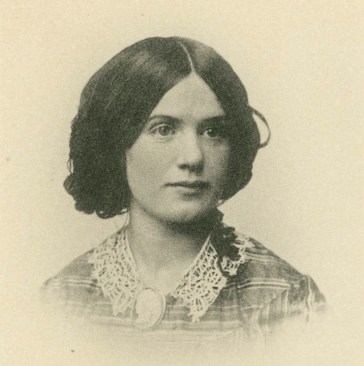
This is the second installment in a series about actress, Alice Gray. Gray’s photograph was one of the five discovered upon the body of John Wilkes Booth when he was cornered and killed on April 26, 1865. Gray’s theatrical career has largely been forgotten with very little biographical material readily available about her. The following post was developed by consulting a variety of sources including digitized newspapers such as the Buffalo Courier, Baltimore Sun, New York Clipper and D.C.’s National Intelligencer. In all, it took several days’ worth of work to find and organize the material. This post is the second in a series about Alice Grey’s life, career, and connection to the Booth family. To read Part One entitled, Alice Gray: An Actress is Born, please click HERE.

Alice Gray

Part Two: Successful Partnerships

Research completed thus far has yet to solve the mystery of how Alice Gray became acquainted with theater owner John T. Ford. Alice had met many prominent actors and actresses during her run at the Metropolitan, Charleston, and Mobile Theatres. During that time she had acted side by side to both Edwin Booth and H. B. Phillips, two men who were very close to John T. Ford. Perhaps one of them told Ford about Gray’s acting abilities and encouraged him to seek her out. Or perhaps Gray reached out to Ford on her own and inquired about working for him. Regardless of how it happened, when the 1860-1861 theatrical season began, Alice Gray found herself employed by John T. Ford to be the leading stock actress at his Holliday Street Theatre.

In the year prior, John T. Ford had lavishly renovated the Holliday Street Theatre in Baltimore. The Holliday Street Theatre was the only theater Ford owned outright at this time, but he had prior experience leasing and managing other theaters. This was Gray’s first time in Baltimore but the public there quickly took a liking to her. The August 29th, the Baltimore Sun newspaper reported that, “Miss Gray sustained the part of Mrs. Haller last night with quite unexpected grace, talent and effect and received in this case no unmeaning tribute of a call before the curtain to receive the congratulations of the audience. She is a brilliant accession.”

While in Baltimore in the fall of 1860, Alice Gray became acquainted with another member of the Booth family, John Sleeper Clarke. Clarke had known the Booth family from childhood when he played with young Edwin and John Wilkes in Baltimore. Clarke had been a member of Edwin’s kiddie acting troupe that put on plays for the neighbor kids. Clarke followed the Booths into the acting profession but became a comedian rather than a tragedian. In 1859, John Sleeper Clarke married Asia Booth, the youngest Booth daughter. Clarke was a popular comedian for John T. Ford and would make frequent appearances in his theaters. These first performances with Clarke in September of 1860 would be the first of many for Gray.

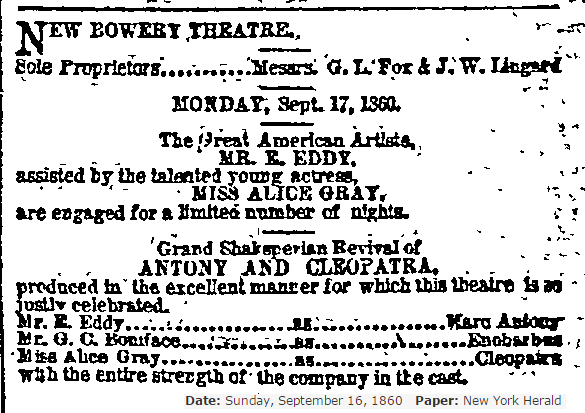
The respect and approval Gray received from Baltimore audiences was no doubt gratifying to Gray, but once again she was called back to New York City’s stages by her friend, Edward Eddy. Eddy was performing an engagement at the New Bowery Theatre and must have requested Alice Gray by name to be his leading lady. Ford gave Gray permission to leave the Holliday Street Theatre to join Eddy for his engagement in New York.

Engraving of Edward Eddy in the role of Posthumus (click to see the full image)

Engraving of Edward Eddy in the role of Posthumus (click to see the full image)

1860 With Eddy in NY Alice Gray

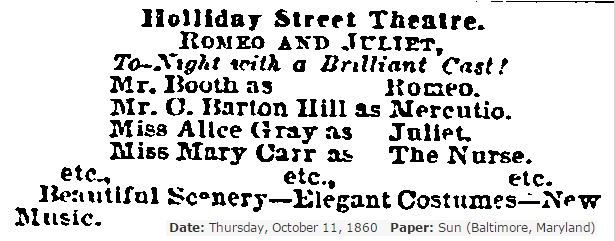
Alice Gray eventually ended her engagement with Eddy early. Whether this was contracted by Ford when he allowed her to leave or whether she returned back to the Holliday Street Theatre before the end of Eddy’s New York engagement on her own is unknown. Regardless, the decision to depart New York early to return to Baltimore was well founded. That eminent star of the stage, Edwin Booth, was starting an engagement at the Holliday Street Theatre. It had been almost three years since Booth and Gray had performed together back in Buffalo and the young actor’s fame had only increased since then. Booth in Baltimore was more of a draw than Eddy in New York and so Gray took her place alongside him.

Edwin Booth circa 1860

1860 Performing with Edwin Alice Gray

Gray played Juliet to Edwin’s Romeo, Katherina to Edwin’s Petruchio and Desdemona to Edwin’s Othello. Ford no doubt witnessed these performances and felt contented that he had chosen his leading stock actress wisely. By the end of October of 1860, Edwin departed for his next engagement in Philadelphia. Gray continued to act at the Holliday Street Theatre for the remainder of the 1860-1861 season, regularly receiving advertised benefits.

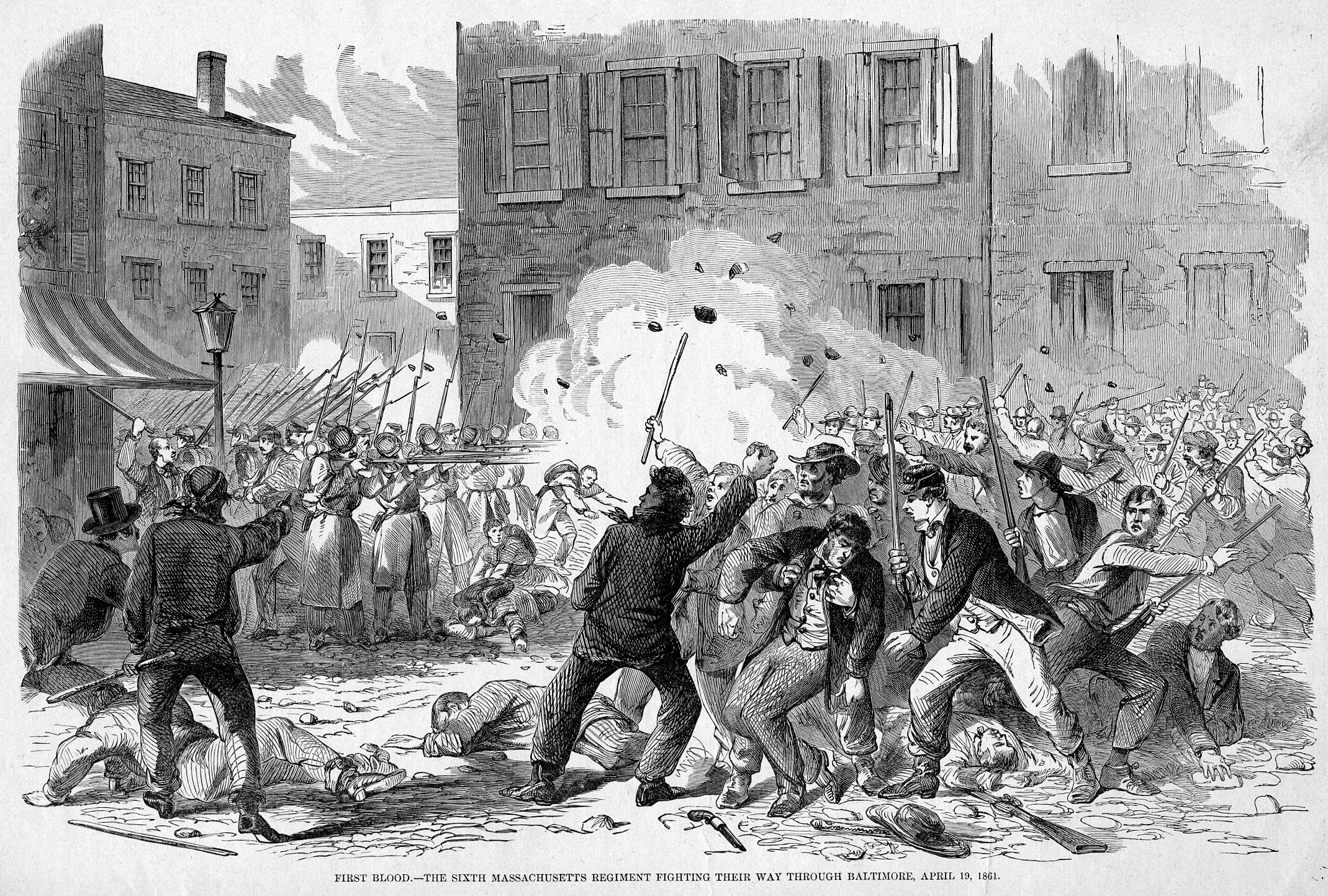
It was while Gray was in Baltimore that the Civil War began. The conflict commenced on April 12, 1861, when Confederate forces laid siege upon Fort Sumter in Charleston, South Carolina. The simmering cauldron of the secession crisis had finally boiled over due to the election of Abraham Lincoln. Working and residing in Baltimore, Alice Gray would have been acutely aware of the anti-Lincoln and anti-war feeling that permeated the city. On April 19, 1861, a deadly riot occurred in Baltimore, causing the first hostile deaths in the Civil War. The Sixth Massachusetts Militia was passing through Baltimore on their way to Washington, D.C. when they found themselves surrounded by anti-war and pro-Confederacy sympathizers who called themselves the National Volunteers. After some tense moments, members of the National Volunteers attacked some of the members of the Militia with rocks, bricks, and pistols. In response, the Militia fired at the mob. A melee broke out and ended only after the Sixth Massachusetts Militia left behind most of their supplies and made it to Camden Station. In the end, four soldiers with the Militia and 12 civilians with the mob were killed.

Baltimore Riot 1861 Harper's

The pro-Southern residents of Baltimore used this event as propaganda, comparing it to the 1770 Boston Massacre that helped spur the American Revolutionary War. However, the pro-Northern public decried the violence and bloodshed caused by the rebels in Baltimore and demanded swift action against them. The federal government responded quickly and showed Baltimore and the rest of Maryland in no uncertain terms that it would not be allowed to foment insurrection like this again. In May of 1861, General Benjamin Butler entered Baltimore with about 1,000 soldiers, occupied the city and declared martial law.

All of these events were likely troubling to Alice Gray. Gray had lived most of her life in western New York, which was a largely anti-slavery region. Her home of Buffalo, New York was filled with safe houses for the Underground Railroad and was a common meeting place for abolitionist societies. It is unlikely that Gray shared the same pro-slavery sympathies as many of those she was surrounded by in Baltimore. John T. Ford was largely anti-Lincoln, though he would become more pragmatic as the war continued. In March of 1861 however, Ford seized upon the fact that Lincoln had to slip through Baltimore incognito on his way to his own inauguration for fear of physical harm. He included the scene in a patriotic piece called “Uncle Sam’s Magic Lantern” in which the audience was presented with several scenes of America’s gloried past, present, and future. “The Flight of Abraham” was included as a scene along with “Our National Troubles,” demonstrating Ford’s pro-Confederate sympathies. Alice Gray no doubt played her assigned role in these “patriotic scenes.”

It is perhaps for these reasons that, when the 1861-1862 season commenced, Alice Gray did not stay at the Holliday Street Theatre with John Ford. Instead she made her way to Philadelphia where she was employed at the Walnut Street Theatre. The 1861-1862 theatrical season was a lean one for the entertainment industry. Many of the big British stars decided against visiting the United States with the Civil War raging. Even some American actors, like Edwin Booth, left the country for European tours of their own during this year. Audiences were smaller as the news from the war occupied everyone’s thoughts. At the Walnut Street Theatre, Alice Gray once again performed with John Sleeper Clarke when the comedian was engaged there for three weeks straight. She received little press during her time at the Walnut Street Theatre. One quick mention described her as a “handsome young actress, who evidently has not very much stage experience.” Such a review must have hurt the 26 year old actress who had been acting on the stage for almost 10 years at that point. When Gray’s season with the Walnut Street Theatre ended she decided to try her luck somewhere else.

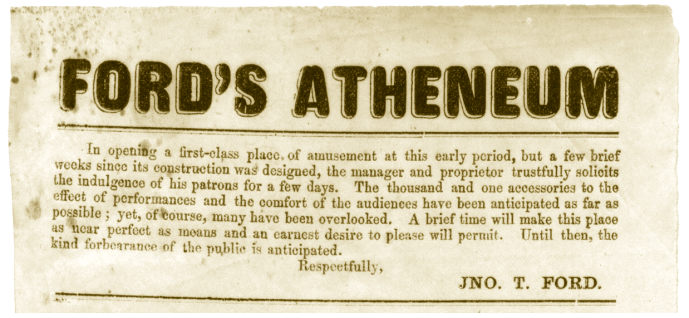
It was during Gray’s time in Philadelphia that John Ford had decided to invest in a new theater. Ford may have disliked Lincoln and the war but he was an astute business man. Washington, D.C. was a growing city during the war with thousands of soldiers and private citizens coming to the nation’s capital. Ford believed he could succeed in establishing a new theater in this growing metropolis. In December of 1861, Ford signed a five year lease on the First Baptist Church of Washington. The parishioners of the First Baptist Church had merged their congregation with another church and were no longer using the edifice on Tenth Street. The church already had a raised platform on which the pulpit and choir would be situated and so Ford realized that the building could be remodeled fairly inexpensively to serve as a theater. At first Ford rented the church to a minstrel group, but then, in February of 1862, he began a $10,000 renovation on the building. The building reopened on March 19, 1862 under the name “Ford’s Atheneum.” Ford’s renovations had been done quickly so as to preempt the reopening of another of Washington’s theater’s, Leonard Grover’s New National Theater, which completed its renovations on April 21st.

Ford's Atheneum 1862

Ford’s Atheneum proved a considerable success from the start. With his connections, Ford was able to attract first rate stars despite the war. The stationed soldiers and citizens of Washington proved devout theater goers. Even President and Mrs. Lincoln attended an operatic performance at Ford’s on May 28, 1862.

When the 1862-1863 theatrical season opened, Ford renamed the building “Ford’s New Theatre” and looked forward to another prosperous year. The theater opened with an engagement by John Sleeper Clarke and it’s possible that Ford missed his former leading actress. When Gray had departed for Philadelphia, Ford had replaced her at the Holliday Street Theatre with actress Annie Graham. Graham was brought down to Ford’s New Theatre for a few performances with John Sleeper Clarke, but it doesn’t seem like they had the same chemistry (or marketability) as Clarke and Gray once had. It appears that Ford reached out to Gray with an offer to be his leading stock actress again. Perhaps this time he promised she would act in his new D.C. theater and therefore not have to relive the unpleasant scenes in Baltimore.

Gray had spent the summer and fall months of 1862 up in Montreal, Canada. The Theatre Royal was famous for “importing” American talent during the summer months. This was also a wise way for American performers to keep a steady paycheck between seasons. Alice Gray played to good crowds but as fall gave way to winter, an engagement down in D.C. likely looked more hospitable to her.

Whether John T. Ford originally intended for Gray to perform at his new D.C. theater or whether he wanted her back at his Baltimore establishment we may never know for sure because on the evening of December 30, 1862, cruel fate made the decision for him. Under the stage of Ford’s New Theatre in D.C. a fire was started by a faulty gas meter. While there was no loss of life from the severe blaze that followed, the fire completely consumed the inside of the theater. Ford lost over $20,000 in the inferno but the outside walls of the theater survived. While other theater owners might have given up and left the capital, Ford decided to rebuild his theater and make it bigger and more grand than had ever been seen in D.C. before. Ford would spend the next eight months raising money for and constructed his new theater. In the mean time, at the Holliday Street Theatre in Baltimore, the show must go on.

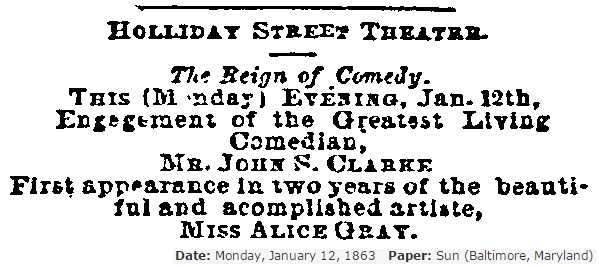
Alice Gray made her return to the Holliday Street Theatre in January of 1863 with great fanfare in the press:
1863 Return to Baltimore 1 Alice Gray 1863 Return to Baltimore 2 Alice Gray 1863 Return to Baltimore 3 Alice Gray

Gray acted alongside John Sleeper Clarke again, with Ford highly advertising their partnership. In this way, Gray replaced her own replacement, Annie Graham, who was assigned smaller female roles when Gray came back. Gray and Clarke performed together at the Holliday Street Theatre throughout Clarke’s engagement which ended on February 14th. Clarke himself must have realized that he and Gray had good chemistry together. They had performed several long engagements with each other since 1860 and the results had been paying off in the box office. When Clarke went off to his next engagement in nearby D.C., he brought Alice Gray with him.

Clarke was scheduled to make his debut at the Washington Theatre on February 23, 1863. The Washington Theatre was a slightly rundown edifice that only had intermittent productions when there was a lessee. The building lacked a full time manager/owner and was instead leased out to different individuals who staged their own shows at their own expense. It was essentially a rental theater, and hardly a five star establishment. However, John T. Ford had proven with his Atheneum that theaters were a sound business in war-time Washington. With that establishment burnt, the only other theaters of note were Grover’s New National Theater, the Washington Theatre, and Grover’s Canterbury Hall – a far seedier establishment which only catered to men. Until Ford completed his construction on his new theater, the only real places to act in Washington were the New National Theater or the Washington Theatre.

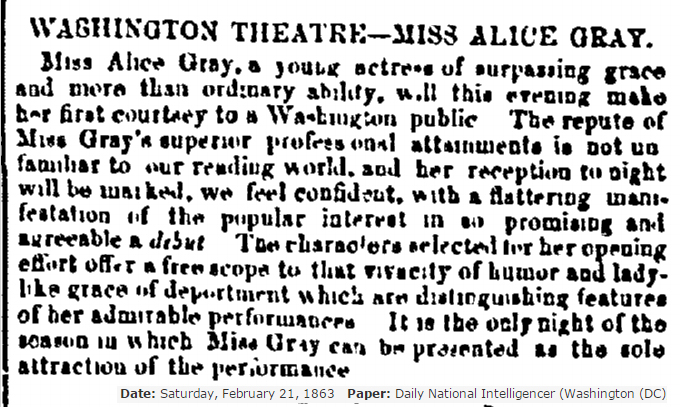
On the Saturday before Clarke’s engagement began, the managers of the Washington Theatre gave Alice Gray a headlining performance of her own.

1863 Solo in Washington Alice Gray

This was Alice’s first appearance in D.C. and the papers did a nice job of advertising it:
1863 First time in Washington

Aside from her summer engagements in Cleveland and Montreal, this was Alice Gray’s first time being the “sole attraction” for a performance. For once she was not playing second fiddle to a visiting star or receiving the assistance of other stars for her benefit. To paraphrase Shakespeare’s Richard III, “She was herself alone.” Gray likely reveled this chance, even if it was only for one night. She had a good reputation in nearby Baltimore and a good solo performance here would help her establish herself as a star quality actor to the Washington public. The next day, Gray’s performance was described as a “decided sensation” but was sadly overshadowed by her anticipated debut with Clarke, who took much of the press. Clarke was scheduled to make his debut alongside Gray in Our American Cousin on February 23rd. However, when the curtain rose, Clarke was markedly absent. An advertisement in the next day’s newspaper announced that Gray would appear alongside a different comedian, C. B. Bishop, with the following note from the management:

“The Managers regret exceedingly the disappointment to their patrons last evening in not being able to present the popular Comedian, Mr. J. S. CLARKE, in his celebrated characters, and beg to assure them that the severe domestic affliction which compelled his absence will only defer his first appearance for a night or two.”

In all, Clarke would be absent from the stage until Thursday, February 26th. The “severe domestic affliction” that prevented Clarke from performing during that time was a death in the family. Mary Devlin Booth, the wife of Edwin Booth, died on the morning of February 21st. Clarke and his wife Asia (who, coincidentally, had never cared for Mary Devlin) rushed to Edwin’s side at his time of need. They were also joined by John Wilkes Booth, who had left his upcoming engagement in Philadelphia to be with his brother. Clarke and the rest of the Booth’s attended Mary’s funeral and burial at Mount Auburn Cemetery in Cambridge, Massachusetts.

Mary Devlin Booth, Edwin Booth's first wife

Mary Devlin Booth, wife of Edwin Booth

Alice Gray had continued to perform at the Washington Theatre without Clarke: “During Mr. Clarke’s temporary absence they have introduced a young and beautiful actress, Miss Alice Gray, who has made a decided sensation in every character she has appeared in.” When Clarke returned to town, he and Gray once again began their successful partnership. Clarke’s absence for a few days increased his appeal and so Clarke and Gray performed to full houses for the rest of his engagement. However, when Clarke left for his next engagement in Philadelphia in mid March, Gray did not join him. Instead, she returned to Ford’s Holliday Street Theatre to act alongside a new member of the Booth family. This young, handsome actor would make an indelible mark on Alice Gray and, in a couple years, would alter the course of American history.


This concludes part two of the series about Alice Gray’s life, career and connection to the Booth family. The third installment, “Alice Gray and John Wilkes Booth,” will be posted soon.

References:
Backstage at the Lincoln Assassination by Thomas Bogar
Additional research graciously provided by Thomas Bogar
Restoration of Ford’s Theatre by George J. Olszewski
American Tragedian: The Life of Edwin Booth by Dr. Daniel Watermeier
Edwin Booth: A Biography and Performance History by Arthur Bloom
John Wilkes Booth: Day by Day by Arthur Loux
Images of America: Ford’s Theatre by Brian Anderson for the Ford’s Theatre Society
Ford’s Theatre Society
Ancestry.com
Library of Congress
Newspaper extracts from: University of Illinois (free), FultonHistory.com (free), GenealogyBank.com (subscription)

Categories: History | Tags: , , , , , , , , , | 11 Comments

John Wilkes Booth’s Richard III

NOTE: The live event has already occurred but you can still watch a video of the production embedded below.

Tonight (2/2/2016) at 7:00 pm CST (8:00 pm EST) a very special staged reading of Shakespeare’s Richard III will be enacted by the Harry Ransom Center at the University of Texas at Austin. The Hidden Room Theatre troupe will be recreating the production as it appeared using a promptbook which belonged to, and was annotated by, John Wilkes Booth.

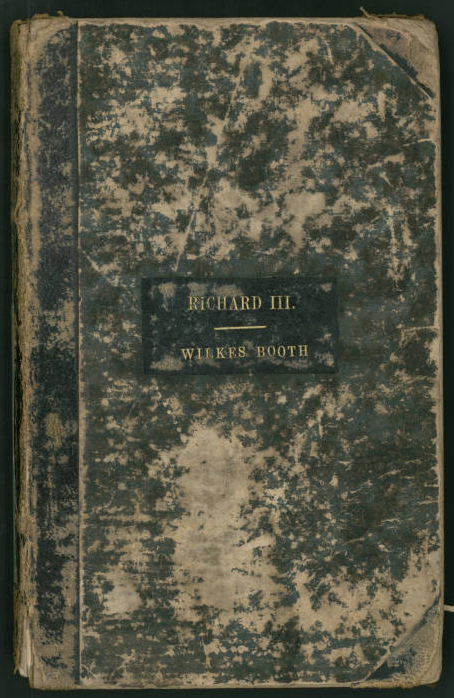
John Wilkes Booth's Richard III promptbook

John Wilkes Booth was famous for his portrayal of Richard, Duke of Gloucester, and he regularly opened his engagements in different cities with Richard III. Booth’s first full appearance as Richard occurred on October 5, 1860 and his last was on May 12, 1864. Between those two dates he performed the lead role a total of 115 times. Richard was truly Booth’s title character and the one he was most known for. The adaptation of Richard III that Booth used for the role was one that was filled with sword fighting and intensity that suited the younger Booth well. Just as Edwin Booth is known today as being the world’s greatest Hamlet, John Wilkes Booth could have been remembered as the world’s greatest Richard, had he not chosen a different path.

The Harry Ransom Center has in its collection one of only two known promptbooks belonging to John Wilkes Booth. The complete book has been scanned and is available digitally HERE. The book is filled with John Wilkes Booth’s handwritten instructions and cues regarding how his version of Richard III should be staged and enacted. It makes alterations to the printed script’s directions and adds supplemental material on how he wanted scenes to go. Promptbooks were common for stars to send out to different theaters ahead of their engagements. The stock actors in the theater’s company would then read the book in order to know how a particular star wanted “their” version of the play to go.

Usually, other than traveling back in time ourselves, reading through John Wilkes Booth’s promptbook would be the best way to get an idea of what Booth’s acting looked like. However, tonight, John Wilkes Booth’s promptbook will be used as the source material for a production of Richard III. The event will be streamed live over the internet on the Harry Ranscom Center website. The live stream is scheduled to start at 7:00 pm CST and can be accessed by clicking this link: http://www.hrc.utexas.edu/multimedia/webcast/

During the event, Harry Ransom curator Eric Colleary will be live tweeting the event and answering your questions about the production and source material. You can follow along with the discussion on Twitter with the hashtag #BoothR3.

I hope you are able to watch this unique production tonight. It is the closest we are able to get to actually watching John Wilkes Booth himself on the stage. For more information, please check out this program from the Harry Ransom Center.

Categories: History | Tags: , , , | 5 Comments

Treasures of the Dr. Samuel A. Mudd House Museum

Dr Mudd House 2015-11

Located off of Dr. Samuel A. Mudd Road in Waldorf, Maryland is, appropriately, the Dr. Samuel A. Mudd House Museum. Situated on 197 acres of farmland, the museum tells the story of Dr. Mudd and his involvement with the tragedy of 1865.

Dr. Samuel A. Mudd

There are so many fascinating objects to see at the Mudd House. In fact, one could return time and time again and still find new items of captivating interest.  The following are just a few of the countless treasures to be found at the Dr. Mudd House Museum.

A Doctor’s Life (Prior to 1865)

Dr. Mudd’s Medical Book

Mudd medical book

Dr Mudd's name on medical book

Mudd medical book interior

This volume of Beck’s Materia Medica (the text of which can be read online here) was owned by Dr. Mudd and was conceivably used by him while he was studying for his degree in medicine. Perhaps he also consulted this book from time to time during his practice. In addition to his name being written on the cover of the book, there is also an interior inscription of “Saml. A Mudd MD, Bryantown Char. Co., M.D.” While Dr. Mudd’s handwriting changed over time, the interior inscription does appear to match the handwriting on Dr. Mudd’s doctoral thesis, making it likely that he wrote the inscription himself. This book is sometimes seen laying out on the secretary in the doctor’s office or is otherwise shelved with some other medical books.

Dr. Mudd’s Mortar and Pestle

Mudd's mortar and pestle

In his occupation as a physician, Dr. Mudd owned and used this mortar and pestle to create medicines for his patients. It is on display in the doctor’s office.

Clay Jars made by Dr. Mudd’s slaves

Jars made by Dr Mudd's slaves

The practice of medicine was largely secondary to Dr. Mudd, who was first and foremost a plantation owner with a large farm. Dr. Mudd own several slaves who worked in his fields tending to his crops and in his home doing domestic chores. These clay jars, on display in the kitchen of the Mudd house, were made by some of the Mudd family slaves. Dr. Mudd could be a very harsh master at times and at the trial of the conspirators several of his former slaves testified against him. One of his former slaves, Elzee Eglen, recounted how Dr. Mudd had shot him for being “obstreperous” and then threatened to send him south to Richmond to build defenses for the Confederacy. Elzee escaped from slavery by running away from Dr. Mudd’s farm in 1863. On the other hand, a few of Dr. Mudd’s slaves testified in his favor and stated that he was a kind master. After Emancipation, three of Dr. Mudd’s slaves stayed with the family and continued to work for him for several years. We do know that Dr. Mudd participated in “slave catching posses” to recapture escaped slaves. At the very least, Dr. Mudd’s strong ties to slavery and the cause of the Confederacy dispels the concept that he was “a Union man,” as he tried to paint himself after being arrested. To learn more about those held in slavery by Dr. Mudd, I recommend the book, The Doctor’s Slaves by Robert K. Summers.

The Booth Sofa

Booth Sofa Mudd House

The centerpiece of the Mudd House parlor is an antique settee. This small sofa is undoubtedly the most iconic item on display in the Dr. Mudd House and the most photographed piece in the museum. After the assassin of Abraham Lincoln and his accomplice arrived at the Mudd farm during the early morning hours of April 15, 1865, the injured assassin was brought inside and laid upon this couch. It was while here that Dr. Mudd first examined the leg of John Wilkes Booth.  To subsequent generations of the Mudd family, this couch perfectly personified the desired mythology for Dr. Mudd. This settee was an innocent bystander, a piece that unknowingly gave comfort to an assassin. One can not place blame a sofa for being laid upon just as one cannot blame a doctor for fulfilling his Hippocratic Oath. However, while the sofa is free from any wrong doing, history has proven that Dr. Mudd had known Booth long before the assassination and likely provided assistance in Booth’s plot to abduct Abraham Lincoln.

Mrs. Mudd’s Painting

Mrs Mudd's Painting

On the wall of the bedroom where John Wilkes Booth slept during most of the daytime hours of April 15, 1865, hangs a beautiful painting called, “The Sleeping Beauty.” This painting was painted by Sarah Frances Dyer, Dr. Mudd’s wife. She painted this portrait when she was in school and it demonstrates Mrs. Mudd’s creative talents.

Wood Working to Pass the Hard Time (1865 – 1869)

A. Fort Jefferson

Many of the unique treasures contained in the Mudd house consist of objects Dr. Mudd created while carrying out his prison sentence at Fort Jefferson. During his imprisonment, Dr. Mudd (and the other prisoners) tried their hands at various crafts and trades to help pass the time. The imprisoned conspirators often sent boxes of crafts and carpentry projects back home to their loved ones. Here is a newspaper article which mentions the Lincoln conspirators’ handiwork:

Gifts from Fort Jefferson article

The following artifacts, on display at the Mudd house, are all items created by Dr. Mudd while he was in prison.

Shark Cartilage Cane

Dr Mudd Cane

Fort Jefferson is located approximately 67 miles west of Key West, Florida. This island prison was so isolated and the threat of survivable escape from it was so low that prisoners were allowed almost complete access to the entire island. As such, there were many chances for Dr. Mudd and the others to collect specimens from the tropical waters. Dr. Mudd made several canes and walking sticks while at Fort Jefferson but this one has the unique feature of being decorated with shark cartilage likely scavenged from the remains of a shark that had washed up on the Dry Tortugas. This cane is displayed on the bed in Dr. Mudd’s bedroom.

Book of Pressed Flowers

Dr Mudd's pressed flowers

Though a limited amount of flora grew on Fort Jefferson due to the lack of fresh water, Dr. Mudd still took the time to collect samples of flowers and leaves from the island’s vegetation. He put his specimens into this album, which appears to have been originally created to hold CDVs, common photographs of the day. This book is on display in a case in the second floor hallway.

Letter Opener

Mudd letter opener

Dr. Mudd created this plain yet practical letter opener while at Fort Jefferson. It is displayed in the second floor case.

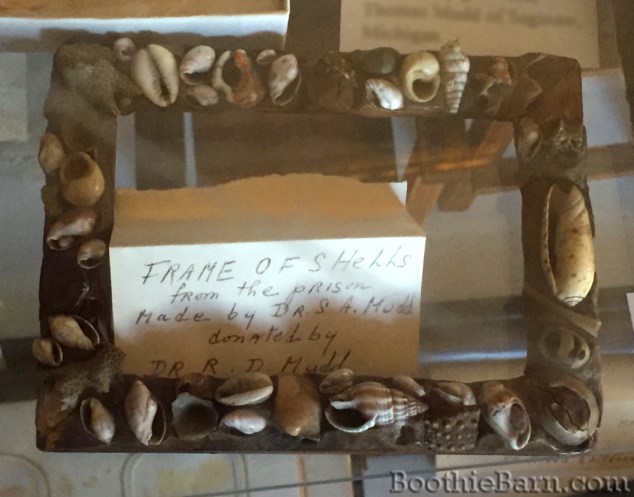
Frame of Shells

Dr Mudd Frame of Shells

Though fresh water was scarce, what was not lacking on the shores of Fort Jefferson’s beaches were shells. As such, Dr. Mudd took to collecting shells and affixing them to many different objects. This frame decorated by shells is in the second floor display case.

Jewelry Boxes

Mudd jewelry box 1

Mudd jewelry box 2

The Dr. Mudd House displays two jewelry boxes built by Dr. Mudd which he ornately encrusted with a plethora of seashells. Another jewelry box created by Dr. Mudd appeared on Antiques Roadshow several years back.

Cribbage Board

Dr Mudd's cribbage board

Jewelry boxes and cribbage boards appear to have been the most popular items to construct when spending time at Fort Jefferson. In 1867, Dr. Mudd’s fellow conspirator Edman Spangler sent a package of gifts to his former employer John T. Ford. The package contained several items to be distributed among the friends and families of Spangler, Dr. Mudd, Samuel Arnold, and Michael O’Laughlen. The items were four decorated boxes and six cribbage boards.  So it appears that the conspirators had a veritable cribbage board factory at Fort Jefferson and honed their skills making them. This board, said to have been created by Dr. Mudd, is in the second floor display case.

Checkerboard Tabletop

Dr Mudd's checkerboard top

This checkerboard tabletop, created by Dr. Mudd, is affixed to a small table just inside the front door of the Dr. Samuel A. Mudd House Museum. It demonstrates Dr. Mudd’s increasing skill at inlay and marquetry. It is worth noting that lumber was fairly scarce on the islands of the Dry Tortugas. These pieces would have been made with either driftwood that washed up on the shore, or with surplus wood from the Fort’s carpentry shop where Dr. Mudd was sent to work alongside Edman Spangler.

Circular Game Table

Dr Mudd's inlaid table

As Dr. Mudd’s time on Fort Jefferson increased, it appears he became more and more adept at woodworking and general carpentry. This game table shows great skill and is likely due to the teachings of his fellow inmate, Edman Spangler, who had been a carpenter by trade. Spangler helped construct the Booth family home of Tudor Hall many years before he was employed by John T. Ford to work as a carpenter and scene shifter in his theaters. It is likely that Spangler gave lessons in carpentry to his fellow prisoners and assisted Dr. Mudd in the creation of this table. It is on display next to the Booth sofa in the front parlor of the Mudd house.

A Familiar Guest (1873 – 1875)

As we know, Dr. Mudd eventually secured a pardon from President Andrew Johnson due to his conduct during a Yellow Fever epidemic that swept Fort Jefferson in 1867. That epidemic took the life of Michael O’Laughlen, one of the other Lincoln conspirators. President Johnson pardoned Dr. Mudd shortly before the end of his term. He also pardoned the two remaining conspirators, Samuel Arnold and Edman Spangler. The men had bonded quite a bit due to their shared ordeal and circumstances. Though they parted ways, there was a reunion of sorts between Dr. Mudd and his teacher of carpentry, Edman Spangler.

Spangler Icon

Spangler originally went back to work for John T. Ford in his theaters. John T. Ford always believed in his employee’s innocence and worked hard to get Spangler released. However, when Ford’s Holliday Street Theatre in Baltimore burned down in 1873, Spangler found himself out of a job. Spangler made his way to Dr. Mudd’s farm where he was welcomed in with open arms. Spangler lived with the Mudds for about 18 months doing carpentry, gardening, and other farm chores. Some of the artifacts on display at the Mudd house were owned or built by Edman Spangler.

Doll Chairs

Spangler doll chairs

These doll chairs, on display in the second floor case, were made by Edman Spangler for Dr. Mudd’s young children. Nettie Mudd, the doctor’s youngest child, recalled that Spangler’s, “greatest pleasure seemed to be found in extending kindnesses to others, and particularly children, of whom he was very fond.”

Spangler’s Wood Plane

Spangler's wood plane 1 Mudd house

This wood plane, used in carpentry work to flatten and smooth a piece of wood, belonged to Edman Spangler and he likely used it while doing carpentry projects around the Mudd farm. It is usually regulated to a shelf in the doctor’s office but if you ask about it, and your docent is willing, he or she may take it out so that you can see the stamped ends that bear Spangler’s name.

Spangler's wood plane 2 Mudd house

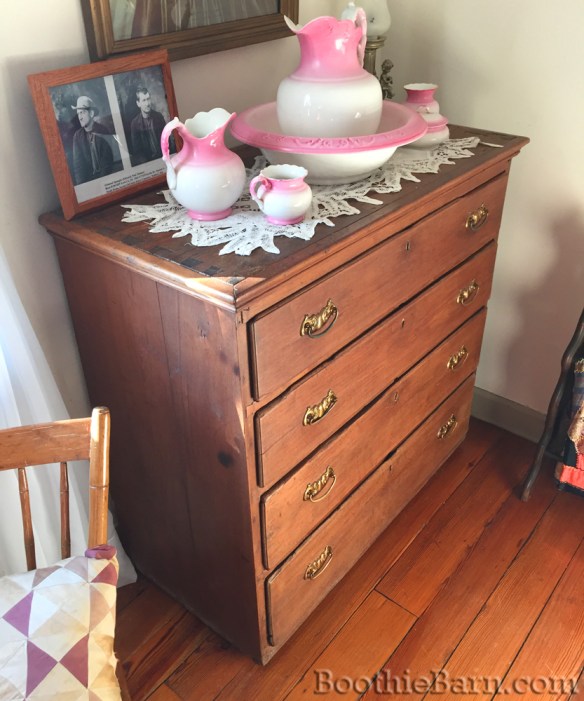
Spangler’s Dresser

Spangler's dresser Mudd house

This dresser was made by Edman Spangler while he lived at the Mudd farm. Today, this piece furnishes the children’s bedroom, a fitting place due to Spangler’s affinity for children.

Spangler’s New Testament

Spangler's New Testament from Ewing

In the second floor display case of the Mudd house is a 1861 copy of the New Testament which belonged to Edman Spangler. It was inscribed to him by Mrs. Ewing. At the trial of the conspirators, Edman Spangler was one of the last to find legal representation and it was essentially appointed to him by the court. His lawyer was General Thomas Ewing, Jr. Ewing had already been hired to defend Dr. Mudd and Samuel Arnold and was then asked to defend Spangler as well when the latter could not find any other representation. When Mrs. Ewing, the wife of Spangler’s lawyer, gave him this New Testament is unknown. However, whether he received it in the midst of the trial or at its conclusions when his fate was known, Spangler likely read thorough it for guidance and hope during the dark days at Fort Jefferson. It was found among his things when he died in the Mudd house on February 7, 1875. Edman Spangler died at the age of 49 while being cared for by his good friend, Dr. Mudd.

Endings and Beginnings (1883 – Present)

Dr. Mudd’s Original Gravestone

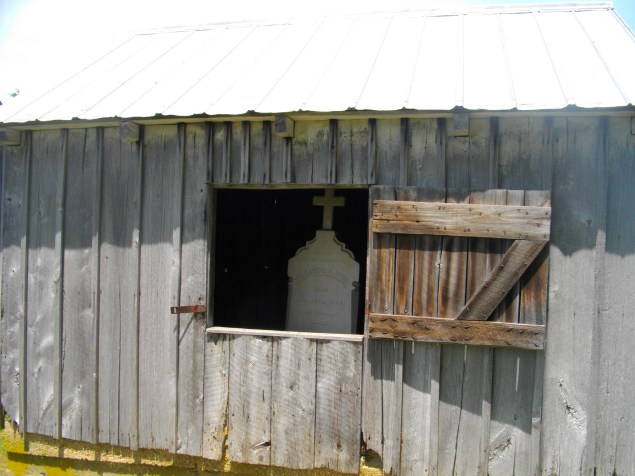
Mudd Outbuilding with grave

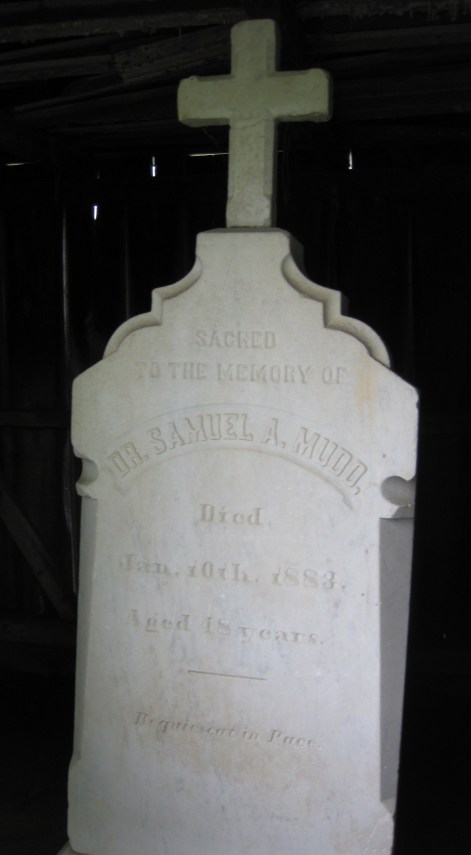
Dr. Samuel Alexander Mudd died on January 10, 1883 at the age of 49. He was interred at St. Mary’s Catholic Church Cemetery where his parents were buried. Dr. Mudd’s wife, Sarah Frances, outlived her husband by 28 years before passing away in 1911. She was buried alongside her husband but for many years had no stone of her own. Around 1940, some of Dr. and Mrs. Mudd’s descendants decided to replace Dr. Mudd’s old headstone with a new one that would include both of their names. This was also deemed advantageous to do because there was a mistake on Dr. Mudd’s original tombstone that needed to be corrected. When the gravestone was replaced, Dr. Mudd’s old headstone was brought back to the farm. It was eventually placed in an old chicken coop located right behind the Mudd house. Look closely at the image below and see if you can find the mistake on Dr. Mudd’s original headstone.

Former Mudd Stone

The Dr. Samuel A. Mudd House

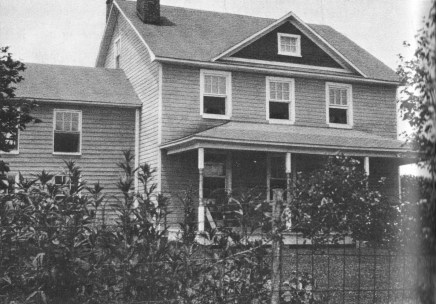
One cannot discuss the wonderful treasures in the Dr. Samuel A. Mudd House Museum without acknowledging the treasure that is the restored house museum itself. Dr. Mudd’s home continued to be owned and lived in by his descendants all the way up to the present day. As a family home, it underwent its share of upgrades and changes. In the 1970’s, the house looked quite a bit different than it did in Dr. Mudd’s day:

Dr. Mudd House circa 1970

It is very fortunate that generations of the Mudd family came together in the 1970’s and embraced the house’s historical importance. They choose to restore the house to its 1865 appearance and open it as a museum. The earliest known photographs of the Mudd house, like this one from 1895, were consulted during the restoration in order to duplicate the exterior of the home as accurately as possible.

Mudd house 1895 Victor Mason

Dr. Mudd House 1

Today, the restored Mudd house sits on almost the same amount of land it did in 1865, preserving the historic landscape that John Wilkes Booth and David Herold saw when they departed the home after receiving aid.

Mudd house landscape

Click to enlarge

Even ignoring the massive repository of items and artifacts relating to Dr. Mudd’s life and saga, the Mudd house is definitely a treasure all its own.

Plan Your Visit (The Future)

Despite the numerous artifacts highlighted in this post, there is still so much to see at the Dr. Samuel A. Mudd House Museum. There’s Mrs. Mudd’s original cruet set, the Mudds’ original sideboard table, a large format photograph taken of Dr. Mudd at Fort Jefferson, a secretary built by Dr. Mudd while in prison, keys said to be from Dr. Mudd’s prison cell, a chair from Ford’s Theatre, and so much more. Just to see these artifacts in person is worth the $7 admission price. The Dr. Samuel A. Mudd House Museum closes down for the winter season so you have plenty of time to plan your future visit to this very worthwhile museum. Please visit DrMudd.org for more information.

References:
The Dr. Samuel A. Mudd House Museum
The Doctor’s Slaves by Robert K. Summers
The Assassin’s Doctor by Robert K. Summers
American Brutus by Michael Kauffman

Categories: History | Tags: , , , , , | 26 Comments

Take an Assassination Vacation!

With summer in full swing, now is the time to get out there and take a vacation. Whether it be a lengthy week long trip to a city or shore far distant, or a day’s drive to a “not so nearby” locale, there’s nothing like the thrill of going somewhere new. For the historically minded, vacations often involve adventures such as visiting a museum, rediscovering a National Park, or just taking a selfie with a historical marker off the highway. No matter what form they may take, vacations allow us to make our own marks and memories in places outside our everyday lives.

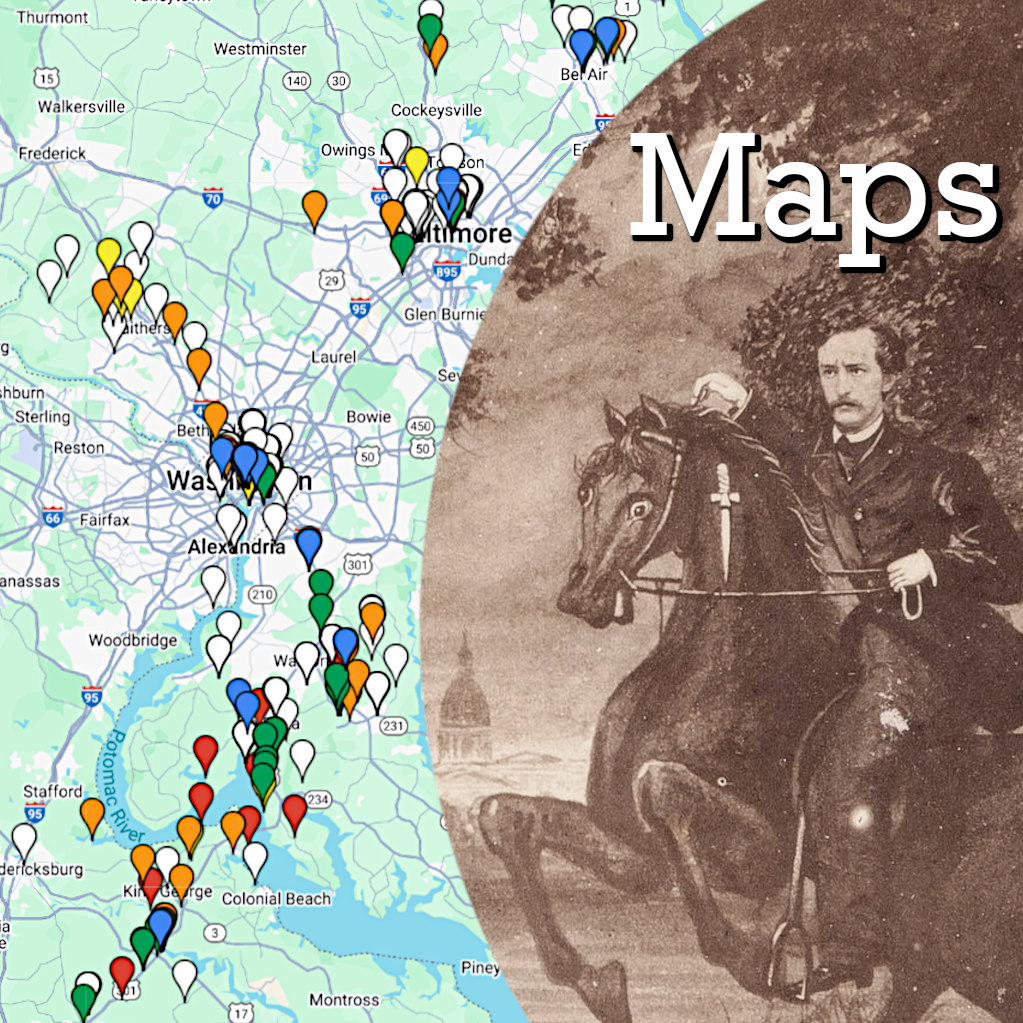
I’ve long said that the story of Lincoln’s assassination is told all over this nation. I cannot tell you how many times I’ve been in the middle of nowhere when suddenly I find a reference to the assassination staring me right in the face. The impact of Lincoln’s death and the manhunt for John Wilkes Booth reached around the globe. Over the last week, I have been working diligently to update the Maps section of this website in order to demonstrate how far reaching it truly is. The result has been the creation of five new maps, four which cover the entirety of the United States and a fifth map representing the rest of the world. All of these maps provide the locations, a brief description and the exact GPS coordinates of different sites related in some way to the assassination of Abraham Lincoln and his assassin, John Wilkes Booth.

Lincoln Assassination Maps

The maps are still in the beginning stages. The 225 locations currently marked are little more than a drop in the bucket of the potential sites worldwide. Everyday, however, new sites pop into my head and I diligently research to determine their exact GPS coordinates. I’ve analyzed Civil War era maps to determine their modern counterparts, struggled with foreign languages in order to find international sites, and I have even spent hours staring at aerial pictures of cemeteries trying to determine the exact locations of specific graves. It is very slow work, but by pinpointing these sites with GPS coordinates, we can ensure that they will never be lost. The buildings and terrain around them may change but, with GPS, where they once stood can always be found.

With this in mind, I encourage you all to check out the newly updated Maps section of BoothieBarn. See if there’s something “not so nearby” that you might want to drive and see. Better yet, if you are already planning a trip somewhere, take a look and see if you’ll be passing by something assassination related. I mean what kid wouldn’t love to make a detour on their way to Disney World in order to visit a cemetery in Geneva, Florida? “Forget Cinderella’s Castle, Mommy. What I really want to see is the grave of Lewis Powell’s skull!”

So check out the Maps section here on BoothieBarn by clicking the image above. Then get out there and have yourself an assassination vacation!

Categories: Uncategorized | Tags: , , , , , | 9 Comments

Blog at WordPress.com.