Posts Tagged With: Luther Baker

The Other Reward Offers for John Wilkes Booth’s Capture By Steven G. Miller

 “It is hard to get them all in court”

The Other Reward Offers for John Wilkes Booth’s Capture

By Steven G. Miller

One of the most famous broadsides in American History was the one issued by the War Department on April 20, 1865, announcing a $100,000 reward for the capture of John Wilkes Booth, David Herold, and John H. Surratt. This poster is one of the best-known features of the assassination of President Lincoln, and is easily identifiable by people who know little of the details of Booth’s deed and its aftermath.

One of the least-known aspects of the Lincoln Assassination is the existence, specifics, and disposition of other monetary offers for Booth’s capture. I’ve discovered that there were at least nine of them, and they were made by cities and states from “coast to coast.” All of these offers were repudiated, ignored, or combined with other schemes. The only one that was settled was the one made by the Secretary of War.

  • The first reward offer was made on the 15th of April by General Christopher Columbus Augur, the commander of the Twenty-Second Army Corps, the man in charge of the Defenses of Washington. He proclaimed that $10,000 would be given to the person or persons who aided in the arrest of the assassins.
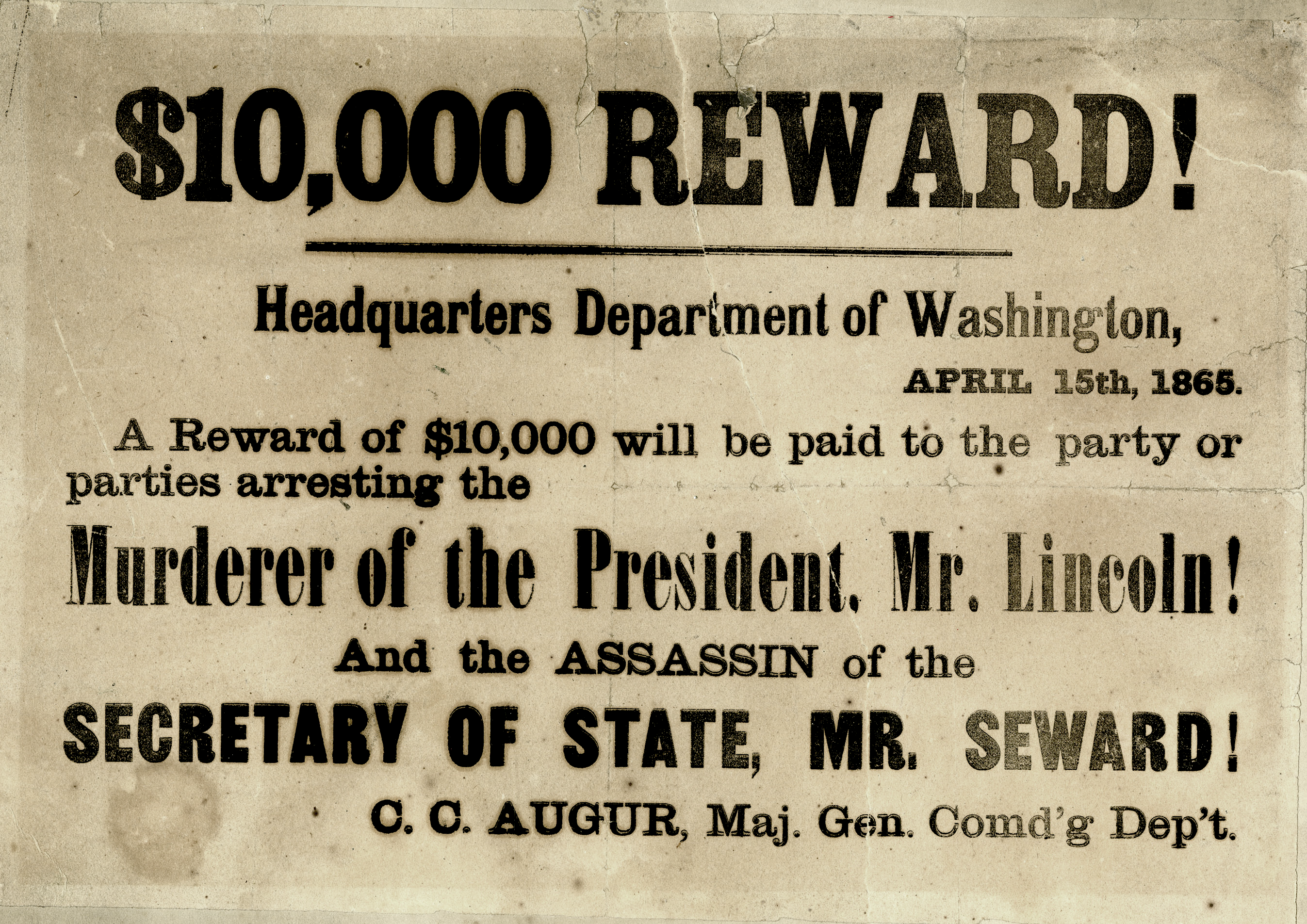
Courtesy The Historical Society of Washington, D.C.

  • Two days later, the Mayor and Common Council of the City of Washington passed “Chapter 274 of the Special Laws of the Council of the City of Washington.” This Act stated: “Be it enacted by the Board of Aldermen and Board of Common Council of the City of Washington, that the Mayor be, and he is hereby authorized and requested to offer a reward of twenty thousand dollars for the arrest and conviction of the person or persons who were concerned in the assassination of President Lincoln, and attempted murder of Secretary Seward and family on the evening of the 14th inst. Provided that if more than one should be arrested and convicted, then said amount shall be apportioned accordingly. Approved April 17, 1865.”
  • Later that day, Colonel L.C. Baker, the infamous War Department detective-chief, published a handbill proclaiming a $30,000 Reward. It described John Wilkes Booth and offered a description of the “Person Who Attempted to Assassinate Hon. W.H. Seward, Secretary of State.” As a matter of explanation, Baker stated, “The Common Council of Washington, D.C. have offered a reward of $20,000 for the arrest and conviction of these Assassins, in addition to which I will pay $10,000.”
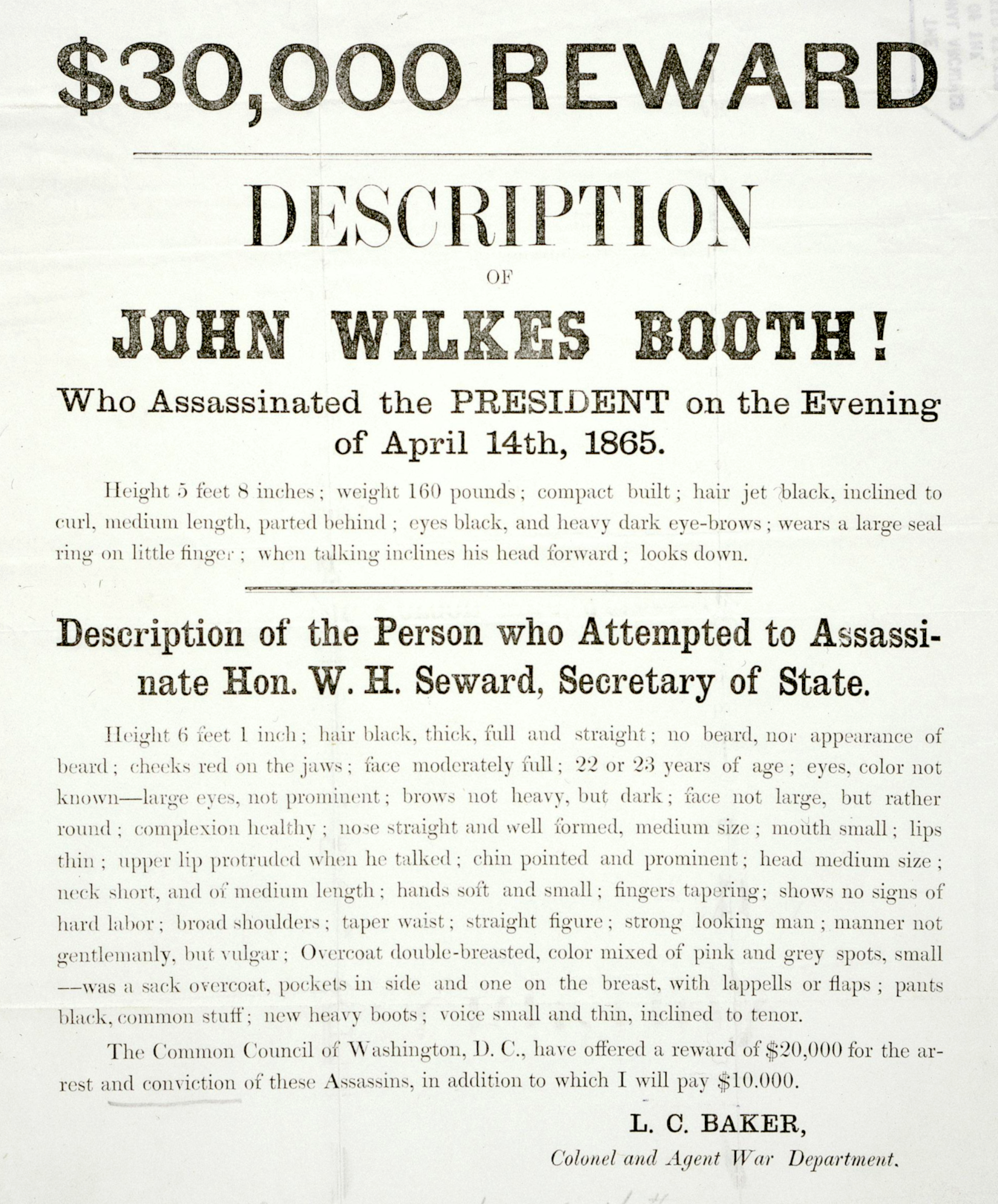
  • On some date unknown—possibly April 17—a $10,000 reward was supposedly offered by the Common Council of Philadelphia.
  • The City Council of Baltimore also offered $10,000 for the arrest of the assassin, a former hometown boy. An untitled squib, in the Davenport (IA) Daily Gazette, April 19, 1865, commented on the offer saying, “The feeling here (Baltimore) against Booth is greatly intensified by the fact that he is a Baltimorean, and it is desired by the people that one who has so dishonored the family should meet with speedy justice.”
  • On April 20th, Governor A.G. Curtin of Pennsylvania announced $10,000 for the capture of the assassin. However, this offer had a catch: the assassin had to be arrested on Pennsylvania soil.

  • On April 20, Edwin Stanton published his famous $100,000 reward, offering sums of $50,000 for Booth and $25,000 each for David Herold and John Surratt. A version of Stanton’s reward poster even had photos of the three major conspirators attached. Since this was in the days before the technique of printing halftone photos was developed, photographic prints of the three suspects were actually glued onto the printed piece. This is reportedly the first time actual photographs were added to a wanted poster. Copies of this broadside were distributed throughout Maryland and carried by search parties. The poster was also “re-composed” (re-typeset, in other words) and reprinted in New York City.

  • On some unspecified date, the State of California offered $100,000 in gold to the captors. The claim agents for Private Emory Parady, one of the captors of Booth and Herold, contacted the California officials, but nothing came of it, and nothing specific is known about this offer.
  • New York State supposedly offered a reward, too. Details are sketchy, but John Millington, another of the Garrett’s Farm patrol members, mentioned this in a 1913 letter to the National Tribune.

Most of these proposals died a quiet death and were forgotten in the aftermath of the arrest, trial, and execution of the conspirators. But attorneys pursued the offers made by the City of Baltimore, and the Washington City.

The Baltimore effort ended quickly. An article headlined “Capt. Doherty’s Story” in the August 22, 1879, New York Times explained what happened: “In the case of the claim against the City of Baltimore, which offered $30,000 {sic, should be $10,000} for the arrest of the assassin, Capt. Doherty did not sue to recover, the Mayor and Aldermen telling him point blank that they would not pay it, as the reward was offered under a previous administration. The claim has now lapsed by limitation.”

On November 24, 1865, the War Department issued “General Order No. 64”, which announced that a special commission would be set up to determine the validity of claims for the Reward and that all applications for a share had to be submitted by the end of the year.
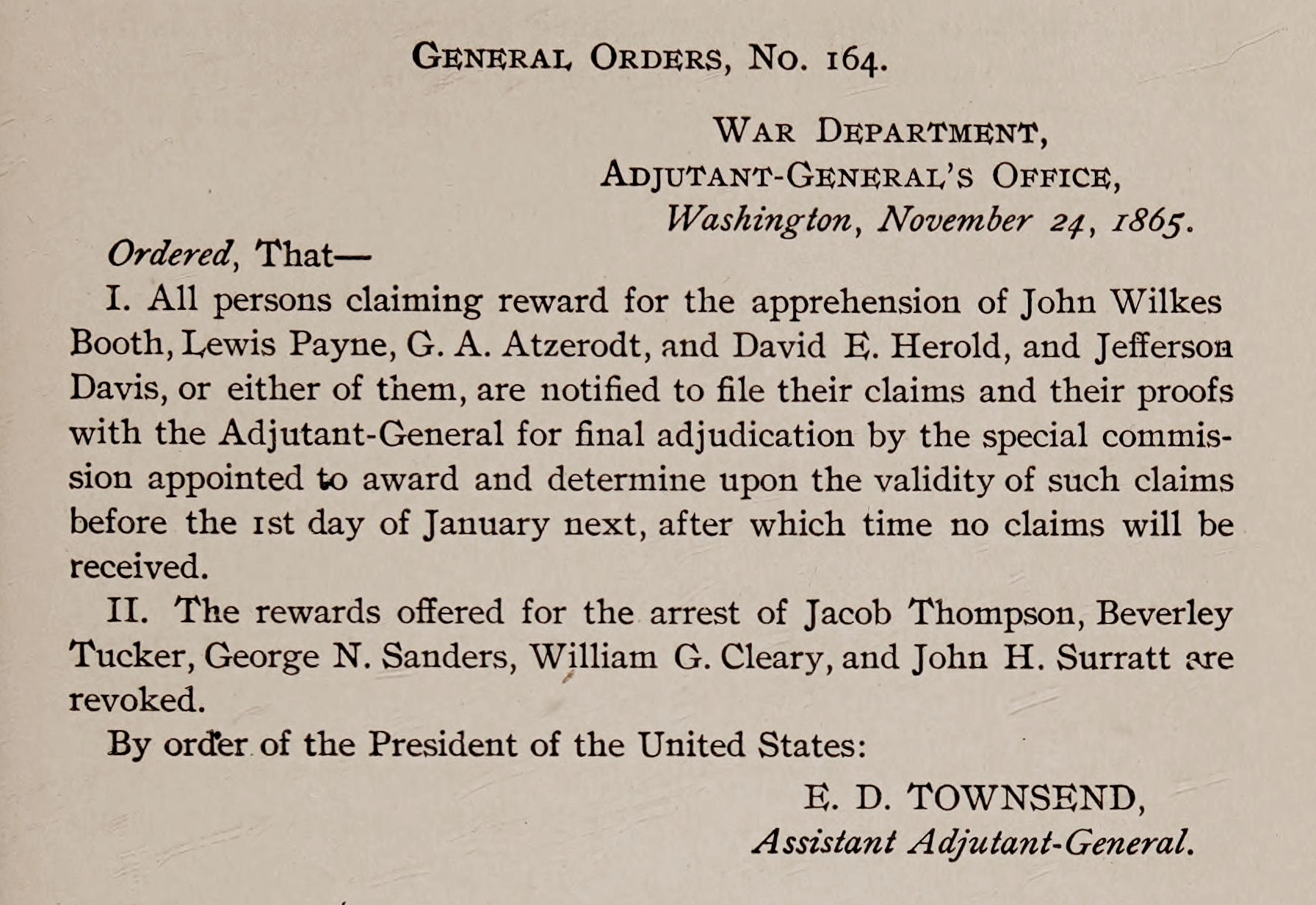
It also announced that any other offered rewards were withdrawn. This applied to the $25,000 reward offered for John H. Surratt, who was still a fugitive, and to other amounts posted for members of the so-called Confederate “Canadian Cabinet.” When the final report of the commission was issued, the offers by General Augur and Colonel Baker had been incorporated into the Stanton offer of April 20th.

There was a great deal of wrangling involved in the settlement of the War Department $100,000 offer (as detailed in my article “Were The War Department Rewards Ever Paid?” February 1994, Surratt Courier), but that was minor as compared to the struggle over the reward offered by the officials of the City of Washington. A lawsuit was filed by the three National Detective Police officers in an effort to get the city fathers to live up to their promise. This fight involved a huge cast of characters and dragged on for over a dozen years. It took so long, in fact, that by the time it started moving through the courts, one of the major players was dead.

Here’s the story of that case:
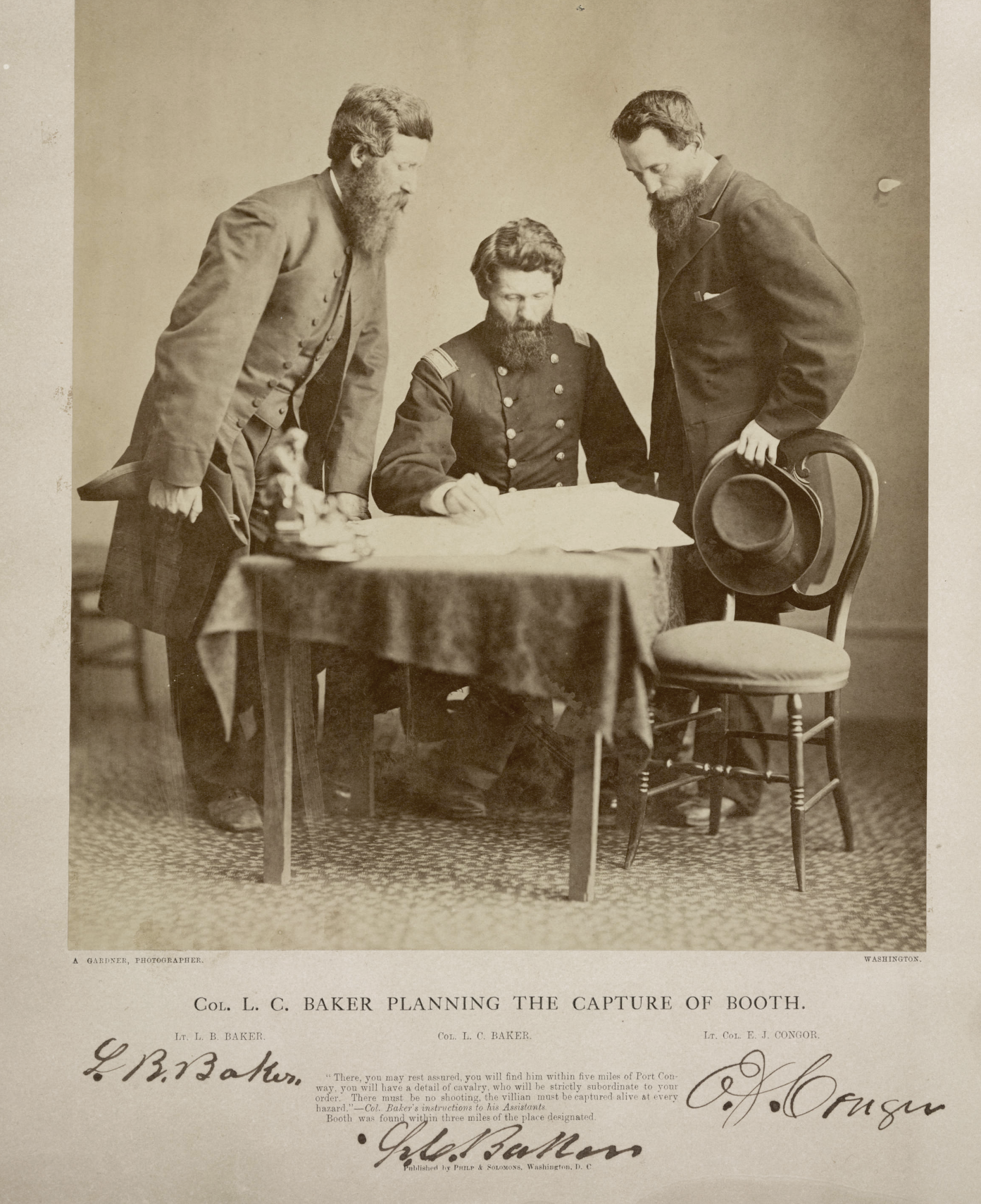
On October 10, 1866, an equity case was filed in the Supreme Court of the District of Columbia in General Term by the three detectives and their attorneys. It was designated case “No. 790” and was known as “L.C. Baker, E.J. Conger and L.B. Baker v. The City of Washington, et al.” There were forty-six individuals involved in the suit, all of whom had gotten shares of the War Department reward for the capture of Booth, Herold, Atzerodt, and Payne. The stated purpose of the case was: “For Distribution of the Reward offered by the City of Washington for Assassins of Abraham Lincoln, President of the U.S.”

As I pointed out in my earlier article, the troopers of the Garrett’s Farm patrol monitored the progress of the suit. One of the men who captured Booth, former private Emory Parady, received periodic progress reports from his agents, attorneys Owen & Wilson of Washington. On December 26, 1866, for instance, they wrote: “The suit on the city is progressing — there are so many parties it is hard to get them all in court so we can try. Capt. Dougherty is in North Carolina & we have not got service upon him and there are several others of the same character. When they are all properly before the Court we shall call it up & have it tried.”

The filing of motions, gathering and introduction of affidavits took the rest of 1866, 1867, and all of 1868. During this process, one of the prime movers, Col. Lafayette C. Baker, died in Philadelphia on July 3, 1868. Finally, all of the papers were submitted, and the Court took the matter under consideration. On April 20, 1869, the D.C. Supreme Court announced their verdict. They dismissed the case against the City, ordering that the plaintiffs pay the court costs.

The decision was appealed. On April 25, 1870, a re-argument of the case was granted by a Special Term of the D.C. Supreme Court. On September 29, 1870, the court received an “Amended Answer of the Mayor & Board of Aldermen & Common Council – motion for leave to file made in the Court sitting in General Term.”

The New York Herald summed up the case in an article on September 30th. There were several plaintiffs, the Herald said; the three detectives, Capt. Doherty, attorneys representing the 26 soldiers of the Garrett’s Farm patrol, and three civilians involved in the planning or capture of Mrs. Surratt and Louis Powell. The Herald laid out the positions of the various parties pretty clearly: The attorney for the Corporation of Washington opined that the City had had no authority to offer the reward, and that “the parties claiming this reward did nothing more than, as good citizens, they should have done.” He also stated that they were merely following the orders of their officers.

The counsel for Prentiss M. Clark, one of the civilians involved in the Mary Surratt arrest, stated that police, detectives, and soldiers had no claim since they were only doing their normal duties. By this argument, then, only civilians who gave evidence would be entitled to a chunk of the reward. (Clark was a mere civilian at the time of the arrest, naturally.)

The attorney for the troopers responded that it was not part of their duty as soldiers to assist in the capture of offenders against the law, and, besides, they were not subject to any orders from the officials of Washington City.

In the official documents of the case, counsel for the defendants stated that “the Mayor, Board of alderman and Board of Common Council of the City of Washington did not and do not possess any legal authority to offer or to pay out of the monies of the tax payers of said city any sum whatsoever for the purposes mentioned in the (1865) ordinance.”
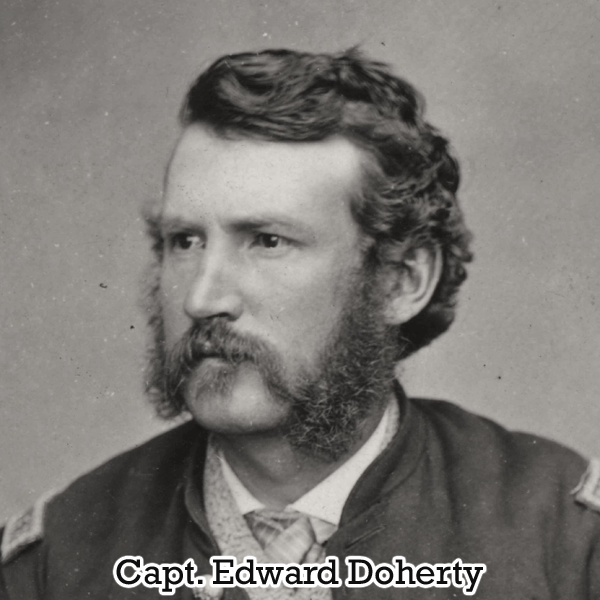
Edward Doherty responded with evidence that the mayor had issued a Message on June 30, 1868, indicating that he would seek permission from Congress (which then, as now, governed the District and Washington City) to raise $550,000 in bonds. These were to pay city debts. One of the debts specifically mentioned in the message by the mayor was the $20,000 reward, Doherty noted.

On October 15, 1870, the Special term of the Supreme Court of the District of Columbia dismissed the appeal. They found in favor of the City of Washington, et al, and against Stedpole (the executor of the estate of L.C. Baker, deceased), et al.

A long period of silence ensued, but on October 12, 1875, an appeal was filed with the United States Supreme Court. The two individuals who put up the $550 bond for the filing were Prentiss Clark and George F. Robinson, the attendant who helped save Secretary William Seward’s life in 1865.

The appeal was labeled Case No. 691. Which was soon changed to case number 441, and then to 200. It was placed on the docket for October Term 1877, but not called. It carried over to October Term 1878.

The High Court finally dealt with it, but not in a way that the plaintiffs hoped: on November 15, 1878, the U.S. Supreme Court ordered the appeal “dismissed with costs” and ordered that the defendants get their costs from the complainants.

In the end, only the War Department paid any reward for the capture of the assassins of President Lincoln. In 1898, former Pvt. John W. Millington summed up the situation to a reporter in Sioux City, Iowa. The journalist stated: “Other rewards had been offered by different states, but Mr. Millington never saw any part of them and long ago came to the conclusion that most of them were in the nature of ‘grand stand plays’.”

Sources:
Boston Corbett-George A. Huron Papers, Kansas State Historical Society, Topeka, Kansas
“Lafayette C. Baker, Everton J. Conger and Luther B. Baker, v. City of Washington, et al,” Equity docket, Supreme Court of the District of Columbia, Equity Case 790, National Archives, Washington.
Miller, Steven G., “Were The War Department Rewards Ever Paid?” February 1994, Surratt Courier.
The Millington-Parady Papers, Steven G. Miller Collection.
“One of Booth’s Captors,” National Tribune (Washington, DC), June 26, 1913. (John Millington “wants to know why” the rewards offered by the governors of New York and Pennsylvania were never paid.)
“The Reward for the Discovery of the Lincoln Assassins,” New York Herald, September 30, 1870.
“Thirty-Three Years Ago. Anniversary of the Assassination of Lincoln by John Wilkes Booth. A Resident of Sioux City Who Assisted in the Capture of the Murderer. Story of the Pursuit and the Final Scene When He Refused to Be Taken Alive and Was Shot,” The Sioux City (IA) Times, April 14, 1898.


I’m grateful to my friend Steve Miller for allowing me to republish this very interesting article he wrote about the rewards offered for the capture of John Wilkes Booth. This article was originally published in the September 2006 edition of the Surratt Courier.

Categories: History, Steven G. Miller | Tags: , , , , , , | 7 Comments

A Genuine Garrett Farm Relic? Patrick Tighe and the Patrols of the 16th NY

My friend Carolyn Mitchell alerted me to this lot currently up for bid from Raynor’s Historical Collectible Auctions. It is a collection of materials from a Civil War veteran by the name of Patrick Tighe.

The lot includes some of Tighe’s possessions including his Grand Army of the Republic medals and badges, his pocket watch, a memorial ribbons for President Lincoln, and also some CDVs and books which are not pictured. The most interesting part of the lot, and the likely reason that the starting price is $3,500, is the large piece of wood that has a replica wanted poster affixed to it. According to the lot description the piece of wood is from the Garrett house, on the porch of which John Wilkes Booth died on the morning of April 26, 1865.

The lot description states, in part:

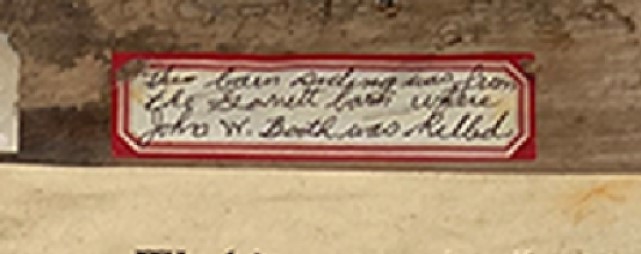
“Patrick Tighe, (The CW Date Base spells it TIGH) at age 38, enlisted September 3, 1864 at Avon New York, mustering into Company H, 16th NY Cavalry and mustered out May 29, 1865. Tighe was a member of of the detachment of the 16th New York that had the distinction of killing Lincoln assassin John Wilkes Booth and apprehending accomplice David Herold. Post war, Tighe joined GAR post #235, Avon New York. The impressive 13″ x 18” barn wood has two period labels, “GAR Post 235, H.C. Cutler, Avon New York” where Tighe was a member and the donor of the piece. The second label “This barn siding was from the Garnett House where John W. Booth was killed”. When the Post closed, c1930, the siding was returned to the Tighe family. The siding has a reproduction April 20, 1865 Reward Poster for the Assassins, 11″ x 15″…”

Carolyn knew this lot would pique my curiosity due to my interest in the death of Booth at the Garrett farm. But the name of Patrick Tighe did not ring a bell. With some research I confirmed that Pvt. Tighe was a member of the 16th NY Cavalry. As we know, a detachment of the 16th NY were the ones who tracked down John Wilkes Booth. However, when I consulted a list of the soldiers of the 16th NY present at the Garrett farm when Booth was shot and killed, Tighe’s name is not included. Nor did Tighe receive any reward money for the capture of Booth. Tighe wouldn’t be the first member of the 16th NY Cavalry to later claim to have been at Booth’s death even though he wasn’t. Several others who were part of the 16th NY but not at the Garrett farm embellished and lied about their role in hunting down Booth in the decades that followed. I was ready to chock up Patrick Tighe’s piece of Garrett farmhouse wood as yet another fake, just like the replica wanted poster attached to it.

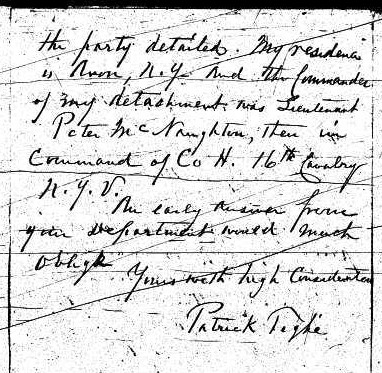
But I decided to dig a little bit more on Mr. Tighe. Though Tighe never received any money for Booth’s capture, I was surprised to find that he did make an application to the government for a share of the reward. Here are the microfilm scans of Tighe’s official application for reward money followed by a transcription:

“Avon, Dec. 8th 1865
To/ The Adjutant General of the Armies of the U.S.

Your petitioner, Patrick Tighe private in Co. H. 16th Cavalry N.Y.V humbly represents that he was one of the Cavalry detailed to arrest, seize, and if necessary kill the Assassin of Abraham Lincoln, and his accomplices.
As the Government has set apart a sum to reward those engaged to secure such arrest, I hereby put in my claim for such part of the reward as I may be entitled to – being myself, Patrick Tighe aforesaid, one of party detailed. My residence is Avon, N.Y. and the Commander of my detachment was Lieutenant Peter McNaughton, then in command of Co. H. 16th Cavalry N.Y.V.
An early answer from your department would much oblige.

Yours with high Consideration
Patrick Tighe”

I was a bit perplexed by this reward application. It is carefully worded to imply that Tighe was with the group that arrested Booth and Herold, but it doesn’t explicitly state that. It just states that Tighe was detailed with attempting to find the assassins. Hundreds of men were put in the field to search for Booth and his accomplices and many of them filed reward claims only to be denied, as Tighe was. But his ongoing connection to the 16th NY was intriguing.

I contacted Steve Miller who is THE expert on Boston Corbett and the 16th NY. He stated Tighe’s name didn’t ring any bells but the commander Tighe mentioned, Lt. Peter McNaughton, did. Steve reminded me about how different detachments of men from the 16th NY Cavalry were all over the place during the manhunt. John M. Lloyd, the renter of Mary Surratt’s tavern who became a key prosecution witness against her, was arrested by men of the 16th NY. On April 21st, Dr. Mudd was arrested by Lt. Alexander Lovett of the Veteran Reserve Corps. accompanied by Lt. William Farrell (and men) of the 16th. At the same time Booth was shot and killed a separate detachment of men from the 16th NY claimed to have been on his trail and only four miles from the Garrett farm. Lt. Peter McNaughton, in his own reward application, claimed to have been one of the men present at Dr. Mudd’s arrest.

Lt. Peter McNaughton
Courtesy of Steven G. Miller

McNaughton was also one of the leaders of what Steve calls the second Garret farm patrol. The first Garrett farm patrol is the one we are familiar with. Those were the 26 guys led by Lt. Edward Doherty, along detectives Everton Conger and Luther Baker, who tracked and killed Booth at the Garrett farm. All of those participants received a share of the reward money. After Booth’s body was transported by these men up to Washington, it was determined that a second patrol was needed to return to the northern neck of Virginia in order to retrace and determine Booth’s route through the region. This second Garrett farm patrol consisted of 20 Cavalry men of the 16th NY guided by detective Luther Baker, who had been present at Booth’s death. The soldiers were commanded by Lt. McNaughton.

The group was also accompanied by a reporter for the New York Herald, a man by the name of William N. Walton. How Walton managed to gain access to this detachment is unknown. Late on April 29th, the group set out from D.C., steamed south, and then headed overland to the Garrett farm. They arrived back at the Garrett farm just before sundown on April 30th. Several members of the detachment remained at the Garrett house overnight as did William Walton. During this time, Walton sketched the Garrett house and the remains of the burned down barn. These sketches would later be turned into woodcuts and published in the May 20 edition of Harper’s Weekly.

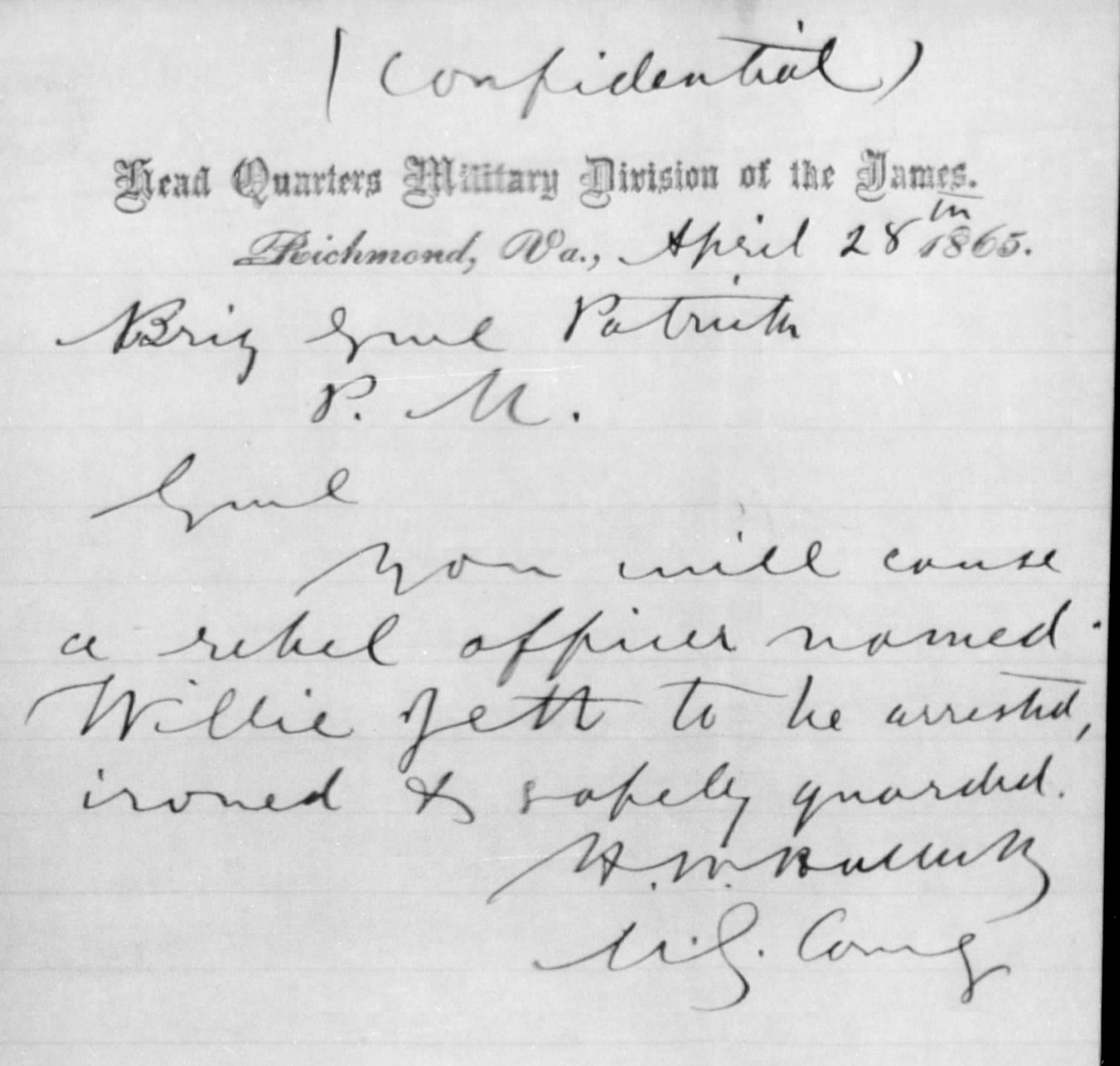
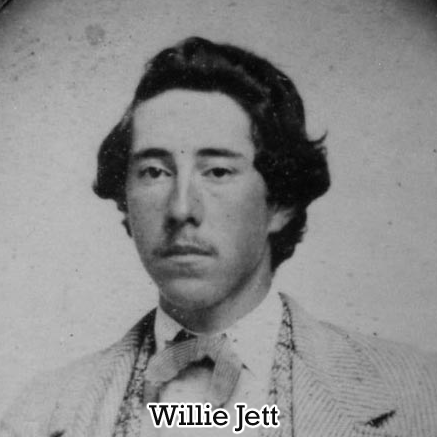
As the bulk of the second Garrett farm patrol rested at the farm, some men were ordered out in search of Willie Jett, the Confederate private who had dropped John Wilkes Booth off at the Garrett farm in the first place. Jett had originally been arrested by the first Garrett farm patrol. He was the one who led the soldiers from Bowling Green back to the Garrett farm where Booth was hiding out in the barn. Jett witnessed Booth’s death and then traveled northward with Luther Baker, a couple soldiers, and Booth’s body. However, during the trek north through Virginia, Luther Baker released Jett and allowed him to go home. When the party arrived in D.C., the Secretary of War was angry at Baker for releasing Jett and immediately ordered his arrest.

An arrest order for Willie Jett dated April 28th.

Recapturing Jett was a key part of the second Garrett farm patrol’s mission. Earlier on April 30th, Mr. Garrett had visited Willie Jett in Bowling Green and attempted to get Jett to sign a statement attesting that he had brought Booth to the farm under an assumed name. Jett had decline to sign the statement. When the troopers attempted to find Jett in Bowling Green, they discovered he had departed. Eventually they hunted him down to the home of his father in Westmoreland County and placed him under arrest.

Over the course of the next couple of days, the second Garrett farm patrol retraced Booth and Herold’s movements backwards. They spoke with several people who interacted with the fugitives during their escape and arrested several of them. They seemed to be especially keen on arresting folks with the first name of William. In addition to Willie Jett, the patrol rounded up William Rollins, the fisherman in Port Conway who had agreed to take Booth and Herold across the Rappahannock River before Jett and the other two Confederates arrived, William Lucas, the free Black man that Booth essentially evicted from his home after being turned away by Dr. Stuart, and William Bryant, the man who transported the fugitives from Mrs. Quesenberry’s to Dr. Stuart’s home of Cleydael. The group also interviewed Mrs. Quesenberry and her daughter who had spoken with David Herold after the pair made landfall in Virginia.

On May 3rd, the second Garrett farm patrol arrived back in D.C. and deposited their detainees in the Old Capitol Prison. They also passed along the information they had gained from their Virginia sojourn. The next day, William Walton published a lengthy article in the New York Herald documenting what he had learned about the escape route of John Wilkes Booth as a result of his trip with the second Garrett farm patrol.

From Walton’s article, it appears that the second Garrett farm patrol was very successful in establishing JWB’s escape route through Virginia. However, it was decided by the authorities in Washington that the second patrol had not done an adequate job in acquiring all of the witnesses that were needed. As a result, a third patrol of men from the 16th NY was quickly assembled in order to make a return trip. Detective Baker did not join this group and it was, instead, solely led by Lt. McNaughton who was now familiar with the territory. Reporter William Walton later wrote about this third trip but it’s difficult to tell if he was speaking from his own firsthand experiences with this third patrol or if he was relating things that were told to him by Lt. McNaughton, whom he appears to have befriended.

The third group of men from the 16th NY Cavalry departed D.C. late on May 4th. Rather than going to the Garrett farm, however, this detachment was tasked with finding and arresting Absalom Bainbridge and Mortimer Ruggles, the Confederate soldiers who ran into Booth with Willie Jett at the Rappahannock River. The posse traveled to Friedland, the home of Confederate General Daniel Ruggles, in King George County, Virginia. There they found and arrested Mortimer Ruggles, who was Gen. Ruggles’ son. Friedland plantation was also the home of Absalom Bainbridge as his mother and Mortimer Ruggles’ mother were sisters. Bainbridge was not at the home when Lt. McNaughton and his men got there but, according to Walton’s account arrived back about a half hour later. The two cousins were transported and placed on a waiting steamer while the group then traveled to Dr. Stuart’s home of Cleydael. While the second Garrett farm patrol had interviewed Dr. Stuart a few days earlier, they had not taken him into custody. This time, however, he was compelled to come with the men. On May 6, the whole detachment, with their three prisoners in tow, arrived back in D.C.

As stated, William Walton wrote about this third expedition for the New York Herald. You can read that article here.

Now that we have a handle of the different patrols of 16th NY Cavalry that visited Virginia, let’s return to the subject of Patrick Tighe and his alleged piece of wood from the Garrett house. As we have established, Pvt. Tighe was not one of the soldiers of the 16th NY Cavalry present in the first Garrett farm patrol that cornered and killed John Wilkes Booth on April 26, 1865. The third patrol which traveled into Virginia on May 4th did not stop at the Garrett farm but stayed in King George County the whole time. Therefore, the only way for this relic to be genuine and to have been  personally acquired by Pvt. Tighe is if he was a member of the second Garrett farm patrol that arrived at the farm on April 30th.

The problem is, there’s no way to prove that Tighe was part of that patrol. The only reason the specific members of the original Garrett farm patrol are known is because of the fight for the reward money. Lt. Doherty made a list of the men under his command in order to ensure each one received their fair share. There are no rosters of the second or third group of 16th New Yorkers who traveled into Virginia during the subsequent visits. Patrick Tighe’s application for reward money is vague. He might have been with Lt. McNaughton and the second Garrett’s farm patrol, or he might have been with him at the arrest of Dr. Mudd or another part of the manhunt. Without more information, we can never be sure.

Patrick Tighe’s grave in Avon, NY.
The stone is incorrect. Patrick Tighe died on April 3, 1907.

While the relic being genuine is an intriguing possibility, I’ll admit that the size of the wood piece and the corresponding lot description gave me some pause. Why would the Garretts allow a solider to take such a sizable piece (13″ x 18″) of wood from their house, which was their main residence and undamaged from the fire that consumed their barn? The Garretts continued to reside in the farmhouse for decades after Booth’s death and while a sneaky soldier might be able to break off a small relic, it seems improbable that Tighe could have walked off with a large piece of the house without any of the Garretts noticing and objecting. The phrasing of the lot description is also confusing as it is refers to the relic as “barn wood” from the “Garnett [sic] house”. Why would the siding of the house be called barn wood?

It appears that there are some quality control issues over at this auction house. I zoomed into the small label affixed to the wood. It’s a bit pixelated as the original image isn’t all that big. Still, in my opinion, this label reads, “This barn siding was from the Garrett barn where John W. Booth was killed.”

The wood relic coming from the remains of the burned down barn makes more sense than a piece pried off of the Garrett house. I wish the auction house had more images of the wood piece. It would be interesting to see if it bears any evidence of having been charred or blackened.

At the end of the day, however, this lot is far too pricey for a centerpiece item whose authenticity is only a “maybe”. Two of the claims in the lot description, that Tighe was there when Booth was killed and that the wood came from the Garrett “house” have been disproven. While it’s still possible that the piece is genuine and something that Pvt. Tighe acquired as a member of the second Garrett farm patrol, without further evidence, such claims would be impossible to prove. Still, this relic served as an illuminating jumping off point to learn more about the different patrols of the 16th New York Cavalry that were sent into Virginia in order to retrace the steps of John Wilkes Booth. And, hey, if anyone wants to purchase the lot before it ends on August 27th, I certainly wouldn’t say no to a gift.

Many thanks to Carolyn Mitchell for making me aware of this auction item and to Steve Miller for sharing his picture of Lt. McNaughton and his expertise with the 16th NY Cavalry with me. 

Categories: History, News | Tags: , , , , , , , , , , | 23 Comments

The Lincoln Assassination on this Day (December 12 – December 31)

Taking inspiration from one of my favorite books, John Wilkes Booth: Day by Day by Art Loux, I’ve been documenting a different Lincoln assassination or Booth family event each day on my Twitter account. If you click on any of the pictures in the tweet, it will take you to its individual tweet page on Twitter where you can click to make the images larger and easier to see. Since Twitter limits the number of characters you can type in a tweet, I often include text boxes as pictures to provide more information. I hope you enjoy reading about the different events that happened over the last week.

NOTE: After weeks of creating posts with multiple embedded tweets, this site’s homepage now tends to crash from trying to load all the different posts with all the different tweets at once. So, to help fix this, I’ve made it so that those viewing this post on the main page have to click the “Continue Reading” button below to load the full post with tweets. Even after you open the post in a separate page, it may still take awhile for the tweets to load completely. Using the Chrome browser seems to be the best way to view the tweets, but may still take a second to switch from just text to the whole tweet with pictures.

Continue reading

Categories: History, OTD | Tags: , , , , , , , , , , , , , , , , , , , , , , , , , , , , , , , , , , , , , , , , , , | Leave a comment

The Lincoln Assassination On This Day (May 23 – May 29)

Taking inspiration from one of my favorite books, John Wilkes Booth: Day by Day by Art Loux, I’m documenting a different Lincoln assassination or Booth family event each day on my Twitter account. In addition to my daily #OTD (On This Day) tweets, each Sunday I’ll be posting them here for the past week. If you click on any of the pictures in the tweet, it will take you to its individual tweet page on Twitter where you can click to make the images larger and easier to see. Since Twitter limits the number of characters you can type in a tweet, I often include text boxes as pictures to provide more information. I hope you enjoy reading about the different events that happened over the last week.

NOTE: After weeks of creating posts with multiple embedded tweets, this site’s homepage now tends to crash from trying to load all the different posts with all the different tweets at once. So, to help fix this, I’ve made it so that those viewing this post on the main page have to click the “Continue Reading” button below to load the full post with tweets. Even after you open the post in a separate page, it may still take awhile for the tweets to load completely. Using the Chrome browser seems to be the best way to view the tweets, but may still take a second to switch from just text to the whole tweet with pictures.

Continue reading

Categories: History, OTD | Tags: , , , , , , , , , , , | Leave a comment

Blog at WordPress.com.