
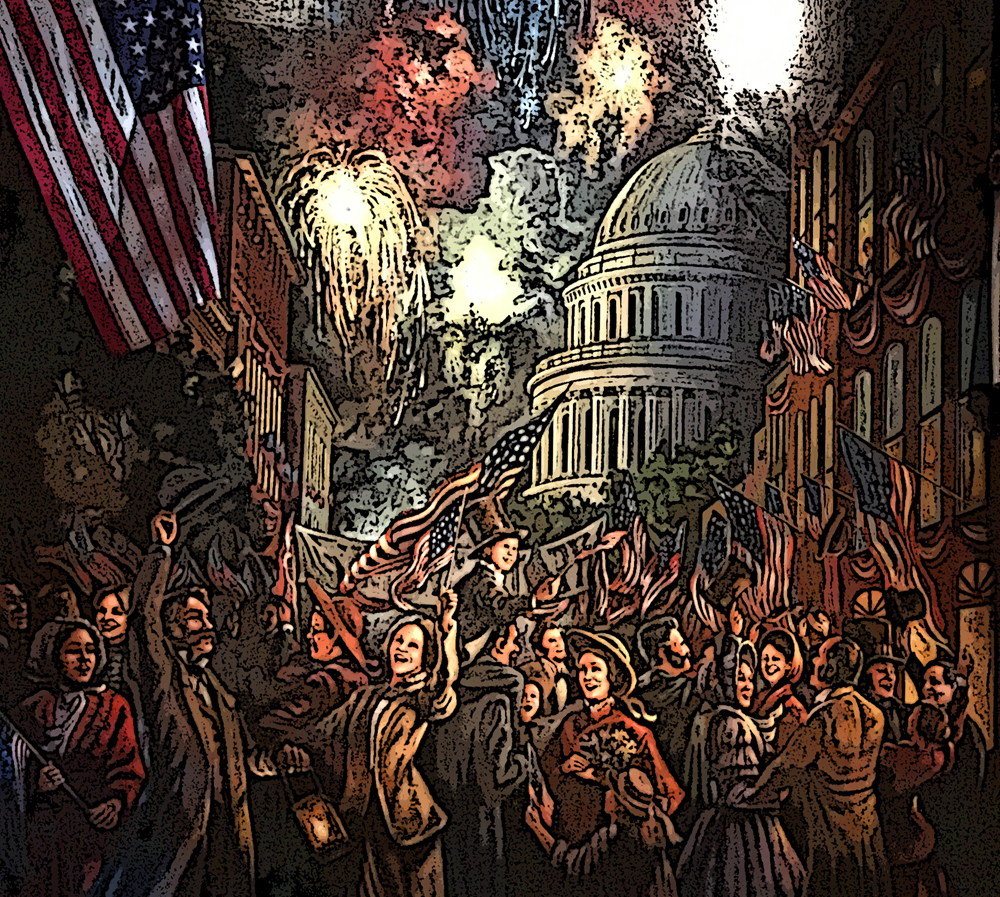
On the night of April 13, 1865, Washington, D.C. was a city of jubilation. The nation’s capital was decked out in beautiful displays of celebration and light. Described as the Grand Illumination, countless businesses and private homes burned candles and were lavishly decorated in order to mark the essential end of the Civil War due to Confederate General Robert E. Lee’s surrender to Union General Ulysses S. Grant on April 9th. The event brought many visitors to D.C. and the streets were filled with revelers until late into the night.
Among the throng of people who viewed the Grand Illumination in all its grandeur was a solemn and dejected John Wilkes Booth. The cheering and good humor of the citizens of Washington was nothing but a reminder to Booth that his prior months’ plan to abduct President Lincoln and surrender him to the Confederacy had come to naught. With the war being celebrated as practically over, Booth had to admit to himself that he had done nothing substantive on behalf of his cause.
At around 2:00 a.m., Booth returned to his rented room at the National Hotel. He composed a quick note to his mother stating of the illumination, “Everything was bright and splendid. More so in my eyes if it had been a display in a nobler cause. But so goes the world. Might makes right.” With that, Booth retired.
Booth’s whereabouts in the subsequent hours leading up to the assassination of Abraham Lincoln have long been the subject of study. We know several of the places he visited during this time – such as Ford’s Theatre to get his mail and the Surratt boarding house to ask Mrs. Surratt to take a package to her tavern for him. However, creating a minute-by-minute timeline of his movements is difficult as witnesses sometimes place him in contradictory places at the same time. Arthur Loux has done the best job of trying to establish Booth’s routine on assassination day with his book John Wilkes Booth: Day By Day. Still, plenty of uncertainties remain.
One example that demonstrates the unknowns regarding Booth and his movements on assassination day is in regard to his earliest of tasks: eating breakfast.
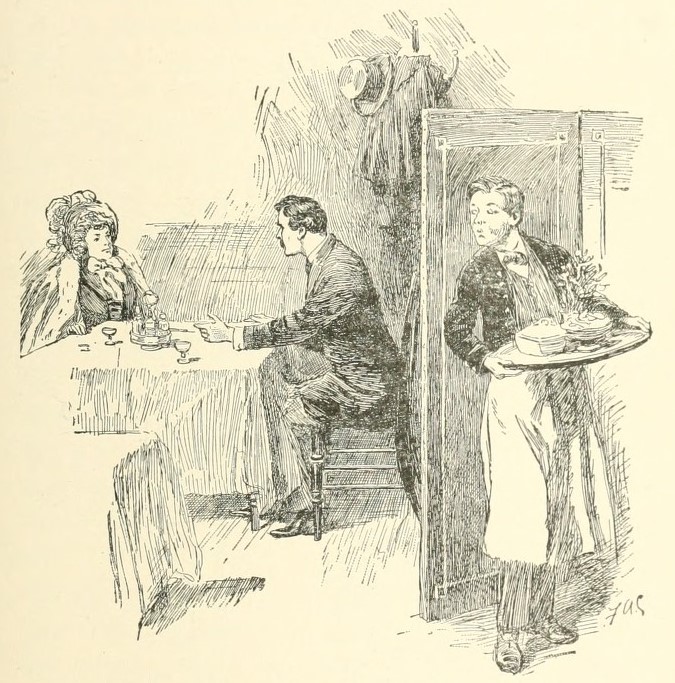
The first source that attempts to explain Booth’s breakfast on April 14, 1865, is journalist George Alfred Townsend. GATH, as he was known, was a correspondent for The World newspaper out of New York City. On the night of Lincoln’s assassination, GATH was actually in Richmond, having arrived shortly after the Confederate capital fell. After the news of Lincoln’s assassination reached Richmond, GATH quickly returned to Washington. From there, he wrote several dispatches to The World, detailing the crime, manhunt, capture of Booth, and the eventual trial of the conspirators. GATH had good relationships with civilians, government leaders, and military officers alike. As a result, he was able to compose fairly detailed reports back to his readers.
On April 28, 1865, The World published a biographical article about John Wilkes Booth written by GATH. The lengthy biography ended with a paragraph titled “Closing Scenes” which stated:
“On the morning of the murder, Booth breakfasted with Miss Carrie Bean, the daughter of a merchant and a very respectable young lady, at the National Hall. He arose from the table at, say eleven o’clock. During this breakfast, those who watched him say that he was very lively, piquant and self-possessed as ever in his life.”
While GATH does not provide the source for his knowing that Booth dined with “Miss Carrie Bean”, the entire article about Booth was supposedly “complied for The World from the statements of his personal friends and companions”. GATH’s knack for sniffing out details had always served him well. In this instance, I’m willing to believe that GATH visited the National Hotel himself and heard the story from some people there.
So who was this Carrie Bean that GATH wrote about? Well, for the longest time, I believed that Carrie Bean was this woman buried in D.C.’s Congressional Cemetery. I’ve visited her grave in the past and even had her marked on my Lincoln assassination maps as the woman who might have shared breakfast with the assassin of Lincoln.

However, as I was researching for this piece, I became less and less convinced that the Carrie Bean buried in Congressional Cemetery is the correct woman. GATH described Carrie Bean as a “Miss”, “young”, and the “daughter of a merchant”. Congressional Carrie doesn’t really fit any of these descriptors. Her father, Thomas Copeland, had been dead since 1856. He was never a merchant but spent most of his career as a “master machinist and engineer of the U.S. Navy Yard.” Next, Congressional Carrie wouldn’t have been considered all that “young” by Victorian standards. At the time of Lincoln’s assassination, she was 34 years old and the mother of three children. Her first husband, William Bean, had died ten years previously. Lastly, in 1862, Carrie remarried a man named John Russell. Thus, in 1865, Congressional Carrie was technically Mrs. Carrie Russell. While she did have a similar name as the person referred to by GATH, it no longer seems possible for her to have been the one he was writing about.
Trying to track down the identity of GATH’s “Miss Carrie Bean” has been quite a struggle as his description provided so little to go on. However, after following up on many false leads over the course of two weeks, I think I have actually found the person he was referencing. If you’ll indulge me, I’d like to walk you through my research process on this. I did not take the most linear path, but I still believe I managed to find the most likely candidate.
My investigation started when I saw a version of the following image attached to the FindaGrave page for Carrie Bean Russell buried at Congressional Cemetery:

This drawing comes from the cover of the March 23, 1861 edition of Frank Leslie’s Illustrated Newspaper. On this cover several of the ladies who attended President Lincoln’s first inaugural ball are shown, wearing their beautiful gowns.
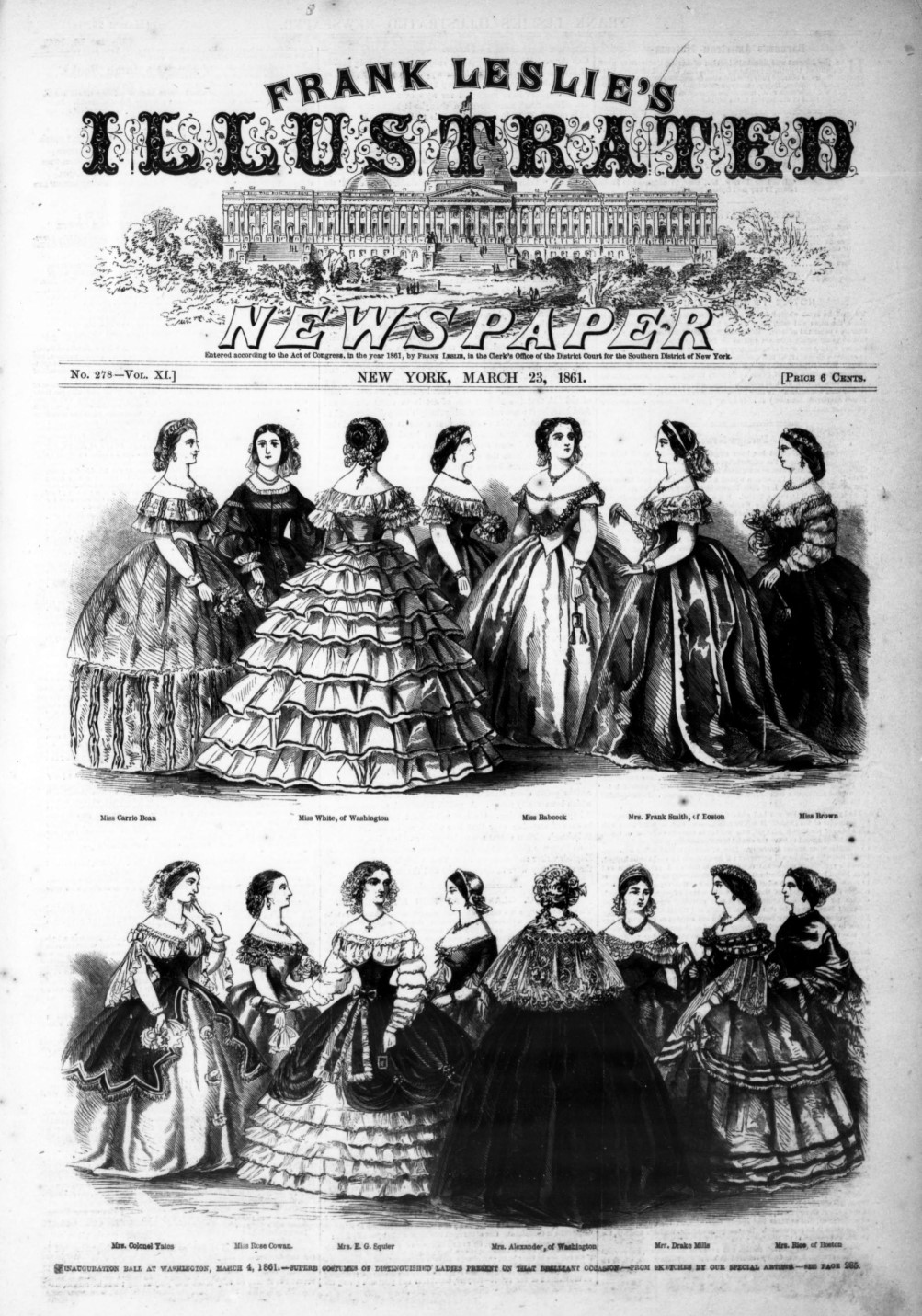
Now, this labeled image seems to be proof that Congressional Carrie was quite the socialite and had attended Lincoln’s inauguration in 1861, thus making it more likely she could have later rubbed elbows with John Wilkes Booth at the National Hotel. However, attributing this image to Carrie Bean Russell is yet another case of mistaken identity.
What bothered me about Carrie’s drawing was how some of the other ladies present on the cover had their home cities listed, while Carrie Bean did not. For example, the lady right next to Carrie is “Miss White, of Washington” and two ladies down from her is “Mrs. Frank Smith, of Boston”. Yet Carrie and others on the page are not attributed to a certain city. I found a digitized copy of the whole issue on the Internet Archive and flipped through the pages. Near the end of the issue is the article about the inaugural ball and its attendees. The dresses of the different ladies on the cover are described, some more than others. The description for Carrie Bean is short but provides one key piece of information. It states: “Miss Bean, of New York, in white tarletan.”
Suddenly things made sense. Frank Leslie’s was a New York City paper. Thus, Carrie Bean and the other New York ladies present on the cover did not need any introduction to the paper’s New York audience. Only the ladies from outside of New York got special treatment.
I decided to try and track down this Carrie Bean of New York. While Frank Leslie’s only placed her in D.C. in March of 1861, I was hoping that she might have had enough clout to get another invitation to Lincoln’s second inauguration in March of 1865, just one month before his assassination. Plus, since GATH was writing for the New York World, it would make sense for him to include this detail about Booth’s breakfast since it involved a New Yorker.
Doing different searches for “Carrie Bean” and “New York” provided several newspaper articles that appeared to be the subject in question, but none of them really provided more information on who she was. However, they all helped establish that Miss Bean was a well-known socialite who hobnobbed with important figures of the day, many of whom had connections to the National Hotel. For example, in February of 1864, “Miss Bean, of New York” attended a ball in Washington, D.C. put on by General Gouverneur Warren in honor of the II Corps of the Union Army. The exclusive event was attended by Vice President Hanibal Hamlin, General George Meade, Senator John P. Hale “and daughter” (Lucy Hale, perhaps?), along with other senators and generals. Steve Williams, a fellow researcher on Roger Norton’s Lincoln Discussion Symposium, found the following article describing “Mrs. Bean and Miss Bean” attending a reception at the home of Ohio Senator John Sherman in February of 1865. The guest list was the very elite of Washington society:

In February of 1865, Senators James Harlan of Iowa and John P. Hale of New Hampshire were both living at the National Hotel. The fact that these Senators were connected to Miss Bean and her mother enough to include them in their party or escort one of them made it seem like I was on the right track. This reception took place just two months before the assassination of Lincoln.
It must be remembered that Washington became a bustling city as a result of the Civil War and the hotel industry there boomed. It was common for people to engage in long hotel stays in those days. Politicians especially lived out of hotels and boarding houses while Congress was in session, only to return to their home states when in recess. The Vice President didn’t have an official residence in D.C. until the 1970s, which is why Andrew Johnson was living at the Kirkwood House hotel at the time of Lincoln’s death. But long hotel stays were not limited to politicians. John Wilkes Booth had been residing at the National Hotel for months before the assassination. Correspondents from all the nation’s papers lived full-time in D.C. hotels. Lawyers with business in the federal courts spent weeks or months living out of hotels waiting for their cases to come up. Countless lobbyists, salespeople, and contract-type employees in connection with the federal government took up residence in hotels rather than purchasing property. If you had the money, then staying long-term at a hotel was the way to go.
Despite these and other finds showing that Miss Bean of New York was a known social figure in Washington during the Civil War years, I still lacked any additional identifying information. A big break came from a couple of articles that were published by GATH in June of 1865. These articles had nothing to do with the assassination but covered the annual examinations at the United States Military Academy in West Point, NY. The West Point examinations were a celebrated public event in which members of the public watched as the cadets were drilled and tested. In the first article, GATH included the name of “Miss Carrie Bean” among the ladies who had helped to make the examinations a successful social affair.
However, the big break came in the second article about the West Point examinations. It focused on the attendance of Generals Winfield Scott and Ulysses S. Grant at the trials. When GATH wrote out the list of visitors who watched as the cadets were tested in the academy’s library, he included the following:
“The ladies list included Mr. F. B. Conkling, Mrs. Sherwood, Mrs. Bigelow, the Misses Fish, Mrs. Strong, Mrs. Lavery, and many of equal social prominence, Mrs. Carrie Bean, Miss Roe and other bright faces represented the Highlands.”
Ignoring the change in salutation for the moment, it was the note that this Carrie Bean and others “represented the Highlands” that finally gave me a lead.
The Highlands is the area right around West Point on either side of the Hudson River. The land here is technically part of the Appalachian Mountains, though most of the mountains here are quite low in comparison with other parts of the range. Still, along the Hudson River in this area, the land is quite hilly earning the name the Hudson Highlands. If GATH was writing truthfully, then Carrie Bean was a resident of this particular area of New York, which greatly narrowed down the search.
Armed with this information, I quickly found my most promising lead yet in the 1870 census. I found a 23-year-old named Cara Bean living in Phillipstown, NY which was located just across the Hudson River from West Point.
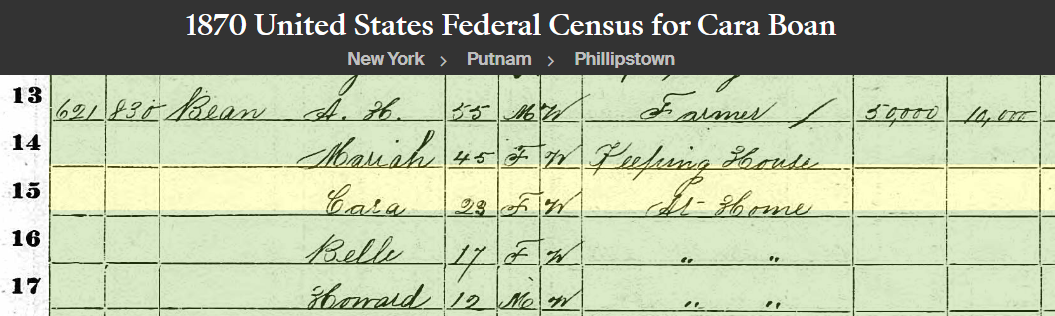
After spending over a week researching her and painstakingly creating her family tree, I’m very confident that this is the Carrie Bean referenced by GATH. Allow me to introduce you to her.
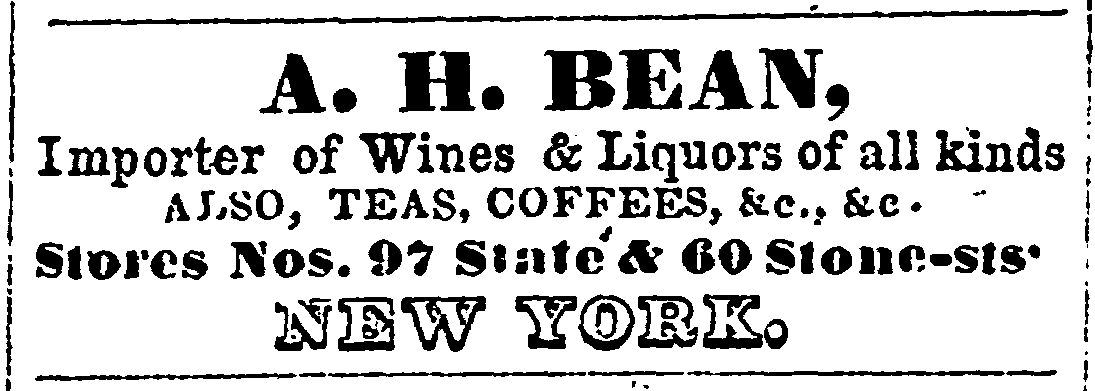
Cara Bean was the daughter of Aaron Hook Bean and Maria Louise Remer. Aaron was a New Hampshire native who moved to New York City with his brother, Moses Dudley Bean. The two men entered into the liquor business and quickly became successful merchants. After a few years, Dudley left the partnership, leaving Aaron with a successful solo business.
Aaron married Maria Remer in New York City in October of 1841. On December 22, 1842, the couple announced the birth of a daughter named Cara Louise. Two other children followed, Anabel in 1853, and Howard Dudley in 1857. In addition to his thriving liquor business, Aaron Bean got involved in other ventures. In 1844, Aaron’s sister Susan Bean Marston, a widow with two children, married Thomas “Peg Leg” Ward of Austin, Texas. Ward was a celebrated figure in Texas as a result of his having lost a leg in the fight for Texas independence. While the marriage between Ward and Susan Bean would later prove to be acrimonious and abusive, in the first few years Ward was a celebrated member of the family. Aaron used his brother-in-law’s fame and reputation to jump-start more business ventures. As a merchant, Aaron provided patent documents and clerical supplies to Ward when the latter was engaged as a Texas Land Commissioner. Aaron also invested in the Galveston, Houston, and Henderson Railroad bringing him further financial success. In the 1860 census, Aaron Bean’s real estate holdings were valued at $300,000 and his personal estate was valued at around $50,000. It was in this way that Cara Bean, her siblings, and her cousins, all lived a life without want.
When Cara Bean began living the life of a young socialite is unclear. Her family certainly had the money to support such a lifestyle. While they were New York residents, the Bean family were no strangers to the nation’s capital. Aaron Bean’s name can be found on the arrival lists of various D.C. hotels starting as early as 1853. On the last day of February 1861, Aaron Bean checked into Clay’s Hotel in Washington. Cara Bean joined her father in the city as preparations for Lincoln’s inauguration were underway.
In support of this claim is a letter written by Blanche Butler, the daughter of future Union General Benjamin Butler. In 1861, 14-year-old Blanche was attending boarding school in Washington. She regularly corresponded with her father and mother back home in Massachusetts. On March 11, 1861, Blanche wrote a letter to her mother about the events surrounding Lincoln’s inauguration and her attendance at the inaugural ball. In the letter, she mentions Carrie Bean and Clay’s Hotel specifically:
“[Uncle] came over quite early in the morning, and we had breakfast at Clay’s Hotel, with the Misses Bean, and we stood on the balcony all the morning and saw the procession go by; then Uncle took me up to Mr. Baker’s and there he decided that I had better go to the Ball; although I was not anxious to do so. Carrie Bean lent me a white muslin dress, which with a cherry sash, white gloves, a cherry and white fan, a pair of white kid slippers with little rosettes on the top, completed my outfit. We went about half past nine and returned at half past three. As I refused to dance every set but one, ate a very light supper, I did not experience any ill effects from it excepting a slight cold, which you know was impossible to avoid.”
Blanche Butler was the beneficiary of Carrie Bean’s kindness in lending the young girl a dress and the two joined the other celebrants at the ball on March 4. But it was Carrie, not Blanche, who got her dress memorialized in the pages of Frank Leslie’s.
When the Civil War broke out, Aaron Bean sold many of his business assets, including his lucrative liquor business. With the funds, he purchased the 252-acre piece of property near West Point, NY where the family is found in the 1870 census. However, Aaron Bean was not completely divested of all his businesses. In the middle of the war, Aaron partnered with a cousin of his named Moses Hook Bean to lease the former Clay’s Hotel in D.C. and run it as the United States Hotel. Aaron was also active in pushing for an expansion of the D.C. street car system. His name was on a list of incorporators for a line that would connect the Navy Yard to Georgetown. Aaron’s business interests in D.C. meant that the family had plenty of reasons to return to Washington. The various mentions of “Miss Bean” at different social gatherings in D.C. make it clear that Cara was easily able to ingratiate herself with important members of Washington society during the Civil War years.

Elizabeth “Libbie” Custer
In the spring of 1864, a new woman came to reside in Washington. Her name was Elizabeth “Libbie” Custer, and she was the wife of Major General George Armstrong Custer. The Custers had just married in February of ’64, but George’s duties to the Union army had cut their honeymoon short. Libbie, a Michigan native, was brand new to the capital city but her husband’s service at the Battle of Gettysburg had made him famous. Thus, she was quickly welcomed by the political elite of the city.
Given that both ladies ran in the same social circles, it was only inevitable that Libbie Custer and Cara Bean would meet. When this happened exactly is unclear but soon the pair had formed a friendship. In addition, Libbie became friends with Cara’s cousin, Fanny. Blanche Butler mentioned the “Misses Bean” in the plural when writing her letter in 1861. Cara Bean was 18 years old at the time of Lincoln’s first inauguration while her younger sister, Anabel, was only about 8. It’s possible that Anabel joined her sister for that trip to Washington, but I posit that there is also a chance that Blanche was referring to Cara’s cousin, Fanny.
Fanny Ellen Bean was the daughter of Moses Dudley Bean and his wife Mary Curtis. The two cousins, practically identical in age, grew up together. Aaron and Dudley’s families are shown all living together under the same roof in the 1850 and 1860 censuses. Fanny was close to Cara their whole lives and when Fanny died in 1899, she left Cara part of her estate.
Cara Bean appears to have become quite close with the Custers. It is because of them that we actually have a picture of Cara Bean. According to photography expert D. Mark Katz, on October 23, 1864, Libbie, Custer, and “Cora” Bean posed together for this photograph in Mathew Brady’s studio in Washington:

Here’s a close-up of Cara Bean from a different copy of this image:

If the date this photograph is attributed to is correct, then this is Cara Bean as she appeared just a couple months shy of her 22nd birthday.
I found this image fairly early on in my research. However, the name attributed to this image is “Miss Cora Bean”. During my initial searches, I found a couple mentions of Cora Bean but I had no way of knowing if this was the same person as the Carrie Bean mentioned by GATH and featured on the cover of Frank Leslie’s. For a time, I had actually dismissed all the references to Cora Bean entirely as I found that there was a Cora L. Bean from New York who was alive during the Civil War.
However, when I discovered Cara L. Bean and saw how easily her unique name could be confused for Cora (and how it often was when she was older), I delved more into the other Cora Bean. It ends up that Cora and Cara were second cousins. Cora was the daughter of Cotton Ward Bean, a cousin of Aaron H. Bean. But beyond the family connection, the important thing I learned is that Cora Bean wasn’t born until 1858. That means she would have only been about 6 when this picture with the Custers was taken. But it’s clear that the person in this photograph is not 6 years old. This photograph cannot be of the actual Cora L. Bean. It must be of Cara L. Bean. This helped establish the fact that, in addition to Carrie and Cara, I had another name I would have to search for in order to flesh out her life story.
The shared photograph is not the only connection between the Custers and Cara Bean. In March of 1866, George Custer was in New York without Libbie. On March 29th, George wrote a letter to Libbie recounting his activities. Libbie’s biographer, Shirley Leckie, summarized the contents of the letter in her book:
“[George] took Cora [sic] and Fannie Bean, two of Libbie’s friends, to dinner and shopping. Later the three attended Maggie Mitchell’s performance in Little Barefoot. The blond actress had become one of the most popular figures on stage, following her role in Fanchon, the Cricket, a play she now owned. During curtain calls, Custer and the two young women threw a bouquet with a card: ‘from an admiring trio.'”
Leckie continues, describing how a few days later on April 5th, Custer and the Bean cousins attended a Bal d’Opera at the Academy of Music. This was a masquerade ball in which Custer dressed up as the devil. Later, he wrote to Libbie noting Thomas Nast had drawn the scene of the ball and that a caricature of his costume was published in Harper’s Weekly. While the drawing doesn’t seem to capture either Cara or Fanny Bean, here apparently is George Armstong Custer as the devil.

General Custer was famously killed at the Battle of the Little Bighorn in 1876. A year later, his body was shipped to New York for burial at West Point Cemetery. According to newspaper articles, Libbie was attended at the funeral by her friend, Cora [sic] Bean.

The Custers were not the only individuals with whom Cara Bean established a friendship during the Civil War years. As mentioned before Senator James Harlan of Iowa had resided at the National Hotel in 1864 and 1865 and was connected to the Beans. In the early years of the war, he had lived at Clay’s Hotel, another usual haunt of the Beans. Senator Harlan’s eldest child was Mary Eunice Harlan. She was born in 1846 and was educated both in Iowa and in Washington due to her father’s position as Senator. At some point during her months in Washington, Mary Harlan met Cara Bean, likely because they ran in the same circles and often boarded at the same hotels. In 1864, a courtship began between Mary Harlan and Robert Todd Lincoln. At his father’s second inaugural ball, Robert Lincoln escorted Mary Harlan as his date. The two were planning a wedding when Abraham Lincoln’s assassination occurred. For a time, it looked like their courtship was over as a result. Eventually, however, the two renewed their courtship and on September 24, 1868, Robert Lincoln and Mary Harlan were married.
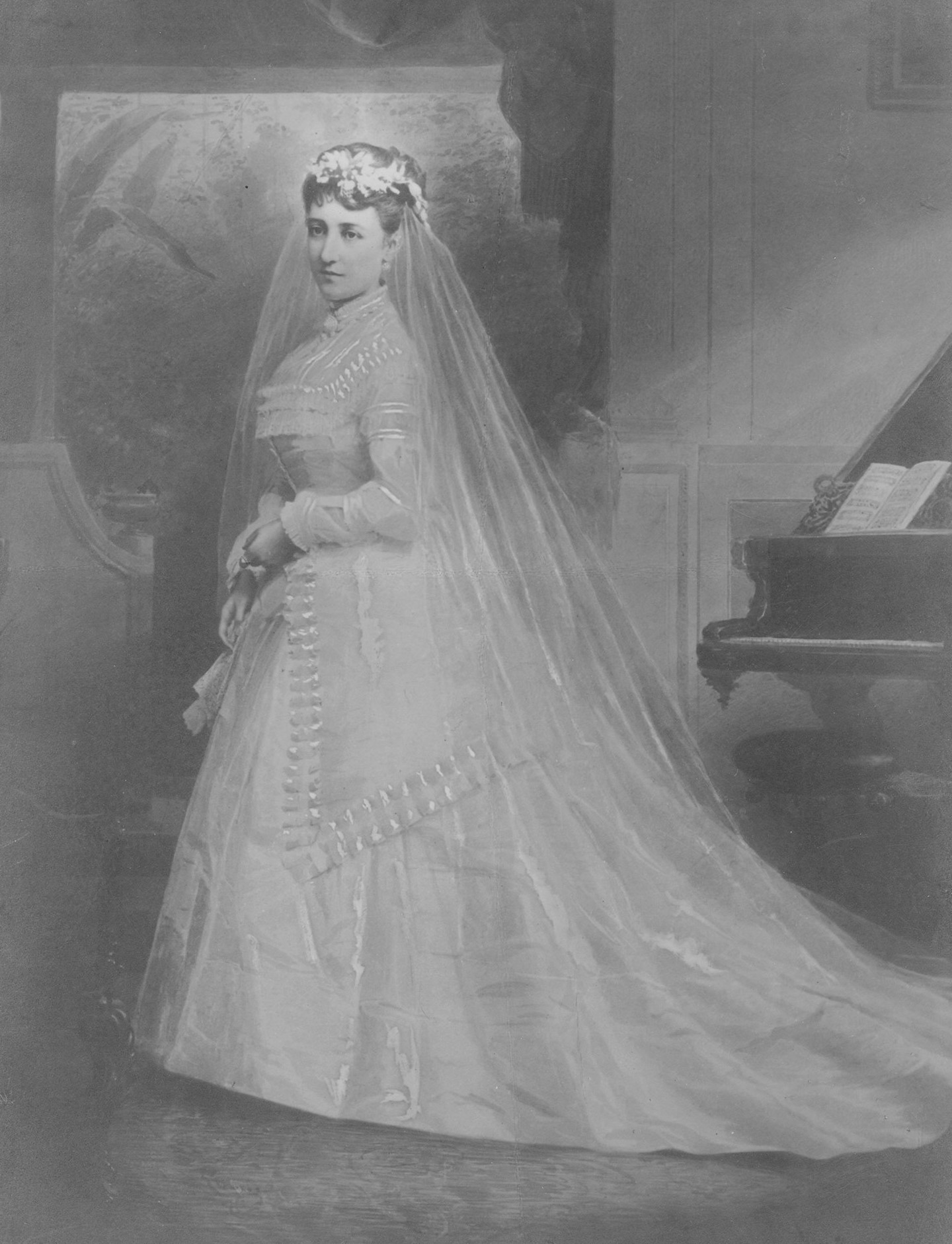
Mary Harlan in her wedding dress
By this time the Harlans had ceased living out of hotels and so the wedding was held at their home on H Street in Washington. While the wedding of Lincoln’s eldest child would have been the most celebrated event in Washington, the couple decided to keep it very small. They only invited about thirty of their closest friends. It was a very exclusive event but one person who made the cut was Cara Bean. Her outfit for the wedding was described in the D.C. papers:
“Miss Cora [sic] Bean, of New York, was dressed in white French mouslin, elegantly embroidered over a purple silk, with amethyst necklace, earrings and bracelets. Her dress was made in the latest and most fashinable [sic] style.”
From these examples, it’s clear that Cara Bean was an active participant in the social circles of Washington, D.C. during the Civil War years.
After the Civil War ended, it appears that Cara Bean returned home to New York to live at the family’s estate near West Point. References to her in the D.C. papers end with Robert Lincoln’s marriage in 1868. In 1879, the Beans sold their estate and moved back into New York City. In the 1880 census, Cara, her parents, and her brother are all living in a hotel. Also boarding in the same hotel is Cara’s cousin Fanny. Aaron Bean died in 1883 and was buried in Woodlawn Cemetery in the Bronx.
Cara Bean never married. In the 1890s she lived with her widowed mother and fellow spinster cousin Fanny at The Albany, an apartment complex on Broadway and 51st streets in New York City. Yet she was still engaged in social activities. She was a patron of the music scene and contributed her time and money to worthwhile causes, especially those catering to needy children.

1899 – 1900 was a period of great loss to Cara Bean. Her cousin Fanny died in November of 1899. A month later, her mother Maria also passed. Six months after that her brother Howard Dudley died. By 1901, she was alone at The Albany. Cara sought company with the only close relative she had left, her sister Anabel. The younger middle Bean sibling was the only one who had children. Anabel lived with her husband Edward Leavitt in Stamford, Connecticut. Cara Bean departed New York City to live with her sister and her five nieces and nephews.
On November 16, 1902, Cara Louise Bean died at the home of her sister in Stamford. She was 59 years old. Her obituary in the New York Times was short but did recount how Cara and her cousin Fanny (misidentifed as Blanche) were, “well known in New York society”.

Cara Bean’s body was transported back to New York and she was interred in Woodlawn Cemetery with her parents.
I believe that the “Miss Carrie Bean” described by George Alfred Townsend in his article about John Wilkes Booth was Cara Louse Bean of New York. The pieces of Cara Bean’s life and influence in D.C. society all seem to fit GATH’s description of that, “daughter of a merchant and a very respectable young lady”. Cara Bean knew and interacted with so many important figures in D.C. society. She resided for long periods of time at the National Hotel. She went to parties and balls with the daughters of Senators like Mary Harlan and Lucy Hale. She was escorted to events by the like of Lincoln’s private secretary John Hay and was well known to Robert Todd Lincoln. I have no doubt in my mind that Cara Bean also knew the famous actor, John Wilkes Booth.
With that being said, nothing in my research can definitively prove GATH’s claim that Cara Bean ate breakfast with John Wilkes Booth on the morning of April 14, 1865. I think it’s certainly possible that she did, but without another witness or something from Cara herself attesting to the shared meal, we can never be sure.
I never intended to do this deep dive on Cara Bean. Remember, I originally thought the Carrie Bean mentioned in GATH’s article was the woman buried in Congressional Cemetery. Talking about Carrie Bean was supposed to be the quick and easy part of a completely different blog post. I was just going to mention Carrie Bean in order to give context to an interesting article I had stumbled across. You see, Carrie Bean is not the only person who was connected with John Wilkes Booth’s breakfast on April 14, 1865. In my next post, I’ll discuss the two other ladies who have been linked to the assassin’s breakfast. One of them has a doozy of a story:

References:
The family history of Cara Bean was assembled through documents accessible through Ancestry.com and newspaper articles accessed through GenealogyBank, Newspapers.com, and the Internet Archive.
“Right or Wrong, God Judge Me”: The Writings of John Wilkes Booth edited by John Rhodehamel and Louise Taper (1997)
“John Wilkes Booth and George Alfred Townsend: A Marriage Made in Hell?” by Terry Alford (1992)
Peg Leg: The Improbable Life of a Texas Hero, Thomas William Ward, 1807 – 1872 by David C. Humphrey (2009)
Chronicles from the Nineteenth Century: Family letters of Blanche Butler and Adelbert Ames, married July 21st, 1870 by Blanche Butler Ames (1957)
Custer in Photographs by D. Mark Katz (1985)
Elizabeth Bacon Custer and the Making of a Myth by Shirley Leckie (1993)
NYPL Digital Collections
Wikimedia Commons
Giant in the Shadows: The Life of Robert T. Lincoln by Jason Emerson (2012)
Proceedings of the John Bean (1660) Association at its Annual Reunion at Boston, September 5, 1900
Burial records from Woodlawn Cemetery
My thanks to Steve Williams and others at Roger Norton’s Lincoln Discussion Symposium for helping in my initial searches for Carrie Bean.



















 LincolnConspirators.com
Recent Comments