
While Booth’s “Wrenched Ankle” was easy to get, they never did find his “Charley Horse”

While Booth’s “Wrenched Ankle” was easy to get, they never did find his “Charley Horse”
Today, I visited the Lauinger Library at Georgetown University. The bulk of my research was in the David Rankin Barbee papers contained in the library’s Special Collections. As an aside, I also looked at the Earl H. Swaim collection located in the library’s holdings. The Swaim collection contains many of the papers and correspondences of Finis Bates, W. P. Campbell, and Dr. Clarence Wilson regarding Booth’s postmortem wanderings. While a plethora of evidence disproves their claims of Booth’s escape, the theories nevertheless continue to survive.
The most interesting item located in the Swaim collection, is one of the cornerstones of the “Booth escaped” doctrine. According to Finis Bates’ book, The Escape and Suicide of John Wilkes Booth, a man known to him as John St. Helen called upon him in Granbury, TX when the latter believed he was on his deathbed. He informed the attorney that his real name was not St. Helen, but that he was, in fact, John Wilkes Booth. A few days later, St. Helen survived his illness and freely told Bates his whole story. He also presented Bates with a damaged tintype of himself so that someday, if he should choose to, he could substantiate his story as the truth. Then St. Helen left town. This tintype given to Bates by St. Helen was taken in Glenrose Mills, Texas in June of 1877. Bates would have several paintings done of the conspirators in preparation for his book and his traveling showcase of St. Helen’s body. In addition, he had the tintype painted as a complete portrait.

The original, damaged tintype, however, is in the Swaim collection:

In my opinion, John St. Helen does not even look like John Wilkes Booth.

John St. Helen

John Wilkes Booth
Similar to so many eBay auctions claiming to be unseen images of Booth, St. Helen is merely a mustachioed man with wavy hair. He lacks Booth’s distinctive Roman nose and has different eyebrows and face shape than the real McCoy.
While this picture has been the reason for so many years of historical malpractice, it was still an interesting experience to view and handle it firsthand.
Epilogue: Right before posting this I saw (via the Lincoln-Assassination forum) that a new indie movie will be coming out with the John St. Helen story as plot line. I found the timing eerily appropriate.
References:
The Legend of John Wilkes Booth: Myth, Memory, and a Mummy by C. Wyatt Evans
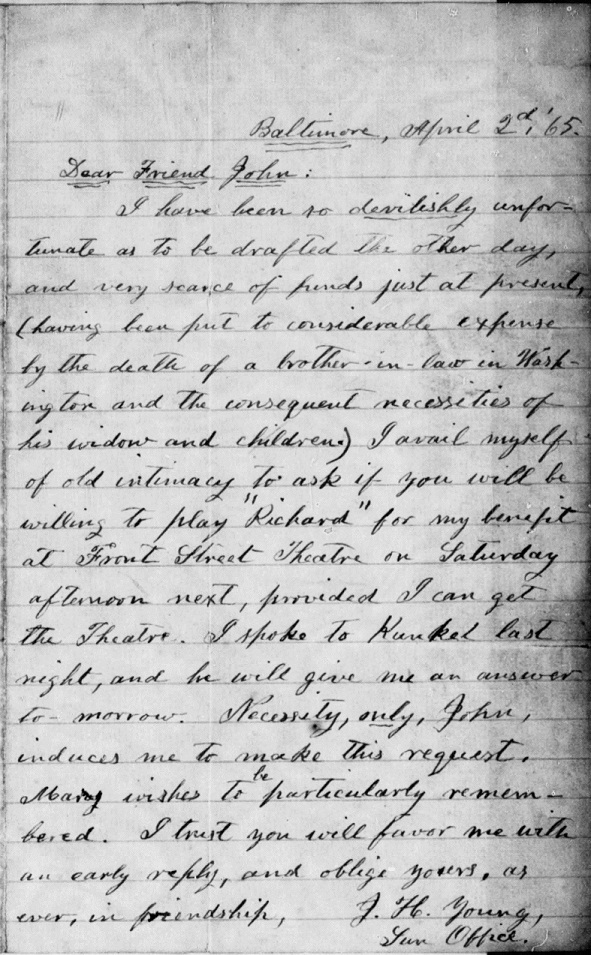
During the course of the investigation, Booth’s room at the National was searched. In the room, the investigators discovered a treasure trove of materials in Booth’s theatrical trunk. Several of the documents in Booth’s trunk were used in the investigation and even in the trial. The “Sam” letter written by Samuel Arnold was one such important discovery. Some other papers were unrelated to Booth’s plot. The following is a letter written by an actor, J.H. Young, asking Booth for a favor, twelve days prior to his assassination of Lincoln:
“Baltimore, April 2nd, ’65
Dear Friend John:
I have been so devilishly unfortunate as to be drafted the other day, and very scarce of funds just at present, (having been put to considerable expense by the death of a brother-in-law in Washington and the consequent necessities of his widow and children.) I avail myself of old intimacy to ask if you will be willing to play “Richard” for my benefit at Front Street Theatre on Saturday afternoon next, provided I can get the Theatre. I spoke to Kunkel last night, and he will give me an answer tomorrow. Necessity, only, John, induces me to make this request. Mary wishes to be particularly remembered. I trust you will favor me with an early reply, and oblige yours, as ever, in friendship.
J. H. Young,
Sun Office.”
It is unlikely that Young went to war, seeing as Richmond fell and Lee surrendered to Grant shortly after this letter was written.
While Booth did not perform a benefit for Young, this letter still presents a look at how well Booth was viewed by his acting peers. Young clearly thought Booth was a talented and popular enough actor to bring in a crowd, thus gaining him significant funds. In addition, Booth had a reputation for generosity which made him a likely candidate to help out a fellow thespian. Had his mind not been on other pursuits, it is probable that he would have come out of “retirement” to help Mr. Young.
References:
American Brutus by Michael Kauffman
When John Wilkes Booth committed his act, the uproar from the general public was swift and vicious. In D.C. angry crowds surrounded confederate prisons like the Old Capitol ready to jump any new prisoner brought in. Countless individuals who bore a resemblance to Booth were mobbed with many suffering beatings courtesy of their doppelganger. The fury extended beyond D.C. when people woke up to the news of Lincoln’s assassination on April 15th. On that morning Junius Brutus Booth, Jr., the 43 year old brother of John Wilkes, awoke to find the horrifying truth of his kin’s deed. The following is an article originally from the Louisville Courier Journal (reprinted in the August 30, 1884 edition of the Knowersville Enterprise) giving an account of how June learned of his brother’s act.

Narrow Escape of Booth’s Brother
“One of the most exciting mobs I ever saw was the one which attempted to hand Junius Brutus Booth at Cincinnati the morning after Lincoln’s assassination.”
Emile Buelier was the speaker. He made the remark in conversation with some friends last evening.
“I was then a clerk at the Burnet house,” he continued. “I had gone there with Captain Silas Miller, who had purchased it just prior to that time. Junius Booth was billed to play there, and arrived at the hotel on the evening when his brother shot Lincoln.
He came down stairs the next morning, and after breakfast was on the point of going out to take a stroll. I had just heard a few minutes before that the people were in a tumult, and had torn down his bills all over the city. He came up to the desk and, as he did so, I informed him that I thought it would be best for him not to go out in the streets. He looked at me in astonishment, and asked what I meant.
‘Haven’t you heard the news?’ said I. He replied that he had not. I didn’t like to say any more, and he walked off, looking greatly puzzled.
Going to a friend, who was standing near, he asked, in a rather excited manner what was that young man meaning by talking that way, and wanted to know if I wasn’t crazy. The man told him no, that I was a clerk.
More mystified than ever he returned and demanded my reason for the remark. I saw then that he was in ignorance of the tragedy, and reluctantly informed him that his brother had killed the President.
He was the most horrified man that I ever saw, and for the moment he was overcome with shock. I suggested to him that it would be better to go to his room, and he did so, being accompanied by one or two of his friends.
He had scarcely gone up-stairs before the room was filled with people. The mob was fully 500 in number and wanted to find Booth. They were perfectly furious, and it was the greatest difficulty that we checked them by the story that their intended victim had left the house. They would have hung him in a minute if they could have laid hands on him, so great was their rage.
They returned almost immediately, but by this time we had removed Booth from his room to that of a friend. The mob watched the house so closely that it was four or five days before he had a chance to leave. We finally smuggled him away however.
I’ve seen four or five different accounts of that circumstance, but none of them were correct. The story that he was disguised as a woman to effect his escape is all wrong. He left in ordinary clothing.”

When it was safe, Junius traveled from Cincinnati to Philadelphia to his sister Asia’s house. It was here on April 25th that Junius and Asia’s husband John Sleeper Clarke were arrested. They were transported back to D.C. and detained at the Old Capitol Prison. The authorities had found a letter written by Junius to his brother encouraging him to give up in the oil business which had cost him so much. This brotherly advice was misinterpreted by the government as a code for the assassination plot and so Junius was tracked down. Though imprisoned, he was given some preferential treatment as the Secretary of War ordered that he would not be placed in irons like many of the other prisoners. In prison he gave several statements complying with the authorities completely. He was eventually released on June 2nd.
References
Knowersville Enterprise (8/30/1884)
The Lincoln Assassination: The Evidence by William Edwards and Ed Steers
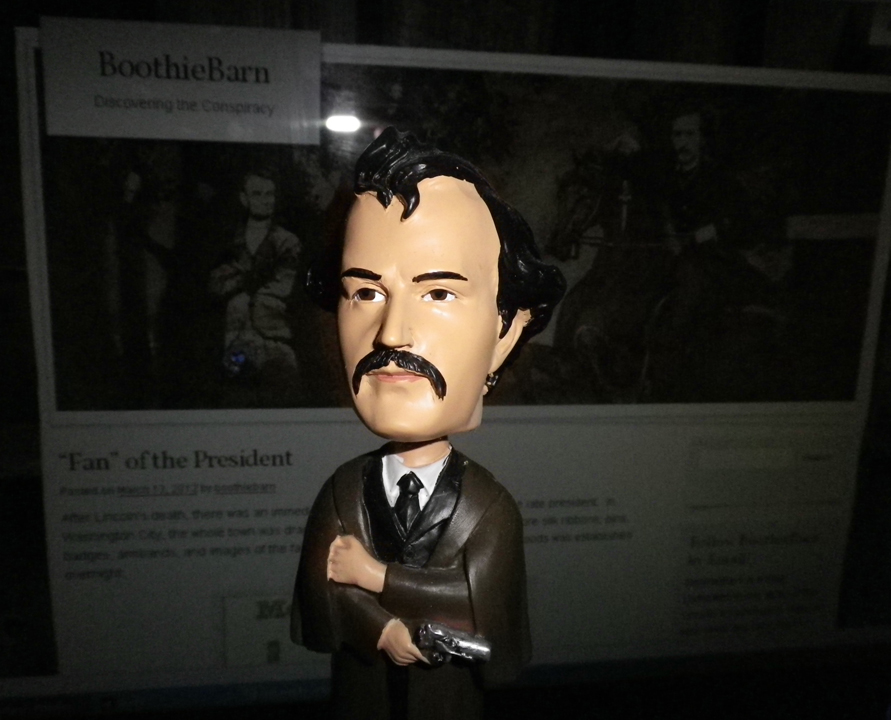
Recently, there has been a minor controversy regarding the sale of John Wilkes Booth bobblehead dolls. A reporter from The Evening Sun of Hanover, PA, received an anonymous complaint about the dolls being sold at the Gettysburg National Military Park gift shop. When he inquired about them, the gift shop removed them from their shelves within a couple of days. Shortly thereafter, without any noted complaints or inquires, the Abraham Lincoln Museum and Library in Springfield, IL, followed suit and removed the bobbleheads from their gift shop.
What interests me the most about this controversy is how people have reacted to the dolls. The original article notes that, “At first, the bobblehead drew chuckles from some of the students. But most reconsidered that reaction when asked to comment.” This “chuckling” reaction would be the one I would expect from most people. As a bobblehead doll, it is made to be a gag gift. People either like them enough to buy them, or they move on, instantly forgetting them.
When probed about the dolls, the students being interviewed responded with the remarks akin to, “Yes, I suppose it is wrong to make them.” What changed their minds? A few seconds earlier they were chuckling at the John Wilkes Booth bobblehead, and now they are calling for its immediate removal. Their new-found disgust is a product of their education about Lincoln. It is this education that we all receive. We rightfully idolize and revere Lincoln for his strengths and courage as president. He freed the slaves, kept the nation together and paid for it all with his life. All of these things are true, but, in order to keep Lincoln as the penultimate American president, we all ignore the complexity of his death. The man who killed him was a crazy, racist, cold-blooded killer. We simplify Lincoln’s death into its simplest but, inherently, incorrect terms. Did Booth commit an atrocious deed that should be condemned? Of course. However, we should not dismiss his importance to the Lincoln we know and love.
This is the fine line that “Boothies” walk pursuing our interest. As those who study the assassination, we look at the factors and motivations of Booth and other groups, North and South, who wished for and plotted to end Lincoln’s life. While Lincoln was a great man and a great president, he was also one of our most hated presidents. This version of Lincoln was buried and forgotten with Booth’s body. One bullet, fueled by the anguish of the ravaged South, transformed Lincoln into a saint. Booth should be studied not only for this crucial act, but for the complexity of his character that led him to such a crime.
Of all the reactions given in the articles and comments regarding the bobbleheads, I am slightly disappointed on a purely scholarly level with Mr. Harold Holzer’s quote in which he states that selling the John Wilkes Booth bobbleheads are, “…like selling Lee Harvey Oswald stuffed dolls at the Kennedy Center.” While both Lincoln and Kennedy’s assassinations were traumatic events in our history, the men who committed them were polar opposites. The times and events they lived through defined them as uniquely troubled individuals and each had vastly different motivations for their crimes. By painting these two assassins with the same brush, we actually diminish the honored men they killed. The story of Lincoln’s assassination is a dark one and an unpleasant one. However, looking at the men and women who conspired to kill Lincoln helps us better understand the harsh period of time in which Lincoln lived and led a nation.
According to the original Evening Sun article, 11 out of the 12 people interviewed stated that the Booth bobblehead was inappropriate. The sole hold out was a 15-year-old boy who stated, “It’s a part of history and we can’t just ignore it because it’s a bad part.”
I couldn’t agree more:
References:
Evening Sun articles: 1, 2, 3
Abraham Lincoln Museum and Library article

The real reason it took Booth and Herold two tries to reach Virginia
Have an issue with tissue? If so, then I recommend against you visiting the Mütter Museum in Philadelphia. Founded in 1849 by the Philadelphia College of Physicians, it houses one of the premiere collections of medical oddities and specimens. Perfectly preserved skulls, fetuses, and the most enlarged body parts you’ve ever seen, cover the walls from ceiling to floor. Among the collection of plasticized parts, lies a piece of the assassin himself.
During his autopsy on April 27th 1865, the vertebrae through which the fatal bullet traveled were removed from John Wilkes Booth. Those vertebrae now lie in the National Museum of Health and Medicine. The tissue surrounding and scraped from those vertebrae, on the other hand, is exhibited at the Mütter Museum.

Tissue taken from John Wilkes Booth during his autopsy aboard the monitor Montauk.
While documented as a “piece of the thorax of John Wilkes Booth” and still labeled as such, it is more likely tissue from Booth’s neck. No mention is made of Booth’s thoracic cavity in the brief autopsy records. The doctors performing the autopsy focused almost exclusively on his broken leg and neck wound.
So, if you’re ever in Philadelphia and you want to observe the medical macabre, stop on in the Mütter Museum and catch a look at a piece of the assassin.
References:
The best resource about Booth’s autopsy is Roger Norton’s unparalleled Lincoln Assassination Research Site. It was Mr. Norton who first learned that the Mütter specimen from Booth was probably not his thorax but tissue from his vertebrae.



Recent Comments