
There have been a few articles and opinion pieces published of late by the Enid, Oklahoma newspaper, Enid News & Eagle dealing with the subject of David E. George and the “Booth” mummy. The initial article was entitled, “A deathbed claim” and was published on January 12. It came on the anniversary of David E. George’s suicide by poison and did a good job of relating the tale.

The hotel room in which David E. George committed suicide. Now part of the Garfield Furniture store.
Enid News & Eagle
In the end, the article relates escape theorist Nate Orlowek’s failed attempt to exhume John Wilkes Booth’s body from Green Mount Cemetery in the 1990’s to perform a DNA test, and his current quest to desecrate the grave of Edwin Booth to do the same. While I do enjoy the Booth mummy story and find the mummy itself to be interesting, it is nothing more than an oddity. It is on the same level as the Trigger Finger I posted about before, only the mummy has a much better back story.
I was very surprised by one quote from the article:
One of the most compelling facts, Orlowek said, is that George, as St. Helen, related to Bates details of a botched plan to kidnap Lincoln that would have been known by Booth, but which weren’t released from government records until 1935, after Bates’ death.
The kidnapping plot was far from a secret from the general public until 1935. At the trial of the conspirators in 1865, the kidnapping plot was discussed in testimony relating to Samuel Arnold and Michael O’Laughlen in particular. Anyone who read the daily newspaper accounts of the trial would have known about the “botched plan”. Many books, penny dreadfuls, and newspapers of the time featured accounts of the conspirators’ attempt to abduct Lincoln and take him South. To say that no one knew about it until 1935 is just untrue.
What’s more interesting to me is the fact that whenever articles like these come up, they never mention a big part of Bates’ book: that Andrew Johnson was behind the assassination plot. John St. Helen told Bates that it was Johnson’s idea and command for Booth to kill Lincoln. Escape theorists always seem to shy away from this point when discussing “Booth’s” escape and suicide. Is it because they realize that, while the average person might entertain the idea the Booth could have escaped, they would never believe it if they knew the details of this purported theory? It’s easier to find followers to a theory when its absurdity doesn’t seem to harm anyone. To believe that Booth escaped based on Bates’ book is to also believe that Andrew Johnson was behind Lincoln’s death. You cannot support the one without supporting the other.
Anyway, the initial article was followed up by a few opinion letters sent to the Enid News. The first was a letter from a woman recounting her grandfather’s time in Enid when David E. George died. The next one was an opinion piece, seemingly from the newspaper itself, supporting the idea of exhuming Edwin to test his DNA. The most recent one, is the first to denounce Bates’ book and the idea that Booth escaped his death at Garrett’s farm. Here’s a funny excerpt from that one:
This entire mirage is based on a book written by Finis Bates. I have repeatedly proclaimed it is one of the worst pieces of literary rambling I have ever read. It provides no research and no documentation whatsoever. The main source of this meaningless book is the so-called words of a guy allegedly named John St. Helen. According to Bates, this exchange of information took place while he and St. Helen were sitting on a pile of rocks down in Texas.
I taught the Lincoln assassination for years, and I find that no honorable historian has recognized David George as John Wilkes Booth. According to Sunday’s article, Nate Orlowek said he is 85 percent sure the man shot in the Garrett Farm barn was not John Wilkes Booth. Wow! I am 100 percent certain that John Wilkes Booth died on the front porch of the Garrett Farm. I see no reason to glorify this wayward coward. Frankly, sports fans, it just ain’t so.
For those of you interesting in learning more about the facts and stories surrounding the John St. Helen/David E. George story, the absolutely best resource is the compendium of articles published by the Surratt Society entitled, The Body in the Barn: The Controversy Over the Death of John Wilkes Booth.

This publication contains articles by escape theorists and assassination researchers debating the death of John Wilkes Booth. It is available for purchase from the Surratt House Museum Giftshop for $10. To order a copy, call (301) 868-1121 or complete a mail order and send in a check.
In conclusion, the story of David E. George’s death in Enid, OK is an interesting, but fringe, aspect to the assassination story. It will undoubtedly continue to be brought up and discussed, especially in the environs of Enid. On its face it is an entertaining and harmless enough theory. However, when it is used as a catalyst to desecrate the grave of Edwin Booth – a man whose whole life was marred by the actions of his misguided brother – or damage one of the few relics that remain above ground of the assassin, it is a very dangerous thing.
Orlowek states that, “No historian should fear the truth.” I wholeheartedly agree. Historical truths are constantly being examined and re-evaluated. Booth’s death at Garrett’s farm has been studied for almost 150 years by amatuer and experts alike. While minor aspects may be up for debate and interpretation, the facts have been validated countless times. John Wilkes Booth died on April 26, 1865 on the Garrett farm in Caroline County, VA.
“Body of Wilkes Booth Revival of Report that Assassin Effected Escape Desire For Investigation Transfer of Remains to the Family of Deceased Star Reporter Was Present Identification Was Complete – Opening of the Ordnance Chest That Contained the Corpse
By James Croggon, The Evening Star, January 5, 1907 [pt. 3, p. 1]Since the assassination of President Lincoln by John Wilkes Booth at Ford’s Theater the night of April 14, 1865, there have been questions raised as to the identity of the assassin and of the body which, after interment for four years in the grounds of the Washington arsenal, in 1869 found a permanent resting place with his kindred in Greenmount cemetery Baltimore. And now, after nearly forty years, the story that Booth in some manner made his escape and under another name lived for many years is again revived. This time it appears in the form of a letter to Speaker Cannon asking a congressional investigation of the subject to determine whether the body of John D. Heley, who committed suicide at Enid, Okla., in 1903 is not the body of the assassin. The suggestion is made that if such is the case the body be placed on exhibition in a museum as an object lesson.
That this story has perhaps, no other foundation than that the party in question may have borne a striking resemblance to Booth and had woven an air of mystery around him by his reticence as to his antecedents is evident. From time to time such stories have been put forth, one from South America, another from Texas and still another from Georgia. Were they true, Booth resided in several far distant localities at the same time. It is said that in the Georgia case the people who associated with the party suspected as the assassin were so well satisfied that he (a school master) was the real Booth that to this day they repeat the assertion.
That Booth escaped from the theater after firing the shot and rode across the Navy Yard bridge, through Prince George and into Charles county, MD and later crossed the Potomac; that he was pursued and wounded during this attempt to capture him near Bowling Green, Va., are facts which cannot be controverted.
Identity of Assassin Mr. Lincoln was removed from the box in the theater a very short time after the shot had been fired to the Petersen house opposite, then 516 10th street, now known as the Lincoln Memorial Museum – and died there at an early hour in the morning, which fact was announced by the tolling of bells. The fact as to who the assassin was and the manner of his escape from the building and mounting a horse held waiting for him in the alley was soon learned and pursuit was given. It must be confessed that had it not been for the lack of horses by our police force until early in the morning his capture might have been effected within a few hours. Police headquarters was then in the square south of the theater and in less than an hour Maj. Richards and his men had secured information as to the direction taken by Booth. A request was made of the government for horses, but, as stated, several hours elapsed before they were furnished and other parties had obtained a start. That every exertion to capture the parties and hold them secure for trial was apparent in the movements and orders of the government officials and that prompt measures were taken for the confinement of such is seen in the order which reached Commodore Montgomery at the navy yard by 10 o’clock:
“If the authorities arrest the murderer of the President take him to the navy yard and place him on a monitor.”The ironclads were the Montauk and the Saugus, then lying in the stream on which some of the workmen were employed, and they from April 18 to the 29th were used as prison ships.
Escaped Into Virginia It having been ascertained that Booth escaped into Virginia, Lieut. Col. Conger, with some of Baker’s force and a detachment of the 16th U. S. Cavalry, under the command of Lieut. E. P. Doherty, went in pursuit. He was tracked to Garrett’s farm near Port Royal, beyond the Rappahannock river. He then took refuge in a barn which was fired, and of the soldiers, Boston Corbett, taking aim at Booth, the ball pierced the latter’s neck. The party, with Booth in a wagon, started at once for Acquia creek to board a boat. Before reaching that point Booth died. Corbett’s shot passed through the spinal cord in his neck and the lower part of his body was paralyzed, but in the few hours he lived after receiving the wound he appeared conscious at times and was heard to say as he gazed on his hands – “Useless, useless.”
There were two or three others brought along by the party, and, with the body of Booth, came on the steamer from Acquia creek. It was shortly before 2 o’clock on the morning of April 27 that the members reached the navy yard, and the members of the party were transferred to the monitors. The prisoners were placed in confinement on a monitor and in the yard, and the body of Booth, wrapped in an army blanket, was placed on the Saugus.
That the news of the arrival of the body caused excitement is evident, and in the yard it was difficult for the many workmen to perform their tasks, and there were hundreds who endeavored from the wharf to secure a look at the body, while every one believed to possess information was held up.
Commodore Montgomery gave orders for the making of a box for the remains, and when it became known that such was the case there were men who expressed a wish to drive a nail in it.
Communication with the monitors was restricted to those bearing a pass signed by both Secretaries Stanton and Welles. Lieut Frank Munroe, with a guard of marines enforced the orders.
Surgeons Examine Body While Booth’s body reposed on the monitor men of Baker’s force, as well as cavalry, were about, and there were a few visitors. A girl who had known Booth well was taken aboard by one of Baker’s men, and on identifying him attempted to cut a lock of his hair, but was prevented. During the day Surg. Gen. Barnes, with one or two assistants, and Dr. J. F. May went aboard the monitor. The latter, having removed from the back of Booth’s neck during life a tumor, identified the body from the cut, as well as from his general knowledge. In the afternoon Gen. Barnes and others were seen around the body, and it was afterward learned that from the neck was taken a section or two of the vertebras with some of the spinal cord. This showed the course of Boston Corbett’s bullet, by which death was caused, and these now are among the anatomical specimens at the Army Medical Museum.
The government being satisfied with the identification of the body, its disposition claimed attention. It was left sewed up in the army blanket on the bench, and as Gen. Barnes and party departed some mysterious movements were observed. A report was prevalent in the yard and elsewhere that a vessel of war and the U. S. S. Wachusetts, then lying in the river, would take the body to sea and consign it to oblivion. There is no doubt that the story emanated from Gen. L. C. Baker’s force, as in his published history of his life such a disposition of the corpse is related and pictured. And although there were some movements calculated to bear out the story, The Star announced within a few days that the body had been buried at the arsenal.
It was about 2:30 o’clock when one of the small steamers of the quartermaster’s department moved up the Eastern branch and made fast to one of the monitors. Then a boat was rowed out from the yard and about the monitors and finally to the steamer. From the shore spectators were straining their eyes to decipher what was going on, and soon saw what had the appearance of a body carried to the steamer, and a few minutes later a similar looking object followed. The steamer immediately cast off and soon rounded Glesboro Point and steamed southward.
Proceeded to Arsenal The small boat in which were a naval officer, four sailors and two of Baker’s men pulled away about the same time and in anything but a direct course reached the arsenal front. There the party was landed on a wharf and a sentry was stationed to prevent intrusion. Some of Baker’s men and a War Department official were in consultation with Maj. J. G. Benton, the commandant, during the afternoon, some of the former remaining till after nightfall.
The old penitentiary building extending across 4½ street was then used by the ordnance department and it was determined that a grave be dug in one of the cells for the reception of the body. Two stalwart laborers with pick and shovel made the attempt, but in an hour or two reported the difficulty of the work and a new site was selected. It was in the old store room of the building, which, being paved only with brick, facilitated the digging of a grave. After nightfall the body was removed from the wharf, after being placed in an ordnance or musket box or case, and carried into the penitentiary inclosure to the place prepared and buried without ceremony. There were present a representative of the War Department, who took the key of the room when the door had been closed; Col. Benton, the commandant, some of Baker’s men and three or four of the arsenal workmen.
When in 1867 the central portion of the penitentiary was about to be razed the remains were exhumed and placed in the north end of No. 1 storehouse of the arsenal.
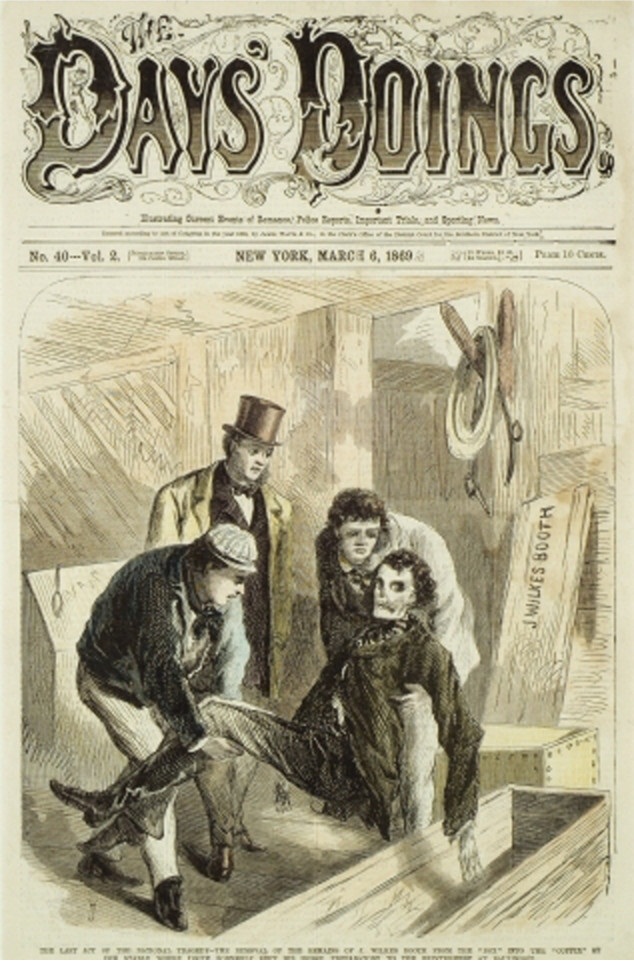
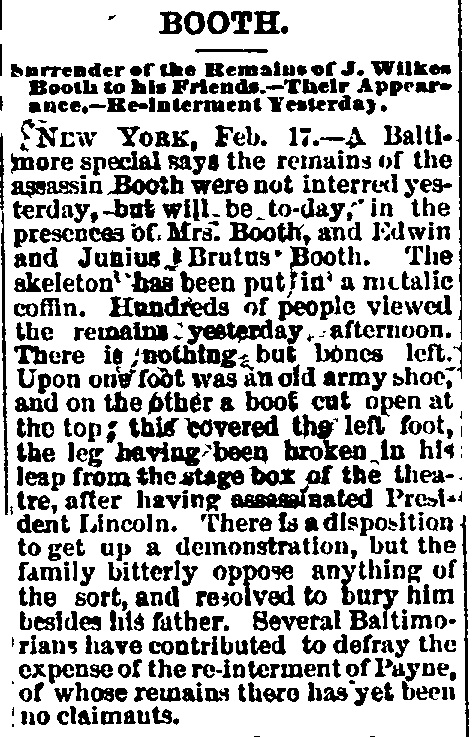
In February, 1869, as the administration of President Johnson was drawing to a close, Edwin Booth secured from him an order for the body that it might be interred in the family lot at Greenmount cemetery, Baltimore. That day a Star reporter was approached by Mr. R. F. Harvey of Harvey and Marr, undertakers, who remarked:
“Don’t ask any questions, but be at our place at 6 o’clock this evening, as one of my assistants, and you will get a good item.”Promised to Be There “I’ll be there,” was the response, and as the hour struck the reporter passed through the office to the workroom on the alley and there joined the workmen.
Mr. W. R. Speare, then a boy, had just entered the service of the firm to learn the business. An hour or so before Mr. Edwin Booth and Mr. J. H. Weaver, a Baltimore undertaker, were there consulting with Mr. Harvey, and the latter told Mr. Speare to go to the avenue and hire a furniture wagon to go to the arsenal to get something and to meet them at the arsenal gate. Mr. Speare did so. Messrs. Weaver and Harvey going down in a carriage. They proceeded to the store house and workmen brought out the box. Then it dawned upon Mr. Speare’s mind that the fact that the undertaker’s wagon was not taken was to ward off suspicion. A receipt was given to an officer and in a little time the wagon with the corpse was in the alley from which Booth had rode four years before. The little company in the shop were in waiting and the rumble of wheels was hailed with the remark, “There they are,” simultaneously with Rich Harvey’s call: “Come, here, now!” as the wagon was backed to a stable.
The box was removed by the assistants, including the volunteer, and placed on trestles, as was also an ordinary coffin brought from the shop. The arms chest was quite light. When a lantern had been produced the scene was a weird, uncanny one. The box was somewhat decayed about the joints, but when with little difficulty the lid was removed the blanket with which the corpse had been covered showed but little evidence of decay.
Blanket Thrown Aside The blanket on being thrown aside revealed what remained of the body and clothing. The latter was in shreds from decay, and the body was almost denuded of flesh and skin, some of the bones being bare.
Mr. Weaver seemed anxious that the remains be identified and picked up the head, examining it carefully. Some blotches of flesh and skin adhered to the cheek and jawbones, and the fine suit of hair for which Booth was noted was still on the head. Except for the mildew and clamminess it was in fine order, and the remark was made by some who had known Booth that it was an instance of hair growing after death, for it was an inch or more longer than it had been his custom to wear. The head was resting on decayed shavings, and one of the party plucked what he thought to be a loose lock of hair, which afterward was found to be a shaving. The head was taken up by Mr. Weaver, who examined it with interest, and a dentist from Baltimore being called from the front office in which Edwin Booth was awaiting developments next examined it. After looking intently at the teeth, he said: “This is Wilkes Booth, for this is some of my work.”
Head Passed Around The head was passed from hand to hand by the others, and Messrs. Weaver and Harvey examined other portions of the body, or, rather, what remained of it. The boots were found, one with one leg missing and a slit converting it to a shoe; and it was recalled that some of the witnesses before the military commission had testified that Booth had had one of his boots so cut to relieve the pressure on the leg in which he had a broken bone.
Edwin Booth having secured the report of the dentist, as well as that of Messrs. Weaver and Harvey as to the identification, left with the dentist. The sides of the blanket in which were the remains were lifted gently to the coffin, a temporary affair, and in a few hours they were in Baltimore, where they were interred at Greenmount. Of the company who were present when the transfer was made from box to coffin only Mr. Speare and the writer survive.
This statement should be sufficient to dispel all remaining doubts. Booth was recognized at the time he fired the shot, traced to the place of his capture, was known personally by some of the captors, his body identified by several as it laid at the navy yard. And, though a mystery surrounded the disposition of the body – and the current rumor was that it was buried at sea – The Star, the Monday following, announced the place of burial; and when the body, thirty-seven years ago, was disinterred and delivered to the family, the identification was complete.”












 LincolnConspirators.com
Recent Comments