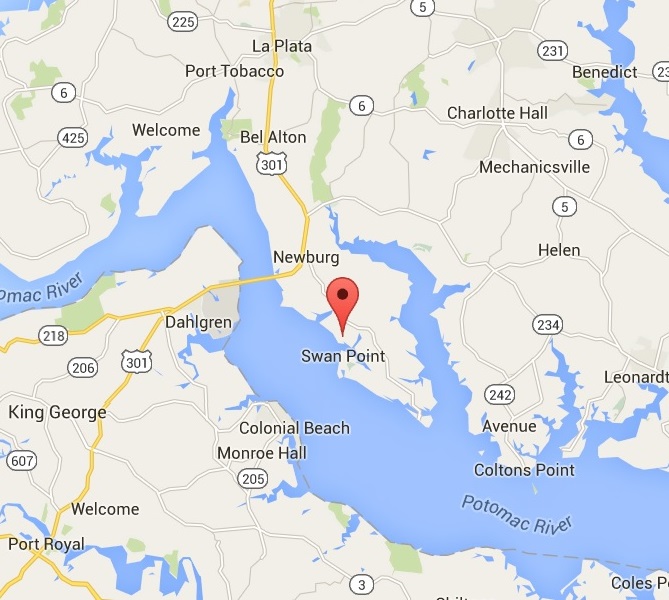
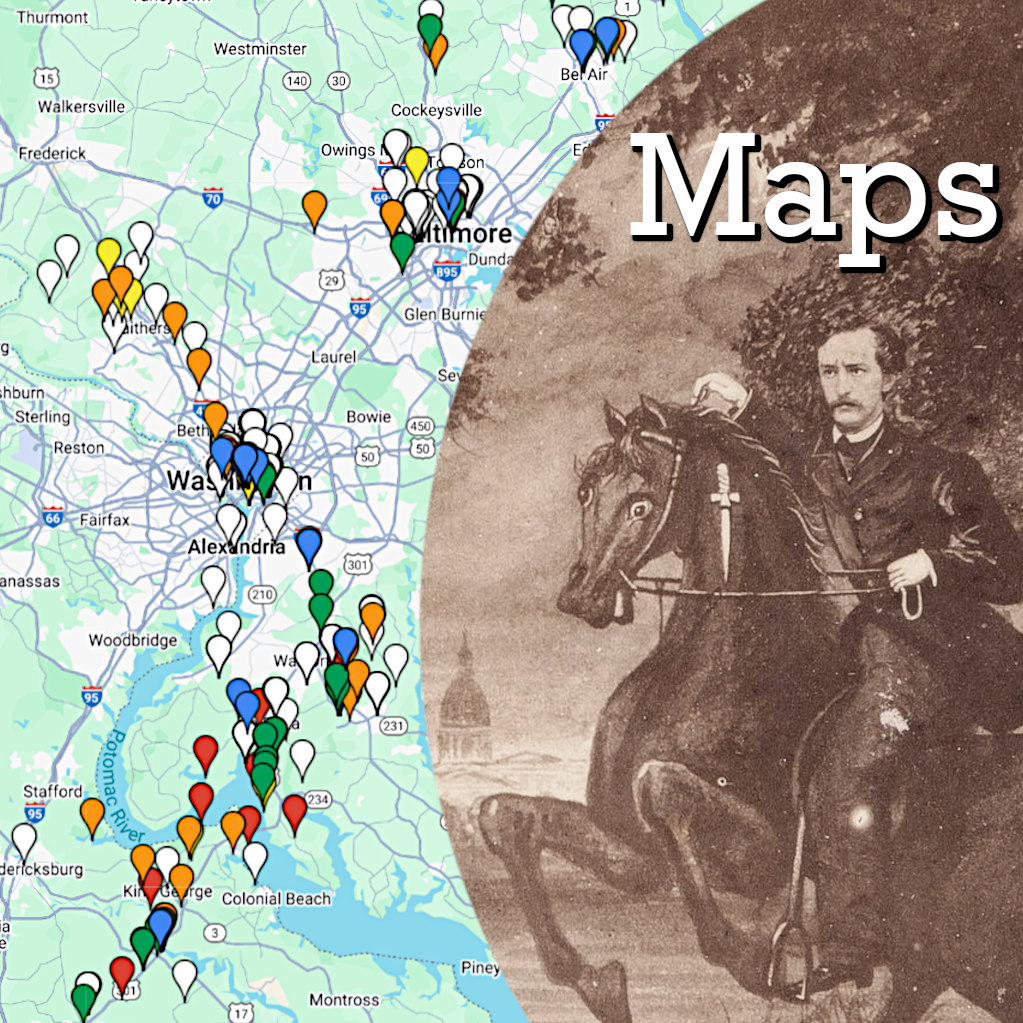
I found this free interactive mapping program online today and decided to see if I could construct a nice little map of John Wilkes Booth’s escape route. Unfortunately, this particular map will not embed straight into my site, but you can click the image below to view it.
The 2015 edition of Charles County, Maryland’s Preservation Matters newsletter has been published. The newsletter contains several articles about the historic preservation activities that are occurring around the county. One of the stories explains the wonderful work being done at Rich Hill, the home of Samuel Cox and a stop on John Wilkes Booth’s escape route.
The piece highlights the work that is being done to preserve and plan for future site development. It even quotes a bit from my previously posted article about the history of Rich Hill. Though my name (and giant face) are present, this article is entirely the work of Cathy Thompson, the Community Planning Program Manager for Charles County. Ms. Thompson and the members of the Friends of Rich Hill committee have been working tirelessly to lay the ground work for a restored Rich Hill. If you are interested in donating to the further refurbishment of Rich Hill, please send your donations to either:
Friends of Rich Hill
P.O. Box 2806
La Plata, MD 20646
or to the
Surratt Society
Surratt House Museum
9118 Brandywine Road
Clinton, MD 20735
Please indicate on the bottom of your check that the money is for “Rich Hill”
A few days ago, a wonderful piece was published in the Southern Maryland newspapers about the renovations going on at Rich Hill, the former home of Samuel Cox and a stop on John Wilkes Booth’s escape. Up until last year, Rich Hill was a private and neglected residence which was at great risk of falling down. To illustrate this point, here are a couple pictures and a video I shot in of the interior of Rich Hill back in June of 2013:
This important piece of history was on the verge of being lost. However, in October of 2013, the Historical Society of Charles County entered into talks with the owner of Rich Hill hoping to gain custodianship over the building in the hopes of preserving it. This was good news to all those interested in the home’s history. Despite the best of efforts, however, the talks involving the manner in which the home would be donated to the Historical Society of Charles County broke down. By Christmas of 2013, the outlook for Rich Hill looked dismal once more.
To help raise awareness of the tragic condition of this historic home I wrote the article below. It was published in the January 2014 edition of the Surratt Courier. Soon thereafter (though likely not connected to my article), a deal was struck between the owner of Rich Hill and the Charles County Government. Rich Hill was donated to Charles County, and since then the county has been doing a wonderful job of working to restore the home and make it accessible to the public. In April of this year, I spent two days as part of Charles County’s Lincoln 150 event standing on the porch of Rich Hill telling visitors the history of the home. It was a wonderful two day event that attracted a large audience.
The article published this week in the newspapers highlights the work that has been done of late, including the recent removal of the 1970’s drywall to expose the period “guts” of the house.
Work is continuing, funded in part by a $750,000 state bond. Given the state of the house, however, it is known that additional funds will need to be secured to help renovate Rich Hill completely.
While Rich Hill is most associated with the escape of John Wilkes Booth, the property and house touts a far older and far reaching history than that. Here is my article that was published in January 2014 that gives a looked into this historic home. I have edited it down a bit as my original article described the collapse of talks between the Historical Society of Charles County and the previous owner and ended with a call for action.
A History of Rich Hill
by Dave Taylor
During the wee morning hours of April 16th, 1865, two men and their guide approached the door of a darkened, Charles County, Maryland home named Rich Hill. “Not having a bell,” one of its sleeping occupants later recalled, the door was, “surmounted with a brass ‘knocker’.” One of the three horseback men, under the cover of darkness, reached out a hand and grasped the brass tool. He raised it upwards and, as the hinge reached the apex of its journey, the knocker was silently suspended for the briefest moment in time. In a fraction of a second, the handle would fall, striking the metal plate beneath it and “in the stillness of night the sound from this” would resound, “with great distinctiveness”[1]. The silence of the night would be shattered and the lives of the family sleeping within the house’s walls would be changed forever. History was knocking at the door of Rich Hill and its harbingers were John Wilkes Booth, the assassin of President Lincoln, and David Herold, his accomplice.
While Rich Hill would become known in American History due to the visitors that April night, the house and property had a notable history starting about 200 years before. In April of 1666, a recent immigrant from Wales named Hugh Thomas was assigned and patented “600 acres of land, called Rich Hills, on the west side of the Wicomico river, in Charles county, Md.”[2] Two years later, Hugh Thomas would sell half of his acreage at “Rich Hills” to an English immigrant turned St. Mary’s County merchant named Thomas Lomax. Lomax paid Thomas using the standard currency of the day: tobacco. For 3,500 lbs. of tobacco, Lomax acquired the northernmost 300 acres of the Rich Hill parcel, upon which the notable house would later be built.[3] In 1676, Thomas Lomax gave his brother Cleborne (also spelled Claiborne/Cleiborne) Lomax 100 acres of the Rich Hill property. When Thomas died in the early 1680’s, he was apparently unmarried and without any heirs and so the remainder of his Rich Hill property went to his brother as well. In 1710, the Rich Hill land was sold out of the Lomax family to an intriguing widow by the name of Mary Contee.[4]
A trifecta of circumstances had made Mary Contee nee Townley a very wealthy woman:
Mary Contee’s late husband, John Contee, had previously married a wealthy widow by the name of Charity Courts in 1703. When Charity died the same year of their marriage, John Contee inherited her sizable estate. He and Mary were then married by June of 1704.
In the same year of her marriage, Mary Contee’s cousin, Col. John Seymour was appointed the 10th Royal Governor of Maryland. Mary is recounted as a “favored cousin” of the Governor and due to this her husband John was appointed to several lucrative governmental positions becoming a representative of Charles County in Maryland’s Lower House and a justice in Charles County to name a couple.[5]
Thus far, it has only been shown that John Contee had become a wealthy man. While Mary assumedly enjoyed the fruit of his abovementioned “labors”, how did she herself become wealthy? That is where the real drama comes in. John Contee died on August 3rd, 1708. At the time of his death he possessed 3,697 acres of land and his personal property was assessed at 2,252 pounds sterling and 13 slaves. According to his will which was passed by an Act of Assembly in 1708, Mary became the sole executrix of her husband’s vast estate. However, it was later discovered that this will was not as it seemed. In 1725, seventeen years after Mary Contee had inherited her husband’s holdings, John Contee’s blood nephew, a man by the name of Alexander Contee, had depositions taken with regards to the will that had made Mary such a wealthy woman. Through these depositions Alexander Contee learned that John Contee’s will was a perjured fraud that was never agreed to by the deceased. Alexander discovered that his uncle’s supposed will had actually been written by a man named Philip Lynes. According the Alexander, Mr. Lynes was a man “very officious to oblige the said Mary” while John Contee was dying in the next room. Philip Lynes was married to Anne Seymour, the Governor’s sister and therefore was also a cousin to Mary Contee. The will was apparently brought before John Contee who was still of sound mind, and he refused to sign it as it was written. Though Contee lived for about a week more, the will was never rewritten in terms he agreed to. Due to these depositions, the Maryland Assembly passed another act in 1725 repealing the 1708 act that had granted Mary Contee as sole executrix. The new act mentioned not only the maleficence of those who gained by this false will, but also the fraudulent way a knowingly unsigned will passed the Houses in the first place. According to the new act, the fake will passed due to, “particular persons in power by whose Interest and Influence the said Act past both Houses of Assembly… contrary to the Standing rules of The Lower House.” Perhaps Gov. Seymour, who was still in office in 1708, used his influence, once again, to intervene on behalf of his “favored cousin”.[6]
Therefore, it appears that Mary Contee purchased the Rich Hill property with fraudulently acquired capital. She did not own it for very long, however. By 1714, she had remarried a man by the name of Philemon Hemsley who facilitated the selling of the Rich Hill land for 21,000 lbs. of tobacco. The new buyer was Gustavus Brown.[7] Brown was a native of Dalkeith, Scotland and a surgeon by profession. His immigration to Maryland was an accidental one:
“When a youth of 19 he became a Surgeon’s mate, or Surgeon, on one of the royal or King’s ships that came to the Colony in the Chesapeake Bay, 1708. While his ship lay at anchor he went on shore, but before he could return a severe storm arose, which made it necessary for the ship to weigh anchor and put out to sea. The young man was left with nothing but the clothes on his back. He quickly made himself known, and informed the planters of his willingness to serve them if he could be provided with instruments and medicines, leaving them to judge if he was worthy of their confidence.”[8]
Brown started his medical practice in the Nanjemoy area of Charles County and quickly made a favorable reputation for himself. In 1710, he married a woman by the name of Francis Fowke and the newlyweds lived temporarily with her father in Nanjemoy.
Dr. Gustavus Brown, Sr.Source: Smithsonian Institutions
Dr. and Mrs. Brown’s 1714 purchase of the Rich Hill property ushered in a new age for the estate. Instead of solely using the land for the planting and harvesting of tobacco, Dr. Brown sought to create a home on the land. It is this home that we see today and know as Rich Hill.
The exact date of construction on Rich Hill has not been determined. According to its listing in the National Register of Historic Places, the house was “built probably in the in the early to mid 18th century”[9]. Looking at the genealogical records for Dr. Brown’s children, this author has determined that the house was built by 1720, as his daughter born that year was cited to have been born at “Rich Hills”.[10]
As it is today, Rich Hill was built as a 1 ½ story structure that appears as a full 2 story building from the exterior. The original house had a hip roof and was built on top of cut stone piers. While the front door was on the southwest side of the house as it is now, it was formerly on the center of this wall. As you walked into Dr. Brown’s Rich Hill, the first floor consisted of four similarly sized rooms with a small stair hall in back flanked by a rear door. The original building had two exterior chimneys which stood on the southeast and northwest sides of the house.[11]
The majority, if not all, of the Brown children were born at Rich Hill. Dr. Brown and Frances had a total of twelve children as his practice prospered. He had made a name for himself on both sides of the Potomac, treating residents of Maryland and Virginia. One humorous story regarding Dr. Brown’s experiences as a physician is recounted below:
“On one occasion Dr. Brown was sent for in haste to pay a professional visit in the family of a Mr. H., a wealthy citizen of King George Co., Va., who was usually very slow in paying his physician for his valuable services, and who was also very ostentatious in displaying his wealth. In leaving the chamber of his patient it was necessary for Dr. B. to pass through the dining room, where Mr. H. was entertaining some guests at dinner. As Dr. B. entered the room a servant bearing a silver salver, on which stood two silver goblets filled with gold pieces, stepped up to him and said, ‘Dr. B., master wishes you to take out your fee.’ It was winter, and Dr. B. wore his overcoat. Taking one of the goblets he quietly emptied it into one pocket, and the second goblet into another, and saying to the servant, ‘Tell your master I highly appreciate his liberality,’ he mounted his horse and returned home.”[12]
While his business grew, Gustavus Brown did suffer some of his own tragedies at home. Out of his twelve children with Frances, three died in infancy. In an odd twist, all of the children who died were boys who were named after their father. Dr. Brown himself was actually the second Gustavus Brown as his father in Scotland bore the same name. Dr. Brown named his first two boys, “Gustavus”, only to watch them both die before they were a year old. When his third son was born, Dr. Brown gave him the name Richard, and this son would survive. Perhaps thinking their curse of losing their male children was at an end, the couple named their fourth son “Gustavus Richard Brown” only to witness him perish 10 days after his birth. While not documented, it is extremely likely that the three infant Gustavus Browns were buried somewhere on the Rich Hill property.
Frances Fowke Brown died 1744 and was buried at the estate of her daughter and son-in-law in Stafford County, VA. Dr. Brown remarried a widow named Margaret Boyd in 1746. With Margaret, Dr. Brown had two more children at Rich Hill, a boy and a girl. Though tempting fate, Dr. Brown named his youngest son after himself. This “Gustavus Richard Brown” born on October 17th, 1747, would survive infancy, follow in his father’s footsteps into the medical profession, and enter the history books as one of George Washington’s friends and caregiver at the Father of Our Country’s final hour. Dr. Brown’s other child with Margaret was named after her mother and would later marry Thomas Stone, a signer of the Declaration of Independence from Maryland. Their shared home, Habre de Venture, in Port Tobacco, MD is a National Historic Site run by the National Park Service.[13]
In April of 1762, the senior Dr. Brown died at Rich Hill. His death was from “apoplexy” which was a general term that meant death happened suddenly after a loss of consciousness (i.e. severe heart attack or stroke).[14] Dr. Brown was buried at Rich Hill, though the exact spot of his grave is lost today.[15] Rich Hill and its 300 acres passed to his wife Margaret and then to his eldest son Rev. Richard Brown (who was also a medical doctor) and his wife Helen.
Rev. Richard BrownSource: Smithsonian Institutions
During his tenure in the house, Rev. Brown, through marriage and purchase, managed to acquire a large portion of the 600 acre Rich Hill parcel that was split back in 1668. A tax assessment for Rich Hill in 1783 shows Rev. Richard Brown owning 566 acres of Rich Hill. He also made some unknown “improvements” to the property, which probably entailed some work on the house.[16] When Rev. Brown died in 1789, Rich Hill and its acreage swapped hands a few times between his descendants, with a loss of some of the land the Reverend had managed regain.
The Brown family owned Rich Hill continually for 93 years. At least four generations of Browns had made that house their home. It raised the men and women who befriended and married America’s founding fathers. When it was sold out of Brown family in 1807 to a man named Samuel Cox, a new chapter for Rich Hill began. The new owner and his descendants would own Rich Hill for the next 164 years and would witness the night history came knocking on their door.
Samuel Cox, the new owner of Rich Hill, is not the same man to whom John Wilkes Booth appeared to in 1865. Rather, this Samuel Cox was the latter’s maternal grandfather. From Samuel Cox, Rich Hill descended to his daughter Margaret who had married a man by the name of Hugh Cox. What relation, if any, existed between Margaret Cox and Hugh Cox has yet to be determined. Hugh and Margaret had five children born at Rich Hill, including their son Samuel, named for his grandfather. Samuel Cox was born on November 22, 1819. When Samuel’s mother, Margaret, died, his father Hugh found himself a new wife, Mary Ann T. T. Cox. Hugh had three more children by Mary Ann.[17]
When Samuel Cox was 15 years of age, he was sent to the Charlotte Hall Military Academy. He returned home three years later and followed in his father’s footsteps as a member of the wealthy planter class. On December 6th, 1842, Samuel Cox married his Washington, D.C. cousin, Walter Ann Cox. Walter Ann was named for her father who died a couple months before she was born. By the late 1840’s Hugh Cox and his wife Mary Ann, were residing away from Rich Hill on another property they owned near La Plata called “Salem”[18]. In 1849, Hugh and Mary Ann officially gave Rich Hill to Samuel Cox as a gift. Hugh Cox would die in December of that same year at the age of 70.[19] Rich Hill was now in the hands of the man who would give aid to the assassin of the President.
Samuel Cox, Sr.
Sometime in the first half of the 1800’s a significant amount of remodeling was done to Rich Hill. Whether the work was commissioned by Hugh or Samuel Cox is unknown. Regardless, both the exterior and interior of the house were drastically changed from Dr. Brown’s initial layout. The hip roof was replaced with a gable roof. The two chimneys on either end of the house were replaced with a large, double chimney on the northwest side of the house. On the southeast side, where one of the chimneys had been, the Coxes built a one story frame addition. This new addition contained a dining room and a bedroom in which Samuel Cox and his wife slept. The front door was moved from the center of the southwest wall to its current location right near the intersection between the southwest and southeast walls. The interior layout of the house was changed, too. Originally containing four similarly sized rooms with a rear stair hall, the layout was an end hall plan with a large front room and two small rooms to the rear. Much of the layout of Rich Hill today still follows the renovations done by the Cox family in the early 1800’s.[20]
Samuel Cox was a successful farmer and participated in many political and social groups in the county. Through the exertions of Samuel and his father before him, the Rich Hill farm prospered to 845 acres, even larger than its initial 600 acres in 1666.[21] Despite his success in farming, Samuel Cox, like another previously discussed owner of Rich Hill, had difficulty producing a namesake. None of his children with Walter Ann survived infancy. Instead, Samuel Cox ended up adopting his late sister’s son, Samuel Robertson. Though this younger Samuel had spent much of his life on his uncle’s farm and property, he was officially adopted and had his named changed to Samuel Cox, Jr. three days after his 17th birthday in 1864.[22]
Samuel Cox, Jr. was present at Rich Hill when John Wilkes Booth and David E. Herold arrived in the morning hours of April 16th. Years later, he would write about the night he was awakened so early by the sound of that brass knocker on the door:
“There was at the time in the house, Col Saml Cox, his wife, his wife’s mother Mrs Lucy B. Walker, Ella M. Magruder, now my wife, two servant girls, Mary and Martha and myself. Pa’s bedroom was on the first floor – and to the extreme eastern end of the house, and to approach the front door, which opens into the hall, Pa had to pass through the dining-room, where Mary and Martha slept. The stairway to the 2nd floor is approached through a door midway the hall and at the head of this stairway Mrs. Walker slept. My room is on the second floor and directly over the hall and two windows in this room are immediately over the front door looking out upon the yard and lawn in full view of the road which approached the house. When I was aroused by the knock I jumped out of bed and went down in the hall and as I approached the front door where I found Pa standing with the door partially open with Mary standing just behind him in the doorway of the dining room only some six feet away…”[23]
Samuel Cox, his adopted son, and their servant Mary Swann would claim to investigators that Booth and Herold were never allowed entry into the house and were, instead turned away almost immediately. Cox, Jr. would hold onto this story to his dying day, telling assassination author Osborne Oldroyd in 1901 that his father found the fugitives attempting to sleep in a gully close to the house the next morning. It was only then, according to Cox, Jr., that his father instructed his farm overseer, Franklin Robey, to guide them into a nearby pine thicket while he sent Cox, Jr. to retrieve Thomas Jones, who would care for the men during their stay in the pine thicket.[24] Other sources, however, including Oswell Swann, the ignorant guide of the assassin and his accomplice, would state that Booth and Herold spent a few hours inside of Rich Hill before they departed. Some later second hand accounts also speak of Booth and Herold entering Rich Hill during that early morning for food and drink. Regardless of whether or not the men entered the house, the knocking on the door of Rich Hill by David Herold secured the home’s role in the history of the 12 day escape of the assassin of President Lincoln.
Samuel Cox, Mary Swann, and Samuel Cox, Jr. were all arrested in the aftermath of Booth’s visit to their house. They were informed on by Oswell Swann, who brought the troops to Rich Hill at about midnight on April 23rd. The three residents were transported at first to nearby Bryantown. After getting Mary Swann’s statement of events, Samuel Cox, Jr. and Mary were released, only to be rearrested a couple of days later.[25] Samuel Cox, the elder, was transported up to Washington and was imprisoned at the Old Capitol Prison. Though the authorities strongly suspected that Cox had aided the fugitives, with Mary Swann contradicting the account of Oswell Swann, there was nothing to prove their beliefs. While imprisoned at the Old Capitol Prison, Samuel Cox wrote a letter to his wife on May 21st. Addressed to “Mrs. W. A. Cox, Port Tobacco, MD”, Cox recounts, in part, the degree of his imprisonment, “…I know my dear wife it will give you as much pleasure to inform you as it was for me to receive, permission just as your letter was received, to walk in the yard for exercise, which I have been deprived of until to day, having been confined to my room now for nearly four weeks.”[26] Cox was eventually released from the Old Capitol Prison on June 3rd, and returned home to Rich Hill to his waiting family.
Samuel Cox, Jr.
The extent of Booth’s visit to Rich Hill remained quiet for a number of years. During the interim, Samuel Cox died on January 7th, 1880. In his will he left Rich Hill to his wife until her passing, after which the home and property would go to his only heir, Samuel Cox, Jr. In 1884, newspaper correspondent George Alfred Townsend (GATH) met with Thomas Jones. After years of silence, Jones shared with GATH his involvement in helping Booth and Herold during their “missing days” of the escape. Jones did nothing to shield the Coxes from their involvement, divulging how he was brought to Rich Hill by Cox, Jr. and how his father insisted Jones help get the men across the river when the time was right. In his article, entitled, How Wilkes Booth Crossed the Potomac, GATH describes Rich Hill:
“The prosperous foster brother [Cox] lived in a large two-story house, with handsome piazzas front and rear, and a tall, windowless roof with double chimneys at both ends; and to the right of the house, which faced west , was a long one story extension, used by Cox for his bedroom. The house is on a slight elevation, and has both an outer and inner yard, to both of which are gates. With its trellis-work and vines, fruit and shade trees, green shutters and dark red roofs, Cox’s property, called Rich Hill, made an agreeable contrast to the somber short pines which, at no great distance, seemed to cover the plain almost as thickly as wheat straws in the grain field.”[27]
Though Samuel Cox, Jr. was the man of the house, he officially became the sole owner of Rich Hill upon the death of his adoptive mother in 1894. By that time, Cox, Jr. had already married and had 3 children by his wife, Ella Magruder. These young Cox children, Lucy, Edith and Walter, grew up and were raised at Rich Hill. Ella died in 1890 and Cox subsequently remarried a cousin of his named Ann Robertson.
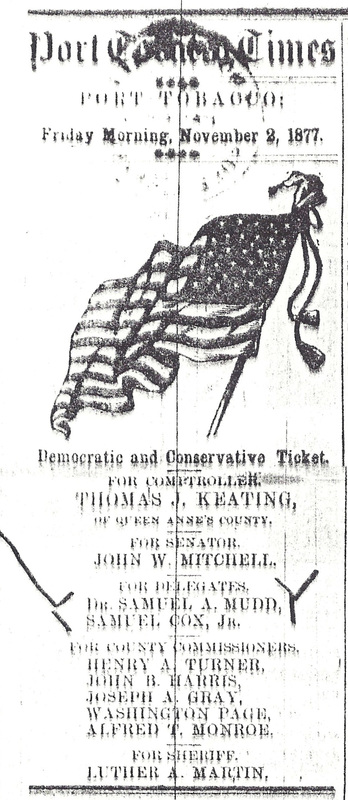
Like his father before him, Cox, Jr. became a prominent member of Charles County society. He had a sizable plantation with Rich Hill and he also owned Cox’s Station, a stop of the Baltimore and Philadelphia Railroad line that ran from Pope’s Creek on the Potomac up to Bowie in Prince George’s County where it connected to other lines. The modern town of Bel Alton (where Rich Hill is located) bore the name Cox’s Station up until Cox sold a sizable parcel of land to the Southern Maryland Development Company in 1891 and they renamed the area to its modern name. Cox, Jr. was also involved in local politics, running for and winning a seat in the Maryland general assembly in 1877. Dr. Mudd, another familiar name in the Lincoln assassination story, ran alongside Cox, but was not elected.[28]
Samuel Cox, Jr. died on May 5, 1906 at the age of 59. The ownership of the property passed to Cox’s son, Walter, who sold his share of it to his married sister, Lucy B. Neale. Lucy and her family did not live at Rich Hill. The last member of the Cox family to reside at Rich Hill was Samuel Cox, Jr.’s second wife, Ann Robertson Cox. Her death on March 4th, 1930, marked the end of the Cox family’s habitation of Rich Hill.
Between the years of 1930 and 1969, Samuel Cox, Jr.’s grandchildren operated Rich Hill’s property as a tobacco farm for sharecroppers. The land shrunk back down to 320 acres by 1971. That year, Rich Hill and its 320 acres were sold to its current owner, Joseph Vallario, a senior member of the Maryland House of Delegates.[29] In celebration for the bicentennial of the United States in 1976, Delegate Vallario restored Rich Hill to its appearance during Dr. Brown’s day. This involved removing the front and back piazzas along with the one story addition that had been added by the Cox family in the 19th century.[30] Though this did make Rich Hill look less like the house that Booth and Herold saw on April 16th, 1865, the restoration worked to preserve Rich Hill and keep it from falling down. Rich Hill served as a beautiful rental property for many years after.
Today, however, Rich Hill is suffering heavily from neglect. There are large, gaping holes in the exterior walls that expose the structure to the elements. The once beautiful rooms that housed generations of Browns and Coxes, are crumbling and filled with trash. To be frank, Rich Hill needs help and action if it is going to be saved.
While Rich Hill’s involvement in the story of Lincoln’s assassination is the house’s most discussed historical aspect, it is far more than the “stop on the trail of John Wilkes Booth” sign that stands some distance from it. As has been shown through this article, Rich Hill has had a notable and lengthy lifespan. It not only holds an important place in the history of Charles County, but it also affected the history of the nation due to the men and women who were raised under its roof. If Rich Hill is left in its current neglected state, it will crumble and collapse. If this happens, future generations will be the victims. As a restored museum run by Charles County in conjunction with the Historical Society of Charles County, Rich Hill would continue to influence and affect the history of our nation.
[1] Samuel Cox, Jr., Letter to Mrs. B. T. Johnson, July 20, 1891, James O. Hall Research Center.
[2] William F. Boogher, Gleanings of Virginia History: An Historical and Genealogical Collection (Washington, D.C.: W.. F. Boogher, 1903), 283.
[3] 26 Apr. 1668. Charles County Circuit Court Liber D, Page 14.
[4] 3 Mar. 1710. Charles County Land Records, Liber C#2, Page 245.
[5] Edward C. Papenfuse, A Biographical Dictionary of the Maryland Legislature 1635-1789 (Baltimore, MD: Johns Hopkins University Press, 1979), 230.
[6]Acts of the General Assembly hitherto unpublished 1694-1698, 1711-1729, Volume 38, ed. Bernard Steiner (Baltimore, MD: Lord Baltimore Press, 1918), 384-386.
[7] 12 Jan 1714. Charles Co. Land Records, Liber F#2, page 51
[8] Horace Edwin Hayden, Virginia Genealogies: A Genealogy of the Glassell Family of Scotland and Virginia : Also of the Families of Ball, Brown, Bryan, Conway, Daniel, Ewell, Holladay, Lewis, Littlepage, Moncure, Peyton, Robinson, Scott, Taylor, Wallace, and Others, of Virginia and Maryland (Wilkes-Barre, PA: E. B. Yorby, 1891), 152.
[9] National Registry of Historic Places Nomination Form, Rich Hill Farms (1976).
[26] Samuel Cox, Letter to Mrs. W. A. Cox, May 21, 1865, James O. Hall Research Center.
[27] George Alfred Townsend, “How Wilkes Booth Crossed the Potomac,” Century Magazine, April 1884, 827.
[28]Report of the Twelfth Annual Meeting of the Maryland State Bar Association held at Ocean City, Maryland July 3rd – 5th, 1907 (Baltimore, MD: Maryland State Bar Association, 1907), 75.
A group called “Friends of Rich Hill” was formed by the Historical Society of Charles County to raise donations for the renovation of Rich Hill. If you are interested, please send your donations to Friends of Rich Hill, P.O. Box 2806, La Plata, MD 20646
This is the second of two posts utilizing content gleaned from the diaries of Julia Ann Wilbur, a relief worker who lived in Alexandria, Virginia and Washington, D.C. during the Civil War. For biographical information on Julia Wilbur, as well as information regarding her diaries please read the first post titled, Julia Wilbur and the Mourning of Lincoln.
Witness to History: Julia Wilbur and the Saga of the Lincoln Assassination Conspirators
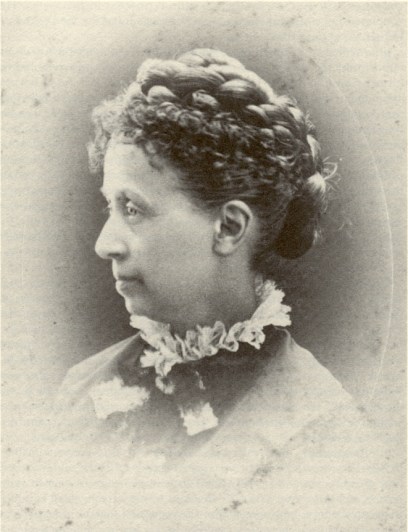
Julia Ann Wilbur, Source: Haverford College
When Abraham Lincoln’s assassination occurred on April 14, 1865, Julia Wilbur understood the impact it would have on the history of our country. When not working to provide relief to the thousand of newly freed African Americans residing in Alexandria and Washington, D.C., Julia Wilbur was a student of history. She traveled far and wide to visit places of historical importance, relished exploring the old burial grounds of a city, and found instances to mingle with those who were shaping her times. Therefore, she not only took the time to be a part of the mourning events for Abraham Lincoln, but she also went out of her way to document and even involve herself in the saga of the Lincoln assassination conspirators. The following are excerpts from Julia Wilbur’s diaries detailing her interactions with the assassination’s aftermath.
Reporting the News
Like many citizens around the country, Ms. Wilbur took to her diary to report the latest news about the hunt for Booth and his assassins. Sometimes the news was good. Other times, Ms. Wilbur reported on the gossip that was on the lips of everyone in Washington.
April 15, 1865:
“President Lincoln is dead! Assassinated last night at the theater shot in the head by a person on the stage. The president lingered till 7 this A.M. so all hope is over. And Secretary Seward had his throat cut in bed in his own house, but he was alive at the last despatch. It is said an attempt was made on Sec. Stanton but he escaped. Many rumors are afloat, but the above is certain.
…Evening. Sec. Seward is comfortable, & may recover, his son Frederick is in a very critical condition, his son Clarence has only flesh wounds & is able to be about the house. There is a report that Boothe has been taken; that his horse threw him on 7th st. & he was taken into a house.— There is no doubt that it was intended to murder the President, the Vice Pres. all the members of the cabinet and Gen. Grant. & that the managers of the theater knew of it.”
April 16, 1865:
“Two Miss Ford’s were at the Theater at the time of the murder.”
[Note: These Miss Ford’s appear to be friends of Ms. Wilbur’s and unaffiliated with the Fords who owned Ford’s Theatre]
April 17, 1865:
“About noon we saw people going towards G. on the run. & we were told that two men had been found in a cellar dressed in women’s clothes. & it was thought they were the murderers, Miss H. & I walked up that way. They are probably deserters. We met them under guard; they were guilty looking fellows.
…We passed Seward’s House. A guard is placed all around it. & on the walk we were not allowed to go between the guard & the house. He was not told of the President’s death until yesterday. He seems to be improving. No news in particular. No trace of the murderers.”
April 18, 1865:
“Mr. Seward is no worse & Mr. F. Seward is improving.”
April 19, 1865:
“When Frances got ready about 12 M. we went out. (all about are posted notices, “$20,000 reward for the apprehension of the Murderer of the President.”)”
April 20, 1865:
“Numbers of persons have been arrested. but Booth has not been taken yet. Ford & others of the Theater have been arrested. The Theater is guarded or it would be torn down. If Booth is found & taken I think he will be torn to pieces. The feeling of vengeance is deep & settled.”
April 21, 1865:
“I went around by Ford’s Theater today. It is guarded by soldiers, or it wd. be torn down. There is great feeling against all concerned in it.— Mr. Peterson’s House opposite where the President died is an inferior 2 storybrick,—but the room in which he died will be kept sacred by the family. A number of persons have been arrested & there are many rumors; but Booth has not been taken yet.— Mr. Seward & son remain about the same.”
April 26, 1865:
“Report that Booth is taken.”
Learning of Booth’s Death from an Eyewitness
One of the more remarkable things in Ms. Wilbur’s diary is how she recounts the details of Booth’s capture and death. On April 27th she is able to give specifics of Booth’s death when such details did appear in papers until the next day. The reason for this is because Ms. Wilbur was able to hear the story firsthand from one of the soldiers of the 16th New York Cavalry, Emory Parady.
Pvt. Emory Parady in his later years
April 27, 1865:
“Booth was taken yesterday morning at 3 o clock, 3 miles from Port Royal on the Rappac., in a barn, by 25 of 16th. N.Y. Cav. & a few detectives. He was armed with 2 revolvers & 2 bowie knives & a carbine 7 shooter, all loaded. Harrold, an accomplice was with him. Neither wd. surrender until the barn was fired. Then Harrold gave himself up. & when Booth was about to fire at some of the party, he was shot in the head by Sargt. B. Corbett, & lived 2 ½ hrs. afterwards. He was sewed up in a blanket & brought up from Belle Plain to Navy Yd. in a boat this A.M. One of the capturers, Paredy, was here this P.M. & told us all about it.”
Collecting Relics
Julia Wilbur was fond of acquiring relics and would occasionally display her collection to visiting friends. The events of April 14th, motivated Ms. Wilbur to acquire some relics of the tragic event.
April 20, 1865:
“I purchased several pictures of the President, also Seward’s.
…Miss Josephine Slade gave me a piece of a white rosette worn by one of the pallbearers. Then Mrs. C. & I went to Harvey’s where the coffin was made. & obtained a piece of the black cloth with wh. the coffin was covered & pieces of the trimming. The gentleman who was at work upon the case for the coffin was very obliging & kind. This case is of black walnut, lined with black cloth, & a row of fringe around the top inside, I have also a piece of this box.”
April 21, 1865:
“Called on Mrs. Coleman. Then we went to Mr. Alexander’s & got some pieces of the cloth which covered the funeral Car. Then we saw an artist taking a Photograph of the car. which stood near the Coach Factory where it was made. We went there & Mrs. C. took of pieces of the cloth & alpaca. & a young man told us the Car would be broken up to day & he would save us a piece.
“…Then I went out again & obtained a board from the Funeral Car, which a workman was taking to pieces. & also some of the velvet of the covering. I intend to have this board made into a handsome box. & will make a pin cushion of the velvet.”
April 22, 1865:
“Went to see Mrs. Coleman. she gave me some of the hair of President Lincoln.”
May 2, 1865 (in Philadelphia):
“In all the shops are pictures of the President, & there are some of Booth.”
October 12, 1865:
“Called at Ford’s Theater. got relic.”
October 18, 1865:
“Then Mrs. B. went with me to Ford’s Theater & we each obtained from Mr. Kinney who has charge of the building, a piece of the Presidents Box. The wood work where his knees rested when he was shot.”
A Visit to Richmond
Ms. Wilbur temporarily departed Washington in mid May of 1865. During that time she traveled to Richmond, with side trips to Petersburg and Appomattox, to provide relief work for the newly freed African Americans. Diary entries during her time in Richmond lament the poor living conditions of the black citizens and also discuss her own experiences in the city. One of my favorite anecdotes from that period is Ms. Wilbur’s recounting having tea with a family of free African Americans.
May 19, 1865:
“Took tea by invitation at Mr. Forrester’s. Quite a company. We drank from Jeff. Davis’s tea cups, eat with his knives & forks & eat strawberries & ice cream from his china saucers— I sat in the porch & looked at Jeff’s house not many rods distant, & tried to realize that I was in Richmond— The morning of the evacuation people fled & left their houses open. goods were scattered about the street, & Jeff’s servants gave this china to Mr. Forrester’s boys. That morning must have been one long to be remembered by those who were there. All night long there was commotion in the streets. Jeff. & his crew were getting away with their plunder.”
“Thought I might as well see some thing of this important trial”
Ms. Wilbur returned to Washington, D.C. in mid-June. Once back home, she quickly resumed her habit of engrossing herself in the historical proceedings happening around her. In June of 1865, such historical proceedings could only be the trial of the Lincoln conspirators. Before attending the trial however, Ms. Wilbur first visited the conspirators’ former site of incarceration.
June 17, 1865:
“In P.M. went to Navy Yard. Went on to the Saugus & the Montauk.
…The Saugus weighs 10 hundred & 30 tons, draws 13 ft. water & its huge revolving turret contains 2 guns wh. carry balls of 470 lbs. It is 150 ft. in length, pointed fore & aft & its 83 deck & sides plated with iron. The turret, pilot house— smokestack & hatchways are all that appear on deck & in an engagement not a man is visible. It has been struck with heavy balls & deep indentations have been made on the sides of the turret. Once a heavy Dahlgren gunboat during an engagement, The Saugus did service at Fort Fisher.— There are 13 engines in this vessel.
We went below & saw the wonders of the interior. Booth’s associates were confined on this vessel for a time. Booth’s body was placed on the Montauk before it was mysteriously disposed of.”
Then, on June 19th, Julia Wilbur attended the trial of the conspirators:
“At 8 went for Mrs. Colman & got note of introduction to Judge Holt from Judge Day & proceeded to the Penitentiary.
Thought I might as well see some thing of this important trial.
Mr. Clampitt read argument against Jurisdiction of Court by Reverdy Johnson.
It was very hot there. Mrs. Suratt was sick & was allowed to leave the room & then they adjourned till 2, & we left. Mrs. S. wore a veil over her face & also held a fan before it all the while.
Harold’s sisters (4) were in the room. The prisoners excepting Mrs. S. & O’Laughlin appeared quite unconcerned. They are all evidently of a low type of humanity. Great contrast to the fine, noble looking men that compose the court.”
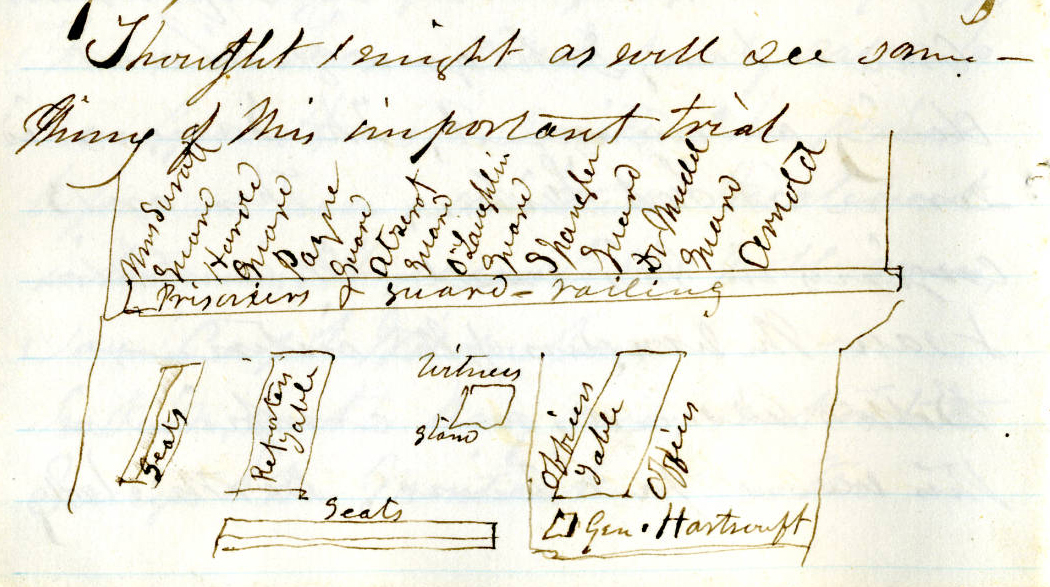
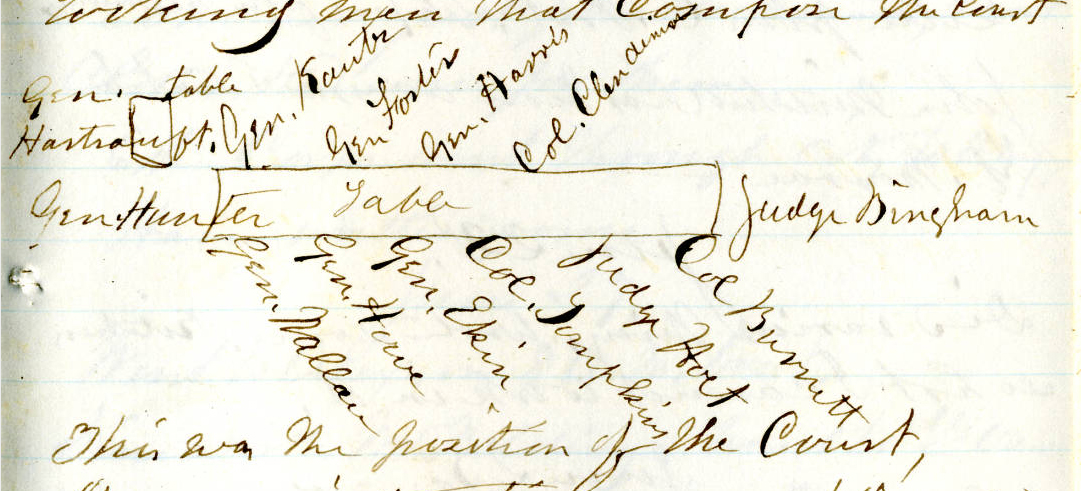
Ms. Wilbur’s diary entry concerning the courtroom is valuable not only due to the descriptions she gives of Mrs. Surratt and Michael O’Laughlen, but also because she took the time to sketch the layout of the court when she got home:
“This was the position of the court.
It was an interesting scene, & I am glad I went, although it is so far, & so hot.”
These diagrams are fascinating and help us solidify the placement of the conspirators and members of the military commission in the court room.
Reporting on the Execution
It is likely that the excessive heat in the courtroom convinced Ms. Wilbur that she did not need to attend the trial again. However, she did keep up with the proceedings and reported on the sentencing and execution of the conspirators (which she did not attend).
July 6, 1865:
“The conspirators have been sentenced. Payne, Harold, Atzerott & Mrs. Surratt are to be hung to morrow. O’Laughlin, Mudd, & Arnold to be imprisoned for life at hard labor, & Spangler to State prison for 6 yrs.”
July 7, 1865:
“Hottest morning yet. Martha ironed, & the whole house has been like an oven. It was too much for me. I could not work.— The days pass & nothing is accomplished— This eve. F & I took a walk.
— About 1 P.M. The executions took place in the Penitentiary Yard. A large number of people witnessed them. They were buried within a few feet of the gallows. It is all dreadful, but I think people breathe more freely now. They are convinced that Government means to punish those who deserve it. Jeff. Davis friends may feel a little uneasy hereafter.”
Unfortunately, it does not appear that Ms. Wilbur had any reaction to the death of Mary Surratt, a middle aged woman like herself. In fact the very next day Ms. Wilbur mentions walking past Mrs. Surratt’s house without any commentary.
July 8, 1865:
“Then passed Mrs. Surratt’s house on the way to Mr. Lake’s, where we had a pleasant call.”
It’s likely that Ms. Wilbur agreed with Mrs. Surratt’s fate as Ms. Wilbur was very against those who held “secesh” sympathies.
Attending Henry Wirz’ Trial
Julia Wilbur continued her habit of attending historic trials in the city, by attending the trial of Andersonville prison commandant, Henry Wirz. After Henry Wirz’ execution she once again invoked the Lincoln conspirators:
November 11, 1865:
“Called at Mr. B’s office & saw Mr. & Mrs. Belden. Heard particulars of the Execution yesterday. Mr. B. gave me an Autograph Note of Henry Wirz, a lock of hair & a piece of the Gallows. I came only for the autograph. His body was mutilated after death, Kidneys were divided among 4 surgeons. Another person had a little finger, obtained under pretense of Post Mortem examination. Remainder of body buried in Yard of the Penetentiary near Atzerot. All this, & we claim to be civilized & human! If his body had been given up to his friends, it would be torn to pieces by the infuriated people.”
As we know Henry Wirz mingled with the bodies of the conspirators until 1869, when Andrew Johnson allowed the bodies of all those executed to be claimed by family. Wirz was buried in Mt. Olivet Cemetery, the same resting place of Mary Surratt.
Piece of Henry Wirz’ Old Arsenal coffin in the collection of the Smithsonian’s American History Museum.
In the Interim
By 1866, John Wilkes Booth and four of his conspirators were dead. The other four tried at the trial of the conspirators were serving sentences at Fort Jefferson off the coast of Florida. As such there was a lull for a time during which Julia Wilbur reported next to nothing revolving around the events of April 14, 1865. Only a few brief mentions exist in her diary of 1866 and early 1867.
April 14, 1866:
“Anniversary of a sad day.
Departments have been closed, & flags are at half mast. No other observance. A year ago today I was in Alex. & could not get away. It was a sad time.”
April 28, 1866:
“Went to the Army Medical Museum. Many interesting in this Museum. Called on Mrs. Smith. She is ill. Went into Ford’s Theater. Not finished yet. It is intended for archives relating to the War of the Rebellion. The sad associations connected with it will make it an object of interest for generations to come.”
April 15, 1867:
“Anniversary of Death of Abraham Lincoln! Two years have passed rapidly away.”
On visiting the National Cemetery in Alexandria on May 12, 1867:
“There is also a monument to the memory of the 4 soldiers who lost their lives in pursuit of Booth the Assassin. They were drowned.”
Upon seeing Secretary War Edwin Stanton on May 27, 1867:
“Saw Sec. Stanton today, but how unlike the Sec. of War that I saw in his office in Oct. ’62. He was then in the vigor & prime of manhood. Hair & beard dark & abundant. But 5 years of War have made him 20 years older. He is thin, sallow, careworn. His locks are thin & gray. I never saw a greater change in any man in so few years.”
June 21, 1867:
“On return went into Ford’s Theater to see the Medical Museum.”
The Escaped Conspirator
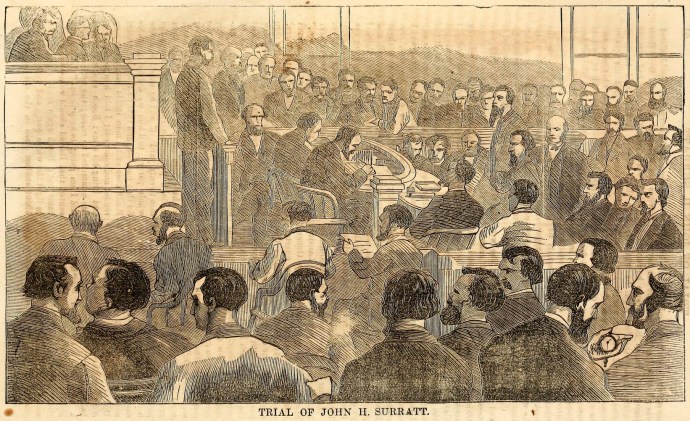
In late 1866, John H. Surratt, Jr. was finally captured after more than a year and a half on the run. Surratt had been an active member of John Wilkes Booth’s plot to abduct President Lincoln and take him south. His arrest in Alexandria, Egypt and extradition to the U.S., set in the motion the last judicial proceedings relating to Abraham Lincoln’s death. Once again, Ms. Wilbur would be sure to take part in this event, attending John Surratt’s trial twice and providing some wonderful detail of the courtroom scene.
February 18, 1867:
“(Surratt arrived in Washington today, is in jail)”
June 19, 1867:
“Miss Evans & I went to Mr. B’s & he went with us to City Hall & got tickets of admittance for us to the Court Room. 6 ladies present besides ourselves. Surratt was brought in at 10, & the court was opened. Judge Fisher presiding. Witnesses examined were Carroll Hobart. Vt.; Char. H. Blinn, Vt.; Scipano Grillo, Saloon keeper at Ford’s Theater; John T. Tibbett mail carrier, & Sergt. Robt. H. Cooper. Examined by Edwards Pierpoint of N.Y, Atty, Carrington.
Surratt sat with his counsel, Bradly, he, a pale slender, young man, seemed to take an interest in all that was said. His mother’s name was mentioned often, & Tibbett said he had heard her say “she wd. give $1000 to any body who would kill Lincoln.” I could not feel much sympathy for him. They must have been a bad family.
But I think Surratt will never be punished. The Government will hardly dare do it after releasing Jeff Davis.
The room outside the bar was crowded, & this is the first day ladies have been seated inside the bar.
Miss Evans was never in a Court before, & we were both much interested.”
June 21, 1867:
“Frances & Miss Evans went to Surratt’s trial”
June 27, 1867:
“Rose early. Worked till 9 A.M. Then went to Surratt’s trial at City Hall. Courtroom crowded. Judge Fisher presiding. Witnesses, 2 brothers Sowles, & Louis Weichman. He last boarded with Mrs. Surratt, was intimate with J.H. Surratt. His testimony was minute but of absorbing interest. Examined by Edwards Pierpoint. Bradly & Merrick, counsel for prisoner, are evil looking men.
Surratt looked less confident today than when I saw him a week ago yesterday.
When they were removing the handcuffs he breathed hard. Took his seat looking a little disturbed. His brother Isaac soon came & took a seat by him & they talked & laughed a few minutes.
Isaac looks like a hard case & quite unconcerned. It is very evident that J.H. Surratt was a conspirator & that the family were bad.
I would like to be here at the close of the trial, and hear the summing up.”
Unfortunately, Ms. Wilbur did not get her wish to witness the close of John Surratt’s trial. She was visiting back home near Avon, New York when the trial ended.
August 10, 1867:
“Papers from Washington.
Argument in Surratt case finished. Jury do not agree.”
August 12, 1867:
“Finished reading for Father Mr. Pierpointt’s argument in Surratt case to father. Very able argument.”
August 16, 1867:
“Jury discharged, could not agree, ([illegible]). Surratt remanded to jail.
Bradley has challenged Judge Fisher. Much excitement in W[ashington].”
Epilogue
While the period of assassination events effectively ended with the trial of John Surratt, Ms. Wilbur maintained diaries for the rest of her life. There could be more passages in her diaries commenting on or recalling those tragic days. As stated in the prior post about Julia Wilbur and the Mourning of Lincoln, Julia Wilbur’s diaries have only been transcribed for the period of March 1860 until July of 1866. All entries in this post dated beyond July 1866, were discovered by meticulously reading through the digitized pages of Ms. Wilbur’s diaries located here. There are still many discoveries to be made in Julia Wilbur’s diaries and I encourage you all to follow Paula Whitacre’s blog to read more about the work being done on Julia Wilbur.
I am visiting my family here in Illinois and decided to use the opportunity to make use of the newly updated Lincoln assassination maps here on BoothieBarn. I planned and executed a two day excursion to visit some of the sites on the Lincoln Assassination in the Midwest map. The following is an overview of my trip composed using the tweets I sent out en route along with a couple of short videos I made.
After leaving Chicagoland, we headed straight to Keokuk, Iowa, a bit over 4 hours drive. There, we did what we do best, look for a grave.
While the trip mainly consisted of two long days of driving, I enjoyed myself and it was a lot of fun to see so many Lincoln assassination places, graves, and artifacts all at once. Thank you to the Historical Society of Quincy and Adams County, Mr. Blair Tarr, curator of the Kansas State Historical Society Museum, Nikaela Zimmerman, Barry Cauchon, and Steve Miller for all your help in making this trip possible. Also, thank you to my parents for letting me use (and put a considerable number of miles on) their car.
Now you all get out there, take your own assassination vacation, and tell me about it in the comments below!
Every year for the past 16 years, Port Royal, Virginia has put on a celebratory Independence Day event. The day is filled with musicians, Revolutionary and Civil War reenactors, speakers, 18th century dancers, bagpipers, and a formal reading of the Declaration of Independence. It is a wonder annual program and a great way to spend part of the 4th. Here are a few pictures that I managed to take of the event:
This slideshow requires JavaScript.
This year, I had the honor of being asked to give a short speech. Knowing my interest in the Lincoln assassination story, my fellow board members of Historic Port Royal asked me to speak on the topic of John Wilkes Booth. I heartily agreed. Later on though, as I was trying to prepare for my speech, I had a hard time reconciling the discussion of a Presidential assassin on the day of our country’s birth. So, rather than discussing John Wilkes Booth, I decided to present a more Revolutionary tale. Below is a video of the speech I presented.
With summer in full swing, now is the time to get out there and take a vacation. Whether it be a lengthy week long trip to a city or shore far distant, or a day’s drive to a “not so nearby” locale, there’s nothing like the thrill of going somewhere new. For the historically minded, vacations often involve adventures such as visiting a museum, rediscovering a National Park, or just taking a selfie with a historical marker off the highway. No matter what form they may take, vacations allow us to make our own marks and memories in places outside our everyday lives.
I’ve long said that the story of Lincoln’s assassination is told all over this nation. I cannot tell you how many times I’ve been in the middle of nowhere when suddenly I find a reference to the assassination staring me right in the face. The impact of Lincoln’s death and the manhunt for John Wilkes Booth reached around the globe. Over the last week, I have been working diligently to update the Maps section of this website in order to demonstrate how far reaching it truly is. The result has been the creation of five new maps, four which cover the entirety of the United States and a fifth map representing the rest of the world. All of these maps provide the locations, a brief description and the exact GPS coordinates of different sites related in some way to the assassination of Abraham Lincoln and his assassin, John Wilkes Booth.
The maps are still in the beginning stages. The 225 locations currently marked are little more than a drop in the bucket of the potential sites worldwide. Everyday, however, new sites pop into my head and I diligently research to determine their exact GPS coordinates. I’ve analyzed Civil War era maps to determine their modern counterparts, struggled with foreign languages in order to find international sites, and I have even spent hours staring at aerial pictures of cemeteries trying to determine the exact locations of specific graves. It is very slow work, but by pinpointing these sites with GPS coordinates, we can ensure that they will never be lost. The buildings and terrain around them may change but, with GPS, where they once stood can always be found.
With this in mind, I encourage you all to check out the newly updated Maps section of BoothieBarn. See if there’s something “not so nearby” that you might want to drive and see. Better yet, if you are already planning a trip somewhere, take a look and see if you’ll be passing by something assassination related. I mean what kid wouldn’t love to make a detour on their way to Disney World in order to visit a cemetery in Geneva, Florida? “Forget Cinderella’s Castle, Mommy. What I really want to see is the grave of Lewis Powell’s skull!”
So check out the Maps section here on BoothieBarn by clicking the image above. Then get out there and have yourself an assassination vacation!
In Charles County, Maryland, located on the peninsula that is created by the merging of the Potomac and Wicomoco Rivers is a small rural area called Banks O’Dee:
The name Banks O’Dee or “The Banks of the Dee” was given its name by Welsh and Irish settlers to the region who named the area after the River Dee which forms part of the border between England and Wales. It is now, as it was then, a very small rural community with only a local road bearing the name Banks O’Dee Road to betray its existence. Yet, as we have often seen, even the most isolated and small communities can have connections to Lincoln’s assassination. Banks O’Dee, exemplifies this fact by having not one, but two associations to the great crime of April 14, 1865.
Mistaken Identi’Dee
After Lincoln’s assassination, the government mobilized troops and detectives to scour the entire region around Washington. Many men were sent into Southern Maryland which was a hotbed for Confederate sympathizers. Washington Provost Marshal, James R. O’Beirne, ordered several of his detectives into the region around Banks O’Dee in the search for John Wilkes Booth and David Herold in the hope that they had not yet crossed the Potomac River into Virginia. Three of O’Beirne’s detectives, Henry Bevans, Michael O’Callaghan, and Edward McHenry, were steamed in on April 19th to investigate the locals. Two the the detectives, McHenry and O’Callaghan, impersonated refugees and found themselves dining with a Banks O’Dee farmer by the named of Richard Claggett. During dinner, Claggett’s son revealed that at around 7:00 am on April 16th, he had seen two men in boat crossing over to a place on the Virginia shore called White Point (now Colonial Beach). The detectives passed this information along to O’Beirne and even crossed over the Potomac themselves in search for the two men in a boat, to no avail.
A farm near the water at Banks O’Dee. Thomas Harbin and Joseph Baden crossed the Potomac river near here on April 16, 1865.
By April 24th days had gone by with no new credible sightings of Booth and Herold in Southern Maryland. O’Beirne, in the field himself at Port Tobacco, decided to once again bring the report of his detectives in Banks O’Dee to the attention of Lafayette Baker, head of the National Detective Police. Baker decided the report was now worth investigating further and approved the dispatch of men from the 16th New York Calvary to travel into the Northern Necks of Virginia in search of Booth and Herold. Two days later, this gamble paid off as the 16th New York cornered and killed John Wilkes Booth at the Garrett Farm in Caroline County, VA.
However, this report from Banks O’Dee of two men crossing over the Potomac in a boat on April 16th was a case of mistaken identity. From April 16 – 20, John Wilkes Booth and David Herold were hiding out in a pine thicket near Samuel Cox’s Rich Hill farm. The two men who did cross from Banks O’Dee on April 16th were actually Joseph Baden and Thomas Harbin. Harbin had been an early recruit into John Wilkes Booth’s abduction plot and, when the assassin did manage to cross the river, Harbin briefly assisted Booth onward to Dr. Stuart’s. Still, had Harbin and Baden not been seen by a farmer in Banks O’Dee who then blabbed the sighting to undercover government detectives, John Wilkes Booth may have been able to escape further south.
Lloyd-ering around Banks O’Dee
Banks O’Dee’s connection to the Lincoln assassination story stretches even further back than 1865. In 1835, two large properties in the area were purchased by a man named Minchin Lloyd, Jr. Mr. Lloyd’s father was an Irish immigrant who had set up his residence, and family, in Virginia and then in Port Tobacco, the county seat of Charles County.
Minchin Lloyd, Jr. was an enterprising businessman in Charles County, serving his county as a Deputy Sheriff and Deputy Tax Collector. The second of six brothers, Minchin, Jr. had been entrusted by his siblings with many things of importance. When his youngest brother Francis died, the financially successful Minchin inherited his entire estate. He also inherited a large piece of his brother William’s estate when William died in 1833. William, who had been a businessman in Port Tobacco running a general store, also left two other things to his brother Minchin upon his death. This two things were his two young sons. Minchin became the guardian of William’s two children, Charles William and John Minchin Lloyd.
The latter name should sound familiar. In 1865, John Minchin Lloyd would play a pivotal role in the assassination saga when, while renting Mary Surratt’s country tavern, John Wilkes Booth and David Herold arrived at the tavern, demanded the weapons that had been hidden there previously, and rode off after telling Lloyd they had assassinated President Lincoln. John M. Lloyd would prove to be one of the government’s key witnesses against Mary Surratt at the trial of the conspirators and his testimony would help seal her fate.
When William died in 1833, John was 8 years old. He and his younger brother went to live with his Uncle Minchin. In 1835, Minchin bought a large (500+ acre) property near Banks O’Dee. Minchin moved his whole family into a beautiful home which stood, “on an eminent hill in the center of the farm”. The house was called Milton Hill and was constructed around 1792. As a young boy of 11 years old, John is sure to have spent many days at Milton Hill with his uncle/adopted father. John M. Lloyd grew up in the Banks O’Dee area and watched as the family acquired more land in the area. Today a road, creek, and point in the region bear the Lloyd name and there are still descendants of the Lloyd family living in the area. By about 1850, John M. Lloyd had left Banks O’Dee and had settled in Washington, D.C. Lloyd became a brick layer, Washington Police Officer, and, later, unlucky tavern keeper.
Amazingly, the house in which a young John M. Lloyd lived still stands today in Banks O’Dee. Milton Hill, which is private property, dates to about 1792.
Milton Hill, childhood home of John M. Lloyd
Epilogue
In addition to visiting Banks O’Dee and locating Milton Hall today, I tried to determine the final resting place of John M. Lloyd’s father, William. It seemed that the Lloyds often worshiped at St. Mary’s Church at Newport, the same church where Confederate agent Thomas Jones is buried. I traveled to St. Mary’s in hopes there might be a few Lloyds there. In the end I found this stone which seems very promising:
The possible gravestone for William Lloyd, father of John M. Lloyd in St. Mary’s Church in Newport, MD
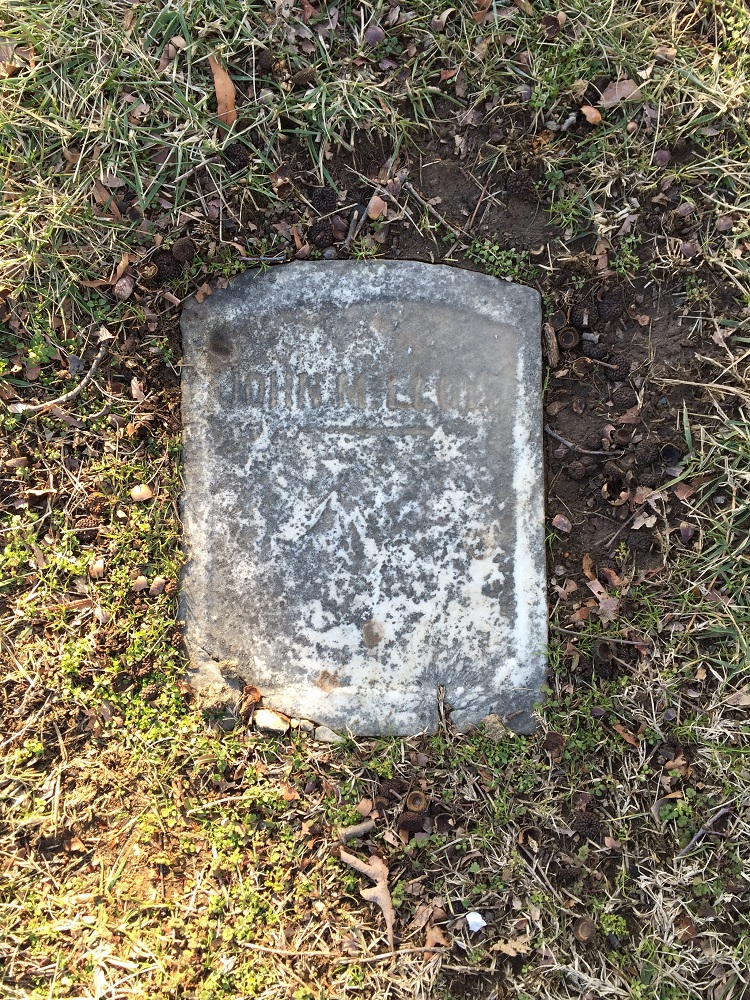
If this is the stone for “our” William Lloyd than it seems the phrase “like father, like son” is applicable even in death. John M. Lloyd also has a small stone with only his name on it that has been knocked flat over the passage of time:
Grave of John M. Lloyd in Mt. Olivet Cemetery in Washington, D.C.














 LincolnConspirators.com
Recent Comments