Posts Tagged With: Ford’s

Associated Ads

The assassination of Abraham Lincoln manifested into countless front page headlines in newspapers across the country. From the details of the assassination, the hunt for Booth and his conspirators, and the trial that followed their arrests, nary a day went by between April 15th and July 7th, 1865, that aspects of Lincoln’s death were not “today’s top stories”. While significant and valuable text space was attributed to the big items of the assassination story, minor details had played out in the classified sections of various newspapers before the tragedy occurred. For a long time after the events as well, echos of the crime at Ford’s Theatre popped up in the most innocuous area of the newspaper – the advertisements. Here are a few examples of period advertisements associated with the death of Abraham Lincoln.

April 14th, 1865
Evening Star, Washington, D.C.
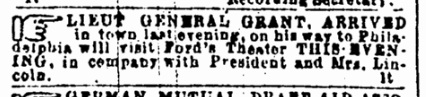
Advertisement for Lincoln at Our American Cousin 1 Advertisement for Lincoln at Our American Cousin 2

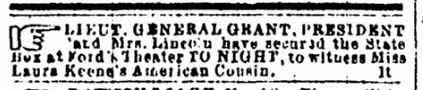
On page two of the Evening Star, the attendance of the Lincolns and General Grant is announced for that night’s performance of Our American Cousin at Ford’s Theatre.

November 25, 1864
New York Herald, New York City, NY
Booth Shakespeare Benefit 1864 advertisement

The New York Herald announces that night’s performance of the brother’s Booth in their benefit towards the construction of a statue of Shakespeare in Central Park.

August 18, 1869
Sun, Baltimore, MD
JJSellingTeas1869

After being released from prison for the final time, John Harrison Surratt, Jr. made his way down into South America for about six months. Upon his return to America he tried his hand at the mercantile life with his own business selling tobacco and other commodities like the “slightly damaged” tea above. This business did not last long and about 18 months later, John Surratt would be a teacher in Rockville, MD.

January 3, 1871
Richmond Whig, Richmond, VA
JJLecture1871

Attempting to cash in on his story and connection to John Wilkes Booth, John Surratt underwent a lecture tour. His lecturing was as short-lived as his mercantile business due to public outcry.

CHALLENGE
June 15, 1864
Evening Star, Washington, D.C.
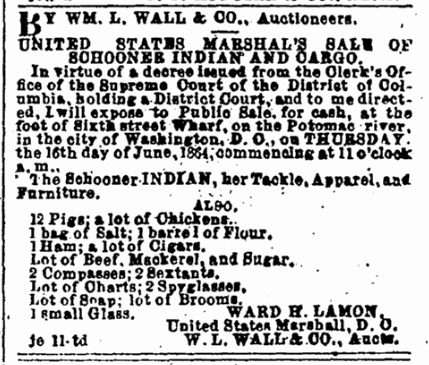
SchoonerIndianAuction1864

Here’s a good challenge for you all. Can any of you tell me how this sale of a schooner by the federal government is involved in the story of Lincoln’s assassination. Show me your skills by replying in the comment section below.

References:
The Last Lincoln Conspirator by Andrew Jampoler

Categories: Uncategorized | Tags: , , , , | 7 Comments

The Actors Repent

When John Wilkes Booth assassinated Abraham Lincoln at Ford’s Theatre, he not only stigmatized the Booth name for all time, but he also set back the entire profession of acting.  While today actors are celebrated, and many are viewed as members of high social standing, this was not the case in 1865.  Actors were seen by many as vagrants akin to gypsies.  While audiences would celebrate and applaud talented actors, they would not socialize publicly with them.  While some progress had been made with actors like Edwin Booth gaining acceptance in esteemed social circles, most of the populace still saw actors and their profession in an unfavorable light.  After Lincoln was shot and it was determined that the wound was fatal, the doctors moved him to the Petersen house so that he would not have the shame of dying in a theatre.

After the assassination, many of the actors and crew from Ford’s Theatre, probably worried about the future of their careers and occupation, met together and drafted resolutions to make it clear to the public that they did not support the actions of their fellow actor, John Wilkes Booth.  On April 24, 1865, the Daily National Republican ran the following article:

Resolutions of the Theatrical Profession Respecting the Assassination of the President –

At a meeting of members of the theatrical profession now sojourning in Washington, Wednesday, April 19, 1865, the following preamble and resolutions were unanimously adopted:

Whereas the fact being indisputably proved that our beloved lae President, Abraham Lincoln, was assassinated in a most wanton and brutal manner on the night of the 14th of April, 1865, by a fiend named John Wilkes Booth, who has used our profession as an instrument to the accomplishment of his horrible and inhuman design; Therefore

Resolved, That in the cruel murder of President Lincoln our country has lost its wisest defender and best and greatest citizen – greatest because best.

Resolved, That the Histrionic profession especially has cause for heart-fels mourning in the awful sacrifice of Mr. Lincoln, the good and kindly man of liberal mind, who, through genial patronage, was refining and popularizing the dramatic art.

Resolved, That disloyalty, under any guise, has not nor ever will be countenanced by our noble profession, whose members are to be found in the ranks of the Union army and whose hearts are always open to the appeals of charity

Resolved, That the undersigned do hereby pledge themselves to hold no friendly intercourse with any person, male or female, who has or shall give utterance to the least sympathy with secession, and that managers as well as artistes are invited to co-operate with us in this resolve.

Resolved, That we will wear a suitable badge of mourning for ninety days.

J. C. McCollom, George Wren, S. H. Verney,
Tom Hampton, H. B. Phillips, J. B. Wright,
J. W. Jennings, C. H. Clark, Wm. Barron,
G. G. Spear, Chas. Koppitz, Wm. Withers, Jr,
T. C. Gourlay, C. V. Hess, J. H. Evans,
G. A. Parkhurst, A. C. Green, D. A. Strong and
H. McDonall, W. J. Ferguson, J. Lamb, sc’c art.

Many who signed their names above would have to carry the association of that dreadful night forever.  In the end though, the public’s desire for entertainment trumped any retribution for Booth’s crime against acting as a whole.  The main acting related casualty from that night was John T. Ford’s beautiful theatre.  It was shut down and would not reopen as a theatre again until long after the generation that witnessed Lincoln’s death had, themselves, turned to dust.

References:
My Thoughts Be Bloody by Nora Titone

Categories: Uncategorized | Tags: , | 6 Comments

“An old codger like me” – Samuel Seymour, Eyewitness to History

Prologue: This post is dedicated to the memory of my grandfather, Robert James Taylor, who passed away on July 4, 2013, at the age of 95, a year after this post was written. Thanks for sparking my interest in the past, Umpa.


Today, June 20, 2012, my grandfather celebrates his 94th birthday. The son of an Irish immigrant and his Illinois-born wife, my grandfather was educated at Illinois Wesleyan University, served as a Captain in the Marines during WWII and the Korean War, and raised a family of three boys with my grandmother. To me, though, he has always been Umpa: the devoted church going grandfather who would take me fishing and was always working his garden. I never knew until I was older that he was a Marine, and while he would openly tell me stories about the war, it always brought tears to his eyes. My grandfather taught me that war was always a regrettable thing, even when it is justified. He was proud of his service to his country but would never glorify what he had experienced. Nowadays, his life has slowed down considerably. He talks less, sleeps more, but is still the kind and inquisitive grandfather I’ve always known. Unfortunately, he will be spending this birthday in the hospital. I’ve logged about 18 hours with him over the last two days after a recent medical setback. As a 94-year-old, it is to be expected. Nevertheless, he still enjoys sharing one fact about his life with the nurses that always throws them for a loop. When asked where he was born, he answers truthfully, “Nani-Tal, India.” The nurses briefly stare at him, before turning to us, his family members, with a worried look that this characteristically Caucasian man has gone senile. We, of course, respond in the affirmative, and recall how his parents were missionaries and that he and two of his siblings were born in India. My grandfather was almost three years old when the family returned to America. His memory of India is now just a few Christian hymns in the Hindi language that he sang as a child. Nevertheless, he can still recall all the lyrics to “Jesus Loves Me” in Hindi.

My 94-year-old grandfather’s ability to remember one of his earliest experiences mirrors that of another 94-year-old man who recounted his experience of Lincoln’s assassination.

Many of us have seen the following episode of the TV show, I’ve Got a Secret, which aired on February 9, 1956.  In it, the American viewing audience is presented with the last surviving witness to Abraham Lincoln’s assassination, 96-year-old Samuel J. Seymour of Baltimore. You will want to fast forward to the 11:57 mark in the video below:

In the video, the host mentions that they learned about Mr. Seymour due to an article written by him in The American Weekly magazine.  That article was published on February 7th of 1954, when Samuel Seymour was 94 years old.

After some searching, I found the original article by Mr. Seymour and transcribed it from the newspaper record.  Here it is in full:

I Saw Lincoln Shot

By Samuel J. Seymour

As told to Frances Spatz Leighton

The only living witness re-creates the drama of that tragic night

This is an eyewitness account of one of history’s great tragedies – the assassination of Abraham Lincoln – told by the only living witness to the fateful drama enacted at Ford’s Theater on the night of April 14th, 1865 – THE EDITORS

Even if I were to live another 94 years, I’d still never forget my first trip away from home as a little shaver five years old.

My father was overseer on the Goldsboro estate inTalbot County, Maryland, and it seems that he and Mr. Goldsboro has to go to Washington on business – something to do with the legal status of their 150 slaves. Mrs. Goldsboro asked if she couldn’t take me and my nurse, Sarah Cook, along with her and the men, for a little holiday.

We made the 150-mile trip by coach and team and I remember how stubborn those horses were about being loaded onto an old fashioned side-wheeler steamboat for part of the journey.

It was going on toward supper time – on Good Friday, April 14th, 1865 – when we finally pulled up in front of the biggest house I ever had seen. It looked to me like a thousand farmhouses all pushed together, but my father said it was a hotel.

I was scared. I had seen men with guns, all along the street, and every gun seemed to be aimed right at me. I was too little to realize that all of Washington was getting ready to celebrate because Lee has surrendered a few days earlier.

I complained tearfully that I couldn’t get out of the coach because my shirt was torn – anything to delay the dread moment – but Sarah dug into her bag and found a big safety pin.

“You hold still now, Sammy,” she said, “and I’ll fix the tear right away.” I shook so hard, from fright, that she accidentally stabbed me with the pin and I hollered, “I’ve been shot! I’ve been shot!”

When I finally had been rushed upstairs, shushed and scrubbed and put into fresh clothes, Mrs. Goldsboro said she had a wonderful surprise.

“Sammy, you and Sarah and I are going to a play tonight,” she explained. “A real play – and President Abraham Lincoln will be there.”

I thought a play would be a game like tag and I liked the idea. We waited a while outside the Ford Theater for tickets, then walked upstairs and sat in hard rattan-backed chairs.

Mrs. Goldsboro pointed directly across the theater to a colorfully draped box. “See those flags, Sammy?” she asked. “That’s where President Lincoln will sit.” When he finally did come in, she lifted me high so I could see. He was a tall, stern-looking man. I guess I just thought he looked stern because of his whiskers, because he was smiling and waving to the crowd.

When everyone sat down again and the actors started moving and talking, I began to get over the scared feeling I’d had ever since we arrived inWashington. But that was something I never should have done.

All of a sudden a shot rang out – a shot that always will be remembered – and someone in the President’s box screamed. I saw Lincoln slumped forward in his seat. People started milling around and I thought there’d been another accident when one man seemed to tumble over the balcony rail and land on the stage.

“Hurry, hurry, let’s go help the poor man who fell down,” I begged.

But by that time John Wilkes Booth, the assassin, had picked himself up and was running for dear life. He wasn’t caught until 12 days later when he was tracked to a barn where he was hiding.

Only a few people noticed the running man, but pandemonium broke loose in the theater, with everyone shouting:

“Lincoln’s shot! The President’s dead!”

Mrs. Goldsboro swept me into her arms and held me close and somehow we got outside the theater. That night I was shot 50 times, at least in my dreams – and I sometimes still relive the horror of Lincoln’s assassination, dozing in my rocker as an old codger like me is bound to do.”

Of the many firsthand accounts given in books (like We Saw Lincoln Shot by Timothy Good), I prefer this one by Mr. Seymour. There is an innocence in his account that can’t be found anywhere else. While Major Rathbone and others give more details regarding the actual event, young “Sammy” gives a unique perspective. We become more connected to this child and his young life. We can empathize with his sense of uncertain fear and even feel the disappointment he must have had when he experienced what a “play” truly was. Most of all, I marvel at Sammy’s kindness and compassion. Ignorant of the context of what had occurred, this boy only wanted to help the man who had fallen.

Mr. Seymour died two months after his appearance on I’ve Got a Secret, possibly related to his fall the day before the show. He died on April 13, 1956, just a day shy of the anniversary of the event he witnessed.  Mr. Seymour is buried in Loudon Park Cemetery in Baltimore, MD; however, his grave is unmarked.

References:
We Saw Lincoln Shot by Timothy Good
Mr. Seymour’s article in The American Weekly
Roger Norton’s Abraham Lincoln’s Assassination Research Site has a nice picture of Mr. Seymour

Categories: History | Tags: , , , | 8 Comments

Mail for Mr. Booth

Previously, I posted about one of the letters that was found in Booth’s room at the National Hotel.  As a popular actor, Booth received many letters from friends, fans, and theatre owners.  Another letter found in Booth’s room is the following from McVicker’s Theatre in Chicago:

“Chicago, Dec. 25, 1864

Friend Booth,
What do you say to filling three weeks with me May 29th?  I have not yet filled your time in January and see no chance of doing so with an attraction equal to yourself.  There are plenty of little fish but I don’t want them if I can help it.  So as you can’t come then come at the above date.
With a Merry Christmas and Happy New Year.
Yours Truly,
McVicker”

While Booth’s ability as an actor has been questioned by many authors, he nevertheless had the ability to draw a crowd.  This letter appears to state that Booth was, at one time, asked to play in Chicago in January of 1865 and declined the invitation.  Historically, McVicker’s had been very kind the John Wilkes Booth.  In January of 1862, he made his premiere there selling out the 2,500 seat theatre.  He would return there several times over the next two years.  But, as the years turned from 1864 to 1865, Booth’s mind was on other aspects.  He had suffered large losses in his oil ventures but told family and friends of his success.  He spoke of big plans that would allow him to retire from acting for good.  While wanting of money, an engagement in Chicago would separate him for too long from his new plan and target: Abraham Lincoln.

What makes this letter interesting is not just the content, but also the envelope that held it:

We can see that the letter was originally addressed to “J.Wilkes Booth, 28 East 19th St., New York”.  Written along the left hand side, in McVicker’s handwriting is the note, “forward if from home”.  McVicker had initially sent the letter to the Booth home in New York.

In September of 1863, Edwin Booth purchased the house on 19th St. near Gramercy Park in New York City as a permanent residence for his family.  Mary Ann, Rosalie, and Edwin’s daughter Edwina, lived there year round.  During breaks in touring and when the theatrical season ended, Edwin and John would both reside in the house.  Despite the brothers’ desire to keep the peace in the presence of their mother, the close quarters caused Edwin and John to engage in many arguments, usually stemming from their opposite political beliefs.  In late November of 1864, Edwin finally had enough of his brother’s secessionist talk, and kicked him out of the house.  Booth would briefly stay with his sister Asia in Philadelphia, before moving to Washington.

As the note on the envelope requested, someone in the Booth’s New York house forwarded the letter to John in Washington, D.C.  Specifically, they sent it to Ford’s Theatre.  Noted actors received liberties at theatres and receiving mail was one of them.  Harry Clay Ford, treasurer of the theatre, recounted the morning of April 14th, when Booth, once again, received his mail at the theatre:

“When [Booth] came there I do not know whether he asked for a letter or not, but Mr. Raybold ran into the office and brought him out a letter.  He generally had his letters directed to the theatre…He then commence[d] opening his letter.  Then I left for a while and went into the office.  On coming out again, I found him seated on the steps where he was on Thursday, the steps leading into the office…I think he was reading the letter then.  He did not make any remark in reference to the letter.  I do not know whether the letter consisted of two or three sheets written over.  It was notepaper I think; appeared to be written all over both sheets.  I don’t recollect positively, but I think the writing was rather large.  If I remember right it was zigzag all full of writing.  Did not see any blank on it al all.  He had not finished the letter when I left him.  Was reading it still.”

Harry Ford provides a tremendous amount of detail regarding Booth’s letter.  It seems that this was done to direct attention away from the fact that it was probably him (or someone in his office) that divulged to Booth that Lincolnwas coming.

How our history could be different if, on April 14th, 1865,  Booth had not received a similarly addressed letter like the one above.  He may have continued on past Ford’s never knowing Lincoln was going to be there that night.

References:
My Thoughts Be Bloody by Nora Titone
The Lincoln Assassination – The Evidence by William Edwards and Ed Steers

Categories: Uncategorized | Tags: , , | 1 Comment

Thoughts From Major Rathbone

When Booth’s dark deed was committed at Ford’s, no one had a closer seat to the action than the occupants of the theatre box. Mary Todd Lincoln, Clara Harris, and her fiancée and stepbrother Major Henry Rathbone, had the horror of watching the scene play out within arm’s length. Shortly after the crime, Henry Rathbone gave a lengthy and detailed statement recalling the events as he remembered them. Rathbone’s account (which can be read here) provides a wonderful description of the scene of the crime and his activities after the shot was fired. While a re-reading of Rathbone’s account doesn’t provide any ground breaking new claims, it does contain a few details worthy of address and consideration. This post will discuss two minor details set forth by Rathbone in his testimony.

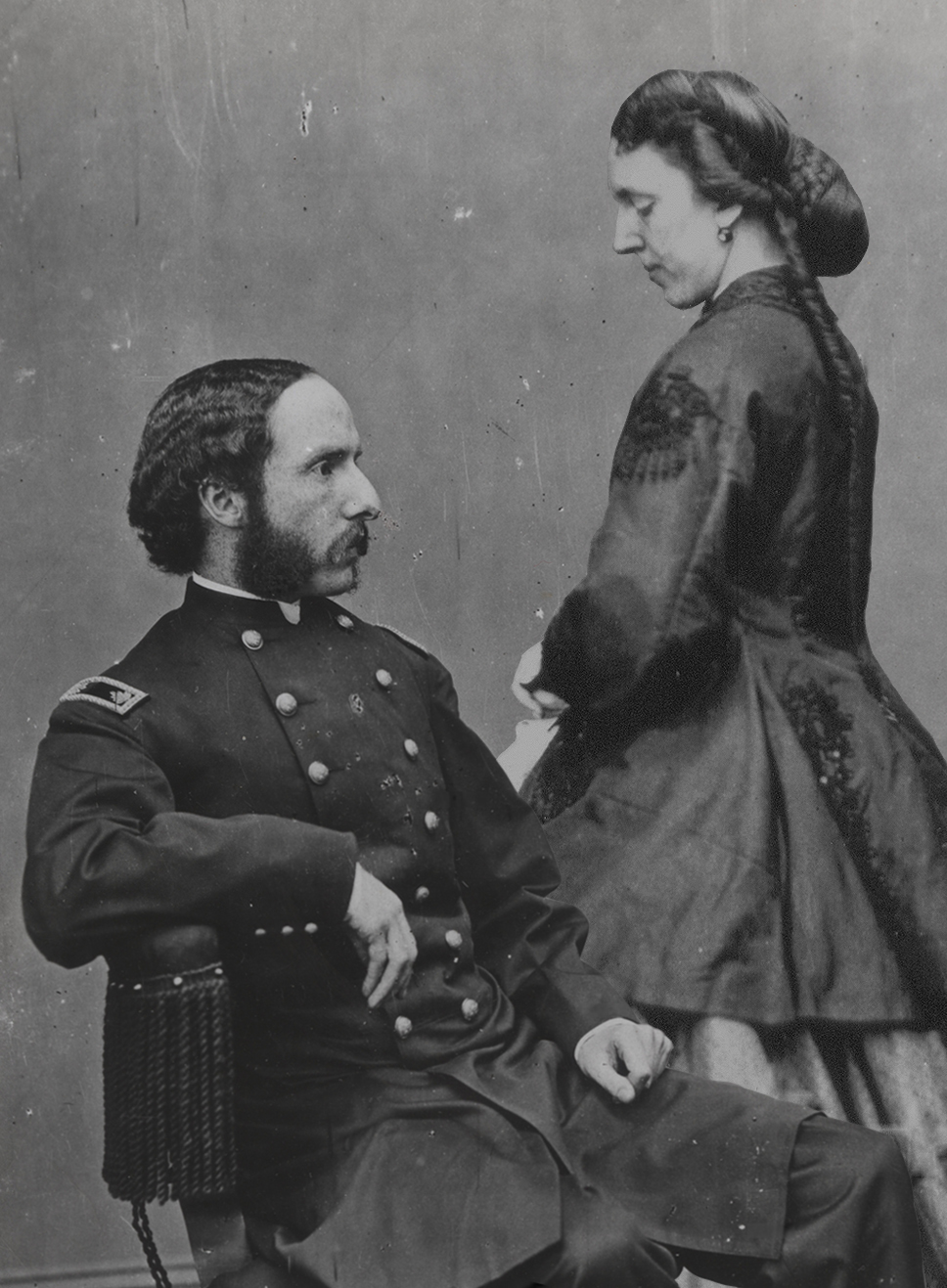
Major Henry Rathbone and Clara Harris (composite by the author)

After Booth shot Lincoln, Major Rathbone, alarmed by the report of a pistol and cloud of powder in the box, raised himself and attempted to subdue the assailant. During the struggle Booth thrust at Rathbone with his knife, which Rathbone parried upwards. In the course of this parry, Rathbone received a deep cut on his left arm between his elbow and his shoulder. It was a painful blow that knocked Rathbone back a bit. At this moment, free from grappling with Rathbone, Booth moved to the front of the theatre box, and leapt over it.

Many witnesses at the time said that Booth’s jump from the box was a noticeably ungraceful one. One eye witness account stated that, “He did not strike the stage fairly on his feet, but appeared to stumble slightly.” Immediately following the events, several others described similar stumbles Booth made upon reaching the stage.

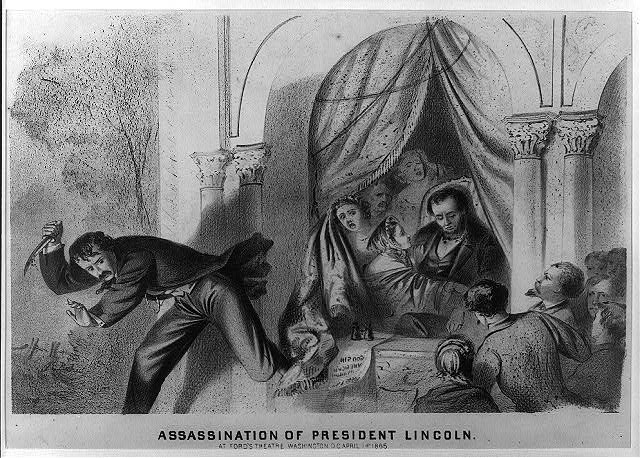
A quite ungraceful engraving of Booth’s jump from the box

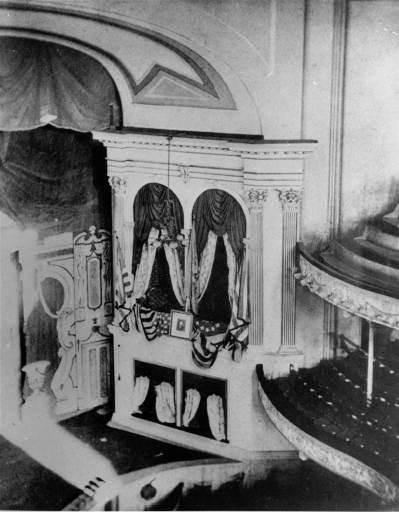
Granted, the distance he leapt was twelve feet off the ground and it can be a hard landing for any man to make properly. In his act of jumping, Booth disturbed the flags decorating the box. This, of course, makes perfect sense. The flags decorating the box were merely attached to the outside and weren’t expected to be moved during the President’s attendance. Instead of jumping straight from inside the box down to the stage in a hurdler’s motion, Booth likely leapt over the railing of the box, paused briefly on the small ledge on the other side, and then jumped down. This small ledge is where many flags were resting and draped about. A witness at Ford’s described that, during the jump, Booth, “partially t[ore] down the flag”.

Photograph of the box shortly a day or two after the assassination. Notice the partially pulled down flags.

Another witness had a similar account about his riding spur getting caught up in the decorations, causing his awkward fall. The American mythos of the assassination states that, while jumping, Booth was tangled in an American flag causing him to land poorly onto the stage and breaking his leg. In his diary, the vain Booth, probably attempting to save face for his less than perfect “performance”, claimed that in jumping from the box he broke his leg. Most Boothies accept this as fact while also entertaining the idea set forth by author Michael Kauffman that Booth broke his leg later that night, when his horse fell on him during the rough ride south. With it being impossible to prove one theory over another, historians just pick the idea they like better and concede that differences of opinion exist on the matter.

What is not really debated is that Booth fell uneasily upon the stage, making one of his worst entrances ever. While the flags generally receive the attention for causing Booth’s missteps, Rathbone’s account provides another possible reason:

“The man rushed to front of the box and [I] endeavored to seize him again but only caught his clothes as he was leaping… The clothes, as [I] believe, were torn in this attempt to seize him.”

While Rathbone gets credit for struggling with Booth and sacrificing his own arm attempting to subdue him, is it possible that Rathbone was also the reason Booth landed so hard upon the stage? As Booth was making his jump, could the grasp of Major Rathbone on his clothes have thrown the actor’s balance off and caused his clumsy landing? Further, if this is indeed when Booth broke his leg, effectively slowing down his escape, could it be Rathbone and not the flags, that deserve the credit? These questions and the overall scenario produced by them are merely items to contemplate and I make no claims of them being in anyway definitive.

A second item Rathbone mentions in his testimony is about the set up of the box itself. From the beginning Rathbone gives a wonderful description of the box and the locations of the parties therein. From his description the following diagram of the box seems to correct display the set up:

Booth entered the box through the outer passageway door marked H on the diagram. Remember, during normal nights the box in which the President’s party occupied severed as two boxes. A partition would separate it into two smaller boxes. That is why there are two doors inside the passageway. The door marked as G, was actually the closest door to the President, but was closed during the whole night. It was the entrance to Box 7. The Presidential party and Booth all entered the box through door F. That was the door to Box 8.

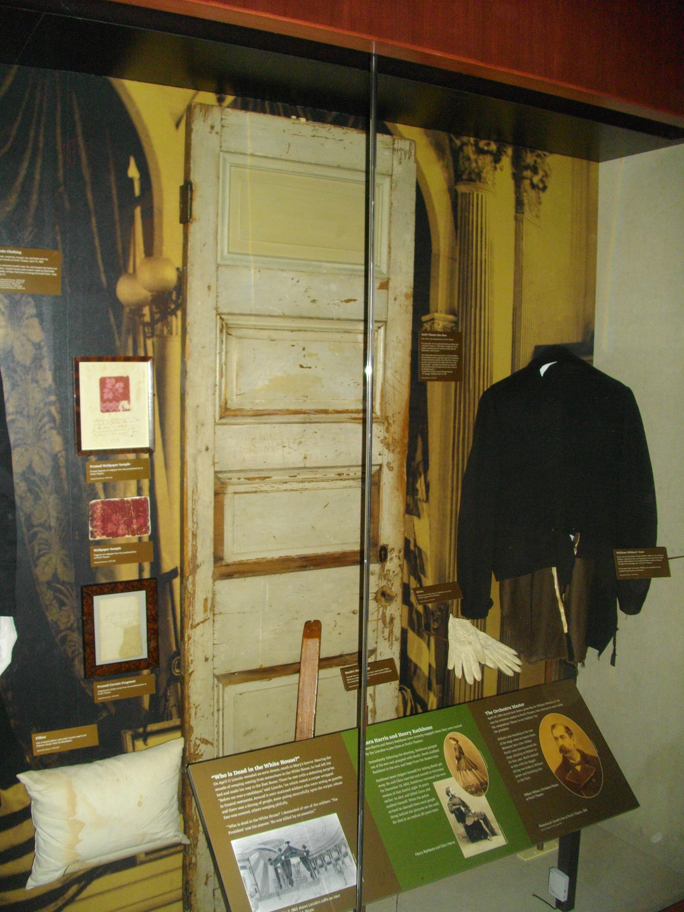
This inner door to Box 7 is on display at in the Ford’s Theatre Museum.

This door has a unique feature as it has a peep hole bored into. For many years it was written that this hole was bored by John Wilkes Booth on the morning of the assassination. After learning about Lincoln’s attendance that night, Booth did enter the theatre and found a wooden bar with which to jam the outer door so that it could not be opened. The wooden bar can be seen in the above picture sticking out from the bottom of the door. It was assumed that during this prep work, that he also bored a hole into the door in order to have an eye on the President before entering the box.

A letter written by Frank Ford (son of Harry Clay Ford, the theatre’s treasurer) denounced this idea. Frank stated that his father ordered the hole to be bored into the door so that the President’s guard, and others employed in their duties for the government or theatre, could look in on the President and his party instead of barging in straight away and disturbing them. Frank quotes his father as saying, “John Booth had too much to do that day other than to go around boring holes in theatre doors.” However, a period statement from Harry Ford has him saying, “Did not notice a hole in the door or in the wall. Did not take particular notice of the wall or door however.” So the mystery regarding the hole remains.

Even if this hole was bored at the bequest of the Ford’s, Booth still used it to eye the President before making his move, right? Not necessarily. According to Rathbone:

“The distance between the President as he sat and the door was about four or five feet. The door, according to [my] recollection, was not closed during the evening.”

Rathbone claims that the door to Box 8 was never closed during the performance. If this is the case, Booth may not have used the peephole to spy on the President through Box 7. After entering the passageway door, Booth stealthily put the wooden bar in place to “lock” the outside door, and either peered through the slightly open Box 8 door into the box, or just waited until the lines of the play were right to bust in and get his first real view. With all eyes directed on stage and not towards the rear, it seems that Booth could have been standing in the shadows of the passageway eyeing the President for some time before he acted. If Rathbone is to be believed and the door was open during the performance, the image of Booth before he shot Lincoln could change. Instead of a man hiding behind door 7 nervously peeking at his target through a hole, Booth becomes a shadowy figure, standing motionless in the doorway to box 8 eyeing his prey. To me the latter image is in line with Booth’s brazen persona. He brought an unreliable single shot derringer to kill the President, assured that he would succeed. I have no problem picturing this arrogant Booth, lurking near an open door a few feet away from the President, coiled like a viper waiting to strike.

Again, these small pieces of Rathbone’s account are posted here merely to initiate contemplation and conversation. Feel free to post your thoughts about them by clicking on the “comment” button below.

References:
The Lincoln Assassination – The Evidence by William Edwards and Ed Steers
We Saw Lincoln Shot by Timothy S. Good

Categories: Uncategorized | Tags: , , , | 20 Comments

The Collapse of Ford’s Theatre

On this date, June 9th, in 1893, a part of the three upper floors of Ford’s Theatre collapsed killing twenty two clerks and injuring over 100 more government employees.

NPS Photo

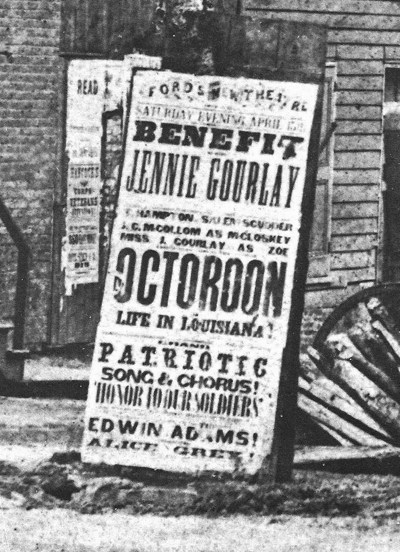
After the assassination of Lincoln, the government immediately seized Ford’s Theatre.  Military guards had been posted to the theatre and access was granted by War Department passes.  Matthew Brady was allowed to photograph the interior and members of the stage crew and orchestra were allowed to retrieve their items from within its walls.  After the execution of the conspirators on July 7th, 1865, John T. Ford was given permission to reopen his theatre.  He announced that the play, “The Octoroon” was to be performed on July 10th.  As is shown on the playbills and broadsides from “Our American Cousin”, “The Octoroon” was initially scheduled for April 15th.  While Ford sold over 200 tickets for the performance, there was also a large uproar over the theatre reopening after what had transpired within her walls.  Ford received this anonymous letter implying retribution if he fulfilled his plan:

 “Sir:

You must not think of opening tomorrow night.  I can assure you that it will not be tolerated.  You must dispose of the property in some other way.  Take even fifty thousand for it and build another and you will be generously supported.  But do not attempt to open it again.

One of many determined to prevent it.”

For fear of the place being burned, the Judge Advocate ordered a troop of soldiers to the theatre on the night of July 10th, to prevent anyone from attending the play.  Ford placed a sign on the door reading, “Closed by Order of the Secretary of War” and refunded the ticket holders.  He would not attempt to revive his theatre again.

The government decided its best option was to just retain the property.  They began paying John Ford $1,500 a month to lease his theatre.  By July of 1866, the government bought the property outright for Ford for $88,000.  Even before purchasing the building, the government had started renovating the theatre.  They transformed the interior into a three story office building.  In December of 1865, the Army Medical Museum moved into the third floor of the space.

Engraving of the Army Medical Museum housed in Ford’s Theatre from the book, “Ten Years in Washington: Life and Scenes in the National Capital as a Woman Sees Them” (1874).

The museum would stay in Ford’s until 1887, when a separate building was constructed for their purposes.  The Army Medical Museum’s occupancy at Ford’s provided a slightly macabre reunion between Abraham Lincoln and John Wilkes Booth.  The museum housed pieces of Lincoln’s skull and hair, and Booth’s vertebrae, each taken from their perspective autopsies.  Parts of the two men spent over twenty years together at the scene of their last meeting. EDIT: Further research has shown that Lincoln’s skull fragments were not given to the Army Medical Museum until after it had moved out of Ford’s Theatre. Darn.

Lincoln Skull Fragments and Nelaton Probe

Engraving of Booth Vertebrae

The other two floors of Ford’s housed the Office of Records and Pensions run by the War Department.  When the medical museum moved out, they took over the entire building.  The many clerks employed in the building compiled the official pension records for Civil War veterans and others.

In 1887, the Pension bureau received a new chief, Colonel Fred C. Ainsworth.  As a boss, Ainsworth was not a popular fellow.  His methods of leadership and his expectations of his clerks was a drastic change from the department’s previous leaders.  Old timers who had worked in the office for years found themselves held to greater expectations and increased workloads.  While this made Ainsworth an efficient chief, it also made him a very disliked leader.  However, Ainsworth was not heartless and tried his best to appease his clerks.    Ainsworth was aware of his clerks’ apprehension about the building they occupied.  When he first started, he heard rumors that the east wall of Ford’s was unsafe.  He made inquiries with his superiors and was assured that the wall was perfectly secure and the whole building was safe.  In 1888 and 1889, Ainsworth directed the installation of a new steam heating apparatus and a new plumbing system for the building.  Then in 1893, he received permission to install an electric light plant for the building.  In order to place the light plant and provide amble ventilation for it, it was required to excavate about twelve feet between two partition walls in the basement.  Ainsworth wrote up specifications, gave them to the War Department, and the War Department created a contract and accepted bids.  Eventually, the bid by a contractor named George W. Dant was chosen to do the work.  During this entire process, no element of danger was discussed by anyone.  With proper underpinning of the floor above, the excavation was a relatively safe job.

While this construction was going on, the clerks’ unease about the building increased.  Plaster was known to fall from the ceiling and, at one point, part of the first floor was roped off causing the clerks to worry about the structure.  None of them however, seem to have brought their concerns up with Colonel Ainsworth.  As chief, he continually went into the basement to check on Dant and his men.  Dant continually assured him that everything was fine and that the roped off area was just because that particular part of the first floor was to be removed as part of the excavation.

Then, on this day in 1893, tragedy struck Ford’s again.  During the course of the work day, with hundreds of clerks and files hustling about, a support pier in the basement excavation area collapsed.  The floors above were supported by iron beams, which rested on columns, which rested on the brick piers in the basement.  When the one pier gave way, a 40 foot section from all three floors collapsed down.  Twenty one clerks were instantly crushed and killed.  One would die a few days later from his injuries.  A total of 105 clerks suffered injuries, with two more clerks dying as a result of their injuries over the next three years.

Almost as soon as the dust settled, and the dead were dug out, the public demanded to know who was responsible for the collapse.  A Coroner’s inquest was held to determine if there was any criminal responsibility.  The surviving clerks, furious over the loss of their brethren, used this opportunity to lay the blame on their despised chief, Colonel Ainsworth.  On the witness stand they spoke of the building being a death trap long before the accident.  They claimed they were told by Ainsworth’s assistants to tip toe on the stairs because they were dangerous.  They said they were too afraid to say anything about the conditions for fear they would be fired.  The room in which the inquest was held turned into a scene of fury, with all rage directed towards the Colonel.  A man who lost his brother in the accident came up behind the sitting Colonel and yelled “You murdered my brother!”  Shouts of agreement came from others in the crowd and several rose to their feet moving to close in on the Colonel.  Luckily the police lieutenant in the court was able to disperse the impromptu mob.  As more and more witnesses took the stand, the outbursts from the crowd increased.  All the while, the Colonel sat calmly in his chair, unwavering.

With emotions high, even members of the jury broke decorum.  B. H. Warner, a juror, interrupted a testimony and asked for Ainsworth to leave as he was intimidating witnesses with his mere presence.  The crowd applauded this suggestion for a full minute glaring at Ainsworth all the while.  Ainsworth refused to leave citing it as his right to hear testimony regarding the events.  The Coroner agreed.  He had no precedent to evict Ainsworth, as he had done no wrong and merely sat there.  When the Colonel’s representative, a Mr. Perry, rose to address the room, the crowd yelled at him and hissed.  When the room finally gained its composure, Mr. Perry begged the crowd, “I appeal to you as American citizens for fair play.”  To this a member of the crowd replied with, “You didn’t give us fair play!” At that point, the tempest roared.  The shouts of, “Murderer!” changed to, “Hang him! Hang him!” and the mob approached Ainsworth who continued to sit cool and collected in his chair.  The police lieutenant was powerless to disperse the mob.  For a brief moment of time, it appeared the Colonel’s life was to end right there by the hands of his angered employees.

The only thing that brought the mob back to its senses was the when the juror who previously spoke, B. H. Warner, stood upon his chair and begged for order.  He calmed the crowd back down with the following:

“This outbreak of feeling must be suppressed not by the strong hand of the law, but by the hand of fraternity.  I appeal to you to have fair play as American citizens, and not to stain the fair name of the glorious Capitol of this Republic.  I appeal to you in the name of the Master who reigns above.”

The inquest continued for the next few days but with increased police attendance that squashed all disturbances before they could start.  The jurors of the inquest found Colonel Ainsworth, contractor Dant, the superintendent of the building, and the mechanical engineer of Ford’s guilty of criminal negligence.  However, the Coroner’s inquest had no real power.  It merely established whether or not the men could be charged with the crime.  Despite the findings, the district attorney never charged the superintendent or the mechanical engineer with any crime.  Due to the public outcry, however, he did go after Ainsworth and Dant.  The defense effectively postponed matters until time allowed the public to cool down.

In the end, the charges against Colonel Ainsworth were dropped as the Coroner’s inquest never proved that he had any knowledge that the building was unsafe.  The jurors’ verdict was a product of the emotions of the times and not the evidence.  The accident was a travesty, but the Colonel was guilty of no wrong doing.  He continued as Chief of the Records and Pensions bureau and worked his way up to becoming the Adjutant General.  He died in 1934 and is buried in Arlington.

Of all those involved, it is probably George W. Dant who is to blame for the collapse.  It appears that he and his crew did not properly shore up the brick piers around the excavation.  With the ground around them gone, the weight of the floors above was too much for the exposed piers.  The cause of the collapse was due to the improper support of these piers.  While Dant was the most liable for what occurred, by April of 1895 the prosecution gave up its case against him.

NPS Photo

For the clerks who perished, the government paid $5,000 to each of their families.  Those who were wounded in the collapse received anywhere from $50 to $5,000 depending on the extent of their injuries.

The inside of Ford’s was rebuilt immediately after the collapse.  From 1893 to 1931 the building housed the Government Printing Office under the direction of the Adjutant General.  In 1931 the building was turned over to the Department of the Interior and the Osborne Oldroyd’s Lincoln Museum opened on the first floor in 1932.  It became a National Historic Site the same year.  After being renovated and restored to its 1865 appearance, it reopened as a working theatre and museum in 1968.

While it is well known, the one item of coincidence regarding the June 9th, 1893 collapse of Ford’s is still worth repeating here.  At around the same time the clerks of Ford’s were falling to their deaths, another man was being buried in Massachusetts.  Edwin Booth, the great tragedian and brother of the assassin, died on June 7th.  On the day of the collapse, he was being interred at his final resting place in Mount Auburn cemetery.  Despite Edwin’s lifetime of success as the greatest actor of his generation, both his life and death are eclipsed by tragedies at Ford’s Theatre.

References:
Ford’s Theatre and the Lincoln Assassination by Victoria Grieve
Restoration of Ford’s Theatre by George Olszewski
There are many newspaper articles about the inquest and legal proceedings regarding the collapse.  I used GenealogyBank searches for Ainsworth and Dant to find several articles.  Others can be found in the New York Times’ archive.  The most entertaining account (which contains the material about the mob at the first session of the inquest) can be read here.
Other articles about Ainsworth’s legal process: 1, 2, 3

Categories: Uncategorized | Tags: , , | 23 Comments

The Assassination Playbills

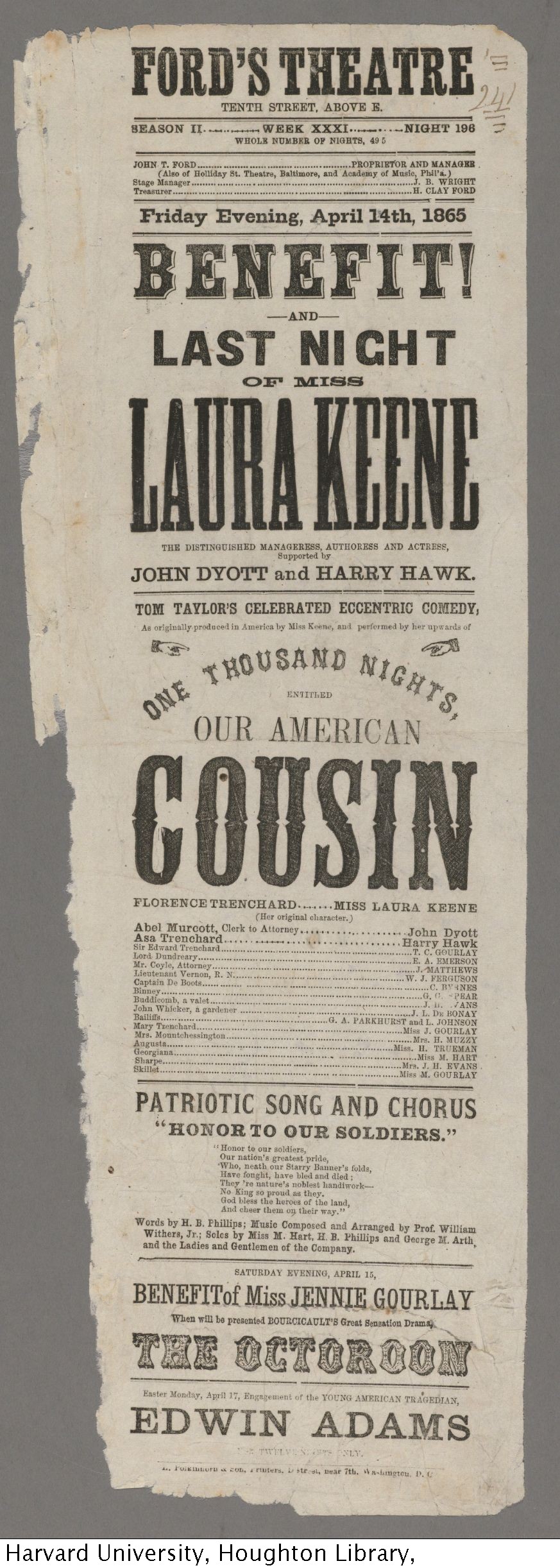
Earlier, I introduced you to Henry Polkinhorn, a Washington, D.C. printer.  From his building on D Street, Polkinhorn printed newspapers, books, and a plethora of other custom items.  Of all the items he printed over the years, the most sought after item today is the playbill from Ford’s Theatre for April 14th, 1865.  In this post we will explore the details of Polkinhorn’s work, in order to identify genuine playbills and later reprints.

We will be utilizing the wonderful, but rare book, The Ford Theatre Lincoln Assassination Playbills: A Study by Walter C. Brenner.  Mr. Brenner privately printed this 16 page book in 1937.  In it he sorted out the many misconceptions about the playbills and, for the first time, created a tool for identifying and authenticating genuine playbills.  In the foreword of his book, Mr. Brenner wisely stated that, when attempting to authenticate a playbill as genuine, “source and pedigree must be disregarded,” and many, “will not prefer to do so.”  The simple truth is there is an exceedingly small possibility that genuine playbills still exist outside of libraries, museums, and private collections.  In fact, many libraries, museums, and private collections themselves don’t even have genuine playbills.  The best of provenance must be ignored when faced with the facts and details of the printed playbill.  The evidence within is unbiased and is merely for the benefit and education of those interested in the drama at Ford’s.

As stated before, Henry Polkinhorn was the regular printer for Ford’s playbills.  His association with the theatre started when John T. Ford took over the Tenth Street Bapist Church and started putting on musical performances:

Ford continued using Polkinhorn’s services when he renovated the church into Ford’s Atheneum:

When a fire destroyed most of the building in December of 1862, Polkinhorn helped his customer by purchasing stock so that he could build Ford’s New Theatre.  Ford continued to use Polkinhorn for his playbills and printed materials all the way until when the theatre closed for good after the events of April 14th, 1865:

Large advertisement for Ford’s April 15th, 1865 performance of The Octoroon. The performance never occurred as the theatre was closed after Lincoln’s assassination.

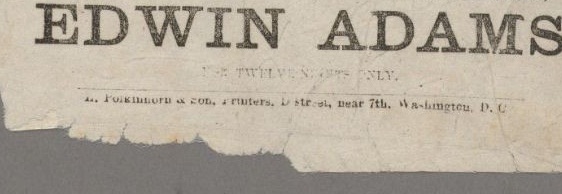
Therefore, when attempting to authenticate a playbill, it is important that it has been printed by “H. Polkinhorn & Son, Printers, D street, near 7th, Washington, D.C.”.  This is the final line on the playbill right at the bottom:

Now, just because a playbill says “H. Polkinhorn” at the bottom does not mean that it is genuine.  Practically all the later forgeries and reprints include the correct printer.

To Polkinhorn, printing the playbills for April 14th was just another job like the day before.  As a printer, he kept the previous day’s playbill set up on the press until he was given orders to change it, and then he changed only as much as was necessary.  This would save time in the printing process as long as the customer did not call for a completely redesigned playbill.  The Harvard Theatre Collection has the bound volume of playbills belonging to John B. Wright, the stage manager at Ford’s.  Looking at the playbills leading up to the 14th, Polkinhorn used the identical line of lettering for Laura Keene’s name on the 10th, 11th, 13th, and the 14th.  On the 12th, he had to resize her name to make room for an illustration on the playbill, but reverted back on the 13th.  On the morning of the 14th, Polkinhorn was printing the bills.  At around 10:30 am, Mrs. Lincoln’s messenger arrived at Ford’s to reserve the box for that night.  After this announcement happened, John Wright went to Polkinhorn’s printing shop to change the playbill.  Originally, there was going to be a special musical performance on the next night, April 15th.  On the large poster above you can see on the bottom the announcement for “Honor to Our Soldiers”.  This was a song written by Ford’s orchestra director William Withers.  With the announcement that Lincoln was attending that night, it was decided that the premiere of the song should coincide with the visit of their honored guest.  Therefore, Wright went to Polkinhorn’s to change the playbill to include mention of the song.  When Wright arrived, Polkinhorn altered the press to print the new bills.  Rather than throw out the bills Polkinhorn had already printed without the song, they were also used that night.  This is the reason why there are two issued of playbills for Our American Cousin:

Ford’s Theatre Playbills from April 14th, 1865

After Lincoln was killed, the theatre was shut down never to be used by Ford again.  Polkinhorn found that one of his most consistent clients no longer needed his services.  He removed the song playbill design off of the press and carried on with his business.  As time passed, people clamored for mementoes of the fallen President and the events at Ford’s Theatre.  John Buckingham was the door keeper at Ford’s on the night of the assassination.  In 1894, he published a short, illustrated book called Reminiscences and Souvenirs of the Assassination of Abraham Lincoln.  Before, publishing this book, however, Buckingham got into the business of reproducing playbills from that night.  When Buckingham first started printing his “souvenir” playbills is unknown.  The earliest I can confirm is by 1879, but it is likely he started much earlier than this.  One source states that the reprints were sold on the streets of Washington “a day or two after the tragedy”.  What is known is that when Buckingham decided to print his souvenirs he went right back to Polkinhorn’s printing company.  Richard Oliver Polkinhorn, Henry Polkinhorn’s nephew, is the one that helped him recreate the bills from that night.  Using Polkinhorn’s own press and type, the two printed copies and created an engraving of the first issue playbills.  Buckingham started selling the playbills as souvenirs.  At first, the reprinted bills had no markings to identify them as reprints.  Years later, Buckingham would start stamping them, “Lincoln Souvenir Engraving”, but by then countless numbers had made their way into the public and began masquerading as authentic bills.  Buckingham’s souvenir playbills look like this:

John E. Buckingham’s souvenir reprint playbill

So, there are two issues of authentic playbills printed on April 14th, 1865, and one version later printed by Ford’s doorman.  Buckingham only reprinted the first issue playbill and so the second issue, the one with “Honor to Our Soldiers”, has been saved from period forgeries.  Aside from contemporaneously forged examples, all second issue playbills that exist are most likely genuine.  For the first issue playbills, however, careful attention must be paid to identify Buckingham and other reprints.

As well as John Buckingham and Richard Polkinhorn did in recreating the first issue playbills, the devil is in the details.  As we will see, Buckingham made his own mistakes and actually corrected mistakes that were present in the original bills, when making his copies.  A close look at a genuine bill and a Buckingham copy shows the differences.

The way we know that Buckingham used Polkinhorn’s own type and press is twofold.  First, on the back of an 1891 Buckingham reprint there is a stamped note from R. O. Polkinhorn citing his involvement in creating the copies.  Second, the type itself is a match for Polkinhorn’s press.  One way to identify a bill that used Polkinhorn’s press is the particular type that is used to create the words “THE OCTOROON”.  Other period reprints from other printers, like this one housed at the University of Delaware, did not have this specific font type.  This clearly identifies it as being from another printer entirely.
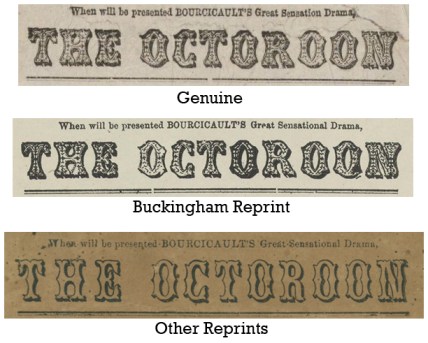
On the Buckingham reprints, however, “THE OCTOROON” is in the exact same type as on the original playbills, proving that Polkinhorn’s printing shop was used for the souvenirs.

The most obvious difference between a genuine first issue playbill and a reprint is the final “E” in LAURA KEENE.  In genuine bills, the final “E” is perfect.  This “E” is consistently undamaged on the previous Ford playbills from the week leading up to the assassination.  On the Buckingham reprints, however, the final “E” is marred:

Not only is the “E” damaged, but also the final letters and numbers on many of the lines.  According to Brenner this damage was caused by the gauge pins on the press getting in the way.  However it happened, it provides the most notable difference between a real playbill and a souvenir.

While the “E” was a mistake on the part of the printer, the pair also fixed mistakes from the original bill.  In the genuine first issue bills, right above “The OCTOROON”, it states, “When will be presented BOURCICAULT’S Great Sensation Drama,”.  This is a typo.  It should read “Great Sensational Drama”.  When Buckingham created his souvenirs he corrected it and changed it to the appropriate “Sensational” (See the Octoroon examples above).

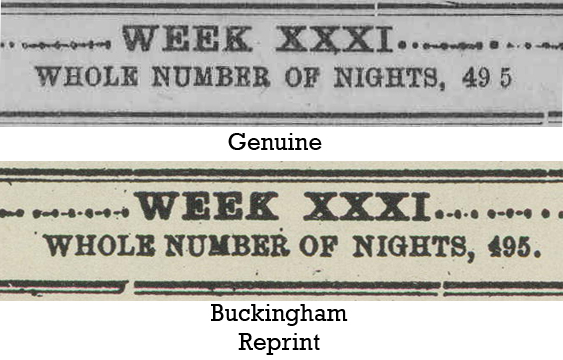
In addition, the original bill had an accidental space at the top.  Under the heading it states, “WHOLE NUMBER OF NIGHTS 49 5”.  There is a space between the 9 and 5 in “49 5”.  Buckingham corrected this unnecessary space and changed it to “495”.

In Walter Brenner’s book, he identifies 14 minute differences between Buckingham’s reprint and genuine playbills.  From missing words to the vertical alignment of letters, he provides a chart of the changes.  If a playbill has correctly passed the above criteria, this book should be consulted and the rest of the details authenticated.

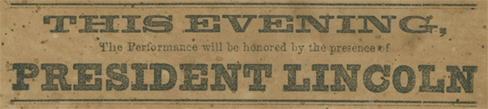
In addition to Buckingham’s souvenirs, many other printers and indiviudals of the period tried their hand at creating false bills.  Any playbill that bears the announcement that, “THIS EVENING The Performance will be honored by the presence of PRESIDENT LINCOLN” is a fake.

Forgery

As was mentioned earlier, the playbills were altered when it was ascertained that Lincoln and his guests were attending the night’s performance, however, they were only changed to include lines from the song “Honor to Our Soldiers” and not to announce his attendance.  Playbills containing Lincoln’s name are reprints from other printers, and not authentic.

While period fakes are common, there are also modern fakes that often trip people up.  Like Buckingham did so many years ago, museums sell reproduction playbills in their gift shops around the country.  Ford’s Theatre actually sells a reproduction of the Buckingham reprint.  It is attached to a reproduction wanted poster and costs $1.50.

The paper is browned and made to look old, too.  They are excellent reproductions but can add to the confusion when someone believes they have the genuine article.

When it comes to Ford’s Theatre playbills from April 14th, 1865, it is important to dismiss any stories of provenance until the bill is authenticated.  In Brenner’s book, he mentions a playbill with impeccable provenance.  Two signed affidavits accompany it; one written by the owner of the bill and another by John T. Ford himself.  In it he states, “I, John T. Ford on oath say that I presented Mr. A. K. Browne with a programme of the play of ‘Our American Cousin’ which I picked up near President Lincoln’s chair when he was assassinated…”  This superb provenance is a rare and valued thing for historical artifacts.  Unfortunately, the marred “E” on the playbill that accompanied these affidavits prove that it is not a genuine playbill, but instead a Buckingham reprint.  The best provenance in the world has to be ignored when faced with unbiased evidence.  Despite the affidavit to the contrary, John T. Ford was not even in D.C. when Lincoln was assassinated, and he did not arrive there until the Monday after the shooting.  Treasure seekers had cleaned out the theatre box long before he showed up.

As far as relics go, a genuine playbill is a treasured commodity.  On its face, it’s an advertisement for a night at the theatre.  In the context of history however, it exudes a sense of foreboding.  These playbills capture Lincoln’s assassination in a way that no other artifact can.  They are the last vestige of Lincoln as he lived, and the gateway to his immortality.  While reproductions have been made, only genuine playbills provide the emotional impact of that moment frozen in time.  They exist today as silent witnesses to Ford’s last great drama.

References:
The Ford Theatre Lincoln Assassination Playbills: A Study by Walter C. Brenner
Restoration of Ford’s Theatre by George Olszewski

Categories: Uncategorized | Tags: , , , , | 25 Comments

H. Polkinhorn, Printer

Often, I get caught up in the little people of the assassination story.  Those who had relatively minor roles seem to fascinate me for their trivial involvement in the great drama.  The first article I wrote for the Surratt Courier was about Emerick Hansell, the state department messenger wounded by Lewis Powell at Secretary Seward’s.  We know him merely because he was at the wrong place at the wrong time and got a knife in the back for it.  Nevertheless, it is the almost trivial characters of the story that continually draw me in.  This post is further proof of that.  For the past few weeks I have been researching a very minor figure to a great degree.  I contacted Harvard University for a picture, made inquiries through Ancestry to help figure out his genealogy, and searched newspaper records for hours on end.  Even while I was doing it, I couldn’t help but think, “Why are you going to all this trouble?  Who is going to care about the minor details of this minor character?”  In truth, I may be the only one who cares about this man and his background, but the search for knowledge is enough motivation for me.  Will it change our view of the assassination? No.  But in a field where the big picture is explored so many times, sometimes it’s just fun to get lost in the little things.  The following is what I have spent my time doing – researching a man who is barely on the cusp of the assassination story merely because I enjoy the hunt. 
 

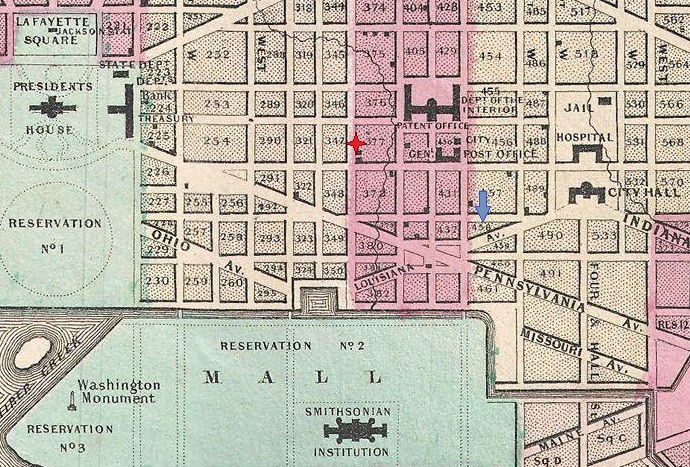
In the above map, the blue arrow points to 634 D Street NW in Washington, D.C., as it was in 1861.  During the Civil War era and for many years after it, this location held the prestigious and profitable printing company of Polkinhorn and Son.  Its founder was Henry Polkinhorn:

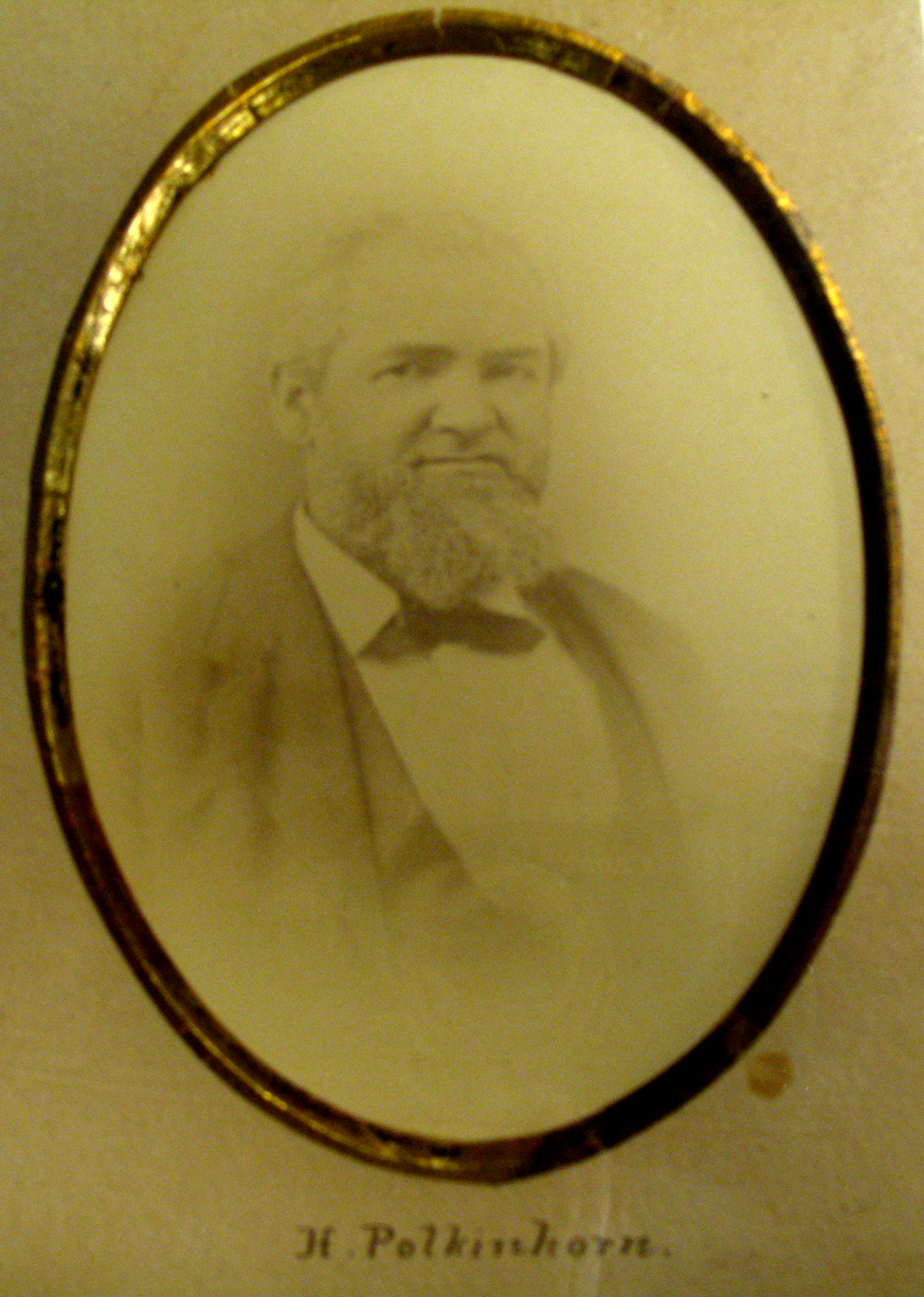
Henry Polkinhorn from the Harvard Theatre Collection

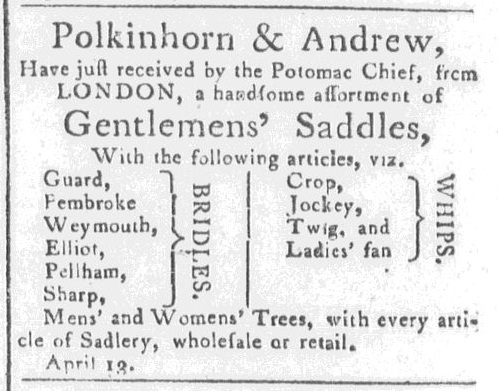
Henry Polkinhorn was born in 1813 in Baltimore.  His father, Henry, Sr., was an immigrant from England and a saddler by trade.  As a saddler in Baltimore, Henry Sr. was a very prosperous businessman himself:

A 1797 advertisement for Polkinhorn saddles

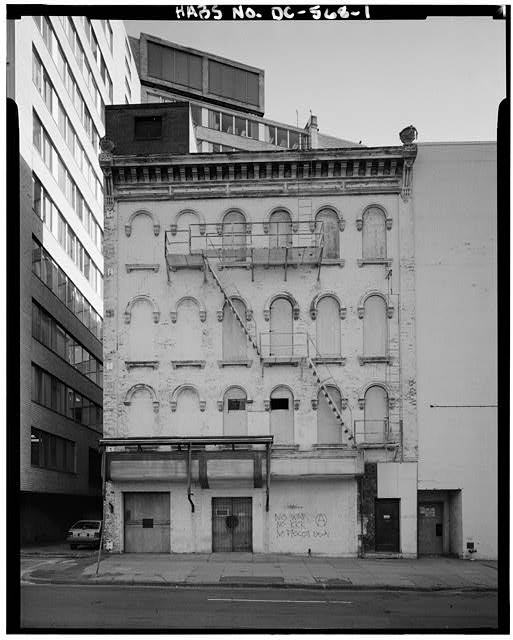
As a young man, Henry Polkinhorn, Jr relocated to D.C. and married Marianne Brown in 1839.  Together Henry and Marianne had six children.  Marianne died in 1857 and Henry married Rachel Ann Barnes less than two years later.    Differing from his father, Henry entered into the trade of a printer to support his growing family.   In his chosen occupation, Henry Polkinhorn was extremely successful.  After a few years of increasing success in his printing trade, Polkinhorn was able to erect his own building at 634 D Street NW between 6th and 7th streets.

It was a five story building in the Italianate style, which became very popular in the US after the late 1840’s.  Italianate buildings are noted for their bracket cornices and arched windows.  A newspaper article of the day described Polkinhorn’s building as having, “great height and [a] majestic appearance.”  Of the five stories, three of the floors were committed to Polkinhorn’s printing trade.  The second floor, in particular, was, “furnished with every facility for the execution for all descriptions of printing, both plain and ornamental.”  For his skills in printing and self-made success, Polkinhorn was very well respected by his peers.  The article honoring his building ended with, “We sincerely recommend the enterprising proprietor to the favorable notice of our citizens, as one, independent of his long established reputation, worthy of their highest consideration and esteem.”

As with all printers of the day, Polkinhorn ran a diversified printing company.  In each major area of his business, he printed materials connected to the assassination of Abraham Lincoln in 1865.  First, he printed newspapers.  Not only did he print them for others, he even started a couple on his own like Our Newspaper and the Constitutional Union.  Another newspaper he printed was the National Intelligencer.  The office of the Intelligencer was right across the street from Henry Polkinhorn’s printing office.  This provided steady income for Henry Polkinhorn and convenience for the Intelligencer management.  The Intelligencer also relates to the assassination of Lincoln, as it was one of the best newspapers for daily coverage of the trial of the conspirators.  Even to this day, issues of the National Intelligencer have been microfilmed by the National Archives and housed with the Lincoln assassination papers due to their relevance and content.  Polkinhorn would have even more connection with the Intelligencer after the trial was over.  By late 1868, the National Intelligencer was broke.  The owners, who had taken it over in 1865, had run it into the ground and owed thousands of dollars to many people.  The biggest debt they owed was to Henry Polkinhorn.  For his printing of their paper, they owed him over $50,000.  Fed up, he finally called to settle his tab.  With no money to pay him, the owners transferred the Intelligencer completely over to Polkinhorn.  Henry continued to make and print the Intelligencer until he himself was able to sell it off.  Shortly thereafter, the Intelligencer merged with the Washington Express and effectively died.

While newspapers provided daily work for Henry Polkinhorn, he was also well known for his book printing.  He devoted a whole floor in his five story building for Book and Job Printing.  Many famous and common citizens went to him to print their books.  An online search for “Polkinhorn printer” and alike will yield numerous nineteenth century books that were printed from his D street establishment.  On the brink of the Civil War, Polkinhorn printed, in book form, a letter by Joseph Holt explaining the dangers that were to come and his satisfaction that his own home state of Kentucky choose to stay with the Union.  Holt would later be named the Judge Advocate General, and chief prosecutor at the trial of the Lincoln conspirators.   During the trial, Polkinhorn printed many pamphlets containing the testimony of the trial pertaining to certain individuals like Dr. Mudd and Edman Spangler.  Polkinhorn also published Thomas Ewing’s argument against the jurisdiction of the military tribunal that tried the conspirators.  He also printed a plethora of other books on wide range of topics.  One book that sticks out is a doctor’s thesis about the dangers of cemeteries in populated areas.  The doctor blames many of the illnesses and sicknesses of those living in Georgetown on the nearby cemetery “Oak Hill”.  He called for the immediate closing of the cemetery and for the removal of the bodies.  When Henry Polkinhorn died in 1890, he was buried at Oak Hill.

While the newspaper and book printing jobs loosely connect him to the assassination of Lincoln, Henry Polkinhorn’s real relationship to the death of our 16th president is based on several individual pieces of paper, 18 inches long.  On top of his already multipurpose book and newspaper printing, Polkinhorn also has the honor of printing one of the most sought after relics of Lincoln’s assassination: the playbill from Our American Cousin.

A true playbill from Ford’s Theatre on April 14th, 1865.

Polkinhorn’s was the “go to” establishment for Ford’s Theatre for their playbills.  The map that started this post has a red star marking where Ford’s Theatre is.  Polkinhorn’s office was less than a half mile away, making him a perfect place for the Ford’s to do their business.  In the Harvard Theatre Collection there is a ten by twenty inch bound volume of Ford’s Theatre playbills originally belonging to John B. Wright, stage manager at Ford’s.  The volume contains 193 playbills commencing from August of 1864 until the closing of the theatre after the events of April 14th, 1865.  A look at this volume shows that “H. Polkinhorn & Son” was the regular printer of the Ford’s Theatre playbills.  The “son” in “Polkinhorn & Son” was Henry’s son Samuel Polkinhorn.  After Henry retired, Samuel would partner up with his cousin, Richard Oliver Polkinhorn, who worked in the Polkinhorn building and was a talented printer in his own right.   “S & R. O. Polkinhorn, Printers” would last about a year before Samuel decided to bow out leaving his cousin as the sole owner of “R. O. Polkinhorn, Printer”.  Richard would create “R. O. Polkinhorn & Son” with his son Joseph and the Polkinhorn printing legacy would go on.

For a detailed look at the assassination playbills read the follow up post here.  What is important to know is that the only legitimate “Our American Cousin” playbills were printed by “H. Polkinhorn & Son”.  Any playbills bearing a different printer other than Polkinhorn are reprints or souvenirs.  Also, while Polkinhorn did print two different versions of the playbill, neither of them mention anything about President Lincoln.  Another printer named Brown would later print his own, slightly similar looking playbills announcing that “this evening the performance will be honored by the attendance of President Lincoln” and many people are fooled today into thinking they are legitimate, when they are not.

After retiring from the printing game, Henry Polkinhorn’s success allowed him to purchase a couple buildings and houses that he rented out.  In 1881, his own printing building (then being run by his nephew R. O. Polkinhorn) caught fire and the was severely damaged.  The entire fifth floor burned down, and was never replaced.  The rest of the building was repaired for a cost of around $20,000.

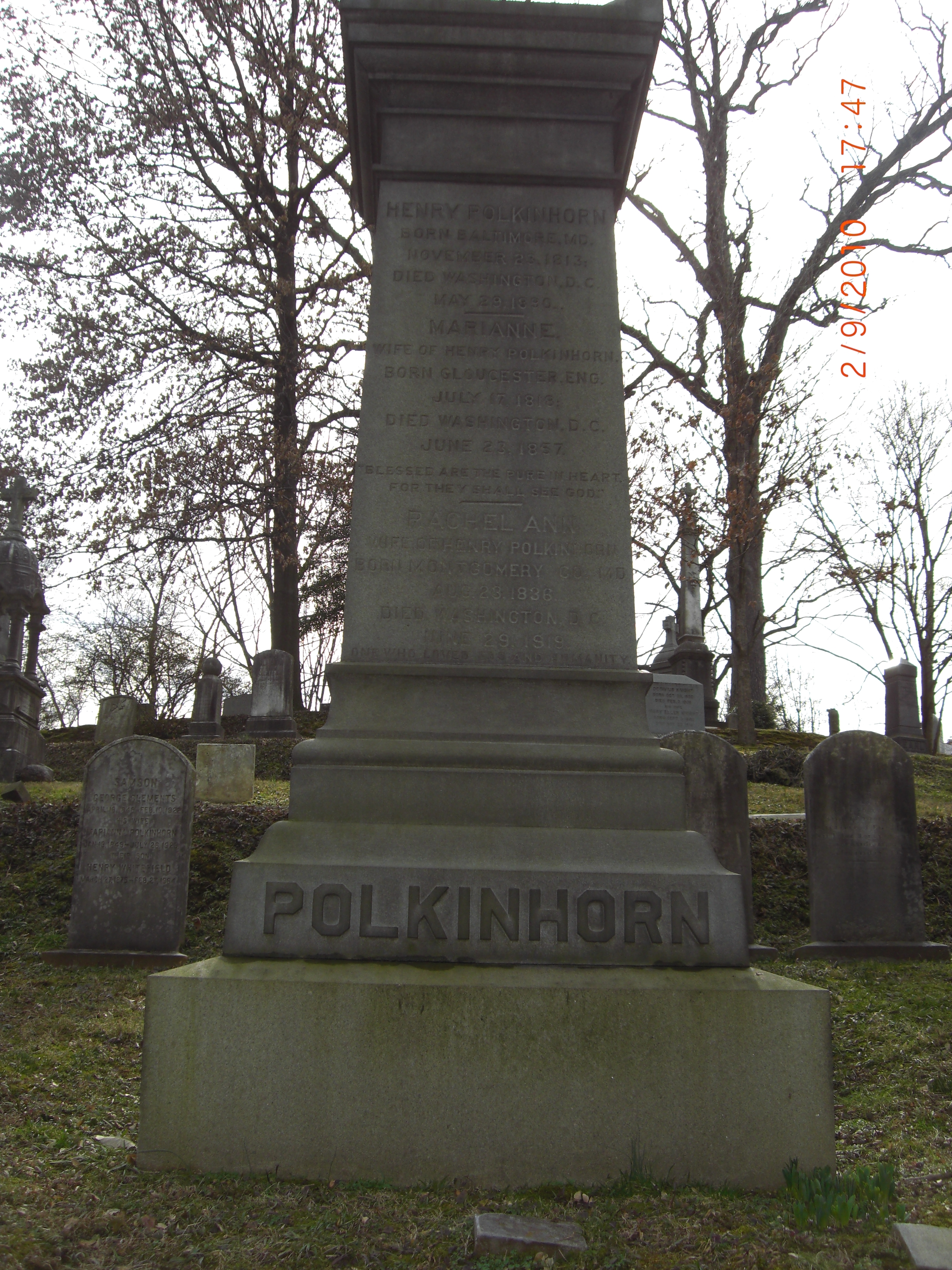
Henry Polkinhorn died on May 29th, 1890 at the age of 76.  He was interred at Oak Hill cemetery in lot #821.  Today, he rests there with his two wives and most of his children.

The Polkinhorn building, not far from Ford’s, survived until the late 1980’s when most of the block was torn down for redevelopment.

Polkinhorn Building in March of 1987 before being demolished.

At the end of it all, Henry Polkinhorn and his family represent the American dream in the best way.  His father imigrated from England, found success as a saddler, and saw his own son become one of the most respected printers in Washington, DC.

In his long and fruitful career, Henry Polkinhorn made a name for himself and today, at the bottom of one of the most sought after relics of the tragedy at Ford’s Theatre, that name get the final billing.

References:
I would like to thank Dale Stinchcomb at the Harvard Theatre Collection for the image of Mr. Polkinhorn, Kia Fennell for her assistance in figuring out his genealogy, and Rich Smyth for the picture of his grave.
Polkinhorn Building – Historic American Buildings Survey
The End of the National Intelligencer Article 1868-11-25
All newspaper clippings displayed above are from GenealogyBank.com

Categories: Uncategorized | Tags: , , , | 22 Comments

Blog at WordPress.com.