Posts Tagged With: Ford’s

Lincoln Assassination sites via View-Master

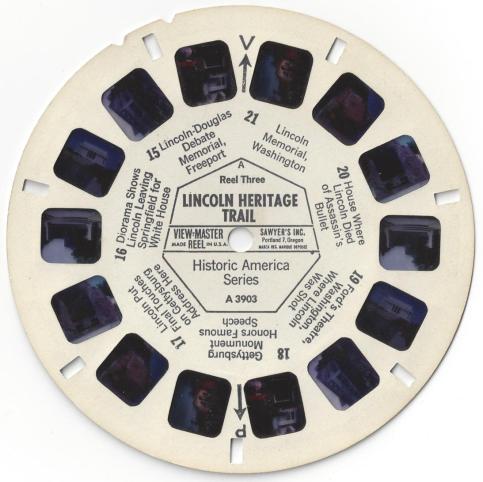
One of the great things about being home for the holidays is the chance to engage in some nostalgia. Today, I was looking through some of the old toys that my siblings and I played with as kids. My eyes came across a large container full of old View-Master cards. I found my favorite reels containing images of Mickey Mouse, Muppets, Snoopy, and other childhood characters. After playfully clicking through and looking at the familiar 3D images, I discovered some non-familiar View-Master reels. We probably inherited from my grandparents collection and it’s doubtful that I ever took any interest in these, non character, related reels as a child. Among the different views of national parks and seascapes was a set of three reels entitled the, “Lincoln Heritage Trail”.

Lincoln viewmaster

Though I have not been able to come up with a date for the images or the reels, there were two pictures from the reels that connect to Lincoln’s assassination.

Photo Dec 25, 8 53 21 PM

Ford’s Theatre from the “Lincoln Heritage Trail” View-Master reel

Photo Dec 25, 8 54 23 PM

Petersen House from the “Lincoln Heritage Trail” View-Master reel

I put the other 19 images from the “Lincoln Heritage Trail” View-Master reels up on Roger Norton’s Abraham Lincoln Discussion Symposium. Check them out here.

Categories: Uncategorized | Tags: , | 6 Comments

The Rear Wall and Doors of Ford’s Theatre

A visitor of this blog named Justin posed the following question on the “Reconstructing Ford’s Theatre” post:

“Random question – but the rear doors of the theater, are those period to the assassination? Not the actual doors themselves but is Booth’s escape door in the same place as they were the night of the assassination or has the façade been redone?”

Excellent question, Justin.  With regard to the location of the doors, the short answer is yes.  The large, rolling, scenery door and normal stage door you see on the back of Ford’s Theatre today are both in the same locations as their 1865 counterparts.  When Ford’s Theatre was restored in the 1960’s the architectural branch of the National Park Service was able to “definitely reestablish” the locations of the doors.

Baptist Alley - Detective McDevitt 3

The answer to the second part of your question, whether or not the rear façade of Ford’s Theatre has changed, is also yes, but this answer will take longer to explain.

In the aftermath of Lincoln’s assassination, the government shut Ford’s Theatre down.  While it looked as though John T. Ford would regain his theater and even reopen it after the execution of the conspirators, a large public outcry prevented this.  The government started renting the Ford’s Theatre building from John Ford before purchasing the structure outright in July of 1866.  Even before purchasing the building, however, the government began renovating the theatre.  They transformed the interior into a three story office building.  The top floor housed the Army Medical Museum.   The other two floors of Ford’s housed the Office of Records and Pensions run by the War Department.  When the medical museum moved out in 1887, they took over the entire building.

During this time the rear wall of Ford’s was altered to facilitate its new use as an office building.  The large, and now pointless, scenery door was bricked up and transformed into a regular sized door.  The former stage door, through which Booth escape was bricked up and transformed into a window.  If you look closely at the picture below, you can still see the outline of where the scenery door and its rollers once were, having been bricked up into a normal sized door:

Back Wall of Ford's

On June 9th, 1893, while construction and excavation was being done in the basement of the building, a stone pier near the west (front) end of the building collapsed.  It brought down a forty foot section from all three floors above it.  It was a tragic accident, crushing and killing 21 War Department clerks instantly.  You can read more about the aftermath of that accident here.

While the majority of the damage occurred at the front of the building, it was decided to take down the rear wall to complete the clean up.  In this way, the front “face” of Ford’s Theatre, with its decorative and elaborate architectural components, was spared from having a gaping hole put into it.  When the interior was rebuilt (again as an office building) the rear wall was also rebuilt, but now it no longer resembled the same wall Booth escaped out of.   The new rear wall was made with many windows on all three floors.  The new rear door was placed in the approximate area as the old scenery door (centered on the wall).  Though a few post-1893 newspaper engravings identify this new door as the one Booth escaped out of, the true location of the former stage door was farther north on the rear wall and was now a window:

Not the door Booth escaped out of.  The rear wall of Ford's was taken down and rebuilt after the 1893 collapse.  This door was placed in the approximate location of where the large scenery door had been.

Not the door Booth escaped out of. The rear wall of Ford’s was taken down and rebuilt after the 1893 collapse. This door was placed in the approximate location of where the large scenery door had been.

Here’s another picture showing the “new” rear wall and door built after the 1893 collapse:

Baptist Alley Later

Though the building of Ford’s Theatre underwent additional interior changes from 1893 until it was restored by the National Park Service in the 1960’s, the rear wall remained relatively unchanged during this time period.  When the NPS was looking to restore Ford’s they consulted sketches from Harper’s Weekly and Frank Leslie’s Illustrated Newspaper, along with depositions from Ford’s Theatre employees, to determine the original appearance of Ford’s Theatre.  Using these materials, they determined the original locations for the scenery door and the original stage door and had them placed back into the walls.  They also bricked up the windows that had been added post-1893.

20130825-194712.jpg

Photograph showing the rear wall of Ford’s Theatre taken during its reconstruction and restoration in the 1960’s. From this view you can see the scenery door that was put back in and the post-1893 windows that have been bricked up.

To sum up, the scenery and stage doors on the back of Ford’s Theatre today are in the same locations as their 1865 counterparts.  They are not, however, on the original doorways that Booth would have used. The originally scenery door was bricked up into a normal sized door and the original stage door, through which Booth escaped, was bricked up into a window.  Following the collapse in 1893, the whole wall was torn down and then completely rebuilt, removing even the outlines of the original doors.  In the 1960’s, the NPS, using sketches and accounts, put the scenery and stage doors back into their proper place while restoring the building.

Thanks for the great question, Justin!

References:
Historic Structures Report – Restoration of Ford’s Theatre by George Olszewski

Categories: Uncategorized | Tags: , | 5 Comments

Reconstructing Ford’s Theatre

A few years ago, I went and saw the musical, The Civil War, at Ford’s Theatre. It was a very entertaining and moving production. There are several times throughout the show where you hear quotations from historic individuals involved in the Civil War. Quotations from Abraham Lincoln are, appropriately, quite prevalent. Each time we heard the words of Lincoln, the stage would go dark and a light inside the Presidential Box would brighten. The first time I saw this, I got shivers. It was very moving to hear the words of our 16th President echoing forth from the box where he was shot. I expect many others who witnessed the play found this to be quite moving.

In truth though, that is not the box where Lincoln was shot. That specific box was destroyed long ago. Ford’s Theatre, as beautiful as it is, is a complete reconstruction except for its exterior walls. It was recreated to appears as it did in 1865 by a group of experts and historians in the 1960’s. While they thoroughly documented their work in this book, sometimes a picture is worth a thousand words. Here are some pictures of the inside of Ford’s when it was being rebuilt in the ’60’s:

20130825-193935.jpg

20130825-194034.jpg

20130825-194142.jpg

20130825-194228.jpg

20130825-194432.jpg

20130825-194603.jpg

20130825-194712.jpg

20130825-194845.jpg

Categories: Uncategorized | Tags: | 23 Comments

John T. Ford after the Collapse

John T Ford

A young John Thompson Ford

The collapse of Ford’s Theatre in 1893 was a major news story. Even before the official investigation began, letters to the editors of various D.C. newspapers laid the blame of the collapse on the feet of a plethora of people. In the early days, the greatest scapegoat was Congress and the government for allowing workers to remain housed in knowingly dangerous or condemned buildings. Many called for inspections of all federal buildings in Washington to prevent the tragedy from happening elsewhere. Perhaps it was a latent sense of pride in his building, or a desire to distance his reputation from yet another tragedy, that led 64 year-old John T. Ford to pen this letter to the Evening Star:
John Ford about the collapsed theatre

John Ford would end of being very much correct in his claims. It was not any flaw in the building that led to its collapse, but rather the incompetence of the workers excavating the basement who did not adequately support the foundation during their dig. As Tudor Hall stands today, architect James Gifford had built a sturdy building with Ford’s Theatre that could have lasted for much longer, had it not been for human error and negligence.

References:
Evening Star – June 12, 1893

Categories: Uncategorized | Tags: | 13 Comments

“An Interesting Flag”

The following article was written by The Rambler and appeared in February 9th, 1913 edition of the Evening Star.  The Rambler, whose real name was John Harry Shannon, wrote for the Star from 1912 until 1927, telling stories about his travels in and around Washington.  Many of his “rambles” involved trips into Maryland’s “assassination country” as I like to call it.  This article however, deals with his knowledge of one particular artifact relating to Lincoln’s assassination: the Treasury Guard flag.

Treasury Guard flag on display at the Ford's Theatre Museum

Treasury Guard flag on display at the Ford’s Theatre Museum

“An Interesting Flag

The flag which led indirectly but none the less certainly to the capture of John Wilkes Booth is now one of the main objects of interest in the Treasury building. For many years this famous flag occupied a place on the wall of the northeast corridor of the Treasury and divided honors with the money vaults as an object of popular interest. It was for many years about the first thing guides pointed out to visitors. Then the flag was loaned to Capt. O H. Oldroyd and for a long time had a prominent place in the museum of Lincoln relies. Not long ago it was reclaimed by the Treasury and hangs once more in that grim and classic building.

It was in the knotted fringe of this old flag that one of Booth’s spurs caught when he leaped from Lincoln’s box at Ford’s Theater on the night of April 14, 1863, after having mortally wounded the President and stabbed Maj. Rathbone. Had not the spur caught, Booth’s leg would in all probability not have been fractured or injured and his capture would perhaps have been very much more difficult.

When the advisability of a Home Guard for Washington was suggested the Treasury Department took an early interest if not the initiative in the movement. In In that department there was soon organized a full regiment. It was called the Treasury Guard, and Treasurer E. E. Spinner was made its colonel. Every afternoon after the department closed the regiment was drilled on the White Lot. Large crowds witnessed the drills of the Treasury Guards and the ladies of the department and the wives and daughters of the clerks naturally took a fond interest in the organization. These ladies at a meeting determined to present to the regiment a stand of colors. The regimental flag of the guard in the office of the captain of the watch of the Treasury, but it is the national flag with which this account deals.

On the night of April 12, 1865, the Treasury Guard gave a ball at Ford’s Theater. The theater was transformed into a large ballroom by the erection of a temporary flooring over the tops of the scats in the lower part of the house. The decorations were elaborate, and the flags of the guard were draped on the boxes. The guest of honor at that ball was Commodore Winslow of the Kearsarge. It was the first visit of that officer to Washington after the sinking of the Alabama.

It is narrated that after the ball John T. Ford requested the officer of the Treasury Guard to allow the flags to remain on the boxes as the President was expected to attend a performance at the theater the night of April 14. How Booth shot the President how he leaped from the box, how his spur caught, how his leg was broken or fractured by the fall, and how his injury proved an impediment in his flight are matters of common knowledge.

The day after Lincoln’s death, when the whole city was practically under martial law and Andrew Johnson had taken the oath of office as President in that room of the Treasury building long occupied as the office of the director of the mint, but which was then the office of the Secretary of the Treasury, the guard flag was brought up from the theater and taken into this room. The rent made in it by the assassin’s spur was exhibited to all those present. The Treasury Guard soon after disbanded, the flag was stored away and forgotten, and it was not brought to light again until 1872, when Capt. Cobaugh of the Treasury watch found it in the machinists’ shop in the basement of the building. The flag was loaned to the Lincoln Museum by Secretary Gage, but it was recalled not so long ago.

The pistol used by Booth in the assassination of Lincoln is in a safe in the office of the judge advocate general of the army, having been in the custody of that officer since the trial of the conspirators. This fact was brought out a few years ago by the sale in Philadelphia of a pistol with which the crime was said to have been committed. The purchaser wrote to the War Department and learned that he had been victimized.

Booth’s spur, the one which tripped him, and which was removed from his injured leg by Dr. Mudd, is in possession of Capt. Oldroyd.”

Torn Treasury Guard Flag

Categories: Uncategorized | Tags: , | 5 Comments

Another jaunt through Congressional Cemetery

I visited Congressional Cemetery again today. My main purpose was to visit conspirator David Herold, but I also took the time to track down a few more people related to the assassination that I hadn’t before. Consider this post an addendum to my previous “Jaunt“.

First off, I tracked down all of David Herold’s sisters. Fortuitous for me, all of them are buried here at Congressional:

20130218-144902.jpg
Mary Ann (Herold) Nelson

20130218-145016.jpg
Margaret Cecelia (Herold) Rockwell

20130218-145225.jpg
Catharine Virginia (Herold) Brown

20130218-145357.jpg
Alice King (Herold) Earnshaw

20130218-145509.jpg
Georgia Isabel (Herold) Earnshaw

20130218-145617.jpg
Emma Frances (Herold) Keilholtz

20130218-145730.jpg
Elizabeth Jane Herold. Elizabeth is buried right on top of her unmarked brother, David.

From there I went to see a few other individuals.

20130218-151105.jpg
William Francis Walsh was a pharmacist near the Navy Yard. David Herold was employed by Walsh for 11 months until he quit in order to have more time to go hunting.

20130218-152446.jpg
As his descriptive stone states, Charles Forbes was Abraham Lincoln’s footman and was present at Ford’s the night of the assassination.

20130218-155208.jpg
John E. Buckingham was the doorman at Ford’s and later wrote a book about his souvenirs of the event.

20130218-155456.jpg

20130218-155539.jpg
William Wood was involved in the search for Booth and Herold and was the superintendent of the Old Capitol Prison when Mary Surratt and Dr. Mudd were there.

Those are all the assassination related graves we saw at Congressional Cemetery today. There are still many more people involved with the great drama buried at Congressional so don’t be surprised if there’s another jaunt in the future.

Categories: Uncategorized | Tags: , , | Leave a comment

New Galleries – The Assassination

I’m pleased to announce that there are four new galleries in the Picture Galleries section of the site.  All four of them consist of drawings and engravings regarding John Wilkes Booth’s assassination of Abraham Lincoln at Ford’s Theatre on April 14th, 1865.  Instead of putting all the drawings of the events that took place at Ford’s together, I’ve divided the actions into four sections.

 The first is called “Sneaking Up” and these images (only three at this point) show John Wilkes Booth in the moments before shooting Lincoln.  The next section is called “The Shot” and consists of the many images of John Wilkes Booth pulling the trigger of his single shot derringer.

The third section is entitled “The Leap“. These drawings show John Wilkes Booth’s leap from the president’s box after shooting Lincoln and wounding Major Henry Rathbone The last section demonstrating Booth’s havoc at Ford’s Theatre is called, “On the Stage“. These drawing show Booth brandishing his bloodied knife while making his way across the stage into the wings. From here Booth exited the back of the Theatre and escaped onto Baptist Alley.

I hope you enjoy these new additions to the site.

Categories: Uncategorized | Tags: , , | Leave a comment

New Gallery – Baptist Alley

After shooting President Lincoln in his box at Ford’s Theatre, John Wilkes Booth leapt onto the stage, brandished his knife red with Major Rathbone’s blood, and made his way swiftly backstage.  From there he exited the building from a small stage door.  Outside he found Peanut John, a young boy who sold peanuts at the theatre and did odd jobs like watch the stage door during performances, holding the reins of his horse.  Upon his arrival at the back theatre entrance that night, Booth had called for his friend Edman Spangler to hold the reins of his restless horse.  Spangler, busy with the job of shifting the scenery for the play outsourced the job to Peanuts.  Upon his explosion from the theatre, Booth shouted for his horse, struck Peanuts as he mounted, and galloped away down the alley.  He quickly turned left and exited out onto F street.

This alley was called Baptist Alley due to the theatre having previously been the home of the First Baptist Church of D.C.  The originally rented their building to John T. Ford before selling it to him outright.  The building caught fire and burned on December 30th, 1862 and Ford rebuilt.  The alley was a common place to John Wilkes Booth, who had Edman Spangler construct him a makeshift stables in the alley.  When his body was released to his family n the waning hours of Andrew Johnson’s presidency, Booth made a return trip to his former stables in Baptist Alley as his remains were placed there to hide them from the public.

Click on the Picture Galleries tab to see the new addition of pictures relating to Baptist Alley.

Categories: Uncategorized | Tags: , , | 1 Comment

Blog at WordPress.com.