Posts Tagged With: Ford’s Theatre

The Lincoln Assassination On This Day (September 20 – September 26)

Taking inspiration from one of my favorite books, John Wilkes Booth: Day by Day by Art Loux, I’m documenting a different Lincoln assassination or Booth family event each day on my Twitter account. In addition to my daily #OTD (On This Day) tweets, each Sunday I’ll be posting them here for the past week. If you click on any of the pictures in the tweet, it will take you to its individual tweet page on Twitter where you can click to make the images larger and easier to see. Since Twitter limits the number of characters you can type in a tweet, I often include text boxes as pictures to provide more information. I hope you enjoy reading about the different events that happened over the last week.

NOTE: After weeks of creating posts with multiple embedded tweets, this site’s homepage now tends to crash from trying to load all the different posts with all the different tweets at once. So, to help fix this, I’ve made it so that those viewing this post on the main page have to click the “Continue Reading” button below to load the full post with tweets. Even after you open the post in a separate page, it may still take awhile for the tweets to load completely. Using the Chrome browser seems to be the best way to view the tweets, but may still take a second to switch from just text to the whole tweet with pictures.

Continue reading

Categories: History, OTD | Tags: , , , , , , , , , , , , , , | Leave a comment

The Lincoln Assassination On This Day (August 23 – 29)

Taking inspiration from one of my favorite books, John Wilkes Booth: Day by Day by Art Loux, I’m documenting a different Lincoln assassination or Booth family event each day on my Twitter account. In addition to my daily #OTD (On This Day) tweets, each Sunday I’ll be posting them here for the past week. If you click on any of the pictures in the tweet, it will take you to its individual tweet page on Twitter where you can click to make the images larger and easier to see. Since Twitter limits the number of characters you can type in a tweet, I often include text boxes as pictures to provide more information. I hope you enjoy reading about the different events that happened over the last week.

NOTE: After weeks of creating posts with multiple embedded tweets, this site’s homepage now tends to crash from trying to load all the different posts with all the different tweets at once. So, to help fix this, I’ve made it so that those viewing this post on the main page have to click the “Continue Reading” button below to load the full post with tweets. Even after you open the post in a separate page, it may still take awhile for the tweets to load completely. Using the Chrome browser seems to be the best way to view the tweets, but may still take a second to switch from just text to the whole tweet with pictures.

Continue reading

Categories: History, OTD | Tags: , , , , , , , , , , , | 1 Comment

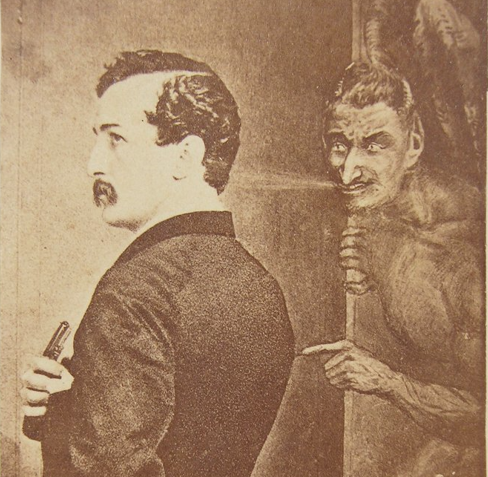
The Imp in Nanjemoy

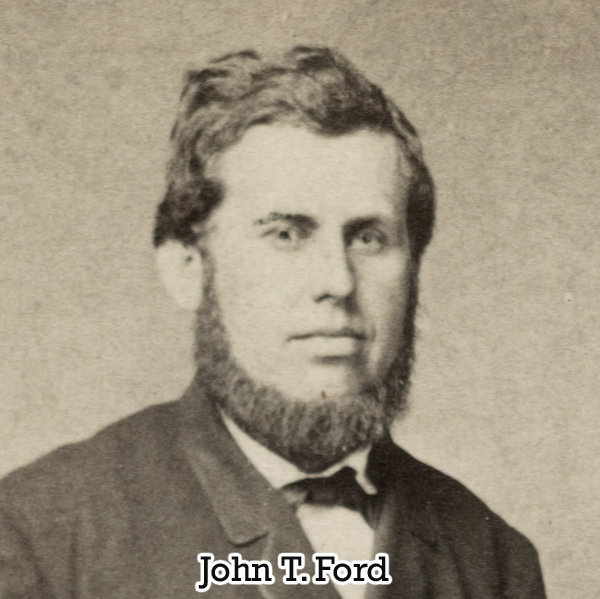
On November 6, 1873, The Daily Graphic, an illustrated newspaper similar to Harper’s Weekly or Frank Leslie’s, published an article by one of their correspondents who went by the nom de plume, Laertes. The piece was partly an interview Laertes had with three of John Wilkes Booth’s former associates John McCullough, John T. Ford, and Harry Clay Ford. The Ford brothers were the owners and operators of Ford’s Theatre where the assassination took place with Harry Ford having spoken to and innocently alerted John Wilkes Booth of President Lincoln’s planned attendance at the theatre on April 14th. John McCullough was a fellow actor and close friend of Booth’s. The last time John Wilkes Booth performed onstage was in a benefit performance for McCullough on March 18, 1865 at Ford’s Theatre. All three men knew Booth well but were all very much shocked by the assassination. Laertes’ interview with these men doesn’t uncover any earth shattering revelations, but does produce some interesting reflections 8 years after Booth’s crime.

John McCullough described Booth as, “a wonderful compound of poetry, adventure, and disease.” McCullough recounted that one time in the spring of 1865 when he and Booth were sharing a room at the National Hotel in D.C., Booth had McCullough go out riding with him. “He imposed on my good nature by making me get on a horse, and ride here and there with him by forts, ferries, and bridges, saying, ‘Now, Johnny, if a man was to get in a tight place and have to break out of this city, there would be one opportunity.’ ‘What do I want to see that for, Booth?’ I used to say. ‘I prefer the leave by the cars. Besides, the broad of my back is all skinned by this pampered jade of Asia.'” McCullough also recalled how Booth, “was always practising gymnastics at Brady’s gymnasium.”

Interestingly, on the morning of the assassination, while Booth was at Ford’s Theatre getting his mail, he was conversing with Harry Clay Ford about Brady’s gymnasium. Harry Ford wished to go into partnership with Mr. Brady and was hoping that his brother John T. Ford, Booth, and the owner of the Star Saloon adjoining Ford’s, Scipione Grillo, would become investors in the endeavor. When talking to authorities in 1865, Harry recalled that on the morning of the assassination he asked Booth about about investing. Booth replied, “Harry, that is too much money. You can build a gymnasium for that.” Harry replied that the plan was to rebuild the gymnasium and make it better to which Booth replied noncommittally, “Well, I will see about it.” Just like everyone else in Booth’s life, Harry Ford did not know that Booth was low on funds due to his failed oil ventures, retirement from full time acting, and the expenses connected to his plot against the President. One wonders if he even had the funds to pay for his gym membership.

“Booth was crazy for fame,” John T. Ford told Laertes during his interview. He recounted the many plans Booth had concocted to kidnap the president and asserted that, “had General Grant come to the theatre with Mr. Lincoln that night, [Booth] would have shot them both.” John Ford concluded that Booth’s entire assassination plot was, “very vagarious and boyish,” and that it was only, “coincidence or good luck” that made it successful. John T. Ford also claimed that, in regards to the final disposition of the horses that Booth and Herold rode out of Washington, he had, “seen a person who saw the dead horses at the river side. The crows were already assembling for a feast. Suddenly a freshet came and carried the carcasses off on the tide. That’s the end of that mystery.”

In addition to this brief interview with three of Booth’s associates, the article also recalled a trip Laertes had made into Southern Maryland following the path of Booth’s escape. At the time of Laertes’ writing it was not yet widely known of the role Thomas Jones had played in secreting and then putting the assassins across the Potomac river. Still, even with this missing piece, Laertes had done a good job retracing the path of Booth including the villages of Piscataway, Port Tobacco, T.B., and Surrattsville. In Surrattsville, Laertes took the time to sketch Mrs. Surratt’s former tavern but for some reason, this illustrated newspaper decided not to include it. In Port Tobacco, Laertes saw George Atzerodt’s former carriage shop and met with Frederick Stone who had acted as defense counsel for David Herold and Dr. Mudd during the conspiracy trial. Laertes referenced that Dr. Mudd, “still resides at Bryantown, a sadder and a wiser man,” but doesn’t appear to have visited him. In describing the other surviving conspirators Laertes wrote:

“John Surratt has been recently married to a Miss Hunter, of Rockville, Md., a lady of a respectable country-side family. Like many surviving assassins, he feels that his crime has made a great man of him, although he was afraid to come to the rescue of his mother. Sam Arnold is in Baltimore, the worse for barroom wear, for the same reason; and poor old Spangles [sic], the scene-shifter, has got a great red nose on him for being treated so often. He takes it straight.”

The bulk of Laertes’ article, however, is actually devoted to a unique poem the correspondent wrote after concluding his tour of “Lower Maryland”. Inspired by the fields, forests, swamps, and rivers that Booth encountered on his escape, Laertes wrote a poem that he entitled The Imp of Nanjemoy. In it, the impish devil John Wilkes Booth is haunted by the word Nanjemoy throughout his ultimately failed escape from justice. For context, Nanjemoy Creek is a tributary of the Potomac River located in Charles County, Maryland. When John Wilkes Booth and David Herold failed to cross the Potomac the first time, they ended up landing in Nanjemoy Creek and spending about 48 hours there before trying to cross to Virginia again. Laertes knew about this part of the escape and it inspired him to write this poem.

The Imp in Nanjemoy

Dull in the night, when the camps were still,
Thumped two nags over Good Hope Hill;
The white deserter, the passing spy,
Took to the brush as the pair went by;
The army mule gave over the chase;
The Catholic negro, hearing the pace,
Said, as they splashed through Oxon Run;
“Dey ride like the soldiers who speared God’s son.”
But when Good Friday’s bells behind
Died in the capital on the wind,
He who rode foremost paused to say:
“Harold, spur up to my side, scared boy!
A word has run in my ears all day –
Merely a jingle, ‘Nanjemoy.’”

“Ha!” said Harold, “John, why that’s
A little old creek on the river. Surratt’s
Lies just before us. You halt on the green
While I slip in the tavern and get your carbine.”
The outlaw drank of the whiskey deep,
Which the tipsy landlord, half asleep,
Brought to his side, and his broken foot
He raised from the stump and slashed the boot.
“Lloyd,” he cried, “if some news you invite –
Old Seward was stabbed on his bed to-night.
Lincoln I shot – that long-lived fox –
As he looked at the play from the theatre box;
And it seemed to me that the sound I heard,
As the audience fluttered, like ducks round decoy,
Was only the buzz of a musical word
That I cannot get rid of – ‘Nanjemoy.’”

“Twenty miles we must ride before day,
Cross Mattawoman, Piscataway,
If in the morn we would take to the woods
In the swamp of Zekiah, at Doctor Mudd’s!”
“Quaint are these names,” thought the outlaw then.
“Though much I have mingled with Maryland men.
I have fever, I think, or my mind’s o’erthrown.
Though scraped is the flesh by this broken bone,
Every jog that I take on this road so lonely,
With thoughts, aye bloody, my mind to employ,
I can but say, over and over, this only –
The drowsy, melodious ‘Nanjemoy.’”

Silent they galloped by broken gates,
By slashes of pines around old estates;
By planters’ graves afield under clumps
Of blackjack oaks and tobacco stumps;
The empty quarters of negroes grin
From clearings of cedar and chinquopin;
From fodder stacks the wild swine flew,
The shy young wheat the frost peeped through,
And the swamp owl hooted as if she knew
Of the crime, as she hailed: “Ahoy! Ahoy!”
And the chiming hoofs of the horses drew
The pitiless rhythm of “Nanjemoy.”

So in the dawn as perturbed and gray
They hid in the farm-house off the way,
And the worn assassin dozed in his chair,
A voice in his dream, or afloat in the air,
Like a spirit born in the Indian corn –
Immemorial, vague, forlorn,
And disembodied – murmured forever
The name of the old creek up the river.
“God of blood,” he said unto Harold,
As they groped in the dusk, lost and imperilled,
On the oozy, entangled morass and mesh
Of hanging vines over Allen’s Fresh:
“The chirp of birds and the drone of frogs,
The lizards and crickets from trees and logs
Follow me yet, pursue and ferret
My soul with a word which I used to enjoy,
As if it had turned on me like a spirit
And stabbed my ear with its ‘Nanjemoy.’”

Ay! Great Nature fury or preacher
Makes, as she wists, of the tiniest creature-
Arming a word, as it floats on the mind,
With the danger of wrath and the wing of the wind.
What, though weighted to take them down,
Their swimming steeds in the river they drown,
And paddle the farther shore to gain,
Chased by gunboats or lost in rain?
Many a night they try the ferry
And the days in haggard sleep employ,
But every raft, or float, or wherry,
Drifts up the tide to Nanjemoy.

“Ho! John, we shall have no more annoy,
We’ve crossed the river from Nanjemoy.
The bluffs of Virginny their shadows reach
To hide our landing upon the beach!”
Repelled from the manse to hide in the barn,
The sick wretch hears, like a far-away horn,
As he lies on the straw by the snoring boy,
The winding echo of “N-a-n-j-e-m-o-y.”
All day it follows, all night it whines,
From the suck of waters, the moan of pines,
And the thread of cavalry following after,
The flash of flames on beam and rafter,
The shot, the strangle, the crash, the swoon,
Scarce break his trance or disturb the croon
Of the meaningless notes on his lips which fasten,
And the soldier hears, as he seeks to convoy
The dying words of the dark assassin,
A wandering murmur, like “Nanjemoy.”

References:
Daily Graphic (New York, NY), November 6, 1873, 34 – 35. Accessible here and here.
William C. Edwards and Edward Steers, Jr., ed, The Lincoln Assassination: The Evidence (Chicago: University of Illinois Press, 2009), 518.

Categories: History | Tags: , , , , , | 6 Comments

Lincoln Assassination Ephemera

When you first start researching and “doing history”, there are several new vocabulary words that you have to learn. In the same way that doctors have a long list of subject-specific jargon, so too, do historians. When dealing with artifacts, it’s key to know the items provenance, or personal history. How do we know this thing is what it claims to be? What evidence do we have of its journey from there to here? Historiography is the study of how history has been written. How has the study of a specific event or period changed over subsequent years or decades? How have the ideals and beliefs of historians during different time periods influenced their presentation and understanding of history? What does it mean to study history? One must be careful not to include anachronisms in their writing of history. These are items, places, phrases or customs that would not exist in the time period being discussed. One would not speak of President Lincoln in the Oval Office since the Oval Office did not exist in Lincoln’s day. The list goes on and on.

One of my favorite history jargon words is ephemera. It relates to items that were made to exist for a short period of time and not expected to be preserved or retained. An advertisement for a sale at a grocery store is an example of ephemera. Within a matter of days, the advertisement is no longer accurate and thus disposed. Ephemeral things are meant to be temporary and fleeting. This idea has evolved into digital platforms as well with apps like SnapChat being based around the idea that the pictures and videos sent over the app only exist for a short time before they cease to exist. Today marks the beginning of a brand new year and many of us may be eagerly disposing of our old 2020 calendars, they having served their purposes. While the vast majority of ephemeral things are disposed or destroyed in this way, examples of ephemera that have survived through the years can give us a unique look into the past.

Here are some examples of ephemera related to the Lincoln assassination story.


Newspaper classifieds for the Surratt boardinghouse

In 1853, John H. Surratt Sr. acquired a ten-room house located at 541 H Street in Washington, D.C. The elder Surratt never lived in this house and the family spent the next 11 years renting it out. By 1864, Mary Surratt struggled to keep up the family’s tavern in Prince George’s County, Maryland. The widowed Mary made the decision to move her family to this D.C. home and operate it as a boardinghouse. In addition to her often absent son John Jr. and her daughter Anna, several other boarders came to take up residence in the H street boardinghouse. On October 6, an 18 year old named Honora Fitzpatrick moved in and shared a room with Anna. On November 1, Louis J. Weichmann, a friend of John Jr.’s, moved in. Weichmann would come to be one of the key witnesses against Mary Surratt at the trial of the Lincoln conspirators. Anxious for more boarders to help pay off some of her deceased husband’s many debts, Mary Surratt decided to advertise in the Evening Star newspaper. The excerpts above show some of the advertisements she ran in November and December of 1864 looking for additional gentlemen tenants. While John Wilkes Booth was never a lodger at the Surratt boardinghouse, his introduction to John Surratt in December of 1864 through the assistance of Dr. Mudd, made Booth a regularly visitor to the house on H street. For a short period, Mary did house conspirator Lewis Powell, though he was not living there at the time of the assassination. Like the many countless classifieds that appear and then disappear from newspapers each day, these ads would have been completely forgotten if not for their connection to the story of Lincoln’s assassination.


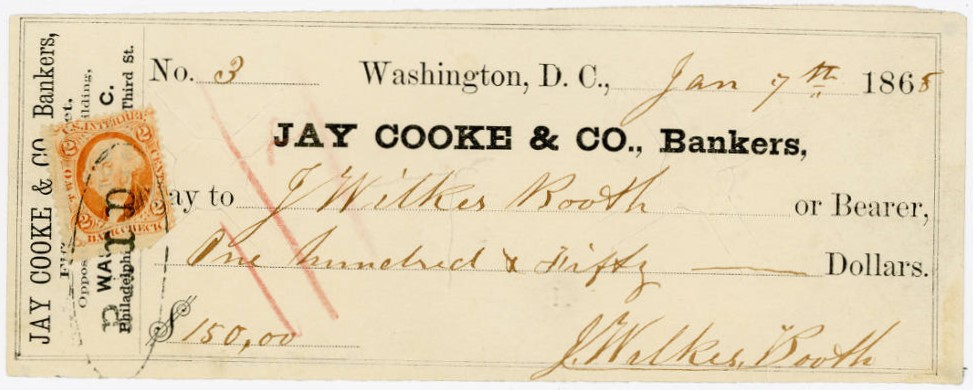
John Wilkes Booth’s check to himself

Talk about ephemeral! With online banking and online money transfer services, writing checks are a thing of the past. But even those of us who still write checks every once and awhile, have to admit that they are not things we generally hold on to once we cash or deposit it. But perhaps if you were a bank and had a check signed by a Presidential assassin just a few months before he committed his deed, you might hold onto it. John Wilkes Booth opened his account with Jay Cooke & Company on November 16, 1864 with an initial deposit of $1,500. This deposit occurred just a few days after Booth had returned from visiting Southern Maryland (and Dr. Mudd) for the first time. Over the next few months, he made different withdrawals on the account withdrawing the final balance of $25 on March 16, 1865, just a day after his meeting at Gautier’s Restaurant in which he laid out his abduction plot to all of his conspirators. The check above was a withdrawal of $150 made out to Booth himself on January 7, 1865. Two days later, Booth would make another deposit of $750. Part of this larger sum would be used to pay for part of the boat that was intended to be used to ferry the kidnapped Lincoln across the Potomac. In short, John Wilkes Booth’s account with Jay Cooke & Co. was where he kept the money he was using to finance his plot against Lincoln. This ephemeral check that Booth wrote to himself likely paid out some very real blood money. This check come from the collection of the Allen County Public Library in Fort Wayne, Indiana.


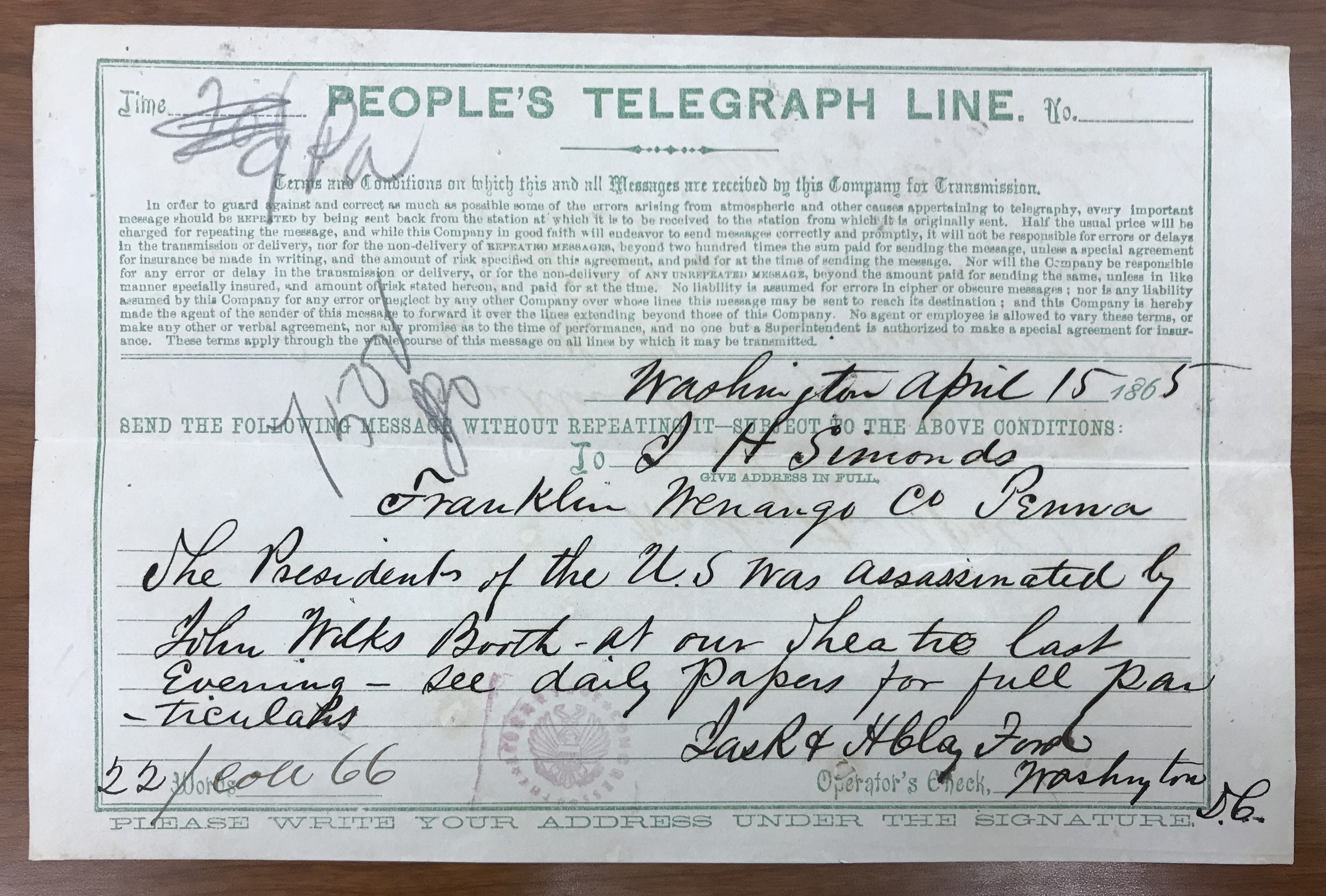
Telegram from the Ford brothers

There are many telegrams that are a part of the story of Lincoln’s death. As the main method of rapid communication across distances in the 1860s, John Wilkes Booth and his conspirators often communicated with each other via telegram. However, the telegram above does not come from Booth or any of his conspirators. Rather it was a note sent by two of the Ford brothers from Ford’s Theatre. Harry Clay Ford had been present at his theatre when Booth shot Lincoln. His brother, James Reed “Dick” Ford, had been present earlier in the day and evening, but was away at the moment of the assassination. At some point on April 15, Harry and Dick sent off this telegram stating that, “The President of the U.S. was assassinated by John Wilks [sic] Booth at our theatre last evening – see daily papers for full particulars.” Interestingly, the recipient of this telegram was Joseph Simonds, a friend of John Wilkes Booth’s who acted as his agent in the Pennsylvania oil region. Booth had recruited Simonds, a former banker from Boston, to help him in the oil business in 1864 and even though most of Booth’s investments had ended Simonds had stayed in the oil business. Simonds often sent mail to Booth care of Ford’s Theatre and so the Ford brothers may have felt compelled to alert Simonds of what had occurred as soon as possible. At the trial of the Lincoln conspirators all three men, Dick Ford, Harry Ford, and Joseph Simonds, would be called to testify about their relationship with Booth. This telegram is in the collection of the Library of Congress.


Pressed flowers from Dr. Mudd’s island prison

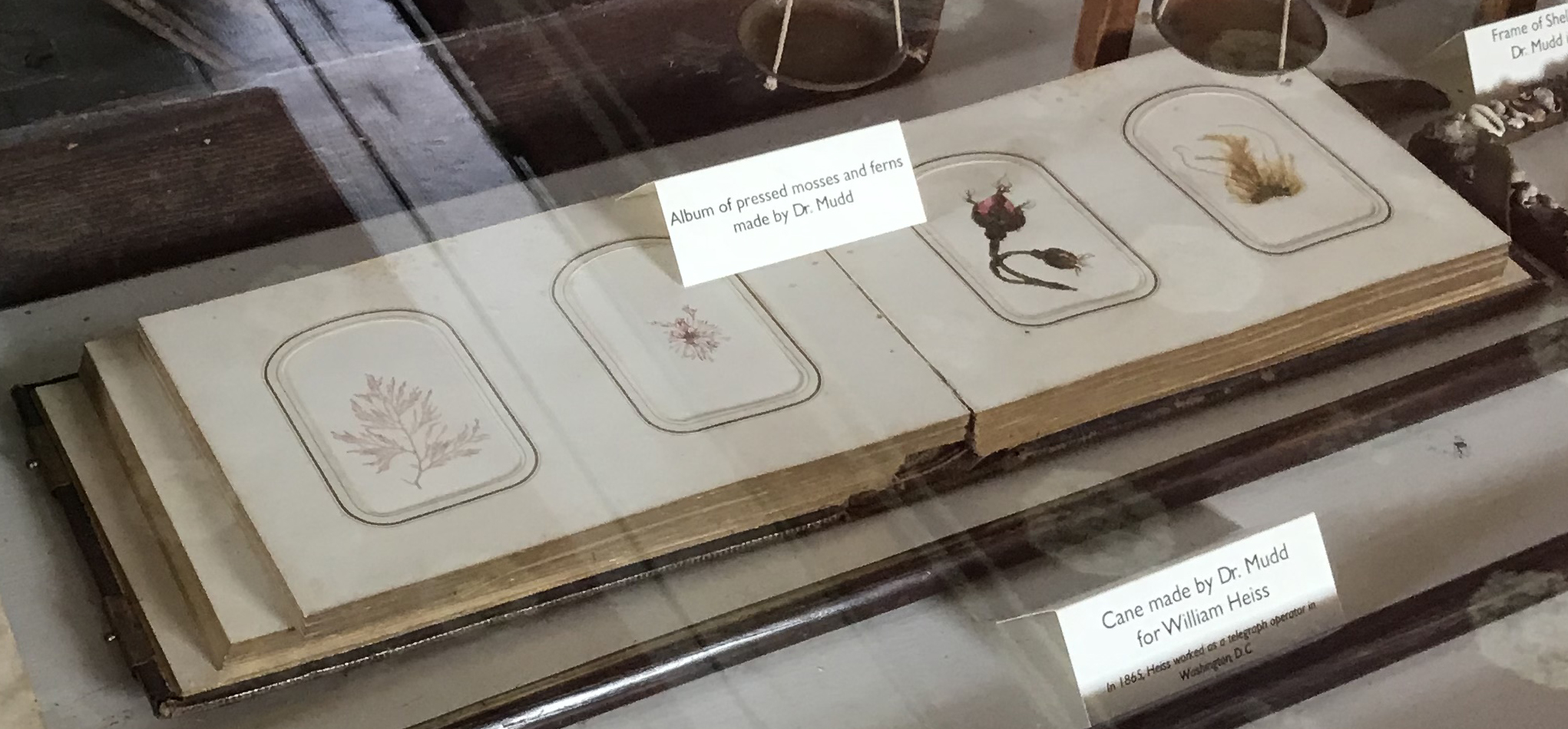
Ephemeral objects go far beyond humanmade creations. Nature is the largest producer of ephemera as everything living must inevitably die. We treasure the sweet blossoms that appear in springtime because we know that their existence is short lived. So much of the beauty behind a flower is because it is fragile and temporary. As the saying goes, “To every thing there is a season.” Dr. Mudd spent some time during his many seasons at Fort Jefferson attempting to preserve some of the naturally fleeting floral specimens in his tropical island prison. He collected several examples of mosses, ferns, and flowers from around the Dry Tortugas and pressed them into an album that generally housed photographs. The album can be found at the Dr. Samuel A. Mudd House Museum alongside some of Dr. Mudd’s other creations from his imprisonment.


Broadside advertising John Surratt’s lecture

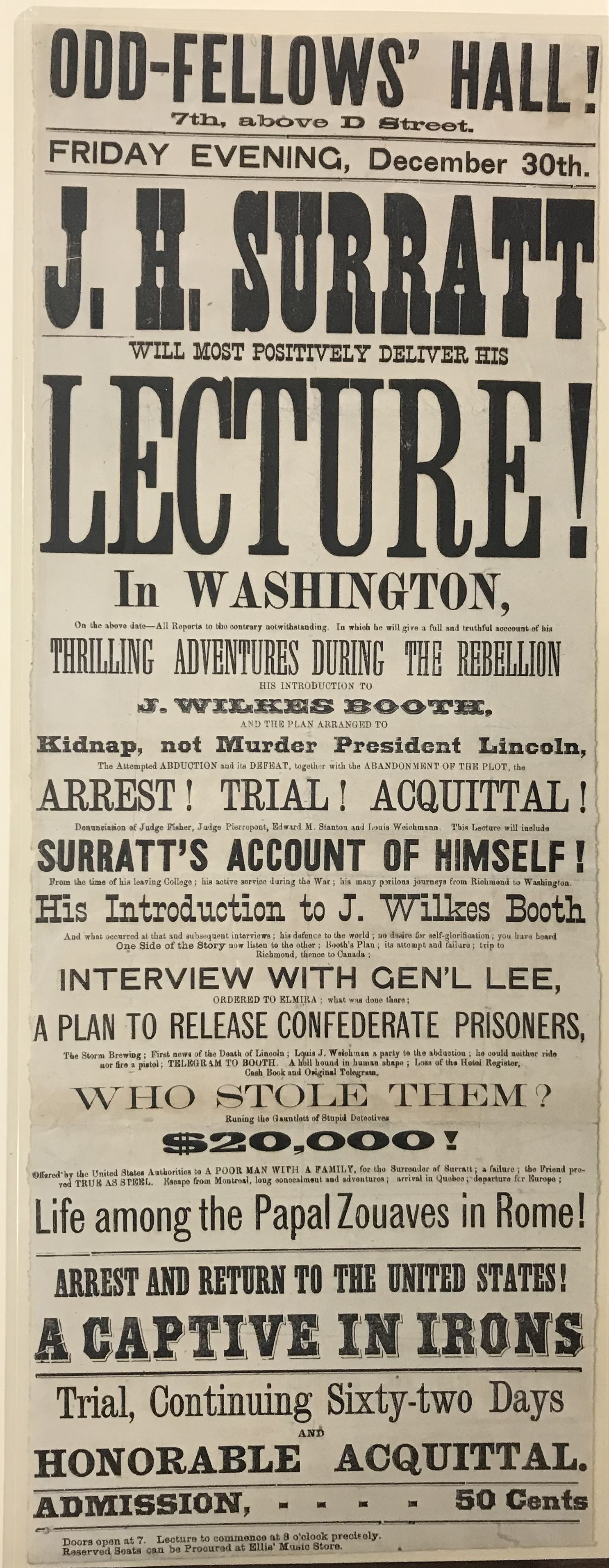
Rather than today’s practice of putting on the same play or musical for a prolonged engagement lasting several weeks, in the Victorian era theater specific shows generally changed each night. The main draw of the stage was the celebrated touring actor or actress who was gracing the boards at that time. The audience came out to see a certain performer who chose which shows they wanted to perform in as the lead role. Each theater’s playbills were. therefore, extremely ephemeral items, meant to capture a single performance only. Instead of using a copy of one of the most sought after playbills in the world, an authentic copy of Ford’s Theatre’s Our American Cousin playbill from April 14, 1865, I decided to show off another rarity. This playbill of sorts advertises a lecture by John Surratt, the sole Lincoln conspirator to avoid conviction for his role in the President’s death. At the time of Lincoln’s assassination, John Surratt was in Elmira, New York. When he heard the news of what Booth had done and that he was wanted in connection with the crime, Surratt flew to Canada. He hid out in Montreal for most of the trial of his mother and other conspirators and was eventually safely transported to Europe. He was eventually discovered hiding out in the Vatican as a Papal Guard. He fled the Papal States but was eventually cornered and arrested in Alexandria, Egypt and extradited to the U.S. in 1867. John Surratt was put on trial but was given a civilian trial rater than a military commission like the one that adjudicated his mother and co-conspirators. The civilian jury of majority Southerners could not come to a decision and resulted in a hung jury. Surratt was then released from custody and returned to civilian life. In 1870, hoping to parlay his notable story into a lucrative speaking career, Surratt embarked on the lecture circuit. He told the story of how he had conspired with John Wilkes Booth to abduct President Lincoln, but denied having any knowledge of Booth’s plan to kill the President. He gave his compelling lecture in Rockville and Baltimore, Maryland, and even at the Cooper Union in New York City where Lincoln had given his 1860 speech that had propelled him to national prominence. The above broadside was for speech John Surratt planned to give on December 30, 1870 in Washington, D.C. This specific lecture never happened, however. A group of locals were outraged that Surratt would be allowed to give a speech detailing his involvement in the plot against Lincoln in the same town were the President was martyred. It is believed that someone in authority contacted Surratt before the speech could start and warned him that though he had been released by the government, he had not been formally acquitted. If he continued to make waves, the government would be happy to use his words against him and re-charge him for complicity in Lincoln’s death. As a result, John Surratt never made another lecture. This broadside for the lecture that never happened is from the collection of the University of Iowa.


Paperwork of Edwin Booth’s 1886 – 1887 tour

Not every financial record need be as doom and gloom as an assassin’s check. For example, here is a look at the inner workings of a far more celebrated touring star. This is the statement showing all of Edwin Booth’s expenses and income during the week of April 25, 1887. During this period of time, Booth was taking part in what is known as the Booth-Barrett Tours. From 1886 – 1890, Edwin and fellow actor Lawrence Barrett traveled around the country. The pair traveled over 14,000 miles and gave 233 performances. It’s fun to see the details of what the accounting for tours like this looked like. For this week of the tour, we can see what shows were produced and where, the total box office gross, and the amount Booth and Barrett received from their efforts. On the other side we see their expenses which included railroad tickets, the printing of playbills and advertisements, the purchase of calcium lights, telegrams, the expenses of their prop and wardrobe keepers, and even miscellaneous expenses like the repairing of a picture frame for $2. These bookkeeping records rarely survived long past their authors but demonstrate the importance of proper records in order to be successful as a traveling actor. This financial record comes from the Harry Ransom Center in Austin, Texas.


Advertisement for the “Booth” mummy

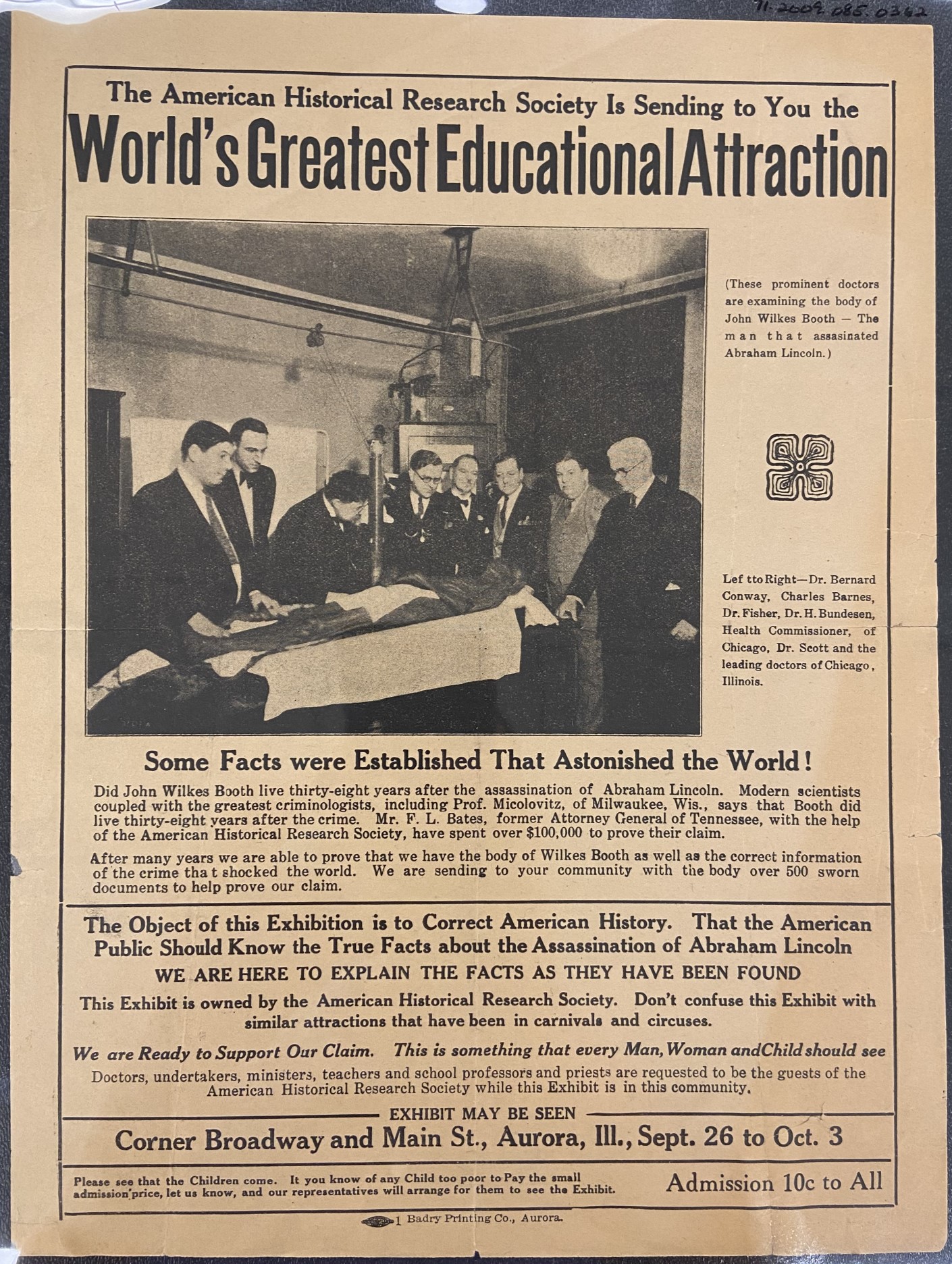
The post-mortem career of drifter David E. George has been the subject of many programs on the so called History Channel and others, but is hardly a new piece of pseudo history. As obliquely referred to on this broadside from the 1930s, it has been claimed that John Wilkes Booth escaped justice in 1865 only to take his own life 38 years later in Enid, Oklahoma. This ad portrays itself as a traveling exhibit of immense educational value that hopes to “correct American history” by showing that Booth had lived. With a name like the American Historical Research Society, I’m sure several people were convinced that they had been presented with the actual mummified remains of the assassin of President Lincoln. However, this advertisement is little more than an ad for snake oil. Despite its claim that one should not, “confuse this Exhibit with similar attractions that have been in carnivals and circuses,” that is exactly was this was. The “Booth” mummy had been traveling with carnivals since the the early 1920s and while it was now a solo attraction that visited towns and cities off the main thoroughfares, it was still little more than a sideshow hustle. The American Historical Research Society was nothing but an imaginary name incorporated by two hucksters of the mummy. They hoped the title would provide some legitimacy to their little sideshow attraction. But a pig is a pig, no matter how much lipstick you put on it! This advertisement for the “Booth” mummy exhibit comes from the collection of the Allen County Public Library in Fort Wayne, Indiana.


Shipping Invoice for Lewis Powell’s head

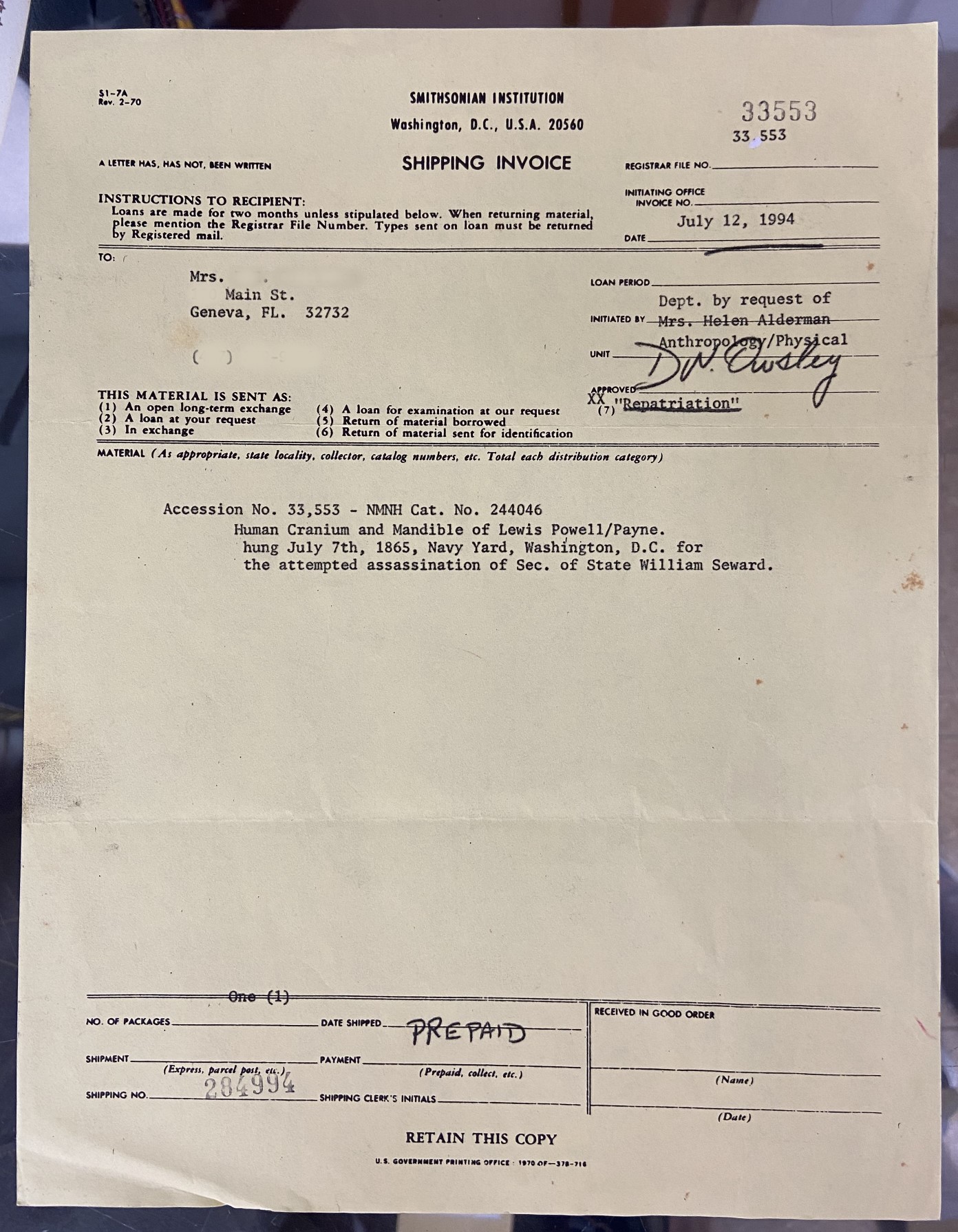
Most of us can’t wait to toss the shipping invoices that accompany our delivered online purchases. Like all receipts, shipping invoices are largely ephemeral, designed to survive the trip to their destinations. But in some cases, especially when it comes to historical artifacts, receipts can be used as a form of provenance to help prove where a specific item came from. In these cases, shipping invoices may become part of a formal record of an item. It’s perhaps not so surprising then that this shipping invoice from the Smithsonian Institution in Washington, D.C. was retained when it accompanied a very unique relic in 1994. As stated on the paperwork, this invoice accompanied the transfer of the, “Human Cranium and Mandible of Lewis Powell/Payne” from the Smithsonian to a descendant of the Powell family living in Geneva, Florida. Noted as a matter of “repatriation”, this document represents the final trip that Secretary of State William Seward’s would-be assassin, Lewis Powell, took after his skull had been rediscovered among the Smithsonian’s anthropology collection in the 1990s. Through the help of historians Michael Kauffman and Betty Ownsbey, descendants of the Powell family took ownership of their ancestor’s remains and laid his skull to rest next to his mother in Geneva Cemetery. For more about Lewis Powell’s post-mortem travels click here. For a video I shot at Geneva Cemetery in 2020, check out this post. This shipping invoice comes from the collection of the Geneva History Museum in Geneva, Florida.

Categories: History | Tags: , , , , , , , , , | 15 Comments

Looking at General Grant

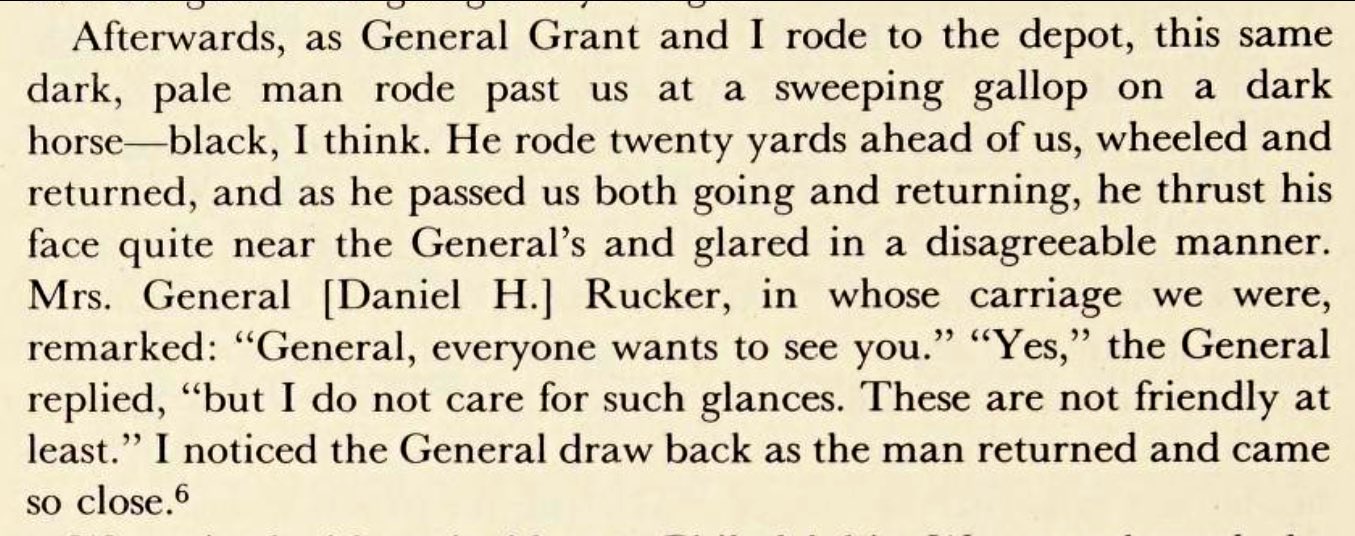
Tonight marks the end of the History Channel’s three part miniseries about the life of Civil War lieutenant major general turned President, Ulysses S. Grant. Being without cable, I have yet to see to the miniseries myself, but I am looking forward to viewing it in the near future. However, thanks to the power of promos and Twitter, I have already been made aware of one part of the miniseries that airs tonight and deals with Grant’s connection to Lincoln’s assassination. The miniseries describes how General and Mrs. Grant declined the Lincolns’ invitation to join them at Ford’s Theatre on the night of April 14, 1865. Instead, the Grants decided to travel by train to New Jersey in order to visit with their children. The miniseries shows the following scene of the Grants riding in a carriage on their way to the train depot when a mysterious stranger stops them.

After this promo was posted on Twitter, one of my followers there, Ilka, asked me if this story of an unfriednly glance between John Wilkes Booth and Gen. Grant on April 14th was true. While I had heard of it before, I always took it to be an apocryphal account with no evidence to support it other than Mrs. Grant’s lively imagination. However, as I researched it this morning, I found that the story has more evidence going for it than I thought. What follows is a Twitter thread I wrote this morning highlighting my research into this story.

Here’s the text from Col. Porter’s reminiscences as included in the above tweet:

Here is Julia Grant’s memory of the event as included in the above tweet:

In response to my thread, fellow tweeter Darin Weeks shared his skepticism regarding the story which I fully understand.

I’m not ready to 100% declare that it happened either, but I responded to Darin that at least this story (unlike a lot of others) has evidence to back it up.

After responding to Darin, I realized that, if the story was true, it might help to explain why Booth wasn’t better armed when he assassinated the President at Ford’s later that night.

In the end, we’ll never truly be sure that John Wilkes Booth was the man who gave Gen. and Mrs. Grant such an unfriendly glance on the afternoon of April 14th, but evidence shows that it could have been!

Categories: History, News | Tags: , , | 5 Comments

An Update Regarding John Wilkes Booth’s Knife

Back in December, I put up a post here on LincolnConspirators that contained my research on the knife John Wilkes Booth used to stab Major Rathbone following the assassination of Abraham Lincoln. By consulting the period evidence that came out during the trial of the conspirators, it is my firm belief that Ford’s Theatre has been displaying the incorrect knife for years and that the correct knife is locked away at the NPS storage facility in Landover, MD.

If you haven’t read the piece, please take a few minutes to read the article and look at the evidence for yourself: https://lincolnconspirators.com/2018/12/31/cloak-and-daggers-cutting-through-the-confusion-of-the-assassination-knives/

The post itself was actually just a reprint of my original article on the subject, which had been published in the Surratt Courier in March of 2012. Since that time, I have been trying to get Ford’s Theatre to acknowledge its unintentional error. In 2012, I sent the article to the National Park Service rangers at Ford’s and to representatives of the Ford’s Theatre Society. While I had a few individuals tell me that they found the evidence compelling, none felt they had the authority to make any changes. And so, for the past seven years, each time I take a group or a bus tour to Ford’s Theatre, I am compelled to point out to the group that they should disregard the knife on display. When asked why Ford’s Theatre doesn’t make an effort to correct its mistake, I can only shrug my shoulders in reply.

Recently, however, there has actually been some progress regarding John Wilkes Booth’s knife. The Ford’s Theatre Society and the National Park Service felt motivated to do their own investigating and last month they published an article on their blog regarding their exploration into the knives. I highly recommend you read their post before continuing with this one: https://www.fords.org/blog/post/which-knife-did-john-wilkes-booth-use-disentangling-the-lincoln-assassination-knives/

By looking at their accession and cataloging records, the Ford’s Theatre team discovered what those of us who study some of these artifacts already knew – their records are incomplete and, at times, incorrect. Remember that after the trials of the conspirators, John Surratt, and the impeachment proceedings against President Johnson, the pieces of evidence (like the knives) were locked away in the Judge Advocate General’s office. They stayed in the possession of the JAG for over 70 years, but there was a distinct lack of orderly care and documentation of those artifacts. The items were regularly removed from their boxes in the JAG and shown off to visitors and reporters. When moths were discovered infesting some of the trial exhibits, the JAG carted the clothing of the assassins into a courtyard and burned it. Some pieces, such as Booth’s diamond stick pin, just mysteriously disappeared from the collection. The JAG was simply not a good steward of the trial exhibits. When the artifacts were finally turned over to The Lincoln Museum (Ford’s) in 1940, the people in the JAG didn’t really know what they had anymore. They wrote up a list which was filled with inaccuracies, and that is what Ford’s has had to rely on for many years. Ford’s inherited messy records and a faulty catalog through no fault of their own.

My research, however, doesn’t rely on those faulty records. I drew my conclusions based on the period evidence of 1865 and 1867, which describes the knife Booth used on Major Rathbone. Those descriptions clearly show that the Liberty knife on display at Ford’s Theatre is not correct. Even the two authors of Ford’s article, David McKenzie and Janet Folkerts, seem to accept that my research on this is sound:

“In his post, Taylor presents additional evidence that the knife currently on display at the Ford’s Theatre Museum, FOTH 3235 (the Liberty knife), is not the actual knife. He cites testimony of witnesses in the assassination investigation, the 1865 military tribunal and the 1867 trial of John Surratt to argue that FOTH 3218 (the Rio Grande knife) is the knife that Booth used to stab Rathbone, and not FOTH 3235 (the Liberty knife), the knife that is currently on display at the Ford’s Theatre Museum.

Between that evidence and what is in the curatorial files described above, we’re inclined to say, at the very least, that a good amount of evidence points to that conclusion.”

The Ford’s Theatre blog post addresses their messy records (which, again, is not their fault as they were originally given erroneous records regarding these artifacts) and acknowledges that the period evidence regarding the knives points to the conclusion that they have the incorrect knife on display.

And yet, the very next sentence in the post is, “But because the evidence is so messy, as Taylor notes, we aren’t prepared to make a definitive declaration.” I have a couple of problems with this sentence. First of all, as I have already stated, the evidence that is “messy” is not historical but curatorial. The accession records regarding the artifacts are inherently messy due to the manner in which they were stored for over 70 years. That is why it is so crucial to take the time to return to the historical evidence for these artifacts. While my article addresses the messy curatorial records, all of my conclusions are based on the historical records, which are clear. John Wilkes Booth stabbed Major Rathbone with a Rio Grande Camp Knife that bore a small spot of rust that looked like blood on the blade.

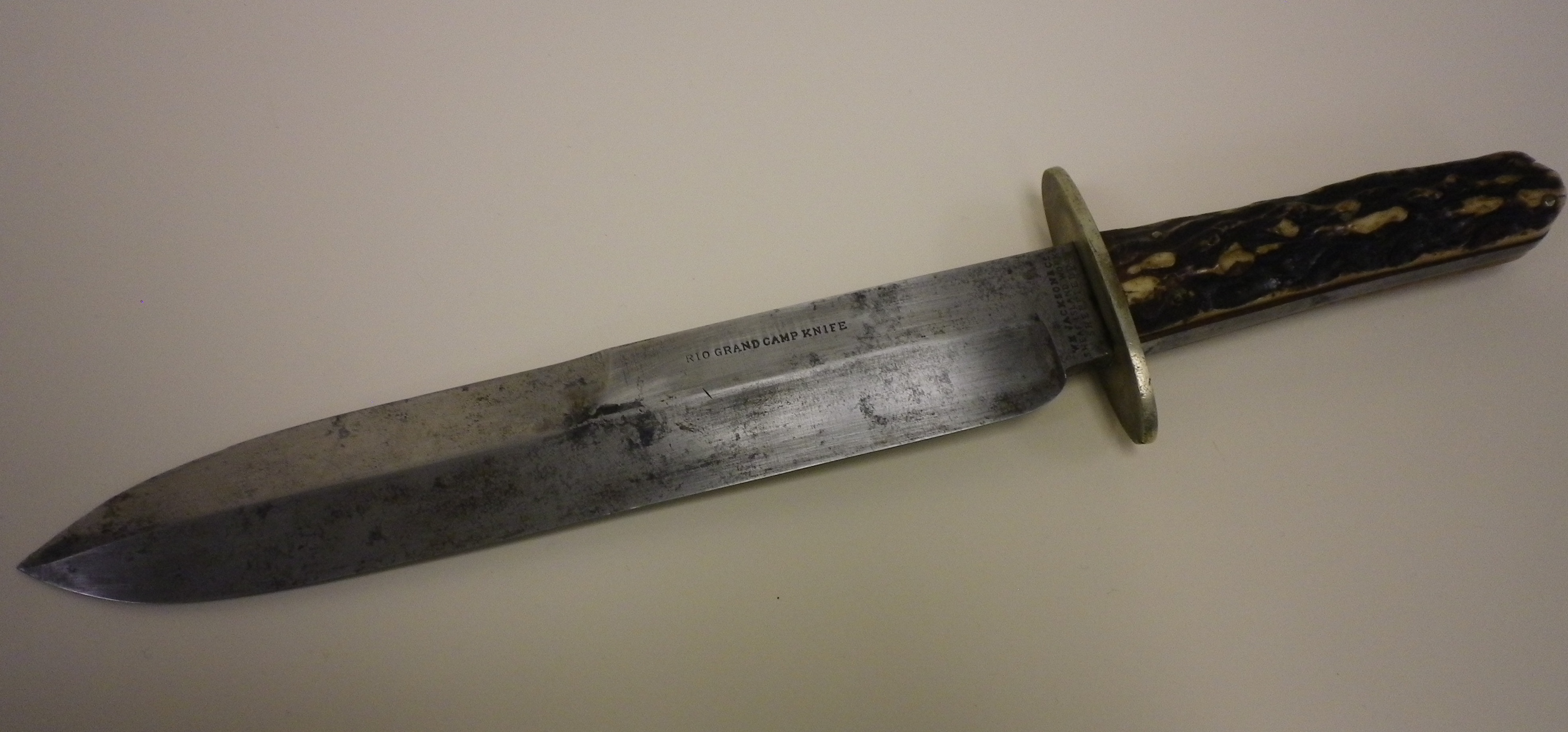
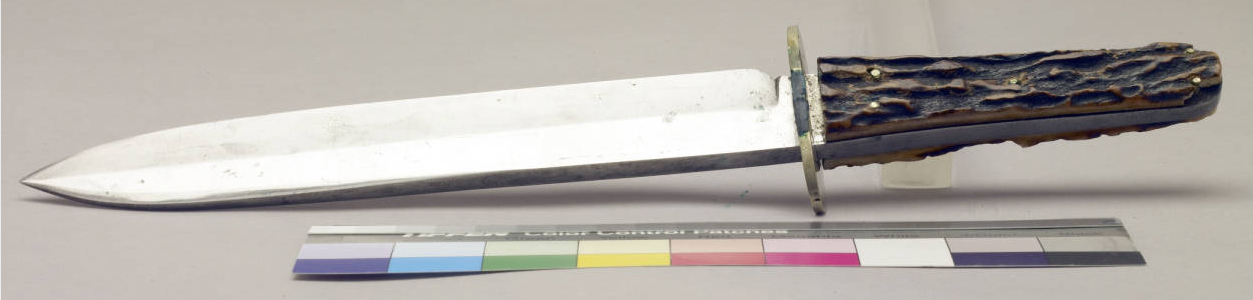
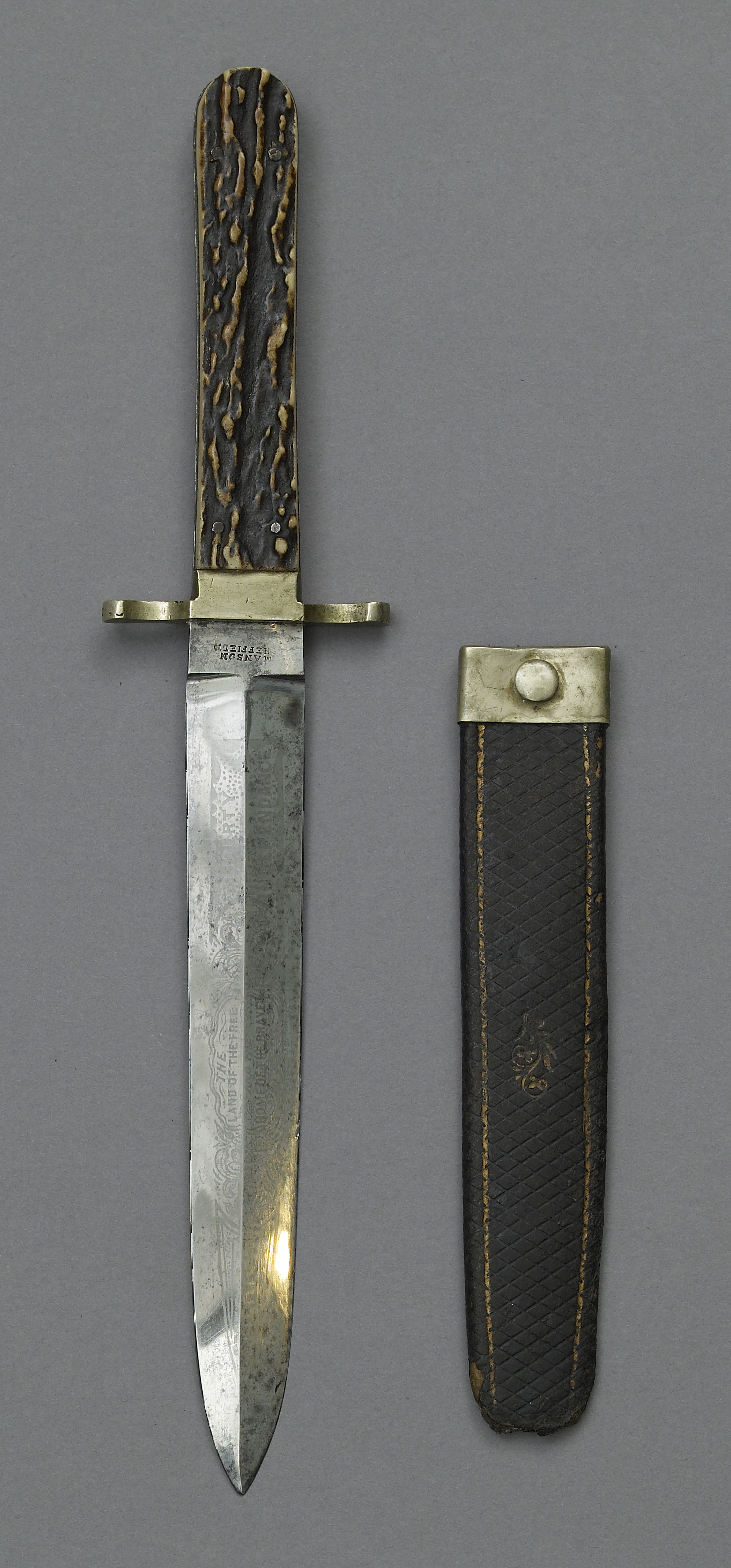
The Liberty knife (shown below), currently on display at Ford’s Theatre, does not fit that description. The Rio Grande Camp knife, known as FOTH 3218, currently in storage in the Museum Resource Center in Landover, does fit this description. While there is a bit of uncertainty regarding where the Liberty knife came from and its place in the trial exhibits, it is clear that it was not the knife Booth used to stab Rathbone.

Secondly, the claim that they “aren’t prepared to make a definitive declaration” is, in itself, a declaration. It’s a declaration that when faced with choosing between incomplete accession and cataloging records or compelling historical evidence, Ford’s Theatre will choose the former if it keeps the status quo. In the course of their post, Ford’s Theatre does not provide any historical evidence to support the Liberty knife as being the one that Booth used. Other than some newspaper accounts from the 1900s from journalists who went to see the artifacts in storage and were told inaccurate information by the clerks in the JAG office, I have never come across any historical evidence that attributes the Liberty knife to Booth. Without true historical evidence, how can Ford’s Theatre only commit that at some unspecified “future” the “on-site and online labels at Ford’s Theatre will reflect the ambiguity of the knives”? Even their claim that “Perhaps a future display could, like Taylor’s post and ours suggest, showcase both knives and lay out evidence to show our visitors how ambiguous historical evidence often is,” creates a false equivalency between Ford’s messy curatorial records and actual historical evidence from the period.

The historical evidence in support of FOTH 3218 as being the knife John Wilkes Booth used on the night of Lincoln’s assassination and as the one that was recovered from his body at the Garrett farm is not ambiguous. Messy accession and cataloging records should not supersede historical evidence at an institution committed to educating the public on the life and legacy of Abraham Lincoln. While John Wilkes Booth’s knife may not rise to the same level of other artifacts like Lincoln’s stovepipe hat, the weapons and possessions of the assassins tell a crucial story of Lincoln’s effect on his fellow man.

I know that the employees of the Ford’s Theatre NPS and the Ford’s Theatre Society are good people. I have worked with them on projects and on Booth tours. I follow many of them on Twitter and know that they are professionals who value education and public history. I appreciate greatly that Ford’s Theatre has chosen to address this part of their collection in such a public way. As David and Janet state in their closing line, “transparency about artifacts like these knives can lead to discussions about what makes visitor experiences in museums ‘real’ and how the history of objects and places affect us in the present day.” Ford’s is to be commended for their professionalism and their ongoing work in acknowledging the complications in their own collection. But acknowledgement without subsequent action is meaningless. It’s the “thoughts and prayers” of the museum world.

To my friends at Ford’s Theatre NPS and the Ford’s Theatre Society: The wrong artifact is on display and has been for many years. With the historical evidence solely in favor of FOTH 3218 and your cataloging records expectantly inconclusive, the correct remedy is to remove the Liberty knife from display and replace it with FOTH 3218. By doing so, you will show your visitors that Ford’s Theatre is an institution that actively improves its exhibits based on sound research, is open about the history of its collection and the uncertainties that exist, and demonstrates a commitment to using historical evidence to guide your public outreach.

In September, I will be taking my next busload of guests to Ford’s Theatre for the John Wilkes Booth escape route tour. My sincerest hope is that I will finally be able to point to FOTH 3218 in the case and rave about the wonderful professionals at Ford’s Theatre who acknowledged an error in their collection and used historical evidence to rectify it. The research has been done, and the error has been acknowledged. All that’s left to do now is to fix it.


For those who are interested, what follows is the fairly long series of tweets I wrote shortly after I read the Ford’s Theatre blog post in May. I have expressed many of the same sentiments in what I wrote above, but I thought I’d include my original thoughts as well.


Categories: History, News | Tags: , , , , , | 9 Comments

Cloak and Daggers: Cutting Through the Confusion of the Assassination Knives

In the aftermath of Lincoln’s assassination, the authorities (both federal and local) took up the task of hunting down and collecting conspirators and evidence. Lincoln’s own wartime policies gave investigators unprecedented power to arrest and confiscate persons and things relating to his assassination. While casting such a wide net did succeed in capturing the members of Booth’s inner circle, it also inundated the War Department with mountains of evidence. Secretary of War Edwin Stanton appointed three army officers; Colonel Henry Wells, Colonel Henry Olcott, and Lieutenant Colonel John Foster, to help manage and assess the ever increasing paraphernalia. In turn, they reported to Colonel Henry Burnett, who sifted through their materials to find the key evidence to be used in the trial of the conspirators.[1] The voluminous paper materials can be found in the edited book, The Lincoln Assassination: The Evidence by William Edwards and Ed Steers, while the original documents can be viewed online (and for free) at Fold3.com. This investigation, however, centers more on some of the collected artifacts found by the War Department: the knives.

During the initial round of evidence gathering, many edged weapons entered the War Department. A knife was collected from the home of a Ms. Mary Cook, a known Confederate sympathizer, who continually celebrated after the assassination and tore down the mourning crepe placed upon her abode.[2] Another knife was taken from a Sergeant Samuel Streett, an acquaintance of Michael O’Laughlen, who was accused of passing two women through his lines at Camp Stoneman on the night of April 14th.[3] A sword was removed from above the mantle at the home of Mary Surratt.[4] In addition to these unrelated weapons, the investigation also managed to acquire the weapons of the conspirators. A knife was found hidden underneath the sheets of a bed at the Kirkwood rented to George Atzerodt. Samuel Arnold was arrested with a knife. Knives belonging to both Lewis Powell and George Atzerodt were recovered on the streets of D.C. the morning after the assassination. Finally, the lead conspirator himself gave up a knife when he was shot in the Garrett’s barn. All of these knives, along with others not mentioned or as fervently documented, left the members of the War Department up to their knees in knives. Therefore, Colonel Burnett began his process of identifying the important items he would need in the trial of the conspirators.

In the end, Colonel Burnett would choose five knives to use in the trial. Four of those knives would be entered as exhibits for the trial, while one knife, Powell’s, was used merely for identification purposes. The handwritten exhibit list for the trial has the following knives listed:

“23. Knife (Atzerodt’s room Kirkwood House)”
“28. Booth’s knife”
“41. Atzerodt’s knife”
“62. Knife found at Mrs. Surratt’s house.”[5]

The selection of which knives to use as exhibits was done very skillfully. With the evidence before him, Burnett realized that, out of those involved in the actual assassination plot, the government’s case was weakest against George Atzerodt and Mary Surratt. Therefore, their blades were touted right along side that of the assassin’s.
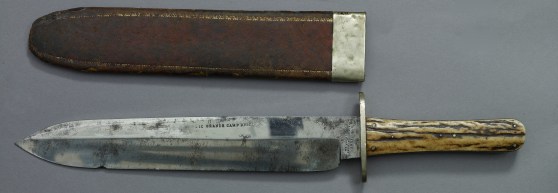
During the trial, the first three knives were identified by their finders. Detective John Lee discovered the knife pictured above at Atzerodt’s room in the Kirkwood house. It was hidden, “between the sheets and the mattress.” [6] While found in his rented room and bed, the contents of Atzerodt’s “lost” statement indicate that the knife, along with the other contents found in the room, belonged to David Herold.[7] Further, the statement of Mrs. R. R. Jones (the wife of a bookkeeper at the Kirkwood) notes that, a little after ten o’clock on the night of the assassination, a man ran rapidly past her room, towards Atzerodt’s, and tried to open the door of a room “three different times”. Not being able to get in, the man ran back past her room and down the stairs.[8] This man is supposed to have been Davy Herold. He left his coat, knife, and pistol in Atzerodt’s room, and came to retrieve them for his flight south. Upon finding the room locked and empty, Davy assumed correctly that Atzerodt had lacked the courage to complete his task, and fled. This could explain why, at the Surratt Tavern later that night, Booth bragged to John Lloyd that, “we have assassinated the President and Secretary Seward.” He did not include the death of Vice President Johnson in his boast, as Davy had likely reported the locked and empty room. While the above scenario is just a theory, it is safe to say that the bulk of the contents in Atzerodt’s room at the Kirkwood were under the care of Davy Herold, including the bowie knife recovered. From this point on, the knife found by Detective Lee, probably belonging to Davy Herold, will be referred to as the “Kirkwood knife”. This will eliminate confusion between that knife, and the knife pictured below that Atzerodt himself tossed into the gutter after hearing the news of the successful assassination.
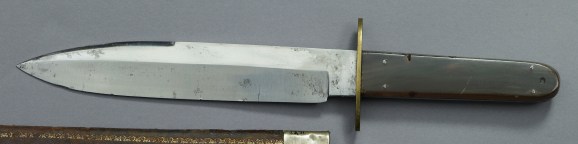
By the afternoon of July 7, 1865, all of the owners of the knives used in the trial were dead. The knives, along with the other pieces of physical evidence, were boxed up and stored. A year later, a request came in to the War Department from Secretary Seward’s former male nurse, Private George F. Robinson. Robinson was asking for a unique keepsake: he wanted the knife Lewis Powell used to stab him and three others. After being approved by Edwin Stanton, the knife was turned over to Robinson, the lone hero on that night of villainy, in July of 1866. Even though Powell’s knife was given to Robinson, this did not affect the four exhibit knives as Powell’s was not one of them. This fact is important to note. Much of the later confusion regarding the assassination knives comes from the assumption that the government retained possession of Powell’s knife. They did not. From 1866 to 1961 the knife was in the possession of the Robinson family. In 1961, the knife pictured below, along with other papers belonging to Private Robinson, were donated to the Huntington Library in San Marino, California. The knife still resides there today. Many journalists and researchers would include Powell’s knife in the government’s holdings during the late 1800’s and early 1900’s, and all would be incorrect in this matter.
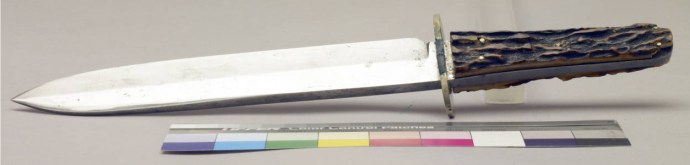
In 1867, the trial of John H. Surratt, the escaped conspirator, began. The evidence boxes were reopened and many of the same witnesses from the initial conspiracy trial were recalled. The civil trial ended in a hung jury and Surratt was set free. About six months later, another trial was held and the assassination of Abraham Lincoln was relived in that court room as well. That trial also acquits its defendant, President Johnson, who narrowly avoided impeachment. The assassination evidence, now having been taken out, examined, and disorganized twice since the conspiracy trial, was boxed up and stored again. This time, the storage lasted quite awhile.

In 1880, Representative William Springer of Illinois was one of the first to try to claim some of the Lincoln assassination artifacts. He introduced House Resolution 178 on January 23, 1880 calling for, “certain books and mementos in possession of the government to be placed in Memorial Hall of the National Lincoln Monument at Springfield, IL.”[9] It was quickly passed in the House and a Chicago Times journalist reported that it “will no doubt pass the Senate in a few days. The articles called for by the resolution are now in the office of Judge Advocate General Drum, in the War Department, and upon the passage of the resolution will be shipped to Springfield.”[10] While the resolution was eventually passed in both the House and Senate, the annual reports from the National Lincoln Monument Association in 1882 reflect what little became of it: “Concerning relics to be sent from the War and State Departments to Memorial Hall, the only article received thus far is one copy of, ‘Tributes of the Nations to the memory of Abraham Lincoln,’ and is the only one that can be spared. Hon. W. M. Springer has been untiring in his efforts to have the provisions in the joint resolution complied with, but obstacles have presented themselves at various points, and the probability is that we will never receive half of what was ordered in that resolution.”[11] Despite a resolution from Congress, the artifacts and knives stayed in storage as they were deemed too important to let go of, at least for now.

In May of 1899, Judge Advocate General Guido Lieber, was in the mood to do some spring cleaning. Particularly, he wanted to be rid of the trial relics: “These relics are now in a locked cabinet, in a storeroom of this office, in the sub-basement. Very frequently visitors obtain permission to see them, but, owing to the storeroom being filled with files, there are no facilities for showing them, and it takes the time of an employee of this office from his official duties for the purpose.”[12] Lieber contacted the Smithsonian (then called the National Museum) and they were “very agreeable” to receive the relics. Lieber then received permission from the Secretary of War, Russell Alger, to transfer the relics under one condition: the artifacts would forever remain “subject to the control of the War Department.” The Smithsonian did not care for this condition and, during the confrontation that followed, the War Department decided that, “the law did not authorize even a temporary removal of the exhibits.”[13] Again the relics stayed in the Judge Advocate General’s office.
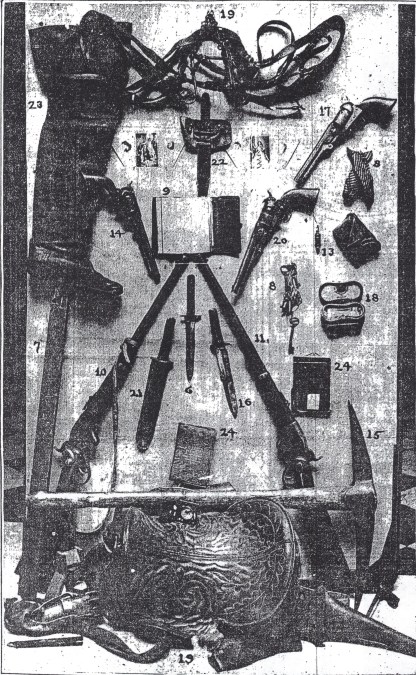
The exhibits of the assassination trials displayed for a reporter in 1908.

The artifacts would not be freed from their tomb until 1940, 75 years after the assassination. By this time the National Parks Service was in control of Ford’s Theatre and the Petersen House, using the space to exhibit Osborn Oldroyd’s collection of Lincolniana. The official exchange happened on February 5, 1940 when the office of the Judge Advocate General transferred over their materials to the Lincoln Museum (Ford’s). In the list of artifacts, there are four knives mentioned:

“Dagger with which Booth attacked Major Rathbone, and which he carried in his hand as he fled across the stage.”
“Knife used by Payne in his attempt to assassinate Seward.”
“Two knives secured from the effects of the conspirators”[14]

Under the control of thirteen different Judge Advocate Generals, the identities of the knives became scrambled and confused. Powell’s knife was not in the government’s possession and therefore was not turned over to Ford’s. The four knives that Ford’s received are the same four listed in the trial exhibit list. While, at times, it seemed that they were going to be transferred elsewhere, they never left the JAG’s office and the number of assassination knives being held by the government remained unchanged since Robinson was granted Powell’s knife in 1866. Since 1940, the National Parks Service has been trying to sort through this mess of knives with varying degrees of success.

Of all of the knives, the NPS has consistently been correct with their identification of Atzerodt’s knife and the Kirkwood knife. This is partially owing to the fact that the 1940 inventory correctly, but vaguely, lists these two as “Two knives secured from the effects of the conspirators”. If you would visit Ford’s today, you would see Atzerodt’s knife (FOTH 3234) and the Kirkwood knife (FOTH 3231) on display and correctly identified. The main problem and confusion with the knives lies with the assassin’s blade.
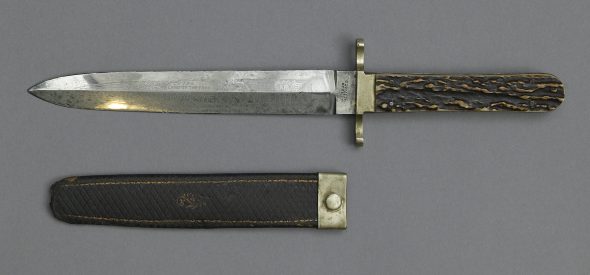
At Ford’s there is the above pictured, ornately etched, double edged knife, manufactured by Manson Sheffield Co. of England. It is just less than 12 inches long with a textured bone handle. This beautiful knife has the words, “America”, “The Land of the Free and the Home of the Brave”, and “Liberty and Independence” etched on the blade. Due to this, Ford’s refers to it as the Liberty knife along with its artifact number FOTH 3235. Most visitors, however, know it by another name: Booth’s knife. According to the tag underneath it, this, “horn-handled dagger was used by John Wilkes Booth to stab Major Rathbone after shooting Abraham Lincoln.” No doubt, many have seen the irony of such a patriotic knife helping to commit such an atrocious crime. It makes a poignant impact on those who have seen it. Unfortunately, it’s also a lie. This is not the knife Booth used to stab Major Rathbone. This knife was not recovered from Booth at Garrett’s barn. This knife did not even belong to John Wilkes Booth.

To explain this confusion, it is crucial to look back at the statements and testimonies of those who were with, and captured, Booth. After Davy Herold was caught at the Garrett’s he was transferred to the monitor, Montauk. Here, he gave a statement skillfully trying to conceal his guilt. Though much of Davy’s statement must be taken with a grain of salt, he does produce the following about his traveling companion’s act: “[Booth said] he struck him [Rathbone] in the stomach or belly with a knife. He said that was the knife (pointing to the one which had been shown to the prisoner).”[15] Davy is stating that the knife recovered from Booth at the Garrett’s is the same knife he used to stab Rathbone. While Davy commits to this, he makes no mention of any ornate etchings on the blade of the knife. In fact, Davy, Everton Conger, Luther B. Baker, John “Jack” Garrett, and Boston Corbett all make mention of Booth’s knife in statements and testimonies, but merely describe it as a “bowie knife”. No mention is made of any noteworthy markings on the blade. The term “bowie knife” was used to describe any large hunting knife usually with a crossbar. It is similar to how a derringer, originally the specific maker of the firearm, came to refer to any small pocket pistol.

It is not until the John Surratt trial that a notable description of Booth’s knife is made. Everton Conger gives the following testimony:

“Q: Will you state what articles you took from him?
A: …He had a large bowie-knife, or hunting knife, and a sheath.
Q: Do you know whose make that was?
A: No, sir; the knife has a name on it, but I do not know what it is.”

At this point Conger is going from memory. He has not seen any of the weapons, but recalls the knife had a name on it. He is then shown the weapons:

“(A bowie-knife and sheath and a compass were shown to witness, and identified by him as being taken from the body of Booth. A piece of map was also identified by witness as having been taken from Herold…”

Conger examines the knife and then later is asked how he can be sure it is the same one he recovered from Booth:

“Q: How do you identify the knife?
A: The knife has a spot of rust on it, about two-thirds the way from the hilt to the point, right where the bevel of the knife commences at the end.  It was said to be blood, but I have never thought it was myself.  It is the same shape and style of knife.
Q: Have you not seen other knives like it?
A: Yes, sir.
Q: Have you not seen a great many like it?
A: No, sir; only a few.
Q: You put no marks on it?
A: No.  I have no means of identifying it except by the description I have given.
Q: You did not look at the name of the maker?
A: I do not know that the name of the maker is on it.  I have looked at it since and noticed the words “Rio Grand camp-knife” on it.  I have no means of identifying it except what I have stated, and my general recollection of the style of the knife”[16]

This blade does not bear any engravings or patriotic slogans. It is identified with the name “Rio Grand Camp Knife” and a “spot of rust” said to be blood. This testimony identifying Booth’s knife raises a question. Since Booth’s knife is not the Liberty knife, from where does the Liberty knife come from? This question can be answered by looking at the exhibit list from the conspiracy trial. The Atzerodt knife and the Kirkwood knife are identified and accounted for, so that leaves just two: “Booth’s knife” and “Knife found at Mrs. Surratt’s House”. Since, through Conger’s identification of the knife he helped take from Booth, we know that the Liberty knife is not Booth’s knife, it has to be the “Knife taken from Mrs. Surratt’s house”.

Aside from the description in the exhibit list and its corresponding tag from the JAG’s office, this Liberty knife from Mrs. Surratt’s is very elusive. The conclusion that this author has drawn, is that this knife was likely taken from Mrs. Surratt’s and never properly inventoried. This is not as unlikely as it seems. The Surratt boardinghouse was stripped of anything that could be used as evidence. In an inventory list dated April 24, 1865, the final item mentioned is a “Trunk and contents from Surratt House”. It is written in a different pen and lacks the numeration and specificity of the other items in that list.[17] In fact, the only record of what was in the trunk comes from its return to Anna Surratt on August 18, 1865. The receipt, noting the return of three pistol cases, a sword, one box of caps and other items, does not mention a knife. However it should not mention it because the knife, as an exhibit, would have been retained by the government.[18] While this is a theory, with the mounds of evidence procured during those days, a knife from Mrs. Surratt’s could have easily been overlooked and not inventoried. Therefore, the Liberty knife currently on display at Ford’s as Booth’s knife is not the assassin’s blade but likely an ornate knife recovered from Mrs. Surratt’s. It never belonged to the assassin, and, conceivably, it was never used to harm anyone.

What then, became of the assassin’s blade? According to the 1940 transfer list, four knives were turned over to Ford’s and yet only three are on display. Two of those are correctly identified, while the Liberty knife continues its impersonation of Booth’s knife. The current fate of Booth’s true knife is identical to what it was for over 75 years. Booth’s knife is in storage.

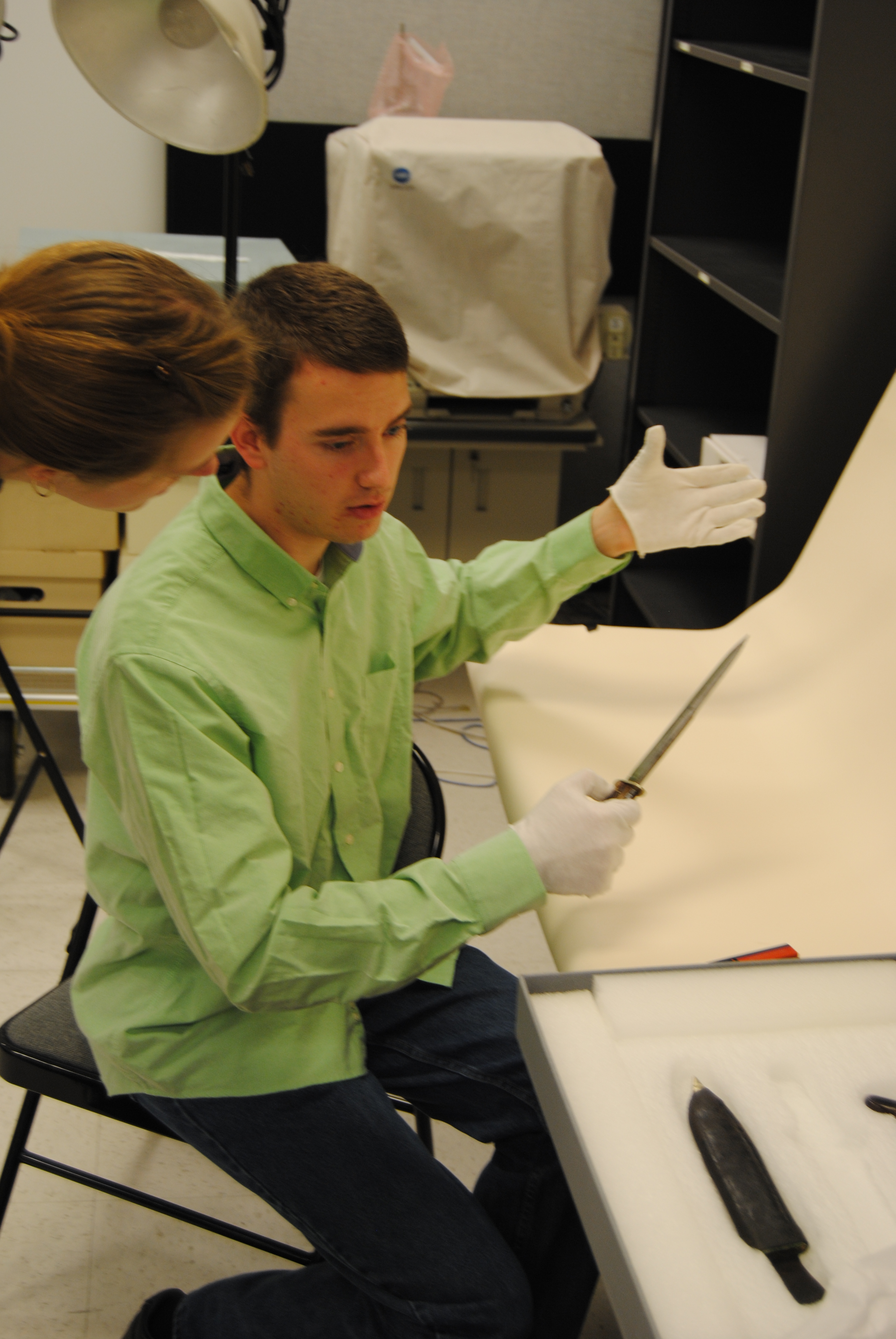
Stored as a generic “knife” with the rest of Ford’s overflow items, it is currently held in the National Parks Service Museum Resource Center in Landover, MD. There it sits, FOTH 3218, encased in protective foam, accompanied by its sheath. While the knife has been found, there is still a mystery to be solved.

Booth’s knife has not always been hidden away in storage. There was a time when it was displayed by Ford’s accurately as Booth’s knife. Books from the 1950s and 60s have pictures of the real, Rio Grand Camp knife, with a spot of rust on the blade, endorsed by the NPS as Booth’s. But suddenly, and inexplicably, it was replaced with the Liberty knife. With the worsening budget cuts the NPS has suffered over the years, the paperwork on the knives at Ford’s is disorganized and, most importantly, they lack a historian to sort it all out. No one seems to know why the knives were switched, but they all trust the unknown predecessor who did so. If the switch was made due to a mere clerical error, the knife doesn’t deserve to sit in storage for another 75 years. It is this author’s hope that this article will merit a re-examination of the knives and the evidence regarding their identification. Hopefully, Booth’s true knife will escape from storage once again and be restored to the Ford’s Theatre Museum.

Booth’s real knife: FOTH 3218
Currently being held in Landover, MD
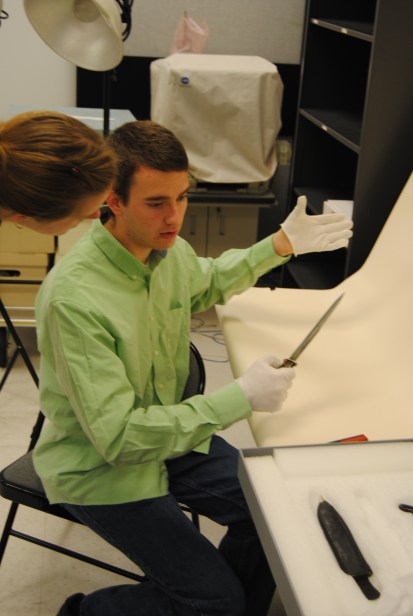
Dave Taylor examining Booth’s true knife in 2012.
Photographs by Jim Garrett.


[1] Edwards, W.C., & Steers, E. (2010). The Lincoln assassination, the evidence. (pp. xxii – xxiii).  Illinois: University of Illinois Press.

[2] Ibid, (p. 545).

[3] Ibid, (p. 1207).

[4] Ibid, (p. 1165).

[5] NARA. Trial exhibit list. Retrieved from website: https://www.fold3.com/image/249/7390964

[6] Poore, B. P. (Ed.), (1865). The conspiracy trial for the murder of the president, and the attempt to overthrow the government by the assassination of its principal officers. Vol. 1. (pp. 66) Boston, MA: J. E. Tilton and Company.

[7] Steers, E. (1997). His name is still Mudd: The case against Dr. Samuel Alexander Mudd. (p. 122). Gettysburg, PA: Thomas Publications.

[8] Edwards & Steers. (p. 758).

[9] U.S. House of Representatives. (1880). Journal of the House of Representatives of the United States, being the second session of the forty-sixth congress, begun held at the city of Washington, December 1, 1879, in the one hundred and fourth year of the independence of the United States. (p. 297) Washington City, DC: Government Printing Office.

[10] (1880, January 31). Assassination relics: A description of some of the articles Congress will order sent to Springfield. The Cleveland Leader, p. 3.

[11] Power, J. C. (1884). Annual reports of the custodian to the executive committee of the national Lincoln monument association, reports for nine years, from 1875 to 1883 inclusive. (p. 35) Springfield, IL: H. W. Rokker.

[12] (1899, May 24). The Booth relics, they are to be transferred to the national museum. The Minneapolis Journal.

[13] (1904, December 18). The first photographs of the mementos of Lincoln’s assassin. The Washington Times, p. 5.

[14] Copy of a list from the Judge Advocate Generals’ office dated February 5, 1940 in the files of James O. Hall.  From the James O. Hall Research Center, Clinton, MD.

[15] Edwards & Steers. (p. 682)

[16] (1867) Trial of John H. Surratt in criminal court for the District of Columbia. Vol. 1. (p. 308) Washington City, DC: Government Printing Office.

[17] Edwards & Steers. (p. 1166).  The handwritten page is viewable here: https://www.fold3.com/image/249/7361960

[18]Edwards & Steers. (p. 698).

Author’s note: A version of this article was originally published in the March 2012 issue of the Surratt Courier

Categories: History | Tags: , , , , , , | 22 Comments

The Novice and John Wilkes Booth

On June 15, 1863, John Wilkes Booth began an acting engagement in St. Louis, Missouri. While Booth visited many different cities as a touring star, the audiences of St. Louis were very supportive of his efforts. This particular engagement was his fourth time playing in the city in only a year and a half. In addition to the audiences, Booth was also aided by the fact that he had a pretty decent connection in the St. Louis theater scene. During each of Booth’s engagements in the city, he performed at Ben DeBar’s St. Louis Theatre.

Ben DeBar

Ben DeBar was essentially family to Booth. In 1840, Booth’s eldest brother, Junius Brutus Booth, Jr. married Ben DeBar’s sister, Clementina. June and Clementina’s union did not last however because, in 1851, June took a page out of his father’s book and ran off with another woman. Despite this unpleasantness, Ben DeBar maintained a good relationship with John Wilkes Booth and the rest of the Booth family. Ben DeBar hired John Wilkes Booth for five different engagements in St. Louis, and when he opened another theater in New Orleans, Louisiana, John Wilkes was hired there as well.

The June 1863 engagement in St. Louis was like any other for the 25 year-old actor. The newspapers noted that Booth was, “nightly greeted by full and fashionable houses; his performance[s] eliciting the most enthusiastic applause.” Booth’s engagement was scheduled to last from the 15th to the 27th, a normal two week engagement.

After a few days in St. Louis, Booth was presented with an offer from an unusual source. A Missouri resident by the name of R. J. Morgan approached Booth asking him if he could take Booth’s place on the final night of his engagement. It was not unheard of for actors to make such requests of their peers though it was more common for actors to request the services of their peers for benefit performances or during emergencies. Being asked to surrender a performance was less common. This request was even more strange, however, because the solicitor was not even a fellow actor, at least not yet.

We know very little about the life of R. J. Morgan. His foray into theater begins and ends over the course of about a year. Four months prior to his proposition to John Wilkes Booth, R. J. Morgan was a relatively unknown man. He was born in England and at the beginning of the Civil War he resided in Missouri. In early 1863, he was briefly living in Davenport, Iowa. What his business was and why he was in Iowa is a mystery. Apparently, he was able to make somewhat of a name for himself as one who knew a little bit about European and American poetry. On February 17th, a group of citizens in Davenport wrote a letter to Morgan which was published in the newspaper. The men appealed to Morgan to honor them with a public reading of various poems known to him. One would expect that Morgan must have previously given private readings of poetry which motivated his friends and neighbors to ask for a public showing. Morgan accepted the invitation of the men stating, “I shall avail myself of the flattering invitation extended to me…” and “the entertainment proposed to be given, I trust you will look upon as an amateur affair, with little professional pretensions.” Morgan secured the use of Davenport’s Metropolitan Hall free of charge after insisting that the proceeds of the readings would not go to him, but would instead be donated to the needy families of absent Union soldiers. It might be a bit cynical but, given his later actions with Booth, it is not out of the realm of possibility that R. J. Morgan desired to start a career as an dramatic orator and organized the invitation and philanthropic gesture to work in his advantage.

On the night of February 24, 1863, R. J. Morgan presented his “Evening with the Poets”. He presented readings of 12 poems including Beautiful Snow, a piece also rendered by John Wilkes Booth from time to time. While the audience enjoyed Morgan’s readings, the turnout was a bit lackluster for his first time out. “The audience was not large,” the newspaper said, “but those who had the pleasure of listening to the reading of the selections on that occasion may count themselves fortunate…It is certain that the public greatly underestimated Mr. Morgan’s ability, else the Hall would have been filled…” Morgan stayed true to his word, however, and donated the night’s entire proceeds of $18 to the Adjutant General of Iowa. “Your request, that I will apply the amount to the relief of needy families of our absent soldiers shall be faithfully complied with,” the General wrote to Morgan (who subsequently had the note published in the newspaper).

This initial, charitable reading, kick-started Morgan’s new career as a dramatic reader. Four days after his debut, Morgan gave another evening of readings in Rock Island, Illinois, just across the Mississippi River from Davenport. For his second reading he duplicated his first program entirely, but this time he took home the proceeds. After that, Morgan spent the next two months travelling around the Midwest giving readings in different cities. We have records of him performing in Iowa City, Muscatine, and Davenport, Iowa; Springfield and Jacksonville, Illinois; and in St. Louis, Missouri. He was apparently still in St. Louis when John Wilkes Booth came to town.

As Morgan’s readings went on, he began expanding his repertoire. He incorporated more and more Shakespeare, doing readings from Hamlet, Othello, and Henry IV. Coincidentally, while he was on the road, Morgan’s talents as a reader drew comparisons with a family of actors, a member of which would be shortly known to him. After a performance in Muscatine, Iowa the newspapers wrote, “The rendering and acting of Hamlet in his deathless soliloquies, was of that high and brilliant order that few attain who reach for it. The true life, energy and expression was breathed into it so faithfully that even a Booth or a Forrest might listen profitably.” After four months, Morgan apparently believed he was ready to move beyond being merely a reader and elocutionist. He wanted to be an actor and so he approached John Wilkes Booth in order to make that happen.

While Morgan’s correspondence to Booth doesn’t appear to survive, the two brief notes Booth wrote back to Morgan are housed in the Abraham Lincoln Presidential Library in Springfield as part of the Taper Collection. It’s clear that Morgan appealed to Booth to surrender the final day of his engagement so that Morgan could take his place and make his own theatrical debut. On June 22nd, Booth wrote to Morgan setting his terms for such a deal.

“Dear Sir,

I will agree to give up Saturday night 27th on condition you pay me fifty dollars $50 to be paid on or before Friday morning 26th

But it is understood I do not play myself these I consider very reasonable terms

Your respects

J. Wilkes Booth”

John Wilkes Booth was perfectly willing to surrender the last night of his engagement – for a price. The 1862/1863 theatrical season had been a good one for Booth and he did very well financially in Chicago earlier in the season. In December of 1862 he wrote to a colleague that he had made $900 his first week in Chicago and, as such, had averaged about $650 per week so far that season. If his success had held out for the rest of the season, $50 was somewhat generous on Booth’s part since he was making around $100 per performance on average. With only two engagements left in the season Booth may have been fine with taking an extra day off, and making $50 not to go to work wasn’t a bad plan.

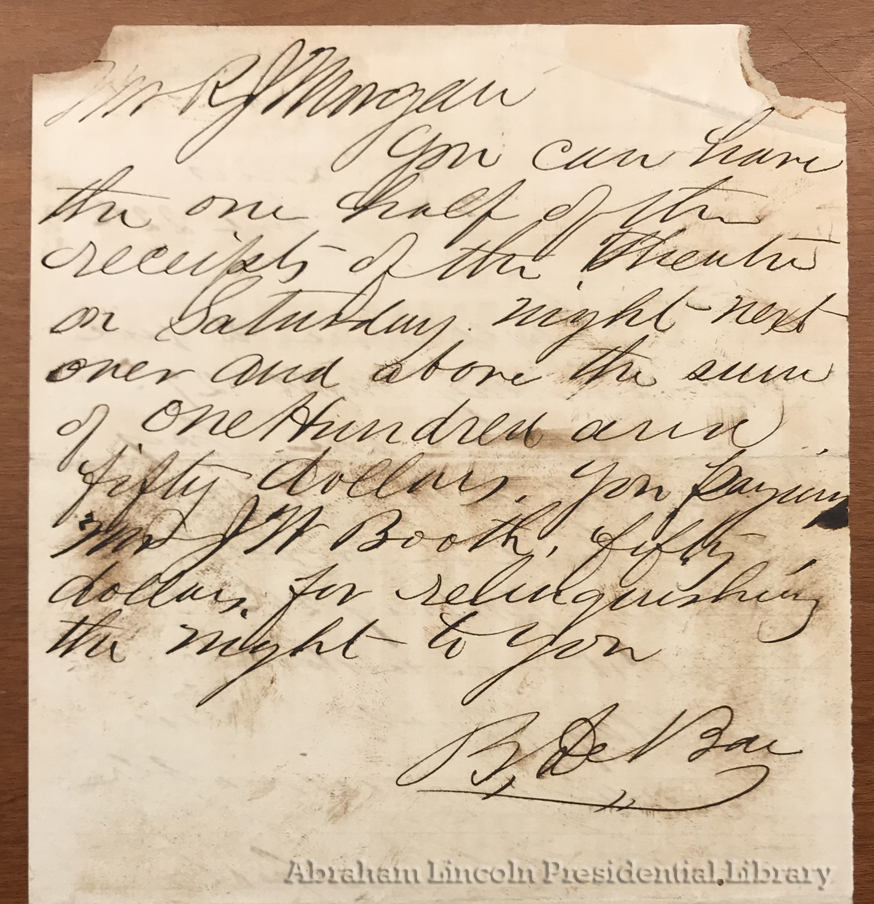
With Booth’s note in hand, Morgan approached Ben DeBar seeking permission to perform at his theater. Since Booth had given his blessing, DeBar consented. Morgan wanted his debut to be a benefit performance for himself, where he would be entitled to a share of the box office. On the back of the same note Booth had written, DeBar gave his terms.

“Mr. RJ Morgan

You can have the one half of the receipts of the theatre on Saturday night next over and above the sum of one hundred and fifty dollars. You paying Mr. J W Booth fifty dollars for relinquishing the night to you.

B. DeBar”

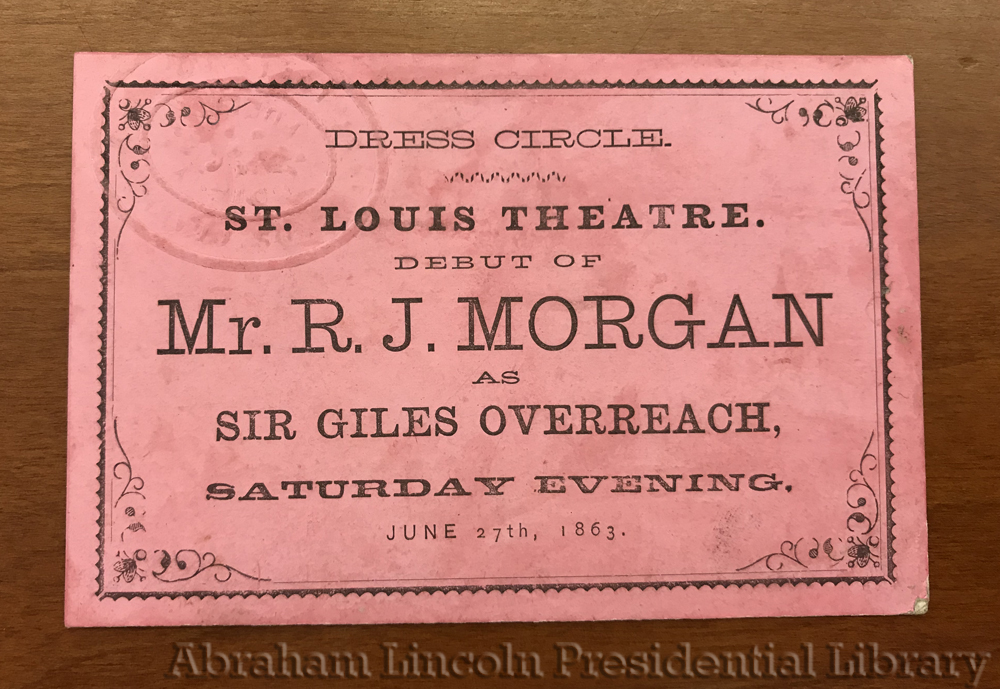
With these agreements in hand, R. J. Morgan began preparations for his debut. He chose A New Way to Pay Old Debts as his play, where he would perform the role of Sir Giles Overreach, the main character and villain. Coincidentally, Sir Giles Overreach was a favorite character of John Wilkes Booth’s father, Junius Brutus Booth, Sr. The elder Booth had performed the role over 320 times during his career.

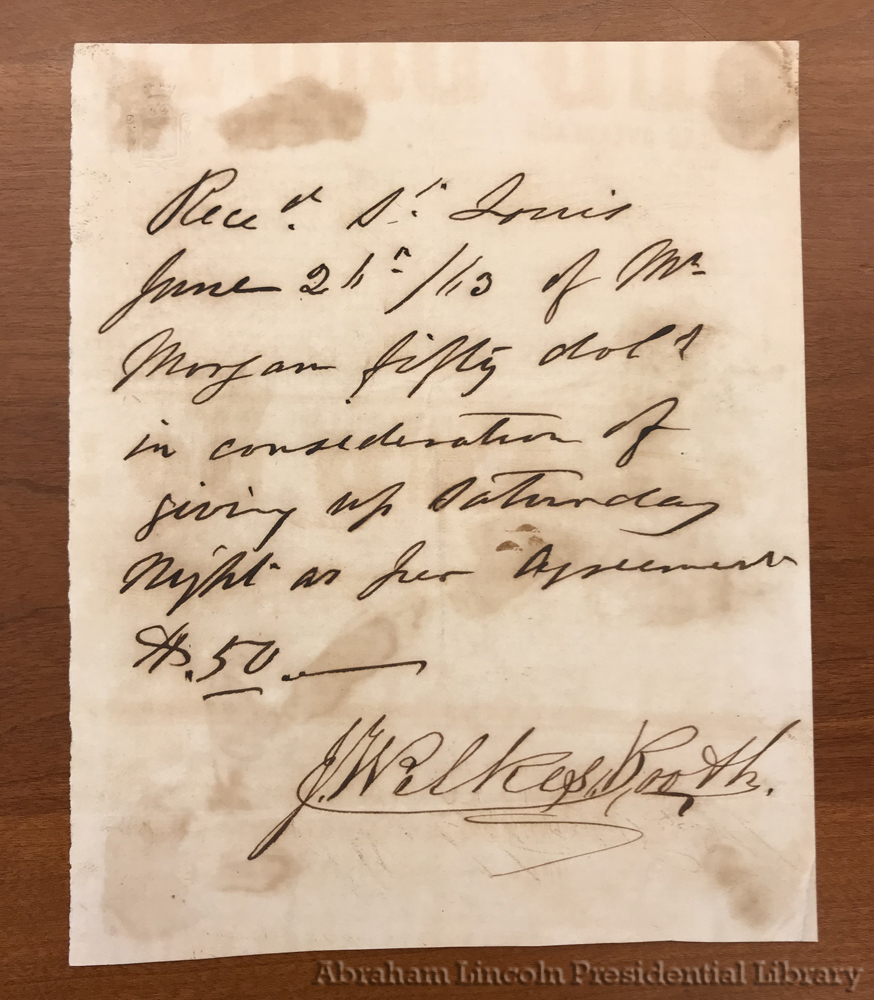
On Friday, June 26th, Morgan paid John Wilkes Booth the $50 he was owed. Booth then jotted down a note for Morgan, which acted as a receipt.

“Reced. St. Louis June 26th / 63 of Mr Morgan fifty doll in consideration of giving up Saturday night as per agreement $50 –

J. Wilkes Booth”

The following evening, Saturday, June 27th, with tickets and playbills in hand, R. J. Morgan made his on stage debut as an actor. Whether John Wilkes Booth attended the performance of the man who took his place is unknown. By Monday Booth was already on route to Cleveland, Ohio for his next engagement.

A few days after the performance, a review in the St. Louis Democrat newspaper hailed R. J. Morgan’s outing a complete success:

“The debut of R. J. Morgan at the St. Louis Theatre last Saturday evening, in the arduous character of Sir Giles Overreach, was, in point of execution, a brilliant success. This was Mr. Morgan’s first appearance upon any stage, and his success more than excelled the high expectations of those who were familiar with him as a dramatic reader. From his first entrance upon the stage, the bold, bad man, the scheming, heartless villain, stood out so prominently that the individuality of the actor was forgotten…His style and acting are of that electric and startling character that carries an audience with him. Mr. Morgan has a good stage presence, a clear and distinct enunciation, a perfect command of himself, and walks the stage with ease and abandon of a veteran stager. We predict for him a brilliant career in the arduous profession which he has chosen.”

Another reviewer from a different paper, however, was a bit more critical of Morgan’s performance:

“Last night, a Mr. R. J. Morgan, who has gained somewhat of a reputation as a reader, attempted the very difficult part of Sir Giles Overreach, in “A New Way to Pay Old Debts”; and, as might be expected, he made a failure, so far as making any favorable impression went. He knew the part, and had a good knowledge of the business; but there are very few old actors who can play the part with effect, and it is utterly impossible for a novice to do it, let his natural talent be what it may.”

Brilliant or failure, Morgan’s on stage debut worked in his favor. Though the 1862/63 theatrical season was wrapping up when he took the stage, the 1863/1864 season was just a couple months away. Somehow, perhaps through a good word from Ben DeBar or possibly even John Wilkes Booth, R. J. Morgan was hired by John T. Ford to become a member of the stock company at his Holliday Street Theatre in Baltimore. Morgan left the Midwest behind to follow his dreams on the east coast. The Holliday Street Theatre opened for the season on August 17th but Morgan didn’t grace the stage until September 1st. Despite being a stock actor, Morgan still found his name on the Holliday Street playbills from time to time. John T. Ford had a practice of publicizing his stock company and some took starring roles when the theater was in between star engagements.

But, while Morgan’s name could be found on several playbills during his time with Ford, he always played second fiddle to the star actors or veteran members of the company. Morgan acted in both Shakespearean tragedies and comedic farces. On November 28th the Holliday Street Theatre put on the comedy Our American Cousin which would gain infamy a year and a half later. Morgan played the more serious role of Sir Edward Trenchard.

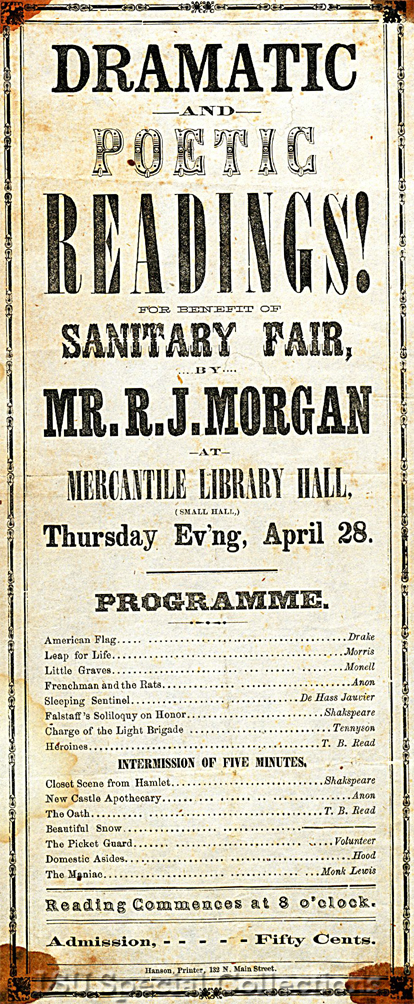
For some reason or other, after December of 1863, R. J. Morgan left the Holliday Street Theatre. What caused Morgan to abandon his career as an actor is unknown. Perhaps he was unhappy with working as a subordinate stock actor. Maybe the fairly poor salary in that job wasn’t enough. Or perhaps he just missed his home. Whatever the reasons, by April of 1864, he had made his way back to St. Louis. On April 23rd, during a celebration of Shakespeare’s birthday, R. J. Morgan returned to his roots and gave dramatic readings from Shakespearean plays. Five days later, on April 28, he gave an evening of dramatic readings as a benefit for the St. Louis Sanitary Fair. In October of 1864, he received a pass to leave and re-enter the military district of St. Louis.

From that point on, the life and dramatic career of R. J. Morgan returns to the anonymity from which he came. Even basic biographical data, like what the R & J stand for, is still a mystery. While there are possibilities as to his identity (there was an auctioneer named Rees J. Morgan who lived in St. Louis in 1865 and 1866), I have been unable to find definitive evidence of his life outside of 1863 – 1864. The bulk of what was presented here comes from some newspaper articles about his dramatic readings and a small collection of tickets and playbills from his career housed in the special collections department of Louisiana State University. How a collector in Louisiana acquired these few papers on R. J. Morgan’s life, I have no idea. The few items about Morgan and John Wilkes Booth that are now a part of the ALPLM’s Taper collection were almost assuredly once a part of the same collection that was later donated to LSU. Hopefully more information about R. J. Morgan will be found in the future.

In closing, while researching there were two interesting bits of trivia that I stumbled across. The first is that it is quite possible that R. J. Morgan, during his limited career with John T. Ford, may have actually performed at Ford’s Theatre. John Ford reopened his Washington theatre in August of 1863, after rebuilding it from a December 1862 fire. After its reopening, Ford would often pull from his Baltimore stock company when he needed extra performers in Washington. It’s very possible that R. J. Morgan was brought to Washington by Ford to supplement his new theater. R. J. Morgan was definitely in Washington, D.C. in January of 1864 because he received a military pass to visit Alexandria, Virginia during that time. What’s even more interesting to think about is the fact that John Wilkes Booth had an engagement at Ford’s Theatre in November of 1863, when Morgan was still employed by John T. Ford. Did Morgan have a chance to act beside the man who allowed him to get his start? Maybe.

Lastly, while R. J. Morgan’s connection to John Wilkes Booth, the first presidential assassin, and Ben BeBar, a member of the Booth family, has been established, amazingly Morgan also has a slight connection to the second presidential assassin. Remember that the event that put Morgan on the path to being an actor was that very first dramatic reading he was asked to do in Davenport in February of 1863. A group of the Davenport citizenry wrote to Morgan, with each man signing their name to the letter.

A total of 22 men affixed their names to the request, the last of which was a man named “J. W. Guiteau”. This man’s full name was John Wilson Guiteau. He was a Davenport lawyer and the older brother of Charles J. Guiteau, the future assassin of President James Garfield. It’s so strange that R. J. Morgan made both his dramatic reading and acting debuts because of the support of assassins and their families.

References:
The Abraham Lincoln Presidential Library
The Albert Louis Lieutaud Collection – Louisiana State University Special Collections
John Wilkes Booth: Day by Day by Art Loux
Junius Brutus Booth: Theatrical Prometheus by Stephen Archer

Categories: History | Tags: , , , , | 3 Comments

Blog at WordPress.com.