Posts Tagged With: Ford’s Theatre

In the Peanut Gallery

I’m very grateful to Joe Barry and his piece “Will Research for Peanuts,” which he recently contributed to this website. Through his research, Joe put together the known facts about Peanut John and documented some of the theories that exist about the identification of this young man who innocently held John Wilkes Booth’s horse behind Ford’s Theatre.

Inspired by Joe’s work, I decided to do a little bit of digging into Peanuts on my own, and I have come up with my own possible theory. While I originally received Joe’s approval to add my speculation to the end of his piece, I didn’t want to detract from his writing with my own, lengthy conjecture. Instead, consider this post to be my own addition to the Peanut John discourse.
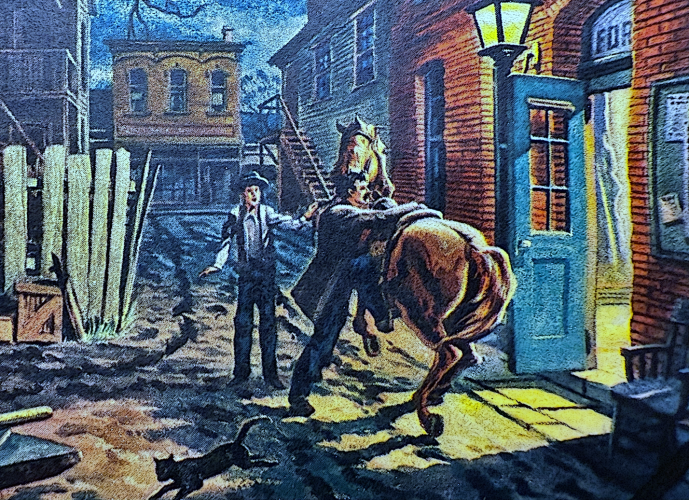
The main issue with trying to research this young man who held Booth’s horse is a lack of a consistent name. He was nicknamed variations of “Peanut John” and “John Peanuts” by the stagehands and employees at Ford’s Theatre. Harry Clay Ford, one of the managing operators of Ford’s Theatre, admitted to not knowing his employee’s full name, stating, “We have a doorkeeper at the back door, John. I don’t know his last name. The boys call him ‘Peanut.’ He is expected to keep the back door, and he works around the theater.” To Ford’s credit, he did not have much in the way of interactions with Peanuts, as the boy usually acted under the direction of James Gifford, the chief carpenter of the theater.

In one of his statements to the authorities, Peanuts notes that “They generally call me John Peanuts around [the theater] because I used to peddle peanuts.” It was not uncommon for individuals to sell small treats and concessions such as peanuts and candy to theater guests. In fact, Peanuts was actually one of several boys who engaged in this practice.

For much of the Civil War years, Dr. Ithamer S. Drake had been employed as a clerk in the Census Bureau in Washington, D.C. During the latter part of his employment, Dr. Drake resided with his family on 9th Street. Just about a week before the assassination, the Drake family had moved back to the doctor’s home in Richmond, Indiana. After hearing of the national calamity in Washington, Dr. Drake wrote a letter to an acquaintance of his who still resided in the city. The recipient was William A. Cook, a clerk in the General Land Office in the Department of the Interior. Dr. Drake noted to Cook that, “My youngest boy was in the habit of going through the theater with other boys.” The doctor then recounted how this son, Frank, informed him that during his time around Ford’s Theatre, he had heard disloyal talk from the scene painter at the theater, James Lamb, at the time of the fall of Richmond, Virginia. Dr. Drake alluded to possible conversations between Lamb and John Wilkes Booth that he felt should be investigated. In the letter, Dr. Drake informed Cook that one of the boys his son hung out with at the theater was David Finney and that he should be questioned on the matter. 

With the permission of Col. John Foster, one of the special commissioners engaged in investigating the assassination, William Cook interviewed David Finney at his father’s home on the corner of 9th and H Streets. Finney, who was about 15 years old at the time, described to Cook that while he did not recall any disloyal statements from Lamb when the Confederate capital fell, he did recall Lamb chastizing some revelers on the night of the Grand Illumination to celebrate the Union’s victory on April 13th. David Finney pointed out that Frank Drake was more acquainted with the people in the theater since the doctor’s son was “allowed to sell ‘gumdrops’ etc. in the building.”

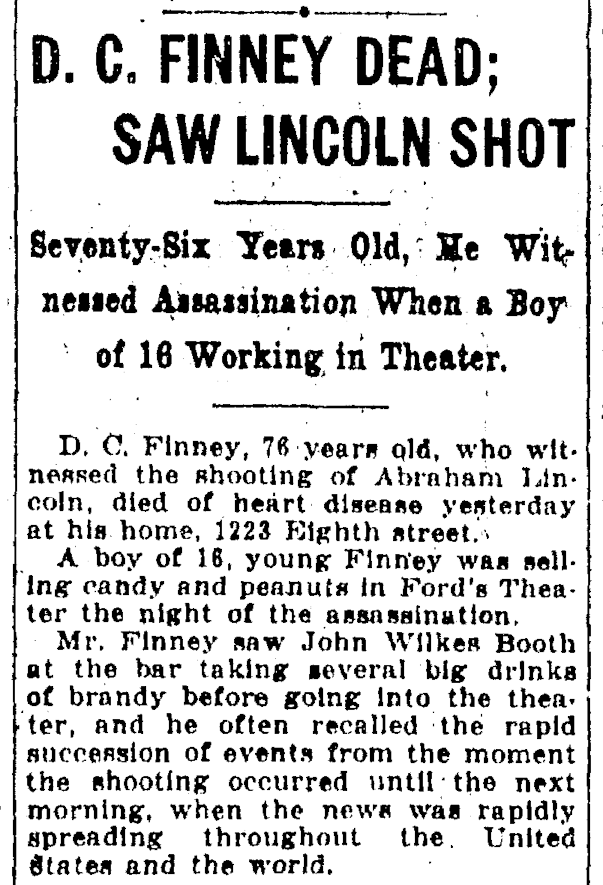
In this way, we know that Frank Drake acted as a sort of gumdrop and peanut boy at Ford’s Theatre. But he had left D.C. with his father shortly before the assassination, so we know he’s not our Peanut John. While in his statement to Cook, David Finney makes it seem like only Frank Drake was involved in the gumdrop trade, when Finney died in 1925, his obituaries noted that he also sold “candy and peanuts in Ford’s Theatre.” Moreover, these obituaries state that Finney was selling concessions the night Lincoln was killed and witnessed the events. In addition, one of Dr. Drake’s other sons, Albert, also told his father about the goings on at the theater, making it likely that there was a small cadre of boys who hung around the theater and made extra money selling gumdrops and peanuts.
While Peanut John had received his nickname from selling peanuts around the theater, he had clearly advanced beyond this role at the time of the assassination, leaving the job to boys like David Finney and the Drake brothers. As noted by Harry Clay Ford, Peanut was tasked with guarding the stage door: “He is to keep all strangers out, everybody…His instructions are not to let strangers on the stage.” In his own testimony, Peanut described his role thusly: “I used to stand at the stage-door, and then carry bills in the daytime.” During the day of April 14, Peanuts also assisted in the decorating of the Presidential box. In short, Peanut John was a gofer of sorts, fulfilling any small task given to him by James Gifford or anyone at the theater. 

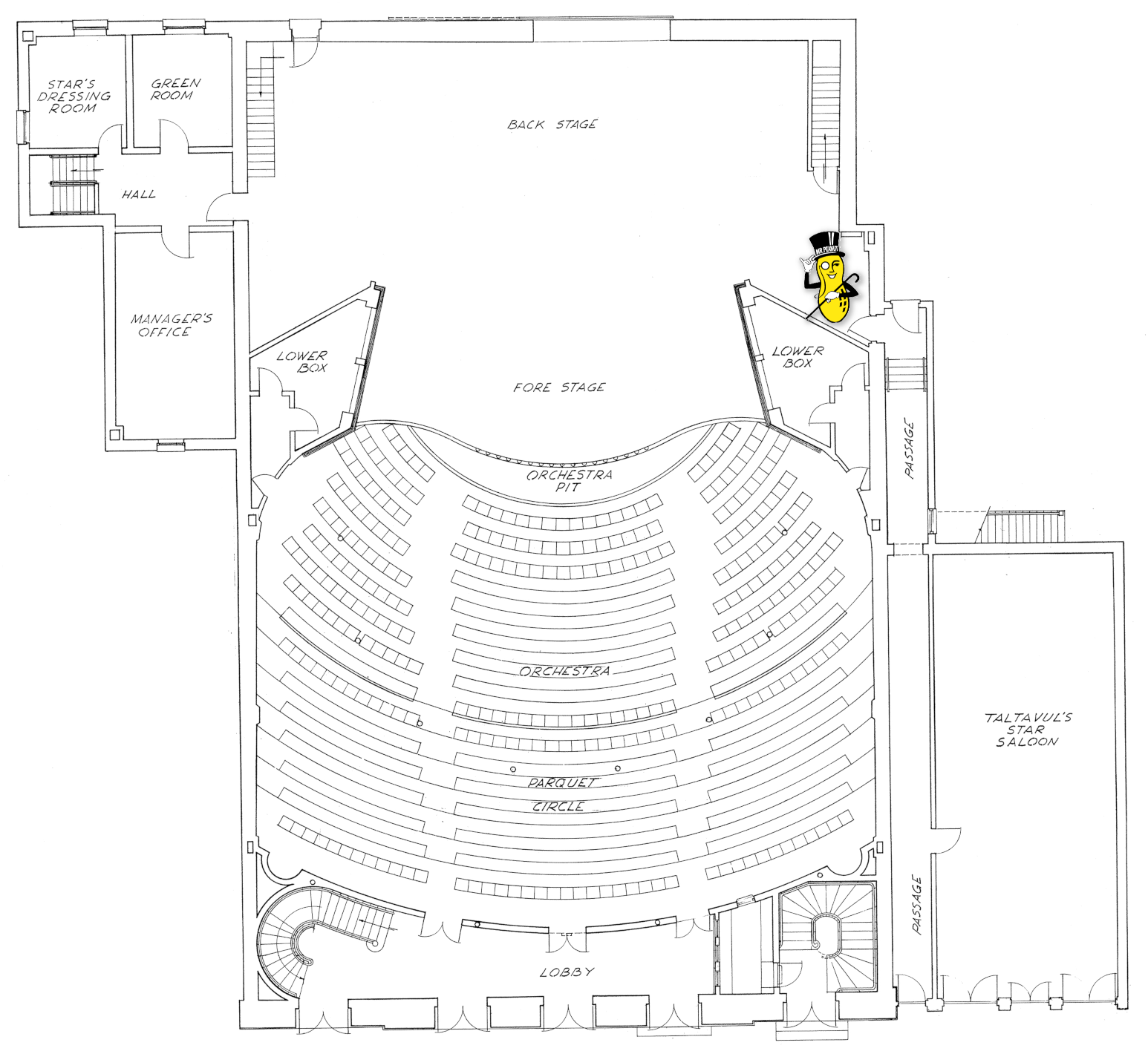
It’s worth pointing out that the stage door that Peanuts was tasked with guarding during performances is not the back door through which John Wilkes Booth entered. Rather, his place was located stage left on the south side of the building. A covered alleyway of sorts ran from Tenth Street all the way to the rear of Ford’s Theatre into Baptist Alley. This walkway separated Ford’s Theatre proper from the Star Saloon located just to the south. A side door of the Star Saloon led directly into this passageway, and it appears the Fords may have had an issue with bar patrons mistakenly opening the door directly onto the stage during performances. Therefore, Peanut John guarded this door, preventing anyone from accidentally interrupting a performance. When Peanuts was called by Edman Spangler, he abandoned his normal post to hold Booth’s horse directly behind Ford’s Theatre.
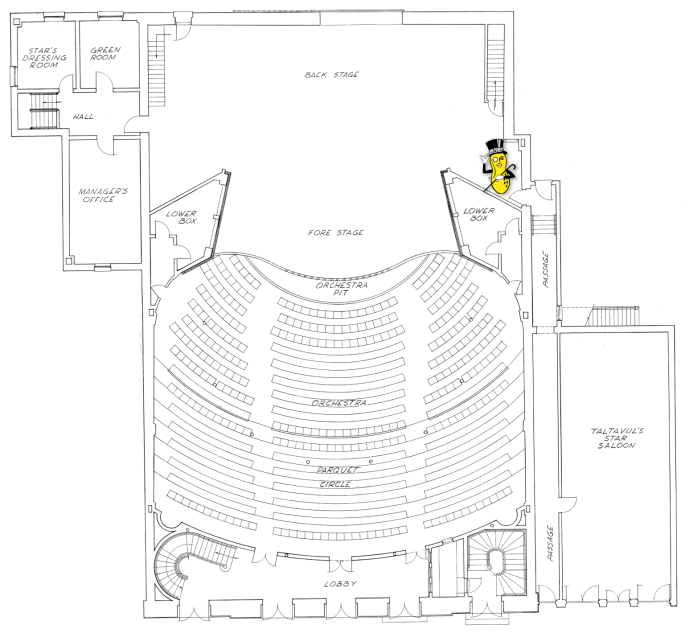
Location of Peanut John’s normal station, guarding the stage door at Ford’s Theatre

Prior to taking the stand at the trial of the conspirators, Peanut John gave two statements to the authorities. The first was on the morning of Lincoln’s death, April 15th. Edman Spangler was arrested around 6:00 am that day and taken to the police station on E Street between 9th and 10th. He had been brought in by Sergeant C. M. Skippon. As Spangler later recalled, “The sergeant, after questioning me closely, went with two policemen to search for Peanut John (the name of the boy who held Booth’s horse the night before) and made to accompany us to the headquarters of the police on Tenth street, where John and I were locked up…” After a period of time in confinement, both Spangler and Peanut were brought before Abram B. Olin, a Justice of the Supreme Court of D.C., who examined them individually and took down their accounts. Peanut John dictated two pages to Justice Olin. In this document, his name is given as Joseph Burrough. As noted by Joe in his article, he does not sign this name, however. Instead, he merely puts an “X” as his mark. Generally speaking, making an X implies that the person could not write their own name and that they may be illiterate. 
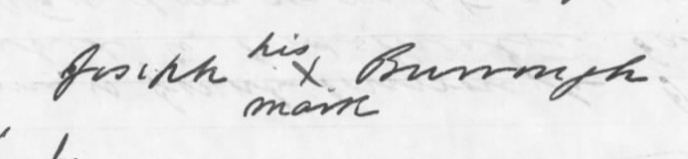
Due to Peanut not signing his name, Justice Olin needed a witness to swear to the fact that Peanut had, in fact, made the X himself. For this, Olin recruited the assistance of another witness who was awaiting examination. William T. Kent had been present at Ford’s Theatre and witnessed the shooting. After the call went up for help, Kent made his way into the Presidential box to render aid. When Dr. Charles Leale required a blade of some sort to cut open Lincoln’s shirt, Kent provided his penknife. After leaving the theater, Kent realized that he had lost his keys in the confusion. He was granted access back into the theater and searched the box. During his search, Kent came across the derringer used to shoot Lincoln. It was dropped in the box and kicked into a corner during the work to save the President. Kent took the gun and turned it over to the police, and he was now waiting his turn to tell his story to Justice Olin. The Justice thus had William Kent act as a witness to Peanut’s “signature” on this statement. Then it appears that Peanut John was released. 

Nine days later, Peanut was interviewed again about the circumstances and people at Ford’s Theatre. This conversation on April 24th was transcribed onto six pages. The name given for this interview is John C. Bohrar, though there is no signature section at the end (X or otherwise). In this interview, Peanut gives more details about his caring for Booth’s stable behind Ford’s Theatre, and the circumstances of how he ended up holding Booth’s horse on the night of the assassination. While the name John Bohrar is different from Joseph Burrough, it’s clear that the same person was interviewed in both statements.
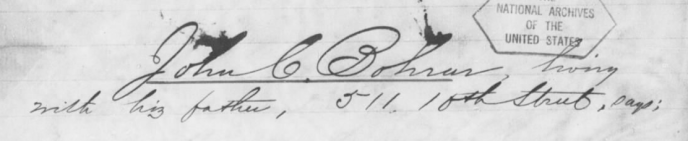
In his article, Joe explored the different Joseph Burroughs/Borrowses that have been suggested as possibly being “our” Peanut. Michael Kauffman theorized in American Brutus that Peanut might have been a son of Dr. Joseph Borrows, who lived right on E Street near Ford’s Theatre. But, thus far, we can’t seem to prove that Dr. Borrows had a surviving son at the time of the assassination. Fellow researcher Steve Williams tracked a Joseph A. Burroughs, who lived in Tenleytown (a neighborhood in the far northwest quadrant of D.C.) and later moved to Baltimore. He would have been about the right age for the teenage Peanuts, but this Burroughs is shown to be literate. 

While these possibilities are interesting, I would like to suggest that they may be based on a wrong assumption. The names we’ve explored have largely just been variations of Burroughs, Burrows, and Borrows. But when we look at the documents of Peanut’s two statements, neither of them put an “S” at the end of his name. He’s Joseph Burrough in the first one, and John Bohrar is the second. So, where is the ending S coming from? The answer, I think, is the trial transcript.

It was quite an undertaking to document the trial of the Lincoln conspirators. It was the duty of several court reporters to take down every word spoken in the courtroom by the commissioners, lawyers, and 347 unique witnesses. The court reporters listened to the words spoken in the trial room and took them down in shorthand. Between each session, the group would then painstakingly translate their notes into longhand and provide a transcript to the commissioners and lawyers the next day. They also provided copies to the newspapers for them to publish the trial, usually a day or two behind. As impressive as this system was, it wasn’t perfect. The shorthand process was done phonetically. Rather than taking down complete words or ideas, the different phonemes, or sounds, of words were taken down and then later transcribed. While this system worked well for much of the trial, one area where it caused mistakes was the spelling of names. When I completed my Trial Project a few years ago, completely documenting and summarizing the conspiracy trial into an easy-to-digest annotated form, the biggest bumps in the road were trying to determine the actual names and spelling of several witnesses. 
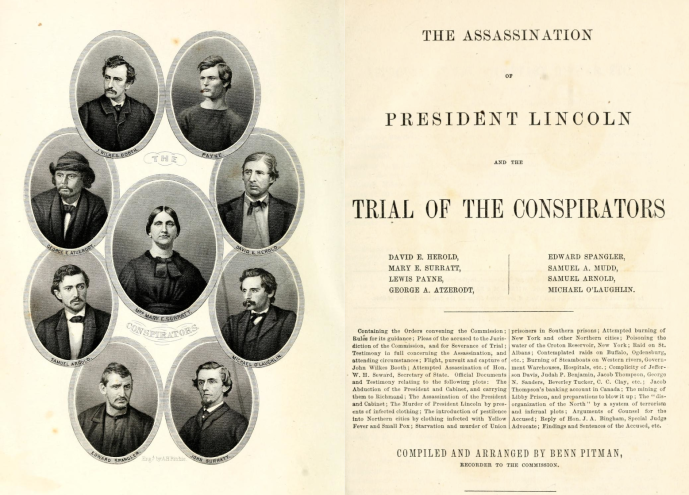
For example, two of the Ford’s Theatre employees, Jake Rittersbach and John Selecman, are given the names of Ritterspaugh and Sleichmann in the trial transcript. Dr. William Boarman is Dr. William “Bowman,” John Cantley is John “Cantlin,” and William Keilholtz is William “Keilotz,” just to name a few more.

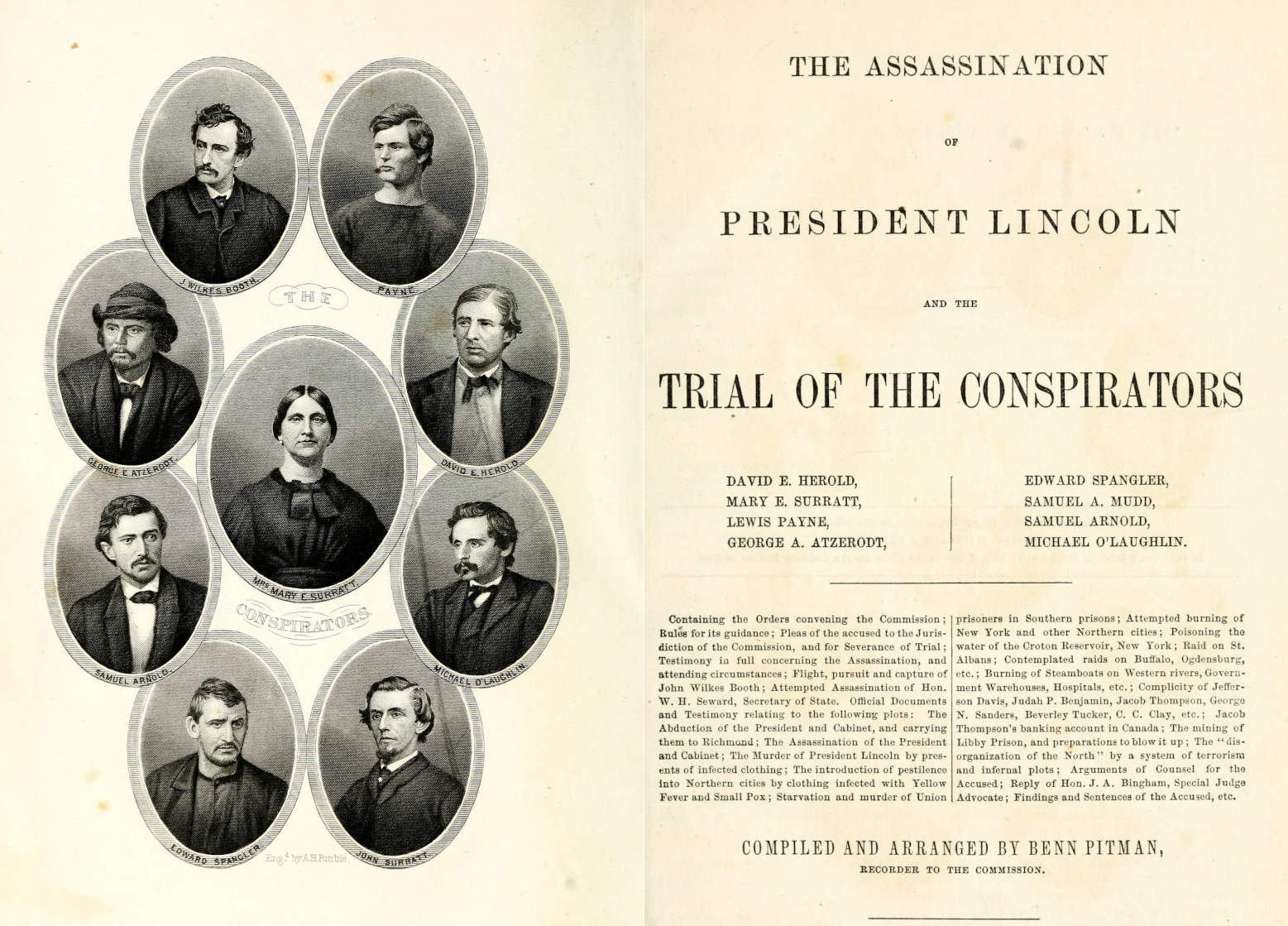
Different versions of the trial transcript exist. Benn Pitman published the “official” version of the trial as a single-volume book. He did this by essentially rewriting witness testimony into long paragraphs of text rather than the actual question-and-answer format that occurred when the lawyers were asking their questions to each witness. Because so much of the original content was taken out to reduce the trial to a single volume, the Pitman version is the least reliable trial transcript. But it is also the most well-known and widely available version. In the Pitman version, Peanut John’s name is given as Joseph Burroughs (with an S). The prevalence of Pitman’s transcript is probably why we have come to accept Peanut’s name to be Joseph Burroughs. However, given the numerous naming mistakes that occurred during the trial, we should be cautious about trusting this spelling, especially given the fact that neither of Peanut’s two statements put an S at the end of his name.

You may be thinking, “So what? Burrough or Burroughs, how does that help us?” Well, the reason I’m going into this is that I think the S has thrown us off. We’ve been looking for a Burrough/Borrow-like name that ends with an S, actively discounting any options without it. But if we free ourselves from the assumption that Peanut’s name has to end with an S, then there is an option that we have overlooked. It’s a small variation of the name given on the second interview Peanut did with the authorities. Let’s explore the possibility that Peanut John’s last name was actually Bohrer.

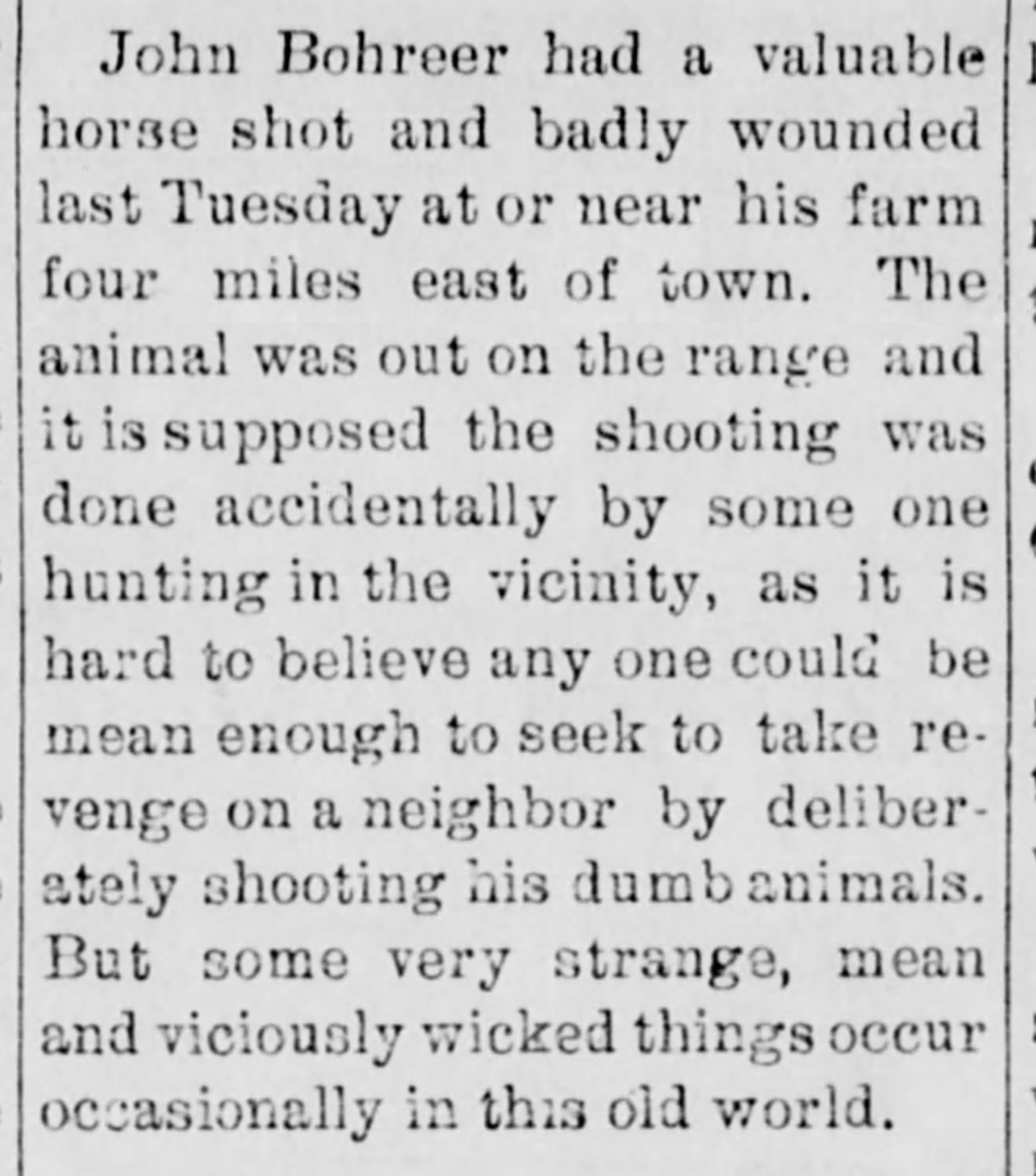
Aside from Peanut’s second interview with authorities on April 24, another piece of evidence that contributes to the speculation that Peanut’s last name might have been Bohrer is an article that was published in the D.C. Evening Star newspaper in 1928. The article recounted how a 1865 police report book had recently been unearthed from “a mass of debris in the subbasement of the Municipal Building.” The book contained handwritten logs from the Metropolitan Police Force from the time of Lincoln’s assassination. It describes some of the items that the police force took possession of after the assassination, as well as a list of those who came into the station to make reports in the hours after Lincoln was shot. This logbook also documented the aforementioned arrest of Edman Spangler and the bringing in of “John Borer (or Burrough) known around the opera house as ‘Peanut John.’” While the name isn’t a perfect match, it is another period document showing a last name without an S that is tantalizingly close to Bohrer.

Bohrer is a German name and, phonetically speaking, is not that far removed from a reasonable pronunciation of Burrough. Given that the Bohrar and Burrough spellings were both used in recording Peanut’s statements, we know that the way he pronounced his name had elements of each. Bohrer is a unique last name, but not an unheard-of one in the Washington, D.C. area. Various Bohrers had lived in the region for many years. 

One of the Bohrers who lived in the area was named Benjamin Schenckmyer Bohrer. He was born in Montgomery County, Maryland, in 1788, but moved to the then-independent city of Georgetown (now a neighborhood of D.C.), where he attended school and became a doctor. Except for a few years when he acted as a medical professor at Ohio Medical College in Cincinnati, Dr. Bohrer spent most of his life caring for the residents of Georgetown. In 1835, Dr. Bohrer was called to examine Richard Lawrence, the house painter who had attempted to assassinate President Andrew Jackson. Dr. Bohrer testified that he felt that Lawrence was “totally deranged” on the subject of President Jackson. Partly due to testimony from Dr. Bohrer and other medical professionals, Lawrence was found not guilty by reason of insanity for his attempted attack on President Jackson. Lawrence was committed to various institutions, eventually making his way to the Government Hospital for the Insane, later renamed to St. Elizabeth’s Hospital. Dr. Bohrer had helped establish this hospital. Dr. Bohrer died in 1862 and his death was greatly lamented in Georgetown, where he had been celebrated for ministering to “three generations in many families in the ancient town.”

Dr. Bohrer and his wife, Eliza Virginia Loughborough, had six children. One of the Bohrer sons was Benjamin Rush Bohrer, born about 1823. In order to avoid confusion with his physician father, Benjamin Jr. often went by his middle name of Rush or by his initials B. R. Bohrer. For a few years, this younger Bohrer ran a livery in Georgetown, renting out horses, buggies, and carriages to his neighbors. In 1848, Rush married Margaret Loretta Sullivan, a Maryland native. The couple had three children together, two of whom were born in D.C. The youngest child was born in Ottumwa, Iowa, where the couple had relocated for unknown reasons. It appears that it was in Iowa that Rush and Margaret’s marriage ended. In 1856, Margaret remarried a widower named Rudolph Bollinger and not long after moved to Brown County, Kansas. In the 1860 Federal Census, Margaret and her three children by Rush are shown living with their mom and stepfather in Claytonville, Kansas. Rush Bohrer had returned to Georgetown and was residing with his father, the doctor, who died two years later.

You may wonder why I’ve chosen to share all of these details about these particular Bohrers. Well, it’s because of my own theory that Peanut John might actually be the middle child of Benjamin Rush Bohrer and Margaret Loretta Sullivan. His name was John Jeremiah Bohrer, and this is a picture of him as he would have appeared at about the time of Lincoln’s death.

John Jeremiah Bohrer was the middle child of Rush and Margaret Bohrer. He was born on October 17, 1849, in Washington, D.C. As noted, John’s parents split up when he was young, and he seemingly resided with his mother and stepfather in the years after his parents’ divorce. In September of 1865, John’s name can be found in the Kansas state census, residing with his mother, stepfather, younger brother, and stepsiblings in Brown County, Kansas. In 1875, John married Susan Blackburn in Eufaula, Indian Territory (now Oklahoma). Susan was a member of the Choctaw Nation, being 1/16 Choctaw according to records. John Bohrer had likely made his way from Kansas to Indian Territory via the newly consolidated Missouri, Kansas and Texas Railway. He and Susan made their residence in the Choctaw Nation. They had six children together. At some point, John changed the spelling of his last name to Bohreer. All of John and Susan’s children were given the last name of Bohreer. Susan died in 1903, leaving John a widower. Oklahoma became a state in 1907, and the former Choctaw land on which John Bohreer had lived since about 1874 became part of Pittsburg County. In 1909, John married Mary Lynch, a widow 25 years his junior. John and Mary had two children together.

For the vast majority of his adult life, John Jeremiah Bohreer worked as a farmer, residing within a mile and a half of the same tract of land in Pittsburg County, Oklahoma. When he died on May 8, 1922, at the age of 72, he was remembered as one of the pioneers in the region, “beloved and respected by all.”
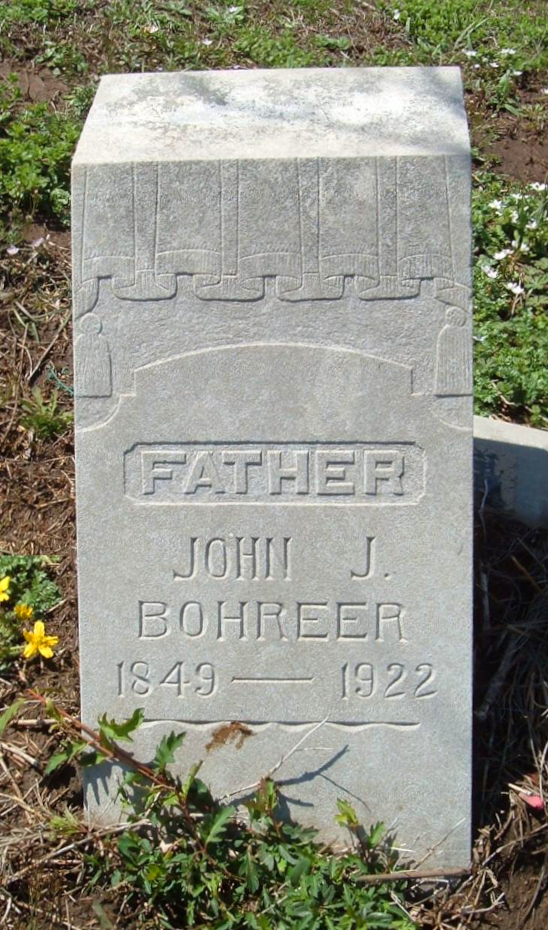
Now, I want to reiterate that I’m merely speculating that John J. Bohre[e]r might have been Peanut John. Much like Michael Kauffman’s theory about Peanut John being the son of Dr. Joseph Borrows, or Steve Williams’ exploration of the Joseph A. Burroughs who lived in Tenlytown, I can’t prove it. And, like those other examples, my theory also has issues. Still, here’s my speculative case.

1. He’s around the right age

John Jeremiah Bohrer was born in October of 1849. This would have made him 15 years old at the time of Lincoln’s assassination. William Kent, the witness who swore to Peanut’s X on his first statement, later estimated that Peanut was about 17 years old when he interacted with him. Bohrer’s age puts him right in the sweet spot and would have made other boys like David Finney and Frank Drake his peers.

2. His parents were not together

On the statement where Peanut’s name is given as “John C. Bohrar” it states that he is “living with his father.” At the time of Lincoln’s assassination, John Bohrer’s parents were divorced and living in different states. His mother, Margaret Bollinger, resided in Kansas while his father, Benjamin Rush Bohrer, was living in Georgetown.

3. John Bohrer changed his last name

As noted, John changed the spelling of his last name from Bohrer to Bohreer (which changed the pronunciation from Buh-rur to Buh-rear). During my research, I had a conversation with John’s granddaughter. She and the rest of the family are not sure why John changed his last name. Could it have been to distance himself from the history associated with his prior last name?

4. John Bohreer was barely literate

In the first statement Peanut gave, he signed the document with an X, implying that the boy was unable to sign his own name. We took this as evidence that Peanuts was likely illiterate. In the years just before his wife Susan’s death, John Bohreer applied to become a member of the Choctaw Nation through marriage. He did this to ensure land rights for himself and his children. He was granted acceptance into the Choctaw Nation and received several land grants to increase his holdings. Several of the documents associated with his application and land grants are available to view on Ancestry. In these records, it’s clear that someone other than John Bohreer is filling out the paperwork. But Bohreer was required to sign the documents. Here are some examples of his signature:

Bohreer was only in his 50s at the time these documents were signed. The shaky and inconsistent lettering across the signatures implies that he struggled to write his own name. If Bohreer was Peanuts and had spent part of his teenage years working at a theater rather than getting an education, it would make sense that that was the best signature he could give in later life.

5. The real Peanut John vanished after the assassination

Thomas Bogar writes in his book Backstage at the Lincoln Assassination that, after finishing his testimony at the trial of the conspirators, Peanut John, “stepped out of the witness box and out of the pages of history.” The whole reason we are having this discussion is that whoever Peanut John was, he seemingly failed to ever discuss his brush with history after leaving the witness stand. One would think that, in the 160+ years since the death of Lincoln, someone somewhere would have come across a newspaper article in which the real Peanut John told his story. The lack of any such document or account implies that the real Peanut John didn’t want to talk about this event. While Peanut was innocent of knowing what John Wilkes Booth was planning, he still held the assassin’s horse, unknowingly assisting in his escape. According to William Kent’s recollection, when those around Ford’s Theatre learned what Peanuts had done, “the infuriated crowd pounced on the boy, and but for the fact that a police station was a block away he would have been lynched. There were many cries of ‘Hang him.’” Thus, the assassination was an exceedingly traumatic experience for this young man. If I were Peanuts, I would want to get as far away from the scene of the crime as possible, as soon as I could. How much farther away from the event could you get than later moving to the frontier, residing in Indian Territory, and changing your name?

It’s worth mentioning that one of the actors in “Our American Cousin” later commented on the fate of Peanut John. Actress Kate Evans had the small role of Sharpe, the maid, in the last production Lincoln saw. She later moved to Chicago and was interviewed about the tragic events of April 14, 1865, several decades later. In her dated memory, Evans erroneously claimed that “Both Spangler and Peanut John, following the trial of the conspirators, were sent to Dry Tortugas, but [were] subsequently pardoned.” Peanut John was never sent to Fort Jefferson like Edman Spangler.

Of course, there are still a few flaws in my speculation. As noted before, John Bohrer is documented as living in Kansas with his mother in the 1860 Federal Census and the September 1865 state census. This doesn’t preclude the idea that, during the Civil War years, John travelled back to D.C. to live with his father, but I don’t have any records to support this. Another issue is that the statement that says Peanuts was living with his father at the time of the assassination gives the address as “511 Tenth Street.” I have not been able to find a record that places Rush Bohrer at this address. In 1866, he was in the D.C. directory, still living in Georgetown. In 1865, 511 Tenth Street was the home of a woman named Louisa Brent, the widow of Thomas. What connection she may have, if any, with Peanuts or the Bohrers is unknown. In addition, we have the other records that give Peanut’s first name as Joseph, rather than John. I can’t explain that repeated discrepancy if John Jeremiah Bohrer is the real McCoy.

Still, I speculate that John Bohrer could have been Peanut John. Perhaps during the Civil War years, John went to live with his father, Rush Bohrer. Even if they started off in Georgetown, young John would have wanted to explore the capital city. There were horse-drawn buses that made transportation between the two adjacent communities easy and fast. Somehow, during his visits, John became involved in selling peanuts and other concessions at Ford’s Theatre. This eventually led to him taking on more significant roles around the theater, such as carrying playbills around the city and guarding the stage door during performances. Perhaps because of this new job, he lived away from Georgetown and found lodging further down Tenth Street. John eventually became acquainted with the actor John Wilkes Booth and helped care for the stable Edman Spangler had helped construct for him in the alley behind the theater. Then April 14, 1865, came, and John’s life changed forever. After nearly being lynched for holding the assassin’s horse, John provided two statements to the authorities. In May, he testified twice at the trial of the conspirators, answering questions about his former coworker, Edman Spangler. Once his testimony was given and he was free to go, John decided to leave town. He made his way back to his mother and stepfather in Kansas and was enumerated with them in the state census in September. In the 1870s, the now-adult John took the train south from Brown County to Indian Territory. He met a girl, married her, and set up a new life with a new last name on the frontier. He spent the rest of his life as a respected pioneer and settler in what would become Oklahoma, dying in 1922.
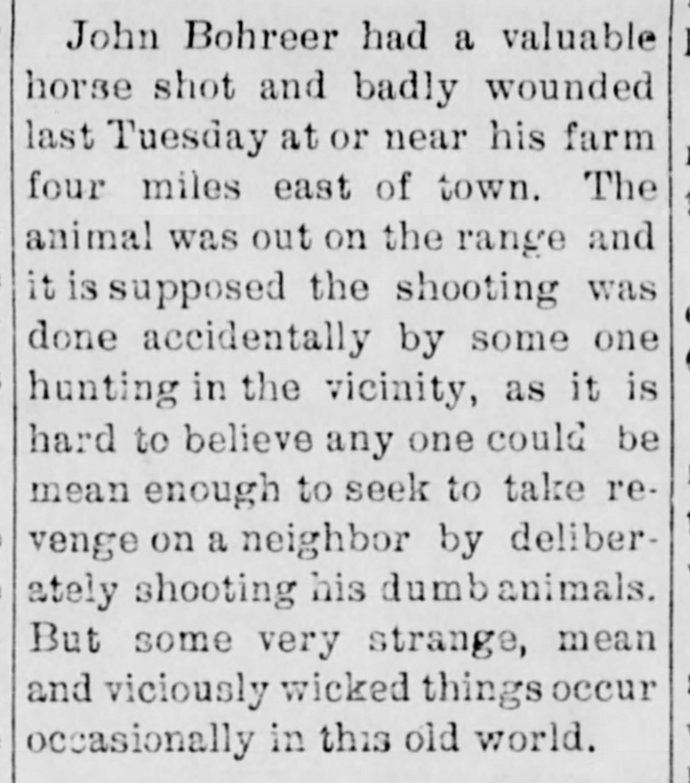
Even if John Jeremiah Bohreer isn’t our guy, I think researchers need to start branching beyond the traditional Burroughs/Borrows name when looking for Peanuts. The assumption that his last name must end with an ‘S’ comes from the unreliable trial transcript, whereas the two best sources we have omit an ‘S’ altogether. If we free ourselves from this constraint, who knows how many other folks with similar-sounding names we might be able to find and add to the old Peanut gallery.

Categories: History | Tags: , , , | 5 Comments

Will Research for Peanuts by Joe Barry

I’m so pleased to welcome another guest contributor to LincolnConspirators.com. The following piece was written by Joe Barry, a historical researcher currently working on a book about Joseph B. Stewart. On April 14, 1865, Stewart was seated in the front row of Ford’s Theatre, taking in the play. Stewart heard the sound of a gunshot and witnessed a man jump from the Presidential box to the stage below. While the rest of the audience remained frozen in their seats in confusion, Stewart was the first to take action. The D.C. lawyer, noted as one of the tallest men in Washington, climbed over the orchestra pit, onto the stage, and gave chase to the assassin. Joe Barry has spent the last few years uncovering many more interesting stories in the life of Joseph Stewart, a man he describes as the Forrest Gump of the 19th century. Having already previewed one of Joe’s chapters about the assassination, I’m very much looking forward to seeing the final product in the near future. You can learn more about Joe and his upcoming book by checking out his website JoeBarryAuthor.com


Will Research for Peanuts!

By Joe Barry

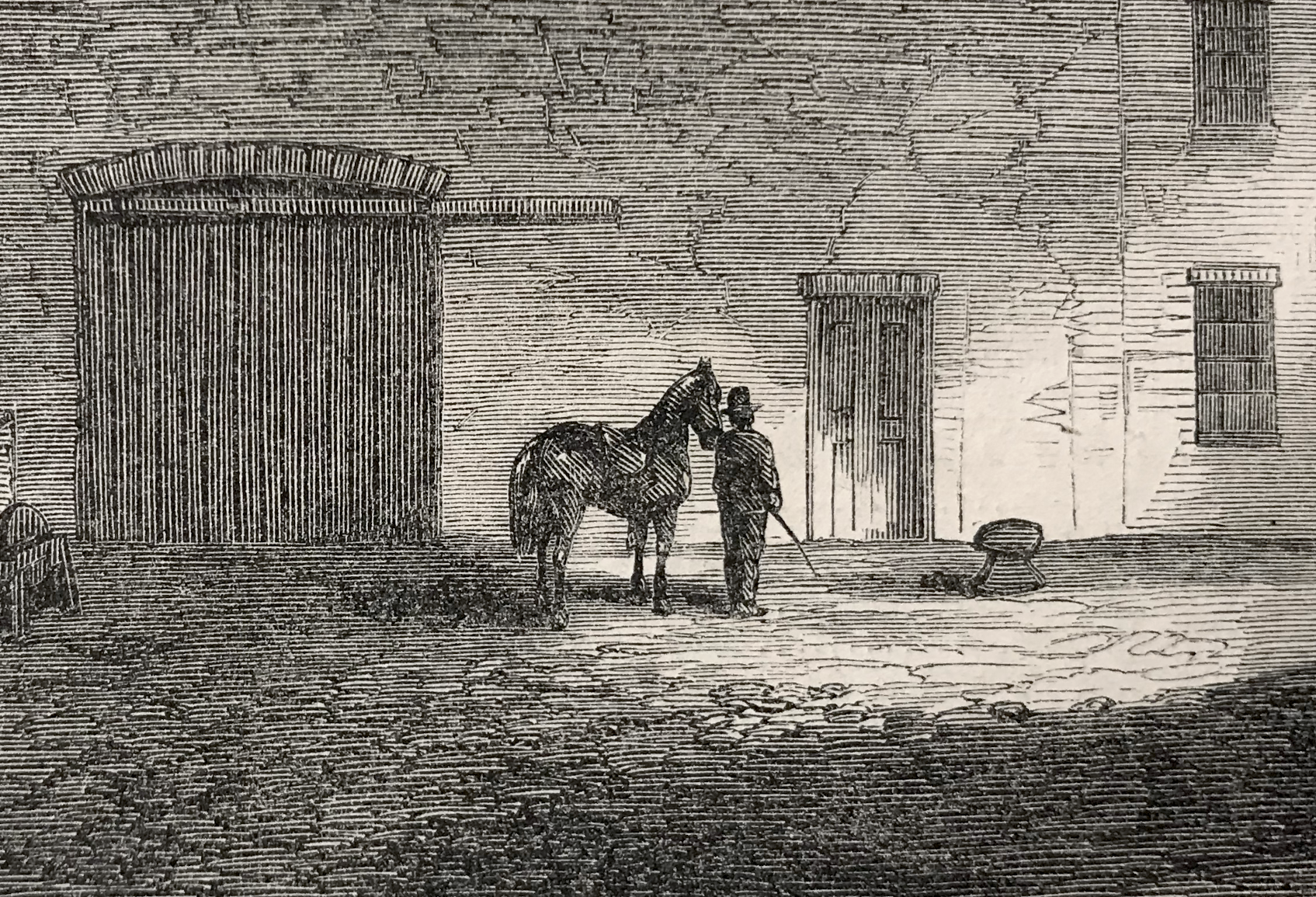
Joseph Burroughs holding John Wilkes Booth’s horse, from the May 13, 1865, Frank Leslie’s Illustrated

One of the more enigmatic figures of the Lincoln assassination is Joseph “John Peanuts” Burroughs, the young errand boy at Ford’s Theatre who held John Wilkes Booth’s horse prior to the assassin’s escape. Burroughs’s age is unknown, although estimates vary between fourteen to seventeen years old. In his statement to Justice Abram Olin on April 15, 1865, his name was dictated as Joseph Burrough. However, the conspiracy trial records also list Borroughs, Burrow, and John C. Bohraw—which are likely phonetic transcription errors. At the theater, he soon earned the nickname “John Peanuts” because he peddled peanuts in between acts. Some newspapers after the assassination even misreported “John Peanuts” as “Japanese.”[1]

Burroughs’s experience in the assassination was brief and traumatic. After Booth asked for the stagehand Edman “Ned” Spangler to hold his horse, Spangler begged off owing to his scene shifting duties, and the task fell to Burroughs. After approximately fifteen minutes, Booth burst through the back door into Baptist Alley and rewarded Burroughs’s loyalty by hitting him on the head with the butt of his knife and kicking him away from his horse. Across Peanut’s multiple pieces of testimony, he described handling horse-related duties for Booth over the previous few months, of working with Spangler in fixing the president’s box at Ford’s Theatre, and of Spangler cursing the president over the war.[2]

Throughout the years, a consensus emerged that Burroughs was Black and dull-witted. The best evidence indicates he was neither. Burroughs signed his second statement on April 24th with an “X”, which could suggest he was illiterate, but his testimony reveals he was intelligent, articulate, and well-versed with horses. The orchestra director, William Withers, and former police superintendent, Almarin C. Richards, both described him as Black, but these accounts were decades old. More conclusively, the trial transcripts for Burroughs lack the “(Colored)” description preceding his name in keeping with the discriminatory practice of the period. John F. Sleichmann, the assistant property manager at Ford’s Theatre, testified that Booth, Burroughs, and a few others shared drinks at the nearby saloon on the day of the assassination. Yet, Blacks were not allowed to sit down in such restaurants at this time, and an inveterate racist like Booth would not associate with a Black person. Nevertheless, contemporary newspaper illustrations depicted Burroughs as Black.[3]

Burroughs watching Joseph B. Stewart chase Booth, from the April 29, 1865 National Police Gazette

In American Brutus, Michael Kauffman theorizes Burroughs was the son of Doctor Joseph Borrows, III, a prominent physician in Washington, D.C. In his April 24th statement, Burroughs stated he was living with his father at 511 Tenth Street. Although this corresponds to the Ford’s Theatre address since at least 1948, prior to 1869, this address was south of Pennsylvania Avenue near the present-day block of 317-337 Tenth Street NW. The address for the Army Medical Museum in 1868 (housed within the theater building) was 454 Tenth Street. Notably, the city directory listed Dr. Borrows’s address as 396 E Street north, which abutted Baptist Alley behind Ford’s Theatre. The Borrows name and his close proximity to the theater make for a compelling connection—even if it does not illuminate Burroughs’s subsequent actions and movements.[4]

However, the Dr. Borrows theory has shortcomings. The reference to Peanuts living with his father implies the mother was absent. Yet, Dr. Borrows had a wife, Catherine, who outlived him. Further, the 1860 census for the Borrows household includes four females, but no son. Tragically, Catherine delivered a stillborn boy, Joseph, in 1850—a year after their five year-old daughter died. As author Susan Higginbotham has noted, a doctor’s son would be in school and not selling peanuts and running errands at a theater.[5]

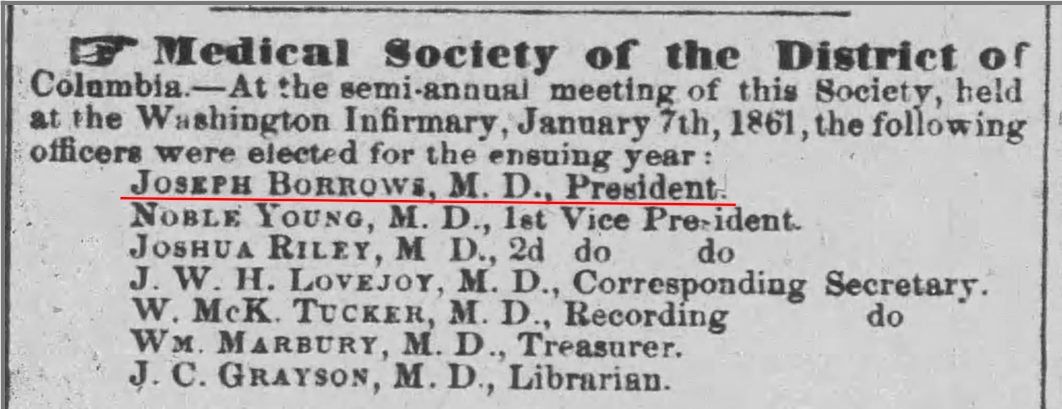
Even still, Dr. Borrows’s obituary in 1889 provides a clue that may explain a potential connection with Peanuts. The doctor was an eminent physician who served for several years as president of the Medical Society of the District of Columbia. His obituary in the Evening Star notes: “There was probably no more popular physician or man in the District than Dr. Borrows, and hundreds of children were named for him in families he attended through, in some instances, four generations.” It is possible Burroughs received assistance from Dr. Borrows and perhaps even stayed at his residence in the same itinerant manner as at Ford’s Theatre. Similarly, Ned Spangler kept a boarding house for supper but mostly slept inside Ford’s Theatre.[6]

Dr. Joseph Borrows was a leading Washington, D.C physician, Daily National Intelligencer, January 9, 1861

Along similar lines of a father-figure role, Thomas Bogar, author of Backstage at the Lincoln Assassination, posited in Roger Norton’s Lincoln Discussion Symposium that Ford’s Theatre stage manager John Burroughs Wright might have semi-adopted Joseph Burroughs and gave his middle name as Peanut’s surname. In 1915, Wright’s wife, Annie, referred to Peanuts as “a simple minded but good natured street waif who worked all day and half the night about the stage.” The Wrights lived at the Herndon House on the corner of F and Ninth streets, only one block to the rear of the theater. (This is the same building Lewis Powell stayed at, and where Mary Surratt called on him.) If the Wrights did play the role of surrogate parents, it was not enough to keep Peanuts from roaming.[7]

Ford’s Theatre stage manager John Burroughs Wright and his wife, Annie

After the assassination, Burroughs was deterred from providing a statement to the police due to the mob accusing anyone entering or departing the police station of being a conspirator. Burroughs had to be especially cautious once it became known he had held Booth’s horse, and one eyewitness recalled a policeman escorting Peanuts into the station. No parental figure appeared on his behalf.[8]

More proof of Burroughs’s independent wanderings is found in Judge Advocate Henry L. Burnett’s May 9, 1865, letter to Colonel Lafayette C. Baker relaying Secretary of War Edwin Stanton’s order “that the boy Peanuts be placed in confinement in some comfortable place that he may be forthcoming when wanted.” Again, if Burroughs had the protection of his parents and a permanent roof over his head, he would have been readily available for questioning and not require government quarters. Regardless, Burroughs avoided any further statements or publicity after his conspiracy trial testimony.[9]

The key question in tracking down Peanuts is whether he stayed in Washington, D.C. or left the capital. To this end, researcher Steve Williams has found an intriguing lead on a Joseph Alexander Burroughs from the Tenleytown D.C. suburb and of the correct age to be Peanuts. This Joseph Burroughs was listed as a farmer, married Mary Elizabeth Burroughs in Washington, D.C. in 1873, and moved to Baltimore shortly thereafter. After settling in Baltimore, this Joseph is listed as a laborer —thereafter a produce seller—and favored the Burrows surname. Joseph and Mary had three daughters and two sons. Of note, he was definitely literate, and his son, Joseph Cornelius, readopted the Burroughs surname. Joseph Burrows died in Baltimore in 1931.[10]

Joseph Burrows of Baltimore from the 1880 Census. Could this be Peanuts?

If Peanuts is not this Joseph Burroughs from Tenleytown, then he likely departed Washington, D.C. before the 1870 census. Bogar correctly notes Burroughs and the other backstage employees had highly transferable skills to find jobs in any city. In the frequently shortened lifespans of the nineteenth century, it is also possible he died early. If Burroughs had a family, he bucked the trend of those associated with the assassination to have their (often highly exaggerated) exploits published in their obituaries. Given the trauma of being an unwitting accomplice to President Lincoln’s assassination, it is understandable if, for the remainder of his life, Burroughs simply wanted to be left alone.[11]

In the decades following the assassination, “Peanuts” resurfaced in random locations, including Washington, D.C., New York, and Massachusetts—but these sightings seem spurious. In 1887, a Louisiana newspaper mentioned Peanut John was living in Shreveport and was known as “Mixie.” In 1930, an elderly Black man appeared at a Washington, D.C. fire station and showed a scar on his head supposedly from Booth’s knife. A formerly enslaved man named Nathan Simms told a tall tale of being John Peanuts and actually helping Booth dismount outside of Surratt’s Tavern later that night. In 1960—twenty six years after Simms’s death—the Boy Scout Troop of Marshallton, Pennsylvania, raised money for a gravestone that told his story. In 1980, A. C. Richards’s biographer, Gary Planck, cited the naturalist John Burroughs as Peanuts.[12]

The most colorful Peanuts imposter was an unwilling participant: a diminutive street person of Italian descent named Joe “Coughdrop” Ratto who sold cough drops near Ford’s Theatre. Local residents taunted him mercilessly, asking if he had held Booth’s horse—which would throw him into a violent rage. Stories of Ratto emerged as early as 1909, and likely fed follow on narratives that John Peanuts was Italian. An imaginative account from 1923 claimed the Italian ambassador helped free him from prison after the assassination, in which Peanuts returned the favor by serving in the Italian Army.[13]

Joe “Coughdrop” Ratto, forever taunted as “John Peanuts”

It need not be highlighted each theory relating to Joseph “John Peanuts” Burroughs relies upon healthy doses of speculation. With multiple names, a single address, and a publicity-shy witness who faded into history, we have limited material to work with. Indeed, the renowned researcher James O. Hall assembled a file on Peanuts, and on the outside cover summarized his findings: “I was never able to trace the boy.” In the end, we are left with the same plea from the Surratt Courier in 1989: “Will the Real ‘Peanuts’ Burroughs Please Rise?!”[14]

Only ghosts remain: Baptist Alley in the years after the assassination


[1] The official record of the commission compiled by Benn Pitman lists the name as Joseph Burroughs. The conspiracy trial transcripts show multiple references to Peanut(s), John Peanut(s), and Peanut(s) John. Michael Kauffman also cites Bohrar and Burrus in American Brutus. “The Assassination,” Daily Illinois State Journal, April 22, 1865, p. 1.
[2] Peanuts stated he held the horse for fifteen minutes at the conspiracy trial, although this is different from his provided statements. Burroughs’s testimony at the conspiracy trial is found at Edward Steers, Jr., ed., The Trial: The Assassination of President Lincoln and the Trial of the Conspirators (Lexington, Kentucky, 2003), 187-95, 465-66; William C. Edwards and Edward Steers, eds., The Lincoln Assassination: The Evidence, (Champaign, Illinois, 2009), 238;
[3] William J. Ferguson’s 1930 memoir I Saw Booth Shoot Lincoln refers to Peanuts as “dull-witted.” Joan L. Chaconas, “Will the Real ‘Peanuts’ Burroughs Please Rise?!” Surratt Courier (June, 1989), 1, 3-7; “Wilkes Booth Again,” Critic (Washington, D.C.), April 17, 1885, p. 1.
[4] Washington, D.C. addresses changed to a new format in 1869. William H. Boyd, Boyd’s Washington and Georgetown Directory, 1868 (Washington, D.C., 1868), 40; Edwards, Steers, The Lincoln Assassination, 463; Andrew Boyd, Boyd’s Washington and Georgetown Directory, 1865 (Washington, D.C., 1865), 142.
[5] “More on the Elusive Peanuts,” Surratt Courier (September, 2014), 11; 1870 US Census, Washington, D.C., Ward 3, family 220; “Dr. Joseph Borrows,” Find A Grave, https://www.findagrave.com/memorial/140486080/joseph-borrows.
[6] Emphasis added. The Ned Spangler information is from Jacob Ritterspaugh’s testimony. “Dr. Joseph Borrows Dead,” Evening Star, May 31, 1889, p. 3; Steers, The Trial, 394.
[7] The thread for this theory is found at: https://rogerjnorton.com/LincolnDiscussionSymposium/thread-1802.html. “She Saw Lincoln Shot,” Boston Globe, April 11, 1915, p. 66; Thomas A. Bogar, Backstage at the Lincoln Assassination: The Untold Story of the Actors and Stagehands at Ford’s Theatre (Washington, D.C., 2013), 88; Trial of John H. Surratt in the Criminal Court for District of Columbia, Hon. George P. Fisher Presiding, (2 vols., Washington, D.C., 1867) I, 235; Louis J. Weichmann, A True History of the Assassination of Abraham Lincoln and the Conspiracy of 1865 (New York, 1977), 121-22.
[8] “Lincoln’s Assassination,” St. Louis Globe-Democrat, Dec. 3, 1891, p. 12.
[9] Edwards, Steers, The Lincoln Assassination, 259-60.
[10] Substantial documentation for this potential Burroughs is in the same above Lincoln Discussion Symposium link.
[11] Bogar, Backstage at the Lincoln Assassination, 276.
[12] Chaconas, “Will the Real ‘Peanuts’ Burroughs Please Rise?!” Opelousas Courier (Opelousas, Louisiana), April 2, 1887, p. 1; Peanuts Folder, James O. Hall Research Center, Clinton, Maryland; Edward Steers, Jr., Lincoln Legends: Myths, Hoaxes, and Confabulations Associated with our Greatest President (Lexington, Kentucky, 2007), 319-22; Gary R. Planck, “The Lincoln Assassination: The ‘Forgotten’ Investigation, A. C. Richards, Superintendent of the Metropolitan Police,” Lincoln Herald, 82 (Winter 1980), 526.
[13] A. C. Richards later referred to Burroughs as Italian in 1906, likely stemming from the Joe Ratto lore. “Did ‘Coughdrop Joe’ Ratto Hold Booth’s Horse?” Lincoln Lore, 1571 (January, 1969), 2-3; “People Met in Hotel Lobbies,” Washington Post, Jul. 14, 1909, p. 6; C. W. S. Wilgus, “The Lincoln Tragedy,” Ravena Republican (Ravena, Ohio), April 19, 1906; “Brooklyn Man was in Theater Night Lincoln Was Shot,” Brooklyn Eagle, Feb. 11, 1923, p. 36.
[14] “Peanuts” folder, James O. Hall Research Center; Chaconas, “Will the Real ‘Peanuts’ Burroughs Please Rise?!”

Categories: History, Joe Barry | Tags: , , , | 4 Comments

An Edman Spangler Anniversary

Today, February 7, 2025, is the 150th anniversary of the death of Edman Spangler. A carpenter and stagehand at Ford’s Theatre, Spangler was convicted of being a conspirator in John Wilkes Booth’s plot against Abraham Lincoln. Sentenced to six years of imprisonment at Fort Jefferson in the Dry Tortugas, Spangler was pardoned by President Andrew Johnson in 1869. After returning home, Spangler returned to working for John T. Ford at his theater in Baltimore. However, a fire gutted the Holliday Street Theater in 1873, leaving Spangler out of a job. He ended up traveling down to Charles County, Maryland, to the home of his former cellmate, Dr. Samuel Mudd. Though the two men had never met each other prior to their arrest and trial, they had bonded during their years together at Fort Jefferson. Dr. Mudd welcomed Spangler into his home with open arms and even gave him some acreage on the farm property for Spangler to work and live on. Spangler died at the age of 49 after contracting an illness in a heavy and cold rain. The Mudd family had their friend buried in a local cemetery, the original St. Peter’s Church Cemetery, which also held the grave of Mrs. Mudd’s father.

Of the nine Lincoln conspirators that were tried in 1865 and 1867, Edman Spangler is the one for which there is the least amount of evidence connecting him to the assassination. Spangler was mostly in the wrong place at the wrong time and was also unfortunate enough to be friendly with the wrong person: John Wilkes Booth. Upon arriving at the backstage door of Ford’s Theatre, Booth called for Spangler to hold his horse. Spangler quickly delegated the task to a less critical Ford’s Theatre employee before returning to his duties shifting scenes. After the shot rang out and the assassin ran out the backstage door, a confused Spangler was unsure what had occurred. When another stagehand suggested that it was Booth who had committed the crime, Spangler cautioned the man not to jump to conclusions or say anything that might slander an innocent man. When it was later firmly established that his friend, Booth, had committed the terrible deed, his words and actions came to be seen as conspiratorial. Investigators felt that Booth must have had an “inside man” at Ford’s Theatre in order to ensure his success, and so Spangler became that man in their eyes.

In reality, there is no conclusive evidence that Spangler knew anything of Booth’s plot against Lincoln. The two men were friendly and had a history dating back to when Spangler helped to construct the Booth family home of Tudor Hall in Bel Air. Spangler assisted Booth by constructing a stable for him in the alley behind the theater, and he was certainly pro-Confederate in his leanings. However, there is no strong evidence that Booth entrusted Spangler with the details of his plot. Instead, it appears that Booth felt bad for the trouble his actions brought to Spangler. After Booth was killed on April 26, 1865, his accomplice David Herold was taken into custody and transported up to Washington. During his integration by the authorities, Herold stated that Booth had told him during their escape that “There was a man at the theatre that held his horse that he was quite sorry for.” While Herold didn’t recall his name at the time, he recounted that “Booth said it [i.e. the act of holding the horse] might get him [Spangler] into difficulty.”

That act did, indeed, get Spangler into difficulty. Yet even the term of his jail sentence of six years demonstrates how poor the evidence was in trying to connect Spangler to the plot. All of the other conspirators tried alongside him were sentenced to death or life in prison, making Spangler’s punishment a “slap on the wrist” by comparison. However, as my recent documentary series on The Lincoln Conspirators at Fort Jefferson shows, life was incredibly difficult for Spangler and the other men sentenced to the Dry Tortugas.

In memory of the innocent Lincoln conspirator on the 150th anniversary of his death, here are three letters Edman Spangler wrote from prison during the time when Yellow Fever struck the fort. They were written to unknown friends of Spangler’s in Baltimore and then published in the newspapers. From other writing samples of Spangler’s, we know that he struggled with spelling and grammar. However, these three letters contain relatively few mistakes, implying that he may have been assisted in their writing by his cellmates or that perhaps his letters were cleaned up by the newspaper editors. Regardless, they give a brief peek into the life of Edman Spangler during the most terrifying portion of his imprisonment.


Fort Jefferson, Fla

Sept. 6, 1867

I am well at present, but don’t know how long it will last, for we have the yellow fever here, and there are two or three dying every day, and I am busy working in the carpenter’s shop, making coffins day and night, and I don’t know when my time will come. They don’t last more than a few hours. I will enclose a few moss pictures for you, and I will send you a barrel of coral, if I don’t get the yellow fever and die; but there are ten chances to one if I ever see you again. It is very desperate here. The doctor of the post is very sick with it, and there is no doctor here but Dr. Mudd, and he volunteered his services, and has made a good hit of it. We have lost no cases with him yet.

With love all,

Edman Spangler


Fort Jefferson, Florida

September 23, 1867

I have received the barrel of potatoes and am very thankful for them. We have drawn but a half bushel of potatoes from the government since the first of January. We have bought some at Key West, for which we paid seven and eight dollars per barrel. There are some seven of us in one mess; we do not eat with the other prisoners. We have the yellow fever here very bad. We had a doctor that came from Washington: he got it and died: his name was J. Sims Smith. He has a wife and two children. Dr. Mudd was in charge for a few days, and was very successful, and then they got a doctor from Key West; but Dr. Mudd is still in the hospital attending to the sick, and I am in the carpenter shop making coffins for those that die. While I am writing they have burned all the beds that belonged to every one that got sick, and all their clothing. We have a dreadful time of it here. There is no use of getting frightened at it; we must stand up and face the music.

Since writing the above, one of Dr. Smith’s children has died, Lieutenants Solam and Ohr, Major Stone’s wife and Michael O’Laughlin.


Fort Jefferson, Florida

Sept. 24

Poor Michael O’Laughlin, my friend and room-mate died at 7 o’clock yesterday of yellow fever, and during the 24 hours, seven others passed from life to eternity. The fever has assumed a more malignant type. There is but one officer for duty at the post, the others having died or now lying ill with the fever. Lieut. Gordon, taken two days ago, is now lying in a critical condition. From all I can learn, we have had 280 cases, out of which so far thirty have died. Some are even taken with it the second time, and from appearances, and from what the Doctor says, we shall always have it here – the thermometer never falling below 63 degrees. I have not been attacked yet, but may be at any moment, in which case I thought it best to forward to you and my family small mementoes, should I die of the fever. Arnold has had it, and has fully recovered, yet remains in a very weak condition. Something should be done, if possible, towards obtaining our removal from this den of pestilence and death to some more healthy place. Nearly all the late cases are of a very malignant type, scarcely any recovering.


Sources:
“Letter from Spangler,” New York Times, September 22, 1867, 3.
“Letters from the Dry Tortugas,” Baltimore Sun, October 11, 1867, 1.

Categories: History, The Lincoln Conspirators at Fort Jefferson | Tags: , , , , , , | 4 Comments

The Centenarian President

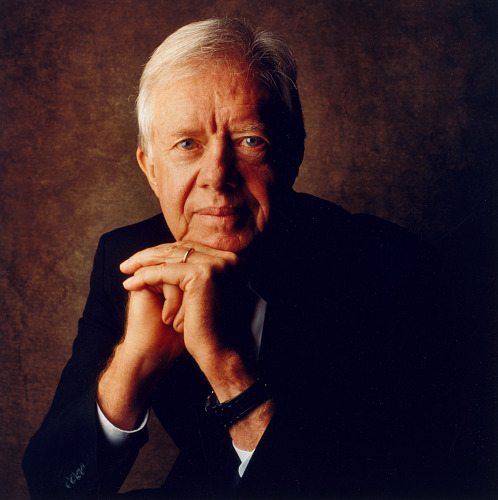
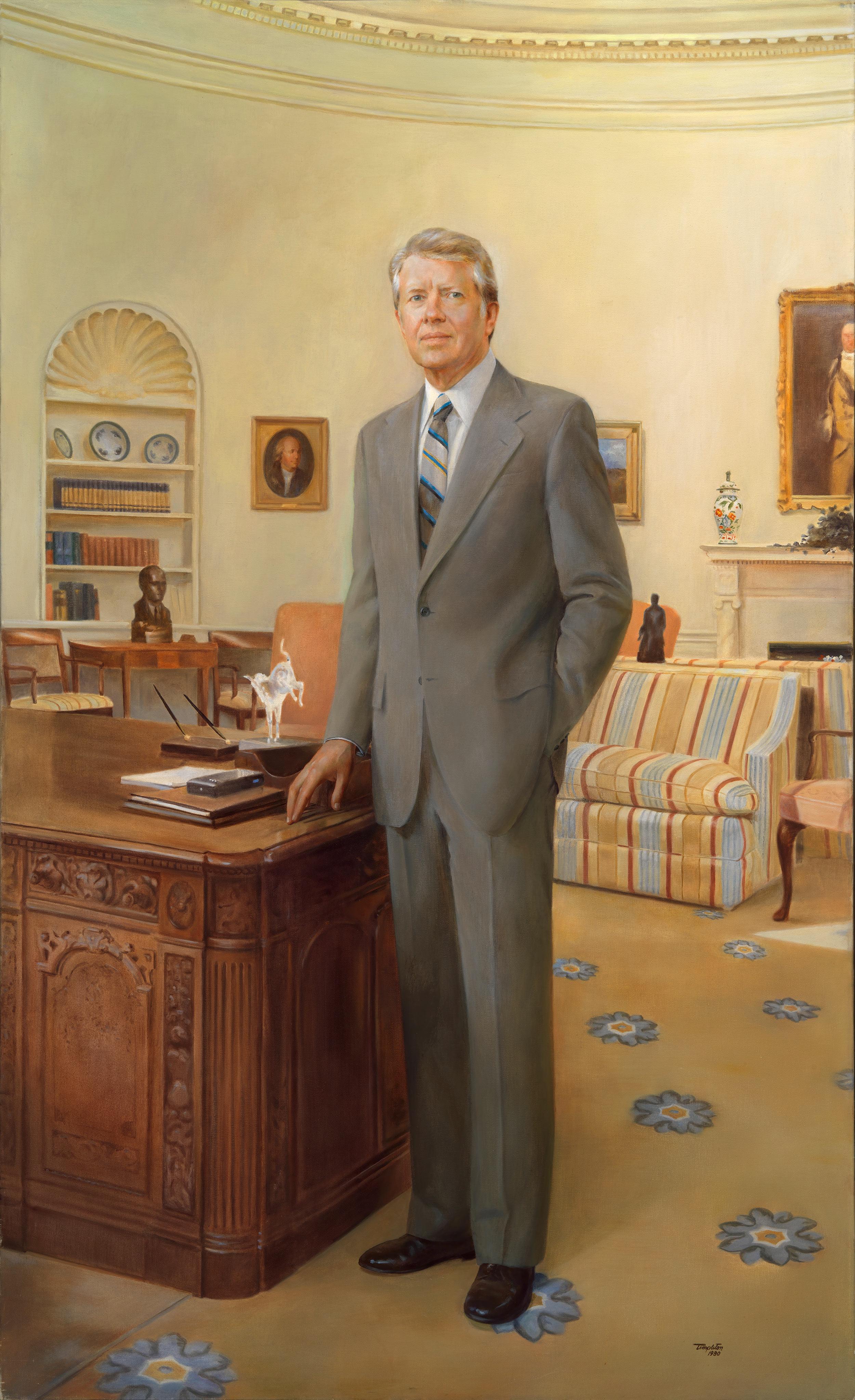
Like so many across our country and world, I wish a very Happy Birthday to President Jimmy Carter! On October 1, 2024, President Carter became the first U.S. President to live to the age of 100.

While President Carter’s time in office was limited to a single term, his positive influence on the world has been lifelong. Jimmy Carter is the definition of a humanitarian, advocating for peace, aid, and health for all people of the world. Carter’s post-presidency life has been filled with service, from negotiating treaties and using diplomatic channels to secure the release of American political prisoners held overseas to selflessly working well into his 90s to physically construct homes with Habitat for Humanity.

In a time when so many politicians denigrate immigrants, the poor, and the downtrodden, Jimmy Carter has worked to raise them up. In a time when religion has been fashioned into a weapon to justify atrocities and bigotry, Jimmy Carter has lived a life of faith and love for all. In a time when people advocate turning our back on the world and seek their own selfish wants at the cost of all others, Jimmy Carter has represented the noble good that can be done when we come together and embrace the global brotherhood of man.

Jimmy Carter reminds us that true leaders care about others. His life of service is the much-needed antidote to the venom that has infected our country of late. In a world of selfish Trumpism that cheers the worst impulses of humanity, Jimmy Carter represents the “better angels of our nature” that Abraham Lincoln once spoke about.


Jimmy Carter was born fifty-nine years after the assassination of President Lincoln. While I don’t feel that I need to justify a post about a man who has so justly earned the respect of his country, President Carter does have a few connections to the subject of this blog. One of them comes by way of another centenarian.

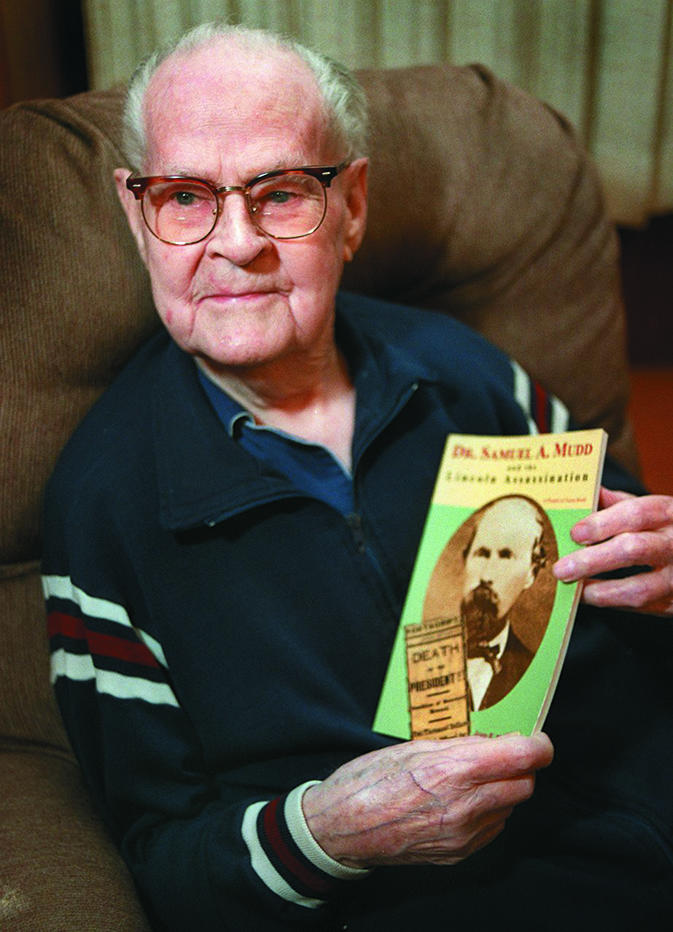
Dr. Richard D. Mudd was the grandson of Dr. Samuel Mudd. He was born in 1901 and died in 2002 at the age of 101. Richard spent his whole life advocating for the innocence of his grandfather. He was constantly writing letters to his Representatives and Senators, hoping for some measure that could overturn Dr. Samuel Mudd’s conviction. When those efforts stalled, Richard made inroads in other ways, like successfully getting a plaque installed at Fort Jefferson highlighting Dr. Mudd’s heroic activities during the 1867 yellow fever epidemic that, ultimately, helped grant him a pardon. While I firmly disagree with Richard’s interpretations of his ancestor’s actions and involvement in Lincoln’s assassination, I respect the way he tirelessly advocated for his beliefs. In addition to his Congressmen, Richard Mudd wrote to the chief executives themselves. Richard received responses from Nixon and Reagan, both telling him that nothing could be done to change history, especially since his grandfather had accepted a pardon (and the implied guilt that comes along with the acceptance).

Dr. Richard Mudd

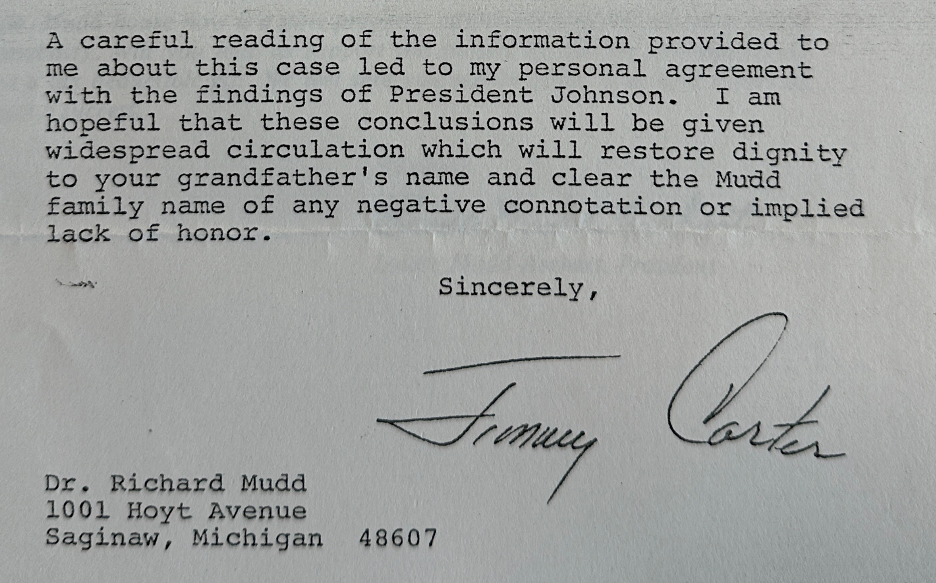
Jimmy Carter also sent Richard Mudd a letter. Like his predecessor and successor, President Carter informed Richard Mudd that nothing could be done to overturn his grandfather’s conviction. However, Jimmy Carter went a bit beyond what other Presidents had done. In his compassion, President Carter expressed his own personal belief that Dr. Mudd was only guilty of aiding and abetting John Wilkes Booth and David Herold after the assassination and not of being a party in the conspiracy that led to Lincoln’s death. In coming to this conclusion, President Carter cited Andrew Johnson’s own pardon of Dr. Mudd, in which Lincoln’s successor seemed to express some doubt as to Dr. Mudd’s proven culpability. What follows is a transcript of Jimmy Carter’s letter to Dr. Richard Mudd in answer to Richard’s many entreaties.

The White House
Washington
July 24, 1979

To Dr. Richard Mudd

I am aware of your efforts to clear the name of your grandfather, Dr. Samuel Alexander Mudd, who set the broken leg of President Lincoln’s assassin, John Wilkes Booth, and who was himself convicted as a conspirator in the assassination. Your persistence in these efforts, extending over more than half a century, is a tribute to your sense of familial love and dedication and is a credit to the great principles upon which our nation was founded.

Your petition and the petitions submitted to me on behalf of your grandfather by numerous members of Congress, several state legislatures, historians and private citizens have been exhaustively considered by my staff over the past two years. Regrettably, I am advised that the findings of guilt and the sentence of the military commission that tried Dr. Mudd in 1865 are binding and conclusive judgments, and that there is no authority under law by which I, as President, could set aside his conviction. All legal authority vested in the President to act in this case was exercised when President Andrew Johnson granted Dr. Mudd a full and unconditional pardon on February 8, 1869.

Nevertheless, I want to express my personal opinion that the declarations made by President Johnson in pardoning Dr. Mudd substantially discredit the validity of the military commission’s judgment.

While a pardon is considered a statement of forgiveness and not innocence, the Johnson pardon goes beyond a mere absolution of the crimes for which Dr. Mudd was convicted. The pardon states that Dr. Mudd’s guilt was limited to aiding the escape of President Lincoln’s assassins and did not involve any other participation or complicity in the assassination plot itself — the crime for which Dr. Mudd was actually convicted. But President Johnson went on to express his doubt concerning even Dr. Mudd’s criminal guilt of aiding Lincoln’s assassins in their escape by stating:

” … it is represented to me by intelligent and respectable members of the medical profession that the circumstances of the surgical aid to the escaping of the assassin and the imputed concealment of his flight are deserving of a lenient construction, as within the obligations of professional duty and, thus, inadequate evidence of a guilty sympathy with the crime or the criminal;

“And… in other respects the evidence, imputing such guilty sympathy or purpose of aid in defeat of justice, leaves room for uncertainty as to the true measure and nature of the complicity of the said Samuel A. Mudd in the attempted escape of said assassins…”

A careful reading of the information provided to me about this case led to my personal agreement with the findings of President Johnson. I am hopeful that these conclusions will be given widespread circulation which will restore dignity to your grandfather’s name and clear the Mudd family name of any negative connotation or implied lack of honor.

Sincerely,
Jimmy Carter

Despite a couple more decades of trying, this letter proved to be the best result Richard Mudd attained in his quest to exonerate his ancestor. Legally, this letter changed nothing about Dr. Mudd’s guilt, but it was a moral victory of sorts. A sitting President had expressed his belief that Dr. Mudd had been innocent of the crime he was convicted of. Even today, this letter from President Carter is something that certain members of the Mudd family point to to support their case.

Now, I very much disagree with President Carter regarding Dr. Mudd’s involvement in John Wilkes Booth’s plot, but I also recognize that Carter was not an assassination historian. He was the chief executive, taking time out of his busy schedule to respond to a man who had spent the last two years recruiting Representatives and sending petitions concerning a matter of family honor. Knowing that nothing could be done to provide Richard with the result he wanted, President Carter did his best to mitigate the disappointment by volunteering his own opinion on the matter. Even this letter demonstrates Jimmy Carter’s empathy and consideration for a fellow citizen.


A year and a half before writing his letter to Richard Mudd, Jimmy Carter attended a gala celebrating the 10th anniversary of the reopening of Ford’s Theatre as a working theater. While the old Ford’s Theatre building had housed a Lincoln museum since the 1930s, it wasn’t until the 1960s that the building was reconstructed to its 1865 appearance. The restored Ford’s Theatre had its debut performance on January 30, 1968, with Lady Bird Johnson in the audience without President Johnson. President Nixon never visited Ford’s Theatre during his Presidency. On April 17, 1975, President Gerald Ford attended James Whitmore’s one-man play “Give ’em Hell, Harry” about the life of President Harry Truman.

When President and Mrs. Carter attended the 10th-anniversary gala at Ford’s Theatre on January 29, 1978, he was only the second sitting President to see a show at Ford’s Theatre since Abraham Lincoln. More importantly, this event marked the start of a tradition. Starting with Jimmy Carter in 1978, every sitting president has attended a nonpartisan gala night of speeches and entertainment at Ford’s Theatre.

President and Mrs. Carter attend Ford’s Theatre on January 29, 1978.

Just before heading off to Ford’s Theatre for its 10th-anniversary gala, President Carter hosted a reception at the White House for the invited guests. As part of his remarks for the evening, President Carter thanked the crowd for their support of Ford’s Theatre and for their “generosity in keeping it a live tribute to the past and an opportunity for the future.” Despite the tragedy that had occurred at the site, Carter expressed his admiration that Ford’s Theatre had been reopened, noting that:

“It wasn’t the character of Lincoln to have a source of entertainment, tragedy, and humor kept closed and isolated from the people of our Nation. And so a unique occurrence has been recognized tonight that happened 10 years ago, when a national historical site was opened, not as a museum, a closed or a dead thing just to be looked at and admired, but an open and a live thing which is the source of both entertainment and inspiration for us all.”

After thanking select people for their efforts in bringing back live theater to Ford’s, Carter ended his remarks by saying:

“So, as a southerner, as a President, I would like to say that I’m very proud of all of you for helping to unite the consciousness of our Nation to remember the past, but also to prepare for the future with confidence and also with pleasure. That’s the way President Lincoln would have liked it. And you’ve honored him in performing as you have in keeping Ford Theatre alive.”


When President Carter entered home hospice care in February of 2023 at the age of 98, it seemed unlikely that he would make it to this milestone age. When his beloved wife of 77 years, Rosalynn, passed in November of 2023, it was also feared that grief might take its toll. Amazingly, however, Jimmy Carter continues to bless this earth with his presence.

In truth, 100 years is an arbitrary number. If Jimmy Carter had passed last year, five years, or even two decades ago, his good deeds would have still been a testament to his character. On his 100th birthday, we celebrate not just the impressive number of years President Carter has lived, but the positive impact he packed into each and every one of those years.

Happy Birthday, President Carter. In addition to the well-deserved praise you will receive today, I sincerely hope you get your birthday wish of making it to November 5 so that you can cast your vote for the next leader of this country.

Categories: History, News | Tags: , , , | 5 Comments

An Assassination Playbill Goes to Auction

Update: This playbill sold for $85,000. After adding the 25% Buyer’s Premium, the total cost of the playbill was $106,250. At the same auction, a John Wilkes Booth wanted poster sold for $105,000 ($131,250 with Buyer’s Premium).

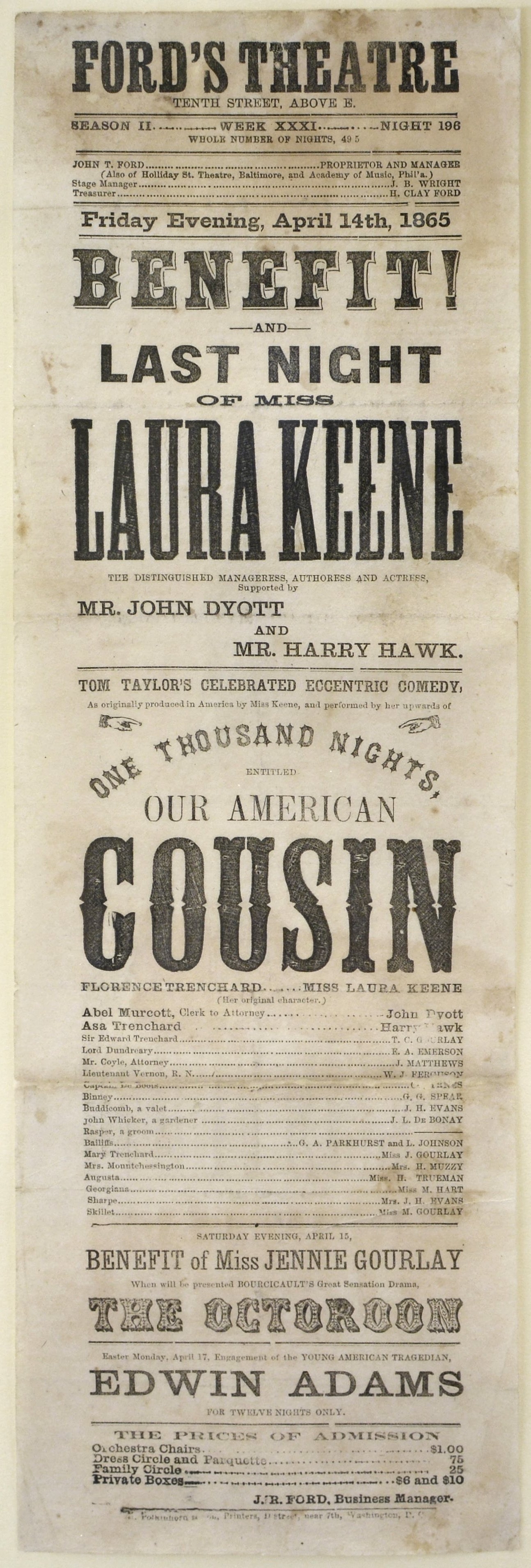
This Saturday (9/28/2024), R.R. Auctions is set to sell an iconic and rare Lincoln assassination-related item: a Ford’s Theatre playbill from the night of Abraham Lincoln’s assassination.

While there are a plethora of period reprints and modern replicas of assassination playbills, genuine playbills are very elusive things, and examples rarely come up for auction. One of the most recent sales of a genuine Ford’s Theatre assassination playbill was by Christie’s auction house. In 2003, they sold a second issue playbill (those included an added section near the bottom advertising the planned singing of “Honor to Our Soldiers”) for $31,000.

Normally, I don’t post about all the interesting items that come up for auction, but this playbill is different. If you check out the auction listing for this playbill, you might notice a familiar name:

It turns out I have a little history with this specific playbill.

One of my earliest posts on this blog concerned the assassination playbills and how you can tell real playbills from fakes and replicas. In addition to regularly being asked my opinion on possible “new” John Wilkes Booth photographs, I have been sent pictures of a few playbills in the past. Each time I have had to break it to people that they have a reprint or a forgery. Last year, I received an email from a couple who had read my post and were hoping to get my thoughts on a Ford’s Theatre playbill that they owned. I happily agreed to take a look at it while mentally preparing to let down yet another disappointed replica owner.

As I looked at the pictures sent me, I was surprised to see that I was not able to instantly discount the playbill. I scoured over the small details of typography, spacing, and printing, and each seemed to align with genuine bills. I sent some follow-up questions to the owners, not tipping my hand that I was getting excited by what I was seeing. I asked about the provenance behind the piece and set to work investigating that. After a few days of research, I came to the astonished conclusion that this was a genuine first-issue playbill for Our American Cousin.

In my excitement, I went about writing up a research report for the owners explaining my conclusions. Never one for brevity, that report ended up being nine pages long. In advance of the sale on Saturday, I asked the owners if I could publish my report for them on this blog. They agreed, so I have published my report below. For the privacy of the current owners, I have redacted their names from the report and replaced them with John and Jane Doe.


Report on an April 14, 1865 “Our American Cousin” playbill owned by John and Jane Doe

By Dave Taylor
LincolnConspirators.com

Introduction: On April 25, 2023, I was contacted through my website, LincolnConspirators.com, by Jane Doe. Several years ago, I published an article on my site discussing the different playbills issued by Ford’s Theatre on the night of Lincoln’s assassination. Given my experience in analyzing authentic and fraudulent Lincoln assassination playbills, Jane asked me if I would look at a playbill owned by her and her husband, John, and give my opinion of it. I accepted and was provided with several images. The following is a report of my research process and ultimate conclusions regarding the playbill in question.

Background: Abraham Lincoln was shot by assassin John Wilkes Booth on the evening of April 14, 1865, while the President and his party were attending a performance at Ford’s Theatre in Washington, D.C. The play they were attending was a comedy entitled Our American Cousin, with actress Laura Keene as the lead star. After the shooting of Lincoln, the theater was shut down and would not see another performance for over 100 years. Very shortly after the tragedy, there was a demand for playbills of the last play Lincoln saw. This demand led to a secondary market of replica and forged playbills. Some of the fraudulent bills were so convincing that they even managed to fool those who were present at the assassination into swearing to their authenticity. In 1937, researcher Walter C. Brenner privately published a monograph entitled The Ford Theatre Lincoln Assassination Playbills: A Study. Brenner analyzed several variations of bills housed in different collections in an attempt to definitively determine which version or versions of playbills were actually printed and present on the night of Lincoln’s assassination. Through his research, Brenner was able to locate proven examples of legitimate assassination playbills in the Harvard Theatre Collection. He published his findings and included a chart noting the small details that can prove or disprove a suspected assassination playbill. In 1940, Brenner published a small supplement to his original research, reproducing an 1898 article that narrated the history of the playbills and why there were two different, but both equally legitimate, versions of playbills used at Ford’s Theatre on April 14, 1865. During my own analysis of the Doe playbill, I heavily referenced Brenner’s work.

Visual Analysis: The Doe playbill measures approximately 18.5” long and 5.5” wide. It is currently matted inside of a frame with a handwritten piece of provenance below it (Fig. 1).

Figure 1: Framed playbill

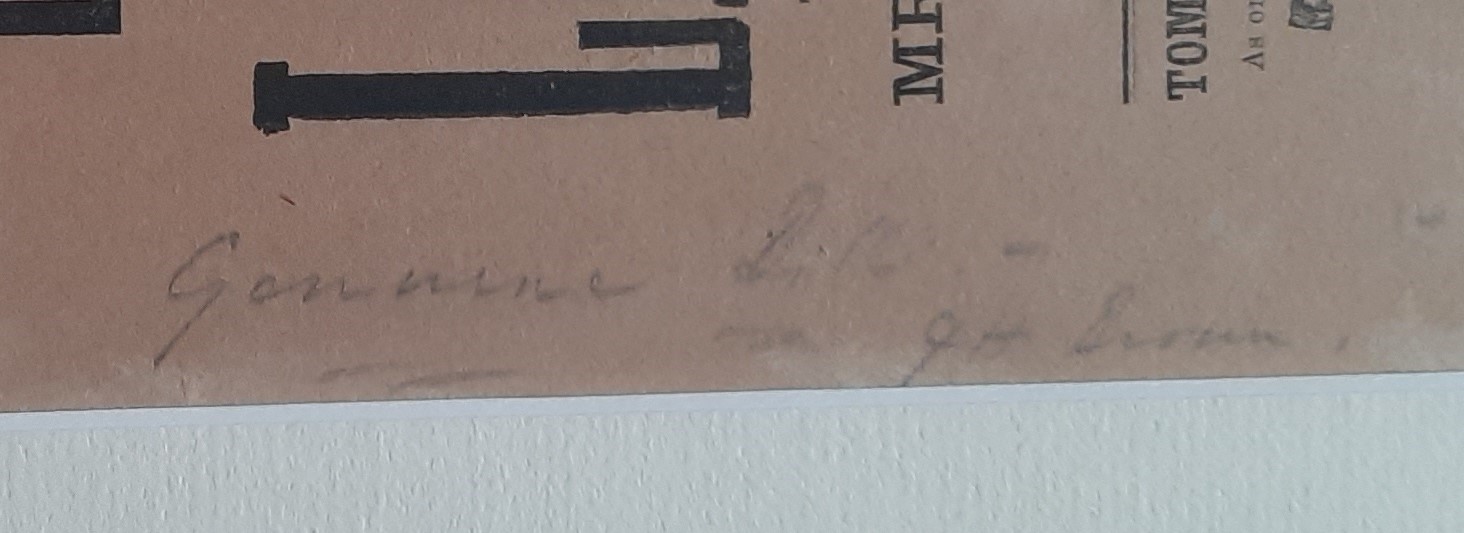
On the left edge of the bill near the name of Laura Keene is written in pencil the words “Genuine bill – [illegible] J H Brown” (Fig. 2).

Figure 2: Notation reading “Genuine Bill – [illegible] J H Brown”

The paper of the bill is browned. There are some discolorations and mild defects around the visible edges. A circular shaped defect about ¼” in size can be seen about 7 inches from the top near the name of John Dyott (Fig. 3).

Figure 3: Small defect near the name of John Dyott

There is evidence that the bill was previously folded with a light horizontal crease through the line containing the text “Buddicomb, a valet” (Fig. 4).

Figure 4: Faint horizontal crease through the entry for “Buddicomb, a valet”

Minor discoloration can be seen in other places. Still, overall, the bill is very clean, albeit browned from prior display. The bill was not examined out of the frame.

Compositional Analysis: At first glance, this bill represents an example of the first issue playbill for April 14, 1865. Bills of this sort were initially the only bills in production by printer H. Polkinhorn and Son in preparation for the evening’s show. After it was ascertained that President Lincoln was going to be attending the theater that night, it was decided that the singing of a patriotic song that was planned for the following evening was to be included. As a result of this change, the type of the printed bill was adjusted to include a paragraph about the now-planned singing of “Honor to Our Soldiers.” The Doe bill does not contain this paragraph, thus making it a possible first-issue playbill.

The Huntington Library in San Marino, CA, owns a genuine first-issue playbill for Our American Cousin. They have digitized this playbill at a high resolution, and it is available to view here: https://hdl.huntington.org/digital/collection/p16003coll6/id/5034/rec/1 Using this bill as an example, I then conducted a detailed comparison between it and the Doe playbill.

During my comparison, I looked for the different details documented by Brenner as those present on a genuine first-issue playbill, all of which are borne out on the Huntington playbill. Among those details are:

  • A space between the digits 9 and 5 in the text “NUMBER OF NIGHTS, 49 5”
  • The condition of the final E in the name of “LAURA KEENE”
  • The condition of the final R in the word “MANAGER”
  • The alignment of the letter H in the name “H. CLAY FORD”
  • The alignment of the letter S in the words “Supported by”
  • A small interior misprint on the letter C in “COUSIN”
  • A small circular defect on the letter N in “COUSIN”
  • The spelling of “Sensation”
  • The word “Chairs” after the word “Orchestra”
  • Several breaks in the horizontal lines separating different blocks of text

For each point of comparison, I found that the Doe playbill matched the details of the Huntington playbill. Everything was compositionally correct and in the right place to match a genuine first-issue bill.

I then looked for evidence of duplication. There have been other bills that I have examined in the past that have had the correct content, but they have distinct evidence that were merely copies of a legitimate bill. When copies of bills are made, there is a distinct drop in quality and detail. This is very noticeable in the font of “THE OCTOROON,” where the small details are lost. In addition, duplication removes the minor irregularities present during the original printing process. In addition to examining the font of “THE OCTOROON,” I requested and was provided with close-up images of the word “COUSIN” so that I could assess the natural deviations in this boldly printed word.

In my opinion, this bill does not show signs of being a duplicate. The fine details are present and consistent with an original printing, not a copy done by modern means.

Based on my visual and compositional analysis, I believe that the Doe playbill is a genuine first issue from April 14, 1865. It matches all points of comparison as laid out by Walter Brenner in his study of genuine assassination playbills, and there is no evidence of the bill being a period of modern reproduction.

Provenance Analysis: From my communications with Jane, I learned that this playbill has been in her husband’s family for over a hundred years. Mr. Doe’s great-grandfather was named Frederick S. Lang, the owner of a sizable Lincoln collection. According to Jane, this playbill and some other materials are what remains of the former Lang collection of Lincolniana.

In June of 1919, C. F. Libbie and Co. auctioned off what was advertised as a “Lincoln Collection formed by Frederick S. Lang, Boston.” Mr. and Mrs. Doe still retain two copies of this auction catalog. A digitized version of the catalog, housed on the Internet Archive, can be viewed here: https://archive.org/details/catalogueoflinco00libb. In examining the catalog, we find the following lot description:

“1129 Play Bill. Ford’s Theatre, April 14, 1864[sic]. One of the original play bills, first issue. Neatly matted in a narrow oak frame. Folio. This is one of the original play bills purchased from the Estate of John B. Wright, who was stage manager, by J. H. Brown.”

This lot appears to describe the playbill still in possession by the Does. Jane sent images of the original frame the playbill was housed in before it was reframed by her in-laws. One of these images is included below. This frame appears to match the description of “a narrow oak frame.”

Given the presence of the playbill with a descendant of Frederick Lang today, it would appear that this lot did not sell in 1919. Perhaps the misprint in the auction catalog of 1864 rather than 1865 caused it to fall under the radar.

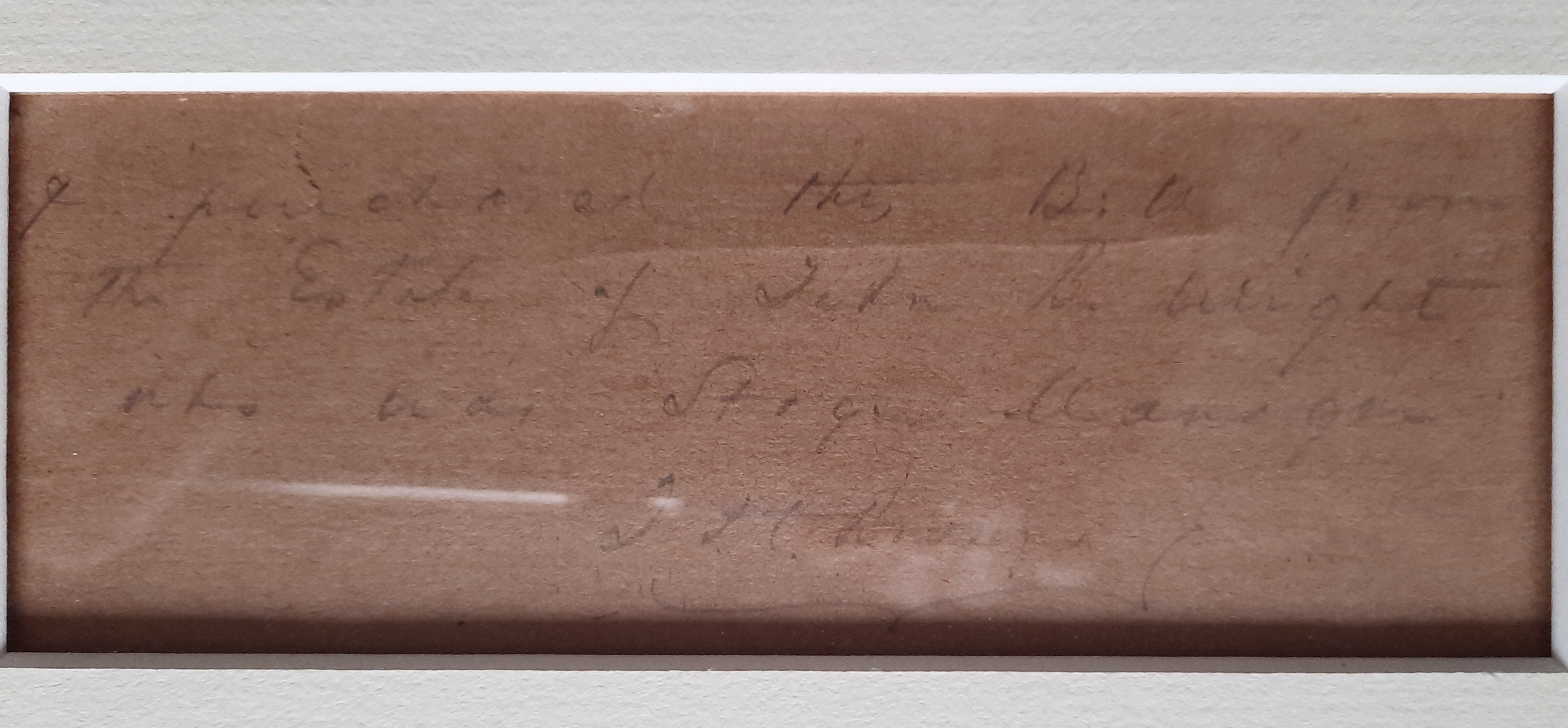
In addition to the playbill’s entry in the 1919 auction catalog, the bill is framed alongside a small handwritten note. This note is faded and brown but is still legible. It states, “I purchased this Bill from the Estate of John B. Wright who was Stage Manager / J H Brown”

Further information about the bill is included in a transcript of a circa 1909 typewritten essay or article about Frederick Lang’s collection. This transcript is owned by Mr. Doe. Jane provided a picture of a page from this essay that mentions the playbill. The text is as follows:

“occupying[sic] a prominent place on the wall is the exceedingly rare, genuine play-bill of Ford’s Theatre, April 14th, 1865 the night of Lincoln’s assassination. The attraction was Laura Keene, in Our American Cousin, and in the cast were many players well known in Boston, among them being W. J. Ferguson, Harry Hawk, and Geo. G. Spear. This play-bill was obtained from the collection of the late J. H. Brown, one of the best known theatrical collectors in the country. It is accompanied by his affidavit that it was purchased from the estate of J. B. Wright, the stage manager of Ford’s Theatre at the time of the tragedy. Mr. Wright was well known in Boston, as he was for many years connected with the National Theatre of this city, as stage manager and lessee. Mr. Lang also has a copy of the fac-simile of the genuine bill, copyrighted 1891, with affidavit by R. O. Polkinhorn who was pressman at the time of the assassination, and certificate from J. F.[sic] Ford, proprietor of the threatre[sic]. Accompanying this is a copy of this bogus bill which had a wide sale before the fraud was disclosed. This bill contains the following announcement, ‘This evening the performance will be honored by the presence of President Lincoln.’ As it was not known at the time of printing the bills, that Lincoln would attend the threatre[sic], this alone stamps the bill as spurious, but as this fact was not widely known, many of them were disposed of at fancy prices. This bogus bill is seldom met with now, and the three items make a rare and interesting collection in themselves. The latter two are not framed but are in a Booth portfolio.”

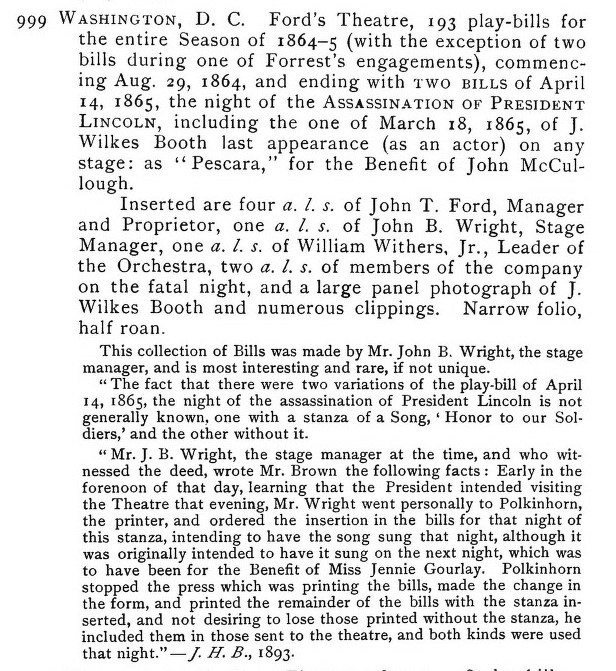
Through research, I determined that the J. H. Brown mentioned in the provided provenance was James Hutchinson Brown, a Massachusetts theatrical collector who lived from 1827 to 1897. In 1898, C. F. Libbie and Co. sold off Brown’s extensive collection of dramatic books, autographs, and playbills over the course of three different auctions. The third and final of these auctions occurred on June 15 and 16, 1898. This auction contained a collection of around 180,000 American and English playbills, “formed by the late James H. Brown, Esq., of Malden, Mass.” A digitized version of this auction catalog, housed on the Internet Archive, can be viewed here: https://archive.org/details/cu31924031351533. In examining this catalog, we find the following lot description:

“999 Washington, D. C. Ford’s Theatre, 193 play-bills for the entire Season of 1864-5 (with the exception of two bills during one of Forrest’s engagements), commencing Aug. 29, 1864, and ending with TWO BILLS of April 14, 1865, the night of the ASSASSINATION OF PRESIDENT LINCOLN, including the one of March 18, 1865, of J. Wilkes Booth last appearance (as an actor) on any stage: as ‘Pescara,’ for the Benefit of John McCullough. Inserted are four a.l.s. of John T Ford, Manager and Proprietor, one a.l.s. of John B. Wright, Stage Manager, one a.l.s. of William Withers, Jr., Leader of the Orchestra, two a.l.s. of members of the company on the fatal night, and a large panel photograph of J. Wilkes Booth and numerous clippings. Narrow folio, half roan. This collection of Bills was made by Mr. John B. Wright, the stage manager, and is most interesting and rare, if not unique. ‘The fact that there were two variations of the play-bill of April 14, 1865, the night of the assassination of President Lincoln is not generally known, one with a stanza of a Song, ‘Honor to our Soldiers,’ and the other without it. ‘Mr. J. B. Wright, the stage manager at the time, and who witnessed the deed, wrote Mr. Brown the following facts: Early in the forenoon of that day, learning that the President intended visiting the Theatre that evening, Mr. Wright went personally to Polkinhorn, the printer, and ordered the insertion in the bills for that night of this stanza, intending to have the song sung that night, although it was originally intended to have it sung on the next night, which was to have been the Benefit of Miss Jennie Gourlay. Polkinhorn stopped the press which was printing bills, made the change in the form, and printed the remainder of the bills with the stanza inserted, and not desiring to lose those printed without the stanza, he included them in those he sent to the theatre, and both kinds were used that night.’ – J.H.B., 1893.”

Interestingly, while the assumption would be that Mr. Lang purchased this lot of Ford’s Theatre playbills at auction in 1898, we know that not to be the case. This lot was purchased by another collector named Evert Jansen Wendell (1830 – 1917). After Wendell’s death, this specific collection of Ford’s Theatre playbills was donated to Harvard University. It was this same collection of playbills that Walter Brenner consulted for his 1937 study. At the time of Brenner’s research, the collection still had the two April 14, 1865 bills mentioned in the Brown auction catalog, making it impossible for Lang to have purchased this lot of 193 playbills.

John B. Wright, former stage manager at Ford’s Theatre

However, this auction catalog does confirm that James H. Brown had dealings with the estate of John Burroughs Wright, the former stage manager of Ford’s Theatre. Wright was a Massachusetts native who maintained a home in the Boston area even when he was working for John T. Ford in Baltimore and D.C. during the Civil War years. After the shooting of Lincoln, Wright returned to Boston. After several seasons touring with star Edwin Forrest and managing theaters in New York, Wright retired from the theater business in 1880. He died in 1893. His wife Annie, who had been present in the audience on the night Lincoln was assassinated, outlived her husband and eventually died in 1924.

The catalogs for the Brown auctions contain several pieces associated to John B. Wright, showing that Brown’s purchases from the Wright estate were more than just the collection of Ford’s Theatre playbills from 1864 – 1865, which eventually went to Evert Wendell. It is, therefore, reasonable to assume that John B. Wright possessed more than one copy of the first issue playbill used on the night of Lincoln’s assassination and that James H. Brown purchased it along with the rest of the materials he acquired from the Wright estate. From there, this specific bill was purchased by Frederick Lang, a collector not of theater memorabilia but of Lincolniana.

The framed note, along with the Frederick Lang auction catalog, conclusively traces this playbill back to Ford’s Theatre stage manager John B. Wright. Two other genuine playbills from the Wright collection exist in the Harvard Theatre Collection, demonstrating that Wright retained genuine playbills after the assassination of Lincoln.

In my opinion, the provenance associated with the Doe playbill is strong.

Conclusions: The Doe playbill has all the marks of a first-issue Ford’s Theatre playbill from the night of Abraham Lincoln’s assassination. By looking at the minute details, it can be seen that the bill is not a period reproduction, nor is there any evidence of modern duplication. The provenance demonstrates an unbroken line of ownership from John B. Wright, stage manager of Ford’s Theatre, to the current owners, John and Jane Doe. The claims of provenance can be backed up with supplementary evidence in prior auction catalogs.

It is my opinion that the Doe playbill is a genuine playbill from the night of April 14, 1865. As such, it is a rare and unique piece of American history.

Dave Taylor

List of sources and references used in this research:

  • Bogar, Thomas A. Backstage at the Lincoln Assassination: The Untold Story of the Actors and Stagehands at Ford’s Theatre. Washington, D.C.: Regnery, 2013.
  • Brenner, Walter C. The Ford Theatre Lincoln Assassination Playbills: A Study. Philadelphia: Privately Printed, 1937.
  • Brenner, Walter C. Supplement for insertion in The Ford Theatre Lincoln Assassination Playbills: A Study. Philadelphia: Privately Printed, 1940.
  • Catalogue of a Lincoln collection formed by Frederick S. Lang, Boston. Boston: C. F. Libbie & Co., 1919.
  • Catalogue of the valuable collection of play-bills, portraits, photographs, engravings, etc., etc., formed by the late James H. Brown, Esq., of Malden, Mass. Boston: C. F. Libbie & Co, 1898.
  • The Huntington Library, Art Museum, and Botanical Gardens
  • Harvard Theatre Collection
  • Emails with Jane Doe

I hope you enjoyed a dive into the research and provenance behind the Ford’s Theatre playbill that will be sold by R.R. Auctions. If you’ve always wanted to own one of the rarest pieces of assassination history, you might want to keep on eye on Saturday’s auction. But be prepared to shell out quite a nest egg to add this to your collection. At the time of this writing, during the pre-auction bidding period, this playbill is already up to $55,000 and will likely go much higher before the gavel falls.

Even if you’re like me and will never have the scratch to own something like this, I hope you still enjoyed learning about the playbill and its history. And, if anyone else has any cool priceless artifacts you’d like me to look at, I’m happy to give my opinion. This genuine playbill just goes to show that there are still treasures to be found out there.

Categories: History, News | Tags: , , , , | 10 Comments

The Last Words Lincoln Heard

In January of 1890, an article appeared in the Century Magazine by John Nicolay and John Hay, the personal secretaries of President Abraham Lincoln. For the past four years, the pair had been releasing regular articles in Century documenting the life and Presidency of their former boss. Nearing the end of their project, this 1890 chapter of their ongoing Abraham Lincoln: A History series was titled “The Fourteenth of April” and covered Lincoln’s assassination. Nicolay and Hay set the scene well, documenting Lincoln’s movements that day and highlighting the fateful events at Ford’s Theatre that evening. When discussing the moments just before the fatal shot was fired, the duo wrote:

“No one, not even the comedian on the stage, could ever remember the last words of the piece that were uttered that night – the last Abraham Lincoln heard upon earth. The whole performance remains in the memory of those who heard it a vague phantasmagoria, the actors the thinnest of specters.”

This claim –  that no one could recall the words spoken on stage before the shot was fired – came as a surprise to several people who had witnessed the assassination or had heard the story from those who had been there. While the memory of the last words may have waned in Hay and Nicolay, there were some alive in 1890 who remembered well the last lines of Our American Cousin that were uttered before the building erupted into chaos. Not the least of those who remembered the event vividly was the described “comedian on the stage” himself, actor Harry Hawk.

In 1865, William Henry “Harry” Hawk was a star performer in Laura Keene’s acting troupe. Our American Cousin had been a breakout hit for the trailblazing actress and theater owner when she debuted it in 1858. Even seven years later, the play was immensely popular, so much so that Keene had gone to court against actors like John Wilkes Booth’s brother-in-law, John Sleeper Clarke, who had put on the show themselves without her consent. Even though Harry Hawk had not been part of the original 1858 cast, as part of Laura Keene’s troupe for the season of 1864-65, he aptly played the titular role of the American cousin, Asa Trenchard.

Just before Booth fired his derringer at Ford’s Theatre, Hawk’s character had been upbraided for his lack of proper English manners by the character of Mrs. Mountchessington, played by Ford’s Theatre stock actress Helen Muzzy. The flummoxed Mrs. Mountchessington, unaware that Asa had selflessly burnt the will granting him a large portion of the English estate so that members of the immediate family were not dispossessed of their inheritance, lambasted the backwoods American for not being used to “the manners of good society.” She then exited in a huff along with her daughter. This left Harry Hawk’s character as the only person present on the stage.

So, what were the last lines that Lincoln heard on stage? Well, according to the play’s script, after Mrs. Mountchessington leaves the stage, the somewhat frustrated Asa Trenchard is supposed to call after her with the comment, “Don’t know the manners of good society, eh? Wal, I guess I know enough to turn you inside out, old gal – you sockdologizing old man-trap.”

This famous line has gone down in history as the last words Abraham Lincoln ever heard, for according to witnesses, Booth used the laughter that followed this line to help cover the report of his pistol.

There is a minor fly in the ointment, however. What appears in the “script” for Our American Cousin may not be the exact lines that were spoken that night. Our American Cousin was very much a “living play” at the time it was being performed. The original version that British playwright Tom Taylor had written and sold to Laura Keene was very different from the show that became famous. Taylor’s version was a melodrama with some instances of farce. To spice the play up a bit, Keene and her original cast made drastic changes to Taylor’s work and increased the comedic aspects. Most notably, the character of Lord Dundreary was altered from a minor role with only 40 or so lines into the major comic relief of the entire play. Rather than being just a slightly out-of-touch aristocrat, E. A. Sothern, the original actor of Lord Dundreary, wholly reinvented the part, transforming Dundreary into a laughably loveable buffoon with a crazy style who talked with a lisp and uttered his own uniquely rearranged aphorisms such as “birds of a feather gather no moss.” The changes Keene and Sothern made to Tom Taylor’s work are what made the show a hit. Sothern became so popular in the role that he penned his own Dundreary spin-off shows that he acted in for the rest of his life.

By 1865, much of the show had become more structured, but ad-libbing and the alteration of lines were still common. In the years after the assassination, the show continued to evolve as well, making it unclear how much the 1869 printed version of Our American Cousin differs from what was heard in 1865. We know, for example, that Laura Keene herself did some ad-libbing at Ford’s Theatre, adding a line to draw attention to the President’s arrival after the show had started. Another adlib was made after one character stated their line about their being a draft in the English manor house, only for one of the actors to reassure the audience that, with the Civil War now practically at an end, there would no longer be a “draft” in the military sense.

One would think that our best source for the exact words said on stage would be from the man who uttered them, Harry Hawk. In the hours after the assassination, Hawk was interviewed by Corporal James Tanner in the front parlor of the Petersen House, where Lincoln lay dying. While Hawk discussed his placement on the stage and was among the first to formally identify John Wilkes Booth as the assassin, he did not mention the words he had spoken just before the shot. Over a decade ago, I transcribed a letter Harry Hawk wrote to his parents in the aftermath of the assassination. In that letter, Hawk confirms he was “answering [Mrs. Mountchessington’s] exit speech” when the shot was fired, but he does not include his lines.

The genesis of this post was a letter from Harry Hawk that I recently viewed in the Harry Ransom Center at the University of Texas in Austin. The letter is merely dated “Sept. 21” with no year given. However, based on the reference to the Century Magazine article, we can conclude that the letter was likely written in 1890 or perhaps 1891. Hawk is writing from the Camden House, a lodging establishment in Boston. The recipient of the letter is unknown, but it appears that they originally wrote to Hawk asking him about his experience the night of Lincoln’s assassination. This letter from Hawk is transcribed below:

Camden House
331 Tremont St.
Sept. 21st [1890 or 91]

Dear Sir

In reply to yours I will state, first that Mr. John Mathews, W. J. Ferguson, Thos Byrns [sic], Emerson, and myself are the last survivors of the men of that sad fateful event. That is to my knowledge. I haven’t a bill with the cast by me. In contradiction to the statement made by The Century Article last January, that, not even the comedian who was speaking at the time could remember the last words spoken is all rot. I was speaking at the time being entirely alone on the stage, and as I played the character many times after it would be very strange if I did not remember the lines and incidents. They are all indelibly impressed on my mind, and as clear as thought it occurred last night. I have positively refused to be interviewed on account of my friendship for Edwin Booth. And would not wound his feelings by permitting the papers publishing what I did and did not say. A few days after the Graphic article, I was awakened early in the morning at the Lindel Hotel St. Louis, by a reporter for the World, N.Y., to interview me regarding it. The last words spoken on that stage and the last ones dear old Martyr Abe Lincoln heard, these in reply to the old lady Mrs. Muzzy, who had just gone off the stage – I knew enough to turn you inside out – old woman, you darned old sock dolagin man trap 

Resp. Yours

Harry Hawk

In this way, Harry Hawk describes the last lines heard by Lincoln as a slight variation of the lines printed in Our American Cousin. While I would like to take Hawk at his word here, we should be cognizant to remember that this letter was written at least 25 years after the events it describes. Despite Hawk’s claim that the lines and incidents are “indelibly impressed” on his mind, human memory is a fickle and unreliable thing. That is why, as historians, we try our best to find sources as close to the event as possible while the memory is still fresh and is unlikely to have been inadvertently altered by the passage of time.

A photo of Edwin Booth taken in 1892.

It appears that Hawk stayed true to his word to not discuss the events of that night with reporters so long as Edwin Booth lived. The famous tragedian died in 1893, which is probably why, in 1894, Hawk agreed to be interviewed by reporters. An article about Hawk was published in March by the Washington Post, followed by a slightly different one from a Chicago reporter in April. The second article, republished across the country, described the events at Ford’s Theatre and Harry Hawk’s experiences. In this recounting of the last words said before the shot, Hawk stated, “My lines were: ‘Not accustomed to the manners of good society, eh? Well, I guess I know enough to turn you inside out, old woman. You darned old sockdologing mantrap.’

In some other similar articles from Hawk in 1894, the only significant change in the lines given is the use of the word “damned” rather than “darned.”

An engraving of the assassination from Frank Leslie’s Illustrated Newspaper. Here we can see Booth brandishing his knife on stage and uttering “Sic Semper Tyrannis” while a stupefied Harry Hawk looks on. In reality, Hawk fled from the stage when he saw Booth running towards him with a knife.

The exact phrasing Harry Hawk used to say his lines in Act 3, Scene 2 of Our American Cousin will never be known for absolute certainty, but through the printed script and Hawk’s own reminiscences from that night, we can get very close to the last words heard by President Lincoln. Regardless of the phrasing, as Hawk uttered these lines, “the audience clapped their hands and laughed in glee, in which the President joined with a smile.” For all the tragedy of that fateful night, we should take some solace in the fact that Abraham Lincoln’s last moments of consciousness were filled with joy and laughter.

Epilogue:

I’ve often heard the Park Rangers at Ford’s Theatre give their presentation about the assassination. As part of their schtick, they tell the audience that Lincoln was shot during the “biggest laugh line of the play” and then recite the printed line above. Other than some nervous laughter from a few who fear they’ve missed the joke, the line regularly goes over like a lead balloon. Part of the problem is that the line alone is just not that funny. It’s the character of Asa Trenchard as the American country bumpkin finally breaking loose and telling his British counterparts “what for” that makes the line funny. There’s also irony that the stuck-up Mrs. Mountchessington claims Asa doesn’t know his manners when he has demonstrated better manners than the entire household by selflessly renouncing his inheritance so that his British relatives would be taken care of. Out of context, the line just doesn’t pack the same comedic punch.

The other issue is likely to do with the word “sockdologizing.” It’s a completely foreign word to a modern audience, which creates confusion. But, in truth, it was a slightly made-up word in 1865 as well. The basis of the word appears to be “sockdolager” which an 1897 Dictionary of Slang struggled to define. The Dictionary of Slang attempts to connect it to the word “doxology,” a religious verse that is sung at the end of a prayer. In this way, a sockdolager could mean something conclusive that settles or ends something. If interpreted this way, Asa Trenchard is criticizing Mrs. Mountchessington for acting like she is the final word on everything, which is ironic since she doesn’t even know what Asa has done, and his news could “turn her inside out.” However, a “sockdolager” was also the name of a type of fish hook that closed via a spring.

A circa 1847 sockdolager fish hook. (Don’t ask me to explain how it works)

Given that the word “sockdologizing” is followed by the phrase “old man-trap,” this line could be interpreted to mean that Asa is calling Mrs. Mountchessington out for her own aggressive barbs and ruses hidden under the facade of her so-called “good manners.” In the end, we can’t be sure how to interpret the word “sockdologizing” in this line, but, at the same time, it really doesn’t matter. The creative wordplay alone invokes the sense of exasperation Asa is feeling, and that, above all, is where the humor comes from.

Categories: History | Tags: , , , , , , | 7 Comments

Forensic Analysis of the Abraham Lincoln Assassination

An interesting article has been published in The American Journal of Forensic Medicine and Pathology by Drs. Theodore N. Pappas, Sven Swanson, and Michael M. Baden from the Department of Surgery at Duke University School of Medicine. The authors attempted to come to a conclusion about an oddly debated detail of Lincoln’s assassination: the path the bullet took inside Abraham Lincoln’s skull.

In the journal article, the doctors discussed the contradictory evidence that exists regarding the path Booth’s bullet took as it was fired into Lincoln’s brain. This debate is not a new one, as fellow MDs and late Lincoln researchers John K. Lattimer (whose diagram is shown above), Blaine Houmes, and E. Lawrence Abel each wrote about this topic.

What makes this new journal article unique is the way in which Drs. Pappas, Swanson, and Baden, were granted access to the Presidential Box to re-stage the assassination based on eyewitness accounts. They attempted to simulate the circumstances surrounding the assassination to get a better idea of the path the bullet may have taken. I’m happy to see Ford’s Theatre allowing this scientific exploration, even though the process involved a somewhat eerie floating skull over the reproduction Lincoln Rocker.

I won’t spoil the doctors’ findings here. Instead, I encourage you all to read the article for yourself. As far as scientific journal articles go, this one is very easy to digest. Click here or on the following title to read their article on The American Journal of Forensic Medicine and Pathology‘s website:

I’m grateful to these doctors and the ones who came before them for using their expertise to help further our understanding of this key event in American history.

Categories: History, News | Tags: , , , , | 16 Comments

Manhunt Miniseries Trailer

AppleTV+ released its first trailer today for its upcoming miniseries based on the Lincoln assassination book, Manhunt: The 12-Day Chase for Lincoln’s Killer by James L. Swanson. I have previously written about this new series that is set to debut on the streaming service on March 15. This trailer gives us our first real look into the series, which will focus on the efforts of Secretary of War Edwin Stanton to track down Lincoln’s assassins. Give the trailer a watch:

I had a few initial thoughts while watching this trailer.

  • Anthony Boyle, the actor playing John Wilkes Booth, looks pretty good in the role. He has a decent resemblance to the assassin, much more so than some of the reenactment Booths used in some TV documentaries about the assassination.
  • Booth yells “Freedom for the South” from the theater box. While a limited number of eyewitness accounts claimed Booth might have yelled, “Freedom!”, “Revenge for the South!” or “The South is avenged!” I don’t recall reading “Freedom for the South!” before. It’s certainly not in Swanson’s book. The overwhelming evidence is that Booth said, “Sic Semper Tyrannis!” after shooting Lincoln, though whether this was in the box or on the stage is debated.
  • Stanton is shown learning of Lincoln’s assassination while riding a carriage during a fireworks display. Fireworks are also shown as Booth is riding out of Baptist Alley behind Ford’s. While visually appealing, the Grand Illumination in D.C. featuring fireworks was technically on the night of April 13, not the night of Lincoln’s assassination. Also, Stanton learned of the attack on Secretary Seward first. It was when Stanton arrived at the Seward house to check on the Secretary of State at about the same time as Secretary of the Navy Gideon Welles that he was informed that Lincoln had also been targeted. However, this trailer may be depicting that event as it’s unclear from the clip where Stanton is supposed to be.
  • Booth is shown interacting with and seemingly threatening actress Lovie Simone, who plays the part of Mary Simms. As I previously noted, Mary Simms and her siblings left the Mudd farm in 1864 and were not around in 1865. Booth did not interact with Mary Simms during his escape.
  • The interior of Ford’s Theatre replicates the stage set of Our American Cousin well, but the theater box looks nothing like the real thing. It appears that Major Rathbone and Clara Harris are seated in their own box a few feet above the President and Mrs. Lincoln. It’s too bad the actual box appearance and layout couldn’t be recreated.
  • The overhead shot of Lincoln’s plain coffin being carried down the circular stairs of the Petersen House is an effective one.
  • At the 1:06 mark, you’ll see the actor playing Booth’s slayer, Boston Corbett. The actor’s name is William Mark McCullough. Coincidentally, he played John Wilkes Booth in 2015 Smithsonian Channel documentary, Lincoln’s Last Days.

  • There’s just a flash of the conspirators seated in their courtroom at the 1:13 mark. I can easily make out a hunched and bearded George Atzerodt, but I’m not sure about the other two men visible. Mary Surratt is erroneously shown placed amongst the men.
  • A man is shown in daylight pulling guns on the fugitives and stating, “I know who you are Mr. Booth.” I was uncertain who this figure was supposed to represent, but looking through the cast list on IMDB, it seems this is actor Roger Payano in the role of Oswell Swan. Swan guided Booth and Herold across the Zekiah Swamp to Samuel Cox’s home of Rich Hill. However, this occurred at nighttime, and Swan didn’t know the identities of the men he took over the swamp. He certainly didn’t pull a gun on them.
  • At 1:30, blink and you’ll miss actor Matt Walsh as Dr. Samuel Mudd handing something to Herold and Booth while a servant (likely the anachronistic Mary Simms) watches in the background. From this quick shot, Walsh looks good as Dr. Mudd.
  • The music in this trailer is quite good. I hope the actual show utilizes some of the songs included here.

From this trailer, it’s clear there will be a lot to talk about when the miniseries airs. What are your thoughts on this first look?

Categories: History, News | Tags: , , , , , , , , | 22 Comments

Blog at WordPress.com.